Onchain Stocks & Equity Perpetuals Deep Dive — The High-Torque Tokens in the Race to Sell Leveraged Stocks to the World: $RAY, $KMNO, $JUP,
A perpetual future lets anyone with a wallet and a few hundred dollars of stablecoins hold leveraged exposure to $NVDA, $TSLA or the S&P 500 at three in the morning on a Sunday, with no expiry date and no option premium bleeding away. That is the product we think matters most in onchain stocks: it removes theta from leveraged equity exposure and hands that exposure to the whole world, not just to U.S. residents with an options-approved brokerage account. On 27 September 2026 equity, index and commodity perps on Hyperliquid carried $3.94B of open interest, and the SEC's 17 September Innovation Exemption opened a separate, narrower door for real tokenized shares.
We rank the crypto projects in that stack for torque: how much each gains if equity perps and stock tokens become the way the world outside the U.S. holds stocks. Six carry the theme. $RAY is the venue where Solana's stock tokens already trade, and 12% of its fees already buy back the token. $KMNO is the credit desk for those tokens, with its stock-collateral dollars 92% lent out. $JUP routes the trades and has begun listing stock perps open only to $JUP stakers. $ONDO is the largest stock-token issuer, with a perp venue of its own. $HYPE clears most of the world's onchain equity perps. Backpack's token carries a written claim on the company's equity. Three of those pay holders nothing today, and we price each one's fee switch as the option the market is not paying for. $HOOD is the anchor, not the headline: the equity we would buy today, with a fraction of the upside if the theme wins.
The Ground Floor — From an Option to a Perpetual
Start here. A share is a slice of a company that you own outright: if the price doubles you double, and if you want twice the exposure you need twice the money. Leverage is exposure bigger than the cash you put up, which someone has to lend you or synthesise for you. An option is a contract that gives you the right, but not the obligation, to buy a share at a fixed price before a fixed date, which is one way to get leverage without borrowing. Theta is the part of an option's price that melts as that date approaches, the rent you pay for the right. A future is a contract to trade the share at a set price on a set date, so it carries leverage without theta but has to be rolled into a new contract every time the old one expires. A perpetual future is a future with no expiry at all, kept close to the share price by a payment between longs and shorts called funding. Everything below is about who builds, clears and sells that contract, and who gets paid.
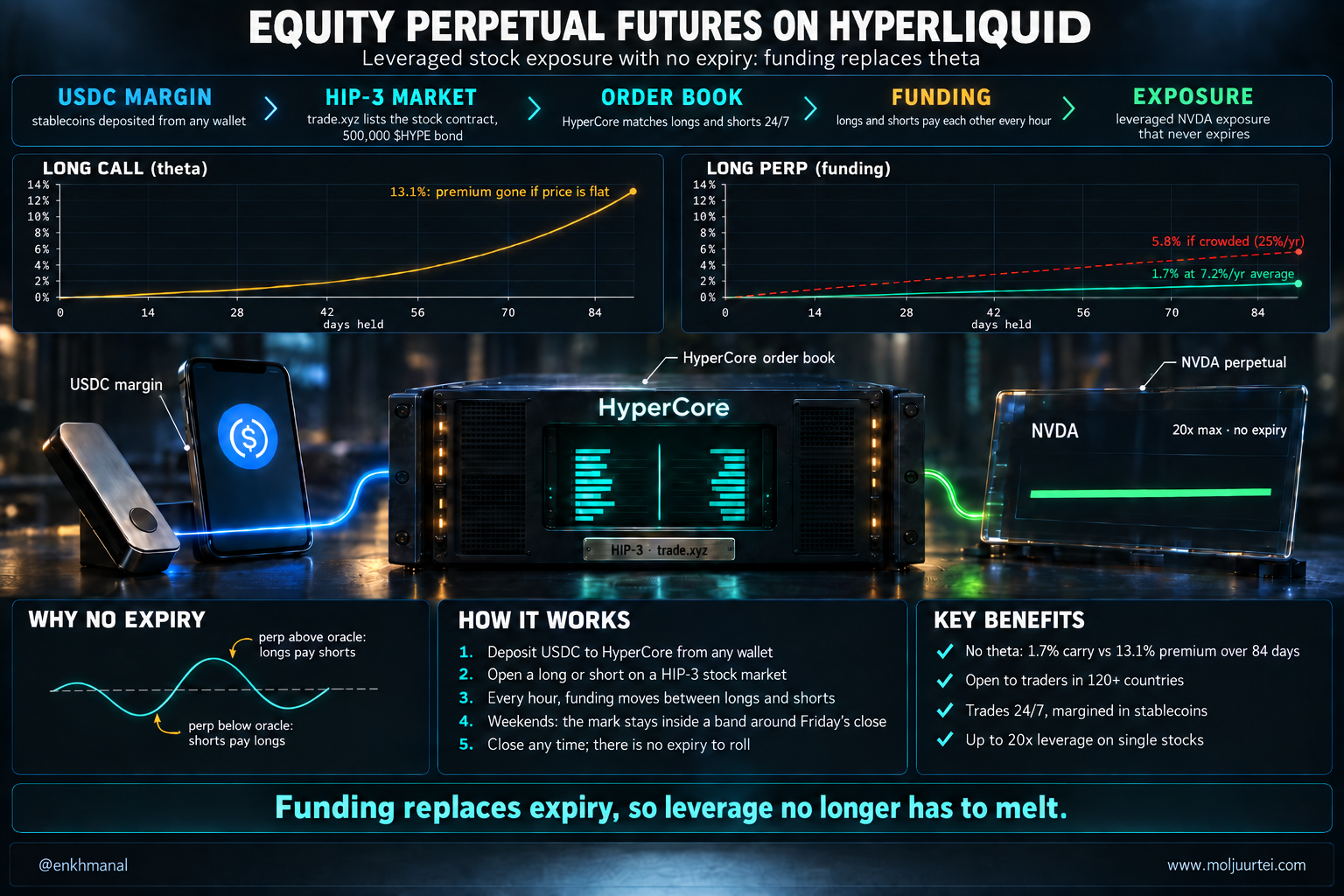
Theta is not a fee anyone chose to charge; it is arithmetic. On 25 September 2026 the $NVDA call struck at $225 and expiring on 18 December, 84 days out, traded at a $16.36 midpoint with the stock at $225.07. None of that premium was intrinsic value. If $NVDA sits still until December, all $16.36 disappears. Because that call moves only 0.555 dollars for each dollar the stock moves, matching the exposure of one share takes 1.8 calls and $29.48 of premium, or 13.1% of the share price, spent in 84 days on the right to be leveraged.
A dated future removes the melting premium. The price of a future sits above today's share price by roughly the interest you would have paid to borrow and hold the share, and on the expiry date it is forced to equal the share. That forced convergence is what keeps it honest, and it is also why every futures position has a birthday: the holder must close it and open the next month's contract, paying a spread and a little slippage each time.
A perpetual deletes the birthday. Instead of expiry pulling the contract to the share price, a funding payment does it continuously: when the perp trades above its reference price, longs pay shorts a small amount every hour, and when it trades below, shorts pay longs. On the trade.xyz $NVDA perp that payment averaged 7.2% a year over the 90 days to 27 September, with a median of 5.5%, according to Hyperliquid's own funding history. Over the same 84 days, one share of exposure cost about 1.7% in funding against the option's 13.1%. The difference is the product.
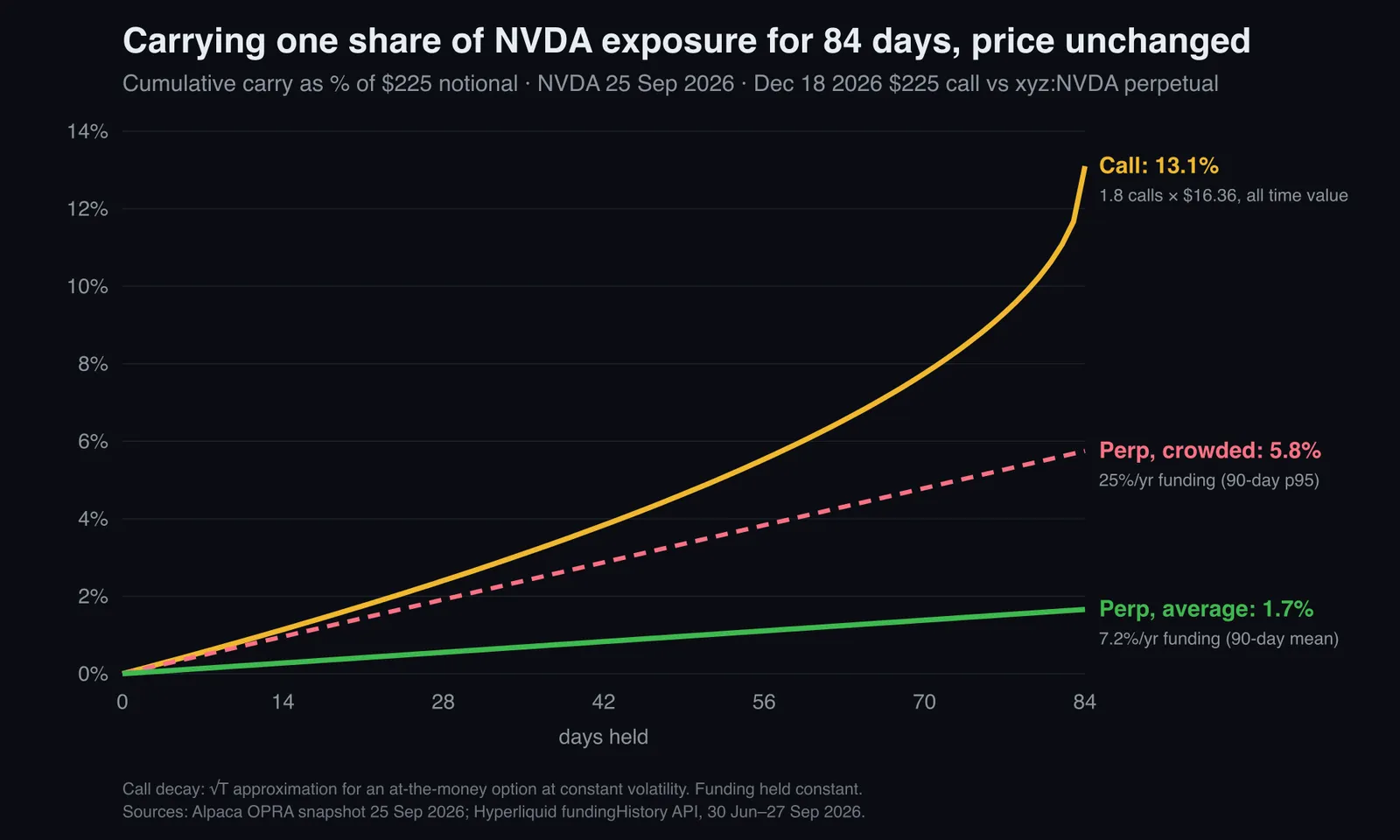
Two honest caveats belong next to that chart, and we repeat neither later. First, the option buys something the perp does not: a floor. The call holder can lose $29.48 and no more, while the perp holder can be liquidated by a sharp move against a thin margin. Second, funding is not fixed. The same $NVDA perp printed hourly rates equivalent to 110% a year at its most crowded, and its 95th percentile was 25%, which would have cost 5.8% over the 84 days. Funding can also turn negative and pay the long, which happened in 7% of hours. Theta never pays you.
Now the second half of the idea: who can buy the call at all. Listed $NVDA options require a U.S. brokerage account with options approval, a funding path in dollars, and access during U.S. market hours. A resident of India faces a rule the Reserve Bank of India states plainly in its Liberalised Remittance Scheme FAQ: remittances "for margins or margin calls to overseas exchanges / overseas counterparty" are not permitted, inside an annual cap of $250,000. Robinhood's own chief executive told investors on 29 July that its stock tokens and single-stock perps are "ex-U.S. products" that "people in over 120 countries" can use. The same perp that a New Yorker cannot legally trade is, for a trader in Jakarta or Ulaanbaatar with a wallet and stablecoins, the first leveraged $NVDA position they have ever been offered.
Keone Hon, who co-founded Monad, calls stocks occasionally priced assets: a share has a trustworthy price only while its home exchange is open, about 6.5 hours of the 168 in a week. A perpetual needs a price every hour to compute funding, so on a Saturday somebody has to invent one. His argument is that dated futures fit such assets better than perps. We think he is right about the weekend and wrong about what the world's traders will choose, and the evidence for both sides sits in the Risks section.
Thesis
Equity perpetuals give the world leveraged stock exposure without theta, and the companies that distribute them to non-U.S. retail, clear them on a public order book, and settle them in dollars are building a new, growing market that the SEC's September order does not touch.
Backdrop — How Onchain Stocks Got Here
What changed on 17 September is narrower than the headlines. The SEC issued an order exempting "Tokenized Securities Venues" from the definition of an exchange so they can trade tokenized shares of exchange-listed stocks in permissioned automated market-maker pools. The order text, Release 34-106402, sets the conditions. The token must give holders "the same rights and privileges" as the ordinary share: the same dividends, the same votes, the same claim in liquidation. A third party may tokenize a company's stock only after sending the issuer written notice and waiting at least 30 calendar days, and the issuer can object. Synthetic exposure, "such as a tokenized linked security or a tokenized security-based swap", is excluded outright. The venue itself must be a U.S. person. Large, liquid Tier 1 stocks are capped at 75 symbols and 0.25% of the prior month's average daily volume, other stocks at 250 symbols and 2.5%, and the whole exemption runs from 17 September 2026 to 17 September 2031.
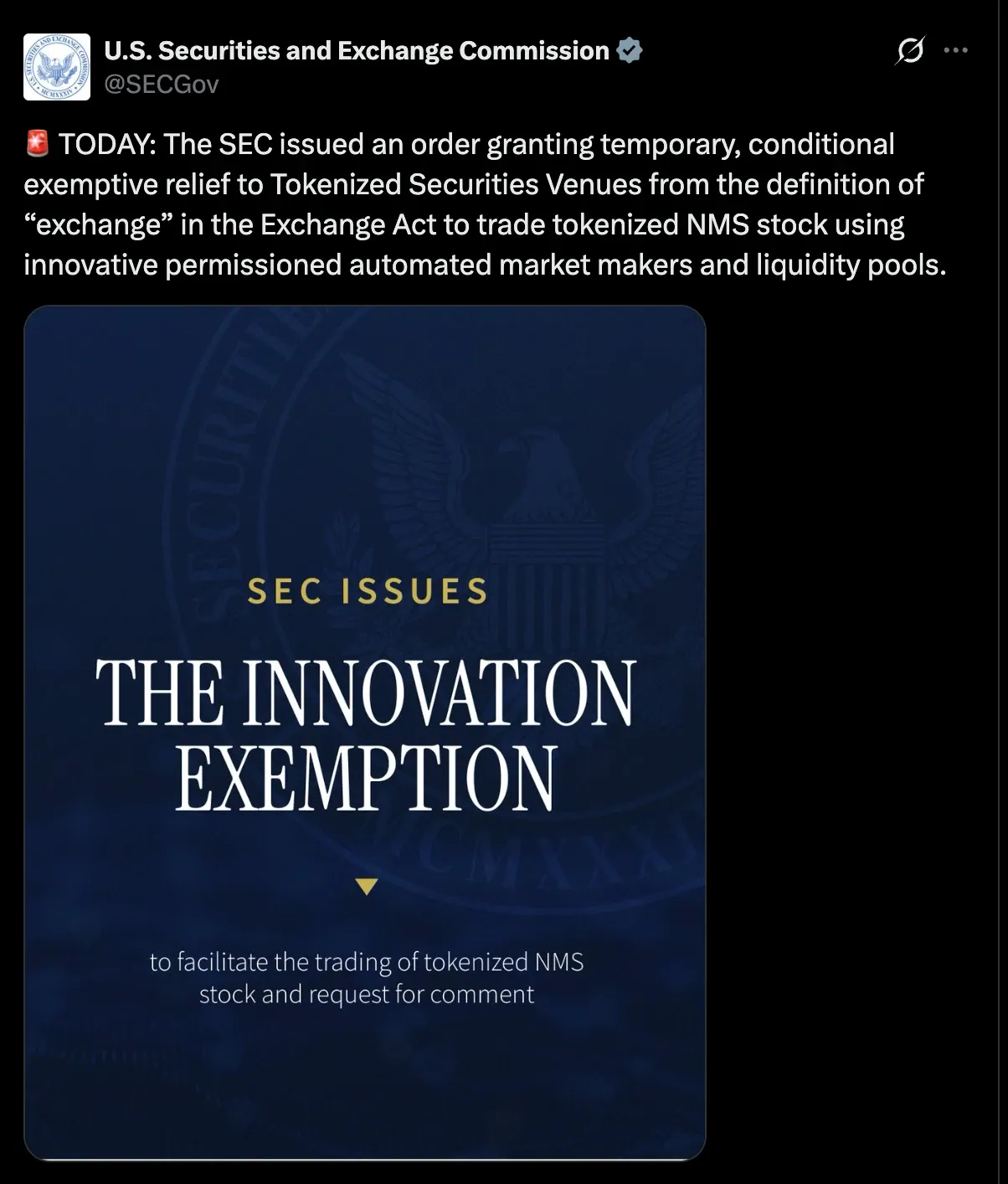
Read those conditions against what already trades, and the order mostly describes a market that does not exist yet. It blesses issuer-native shares like $SECZ's own tokenized stock. It says nothing that makes a U.S. person eligible for a Hyperliquid equity perp, and trade.xyz's terms still prohibit access "to United States persons, in the United States." The perp market grew up offshore, it stays offshore, and it is already the bigger of the two.
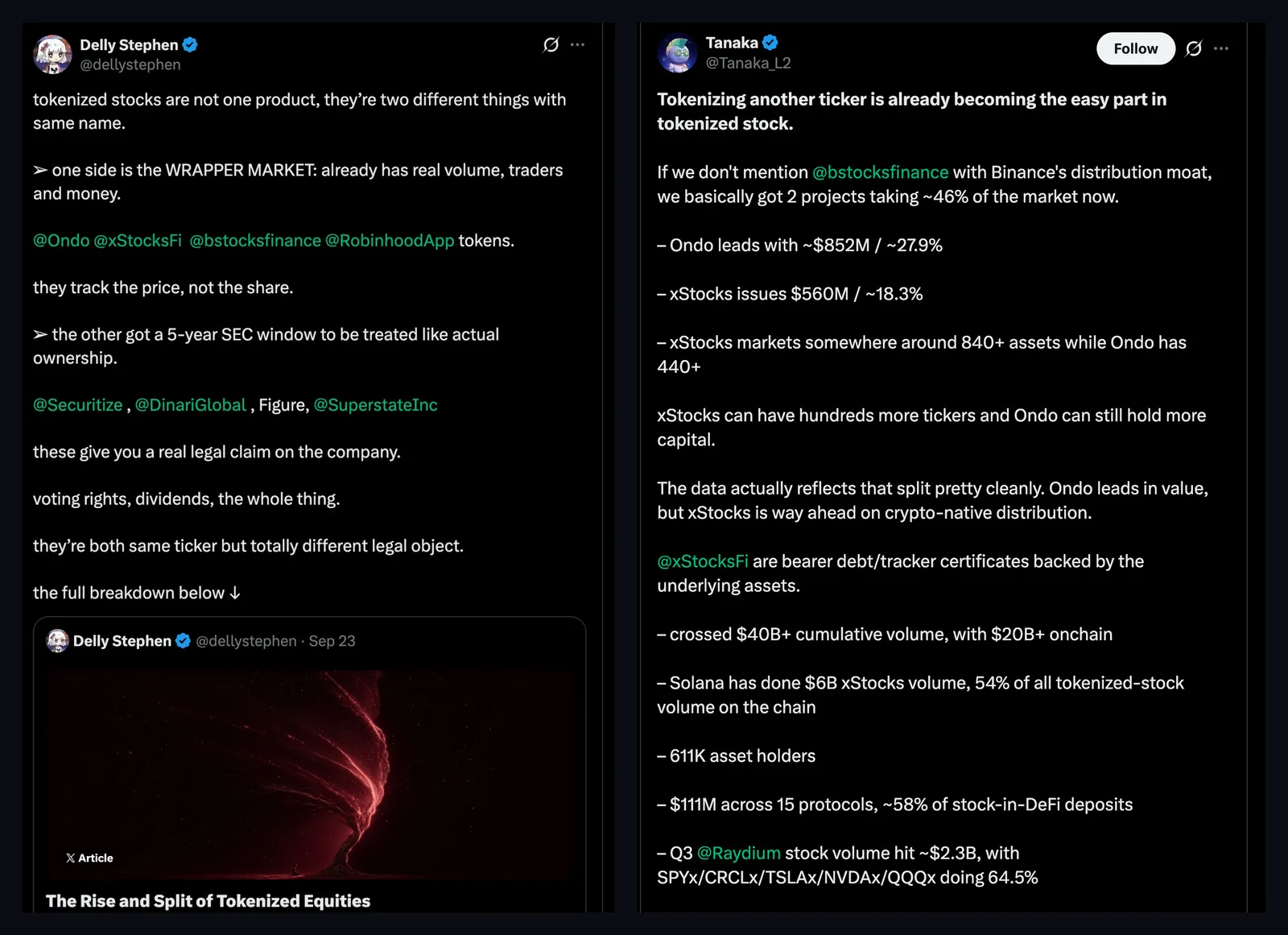
The spot side is real but small. rwa.xyz counted $3.14B of distributed tokenized stocks on 28 September, up 15.5% in 30 days, held by 4.00M addresses: Ondo $868.7M, Binance's bStocks $761.7M, xStocks $569.4M, Securitize $498.3M, Robinhood $148.8M and Figure $76.0M among the larger platforms (rwa.xyz). Against a U.S. equity market measured in tens of trillions, that is a rounding error, and Securitize's own chief executive called it one on the August call. Monthly transfer volume was $12.58B, down 70.4% from the prior month, which is the first sign that spot wrappers are being held rather than churned.
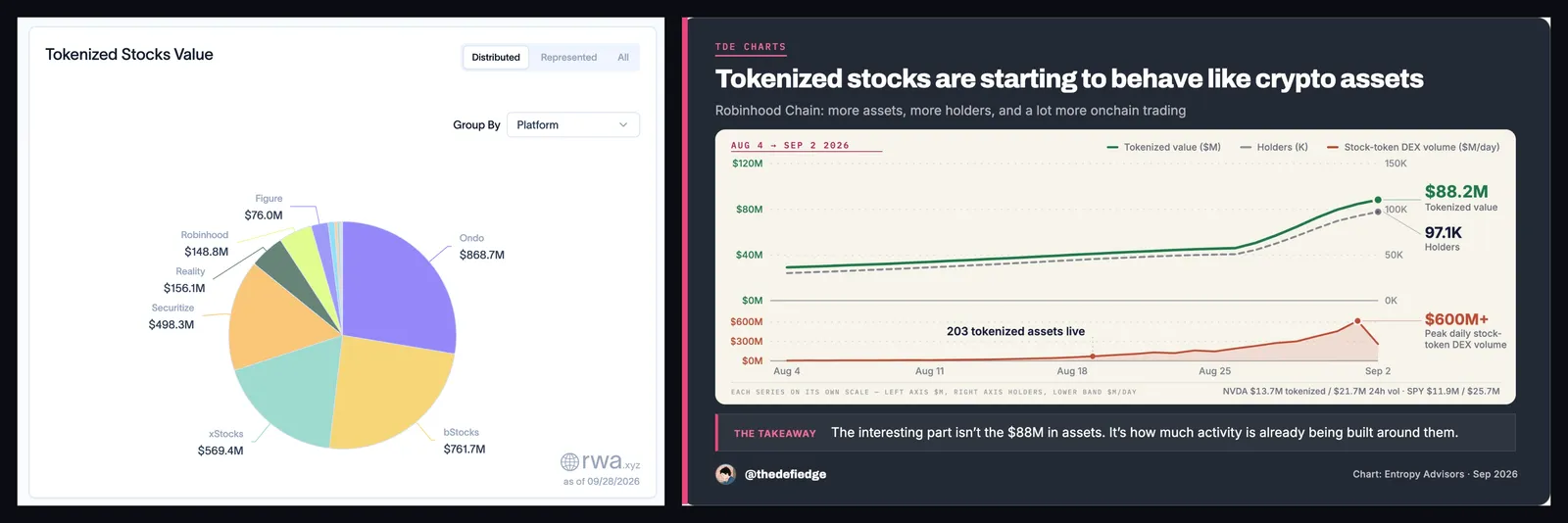
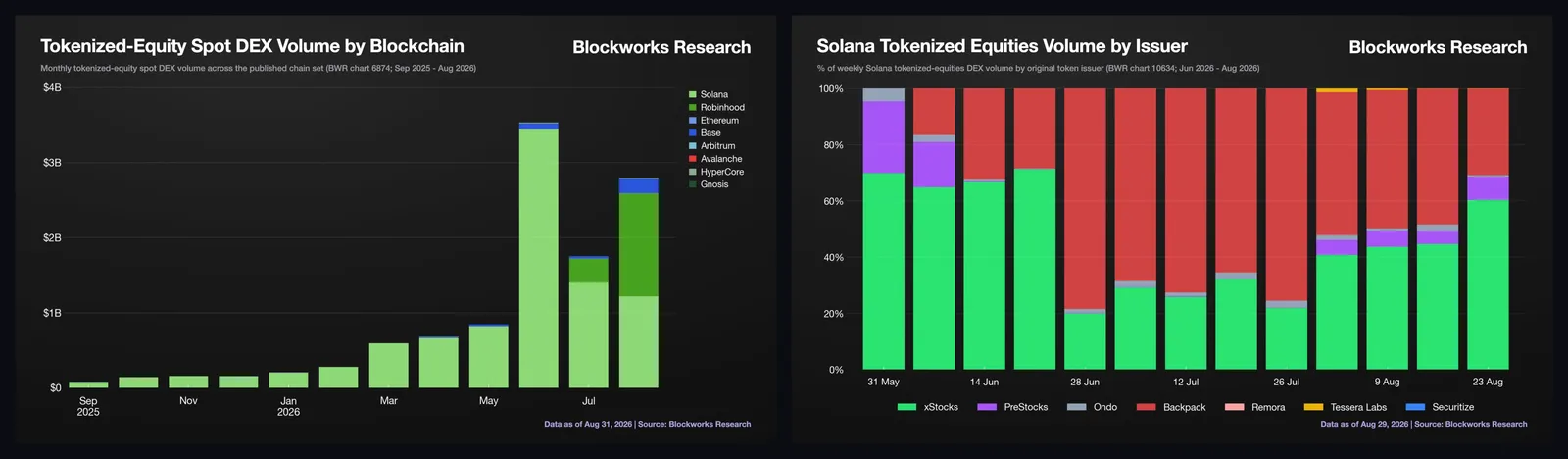
Where the spot tokens trade has moved fast. Blockworks Research's monthly series shows tokenized-equity spot DEX volume near $3.5B in June 2026, almost all on Solana, and about $2.8B in August with Robinhood Chain carrying roughly half, read off the chart. Inside Solana, the issuer mix swung from xStocks at around 70% in late May to Backpack's tokens at up to 80% by mid-July, then back to xStocks at 60% by late August. Robinhood Chain's own economics show up on DefiLlama: gas revenue net of Ethereum costs went from $3.2M in July to $6.0M in August and $31.9M in the first 27 days of September (DefiLlama). That is chain-operator income, and Robinhood does not yet break it out.
The derivative side is where the scale is. Coin Metrics reported on 22 September that real-world-asset perps peaked above 30% of futures volume on Binance and above 60% on Hyperliquid this year (Coin Metrics). $CRCL told investors on 5 August that real-world assets had reached "nearly 75% of perps volume" on Hyperliquid the week before. On 27 September, the HIP-3 markets deployed on Hyperliquid held $3.94B of open interest against $13.09B on its native crypto perps, pulled from Hyperliquid's public API; trade.xyz alone held $3.86B across 126 markets. Its largest were the S&P 500 at $351M, two Korean memory names, gold, silver, $MU, $INTC and $NVDA. Stocks that close at 4pm in New York now have their busiest leveraged market in a venue that never closes.
Mechanism — Why Now & How It Works
Three different legal objects now quote the same ticker, and most commentary goes wrong by blending them. The first is an issuer-native share: the registered common stock itself, recorded onchain by the company or its transfer agent, with votes and dividends. $SECZ tokenized its own stock this way on its listing day, and Figure issues its equity natively on its Provenance chain. The second is a wrapper: a note or certificate backed by shares in custody, giving price exposure and sometimes dividends but no vote. Ondo, xStocks, bStocks, Robinhood's stock tokens and Coinbase's tokenized stocks all sit here in various legal forms. The third is the synthetic perpetual: an oracle-priced contract with funding and liquidation, no share anywhere. Only the first qualifies under the SEC order, the second is where the spot volume is, and the third is where the leverage is.
Here is how a single leveraged $NVDA trade actually moves on Hyperliquid. A trader outside the U.S. deposits USDC to HyperCore, Hyperliquid's own chain and matching engine. The market she trades was not listed by Hyperliquid: under HIP-3, a builder such as trade.xyz stakes 500,000 $HYPE as a bond, defines the contract, and runs the oracle that feeds it (Hyperliquid docs). Her order meets other orders on a central limit order book, the same design as a futures exchange. Every hour the contract compares its price to the oracle and moves funding between the two sides. If her margin falls below maintenance, the engine liquidates her. Fees go to the builder and to Hyperliquid, and Hyperliquid's share buys $HYPE on the open market.
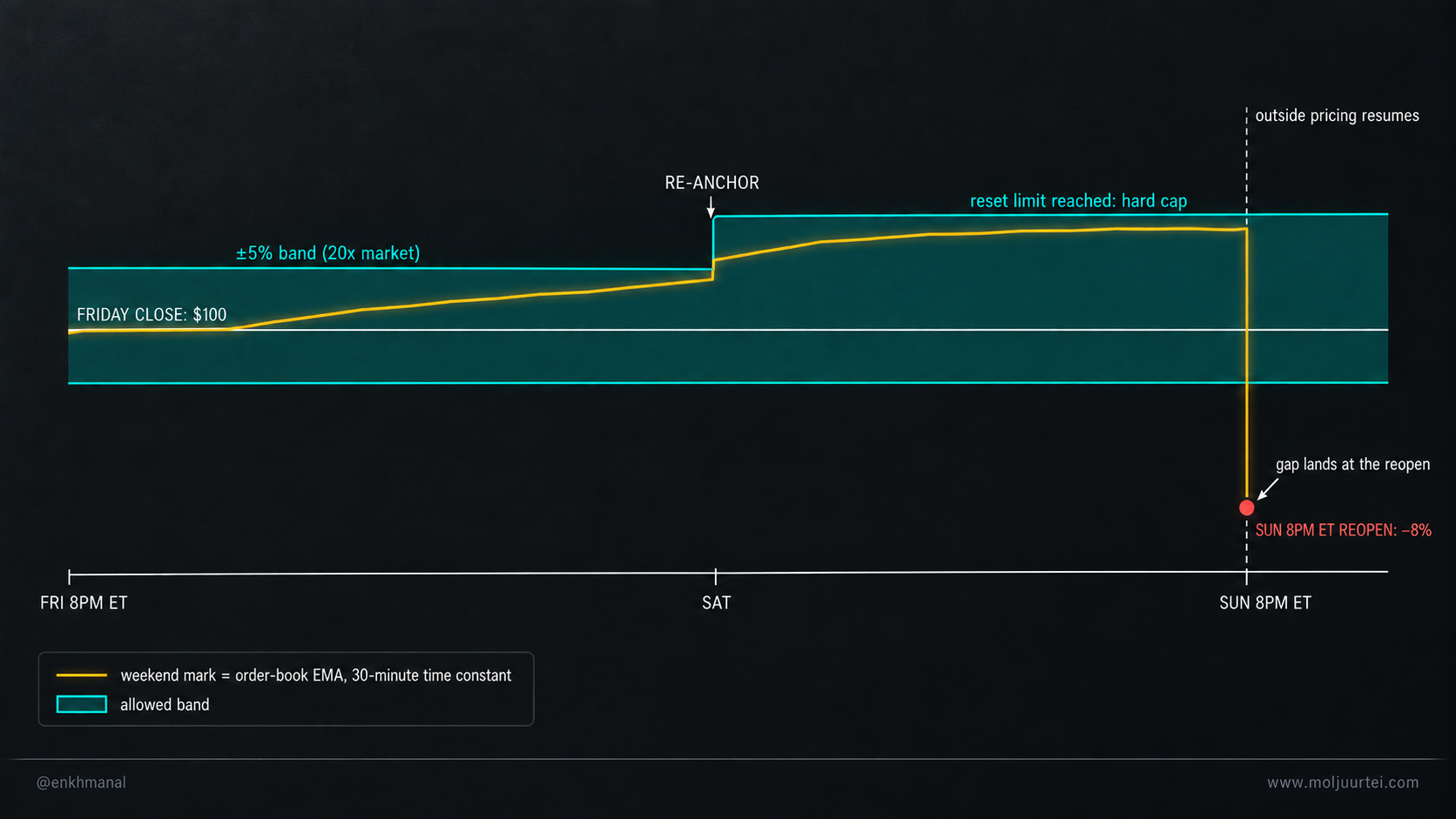
The oracle is where equities differ from crypto. trade.xyz's documentation says the relayer takes an external price for U.S. stocks 24 hours a day, five days a week, from Sunday 8pm to Friday 8pm Eastern, stitching pre-market, regular, post-market and overnight sessions. Only from Friday night to Sunday night does the oracle run on its own: an exponentially weighted average, with a 30-minute time constant, of where the perp's own order book would fill a set size. The mark price used for liquidations is the median of that oracle, a 150-second average of the perp's premium, and the book's best bid, ask and last trade, and each update is clamped to 50 basis points.
On top of that sits a band. During the weekend the mark may move only within one divided by the maximum leverage of a reference price, which starts at Friday's close: ±5% for a 20x market. When the oracle pushes to 90% of the way to an edge, the band re-anchors and moves, up to a set number of times per direction, after which it becomes a hard cap until outside pricing resumes. The documentation is candid about the consequence: "If a trader's liquidation price lies outside the active price bounds, their position cannot be liquidated." That protects a weekend trader from a thin book, and it moves the gap risk to the moment outside pricing returns: 8pm on Sunday in New York, Monday morning in Asia.
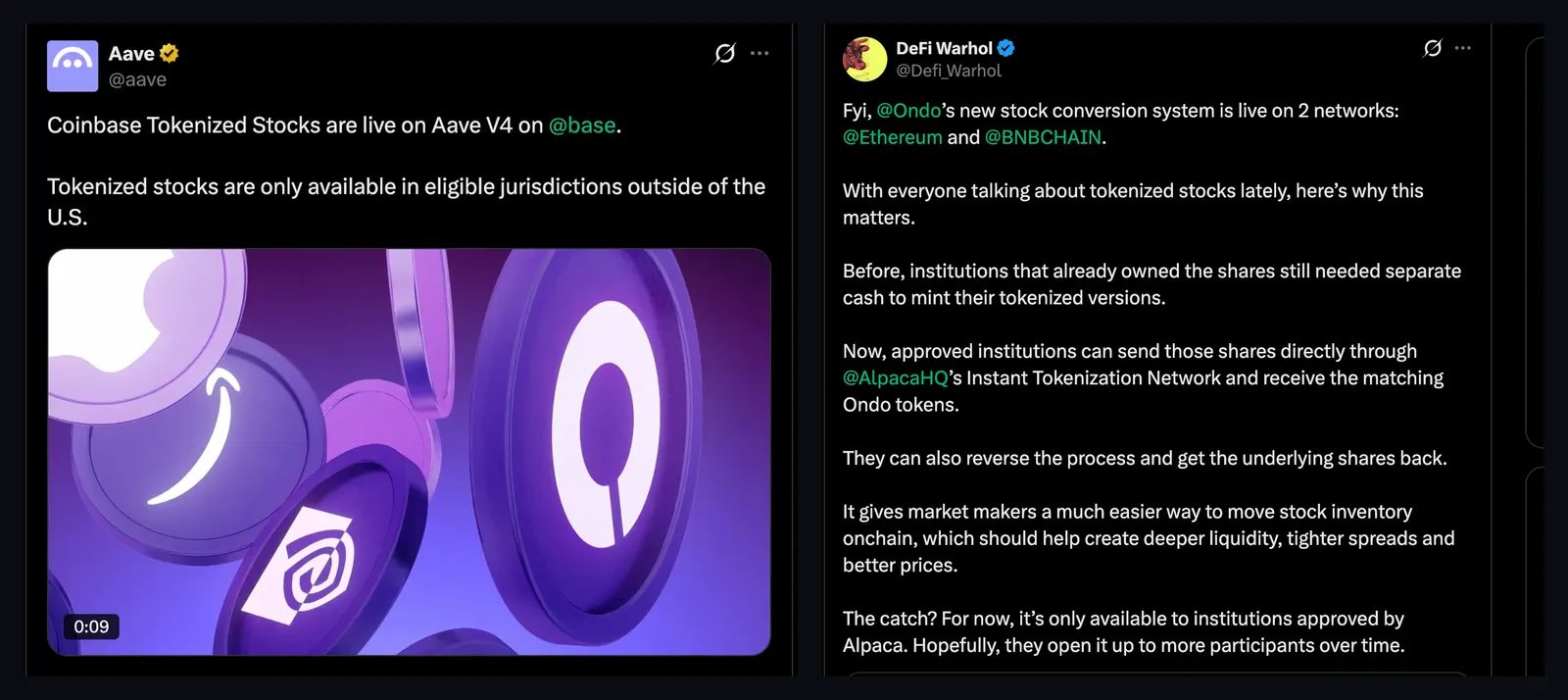
Why now: the pieces that make the product usable all arrived in 2026. Market makers can hedge perps with spot wrappers on the same chain, which is why xStocks listing on HyperCore mattered. Institutions that already own shares can move them onchain without selling: Ondo converts them in kind through Alpaca, both ways. Collateral became productive: Ondo Perps accepts its own SPYon and QQQon as margin, and Coinbase's tokenized stocks can be deposited on Aave V4 on Base outside the U.S. Data providers followed; Nasdaq chose Pyth to distribute TotalView, and Pyth builds indices that keep running while markets are shut.
The U.S. is building its own version, and it looks different on purpose. Coinbase Derivatives filed a Form 1-N and Coinbase Financial Markets a Form BD-N on 1 September to register for security futures, then filed rules on 18 September for perpetual single-stock futures (Federal Register). The contract trades from Sunday 8pm to Friday 5pm Eastern, not around the clock; margin is at least 15% of market value, which caps leverage near 6.7x against 20x offshore; underlyings need a $100B market cap and $450M of average daily value; and customers reach it through futures commission merchants. It is a real product for Americans. It is not the product the rest of the world already has.
Basket & Positioning
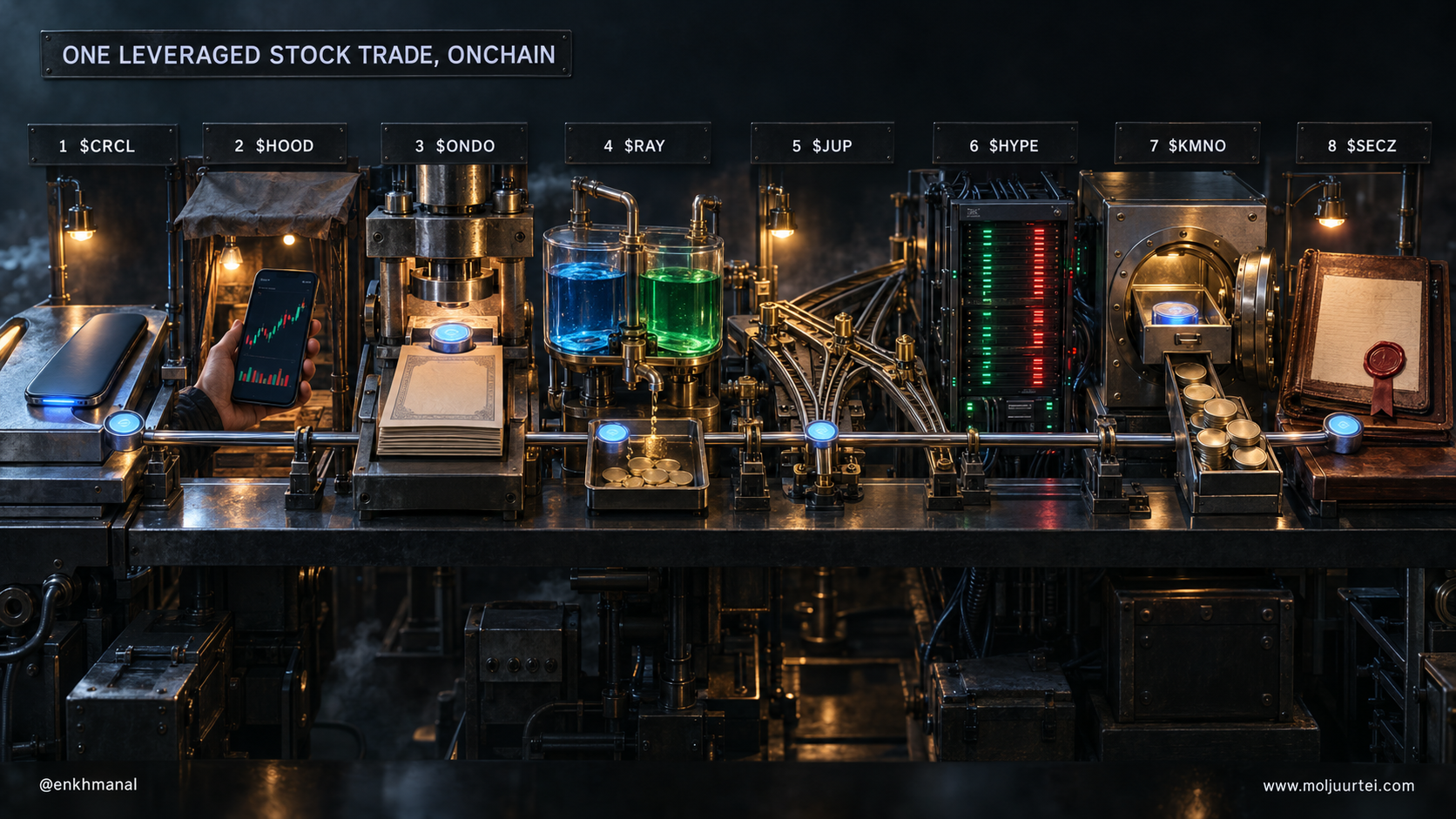
We map the chain first and slot the names into it. A leveraged stock trade needs a dollar to margin it, an app a trader can reach, an issuer to mint the stock token, a pool that prices it when the market is shut, a router to find the best path, an engine that matches and clears the perp, a lender that lets the position be levered, and, underneath, a share someone is legally holding. Each step has more than one owner, including competitors that sit at the same step, and several owners collect nothing from the step they are famous for. The researched universe is twelve listed names and tokens, compared in pairs where they compete for the same job, plus Backpack, a private challenger we profile separately because its only tradeable instrument is a token held outside U.S. brokerages, and Meteora, screened and left on watch.
Our ranking axis is the house one, in order: a real business with a durable tailwind, growth that is accelerating, then a price that is inflecting or trending above its moving averages. Multiples come after, as context. $HOOD passes all three. $HYPE passes the first and third and fails the second: its holders revenue has run between $37M and $58M a month all of 2026. $COIN and $CRCL have the tailwind but shrinking or flat revenue. $SECZ has the purest legal fit and a revenue line going the wrong way. $FIGR is growing fast for reasons that have nothing to do with this theme, which is why it is excluded here rather than rated.
The pairs we compared, and what each comparison settled. $HOOD against $COIN for distribution: both sell tokenized stocks and perps to non-U.S. users, but $HOOD's core revenue grew 32% in the second quarter while $COIN's fell 18.5%, and $HOOD already routes single-stock perps through its wallet while $COIN's U.S. contract awaits approval. $HYPE against $UNI for a token that collects from trading: both route fees to holders, but $HYPE's buyback applies to every HIP-3 equity market today, while Robinhood Chain's stock tokens trade on Uniswap v4, whose pools sent $0 to $UNI holders in the last 30 days. $SECZ against $FIGR for issuer-native shares: $SECZ services other issuers' tokens and is the one the SEC order was written around, while Figure's native equity is a single $76.0M asset.
The Engine — $HYPE and What Reaches Holders
$HYPE is the only token in this chain with a contractual path from a trader's fee to a holder. Hyperliquid's perps collected $66.1M of fees in the 30 days to 27 September and routed $51.7M, 78%, to holders through buybacks, per DefiLlama. Adding the spot book and the chain itself, annualized holders revenue is about $663M. At $92.08 on 25 September, 222M circulating tokens made a $20.5B market cap, so the buyback retires about 3.2% of the float a year at today's price. On the fully diluted count of 955M tokens the same figure is 0.76%. That gap is the supply schedule a buyer is short, and it is the first thing to hold in mind.
The share reaching holders has fallen, and the reason is the thesis itself. In June and July 2025 holders received 97% of perp fees. Since then the monthly figure has run between 70% and 82%. Hyperliquid's documentation explains why: HIP-3 deployers keep a share, and on trade.xyz standard fees are twice the base rate, split 50% to Hyperliquid and 50% to trade.xyz (trade.xyz docs). Many equity markets also run in "growth mode", which cuts all-in fees by at least 90%. trade.xyz's own fees were $8.7M in August and $5.6M in the first 27 days of September (DefiLlama), against $64.5M and $61.0M on Hyperliquid's perps. The equity business that holds nearly a quarter of open interest today pays in only a sliver of the buyback.
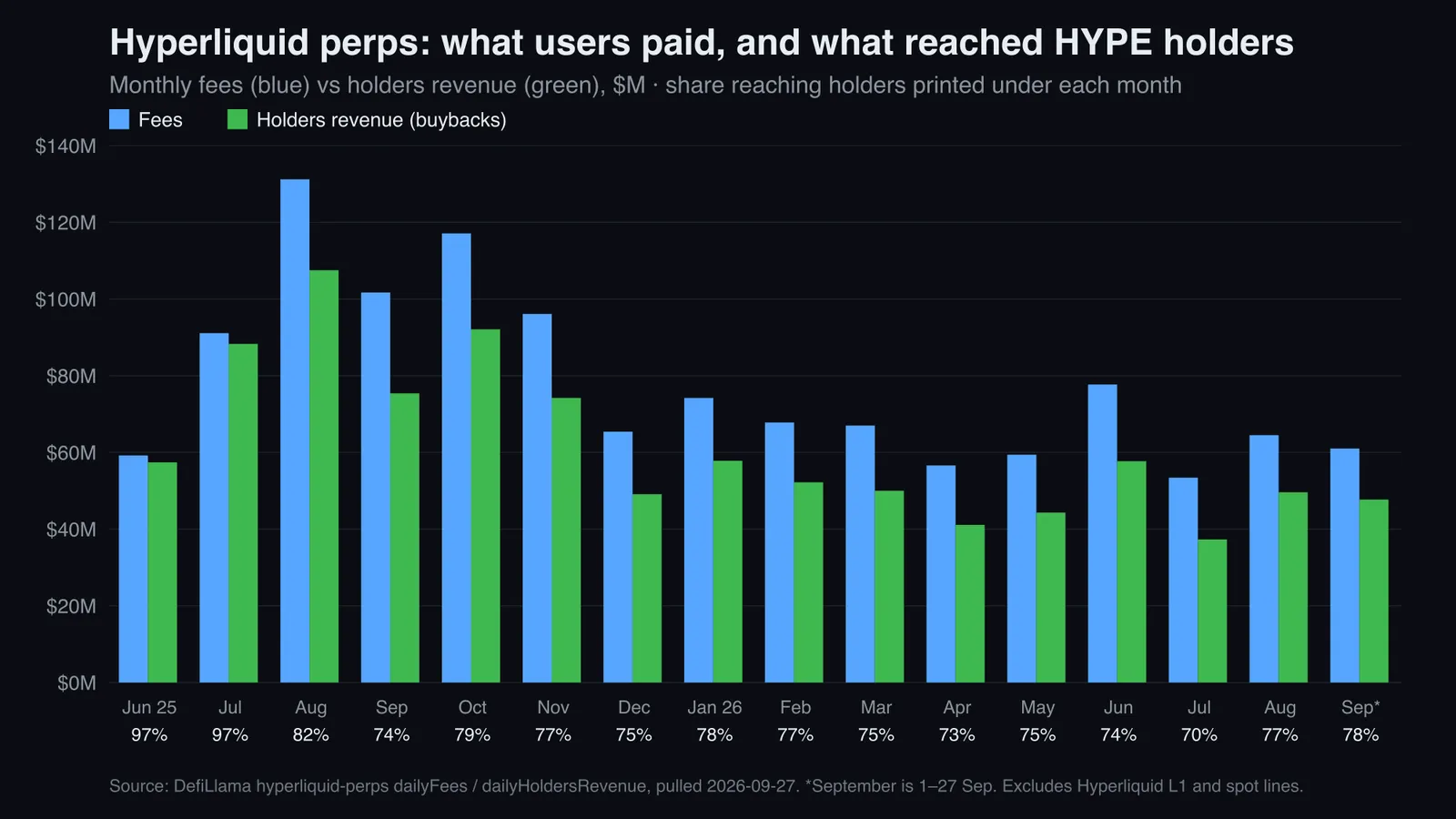
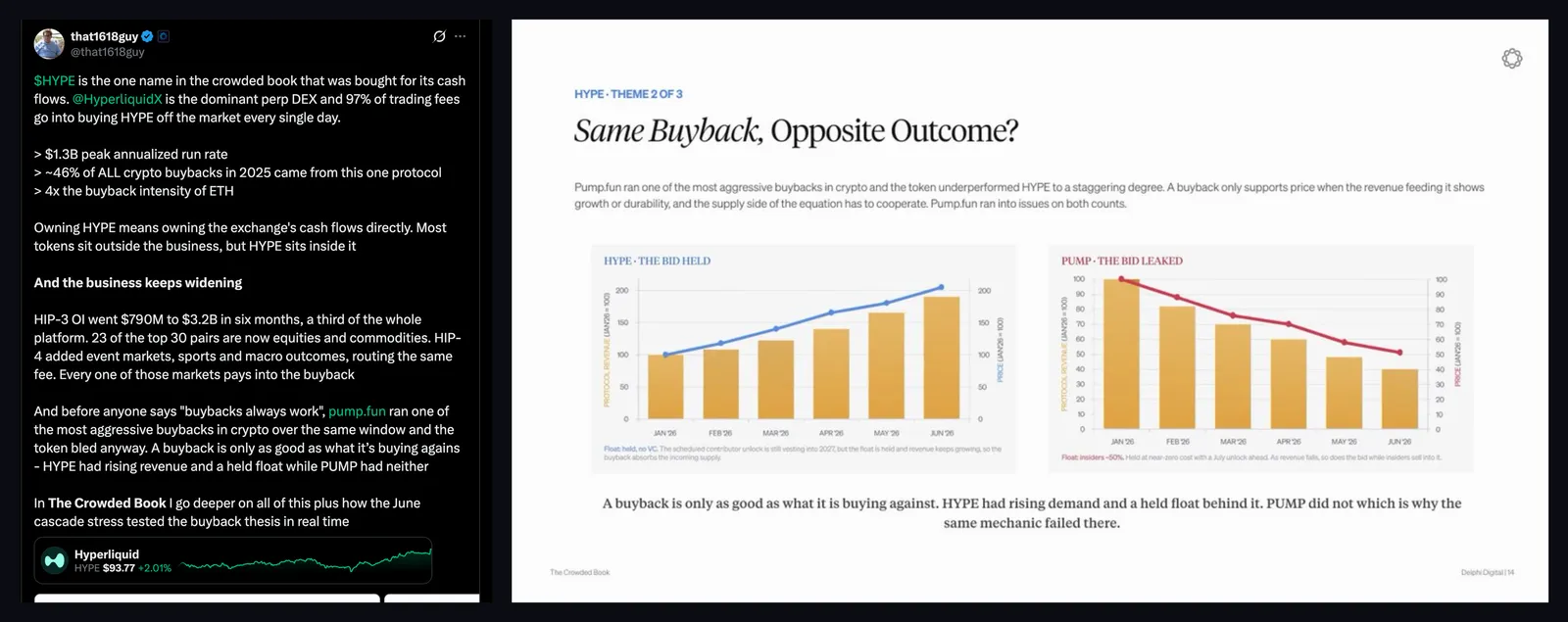
That is also why we read the loudest $HYPE claims carefully. The figure that "97% of trading fees" go to buybacks was true in mid-2025 and is 78% today. The "$1.3B peak annualized run rate" matches August 2025, when holders revenue was $107.5M; the latest 30 days annualize near $630M on perps alone. And a widely shared comparison that indexes Hyperliquid's protocol revenue from 100 in January 2026 to about 190 by June does not match DefiLlama's series, where perp fees went from $74.2M in January to $77.7M in June and holders revenue from $57.8M to $57.7M. The bid under $HYPE has held because the float is held and the product is spreading, not because revenue doubled.
So what does a $HYPE holder own? A share of fees from an engine that already clears the world's largest onchain equity-perp book, with the equity fees mostly waived to win that book. The day trade.xyz and the other deployers turn growth mode off on their largest markets, a business that is already there starts paying. We do not know when that will be. Coinbase's reported stake of 500,000 $HYPE, the exact bond a deployer posts, and Kraken's plan to run U.S. HIP-3 markets through Bitnomial are the two signs that larger, regulated deployers intend to pay full fees on this engine.
The Distribution Layer — $HOOD and $COIN
$HOOD has the widest open door to the theme. Robinhood's stock tokens are available in more than 120 countries, it runs its own chain for them, and its wallet offers single-stock and commodity perps outside the U.S. through a partnership with Lighter. Its July "World is Flat" event added perps on oil, gold, silver and ETFs for European customers, who were already trading crypto perps. The core business pays for all of it: second-quarter revenue rose 32% to $1.31B with a 57% adjusted EBITDA margin, net deposits were a record $22B, and management cut its 2026 cost outlook to $2.675B–$2.775B while adding two businesses (Q2 8-K).
Here, through our partnership with Lighter, you can, if you're an active trader outside the U.S., get leveraged exposure to not just crypto perps, but also commodity perps and single stock perps as well.
What $HOOD does not yet show is revenue from any of it. The stock-token platform held $148.8M of distributed value on rwa.xyz on 28 September. Robinhood Chain's gas income rose to $31.9M in the first 27 days of September, but it is chain-operator revenue on DefiLlama's methodology and it is not a line in Robinhood's filings. We therefore class $HOOD's theme exposure as a proxy: real users, real volume, an option on monetization inside a business that is growing without it.
$COIN is building the American version, and the rest of its business is in a down leg. Its tokenized stocks, launched in June as "true stock ownership, fully on-chain", are live as Aave collateral outside the U.S.; its Base app routes users to Hyperliquid perps through builder codes; and its U.S. perpetual single-stock futures await approval. Revenue fell 18.5% in the second quarter to $1.22B, with an operating loss, as crypto trading cooled (Q2 10-Q). Management's own framing on 9 September was that "launching a perp may be simple, but actually making it successful" takes distribution and liquidity, which is the argument for waiting to see the U.S. product trade before paying for it.
The Rails — $CRCL, $SECZ, $FIGR, $ONDO, $UNI and $KMNO
$CRCL sits under every stablecoin-margined trade. On its 5 August call, Circle said USDC reached 40% of open-interest collateral on Binance and Hyperliquid, and it ended the quarter with $73.3B in circulation, up about 20%. The problem is the income statement: Circle earns on reserves, and second-quarter revenue and reserve income of $701M was up 6.5% year on year and down from $770M in the fourth quarter as rates fell (Q2 10-Q). Perps use dollars as margin; they do not add many dollars to the float. We watch it for a rate floor or a pricing change on the platform.
$SECZ is the company the SEC order reads as if it were written for. Securitize listed on the NYSE on 2 July through a merger with Cantor Equity Partners II and tokenized $295M of its own common stock on Solana and Avalanche the same day, the same security rather than a new class (CoinDesk). It is a registered transfer agent, broker-dealer and alternative trading system, and Computershare and Continental, the largest and third-largest U.S. transfer agents, picked it for issuer-sponsored tokenized shares. The numbers have not followed yet. Second-quarter revenue fell 5% to $14.4M, the company cut its 2026 revenue outlook from $85M to $70M–$80M and no longer expects positive adjusted EBITDA this year (Q2 release). The stock has nearly tripled from its August low of $5.61 to $15.96, a $2.61B market cap on 163.27M shares (S-1).
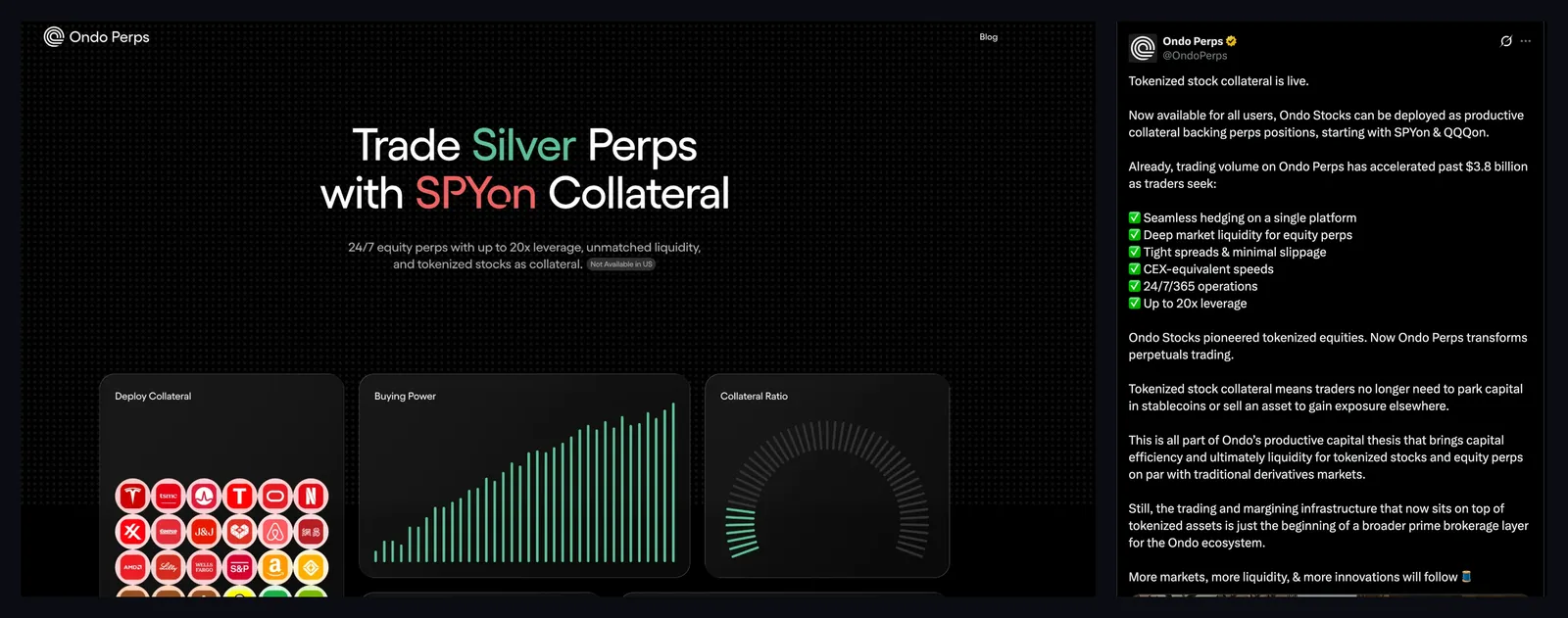
$FIGR belongs in the map and not in the basket. Figure issues its own equity natively on Provenance, worth $76.0M on rwa.xyz, and runs an alternative trading system, so its structure fits the SEC's issuer-native model. But its second-quarter revenue of $226M, up 113%, comes from home-equity lending and its marketplace, and the tokenized-equity piece does not appear as revenue (Q2 10-Q). $ONDO is the reverse case. Ondo leads tokenized-stock value at $868.7M and its perps venue reported $3.8B of volume by 21 July, yet the token received nothing: DefiLlama records $0 of revenue on Ondo's yield products because Ondo passes the yield through and waives its fee (DefiLlama). With no revenue per token to screen, we test the owner's view that it is cheap on its assets instead, in its own section below.
$UNI and $KMNO show the switch from both sides. Uniswap turned on its fee switch in stages from 28 December 2025, and its v3 pools sent $14.3M to $UNI buybacks and burns in the first 27 days of September, up from $9.3M in August (DefiLlama). Robinhood Chain's stock tokens trade in v4 pools, which collected $136.7M of fees in 30 days. Governance extended the protocol fee to v4 pools on seven chains, Robinhood Chain among them, on 27 July (Proposal 100); DefiLlama does not yet count v4 revenue, so that leg is paying but not yet visible in the data. Kamino, one of Solana's largest lenders, accepts xStocks as collateral and kept $0.57M of protocol revenue from $4.39M of fees in 30 days, none of it routed to $KMNO holders yet (DefiLlama). One has flipped its switch and the other has not, which is why we price the unpaid tokens as options in the next section.
Who Leads — A Global Market and the Switch Priced at Zero
Start with who is locked out. A U.S. resident cannot hold a single-stock perpetual today: trade.xyz and Ondo Perps bar U.S. persons in their terms, $COIN's U.S. contract is still a filing, and $CME is suing the CFTC to have perps treated as swaps. Everyone else can, and they already trade them. HIP-3 markets held $3.94B of open interest on 27 September, and real-world assets ran above 60% of Hyperliquid's perp volume at their peak this year. A product that turns a wallet and a few hundred dollars into leveraged $NVDA exposure, sold to everyone outside U.S. brokerage, is headed for billions of dollars of monthly volume. The question that decides the tokens is who leads it.
Four protocols in this memo are building for that lead, and each owns a different piece. Hyperliquid clears the trade. Ondo issues the largest share of the stock tokens and now runs its own perp venue. Backpack runs an exchange with stock tokens and 93 perps. Kamino is the lender that lets a stock token earn and borrow as collateral. Three of the four pay their token holders nothing today. We read that as the market's blind spot rather than a verdict: a protocol that owns a growing fee base can turn the fee switch on, and one already has.
The precedent is $UNI. Uniswap went seven years without paying $UNI holders. Its UNIfication proposal of 10 November 2025 turned on a protocol fee that buys and burns $UNI. It passed with 125M votes for and fewer than 1,000 against, and went live on 28 December with a one-time burn of 100M $UNI from the treasury (Uniswap, vote). Holders revenue went from $0 to $2.9M in January and $15.1M in September (DefiLlama).
The price path carries the lesson we apply below. $UNI jumped 43% the day after the proposal, from $6.57 to $9.41, and gave all of it back within a month: $5.75 on 10 December, $3.67 in late July. The lasting move came when the switched-on fees grew, and $UNI was $8.80 on 29 September. At both ends the market paid about 30 times annualized holders revenue: $1.8B for $61M a year in June, $5.4B for $181M in September. The switch opened the door and scale set the price. So for an unpaid token we ask whether its fee base can grow into a switch, who can flip it, and whether the price already assumes both.
Others have taken the same road. Aave began buying back its token at $1M a week in April 2025. On 8 September 2026 Ethena's governance approved a fee switch that sends a rising share of revenue to buybacks as its dollar grows, from 5% at $7.5B of supply to 20% at $20B (Ethena). A switch that turns up with scale is the design we would want Ondo and Kamino to copy.
What changed in Washington. Most protocols left the switch off because paying holders risked turning the token into a security. That risk has fallen, though not to zero and not by statute. SEC staff said on 29 May 2025 that protocol staking is not a securities transaction, and extended that to liquid staking on 5 August 2025 (SEC). A joint SEC–CFTC interpretation effective 23 March 2026 classed tokens without income rights as digital commodities (Release 33-11412). On 25 September 2026 SEC staff added that announcing a buyback for a functional system with no central party is not a promise of managerial effort (SEC FAQ). A token safe harbor, Regulation Crypto Assets, was proposed on 18 August with comments due 20 October. The CLARITY Act, which would put this into law, failed a Senate cloture vote 49–50 on 15 September. Read together, a buyback run by a decentralized protocol is now the safest way to pay holders, and a direct payout of income is still the riskiest, because income rights are what the March interpretation says a commodity lacks.
The Switch, Priced — $KMNO, $ONDO and Backpack
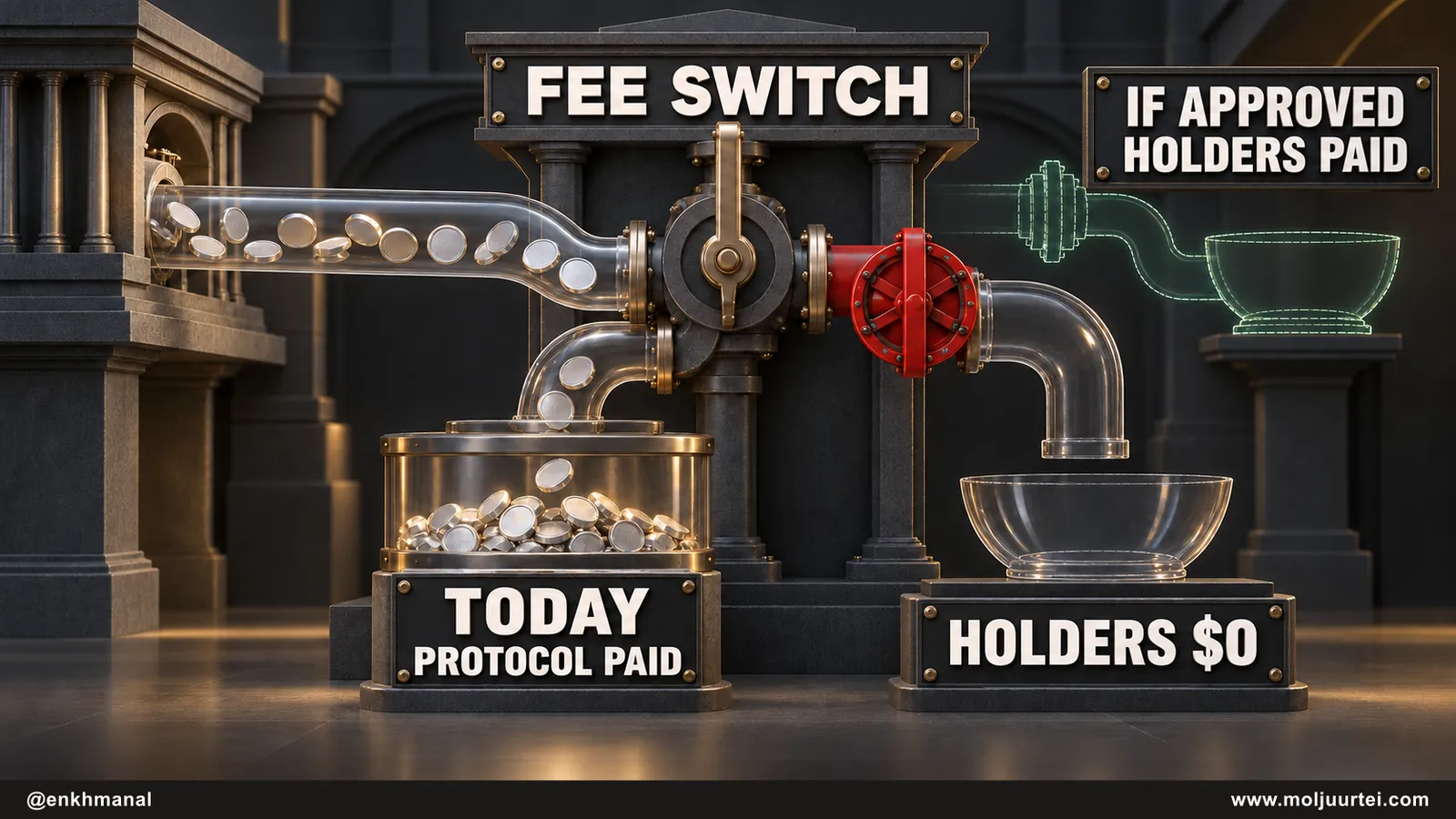
Kamino is the unpaid token we are most constructive on, because its switch is the easiest to flip. The stakers already exist: 609.6M $KMNO, about 10.8% of circulating supply, sit in its staking contract across 131,028 wallets and earn points boosts and votes, not fees (Kamino). Governance is a token-holder vote rather than a company, which is the case the SEC staff's September answer on buybacks was written for. Its job in this theme is the one a stock token needs once it is issued: somewhere to borrow against it. Kamino accepts xStocks as collateral, so a trader can post tokenized $NVDA and borrow dollars without selling. The price already pays for today's revenue switched on: $244.5M on 29 September is 27 times the $9.2M Kamino kept last year, close to $UNI's multiple. What it does not pay for is the fee base recovering. Kamino's fees fell from $10.3M in August 2025 to $4.3M in September 2026 as Solana borrowing cooled. Back at the 2025 rate and switched on at the same 14% take, holders would receive about $17.8M a year, worth about $530M at 30 times, a little over twice today. On a fully diluted count the token is $433M, and 43.5% of supply has yet to reach the market. We would accumulate $KMNO now and add on a fee-share or buyback proposal, or on two consecutive months of fees above $6M.
The stronger case for Kamino is what sits on top of the venues. Its lending markets for stock tokens hold about $36.8M across two markets, and in the larger one $5.19M of the $5.63M of USDC supplied is already borrowed, 92% utilisation, so demand to borrow against stock tokens is running ahead of the dollars on offer (Kamino API). Its Multiply product lets a trader loop SPYx, QQQx, NVDAx or TSLAx against USDC up to 3.7 times, which is leveraged stock exposure without a perp and without theta, and on 14 September Kraken launched xStocks vaults whose lending runs on Kamino (@kamino). Its liquidity vaults turn Raydium concentrated-liquidity positions into kTokens that Kamino Lend accepts as collateral, so an LP can earn pool fees and borrow against the same position. No stock-token LP vault exists yet; every xStock enters as single-asset collateral. The first xStock–USDC vault would let an LP earn trading fees on a stock pool and lever them, and Kamino would collect on both legs. That is the step we watch.
The Venues — AMMs That Price Stocks Between Closes: $RAY, $JUP, $ORCA and Meteora
The step our first draft left out is where a stock token actually trades. An automated market maker, or AMM, is a pool of two assets, say tokenized $NVDA and USDC, that quotes a price from the ratio between them and charges a fee on every swap. Liquidity providers deposit both sides and earn most of the fee; the protocol keeps a slice. When New York is shut, that pool is where the price of a stock token is made, and arbitrageurs who keep it in line with the perp and the Monday open pay the fee for doing it. Price discovery and fee accrual are the same event.
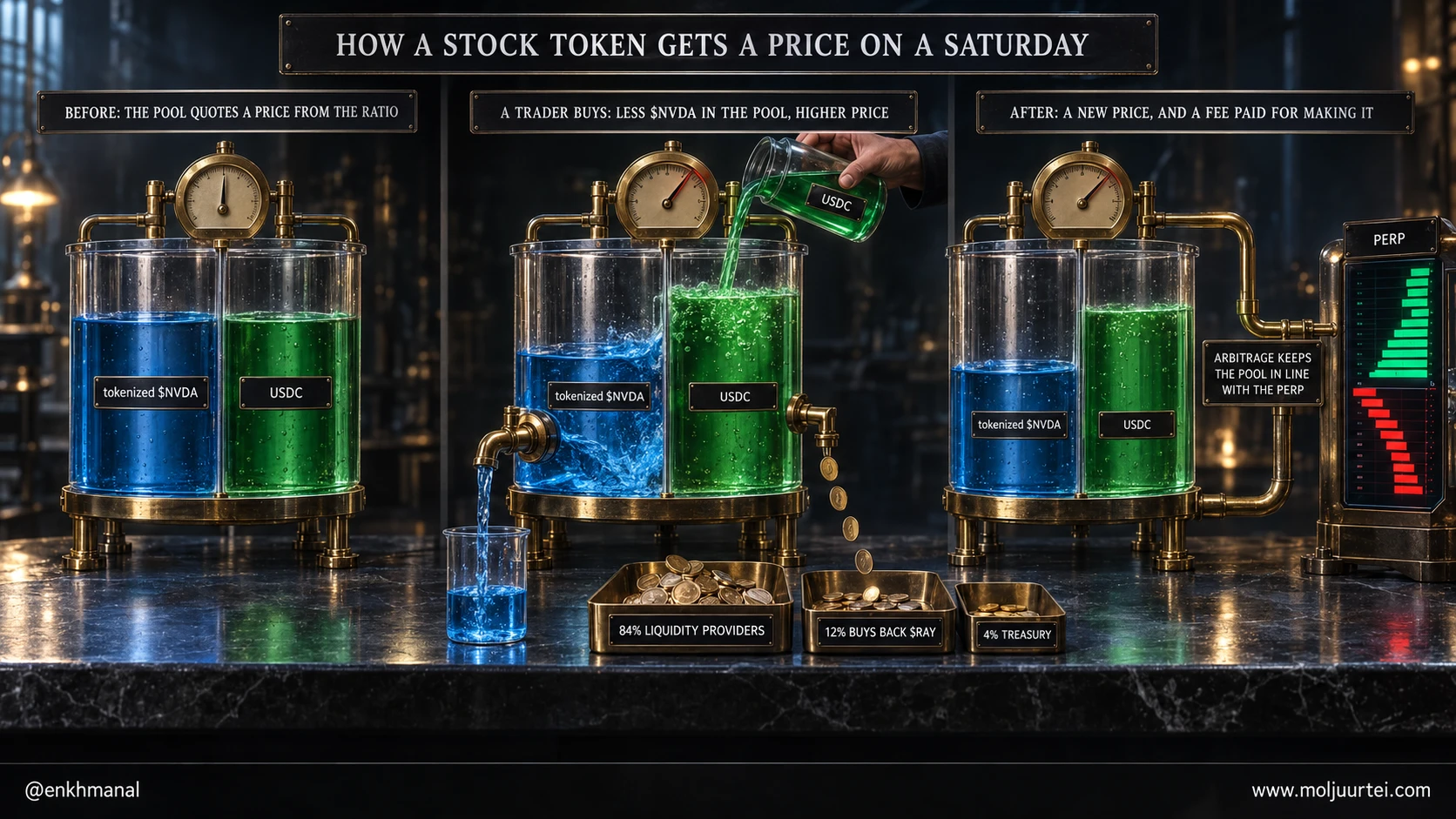
Raydium is where Solana's stock tokens trade today. It passed $5B of cumulative tokenized-stock volume on 18 September, after a record week of $700M (@Raydium), and xStocks traded $1.3B on Raydium in the 23 days to 23 September (@xStocksFi). Solana Compass puts Raydium above 90% of Solana's tokenized-stock DEX volume; we have not verified that share on a primary source. At that record week's pace, stock tokens were about a third of Raydium's $9.35B of volume over 30 days. The token is already paid: 12% of trading fees buy back $RAY (Raydium docs), $18.3M over the last year and $4.62M in the last 30 days, a $55M annual run rate (DefiLlama). Against a $508M market cap that is a buyback yield near 11% at September's rate, on a float that is 48.6% of supply ($1.05B fully diluted). No other token in this memo is paid today by stock-token volume that has already arrived.
Jupiter routes more Solana volume than any venue, $14.6B in 30 days, and it is doing what the owner described: adding a use to the token as the product scales. On 22 September it listed new perps including SK Hynix and SanDisk, open in beta only to $JUP stakers (@JupiterExchange), and a Stocks page is in preview. Half of its revenue buys back $JUP, $42.9M over the last year. The catch is supply: only 33.2% of $JUP circulates, so the $1.10B market cap is $2.27B fully diluted, and in February the team moved to hold net emissions at zero (@JupiterExchange). $JUP's torque is a Solana answer to HIP-3: if stock perps on Jupiter reach a fraction of Hyperliquid's equity book, the fees land in a buyback that already runs.
Orca and Meteora are the smaller bets. Orca hosts Backpack's stock tokens, issued through Sunrise, since 9 September (@orca_so), and 40% of its 12% treasury share buys $ORCA into the xORCA staking vault; that is $0.50M in 30 days against a $96M market cap, 60.8% circulating (@orca_so). It has the most torque per dollar and the least evidence that stock volume is reaching it. Meteora collected $30.9M of fees in 30 days and sent none to holders in that period; a staking programme sharing its pool fees began in July and passed 100M staked tokens on 25 September (@MeteoraAG). We found no stock-token pools on Meteora, and its token symbol collides with MetLife's, so we name it only in prose and keep it on watch.
The Challenger — Backpack, Its Founders and Its Stock Tokens
Backpack is the name in this story with the most interesting founders, and we tested the idea that its leadership is the reason to care. Armani Ferrante, the chief executive, was an early hire at Alameda Research before it launched in 2018 and returned in 2020 to build Solana tools around Serum; he then wrote Anchor, the framework most Solana programs are built with (Cointelegraph). His co-founder Tristan Yver ran strategy at FTX.US. In September 2022 their company, then called Coral, raised $20M in a round co-led by FTX Ventures and Jump Crypto; two months later FTX failed with most of its operating cash inside it, 80% by Ferrante's own account.
What they did next is better evidence for the leadership thesis than the collectibles. Mad Lads, launched in April 2023 through the Backpack wallet, became one of Solana's two largest collections and kept the company alive; that proves they can build a community, not that they can run a regulated securities business. The regulated record came after. They raised $17M in February 2024 (CoinDesk), bought FTX EU for $32.7M, closed in January 2025 with court and Cyprus regulator approval (CoinDesk), repaid FTX EU's customers, settled with CySEC for €200,000, and launched Backpack EU under a MiFID II licence on 8 September 2025 with more than 40 crypto perpetuals (Backpack). On 1 July 2026 Backpack EU added a MiCA licence and a payment-institution licence from the Bank of Latvia (@Backpack). Backpack Securities, a U.S. brokerage paired with Sunrise's tokenization, followed in June 2026, and a SpaceX token began trading on Solana on 12 June, the day SpaceX listed. From 8 September its global exchange also lists equity perpetuals, starting with $HOOD, $CRCL and $TSLA (@Backpack), which puts it in direct competition with the venues this memo is about.
The legal object matters for where Backpack's stock tokens sit in our three stacks. The launch release promised "real ownership rights", but Backpack's own support pages describe each token as a "tokenized claim" on an entity holding the shares, redeemable one for one into the real shares through Backpack Securities (Backpack support). Delphi Digital's reading on 27 September is the fair one: redemption turns the claim into a security entitlement the holder can move to another broker, a better exit than cash-settled wrappers offer, but until redemption it is a wrapper (Delphi). The support page says dividends are reinvested as more tokens; on 25 September Backpack said cash dividends on stocks and ETFs are now credited to accounts (@Backpack). Either way the tokens sit outside the SEC order's definition of tokenized stock, for the same reason Ondo's and Kraken's do.
Backpack's burst in the Blockworks chart was real trading on a very small float, with incentives around it. From late June to late July its tokens took between roughly 50% and 80% of weekly Solana tokenized-equity volume, then fell to about 30% by 23 August as xStocks recovered to 60%. In July they traded $1.06B against about $26M of supply, a turnover of 41 times, while xStocks turned its $450M of supply over 0.7 times (@SolanaLegend). About 71% of Backpack's volume ran through proprietary AMMs, pools quoted by market makers (Crypto Briefing). Backpack also ran quests from 11 June that paid up to $600 in SpaceX token shares for trading crypto perps, with 20% more for holding stocks (@Backpack). Those rewards bought holders and crypto-perp volume rather than stock-token swaps directly, so they explain the holder count better than the 41-times turnover, which looks like market makers cycling a thin float in a few launch names. It is liquidity, not distribution: Backpack does not appear among rwa.xyz's ten largest tokenized-stock platforms.
Backpack's Token — An Equity Claim, and Its Price
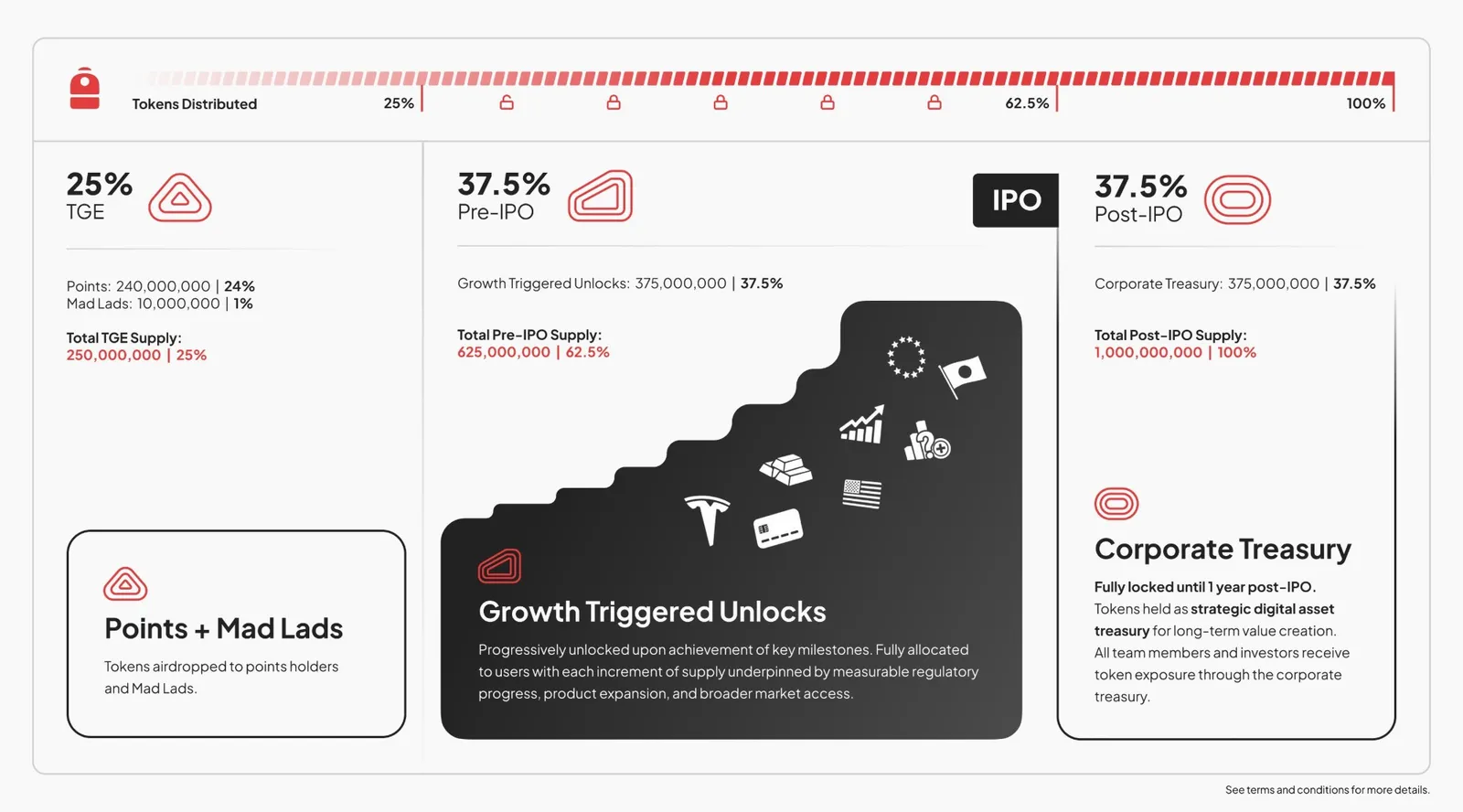
The token carries a written claim on company equity, which changes how it should be valued. Backpack's token launched on 23 March 2026 with 1B supply, no allocation to founders, staff or investors, and the split shown above (CoinDesk). The equity terms sit in Backpack's participant-program FAQ (Backpack). A holder who keeps tokens staked continuously for a year, and stays a monthly active user, earns the right to exchange each token for 12.5% of a Backpack company's equity divided by 625M, the pre-IPO token count; staying staked up to three more years adds another 7.5% on the same basis, accruing daily. The pool is therefore 20% of each company, benchmarked to the 23 February 2026 cap table: 12,853,914 ordinary shares of Trek Labs Ltd., the British Virgin Islands company that runs the exchange, and 9,491,900 common shares of Blue Coral Inc., the Delaware company that runs the wallet. The exchange happens only at a "Backpack Exit Event": an IPO on a U.S. exchange, a merger, an acquisition, or another major liquidity event. What the holder receives is non-voting common stock of a special-purpose vehicle that holds the company's shares, a British Virgin Islands entity in the exchange's case.
The rights come with conditions a buyer has to price. Backpack may redeem accrued rights for cash at any time, at a "Qualifying Value" it calculates and which is final absent manifest error; it must also pay cash where a regulator bars equity in a jurisdiction. Eligibility by country, and whether U.S. persons qualify, is not published. The share-count denominator is fixed, so later fundraising dilutes the exchanged stake like any other shareholder's. Nothing else reaches the token: stakers get trading-fee discounts and 0.5–3.0% extra yield on USD lending, and there is no buyback or fee share (@Backpack). As for supply, CoinGecko has counted 250M tokens in circulation on every day since launch, so none of the 375M growth-triggered tokens appears to have been released, even though "open up stocks" was one of the milestones Ferrante named in February (@armaniferrante); Backpack has not said who decides a milestone is met.
Read as an option on the company, the price is the problem. At $1.23 the token values Backpack at $3.84B if every eligible token stays staked four years, and $6.15B on the one-year base alone, against the $1B pre-money valuation reported in February for a raise that has not been confirmed. The 375M growth tokens dilute the float 2.5 times before any IPO without diluting the per-token equity claim, because the 625M denominator already includes them; the 375M treasury tokens arrive only a year after an IPO and carry the team's and investors' exposure.
Our verdict on the owner's thesis: the leadership case is supported, and more by the licensing record than by Mad Lads. Backpack's token moves out of "not investable" (@armaniferrante argues the same case for equity conversion): it is the only token in this basket with a contractual path to company equity, which is an accrual path in its own right, and Backpack is one of the few venues already selling stock tokens and stock perps together outside the U.S. At $1.23 the price already assumes a $3.84B company, so we would start with a small position and build it at or below $0.64, where full-accrual conversion implies about $2B, or on a priced round or U.S. IPO filing that resets the company value. Backpack still has to publish which countries can make the election. Its three-letter symbol is shared with the oil company $BP, so check the Solana contract address before buying.
Is $ONDO Cheap? — The Lead Issuer and Its Switch
Ondo the company is winning; the question is whether $ONDO the token owns any of it. The business is broad. Ondo Stocks, renamed from Global Markets in July, is the largest tokenized-stock platform at $868.7M of distributed value across 408 assets on rwa.xyz, on Ethereum, Binance's chain and Solana, and offered inside wallets such as MetaMask. Its tokenized Treasury funds hold $2.56B on DefiLlama. Ondo Perps launched in July on the new Ondo Network with its own tokenized stocks as margin. It bought Oasis Pro, an SEC-registered broker-dealer, alternative trading system and transfer agent, in October 2025 (Ondo), and on 23 July 2026 that subsidiary received authorization from the broker regulator to offer tokenized equities and funds to U.S. investors (Ondo). On 24 September it launched three portfolio tokens, High Income, Diversified Growth and High Growth, that follow model allocations BlackRock designed across equities, bonds and bitcoin ETFs. BlackRock supplies the models only; Ondo Global Markets issues the tokens, rebalances them onchain and sells them outside the U.S. (@Ondo, The Block).
None of that reaches the token today. DefiLlama records $6.69M of yield on those funds in the last 30 days, all of it passed to the holders of those products, and zero protocol revenue, because one charges no fee and the other's 0.15% fee is waived until 2027 (DefiLlama). Ondo Stocks and Ondo Perps are not tracked, and Ondo, a private company, does not publish revenue. If it earned a typical 0.15% to 0.50% a year on its $3.5B of assets, that would be $5M to $18M, our estimate rather than a disclosure. $ONDO itself is a governance token with no buyback, no fee switch and no staking yield, and its terms say it carries no right to Ondo's profits or revenue; the Ondo Foundation manages the treasury, and no governance proposal has been executed since 2024 (Ondo docs, DefiLlama). Holders revenue is $0, and the switch sits with the Foundation.
On today's accrual $ONDO is dear: 0.69 times its TVL on 29 September against 0.33 for Sky's token and 0.36 for Pendle's, both of which pay holders. That comparison prices the token as if the switch will never turn, and that is where we think the market is wrong. Price the switch instead. At the 30 times holders revenue $UNI has held, the $2.43B market cap needs about $81M a year reaching holders. At a 0.15% to 0.50% take that is $16B to $54B of assets, 4.6 to 15 times Ondo's $3.53B today, before any revenue from Ondo Perps or the BlackRock portfolios, whose fees Ondo has not disclosed. Tokenized stocks grew 15.5% in September alone; at that pace 4.6 times takes under a year, and at a third of it, closer to three. At $0.498 the token is 77% below its December 2024 high of $2.14. Supply sets the timing: 48.7% circulates, and 1.94B tokens, about 40% of today's float, unlock on 18 January 2027, with the rest vested by January 2029 (Tokenomist).
The catalysts are real, and each one widens the fee base a switch would draw on. The SEC order does not reach Ondo Stocks, which are notes backed by custodied shares rather than the issuer's stock. The U.S. path runs through Oasis Pro's new authorization, the BlackRock portfolios widen distribution, and Ondo Perps puts Ondo's own stock tokens to work as margin in the market this memo is about. Against them sit the January unlock, bStocks at $761.7M closing on Ondo's lead in value, xStocks ahead on crypto-native trading, and the fact that Ondo's switch sits with a foundation, which the SEC staff's buyback answer does not cover as cleanly as token-holder governance. On 27 September the price had run 58.5% in 30 days and sat 49% above its 50-day average, so the trend leg of our ranking is met.
Our verdict: $ONDO is the lead issuer in a market we expect to go global, and the token is an option on Ondo turning that lead into holder revenue. It is not cheap on today's structure; we are buying the structure changing. We would accumulate in tranches: a first position now and the larger part after the 18 January unlock has cleared, adding on any Ondo Foundation proposal that routes revenue to holders through a buyback or staking, on Ondo publishing revenue, or on Ondo Stocks passing $2B of distributed value. The owner can buy it on Robinhood (Robinhood).
Management & Track Record
$HOOD's management has done what it said on costs through a year of new products. In April the chief financial officer raised the 2026 outlook for adjusted operating expenses plus stock compensation by $100M to $2.7B–$2.825B to build Trump Accounts; three months later, with two acquisitions added, he cut it to $2.675B–$2.775B. The company bought back 7.5M shares for $664M in the first half and raised $2.2B of 0% convertible debt with, in his words, "no net dilution until our share price exceeds $300." Across four calls in 2026 the stock-token story moved from Europe-only in May to 120 countries and a wallet with perps by July, which is the pace of shipping the thesis needs.
We're lowering and tightening our 2026 outlook for adjusted OpEx and SBC to a range of $2.675 billion-$2.775 billion.
The revenue and margin trend is the reason we separate $HOOD from the rest. Annually, Robinhood's revenue went from $1.82B in FY21 to $1.36B in FY22 (−25.2%), $1.86B in FY23 (+37.3%), $2.95B in FY24 (+58.2%) and $4.47B in FY25 (+51.6%), while net margin climbed from −203.1% and −75.7% through −29.0% to 47.8% and 42.1% (Q2 10-Q). The quarterly series across the basket, from SEC filings with fourth quarters derived from annual totals, shows the split between names that are compounding and names that are waiting:
Cash against profit needs care at a broker, and we state it rather than lean on it. $HOOD reported $1,638M of operating cash flow against $1,883M of net income in FY25, 87% conversion, but $2,758M of operating cash flow against $911M of net income in the first half of 2026, because customer balances and securities lending pass through its operating cash flow. For a broker the quality test is the cost line, not the cash line, and the cost line held. $CRCL converted better than its accounts suggest, with $539M of operating cash flow against $103M of net income in the first half, while $COIN posted a $753M first-half net loss with operating cash flow still positive at $380M.
$SECZ's management has missed its own targets once already this year. It went public aiming for $9B of assets under management by the end of 2026 and was near $5B in August; it had pointed to $85M of contracted or AUM-based 2026 revenue and now guides $70M–$80M. The mix moved toward servicing: in the second quarter tokenization was $7.84M, 54% of revenue, and asset servicing $6.60M, 46% of revenue, against 58% and 42% a year earlier. That is a business shifting from one-off token launches toward recurring administration, which is the right direction at a smaller size than it promised.
We now expect total revenue to be in the range of $70 million-$80 million for the full year 2026.
Hyperliquid has no public management to hold to a guide, so its record is the code and the docs. It raised no venture money, it put the fee path in the protocol rather than in a treasury vote, and it has changed that path in public: HIP-3 moved deployers from zero to a 50% share of their markets' fees, which is why holders' share fell from 97%. We read that as the protocol paying for distribution in the open, and it is exactly the decision we will watch reverse.
Risks & What Breaks It
The weakest assumption in our thesis is that a weekend price invented by a perp's own order book is good enough for the world's traders to keep using. The evidence is mixed at best. WuBlockchain's study of Binance stock perps found that across 25 weekend observations the Sunday direction matched Monday's cash open 13 times, 52%, no better than a coin (WuBlockchain). Over the U.S. Independence Day weekend the SanDisk perp priced most of a +4.8% opening gap in advance; one August weekend it traded above Friday's $1,212.21 close at $1,223.98 on Sunday and the stock opened at $1,203.41. A trader who sized for the Sunday price was wrong on Monday.
Keone Hon's argument deserves its own line because it could be right. Dated futures handle occasionally priced assets better: expiry pins the contract to a real closing auction, and funding does not have to be computed from a book with nobody in it. If U.S. regulated venues offer dated single-stock futures with deep liquidity, the perp may end up an offshore product for weekend speculation rather than the default way the world holds leveraged stocks. What would change our view: two consecutive months in which HIP-3 open interest falls below $2.5B, a $CME win in its suit against the CFTC, or a large reopen gap that leaves trade.xyz or Ondo Perps with bad debt.
Part of his argument has a date on it. On 6 December 2026 Nasdaq, NYSE Arca, Cboe and Members Exchange open an overnight session, Sunday to Thursday from 8pm to 4am New York time with a short pause, and the consolidated tape extends its hours the same day; the Depository Trust & Clearing Corporation has cleared on a 24-hours-a-day, five-days-a-week schedule since 29 June (WilmerHale, Depository Trust & Clearing Corporation). $SPY already trades overnight on the Blue Ocean system behind Robinhood's 24 Hour Market. A stock with a trustworthy price 6.5 hours of the week's 168 becomes one with a price about 115 hours of 168, and a perp's funding gets a real reference for most of the week. The weekend stays dark: the exchanges state that weekends and holidays are still not trade dates. That leaves the perp the only venue quoting $NVDA from Friday night to Sunday night, which is both its risk and the reason traders outside the U.S. will keep using it.
Price Setup
All prices are the 25 September close for equities. $HOOD at $119.40 is 14.5% above its 50-day average of $104.25 and 26.2% above its 200-day of $94.63, with the 50-day rising; options positioning puts the call wall at $120, right at the price, and the put wall at $100. It trades 22% below its 52-week high of $152.46, which leaves room for the trend to run before the old high matters.
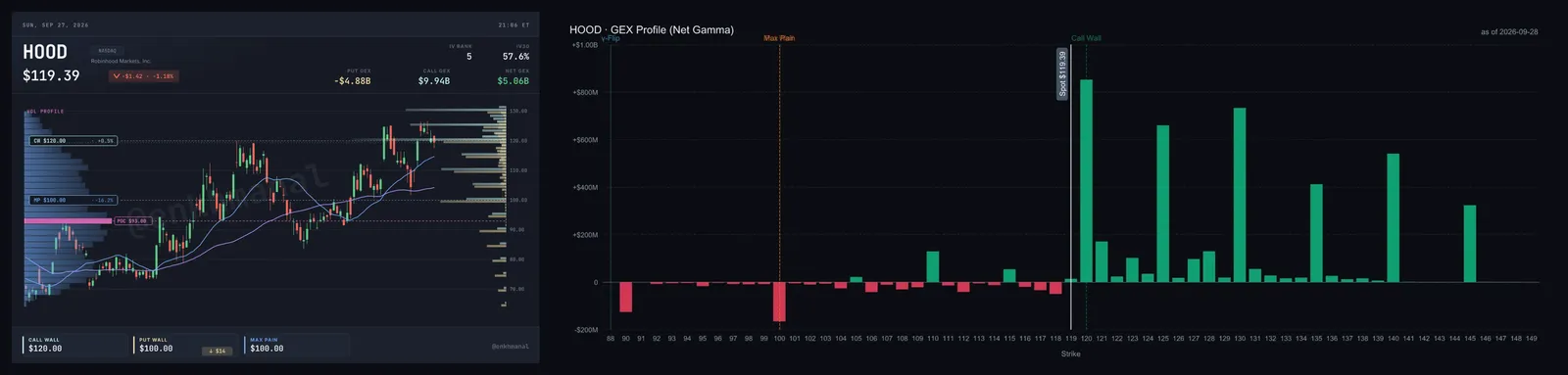
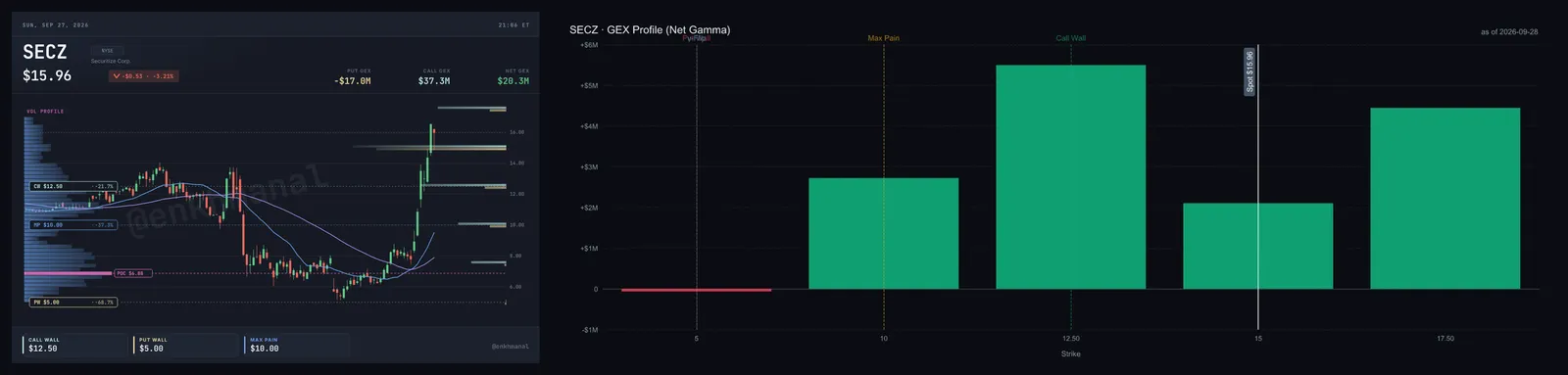
$COIN at $195.11 is 14.5% above its 50-day and 4.1% above its 200-day, recovering but still half its 52-week high of $387.27; walls sit at $220 and $125. $CRCL at $89.00 is 11.8% above its 50-day and 3.4% above its 200-day, with walls at $120 and $75. $SECZ at $15.96 has more than doubled its 50-day average since listing; its options chain is thin enough that both walls, $12.50 and $5, sit below the price, so positioning tells us little. Among the tokens, $HYPE at $90.76 on 27 September is 13.9% above its 50-day and 52.6% above its 200-day, four days after a record high of $97.96; $UNI rose 118.6% in 30 days as its fee-switch revenue grew.
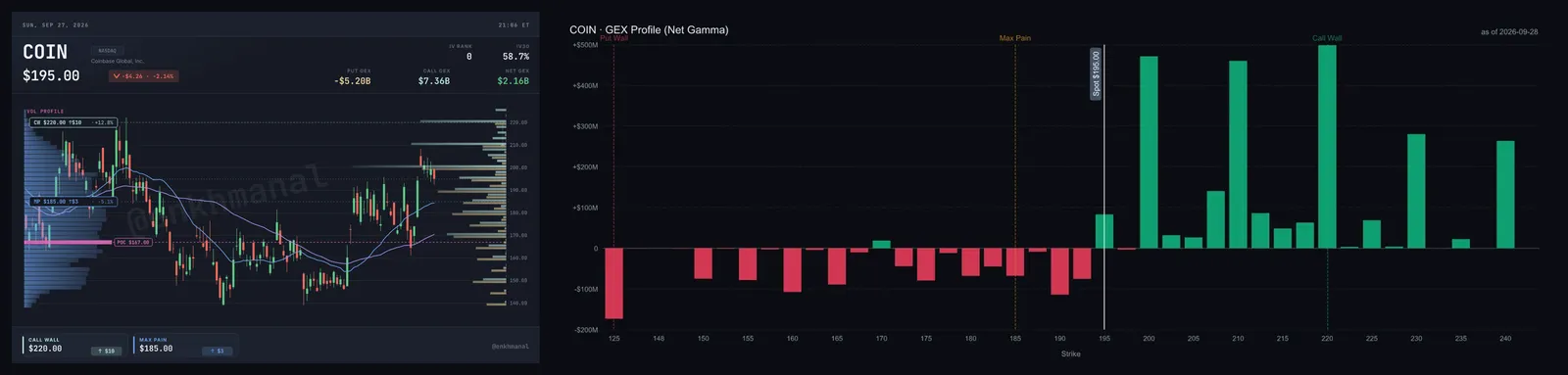
The remaining chart is here for completeness rather than for a trade. Neither $CRCL nor $SECZ is a buy on our axis today, and the setups say the same: both have run hard off their lows into the September news, and neither has the revenue acceleration that would let us call the move a trend rather than a reaction.
$SECZ's chart is the sharper warning of the two. The stock fell 54% in its first six weeks of trading, then rose 185% in the next seven, including 93% across the two weeks around the SEC order. Securitize's own business did not change by anything like that in September; the narrative did.
Valuation & House View
We use one screen for every name so they can be compared: at the 25 September price, what annual growth in the relevant per-share metric does each need over three years to return 15% a year, at two exit multiples? The metric is earnings per share where earnings are positive, revenue per share where they are not, and holders revenue per token for tokens. The formula is required growth = (price × 1.15³ ÷ exit multiple ÷ base per share)^(1/3) − 1. Exit multiples are our assumptions, bracketed low and high; this is a hurdle screen, not a fair value, and it issues no price targets.
Read against the running rates, only one name clears its own hurdle today. $HOOD needs 26–39% a year of earnings-per-share growth and is delivering 48% on a roughly flat share count, at 52.8 times trailing earnings, almost exactly its five-year median of 52.5 times, per our valuation history against $SCHW and $IBKR (Q2 10-Q). $HYPE needs 16–33% a year of holders-revenue growth per token and has had none this year, and on the fully diluted count the hurdle is far higher. $COIN and $CRCL look easy at 10 times sales and hard at 6, with revenue going the wrong way; $SECZ needs 38–74% on a cut guide; $FIGR clears on growth that is not this theme's. $KMNO and $ONDO are screened on revenue that does not yet reach the token, so their rows are hurdles for the switch rather than for today's holder; we price both on the switch in the section above (DefiLlama).
The Torque Ranking — What We Would Own
The hurdle screen above asks what each name needs to return 15% a year. The owner's question is different: which tokens gain the most if the theme goes right. We rank the crypto names on that below, with the prize set against today's fully diluted value and the way each one fails beside it.
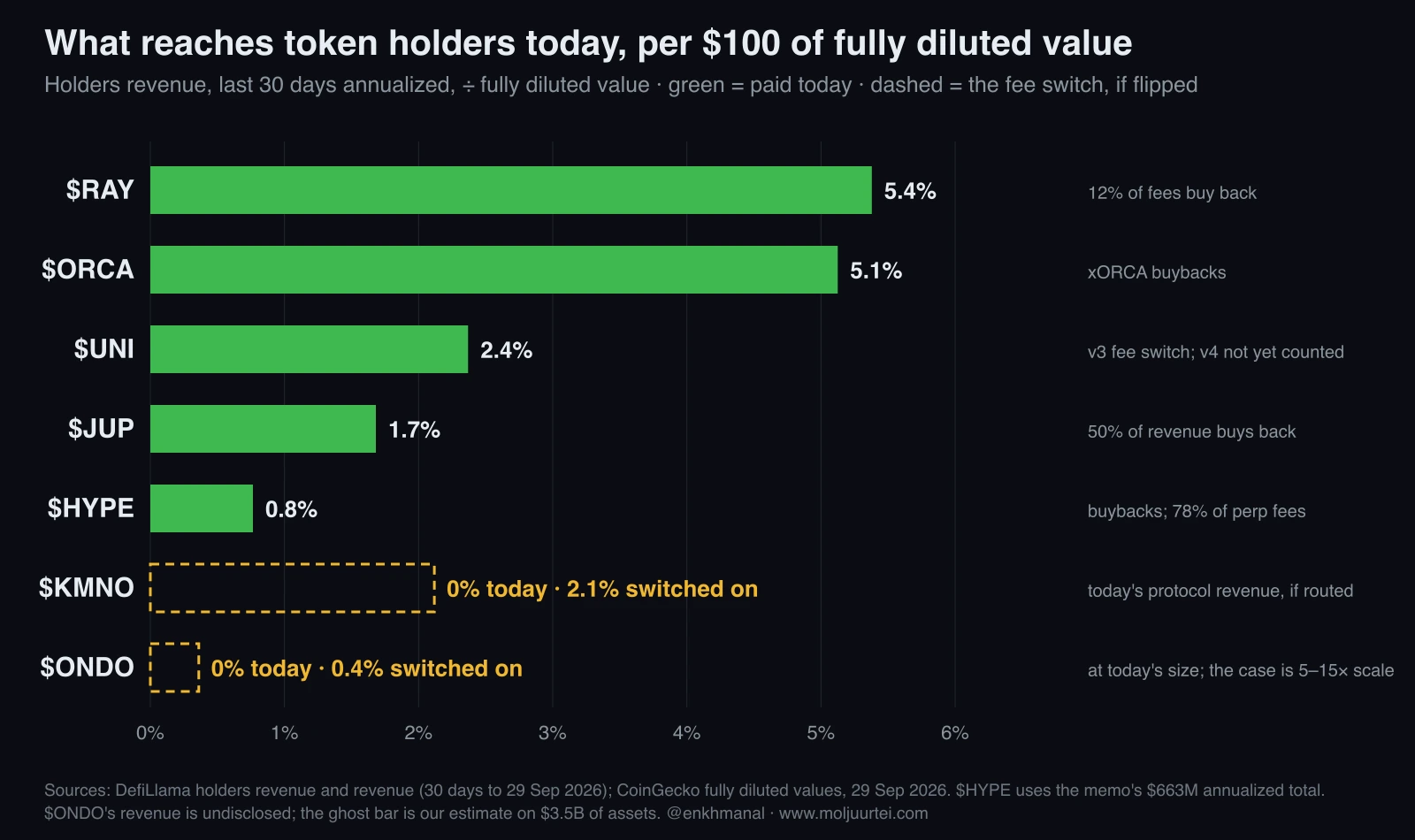
In order of torque: $RAY is a buy now, the one token already paid by stock-token volume that has arrived, and we add on each month that Raydium's stock volume sets a new high. $KMNO we accumulate now and add on a fee-share or buyback proposal, on two months of fees above $6M, or on the first stock-token LP vault. $JUP we accumulate on the stock-perp beta, adding when it opens beyond stakers and the fees show up in the buyback. $ONDO we accumulate in tranches, with the larger part after the 18 January unlock, adding on a Foundation proposal to route revenue to holders or on Ondo publishing revenue. Backpack's token is a starter position, built at or below $0.64 or on a priced round or U.S. IPO filing. $HYPE we buy when monthly holders revenue re-accelerates above $60M for two consecutive months. $ORCA and Meteora's token stay on watch until stock volume reaches them. $HOOD is the anchor: a buy at today's price with the 4 November print the first test, owned for the business it already has rather than for torque. $COIN, $CRCL, $SECZ and $UNI stay on watch with the triggers set out above, and $FIGR sits outside the basket because its growth is not this theme's. We review the whole basket by 5 November 2026.
What We Have Not Covered
We have not valued Binance, Kraken, Bybit or other private exchanges that run large centralized stock-perp books, because none is listed where the owner can buy it; Coin Metrics puts Binance's tokenized-stock volume above $3.7B in a single month, and that scale belongs in the competitive picture even without a ticker. We have also not covered Bullish ($BLSH), dedicated oracle networks, or the depository route, in which the Depository Trust & Clearing Corporation tokenizes securities while keeping the record inside the incumbent system.