$XGN Exagen — the autoimmune panel that reads complement fragments, and the quarter that proved the model works
investmentXGNdiagnostics
Autoimmune disease is not a disease. It is roughly eighty of them, sharing one set of symptoms and one screening test that says almost nothing. $XGN sells the thing that comes next: a single blood draw that measures forty-odd immune markers at once and returns a probability rather than a shrug.
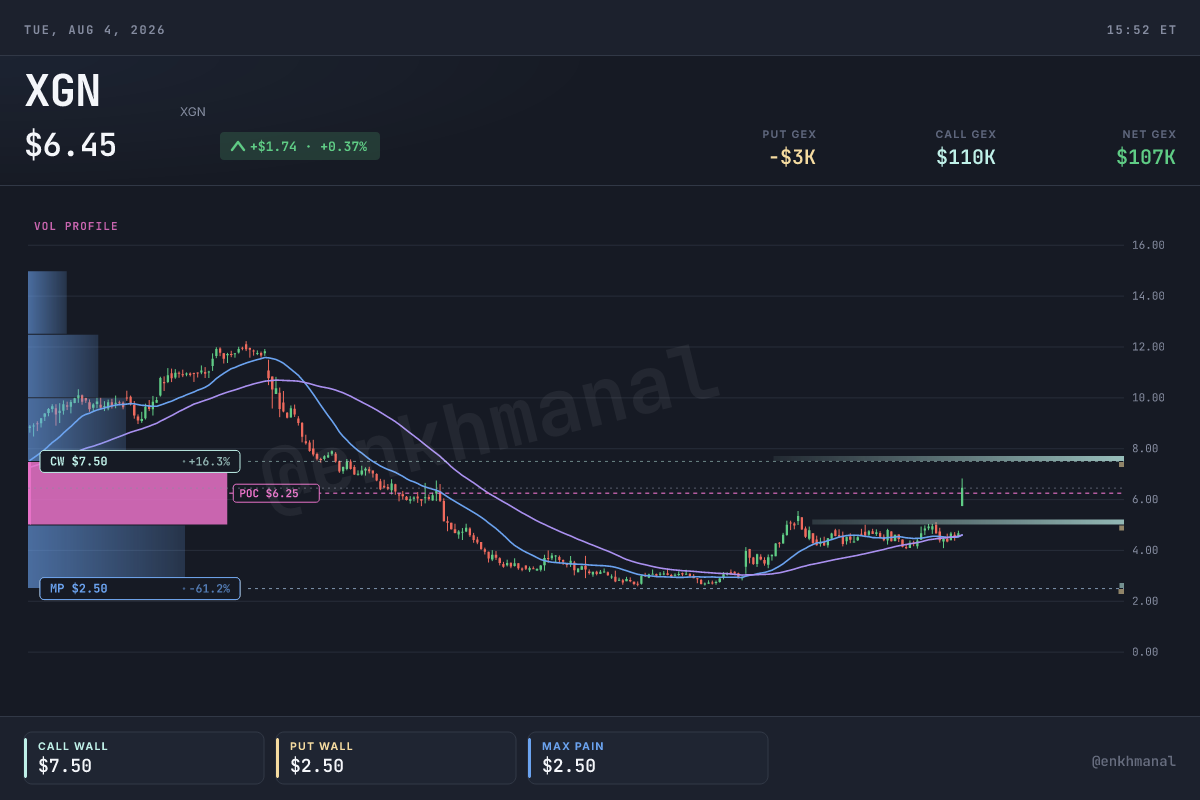
$XGN price and levels, 365 days to 4 Aug 2026. The stock gapped 38% over its 200-day (~$5.20) on the Q2 print.
LOG 01 // THESIS
A 1950s screen, an 80%-sensitivity answer, and a pipeline behind it
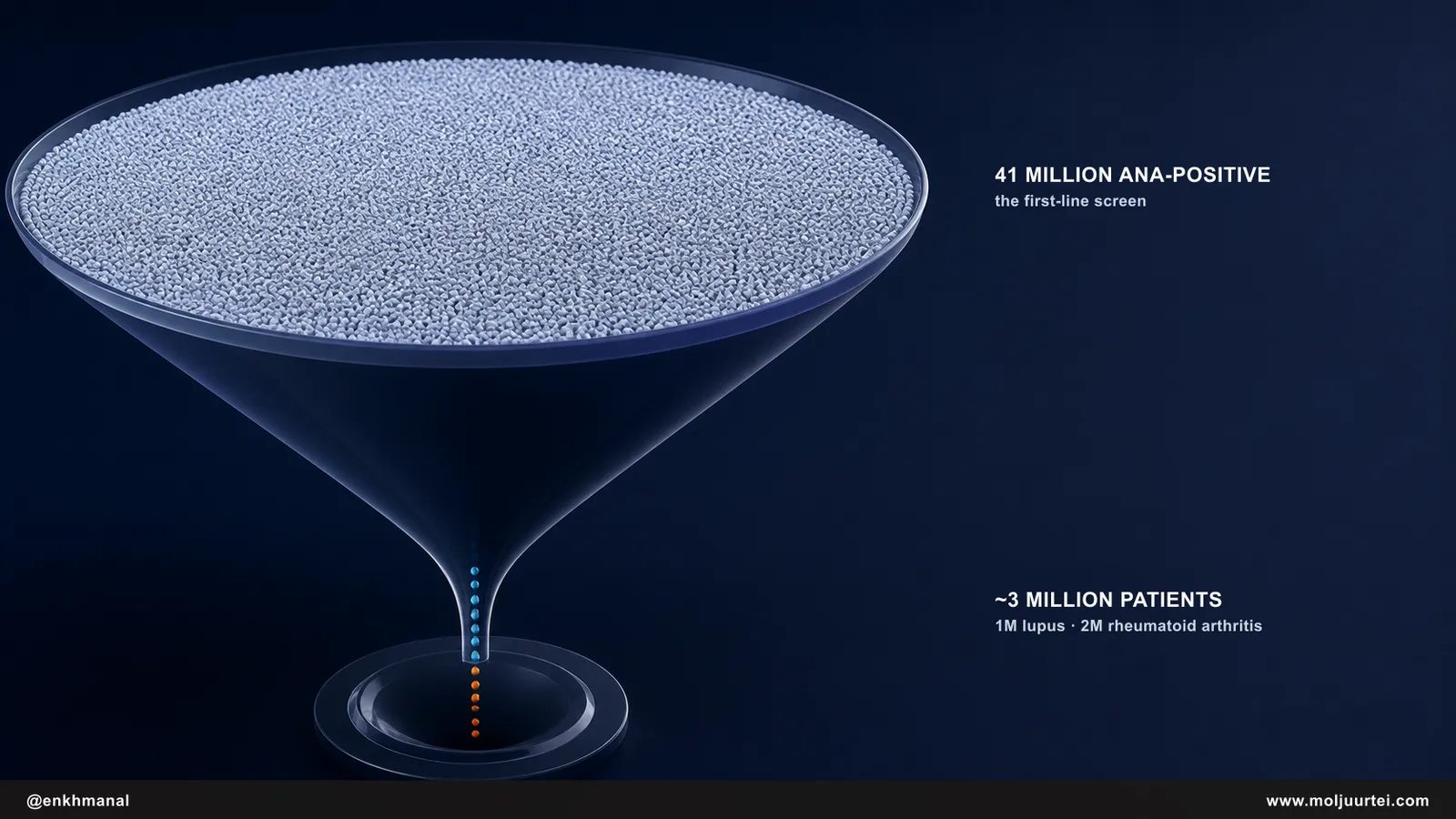
Autoimmune medicine is the last large field still triaged on single-analyte serology designed in the 1950s, and it fails in public: 41 million Americans screen antibody-positive on a test that identifies perhaps 3 million real patients, and a lupus diagnosis still takes six years. $XGN is the only commercial lab running cell-bound complement activation products — fragments welded onto circulating cells that record immune activity cumulatively instead of as a spot depletion — which lifts lupus sensitivity from 44% to 80% at 98% specificity.
That chemistry is patented to 2035 and has just extended into seronegative rheumatoid arthritis, where roughly 30% of genuine patients are invisible to standard antibodies. The bet is on the platform compounding: myositis ships in early 2027 into the channel's most-requested gap, a product roughly every twelve months behind it, and a pipeline that moves from one-time diagnosis into recurring disease-activity monitoring — with the operating model having just proven it scales.
LOG 02 // BACKDROP
41 million positives, 3 million patients
Americans ANA-positive
>41M
the first-line screen — sensitive, near-useless
Diagnosed with lupus
~1M
~6 years, 15 visits, 58 lab procedures to diagnose
With rheumatoid arthritis
~2M
~2 years and 4 physicians to diagnose
AVISE CTD tests delivered
>1.2M
~39,000 in Q2'26 alone, +11% YoY
the 41-million-to-3-million gap at true proportion — the reason a positive first-line screen starts a search instead of ending one
LOG 03 // TECHNOLOGY
Measuring the exhaust, not the fuel gauge
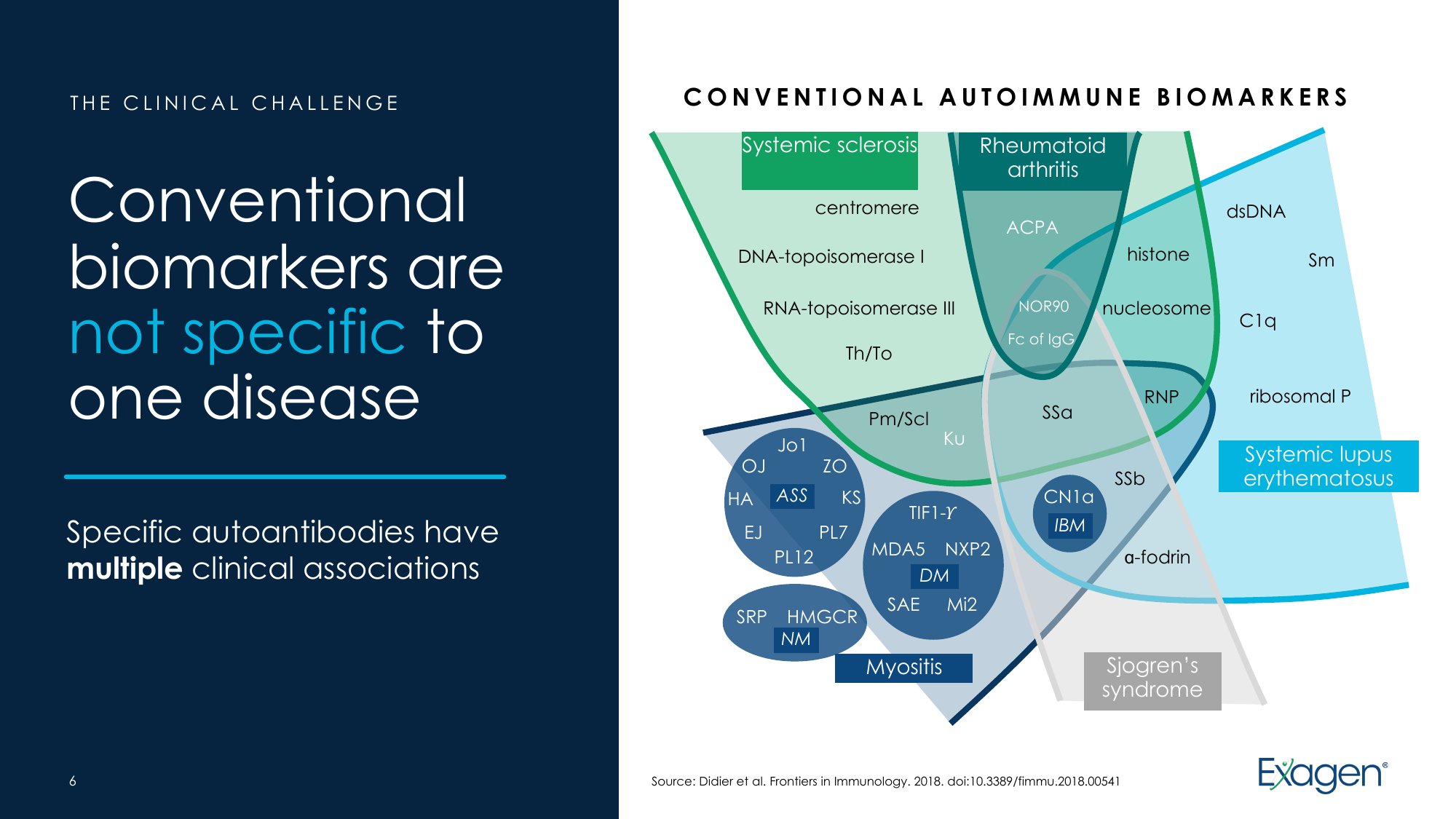
No single autoantibody is specific to a single disease. Anti-dsDNA leans lupus; ACPA leans rheumatoid arthritis; SSa/SSb lean Sjögren's — but they overlap heavily, and a patient can be positive for several while having one condition or none.
Why one marker cannot answer the question. Exagen Q2 2026 earnings presentation, slide 6 (after Didier et al., Frontiers in Immunology 2018).
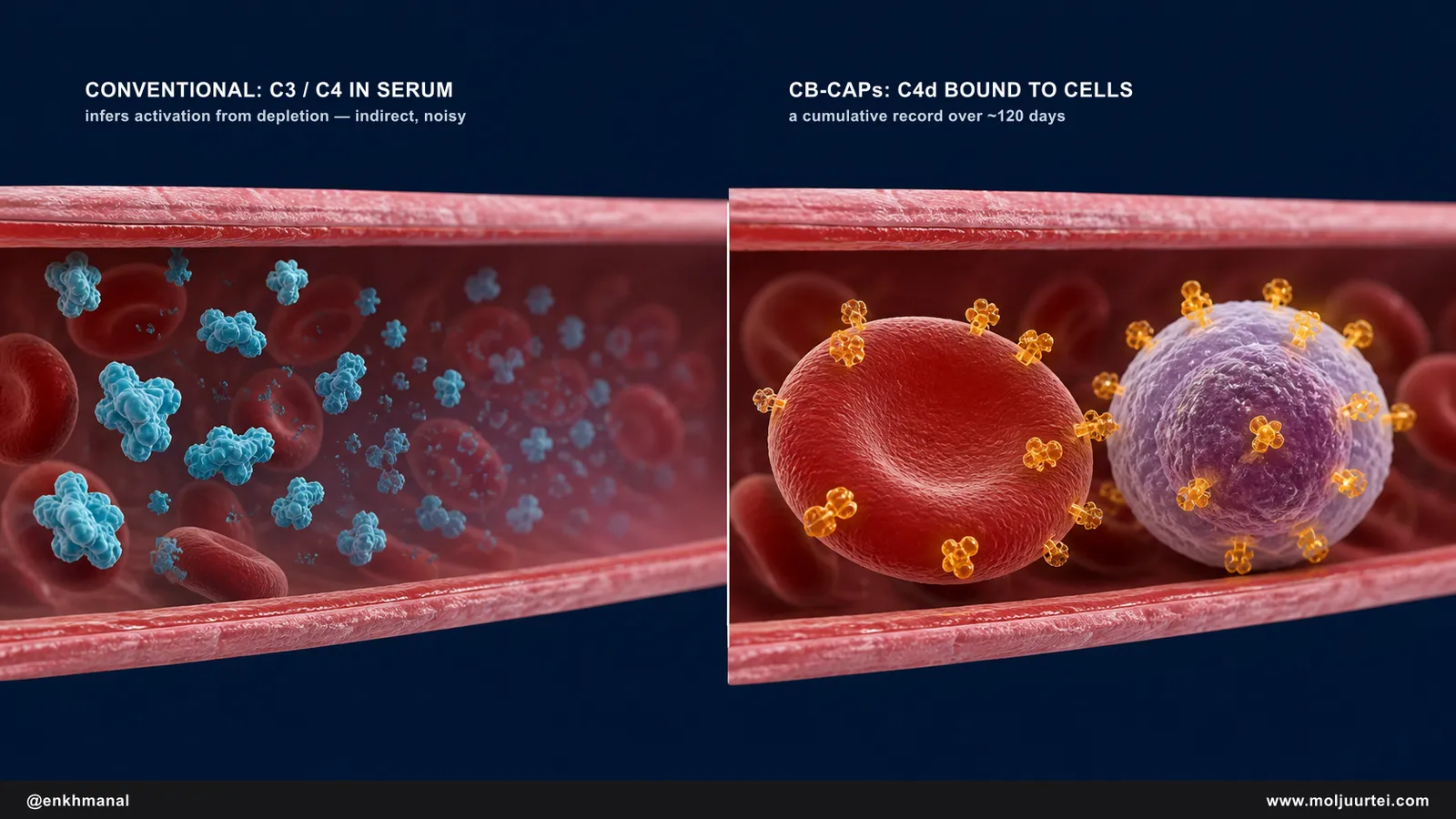
$XGN's differentiator is a class of markers almost nobody else runs commercially: CB-CAPs — cell-bound complement activation products. Classical serology measures complement proteins in serum (C3, C4) and infers activation from their depletion. CB-CAPs instead measure the fragments left covalently stuck to circulating cells after activation: EC4d on erythrocytes, BC4d on B-lymphocytes, and since 2025 TC4d on T-cells. Because red cells live about 120 days, the fragments they carry are a cumulative record rather than a spot reading. The test measures the exhaust, not the fuel gauge.
why sensitivity jumps from 44% to 80% — conventional serology infers activation from what DISAPPEARED, CB-CAPs read what stayed STUCK
Sensitivity for lupus — conventional markers vs AVISE
%
All company-reported from Putterman et al., Lupus Science and Medicine 2014 (n=794). AVISE reaches 80% sensitivity at 98% specificity vs healthy individuals; AUC 0.91 vs 0.79 for anti-dsDNA.
Two 2025 additions matter commercially. T-cell markers raise lupus sensitivity further and are rarely present in other rheumatic diseases. Anti-RA33 and anti-PAD4 attack a genuinely unserved population — seronegative rheumatoid arthritis, patients with real RA who test negative on ACPA and rheumatoid factor. Management claims these detect 30% of seronegative RA patients.
Patents issued / pending
16 / 5
10 US, 6 ex-US, as of August 2026
CB-CAP SLE family expiry
2032
T-cell + CB-CAPs to 2035; lupus nephritis to 2045
CAPSTONE cohort
~50,000
AVISE-positive 5.1× more likely to receive SLE diagnosis
2026 systematic review
3,100+
patients across 14 centres; found ~25% of SLE missed by conventional markers
LOG 04 // ROADMAP
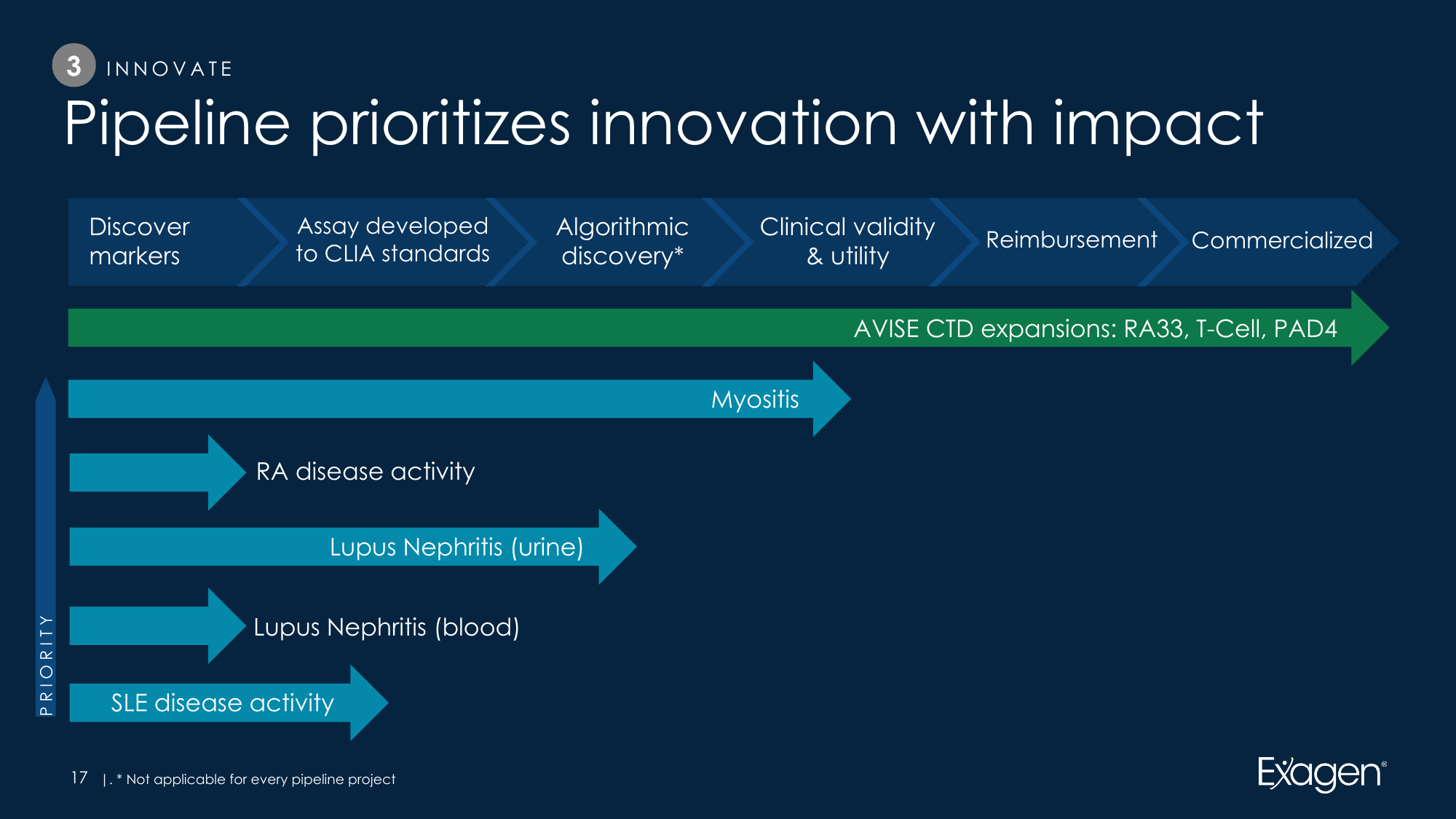
Myositis first, then monitoring
R&D is small in absolute terms — $1.4M in Q2, $6.3M in FY25 — which is the honest weak spot in a technology story. What it buys is a deliberately sequenced pipeline rather than a moonshot. The near-term item is myositis, the first standalone product in years, on track for early 2027.
“
It is the number one asked for product amongst our rheumatologist clinical base... it's not even close to the number two asked for offering.
— John Aballi, President & CEO, Q2 2026 earnings call (4 Aug 2026)After myositis the roadmap moves from diagnosis into monitoring — a recurring revenue shape. Exagen Q2 2026 presentation, slide 17.
Execution risk is lower than a typical launch. The two new laboratory platforms are already installed and analytically validated; clinical validation is in process; the sales force trains at the end of Q3 and sells it across all 45 territories to the same rheumatologist call point. Reimbursement launches on established methodology-based CPT codes rather than a novel-code fight.
LOG 05 // THE SETUP
What broke, and what just un-broke
2025-11-04Operational
Q3'25: revenue $17.2M, +38%
Guidance reiterated; said positive Q4 adjusted EBITDA expected AT THE HIGH END of the range. Stock near $12.
2026-01-11Risk
Preliminary FY25: $66–67M
Conceded 'unexpected ASP headwinds in the second half of the year' — the low end, not the high end.
2026-03-10Risk
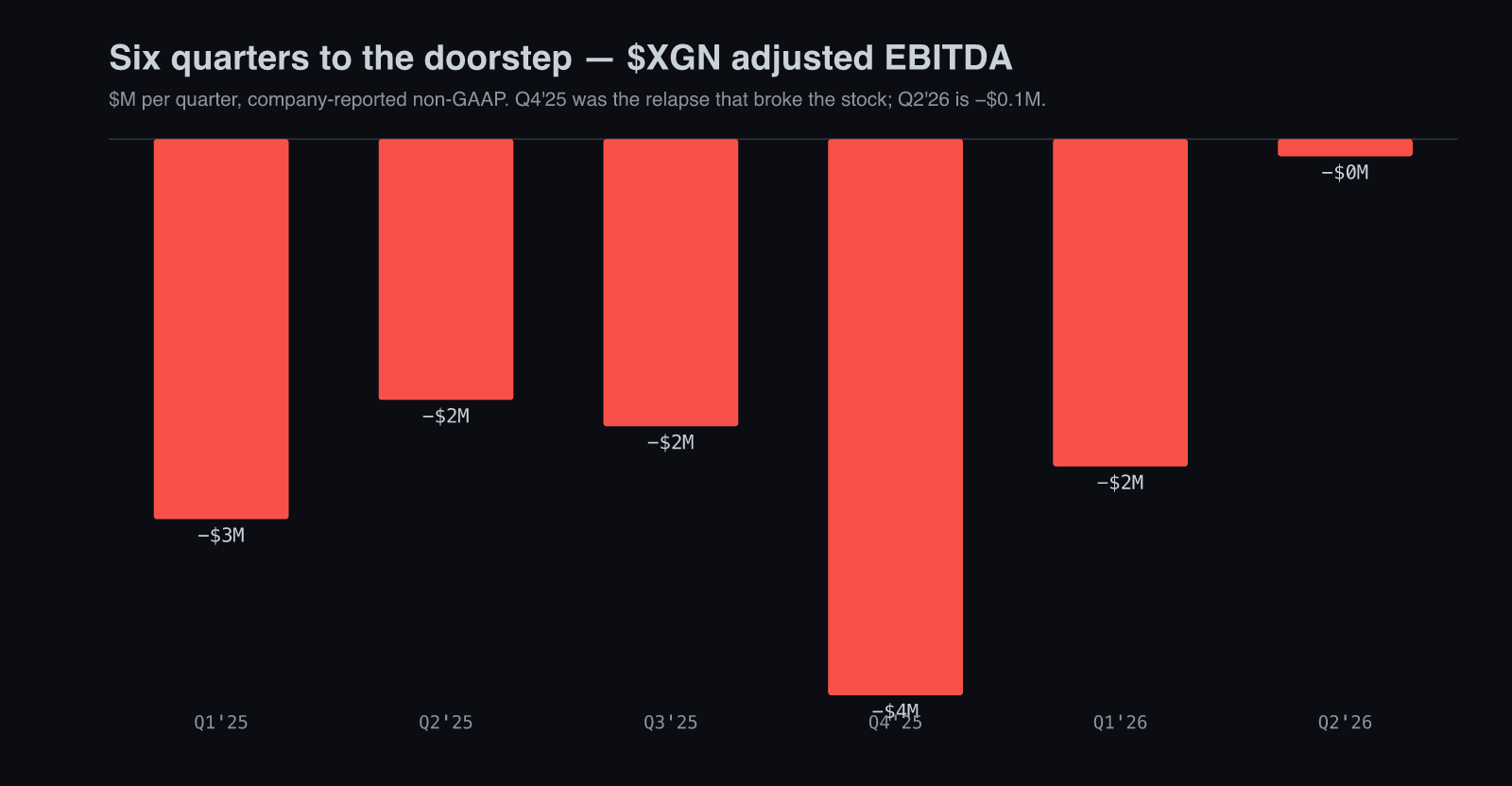
Q4'25: margin 55.4%, adj. EBITDA −$3.7M
Revenue fell sequentially to $16.6M; FY26 guided to $70–73M (+5–10%) after +20%. Stock bottomed at $2.65.
2026-08-04Award61.3%
Q2'26: record margin, breakeven EBITDA
Revenue $19.9M (+16%, beat by 11.6%), opex 70% of revenue vs 75%, adjusted EBITDA −$0.114M. Guidance raised to $72–75M.
Six quarters to the doorstep. Q4'25 was the relapse that broke the stock; Q2'26 is −$0.1M. All company-reported non-GAAP.
Underneath sits the metric management actually runs on: trailing-twelve-month ASP of $446, up $18 year over year and the 13th consecutive quarter of growth, from $284 at the end of 2022 — a 57% increase achieved with a static Medicare rate, entirely through commercial-payer appeals, administrative-law-judge hearings and evidence submission.
Note what the GAAP line hides: FY25's net loss of −$20.0M was wider than FY24's −$15.1M even as adjusted EBITDA improved, because interest expense rose to $4.3M on the Perceptive facility and warrant fair-value swings ran through the P&L. The operating business improved while the reported loss deteriorated.
LOG 06 // RISKS
The assumption that almost broke the thesis
The ASP engine may be a collections harvest, not a pricing re-rate. Q2's ASP included over $1M collected on claims more than 360 days old; H1 collected $2.3M of such recoveries against $1.5M in all of FY25. That is a stock of aged claims being worked down, not a flow.
“
The better we do in any given quarter, we're kind of working against ourselves because that typically has an impact on the accrual rate.
— Jeff Black, CFO, Q2 2026 earnings call (4 Aug 2026)the single assumption that almost breaks the thesis — that ASP growth is a finite stock being harvested rather than a recurring flow
What breaks it
Medicare is a four-year non-event — the MolDX coverage request has been pending since summer 2022, with no CAC meeting and no draft LCD. Model the LCD as free optionality, never as a base case.
Dilution is real and recent — shares went from 17.6M (Dec-2024) to 24.2M (Jun-2026), a 37% increase. $126.2M remains on the shelf.
Governance history is untidy — EDGAR shows 10 SEC comment letters, two restated filings and a late-filing notice, though the restatements cluster in 2022, before this management team.
This is a $156M-market-cap stock with a beta above 2.0 and thin liquidity, up 38% in a session with RSI at 78. The business inflected; the entry point is extended.
The flip condition: TTM ASP stalling for two consecutive quarters would break the memo.
LOG 07 // VALUATION
Reference-lab prices for specialty-lab economics
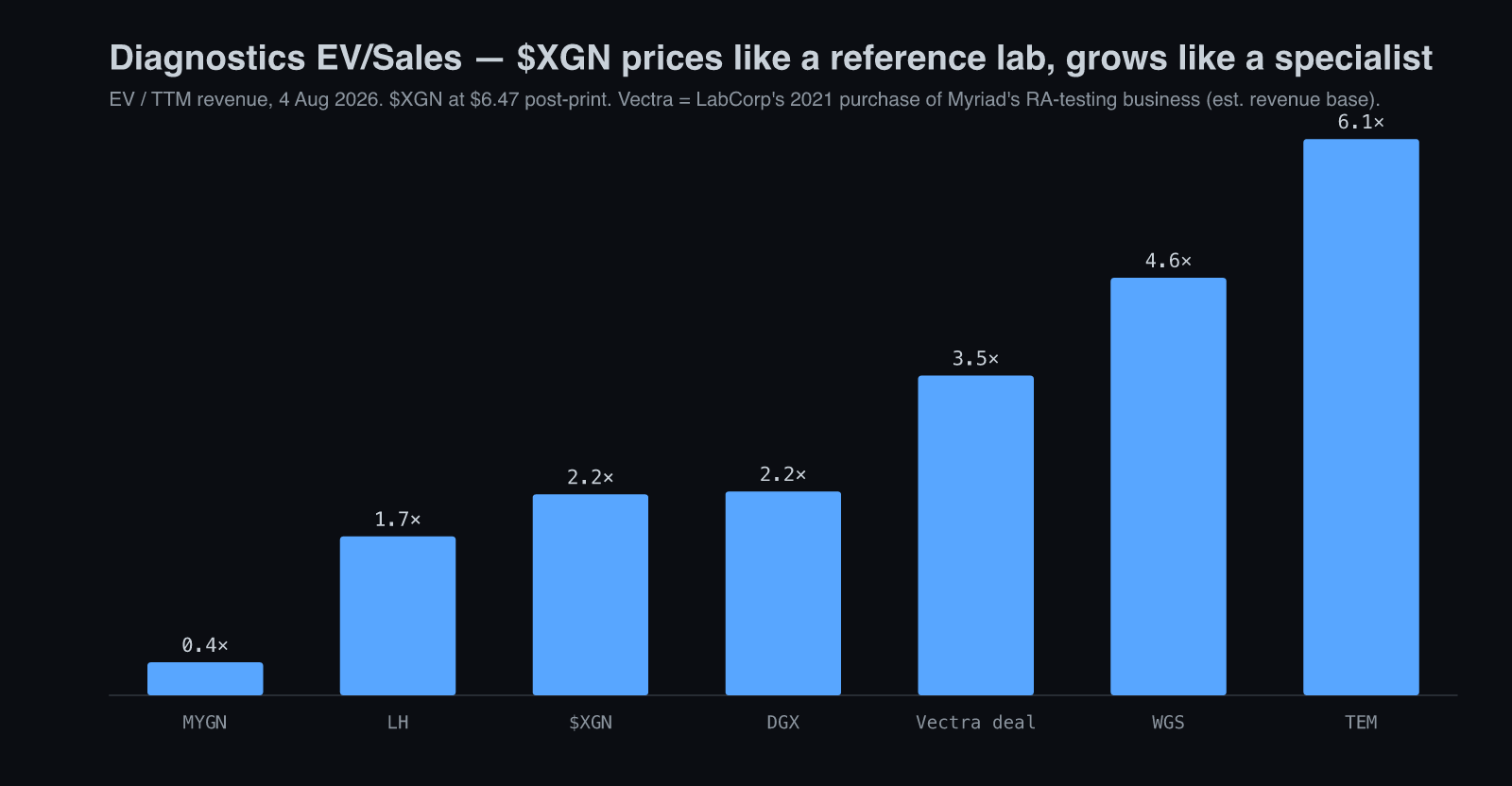
$XGN trades between LabCorp (1.74×, 6% growth) and Quest (2.23×, 10% growth) while growing 20.6%. $MYGN at 0.36× is where multiples go when growth stops.
Case
FY27E revenue
EV/Sales
Implied price
vs $6.47
Bear — ASP recoveries decay, growth reverts to 5–8%
$74M
1.2×
$3.55
−45%
Base — $80M revenue, adj. EBITDA breakeven, GM ~63%
$80M
2.5×
$8.00
+24%
Bull — myositis contributes, LCD lands, or a strategic buyer moves
$80M
3.5×
$11.25
+74%
M&A anchor: LabCorp paid $150M for Myriad's Vectra rheumatoid-arthritis testing business, closing 13 September 2021. Myriad never disclosed Vectra's standalone revenue (it was reported bundled with two other units at $20.7M in a quarter), so the commonly-cited ~3.5× multiple rests on an estimated ~$40–45M revenue base — treat it as approximately 3–4×, not a precise comp. $XGN today is roughly 60% larger than Vectra was.
Why it works
Q2'26 restored gross margin (61.3%, a record) AND held opex at 70% of revenue while accelerating revenue to +16% — the exact combination the bear case required it to fail at.
13 consecutive quarters of TTM ASP growth, $284 → $446, achieved with a static Medicare rate.
Roughly net-debt-free: $24.6M cash against ~$22.9M borrowings, plus $40M undrawn Perceptive capacity.
Myositis launches early 2027 into the #1 clinician request, on installed and validated platforms, using established CPT codes.
Board is a roster of people who have sold diagnostics companies — McKhann (Apollo, Silk Road), Nova (Decipher → Veracyte, $600M), Black (Apollo).
What I am watching
Watching: the ASP gain may be a stock of aged claims being harvested, not a durable pricing re-rate — the CFO says a good quarter raises the accrual rate against them.
Watching: MolDX coverage pending since summer 2022 with no CAC meeting and no draft LCD.
Watching: 37% share-count increase since Dec-2024 and $126.2M still on the shelf.
Watching: RSI 78 after a 38% single-session gap; beta above 2.0 on thin microcap liquidity.
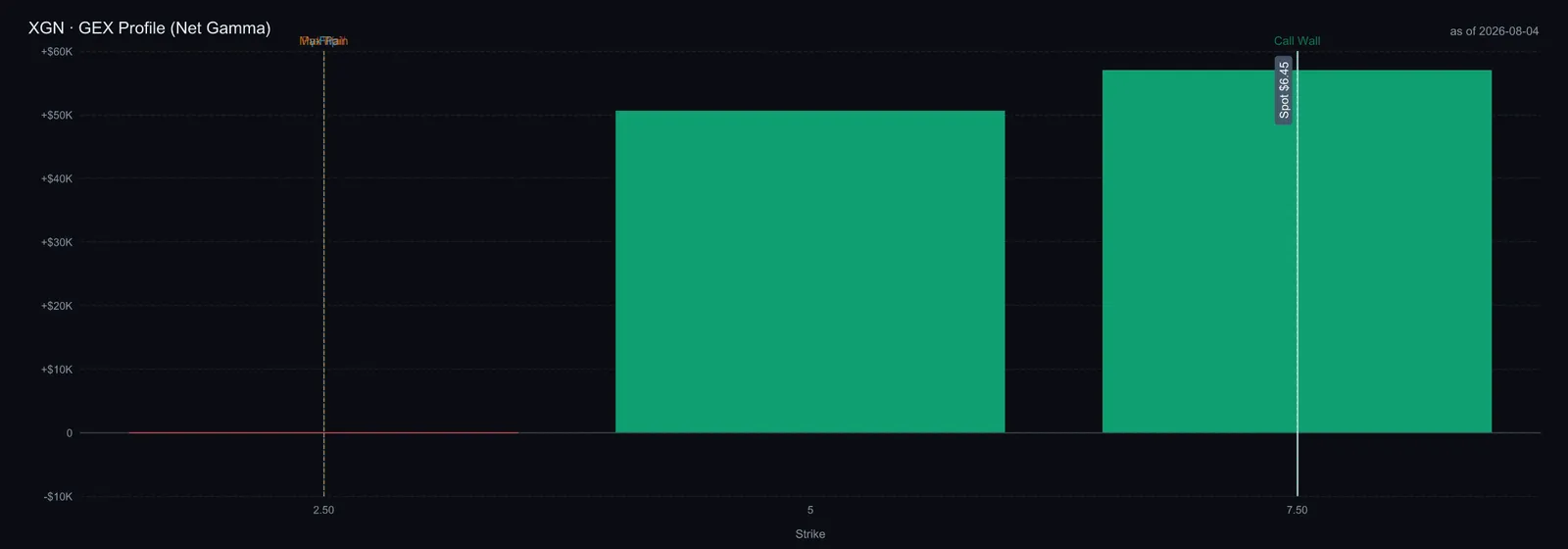
Dealer positioning after the print — call wall at $7.50 caps the near-term move; put wall sits far below at $2.50.
The Q2 print did the one thing the bear case required it to fail at — it restored gross margin and held opex while accelerating revenue. The business is now roughly one good quarter from sustained cash breakeven. Constructive, with the entry disciplined rather than immediate: the stock is 38% higher in a day with RSI at 78 and a GEX call wall at $7.50, so the risk is paying for six quarters of progress in one session. A pullback toward the reclaimed 200-day (~$5.20) is the attractive accumulation zone.
Slides reproduced from Exagen's public Q2 2026 earnings presentation (4 August 2026). Takeout framing via Investing with Martin and @AsymmetricRam; all figures independently verified against SEC filings (10-Q, 8-K, XBRL companyconcept) and the Quartr transcript. First internal coverage of $XGN.