
$VG Deep Dive — The Uncontracted LNG Windfall Meets a Qatar-Sized Hole in Winter Supply
Update · 8 October 2026. This deep dive was written on 8 July; the price, valuation, Qatar/Hormuz status and event calendar below are that day's snapshot. Venture Global's 11 August Q2 results subsequently confirmed 127 exported cargos and $4.6 billion of revenue, and reported $1.3 billion of net income and $2.5 billion of consolidated adjusted EBITDA. Management raised its 2026 adjusted EBITDA outlook from $8.2–8.5 billion to $8.7–9.1 billion. It said 91% of available 2026 cargos had been contracted, versus the 84% figure in the original memo, and revised the remaining $1/MMBtu fee sensitivity to $180–210 million of adjusted EBITDA. These updates strengthen the near-term earnings evidence but reduce the volume exposed to further 2026 spot-price upside. Management still targeted Plaquemines Phase 1 commercial operation in Q4 2026. On 1 October it signed a 20-year, 1.0 MTPA offtake agreement with ConocoPhillips starting in 2030. Construction funding, customer arbitration outcomes and volatile uncontracted-cargo fees remain the key risks. The scenarios and trading levels below have not been recalculated as of this update.
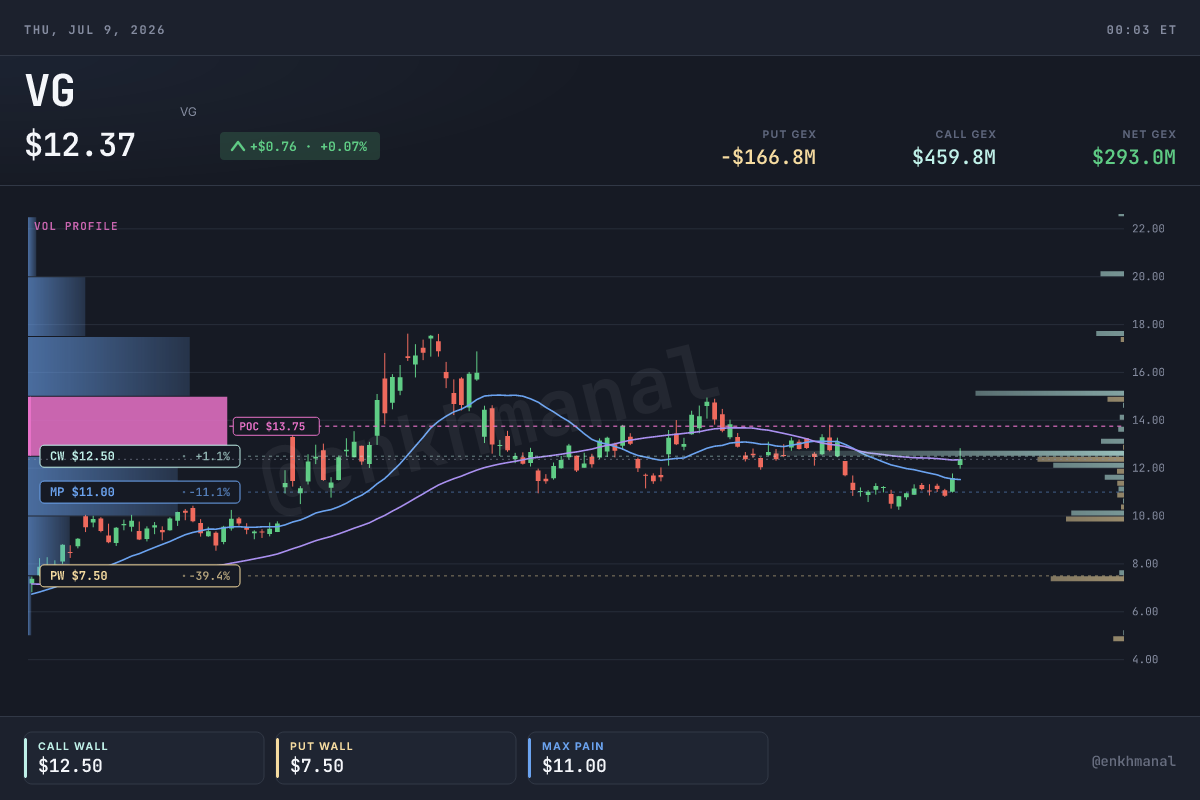
$VG is a levered, controlled, fast-growing US LNG developer whose commissioning-phase spot cargoes are simultaneously its single biggest earnings tailwind and the source of $5B+ in customer arbitration liability. The bull case — a structural Qatar outage pulling Atlantic-basin LNG into a low-storage European winter — is real and getting more acute by the week; the reasons the stock sits at $12.37 (down ~50% from its January-2025 IPO) are the leverage, the litigation, and relentless insider selling, not the demand story.
Executive Summary
- The setup. $VG exports LNG from Calcasieu Pass (operating) and Plaquemines (ramping) while ~50% of its ~100 MTPA target capacity is still uncontracted — so it captures near-spot economics on a large volume exactly as an Iranian strike on Qatar's Ras Laffan has removed ~12.8 MTPA (2 of 14 trains) from global supply for 3–5 years. Q2 2026 (reported 7/8): 127 cargos, 466.4 TBtu, an implied weighted-average fixed liquefaction fee of $6.45/MMBtu — roughly 2.5× the ~$2.50/MMBtu long-term contract fee.
- Why it's cheap anyway. ~$31.85B net debt (D/E 5.07×), a founder-controlled dual-class structure, 14+ insider Form-144 sale notices since April, and — the piece the bull reports omit — $BP won its Calcasieu arbitration (>$1B sought), Shell is appealing its loss, and four remaining Calcasieu customers seek $3.8–4.5B aggregate. The very spot-selling that drives the windfall is what created the liability.
- The one risk that matters. A fast Qatar restart plus the 2026–27 global liquefaction supply wave collapsing spot margins back toward the $2.50 contracted fee before Plaquemines/CP2 are fully de-risked — the "LNG glut" debate is live.
- Framing: high-conviction thesis, high-volatility vehicle. This is a sizing-discipline name, not a max-position name — the payoff is asymmetric but the leverage and litigation make the drawdown path violent.
Industry History & Technological Evolution
LNG turned natural gas — a stranded, pipeline-bound commodity — into a globally shippable good. Chilling methane to −162 °C shrinks it ~600× so it can cross oceans in specialized membrane tankers, then regasifying it at the destination. For fifty years the business was the province of national oil companies and integrated majors building 4–5 MTPA "trains" over 5–7 years at $1,000+/tonne of capacity, funded by 20-year take-or-pay contracts signed before a shovel hit the ground.
The US shale revolution rewired that model. Cheap, abundant Henry Hub gas made the Gulf Coast the world's lowest-cost liquefaction feedstock, and $LNG (Cheniere) proved in the 2016–2020 window that a merchant US exporter could sign SPAs at a fixed liquefaction fee (~$2–3/MMBtu) and let the customer bear commodity risk. That fixed-fee, toll-road model is the industry's cash-flow spine.
$VG's innovation was speed and modularity: instead of a few giant trains, it deploys dozens of smaller, factory-built modular liquefaction units, compressing FID-to-first-LNG to the fastest in industry history. That speed is the whole thesis — it let $VG bring Calcasieu Pass and then Plaquemines online into the 2022–2026 supply-scarce, war-disrupted window, capturing spot cargo economics that the slow incumbents structurally could not.
Company Origin & Industry Positioning
$VG was founded in 2013 by Michael Sabel and Robert Pender and went public in January 2025 at $25/share — one of the largest US energy IPOs in years, briefly valuing the company near $60B. It sits at the production node of the value chain: it owns and operates the liquefaction facilities, increasingly owns the ships (see the June shipping-loan below), and sells LNG either under long-term SPAs or, during the multi-quarter commissioning phase of each facility, on the spot market.
The asset base, in one picture (slide 22, below): three facilities on the Louisiana Gulf Coast at different stages — Calcasieu Pass (operating since 2024, 11 MTPA), Plaquemines (in construction & commissioning, 28 MTPA — this is what's ramping right now and drove 90 of the 127 Q2 cargos), and CP2 (under construction, 29 MTPA, first LNG targeted H2 2027) — plus development-stage bolt-ons. Together: 106 mid-scale trains, ~85 MTPA expected capacity, $137B of contracted revenue.
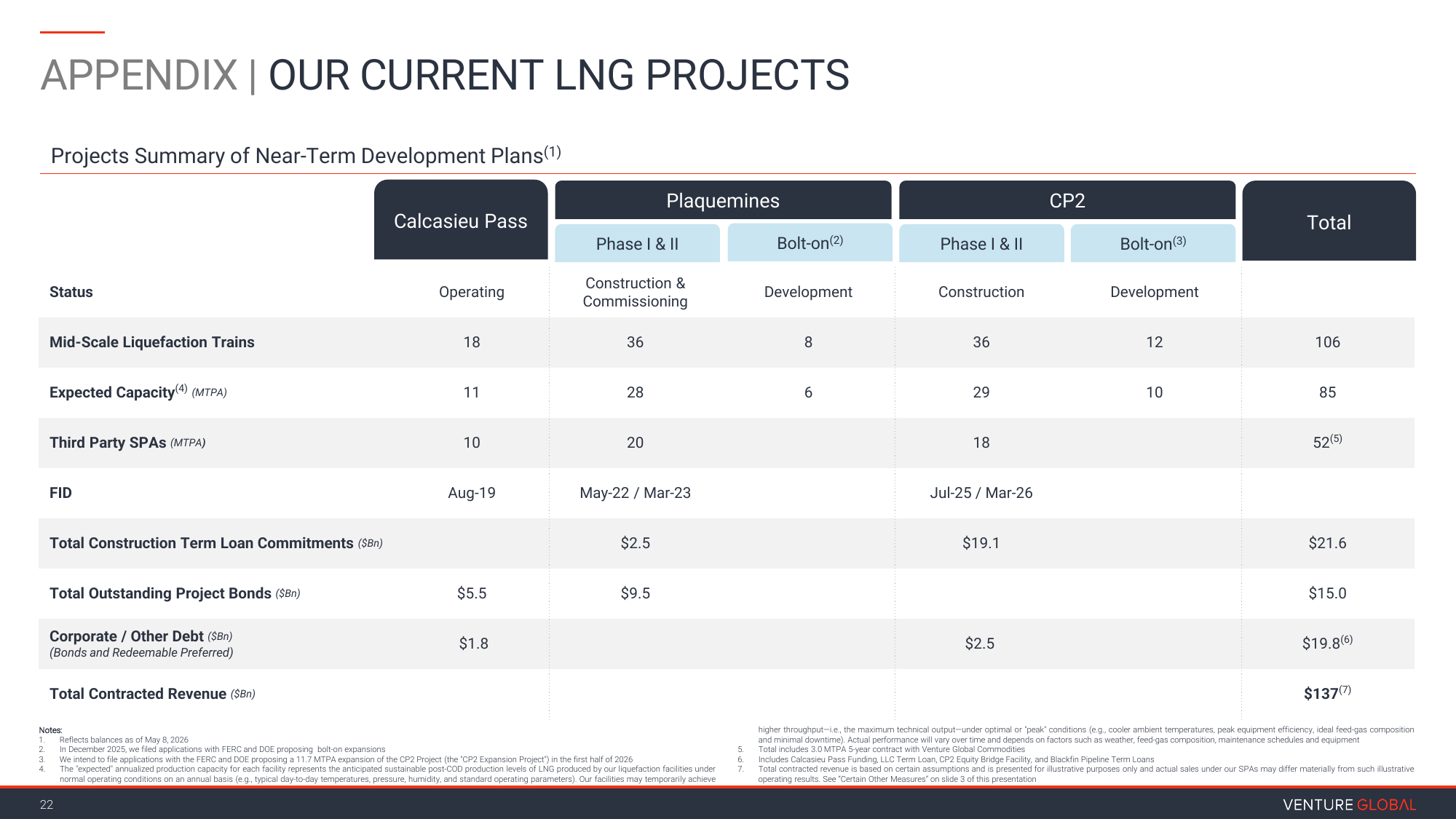
The debt number, decoded — because this is where the bear reports go wrong. That slide is also the cleanest read of the balance sheet. The widely-cited "$56.4B in debt" is the sum of three rows: $21.6B of construction term-loan commitments + $15.0B of outstanding project bonds + $19.8B of corporate/other debt. But "commitments" ≠ drawn: CP2's $19.1B term loan was only FID'd in 2025 and is largely undrawn, because you draw a construction loan as you spend. What's actually on the balance sheet today is roughly $34.2B gross debt / $31.85B net (SEC XBRL) — the $56.4B is committed financing capacity for a build that isn't finished, not money owed today. Crucially, nearly all of it is non-recourse project financing ring-fenced at each facility, secured by that facility's cash flows — so a problem at CP2 doesn't automatically sink Calcasieu. This is why straight consolidated EV/EBITDA overstates the leverage on the producing base: you're dividing 2026 EBITDA by debt raised against assets that don't produce until 2027. The bull argument is that this is a growth company being priced as a distressed credit.
The reason to stay skeptical is governance: $VG is a controlled company. Sabel and Pender hold super-voting Class B stock; public Class A holders (the $VG you buy) have limited say. Controlled LNG developers have a long history of prioritizing the sponsor and the build over the minority shareholder — and the current insider-selling pattern (below) does nothing to dispel that.
Technology Deep Dive
First, what "modular" actually means — because it's the whole thesis. A liquefaction plant chills natural gas to −162 °C in a "train" (a self-contained processing line). The incumbent model, which $LNG (Cheniere) and the majors use, builds a handful of enormous bespoke trains — each ~5 MTPA, custom-engineered on-site over 4–5 years, a giant one-off construction project every time. $VG inverted this: it uses many small, identical, factory-built mid-scale trains (~0.6–1.5 MTPA each) that are manufactured in a controlled shop, shipped to site, and bolted together like Lego. The project table (slide 22) makes the scale concrete — 106 mid-scale trains across Calcasieu Pass (18), Plaquemines (44), and CP2 (48), versus a dozen-ish jumbo trains at a comparable Cheniere footprint.
Why this is a moat and not just a design choice: (1) Speed. A factory line is faster and more repeatable than pouring a new mega-structure each time, which is how $VG claims the fastest FID-to-first-LNG record in the industry. (2) Cost. Repetition drives the per-unit cost down — management pegs production cost at <$0.40/MMBtu at Calcasieu and the low-$0.30s at Plaquemines at full capacity, a fraction of the realized fee. (3) Modularity of growth. Because the design is standardized and the sites are permitted, $VG can drop "bolt-on" trains into an existing footprint (CP2 Expansion +10 MTPA, Plaquemines Bolt-on +6.4 MTPA) far cheaper and faster than a greenfield project.
The speed compounds directly into returns — and management quantified it:
"We are increasingly confident [CP2] will be the fastest to progress from FID to first LNG, not only for Venture Global, but in the history of the LNG industry. That speed translates into returns, as we expect we should be able to earn back nearly all of our equity in the project with pre-COD cargos with a return on invested capital over 30%."
Mike Sabel, CEO & Founder, Q1 2026 earnings call (5/12/26)
That is the flywheel: build fast → sell the commissioning cargoes (the ones produced before the plant formally starts long-term contract delivery) into a hot spot market → recover most of the equity before the project is even "done." It is also, not coincidentally, the exact behavior that spawned the arbitration liability (§11) — the commissioning-cargo windfall and the legal exposure are the same coin.
The economic moat behind all of this is replacement cost. On the Q4 2025 call, Sabel put the global cost of new liquefaction capacity at "more north of $2,000 a [tonne]" (Michael Sabel, Q4 2025, 3/2/26, via Quartr) — while $VG has historically delivered projects at <$1,000/tonne. That ~2× cost advantage is the durable edge: it lets $VG under-price long-term SPAs versus any greenfield competitor and still clear a fat margin, which is why it keeps winning 20-year contracts (9.25 MTPA of new 20-year SPAs signed since re-entering the contracting market in April 2025).
The emerging bet is vertical integration into shipping. The June 26 credit agreement finances a fleet of nine LNG carriers — controlling the tankers lets $VG deliver on a "delivered ex-ship" (DES) basis, capture the freight spread, and reroute cargoes to whichever basin (TTF Europe, JKM Asia) is paying up. In a fractured, chokepoint-disrupted market, owning the ships is optionality, not just cost.
Peer Landscape — Technology & Price Action
The clean comps are the other listed US LNG developers: $LNG (Cheniere) — the mature, buyback-returning incumbent — and $NEXT (NextDecade) — the pre-cash-flow, single-project (Rio Grande) developer one rung riskier than $VG.
The price chart is the whole argument in one line. Over the past year $LNG rode the Qatar/winter tailwind to +11% while $VG is down 19% (and $NEXT −29%) — and $VG is the name with more uncontracted volume, therefore more torque to that exact tailwind. The gap opened after $VG's late-2025 selloff (the arbitration headlines + a soft-price scare) and has only partly closed on the Hormuz re-escalation.
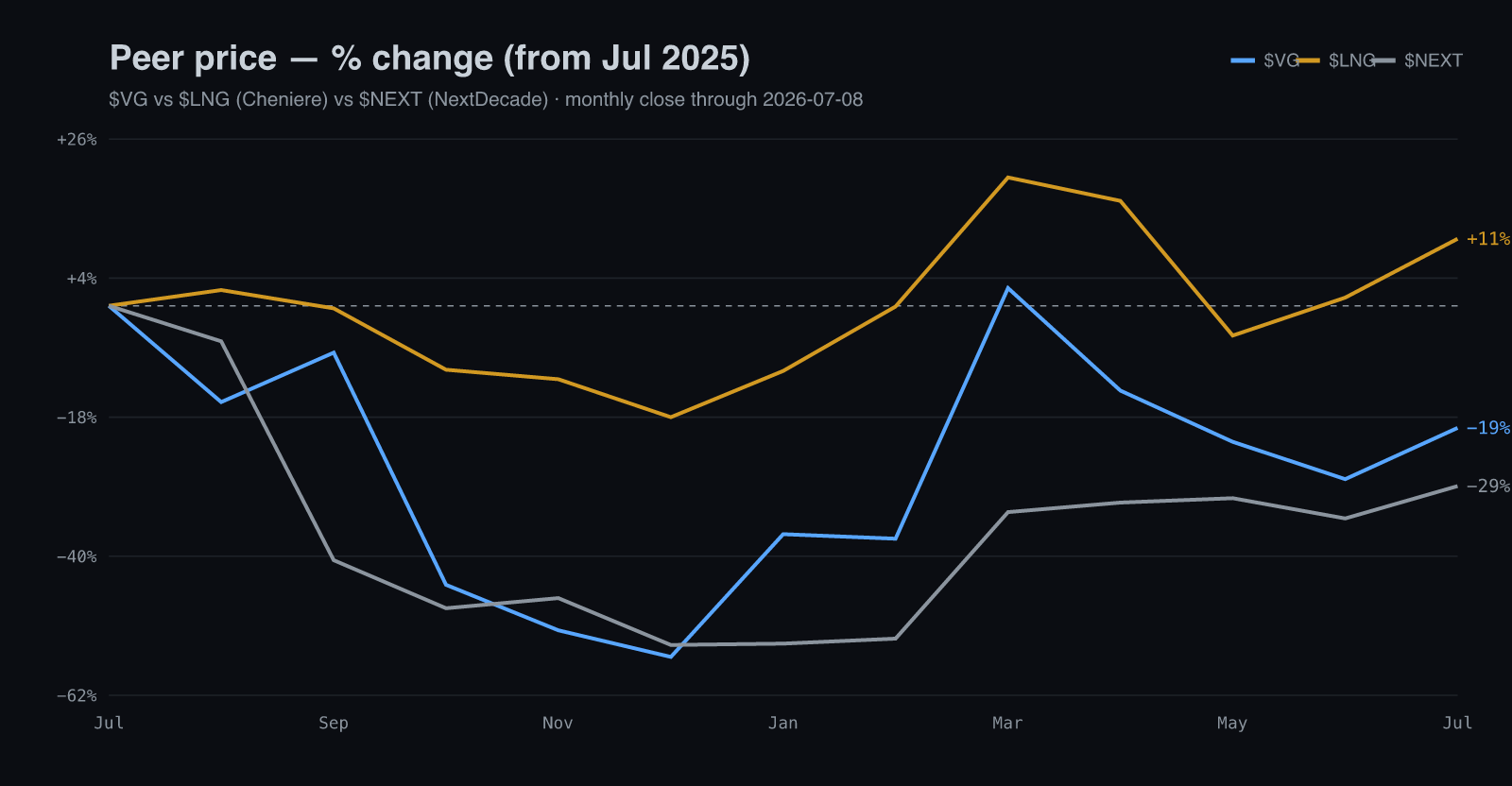
On valuation the discount is stark: $VG trades at roughly half $LNG's forward P/E and a ~30% discount on EV/EBITDA, despite faster growth. Some of that is deserved (leverage, litigation, no buyback/dividend yet); the bull case is that the rest is the mispricing.
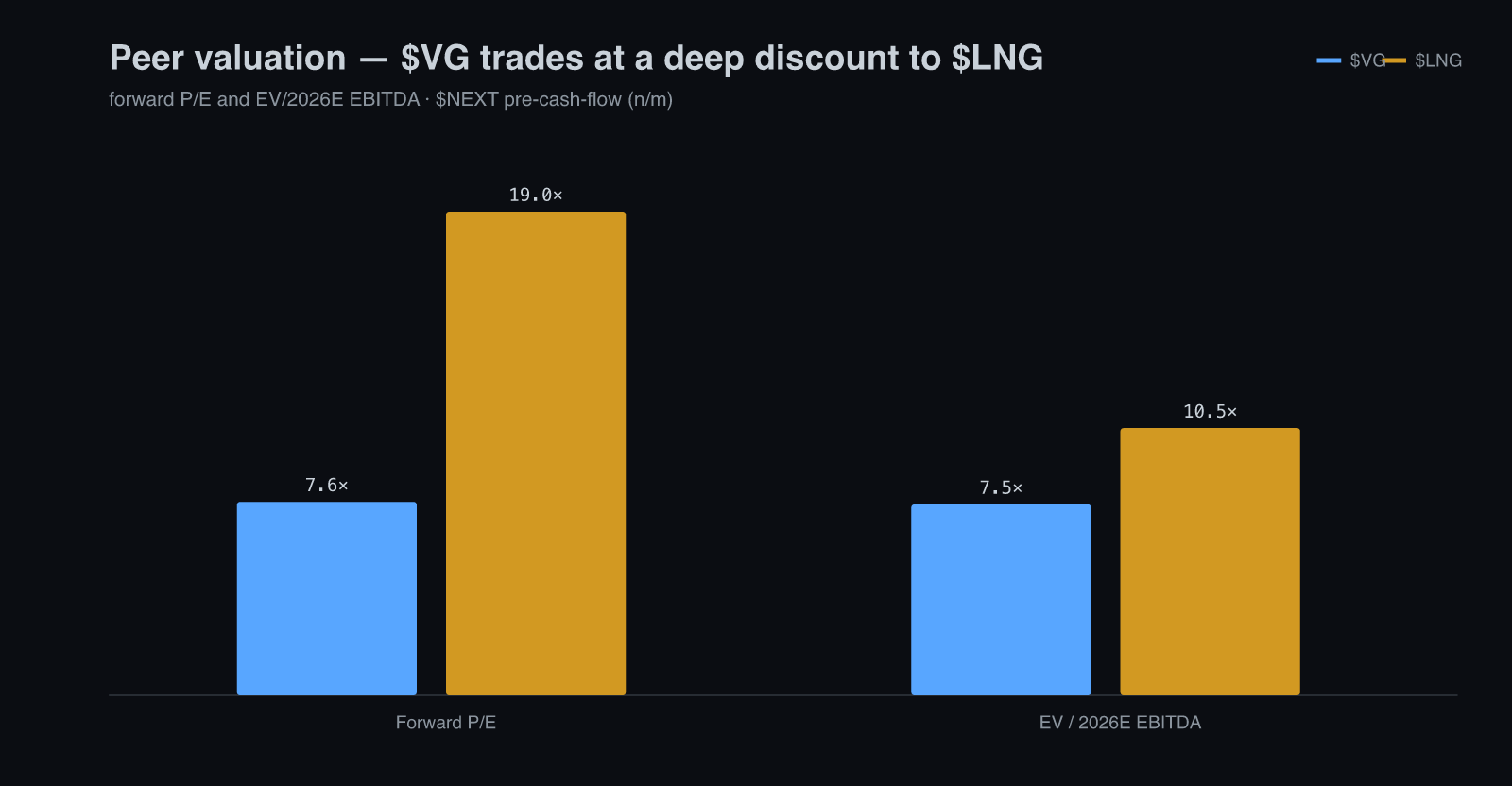
$NEXT (NextDecade) is not really a valuation comp — it's pre-cash-flow (its single Rio Grande project is still under construction), so it has no meaningful earnings multiple and trades as a longer-dated option on the same theme. The tell across all three: if $VG resolves the arbitration overhang and Plaquemines de-risks into COD, the natural pull is toward the incumbent's multiple.
Business Model, Growth & Margins
$VG earns a fixed liquefaction fee per MMBtu on contracted volumes and near-spot spreads on commissioning cargoes. The FY25 income statement (SEC XBRL) shows the operating leverage: revenue $13.77B, operating income $5.16B (37.4% operating margin), interest expense $1.45B, pretax $3.36B, and diluted EPS $0.86 on ~2,635M diluted shares.
| Quarter | Cargos | Revenue | Adj. EBITDA | Note |
|---|---|---|---|---|
| Q1 2025 | ~85 | $2.89B | $1.35B | Calcasieu-only |
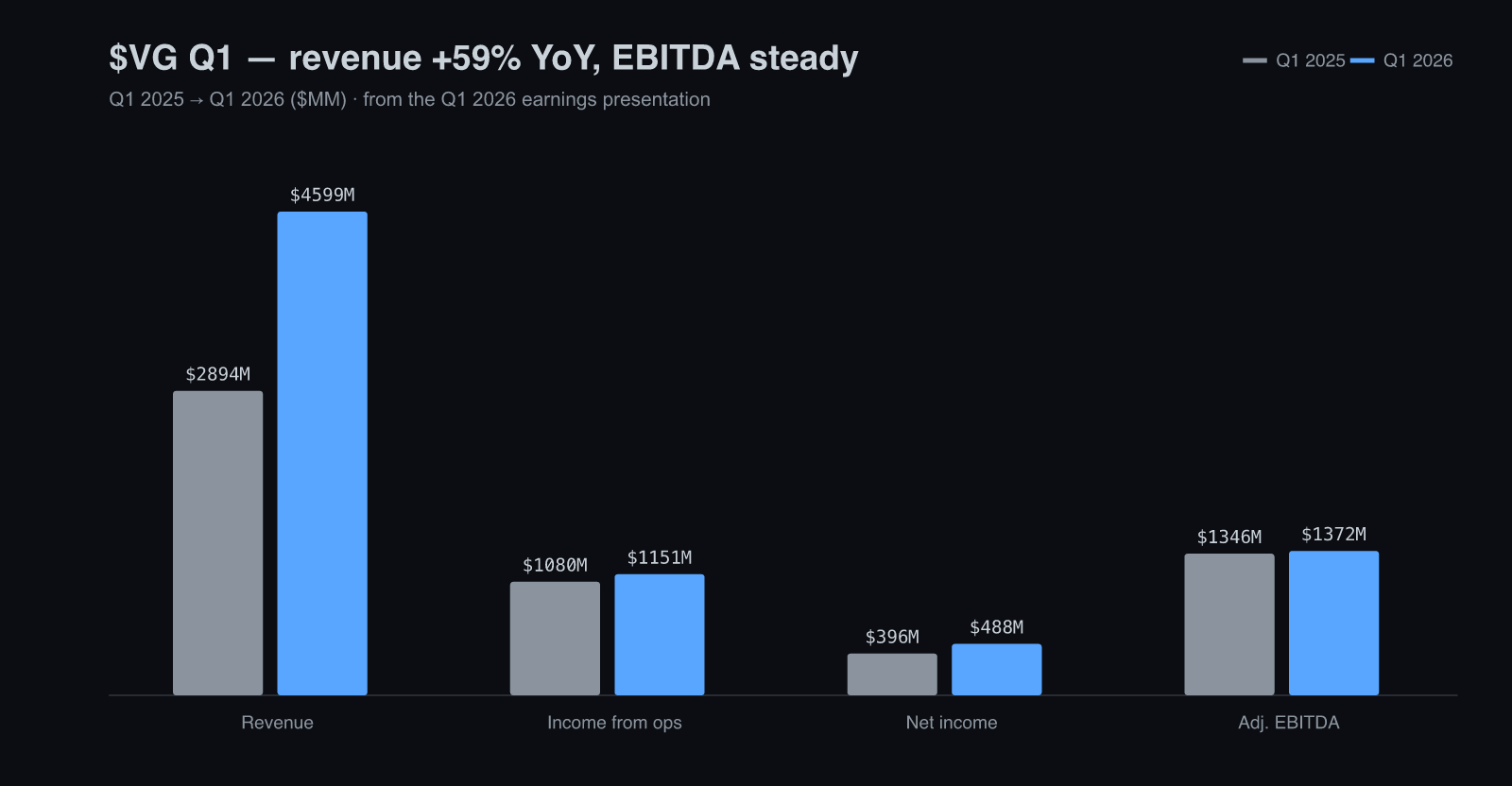
| Q1 2026 | 130 | $4.60B | $1.37B | +59% YoY rev; Plaquemines ramping |
| Q2 2026 | 127 | (with Q2 earnings) | (with Q2 earnings) | 466.4 TBtu @ $6.45/MMBtu implied fixed fee |
The Q2 operational print (8-K, 7/8/26) is the near-term hinge: 127 cargos (Calcasieu 37, Plaquemines 90), with five DES cargos (20.1 TBtu) slipping into Q3 revenue on shipping timing. The $6.45/MMBtu implied weighted-average fixed liquefaction fee is ~2.5× the "mid-$2 handle" long-term contracted fee (Jack Thayer's phrasing on the Q1 call) — and it rose ~69% Q/Q, the opposite of the "normalizing LNG prices" bear framing. The unit economics behind that spread are extraordinary: management pegs production cost at <$0.40/MMBtu at Calcasieu and the low-$0.30s at Plaquemines at full capacity (Q1 call), so almost the entire realized fee drops through. FY2026 guidance: Consolidated Adjusted EBITDA $8.2–8.5B (raised ~52% off the Q4'25 $5.2–5.8B guide; the guide assumes a $9.50–10.50/MMBtu liquefaction fee on the remaining unsold 2026 cargoes), against capex of $12–13B — so $VG is deeply FCF-negative today; the celebrated "20% FCF yield" is a full-build-out (≈100 MTPA, 2029+) scenario, not a current fact.
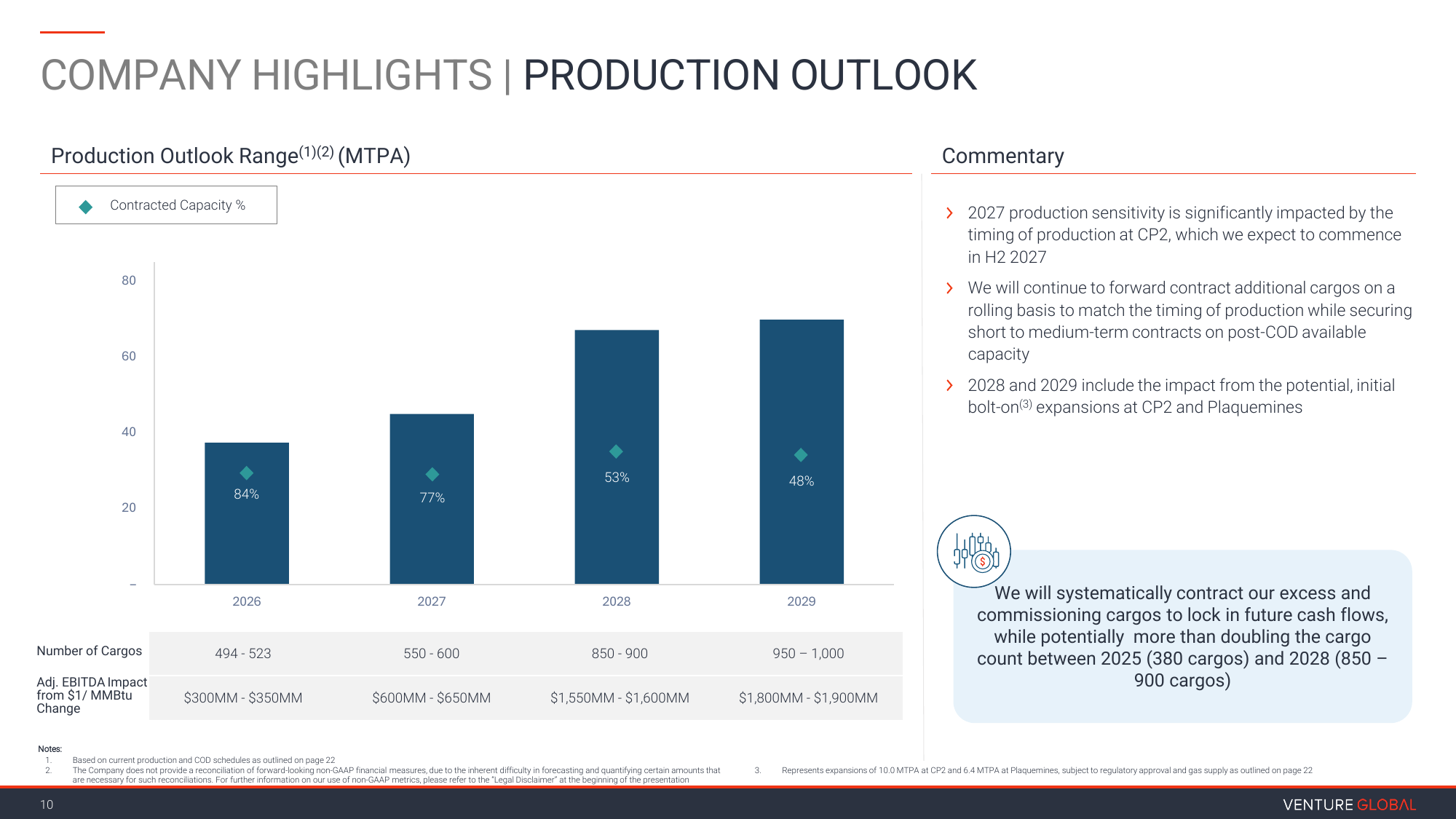
The load-bearing bull mechanic is how the spot torque grows over time. On the Q1 call management put the 2026 book at 84% contracted (up from 69% at Q4'25), so a ±$1/MMBtu move in the liquefaction fee swings 2026 EBITDA by only ±$300–350M. But as CP2 comes online (first LNG H2 2027), the contracted share falls — 77% in 2027, 53% in 2028, 48% in 2029 — because new capacity outruns new contracts. So the same ±$1/MMBtu swing moves EBITDA by ±$1,550–1,600M in 2028 and ±$1,800–1,900M in 2029. The uncontracted volume is the option, and it gets bigger, not smaller, into the years the deficit thesis targets.
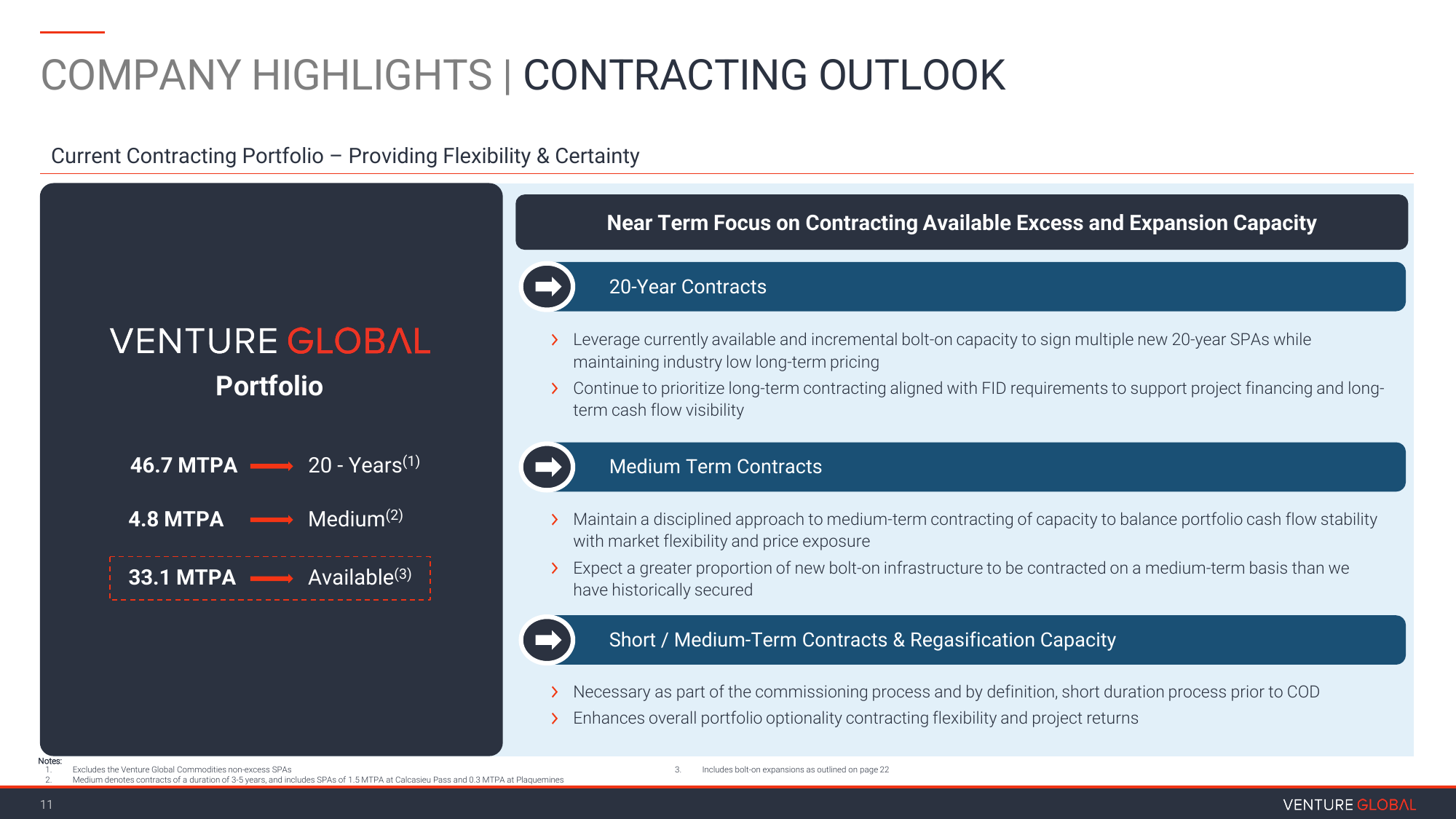
The contract book is the ballast: $137B of contracted backlog, ~77% of capacity — 46.7 MTPA on 20-year SPAs, 4.8 MTPA medium-term, and 33.1 MTPA still available (the spot-torque bucket). New Q1–Q2 offtake: Hanwha (South Korea) 1.5 MTPA/20yr, Vitol raised to 1.7 MTPA, Trafigura ~0.5 MTPA, TotalEnergies 0.85 MTPA/5yr, and Atlantic-SEE (Greece) doubled to 1.0 MTPA. (Note: a widely-circulated bull write-up mis-stated the Hanwha deal as "35 MTPA" — the filing/deck figure is 1.5 MTPA over 20 years; the ~3.5 MTPA number is the total of the Q1'26 offtake batch.)
TAM, Strategic Narrative & Leadership
Global LNG demand is a structural-growth market: coal-to-gas switching in Asia, European supply diversification away from Russian pipeline gas, and now a war-driven premium on reliable, non-Gulf supply. Management frames itself as the low-cost swing supplier into exactly this gap — Sabel on the Q1 2026 call: "approximately 20% of global LNG capacity has been offline in Qatar and Abu Dhabi" (Michael Sabel, Q1 2026, 5/12/26, via Quartr), positioning $VG's commissioning volumes as the market's stabilizer. The macro backdrop is genuinely supportive: US Henry Hub feedgas remains cheap relative to international TTF/JKM, preserving the arbitrage that makes US LNG the marginal Atlantic supplier.
Leadership is credible on execution — the FID-to-first-LNG record and repeated project financings are real — but the shareholder-alignment picture is the blemish. The insider record since the IPO lockups rolled off is a wall of selling: 14+ Form 144 proposed-sale notices between April 20 and June 17, 2026, alongside numerous Form 4s. Some is scheduled 10b5-1 diversification by early PE backers (Stonepeak, etc.), but the persistence and timing — steady distribution as the stock bounces off lows — is a signal a bull memo should not wave away. There is no 13D (no activist); the >5% holder filings are passive 13G/A.
Latest Earnings
- Q2 2026 operational update (furnished 8-K, 7/8/26): 466.4 TBtu of LNG sold, 127 cargos exported (Calcasieu Pass 37 / Plaquemines 90) at an implied weighted-average fixed liquefaction fee of $6.45/MMBtu — up ~69% Q/Q from ~$3.82 on the Hormuz-driven blowout in the Henry-Hub-to-TTF spread. The fee is rising, not normalizing. Stock reaction: +6.5% on the day (from $11.61 to $12.37) — the market read the volume-and-fee print as ahead of a beaten-down bar. Full P&L (net income, cash flow) comes with the Q2 earnings release.
- Q1 2026 (reported 5/12/26): Revenue $4.60B (+59% YoY), Consolidated Adjusted EBITDA $1,372MM, income from operations $1,151MM (+7% YoY), net income $488MM (+23% YoY), 130 cargos exported — a new quarterly record.
- The new disclosures this window: (1) the $1.5B senior secured shipping term loan (floating rate of the secured overnight benchmark + 2.00%, matures June 2032) financing nine LNG carriers — a strategic shift toward owning the fleet; (2) the FY26 EBITDA guide raised to $8.2–8.5B on elevated spot margins.
- The tough question: analysts pressed management (Q1 call) on the divergence between rising global prices and falling US Henry Hub — the crux of the margin question. Management's answer: the spread is the point — cheap domestic feedgas + high international sales price is precisely $VG's arbitrage, and it widens, not narrows, in a Gulf-disruption regime.
Thematic Investment Angle
Theme: the Qatar-outage winter-gas deficit. An Iranian strike on Ras Laffan (March 2026) removed ~17% of Qatar's LNG capacity — 12.8 MTPA sidelined for 3–5 years — and, critically, the "recovery" is not yet real: as of 7/8, a Qatari LNG tanker was struck in Hormuz, the US revoked Iran's oil-sale waivers, and per one on-the-ground read "since the June 17 deal: zero LNG shipments" have resumed. Europe enters this into its lowest gas storage in ~15 years (~46–49% full, TTF €43–55/MWh) with Qatari deliveries not expected before Q4. Atlantic-basin US LNG is the only swing supply — and $VG has the market's largest uncontracted position pointed straight at it.
Management sees the same setup — and Sabel laid out the mechanism on the Q1 call, corroborating the Citrini thesis almost point-for-point:
"Roughly 13 million tons or 3% of global production is likely to remain offline for several years… Storage must be replenished, winter markets are likely to rally absent a near-term cessation of hostilities as market fundamentals take hold… we believe the current backwardation in TTF and JKM forwards is unsustainable."
Mike Sabel, Q1 2026 earnings call (5/12/26)
The "largest uncontracted position" claim is not rhetorical — it's on slide 11: of $VG's portfolio, 46.7 MTPA is locked in 20-year SPAs and 4.8 MTPA is medium-term, but 33.1 MTPA is still available (uncontracted). That available bucket is what gets sold into the spot market at the elevated fees, and it is unusually large precisely because $VG is mid-build with capacity outrunning contracts.
| Ticker | Role | Why this slot | Fwd P/E | 12M |
|---|---|---|---|---|
| $VG | Highest-torque pure-play | Most uncontracted volume → most spot leverage | ~7.6× | −19.3% |
| $LNG | Quality incumbent | Already re-rated; lower spot torque | ~18–20× | +10.6% |
| $NEXT | Long-dated option | Pre-COD; not yet in the flow | n/m | −28.5% |
| TTF (via TTFW LN) | The underlying | Direct European gas price expression | — | — |
| Thermal coal | 2nd-order substitute | Gas-to-coal switching if TTF spikes (per The Coal Trader) | — | — |
$VG is the crowded-thesis / uncrowded-stock slot: everyone agrees the winter deficit is bullish LNG, but $VG's own shares lag the theme because of the idiosyncratic overhangs. What invalidates the theme: a durable Hormuz ceasefire plus fast Qatar restart plus the 2026–27 new-supply wave (US + Qatar North Field expansion) arriving together — i.e., the glut.
Bull Case & Catalysts
The 1–3 year bull case is a re-rating on three converging vectors: (1) Plaquemines fully ramps and CP2 reaches first LNG (H2 2027), roughly doubling producing capacity and moving cargo count toward the 850–1,000/yr range management guides for 2028–29; (2) the Qatar deficit keeps spot margins elevated across two winters, so the commissioning windfall persists longer than the market has modeled; (3) the arbitration cloud clears at a manageable number, removing the discount and pulling the multiple toward $LNG's.
| Date | Event | Why it matters |
|---|---|---|
| ~2026-08 (est.) | Q2 2026 full earnings | Net income / cash flow / any guide revision; confirms the $6.45/MMBtu spread economics |
| 2026-09 | Qatar force-majeure expiry / Hormuz status | The macro hinge — extension = another leg of deficit; genuine restart = glut risk |
| Q4 2026 | Plaquemines Phase 1 COD | Management's on-track target (Q1 call); moves Plaquemines from commissioning to contracted-delivery basis — also the trigger that starts the SPA-delivery clock $BP/Shell litigated at Calcasieu |
| H2 2026 | Delivery of 2 more LNG carriers (draws remaining term-loan tranches) | Shipping build-out; DES-margin capture |
| 2027 (early) | CP2 Expansion FID (+10 MTPA) | Bolt-on growth; watch for equity issuance |
| H2 2027 | CP2 Phase 1 first LNG | The next capacity step-change toward 100 MTPA |
What has to go right: Plaquemines and CP2 stay on cost and schedule (LNG megaprojects rarely do), the arbitration settles for low-single-digit billions rather than the $5B tail, and management funds the remaining build without a dilutive equity raise at these prices.
Risk Register
The Calcasieu arbitration saga — explained (it's the whole bear case)
This is unfamiliar to most readers and it's the single biggest overhang, so it's worth explaining from scratch. Here's the mechanism:
- The setup. Before a new LNG plant is formally declared complete — its "Commercial Operation Date," or COD — it still spends many months in a commissioning phase, producing real LNG cargoes while it's being tested and ramped. $VG's long-term customers (Shell, $BP, Edison, Galp, Repsol, PGNiG, Sinopec and others) had each signed 20-year contracts to buy Calcasieu Pass LNG at a low fixed fee, but only from COD onward. Before COD, $VG was free to sell that commissioning LNG on the open spot market.
- What $VG did. Calcasieu Pass started producing in 2022 — and $VG then kept it in "commissioning" status for ~3 years, an unusually long time, declaring COD only in 2025. Across that window it sold 400+ cargoes on the spot market instead of delivering to its contract customers — and it did so during the 2022–23 European gas crisis, when prices spiked to all-time highs after Russia invaded Ukraine. $VG reportedly booked billions in extra profit. The customers, who had signed long-term deals precisely to lock in supply, got nothing during the biggest price spike in history while $VG kept the windfall.
- Their claim. The customers filed for arbitration, alleging $VG deliberately dragged out commissioning to keep selling spot rather than honoring the contracts — i.e., that the long "commissioning" period was a pretext.
- The scorecard so far (split decisions). $BP won: the tribunal found $VG failed to declare COD in a timely manner, and $BP is now seeking >$1B in damages (damages hearing expected 2026). Shell lost: a separate ICC tribunal ruled in $VG's favor, though Shell is challenging that outcome in the New York courts. Four more Calcasieu customers have arbitrations still pending, seeking $3.8–4.5B in aggregate, with rulings not expected before 2026. So the realized-plus-potential exposure is a wide $1B–$5B-plus range depending on how the remaining cases break.
- Why it's the crux, not a footnote. The commissioning-cargo windfall is the same mechanism that makes the bull case (see the >30% pre-COD ROIC quote in §4) — the thing that generates $VG's extraordinary early returns is exactly the thing being litigated as a breach. And it connects directly to the next catalyst: Plaquemines is now in that same commissioning phase, with Phase 1 COD targeted for Q4 2026. The market will be watching whether $VG runs the identical spot-sale playbook there (more windfall, but a fresh litigation-risk clock) or plays it straighter to avoid a repeat. That's why "Plaquemines COD" sits in the catalyst table with a double meaning.
Now the register itself:
- Customer arbitration (the above). A bad-case cluster of losses at the top of the range is a multi-billion-dollar cash hit and a reputational mark that could force tighter contract terms on future SPAs.
- Leverage + FCF-negative build. ~$31.85B net debt (D/E 5.07×) against a $12–13B annual capex program that keeps FCF negative until the build completes. A rate shock, a financing market that closes, or a project overrun forces a dilutive equity raise at a depressed price.
- The LNG glut / normalizing spot margins. A fast Hormuz de-escalation and Qatar restart, layered on the 2026–27 global liquefaction supply wave, compresses spot spreads back toward the ~$2.50 contracted fee before the uncontracted volume is locked — directly deflating the EBITDA guide. "A debate rages over the potential for a glut of LNG to develop" — Allen Brooks, Energy Musings, 6/29.
- Governance / insider distribution. Founder-controlled dual-class structure + 14+ Form 144 sale notices since April = minority-holder misalignment risk and a persistent supply of stock.
What forces a thesis change: a Calcasieu arbitration ruling (or settlement) at the top of the $4–5B range, OR a confirmed durable Qatar restart that pulls TTF back below ~€30/MWh before CP2 first LNG — either one breaks the "levered growth into a structural deficit" frame.
Valuation & House View
| Metric | $VG current | $LNG (yardstick) | Read |
|---|---|---|---|
| Trailing P/E | ~13.4× | ~22× | Cheap |
| Forward P/E | ~7.6× | ~18–20× | Deep discount |
| EV/2026E EBITDA | ~7.5× | ~10–11× | ~30% discount to incumbent |
| FCF yield | Negative (build phase) | Positive | Not a value lever yet |
At $12.37, ~$30B equity value and ~$62B EV sit on $8.2–8.5B of 2026E EBITDA — a discount to $LNG that is partly justified (leverage, litigation, no return of capital) and partly the mispricing the bulls are pointing at (growth priced as credit).
| Scenario | Probability | 2Y target | Implied return | Triggers |
|---|---|---|---|---|
| Bull | 35% | $22 | +78% | Deficit persists 2 winters; Plaquemines/CP2 on track; arbitration ≤$2B; re-rate toward $LNG |
| Base | 45% | $16 | +29% | LNG normalizes as Qatar returns 2027; EBITDA settles ~$6–7B post-commissioning; arbitration ~$1–2B; consensus PT holds |
| Bear | 20% | $7 | −43% | Glut crushes spot margins; arbitration $4–5B; CP2 overrun + dilutive raise; back toward Dec-'25 lows |
House View. The demand thesis is correct and, as of this week, strengthening — the Qatar outage is structural (3–5 years), the "recovery" is a headline not a flow, and $VG has the most spot-exposed volume into the tightest Atlantic winter in a decade. But this is a high-conviction idea in a high-risk vehicle: the $5B+ arbitration tail, 5× leverage, negative FCF, and a founder-controlled cap table with steady insider selling are why the stock lags a theme its peers are riding to highs. Reasonable expression is a sized long (not a core position) with the arbitration calendar and the September Qatar/Hormuz status as the two things that flip the memo. Verify the Q2 net-income print and any guidance revision before adding on strength.