
$VECO Deep Dive — The Ion Beams Inside Every Hard-Drive Head · Toshiba's ¥60B Expansion, HAMR and a Booked 2027
Toshiba's decision to spend about ¥60 billion doubling its hard-drive output broke the industry's supply discipline on October 2, and the market sold the drive makers. Every route the industry has to more exabytes, whether more drives, more platters per drive or denser HAMR platters, runs through the factory that makes read-write heads, and $VECO builds the ion-beam tools that deposit and shape those heads. Its data-storage revenue is coming off its smallest year in a decade, is guided to more than double in 2026 and is booked into 2027; the catch is that each Veeco share becomes 0.3575 of an $ACLS share the day China's regulator signs off on the merger.
What Changed — AI Keeps Its Data on Spinning Disks, and the Disk Makers Just Broke Ranks
Start here. A hard disk drive is a sealed box of spinning platters, glass or aluminium discs coated in a magnetic film a few nanometres thick. A bit is a patch of that film magnetised one way or the other. A head is the device that writes those patches and reads them back: a ceramic sliver about the size of a grain of sand, carrying a writer and a reader made of metal and oxide films only a few atoms thick, flying a few nanometres above a platter that spins 7,200 times a minute. A head wafer is the disc on which tens of thousands of heads are built at once, the way chips are built on silicon. An ion beam is a stream of electrically charged atoms fired from a source: aimed at a target it knocks atoms loose to deposit those films, and aimed at the wafer it carves them into shape. Everything below is about who sells the ion beams.
AI does not only compute; it keeps. Training sets, checkpoints, logs and the outputs of inference pile up in the cold tier of a data centre, where cost per terabyte matters more than speed, and that tier is still the hard drive. Seagate told investors in July that its nearline exabyte output can grow in the mid-20% range a year for the next few years, and Western Digital shipped 231 exabytes in its June quarter, up 22% from a year earlier.
For two years the two US makers, $STX and $WDC, met that demand without adding factories. Both told investors that drive units would stay roughly flat while the exabytes came from technology, more terabytes in the same box. That restraint is what let Seagate's non-GAAP gross margin reach 52.7% in its June quarter. It is also why the industry's hardware spending moved inside the drive, to the heads and the platters, rather than into new assembly lines.
On October 2 Nikkei reported that Toshiba, the third maker, will invest about ¥60 billion (about $380 million) to roughly double its capacity for AI data-centre drives by its fiscal 2027, which ends in March 2028, by adding lines at its existing plant in the Philippines. It is Toshiba's first major drive investment in about five years, and the company wants its share of shipped capacity to rise from just over 10% to 30% over the medium term. $STX and $WDC each fell 10.2% that day; $VECO rose 7.8%.
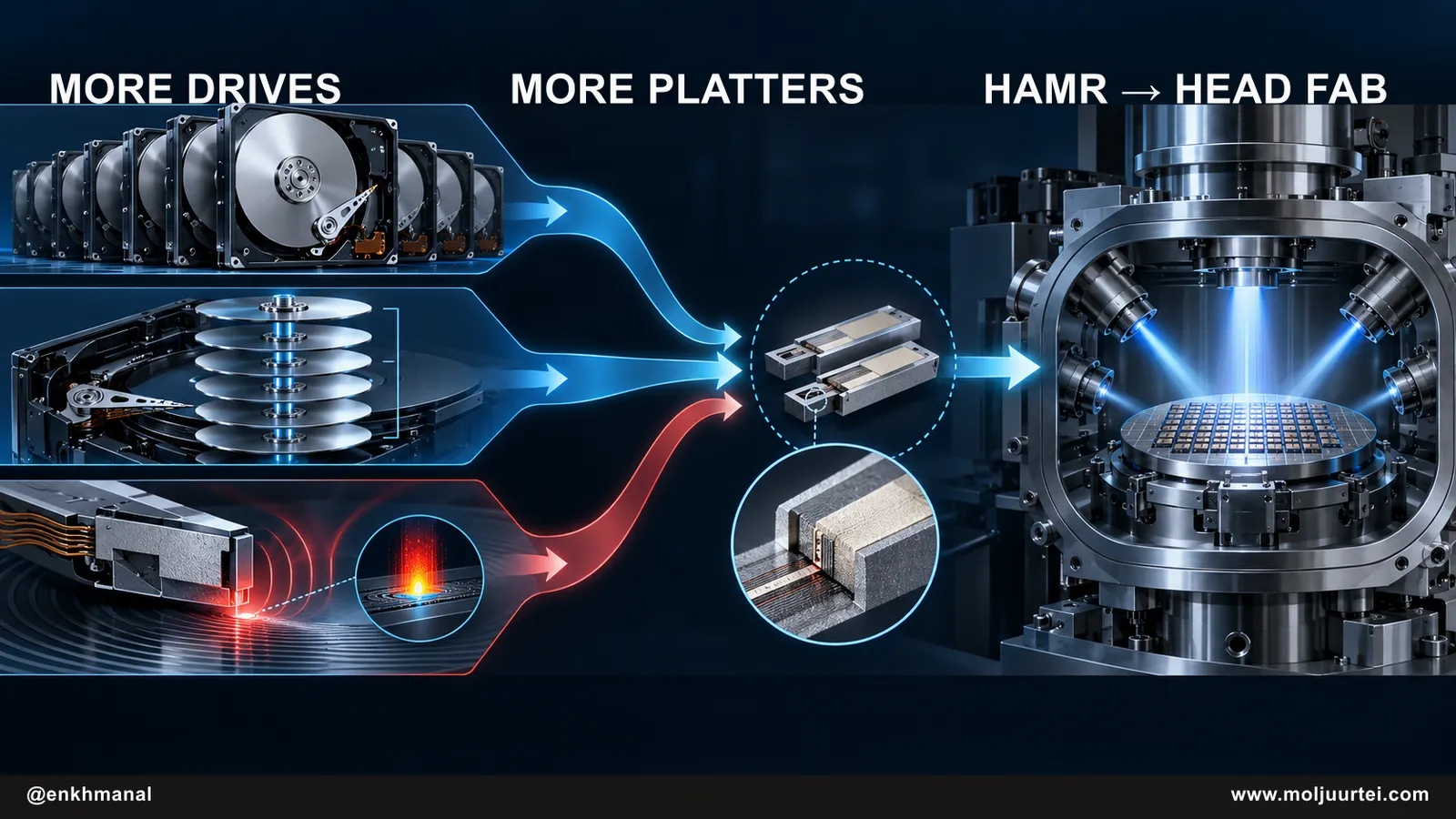
Toshiba makes drives, not their most delicate parts: its heads come from TDK and its platters from Resonac. Its best drive today stores 34TB on 11 platters, where Seagate's HAMR drive stores 44TB on 10, so a laggard that doubles its exabytes on 11- and 12-platter drives needs more heads per exabyte than a leader, not fewer. The three routes to more storage, Toshiba's extra drives, Western Digital's extra platters and Seagate's denser HAMR platters, therefore end at the same place: a head fab buying tools. The company whose ion beams deposit and shape those heads is Veeco Instruments.
Thesis — The Head Fab Is Where the Exabytes Get Built
Veeco makes the ion-beam deposition and etch tools that build hard-drive heads, and the AI storage build-out is now adding heads on three fronts at once: Toshiba's new lines, more platters per drive, and HAMR heads that take longer to make. Data storage was $39.2M of Veeco's revenue in 2025; management guides it to more than double in 2026 and says it is booked well into 2027.
Business & Backdrop — A Build-to-Order Toolmaker Coming Off Its Trough
Veeco sells process equipment to the companies that make chips, lasers and hard-drive heads, and almost everything it sells is built to order. It reports four end markets. In 2025 semiconductor customers bought $476.6M, 72% of net sales; compound-semiconductor makers $59.6M, 9%; data-storage customers $39.2M, 6%; and scientific and other buyers $88.9M, 13%. Lead times run close to a year, so the order book describes the next four quarters: backlog was $554.9M at the end of 2025, up from $409.6M a year earlier, and customer deposits reached $114M by June 2026.
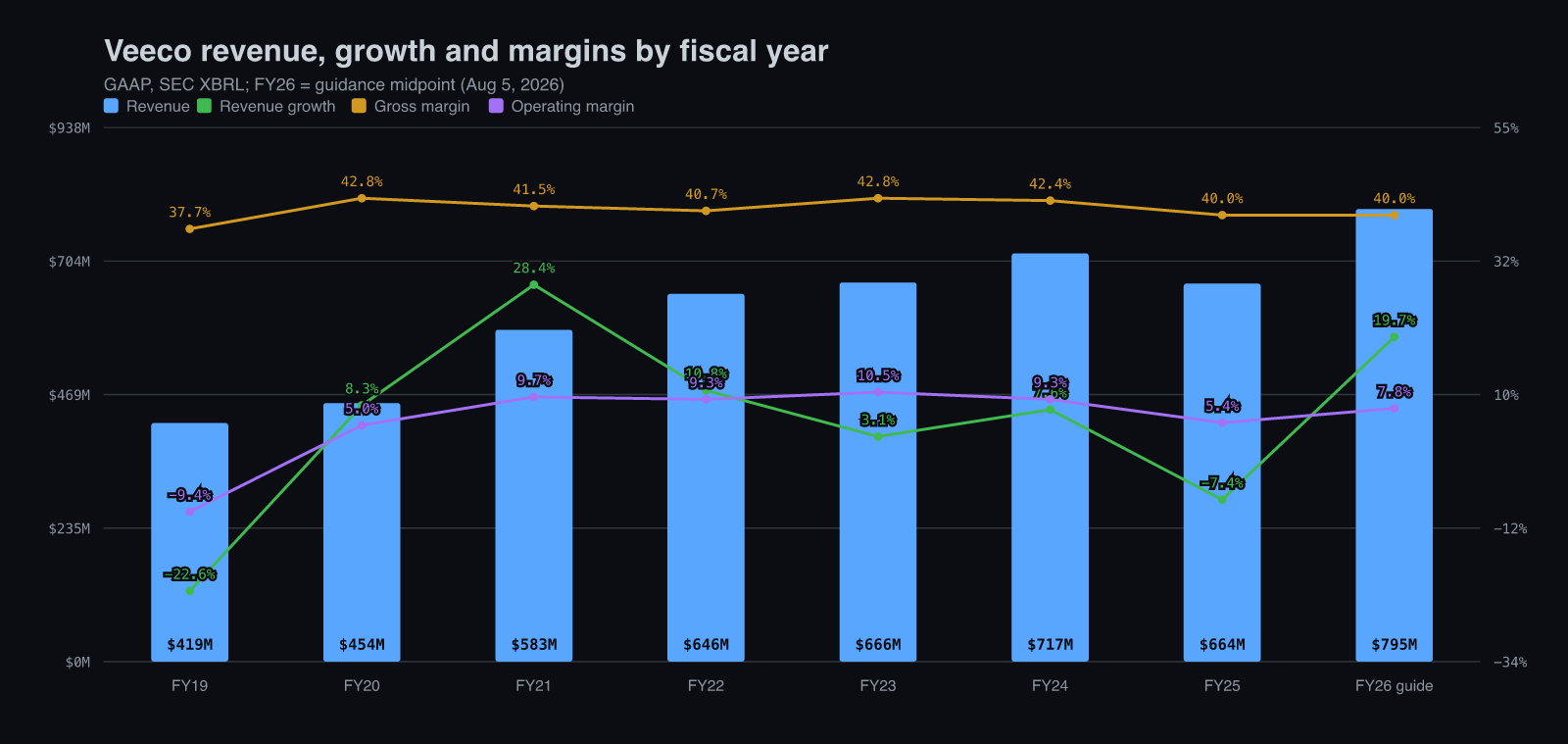
Revenue has grown over the cycle, but margins have not kept pace. Revenue went from $419M in FY19 to $454M in FY20, $583M in FY21, $646M in FY22, $666M in FY23 and $717M in FY24 before slipping 7.4% to $664M in FY25; management guides $780M to $810M for FY26, a 19.7% rise at the midpoint. GAAP gross margin was 37.7% in FY19, 42.8% in FY20, 41.5% in FY21, 40.7% in FY22, 42.8% in FY23 and 42.4% in FY24, then 40.0% in FY25, and the FY26 guide is 39% to 41%. GAAP operating margin peaked at 10.5% in FY23 and was 5.4% in FY25.
The quarterly series shows the trough and the turn. Revenue sat between $165M and $167M for four straight quarters in 2025, fell to $158.3M in Q1 2026, then jumped to $193.5M in Q2 2026, up 16.5% year on year, with Q3 guided to $200M to $220M. GAAP gross margin slid from 42.9% in Q3 2024 to 40.9% in Q1 2025, 36.7% in Q4 2025 and 35.3% in Q1 2026, when a US export-licence requirement held back one laser-annealing system worth about $8M, then recovered to 38.7% in Q2 2026. GAAP operating margin went from 13.2% in Q3 2024 to −1.7% in Q1 2026 and back to 6.1% in Q2.
Data storage was the part of the business that turned first. In Q2 2026 it was 11.5% of net sales against 7.4% a year earlier, and it supplied 36% of the company's $27.4M year-on-year revenue gain, more than semiconductors did. Over the first half it supplied 72% of growth.
Cash has been better than the income statement. In FY25 Veeco produced $69.5M of operating cash flow against $35.4M of net income and $55.7M of EBITDA, and $53.3M of free cash flow; in Q2 2026 operating cash flow was $51M against GAAP net income of $11.9M, helped by $45M of new customer deposits. The weak point is inventory: 252 days of it at the end of FY25 and a 262-day cash cycle, which is why every dollar of growth ties up cash until deposits catch up. The balance sheet holds $429M of cash and short-term investments against $230M of 2029 convertible notes.
The market Veeco's data-storage tools serve is set by how many heads the three drive makers build. Tom Coughlin of Coughlin Associates projects about 126 million drives shipped in 2026, and hyperscalers such as Google and Amazon take roughly 60% of nearline shipments, according to TrendForce. The rest of this piece is about why the head count is rising faster than the drive count.
Technology & Moat — Films a Few Atoms Thick, Shaped by Ion Beams
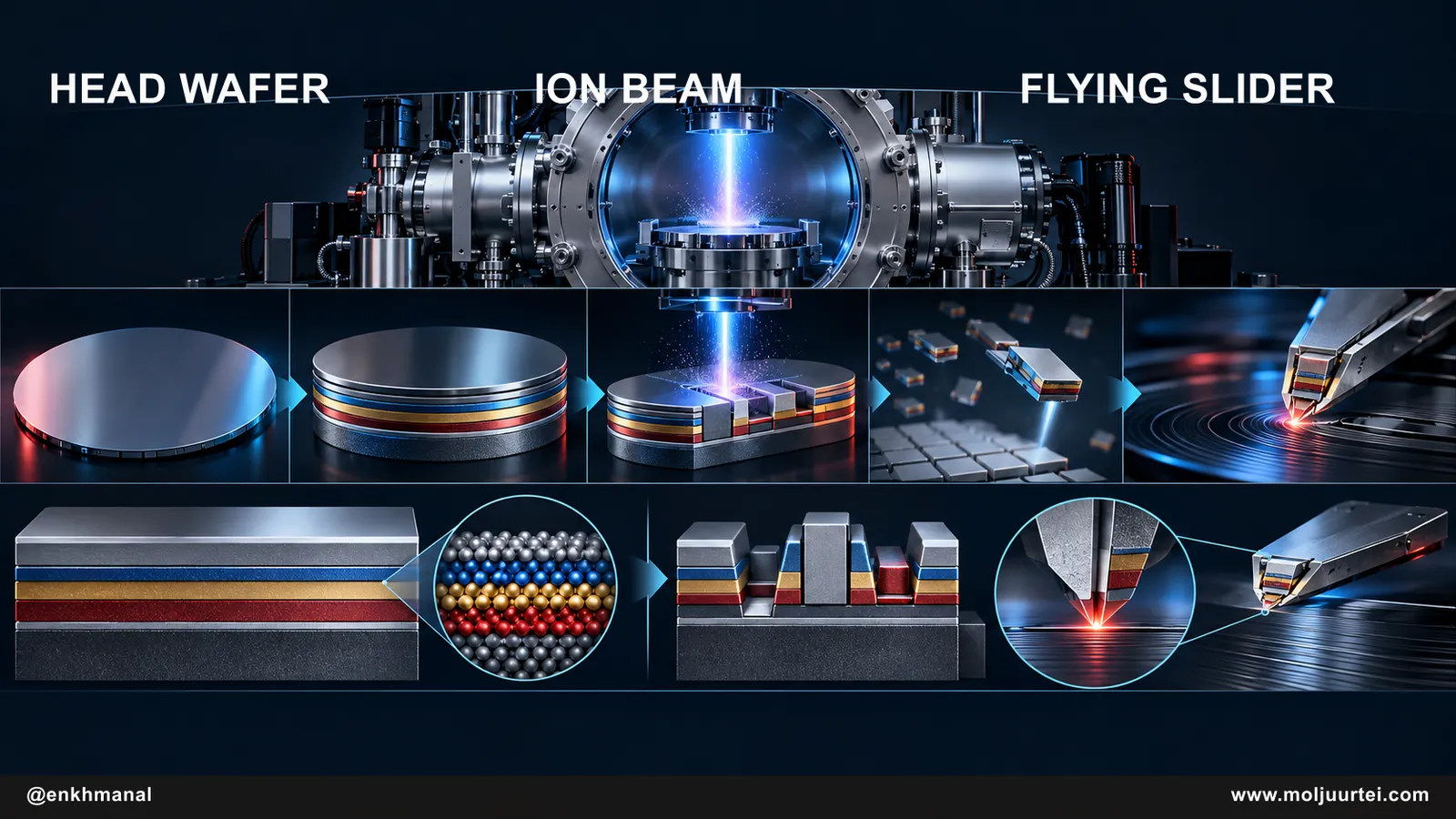
A head is built like a chip and finished like a watch. On the wafer, dozens of layers go down: the reader is a stack of magnetic films separated by an insulating barrier only a few atoms thick, whose electrical resistance changes with the field of the bit passing beneath it, and the writer is a coil and pole that concentrate a magnetic field onto a spot a few tens of nanometres wide. Then the wafer is cut into rows, each row is lapped to set the reader's height, the face that flies over the platter is etched into an air bearing, and a protective diamond-like carbon coat a few nanometres thick goes on.
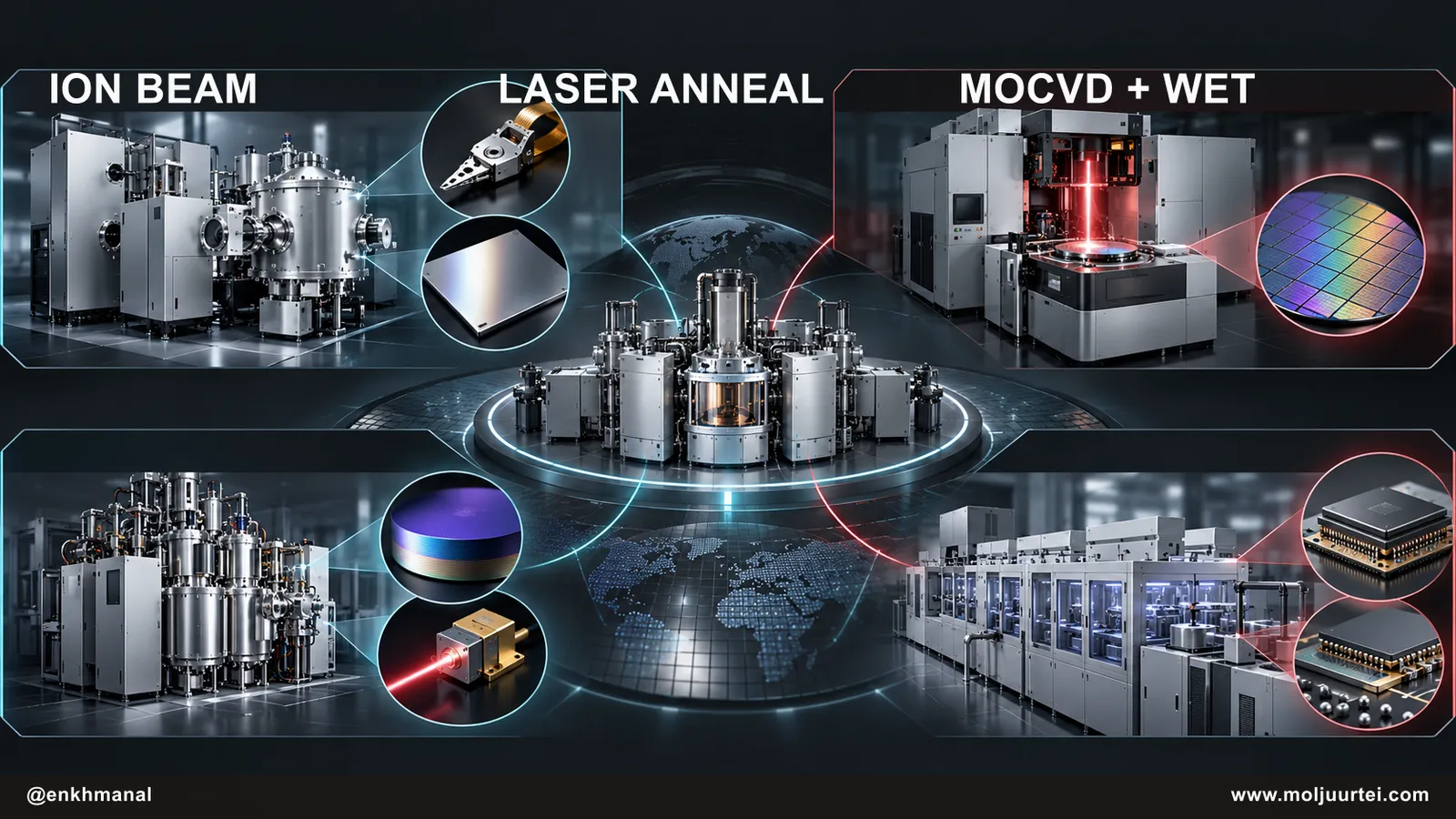
Veeco sells tools for most of those steps. Its 10-K lists ion beam deposition, ion beam etch, physical vapour deposition, lapping and dicing machines, diamond-like-carbon deposition and wet processing for data-storage customers. The two that matter most are the ion-beam pair. In deposition, an ion source fires a beam at a target and knocks atoms off it onto the wafer; because the beam is made away from the wafer, its energy and angle can be set independently, which is how you get the dense, smooth, uniform films a reader depends on. In etch, the same kind of beam is aimed at the wafer and mills material away. The 10-K says the etch systems pattern materials 'challenging to pattern by traditional reactive ion etching techniques', which describes most of what a head is made of, and are 'essential for forming the precise shape of the magnetic head.'
HAMR makes the head harder to build. A HAMR head carries a laser diode, a waveguide and a gold near-field transducer that heats a spot of the platter about 50 nanometres across, in Seagate's description, so the writer can flip magnetic grains that would otherwise be too stable to write; heating, writing and cooling take less than a nanosecond. Every one of those parts is more film to deposit and more structure to shape. Seagate's CFO put the consequence plainly in September:
A heads is produced on a wafer. This wafer has to go through all the PMR equipment like before, and then has to go through some specific HAMR equipment. So cycle time is longer. So if you want to extract the same volume, you need a little bit more space or you need to start more wafer and get the same output.
The technology poster below follows one HAMR head from bare wafer to a slider flying over the platter, and marks the steps where Veeco's ion beams do the work.
The same ion-beam platform is why Veeco shows up in three AI supply chains that otherwise have little in common. It is the tool of record for depositing the reflective multilayer on EUV mask blanks and is extending into EUV pellicles, and its Spector ion-beam sputtering system coats the facets of the indium-phosphide lasers inside 800G and 1.6T optical transceivers; in May Veeco announced more than $250M of laser-manufacturing orders, a substantial portion of them for Spector. Our reading of the moat is recipes and qualification: a head maker that changes deposition tools must requalify its heads with every drive customer, and a mask-blank maker answers to every EUV fab.
What we cannot tell you is Veeco's share of head-fab tool spending: the company does not publish it or name its data-storage customers, and on its Q1 2026 call spoke only of 'both of our major customers'. Only three companies make heads at scale, Seagate and Western Digital for themselves and TDK for Toshiba and others; TDK puts its own share of heads at 15% to 20%.
Roadmap & R&D — Spending Ahead of a 2027 Ramp
Veeco spent $120M on R&D in FY25, 18% of revenue, and is now also spending ahead of revenue on capacity. On the Q1 call management said it plans to raise Spector ion-beam capacity about 10× from its current base by early 2027 and is studying doubling it again; on the Q2 call it said it will more than double advanced-packaging and silicon-photonics capacity in 2027, using its own East Coast plants and contract manufacturers in Southeast Asia. The ramp costs about $10M of extra operating expense and 75 basis points of gross margin in 2026.
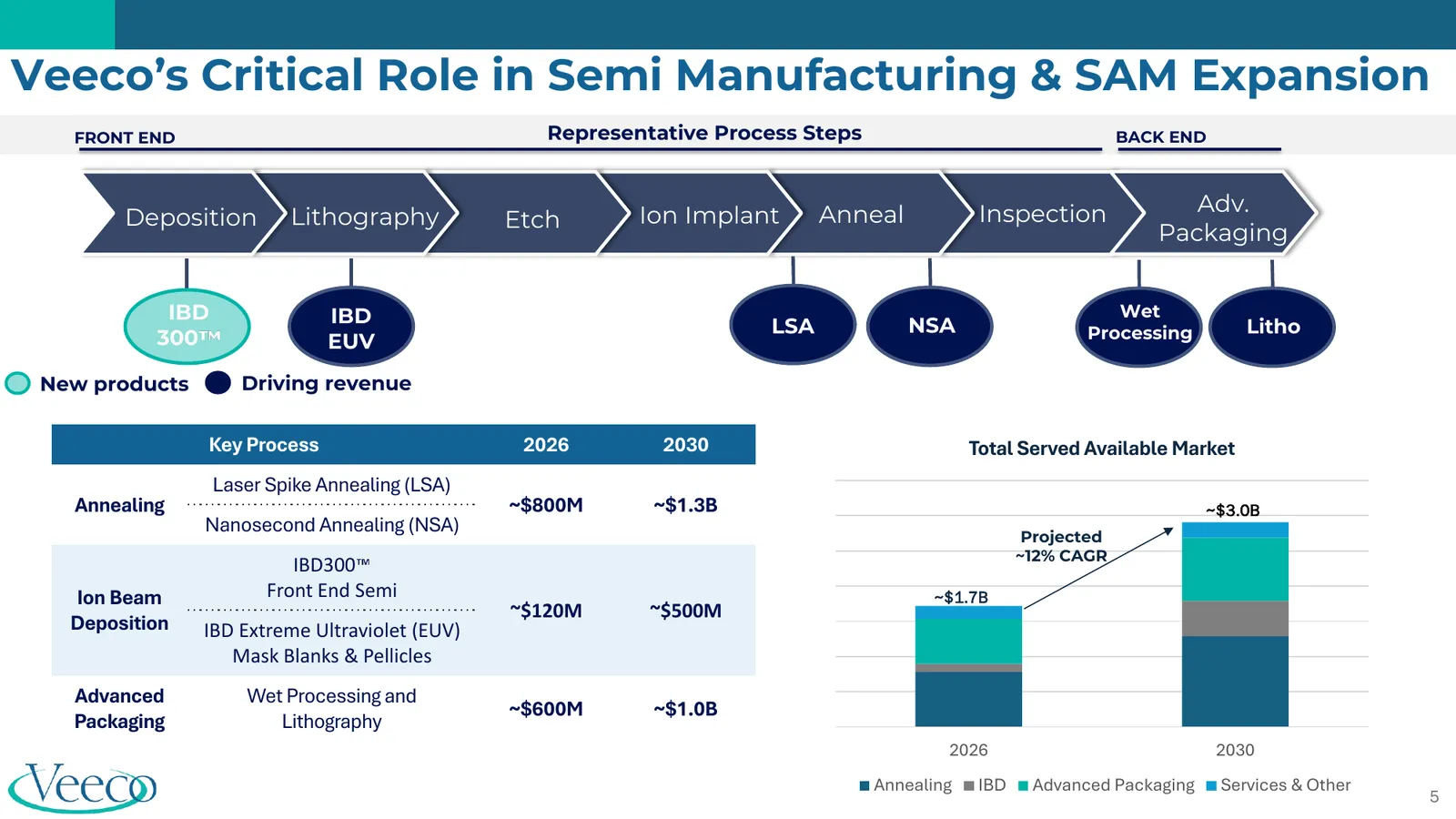
In semiconductors the roadmap is three tools. Laser spike annealing is the production tool of record at all three tier-1 logic makers and at one HBM producer, with a second DRAM maker evaluating it; the next-generation nanosecond annealer has a follow-on order from one tier-1 logic customer and an evaluation tool at the third; and the IBD300 is under evaluation at DRAM makers for low-resistance bit-line metals. Veeco sizes its semiconductor served market at about $1.7B in 2026, rising to about $3.0B by 2030.
In data storage the roadmap belongs to the customers: HAMR production roadmaps, on which management says it is 'engaged closely', and the slider fabs that follow head volume. In compound semiconductors it is the indium-phosphide laser, where Veeco sells the epitaxy reactor (Lumina MOCVD), the wet etch and the facet coat, and where it sees an opportunity of at least $2B over the coming years.
The Setup — Why It's Mispriced: The Market Sees a Photonics Stock and a Merger
The market prices Veeco as a photonics stock attached to a merger. Search X for $VECO and almost every post is about indium-phosphide lasers or the Axcelis deal; Grok found no post connecting Veeco to the Toshiba report, and we found no Substack write-up of the head business. That is the gap: data storage was 29% of Veeco's revenue in 2021, and the cycle that took it there is starting again.
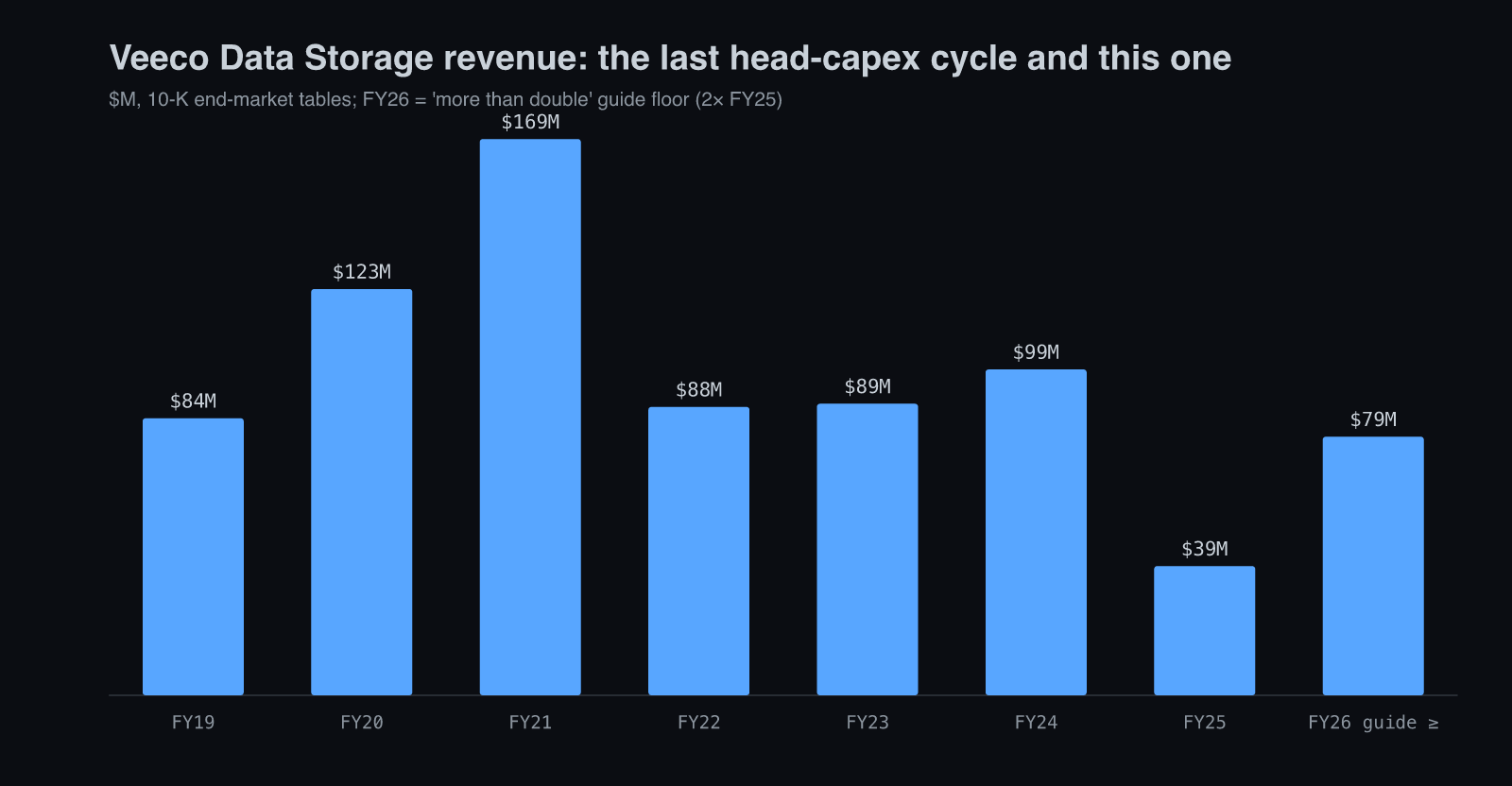
The last head-capex cycle took data storage from $84.1M in 2019 to $123.3M in 2020 and $168.8M in 2021, as drive makers added heads for cloud demand. It then ran at $87.5M to $98.9M for three years and fell to $39.2M in 2025, when, in management's words, customers 'did not add new system capacity'. Orders came back in the second half of 2025 and revenue followed: quarterly data-storage sales ran $6.7M, $12.4M, $10.0M and $10.2M through 2025, or 4.0%, 7.5%, 6.0% and 6.2% of net sales, then $10.2M (6.4%) in Q1 2026 and $22.2M (11.5%) in Q2.
The detail that matters is where the new orders go. The first wave, shipping in 2026, was for front-end wafer fabs, where HAMR adds steps. The second, for 2027, is for slider fabs, the back end where each wafer is cut and finished into individual heads. CFO John Kiernan explained why that distinction matters:
We're starting to see some orders, not only continuing in the front end, but also the back-end fabs, we call the slider fabs, for a shipment in 2027. It does seem that the amount of heads that are being shipped is increasing, 'cause the slider fab is really just a function of the number of heads shipping.
Toshiba's plan is a head-count plan. Its 34TB drive uses 22 heads, two per platter, or about 1.55TB per head; Seagate's 44TB HAMR drive uses 20, about 2.2TB per head. On those figures a Toshiba exabyte takes about 42% more heads than a Seagate one, and the 40TB-class, 12-platter drive Toshiba plans for 2027 (24 heads, about 1.67TB per head) narrows the gap only a little. If Toshiba doubles its exabytes on drives like these, the heads it buys from TDK rise by roughly 85% to 100%. That is our arithmetic on the disclosed capacities, not a figure any company has given.
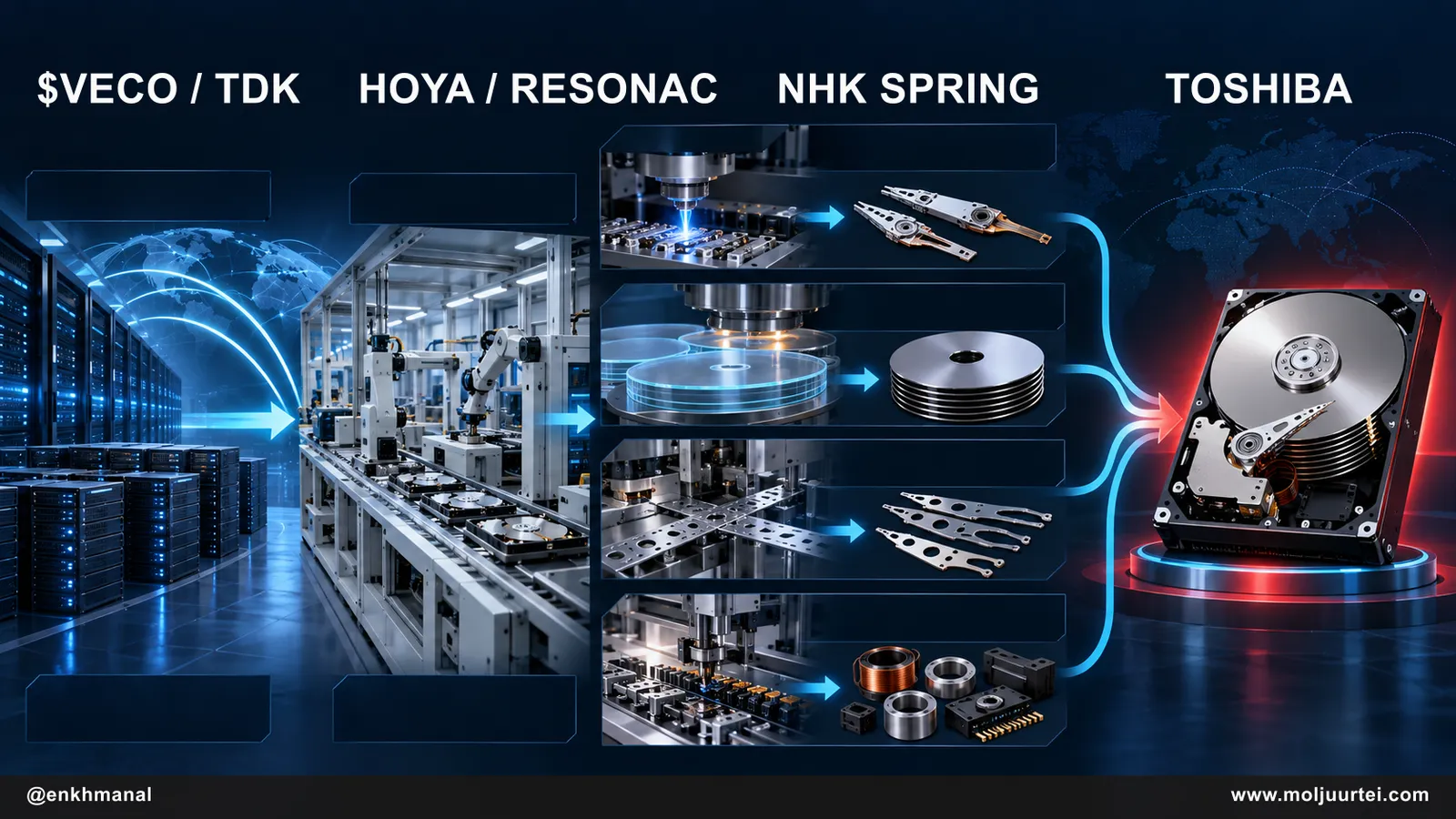
TDK is already seeing it. Sales in its magnetic-application segment, HDD heads and suspensions, rose 49.6% year on year to ¥81.6B in the April–June quarter, with operating profit up 51.8%, and TDK said in May that it would expand head and suspension capacity and start mass-producing HAMR heads in about two years. Seagate, which makes its own heads, keeps capex at 4% to 6% of revenue but says HAMR's longer cycle time needs more space or more wafer starts. Western Digital, which shipped $3.75B of revenue in its June quarter, up 44%, says its growth 'does not require spending CapEx to add unit capacity' but that it is making 'the necessary investments in our heads and media operations'. Three head makers, three versions of the same order.
Timing is the part to underwrite. Veeco's lead times are close to a year, and Seagate says a head-wafer start comes three to four quarters before drive output. Toshiba's capacity lands by March 2028, so any TDK tool orders it triggers would most likely be placed in 2026 and 2027 and shipped through 2027 and 2028, the year after the one Veeco has already booked. What just printed: Q2 2026 revenue of $193.5M beat the top of Veeco's own guide, data storage more than doubled quarter on quarter to $22.2M, and the FY26 revenue guide went up to $780M to $810M while non-GAAP EPS was cut to $1.36 to $1.61 for the capacity spending. Q3 reports on November 3.
Management & Track Record — Long-Tenured Insiders, a CEO From the Head Business
The people running Veeco are long-tenured insiders, and the chief executive came up through the data-storage business. The record is better on mix than on margins: under Bill Miller semiconductor revenue nearly tripled while the company's GAAP operating margin never cleared 10.5%.
Pay is equity-heavy and paid nothing in cash incentives for 2025: Miller's total was $4.62M, of which $3.93M was stock, and his non-equity incentive was zero after a down year. When the merger closes, Axcelis's chief executive Russell Low runs the combined company and Miller joins its board and chairs its technology committee, so the people who built Veeco's head and ion-beam business will not be the ones running it.
Risks & What Breaks It
Price Setup — Levels, Technicals & Options
$VECO closed at $57.35 on October 2, up 7.8% on the Toshiba report and 100.7% for the year. In two weeks it has reclaimed its 20-, 50- and 200-day averages ($46.17, $47.66 and $45.41) after basing between $40 and $45 from August to mid-September, but it sits a third below the $86.55 June high and at a 14-day RSI of 93, a reading that usually comes before a pause.
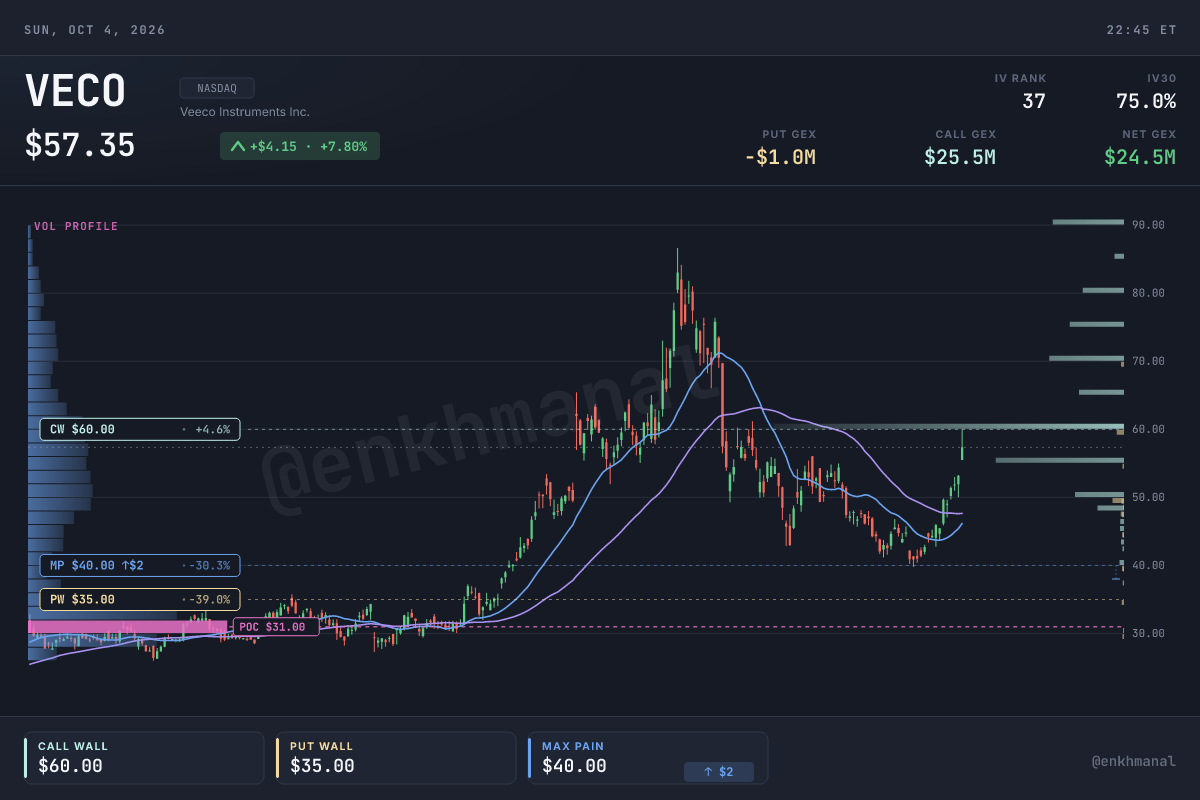
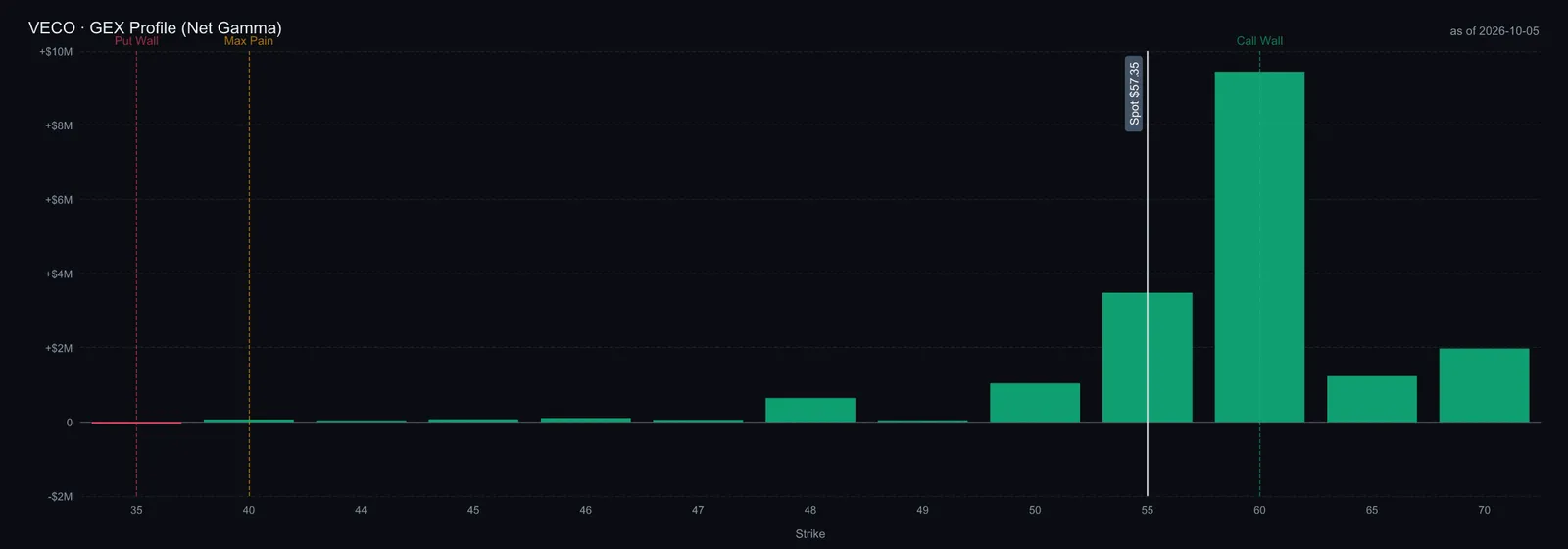
Dealers are long gamma, with net GEX of roughly +$19M to +$25M across the two snapshots we hold. The call wall is $60, 4.6% overhead; the put wall is $35 and the gamma flip about $39, and call open interest outnumbers puts roughly ten to one (put/call 0.09). Thirty-day implied volatility is 75% with an IV rank of 37, and the November 20 expiry, which spans the November 3 print, carries the highest implied volatility on the curve.
The level at which the market would be questioning the thesis is $47 to $48, where the 50-day average meets the top of the September base; a close back below it would say the Toshiba move was a one-day repricing rather than a new leg. One more line belongs on the chart: VECO ÷ (0.3575 × $ACLS). It sat at 1.00 until May, jumped to 1.20 in June and has held between 1.05 and 1.13 since; it is 1.086 today.
Valuation & House View
On trailing GAAP earnings Veeco is expensive and looks it: 159× trailing GAAP EPS of $0.36, the 98th percentile of its own five-year range (median 28.7×), with a trailing PEG of 10.7. On guidance it is 39× the FY26 non-GAAP midpoint of $1.485 and 64× the GAAP midpoint of $0.90. On enterprise value it trades at 58.8× filed FY25 EBITDA and 37.5× our FY26 estimate, against a semiconductor-equipment peer set from 30.1× to 52.5×.
Our workbench model uses ten explicit years because growth is guided above 10%: FY26 on management's guidance, growth fading to 4% by FY35, GAAP costs including stock compensation, a 12% cash tax, 49.8 cents of working capital per dollar of new revenue and a 10% discount rate. It gives two answers 4.9× apart, and the gap is the finding. Capitalising FY35's cash flow at 2% growth gives $19.02 a share; applying the 49.8× peer median to FY35 EBITDA gives $93.47; at Axcelis's own 30× the exit case is $59. The model's audit passes every rule except that gap, which we state rather than average.
The perpetuity is low because on the cost structure management has guided for 2026 Veeco keeps about 7.5 cents of GAAP operating profit per revenue dollar, and growth at a 262-day cash cycle eats cash. Holding growth constant, the perpetuity value reaches $31 at an 11.5% terminal GAAP operating margin, $44 at 15.5%, $53 at 18.5% and $62 at 21.5%. The $57 price needs about 20%, roughly double Veeco's best year since 2011 and two-thirds of Applied Materials' 29%. That is the merger case in numbers: the combined company was pro forma 22% adjusted EBITDA margin on about $1.7B of 2024 revenue, before $35M of targeted cost synergies.
Veeco is a business worth owning for the head-capex cycle that Toshiba just extended, and its ion beams sit in two other AI supply chains as well. At $57 the stock has already doubled this year, trades 8.6% above what the Axcelis exchange ratio pays and needs margins it has never earned to justify the price on cash flow, so we would start with a quarter position, add on a pullback to the $47 to $48 area where the 50-day average and the September base meet, and treat the November 3 print as the test: data storage above Q2's $22.2M and the 'booked well into 2027' language intact. Our probability-weighted value is $63, about 10% above the close; for an investor who only wants the post-merger company, buying $ACLS at the ratio is the cheaper way to own the same thing.