
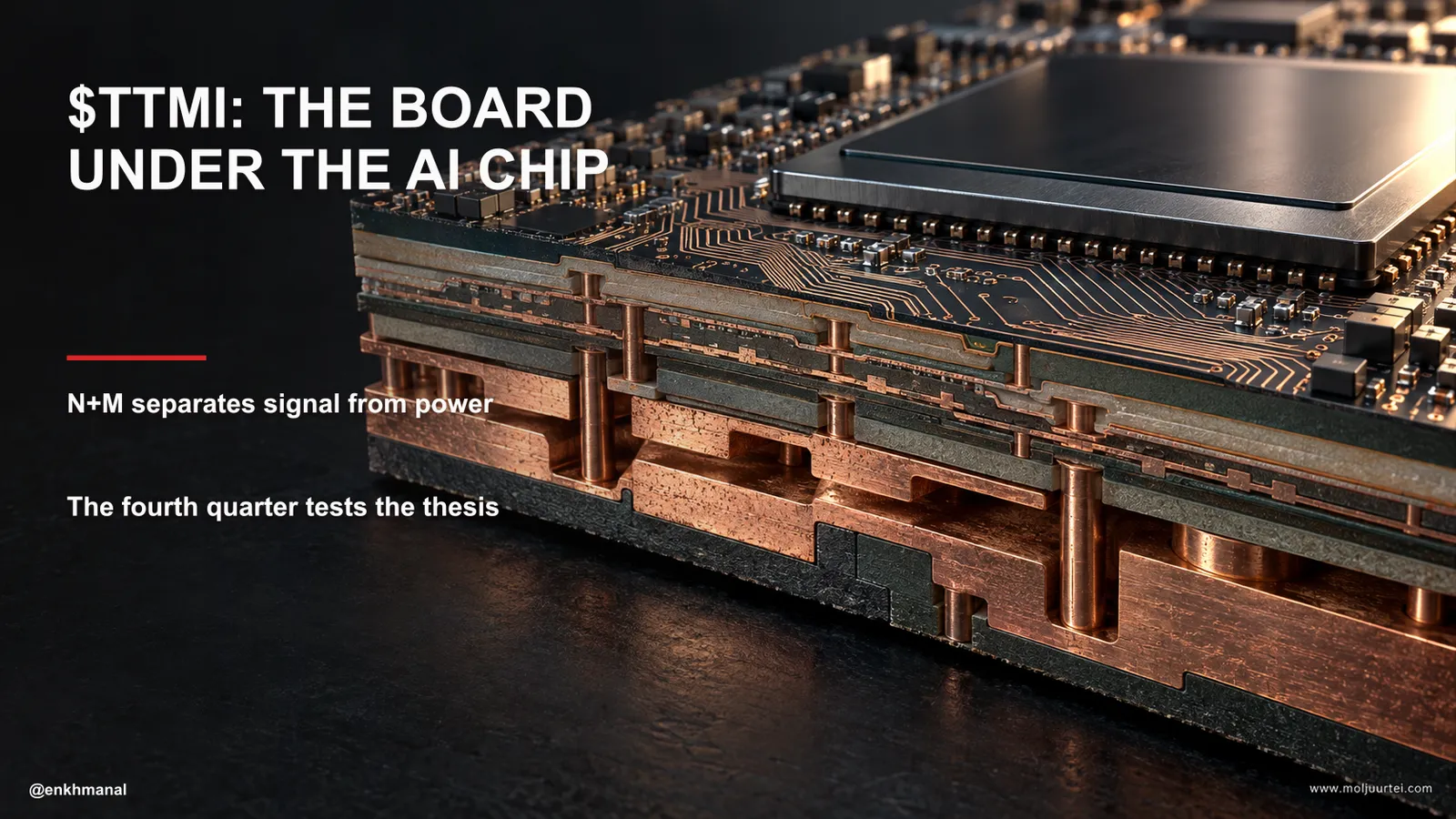
$TTMI Deep Dive — The Board Under the AI Chip · N+M boards and the fourth quarter the guide implies
$TTMI (TTM Technologies) makes the circuit boards that feed power to AI accelerators and carry their signals out, and in this generation of AI hardware that board has become one of the hardest parts of the rack to make. Management's own 2026 guide implies the company exits the year earning about $2.00 a share per quarter on $1.43B of revenue, about twice second-quarter non-GAAP EPS, while the stock was 47% below its June high at the October 8 close because the market does not yet believe the fourth quarter.
The board stopped being the cheap part
Start here. A chip is a slab of silicon that does arithmetic with billions of tiny switches, and it does nothing until something feeds it power and carries its signals in and out. A printed circuit board is that something: a laminated stack of thin copper sheets separated by layers of glass-fibre cloth soaked in resin, with the copper etched into wires and the sheets stitched together by drilled, copper-plated holes called vias. A layer count is how many copper sheets the stack holds, and it is the simplest measure of how hard a board is to make: a phone charger runs on two, a server motherboard on twenty or so, and the boards under AI accelerators and switches now run from forty to more than a hundred. An N+M board is $TTMI's answer to the thickest of these: two different stacks laminated into one, N layers built to carry fast signals and M layers built to carry heavy current.
For thirty years the board was the cheap, boring part of a computer. That changed when AI accelerators grew so large and so power-hungry that the board around them became a design problem of its own. The arithmetic is unforgiving. A chip that draws 1,000 watts at under one volt pulls more than 1,000 amps through the copper beneath it, and every one of those amps wants to share the stack with signals running at hundreds of gigabits per second, where a millimetre of stray copper is enough to blur a bit. Power wants thick copper and lots of it. Fast signals want thin, low-loss material and short paths. One board now has to do both.
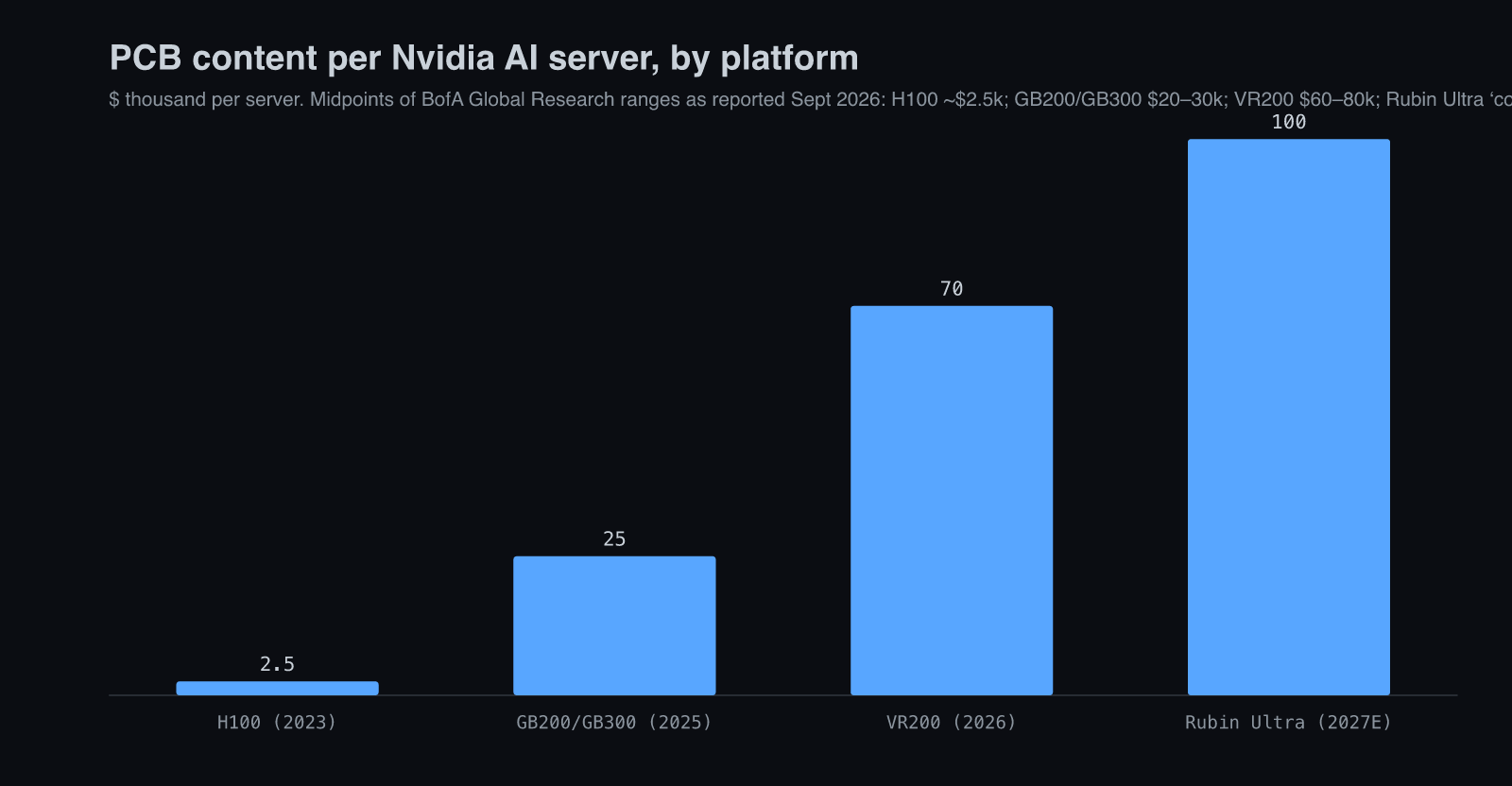
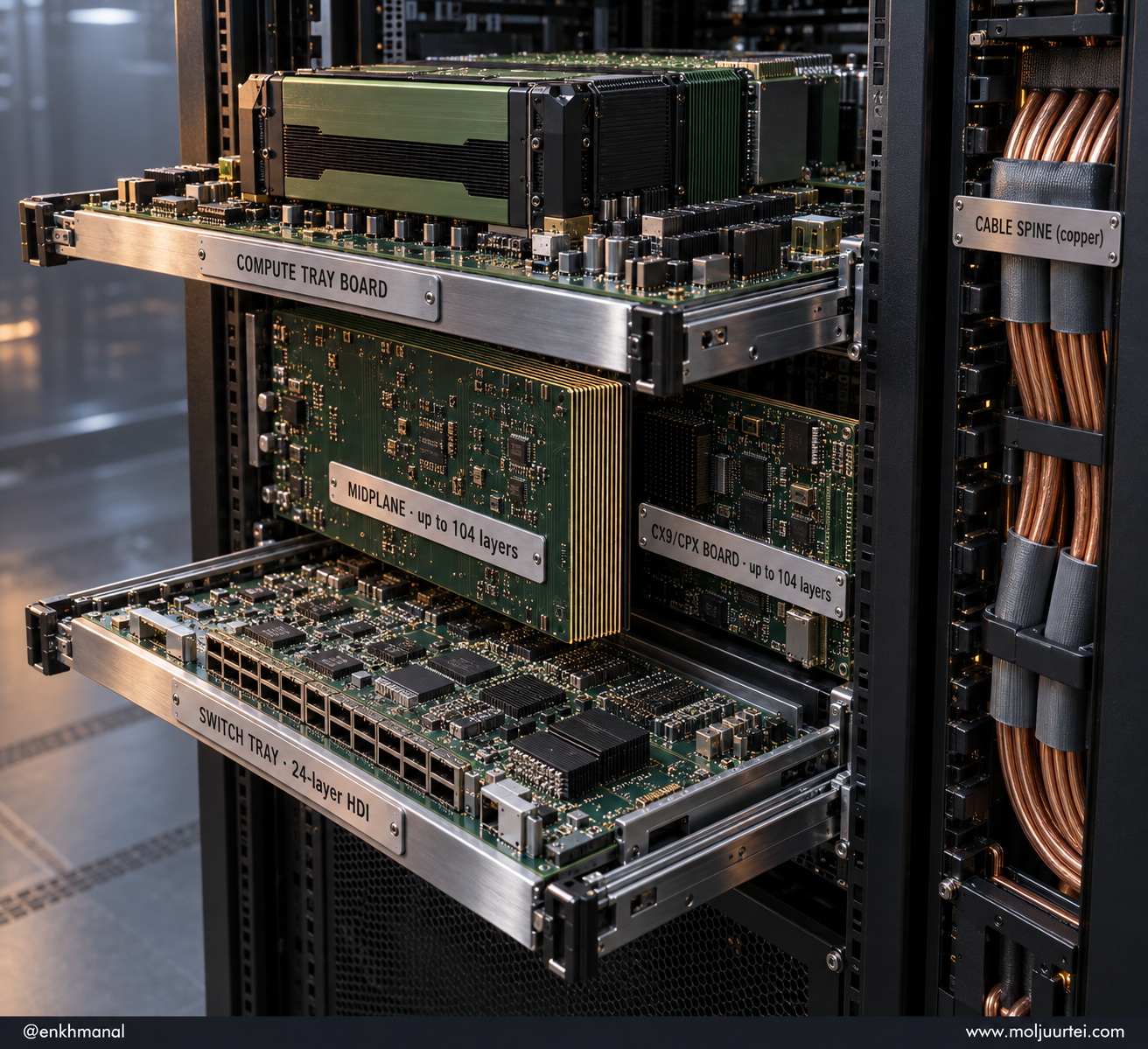
The second change is where the wiring goes. Nvidia's Vera Rubin generation moves high-speed links that used to run through cables onto multilayer boards: switch trays, a new midplane, and network boards. TrendForce, in a November 2025 report, put the Rubin switch tray at a 24-layer HDI board in M8-class laminate and the midplane and CX9/CPX boards at up to 104 layers in M9-class laminate, and said Google's TPU v7 and AWS Trainium 3 are adopting high-layer boards too. Bank of America's estimate of what that does to the bill of materials, as reported in September 2026, is the cleanest summary of the shift: about $2,500 of circuit board per H100 server, $20,000–30,000 per GB200/GB300, $60,000–80,000 per Vera Rubin, and possibly more than $100,000 per Rubin Ultra in 2027.
Every one of those boards still has to be built, layer by layer, by a small number of factories that can hold tolerances measured in microns across a panel the size of a tea tray. That is the bottleneck we are writing about, and $TTMI is the US-listed company most exposed to it.
One of four factories for the newest AI board
$TTMI is one of the top four of the five or six manufacturers that can mass-produce the newest class of AI board, an asymmetric "N+M" stack that keeps a kilowatt of power from corrupting terabits of signal, and it is ramping that product from tens of millions of dollars to a guided $600M in the second half of 2026.
A board factory that bought its way up the chain
$TTMI is the old TTM Technologies of Santa Ana, California, a contract maker of advanced circuit boards that has spent twenty-five years buying its way up the value chain. Its roots go back to Pacific Circuits, incorporated in 1978; it listed on Nasdaq in 2000, bought Tyco's printed circuit group in 2006, Hong Kong's Meadville in 2010, Viasystems in 2015 and the RF designer Anaren in 2018, sold its mobile-phone board business to AKM Meadville for $550M in 2020, and bought the radar maker Telephonics in 2022. Today it runs 24 plants, employs about 18,200 people and sells to about 1,300 customers in two segments. Commercial makes boards for data centers and networking, medical and industrial equipment, and cars, mostly in four plants in China plus Penang in Malaysia and a few North American sites. Aerospace & Defense makes boards, RF modules and complete systems such as the AN/APS-153 radar on the Navy's MH-60R helicopter, of which TTM is the sole provider, from 16 North American locations.
The business is a build-to-print model with a technology premium. TTM rarely designs the circuit; the customer does. TTM wins on what it can manufacture: layer count, fine lines, exotic materials, flatness, yield, and speed from prototype to volume. It is paid per board, and the price of a board climbs steeply with complexity. Asked about it in April, the chief executive put the change in plain terms:
These boards are getting more and more complex. We spoke in the past about the number of layers. You know, we can go to 80 layers, we get 100 layers, even 140 layers now... Because of that complexity, our ASPs are going up, let's say, a factor of four, maybe a factor of eight.
The revenue line has finally started to show it. On an annual basis revenue was $2,105M in FY20 (−1.3% like-for-like after the mobile-board sale), $2,249M in FY21 (+6.8%), $2,495M in FY22 (+11.0%), $2,233M in FY23 (−10.5%), $2,443M in FY24 (+9.4%) and $2,906M in FY25 (+19.0%), while gross margin ran 17.1%, 16.5%, 18.4%, 18.5%, 19.5% and 20.7% and operating margin 1.3%, 5.6%, 8.4%, 1.9%, 4.8% and 9.1% across the same years. Management now guides FY26 revenue of about $4.4B, up 51%. Gross margin has risen in five of the last six years even as revenue swung, which is what mix improvement looks like when it is real.
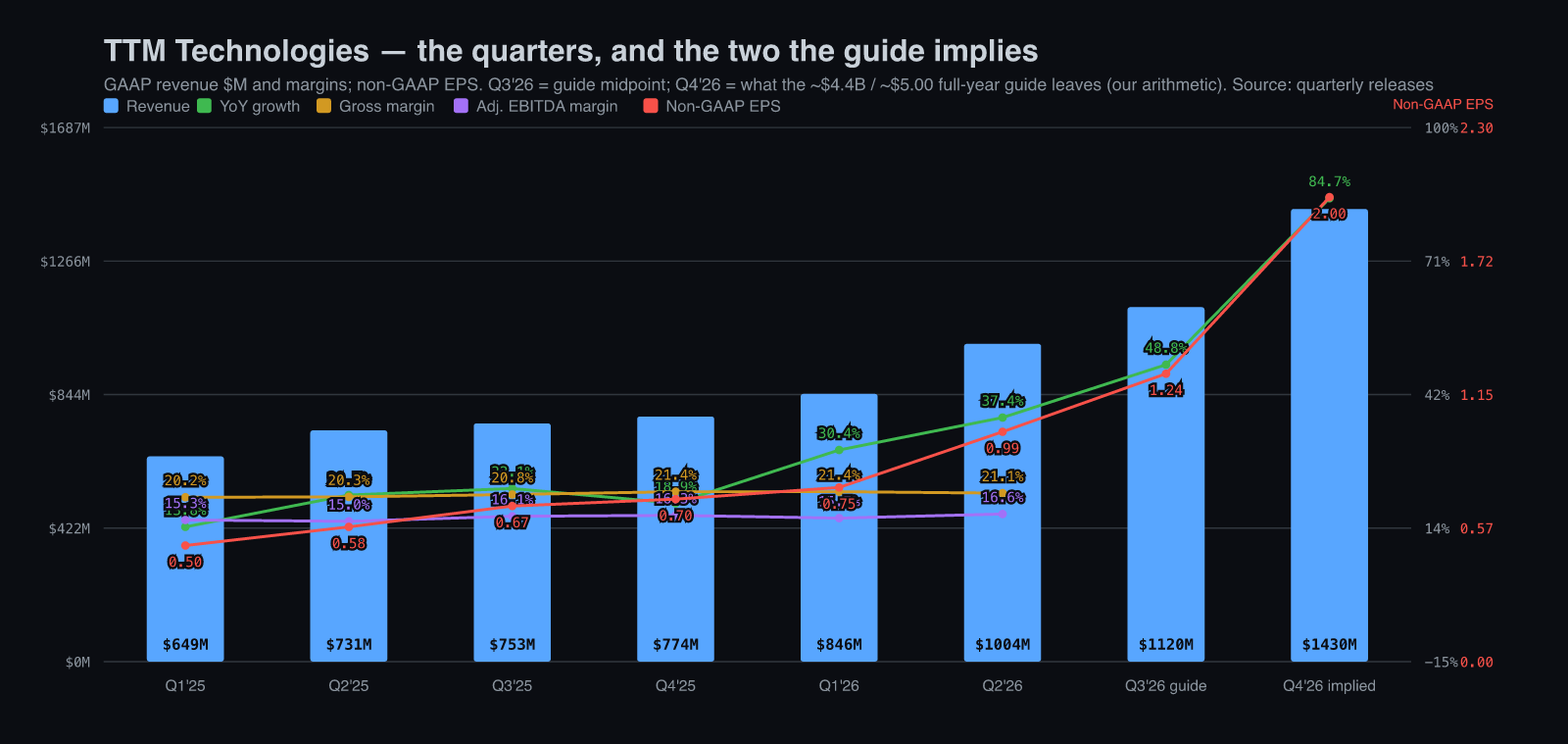
The quarters show the acceleration more clearly than the years. Revenue was $648.7M in Q1 2025 (+13.8% year on year), $730.6M in Q2 (+20.7%), $752.7M in Q3 (+22.1%), $774.3M in Q4 (+18.9%), $846.0M in Q1 2026 (+30.4%) and $1,004.1M in Q2 2026 (+37.4%), the company's first billion-dollar quarter. GAAP gross margin across those six quarters ran 20.2%, 20.3%, 20.8%, 21.4%, 21.4% and 21.1%, and adjusted EBITDA margin 15.3%, 15.0%, 16.1%, 16.3%, 15.7% and 16.6%. The third-quarter guide of $1.10–1.14B is growth of about 49%, and the full-year guide leaves roughly $1.43B for the fourth quarter, growth of about 85%.
One end market is producing most of that growth. In Q2 2026, Data Center & Networking was 40% of net sales at $405M, up 91%; Aerospace & Defense 37% at $371M, up 14%; Medical, Industrial & Instrumentation 15%, up 33%; Automotive 8% and slightly down. Of the $273M of revenue TTM added year on year, Data Center & Networking contributed about 71%, defense about 15% and medical-industrial about 15%, with automotive contributing nothing. In the third quarter management expects Data Center & Networking to reach 49% of sales and defense to fall to 32% of a much larger total. TTM is turning into an AI company with a defense business attached, rather than the other way round.
The suppliers and builders either side of TTM say the same thing with their own numbers. $APH reported second-quarter IT datacom sales up 89% in dollars and 63% organically, 43% of its revenue. $CLS, which assembles hyperscaler switches and AI servers, grew its Connectivity & Cloud Solutions segment 84% to $3.81B, with its switch-platform business up 58%, and expects 2027 growth to beat the 65% it guides for 2026. The market itself is still small enough for a ramp like TTM's to matter: Prismark puts global HDI board output at $16.2B in 2025, growing 13.1% a year to $30.0B in 2030.
N+M: the board that breaks the symmetry rule
TTM's edge in this cycle is one product family, and it is easiest to understand as a broken rule. Every board-maker learns on day one that a laminated stack must be symmetric: the same number of layers, the same materials and roughly the same amount of copper on each side of the centre line. A board is cured under heat and pressure, and when it cools, each material shrinks at its own rate. Balance the two halves and the stresses cancel, so the panel comes out flat. Unbalance them and it bows like a potato chip, and a large chip package with thousands of solder balls underneath cannot be attached to a board that is not flat.
N+M throws the rule away on purpose. The signal section, N layers, is built from thin, expensive, low-loss laminate tuned for high-speed lanes; the power section, M layers, is built from heavy copper planes that carry current to the chip. The two sub-sections are made separately and laminated into one board, so the fast signals never share space with the power noise and the power path gets as much copper as it needs. The result is a thick, high-layer board whose two halves behave differently in every way that matters, and which still has to come out flat. TTM showed 87-layer boards last year and says it now plays everywhere above 40 layers. The executive who runs TTM's data-center business described it at the company's Analyst Day:
For those of us who've been doing this for a long time, this breaks just about every rule from a manufacturing standpoint... you want everything to be equal on both sides, whether it be layers, whether it be materials, whether it be copper distribution. As you can see from the picture up here, we've thrown all that out... the real challenge is manufacturing it to be flat, have a flat coplanarity or flat BGA package... Today, you're looking at 1.6T switches. You're looking at AI ASICs that are going to utilize this technology.
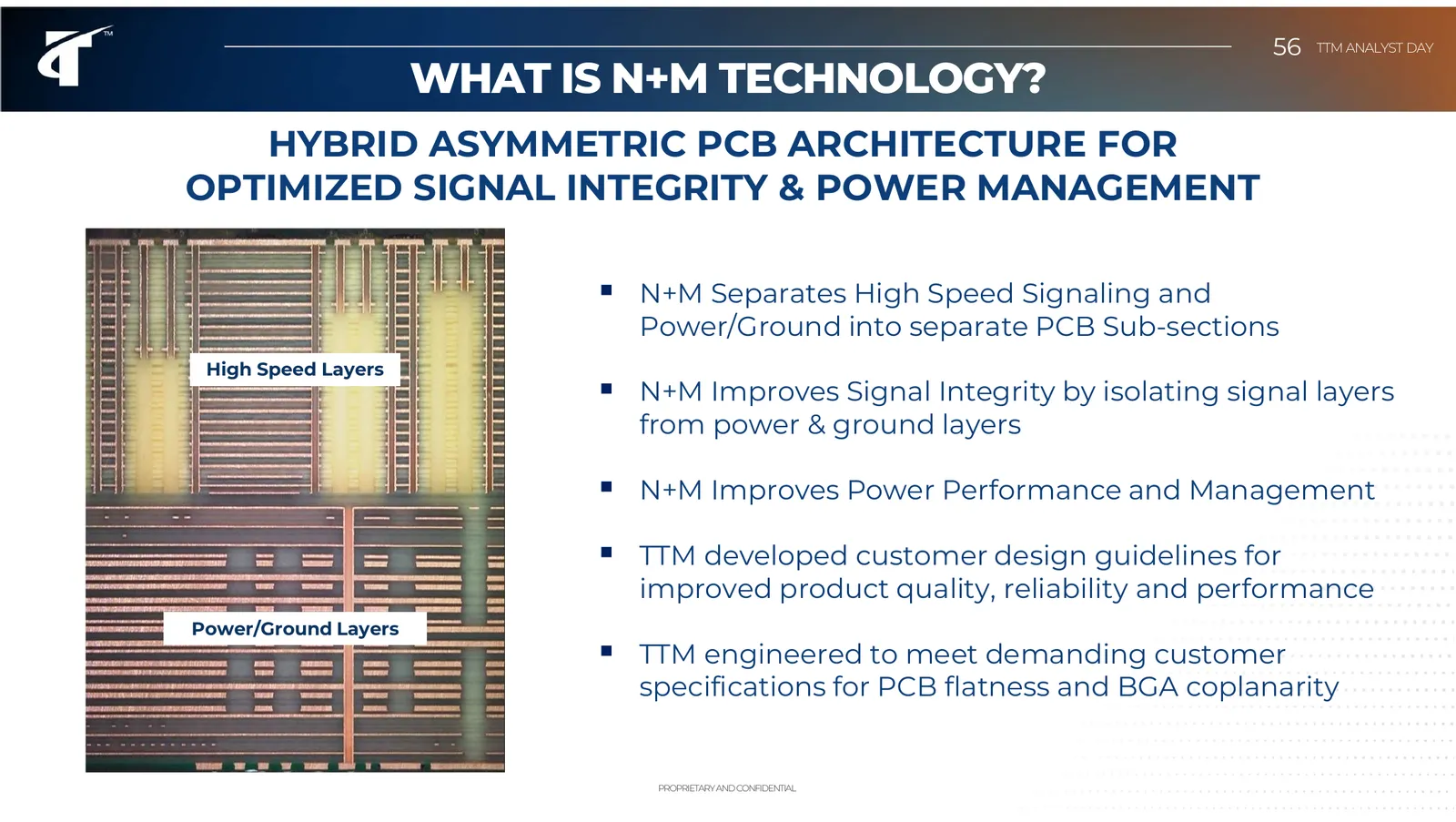
The cross-section above is the product. The upper block carries the high-speed layers on fine copper; the lower block carries the power and ground planes on heavier copper. TTM says it spent more than two years developing N+M with one strategic customer and 12–14 months retooling its Guangzhou and Dongguan plants for volume. The first named application is a key customer's 1.6-terabit switch; the next is custom AI accelerators.
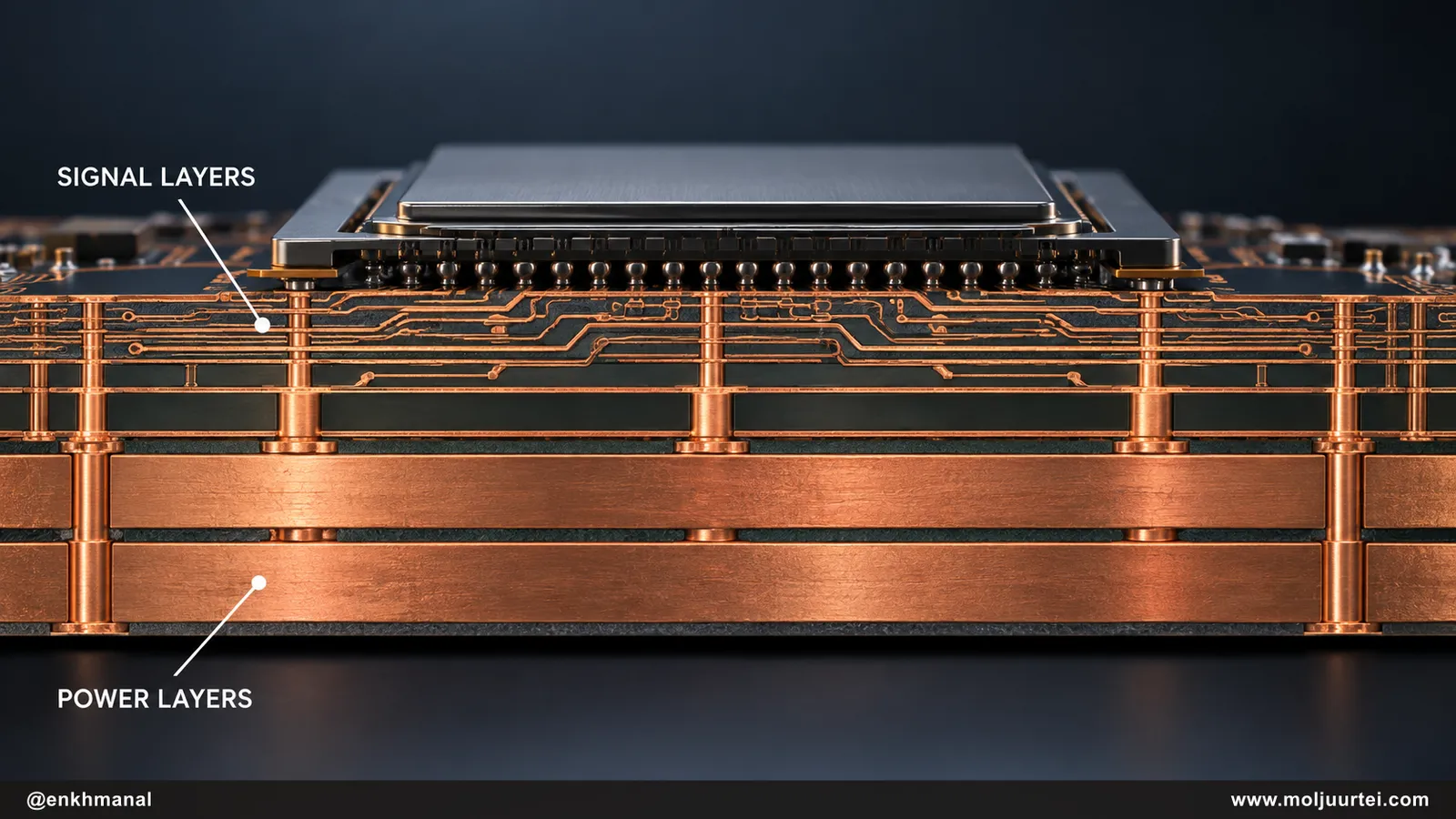
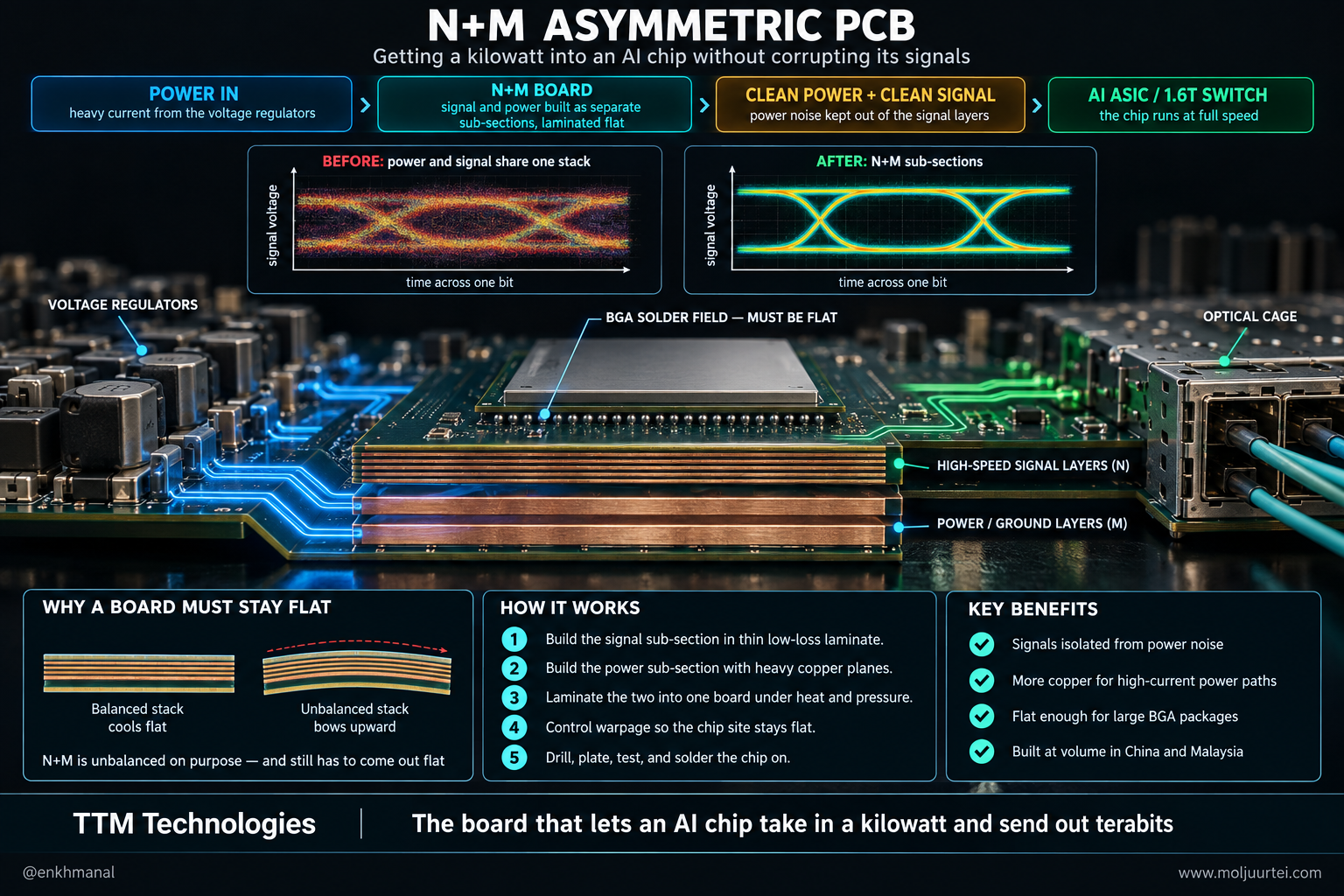
The moat is real but it is a lead, not a lock, and TTM says so itself. In April the chief executive placed TTM in the "top four" of a global field of five or six makers capable of this class of board, naming Victory Giant, WUS and Unimicron, and added that TTM shares N+M know-how with competitors so that customers can be supplied as a whole. Hyperscalers want two or three qualified sources for every board, and they get them. What protects TTM is three things a competitor cannot copy quickly: two years of process learning on the hardest asymmetric stacks, qualification on programs that take a year or more to approve a new supplier, and a footprint that lets a customer choose China, Malaysia or the United States for the same board. In defense the moat is older and stickier: security clearances, a Government Security Committee of cleared directors, and programs on which TTM is the only US supplier.
It is worth listing every way the industry could route around the board, because each one changes TTM's share of the problem. Cables are the first: Nvidia's racks still run their spine on copper cable cartridges, and flyover cables can lift the longest links off a board, but every cable needs a connector and the trend in Rubin is the other way, from cable onto board. Light is the second: co-packaged optics would carry signals off the chip as light and shrink the copper a board has to carry, which is why TTM is developing optical boards and embedded waveguides rather than ignoring them. Power is the third: moving voltage regulation into or right under the chip package cuts the current the board has to deliver, and would take some of the urgency out of N+M's heavy-copper half. The fourth is simply a competitor's N+M. We think the first three arrive slowly and partly, and the fourth is already here, which is why we treat TTM's position as a lead to be defended, not a franchise.
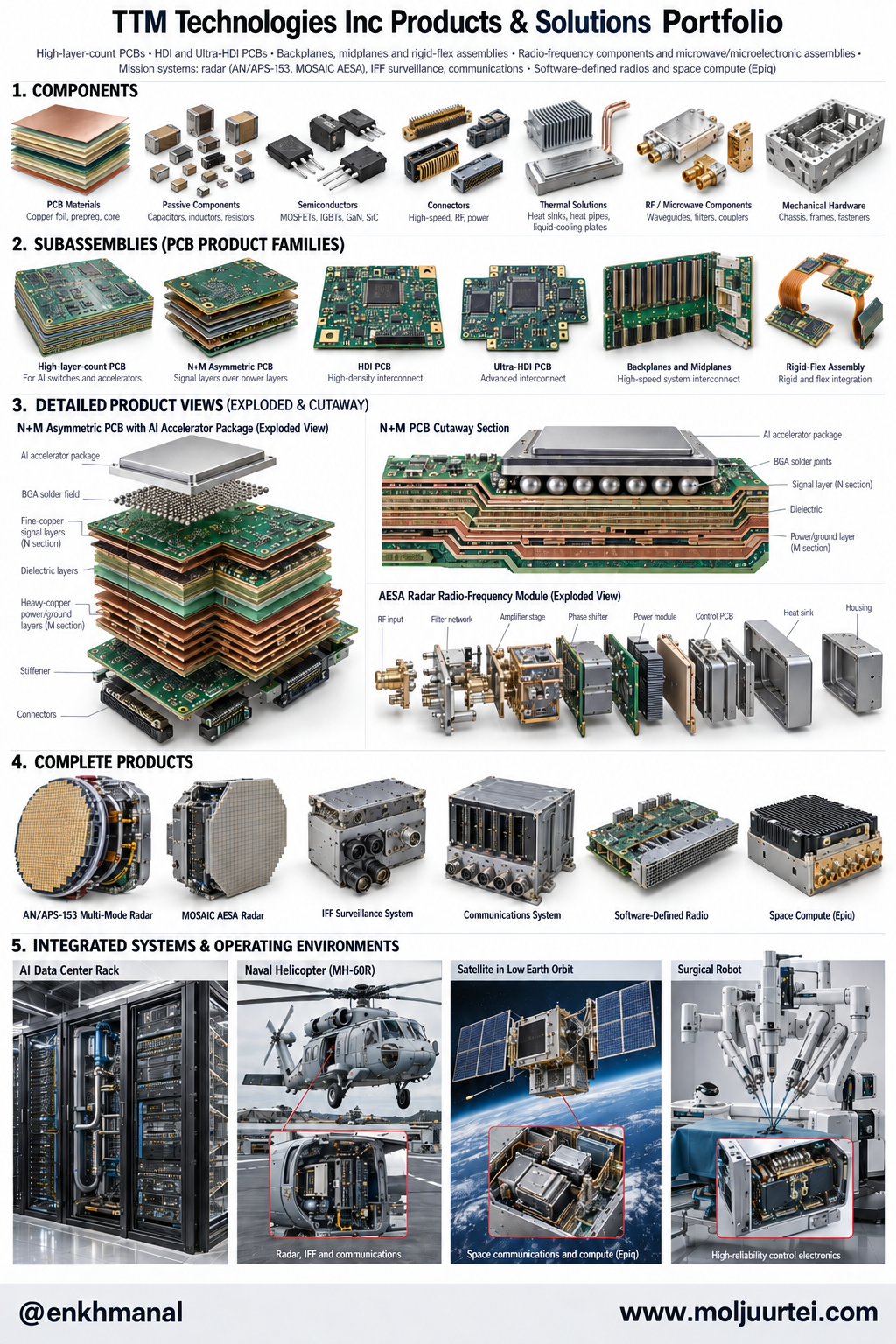
TTM's own catalogue explains why both halves of the business sit in one company. The same plants that make 30-plus-layer boards routinely, and boards of more than 70 layers, feed the defense business's Ultra-HDI boards, radio-frequency modules and radar systems. The poster below lays out what the company physically makes.
Capacity is the roadmap
TTM's roadmap is a capacity plan as much as a research plan, because in this business the process lives on the factory floor rather than in a lab. Reported R&D was $29M in FY25, about 1% of sales; the real development spend sits in plant engineering and in capital spending, which reached $292.6M in FY25 and is guided to $345–365M in 2026, raised by about $45M in the second quarter.
The most interesting line is the third. A 150-layer board cannot be laminated in one pass, so TTM builds it from sub-sections and joins them with a sintered conductive paste, the same build-from-parts logic as N+M taken one step further. That is the product for the midplanes and backplanes the 2027 platforms need. It is also where the competition is thinnest, because few factories can yield a board that thick.
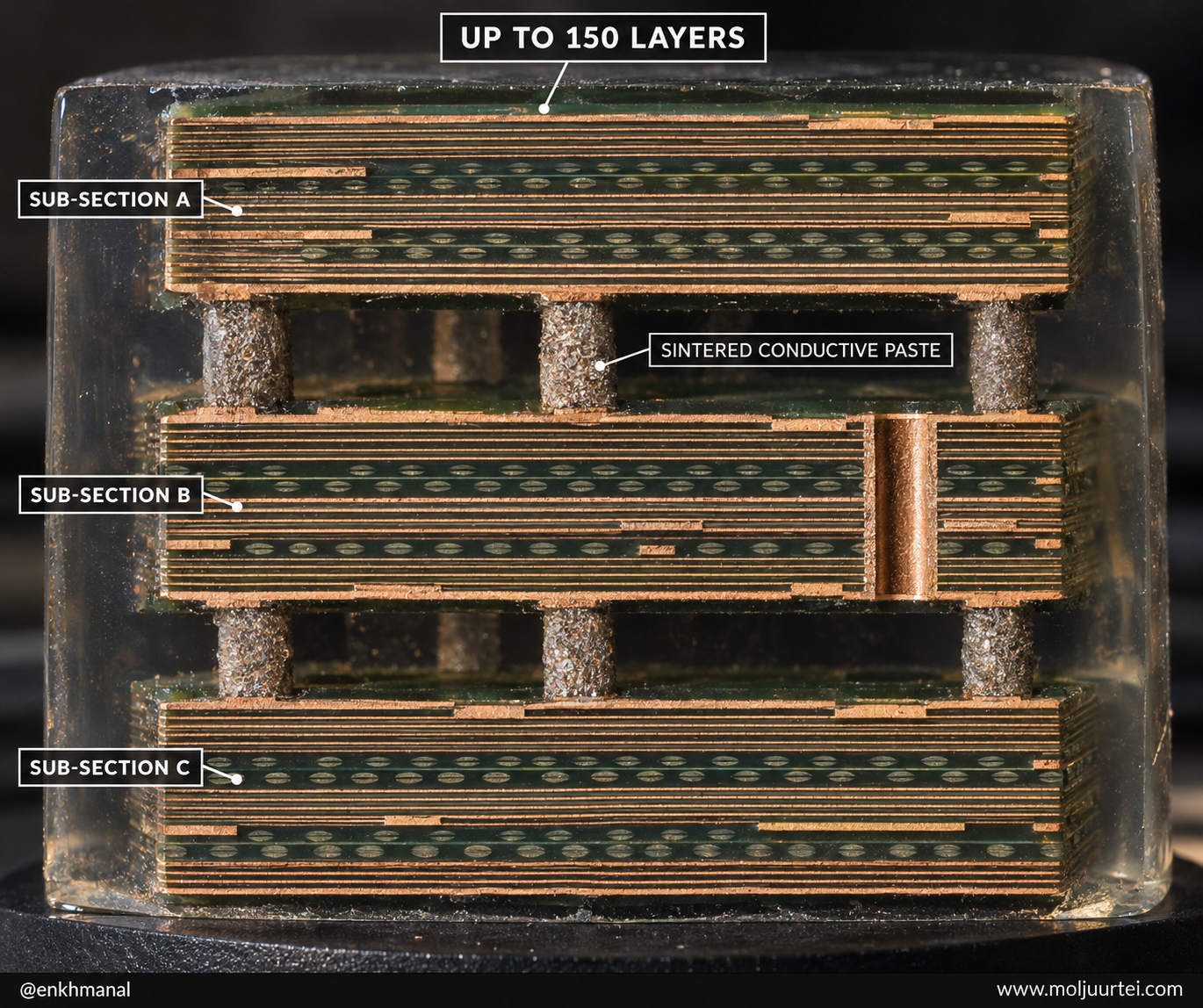
The acquisitions belong on the roadmap too. In June TTM agreed to buy Swiss Technology Group and Germany's ILFA, its first European plants, adding miniaturised boards for medical implants and hearing aids and complex boards for defense, together under 5% of sales. In August it agreed to buy Epiq Solutions from Veritas Capital for $1.1B in cash, a maker of software-defined radios, radio-frequency products and radiation-tolerant space computers; the deal closed on September 30. Epiq moves TTM further from the board toward the finished electronics on the defense side, the same direction the Anaren and Telephonics purchases went.
Why it's mispriced: the fourth quarter nobody believes yet
The market is pricing TTM as if its fourth quarter will look like its second, and the company's own guide says it will not. Take the arithmetic in two steps. First half revenue was $1,850.0M and non-GAAP EPS $1.74; the third-quarter guide midpoint is $1,120M and $1.24. A full year of about $4.4B and EPS that "approach $5.00" leaves roughly $1.43B of revenue and about $2.00 of EPS for the fourth quarter. That is revenue up about 85% year on year and an implied non-GAAP net margin near 15%, against 10.6% in the second quarter. On our arithmetic it also implies a fourth-quarter non-GAAP gross margin near 25%, against 21.9% in the second quarter. The ramp that is supposed to deliver it is N+M, whose yields the chief financial officer tied directly to the margin:
Edwin just mentioned $600 million in the second half, about a third of that's in Q3 and two-thirds in Q4. You see that ramp as we ramp production and improve yields as well into fourth quarter. The margin will kind of improve as well as those yields improve.
The order book supports the revenue side. Book-to-bill was 1.49 in the second quarter, 1.63 in Commercial, and the 90-day backlog stood at $901M against $497M a year earlier, up 81%. On September 9 the chief executive repeated the plan: "$200 million this quarter, and then next quarter, another $400 million." The margin side is the open question, and it is also where the upside lives, because a company earning $2.00 a quarter on a run-rate basis is trading at under 15 times that run-rate at $117.50.
The cash statement tells the other half of the story. TTM converted almost none of its FY25 profit into free cash: operating cash flow of $291.9M against capital spending of $292.6M, on net income of $177.4M. In the first half of 2026 operating cash flow was $118.1M against net income of $133.0M and capital spending of $169.2M, as receivables rose $156M, contract assets $128M and inventory $58M, largely offset by $269M more owed to suppliers. Ninety-six percent of revenue is recognised over time as boards are built, so working capital swells with every step up in volume. Management's FY26 guide for operating cash flow is $300–320M, which needs about $190M in the second half. The model works only if the capex cycle peaks in 2026–27, which is how management frames it.
Why the discount exists is not mysterious. The stock ran from about $73 in January to $223.83 in late June, a trailing P/E above 100, then fell about 30% in a week, a drop traders on X tied to its Russell 1000 inclusion and a round of small officer sales. It fell again in August when TTM agreed to spend $1.1B on Epiq with borrowed money. The latest leg, an 8.3% drop on October 8, came on a day $ALAB fell 9.2% and $COHR 9.6%, with no TTM news. None of those events is about the board.
A Teledyne team running a board factory
TTM's leadership has changed more in the last year than in the previous decade, and that is the most important thing to know about it. Tom Edman ran the company for over ten years before Edwin Roks took over on September 2, 2025. Roks spent the previous eight years at Teledyne, the instrumentation and defense-electronics group, rising to run its largest segment and then serving as its chief executive from January 2024 to April 2025. The chair, Rex Geveden, also came up through Teledyne and runs the nuclear-components maker $BWXT. The board has added a former Secretary of the Army and a former Boeing and Rolls-Royce defense executive this year. TTM now looks and acts like a Teledyne-style acquirer of defense electronics bolted onto a high-volume board factory.
Two parts of the record deserve weight. Roks is thirteen months into the job, so his record at TTM is a record of guidance and deals, not yet of a full cycle; the raised outlook has been met so far, and the fourth quarter is the first real test. And the acquisition pattern has a history: TTM bought Anaren from Veritas Capital for $775M in 2018 and now Epiq from the same seller for $1.1B. Anaren became the core of TTM's radio-frequency business. The insider buying in August, after the stock had halved, came from the two people who designed the strategy.
The fourth quarter carries the thesis
What forces a thesis change: a third-quarter N+M figure well short of $200M, or a fourth-quarter revenue guide below about $1.35B. Either would mean the margin step is a 2027 event rather than a 2026 one, and the stock would trade on second-quarter earnings power instead.
Levels, technicals and options
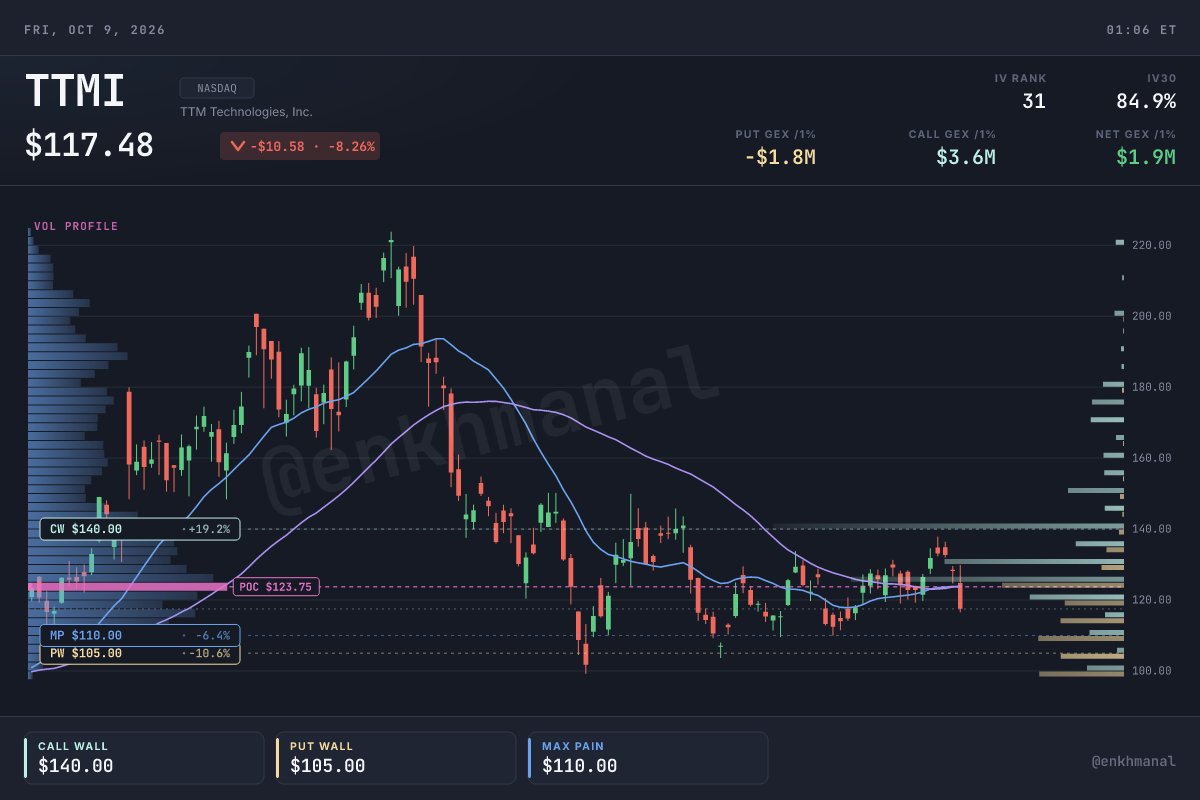
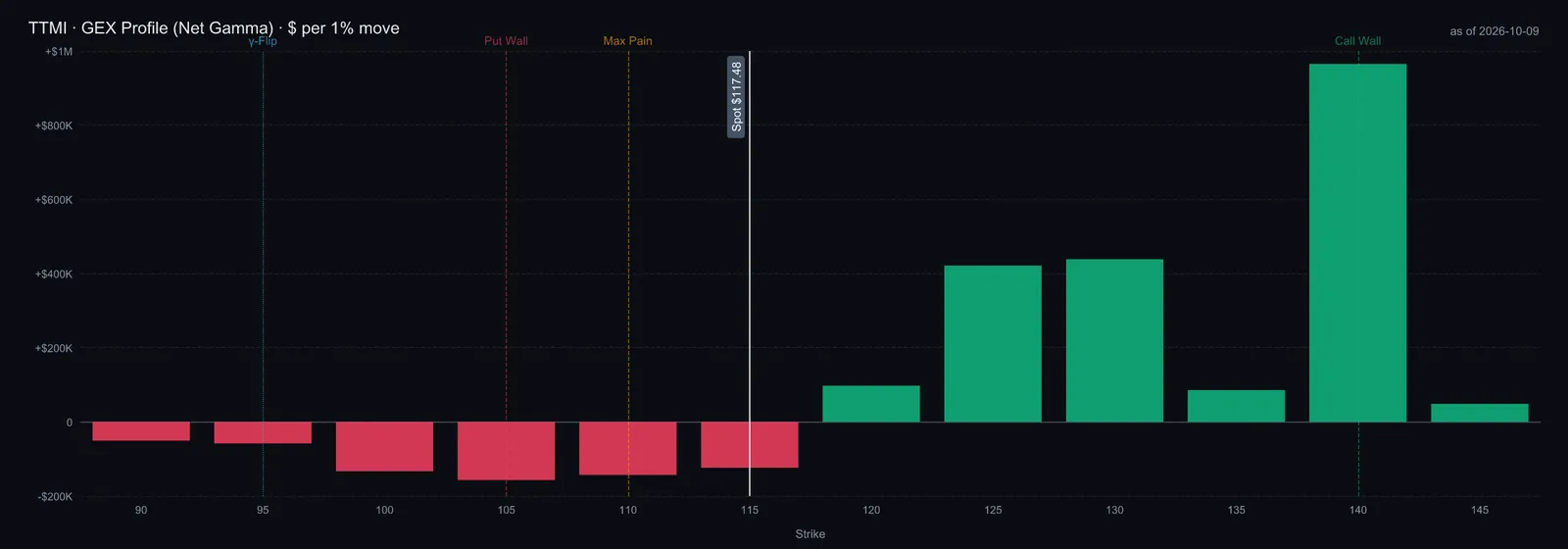
The chart is weaker than the business. $TTMI closed at $117.50 on October 8, below its 20-day moving average of $123.60, its 50-day of $123.98 and its 200-day of $126.46, with the 50-day now sitting just under the 200-day. The 100-day, at $146.38, still carries the memory of the June spike. RSI is 42.5. Since late August the stock has traded between about $104 and $138, and the heaviest volume of the last six months sits at $123.75, the level it lost on Thursday. The stock is still up 70% in 2026 and has doubled over twelve months.
Two methods, 2.5× apart
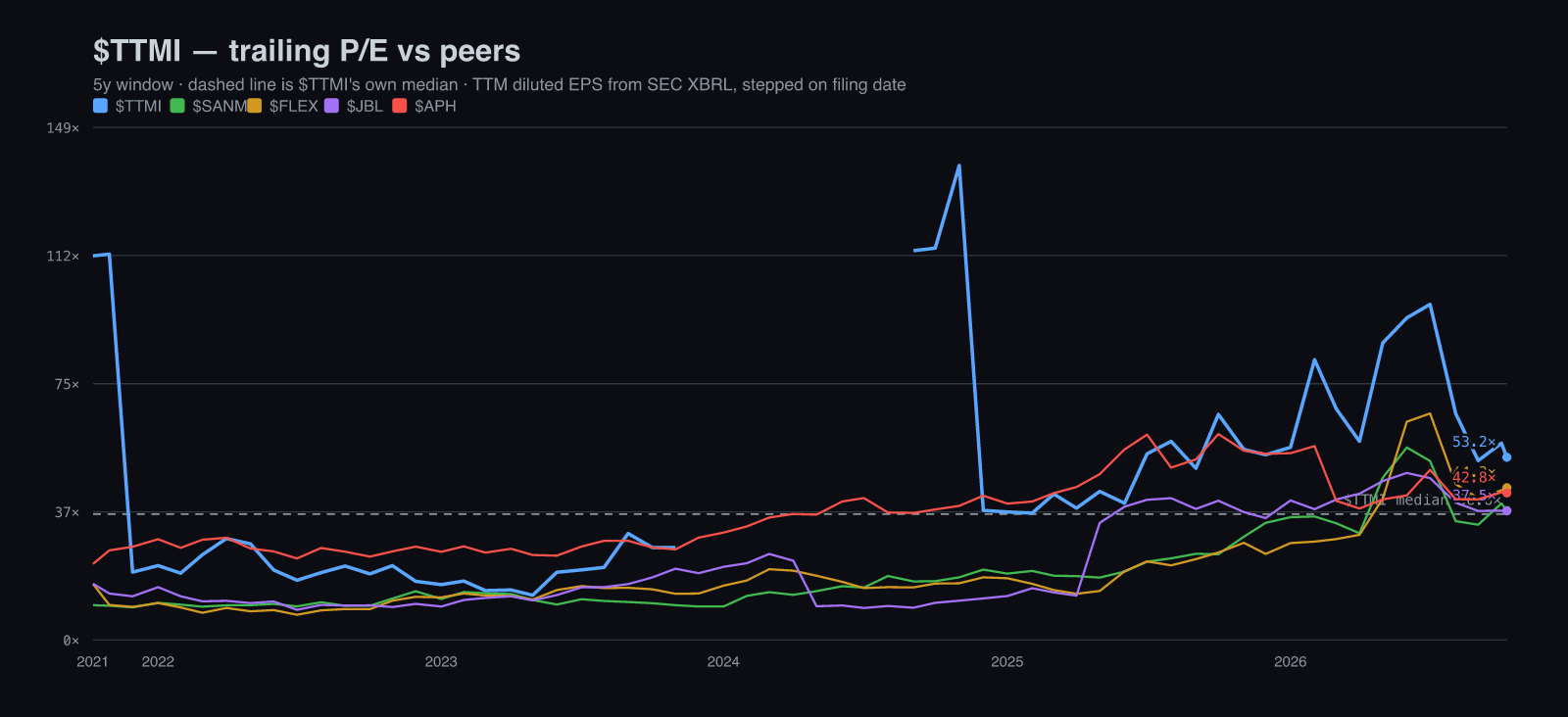
At $117.50 and about 107.6M diluted shares, TTM is worth roughly $12.6B; with net debt of about $1.4B after Epiq on our estimate (the company's 2.3× leverage on trailing EBITDA including Epiq), its enterprise value is about $14.0B. On trailing GAAP earnings of $2.21 a share the P/E is 53.2×, in the 67th percentile of its own five-year range (median 36.6×), against $SANM 37.6×, $FLEX 44.3×, $JBL 37.5× and $APH 42.8×; because trailing EPS has compounded at 79% a year, the trailing PEG is 0.67, the lowest in that group. On the "approaching $5.00" FY26 guide it is about 23.5×, and on the implied fourth-quarter run-rate about 14.7×. Five analysts cover it, all at buy, with targets from $175 to $236 and a mean of $210; Needham cut its target to $175 in September.
Our model, seeded from the guide ($4.4B in FY26, 17.5% growth in FY27, fading to 4% by FY35, gross margin 23%, capex easing to 6% of sales, 10% cost of capital), gives two very different answers, and the gap is the finding. Valued on the cash it throws off with a 2% perpetuity, TTM is worth $80 a share in the base case; valued on its terminal-year earnings at the peer median of 23.2× EBITDA, it is worth $203. The two methods are 2.5× apart because TTM is a capital-hungry grower: the perpetuity only rewards the cash left after years of heavy capex and working capital, while the exit multiple pays for the earnings. A reverse DCF says the price assumes about 19.7% revenue growth every year for ten years at our margins, and at $117.50 our base case earns an internal rate of return of 7.8%.
The EPS figures are our estimates, built from the guide and the implied fourth-quarter margin, not company guidance; the multiples are judgements. The DCF ranges for the same three cases are $33–124 (bear), $80–203 (base) and $136–284 (bull), perpetuity to exit.
TTM is a name worth owning for the technology, at a size that respects the fourth quarter. The probability-weighted two-year value on the table above is about $137, 17% above the price, with the bull case carrying most of the upside and the DCF on cash flow saying the market already pays for much of the ramp. We would start a position at $117.50, keep the $104 August low as the line where the case is wrong, and add after the third-quarter report if N+M revenue reaches about $200M and the stock closes back above its $126.50 200-day.