
Texas data centers — The value of power already approved
A data center turns electricity into computing work and heat. Getting power to the site and removing that heat determine whether it can operate. A Texas project may need a grid connection, environmental permits and a reliable cooling water plan. After the November 3 election, existing approvals became more valuable in the November 5 thesis: Governor-elect Gina Hinojosa pledged a new pause on approvals while lawmakers work on rules. That pledge is not an order in effect.
Start here.
November 10 update — What the latest records change
The grid operator’s verification update still targets December 10. Reviewers identified gaps in proof of site control, equipment procurement and financial security; the report is a test of project readiness, not a new blanket approval. The New Mexico order vacated the December 7 Jupiter hearing; the November 19 status conference is the next date on the docket. The November 4 prices and scenarios throughout remain historical.
IREN reported November 5 that Sweetwater’s 2 GW is conditionally included as base load and Horizon 1 was delivered. Core Scientific reported November 5 $232.9M in Q3 revenue and listed four facilities in Texas. TeraWulf reported November 6 that the Abernathy sale closed; it reported contracted Muskie power rising from 500 MW to 1,000 MW, subject to Kentucky approval. MARA’s November 9 filing still conditions Matagorda’s 2,000 MW potential on the Texas review and approvals. These filings reinforce the need to distinguish approved power, binding contracts and delivered IT capacity.
Thesis
Approved power is scarce in Texas. Cleanview tracks 88.4 GW of planned data centers in the state. That is a tracker estimate of potential projects, not a utility forecast or a commitment to build. The incoming governor’s pledge adds uncertainty for outstanding approvals; projects already energized, projects approved but still building, and projects waiting in the queue face different risks.
Backdrop — How Texas Got Here
Greg Abbott built the freeze with three letters, and that is the fact most of the 4 November commentary skipped. On 3 August he told the PUC and ERCOT to audit every data center in the interconnection process, and the PUC gave ERCOT the time on 20 August (Riot 10-Q). On 14 September he told the water board to compel reporting (water board letter). On 21 September he told TCEQ to "pause the issuance of all permits related to data center projects until ERCOT completes its review" (letter to TCEQ), and added that no other state agency should move forward on approvals.
The September directive covers permits related to data centers. Implementation has not been uniform in reports reviewed for the November 5 thesis; the analysis does not rely on disputed counts of permits issued or suspended. The directive establishes the intended scope, not the status of every individual permit.
The denominators are wild, and they decide how much a pause costs. The governor’s office reported about 474 GW of interconnection requests in August (August 3 governor’s release). Its September update conditionally sorted the first batch into 204 projects at 66.4 GW of base load and 158 projects at 127.9 GW of studied load (ERCOT). Cleanview's tracker holds 88.4 GW planned in Texas (Cleanview). ERCOT's own forecast, as HARC reports it, runs 22 GW to 78 GW by 2030 (HARC). Vistra's CEO told investors in August he has not moved his 2024 forecast of 115 GW to 120 GW of total ERCOT load in 2030, and called the demand in the queues overstated. The queue is more than five times the grid's record peak, which is why queue totals cannot be treated as operating demand.
The Texas Secretary of State’s results put Hinojosa at about 53% in the November 3 governor’s race and show Democrats leading the lieutenant governor and attorney general races. The incoming governor is scheduled to take office January 19, 2027. The November 5 thesis assumes a divided legislature, with Democrats holding the House and Republicans the Senate. Both candidates backed stricter data center rules; the policy difference that matters here is how long approvals could be delayed and what would end a pause.
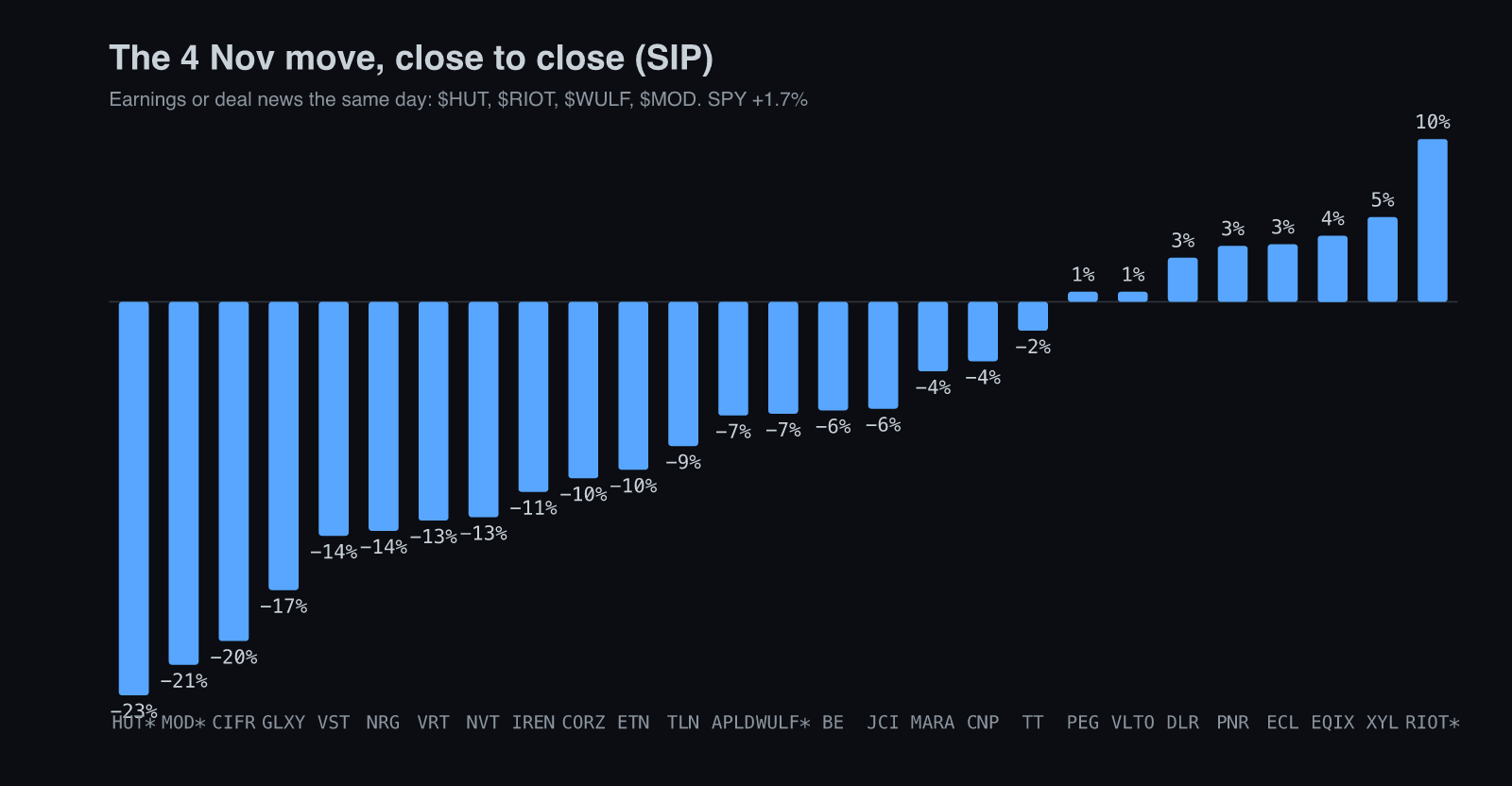
The market's first answer was about stage, and the clean read is narrower than the headlines. $RIOT, whose leased capacity is all in Texas, rose 9.6% on a 910 MW lease, while $CIFR fell 20.0% and $GLXY 17.0% with their pipelines waiting on ERCOT. Four of the loudest moves carry company news, so we would not hang much on any one of them. The longer chart is the humbling one.
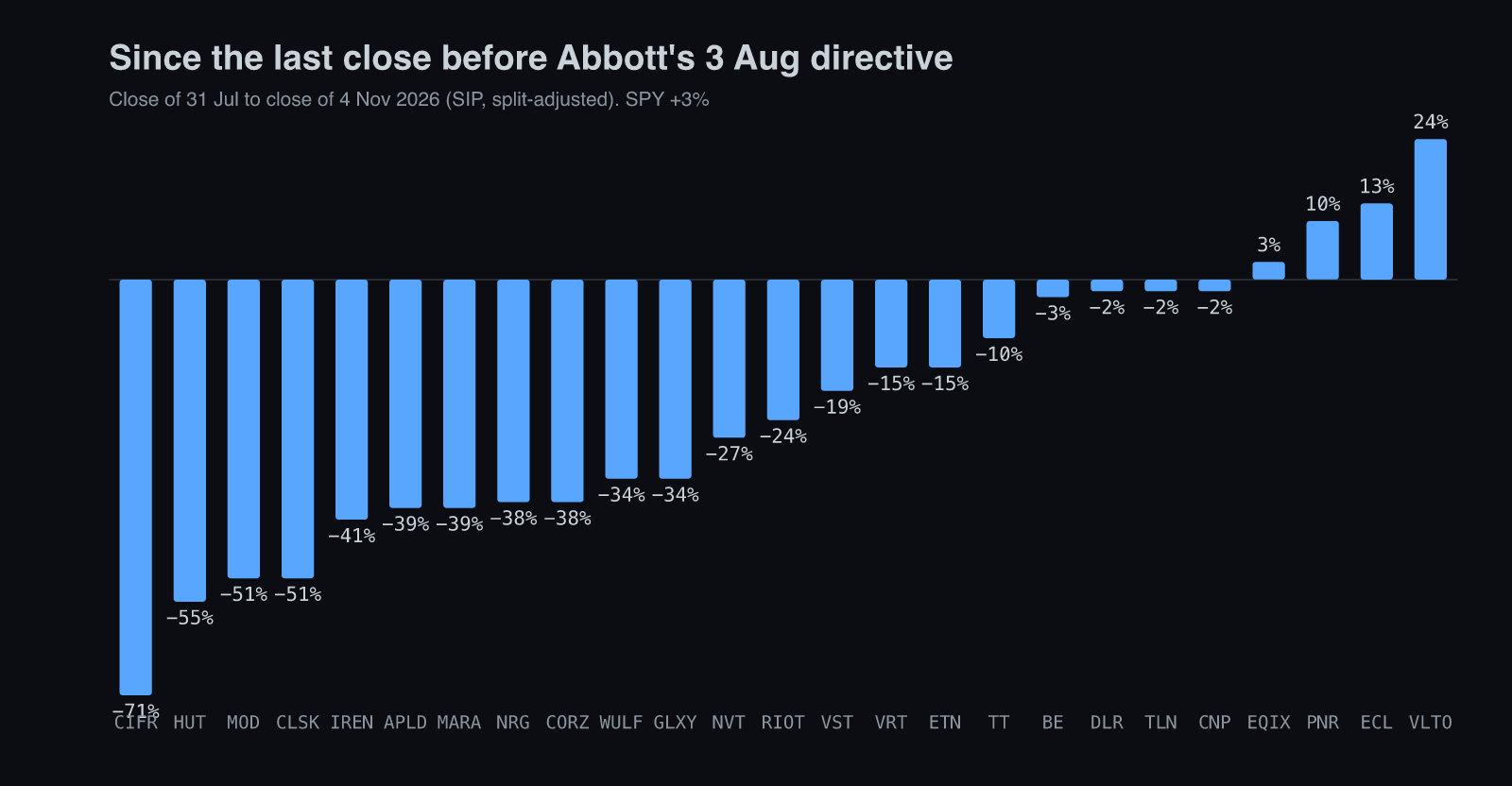
Since the last close before Abbott's first letter, $CIFR is down 71%, $HUT 55%, $APLD 39% and $WULF 34%, against a market up 3%. $WULF and $APLD have no disclosed Texas capacity and still fell by a third or more, because financing and lease sentiment for the whole group broke at the same time. The names holding up are the ones paid another way: $EQIX, $ECL, $VLTO, $DLR.
Mechanism — Why Now & How It Works
Three agencies stand between a Texas site and a running data center, and each is stuck on a different thing. The first gate is the wire. SB6, passed in 2025, sets rules for new loads of 75 MW or more: a $100,000 study fee, $50,000 per MW of security, advance payment of direct connection costs and minimum billing commitments, and the PUC's final standards came in September (Riot 10-Q). On top sits the audit. ERCOT must file its verification and community-impact reports by 10 December (ERCOT). Hut 8 expects unconditional classifications on 17 December, and Galaxy expects power allocations for studied load in April 2027.
The second gate is environmental permitting. The September directive applies broadly to data center approvals. Legal analyses identify possible effects on air, wastewater, stormwater and some permits by rule, even for a site that does not use the ERCOT grid (Bracewell, Foley). SemiAnalysis estimated six Texas campuses with 8.7 GW of on-site power exposed to air permitting. Water is a separate operating constraint: the water reporting directive says failure to file the required survey can carry penalties and affect eligibility for future permits, amendments and renewals. Reporting to the water board is not itself a universal water permit.
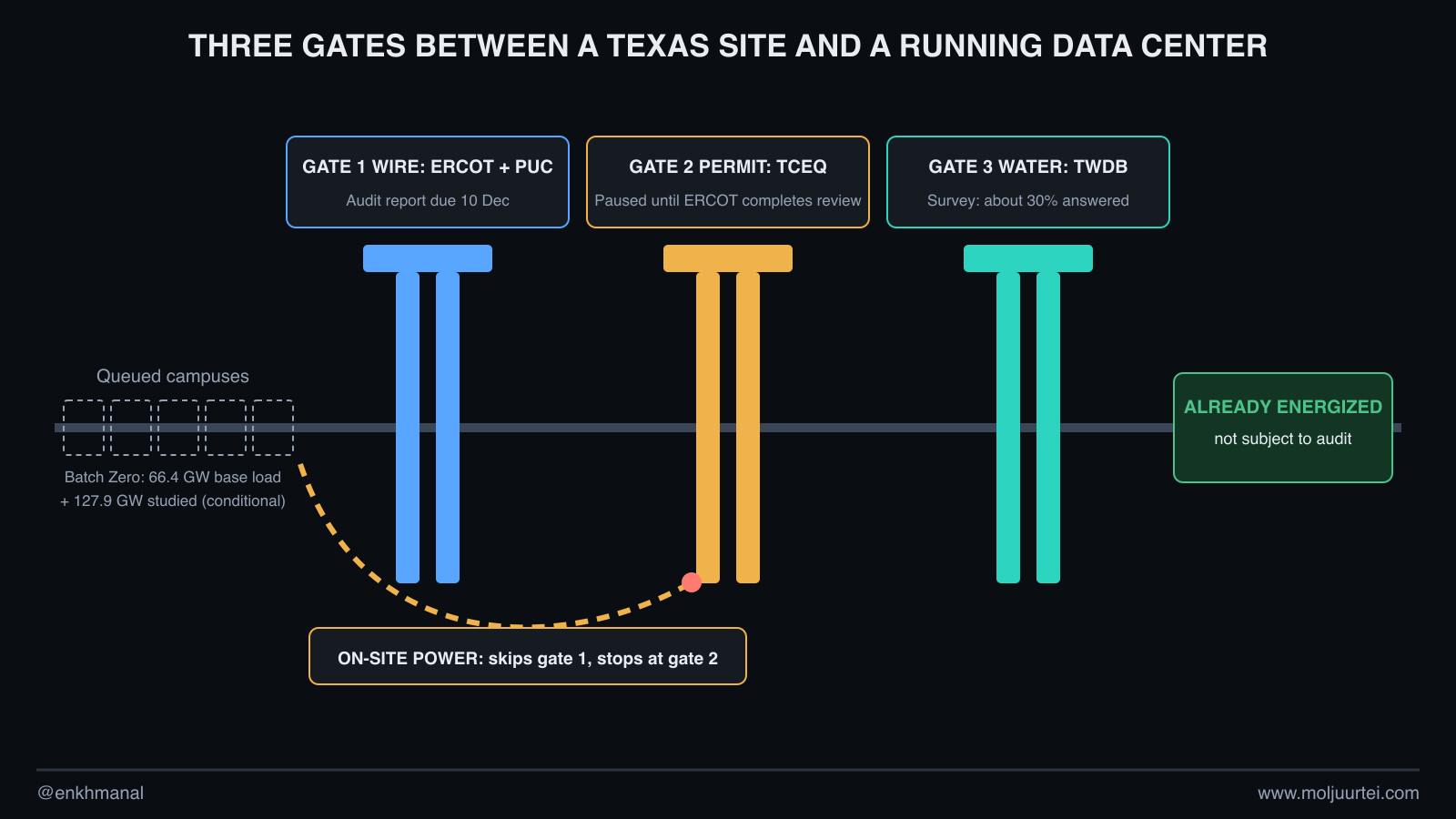
The review and the change of governor are separate events. The grid operator’s November update keeps December 10 for filing its verification report. Abbott’s letter links the permit pause to completion of the review, so a window for approvals before January 19 is possible. A filing date is not a promise that permits will issue or that every project will advance.
What a Governor Can Actually Do
Abbott’s environmental directive set a practical precedent for pausing permit issuance. The water directive separately cites the Water Code. In her campaign proposal, Hinojosa pledged to stop data center approvals until the legislature acts. The text of any future executive action will determine which cases it attempts to cover.
Her limits are real and arrive on a schedule. The Texas Constitution says "No power of suspending laws in this State shall be exercised except by the Legislature" (Art. I, Sec. 28), so a statewide ban on approvals that statutes require is open to challenge, though we have no ruling on this facts pattern and will not pretend to. She also inherits other people's commissioners. TCEQ's chair holds a term to 31 August 2027 (appointment) and the PUC chair to 1 September 2029 (appointment). VanEck's Matthew Sigel counts two of five PUC seats opening in September 2027 (post). One widely read thread argues a governor can only ask, and TCEQ decides (thread). That is the fair legal point, and the agencies' record of saying yes to a letter is the fair practical one.
The August grid review and September environmental and water directives preceded the election. Hinojosa’s campaign proposed a broader pause until legislation, with local input, labor conditions and limits on nondisclosure agreements. Those proposals change the range of outcomes; they do not extend Abbott’s directive by themselves.
Timing favors a deal more than a showdown. Only the governor can call a special session, capped at 30 days (Texas Constitution), and she will not need one: the regular session opens on the second Tuesday of January, 12 January, a week before she is sworn in, and runs 140 days to 31 May. Her moratorium is written to last until laws pass, which hands a 19 to 12 Republican Senate a say over when it ends. Bernstein expects the pause to continue and legislation to stay in gridlock (CoinDesk). We lean the other way on the second half, since Abbott campaigned on the same bill of particulars and Sigel reports a sales-tax repeal already moving in the Senate. Our base case is a law by the end of May with cost and water terms, and a pause that runs until then. That is more than five months beyond what Abbott's letter implied, for projects that never made it through.
New York shows the shape. Governor Hochul's Executive Order 62 of 14 July paused certain state environmental permits for facilities of about 50 MW and up for as long as a year, and left projects with complete permit applications mostly alone (New York governor’s office). A summary of Morgan Stanley's note reads Hinojosa's version the same way, as applying to new permits and sparing projects under construction (summary on X); we have not seen the note itself. If she follows that template, the market's first fear passes. The test is her first order's wording on projects holding a classification and no wire.
Channel One: Location — Stage Beats State
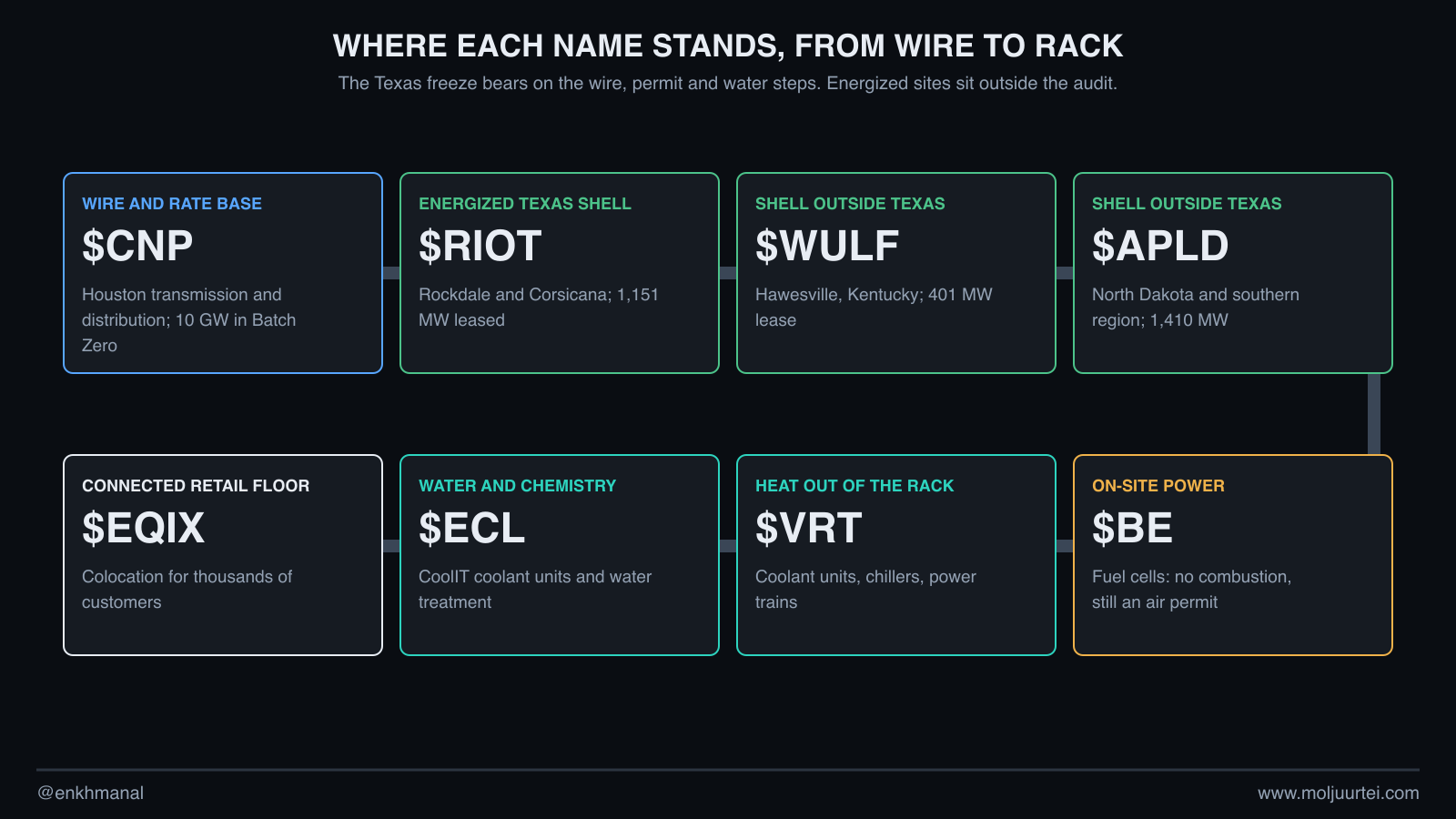
We measured Texas exposure from filings, and the ranking that comes out is a two-by-two: how much is in Texas, and how far along it is. Morgan Stanley's list has $CIFR, $MARA and $GLXY facing more Texas uncertainty and $WULF, $HUT and $APLD better placed, with $RIOT's existing connections possibly worth more (CoinDesk). Bernstein names $IREN, $RIOT and $CIFR as most exposed and calls their approved gigawatts potentially scarce. A single Texas percentage misleads, as the table shows.
$RIOT breaks the simple geography rule. Its filing distinguishes the already energized Rockdale and Corsicana power from future customer capacity. The Corsicana expansion was approved under the prior process and is outside Batch Zero. The 910 MW critical IT lease became binding November 4, with about $28 billion of contracted revenue over 15 years. That is contracted capacity to be delivered, not 910 MW already operating. Construction, financing and a proposed change in how transmission charges are allocated remain risks.
$HUT shows the opposite trap: a low pipeline share and a high contract share. Under 5% of its greenfield pipeline is in ERCOT, and yet Beacon Point in Texas is $19.6 billion of its $26.6 billion of contract value, and Phase 1's baseload designation is still subject to the audit (10-Q). Until 17 December this is a Texas name on the income that matters. It also fell the most on a day it reported, so its 23.2% is part earnings. $WULF is the reverse case for location purists: no Texas after agreeing to sell Abernathy for about $530 million, and New York instead, where Lake Mariner is permitted and the proposed Lake Hawkeye site sits under a governor's order that management says has not touched it. Leaving Texas swapped one governor for another.
The rest of the Texas group sorts by the same two questions. $GLXY says Helios I, II and III hold every permit needed to build and deliver, its open TCEQ items are diesel backups and potable water, and about 1.6 GW of base load is largely unaffected, while 2.6 GW of studied load, including a Caspian site ERCOT moved down from base load, waits until April 2027. $IREN's largest non-Texas site is Kiowa, Oklahoma at 1.6 GW, and its 10-K warns of possible delays at Sweetwater. $CORZ has four of eleven facilities in Texas. $MARA's Matagorda site still needs ERCOT's approval, and fell only 4.1% after losing 39% since July. $IREN and $CORZ subsequently reported on November 5 and $MARA on November 9; see the dated update.
Power Producers Split by How They Get Paid
Inside the generators the Texas label explains less than it appears to. $VST and $NRG fell hard with heavy Texas weights, and $TLN, with no Texas fleet at all since 2024, still fell 8.5% with the wider sale of merchant power. $PEG, regulated in New Jersey, rose 0.6%. $CNP is the awkward one: about as Texas as a utility gets, down only 3.5%, because wires earn a regulated return and its Batch Zero load rests on 10 GW it describes as base load (10-Q). So the market split power by how you get paid more than by where you sit. That is the same answer the data-center owners gave.
Channel Two: Power — Self-Supply Escapes the Queue, Not the Air Permit
Pay-your-own-way rules are the honest tailwind for on-site power, and the Texas freeze is the honest obstacle. Abbott's letter says projects must cover all electrical infrastructure costs and result in lower residential bills. Hinojosa wants the same. A campus that brings its own electrons answers both, and skips the ERCOT queue. But SemiAnalysis's point stands: August only touched grid connections, September brought on-site plants into the freeze through air permits. Cleanview puts 56.1 GW of planned on-site gas in pause states, 45 GW of it in Texas (Cleanview).
$BE has the best version of this argument and does not escape the gate. A fuel cell converts natural gas to electricity by chemistry with no combustion, and Bloom says it uses minimal water at startup and none in normal running. On the Q1 call it announced that Oracle's Project Jupiter in New Mexico was replacing turbines and diesel with up to 2.45 GW of its servers. Its Q3 10-Q is the necessary counterweight: "even projects with our fuel cell systems have experienced increased scrutiny, data requests, and discretionary hearings" and "we generally cannot sell our Energy Servers to a financier until permits are in hand" (10-Q). In Texas, where it says first units ship this quarter, a fuel cell still emits and we read it as caught by the TCEQ pause until told otherwise. We could not find TCEQ's treatment of a fuel-cell filing specifically.
Jupiter shows why the air permit matters. New Mexico’s revised application proposed limiting operations to 1,600 MW at a plant with about 2.4 GW of installed capacity. The November 6 hearing officer order declined to dismiss the application but vacated the December 7 hearing. There is no replacement hearing date yet; a status conference is scheduled November 19. Bloom’s management previously pointed to approvals within three months in New Jersey and said more than 80% of backlog was outside California and the Northeast in February. The national permitting story remains broader than one site or one state.
Cipher is the test of whether self-supply buys time in Texas. It is laying lateral gas pipelines able to support up to 2.5 GW of on-site generation, targets gas availability in 2027 and says it is in early talks on about 1 GW of leases on that power (10-Q). Those campuses would need no ERCOT slot, and each would need the air permit that is paused. A summary of Morgan Stanley's note argues rising resistance points to a US compute supply gap by 2028, which is the demand argument for paying up for any of these routes.
The substitute everyone forgets is not another generator. Hut 8's CEO said this week that TCEQ exposure for diesel backup can be designed around with batteries, and Galaxy says its open TCEQ items concern diesel backups and potable water and do not block delivery. That matters for the theme. Much of what the freeze holds up is backup, and backup has alternatives. Meanwhile $GEV counts 122 GW of gas backlog and slot reservations, so turbines are the buyer's alternative to $BE everywhere a combustion permit is tolerable. Where it is not, the fuel cell's air and water advantage does the selling.
Water — The trade-off between local water and electricity
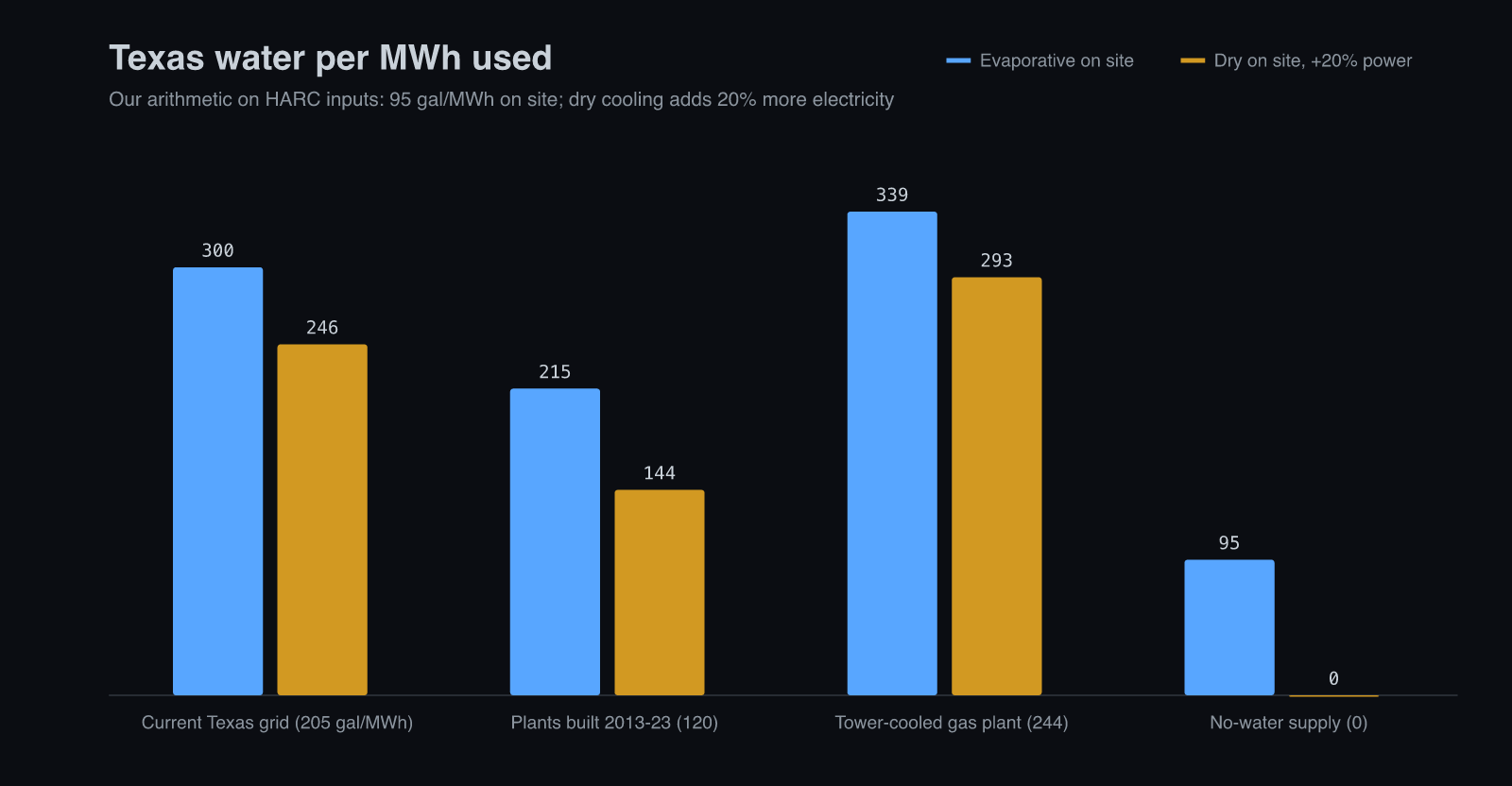
The water figures in circulation are real, and two-thirds of today's number is not at the data center. HARC, a Texas research center, estimates existing data centers consume about 25 billion gallons a year, 0.4% of state use, rising to 29 to 161 billion gallons by 2030, 0.5% to 2.7% (HARC). Those are HARC's estimates, and the state's own survey cannot yet check them. Only 8 billion of the 25 billion is cooling on site, about 0.1% of state use. The other 17 billion is water boiled off at power plants. On HARC's inputs, Texas power plants consume 205 gallons per MWh against 95 gallons per MWh for the average data center's cooling.
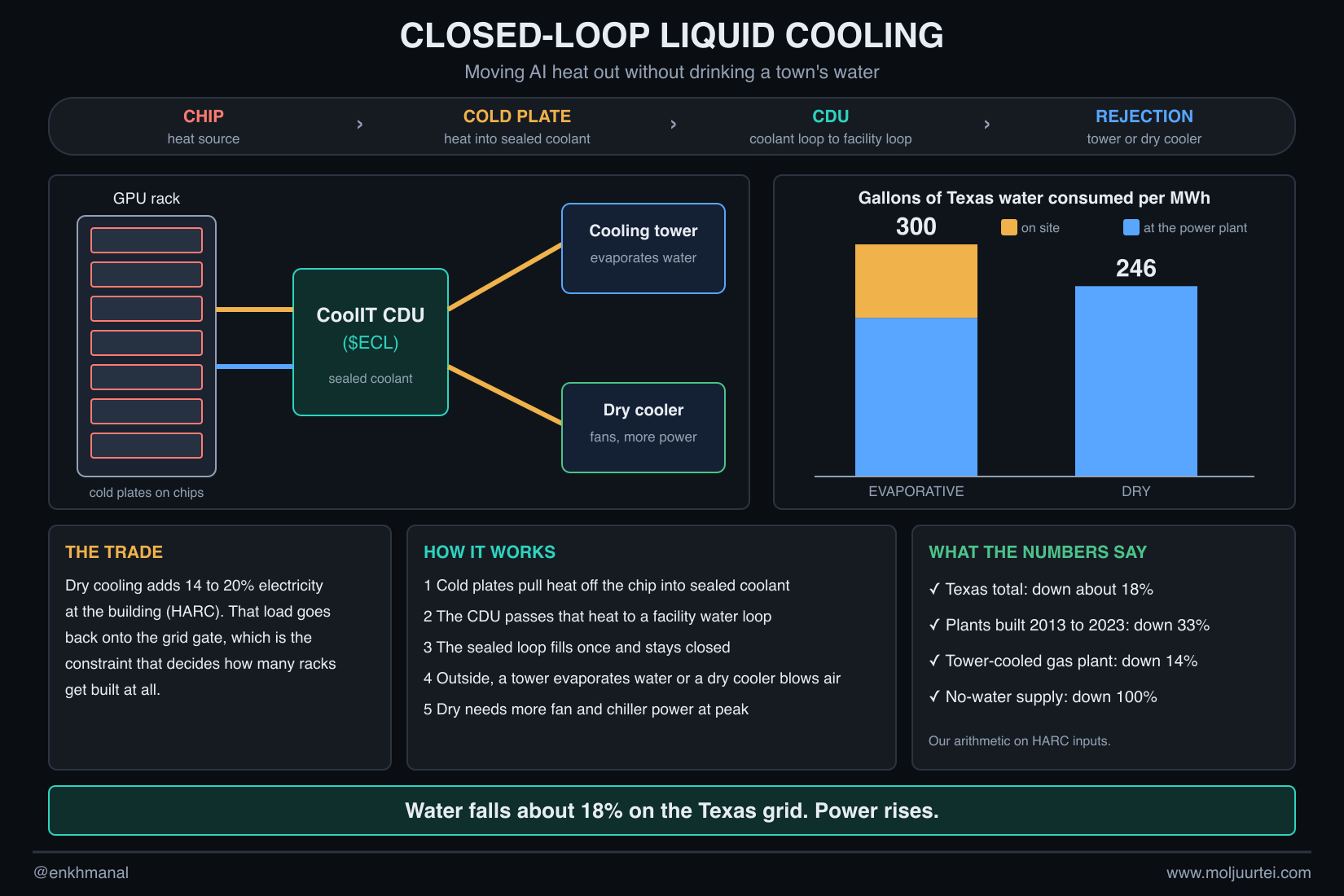
Can fully dry cooling reduce total water once the power plant is counted? In the illustrative Texas grid case, 95 gallons of on-site cooling and 205 gallons at the generator sum to 300 gallons per MWh of original electricity use. If on-site water falls to zero and electricity use rises 20%, generation consumes 246 gallons for the same computing work: 18% less. The other illustrated supplies consume 120, 244 and 0 gal/MWh; the modeled savings are 33%, 14% and 100%, respectively. At more than 475 gal/MWh of generator consumption, the extra electricity can erase the saving. This compares a fully dry option with the HARC average, not every data center design.
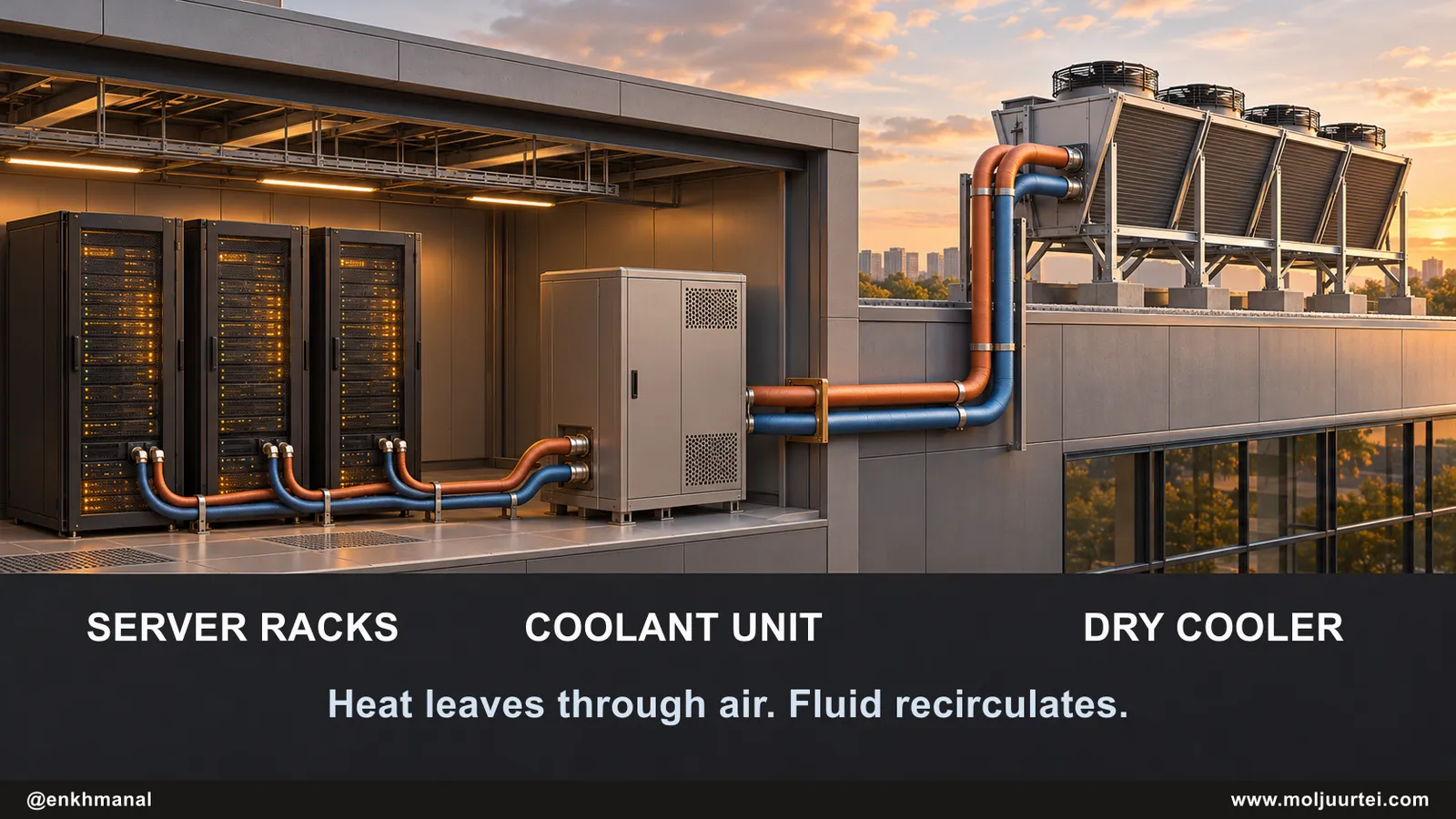
The market disagreed with the water leg as a single trade, and split it the way the paid evidence does. Thermal and electrical gear fell with AI capex: $VRT 12.9%, $NVT 12.7%, $ETN 9.9%, $JCI 6.3%, $TT 1.7%, and $MOD 21.4% after a print dated 3 November. Those are the names in the cooling story, and none of them discloses Texas revenue. Their units follow megawatts built anywhere, so a freeze that moves demand leaves them flat and one that delays it hurts. Vertiv told investors on 28 October it sees no unusual project shifts, and its Q3 organic orders more than doubled. Water names rose: $XYL 5.0%, $ECL 3.4%, $PNR 3.3%, $VLTO 0.6%, in a market up 1.7%. But look at the disclosure. Veralto says its data-center sales remain small even after doubling (10-Q). Xylem cites data-center orders with no figure. Pentair's 10-K never uses the phrase (10-K). That rally is a defensive rotation with a data-center story attached.
$ECL is the exception worth the effort, and we would not call it a Texas trade. Global High-Tech grew 63% organically in Q3, CoolIT more than doubled, and management targets $4 billion of sales by 2030 with more than 25% annual growth (10-Q). It sells the coolant unit, the water chemistry and the monitoring on the same system, which means it gets paid under either cooling choice. The thesis can fail in three ways we can name. New Texas builds were already moving to closed loop: Hut 8 describes Beacon Point that way and Cipher committed money to Colorado City's water system, so a ban may buy little new volume. A state that only ever gets a reporting rule changes no purchase order. And more power per rack makes the gate one problem worse, which is the problem that sets how many racks get built.
Where Demand Goes When Texas Tightens
The just-relocate read is half right, because the map is shrinking too. Cleanview counts nine states with a governor or governor-elect behind a pause, holding 158.6 GW or 41% of the US pipeline, and another 69.2 GW or 18% where the winner wants tighter rules (Cleanview). Texas is 88.4 GW of it, Ohio 21.9 GW, Georgia 20.2 GW, on the tracker’s definition. Goldman, as CoinDesk reports it, puts states likely to tighten at about 45% of planned capacity, and Bernstein counted 244 GW of 433 GW as politically exposed the day before the vote, while expecting most to proceed at higher cost (24/7 Wall St).
A Democratic Congress cuts against relocation less than the governors do. The Sanders and Ocasio-Cortez moratorium bill exists (Senate release), and any such bill needs a Trump signature or two-thirds of both chambers (Tikr on Evercore). Until January 2029 that leaves Congress with hearings and tax fights. The governors can act now, which is why the demand that moves goes to the states that still want it. Sigel names North Dakota, Louisiana and Kentucky (VanEck note). Our own filing sweep adds Oklahoma, where $IREN plans 1.6 GW under a new ratepayer law, and Digital Realty's new land in Indianapolis, Charlotte and Kansas City. Republican voters are not a guarantee: Data Center Watch has 30% of Republican candidates behind a pause. And the projects in motion hold up best: Cleanview's 56.7 GW under construction nationwide is the least exposed to any of it.
Three things follow for the trade. Delay in a hot state raises the value of finished capacity everywhere, so the group's end demand is not what changed. The bottleneck moves from getting a wire to getting a permit, which favors operators with political relationships and clean equipment. And the first developers to reach the next friendly state get the next round of scarcity, which is what $WULF's Muskie site in Kentucky and $HUT's River Bend in Louisiana are positioned to test. None of this is free. Every name here also carries the AI cycle and the debt that funds it.
How the companies are exposed
The November 5 comparison separates companies that get paid when equipment is installed from landlords and developers that must secure power, fund construction and deliver capacity. The following evidence and price comparisons are historical, using November 4 closes.
In the November 5 comparison, $ECL combined per-system sales, the fastest disclosed high-tech growth among the water names, and a price above both moving averages. Data centers are still a small slice of its roughly $16 billion revenue base. $EQIX serves thousands of customers, with no single customer above 2.5% of revenue in the cited filings. Its Texas share is not disclosed. $DLR has a measurable Dallas exposure at 4.3% of annualized rent and has acquired land in Indianapolis, Charlotte and Kansas City; its wholesale mix creates a different concentration risk.
$BE offers a way to generate power on site with less water and no combustion in the fuel cell itself, but its own filing says permitting scrutiny has increased. $RIOT has approved grid power for its Texas projects; delivery of the 910 MW Corsicana lease and Texas transmission charges remain separate tests. $WULF and $APLD illustrate lower disclosed Texas exposure. TeraWulf has Google credit support for project financing on the Anthropic lease and an agreement with Fluor; that is not the same as all financing having closed. Applied Digital disclosed 1,410 MW contracted in North Dakota and an unnamed southern region. Both shares had fallen by a third or more since the pre-August-letter close despite their location advantage.
December classification matters for $HUT at Beacon Point and $CIFR at its 1 GW Colchis site. $GLXY has about 1.6 GW of base load and permits for Helios I–III, while studied capacity has a later allocation timetable. $VRT and $GEV depend on aggregate equipment investment, while $VST and $TLN depend more on wholesale power economics. These businesses should not be valued as one group.
Management & Track Record
This power is already fully approved
The record that matters this week is who positioned before the vote. TeraWulf agreed to sell Abernathy in July, before Abbott's first letter, and said on its August call that it wanted no reliance on one grid or one regulator. Applied Digital's Wes Cummins told investors in October that each new restriction raises the value of powered campuses with community support. Hut 8 published a geographic pipeline split showing under 5% in ERCOT and, on the morning after the vote, closed its prepared remarks with the race and stood by 17 December. Galaxy chose not to sign a Helios II lease over the summer as Texas changed, and says it can wait for clarity because it does not need outside capital until 2027. Cipher's Tyler Page argues Texas is no riskier than other states and committed $10 million with partners to Colorado City's water system. We credit that spending and note the argument gets a harder test than it did a week ago.
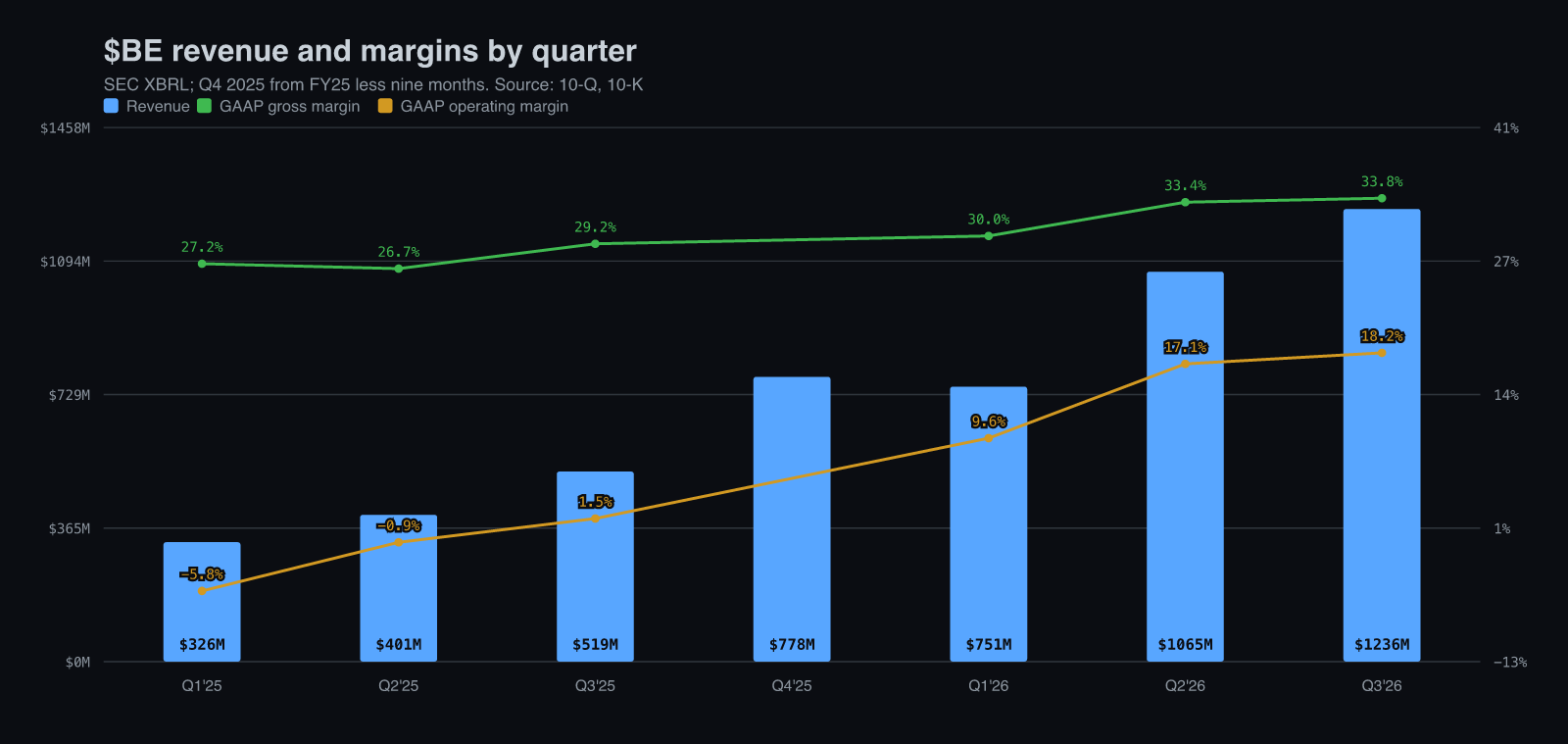
$BE is the name with the longest context here, so it gets the full trend, and the direction is excellent while the cash lags. Revenue ran $907M in FY21, $1.14B in FY22, $1.27B in FY23, $1.44B in FY24 and $2.00B in FY25, and GAAP gross margin moved from 21.8% through a 13.1% low to 29.3%. By quarter, reported quarterly growth was approximately 130% or more in 2026 with gross margin at 33.8% in Q3. The FY26 guide is $4.4B to $4.6B of revenue and $3.10 to $3.40 of EPS. Set that against the cash statement: Q3 GAAP operating income was $225.4M and operating cash flow was −$27M. Mix is the other caution. Two customers were 43% of revenue and 26% of revenue in Q3, and the second is a related party, a financier vehicle and not an end user (10-Q).
By quarter, $BE revenue ran $326M in Q1'25, $401M in Q2'25, $519M in Q3'25, $751M in Q1'26, $1,065M in Q2'26 and $1,236M in Q3'26, with GAAP gross margin at 27.2%, 26.7%, 29.2%, 30.0%, 33.4% and 33.8% and operating margin going from −5.8% to 18.2%. Year-on-year revenue growth was 130.4%, 165.6% and 138.2% across the three 2026 quarters.
The rest of the list is slower and in some ways more honest about what it is. $ECL revenue went from $12.73B in FY21 to $16.08B in FY25, with growth fading from 11.4% to 2.2% and operating margin rising from 12.6% to 17.0%, so High-Tech is lifting a mature base. $EQIX went from $6.64B to $9.22B with growth slowing from 12.7% in FY23 to 5.4% in FY25 and operating margin at 20.0%. $RIOT went from $213M to $647M, with GAAP operating margins from 40.8% to −96.1% that mostly reflect bitcoin marks and say little about a leasing business that has barely started.
Peers corroborate the demand side from the other side of the invoice: $VRT reported net sales up 61% with organic orders more than doubling (10-Q), and $GEV reported orders up 96% with a $197B backlog (10-Q). So far every print says the buyers keep ordering. The freeze has shown up in filings and calendars, and has yet to show up in an equipment order book.
Risks & What Breaks It
The weakest assumption in our whole framing is that an order stays aimed at new approvals. Her pledge says all approvals. Abbott's August letter covered every project advancing through interconnection. A project with a conditional classification, a lease and no energized wire is the ambiguous case, and that is a large share of the value at stake: Beacon Point, Colchis, Helios II and most of the 66.4 GW. If her first order reaches them, the scarcity thesis narrows to sites pulling current today and the Texas names on our list get a much harder 2027.
The thesis weakens if a new order reaches classified projects or issued permits, or if ERCOT removes major projects from the first batch. A court ruling on the scope of a pause or a law that restores approvals on clear terms could also change how much scarcity is worth.
Paths, Dates and What Moves a Name
We weigh three policy paths by judgement. Our base case, about 55%, is that the pause continues past 19 January for anything not yet classified and a law passes by 31 May with cost, water and reporting terms: approved sites gain, the Texas pipeline slips about a year, cooling and power suppliers feel little. The better case, about 25%, is that ERCOT clears most of Batch Zero in December, her order spares classified projects, and tenants return to $HUT, $CIFR and $GLXY quickly, so the group that fell most rebounds most. The worse case, about 20%, is an order that reaches classified projects while the Senate stalls, other pause states copy it, and lenders stop funding anything unfinished, so even the non-Texas developers pay. These weights are ours and are not model outputs.
What to watch: the November 19 Jupiter status conference, ERCOT’s December 10 verification report, December 17 classifications that Hut 8 expects, and the scope of any order after January 19. For fuel cells, watch permitting and delivery; for Texas landlords, check energization and transmission charges; for out-of-state campuses, distinguish a signed lease from funded construction. Ecolab’s investor day is a chance to measure data center sales separately, while Equinix has yet to disclose a Texas share.
Price Setup
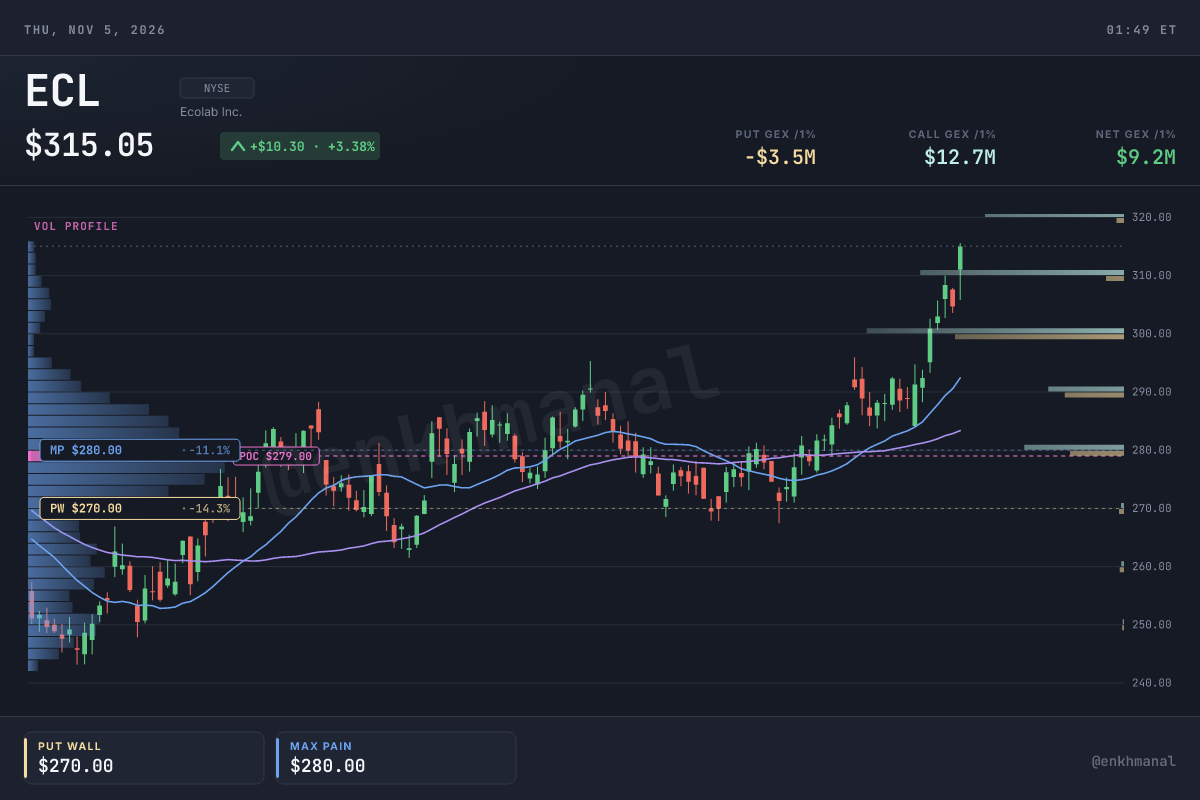
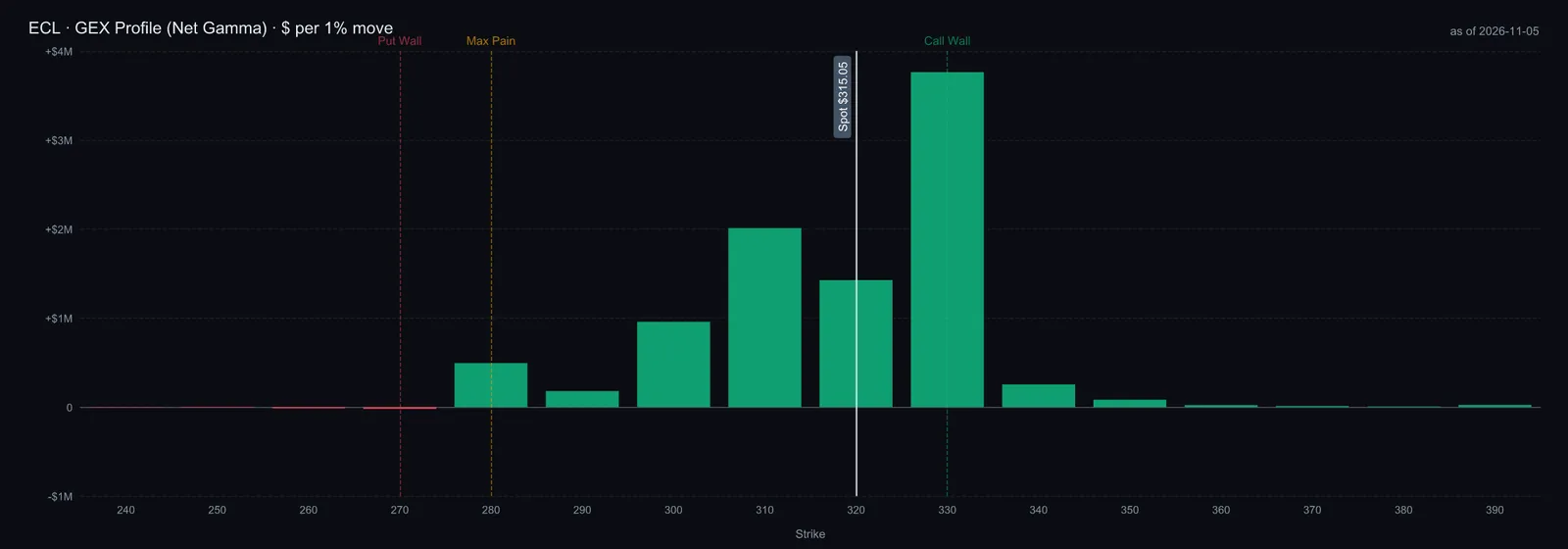
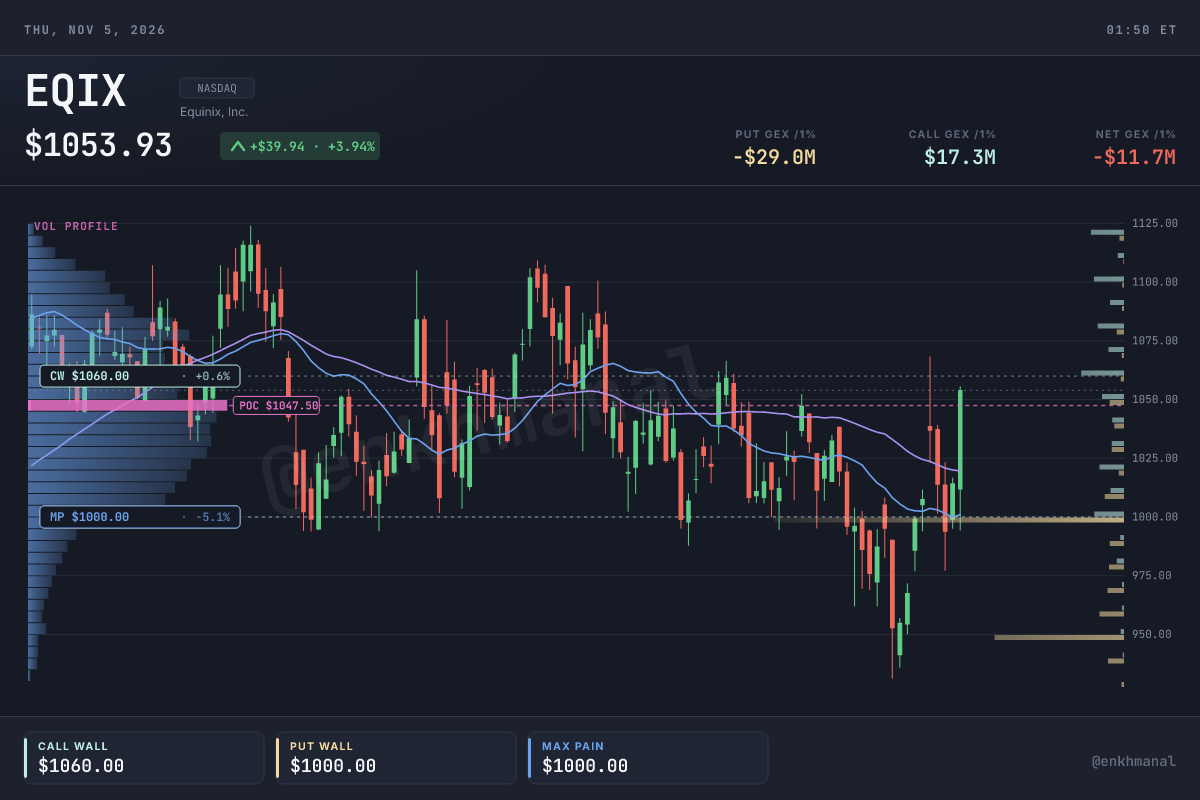
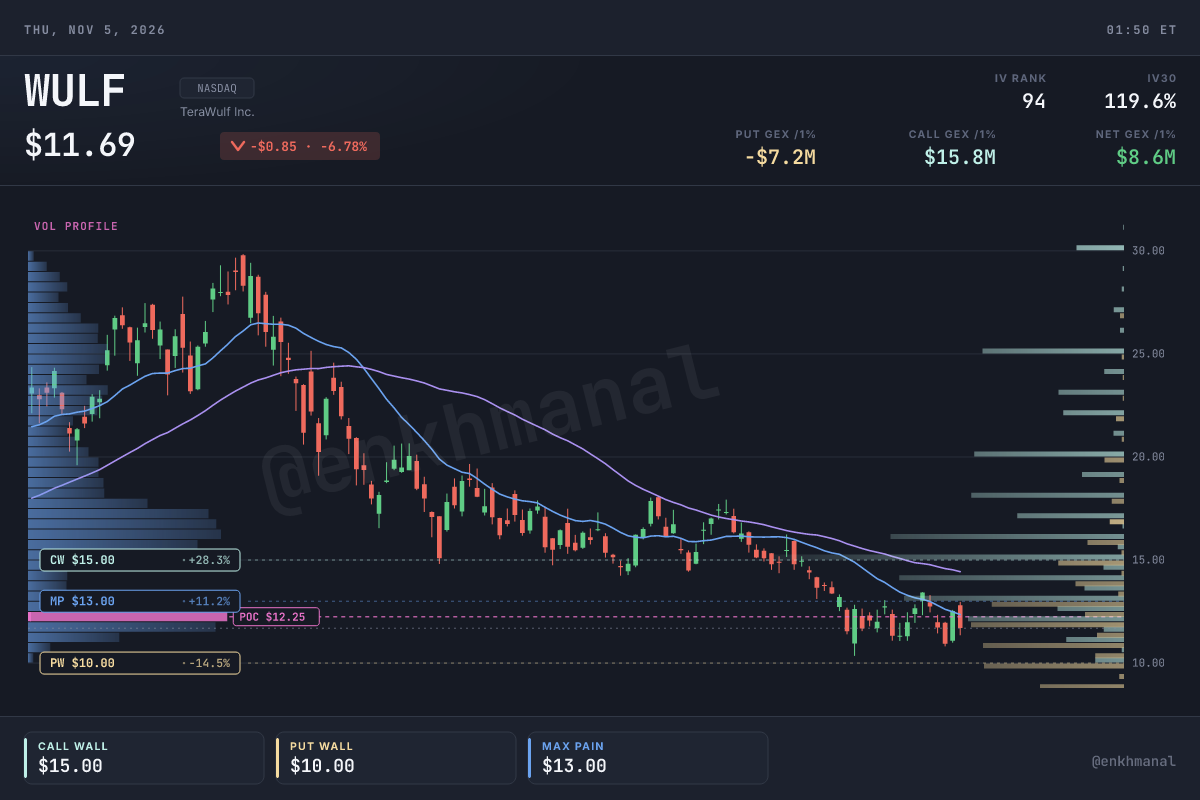
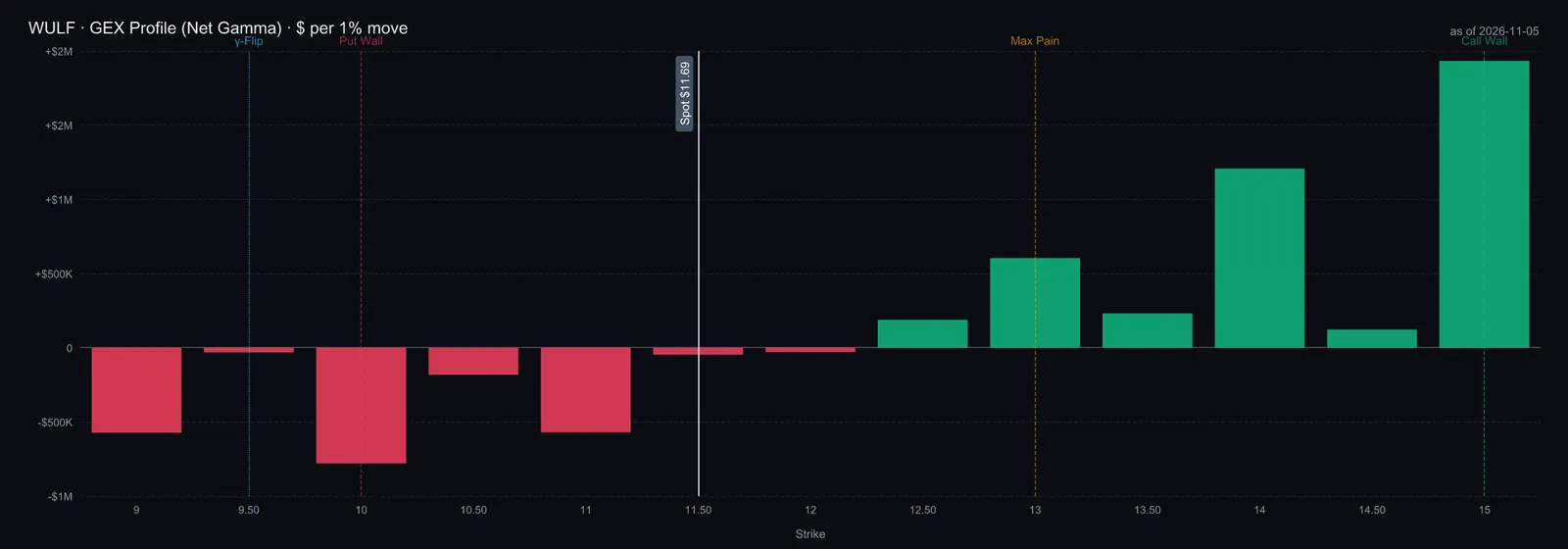
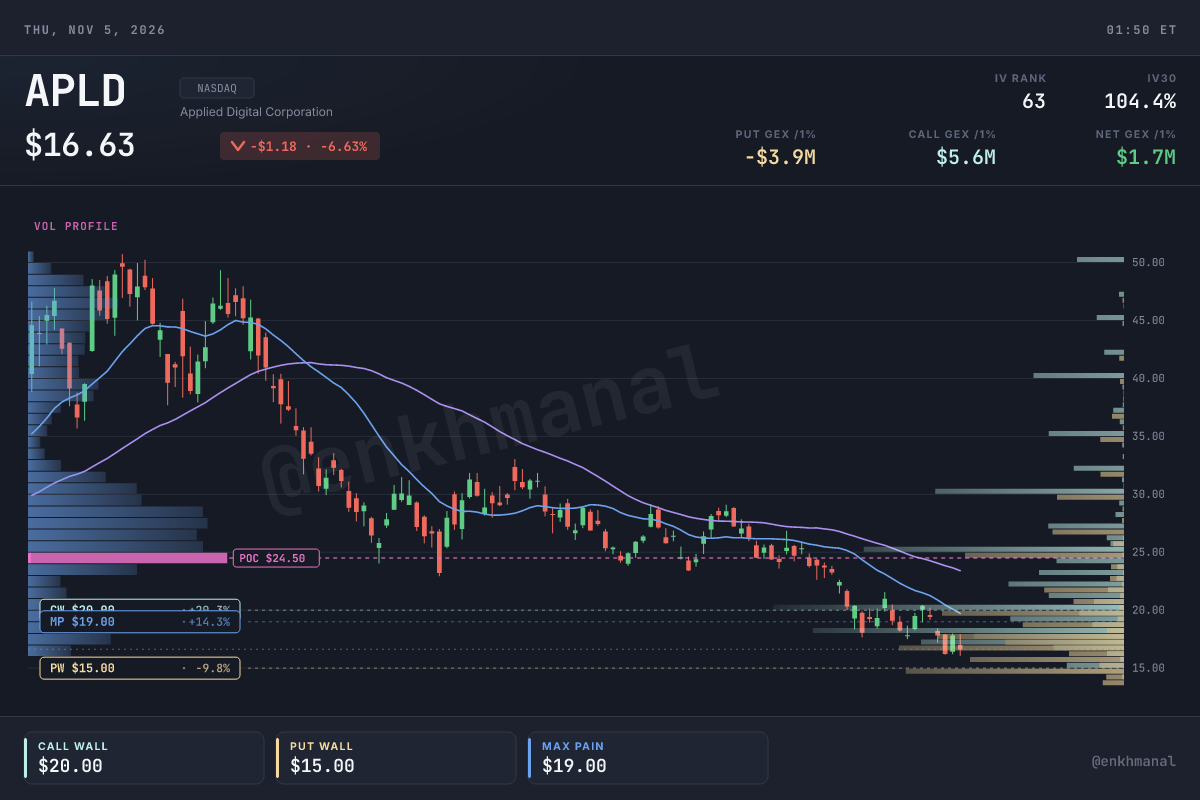
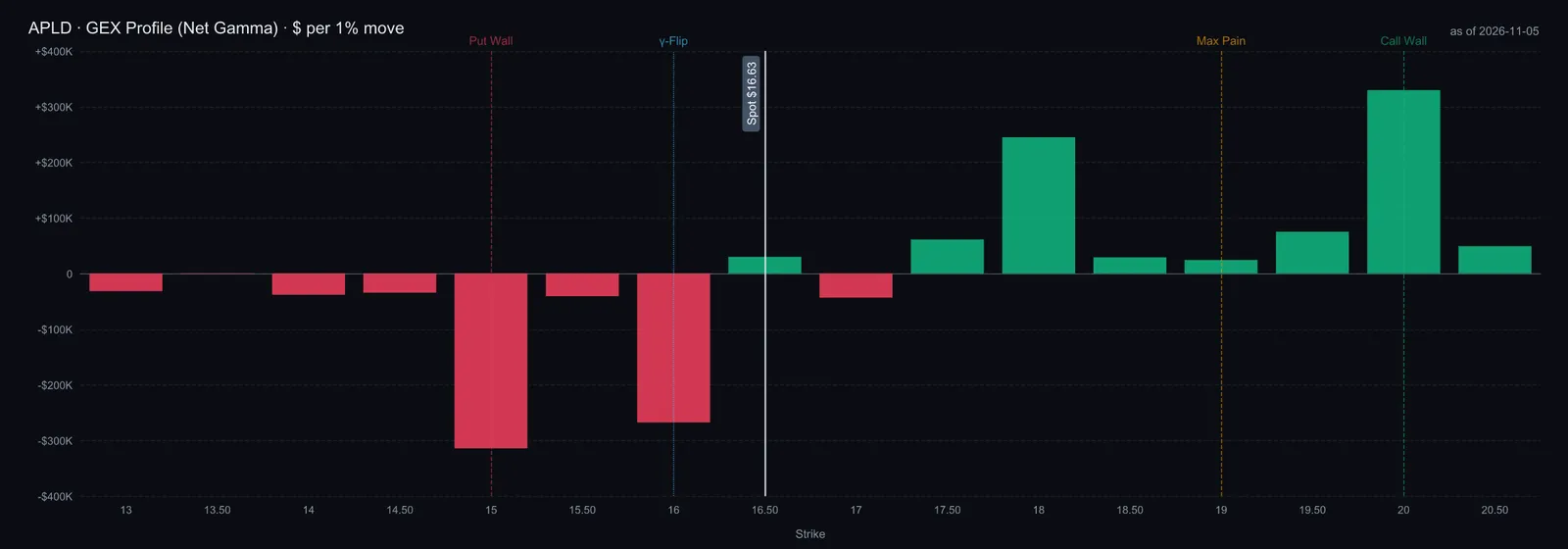
Historical market context: quoted prices and moving averages use the November 4 close. Some accompanying chart headers are November 5 intraday snapshots, not the closing price in the text. The options levels describe concentrations at the time and do not establish support or resistance.
$ECL closed at $315.01, against a 50-day of $283.40 and a 200-day of $276.40, at its one-year high and up 20% this year. Net gamma clusters between a $270 put wall and a $330 call wall. The 17 November investor day is the next dated test.
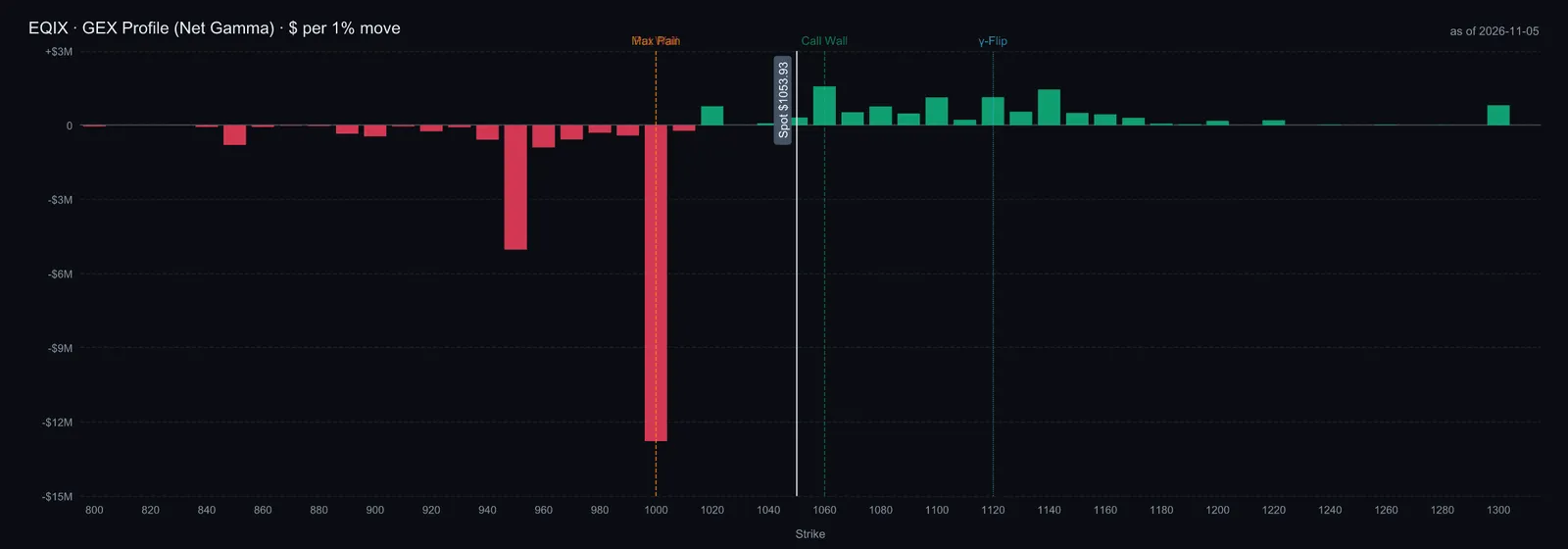
$EQIX closed at $1,054.09, above a 50-day of $1,019.60 and a 200-day of $1,014.10, up 38% this year and 6% off its high. The $1,060 call wall sits almost at the close, with the $1,000 put wall below.
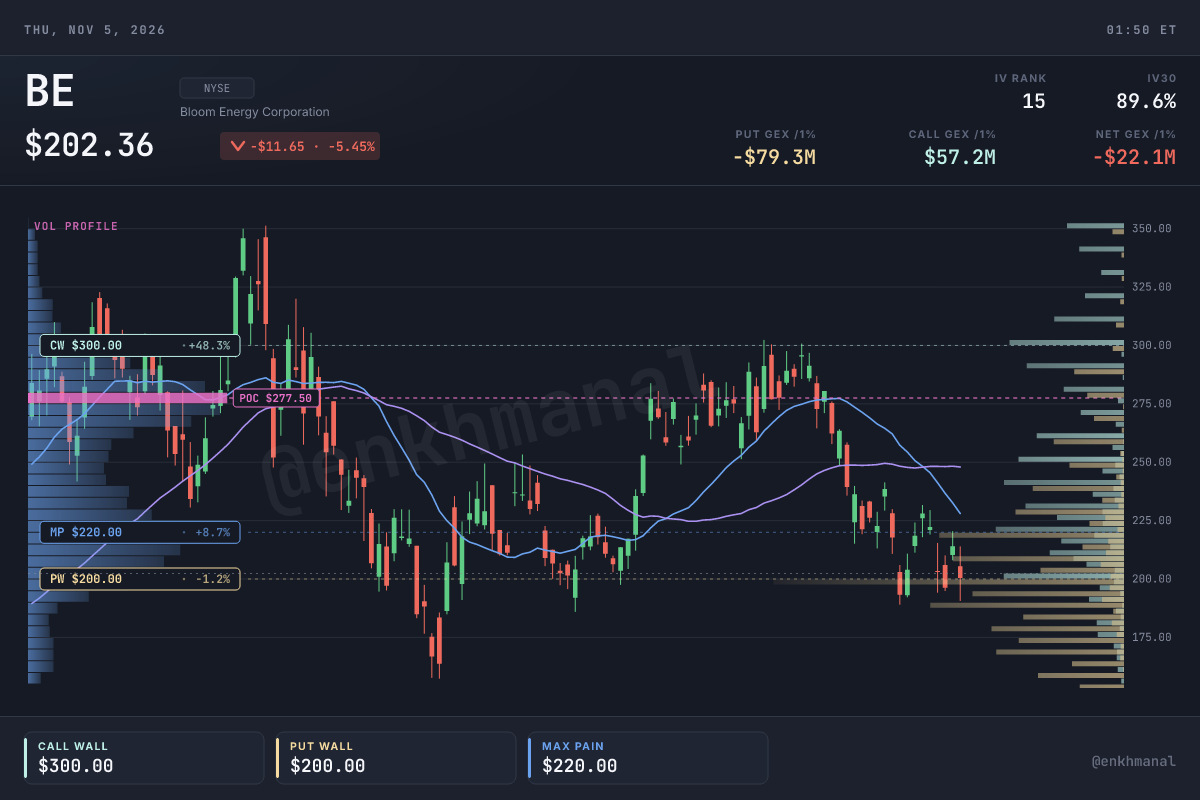
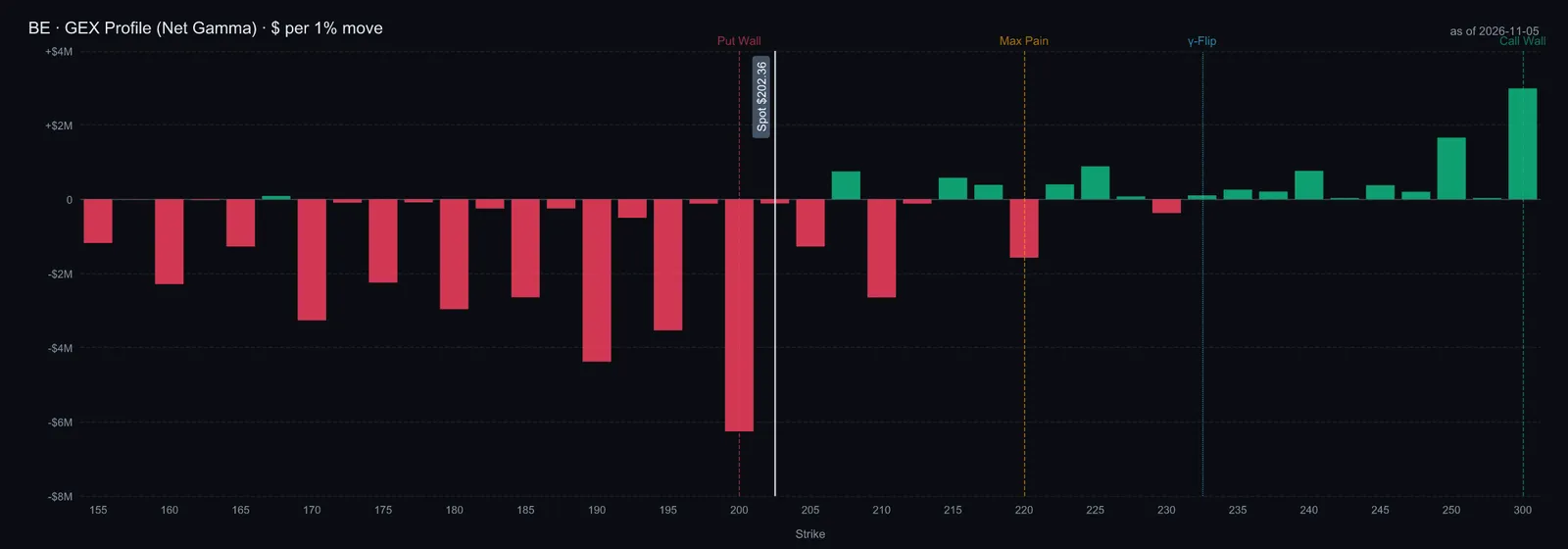
$BE closed at $200.40 and fell 6.4% on the day, well short of the turbines' and grid names' losses, though below a 50-day of $248.00 and a 200-day of $222.20. It is up 131% this year and 42% off its high. Spot sits on the $200 put wall, with the call wall at $300.
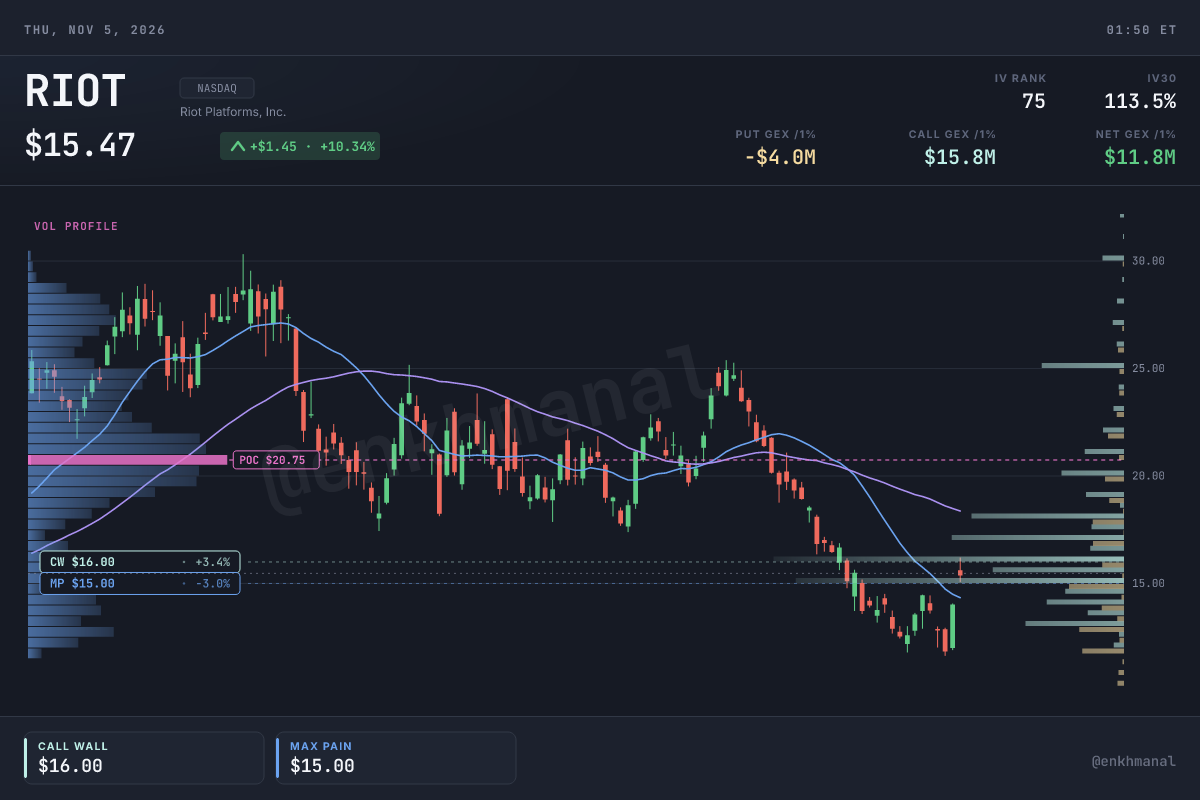
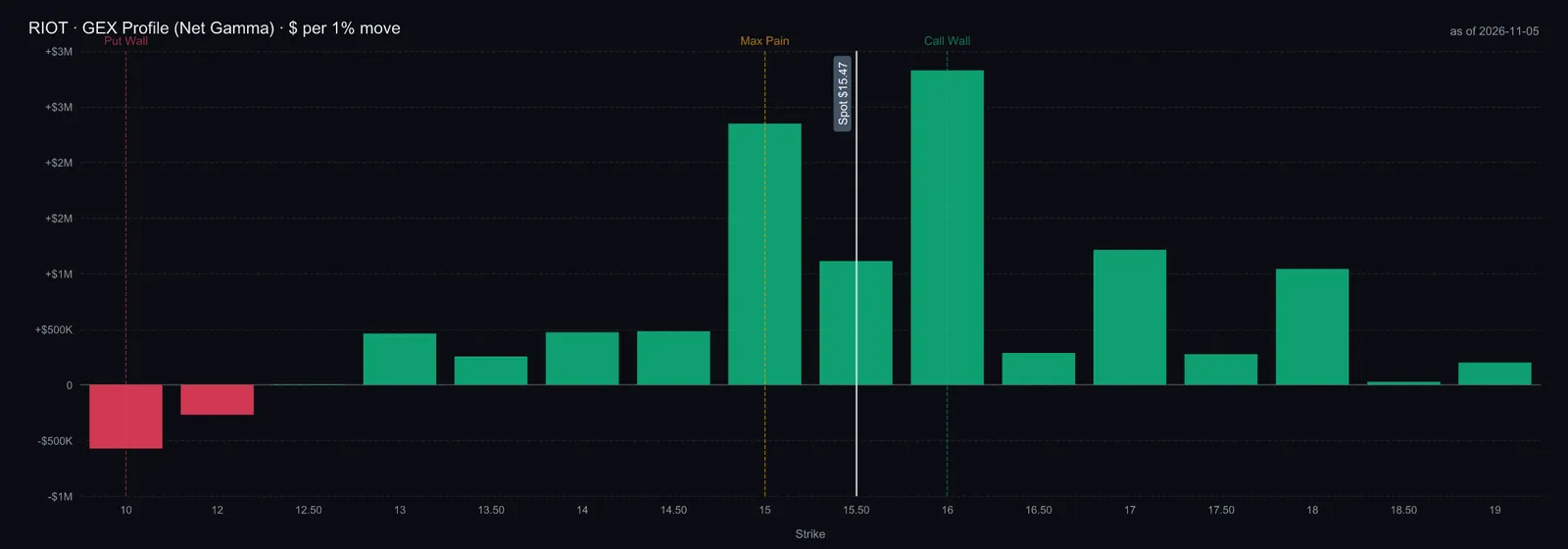
$RIOT closed at $15.37 after its 9.6% lease-day gain, still under a 50-day of $18.40 and a 200-day of $19.30. The $16 call wall is right overhead and the $10 put wall a long way below.
$WULF closed November 4 at $11.70, below the $14.40 50-day and $18.10 200-day averages. Historical option concentrations were $10 and $15. The November 6 results are covered in the dated update above.
$APLD closed at $16.61, 29% under a 50-day of $23.40 and 46% under a 200-day of $31.00, the weakest trend among our seven and an honest reminder of how little being outside Texas has been worth so far. Options cluster between $15 and $20.
Valuation & House View
This is a return-hurdle screen and not a fair-value call: it asks what per-share growth each name needs to return 15% a year for three years at two exit multiples, using 4 November closes. The multiples are our assumptions. On the developers the anchor is contracted rent or NOI before debt and capex, so a negative figure means the contract alone would clear the hurdle only if you ignore the debt that builds it, which you cannot. For a project-financed developer a dollar of NOI is worth far less to equity than the column suggests. On share count, required company growth equals (1 + per-share growth) × (1 + share growth) − 1, and every developer here is issuing or converting. None of this carries an audited model, so none of it can support a buy.
Read across, the equity names ask for plausible things and the developers ask for financing to behave. $ECL needs the per-share growth in the table, which the core business has not delivered and High-Tech alone cannot yet carry. $EQIX and $DLR ask for rates at or above what they guide, depending on the exit. $BE asks for a rate its guide is beating this year, and a lot depends on keeping that pace for three years. $VRT asks for less than its current growth. That last one is why we respect the sell-off in the equipment names as a macro question: the arithmetic is easy if the capex holds.
Historical valuation context: $ECL traded at 42.9× trailing diluted earnings versus its five-year median of 40.6×, at the 64th percentile, with trailing PEG of 3.19. $VRT was 38.4× versus 70.6×, at the 2nd percentile, with trailing PEG of 0.63. $XYL was 22.4× versus 38.8×. Bloom’s comparison uses its FY26 guidance instead of an unreliable trailing series. PEG divides the price-to-earnings multiple by the earnings growth rate expressed as a percentage number. These are historical measures.
The clearest relative advantage belongs to projects that already have approved power and to suppliers that get paid where a campus is built. The November 5 evidence did not establish that the advantage justified buying a specific stock: permits, financing, construction and customer concentration still matter. The December verification report and later project classifications can narrow that uncertainty.
(h/t Morgan Stanley and Bernstein via CoinDesk, Matthew Sigel at VanEck, SemiAnalysis, Cleanview, Data Center Watch and HARC. We re-checked figures against filings, call transcripts and agency documents where those exist, and labelled what we could not.)