
$SPCX — Power, cooling and the race to deploy AI capacity
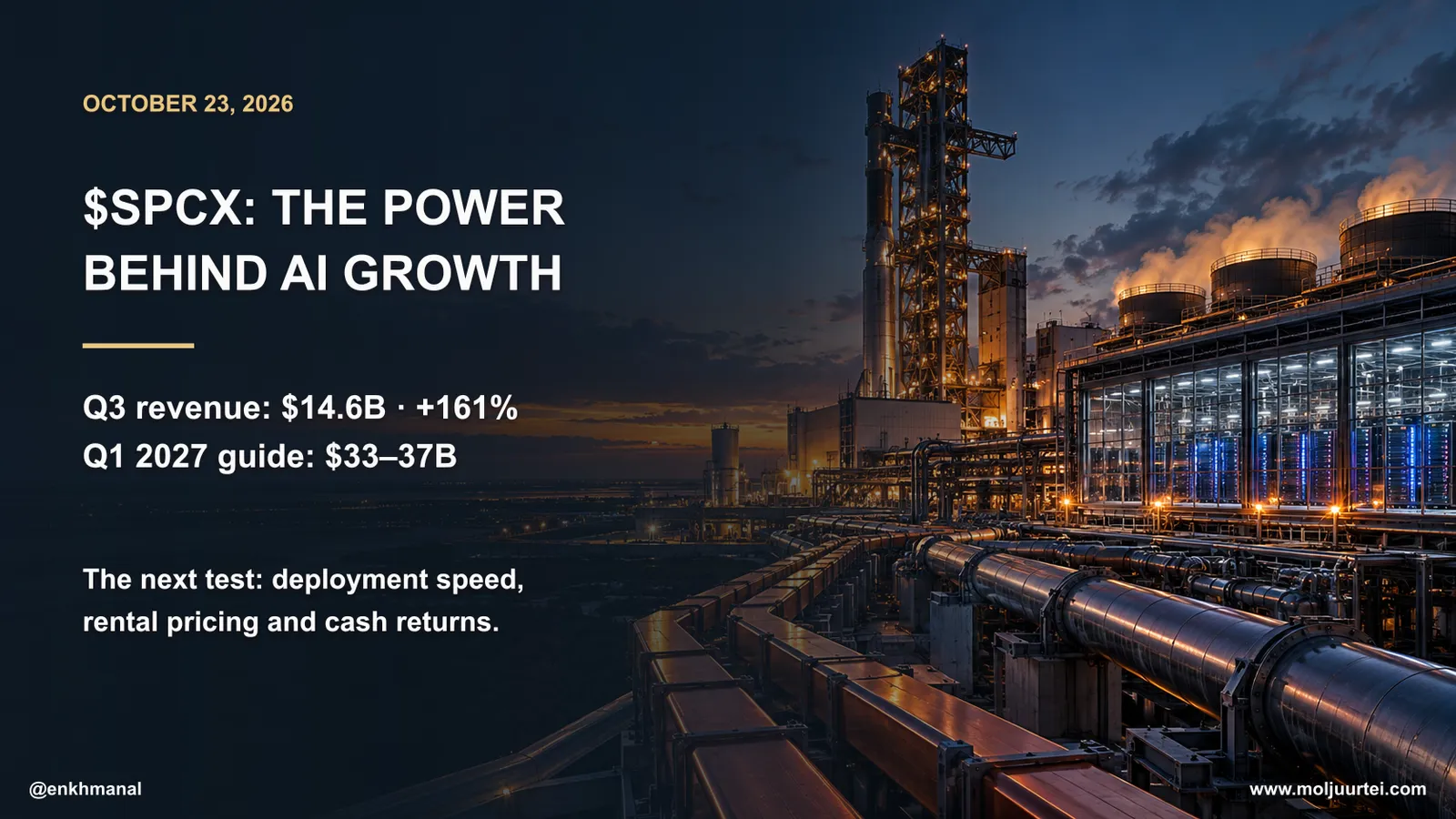
$SPCX is Space Exploration Technologies, the rocket company that became a satellite internet company and, since February, an AI computing company. Its third quarter showed what happens when the hardest part of artificial intelligence stops being the chip: revenue of $14.6 billion, up 161%, more than half of it from renting and running AI compute, and a first forward guide of $33 to $37 billion for the first quarter of 2027.
An AI model is a very large file of numbers that answers questions by doing arithmetic on them, billions of multiplications per word. That arithmetic runs on graphics processors packed into racks, and a rack of the newest Nvidia machines draws as much electricity as a small neighbourhood and turns almost all of it into heat. So the useful output of an AI company is not really a model; it is electricity turned into answers, and the industry now prices its capacity in watts.
Start here. A GPU is a chip that does thousands of small calculations at once, which is exactly the shape of the arithmetic an AI model needs. A data hall is a building that holds tens of thousands of GPUs and feeds them power and coolant around the clock. A gigawatt is a billion watts, roughly the output of one large power plant, and it is now the unit in which AI capacity is planned and sold. Nameplate compute is the power rating of the GPUs a company has installed and switched on. Renting compute at so many dollars per watt is how a customer pays for a share of that capacity, and payback is how long the rent takes to cover what the capacity cost to build. Everything below is about who can turn a delivered chip into a working, rented gigawatt fastest.
What Changed
For three years the scarce input in AI was the chip. In 2026 it moved one step down the line, to the things a chip needs before it can earn anything: a turbine or grid connection to power it, cooling to keep it alive, switchgear, batteries and a building. Elon Musk said it plainly on the 20 October call: "the constraint on deployment of superintelligence is more in power and cooling and infrastructure than it is in chips."
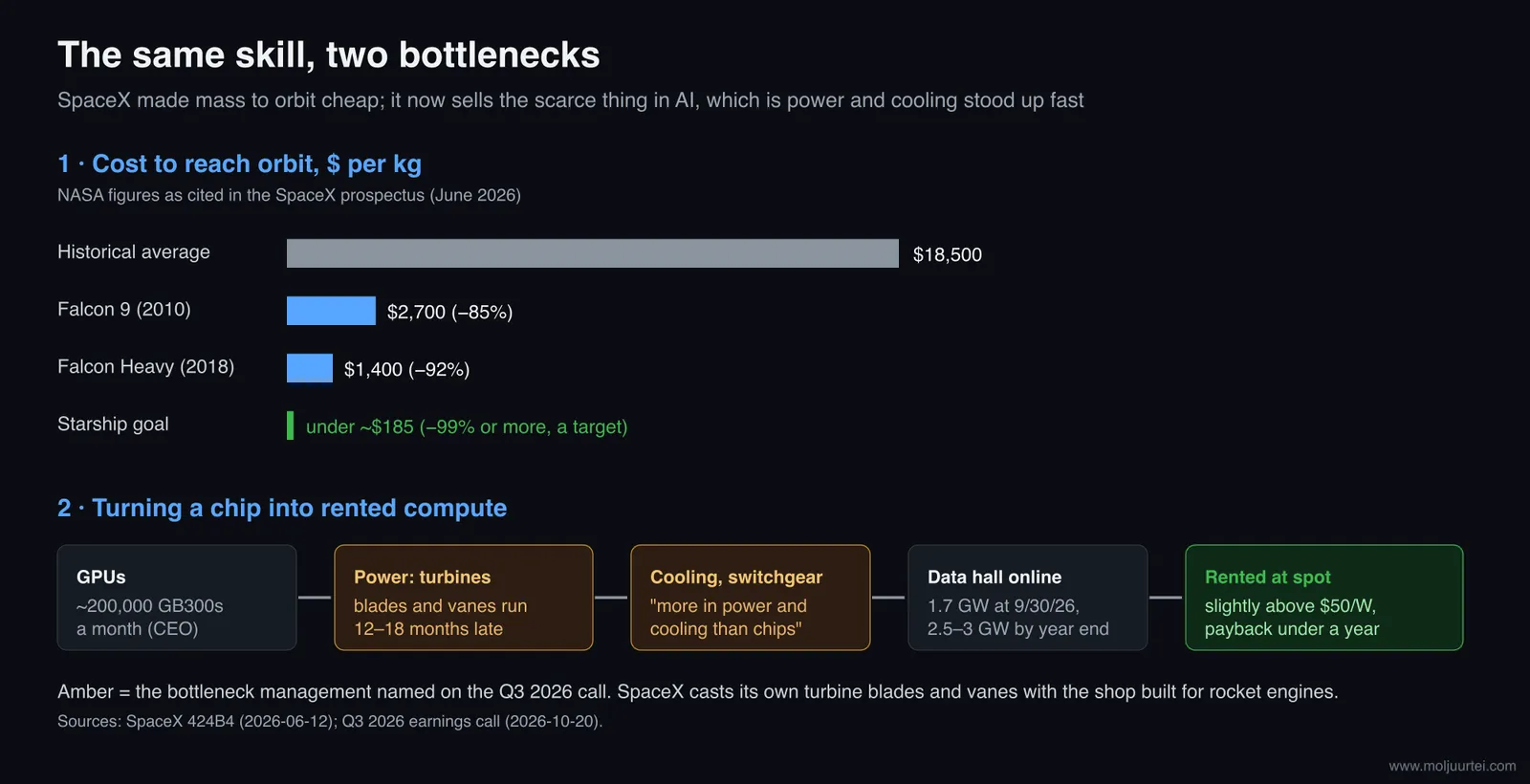
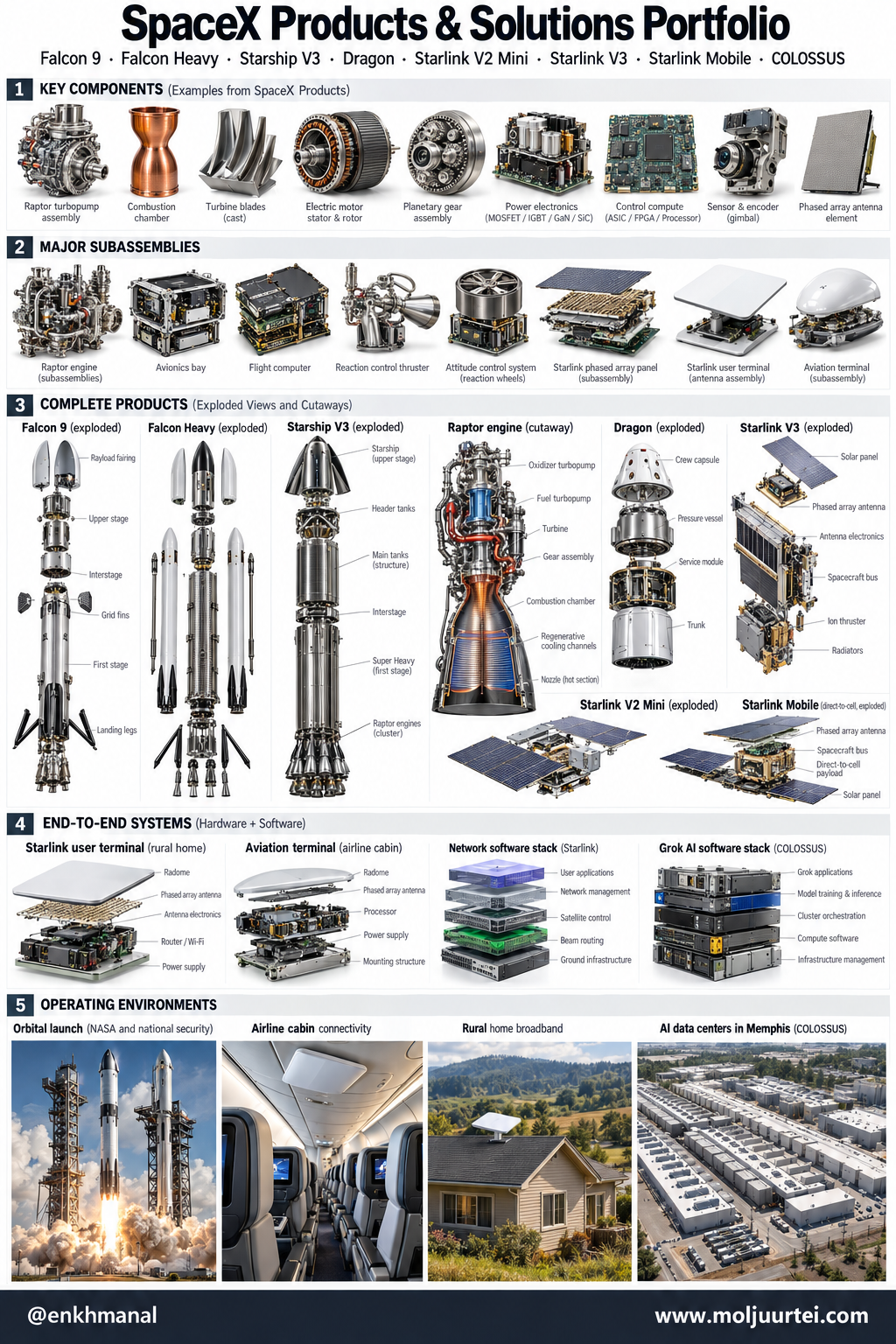
When the bottleneck is physical construction rather than chip design, the advantage goes to whoever builds heavy hardware fastest. SpaceX's whole history is that skill. According to NASA figures quoted in its prospectus, Falcon 9 cut the cost of reaching orbit from a historical average of $18,500 per kilogram to about $2,700 in 2010, and Falcon Heavy to about $1,400 in 2018, by building rockets that land and fly again. The company now flies close to 90% of all the mass sent to orbit, by Musk's count. It reached that position by owning the factory, the engines, the castings and the launch pads.
Since February that same organisation has been pointed at data halls. The turbine blades and vanes that gas generators need are, per the turbine makers Musk quoted, 12 to 18 months behind the rest of the machine, and SpaceX casts its own with the shop it built for rocket engines. It ended September with 1.7 gigawatts of nameplate compute, expects close to 3 gigawatts by December, and says it is "highly confident" of adding 10 gigawatts in 2027. The shift rewards the company that can stand up power and cooling on a schedule nobody else can match, and that company is SpaceX.
Thesis
SpaceX sells the part of AI that is hardest to get, a working gigawatt, at a price that pays back its construction cost in under a year, and its third quarter turned that into $7.6 billion of segment revenue with $5.0 billion of segment adjusted EBITDA.
Business & Backdrop
SpaceX reports three segments, and their order of importance flipped within a year. In Q3 2026 Super Intelligence, the AI segment, produced 51.9% of revenue, Connectivity 36.0% of revenue and Space 12.1% of revenue; a year earlier the AI segment was 14.6% of revenue, Connectivity 55.5% and Space 29.9%. Its contribution to growth was larger still: of the $9.0 billion of year-on-year growth, the AI segment contributed 75.0%, Connectivity 23.9% and Space 1.1%. This is now a compute company with a satellite network and a launch business attached, and the thesis lives or dies on the AI segment's pricing.
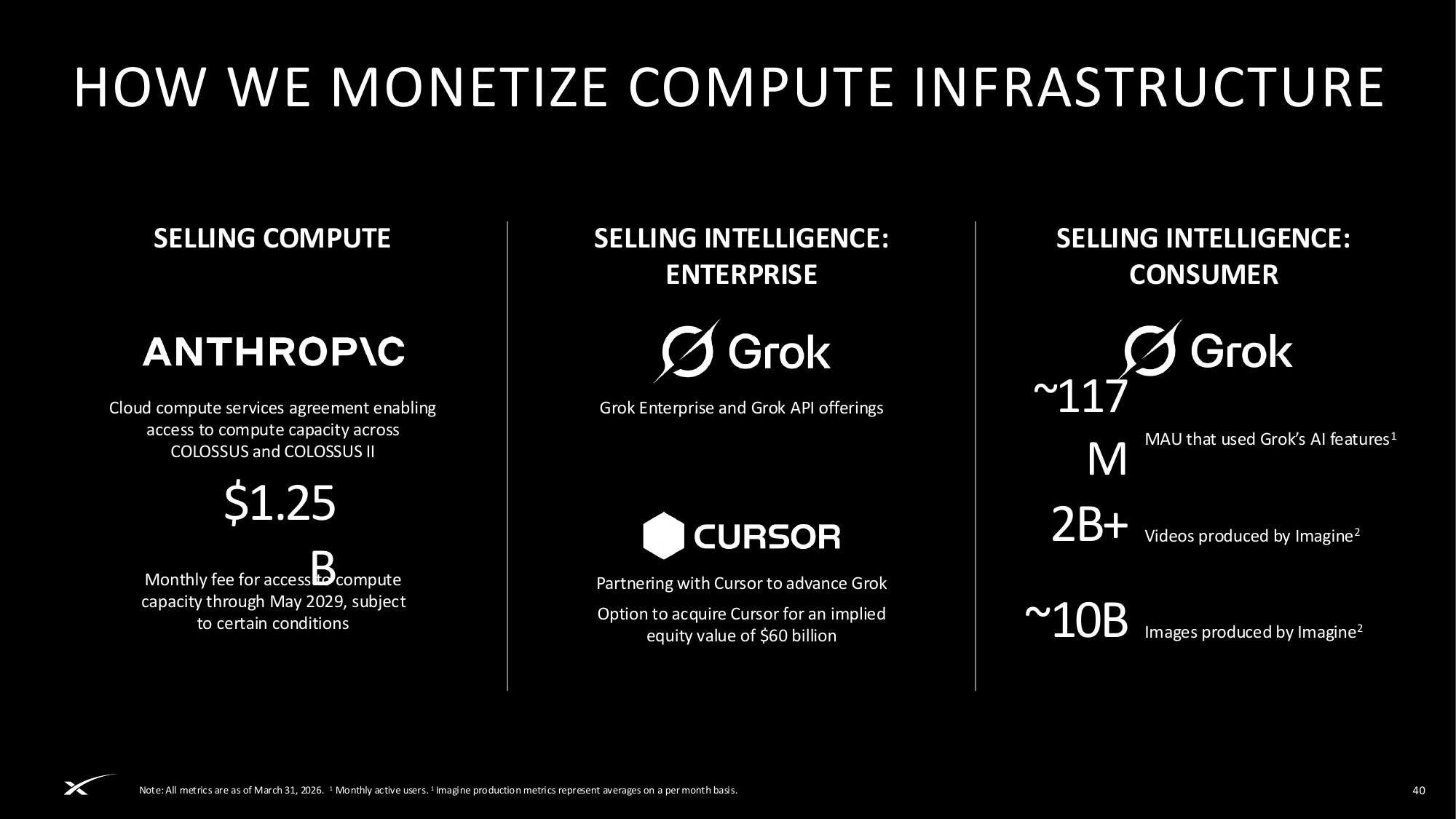
The AI segment earns money three ways: renting GPU capacity to other AI labs under cloud services agreements, selling its own Grok models and the Grok Bot agent, and Cursor, the coding tool it bought for an implied $60 billion on 14 August, which added $608 million of revenue in its first half-quarter. Connectivity is Starlink: 13.6 million consumer subscribers paying $69 a month on average, plus enterprise, aviation and government contracts that grew 91% year on year. Space is launch services and development work for NASA and the Department of War.
The annual record is short because the company has only three audited years, and those combine SpaceX with xAI and X under common control. Revenue was $10,387 million in 2023, $14,015 million in 2024 (+34.9%) and $18,674 million in 2025 (+33.2%); gross margin went 41.2%, 42.9%, 49.4%; operating margin went −33.7%, 3.3%, −13.9% as AI research spending climbed. The first nine months of 2026 produced $27,083 million, up 97.5% on the same period of 2025, at a 58.1% gross margin and a 2.6% operating margin, and management's first guide puts revenue for Q1 2027 alone at $33 to $37 billion, more than the whole of 2025.
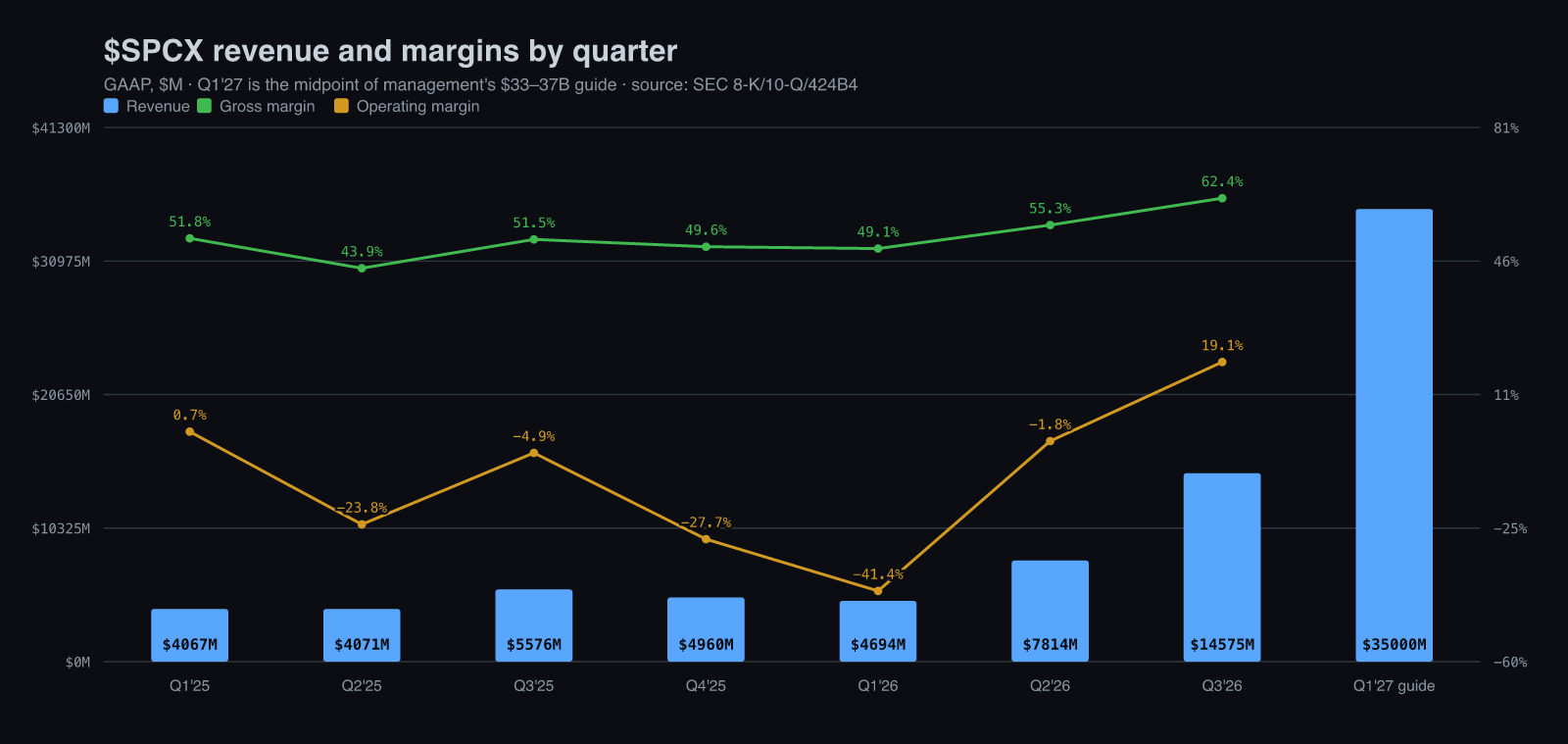
By quarter the inflection is easier to see. Revenue went $4,067M in Q1 2025, $4,071M in Q2, $5,576M in Q3 and $4,960M in Q4, then $4,694M in Q1 2026, $7,814M in Q2 and $14,575M in Q3. Gross margin over those seven quarters ran 51.8%, 43.9%, 51.5%, 49.6%, 49.1%, 55.3% and 62.4%; operating margin ran 0.7%, −23.8%, −4.9%, −27.7%, −41.4%, −1.8% and 19.1%. Management has already told us Q4 gross margin falls back toward Q2's level, because Q3 carried one-time customer-mix benefits and about 3 points of tariff refunds in Connectivity.
The market it is chasing needs one number, not a TAM essay. $CRWV (CoreWeave), the largest listed neocloud, said on its 11 August call that its "near-term capacity remains effectively sold out" and that pricing on Blackwell and Vera Rubin hardware is "setting new highs"; it reported $2.6 billion of Q2 revenue, up 112%, against a $104 billion backlog. $NBIS (Nebius) reported $582 million of Q2 revenue, up 454%, and a $3 billion run rate. Two independent sellers of the same product describe a market short of supply, which is the condition SpaceX's pricing depends on.
Technology & Moat
What SpaceX makes is easiest to see as one chain. Rockets put satellites up at the lowest cost per kilogram in the industry; the satellites sell broadband that throws off cash; that cash and the IPO fund data halls; and the same manufacturing organisation that builds engines builds the halls' power and cooling. Johnsen described it at Goldman Sachs in September as owning everything "from in the rockets, the metal coming in the door to building the engines," and said the company now builds its own data-centre buildings and power the same way.
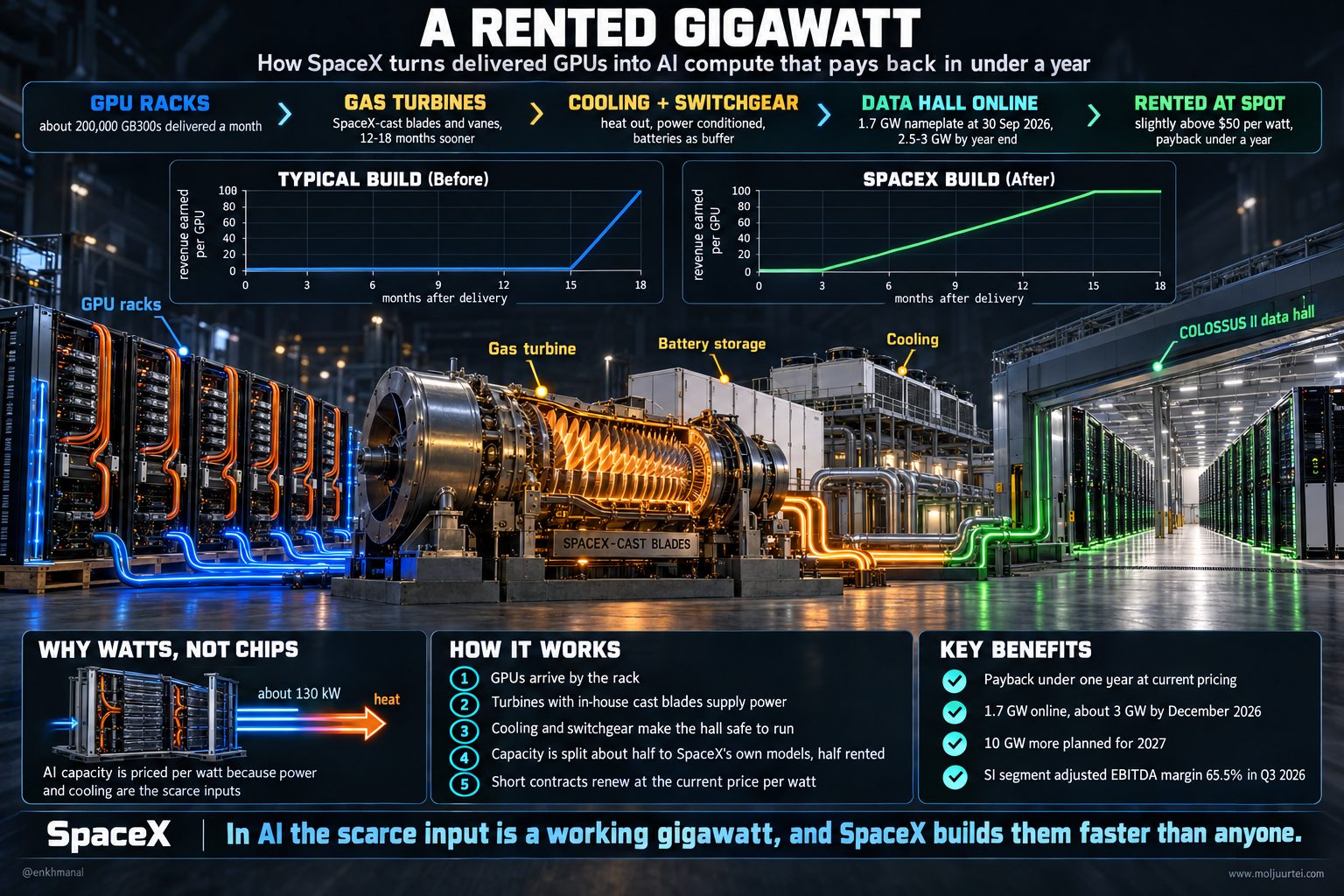
The measured property behind the thesis is deployment speed. On the October 20 call, Musk targeted roughly 200,000 GB300s brought online each month for the rest of 2026; this was a planned deployment rate, not a reported achieved monthly rate, and nameplate compute went from 0.6 gigawatts in September 2025 to 1.4 in June and 1.7 in September 2026. The system consequence is that capacity arrives while rental prices are high. The purchase is a cloud services agreement: the roadshow deck shows Anthropic paying $1.25 billion a month for access to COLOSSUS and COLOSSUS II through May 2029, about 325,000 Nvidia GPUs per the prospectus. The financial consequence is the Q3 segment line: AI segment adjusted EBITDA of $4,953 million on $7,560 million of revenue, a 65.5% margin. The next unproven step is whether that rent holds as SpaceX and everyone else add supply in 2027.
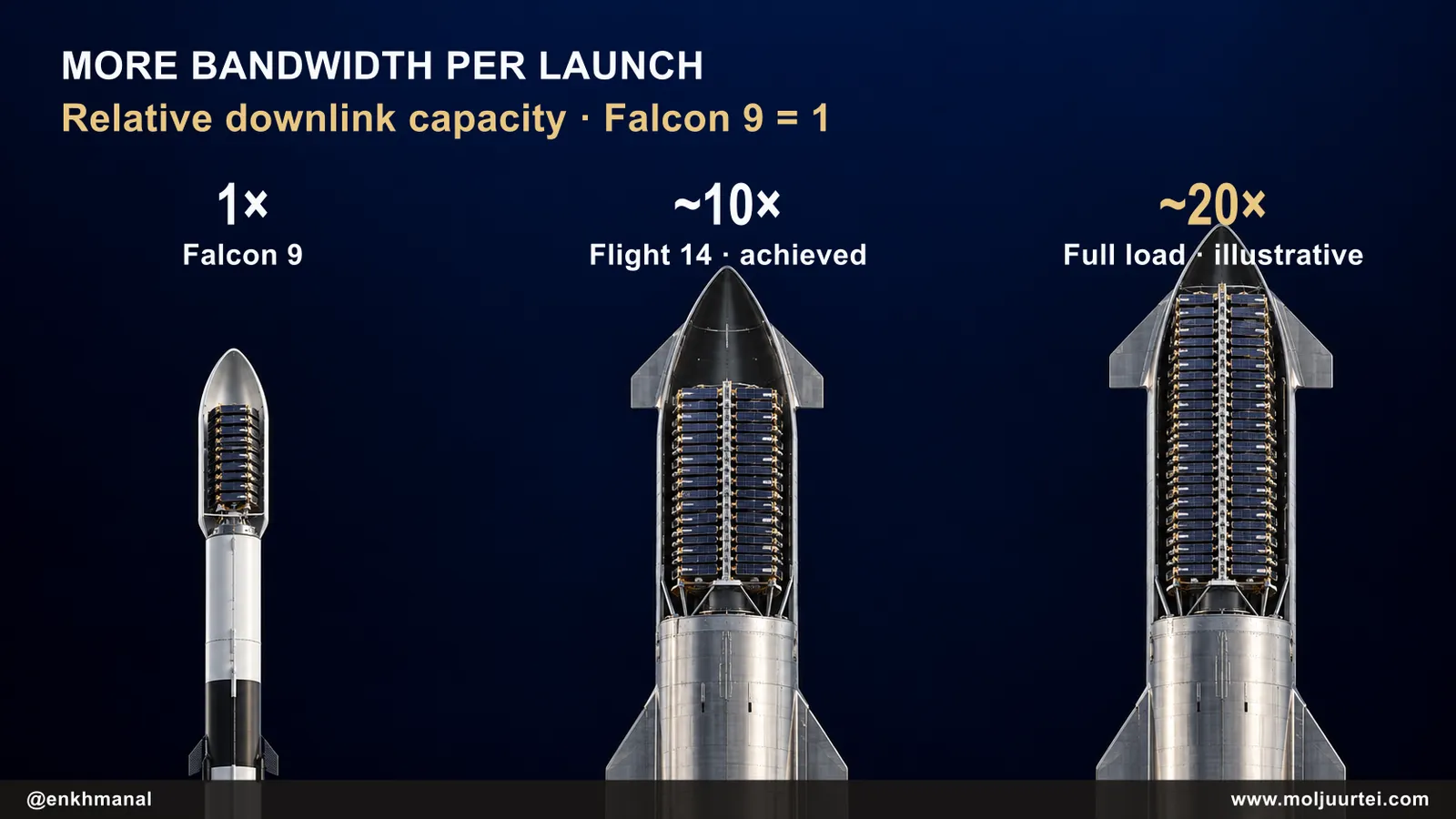
The moat is three things that rarely sit in one company: a casting and machining shop that can make turbine hot-section parts, an investment-grade balance sheet with $89.9 billion of cash and marketable securities at 30 September, and a launch system that makes the satellite side cheaper every year. Starship Flight 14 put 26 V3 Starlink satellites into orbit, about ten times the downlink capacity a Falcon 9 Starlink launch adds, on a vehicle Musk said was roughly half loaded. A single Starship is designed to carry up to 60 V3 satellites, each designed for one terabit per second of downlink.
The weak link in the moat is the price, not the hardware. CoreWeave's Q2 revenue of $2.6 billion on 1.5 gigawatts of active power works out to roughly $7 of annual revenue per watt; SpaceX says its new deployments earn slightly above $50 per watt and pay back within a year. Part of that gap is definitional (nameplate GPU power against a facility's power) and part is the newest chips rented at spot during a shortage. Either way, the premium is large enough that a return to neocloud-like pricing would change the segment's economics, which is why we treat it as the central risk rather than a footnote.
Roadmap & R&D
The money is going where the payback is shortest. Q3 capital expenditure was $19,593 million, of which the AI segment took $16,444 million; Q4 is guided at $35 to $40 billion "because of the additional capacity coming online this quarter." Research and development ran $4,596 million in Q3, with Space at $1,225 million, mostly Starship.
What ships next, with the dates management gave: Starship Flight 15 in November attempts to catch both the booster and the ship, which would make it the first fully recovered orbital launch vehicle; on-orbit refuelling early in 2027; weekly Starship flights in the first half of 2027; Starlink Mobile V2 satellites from 2027, with the 800 MHz spectrum it agreed to buy on 8 October closing in the first half of 2027 and service on new spectrum in early 2028. On the compute side, nameplate reaches nearly 2 gigawatts in October and 2.5 to 3 by December, a training cluster of 440,000 Vera Rubin GPUs is planned by the end of Q2 2027, and the first orbital compute satellites are targeted for 2027. Terafab, the chip plant, aims for a first test chip around May or June 2027 and volume production around Q3 2028, dates Musk himself put "big error bars" on.
The answer to why this is worth more in two years is capacity multiplied by price. Musk said: "I would be surprised if we brought on less than 13 gigawatts of compute by the end of next year." If even half of that is rented near today's rates, the AI segment alone would be several times its current size; the guide for Q1 2027 already implies an annualised revenue run rate of about $140 billion for the company.
The Setup — Why It's Mispriced
At the October 21 snapshot of $159.31, the stock stood $66.33 below its June high of $225.64. The Q3 results shifted the operating mix toward compute. The investment question is whether physical deployment advantages and realized pricing can sustain that acceleration.
Each tranche of capacity has produced more revenue than the last, which is what pricing above $50 per watt looks like in a segment table. The Q2 call guessed $30 to $50 per watt for Rubin; by Q3 the CFO said pricing was "tracking slightly above the high end" of it. Visibility is better than the spot language suggests: backlog was $63 billion at 30 September, of which about $42 billion is expected within a year, and in September the CFO disclosed a hosting deal worth about $1.11 billion a month from 1 December.
At current pricing, new compute deployments are generating a payback of less than a year.
Cash against profit is the part to watch, because the build runs ahead of the income. In the first nine months of 2026 operating cash flow was $13,097 million and capital expenditure $48,069 million, so free cash flow was −$34,972 million against a net loss of only $413 million. In 2025 operating cash flow of $6,785 million covered a third of $20,737 million of capex. The gap is funded: $89.9 billion of cash and securities against $38.8 billion of debt and finance leases leaves about $51 billion of net cash, but the $35–40 billion Q4 capex guide could consume substantial cash and may require additional financing. Comparing Q4 spending with nine-month cash flow does not by itself prove that new debt is required. The sell side has moved but is split: 34 analysts carry targets from $70 to $800, with a median of $235, and J.P. Morgan raised its target to $500 the morning after the print. A short payback is what turns that spending from a burden into inventory that sells within the year.
The Optionality Stack
Three potential new businesses and the expansion of existing artificial-intelligence products offer further upside. Their maturity differs, so distinguish commercial evidence from plans.
The base case does not assign separate revenue to Starlink Mobile, orbital compute or Terafab. It includes the existing in-house product business, including Grok and Cursor. New businesses can add value if commercial results justify it, but they also require capital and may compete with compute rentals for capacity.
Management & Track Record
The leadership is long-tenured, and the record is easier to check than for most IPOs because the same three people have run the company for over a decade.
On their own guidance the record is good on money and loose on dates. The $30 to $50 per watt guess in August was beaten by Q3. The year-end compute target went from "over two gigawatts" in August to 2.5 to 3 gigawatts in October. The $100 billion December run-rate target has been repeated on three occasions, most recently with a new $13 billion-a-year hosting contract behind it. Starship dates slip: the second-stage catch Musk called possible "as soon as the next flight" in August was not attempted on Flight 14. One governance fact belongs here too: Musk holds about 82% of the vote through ten-vote Class B shares, and SpaceX is a controlled company exempt from some Nasdaq governance rules.
Risks & What Breaks It
What forces a change of view: a quarter in which management says compute renewed flat or lower per watt, or Q1 2027 revenue below $33 billion. Either would mean the shortage is ending before the new capacity pays back.
Price Setup — Levels, Technicals & Options
The stock closed at $159.31 on 21 October, up 7.8% the session after the print, above its 20-day average of $155.24 and its 50-day of $149.14. It has 91 sessions of history: priced at $135, it ran to $225.64 in its second week, fell to $104.83 in early August, and has made higher lows since.
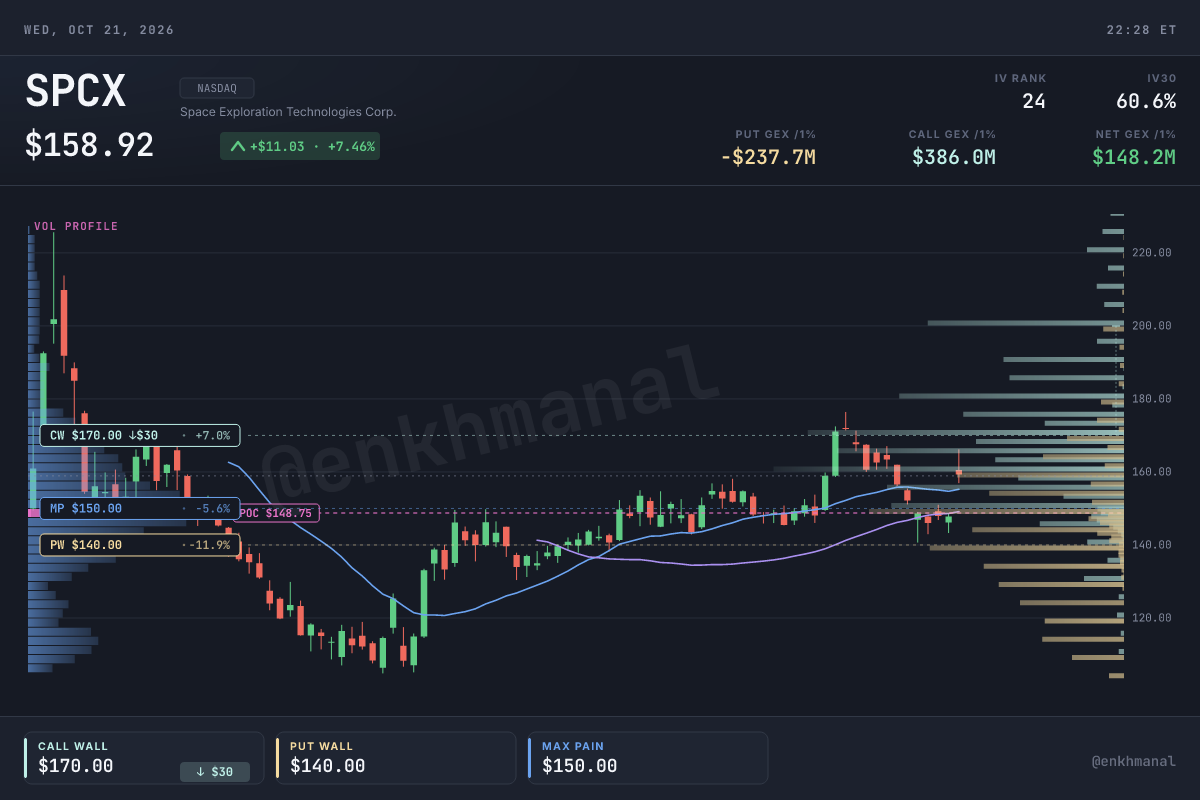
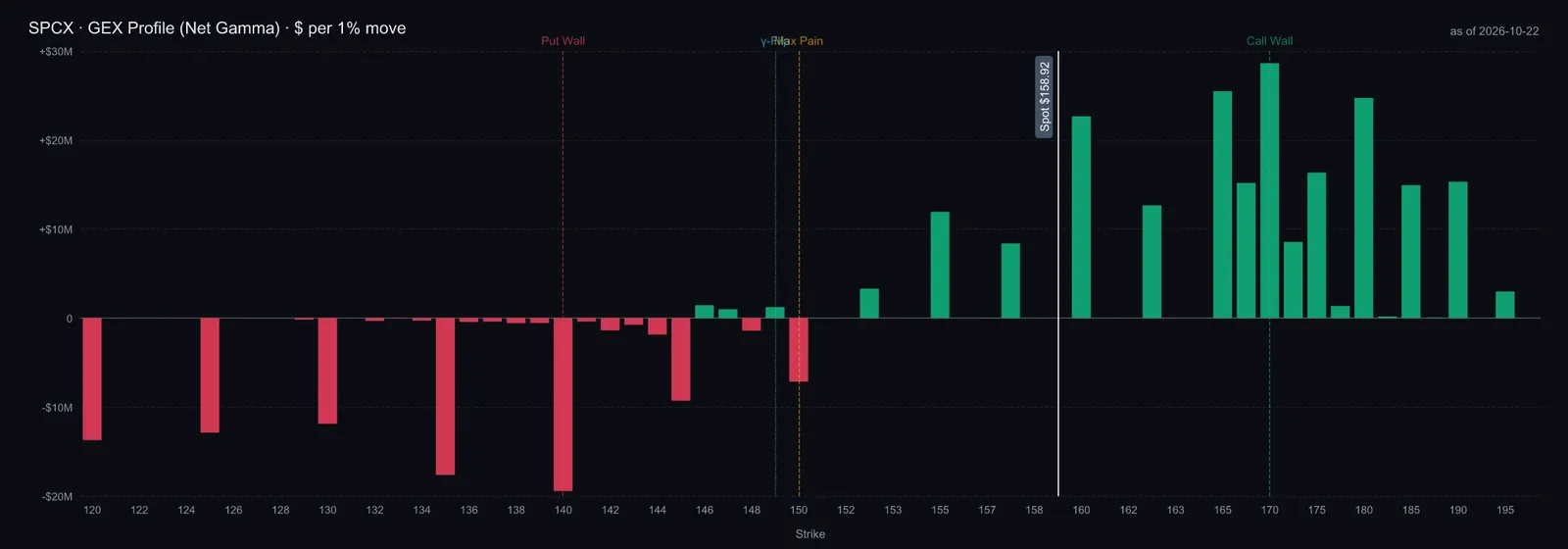
The October 21 options snapshot showed net gamma exposure of +$162 million per 1% move, a $150 gamma flip, a $170 call wall, a $140 put wall and $150 max pain. The put-to-call open interest ratio was 1.06 and 30-day implied volatility about 61%, with IV rank 24. These are dated estimates from options positioning, not current support levels or evidence that the business thesis has changed. Positions and dealer hedging can change quickly.
Valuation & House View
The valuation below is an illustrative end-2027 value based on hypothetical 2028 adjusted EBITDA. It is not a discounted cash-flow result. All three cases assume 14.2 billion shares and $100 billion of net debt at that future date: equity value equals revenue × EBITDA margin × valuation multiple, less net debt; divide by shares for the per-share value. Future financing and dilution can change these assumptions.
Using the original October 21 reference price of $159.31, at 13,579 million shares the equity is worth about $2.16 trillion and the enterprise about $2.11 trillion after $51 billion of net cash. That is 66 times trailing revenue and 15 times the Q1 2027 guide annualised. The original dated comparison, rather than a current market screen, was: $CRWV trades at 10.6 times trailing revenue, $NBIS at 36.3, $ORCL at 7.4, $AMZN at 3.8 and $RKLB at 38.9. Read back, 20 times EBITDA on the current enterprise value needs about $105 billion of 2028 EBITDA, roughly $200 billion of revenue at a 52% margin, against a guided run rate of $140 billion entering 2027.
The 25% / 50% / 25% analytical weights produce approximately $193 per share using the unrounded scenario values. These weights are judgment, not measured probabilities. The base case requires about half of 13 gigawatts to be rented at roughly half the original report’s pricing assumption, plus more than $40 billion of Starlink revenue and roughly $40 billion from internal products. These are assumptions rather than guidance. The bear case asks whether SpaceX’s own new supply ends the shortage it monetizes.
SpaceX’s structural opportunity is to turn power, cooling and deployment speed into scarce, billable AI capacity. Q3 revenue and the Q1 2027 guide support a possible acceleration before the full build is visible. The decisive tests are delivered capacity, realized rental pricing, contract renewals and cash conversion. Short contracts, customer concentration, very large capital needs and launch execution can weaken the opportunity; persistent price compression or capacity that fails to earn an adequate return would challenge the thesis.