$SNAP Deep Dive — A Cash Business Wearing a Science Project · Q3 print Nov 4
$SNAP closed the Specs launch up a couple of percent, with the Street still at Hold and RBC still at $8. The market is treating a company that just generated $706M of trailing free cash flow, told investors that free cash flow per share is now its scoreboard, and put its glasses in a subsidiary built to take outside money, as another Spiegel product night. We think the core business supports the stock without the glasses, and the glasses leaving the parent's P&L is the free option the tape is waiting for.
What Changed
Start here. A social network is a machine that turns attention into money. An advertising impression is one unit of that attention, auctioned to a business that wants to be seen by the person holding the phone; the price it clears at depends on how well the network can prove the ad led to a purchase. A subscription is the other way to charge for the same attention: the user pays the network directly for features, and no auction is involved. A performance-ad stack is the software that runs the auction, attributes the purchase and automates the campaign, and it is the thing that separates a network that can charge Meta prices from one that cannot. For most of its public life $SNAP only had the first, and the first was a bad version of it. Snapchat's 493 million daily users skew young and international; the young ones are worth a lot per head in the United States and very little elsewhere, and the advertising auction that turns them into money was, until roughly 2024, worse at attribution and automation than Meta's. The result was a company with a billion-person audience and no way to charge for it that did not lose money.
Three things changed, and they changed in the last eighteen months rather than the last five years.
The shift: the ad machine got fixed. Snap rebuilt its lower-funnel products (pixel purchase, app purchase, dynamic product ads, Sponsored Snaps) and wrapped them in AI automation it calls Smart Campaign Solutions. Cost per install fell 8% and cost per purchase 18% year over year in Q2 2026 while app purchase volume rose 128%; conversions across the platform rose 56%. Advertising revenue went from −3% year over year in Q1 2025 to +9% in Q2 2026, and the "large customer headwind in North America" that management cited on three consecutive calls turned into "better momentum with large advertisers in North America" on the fourth.
Why the old answer stopped working: growth by marketing spend and headcount ran out of road. Snap spent a decade buying users in rest-of-world at about $1 of annual revenue per user while its cost base was built for a company three times its size. In April 2026 it cut 16% of its staff (a $95–130M charge, ~$500M of annualised savings), and management's total adjusted cost structure grew 4% in a quarter where revenue grew 19%.
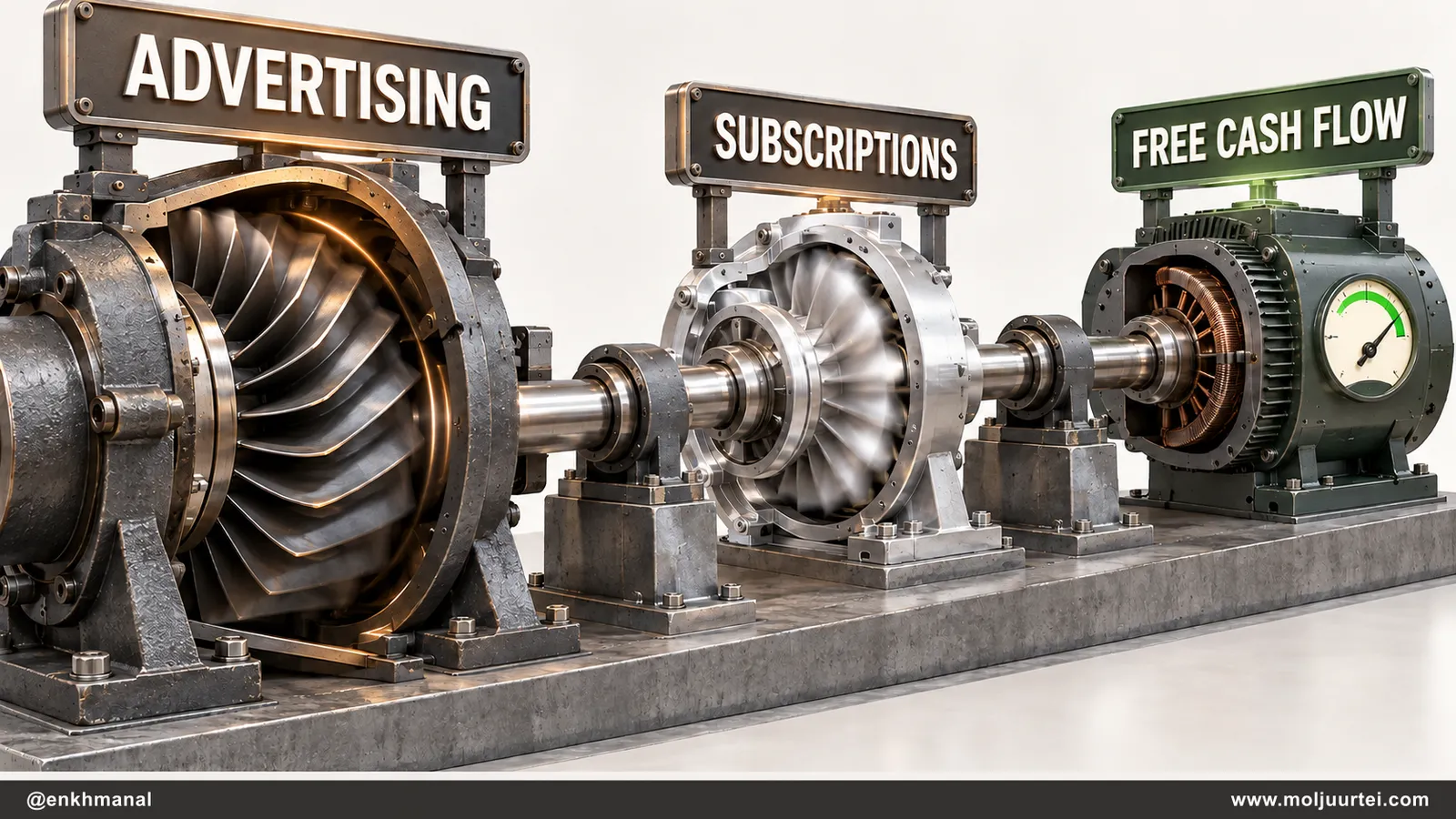
What that creates demand for: a second engine. Snapchat+, Memories Storage and Lens+ turned "Other revenue" into a $1.26B annualised line growing 85%, sold to fewer than 3% of monthly users. A subscription attached to a messaging habit is the kind of revenue an ad recession does not touch.
The company those three changes most reward is the one that already had the audience and only lacked the monetisation and the discipline. That is $SNAP. The complication, and the reason the stock is at $5.66 rather than $9, is that the same founder who fixed the core is also spending roughly half a billion dollars a year on see-through glasses he has told investors will not be mass market until "towards the end of the decade." This memo is about how much of the first you are buying, and how little of the second you are paying for.
Thesis
$SNAP is a 971-million-user messaging platform whose advertising machine has been rebuilt to convert at Meta-class efficiency, carrying a subscription business growing 85% a year from under 3% penetration, priced at 1.6× sales because the market is charging it for a hardware programme that management itself dates to the end of the decade.
What it can do that others can't: monetise a teen-and-twenties audience Meta does not own. North America ARPU is $10.26 (+23% year over year) on 92M daily users; the subscription line, at $316M a quarter, is now a fifth of revenue.
What that lets it sell next: subscriptions from <3% penetration toward Spiegel's own 7–12% industry band; ads at mid-single-digit growth off a fixed cost base; and Specs financed by someone else's balance sheet, which the Specs Inc. wrapper (formed January 28) exists to make possible.
Why now: free cash flow per share became the stated objective on the Q2 2026 call, the buyback is finally shrinking the share count (1,756M → 1,726M in two quarters), and the Q3 print on November 4 is the first with the full restructuring savings in it.
The one risk that matters: North America daily users. Ninety-two million people are ~19% of DAU and roughly 59% of revenue; the line held flat in Q2 after six declines, and every bull model in this memo assumes it holds.
Business & Backdrop
Snapchat is a camera-first messaging app: friends send disappearing pictures, chat, and watch short video (Spotlight) and creator content (Stories) around that habit. Snap sells advertising against that attention, sells subscriptions to the users themselves, and since 2016 has built augmented-reality hardware (Spectacles, now Specs) on the theory that the camera should eventually live in front of your eyes rather than in your hand. The first two are one business. The third is a separate company that happens to share a founder, and the market prices it as if it will consume the first two.
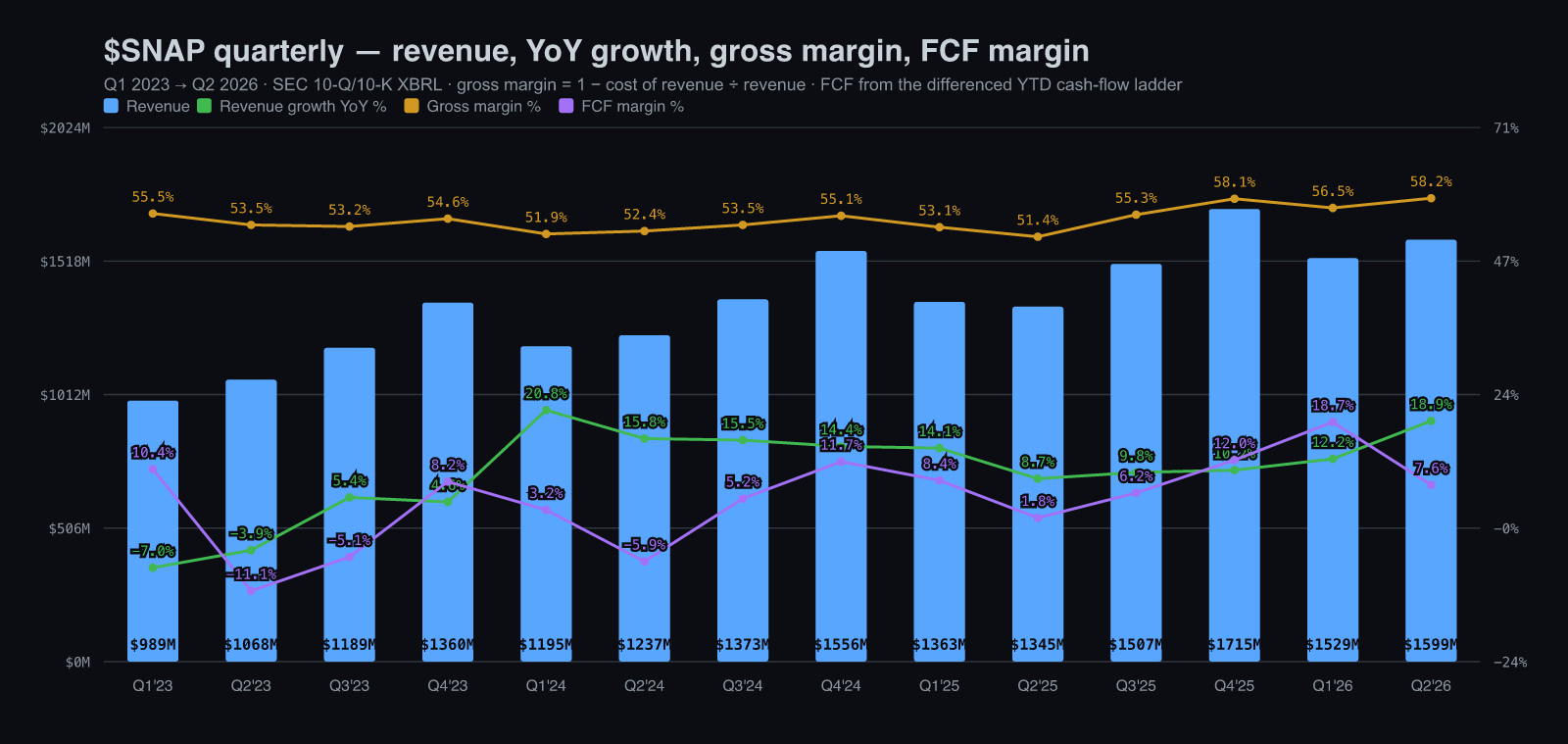
The revenue and margin history explains the multiple. Revenue compounded at 45–64% a year through the pandemic, went flat across 2022–23 after Apple's app-tracking changes and the ad recession broke the targeting-led growth, and has grown 10–16% since. What the annual series hides is that the company never earned a GAAP operating profit in any of those years: operating margin ran from −64% in 2019 to −9% in 2025, because stock-based compensation of $1.0–1.4B a year sits inside the cost lines. Free cash flow turned positive in 2021 and has stayed positive, which is the number the stock has finally started to trade on.
The quarterly series is where the turn shows. Gross margin bottomed at 51.4% in Q2 2025, when infrastructure spend on AI recommendation ran ahead of revenue, and has printed 55.3%, 58.1%, 56.5% and 58.2% since. Revenue growth accelerated from 8.7% in Q2 2025 to 18.9% in Q2 2026, with the World Cup helping the latter. Free-cash-flow margin has been positive for eight straight quarters; the two quarters it was above 10% were the seasonally strong fourth quarters plus Q1 2026, when collections landed.
The peers say the ad market is fine and the discount is Snap-specific. $META grew revenue 22% in FY2025 at a 41% operating margin; $PINS, the closest comparable in audience economics, grew 16% at a 7.6% operating margin and trades at 2.3× sales; $RDDT grew 69% and trades at 10.9×. $SNAP, growing 12–19% at a 55–58% gross margin, trades at 1.55× trailing sales. The market it is chasing is the same digital advertising pool those names share; the number that matters for Snap is not the pool but its own share of the North American user's day, which is why NA DAU is the risk section's first line.
The mix is what moved. Snap reports one segment, but it discloses revenue on the axis that matters: advertising against everything else. A year ago Other was 12.7% of revenue; in Q2 2026 it was 19.8%, and it supplied 57% of the company's year-over-year revenue growth on a fifth of the base.
The market is not wrong that Snap loses money on a GAAP basis. It is wrong about what the loss is made of: roughly $1.05B of stock comp that a $751M annual buyback now offsets in share count, and a hardware programme that lives inside a subsidiary designed to be financed by someone else.
Technology & Moat
What Snap actually makes is three things, and the moat is in the first.
The messaging graph. Snapchat's core loop is friend-to-friend visual messaging; Spotlight (short video), Snap Map (location) and augmented-reality lenses hang off it. The graph is the moat: 971 million monthly users, 493 million daily, and a young cohort in the United States and Europe whose day starts in the app. Management's Q2 letter said the U.S. audience is "broadening quarter-over-quarter, led by people aged 35 and older," which is the demographic advertisers in autos, insurance and financial services actually pay for. The replacement cost of a daily messaging habit among 493 million people is the reason no one has built a second Snapchat, and the reason Irenic's letter values the asset at $35B rather than arguing it is worthless.
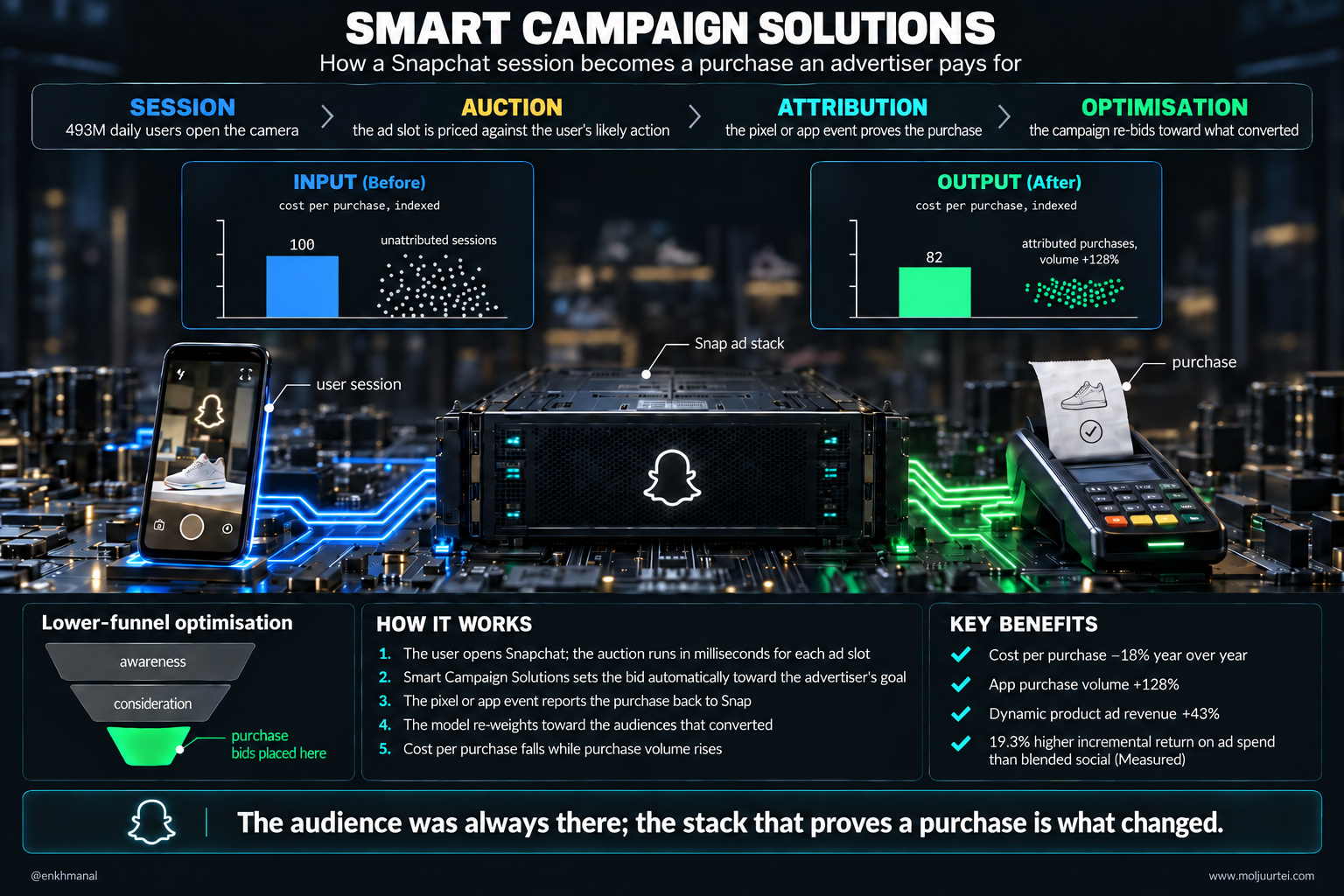
The ad stack. This is where the last two years went. Snap rebuilt attribution and optimisation around lower-funnel outcomes, then automated campaign setup with Smart Campaign Solutions. The results management reported for Q2 2026: cost per install −8%, cost per purchase −18%, app purchase volume +128%, dynamic product ad revenue +43%, and a third-party study (Measured) showing 19.3% higher incremental return on ad spend than the brands' blended social average. AI now reviews 90% of ad images at first pass, up from 40% a year earlier. None of this is unique technology; it is the same performance-ad playbook Meta ran from 2022. What is unique is the audience it runs on.
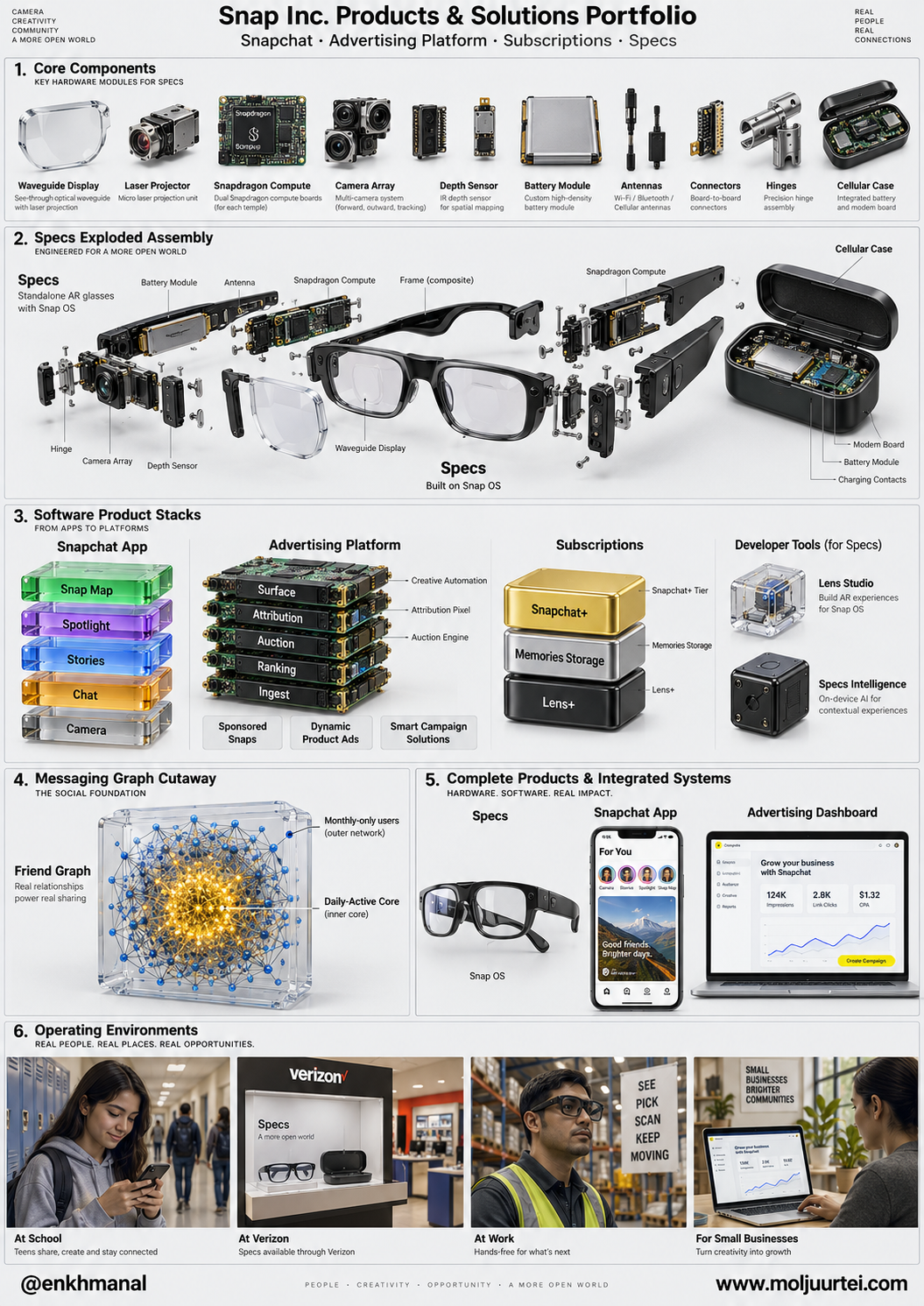
The AR stack. Snap has spent more than $3B over about eleven years on augmented reality: its own operating system (Snap OS), its own waveguide-and-optical-engine display, Lens Studio as the developer tool, and now Specs, a standalone see-through computer with dual Snapdragon processors, a 51° field of view, hand and voice input and an anticipatory AI service called Specs Intelligence. Management's own description on the Q2 call:
Specs are a new kind of computer built into see-through glasses, more capable than today's limited AI glasses and more wearable than bulky VR headsets.
The moat here is patents and a decade of head start on optics; the weakness is that Meta owns the cheap-glasses volume market with Ray-Ban, and Snap's product is $2,195 with a roughly four-hour battery.
The launch reframed what the product is. Specs Intelligence, the anticipatory AI layer, runs on iPhone and Mac as well as on the glasses, with a US iOS preview open now; the glasses are the premium surface for a service that does not need them. That is the same move Meta made with its AI assistant and it widens the addressable base from people who will wear a $2,195 headset to people who own a phone. On the hardware side the enterprise pitch is the one that fits the specification: a mechanic or a warehouse picker needs both hands free, does not care what the frames look like, and buys through an integrator on a three-year contract, which is where Salesforce's Agentforce, AWS's Quick assistant and NVIDIA's extended-reality agents come in.
LightShed's launch note was titled "Snap Has Two Companies. It Should Stop Pretending Otherwise," and that is the correct read of the technology: a monetisable messaging platform and a venture-stage hardware company that need different owners.
Roadmap & R&D
Snap's research spend was $1.79B in FY2025, 30% of revenue, and the Q2 letter says the Specs programme is inside the ~$2.75B FY2026 adjusted-opex guide rather than on top of it. Irenic estimates the hardware line loses close to $500M a year; management has not disputed the figure and has said it will "pace that investment based on product, ecosystem, and economic milestones."
The distribution decision matters more than the spec sheet. Previous Spectacles were sold through vending machines and a website; Specs ships through Verizon as the exclusive US carrier, with a $2,395 bundle that adds a cellular charging case, 36-month financing for eligible customers and data plans from $10 a month for existing subscribers. A carrier store is a place where a $2,395 device becomes a $67-a-month line item next to a phone upgrade, and where a salesperson on commission demos it. Alongside the carrier, Snap's enterprise alliance names Trifork (Tandem, which lets a remote expert see what an on-site technician sees and annotate it) and Hololight (streamed access to documents and 3D models, a "spatial workstation") to do the unglamorous enterprise work of writing the workflows a warehouse or a field-service fleet would actually run. None of this is volume. It is the difference between a product that sells to developers and one that can be sold to a buyer with a budget line.
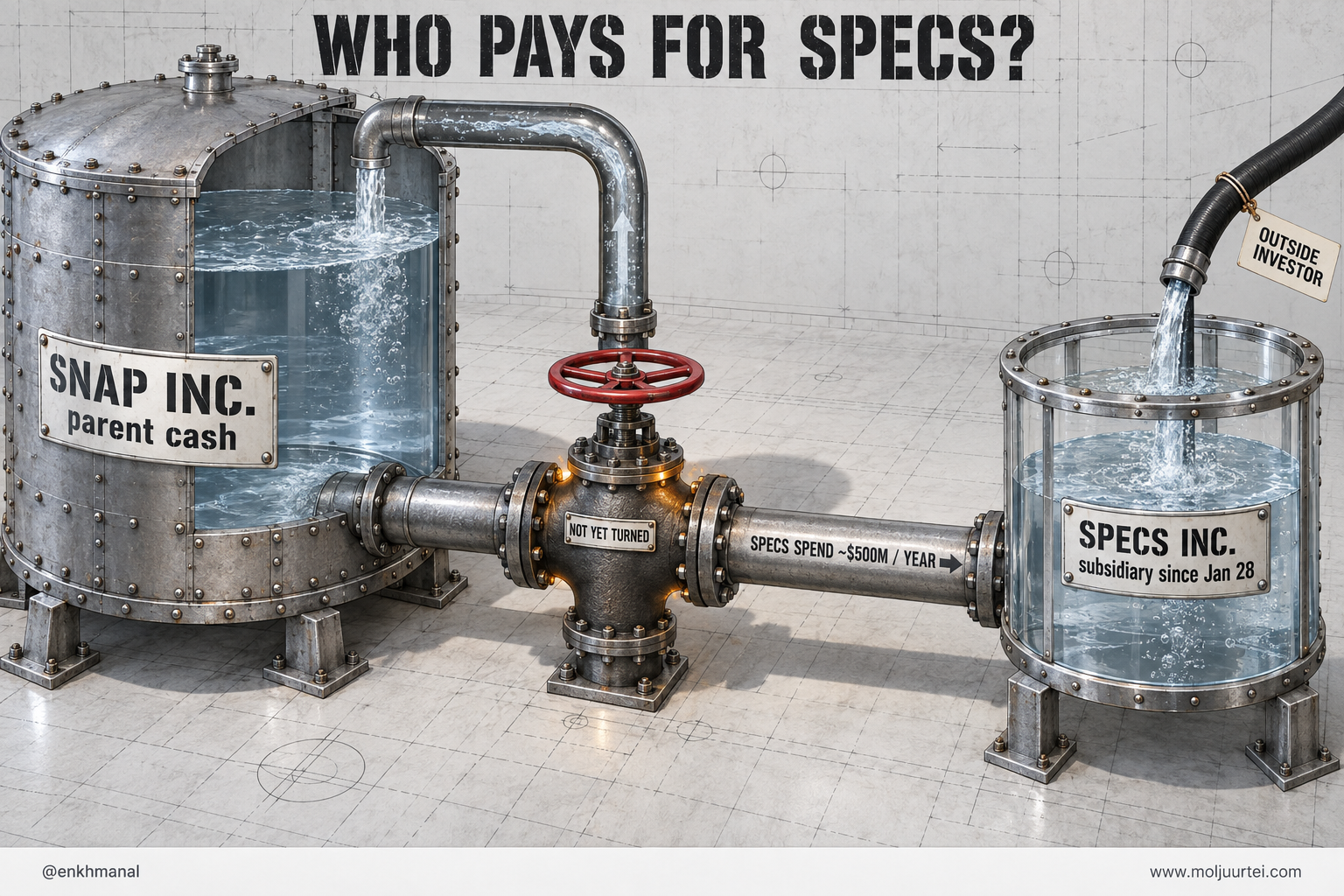
The part of the roadmap that decides the stock is not on the product side. It is whether Specs Inc. takes a cheque. The wrapper was formed, in Bloomberg's words on the day, so the company could "more easily secure investors and partnerships"; Barclays asked on the Q2 call whether "setting up Spectacles as a company outside of Snapchat" was off the table, and CFO Doug Hott answered with a paragraph about product quality and ecosystem development that did not contain the word "no." The launch added the logos (NVIDIA, Salesforce, AWS, Verizon) that make an inbound plausible. Nothing has been announced.
The Setup — Why It's Mispriced
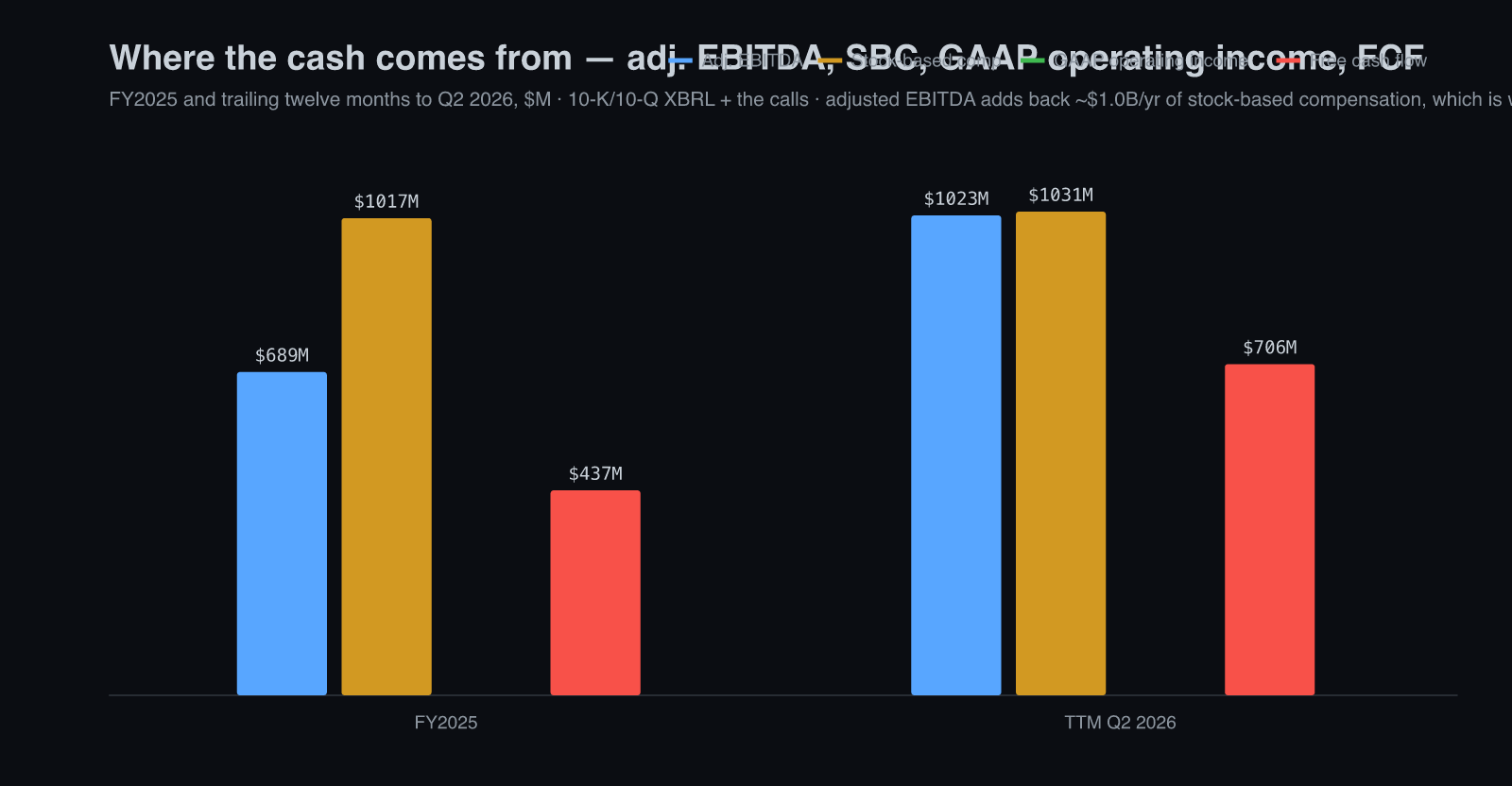
The stock is priced as a loss-making ad company because on a GAAP income statement that is what it is. Net loss was $164M in Q2 2026 and $460M in FY2025. But the loss is almost entirely stock-based compensation, and the company has started doing the two things that make SBC a real cost rather than a paper one go away: it cut the headcount that generates it, and it buys back the shares it issues. FY2025 SBC was $1,017M against $751M of repurchases; in Q1 2026 alone the company bought $350M of stock, and shares outstanding fell from 1,756M in December to 1,726M in June. That is the first two-quarter decline in the share count in the company's history as a public company.
Free cash flow is the honest line, and it says the business earns money. Trailing twelve months to June: operating cash flow $919M, free cash flow $706M, about $0.42 per diluted share. Eight consecutive positive quarters. The company ended June with $2.66B of cash and marketable securities against $3.47B of convertible notes, having repaid more than $2B of the 2027–2028 converts early.
The register explains why the rerating has not happened yet. Invest With Colby's August piece counted, from Fintel data, roughly 300 million shares of net institutional selling over the year into the best profitability quarter in the company's history, and Snap's own governance keeps the natural buyers away: the Class A shares carry no vote, which is why Snap has never been admitted to the S&P 500 and why the passive ownership that anchors a $10B company is missing here. Irenic's letter asked the board to review index eligibility and consider a Nasdaq listing for exactly this reason. A company whose shareholder base is being sold down by active managers, without the index bid underneath, trades on whatever the last marginal seller wants, which is how a business generating $700M of cash gets priced at 1.5× sales.
Three things the market is underweighting.
The subscription line is the fastest-growing revenue of its size in social media, and nobody values it. Other revenue went from a $700M annualised run-rate in Q2 2025 to $1.26B in Q2 2026. Fewer than 3% of monthly users pay. Spiegel's own reference class on the Q2 call was "app-based subscription products… penetration is typically around 7%–12% over the long term." The 85% growth rate will step down as Memories Storage laps its launch, and we model it stepping down; even at half the rate it is a $2B line in two years attached to a habit.
The cost base is now fixed while revenue is not. Management guided FY2026 adjusted opex to ~$2.75B on revenue we roll up to ~$6.8B, and said it expects "disciplined growth in our non-GAAP operating expense base over the medium term." Every incremental dollar of advertising at a 58% gross margin therefore lands mostly in EBITDA. Adjusted EBITDA has gone $41M → $182M → $358M → $233M → $250M → $300–350M guided, and the Q3 number is the first with the full restructuring in it.
Going forward, our financial objective is Free Cash Flow per share. We believe this is the right objective because it connects operating performance, disciplined capital allocation, and long-term shareholder value creation.
That sentence appears in exactly one of the eight calls we read. It is new, it arrived four months after an activist letter, and it is the sentence that makes the buyback structural rather than opportunistic. A CFO who is measured on free cash flow per share cannot let a $500M-a-year hardware line sit on his P&L indefinitely, which is why the third thing the market is underweighting is the Specs Inc. wrapper. The tape closed the launch up 2% with RBC reiterating $8: either the event was already in the price, or the market wants cash attached to Specs, not a demo. We think it is the second, and that the wrapper exists to deliver it.
Management & Track Record
Evan Spiegel has run Snap since founding it in 2011, and Bobby Murphy has been CTO for as long. Together they hold the Class C shares that carry all of the voting power, with no sunset. The public Class A has no vote; that is why Snap is excluded from the S&P 500 and why Irenic, at a ~2.5% economic interest, sends letters rather than proxy cards. The record is genuinely two-sided, and a memo that only tells one half is not useful.
Irenic's Adam Katz is the outside actor in this story, and the useful question is what he can actually do. With ~2.5% of the economics and none of the vote he cannot force anything; his campaign works only by persuasion, which is why the letter reads as a menu rather than a threat: cut costs, stop funding Specs from public money, buy back stock, fix index eligibility. Four months on, three of the four have happened in some form, and the fourth is the one that requires Spiegel to give something up. Old Rope Research's reading, which we share, is that Katz's real lever is legacy rather than economics: a founder who has already made his fortune cares whether the company outlives the stock price, and the FCF-per-share objective is the first sign he has decided it should.
The 2026 board additions are the tell for where Spiegel's attention is: Matthew McRae (Arlo's CEO, ex-Vizio CTO) in December and Luke Wood (ex-president of Beats, then Apple) in May are consumer-hardware executives, not ad-tech ones. Irenic asked for "directors who bring proven operating experience" in AI and advertising monetisation; the company added hardware. That is consistent with a founder who intends to ship Specs, and it is also consistent with a founder building the board a Specs Inc. would need on its own.
What the record does not show is a track record of listening. Spiegel's September 10 fifteen-year letter, and his direct reply to a retail holder sitting on a 47% loss (captured in @ZeeContrarian1's post the same day), are the first shareholder engagement of that kind we can find, and both arrived after the Irenic campaign. We read the FCF-per-share objective, the dilution programme, the Specs subsidiary and the letter as the same event: a founder with absolute control deciding, for the first time, that the share price is his problem too. Four months is not a track record. It is a start.
Risks & What Breaks It
The litigation risk deserves its own paragraph because it is the one that can move the North America number without any competitor doing anything. Snap's users are the youngest of any large platform, and the regulatory response to youth social-media use has moved from hearings to enforcement in the last twelve months: Australia's under-16 ban took effect in December 2025 and cost Snap roughly 400,000 accounts in one quarter; the company is now testing Apple's declared-age-range API and plans to test Google's equivalent, which means age verification is coming to the US product whether or not a court orders it. Management's own Q2 outlook language is unusually direct for a risk factor: several US trials "later this year," with possible "significant changes to our products and business practices, increased compliance requirements and legal costs, increased payments for legal judgments and settlements, and negative impacts to user growth and engagement." We cannot size a verdict. What we can say is that a product change that removes or throttles under-16 users lands almost entirely in North America and Europe, the two regions that carry the ARPU, and that a $10.26-ARPU user lost in the US costs ten rest-of-world users to replace. That asymmetry is why the NA DAU line is the thesis's tripwire rather than one metric among several, and why a print that holds 92M through the first of those trials would be worth more than the number alone suggests.
What forces a thesis change: NA DAU below 90M on the Nov 4 print, or a Q4 call that raises Specs spend for 2027 without a partner attached. Either one moves this memo from constructive to a wait.
Price Setup — Levels, Technicals & Options
The tape has done the work already. $SNAP put in a $3.81 low in the spring, ran to $9.28 on the Irenic surge in March, and has spent the summer building a base between $4.50 and $6.00. Price is above both the 20- and 50-day averages; the six-month volume point of control sits at $5.82, just above spot, and the $6.00 level has rejected three attempts since August.
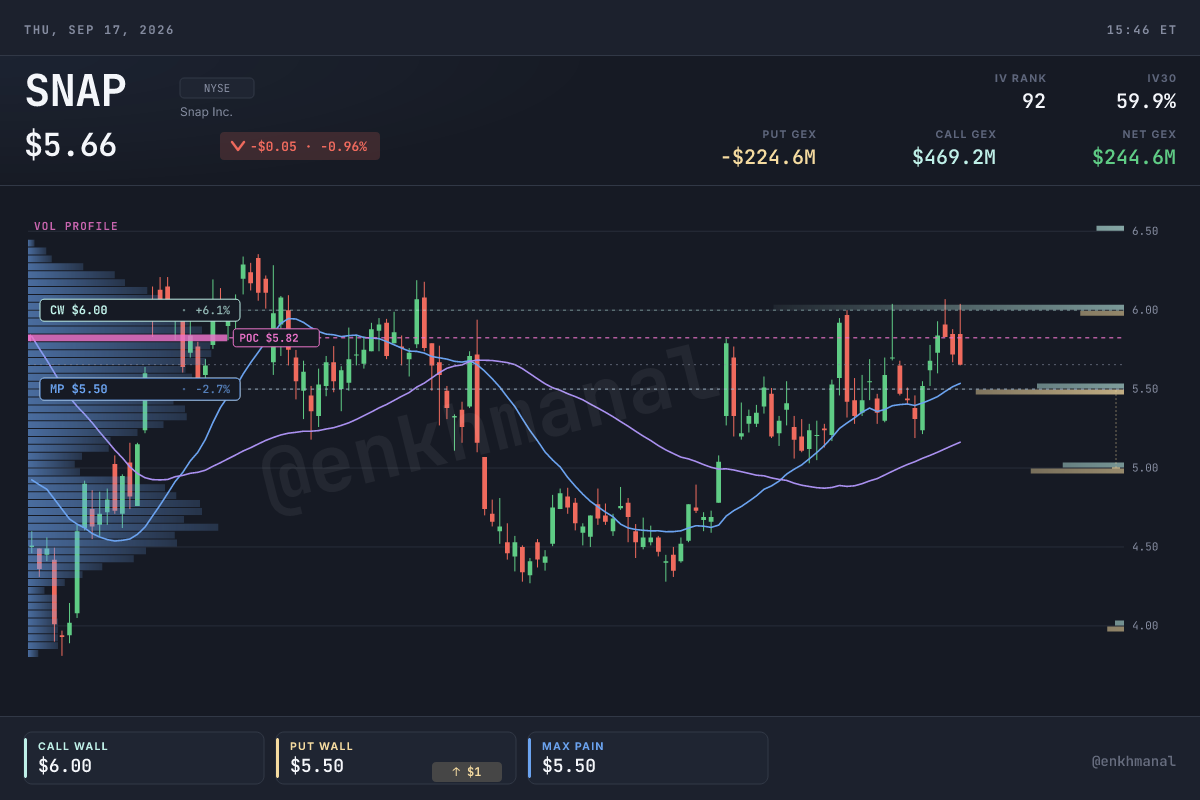
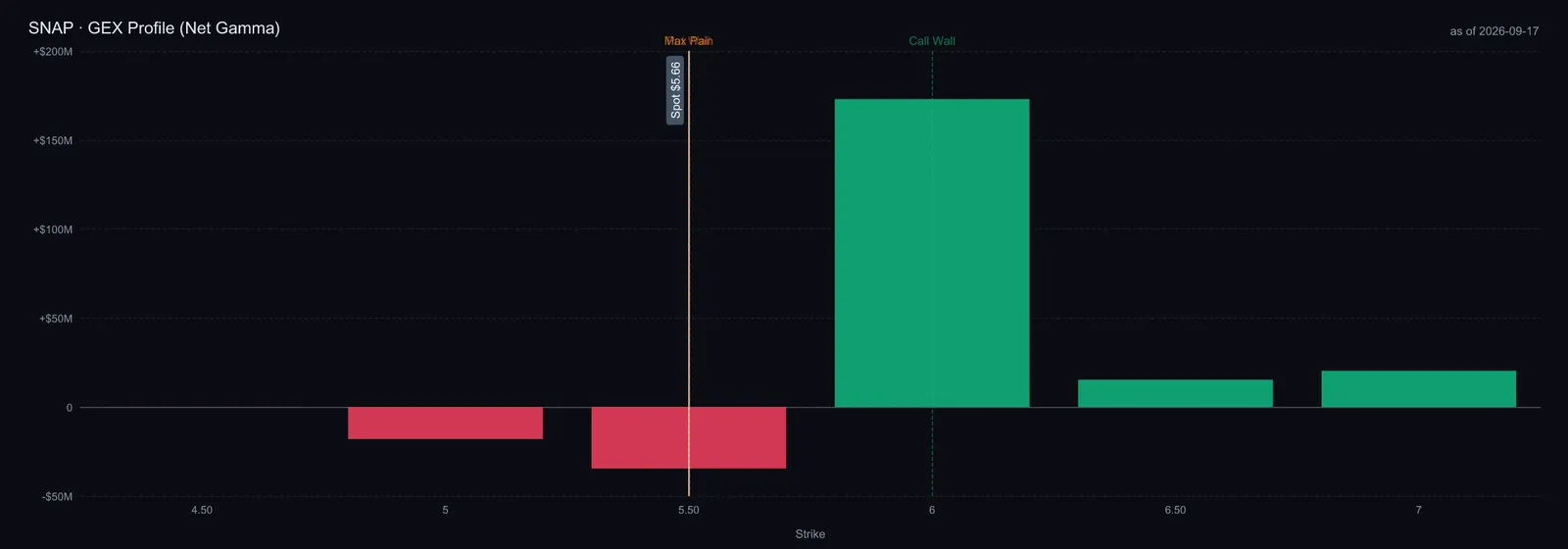
Dealer positioning: call wall $6.00, put wall $5.50, max pain $5.50, net gamma +$245M with calls outnumbering puts three to one in open interest (1.09M vs 0.35M contracts). Positive gamma pins the stock inside $5.50–6.00 into October expiry; a close through $6.00 on volume is the level where dealers stop selling rallies.
Implied volatility: IV30 is 60% at an IV rank of 92, meaning options are as expensive as they have been in a year. The term structure runs 88% for the day after the launch, 61% a week out, 60% into October. The market is paying up for the next six weeks, not for November 4 specifically.
The level that matters: $6.00. Above it the base is complete and the March high at $9.28 is the next reference; below $5.50 the launch reaction has failed and the put wall is the only support before the summer lows.
Expensive options and a pinned stock argue for owning shares rather than calls into November, or for selling the elevated volatility against a position rather than buying it. The arithmetic: 60% annualised volatility over the 22 days to the October 9 expiry implies a one-standard-deviation move of about 15%, or roughly $0.85 either side of $5.66, which reaches neither the March high nor the summer low. The options market is pricing a launch hangover, not a rerating; a position that wants the November print should not be paying October's premium for it, and a holder of shares can sell that premium to fund the wait.
Valuation & House View
The house model on the workbench seeds FY2026 from management's guide: revenue ~$6.79B (two quarters filed, Q3 guided, Q4 inferred at the Q3 growth rate), GAAP gross margin 57.5% from the two guided cost-of-revenue lines, and GAAP opex of ~$3.74B (adjusted opex $2.75B plus ~$0.99B of stock comp). Year 1 reconciles to the guide on all four lines. The Audit shows no fails and four warns, which we name: working-capital lines are not tagged in the filings, the perpetuity and exit methods sit 5.1× apart, only one comp ($META at 16.9× EV/EBITDA; $RDDT at 61.8× is flagged) sets the exit multiple, and the 25% tax rate is a default.
Its verdict is uncomfortable and correct. Treating stock comp as a cost and carrying FY26 cost ratios flat, the base case is worth $2.91 on a peer exit multiple and $0.57 on a perpetuity; the bull case, with gross margin at 59% and SG&A at 13.2% of revenue, is $6.39 on the exit method. The gap is the whole debate: the stock at $5.66 already assumes operating leverage after FY26 and a buyback that neutralises the grants. We accept that assumption because management guided to it (net income positive in 2027, stable share count in 2027) and because the last four quarters delivered it; we hold it loosely because it is four quarters old.
On the multiples the peers actually trade on, the discount is large and the reason is stated.
Probability-weighted that is about $7.00, or +24% from $5.66, with the downside case sitting close to where the house GAAP model already puts the stock. We are constructive and small: underwrite Book A, treat Book B as the free option, and give Book C, the glasses as the next phone, a zero, because the founder himself dated it to the end of the decade. The Street's median target of $6.75 across 35 analysts, 29 of them at Hold, is the base case with no option attached. What changes the view is November 4: North America DAU at or above 92M and adjusted EBITDA inside or above $300–350M keeps the memo; a miss on either, or a 2027 outlook that grows Specs spend without a partner, ends it.