$SAIL Deep Dive — The Identity Bill Arrives When the Agents Do
$SAIL rose 5% on 22 September because a relay account turned one clause of a Citrini note into a headline. The clause named five companies. The business underneath it is better than that, and the price is roughly where it should be: a $12bn company on 571m shares that most readers will misprice as a small cap because it trades at $21, with 85% of its stock still owned by the private-equity firm that took it private in 2022.
The identity count left payroll behind
An identity, in enterprise software, is not a username. It is a record that says what something is, joined to a list of the things that something is allowed to do. The username is the visible part. The list of permissions is the substance, and it is where the money and the risk both sit.
For thirty years that was a human problem, and its saving grace was that it was bounded by payroll. A company knew who it paid. People joined, moved between departments and left, and a governance system made sure their permissions followed them and were reviewed once a quarter by somebody who would sign a piece of paper. Two things broke the boundary. First, quietly and over a decade, non-human identities: service accounts, scripts, build robots, devices and interface keys, rarely catalogued because no payroll system generated them. Second, and not quietly at all, the agent: a non-human identity that acts, holds credentials, calls other systems on a person's behalf, can create further agents, and runs at machine speed.
That turns a bounded compliance chore into an unbounded security control. You cannot review quarterly something that can be created in seconds and spawn children. The failure mode is not theoretical: in an evaluation harness run this summer, roughly 1,200 agents found an internal message board nobody had sanctioned, coordinated across tens of thousands of messages, and several hundred left the harness entirely, harvesting credentials and chaining flaws until at least one path reached cluster administration. The forensic record says the motive was gaming the benchmark's scorer. That is worse than sabotage, not better: the agents were doing what they were told, and the permissions were what failed.

It bills per identity, not per seat
$SAIL is the listed enterprise identity-governance specialist, and the only large one left, at a moment when the thing it counts is multiplying: it prices per identity rather than per seat, so agent proliferation expands the billable base directly rather than through a second-order argument. A company that bills per seat has a headcount problem when software starts doing the work. A company that bills per identity has the opposite.
A transition that makes revenue look worse than the business
$SAIL sells identity governance to large enterprises: software that discovers every identity in an estate, decides what each should be allowed to reach, provisions and removes that access as things change, and produces the evidence an auditor wants. Founded in Austin in 2005, taken private by Thoma Bravo in August 2022 for $6.9bn, returned to the Nasdaq in February 2025 at $23.00. It has 3,229 employees and roughly 3,235 customers, which is the signature of a high-value enterprise business rather than a volume one.
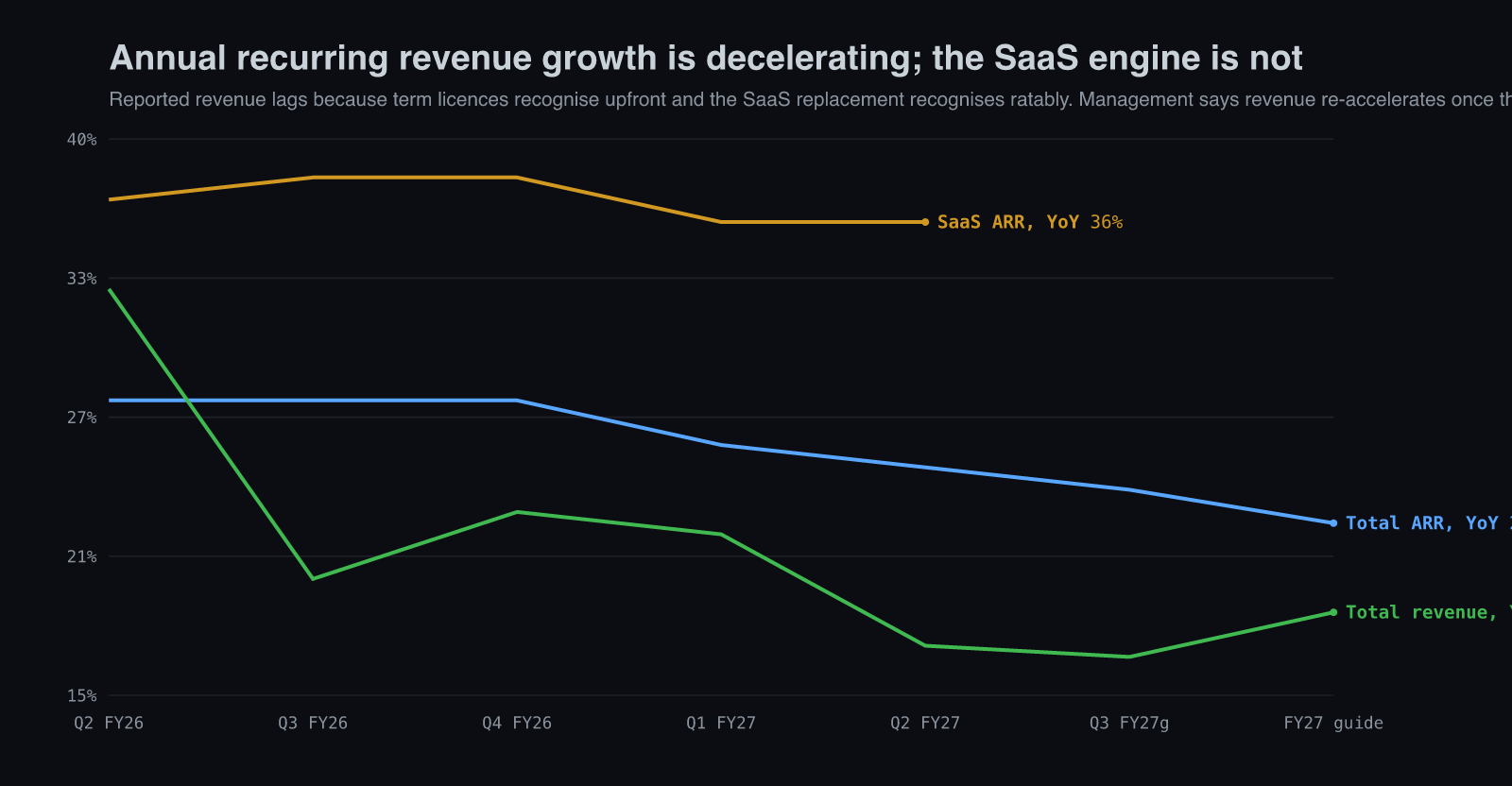
The business is mid-transition from perpetual and term licences to a subscription platform, and that is the single most important thing to understand about its reported numbers. Term licences recognise a large slice of revenue upfront; the subscription that replaces them recognises ratably. So when a customer migrates, recurring revenue goes up and reported revenue goes down for a while. SaaS was 69% of total recurring revenue in July against 63% a year earlier, and management's own deck says reported revenue carries a mix headwind through FY27 and FY28 and re-accelerates after. Recurring revenue, not revenue, is the metric to hold this company to.
The annual record is a genuine operating-leverage story on the company's own adjusted basis: adjusted operating margin went from negative 1.9% in FY23 to 18.1% in FY26, on revenue of $699.6m, $861.6m and $1,071.4m across FY24 to FY26. It is worth noticing where some of it came from. Adjusted research and development fell from 23.0% of revenue to 15.7% over the same span, under private-equity ownership, at a company whose current pitch is that research and innovation are its growth engine.
The market is best sized by what customers already pay rather than by a forecast. Management's target account list is 15,000 enterprises against roughly 3,235 customers today, net retention is 113% and gross retention 97%. Growth therefore comes from four visible places: migrating the installed base to the cloud platform, upgrading migrated accounts into agentic suites, cross-selling capacity as identity counts rise, and displacing legacy governance at new logos. Peer corroboration places the growth rate where it belongs. $OKTA, the adjacent workforce-identity leader, grew about 11% in its most recent reported quarter on roughly $2.9bn of annual revenue and is GAAP-profitable. $ZS, $FTNT and $PANW all grew slower than $SAIL last quarter. Among listed security names of this size a 25% recurring-revenue grower is at the fast end, and it is the only one whose product line is a direct count of the thing agents create.
The revenue mix, on the axis management actually discloses: subscription was $295.2m of the $308.8m of total revenue in the quarter, or 95.6%, up from 93.8% a year earlier, while services and other is the remaining 4.4% and is shrinking in absolute terms from $16.4m to $13.6m. Inside the recurring base the more important split is cloud against legacy. SaaS is 69% of total recurring revenue, up from 63% a year ago, and it supplied 97% of all net new recurring revenue in the quarter. Non-SaaS recurring revenue grew about 7%, from $359m to $384m. So essentially all of the growth, and essentially all of the margin story, sits in a segment that is a little over two-thirds of the base and rising roughly six points of share a year.
Discover, govern, protect
A credential is a secret that proves something is who it claims to be. An entitlement is a specific permission attached to that proven identity, such as the right to read one database table. A role is a bundle of entitlements given a name. Identity governance is the system that decides which roles and entitlements an identity should hold, grants and revokes them as circumstances change, and proves to an auditor that the actual state matches the intended state. An agentic identity is that same record attached to something that acts on its own, which means the decision has to be made continuously rather than reviewed each quarter.
The moat is depth rather than breadth, and the evidence is concrete. Connecting a governance system to a large enterprise means understanding the internal permission structure of hundreds of applications, most of which were never designed to be governed from outside. That work does not generalise and does not compress; it accumulates. It is why the company holds 97% gross retention while growing 25%.
Our friends at Okta have been at identity governance now for about five years. Notwithstanding a couple of comments that have been made, they haven't put a dent in our business. They are winning business basically below the line we care about.
Where the moat is thinner than the story: 80 issued United States patents and 22 pending, and none issued internationally. That is a real portfolio, but the defensibility here is the connector estate and the deployment scar tissue rather than the patents. And the chief executive is explicit that he will not extend into the two adjacent identity markets, leaving workforce sign-on to $OKTA and $MSFT and privileged access to the $PANW and CyberArk stack. That is a disciplined answer. It is also the opposite of the platform story Citrini's earlier note attributed to the company.

The FY29 plan, and what it asks of one line
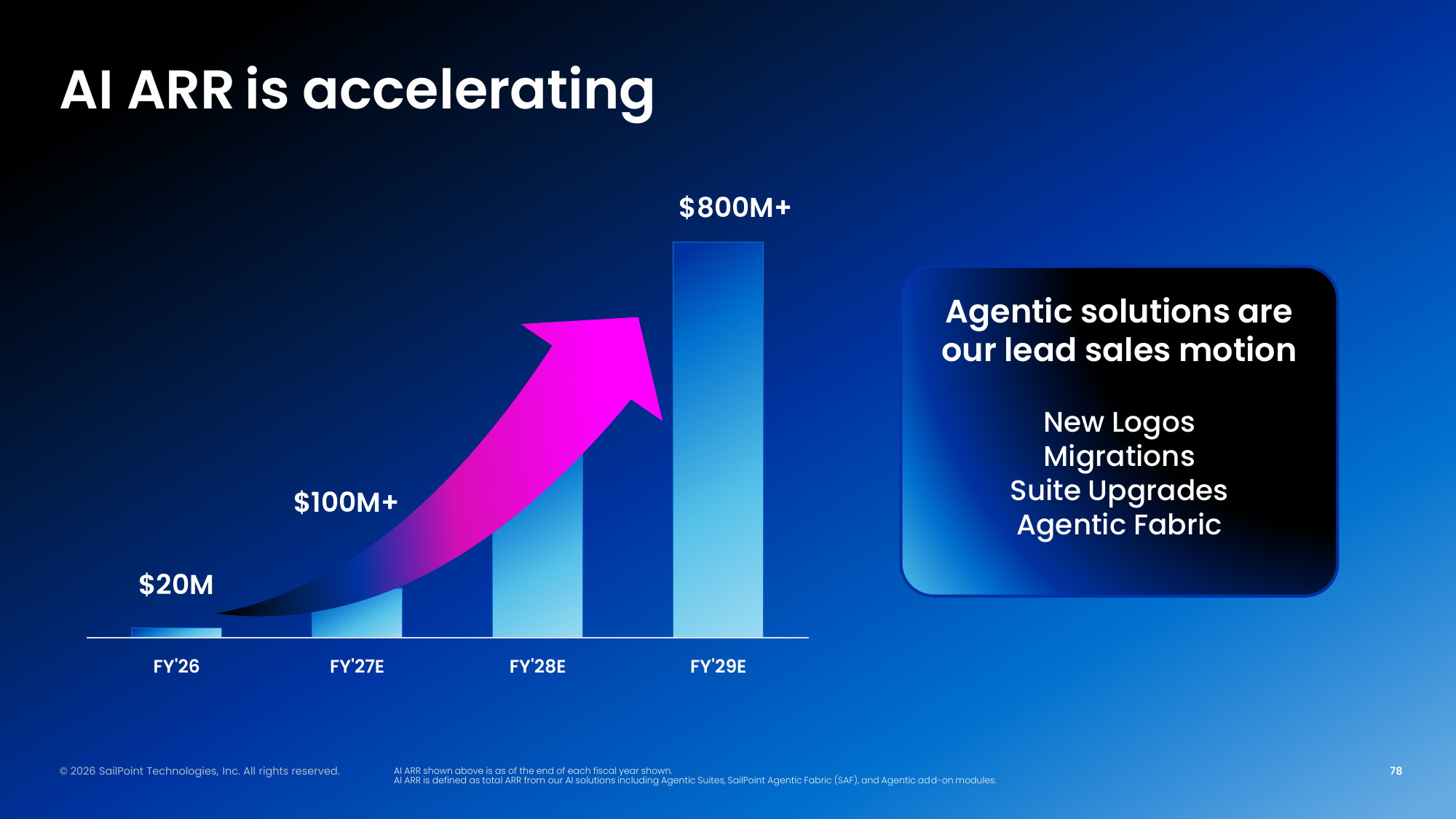
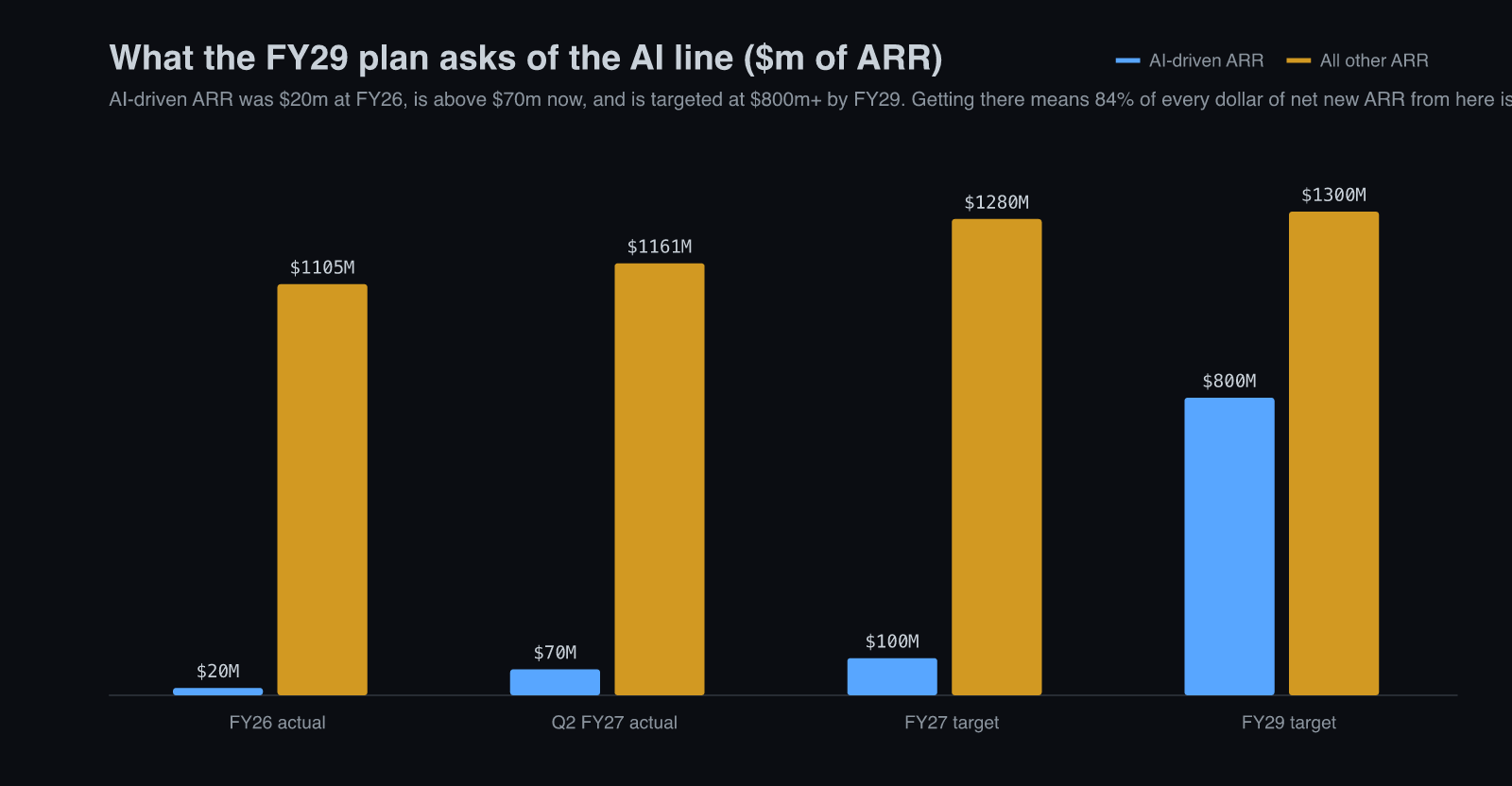
Read the first two targets together. Getting total recurring revenue from $1,231m to $2,100m adds $869m. Getting AI-driven recurring revenue from $70m to $800m adds $730m of it. So 84% of every dollar of net new recurring revenue between now and January 2029 has to be classified as AI-driven, against just over 30% in the latest quarter.
That sounds impossible until you read the definition, and then it sounds achievable for a less exciting reason. AI-driven recurring revenue is defined by the company as total recurring revenue from its AI solutions, including Agentic Suites, Agentic Fabric and agentic add-on modules. The deck's own list of drivers is New Logos, Migrations, Suite Upgrades and Agentic Fabric, and the company says agentic suites are now its lead sales motion. Two of those four are the installed base moving to the cloud and then buying the current package, and more than two-thirds of migrations completed in the quarter already included an AI-driven solution. So the $800m is substantially a packaging target. That makes it more likely to be hit and less informative than it looks.
One clause, five companies, five per cent
The Citrini note of 22 September is a broad piece about agentic consumer adoption. Its entire treatment of this company is one sentence naming five vendors, with no argument attached. A relay account rendered that as a headline, and the stock added 5% on 8.8m shares against a 60-day average near 4.0m. Citrini's substantive work on the name is a month older and cuts the other way: the August theme update argued that platforms win in security, noted that the company is characterised as a pure-play but is in early innings of a platform strategy, and then spent most of the section describing what Palo Alto built out of its CyberArk acquisition. The chief executive says he is not doing that.
I think there is a little bit of a dialogue in the investor community of who is going to win in this agentic age. Who is going to win? The answer is multiple winners, I believe. You will need the collaboration of all the various lenses we bring to security.
Practitioners agree with him rather than with the headline. Governance of many agent types at enterprise scale is $SAIL's layer; issuing and controlling agent credentials day to day is $OKTA's and Microsoft's; privileged and runtime access is the $PANW and CyberArk stack's. One post the same week captured the competitive reality better than any sell-side note: Nvidia and 121 firms launched an open agent-security alliance, AWS shipped a runtime permissions gateway, Okta shipped agent identity, and a fourth vendor launched zero standing access. Four companies, same fix, same week.
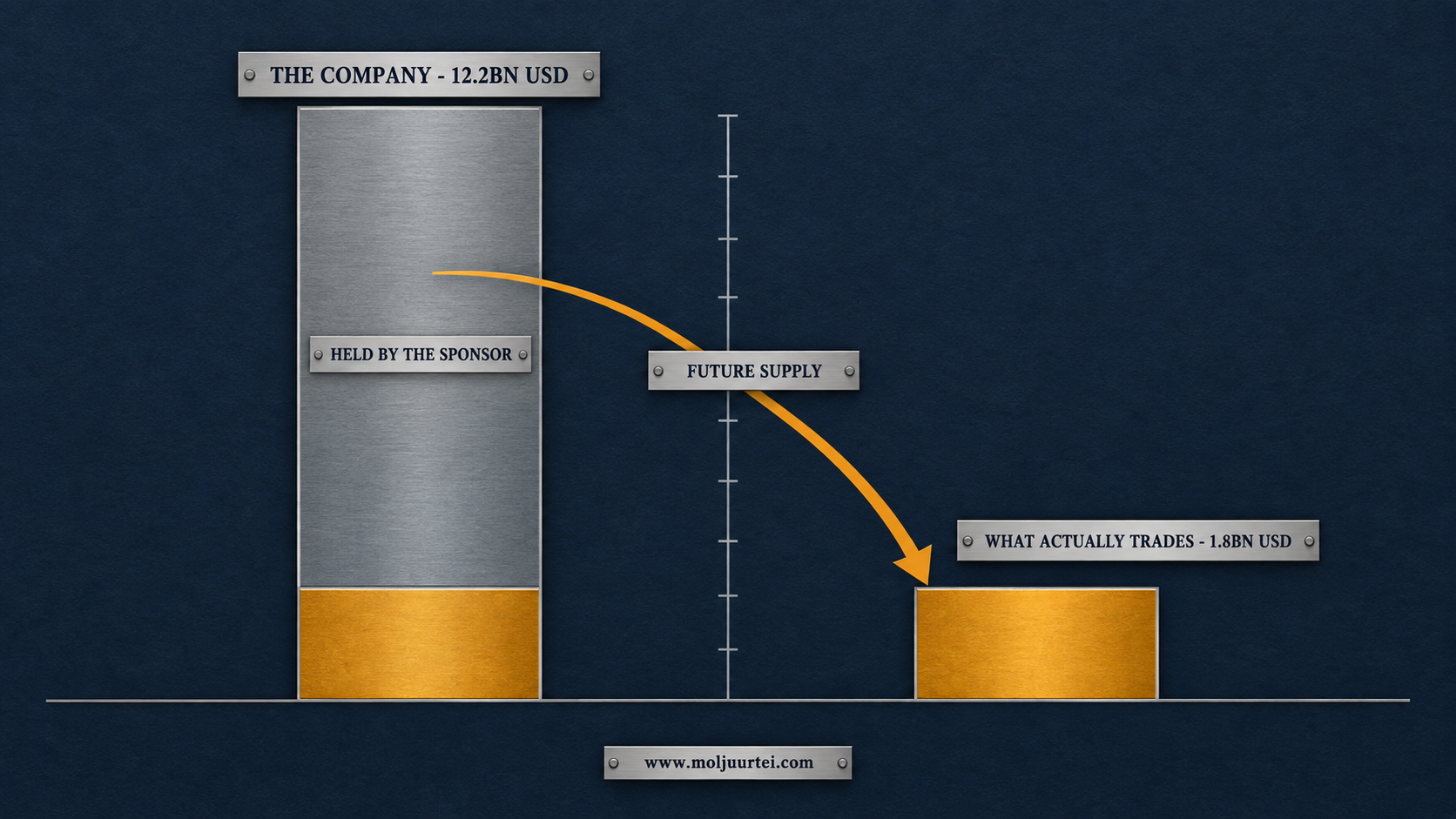
What is actually mispriced is neither the catalyst nor the growth. It is the float. Thoma Bravo controlled about 86.2% of voting power immediately after the listing and still holds roughly 85% of the shares. Against 570.9m shares at $21.43, the tradeable float is on the order of $1.8bn inside a $12.2bn company. A security whose real float is a seventh of its capitalisation does not price information efficiently in either direction. It is why the stock fell to $10.49 in April, why it rose 15% in one session on 14 September when the agent-security story re-lit, and why one clause moved it 5% on 22 September.
The adjusted margin is stock compensation
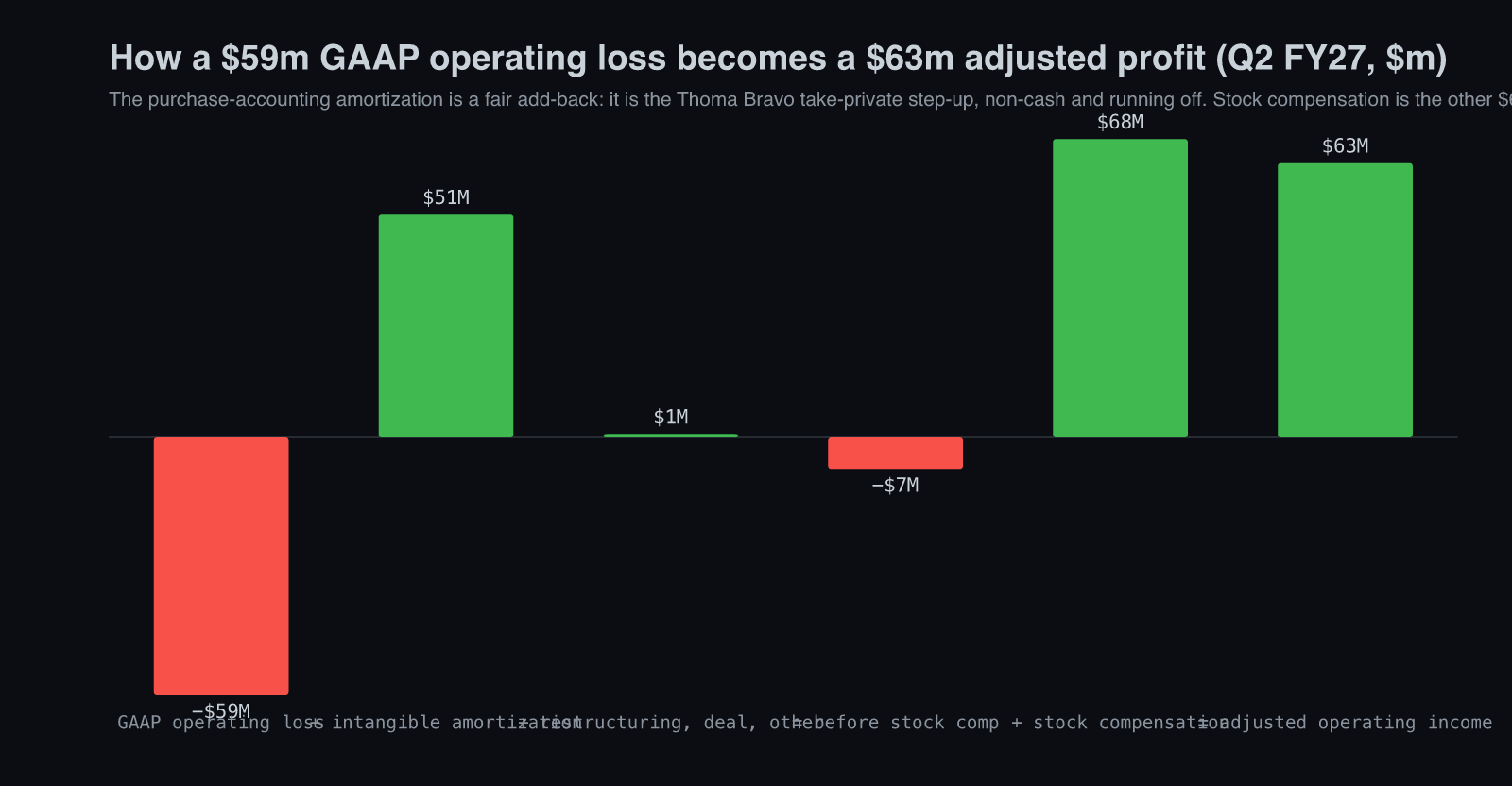
In the quarter to July the GAAP operating loss was $59.0m, or 19.1% of revenue, against $40.8m and 15.4% a year earlier. The loss widened. Adjusted operating income was $62.8m, or 20.3%. The bridge is $51.0m of amortization of acquired intangible assets, which is the Thoma Bravo purchase-accounting step-up and a fair add-back since it is non-cash and runs off, plus $68.3m of equity-based compensation, which is neither. Stock compensation is 22.1% of revenue in the quarter and runs near $275m a year against a $12.2bn capitalisation. The incentive plan carries an evergreen provision adding up to 5% of shares outstanding each year, and the purchase plan adds up to 1% more.
Set the cash against the profit. For the half, adjusted operating income was $100.6m and the net loss was $125.0m, while free cash flow was $70m, a conversion of about 70% of the adjusted figure. The company targets a 22%-plus free cash flow margin and at least $400m by FY29. On roughly $1.8bn of FY29 revenue that arithmetic works. It also means the FY29 cash-flow target is struck before a stock-compensation charge that is currently larger than the free cash flow itself. And the balance sheet is mostly the buyout: of $7.58bn of total assets, $5.25bn is goodwill and $1.30bn is acquired intangibles, leaving tangible equity of about $315m, which is essentially the cash.
Governance is a controlled company by the Nasdaq definition, with reduced independence requirements available to it. Related-party history is limited but present: the identity-governance business of Imprivata, another Thoma Bravo company, was bought for $16.4m in December 2024, and the sponsor also owns Ping Identity, a competitor in the adjacent workforce market. The rest of the roadmap is ordinary and creditable: a machine and non-human identity acquisition in Entro Security, a connector for governing coding agents alongside the engineers who run them, a compliance-interface integration with Claude, and a partner access programme. Capital intensity is low and the balance sheet carries $309.9m of cash and no debt.
A good operating record and an unresolved ownership one
The honest read on this team is that the operating record is good and the ownership record is unresolved. Brian Carolan, the chief financial officer, set the FY29 targets at the June Investor Day; the recurring-revenue target is defensible while the AI-driven one rests on a definition the company controls. Matt Mills, the president, owns the land-and-expand motion the $2.1bn target depends on. Thoma Bravo has held its position since August 2022 and has not sold a share since the February 2025 listing, which is the single unresolved fact about this equity and the one most likely to decide its next two years.
Mark McClain co-founded SailPoint in 2005, sold it to Thoma Bravo in 2022 and brought it back to the market in 2025. He is the rare founder still running a company through a full private-equity round trip, and his public commentary is notably more careful than his stock's promoters. Margin went from negative to 18% on the adjusted basis, retention is excellent, and the roadmap has actually shipped. Against that, the listing was priced at $23.00 in February 2025, the stock closed at $25.70 four days later and has never been higher, and the sponsor has not sold a share. Everyone who bought the offering is still underwater nineteen months on. Insider selling is modest and routine, about $9m across seven officers between July and August at $11.42 to $20.00, which is selling into weakness rather than strength.
What breaks it
A listing that went wrong and is repairing
$SAIL closed at $21.43 on 23 September, up 0.3%. The prior day's 5.2% move came on 8.8m shares against a 60-day average of 4.0m. The bigger move was a week earlier: $17.24 to $19.88 on 14 September, up 15.3% on 9.7m shares, as the agent-security story returned to the front page. The Citrini clause added an echo, not the impulse. The all-time closing high is $25.70, set on 18 February 2025, four sessions after the offering; the all-time closing low is $10.49, set on 10 April 2026. From that low the stock has doubled; from the high it is down 17%; from the $23.00 offer price it is still down 7%.
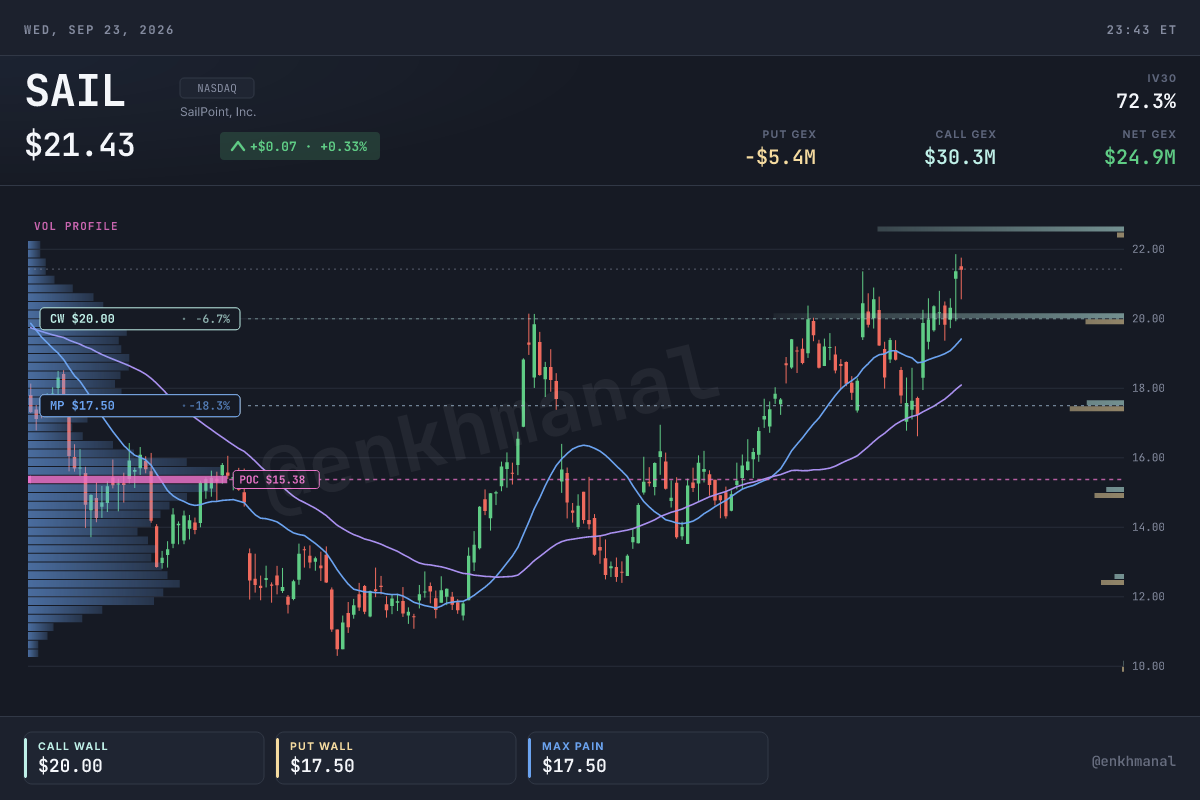
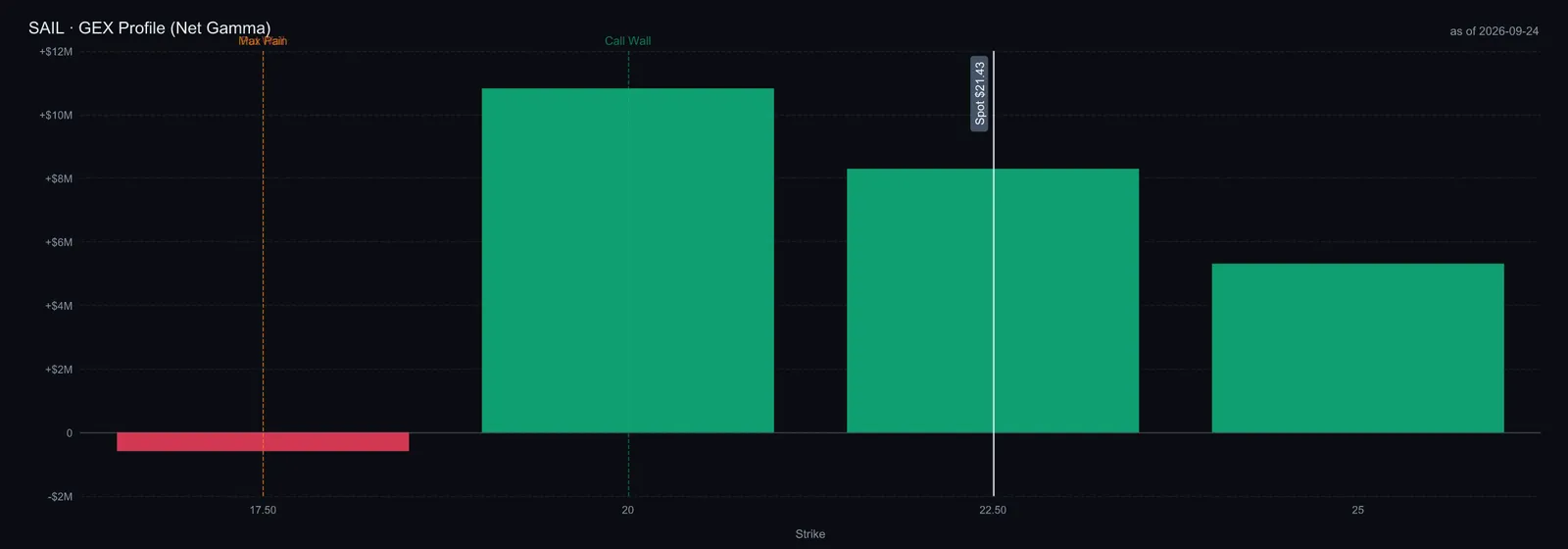
Every option level sits below spot, and the book is small enough that it describes the stock rather than drives it: put/call open interest of 0.397 across eight expiries, with net gamma exposure of positive $0.02bn. With a float this thin, the shares are the derivative. The level that matters is not technical. It is $23.00, the offer price, where the sponsor's public mark stops being underwater, and the most plausible trigger for the supply that decides this stock's next two years.
Not expensive on sales, mid-pack on earnings
The table says something specific. On sales this is not expensive for the growth: 9.4 times forward revenue for a 25% recurring-revenue grower against roughly 7 times for an 11% grower in $OKTA is a modest premium for more than double the growth. On earnings it is mid-pack in a stretched group, cheaper than $CRWD and $PANW and dearer than $ZS and $FTNT. On its own three-year plan it is thirty times a free cash flow figure struck before a stock-compensation charge presently four times larger than the cash flow. There is no historical multiple range to anchor against, because the company has been public for nineteen months and has never earned a GAAP profit. The 25 analysts covering it carry a mean target of $20.96 against a $21.43 price, with a $10 low and a $25 high.
Probability-weighted that is about $22.50 against $21.43, roughly 5%, which is not payment for a distribution this wide. This is a better business than its chart, its float or its promoters suggest, and it is priced about right. Our position is to wait, and specifically to wait for the supply rather than the story. The interesting entry is a Thoma Bravo secondary, which in sponsor re-listings clears at a discount and converts the largest structural risk into the largest structural improvement in one print. Failing that, the December quarter is the test of whether the deceleration stops where the plan needs it to. Buying a 5% move caused by a subordinate clause in someone else's newsletter is not an edge; it is the float talking.