
$RXT Deep Dive — Governed enterprise AI · a 13-bagger off the lows now priced as a levered call option
Update · 9 October 2026. This is a June 11 thesis and its $5.28 stock price, ~$1.35B equity value, leverage ratio, targets, option pricing and scenarios below are historical snapshots, not current trading levels. The key catalyst has changed: Rackspace and AMD signed a definitive agreement on June 16 for a proposed 30 MW phased compute footprint through 2028. The SEC filing says each deployment still needs separately agreed commercial terms and additional financing; neither full deployment nor financing is guaranteed. On July 9, Rackspace cut its 2026 revenue outlook from $2.60–2.70B to $2.45–2.55B and adjusted EBITDA outlook from $305–315M to $285–295M, citing portfolio exits, supply timing and investment ahead of AI revenue. It also announced an at-the-market equity program, so dilution became a live risk rather than a hypothetical one. Q2 actual revenue was $670M, including $263M of Private Cloud revenue (+5.5% year over year); GAAP net loss was $68M, operating cash use was $32M, and June 30 liquidity was $202M. The actual revenue exceeded the $641–649M preliminary range in the July release. Management's projected 2 MW at end-2026, 15 MW at end-2027 and 30 MW at end-2028 are plans, not installed capacity or contracted revenue. The signed framework strengthens the strategic case, but the lower guidance, cash use and financing conditions sharpen the balance-sheet test. The dated June scenarios below have not been recalculated.
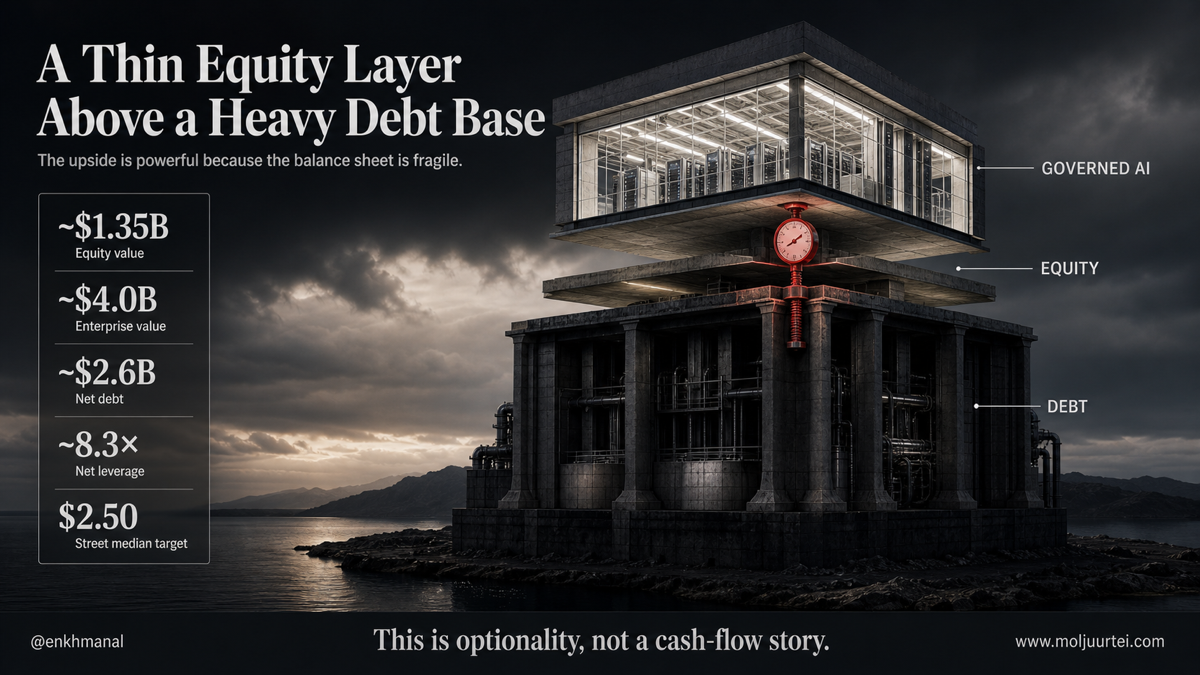
Rackspace has gone from a $0.39 left-for-dead LBO carcass to $5.28 in under a year by re-casting itself as the one "accountable operator" for AI in regulated and sovereign environments — anchored by a $PLTR partnership (Feb) and a non-binding $AMD MOU (May). The story is genuinely differentiated, but at $5.28 the equity trades above the Street's high-end target ($2.50 median) on a balance sheet carrying ~8.3× leverage and a mid-2028 maturity wall — so the stock is now a leveraged call option on a category that does not yet generate revenue, not a cash-flow story.
Executive Summary
- $RXT is the only listed pure-play positioning to own "governed enterprise AI infrastructure" — managed, accountable AI for healthcare, financial-services and sovereign customers that require specialized data controls and accountable operations.
- The catalyst stack is real: $PLTR Foundry/AIP partnership (first joint deal closed in 41 days), an $AMD MOU naming $AMD as launch silicon across four AI offerings, and a return to GAAP net income (+$8M, +$0.03) in Q1'26.
- The one risk that matters: ~8.3× net leverage, negative free cash flow (−$9M in Q1), a debt stack due mid-2028, and an $AMD buildout that needs third-party financing the company has not yet secured.
- The numbers don't yet support the price — FY26 guides to a non-GAAP loss per share of −$0.15 to −$0.20 and ~flat revenue ($2.6–2.7B); the move is pure category-creation optionality.
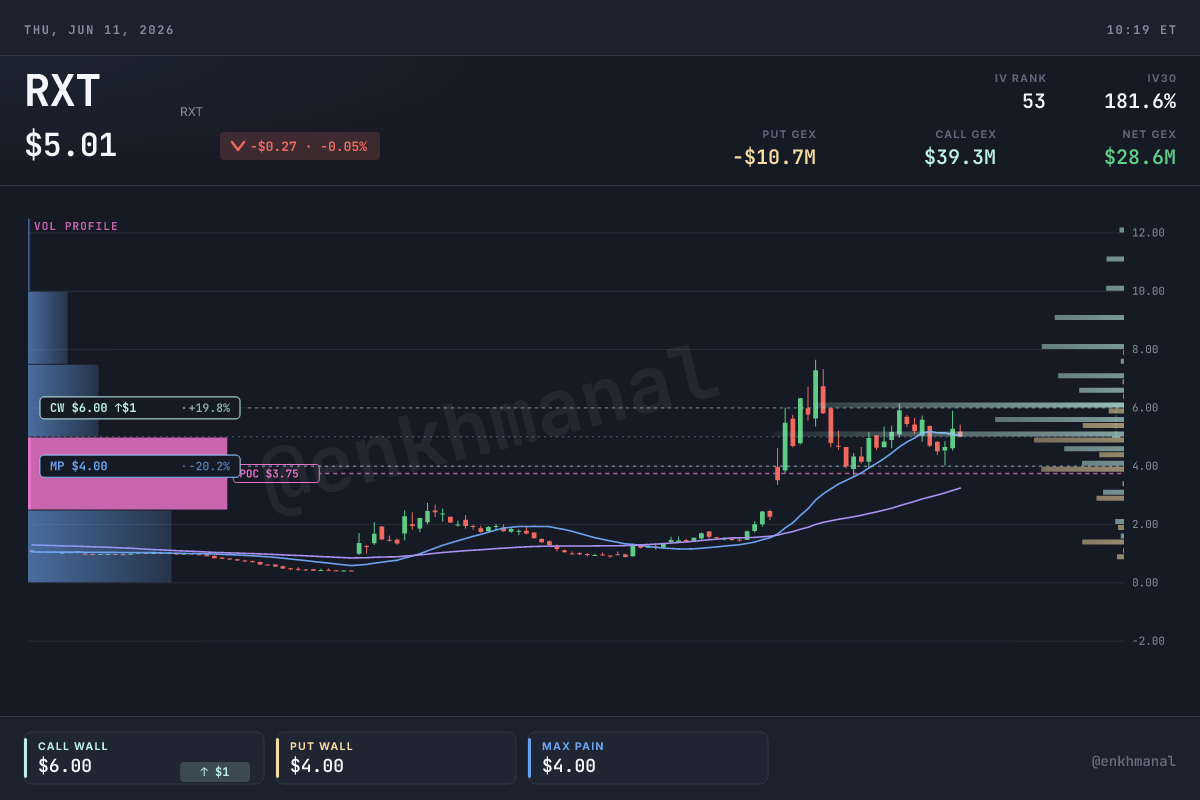
- Framing: this is a small, speculative, high-IV (~170%) position-sizing problem, not a core holding. As of June 11, a November $7 call option would have been a time-limited, high-premium bet on a definitive AMD agreement and further share-price appreciation.
Industry History & Technological Evolution
Rackspace was, for a decade, the cautionary tale of the cloud era. Founded in 1998 in San Antonio, it pioneered "fanatical support" managed hosting — running servers so customers didn't have to — and IPO'd in 2008. Then $AMZN, $MSFT and $GOOGL turned raw compute into a commodity utility, and Rackspace's owned-data-center, managed-hosting model became a melting ice cube. Apollo took it private in a 2016 LBO, re-listed it in 2020 at $21, and loaded it with the debt that has defined the equity ever since. The stock spent 2022–2025 grinding from the teens to under a dollar as legacy revenue eroded and interest expense consumed the P&L.
The industry has now turned again, and the turn is what Rackspace is betting its second life on. The first cloud wave centralized everything into three hyperscalers. The AI wave is creating the opposite pull: enterprises in regulated industries — hospitals running models on patient records, banks scoring credit, governments modeling national-security scenarios — cannot put that data into a U.S.-corporation-owned public cloud without violating HIPAA, data-residency, or sovereignty rules. As one independent analyst put it, the hyperscalers are "structurally prohibited from serving" a huge share of enterprise IT spend (Telos Capital, 5/17). That regulatory wall is the technological inflection Rackspace is riding: the demand isn't for cheaper GPUs, it's for governed AI — compute plus security plus compliance plus a single accountable operator, delivered where the data is legally allowed to sit.
The primitive underneath is shifting too: production AI is heterogeneous. Frontier models run on GPUs, but small language models, embeddings, and classical ML run more efficiently on CPUs — and most regulated enterprise inference is the latter. A vendor that can route each workload to the right silicon, inside a governed envelope, is solving a different problem than a GPU-by-the-hour neocloud.
Company Origin & Industry Positioning
Rackspace's founding problem — "enterprises want the outcome, not the infrastructure headache" — is, ironically, the exact pitch it has resurrected for AI. After near-death as a hosting business, the 2025–26 strategy under CEO Gajen Kandiah (who replaced Amar Maletira during 2025) re-frames the company as "where enterprise AI goes to production": governed infrastructure as the foundation, a curated partner stack on top, and "one accountable operator running it end-to-end."
The positioning sits at an unusual spot on the value chain. Rackspace is not a chip company, not a model company, and explicitly not a commodity GPU landlord. It is the integrator and operator — the systems-integrator-meets-managed-service-provider layer that stitches $AMD silicon, VMware Cloud Foundation 9 (the control plane), Dell hardware, $PLTR and Uniphore (the AI/agent layer), and Rubrik (resilience) into one system it is contractually accountable for. "I haven't seen anyone yet that is able to put all of this together in one place and then own the outcome," Kandiah told RBC on the Q1 call.
What the market is re-pricing is whether a 25-year-old data-center operator's liabilities — owned facilities, regulated-industry relationships, an installed base of Epic and private-cloud workloads — are actually assets in an AI world that suddenly needs exactly that footprint. The bull case is that Rackspace's decades of HIPAA / protected-health-information / sovereign operating muscle is a moat no neocloud can replicate quickly; the bear case is that it's a levered IT-services roll-up dressing up flat revenue in AI language.
Technology Deep Dive
The product architecture crystallized on the Q1 call into four "integrated capabilities," with $AMD as launch silicon: Enterprise AI Cloud (fully-managed private/public/sovereign AI environment, one accountable operator); Enterprise Inference Engine (a "context-aware inference runtime that retains domain knowledge, session history and enterprise-specific data context across queries with Rackspace owning the SLA"); Inference as a Service (dedicated accelerated compute as a governed alternative to commodity GPU rental); and Bare Metal Accelerated Compute ($AMD Instinct for training/inference needing deterministic performance).
The genuine differentiation is the control plane and the accountability wrapper, not the hardware. VMware Cloud Foundation 9 — via a deepened Broadcom partnership Kandiah called "one of the most strategic commitments we are making this year" — gives a single substrate with data-residency controls and policy enforcement that "travels with the workload" elastically between private and public cloud. On top, forward-deployed engineers (the $PLTR playbook) embed inside customer environments. The switching costs are real: once Rackspace operates a hospital's Epic EHR (it runs "one of the top 5 Epic systems in the world") and 400+ additional AdventHealth workloads under HIPAA SLAs, it is not easily ripped out.
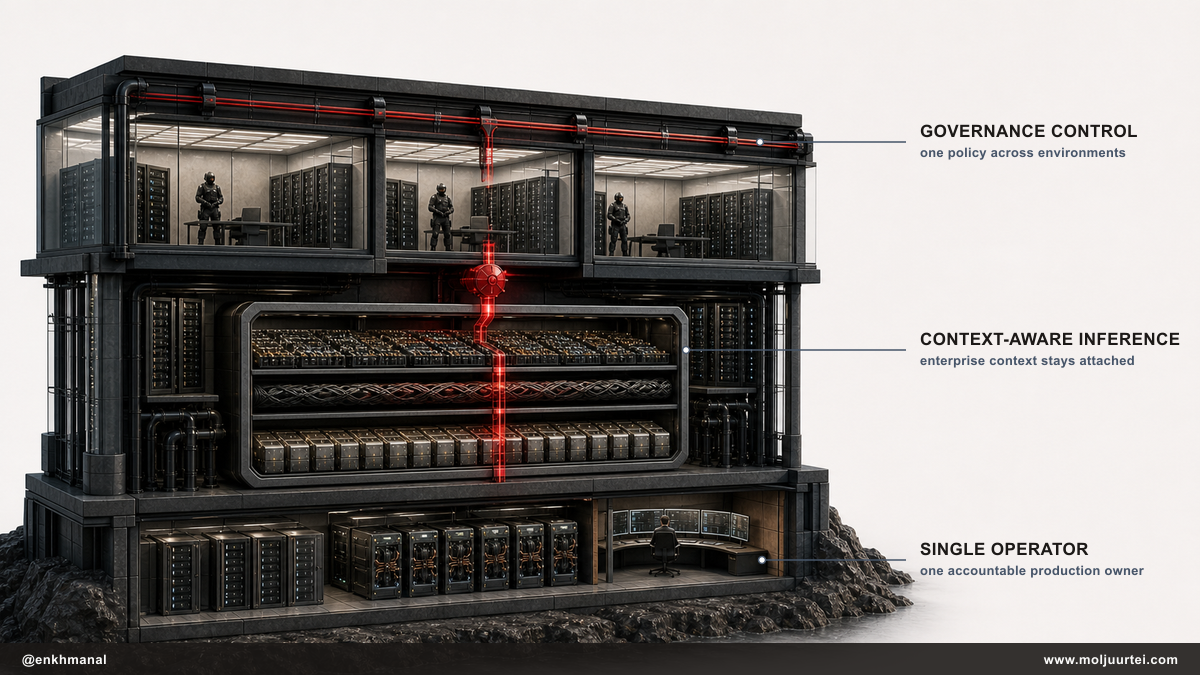
The technology bet is on context-aware inference for regulated data becoming the durable enterprise-AI workload — "training will largely sit with specialized providers, but inference, particularly context-aware inference on regulated data, is where production enterprise AI lives," per Kandiah. The risk is that this is more integration than invention: Rackspace owns the operating model, not the silicon or the models, so its moat is execution and relationships, not core intellectual property — and execution moats erode if a $KD, an $IBM, or a hyperscaler-partner systems integrator decides to copy the governed-AI packaging.
Peer Landscape — Technology & Price Action
There is no clean public comp, which is part of the bull thesis. The most useful frame is three contrasting archetypes: the managed-infrastructure incumbent ($KD, Kyndryl), the legacy IT-services peer ($DXC), and the thing Rackspace defines itself against — the commodity GPU neocloud ($CRWV, CoreWeave).
$KD — Kyndryl, the managed-infra incumbent
The closest structural peer: an $IBM-spun managed-infrastructure operator also executing a margin-led turnaround, but vastly larger, investment-grade, and not levered to a single AI narrative. Kyndryl is the "boring base case" for what a managed-infra turnaround looks like without the optionality or the leverage.
$DXC — the cautionary peer
A melting legacy IT-services book with no credible AI re-rate — the version of Rackspace's future where the pivot doesn't take.
$CRWV — the anti-peer
CoreWeave is the commodity-GPU-rental model Kandiah explicitly contrasts: "capacity sold by the hour and the customer carries the burden of integration, security and accountability." Rackspace's pitch is the inverse — accountability from silicon to outcomes.
Peer price action (approximate, trailing to 6/11/2026):
| Ticker | 1M | 3M | 12M | From 52w low |
|---|---|---|---|---|
$RXT | ~+150% | ~+300% | ~+900% | ~+1,254% ($0.39 → $5.28; rounded inputs) |
$KD | ~+5% | ~+15% | ~+40% | — |
$DXC | ~flat | ~−5% | ~−25% | — |
$CRWV | high-beta | high-beta | n/a (2025 IPO) | — |
Forward multiple comparison:
| Ticker | NTM EV/Rev | NTM EV/EBITDA | Net leverage | Premium / discount |
|---|---|---|---|---|
$RXT | ~1.5× | ~13× | ~8.3× | Premium to managed-infra peers |
$KD | ~0.5× | ~3–4× | Low / IG | — |
$DXC | ~0.3× | ~3× | Moderate | Discount (no growth) |
| Group median | ~0.5× | ~3–4× | — | — |
The market has already crowned $RXT relative to its managed-services peers — it trades at a multiple of their EV/Rev and EV/EBITDA — on the bet that it is no longer a managed-services company but a governed-AI platform. That re-rating has already happened in the equity; the question §12 returns to is whether enterprise value can grow into it.
Business Model, Growth & Margins
Rackspace runs two segments. Public Cloud (Q1'26: $443M, +7% YoY, services +10%) is a low-gross-margin reseller/managed-services book on top of $AMZN/$MSFT/$GOOGL — 8.9% non-GAAP gross margin, 4.7% segment operating margin. Private Cloud (Q1'26: $235M, −6% YoY) is the profit engine — 36% gross margin, 24.7% segment operating margin — and the segment where the entire AI thesis lives. The Q1 Private Cloud decline was timing (a large healthcare deal onboarding), not structural, per management, and the full-year growth profile was reaffirmed.
Revenue segmentation (Q1 FY26):
| Segment | Q1'26 revenue | YoY growth | % of total |
|---|---|---|---|
| Public Cloud | $443M | +7% | 65% |
| Private Cloud | $235M | −6% | 35% |
| Total | $678M | +2% | 100% |
Historical revenue trend + FY26 guide:
| Quarter | Revenue | Notes |
|---|---|---|
| Q1'25 | $665M | year-ago base |
| Q2'25 | $666.3M | flat |
| Q3'25 | $671.2M | flat |
| Q4'25 | $682.8M | flat |
| Q1'26 | $678.1M | +2% YoY |
| FY26 guide | $2,600–2,700M | ~flat; $AMD not in guide |
The business model truth is uncomfortable for the narrative: revenue is flat. The entire thesis is mix shift and optionality, not top-line growth. Margins are the real story — non-GAAP operating profit was $31M (+20% YoY) on cost discipline, and Adjusted EBITDA is guided to $305–315M for FY26. But below EBITDA, the capital structure eats almost everything: FY26 "Non-GAAP Other Income (Expense)" is guided to −$220 to −$230M — that is the interest burden, ~73% of EBITDA — which is why the company still guides to a non-GAAP loss per share. Q1 free cash flow was −$9M. The capital-allocation story is deleveraging, not buybacks: $96M of debt repurchased at a "significant discount" in Q1, with leverage ticking from 8.6× to 8.3×.
TAM, Strategic Narrative & Leadership
The TAM framing is "governed enterprise AI infrastructure" — a category Rackspace is, with $AMD's co-signature, literally trying to create. The credible part is the demand wedge: healthcare, financial services and government are large enterprise IT markets where strict data, procurement and accountability requirements can favor specialized operators. The non-credible-until-proven part is Rackspace's share of it — naming a category is not the same as owning it, and the revenue is back-half-2026-and-beyond at the earliest.
The macro backdrop matters more than usual here because the thesis is a balance-sheet thesis. With the Fed funds effective rate at 3.62% (FRED, 6/9) — down from the ~5.3% 2024 peak — the refinancing window for the mid-2028 maturity is materially friendlier than it was a year ago. A falling-rate path is a quiet tailwind to the single thing that can break the equity: refinanceability.
On leadership: CEO Gajen Kandiah and CFO Mark Marino are running a textbook distressed-turnaround playbook — narrative re-rate to buy time, margin discipline, and active liability management while they get to "refinanceability over the next 12, 18 months." Marino was unusually direct on the call: "our intent is deleveraging — that's our top priority… we've got our eye on 2028, the maturity, the debt stack that's going to be due in the middle of 2028." That candor is a positive signal; the leverage it describes is not. Note the offsetting flag: a steady drumbeat of insider Form 4/Form 144 sales (e.g., CHRO Kellie Teal-Guess sold ~$189K of stock on 6/4) into the rally — routine 10b5-1 selling, but not insiders backing up the truck.
Latest Earnings
Q1 FY26 (reported 5/7/2026) was the print that re-rated the name, but the headline "return to profit" needs unpacking:
- Headline — Revenue $678M (+2% reported, +1% cc); GAAP net income +$8M / +$0.03 EPS vs −$72M / −$0.31 a year ago. But GAAP loss from operations was still −$18M, and non-GAAP loss per share was −$0.06 (flat YoY) — the net-income swing came from below-the-line items, not operations.
- Profitability — Non-GAAP operating profit $31M (+20%); Adj EBITDA tracking the $305–315M FY guide; OCF +$5M, FCF −$9M; $94M cash, $295M liquidity.
- The new disclosure — the $AMD MOU itself, plus the first closed $PLTR joint deal (a U.S. solar-tracker maker, quoting cycle cut 94%, in 41 days), and sovereign anchors: $BT Sovereign Cloud ("U.K.'s first full suite of sovereign services"), SDAIA Saudi Arabia, a U.K. NHS Foundation Trust.
- The tough question — UBS and RBC both pressed on the $AMD MOU status and the capital structure. Kandiah conceded: "we still need to get the financing locked down and sort of tightened up." Marino added the $AMD economics are "not something we've got materially factored into our '26 guidance." Translation: the headline partnership is optionality, not 2026 revenue, and it is contingent on financing that does not yet exist.
Thematic Investment Angle
The theme is "governed / sovereign enterprise AI" — the regulated slice of the AI buildout the hyperscalers cannot serve. Rackspace is the highest-beta, most-levered way to play it; the basket shows how differently each name expresses the same wall.
| Ticker | Role | Why this slot | Profile |
|---|---|---|---|
$RXT | Pure-play / highest-beta | The only listed pure operator of governed managed AI infra | Flat rev, 8.3× levered, optionality |
$PLTR | Software/ontology layer | The governed-AI app layer $RXT deploys; partner, not competitor | Profitable, expensive, the "shovel" |
$AMD | Silicon (2nd-order) | Launch silicon for $RXT; wants the non-$NVDA regulated customer | Mega-cap, $RXT is a showcase not a needle-mover |
$IBM | Incumbent sovereign-AI | watsonx + consulting into the same regulated buyers | Diversified, slow, IG balance sheet |
$KD | Managed-infra base case | The boring turnaround comp without the leverage or AI re-rate | Investment-grade, low-beta |
$CRWV | Anti-peer / hedge | Commodity GPU rental — the model $RXT defines itself against | High-beta neocloud, capital-intensive |
Crowdedness check: on X, $RXT is a retail-momentum name — the June retail discussion included a 15-stock breakout screen (@itsmichaelluu, 103K views) tagging it "+1,500% this quarter," not from institutional research. That asymmetry cuts both ways: under-owned by funds (room to re-rate if the story institutionalizes) but over-loved by momentum chasers (fragile if the tape rolls). The cheapest, highest-quality expression of the theme is $PLTR or $IBM; $RXT is the highest-torque, lowest-quality expression. What invalidates the theme: hyperscalers expanding their compliant cloud offerings enough to erode Rackspace’s claimed differentiation.
Bull Case & Catalysts
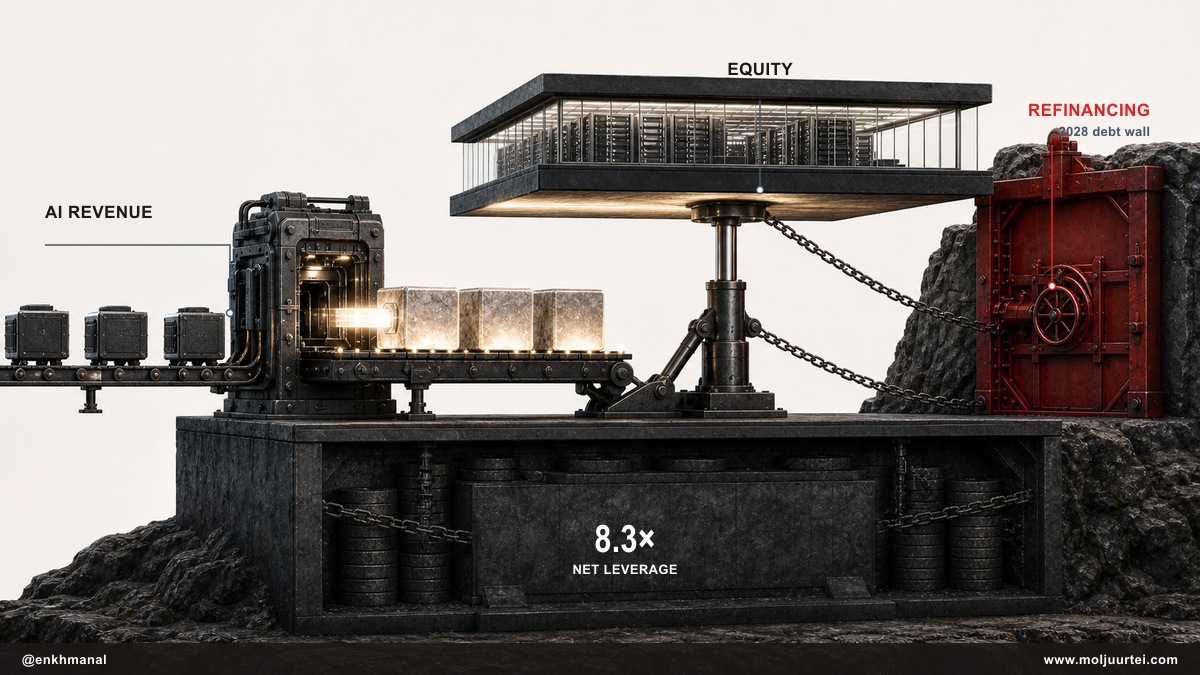
The bull case is a re-rating mechanic, not an earnings mechanic: because the equity sits on ~8.3× leverage, modest enterprise-value gains lever into large equity moves. If governed-AI converts $PLTR/$AMD pipeline into Private-Cloud revenue, EBITDA grows toward $400M+, the multiple holds, and the 2028 wall is refinanced into a falling-rate market, the equity (a thin sliver of a ~$4B EV) can compound fast. The single hardest-hitting near-term catalyst is the $AMD definitive agreement — Kandiah expects it "in the near term," and was the main event a November 2026 $7 call buyer would have needed to occur before expiry.
Catalyst calendar:
| Date | Event | Why it matters |
|---|---|---|
| 2026-08-06 | Q2 FY26 earnings | First read on Private-Cloud re-acceleration + $PLTR pipeline conversion |
| Near-term (mgmt-guided) | $AMD definitive agreement + financing | Converts the non-binding MOU into a real, financed deal — the make-or-break catalyst |
| H2 2026 | $PLTR / Uniphore deal ramp | "Deal sizes we have not historically seen" per Kandiah |
| 2026–2027 | Sovereign anchors live ($BT, SDAIA, NHS) | Proof the governed model scales beyond pilots |
| Mid-2028 | Debt maturity wall | The terminal risk; refinanceability over the next 12–18 months is the whole game |
What has to go right: the $AMD definitive agreement gets signed and financed without diluting equity or adding senior debt; Private Cloud re-accelerates as the healthcare deals onboard; and the 2028 maturity gets refinanced. Hit all three and this is a multi-bagger from here; miss the financing and it round-trips toward the Street's $2.50.
Risk Register
- The MOU is non-binding and needs financing that doesn't exist — the $AMD AI buildout requires third-party financing "subject to availability on acceptable terms"; a company at 8.3× leverage arranging fresh capital is the central fragility. If the definitive deal slips or is financed with equity, the thesis breaks.
- 2028 maturity wall — the debt stack due mid-2028 must be refinanced; failure (or a rates back-up) is an existential, not cosmetic, risk for a stockholders'-deficit balance sheet (liabilities $4.0B vs assets $2.8B).
- Negative free cash flow — FCF was −$9M in Q1 and FY guides to a non-GAAP loss; the company is deleveraging by buying discounted debt, not by generating cash, leaving little cushion for execution stumbles.
- Revenue is flat — the AI narrative sits on top of a ~$2.65B book that isn't growing; if Private Cloud doesn't re-accelerate, the story is just expensive IT services.
- Execution/integration moat, not a hard intellectual-property moat — Rackspace owns the operating model, not the silicon or models; a $KD or hyperscaler systems integrator could copy the governed-AI packaging.
- Retail-momentum ownership — the holder base is breakout-chasers (IV ~170%); a momentum unwind can take the stock down faster than fundamentals justify.
What forces a thesis change: a signed, financed $AMD definitive agreement that does not dilute equity flips this decisively bullish; conversely, a delayed/abandoned MOU, an equity raise, or any sign the 2028 refinancing is in doubt flips it decisively bearish.
Valuation & House View
At $5.28, with ~255–260M shares, the equity is $1.35B — but the operative number is enterprise value ($4.0B including ~$2.6B net debt at 8.3× EBITDA). The equity is best understood as a leveraged call option on enterprise value: tiny relative to the debt, so it swings violently with the AI narrative. The Street's $2.50 median target (BMO recently raised to $5; RBC $2.50, Sector Perform; 0 Buy ratings) implies the analysts price the AI optionality at close to zero — the stock trades above the top of the published range.
Valuation snapshot (approx.):
| Metric | Current | Managed-infra peer median | Read |
|---|---|---|---|
| EV/NTM Rev | ~1.5× | ~0.5× | ~3× the peer group |
| EV/NTM EBITDA | ~13× | ~3–4× | Rich for flat growth |
| FCF yield | negative | positive | The crux |
| Net leverage | ~8.3× | low / IG | The crux |
Bull / base / bear (2-year):
| Scenario | Probability | 2Y target | Implied return | Triggers |
|---|---|---|---|---|
| Bull | 30% | $11–13 | +110–145% | $AMD signed+financed, Private Cloud re-accelerates, 2028 refinanced |
| Base | 40% | $5–6 | ~flat | MOU converts slowly, leverage grinds down, narrative holds |
| Bear | 30% | $2–3 | −45 to −60% | MOU stalls/equity raise, 2028 refi in doubt, momentum unwinds |
House View. Rackspace's pivot is the most credible second life this name has had in a decade — the regulated/sovereign-AI wall is real, the $PLTR and $AMD partnerships are differentiated, and a falling-rate path helps the refinancing. But at $5.28 the equity has already re-rated 13× off the lows and trades above every published analyst target, with the make-or-break catalyst ($AMD definitive agreement + financing) still unsigned and a 2028 maturity wall behind it. This is a speculative, position-sized optionality trade, not a fundamentals buy — the right size is "can go to zero" small. Verdict: a watch-and-size-small speculative long, with the $AMD definitive agreement as the event that turns it from a momentum trade into an investment.