$RKLB Deep Dive — Owning the Replacement Cycle · Iridium Approved, Neutron to the Pad
$RKLB builds rockets, builds satellites, and, if the remaining approvals are obtained and the transaction closes, targeted for mid-2027, will own the 66-satellite Iridium network and the radio spectrum it transmits on, after Iridium stockholders approved the sale with 99.6% of the votes cast on 24 September. The deal that looked like a leveraged bet in July has since had its cash funding secured with $1.94 billion of new shares instead of a $3.6 billion bridge loan, so what $RKLB now asks an owner to underwrite is less the funding gap. It is two engineering questions: when Neutron flies, and how cheaply Rocket Lab can rebuild a constellation that its seller had budgeted roughly $3 billion to replace.
What Changed
A phone call from the middle of the Pacific, a ship's distress beacon, a pilot's position report over the pole: none of them can rely on a cell tower, so they go to space. Doing that as a business takes three things that used to belong to three different companies. Someone has to lift the hardware into orbit, someone has to build the satellites, and someone has to hold the licence to transmit on a slice of radio spectrum and sell the service to paying users. For forty years those were separate trades with separate margins, and the operator at the end of the chain bought the other two from whoever was cheapest that decade.
Start here. A rocket is a machine that throws a payload fast enough sideways, about 7.8 kilometres a second, that it keeps falling around the Earth instead of into it; that falling-around path is an orbit. A satellite is the payload: a box with solar panels for power, reaction wheels that spin to point it, a star tracker that photographs the sky to tell it which way it faces, and a radio. A constellation is enough satellites in coordinated orbits that one is always overhead, which for Iridium means 66 of them arranged so a handset anywhere, poles included, can see at least one. Spectrum is the licence to use a band of radio frequencies; Iridium's is L-band, around 1.6 gigahertz, a low frequency that carries little data but is relatively resilient to rain fade; foliage, buildings and metal structures can still obstruct the signal. Satellites wear out, so every constellation has a replacement cycle, and the operator that must pay someone else to rebuild it every fifteen years is carrying the most expensive bill in its business plan. Everything below is about a company that is trying to own all four pieces, including that bill.
The shift of the last five years is that a single company proved the four pieces are worth more together. SpaceX builds its own rockets, builds Starlink satellites by the thousand and sells the service, and it listed in June 2026 at a value near $2 trillion on about $23 billion of trailing revenue. The lesson the market took is that the operator who launches its own satellites can replace them at cost, on its own schedule, and keep the margin that used to go to the launch company and the satellite builder. That is why launch capacity has become scarce rather than cheap: the companies with rockets are keeping them for their own networks.
Rocket Lab had two of the four pieces in July: Electron, the small rocket that has flown more often than any other of its class, and a satellite business built mostly by acquiring the component makers everyone else waits nine months for. We argued then that Iridium bought the other two, spectrum and paying subscribers, and that the price was the problem: roughly 85 times trailing sales, a stock near $100, and a balance sheet about to swing to $2.5 billion of net debt. Three of those facts have moved. The stock is $73.95. The bridge loan is gone, replaced by an at-the-market share sale that raised $1.944 billion from about 29.3 million shares and by Iridium's own $1.775 billion of term loans, which lenders agreed on 15 September to leave in place after the merger. And Iridium's stockholders have voted.
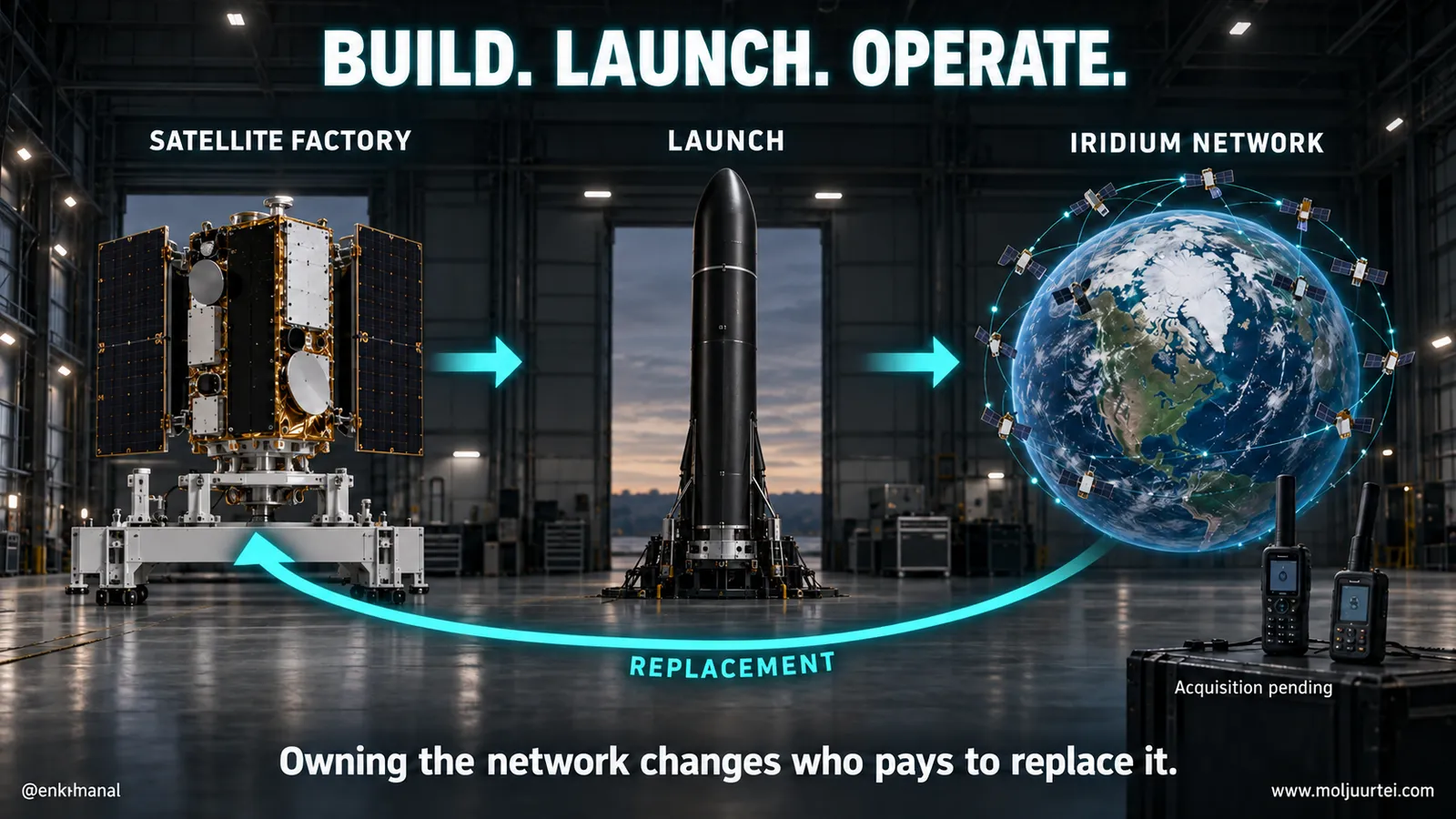
What has not moved is Neutron. In December the company said it aimed to put the rocket on the pad in the first quarter of 2026; in February, after a first-stage tank failed qualification, it moved first launch to the fourth quarter; in August it described the target as delivery to the pad in the fourth quarter and said the window for an end-of-year launch was narrowing. The shift we are writing about is that Rocket Lab is no longer a launch company with a satellite side business. It is becoming the second operator after SpaceX that can build, launch and run its own network, and the price of the stock depends on how soon it can prove the launch half at medium scale.
Thesis
$RKLB is assembling the only Western space company outside SpaceX that will build, launch and operate its own constellation, and the Iridium vote turns that from a plan into a closing date: a 66-satellite L-band network with 2.63 million billable subscribers and a management forecast of $577 million of operating EBITDA in 2027, bolted onto a manufacturer growing 62% a year with a $2.36 billion backlog.
What it can do that others can't: make the parts other satellite builders queue for (reaction wheels, star trackers, space solar cells, separation systems, laser terminals), put them in its own spacecraft, and launch them on its own rockets. Beck's line on the Q2 call: 'we're not buying a big hole in our P&L.'
What that lets it sell next: Neutron at a $50 to $55 million list price into a market where, in Beck's words, 'launch has never been so constrained'; prime contracts such as the $397 million Space Force SB-AMTI award, which pairs Flatellite spacecraft with a Neutron launch; and, after closing, new services on Iridium's spectrum, starting with positioning and timing that backs up GPS.
Why now: the funding question closed on 15 September and the stockholder question on 24 September. What is left is regulatory approval, targeted for mid-2027, and Neutron's first flight.
The one risk that matters: Neutron. The company's own language has moved from a launch date to a pad date, and the cash plan (adjusted EBITDA positive the quarter after the first successful flight, free cash flow 18 to 24 months later) hangs on it.
Business & Backdrop
Rocket Lab reports two segments, and the one most people picture is now the smaller. In the June quarter Space Systems, which builds satellites and sells components, earned $189.5 million, up 94% and 81% of the company. Launch Services, Electron plus its suborbital variant HASTE, earned $44.6 million, down 4%, on a similar number of missions to March: several were HASTE flights for the Pentagon whose revenue is booked as the work is done, so most of it had already been recognised.
Table terminology: Space Systems; Launch Services.
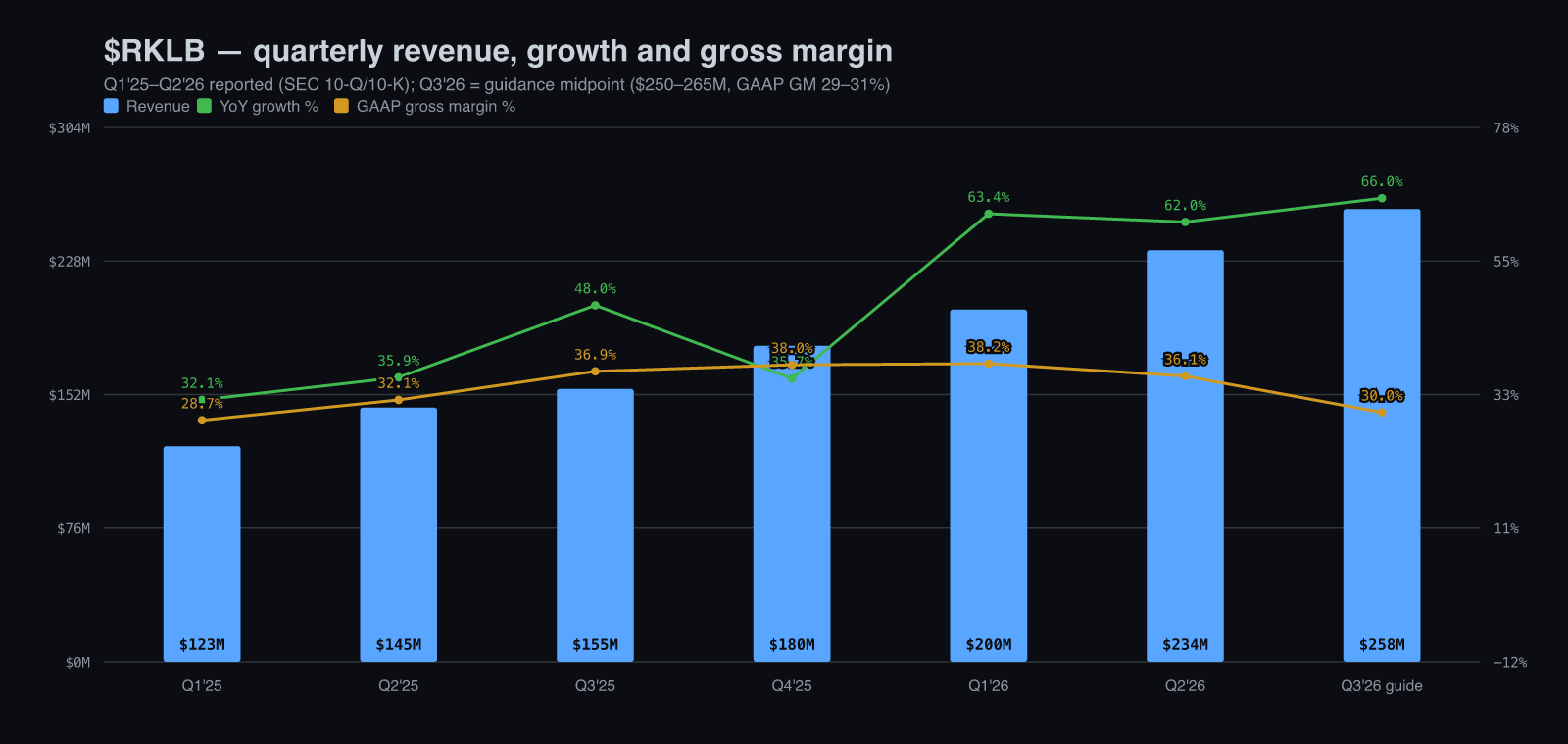
Space Systems produced more than all of the quarter's growth, driven by programme work: the Space Development Agency's Tranche 2 and Tranche 3 constellations, where Rocket Lab is prime on an $816 million award, and the first contribution from Mynaric, the German laser-terminal maker bought out of insolvency in April. That mix is also why September is guided to a 29% to 31% GAAP gross margin after 36.1% in June: CFO Adam Spice said the satellite platforms run in the mid-30s while some components run above 70%, and expects 'a beneficial remixing impact on gross margins as we look beyond Q3.'
The annual record is a manufacturer climbing out of a loss. Revenue went from $62 million in FY21 to $211 million in FY22, $245 million in FY23, $436 million in FY24 and $602 million in FY25, growth of 239%, 16%, 78% and 38%, while GAAP gross margin rose every year: −3.0% in FY21, 9.0% in FY22, 21.0% in FY23, 26.6% in FY24 and 34.4% in FY25. Operating margin improved from −164% to −38% over the same years without ever turning positive, because research and development, mostly Neutron, took $271 million in FY25, more than the year's $207 million of gross profit.
Table terminology: GAAP.
The quarterly series shows where the year turned. Growth ran in the 30s through 2025, apart from a 48% September quarter, then stepped to 63% and 62% in the first half of 2026, and the September guide implies 61% to 71%. Gross margin climbed from 28.7% to 38.2% before the mix-driven dip. Operating losses have held near $57 million a quarter for six quarters while revenue nearly doubled: the spending is fixed, mostly Neutron, and revenue is growing underneath it.
Cash tells a harder story than the margin line. In the June quarter adjusted EBITDA was a loss of only $8.8 million, but operating cash flow was −$84.1 million and free cash flow −$110.1 million; for the half, operating cash flow of −$134.4 million ran behind a GAAP operating loss of −$113.5 million. The gap is inventory, up from $158 million to $267 million in six months as Rocket Lab builds later Neutron vehicles ahead of the first flight and restocks Mynaric. Customers are funding part of it: advances in contract liabilities rose from $195 million to $351 million.
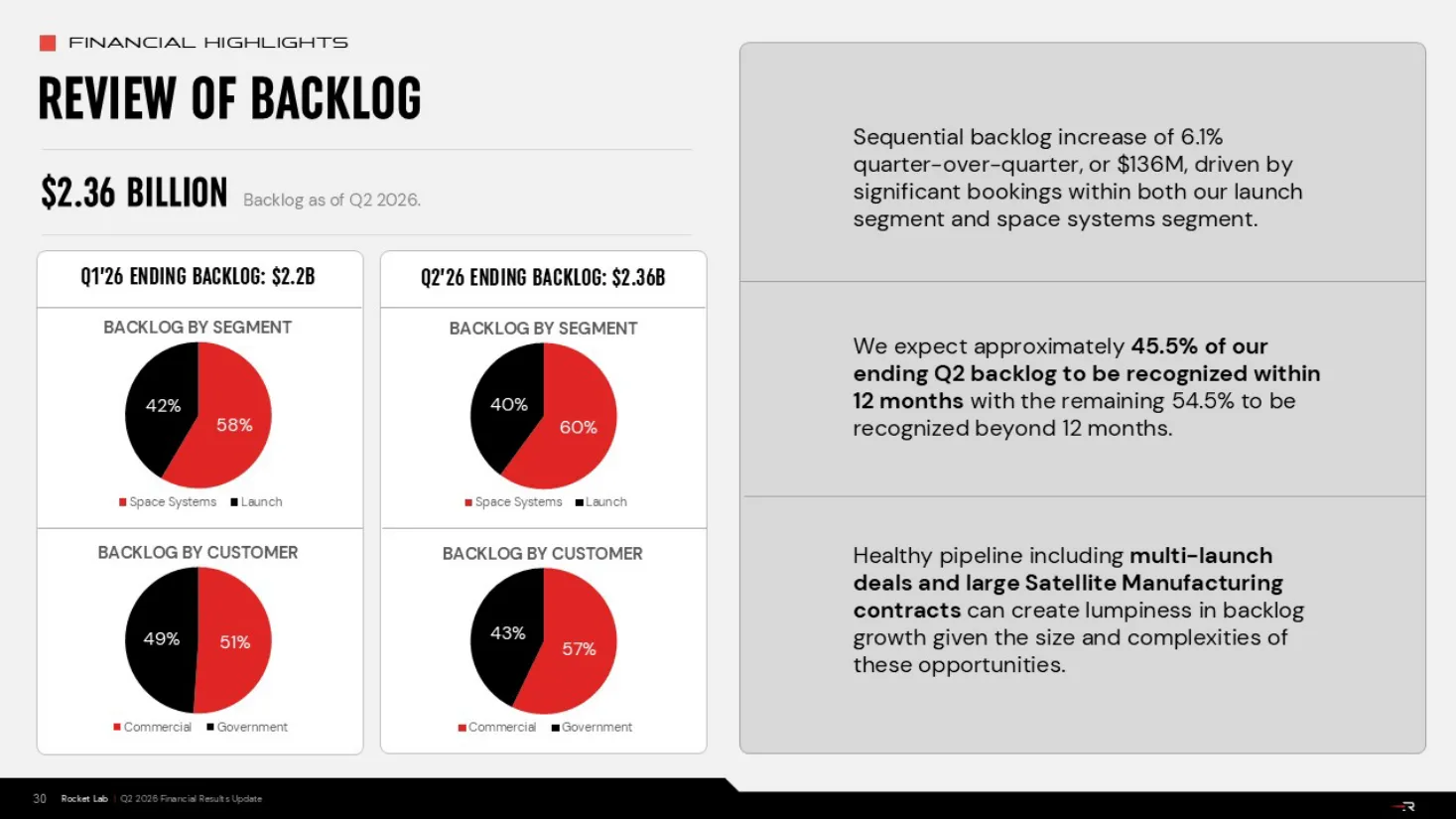
The backlog was $2.36 billion at 30 June, up 137% on a year earlier, with 45.5% expected to become revenue within twelve months: about $1.07 billion of next-year revenue contracted before the component orders that turn within a quarter, and before the more than $1 billion of contracts Beck said were signed in and after the quarter. The peers show the two ends of the chain. Iridium's June quarter grew revenue only 4%, to $225.2 million, but earned $119.1 million of operational EBITDA, a 53% margin; Planet Labs, which builds its own satellites and buys launch, reported a 56.1% gross margin for fiscal 2026. Operators earn the margin and builders earn the growth. Rocket Lab is buying the first to add to the second.
Technology & Moat
Rocket Lab's hardest-to-copy asset is not a rocket. It is the parts bin. Beck put it plainly on the Q2 call: 'if you just turn up in the industry and say, "I want 1,000 reaction wheels," then your chances of getting them are almost zero. Unless you come to, perhaps, us.' A reaction wheel is a flywheel that a satellite spins one way to turn itself the other; a star tracker is a camera that recognises star patterns to fix which way the satellite faces; a space solar cell is a multi-layer cell built to survive radiation for fifteen years. Each has to be flight-qualified, which takes years of heritage that money cannot shortcut. Rocket Lab bought the specialist makers one at a time: Sinclair Interplanetary for reaction wheels and star trackers in 2020, Planetary Systems for separation systems, SolAero for solar, Geost for missile-warning payloads, Mynaric for laser links between satellites, Motiv for solar-array drives and robotic arms. Beck says SolAero is now the largest space-grade solar manufacturer in the world.
The parts bin works twice, which is the part of the model that is easy to miss. When Rocket Lab bids as prime against a large defence contractor and loses, the winner still has to buy wheels, trackers and solar from someone, and CFO Adam Spice says owning the supply chain lets Rocket Lab 'eliminate margin stacking' when it bids. Beck gave the Space Development Agency award as the example: an $816 million prime contract that turned into more than $1 billion of business once the other winners ordered components. The same logic now runs one layer higher. With Iridium, Rocket Lab will be the customer for its own satellites and its own launches, giving it an internal source of demand rather than a guarantee of outside orders.
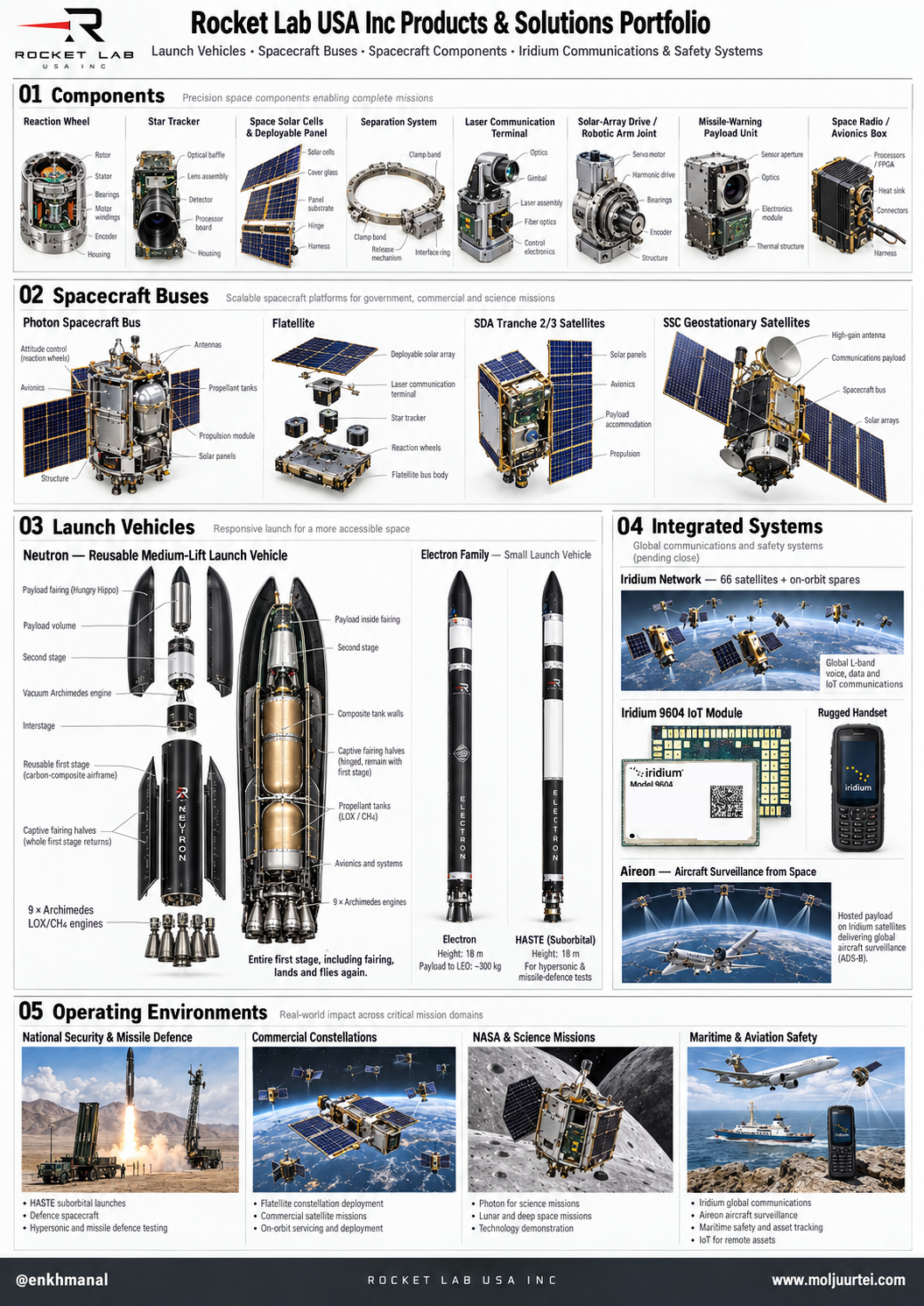
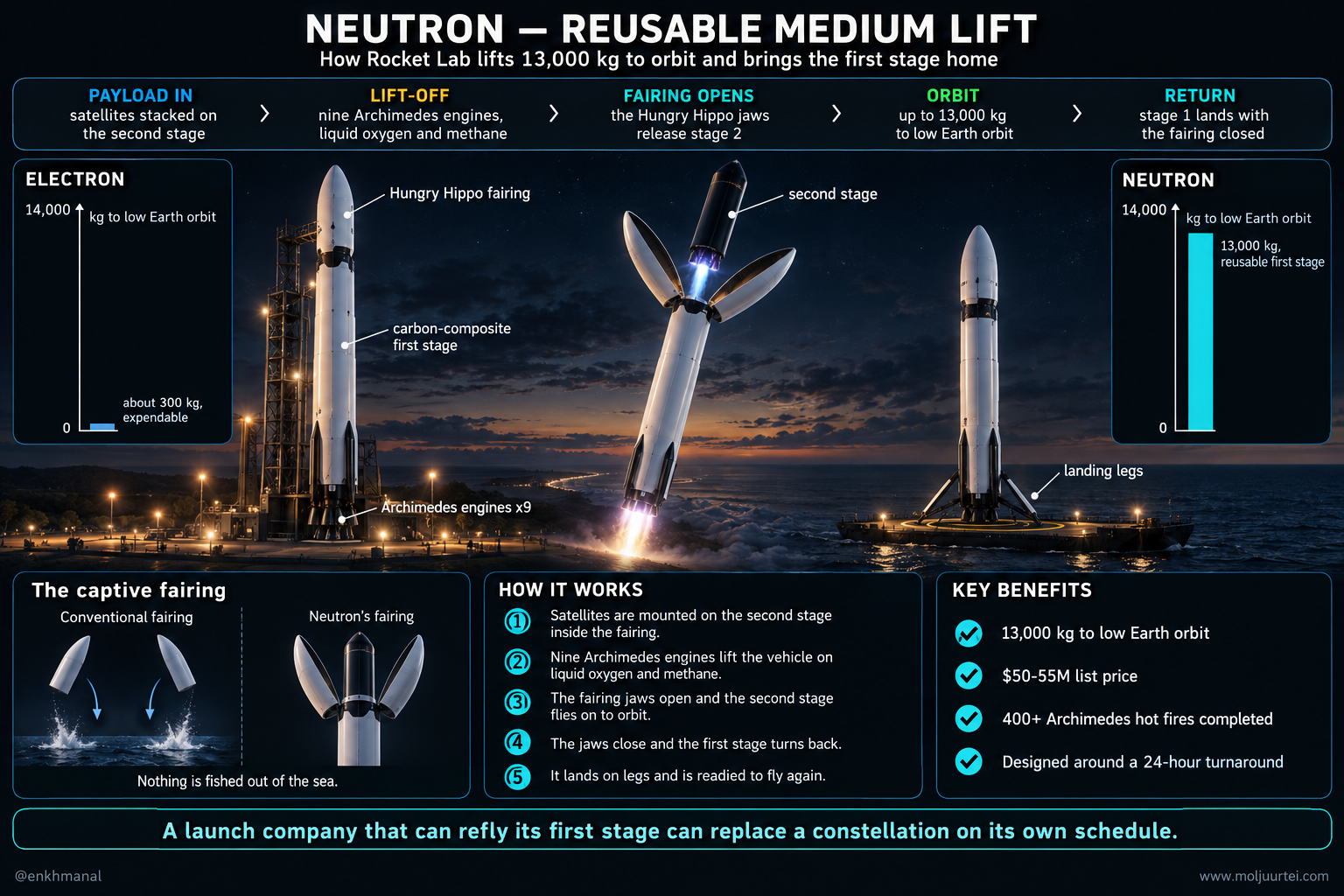
Neutron is where the manufacturing habit meets launch economics. It is designed to carry about 13,000 kilograms to low Earth orbit with a reusable first stage, against roughly 300 kilograms for Electron, and it is priced at $50 to $55 million a flight with, in Spice's words, 'a commitment really not to do any significant discounting for early launches.' Three design choices follow from one constraint Beck set early and now calls 'a stupid constraint' that forced the right decisions: the vehicle had to be able to fly again within 24 hours. The fairing, the nose shell that protects the payload, does not fall into the ocean; it is built into the first stage as two jaws, nicknamed Hungry Hippo, that open to release the second stage and close again for landing. The structure is carbon composite, light enough that the nine Archimedes engines can run at low stress and fly repeatedly without teardown. And the engines burn liquid oxygen and methane, which leave little soot to clean. The company says Archimedes has passed more than 400 hot fires.
Iridium adds a moat of a different kind: physics and a licence. Its satellites talk to handsets on L-band, around 1.6 gigahertz. Low frequencies carry less data than the Ku- and Ka-band that Starlink and Amazon's network use for broadband, but are less susceptible to rain fade; tree canopy and a ship's metal superstructure can still obstruct the link, and a small antenna can hold a link from a moving vehicle at the poles. Beck, asked on the call whether Iridium's spectrum could be used for broadband, answered that it was 'the wrong kind of spectrum for a broadband' and that without it 'there is going to be certain things that you just cannot do.' Those things are safety services: aviation tracking, maritime distress, the U.S. government's Enhanced Mobile Satellite Services contract, and a GPS backup signal that Iridium's CFO has said is a thousand times stronger than GPS at the ground.
Roadmap & R&D
Research and development ran $82.4 million in the June quarter, and most of it is one rocket. The deck's Neutron section shows every major assembly in hardware: engines in acceptance testing at NASA's Stennis Space Center, the thrust module and second stage in final integration at Launch Complex 3 in Virginia, and the first-stage tank, the part that failed qualification in January, back in assembly after new barrels and domes came off the fibre-placement machine. What remains before a launch date is the part Beck called the one that 'gets your adrenaline running': a fully fuelled vehicle on the pad, igniting its engines for the first time.
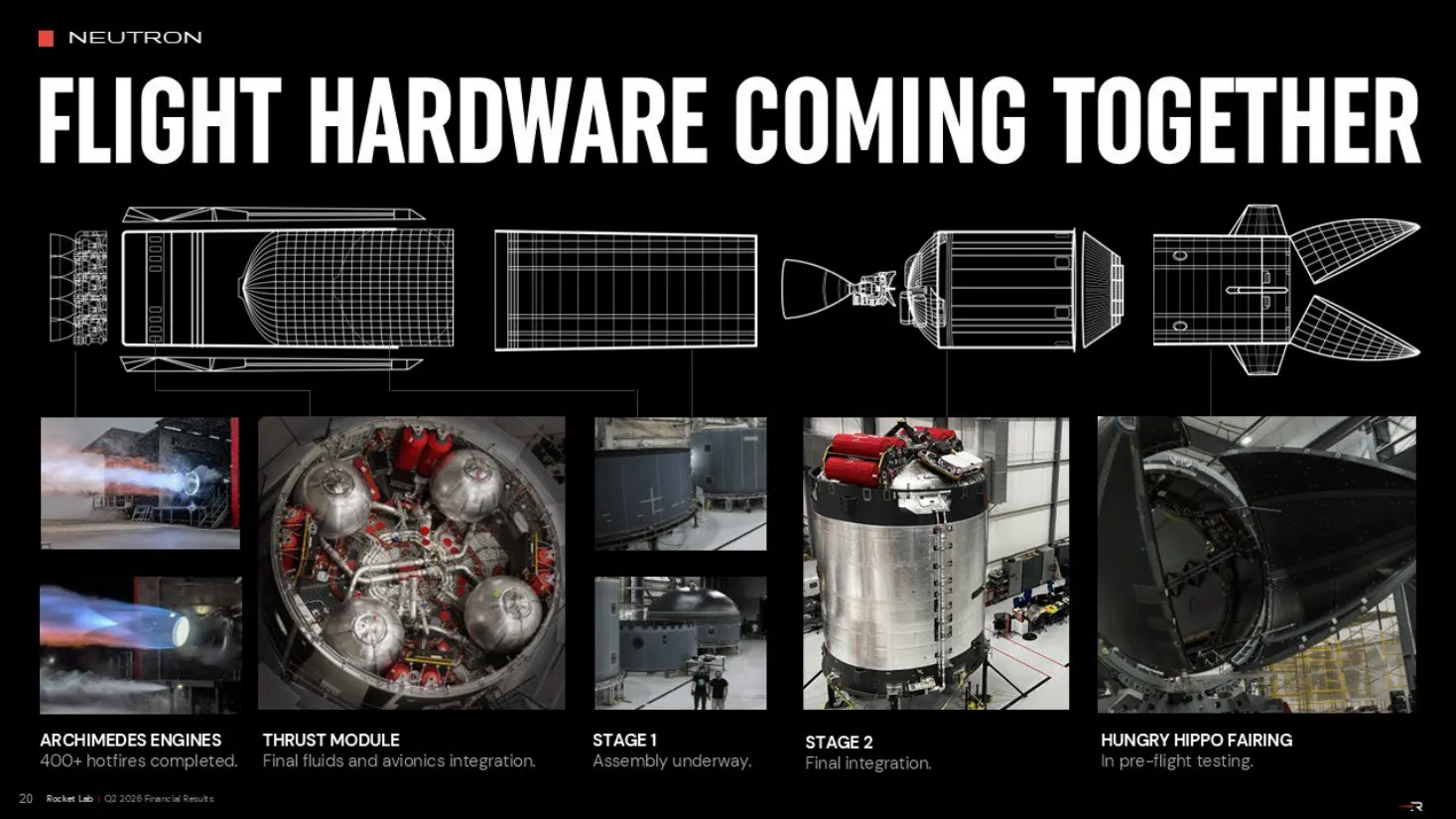
The schedule language is the thing to watch, because it has moved in one direction. At a Goldman Sachs conference in December 2025 the CFO said 'the goal is to get a vehicle to the pad in Q1.' In February, after the tank failure, the company said 'Neutron's first launch is now targeted for Q4 2026.' In May it described test campaigns 'all timed to converge for the first launch at the end of this year.' In August the target became 'delivery of Neutron to the pad in Q4 2026,' with the warning that 'the window for an end-of-year launch is narrowing,' and the 10-Q added that timing 'will also depend on the outcome of first stage qualification and other critical tests occurring later in 2026.' Going further back, the Q4 2024 call opened by calling 2025 'the year of Neutron.' We read the August wording as a first flight in the first half of 2027 and model it that way.
Around Neutron sit programmes that are already contracted. The $397 million SB-AMTI award from the Space Force, signed on 30 July, has Rocket Lab design, build, launch on Neutron and operate Flatellite spacecraft to track aircraft and missiles from orbit; the company says it is one of only two vendors delivering launch plus spacecraft on that programme. Two contracts worth more than $160 million take it into geostationary satellites for the first time. A $266 million Space Force deal for up to 18 suborbital HASTE flights will mostly fly from Kodiak, Alaska, using Ghost, a launch site that ships in containers, from 2027. Government programmes of this kind recognise revenue over about four years on what Spice called a 10/40/40/10 curve, which is why the backlog converts at 45.5% in twelve months rather than faster.
After closing, the roadmap adds Iridium's own programmes, which Rocket Lab has said it intends to accelerate rather than replace: a standards-based direct-to-device service launching this year, the 9604 module that combines satellite, cellular and GPS in one chip, and positioning, navigation and timing, which Iridium's CFO has targeted at $100 million of revenue by the end of the decade. Beck on the call: 'with a relatively modest tweak to a constellation, add a whole bunch more capability.' He declined to describe the next constellation: 'There will be a constellation, but I do not think we are ready to talk about exactly what that is going to be just this early.'
The Setup — Why It's Mispriced
The market sold $RKLB from a $150.23 close on 27 May to $73.95 on 25 September, a 51% fall across three record quarters. Neutron's language slid from a launch date to a pad date; the company sold 29.3 million new shares, about 4.6% of the count, into a falling price between 13 August and 15 September; and the space group cooled after SpaceX listed. The first is real and we treat it as the main risk. The second is finished, and it bought an acquisition paid for without new debt at Rocket Lab.
Table terminology: ATM; FCC.
Rocket Lab also paid more than Iridium's own advisers thought Iridium was worth alone. Evercore's discounted-cash-flow range for a standalone Iridium was $29.97 to $45.54 a share, against the $54 offer; Rocket Lab opened at $42.50 in stock on 15 April, a rival called Party A offered $41 to $45 in cash, and Rocket Lab won by moving half the price into cash. At the midpoint of Evercore's range the premium is about $16 a share, roughly $1.7 billion. The question is what that buys.
The answer sits in a table Rocket Lab never saw. Iridium prepared a forecast for Evercore that runs to 2035, extended specifically 'to account for capital expenditure for expected constellation upgrades.' Revenue grows from $1.04 billion in 2027 to $1.59 billion in 2035 and operating EBITDA from $577 million to $1.02 billion, but unlevered free cash flow goes from $529 million in 2030 to −$21 million in 2031 and recovers only to $135 million by 2035. The gap between EBITDA and free cash flow widens by about $600 million a year from 2031, which on our reading is roughly $3 billion of replacement spending over five years. That is consistent with the roughly $3 billion Iridium's CFO has said it cost to put the current network up. Iridium's CEO told analysts in February that the spending 'would ramp up to the 2034-2035 timeframe.'
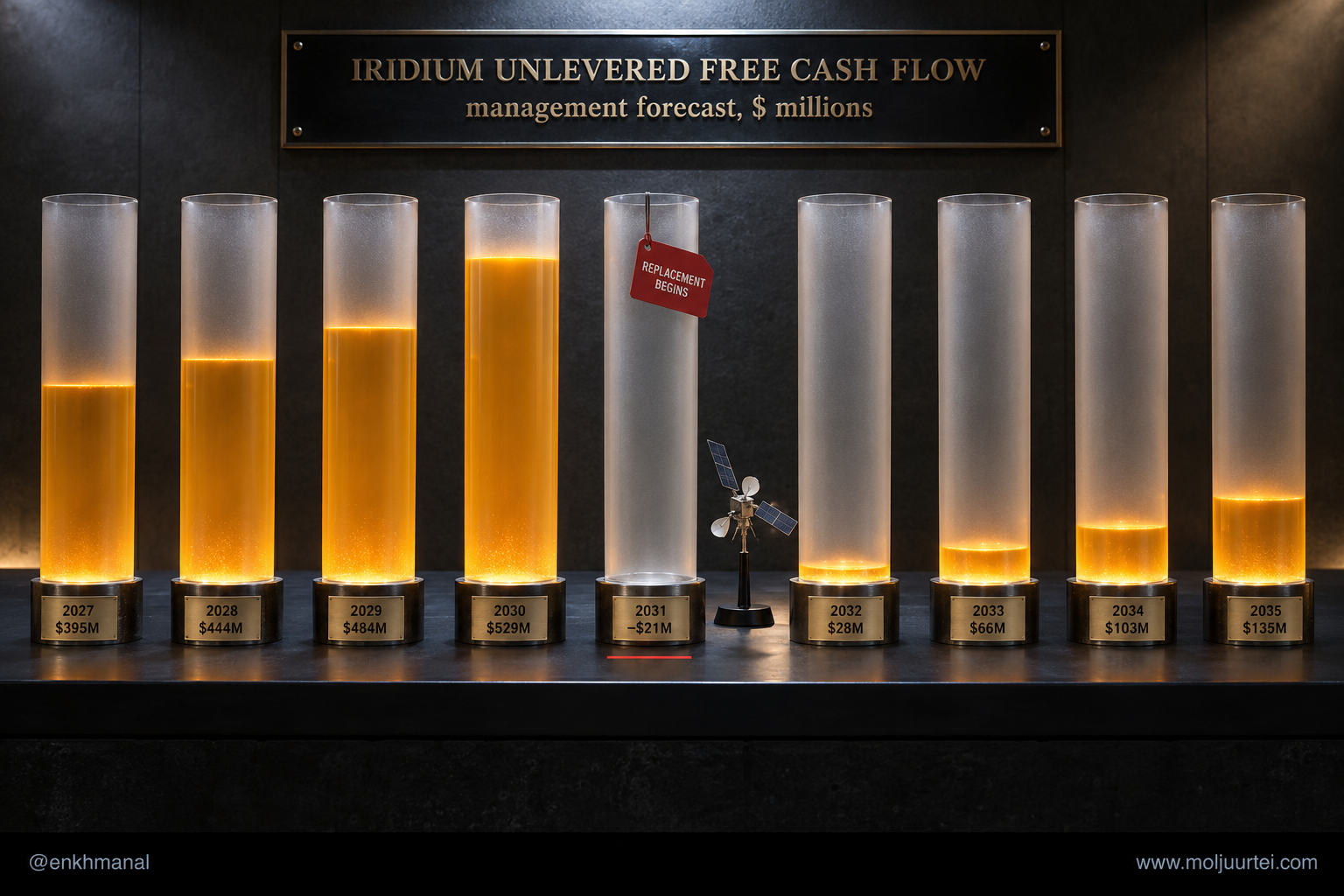
That replacement bill is the synergy Rocket Lab is actually buying. Beck said on the Q2 call that the constellation 'is good into 2035,' and that when he compares what it cost Iridium to build the network with 'what we could do it for now, it's pretty stark. In obviously a good way.' In an interview clip posted on 22 September he put a number on it: about $350 million over roughly 18 months for a network that cost Iridium about $3 billion. That figure is Beck's, it is not in any filing, and we treat it as a ceiling on optimism. Even at three times his estimate, Rocket Lab would save around $2 billion of the forecast replacement spending, worth about $1 billion today at a 10% discount rate. The saving roughly pays for the premium over Evercore's standalone value. It does not, by itself, justify the market value, which is why the rest of the case rests on Neutron and on what Rocket Lab builds with the spectrum after 2027.
It's a quintessential Rocket Lab deal in the fact that we're not buying a big hole in our P&L... They bring some nice profitability, and the constellation itself is good into 2035.
The financing gap that worried us in July has narrowed: our closing estimate is about $1 billion of net debt against almost $600 million of Iridium operating EBITDA, with Iridium lenders consenting to the change of control. This is an estimate, not a debt-free balance sheet. At the 25 September close, Iridium was $48.75 versus a $54 package within the collar, a 10.8% gross spread before time value, taxes and deal risk. The spread does not prove regulatory approval or completion.
Management & Track Record
Rocket Lab is still a founder's company, and the 10-K says so in its risk factors: Beck 'is the source of many, if not most, of the ideas and execution driving our company.' The record behind that sentence is strong on building and weaker on dates. Electron went from first flight to more than 90 launches, with 100% mission success in 2026 through the August call. Revenue went from $62 million in FY21 to $602 million in FY25 while gross margin went from negative to 34%, and the component acquisitions that looked odd at the time now feed an $816 million prime contract. Against that, Neutron's first flight was presented as a 2025 event in February 2025 and is now at risk of missing 2026. The finance team has been disciplined in one visible way: it sold the most stock when the stock was dearest.
Table terminology: 8-K; SPAC; 10-K; EBITDA.
Two things in the ownership record deserve a line each. Insider Form 4 filings over the past year show sales and no open-market purchases; for a founder-run company with a stock down by half, that is worth noting without over-reading, since most are scheduled sales against vesting. And Beck's family trust holds about 41 million shares of Series A Convertible Participating Preferred, exchanged from common in 2025, which vote and convert one-for-one and are counted in the company's 641 million share guide.
Risks & What Breaks It
What changes the thesis: a completed integrated static fire and a first Neutron flight by mid-2027 would strengthen the case to add. A failed stage test or a slip into the second half of 2027 while Iridium closes would move us back to waiting. The refreshed put-wall estimate is $60, not a guaranteed entry floor. A regulator requiring Iridium to separate its government business would weaken the synergy case and require a new valuation.
Price Setup — Levels, Technicals & Options
At the 25 September 2026 close of $73.95, RKLB was above its 20-day ($65.89) and 50-day ($69.49) simple moving averages, but below its 100-day ($88.09) and 200-day ($81.09). It remains 50.8% below the $150.23 closing high of 27 May. The September area around $61 is a historical reference, not a price guarantee.
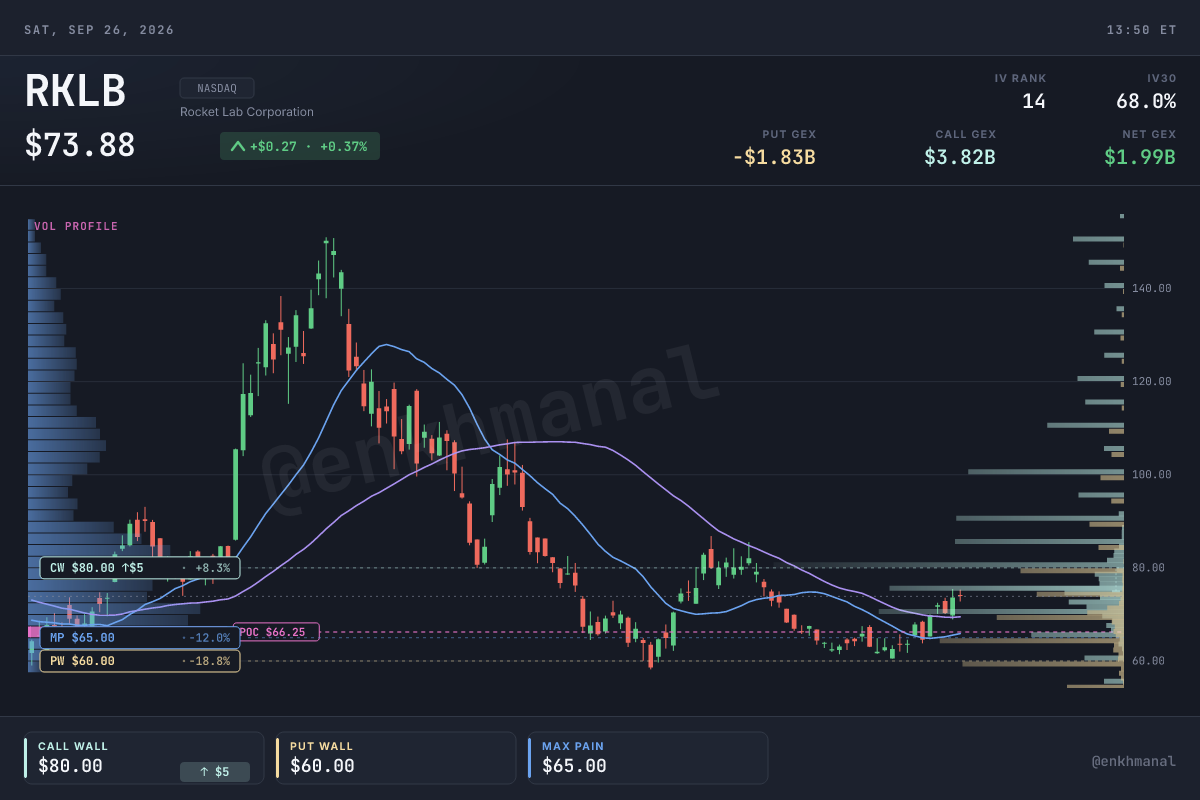
The refreshed all-expiry options proxy covers 16 expirations. At a $73.88 quote, net GEX is approximately +$2.00 billion, the call wall $80, put wall $60, max pain $65 and put/call open-interest ratio 0.70. The model gamma flip is $65; the strike-profile zero crossing is $66. These different calculations are not interchangeable. Snapshot IV is 68.0%, implying roughly ±19.5%, or $14.42, over 30 days under a square-root-of-time approximation. It is neither a directional forecast nor a bound. The app labels IV 26 September; options Greeks refer to the prior market close and open interest updates on its own schedule. A confirmed November earnings date was not found on the company events page.
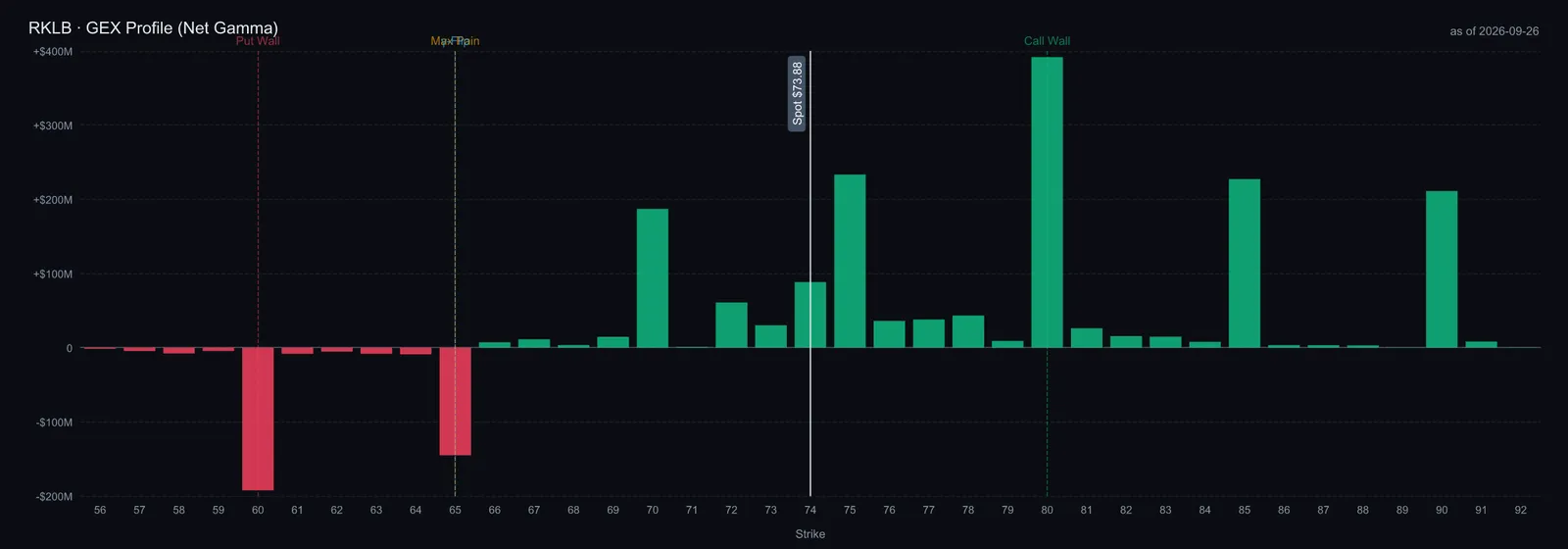
Positive net GEX under this convention can be consistent with dampening hedging, but actual dealer exposure is unknown. A sustained move above $80 would bring the $81.09 200-day average into view; below the $65–66 model region, sensitivity can change. Treat $60, $65–66 and $80 as monitoring levels, not deterministic support or resistance.
Valuation & House View
Rocket Lab has no earnings, so no price-to-earnings history can be drawn, and the valuation has to be read two ways: what a disciplined cash-flow model says, and what the market pays for comparable space assets. Our workbench model starts from the FY26 revenue the filed quarters and the Q3 guide imply ($975 million, +62%; with no annual guide, the fourth quarter is our estimate at the guided 10% sequential step), then 35% in FY27 fading to 4% by FY35. Gross margin reaches 42%, research and development falls from 34% of revenue to 9% as Neutron moves into production, and SG&A from 25% to 11%. FY35 revenue is then $4.7 billion, with $1.46 billion of EBITDA and $875 million of free cash flow.
That model is worth $9.12 a share on a perpetuity (10% discount rate, 3% terminal growth) and $13.76 on an exit at 15.5 times EBITDA, the median of Iridium, Lockheed Martin, Northrop Grumman, General Dynamics and $RTX, on 809 million FY35 shares; bear to bull spans $2.35 to $23.44. Add Iridium at what Rocket Lab is paying (about $7.7 billion of enterprise value including its debt and the Aireon loans), subtract roughly $1 billion of net debt at close, and the combined equity is $13 billion to $17 billion, or $18 to $24 a share on about 709 million shares, against a pro-forma equity value of $52.43 billion at $73.95 on the same assumed 709 million shares. In the original 24 September reverse calculation, the exit case needs standalone revenue to compound at about 41% a year for ten years, to roughly $22 billion in 2035, near what SpaceX reports today. The Model pane's audit passes every rule but one: cash tax is set at 21% rather than taken from the filings, because Rocket Lab has only filed losses.
The gap between $18-24 and $74 is the price of an option on Rocket Lab becoming a scaled operator, and the useful question is what comparable options cost. By the only yardstick all of these names share, enterprise value to revenue, Rocket Lab is not the expensive one.
Table terminology: EV.
On the memo's combined 2027 assumptions, Rocket Lab plus Iridium is about 22.6x revenue. SpaceX's 85.0x and the historical Blue Origin 100x figure use equity value and different revenue periods, so neither is a clean EV/revenue comparator. They illustrate the market's appetite for space platforms, not proof of cheapness. The refreshed analyst mean target is $109.37; the original $64–$150 range is retained as dated context. The 24 September operating model and cash-tax assumption are unchanged, not newly re-underwritten.
The original memo shifted from July's Neutral to constructive, with limited exposure reflecting the execution risk. At the refreshed $73.95 close, the probability-weighted September 2028 scenario value is $82.25, or +11.2% total and approximately +5.5% annualized over two years; it is a future scenario value, not today's fair value. The original cash-flow model including Iridium remains $18–$24, so the gap buys uncertain Neutron cadence and spectrum opportunities. The original $60–$71.79 entry zone is a dated tactical preference; $71.79 is no longer the latest gamma-flip estimate. A completed static fire and first flight are the operational milestones for reassessment. Funding and the vote improved the setup, while integration, regulation and execution still determine the outcome.