
$QURE — Huntington’s gene therapy: the evidence and the filing test
$QURE's investigational AMT-130 uses a one-time brain infusion to reduce huntingtin production. Company-reported studies suggest slower decline over several years, but the pivotal comparison uses external controls. In June 2026, according to uniQure, the FDA accepted the three-year analysis as a basis for submitting an accelerated-approval application; that is not approval of the treatment. Shares fell about 37% on September 29 after the four-year composite endpoint missed statistical significance. At the October 20 snapshot price of $21.97, enterprise value was about $0.78 billion, compared with $651.7 million of operating cash used in 2022–2025.
Start here. A gene is a recipe, written in DNA, for building one protein. Huntingtin is one such protein, built from a gene of the same name, and every neuron in the brain makes it. Huntington's disease is what happens when one copy of that recipe carries too many repeats of three DNA letters, C-A-G, so the protein comes out with a long sticky tail that misfolds, clumps and slowly kills neurons. The striatum is where the damage starts: a pair of structures deep in the brain, the caudate and the putamen, that help start and stop movement and keep thinking organised. A child of a carrier has a 50% chance of inheriting the expanded gene, symptoms usually begin in mid-adult life, and uniQure's 10-K describes a decline that runs over a 12- to 15-year period. Gene silencing means handing the cell a short strand of RNA that matches the gene's message, so the cell's own machinery shreds the message before it becomes protein. A gene-therapy vector is an emptied virus shell that carries the instructions for making that strand into neurons, so the cells keep producing it for years after one dose.
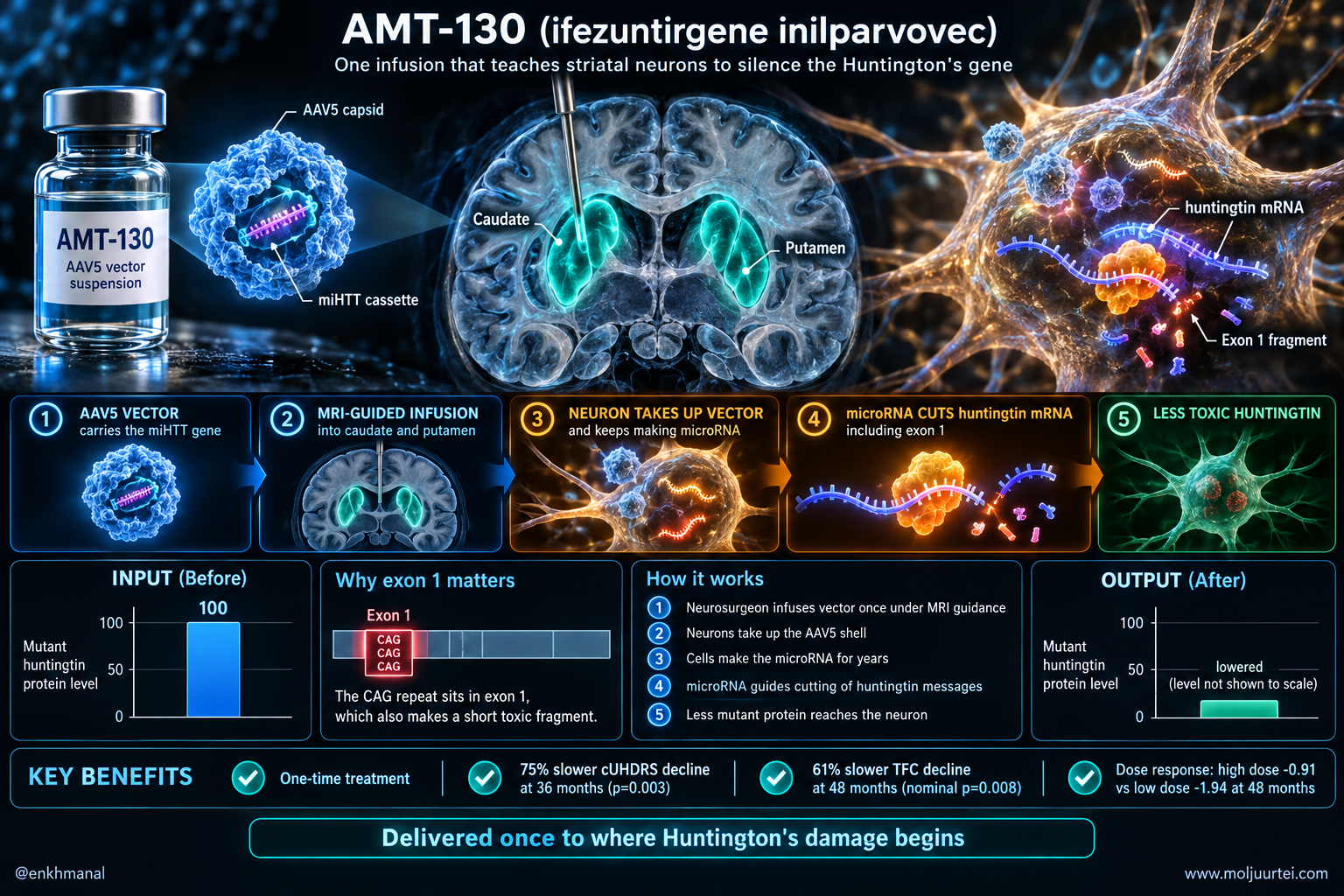
That is the whole mechanism of AMT-130. uniQure's 2023 study deck describes it as a modified AAV5 viral vector carrying a microRNA aimed at huntingtin exon 1, the stretch of the gene that holds the C-A-G repeat and that also produces a short, highly toxic protein fragment. A neurosurgeon infuses it once, under real-time MRI guidance, directly into the caudate and putamen. The existing medicines for Huntington's treat symptoms such as the involuntary movements called chorea; none of them slows the disease. The approaches that tried to lower huntingtin with repeated injections have a mixed record, and the reason AMT-130 matters is that it tries to do the lowering once, at the site where the damage begins.
What Changed
Huntingtin lowering went from a public failure to a filed application in five years. In March 2021 Roche ($RHHBY) stopped dosing in its Phase 3 GENERATION HD1 study of tominersen, an antisense drug injected into the spinal fluid, after an independent monitoring committee reviewed the data ($IONS 10-Q, July 2026). That result made the whole idea of lowering huntingtin look doubtful. AMT-130 took a different route: one surgery instead of an injection every few months, and a drug made by the patient's own neurons in the striatum instead of a drug washed in from the spinal fluid.
The data now run four years, and the three-year cut cleared its pre-specified endpoints. In September 2025 uniQure reported that 12 high-dose patients declined 75% less than a matched natural-history control on the composite Unified Huntington's Disease Rating Scale (cUHDRS) at 36 months (p=0.003), and 60% less on Total Functional Capacity (p=0.033). The cUHDRS adds up four tests: daily function, a movement exam, a symbol-coding test of processing speed and a word-reading test. Functional capacity is the part patients feel. It asks whether someone can still work, manage money, run a household and look after themselves.
The regulator moved, twice, and ended where the company started. In November 2024 the FDA told uniQure that Phase I/II data against an external control might support accelerated approval. At the October 2025 pre-BLA meeting it said the opposite, and after a January 2026 Type A meeting it "strongly recommended" a randomized, double-blind, sham-surgery study (8-K, March 2, 2026). The stock closed at $10.50 that day. In June 2026 a Type B meeting produced the third answer: the three-year analysis "would be acceptable as the primary basis" of an accelerated-approval BLA (8-K, June 17, 2026). uniQure filed in the U.S. and the UK on September 2.
What the shift creates demand for is simple to state. About 40,000 Americans have symptomatic Huntington's disease, roughly half are diagnosed, and there is nothing that changes the course of the illness. The company that holds a filed, one-time treatment with four years of follow-up is uniQure, and the question for an investor is how much of that the current price assumes.
Thesis
The thesis is that a filed Huntington's disease application, supportive 36-month results and persistent functional-capacity differences may be worth more than the October 20 enterprise value of $0.78 billion. This is an investment hypothesis about regulatory and commercial outcomes; the four-year composite miss and external-control design leave substantial uncertainty.
Business & Backdrop
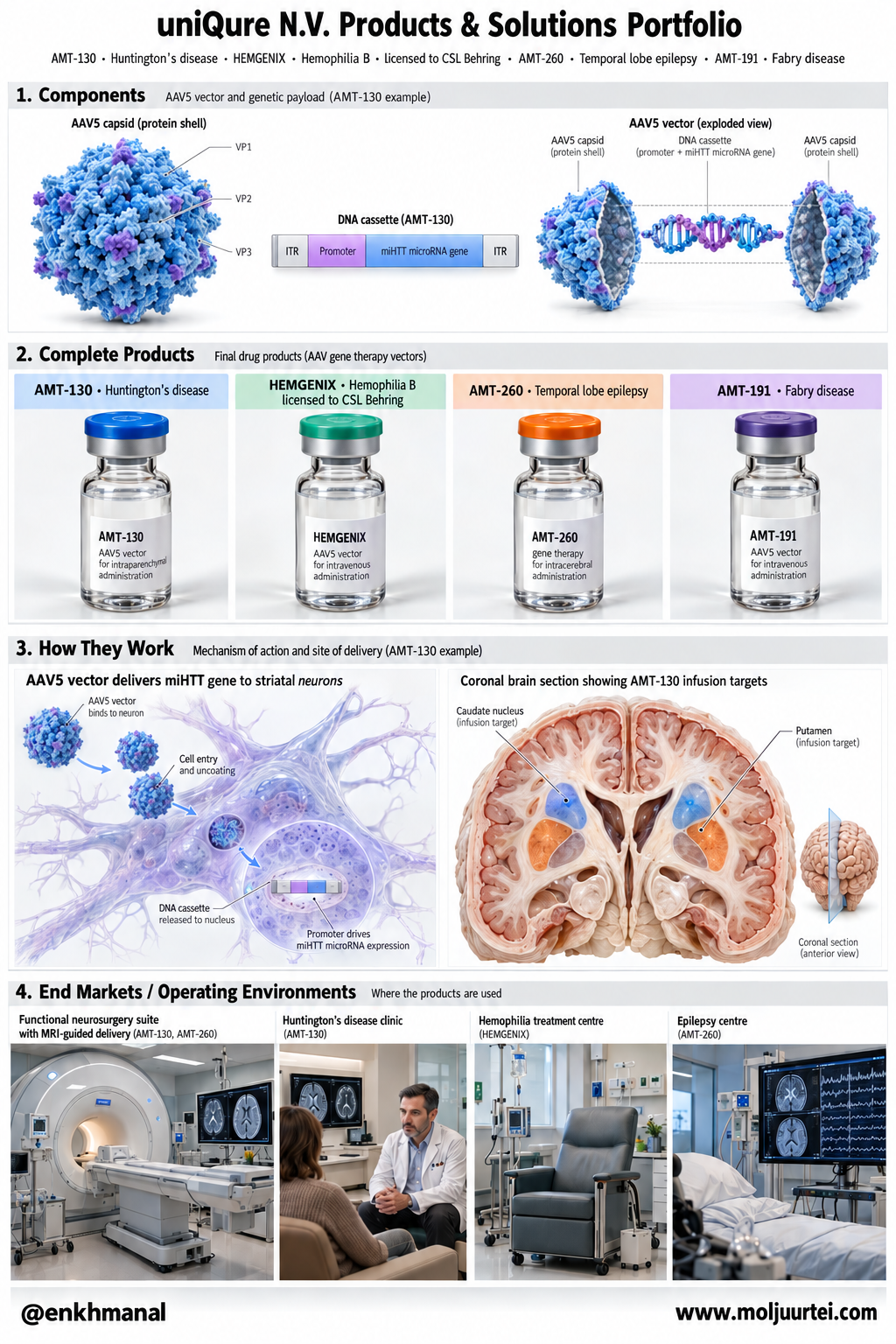
uniQure today is a funded development company with one approved product it no longer sells itself. It developed HEMGENIX, a gene therapy for hemophilia B approved by the FDA in November 2022 and the European Commission in February 2023, and licensed it to CSL Behring. In May 2023 it sold its HEMGENIX royalties to a royalty-financing vehicle (HemB) under a royalty purchase agreement; the $489.3 million liability on the balance sheet is repaid from those royalties, not by the company. In 2024 it sold its Lexington plant to Genezen, cut about 65% of its workforce, and kept a preferred-customer manufacturing agreement with a $14.0 million minimum purchase commitment (10-K, FY2025). What is left is a pipeline of brain and liver gene therapies, a Dutch site, and the cash to take AMT-130 to market.
Revenue is small and lumpy, and the trend that matters is cash burn. Since the 2024 plant sale, every dollar of reported revenue has been license revenue tied to HEMGENIX. The 2021 spike was mostly CSL Behring's license payment, the 2024 bump included contract manufacturing before the plant sale, and operating margin has been deeply negative in every year except 2021.
Operating margin is operating profit or loss as a percentage of revenue.
The quarters tell the same story with a cleaner signal: revenue moved between $1.6 million and $5.8 million while the operating loss held near $40 to $52 million, and the license gross margin, revenue less the cost of license revenue, climbed from 87.4% to 94.0%.
Operating margin is operating profit or loss as a percentage of revenue.
Cash, not earnings, is the scoreboard, and the cash loss runs well below the accounting loss. In the first half of 2026 uniQure reported a net loss of $134.6 million and used $66.8 million in operating cash, against $84.0 million a year earlier. The gap is mostly non-cash: $17.4 million of royalty-financing interest, a $12.2 million mark on pre-funded warrants, $8.3 million of currency losses and $10.1 million of stock compensation (10-Q, Q2 2026). The June offering of 5,686,813 shares at $45.50 raised $259 million and lifted cash, equivalents and current investments to $810.3 million, which management says funds operations into 2030.
Where the money goes is shifting from the lab to the launch. Research and development was 67.7% of total operating expense in FY2025 ($140.7 million) and 65.7% of total in Q2 2026 ($34.0 million), while selling, general and administrative expense rose from 31.5% of total to 33.6% of total ($65.5 million and $17.4 million), as the commercial team hired in late 2025 came onto the payroll. The cost of license revenue is under 1% of total.
The competitors confirm the target and show how long the other routes take. $PTCT licensed votoplam, an oral pill that changes how the huntingtin message is spliced, to $NVS Novartis for a $1.0 billion upfront payment; Novartis began a global Phase 3 in April 2026 that plans to enrol about 770 people, randomized 3:2 against placebo ($PTCT 10-Q, Q2 2026). Wave Life Sciences ($WVE) reported that WVE-003, an injected oligonucleotide that targets only the mutant copy, cut spinal-fluid mutant huntingtin by up to a mean 46%, but it only works in carriers of one genetic variant, about 40% of patients (Wave 10-Q, Q2 2026). Those are real programs. The nearest one to a filing still has to finish a 770-person trial, and uniQure has already filed.
Technology & Moat
AMT-130 is a factory installed once, in the room where the damage starts. The vector is AAV5, a virus shell that carries DNA but cannot copy itself. Inside it is a gene for a microRNA, a short RNA strand, that matches the start of the huntingtin message. Neurons that take up the vector keep making the microRNA, and each copy guides the cell's own cutting enzymes to destroy huntingtin messages, including the short exon 1 message that makes the most toxic fragment. The 10-K adds that the vector spreads from the striatum to cortical areas by transport along neurons and by exosomes, small packets cells pass to each other. It does not distinguish the healthy copy of the gene from the mutant one, which is one reason the infusion is local rather than spread through the whole brain.
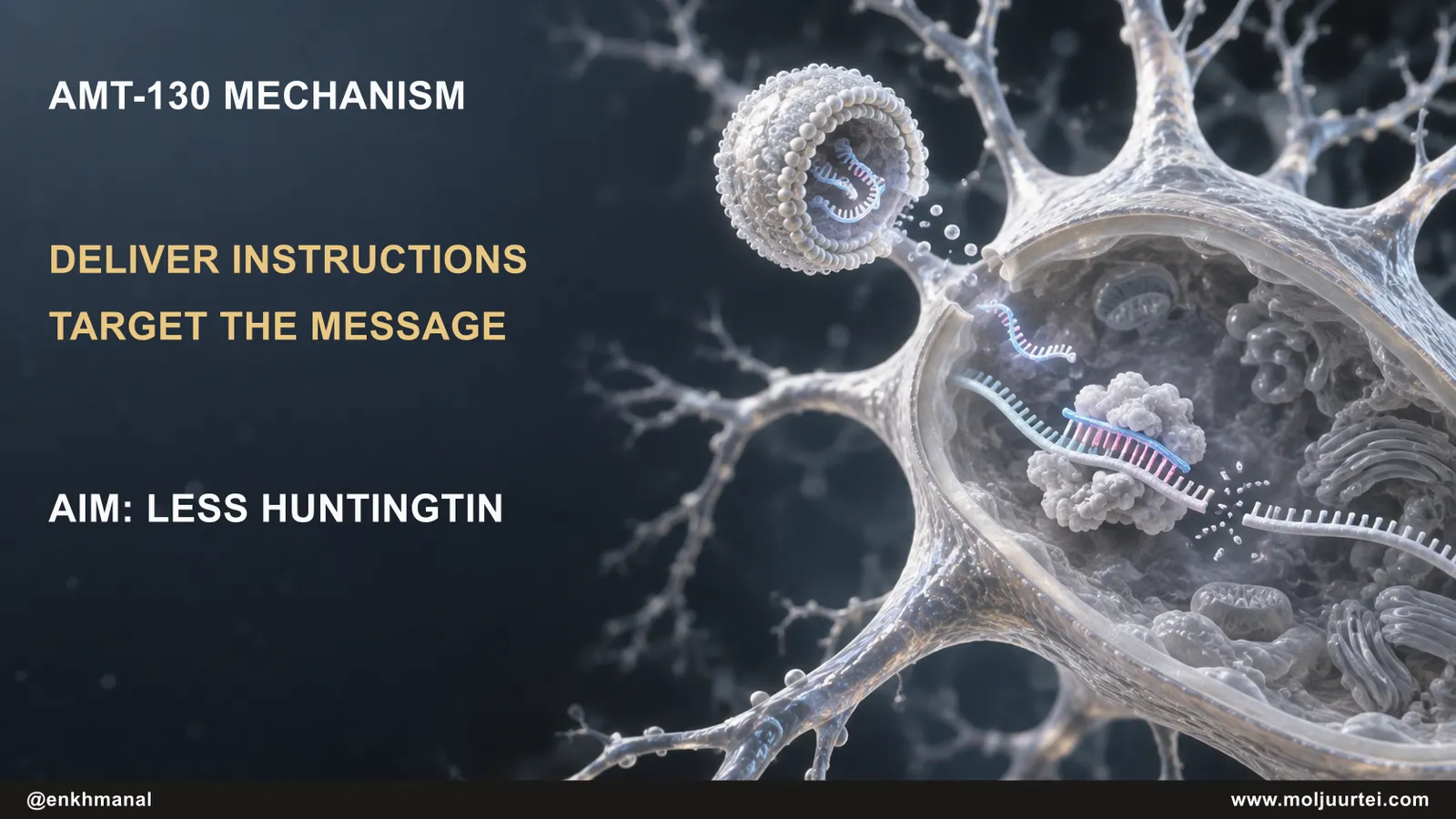
The hard part is the delivery, and that is also the moat. The infusion is a convection-enhanced, MRI-guided stereotactic procedure into both the caudate and the putamen. On the 2025 data call Professor Sarah Tabrizi of University College London put the surgery at "roughly about 12 hours". That is a real cost and a real barrier: a competitor needs years of surgical experience, a dose found by trial, and safety data on every patient. uniQure has dosed 51 patients across four cohorts, holds the first Breakthrough Therapy and Regenerative Medicine Advanced Therapy designations the FDA granted in Huntington's disease, and manufactures in a facility that already supplies a licensed gene therapy, which matters for the CMC review that sinks many first-time gene-therapy filers.
Safety remains a material risk: uniQure calls the profile manageable, but serious inflammation occurred. Five high-dose participants (17%) had a treatment-related serious adverse event of central nervous system inflammation, and all of them resolved; most other adverse events were the headaches and pain of the surgery (8-K, September 29, 2026). One low-dose patient died by suicide about five years after treatment, which the investigator judged unrelated, in a disease where suicide is a leading cause of death.
Roadmap & R&D
The next milestones span regulatory review, confirmatory-trial execution and further clinical data. Research and development spend was $34.0 million in Q2 2026, with direct spend moving toward the epilepsy and Fabry programs as AMT-130's trials mature.
Table terms: BLA; FDA.
Commercial preparation is the less visible half of the roadmap. Management told investors on the Q2 call that it expects an advisory committee for the BLA and is preparing for one, and Kylie O'Keefe's team has been profiling treatment centres where a Huntington's Disease Society of America Center of Excellence sits next to a neurosurgery service with MRI-guided delivery systems. The company discontinued AMT-162 for SOD1 amyotrophic lateral sclerosis in the first quarter, which is the kind of capital decision a company with one shot on goal should be making.
The Evidence — Control Selection and Uncertainty
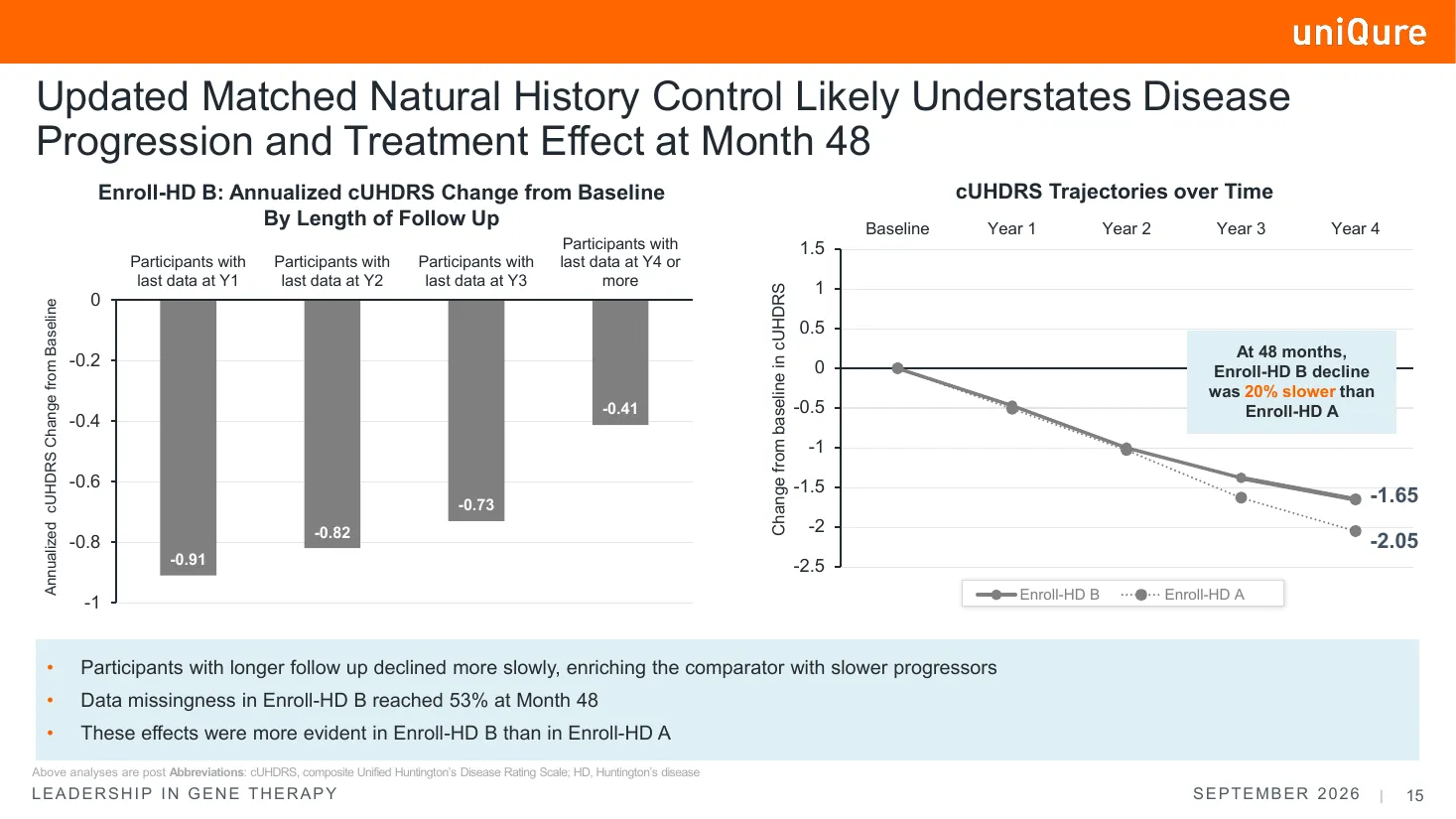
Control selection materially changes the four-year estimate; uniQure attributes part of the miss to comparator attrition. The filed analysis did not change. The same 12 high-dose patients read 44% slowing or 54% slowing at 48 months depending on which version of the ENROLL-HD registry sits on the other side of the comparison. Version A, released in January 2023, is the control behind the BLA. Version B, released in September 2025 with about 26,000 participants, was pre-specified for the four-year analysis.
Reading the clinical table: cUHDRS; TFC; nominal p; post hoc.
Table terms: cUHDRS; BLA; ENROLL-HD; nominal p; post hoc.
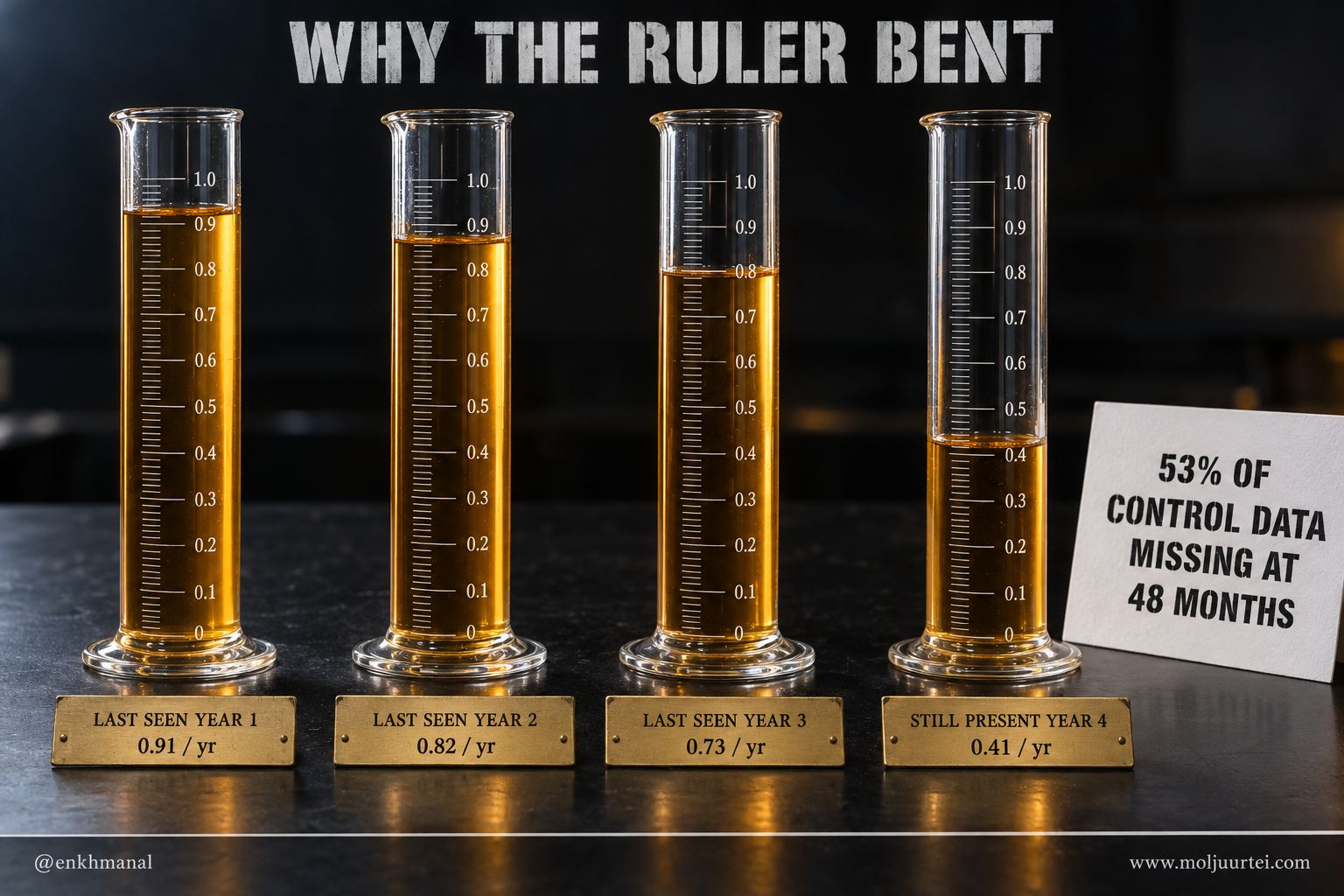
The observed controls declined more slowly at longer follow-up; that does not mean individual patients became healthier. By month 48, 53% of the matched control data in version B was missing, and the company reported faster decline among those who left: controls whose last visit came in year one were losing 0.91 cUHDRS points a year, those still present at year four only 0.41. Picture a class where the students who are failing quietly stop sitting exams, and the average grade rises every term. The matched version B controls lost 1.39 points by year three and only 1.61 by year four, about a fifth of a point in a year in a disease that usually costs about half a point.
Dose-group differences and a biomarker support the thesis, but none resolves the external-control limitation. The high dose is ten times the low dose, and after four years the high-dose group had lost 0.91 cUHDRS points against 1.94 for the low dose, a 1.03-point gap in favour of the higher dose. On function the high-dose group lost 0.30 functional-capacity points against 0.70. And neurofilament light, a protein that leaks from dying neurons into the spinal fluid, was 4% above baseline in the high-dose group at month 48; the company cites a 10% to 15% yearly rise in untreated early-manifest patients.
The honest counterpoint is inside the treated arm too. The 12 high-dose patients went from roughly −0.38 at 36 months to −0.90 at 48 months on cUHDRS, and the step came mostly from the symbol-coding test (20% slowing, p=0.731) and the movement exam (5.6% slowing, p=0.908), while functional capacity and word reading held. With 12 patients, one noisy rater changes the answer; management said on the call that one individual was "probably was pulling the average down significantly." That is a reason to weight functional capacity, which is the confirmatory study's primary endpoint, and to accept that the composite will stay contested.
We have submitted the BLA to the FDA and expect acceptance in the fourth quarter. We also submitted the [UK marketing application] to the [UK regulator], which has since validated the submission.
The market priced the four-year number as if it were the filing. The company says the BLA was submitted before the four-year topline and does not contain it, and the FDA's June minutes accepted the 36-month analysis of the original 12 patients as the primary basis. The price fell from $39.11 to $24.51 in a session and has drifted to $21.97, which leaves an enterprise value only a little above four years of the company's operating cash burn.
Management & Track Record
The leadership is the team that won one gene-therapy approval and then regained alignment on a submission pathway; the commercial lead is new.
Table terms: HEMGENIX; FDA.
Kapusta's record is a pedigree turned into one result: a company that took HEMGENIX through approval and monetised it twice, first through the CSL license and then through the royalty sale. The weaker part of the record is the regulatory communication of 2025, when the company told investors in June 2025 that it had aligned with the FDA on the statistical plan for a first-quarter 2026 filing and the agency reversed at the pre-BLA meeting four months later. The insider sales in June 2026 came immediately after the FDA reversal lifted the stock, which is legal and common and still worth noting.
Risks & What Breaks It
What would weaken the thesis: an FDA refuse-to-file letter or a request for substantial additional efficacy evidence. A standard review alone changes timing; it is not proof the therapy failed.
Price Setup — Levels, Technicals & Options
October 20 price snapshot. The stock is sitting just above $20 after a gap that erased the June rally. The last twelve months are a sequence of FDA headlines: $13.66 to $47.50 on the three-year data in September 2025, a closing high of $70.59 in late October, $34.29 after the November pre-BLA reversal, a closing low of $9.03 in March after the Type A minutes, $48.16 on the June alignment, then $39.11 to $24.51 on September 29. At $21.97 it trades below its 20-day ($26.03), 50-day ($38.33) and 200-day ($29.62) averages, with the heaviest volume node of the past year at $25.
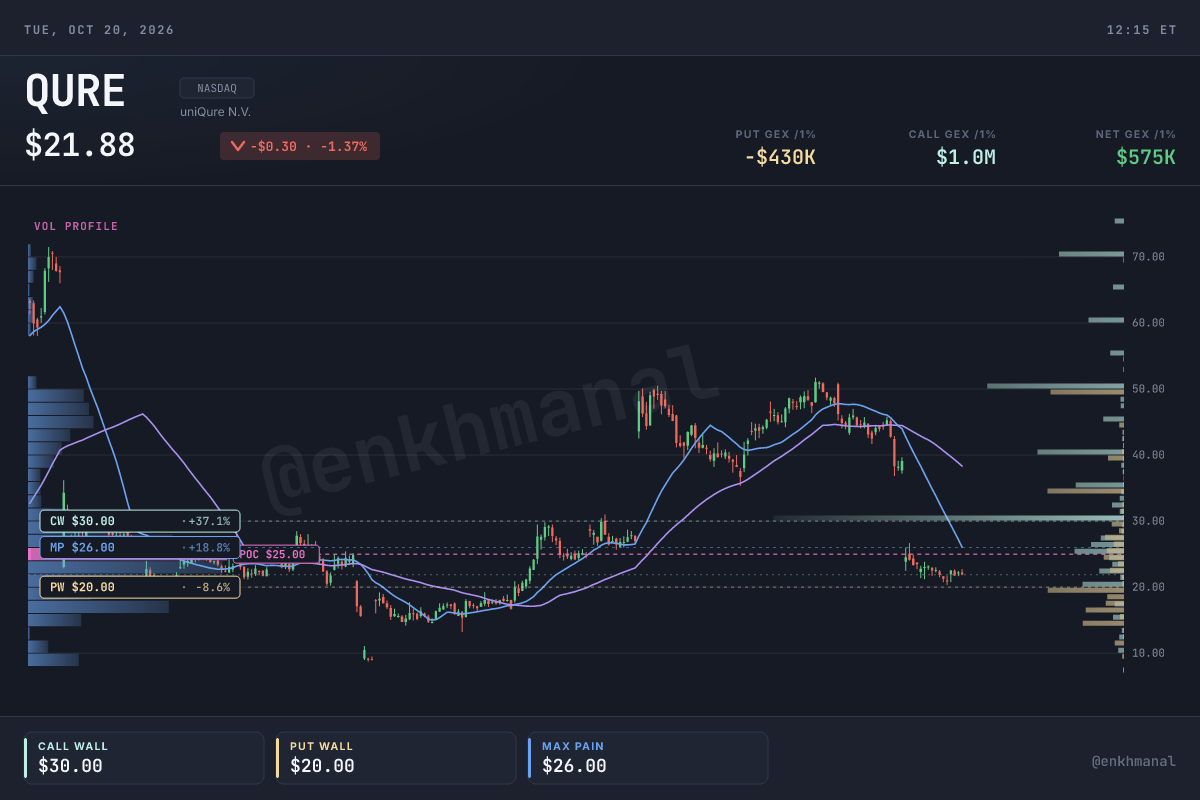
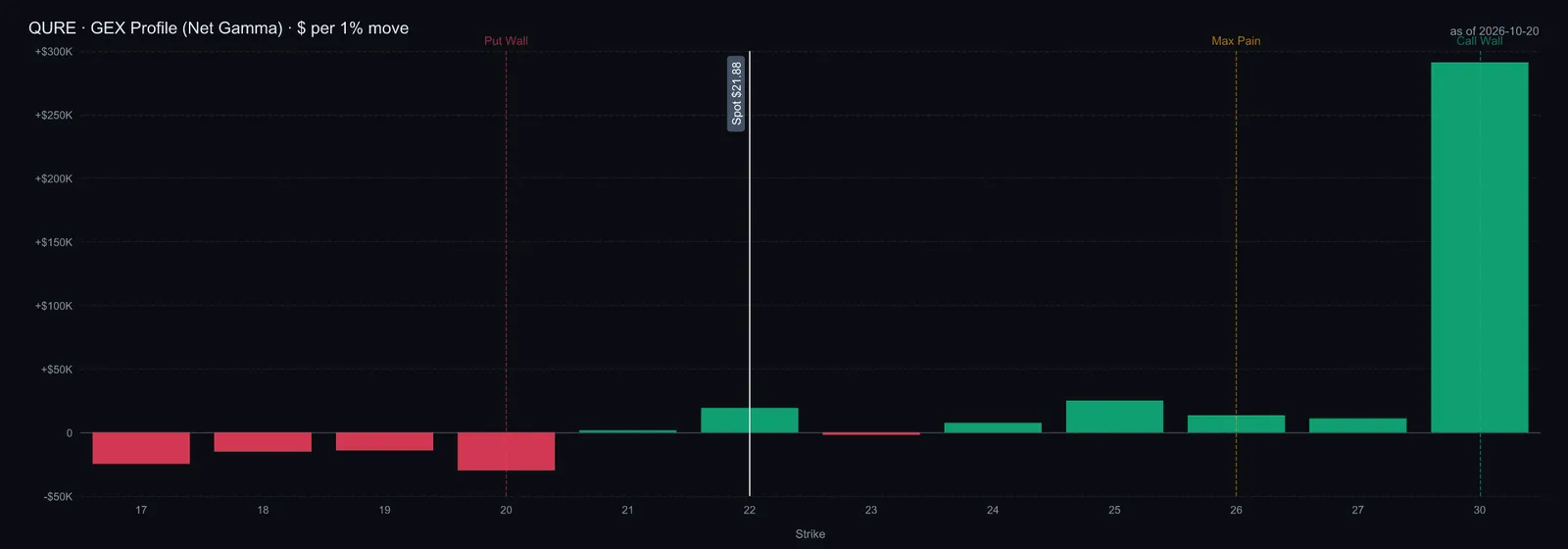
At the October 20 snapshot, dealer positioning is thin and lopsided. The call wall sits at $30, the put wall at $20 and max pain at $26, and almost all of the positive gamma is stacked at the $30 strike. The November 20 options, a monthly expiry around the expected filing-decision window and the quarterly reporting window, trade at about 110% implied volatility, and the at-the-money straddle costs about $5.60, a move of roughly 25% priced in either direction.
Valuation & House View
AMT-130 has no product earnings to multiply. uniQure has not reported positive earnings since 2021, so a P/E or PEG ratio is not informative. Extrapolating about $16 million of legacy license revenue would miss the economics of a potential AMT-130 launch. The scenarios below therefore depend on approval, launch capacity, pricing, future sales and dilution.
The arithmetic of the price is short. There are 69.9 million shares including pre-funded warrants (69,366,412 ordinary shares plus 526,316 warrants, per the Q2 10-Q), so $21.97 is a market value of $1.54 billion. Against it sit $810.3 million of cash, equivalents and current investments and $50.0 million of Hercules venture debt at June 30, for an enterprise value of $0.78 billion. We leave out the $489.3 million royalty liability because it is repaid only from HEMGENIX royalties. The Yahoo consensus of 12 analysts on October 20 still shows a mean target of $61.37 and a median of $66.91, inside a range of $28.06 to $91.75, and some of those targets predate the September 29 data.
The October 20 scenarios are illustrative estimates rather than a reproducible fair-value model. Their framework uses three times peak sales, 12% annual discounting, net cash and 72–78 million shares, but does not specify a complete case-by-case bridge. The displayed probability-weighted target is $32.35 (30% × $72 + 25% × $25 + 45% × $10), about 47.2% above $21.97. The probabilities are judgmental assumptions, not clinical or market-implied approval odds. Enterprise value alone cannot identify an approval probability because timing, dilution, launch economics and pipeline value also matter.
The opportunity is the possibility that a one-time treatment delivers durable patient benefit and becomes commercially viable. The next evidence tests are filing acceptance, the review designation, confirmatory-study execution and whether regulators accept the external-control evidence. A refusal to file or a request for substantially more data would weaken the dated thesis and delay its commercial timeline.
The original research drew on discussion by ClearPath, Left's Newsletter and Bridge Lab Biotech. Primary references include uniQure's September 29 clinical update, its Q2 financial release and company presentations.