The Quantum Supply Chain Deep Dive — $GFS, $FORM, $COHR, $KEYS, $TSEM, $QNT, $IONQ · the fabs, fridges and lasers under the qubit, into the
Whichever qubit wins, it has to be fabbed, cooled, driven, read out and connected, and the listed companies that do those jobs are priced on AI, not on quantum. On 3 September the Commerce Department bought 9.9 million $GFS shares at $37.85, the first time federal quantum money has become equity in a foundry; $GFS trades at $42.75, 52% below its May high. We rank seven names that each occupy one link of that chain and put the foundry first.
Thesis
The scaling problem in quantum computing has become a manufacturing problem, and the manufacturing is done by companies nobody calls quantum. Every modality now demonstrated at lab scale needs to go from hundreds of physical qubits to hundreds of thousands, and each added qubit brings its own control line, its own share of cooling or vacuum, its own laser or detector and its own slice of a wafer. The companies that supply those objects sell the same thing to every camp.
Backdrop — How the Quantum Supply Chain Got Here
Start here. A computer is a machine that stores information as bits, each one a switch that is either off or on, and it computes by flipping billions of them in sequence. A quantum computer is a machine whose switches obey quantum mechanics rather than ordinary electronics, which lets each one hold a blend of off and on until the moment it is read, and lets a group of them be steered together so that wrong answers cancel. A qubit is one of those switches, built from whatever physics holds two states cleanly: an ion floating in a vacuum, a loop of superconducting metal, a single electron's spin, a photon. The next two paragraphs say what a qubit does and why it breaks; the rest of the memo is about the companies that keep it cold, quiet and readable.
A qubit is a physical object with two distinguishable states that can also exist in a combination of both, carrying an amplitude for 0 and an amplitude for 1 at the same time. Measuring it forces a choice, so what a quantum algorithm actually does is arrange the computation so that wrong answers cancel and the right one accumulates before the reading. Only certain problems have that structure: factoring, simulating molecules and materials, some optimisation. That is why a quantum computer sits next to a classical one rather than replacing it.
The enemy is decoherence. A vibration, a temperature swing or a passing cosmic ray acts like an unwanted measurement and destroys the state, and the best qubits today err somewhere between one time in a thousand and one in ten thousand. A useful calculation needs billions of operations, so raw qubits are worthless on their own. Error correction bundles hundreds to thousands of physical qubits into one logical qubit that continuously checks itself, and a classical computer has to render the verdict on each check inside the platform's error-correction cycle, which for superconducting machines is microseconds. Every quoted qubit count has to be asked whether it is physical or logical. The gap is about three orders of magnitude.
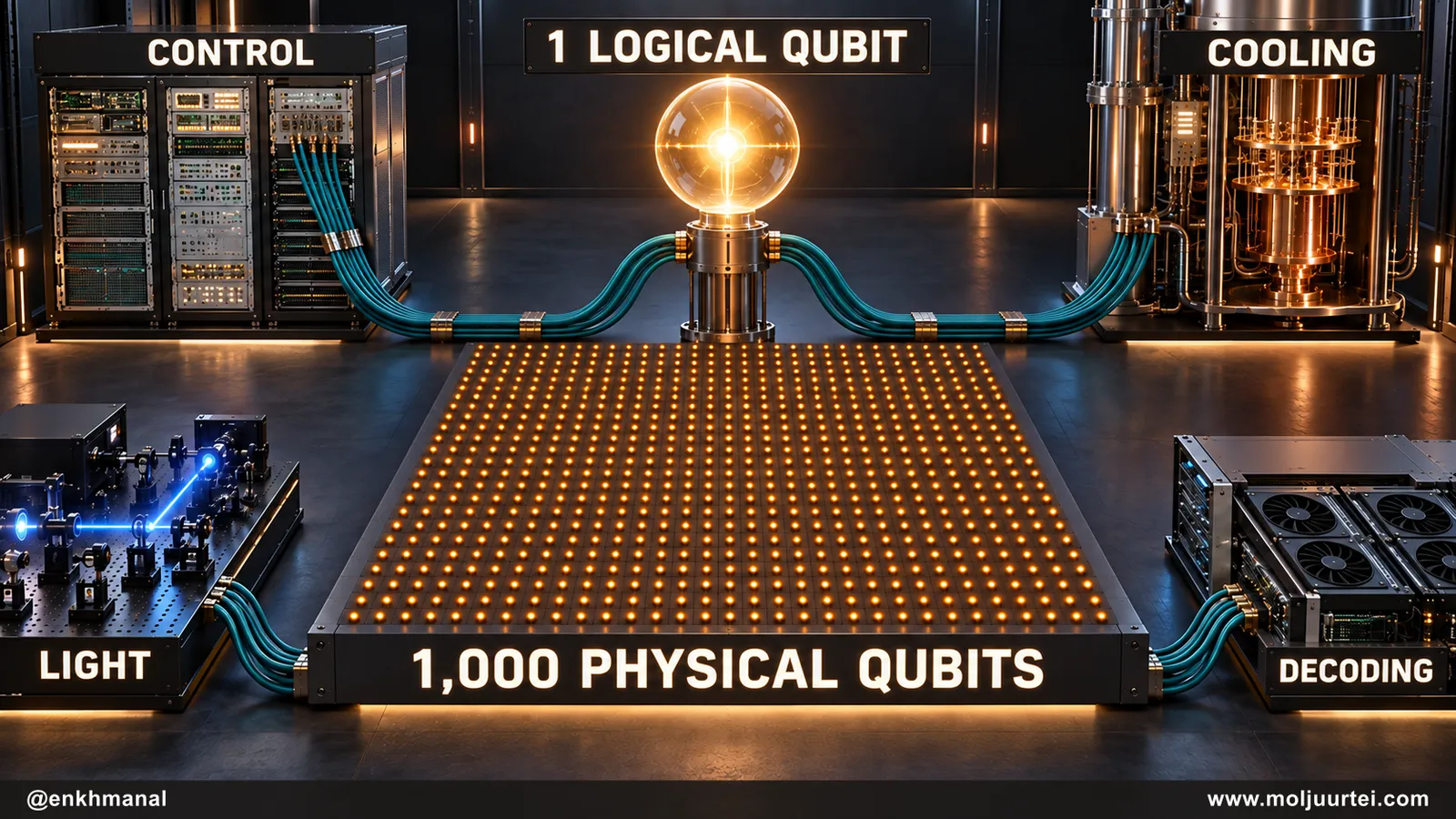
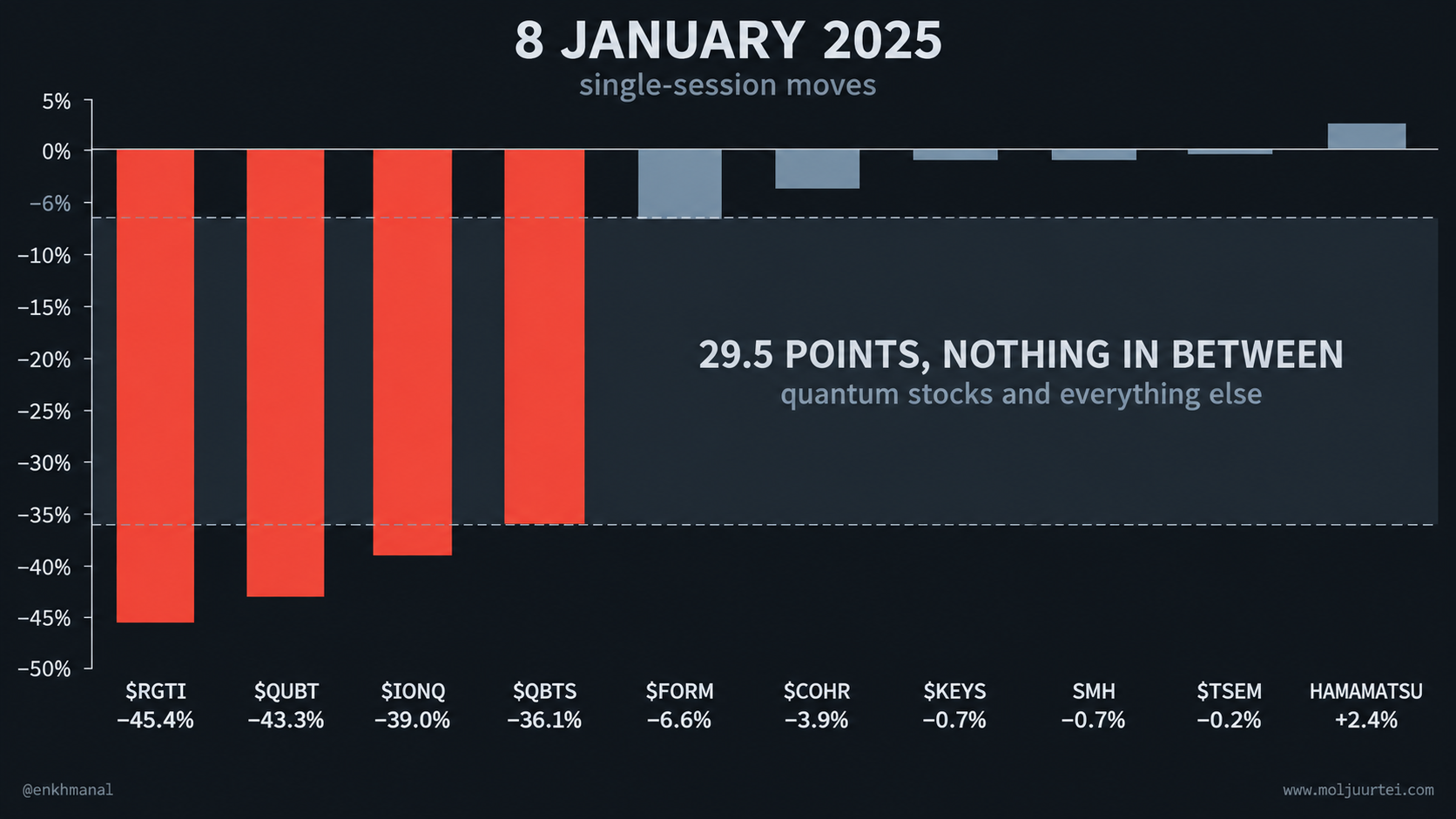
That multiplication is the whole investment case. Once error correction works, money flows to the objects around the qubit, because you cannot add a logical qubit without adding a thousand physical ones and everything wired to them. The four listed pure plays learned the other half of the lesson on 8 January 2025, the day after Jensen Huang told a Las Vegas audience that very useful quantum computers were fifteen to thirty years away. $RGTI fell 45.4%, $QUBT 43.3%, $IONQ 39.0% and $QBTS 36.1% in one session while the semiconductor index fell 0.7%. $COHR fell 3.9%, $KEYS 0.7%, and Hamamatsu, which makes the photomultiplier tubes that read out every trapped ion, rose 2.4%. One sentence took two-fifths off anything priced on quantum expectations and left the other cycles untouched.
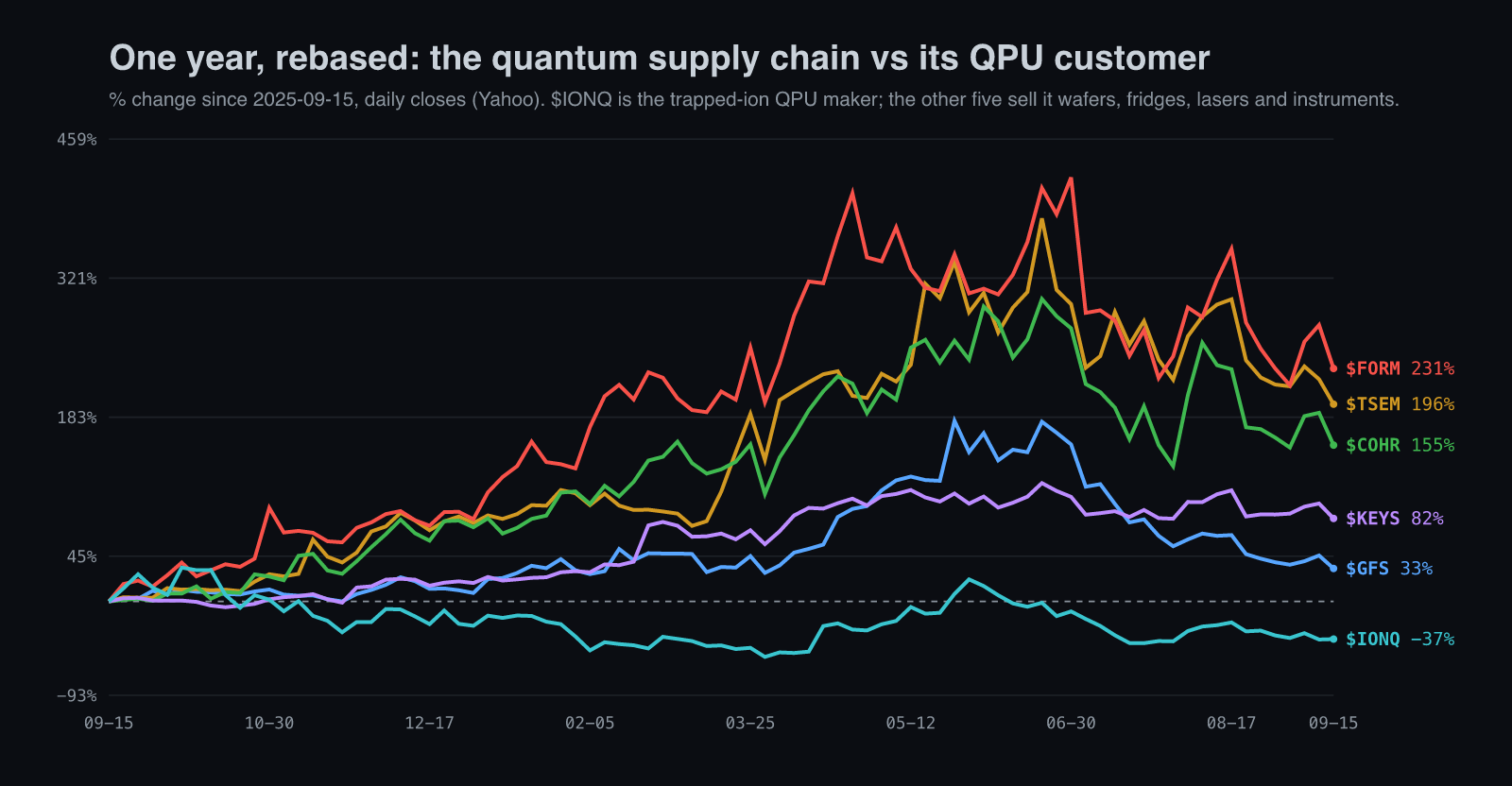
Since that day the four pure plays are down about 5% on average and the component layer beneath them is up well into triple digits, but the component return was built by AI optics and AI test, not by quantum. $TSEM is up 277% since 7 January 2025, $COHR 178%, $FORM 115%, $KEYS 89%; $GFS is down 1.8% and $IONQ down 25%. None of the component names breaks out quantum revenue. The honest description of this layer is a set of AI-cycle businesses that happen to own the tooling quantum needs next.
Government capital changed the shape of the downside in 2026. On 21 May the Commerce Department signed letters of intent worth $2.013B with nine companies, a minority equity stake being a condition of each: $1B to $IBM, $375M to $GFS, $100M each to Atom Computing, D-Wave, Infleqtion, PsiQuantum and Quantinuum, up to $100M to Rigetti and up to $38M to Diraq. The DOE's Quantum Genesis programme followed in June with a 2028 target for a scientifically useful fault-tolerant machine, DARPA is running eleven companies through Stage B of its Quantum Benchmarking Initiative, and the National Quantum Initiative reauthorisation cleared the House Science Committee in April. China answered in kind: Origin Quantum raised close to 3 billion yuan in July in a round led by China North Industries Group, a state-owned defence conglomerate.
Then the letters started converting. On 8 September D-Wave, Rigetti and Quantinuum each signed a definitive agreement for $100M with the equity condition executed; the three rose 6.6%, 4.0% and 1.7% that day and gave back more than half within two sessions, which is what a floor under financing rather than a floor under a share price looks like. $GFS signed the same week, and its filing is the one that tells you the price: a Securities Issuance Agreement dated 3 September under which it issues 9,907,399 ordinary shares to the Department of Commerce at $37.85, with transfer restrictions that bar a sale to any competitor and voting limited to class matters or a merger. Five letters remain open, including $IBM's billion.
Mechanism — Why Now & How It Works
Five camps make the qubit out of five different things. Superconducting circuits ($IBM, Google, Rigetti, D-Wave) are fabricated with ordinary semiconductor tools and switch in nanoseconds, but only work a few thousandths of a degree above absolute zero inside a dilution refrigerator, with a control wire per qubit running into the cold. Trapped ions ($IONQ, $QNT) are single charged atoms held in vacuum by electric fields on a trap chip, flipped between two electron energy levels by lasers and read out by counting the faint fluorescence one state emits; the fidelity is the best in the field and the gates are the slowest. Neutral atoms ($INFQ, QuEra) are pinned by focused laser beams instead of fields, so the whole machine is a pile of lasers. Photonic qubits ($XNDU, PsiQuantum) are photons themselves, made on silicon photonics lines at room temperature and lost a little at every coupler. Silicon spin qubits (Diraq, Quantum Motion) are single electrons in transistor-like structures that a standard fab can make.
Nobody knows which physics wins, and the way around that is to notice what all five need once they grow. One fridge, one trap or one chip holds a bounded number of qubits, so every camp has to split into modules and reconnect them. Across a few centimetres microwave and superconducting wiring work; across a rack or a room the only path demonstrated to scale is converting the state into telecom-band light and sending it down fibre, which is why $IONQ linked two commercial systems by photonic entanglement in April and then bought a foundry, a quantum-memory company and a free-space optics company. Every camp also has to read its qubits out at cryogenic temperature and hand the result to a classical decoder fast enough to beat the error cycle. Those two jobs, cold readout and light, are the same job for everyone, and they are done on wafers.
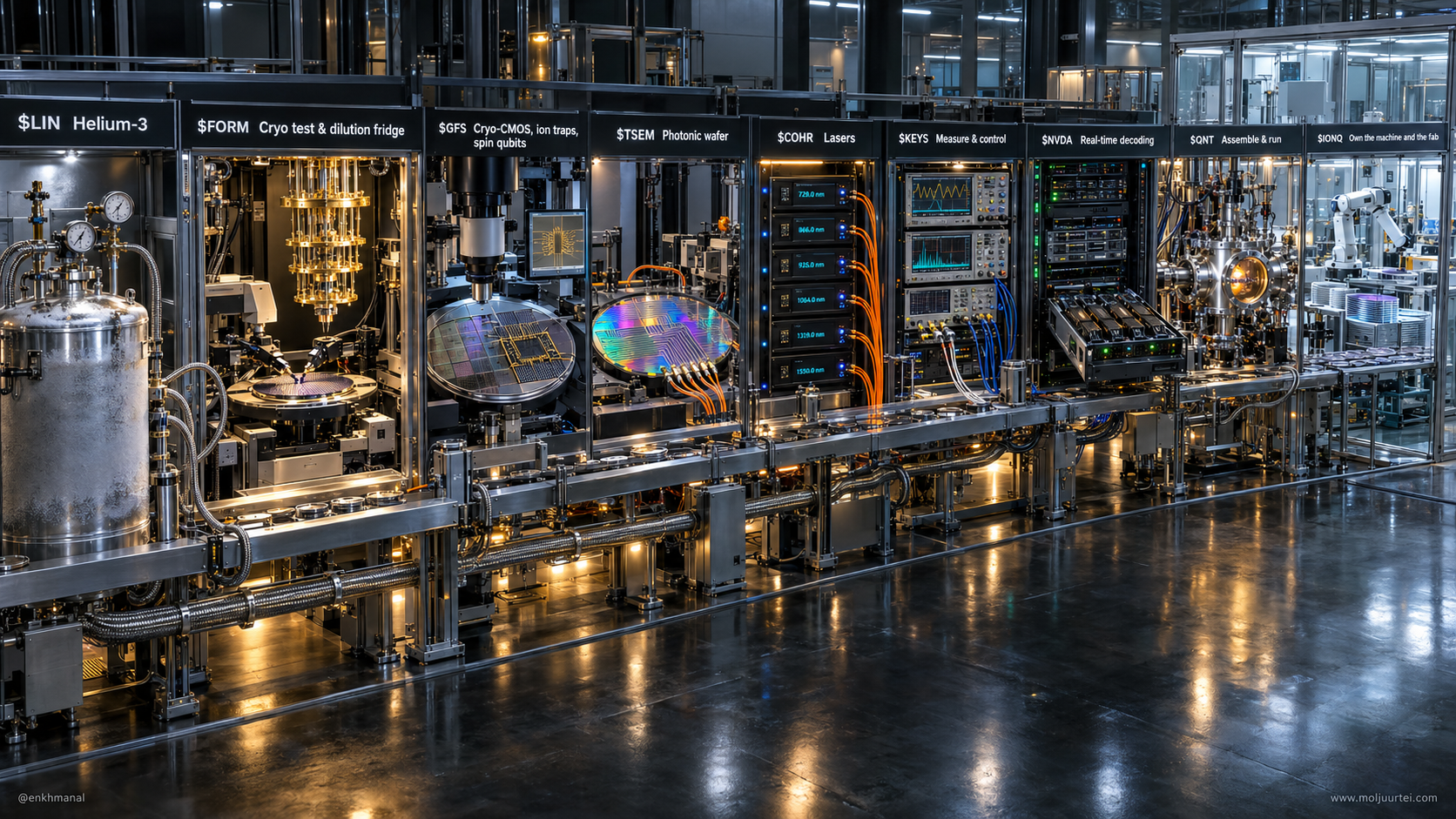
Follow where the quantum companies get their chips made and the wiring diagram of the industry appears. PsiQuantum fabs at $GFS on 300mm silicon photonics. Diraq, Quantum Motion and EeroQ, the whole silicon-spin camp, use the $GFS 22FDX cryogenic CMOS process. Quantinuum's next-generation ion traps and control electronics are named in its own Commerce agreement as being made at $GFS on 300mm wafers, with Monarch Quantum for lasers and Honeywell Aerospace for the current Sol traps. Xanadu co-designed a process with $TSEM that puts its own material stack on Tower's silicon photonics platform and has run multiple joint tapeouts. $IBM is building its own $2B quantum wafer foundry, open to outside customers, with the Commerce billion and a billion of its own. And $IONQ bought SkyWater, whose CEO now says the fab has nine quantum customers. Five camps, five kinds of physics, and the wafers come from four places, one of which is a captive.
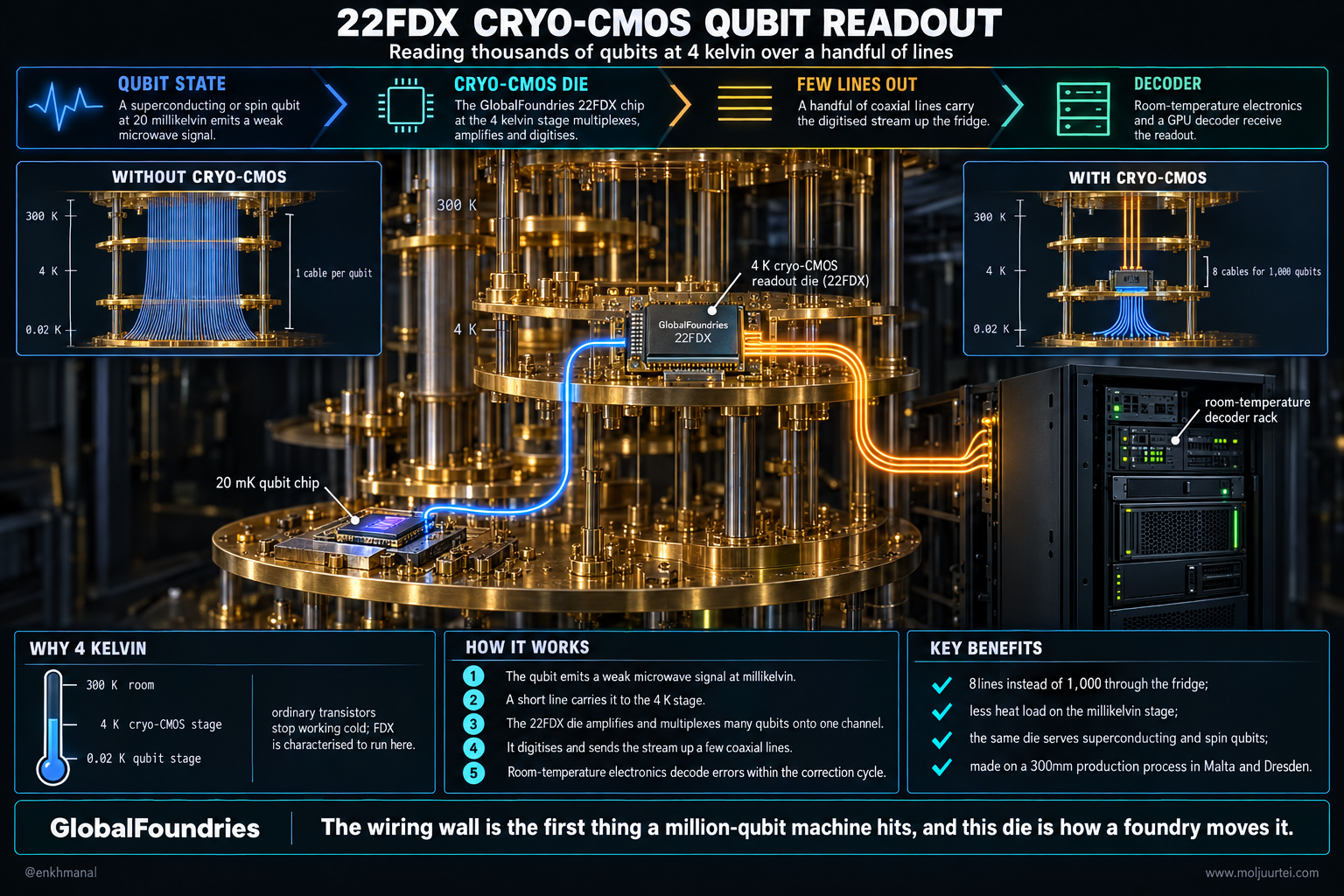
The company that fabs for three camps put the mechanism in one sentence at the Goldman Sachs conference on 8 September, the morning its own award closed.
The bottleneck is not quantum science, it's high-volume manufacturing, and it relies on a lot of the stuff that we do very well when it comes to integrating novel materials, advanced packaging, high-speed interconnect, by the way, many of them using photonics or some kind of optical technology for high-speed interconnect. Then one thing that cuts across nearly every modality, which is that I have to be able to read out those qubits at very low temperature.
Two more things sit on top of the wafer. Real-time decoding is a GPU's job for now: $NVDA's NVQLink connects seventeen hardware builders and nine national labs to CUDA-Q, its April release shipped two real-time decoders, and Quantinuum ran correlated decoding on its Helios machine with an NVIDIA GPU decoder, the only company on the map with primary evidence on both the optical and the decoding axis. And the whole stack needs helium-3, which is not mined but recovered from tritium decay in the nuclear stockpile, so supply has nothing to do with quantum demand. $LIN sits there, though quantum is a rounding error against a $220B company and we do not put it in the basket.
Basket & Positioning
Seven names, seven links, ranked on three things in order: whether the business under the quantum exposure is real and growing, whether that growth is accelerating, and where the price sits against its own moving averages. Multiples are context and live in the valuation section. Theme exposure is stated as honestly as the filings allow, which for every component name means qualitatively, because none of them discloses a quantum revenue line.
$GFS is the lead name because it is the only company on the map that can document modality neutrality at wafer level. Its own Q2 deck calls the platform qubit-agnostic across superconducting, trapped ion, photonic, topological and silicon spin, anchored in New York and Vermont, and the CEO dates the work back seven or eight years to a single PsiQuantum engagement. The government has now paid for it twice over: $375M for Quantum Technology Solutions with the equity taken at $37.85, and a separate $300M letter of intent from July for next-generation photonics materials and packaging. Neither is in the revenue line yet. The chief technology officer was blunt about that at the May investor day, calling it a non-recurring-engineering business for the foreseeable future and then telling the room not to write off the economics.
Wait until you're putting a 1 million qubit module into a quantum computer. We do see, after the 2030 period of time, a significant commercial opportunity for it.
$GFS Up Close — the Numbers Under the Option
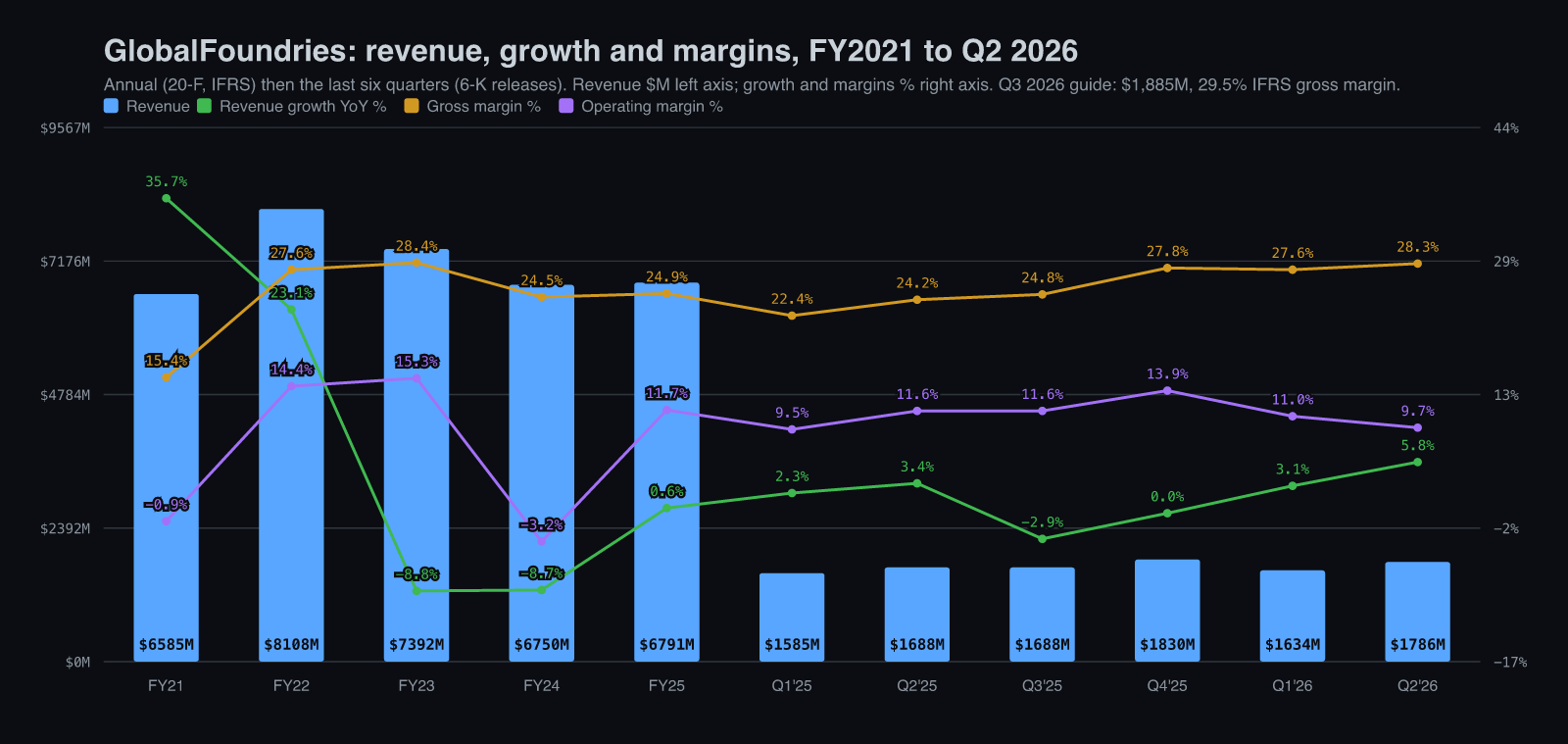
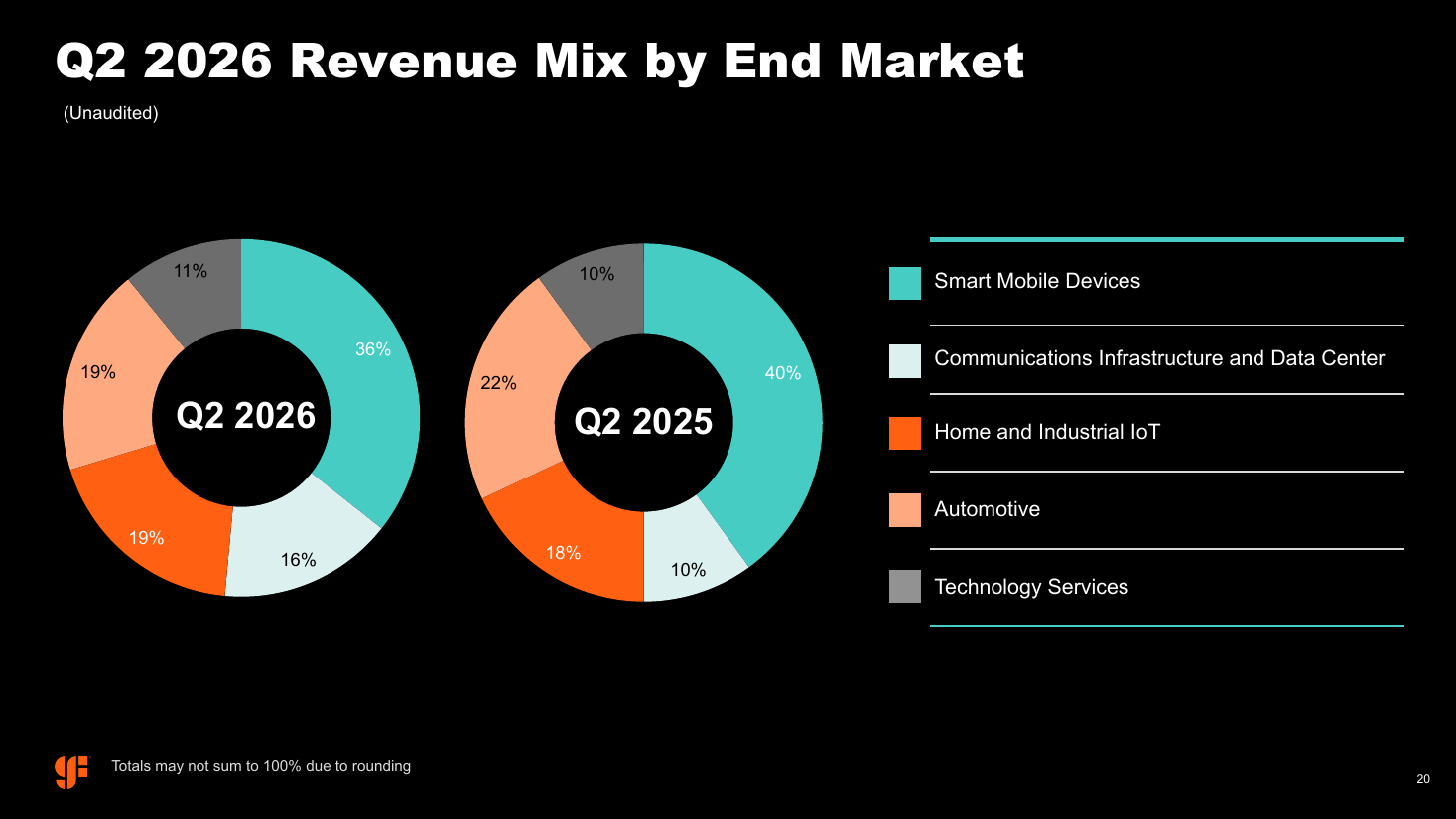
What pays for the wait is the rest of the company, and the rest of the company is accelerating. Revenue growth went from 2.3% in Q1 2025 to 5.8% in Q2 2026 and the Q3 guide of $1,885M implies about 12% year over year; gross margin went 22.4%, 24.2%, 24.8%, 27.8%, 27.6%, 28.3% over the same six quarters with the guide at 29.5%, on the way to the 30% exit-2026 and 40% exit-2028 targets. Communications infrastructure and data center revenue was $277M in Q2, up 62%, silicon photonics is guided to more than double in 2026 and to a $1B run rate exiting 2028, and the SiGe fab in Vermont is oversubscribed into 2027. The mix table below is the whole bull and bear case in five rows.
The data center line is now 16% of revenue and produced more than all of the company's growth: it added $106M year over year while smart mobile and automotive together lost $74M. That is the arithmetic of a mix shift, and it is why total revenue can grow 6% while the interesting part grows 62%. Cash against profit: Q2 operating cash flow was $405M against $587M of adjusted EBITDA, a 69% conversion, and adjusted free cash flow was slightly negative at −$3M because capital spending stepped up to $411M for the photonics and SiGe ramps. First-half operating cash flow of $947M against $1,148M of adjusted EBITDA is the honest run rate. The balance sheet carries $3.3B of cash and securities against $1.1B of debt, a new $1.5B revolver signed in August, and a $0.12 quarterly dividend started in July.
The Cold, the Light and the Meter — $FORM, $COHR, $KEYS
$FORM is the cryogenic link, and it is the name the market misfiles. It fell 6.6% on the Jensen day, the most of any component, and yet its measured sensitivity to quantum since then is zero, even though it is the one listed company that actually sells dilution refrigerators: it bought the JanisULT product line in June 2022 for $3.4M, describes itself as the largest commercial supplier in the United States, and launched the Flatiron benchtop unit at about 30 millikelvin in March 2026. The large system fridges for thousand-qubit machines are still Bluefors and other private names, so this is the device-validation stage rather than the system stage, but every camp headed to volume passes through it. What actually moves the stock is high-bandwidth-memory and co-packaged-optics test: Q2 revenue was a record $258.2M, up 14% sequentially, gross margin crossed 50%, the run rate crossed $1B, and Q3 is guided to $270M with a non-GAAP gross margin near 54% helped by tariff refunds worth about 300 basis points. The Systems segment, where the cryogenic business lives, set a record of $48.5M. Quantum came up once on the investor day and not at all on the Q2 call.
$COHR is the light source, and the only component name whose price moves with quantum at all, with a 64-session beta to the pure-play factor of 0.27 against effectively zero for every other foundry, metrology and cryogenics name. Trapped ions need lasers to flip states, neutral atoms need them for the tweezers that hold the array, and the photonic camp needs the source itself; Coherent also holds indium phosphide capacity. Management named quantum as a longer-term industrial opportunity on the fiscal Q4 call and nothing more, which under the standard we apply keeps it below the names with a disclosed customer. The business paying for the option is the biggest in the basket: fiscal 2026 revenue of $7.12B, a fourth quarter of $2.05B up 34%, a first-quarter guide of $2.2B to $2.4B, and net leverage cut from 2× to 0.7× in a year.
$KEYS is measurement, which discriminates by nothing. Whatever the qubit is made of, its state has to be generated, read and characterised, and Keysight's instruments go into every camp and every national lab. It is also the highest-quality income statement in the basket: fiscal Q3 revenue of $1,846M up 36%, orders up 56%, an operating margin of 33.2% above its own long-term target range, and a fiscal-year guide of 32% revenue growth with earnings up about 60%. Quantum was not mentioned once on the call, and it is the smallest quantum exposure we hold as a share of the company. It is also the only member trading above its 200-day average.
The Photonic Foundry and the Machines — $TSEM, $QNT, $IONQ
$TSEM is the photonic camp's foundry, and the one already priced for the AI cycle. Tower co-designed a process with Xanadu that puts a Xanadu-specific material stack on its silicon photonics platform, and the two have run multiple joint tapeouts; Xanadu's quarterly revenue is $1.5M, so the quantum line here is a relationship, not a number. Everything else about Tower is running hot: Q2 revenue of $460M with record 30% gross and 20% operating margins, a Q3 guide of $520M that annualises above $2B, a 2028 model raised to $3.6B of revenue and $1.2B of net profit, and a dual-track 300mm expansion in Japan with the government's support. Up 196% in a year and 277% since the Jensen day, it is the name in the basket where the AI optics story is most fully in the price.
$QNT and $IONQ are the machines, and we treat them as one small sleeve rather than two positions. Quantinuum is the only company on the map with primary evidence on both convergence axes, integrated photonics and cryogenic electronics at $GFS on one side and GPU-accelerated real-time decoding on Helios on the other, and it has a roadmap with dates: Sol in 2027 at 192 physical and 100 logical qubits, Apollo in 2029 as the first fully fault-tolerant system, positive free cash flow targeted for 2030 and beyond. Second-quarter revenue was $8M, up 279%, year-to-date bookings about $81M against a full-year target of at least $120M, and the stock is 19% below its $60 June IPO price. IonQ is the revenue leader by a wide margin, $80.1M in Q2 and on track for the better part of $300M of platform revenue this year before SkyWater, and it has done the thing this memo is about: it bought the fab. Its Superion 256 processors are being produced by the wafer at SkyWater with electronic rather than laser qubit control, and SkyWater's CEO says the fab now has nine quantum customers. Neither name has a government equity anchor in IonQ's case, and both fall 30% to 45% in a day if a second Jensen moment arrives.
One name we did not underwrite belongs in the footnote. Hamamatsu Photonics (6965.T, buyable on Interactive Brokers) makes the photomultiplier tubes and photon-counting heads that read out trapped-ion fluorescence and the scientific cameras that image neutral-atom arrays, was the only name on the map to rise on the Jensen day, and what drives its share price is semiconductor inspection and medical imaging. It is the eighth link for a reader who wants detection covered; we have not read its filings and do not rank it.
Management & Track Record
A pedigree is not a record, so the table says which one each name has. Three of the seven chief executives are new since 2024; the foundry's is the newest at the helm and the longest inside the building.
The controlling shareholder is part of the management story at the lead name. Mubadala held 77.05% of $GFS after selling 20 million shares to the public at $42.00 in March 2026 alongside a $300M company buyback, and it retains board consent rights until its stake falls below 30%. The government's 9.9 million shares at $37.85 sit beside it as a second holder that has agreed not to sell to a competitor and not to vote on ordinary matters. A free float near a quarter of the register is a fact about how this stock trades, and every sustained re-rate so far has been met with a secondary.
Risks & What Breaks It
What forces a change of view: a DARPA Stage 3 list dominated by one modality, a first quantum revenue disclosure from any member that is trivially small, or a $GFS third quarter on 11 November in which communications infrastructure and data center growth falls out of the high-thirties range management raised it to. Any one of those and we rewrite the ranking; the third breaks the lead name's case outright.
Price Setup — Levels and Dealer Positioning
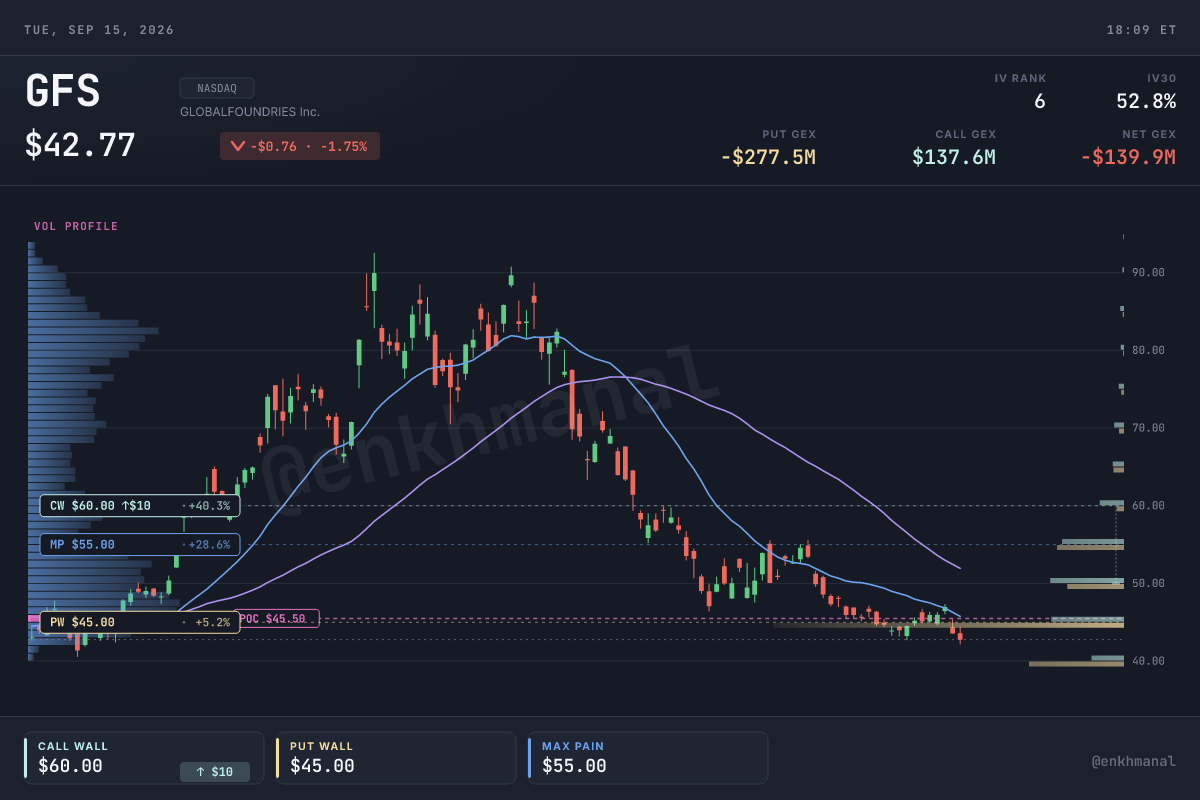
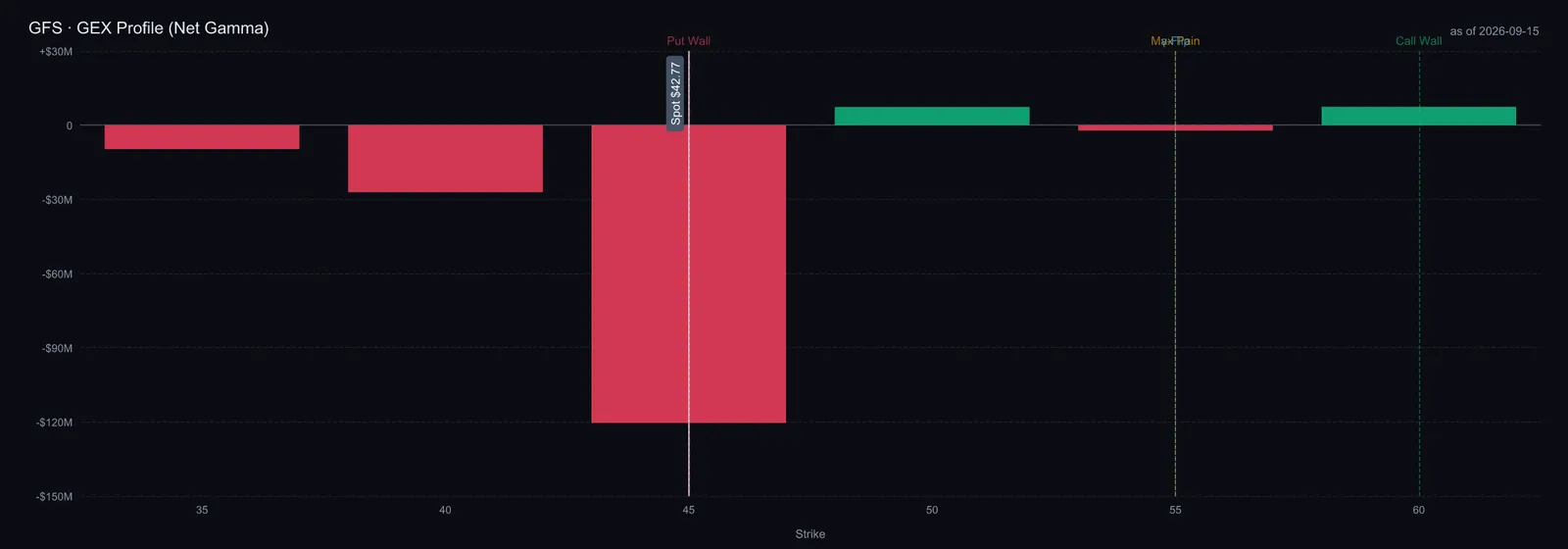
$GFS closed at $42.75 on 15 September, 52% below the $89.96 high of 26 May and 13% above the $37.85 the government paid on 3 September. The put wall sits at 45, now overhead, the nearest call wall at 50 with a larger one at 60 across all expirations, and max pain at 55; net dealer gamma has been negative for twelve straight sessions at about −$150M, so moves in either direction get amplified rather than damped. The first monthly expiry is 18 September and the next print is 11 November. The constructive way in is a starter position here against the government's entry price, an add on a daily close back above the 45 put wall, and the rest on a reclaim of the 50-day near $52, which is also where the July breakdown began.
Underwriting — Challengers and Payment Evidence
The map says who does which job. It does not say that buying one name per job diversifies anything, so before the House View we set each pick against its nearest same-role substitute, state what each name is actually paid for quantum, and, in the next section, ask what earnings growth today's price already assumes. Prices are the 15 September close; every figure comes from the company's own filed release, linked at the end of the next section.
Challengers. The foundry pair is $GFS against $TSEM. Both fab silicon photonics on 300mm; $TSEM's photonic line is growing faster (SiPho at a $680M annual run rate, guided to cross $1B in the fourth quarter) and its stock is priced for it, at roughly 62× its second-quarter earnings run rate against 21× for $GFS. $GFS is the only one of the two with wafer-level work for five qubit modalities and federal equity behind it, so it leads and $TSEM stays in the basket at the back. The machine pair is $QNT against $IONQ, both trapped-ion: $IONQ books ten times the revenue ($80.1M against $8M in the June quarter) and now owns its fab; $QNT has the fidelity record and the $100M Commerce award. Neither wins outright, which is why they share one sleeve. Against that sleeve we tested $RGTI, the superconducting challenger, and excluded it: $5.1M of quarterly revenue at 247× annualised sales, with a Commerce award the only thing it shares with the two we hold. In the light-source role we tested $LITE against $COHR and excluded it too: $LITE is the faster grower this year, but at 50× its guided earnings run rate against 35× for $COHR it is priced entirely for AI optics and discloses nothing on quantum, where $COHR has named the market and is the one component name whose price moves with it.
What each is paid. Only three of the nine are paid for quantum in a form we can point to. $IONQ recognised $80.1M in the quarter and guides $280–290M for the year, all quantum, before SkyWater. $QNT recognised $8M and guides $28–32M. $RGTI recognised $5.1M. $GFS is a different case: the Commerce Department's $375M award arrived as 9,907,399 shares issued at $37.85 under a securities issuance agreement signed 3 September; that is federal money for capacity, not a customer purchase order, and the company discloses no quantum revenue line. The other four are proxies or unproven. $FORM's Systems segment, where the cryogenic probers and dilution refrigerators sit, posted a record $48.5M, but the segment mixes quantum with other systems and the company does not split it. $COHR, $KEYS and $LITE disclose no quantum revenue: for $COHR the evidence is management naming the opportunity and a measured price sensitivity, for $KEYS it is national-laboratory deliveries with no figure attached, and for $LITE there is nothing.
The buyer's alternative. Three substitutes compete for the same budgets. Bluefors, private and Finnish, is the largest maker of dilution refrigerators, and every Bluefors order is one $FORM did not get. Zurich Instruments, part of Rohde & Schwarz, sells an integrated qubit control stack that replaces a rack of general-purpose $KEYS instruments with one purpose-built system. And a machine maker can simply own the fab: $IONQ closed its purchase of SkyWater on 31 July, which removes one merchant-foundry customer from the pool $GFS and $TSEM sell into.
The Return Hurdle — What Today's Price Already Assumes
The screen asks what annual earnings growth each name needs over three years for the stock to return 12% a year, at two exit multiples. It is a sensitivity, not a valuation: the exit multiples are our assumptions, and the base is each company's latest guided quarter annualised, or, for the loss-making machines, guided revenue per share.
Read down the right-hand column. $GFS, $FORM and $KEYS clear 12% a year on single-digit earnings growth if their multiples hold, and each guides sequential growth in the current quarter. $COHR needs high-teens growth at a multiple below its own history, which its AI optics line is delivering. $TSEM needs 40%-plus even at 30×; its 2028 model of $1.2B of net profit would make that number, and the stock already assumes it. The machines need earnings that do not exist yet to grow at rates no company sustains, which is the arithmetic behind sizing that sleeve for a 40% day. Share count cuts the other way: $GFS guides a flat 556 million fully diluted count and pays a dividend, while $QNT's 227.6 million Common Units sit above its 36.1 million Class A shares, so total-company growth there must exceed per-share growth by whatever the exchange and any new issuance add.
Decision. Buy, in the order given, with the review fixed at 11 November 2026, when $GFS reports its third quarter: communications infrastructure and data center revenue must still be growing in the high thirties and non-IFRS EPS must land at or above the $0.51 guide, or the lead name drops to a watch and the order is rewritten.
Sources: $GFS Q2 2026 release, $GFS securities issuance agreement, 6-K, $FORM Q2 2026 release, $COHR Q4 FY26 release, $KEYS Q3 FY26 release, $TSEM Q2 2026 release, $QNT Q2 2026 release, $QNT Commerce award, $IONQ Q2 2026 release, $LITE Q4 FY26 release, $RGTI Q2 2026 release, Bluefors dilution refrigerators, Zurich Instruments qubit control system.
Valuation & House View
Multiples describe what you are asked to pay; they do not set the order. On trailing GAAP earnings against each name's own five-year history, $FORM trades at 69.7× against a 42.5× median at the 74th percentile of its range, $COHR at 65.8× against 35.0× at the 52nd, and $KEYS at 42.9× against 30.4× at the 72nd; the whole layer is dear against its past because the past did not include an AI optics cycle. On forward earnings the picture inverts: Yahoo consensus puts $GFS at 16.3× forward, $COHR 19.4×, $KEYS 22.6×, $FORM 29.3× and $TSEM 29.9×. $GFS on its own filed numbers: a $23.8B market value at $42.75 on 556M diluted shares, $2.2B of net cash, an enterprise value near $21.6B, 9.1× trailing adjusted EBITDA of $2,362M and 23.5× trailing non-IFRS earnings of $1.82, or about 3.0× this year's revenue against the 6.5× it carried in late May.
The ranking follows the rule we hold ourselves to: a real business with a durable thematic tailwind first, accelerating growth second, price trend third. $GFS wins the first test outright, is the only member whose growth is accelerating from a low base with a guided step-up, and loses the third, trading below both its 50-day at $51.94 and its 200-day at $53.63. $FORM has the most quantum-specific hardware after the foundry and the best margin trajectory in the group. $COHR and $KEYS are the quality pair, bigger and less quantum, and $KEYS is the one name whose tape has already turned, holding above its 200-day. The QPU sleeve is sized for a 40% down day. $TSEM is last only because it is the name whose good news is most completely in the price and whose quantum link is a single $1.5M-a-quarter customer.
The basket is a name worth owning in the order given, started now and built as the tape confirms. $GFS is a $60 stock on the company's own margin path and a $90 stock if the optics and quantum options both land, against a $32 downside that is mostly the controlling holder and the phone. $FORM and $COHR are bought on their AI businesses with the quantum hardware attached for nothing; $KEYS is the quality anchor and the only member already trending; the $QNT and $IONQ sleeve together should be sized so a 40% day is a bad week rather than a bad year. The date that decides whether this basket is a quantum basket or an optics basket is not on the quantum calendar at all: it is 11 November, when $GFS says how fast its data center line grew.