
$PUMP Deep Dive — pump.fun Won the Launchpad War; the Question Is How Much Reaches the Token
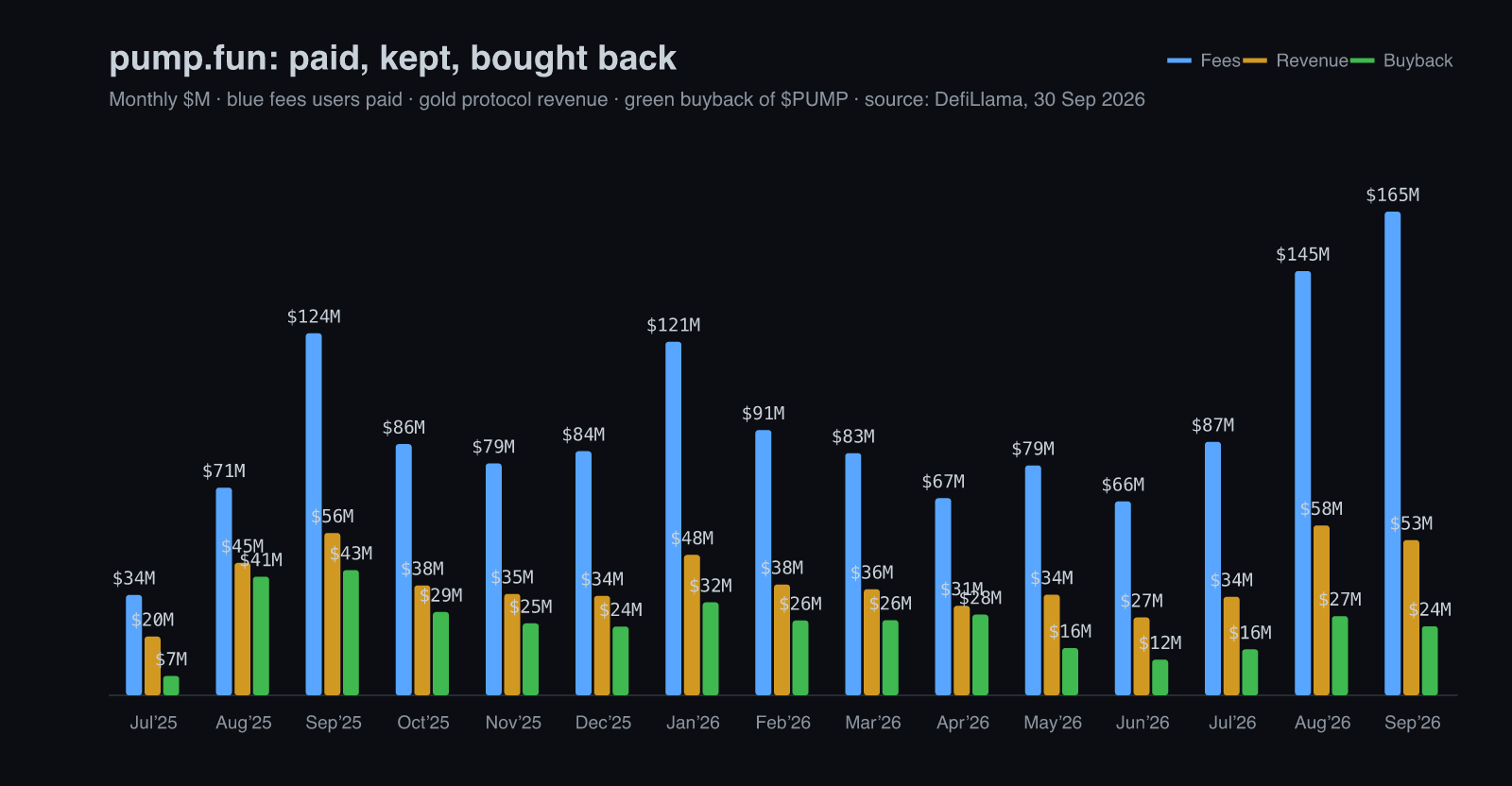
pump.fun is the website where most of the world's memecoins are born. In September 2026 its users paid $165.4M in fees across the launchpad, its own trading venue, its terminal and its new app, the most in any month since the platform opened in January 2024 and more than at the January 2025 peak of the memecoin mania (DefiLlama). pump.fun now owns every layer of a memecoin trade, from the launch to the screen it is traded on, and half of the protocol's revenue from three of those layers buys back and burns $PUMP under a contract that cannot be changed before April 2027.
The token has noticed. $PUMP traded at $0.0057 on 30 September, five times its 25 June low and 35% below its September 2025 high. The market cap of $2.66B is 9.7 times the buyback's annualized pace, up from 1.9 times in April, so the cheapness we wrote about in August is gone. What is left is torque: if the new app and the stock-paired coins double revenue, the token roughly triples; if memecoin trading falls back to June's level, it loses about three quarters. We would accumulate it, and we explain below where we would add.
What Changed — From a Free Coin to a Fee Business
Start here. A token is a digital asset recorded on a blockchain, and anyone can create one in seconds. A memecoin is a token with no business behind it, priced only by what the next buyer will pay for the joke, the community or the momentum. A launchpad is the website where those coins are created and first traded. A bonding curve is the launchpad's built-in market maker: a formula that sells the first tokens cheaply and raises the price with every purchase, so a coin can trade from its first second without anyone supplying cash to a pool. Graduation is the moment the curve fills and the coin moves to an ordinary trading pool, on pump.fun its own venue, PumpSwap.
Before January 2024, launching a token meant writing a contract, paying for a listing and putting up liquidity, so only teams with money did it. pump.fun made it free and instant, and it charges on every trade instead: 1.25% on the curve, then a tiered fee once the coin graduates. That is the whole business model, and its limits are plain. Memecoin trading is violently cyclical, a curve can be copied in a weekend, and the attention that drives it moves between chains. pump.fun has faced all three, and lost most of its market share once already, in July 2025.
Three things changed in September 2026. Fees hit a record. Two rivals, Pons on Robinhood Chain and StonkFun on Solana, briefly beat pump.fun on daily revenue by pairing new coins with tokenized stocks and paying their holders more, and pump.fun answered within days. And the token, which had traded below its July 2025 sale price for most of a year despite roughly $1M a day of revenue, broke out.
Thesis
pump.fun has turned from a single launchpad into the one company that owns every layer of a memecoin trade on Solana and now reaches other chains through its app; that stack earned more in September than at the peak of the 2025 mania, and half of what the protocol keeps from three of its layers retires $PUMP.
We called pump.fun the cheapest cash flow in crypto in August, at 7 times its buyback (our piece on the debasement trade). The token has doubled since. This memo asks the next question: with the obvious discount gone, is there enough growth left to own it?
Backdrop — Fees, Revenue, and the Year Nobody Wanted It
$PUMP was sold on 12 July 2025 at $0.004 a token. A third of the 1 trillion supply went in the sale, 18% to private buyers and 15% to the public, and the public tranche sold out in 12 minutes. The token peaked at $0.0088 on 14 September 2025. pump.fun then spent nine months putting nearly all of its revenue into buybacks, and the price still fell, to $0.00115 on 25 June 2026. The tokens it bought sat in a company wallet, and holders did not trust what would happen to them.
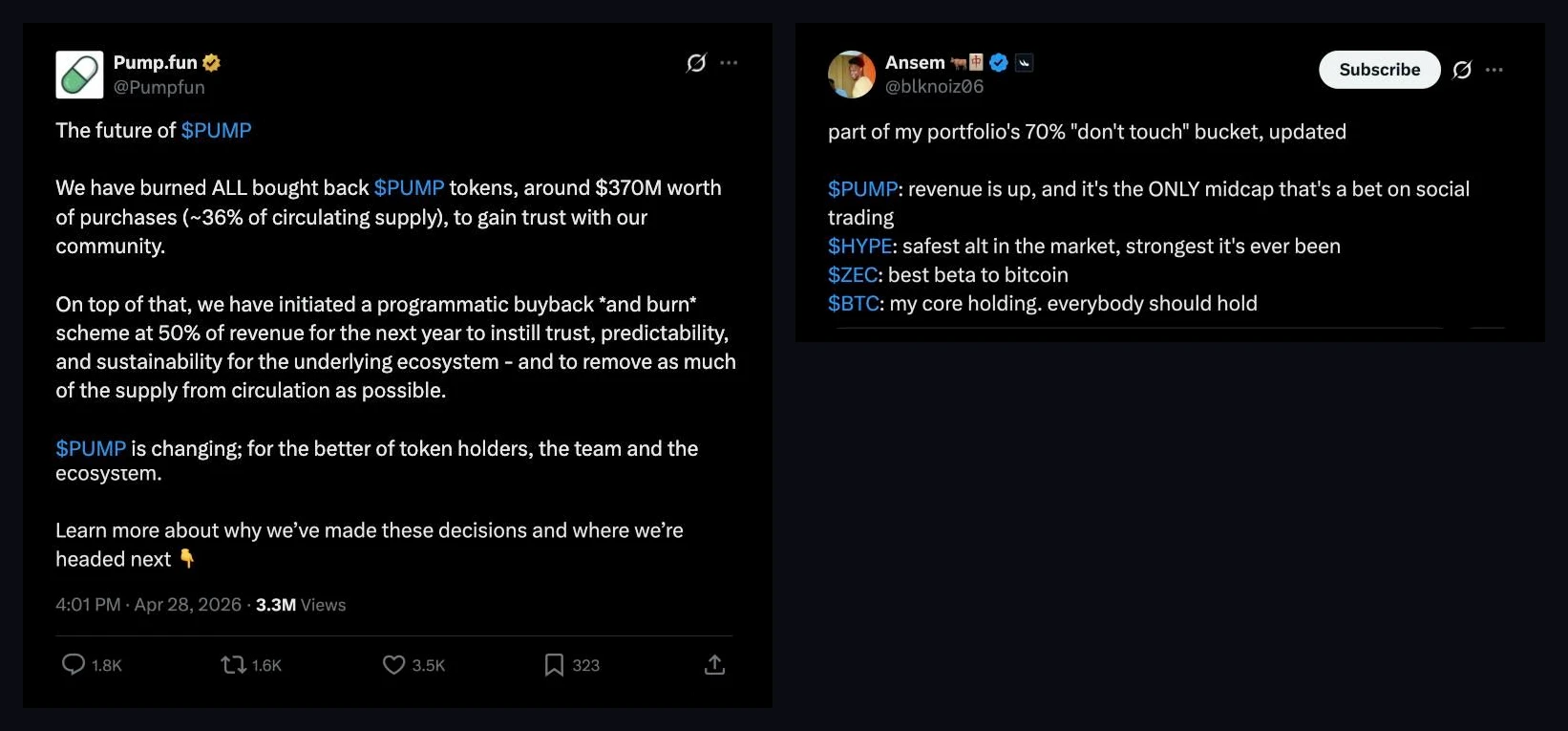
That changed on 28 April 2026. pump.fun burned every token it had bought back, about $370M worth or roughly 36% of the circulating supply, and moved to a smaller, permanent commitment: 50% of revenue, bought and burned by a contract locked for a year. Co-founder Alon Cohen's case for keeping the other half was that the business needs it for product, hiring and acquisitions. The market took two more months to believe it, and the low came in late June.
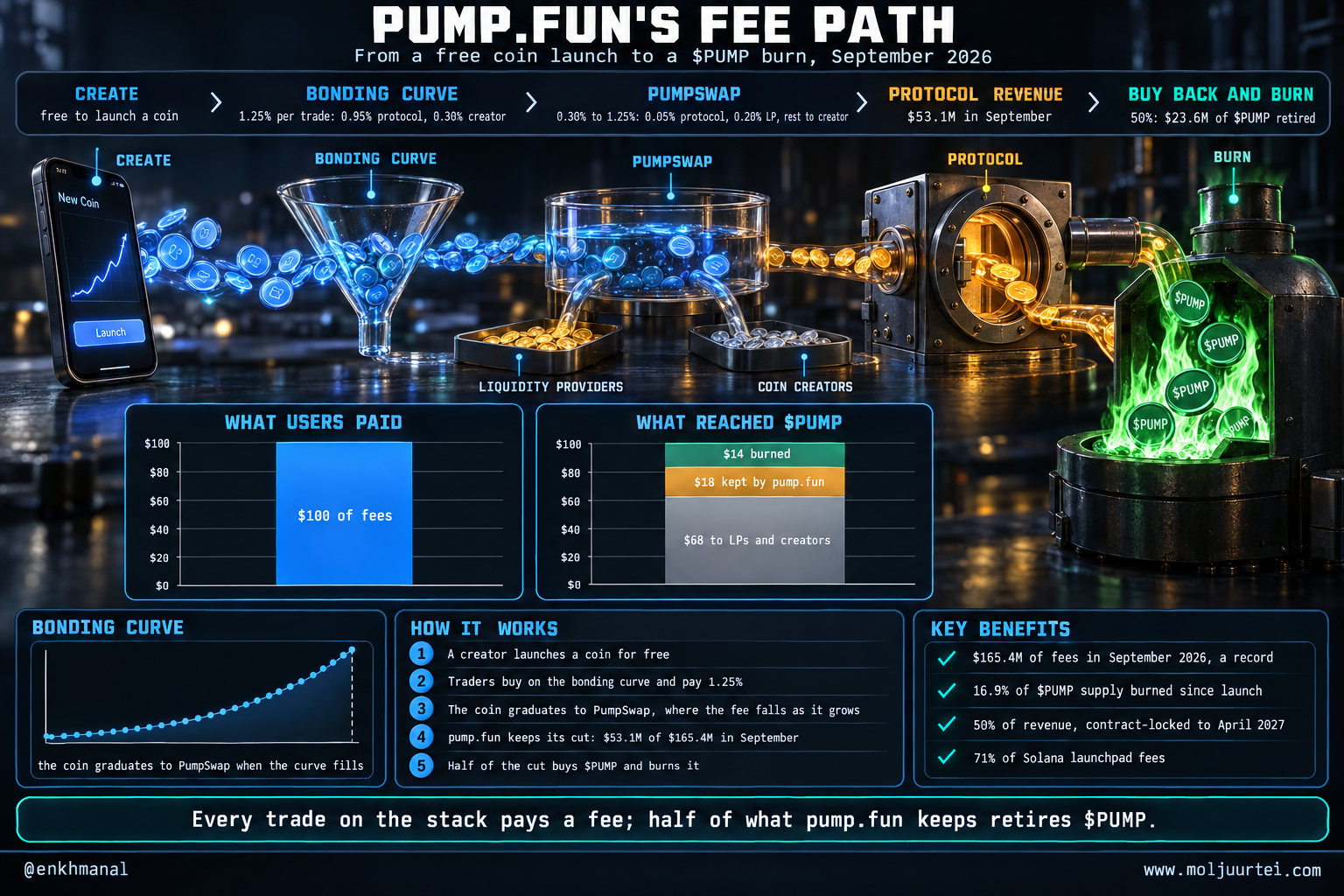
The revenue never stopped, which is the point of the chart below. DefiLlama reports three numbers for any protocol, and they answer different questions: fees are everything users paid, revenue is the protocol's cut, and holders revenue is the part that reaches the token. In September the three were $165.4M, $53.1M and $23.6M. Most of the gap between the first two is PumpSwap, where liquidity providers and coin creators take most of the fee.
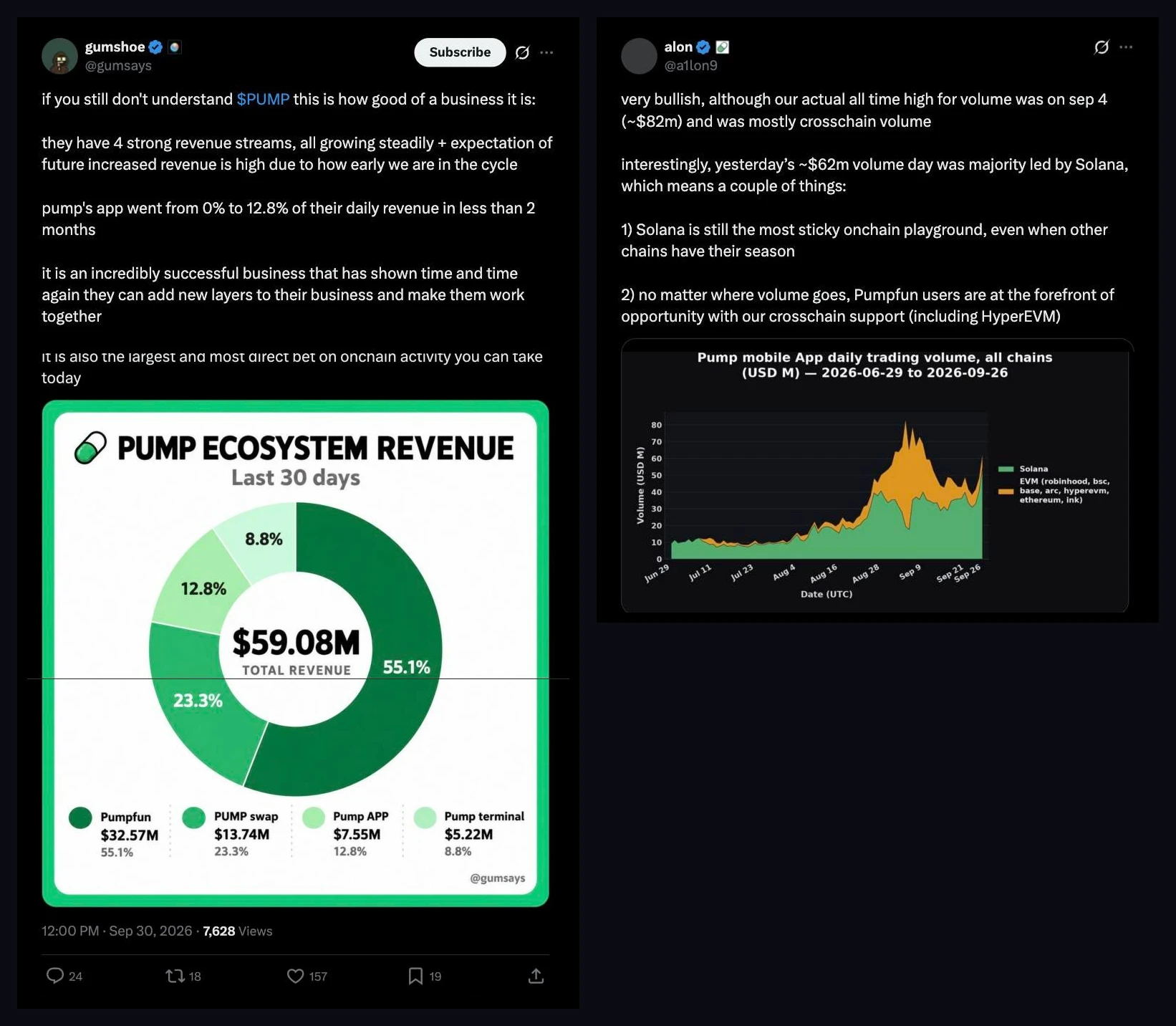
By product, September's fees split four ways: $46.4M on the launchpad, $106.1M on PumpSwap, $7.6M in the mobile app and $5.2M in Terminal, the trading front end pump.fun bought as Padre in October 2025. Messari counted pump.fun as the largest application on Solana by revenue in the first quarter, $124.7M of $342.2M across every app on the chain (WuBlockchain).
Mechanism — Four Layers, One Company
A memecoin trade passes through four layers, and each one can charge a fee: the launch, the pool the coin trades in after it graduates, the screen the trader uses, and the chain underneath. Most competitors own one layer. pump.fun now owns three outright and reaches the fourth through its app.
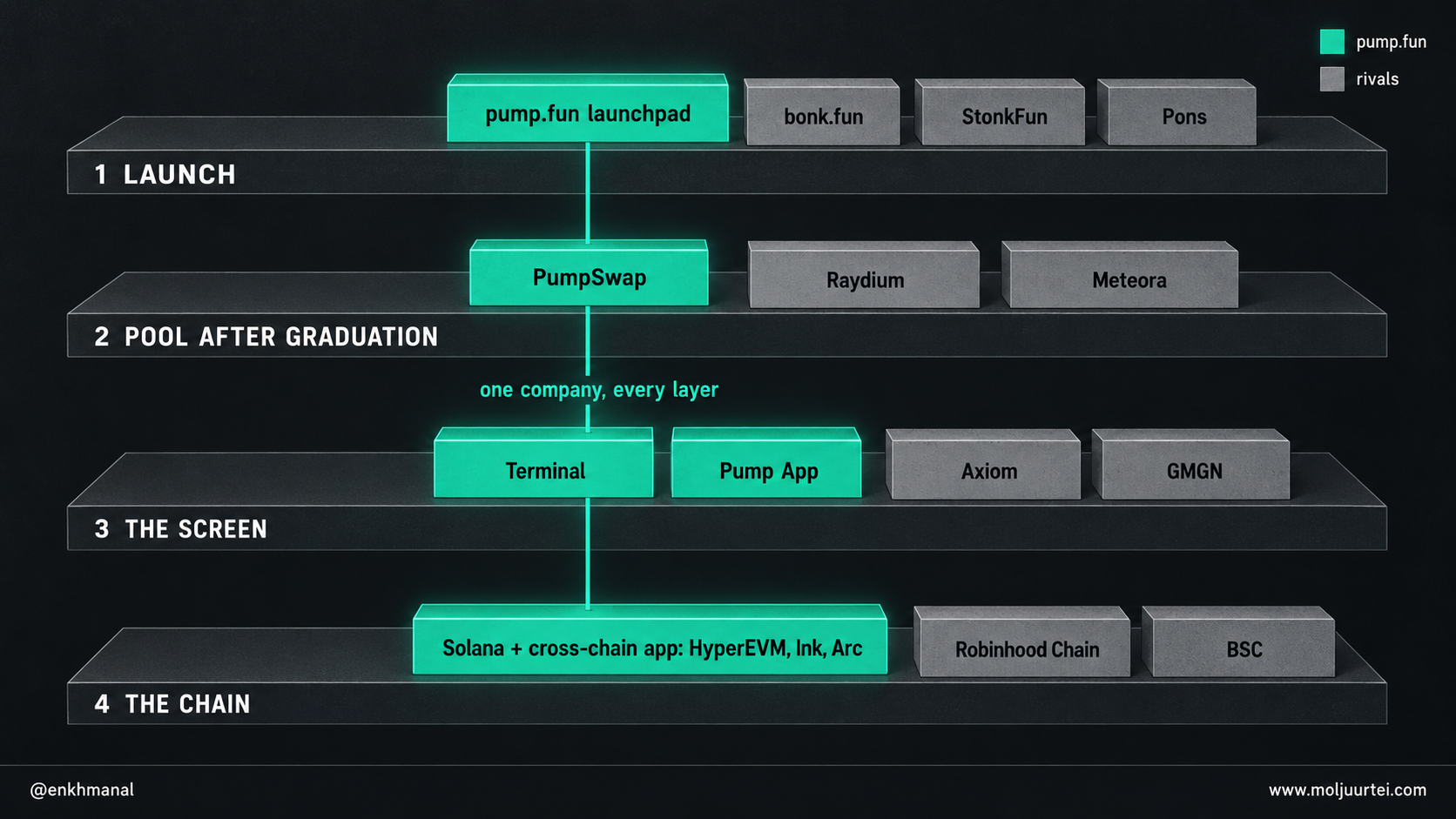
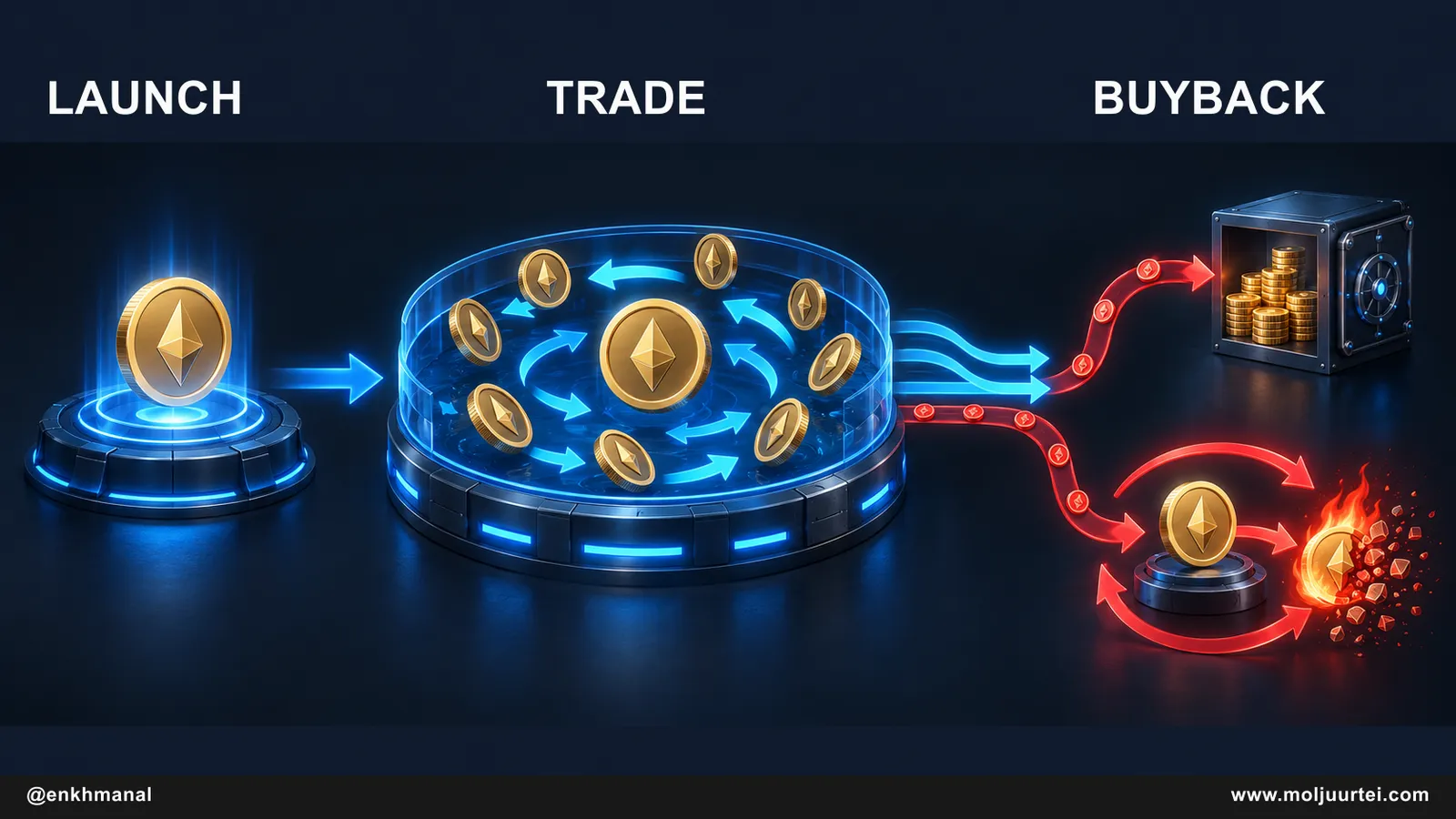
Two newer pieces sit on top. BOOST, live since July, puts about $2,500 into a five-minute purchase of each coin as it graduates and burns what it buys, which deepens the new pool; pump.fun reported $97M reinjected this way by 22 September. Custom Pairs, launched on 9 September, lets a creator pair a new coin with a tokenized stock, a major crypto asset or another memecoin instead of Solana's own token, with 93 pairs at launch through Sunrise and xStocks and over 70 more added three days later. Custom Pairs coins paid $1.08M of protocol fees in their first five days, by the company's weekly newsletter. Rewards complete the loop: $12M paid to users whose public calls drove volume in six weeks, and over $8M to holders of reward-paying coins.
Accrual — Half of Most of It, Locked Until April
The 28 April commitment routes 50% of net revenue from the bonding curve, PumpSwap and Terminal into a programme that buys $PUMP on the market and burns it, through a smart contract locked for one year (@Pumpfun). Custom Pairs revenue was added on 9 September. In the last days of September the programme spent about $1.0M a day and retired 177M to 195M tokens daily, according to @lbexplorer's tracker; at that pace a year of buybacks would retire about 14% of today's circulating supply. The company's own weekly figure for the week to 26 September was $6.37M bought back and burned, on $13.64M of protocol fees from the curve, PumpSwap and Terminal, up from $7.20M of fees in the first week of July (newsletter #13). CoinGecko put cumulative buybacks above $467M on 30 September, and the total supply now stands at 830.7B tokens, so 169.3B, or 16.9% of the original trillion, no longer exist.
Two details matter more than the headline. First, the app is not named in the commitment. It earned 12.8% of revenue in the last 30 days, which is why September's buyback came to 44% of revenue rather than 50%. If pump.fun brings the app inside the programme, holders revenue rises without any growth at all. Second, the lock runs out around 28 April 2027. Rivals pay their holders 60% to 80% of revenue by the counts traders cite on X, so the switch can be turned up; pump.fun kept half to fund the business, so it can also be turned down. Either way it is a date the market will price.
Supply is the other half of the ledger. The sale put 33% of tokens in circulation on day one; the team holds 20% and earlier investors 13%, and their first cliff unlocked on 12 July 2026. @mrnasdog counted 82.75B tokens out of locked wallets in the following 90 days against 22.61B burned, net supply up 12.9% (post), which matches CoinGecko's circulating count rising from 405.9B at the end of June to 465.2B now. Leaving a locked wallet is not the same as being sold, though. By the company's own count, recipients had sold only 8% of the tokens distributed to the team and early investors a week after the cliff, and about 84.5% had never left the receiving wallets (newsletter #3, #4). That is the issuer describing its own insiders, and we would want the wallets checked again after October's release. From here the arithmetic is closer to even: at September's revenue and today's price the burn retires about 68B tokens a year, and the remaining team and investor schedule releases on the order of $10M a month, about $36M in October alone by the unlock trackers.
Roadmap — What Shipped, and What Is Next
pump.fun ships faster than it promises, which is unusual in this industry and the best evidence of how the team runs. The record since the token sale:
What comes next is visible in the hiring and the product posts rather than in a published roadmap: more chains in the app (Cohen's line is that pump.fun will "never wall off other ecos"), more quote assets for Custom Pairs, and support staff for Terminal and the app. The open question is the buyback: whether the app joins it, and what replaces the one-year lock in April 2027.
One promise from the token sale is still open. The July 2025 announcement said the plan was to "Kill Facebook, TikTok, and Twitch", and 3% of the token supply was set aside for livestreaming. Streaming relaunched in 2025, but it does not appear as its own revenue line on DefiLlama or in the newsletters, so for now the social ambition shows up as Callout Rewards and the app's social trading rather than as video.
Mispriced — What the Market Is Paying For Now
For most of the past year the mispricing was simple: the market valued pump.fun's buyback at two to five times. That gap has closed. At the end of September the multiple was 9.7 times, the highest in the twelve months we can measure, because the price rose faster than the buyback.
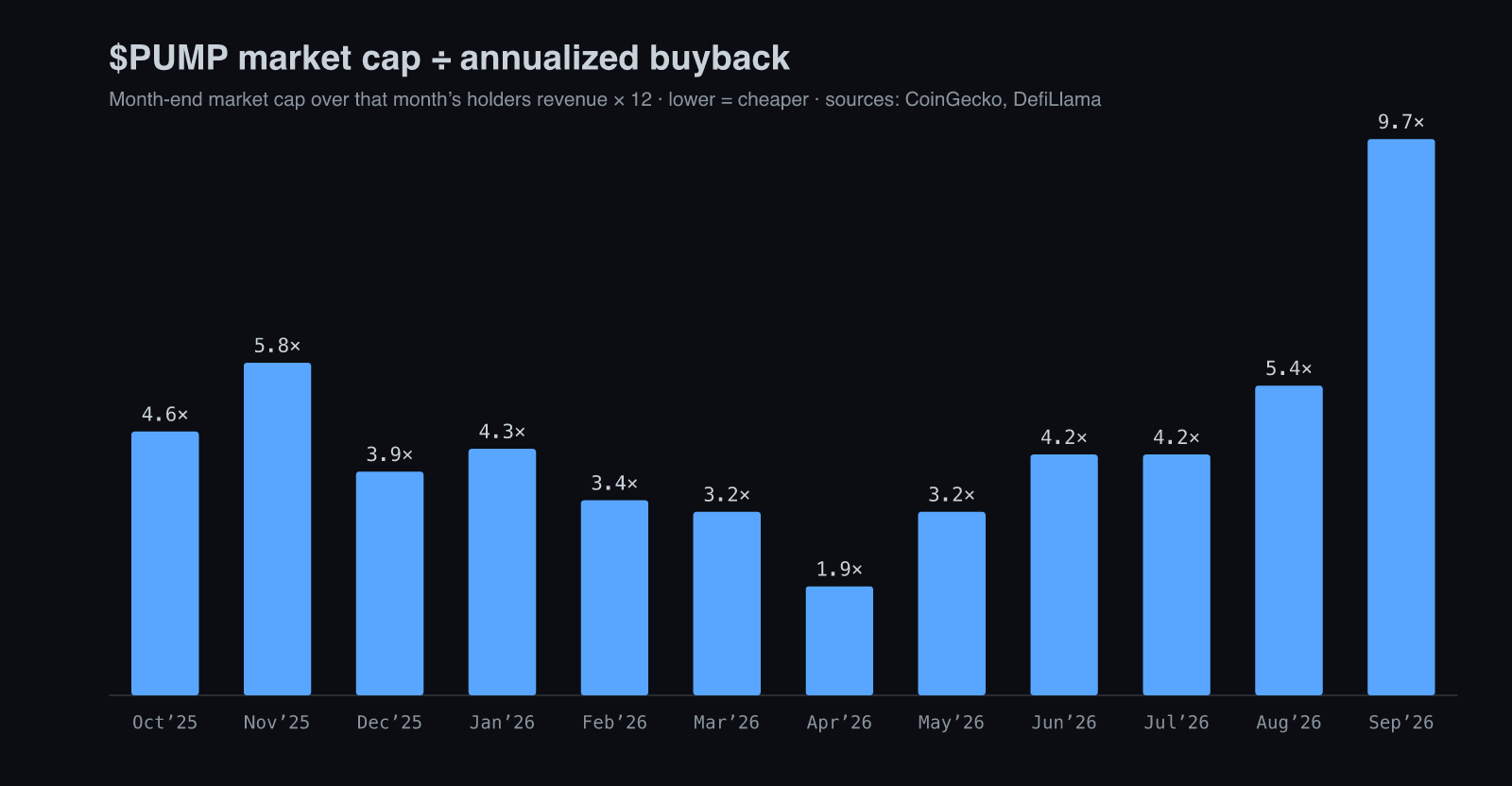
Against its peers, $PUMP now sits in the middle. $HYPE trades at about 29 times what it pays holders: a $19.5B market cap against about $663M a year of buybacks. The two rivals that briefly beat pump.fun trade far cheaper on revenue: $PONS at a $362M market cap against $24.1M of revenue in 30 days, and $STONK at $194M against $26.6M, by @lbexplorer's count. Pons also trades through Uniswap v4 pools on Robinhood Chain, so its growth feeds $UNI's v4 fee switch as well as its own token. Both are weeks old, and $STONK rose about 800% in September alone. pump.fun has 30 months of revenue history; that history is what the premium buys.
What we think the market still underprices is the shape of the next leg. Three things are new since August, and none is in the buyback figures yet. The app already earns an eighth of revenue and sits outside the programme. Custom Pairs ties new memecoins to the tokenized-stock market, which is growing quickly on Solana and on Robinhood Chain. And the cross-chain app means a rival chain's success is also pump.fun's volume. If even two of these work, revenue can double without a return of the 2025 mania, and doubling is what the bull case requires. The first is almost free to test: the app earned about $7.6M in September, and half of that in the buyback would add roughly $46M a year to holders revenue, lifting the buyback yield from 10.8% to about 12.5% at today's price without a single new user.
Management — Three Founders, a Treasury, and a Lawsuit
pump.fun was founded by Alon Cohen (@a1lon9, 420,000 followers, the public voice on product and fees), Noah Tweedale (@sapijiju, who runs the business side as chief executive of Baton Corporation, the company behind the platform, and writes its newsletters on X) and Dylan Kerler, the technical co-founder. In July 2025 an investor in the sale described a team of fewer than 20 people with an average age of 21 (WuBlockchain); it has grown since through two acquisitions.
The record is mixed in an instructive way. The team misjudged trust for nine months, buying back nearly all revenue into a wallet holders could not see the end of, and then fixed it in one decision by burning the whole stack. It answered the September attack with product rather than a bigger buyback, which costs holders in the short run and is the right call if the app and Custom Pairs keep growing. The sale raised about $1.3B at $0.004, and the company has kept half of revenue since April; neither the treasury nor the company's accounts are published.
Disclosure has improved alongside the burn. Since July, Tweedale has published a weekly newsletter with protocol fees, the week's buyback in dollars and tokens, the cumulative share of supply retired and product metrics, and the figures broadly match DefiLlama's. Two entities sit behind the token: Baton Corporation, the operating company, and a foundation that holds part of the allocation. Neither publishes accounts, so the weekly letter is the closest thing holders have to a report.
The lawsuit deserves its own line. Burwick Law says its civil racketeering claims against pump.fun and its co-founders, filed for two clients, survived the defendants' motions to dismiss on 31 August 2026 (Burwick Law). That is the plaintiffs' firm describing its own case; it means the suit proceeds, not that it has merit. It is the risk most likely to arrive without warning.
Risks & What Breaks It
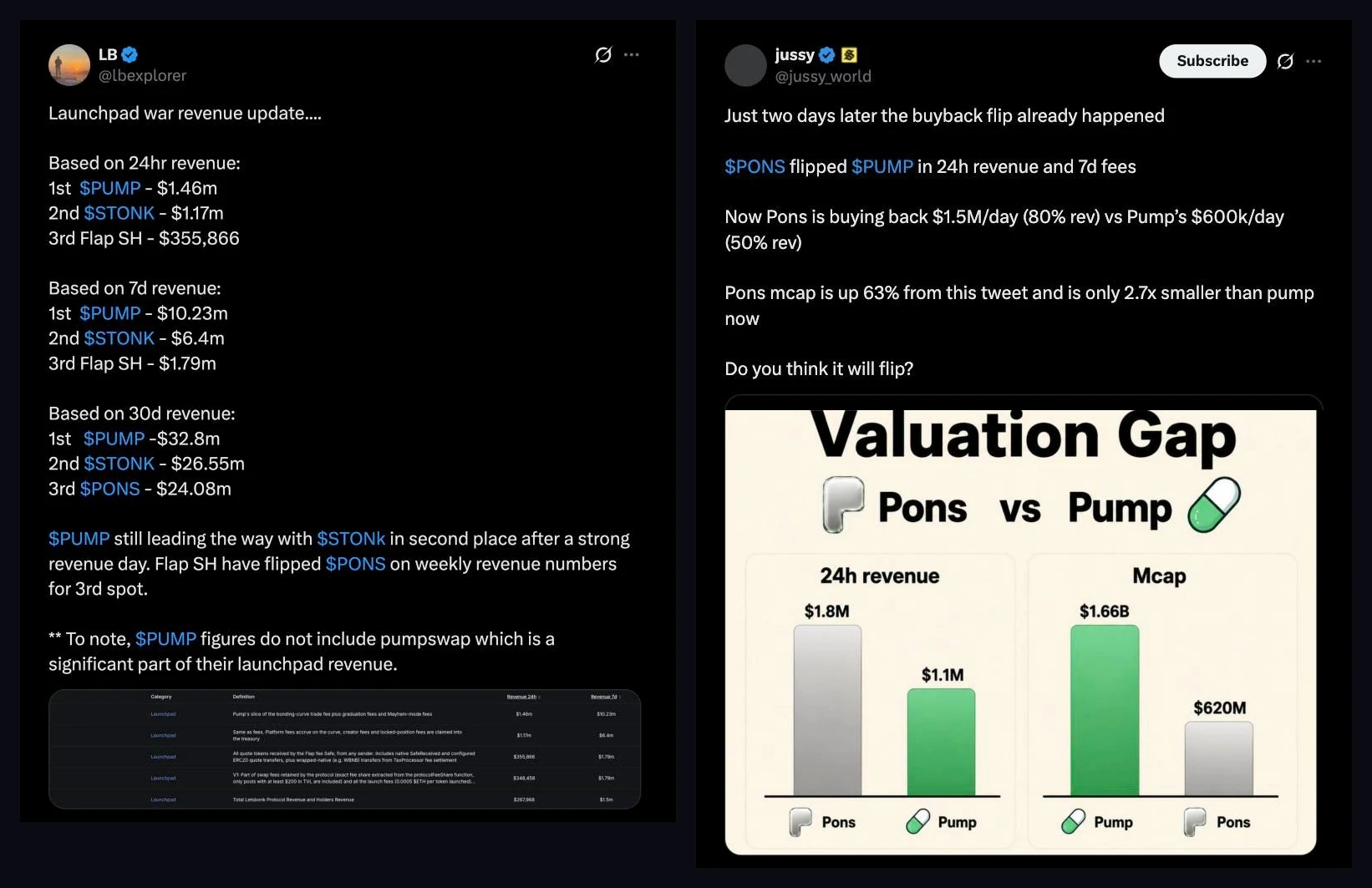
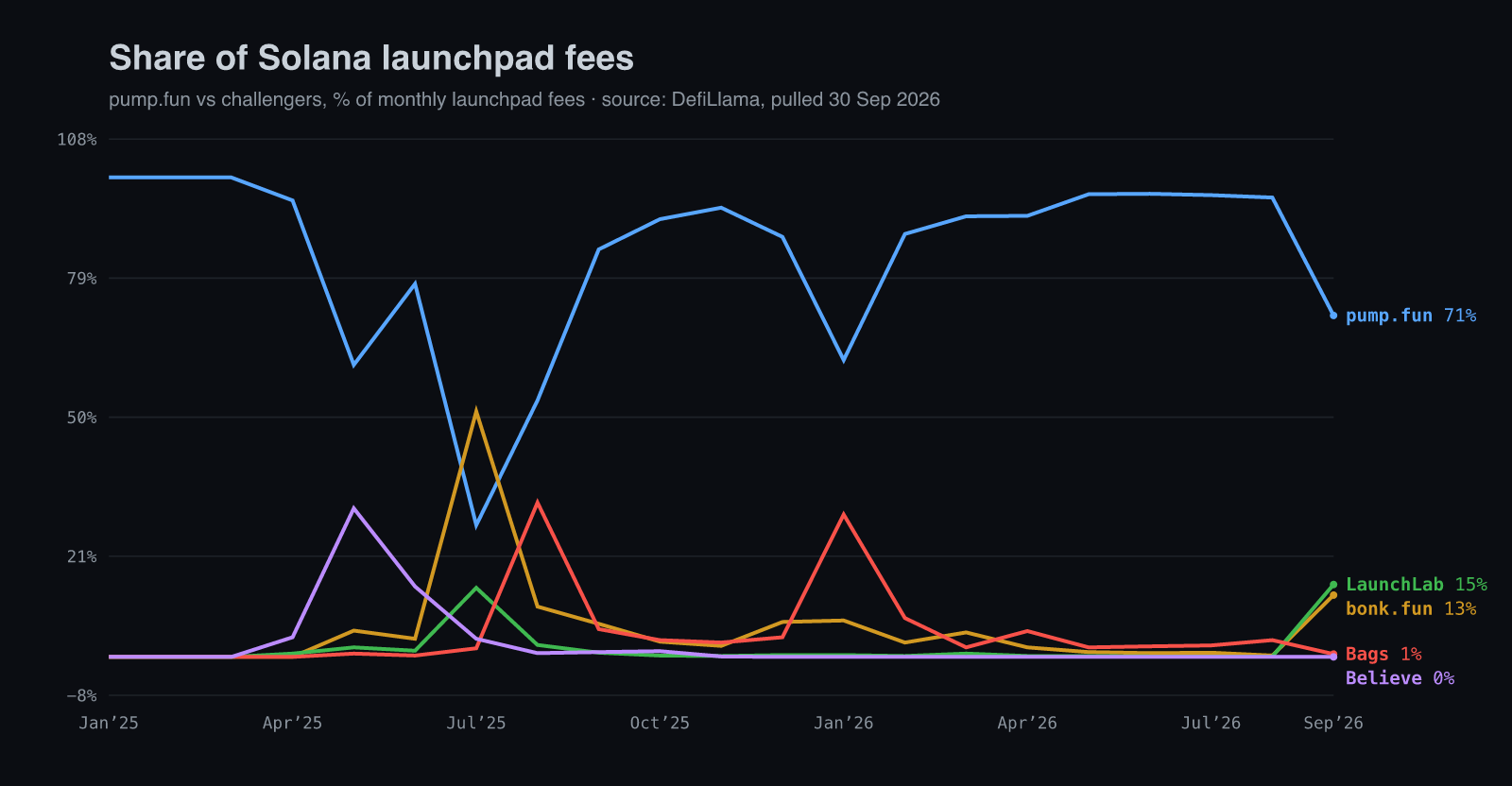
The competitive record is the clearest test of the thesis so far. In early September two launchpads with higher buyback shares overtook pump.fun on daily revenue for a few days; by the end of the month pump.fun led again on every window, without raising its own buyback.
Over a longer window the pattern repeats: share falls when a rival launches with a new hook, and returns when pump.fun copies the hook and its distribution does the rest.
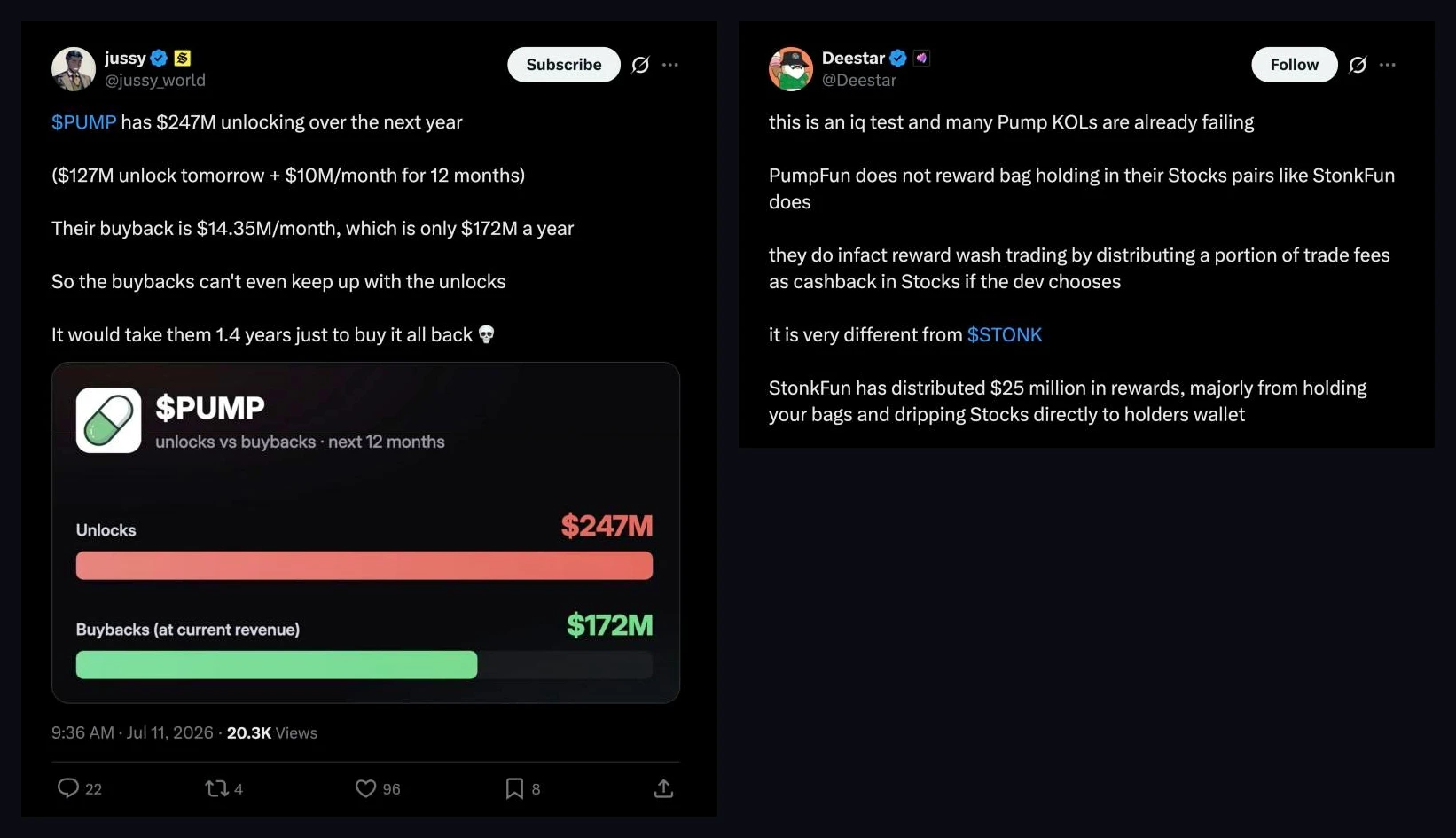
The bear case is better argued on X than in most research notes, and two posts carry it.
The single weakest assumption in our case is that September is a level rather than a peak. Every scenario below that makes money needs revenue to hold near $50M a month while the app and Custom Pairs grow.
Concentration on one chain is the risk behind the others. The app reaches HyperEVM, Ink and Arc, but September's record still rested on Solana: the company's own newsletter called 26 September the biggest single day since June, with $846M traded, as cross-chain speculation faded and traders rotated back to Solana. If activity leaves Solana for a chain where pump.fun has no launchpad, the app keeps some of the volume and the curve loses it.
Price Setup
$PUMP closed 30 September at $0.0057, up 43% in a week and 27% in a month. It sits above its 50-day average of $0.0042 and well above its 200-day average of $0.0024, which it crossed in July, and 35% below its high of $0.0088. Coin Metrics noted it is up 134% this year while the median memecoin is down 27% (Coin Metrics).
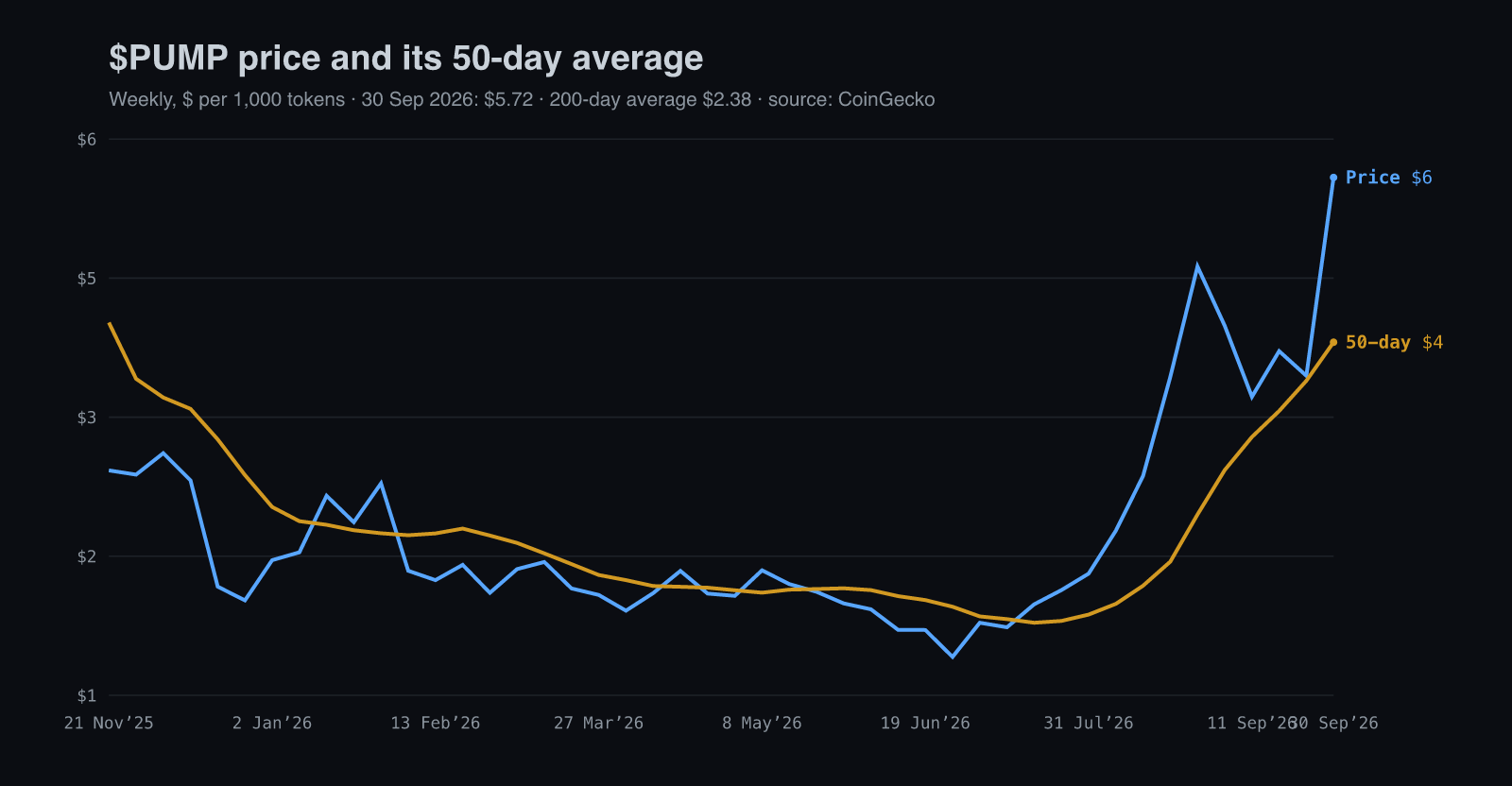
The levels we would use are $0.0052, the 24 August high the price closed above on 30 September, and $0.0042, the 50-day average. A close back below $0.0035, the 14 September low, would undo the breakout. A buyer in the United States can trade $PUMP on Coinbase and Kraken; it is not available on Robinhood. Binance carries the most volume. The ticker PUMP also belongs to ProPetro Holding on the New York Stock Exchange, so check the asset before placing an order.
Valuation & House View
We value $PUMP on what reaches holders, the only number the token has a claim on, and we hold circulating supply flat at 465.2B for the next twelve months because at September's run-rate the burn roughly matches the remaining team and investor unlocks. The hurdle: to return 15% a year for three years, holders revenue per circulating token must grow 33% a year if the market pays 6 times at the end, or 6% a year at 12 times. On a fully diluted basis the same 12-times hurdle is 36% a year.
The multiples are not arbitrary. From December to July, when the market doubted both the revenue and the insiders, the token traded at two to four times its buyback; our bear case uses five, so it is kinder than that history and assumes only a fall in revenue, not a return to the old discount. Nine times is today. Twelve times leaves a wide discount to $HYPE's 29 times, which we think the supply schedule and the lawsuit justify, and assumes only that a growing, cleaner business earns part of the gap back.
The distribution is what makes $PUMP worth owning: the bull case gains more than twice what the bear case loses, and the base case costs little. We would accumulate: a first position at today's price, adding on a retest of $0.0052 and again at the 50-day average near $0.0042. We would add more on any of three triggers: the app's revenue joining the buyback, the buyback share rising above 50%, or monthly revenue above $60M for two months. We would cut if pump.fun's share of Solana launchpad fees stays below 60% for two months, or if holders revenue falls below $15M a month for two. We review the position by 5 November 2026.