
Physical AI — Who supplies the robot’s eyes, safety and brain?
What has since been reported: Intuitive’s October 20 release reported $3.05 billion Q3 revenue, 22% growth, 14% da Vinci procedure growth and 12,094 installed da Vinci systems. GAAP EPS of $1.49 included a $450 million pre-tax litigation settlement; non-GAAP EPS was $3.00. This supports recurring procedure economics but adds a material earnings qualification.
Teradyne’s October 27 release reported $1,306 million Q3 revenue, including $96 million from robotics, and said robotics achieved profitability. Robotics was about 7.4% of revenue; it was no longer accurate to call the latest segment loss-making. Amphenol’s October 28 release reported $10,229.7 million revenue versus $6,194.4 million, about 65.1% growth, including 37% organic growth. Neither figure isolates robot demand.
Still to be tested: Cognex confirms November 4 after-close results and a November 5 call. The RealSense announcement still describes a proposed Q4 close, not completed ownership. BlackBerry’s September QNX results remain the dated evidence here. Tesla’s September-quarter filing continues to describe investment in large-scale Optimus production without a separately quantified robot-sales segment. Production progress is not the same as demonstrated commercial revenue.
A robot repeatedly senses its surroundings, proposes an action, checks safety limits and moves. Suppliers can earn from that loop across different robot designs. BlackBerry's QNX revenue grew 27% in its August 2026 quarter, mainly from automotive demand; Cognex agreed to acquire RealSense, a robot-depth-camera supplier expecting more than 50% growth. These are potential routes into physical AI, not proof that robots already drive either company's results. This October 9 market snapshot compares twelve suppliers and operators. NVIDIA provides a broad computing platform, while data centres still dominate its revenue.
Thesis
Physical AI needs perception, computation, bounded safety functions and actuation on the machine. Standard components may earn per-unit revenue across designs, but robotics exposure must be separated from automotive, factory automation and AI data-centre demand. QNX and Cognex offer specific routes; their robot contribution is still early and incompletely disclosed.
Backdrop — How Physical AI Got Here
Start here. A robot senses the world, computes an action and moves a tool or its body. Traditional programmed automation excels at repeatable work in a controlled environment. Many conventional robots already use vision and operate collaboratively; their limitation is not that all must be caged, but the effort required to handle changing objects and tasks. Learned AI models can extend that adaptability, within a defined operating domain. The control loop reads sensors, computes commands, drives motors and measures the result. Separate safety functions can limit or stop unsafe operation. The investment question is who supplies each part and how usage becomes revenue.
The customer's problem is old: a factory, a warehouse or a hospital wants work that a person does today done safely and without stopping. The incumbent answer is the caged six-axis arm and, in warehouses, fixed conveyors and automated shelving. Both work because the environment is held still: the same weld on the same car door, the same tote on the same rail. Their limit is the same fact seen from the other side. Anything unstructured, a jumbled bin, a shared aisle, a patient on an operating table, needs a machine that can see what is actually there and adapt.
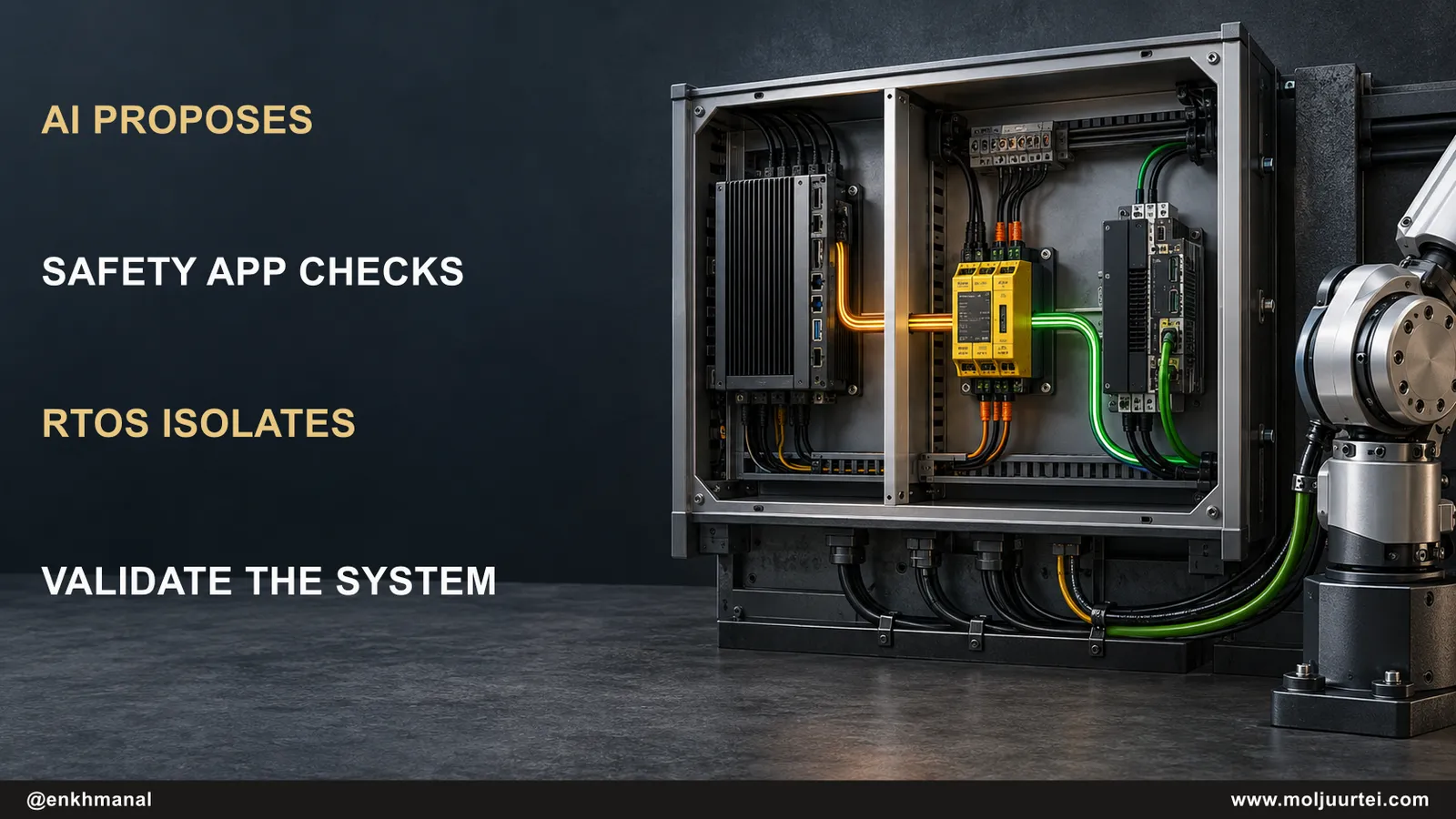
Learned models increase adaptability, but uncertain outputs need independent limits. On-machine perception and computation reduce dependence on network latency. A safety application can check commands against specified speed, force or separation limits; a real-time operating system provides predictable execution and isolation. This is a system architecture, not a guarantee that every unexpected situation is safe. Certification depends on the complete application, hardware, sensors and operating assumptions.
That architecture became a product this year. On 22 June 2026 NVIDIA published Halos for Robotics, a safety stack for its Thor-based industrial robot computer with a dedicated safety island and two software configurations: Linux only, or Linux plus QNX, with NVIDIA's hypervisor splitting the chip into an AI virtual machine and a QNX virtual machine for the safety-critical functions (NVIDIA). In August NVIDIA's chief financial officer said Amazon will adopt its full physical-AI stack, Omniverse, Cosmos, Isaac and Jetson, to run its warehouse robot fleet. In September Cognex agreed to buy RealSense, the Intel spin-out that makes depth cameras for robots (8-K).
The money is still early. NVIDIA's automotive line, which included robotics, was $2,349 million in the year to January 2026, 1.1% of $215.9 billion of revenue (10-K). Teradyne's Universal Robots and MiR business booked $99.9 million in the June quarter and still lost money before tax. The robot is a new customer for these suppliers, not yet a big one. The question we answer is which of them it is already big enough to move.
Mechanism — Why Now & How It Works
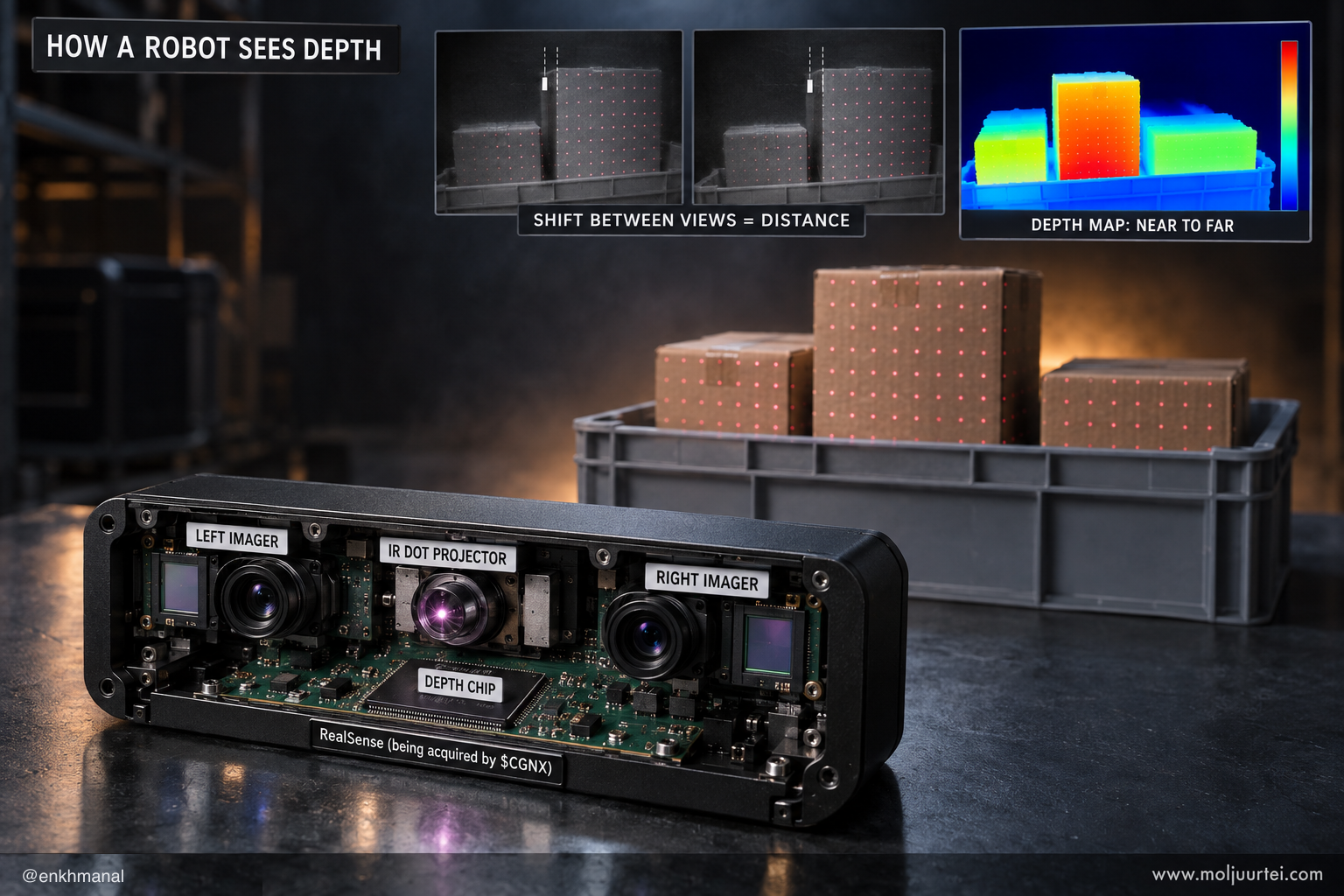
Follow one command through a warehouse robot. Two cameras and an infrared projector build a depth map of a tote, every pixel tagged with its distance. The robot computer runs a learned model on that map and proposes a grasp: for example, close the gripper on the blue box and lift it at half a metre a second. Before the command reaches the motor drivers, a safety application in an isolated partition checks it against limits a certifier signed off: is a person inside the protective distance, is the speed or force above the cap for this zone. If it passes, power chips turn it into current; magnetic fields in each motor produce torque; gears turn fast, weak rotation into a slow, strong joint. The encoders and cameras then report what actually happened, and the loop starts again.
Put a listed name on each step and the map looks like this. The eyes are machine vision and depth cameras, where we compare $CGNX, which is buying RealSense, with Keyence; lidar and camera-only models are the alternatives. The brain is the robot computer and its models, $NVDA against $QCOM and the in-house chips some manufacturers design. The reflex is the certified operating system in the safety partition, $BB's QNX, against NVIDIA's Linux-only configuration and dedicated safety microcontrollers. The nerves are the connectors that carry power and data, $APH against $TEL. Many compact permanent-magnet motors use rare-earth magnets, where $MP is the American supplier and China the incumbent. The body and its upkeep is the finished robot, $ISRG as the one already paid for and $TSLA as the one still to come. And before any of it ships, $TER and $KEYS test the chips and electronics. Only $ISRG and $TER report robot revenue as such today; the rest show the robot, if at all, as a proxy inside a bigger line.
Each step has more than one answer, and a basket that covers only one of them is a bet on a design choice. Safety can be handled by a certified real-time operating system such as QNX running beside the AI, by NVIDIA's own Linux-only Halos configuration, or in hardware: the Thor computer's own safety island already runs a state machine isolated from the AI domain. Perception can be flat 2D vision, active-stereo depth, lidar, or the camera-only end-to-end learning Tesla uses. The brain can be NVIDIA, Qualcomm or a manufacturer's own chip. We cover the listed company at each step and say where an alternative could take the budget. The gears, screws and reducers are in our robot parts piece, the spintronic sensors in a robot hand in our $NVEC piece; lidar we leave for another day.
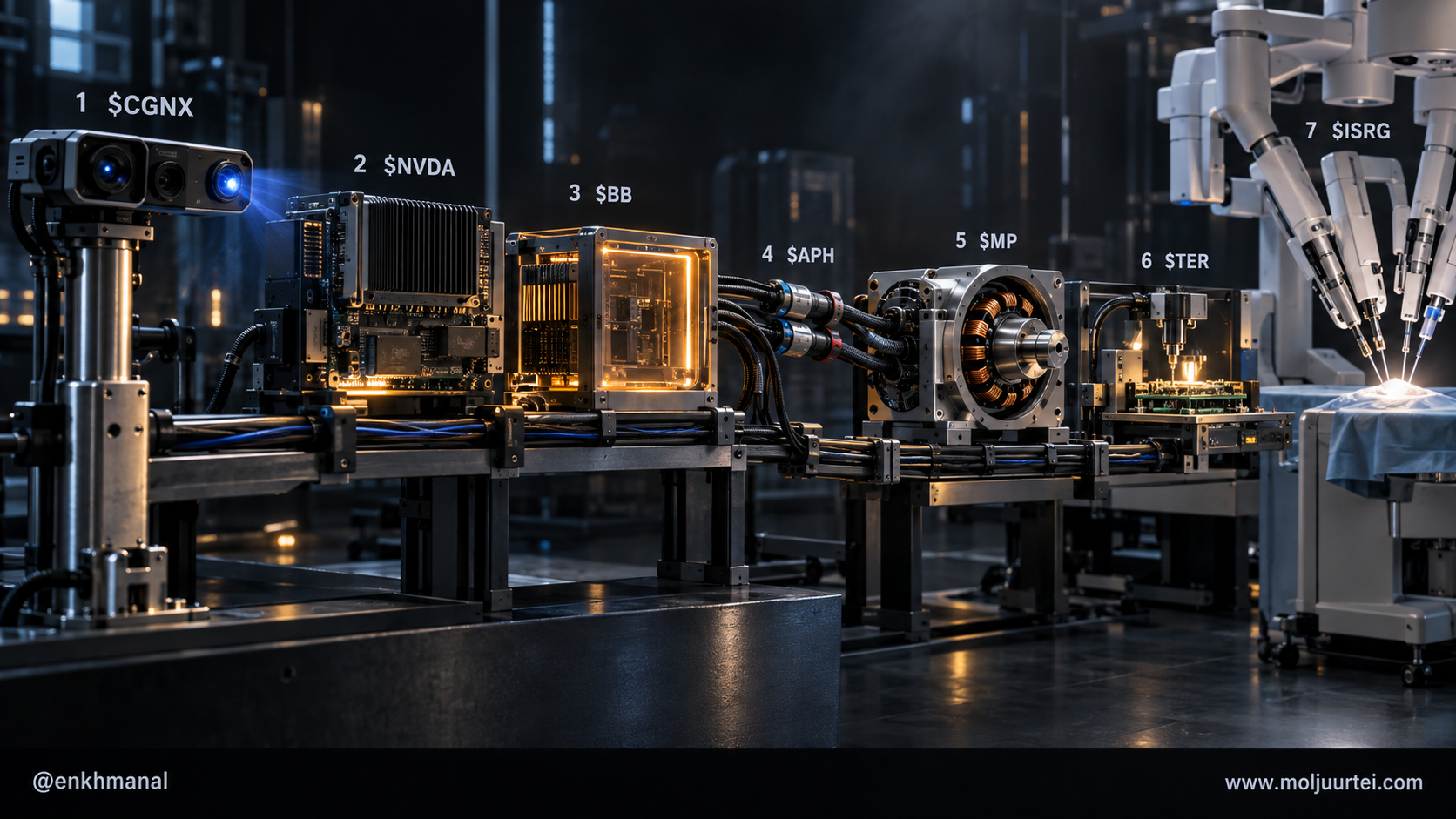
Two things in that picture decide where the profit goes. The eyes and the brain scale with the number of machines and with how hard each machine's job is, so a humanoid in a cluttered home buys more of both than a robot arm on a fixed line. The reflex is different: a certified operating system is designed into a product once, re-certified at great cost if it is swapped, and then paid a royalty on every unit shipped for the life of the product. That is why a software company with $80 million of quarterly revenue can matter to a robot industry whose hardware bill runs into tens of thousands of dollars per machine.
Comparing the Listed Businesses
The comparison includes twelve listed companies covering the main functions and relevant alternatives. It separates directly reported robotics revenue, broader revenue proxies and exposure that is not quantified. Prices and moving-average comparisons are the October 9, 2026 snapshot; quarterly growth in this historical table uses information available then. Later developments are identified in the publication update.
Table terms: QNX; IoT.
The businesses have different exposure. QNX and the proposed RealSense acquisition connect directly to robot software and perception, but existing revenue is dominated by broader markets. NVIDIA, Qualcomm, Keyence and Amphenol serve multiple industries. Intuitive reports robotic surgery revenue; Teradyne reports a smaller robotics segment. MP supplies a magnet input; Tesla’s Optimus commercialization remains a development question. A robot-themed label alone does not establish material earnings exposure.
The direct comparisons clarify alternatives. NVIDIA combines Jetson, Isaac and Halos; Qualcomm competes in lower-power designs but does not quantify robot revenue. Keyence has stronger historical operating margins, while Cognex’s proposed RealSense purchase adds dedicated robot perception. Teradyne and Keysight remain largely test-equipment businesses. Amphenol and TE Connectivity supply interconnects across many markets; neither gives a clean robot-revenue figure.
The Reflex: $BB and QNX
QNX is a real-time operating system: software that guarantees how quickly it responds, not just that it eventually does, and that has been certified for the highest automotive safety level, ISO 26262 ASIL D. BlackBerry says it runs in more than 275 million vehicles. It is paid twice: a development licence while a customer designs a product, then a royalty on every unit that ships, for as long as the product sells. At the end of February 2026 the royalty backlog, estimated future royalties from design wins, not current revenue or guaranteed orders, was about $950 million, and in September a commercial-vehicle software platform from Volvo Group and Daimler Truck added more than $100 million in a single win (Q4 FY26, Q2 FY27).
The order of events matters for an investor. QNX earns development licence fees while a customer writes software, wins the design when the customer commits, and collects royalties only when the finished product ships, so a design win announced this year shows up in revenue as units leave factories in later years. That is why the royalty backlog is the number to watch, and why management said in April that QNX's growth should not be judged quarter to quarter. The robot pipeline sits at the first stage of that sequence: development activity, with a handful of design wins, and almost no royalties yet.
Growth has been quickening. QNX revenue rose 15% in the quarter to August 2025, 10% to November, 20% to February, 26% to May and 27% to August 2026, when it reached $80.3 million at an 87% adjusted gross margin and a 36% adjusted EBITDA margin. In June the full-year QNX guide was $295–312 million; in September it was raised to $315–325 million, 18–21% growth on last year's $268.0 million.
Table terms: QNX; EBITDA.
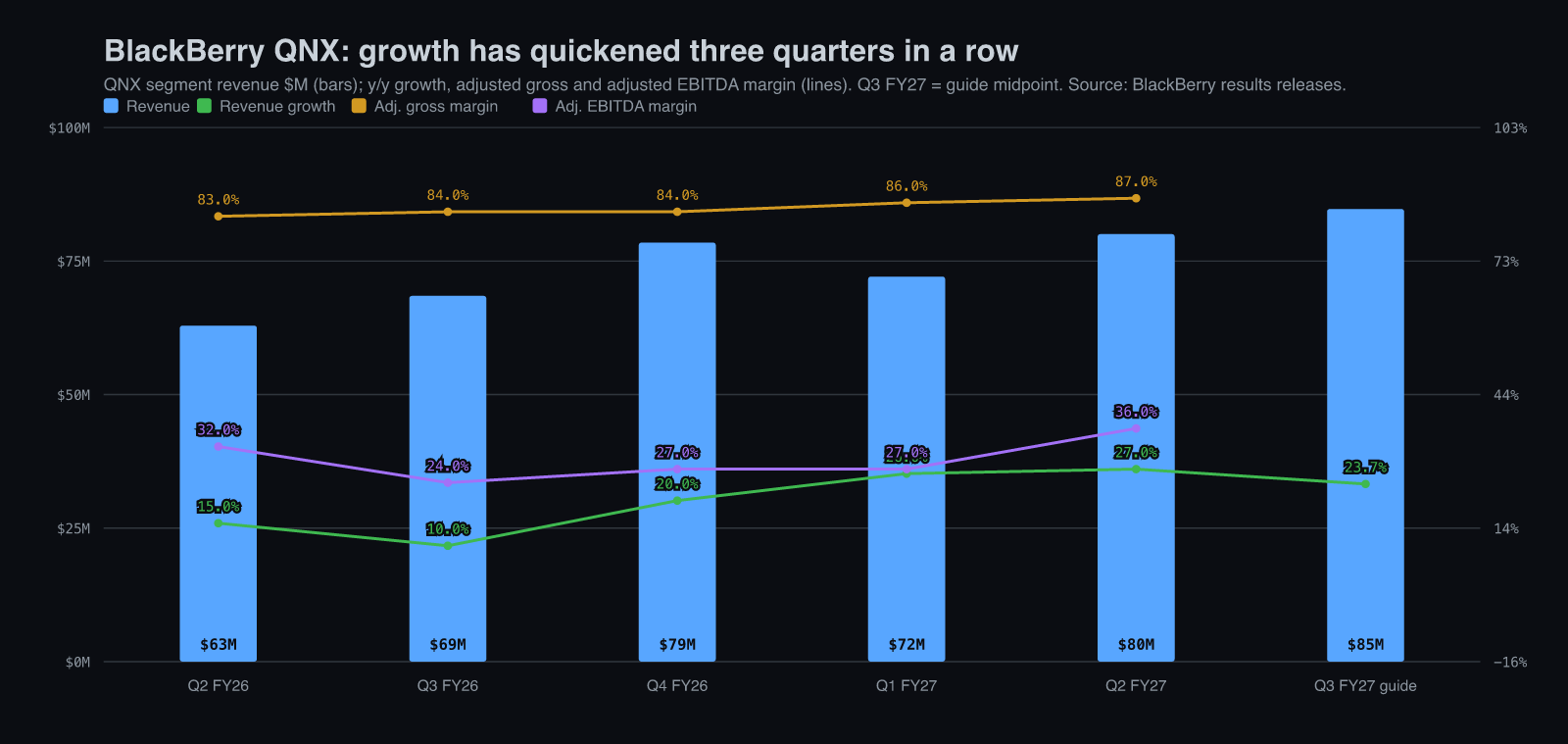
QNX is now the part of BlackBerry that matters. Of $163.3 million of revenue in the August quarter, QNX was $80.3 million, 49% of revenue, growing 27%; Secure Communications was $60.9 million, 37% of revenue, growing 2%; Licensing was $22.1 million, 14% of revenue. The profit is real cash: operating cash flow was $29 million against GAAP net income of $33.9 million, the sixth straight quarter of positive GAAP net income, and the company ended the quarter with $447.1 million of cash and investments.
Robots are still the smallest of QNX's three growth paths. Cars remain the core; the second path is Alloy Kore, a software platform for carmakers; the third is everything else, which BlackBerry calls general embedded, about 20% of QNX revenue, or roughly $16 million a quarter, spread across industrial, medical, rail and robotics. What is new is the pipeline. On the September call the chief executive put a number on it:
Beyond Uber, we are also seeing a growing pipeline of robotics and Physical AI opportunities, including more than 20 companies currently engaging with us around NVIDIA-based platforms. Within the pipeline, we have a number of humanoid robot OEMs as well as surgical robots, autonomous mobile robots, or AMRs, as well as autonomous tractors, drones, and planes.
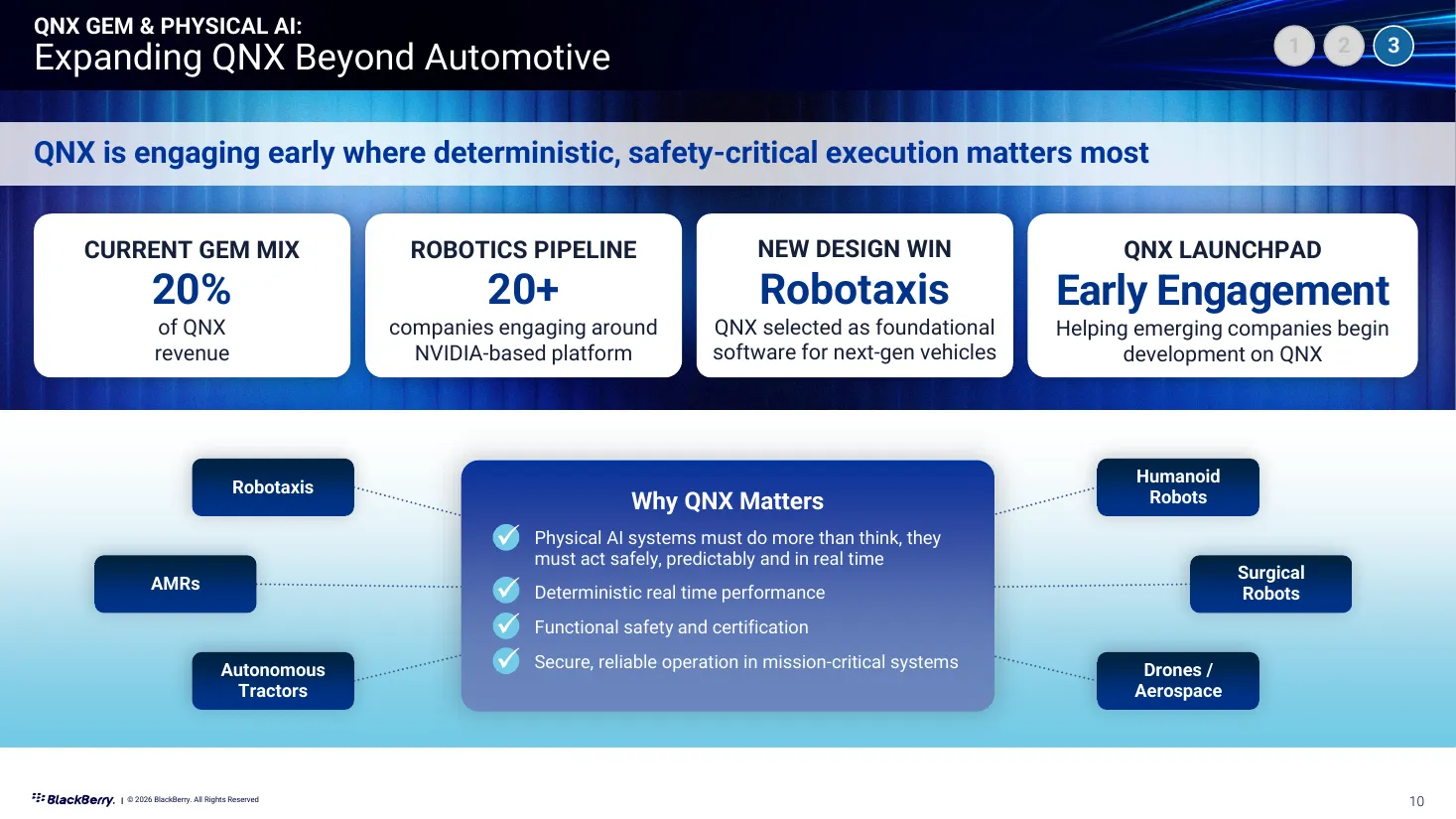
The president of QNX was more careful than his marketing, and that is a point in his favour. At a June conference John Wall said the robots buying today are not humanoids but automated forklifts and cargo carriers that must work without a cage, and called the robotics market nascent. Put plainly, the thesis is this: QNX is already the certified real-time option inside the safety architecture NVIDIA is selling to robot makers, and a 27% grower can afford to wait for that pipeline to turn into royalties. The weak point is that NVIDIA also sells a Linux-only configuration, and a QNX bull on Substack concedes that most robot safety software shipping today is bespoke Linux (Banana Rat). The seat is offered, not guaranteed.
The Eyes: $CGNX, RealSense and Keyence
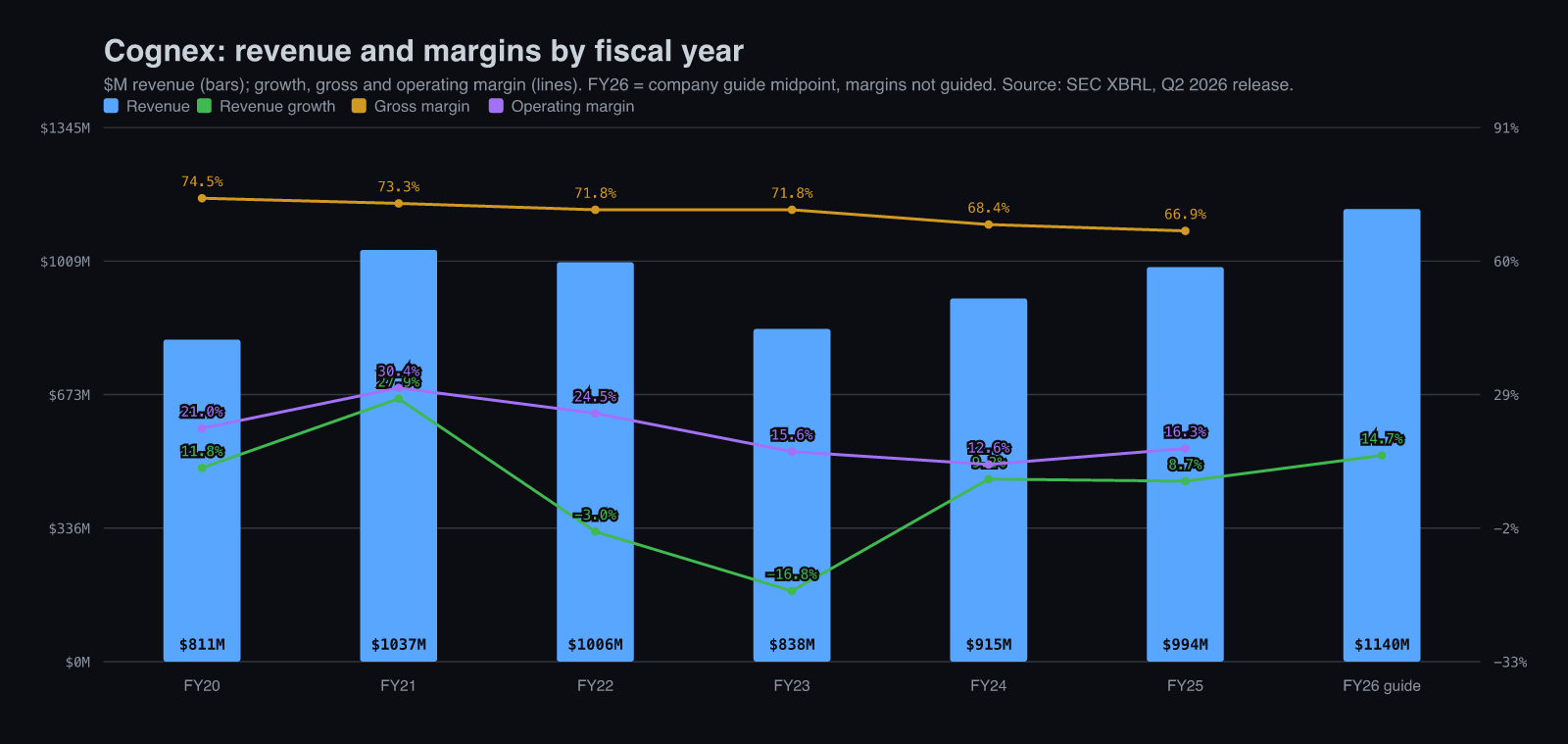
Cognex sells the eyes of the automated factory: cameras, vision software and code readers that find, measure, inspect and identify parts as they move. For fifteen years its sales rose and fell with a few large buyers in consumer electronics and logistics. Revenue was $811 million in 2020 and $994 million in 2025; gross margin slid from 74.5% to 66.9% over those years and operating margin swung from 30.4% in 2021 down to 12.6% in 2024 before recovering to 16.3% in 2025. For 2026 the company guides $1,130–1,150 million of revenue, 15% growth at the midpoint, and adjusted EPS of $1.64–1.68 (Q2 2026).
The table preserves the stated historical reporting periods and units.
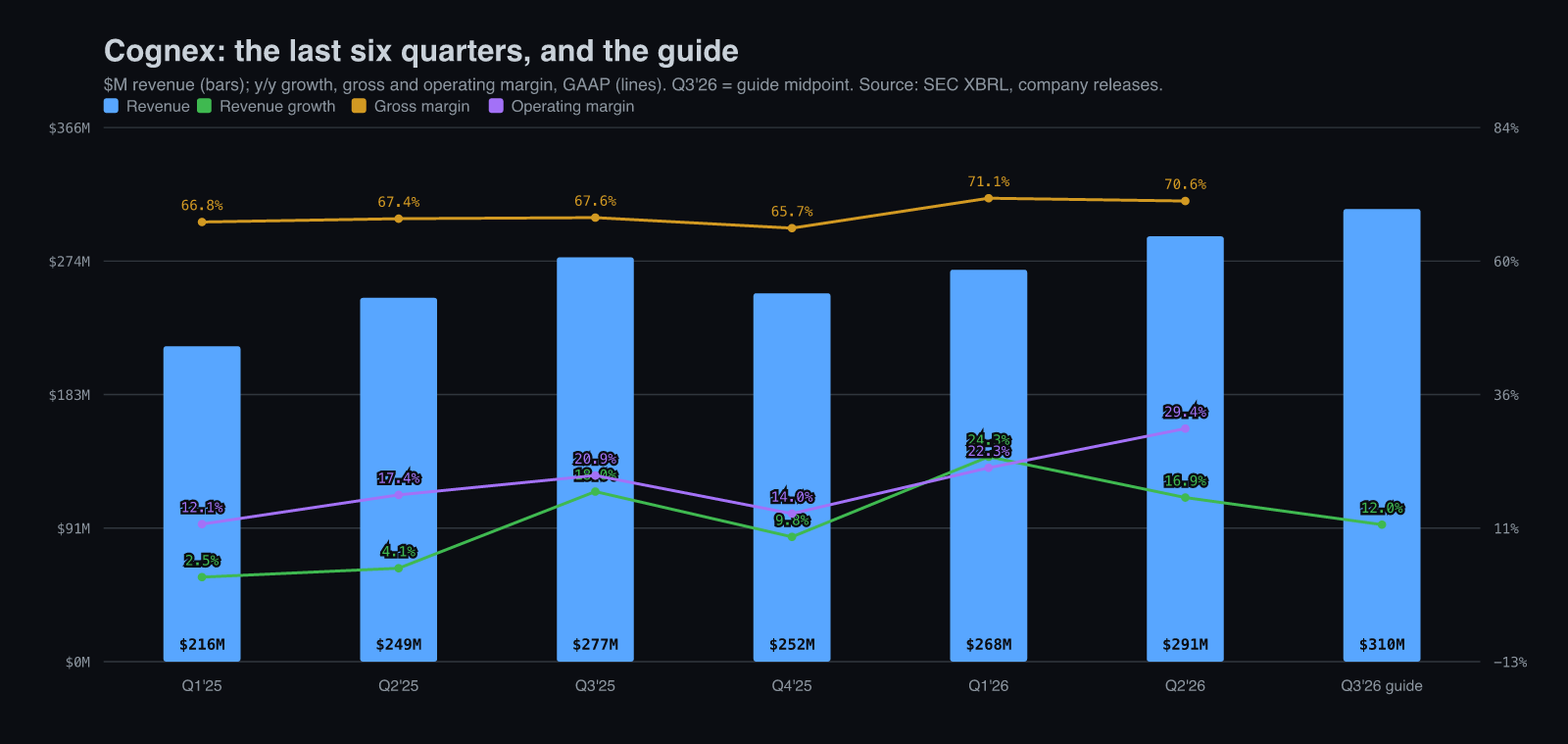
The turn is in the quarters. Revenue grew 2.5% in the first quarter of 2025, then 4.1%, 18.0%, 9.8%, 24.3% in the first quarter of 2026 and 16.9% in the second, when it reached a record $291 million. Gross margin moved from 66.8% to 70.6% and GAAP operating margin from 12.1% to 29.4% over the same six quarters, after management cut costs and began exiting low-margin product lines. Cash followed: in the first half of 2026 operating cash flow was $114.2 million and free cash flow $110.0 million against net income of $124.5 million, an 88% conversion.
Part of the recovery is already robot-shaped. The fastest-growing piece of Cognex this year is inspection for the contract manufacturers that assemble AI server racks, and at a September conference the chief financial officer described how it works: a Cognex vision system is mounted on a robotic arm that travels around the server, takes pictures and checks between 100 and 200 inspection points, a task he said would not have been possible six months earlier without the company's cloud-trained OneVision models and its newest Qualcomm-powered camera. A camera that guides a robot through a job is the same product category RealSense sells into, from the other direction.
RealSense is the robot part. A flat camera tells a robot what is in front of it; a depth camera also tells it how far away each point is, which a robot needs to grasp a box or steer around a person. RealSense, founded inside Intel in 2014 and spun out in 2025, builds active-stereo depth cameras with its own image-processing chips, sold into fixed robot arms, mobile robots, quadrupeds and humanoids. Cognex is paying about $500 million in cash, plus a $56.5 million three-year retention pool and roughly $50 million of restricted stock, for a business that expects $80–90 million of 2026 revenue, up more than 50%, in a robot-perception market it sizes at $600 million today and about $1.6 billion by 2030 (8-K). The deal is expected to close in the fourth quarter.
We view humanoids and quadrupeds as longer-term opportunities that are not necessary to support the core growth thesis but could create additional upside as adoption develops.
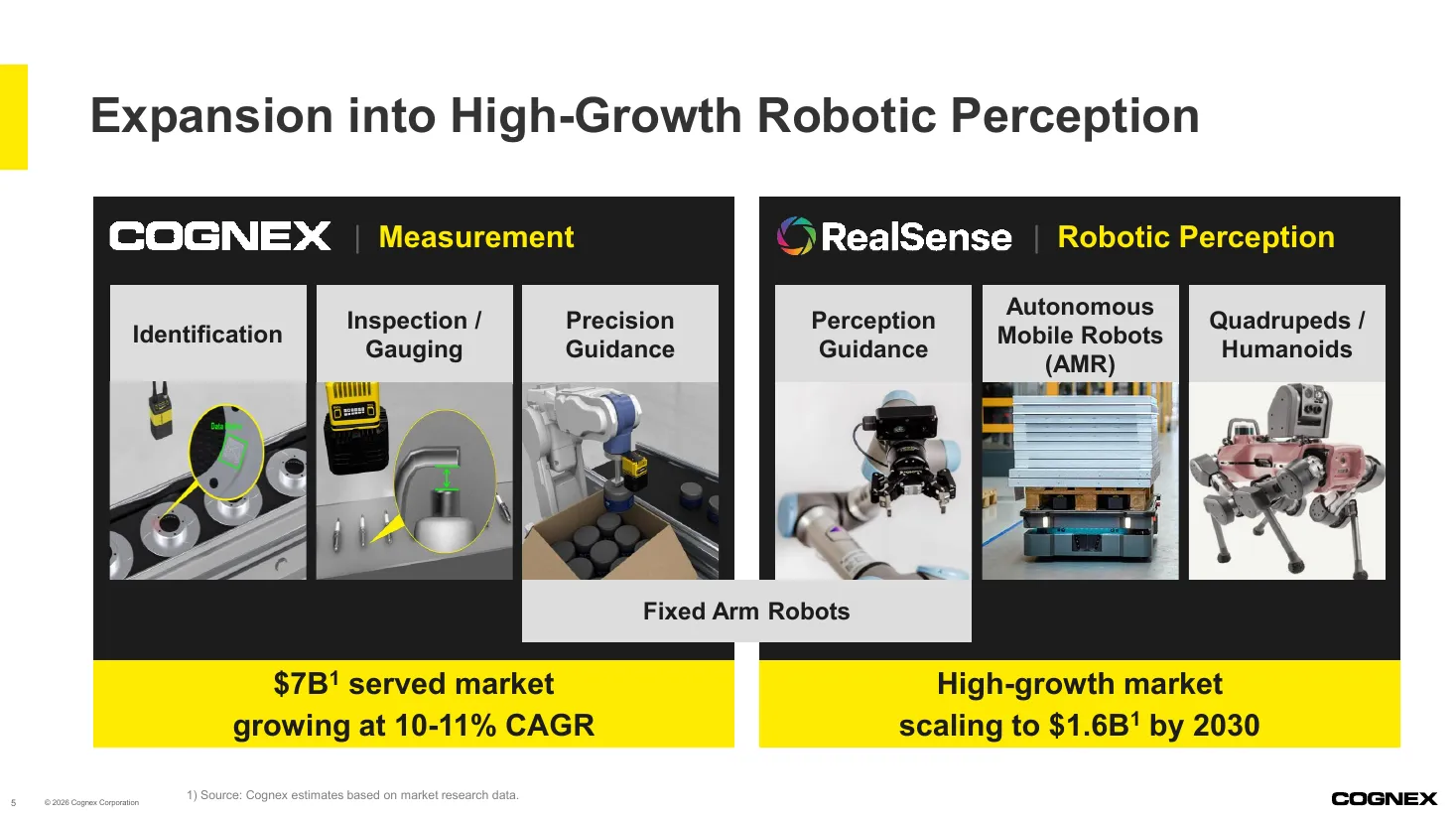
Keyence, Cognex's Japanese rival and the benchmark for factory vision, makes the comparison uncomfortable. In April to June 2026 its sales rose 32.8% to ¥346.6 billion, 24% in local currencies outside Japan, at an 85.0% gross margin and a 54.0% operating margin (Keyence). In the year to March 2026 it earned ¥595.8 billion of operating profit on ¥1,169.3 billion of sales. On every operating number Keyence is the better business, and it is growing faster this year. It issues no guidance and discloses no robot sales, while Cognex agreed to acquire a robot-perception business. Cognex therefore adds a specific proposed robot-perception business, while Keyence offers a broader factory-vision comparison.
The Brain: $NVDA and $QCOM
NVIDIA sells the whole brain: Jetson Thor, the computer that sits inside a robot; Isaac and the GR00T models that teach it; Cosmos and Omniverse, which simulate the physical world so a robot can practise before it touches anything; and now Halos, the safety architecture around them. In the quarter to July 2026 it introduced a reference humanoid design built on Jetson Thor and released the third version of Cosmos. The customer list is the industry: on the August call the chief financial officer said Amazon will run its warehouse robots on the full stack.
Amazon will also adopt our full physical AI stack, Omniverse, Cosmos, Isaac, and Jetson to power its fleet of warehouse robots.
Robotics is small beside the data-centre business. Revenue in the July quarter was $96.2 billion, up 106%, of which data centres were $89.0 billion; Edge Computing, the segment that now holds robotics together with workstations and PCs, was $7.2 billion, up 27% (Q2 FY27). The last year in which robots sat inside a smaller line, the year to January 2026, automotive and robotics together were 1.1% of revenue. At 29 times trailing earnings, the 4th percentile of its own five-year range, the stock is cheap against its history; but that multiple reflects a company dominated by data centres; robotics is an additional opportunity whose contribution is not separately quantified.
Qualcomm is the challenger at the small end, robot computers for machines where NVIDIA's chips draw too much power. In the quarter to June its revenue fell 4% to $9.9 billion as handsets dropped 20%; automotive rose 61% to $1,588 million and the internet-of-things line, where its robotics platforms sit, rose 9% to $1,830 million (Q3 FY26). Management targets $40 billion of non-handset revenue by fiscal 2029, but it does not put a number on robots, and on our evidence scale that makes the robot business unproven rather than small. The robot-specific contribution remains unquantified.
Robots Already Paid For, and Not Yet: $ISRG and $TSLA
Intuitive Surgical is what a robot business looks like once it is paid for. Second-quarter revenue was $2.89 billion, up 19%; $1.73 billion of it, 60%, came from instruments and accessories that are used up procedure by procedure on an installed base of 11,710 da Vinci systems, up 12% in a year (Q2 2026). Procedures grew about 16%, and the company guides 13.5–15.5% da Vinci procedure growth for 2026. That is the elevator model: the machine is sold once, the upkeep is paid for decades. These are the original Q2 figures. The October 20 Q3 outcome is reported in the publication update, rather than treated as a future catalyst.
Tesla is the opposite case: the most visible humanoid program in the world and no robot revenue yet. Its June-quarter 10-Q says the company is making preparations and investments in large-scale production of Optimus; the filing did not quantify commercial robot deliveries (10-Q). On the July call the chief executive said Tesla will soon start Optimus production. Third-quarter deliveries were 486,532 vehicles, and the stock trades at 354 times trailing GAAP earnings of $1.08 a share. Tesla assembles the body, whereas this comparison emphasizes component and software economics.
Magnets, Wires and Test Gear: $MP, $APH, $TEL, $TER, $KEYS
Many compact permanent-magnet robot motors use rare-earth magnets; other motor designs exist, and China refines most of the world's supply. $MP is the American answer: second-quarter revenue rose 89% to $108.5 million as output of NdPr, the neodymium-praseodymium oxide that magnets are made from, rose 41% to 840 tonnes; its magnet segment booked $16.5 million while customers qualify magnets from its Texas plant; and it still lost $20.3 million (Q2 2026). The chief executive's case is arithmetic: 30 to 40 million humanoids a year would by themselves use all of today's global magnet output, China included. The near-term catalyst is political: China's suspension of its October 2025 rare-earth export rules runs to 10 November 2026 (MOFCOM notice 70). In the October 9 snapshot, the stock was 18.4% below its 200-day average.
Connectors are in every robot, and robots are invisible in the connector makers' numbers. Amphenol's second-quarter sales rose 55%, 30% organically, to $8.8 billion with a book-to-bill of 1.23, driven by AI data-centre interconnect (Q2 2026); robots did not come up on its call. $TEL grew 14% to $5.16 billion (Q3 FY26). These historical figures primarily describe broader interconnect demand, not a quantified robotics business.
Test equipment is the same story with a robot attached. Teradyne's second-quarter revenue doubled to $1,329 million, $1,122 million of it semiconductor test for AI chips; its robotics segment, Universal Robots and MiR, grew 33.4% to $99.9 million and still lost $2.6 million before tax (10-Q). Keysight grew 37% to $1.85 billion on communications test (Q3 FY26). Both trade above 52 times trailing earnings, in the 82nd–87th percentile of their own five-year ranges, on chip and network demand. They have some robotics exposure, but their overall results primarily reflect test demand. Teradyne’s subsequent robotics profitability is covered in the update.
Management & Track Record
BlackBerry's management has spent two years under-promising QNX. John Giamatteo, chief executive, sold the Cylance security business and turned the company to six straight quarters of GAAP profit. QNX revenue beat its guidance range in the August 2025 quarter, landed at the top of its $66–70 million range in November, beat its $71–77 million range with $78.7 million in February, and beat its $70–75 million range with $80.3 million in August, after which the full-year guide was raised. John Wall, who runs QNX, has been the brake: in May he told a conference that his marketing team had pressed him for three years for an AI story he had not been able to come up with, until a chip-design partner called QNX the foundation of physical AI.
Cognex's chief executive is new to the job and has so far delivered what he promised. Matt Moschner succeeded Robert Willett on 27 June 2025 (8-K). Under him the company cut costs, began exiting low-margin product lines, issued its first full-year guide, and landed second-quarter revenue of $291 million inside its $280–300 million range. RealSense is the first large acquisition of his tenure and spends roughly two-thirds of the $755 million of cash Cognex held at the start of July; the chief financial officer, Dennis Fehr, frames it against a through-cycle target of 10–11% organic growth. The first test of the deal is whether the third-quarter call quantifies the margin dilution, which the September announcement did not.
NVIDIA's management has pitched robotics as its next large market for years, and the record supports the engineering more than the revenue. The product line now runs from simulation through training to the robot computer and its safety stack, and the partner list runs from Amazon to Agility. What the record does not yet show is robot revenue large enough to report on its own: this fiscal year the company folded automotive and robotics into a broader Edge Computing segment. We read that as a robot business that is real but small next to a $96 billion quarter, not as a business in trouble.
Risks & What Breaks It
Price Setup
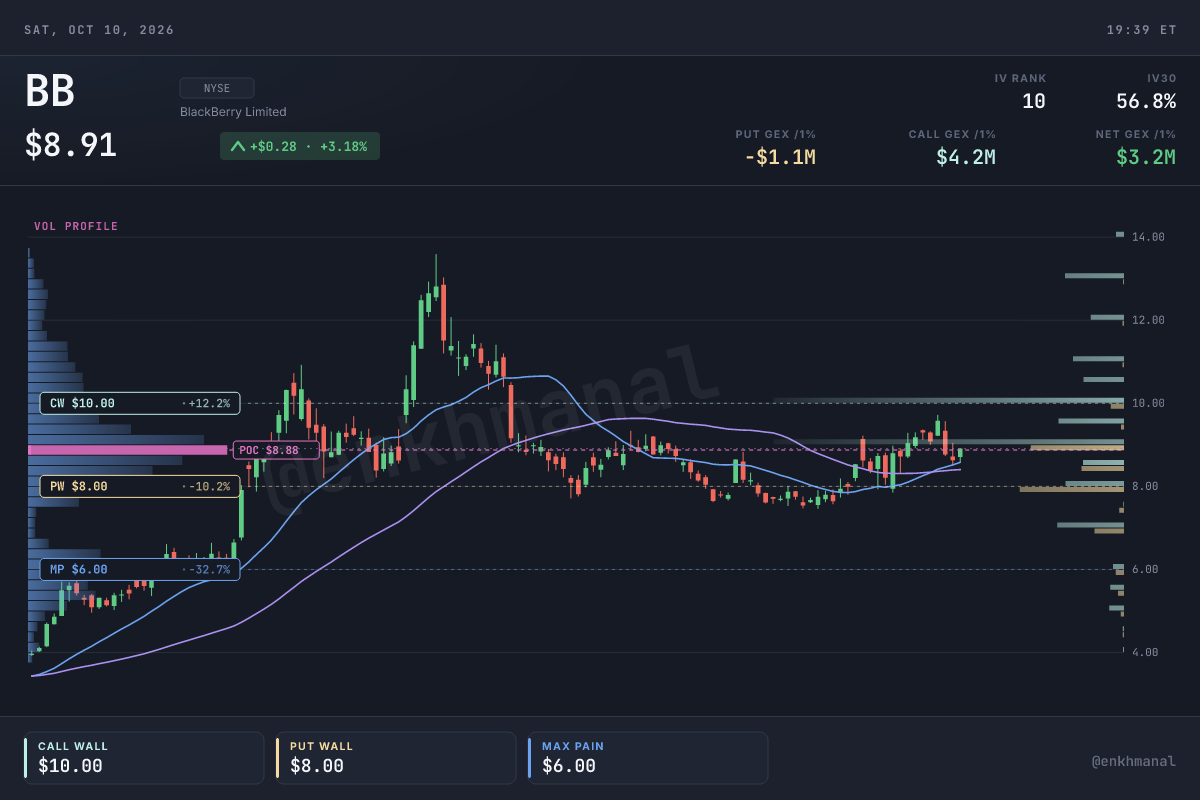
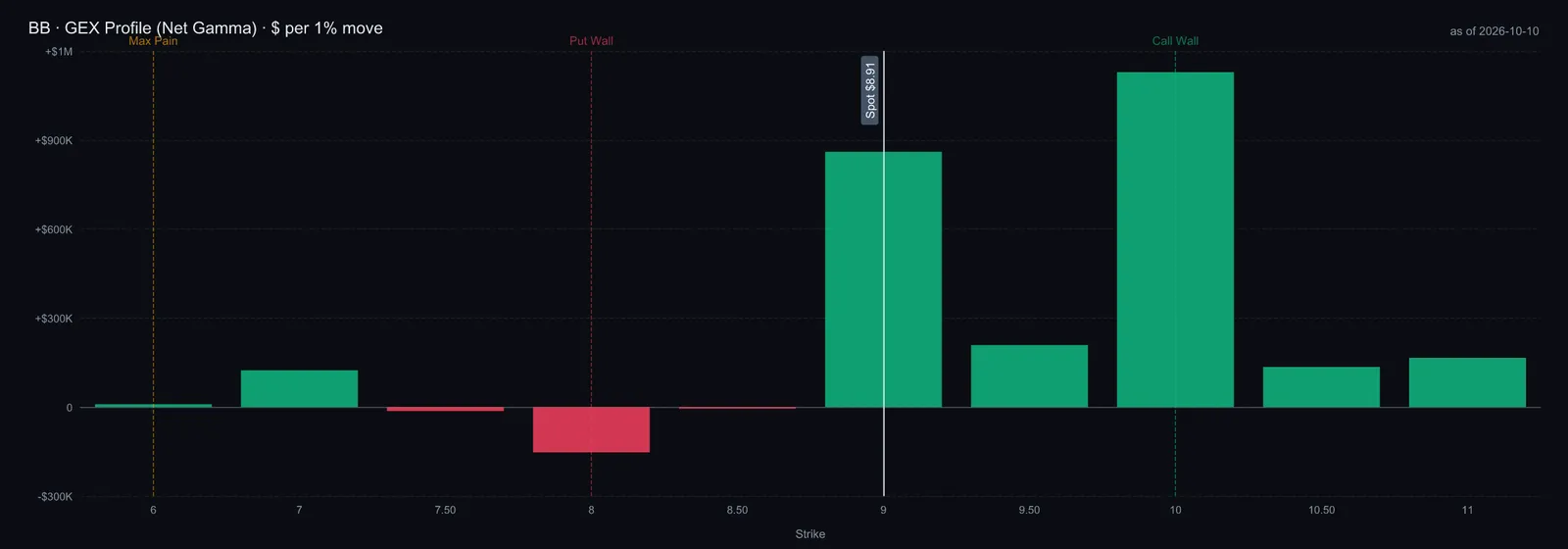
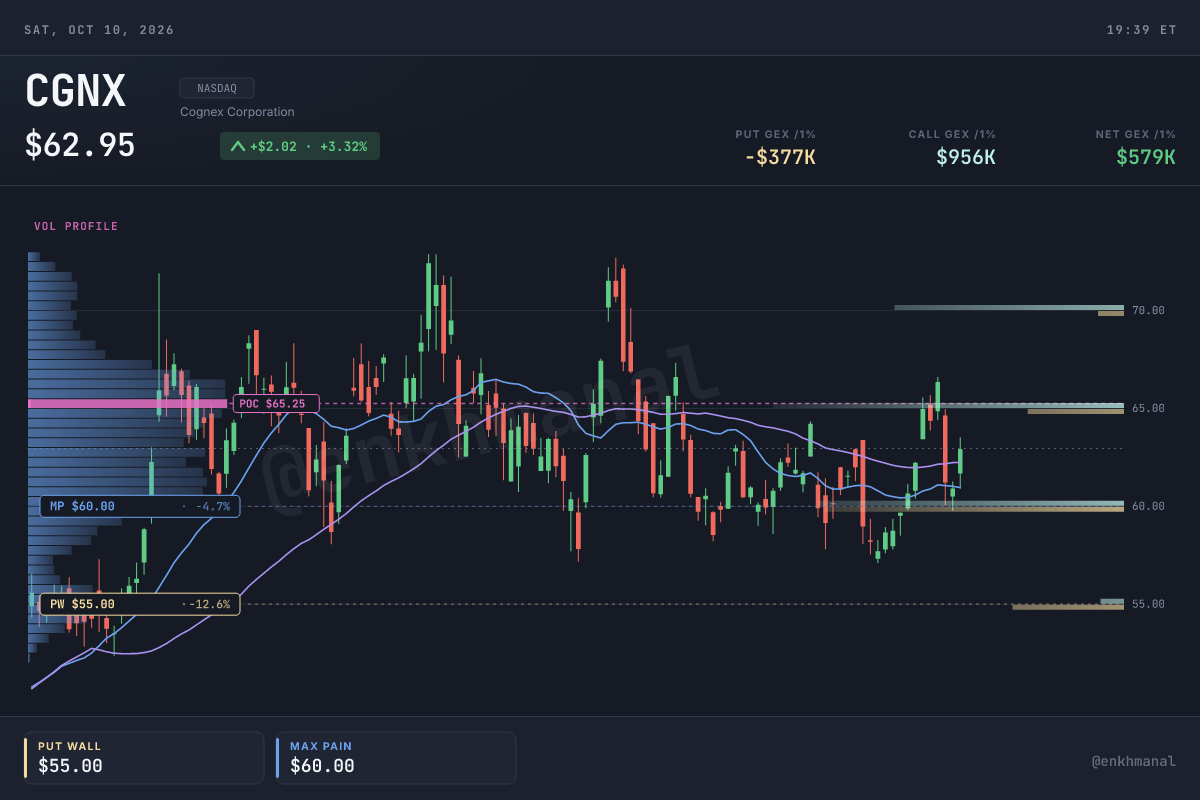
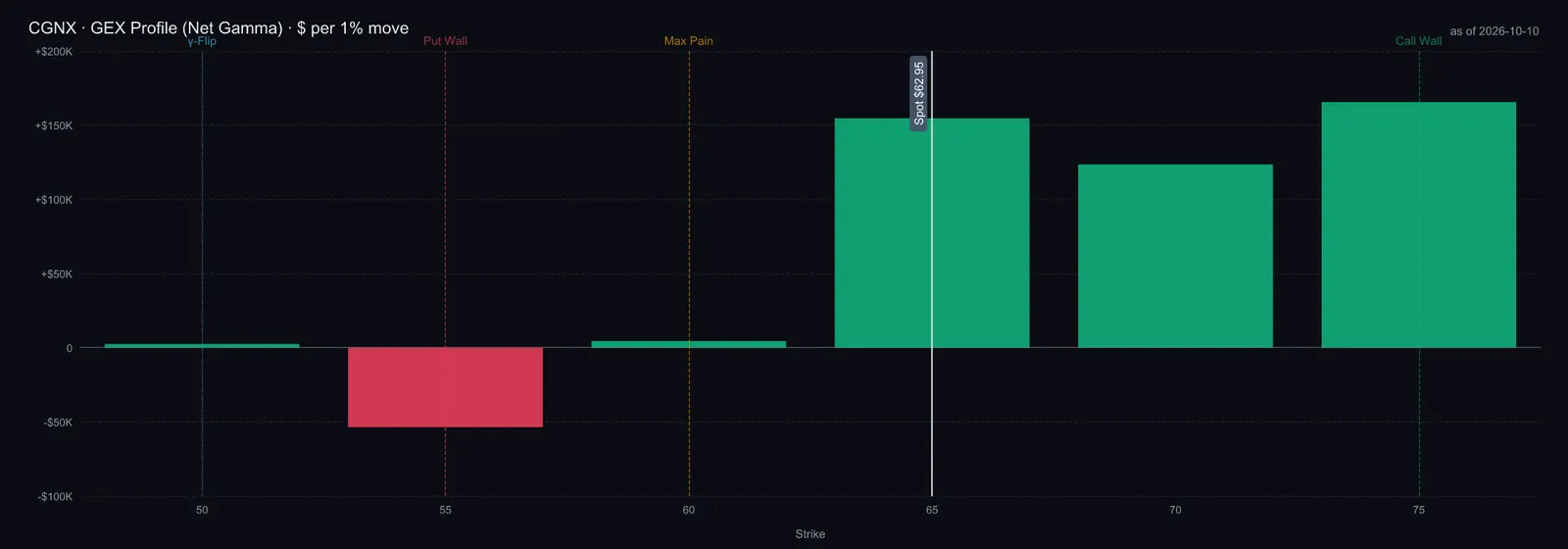
This table is an October 9 market snapshot, not current trading instructions. Option concentration levels are model-dependent estimates: call wall and put wall identify concentrations around strikes; gamma flip marks a modeled change in dealer-gamma sign. These are conditional market observations, not guaranteed resistance, support or future price paths.
Table terms: Call wall; Put wall; Gamma flip; Max pain.
$BB has run from $3.15 to $12.81 inside a year and now sits at $8.91, 37% above its 200-day average, with the $10 call wall the first level above and $8 the put-wall support below.
$CGNX is 13% below its 52-week high of $72.42 and only 1.1% above its 50-day average, in the dated comparison; the $75 call wall marked a modeled concentration and $55 is the put wall, just below the 200-day.
$NVDA is 3.2% above its 50-day average with positive dealer gamma of $1.27 billion per 1% move, which tends to dampen swings; $240 is the call wall and $202 the gamma flip.
$ISRG has rallied to 9.8% above its 50-day average and sits on the $420 call wall, but is still below its 200-day average at $443.41 in that historical snapshot.
$MP has fallen from $98.65 to $46.14 in a year and sits just above the $45 put wall, below both averages and below its $49 gamma flip; the chart has not turned.
Catalysts
The original calendar has partly elapsed. Intuitive reported on October 20; Teradyne released results October 27 and held its call October 28, correcting the original October 21 estimate. Amphenol reported October 28. Cognex now confirms results after market close November 4 and a call November 5 at 8:30 a.m. EST. Keyence’s October 29 reporting window, MP’s November window and BlackBerry’s quarter-to-November reporting window remain separate from already-released results. The November 10 date in MOFCOM notice 70 concerns suspension of specified 2025 measures, not the removal of every rare-earth export restriction.
The Return Hurdle
We tested every name the same way: at the 9 October close, how fast would its per-share fundamental base have to grow for three years to deliver 10% annual price appreciation, excluding dividends, if the market then paid one of two plausible multiples. The arithmetic is required growth = (price × 1.1³ ÷ exit multiple ÷ base)^(1/3) − 1. The base is the company's own guide where it gives one ($BB, $CGNX), its last reported year for Keyence, which gives none, annualised second-quarter sales for $MP, which has no earnings, and trailing twelve-month GAAP diluted EPS for the rest. The exit multiples bracket each company's own history. This is a screen, not a fair value.
Table terms: EPS; QNX; P/E; TTM; GAAP.
The screen sorts the basket by how much growth each price already assumes. $NVDA and $ISRG ask the least, 3–16% a year, under these historical multiple assumptions. $CGNX asks for 8–19% against a guide of 63% adjusted EPS growth this year and a through-cycle target of 10–11% revenue growth. $BB asks for 18–32%, under the stated exit-multiple assumptions, against QNX revenue growing 27%. The chip-test stocks, $TER and $KEYS, ask for 26–43% a year, and $TSLA for 50–81%.
Valuation & House View
The original Cognex cash-flow sensitivity is less optimistic than the earnings-multiple screen. Using a ten-year horizon, 70.5% gross margin, SG&A at 32% of sales, 25% cash tax, 10% discount rate and 2% terminal growth, the dated calculation gave $25.04 per share under a perpetuity and $26.04 under a 9× EBITDA exit; bear and bull variants were $11.21 and $28.28. These are assumption-sensitive estimates, not a verified present fair value. The 9× exit is much lower than the 35.1× multiple on the original current-year guide, which materially affects the result. BlackBerry is evaluated here with the separate earnings-growth screen; no comparable cash-flow valuation is presented.
The opportunity and the valuation tension coexist. Product adoption, named production designs, unit shipments and royalty collections would strengthen the QNX case. For Cognex, sustained organic growth, cash conversion, the RealSense close and disclosed margin effects matter. The following dated scenarios show how earnings and multiples interact; they are not portfolio sizing or trading rules.
BlackBerry FY29 scenarios: QNX supplies the operating system. EPS is the per-share earnings assumption; these cases use two fiscal-year growth steps from the respective current guide, while the preceding hurdle uses three years.
Cognex FY28 scenarios: EPS is the per-share earnings assumption; these cases use two fiscal-year growth steps from the respective current guide, while the preceding hurdle uses three years.
The strongest research question is which suppliers turn robot adoption into separately measurable revenue. QNX offers deterministic software economics but faces Linux and other safety architectures; Cognex adds perception while retaining factory-cycle and integration risks. NVIDIA remains a broad platform, Intuitive demonstrates recurring procedure economics, and materials, connectors and test vendors provide differentiated exposure. Milestones and valuation assumptions should be reviewed as evidence arrives rather than treating the October 9 snapshot as a current recommendation.