
$PENG Deep Dive — Building the tier that catches what spills out of HBM · into the October guide
$PENG has fallen 39% from its 9 July high while raising guidance twice and nearly doubling its memory segment. The company is the clearest listed way to own inference's memory bottleneck — but what you are buying today is a memory-module business in a violent upcycle with an early, real and not-yet-material CXL business bolted to it, and the distinction decides the position size.
Compute outran memory by six hundred to one
Over the past two decades peak floating-point throughput has grown roughly three times every two years — about sixty thousand times cumulatively — while memory bandwidth grew about 1.6 times per two years, or roughly one hundred times. That is a six-hundred-fold divergence between how fast a processor can compute and how fast memory can feed it. Engineers call it the memory wall, and for a long time it was a training problem you could engineer around. Inference is different, and the difference is arithmetic. Generating each token requires reading the active weight set back out of memory, and the key-value cache that holds a conversation's context grows with both context length and concurrency.
A conversation of 128,000 tokens on a 70-billion-parameter model can consume around 40GB of accelerator memory per concurrent user, and context windows are expanding roughly thirty times a year. An accelerator's on-package high-bandwidth memory is physically bounded by interposer area and stack height to something like 80 to 192 gigabytes. Once the working set exceeds that, the only question is which tier catches the overflow. High-bandwidth memory is the fastest tier and the scarcest: a stack runs roughly $60 to $100 against $5 to $10 for an equivalent slice of DDR5, and it consumes about three times the wafer area per gigabyte, which is why conventional memory prices rose around 90% quarter-on-quarter in the first calendar quarter of 2026. What that creates demand for is a coherent, cheap, poolable tier between accelerator memory and a storage hop.
The strongest evidence arrived this month, from the direction nobody expected. Since the third quarter NVIDIA has been evaluating lower memory configurations for Rubin Ultra — 8-high stacks and a step back from HBM4E to HBM4, one design carrying about 192GB against the 1TB once expected — because at the original specification memory reached something like 70% of the accelerator's bill of materials and buyers refused the price. NVIDIA reportedly cut its margin on that memory from 75% to 50% and it was still too expensive. The analyst Jukan, who broke much of this, describes what follows in the terms the memory-wall literature has predicted for years: cold cache and model state move down into the low-power memory, CXL and flash tiers, and what stays in high-bandwidth memory is only the working set the computation needs right now. That is this memo's thesis, written by someone with no interest in it. If the on-package ceiling is being pushed down toward 192GB while context lengths grow thirtyfold a year, the volume of state that must live somewhere else goes up.
A cycle you pay for, an option you do not
Penguin Solutions is the clearest listed expression of the claim that inference is a memory problem, and it is currently priced as though it were only a memory-cycle stock. The near-term engine is real and enormous: in the quarter ended 29 May 2026 the Integrated Memory segment did $275.1m of revenue, up 111% year on year, with segment operating income of $62.2m against $12.5m — a fivefold increase. Management raised the full-year growth guide for that segment to 90 to 95%, raised company earnings guidance twice inside a single quarter, and gave a preliminary view of roughly 30% growth in both revenue and earnings for the year now beginning.
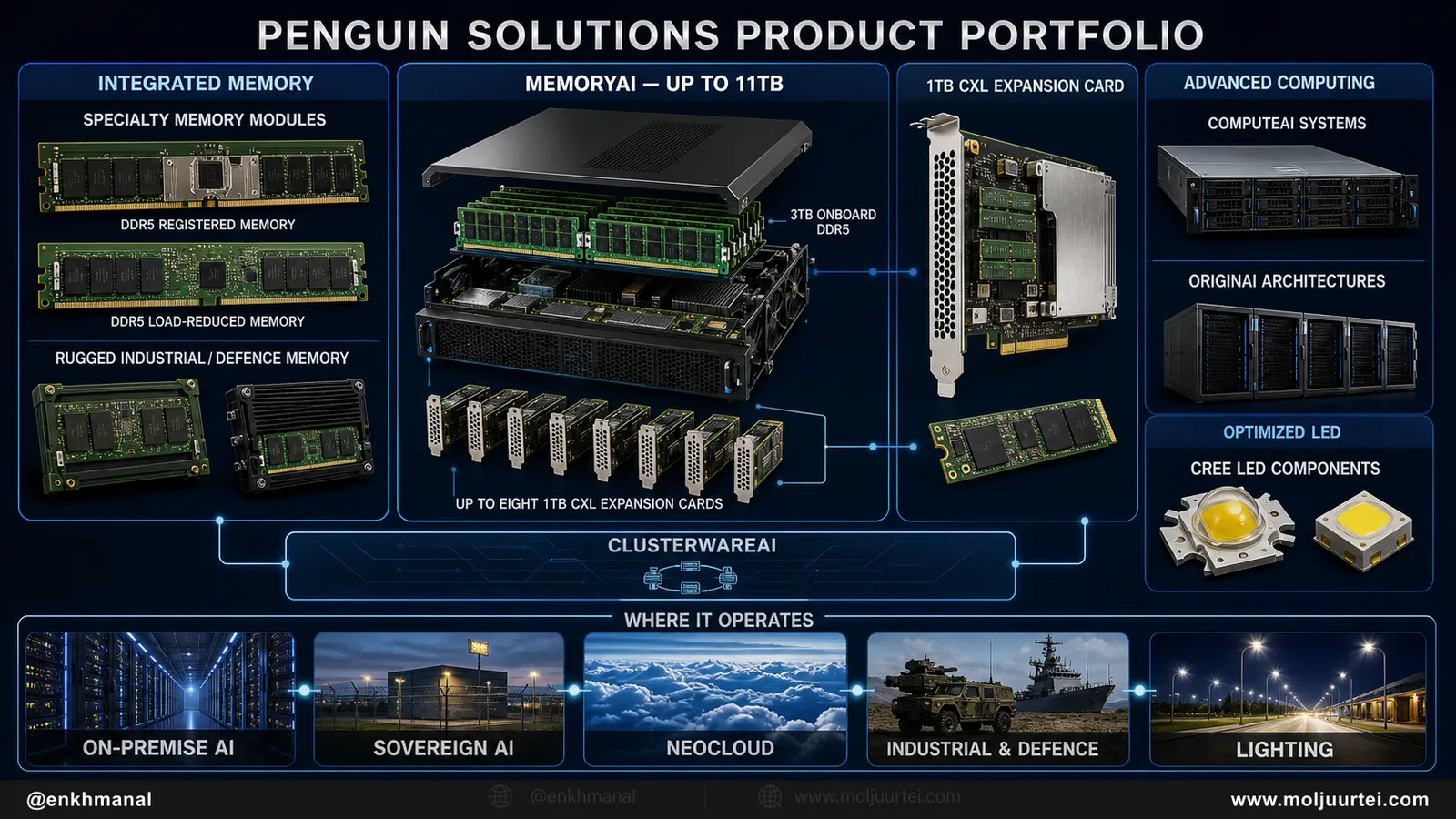
The option on top is the interesting part. Penguin builds its own 1TB CXL memory expansion cards and packages up to eight of them with 3TB of DDR5 into a MemoryAI key-value cache server holding up to 11TB — a tier roughly four to five times more cost-effective per gigabyte than accelerator memory, claiming up to twice the inference throughput and up to eight times lower time-to-first-token, shipping compatible with NVIDIA's inference framework out of the box. And here is the discipline: CXL is not yet the majority of the business, and management says so plainly. Own this for the cycle you can see, underwritten by a balance sheet that just sold five-year money at a zero coupon, and treat the memory-wall option as upside you are not paying much for.
At the high level for our memory business, the higher outlook takes into consideration both the volumes as well as the pricing. CXL is a part of our business. It's a new product line that is growing, but it is a part of the business versus majority of the business is the data center-focused products.
Three segments, moving in three directions
Penguin Solutions is the renamed SMART Global Holdings, redomiciled from the Cayman Islands to Delaware in June 2025. Its fiscal year ends on the last Friday in August, so the year just closed on 28 August and results land in early October. Integrated Memory is the Smart Modular business — specialty memory and storage modules for networking, enterprise storage and server applications, plus supply-chain services — and it is where the CXL products live and where the cycle is hitting. Advanced Computing is the Penguin Computing business, designing, building, deploying and managing full-stack AI and high-performance-computing clusters; revenue there fell 20.6% over the first nine months, deliberately, as the company stopped taking hyperscale hardware orders and wound down its Penguin Edge line. Non-hyperscale AI and HPC sales grew 50% year on year in the first half. Optimized LED is the Cree LED business, $66.1m in the quarter, cash-generative and managed for discipline rather than growth.
The deck cuts the same revenue a second way, and it is the more useful cut: Integrated Memory plus the non-hyperscale portion of AI infrastructure — what management calls the AI-driven business — was 74% of net sales and grew 104% year on year. The segment lines hide that, because the hyperscale wind-down sits inside Advanced Computing alongside the part that is growing.
On the Korean relationship, which is the part most often stated loosely: SK Telecom, not SK hynix, is the shareholder. In December 2024 an affiliate bought 200,000 convertible preferred shares for $200m, carrying a 6% cumulative dividend, a $32.81 conversion price and board-nomination rights for as long as it holds 5% of the company. Separately, at the Consumer Electronics Show in January 2025 the chief executives of SK Telecom, SK hynix and Penguin signed a trilateral collaboration agreement under which SK hynix and Smart Modular would jointly develop next-generation data-centre memory, targeting Japan, Asia-Pacific and the Middle East. So the SK hynix link is genuine and documented — but it is a development agreement, not disclosed revenue, and Penguin's own marketing chief describes SK hynix as another division operating independently of SK Telecom. Treat it as optionality, not backlog. The commercial proof point that does exist is the Haein cluster in Seoul: over 1,000 accelerators deployed in 60 days, running Penguin's cluster software, operated by Penguin's services team, and now underpinning SK Telecom's own compute-as-a-service offering.
What revenue and margins have actually done. Revenue has not compounded: it went $1.21bn, $1.12bn, $1.50bn, $1.82bn, $1.44bn, $1.17bn, $1.37bn across fiscal 2019 to 2025, a round trip through a memory cycle and a divestment. Gross margin did something quite different, ratcheting from 19.6% up to 28.8% and then holding there through a 36% revenue decline. That usually means the portfolio was upgraded rather than the cycle simply turning.
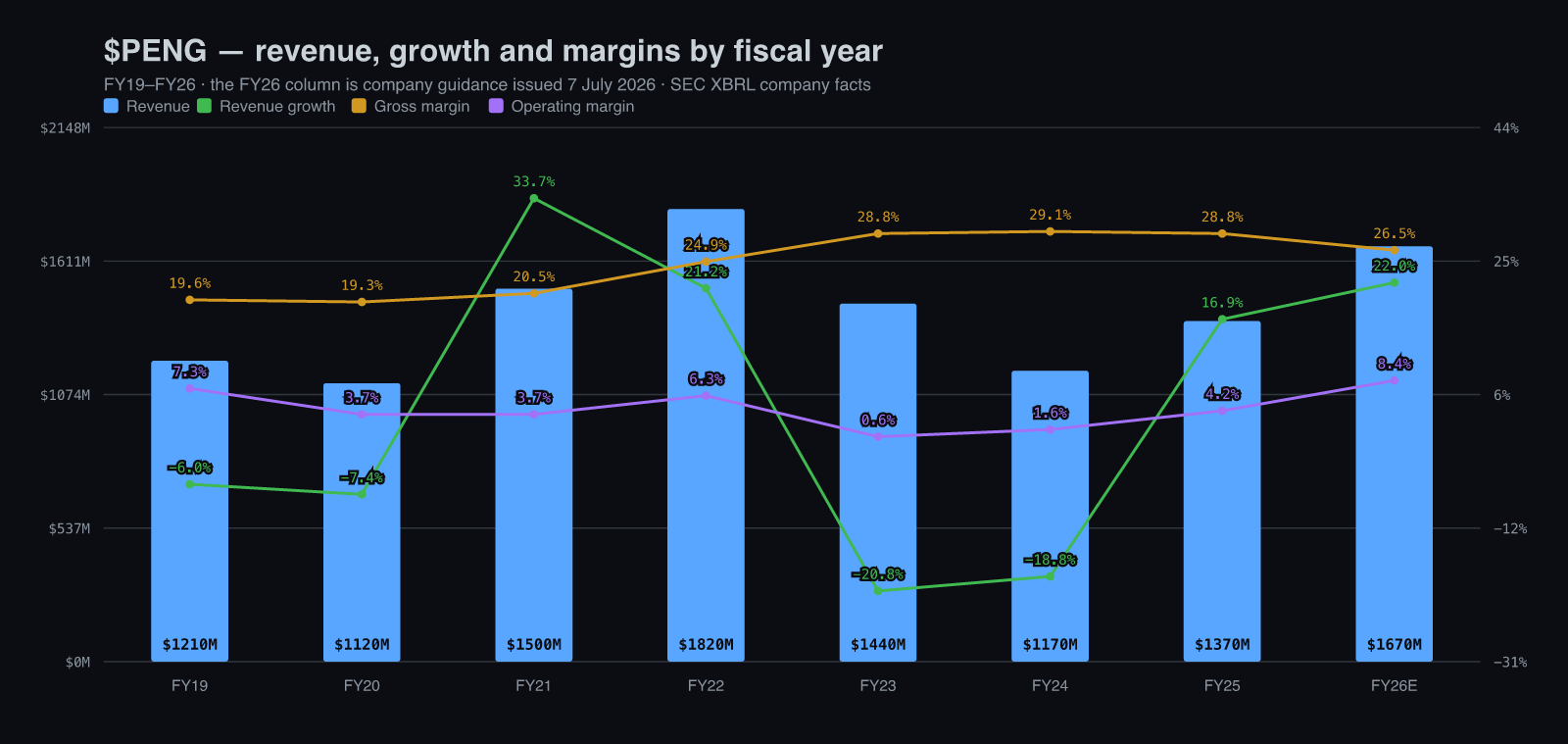
The guide contains a fact that reads backwards until you understand it: fiscal 2026 gross margin is guided down to 26.5% from 28.8%, in the best demand year the company has ever had. Memory modules carry a lower margin rate than cluster services do, so a segment doubling drags the blended rate down even as gross profit dollars climb. Screen this on gross margin trend alone and you will read a deterioration that is not there. The quarterly series makes the point far better, because the two margins move in opposite directions.
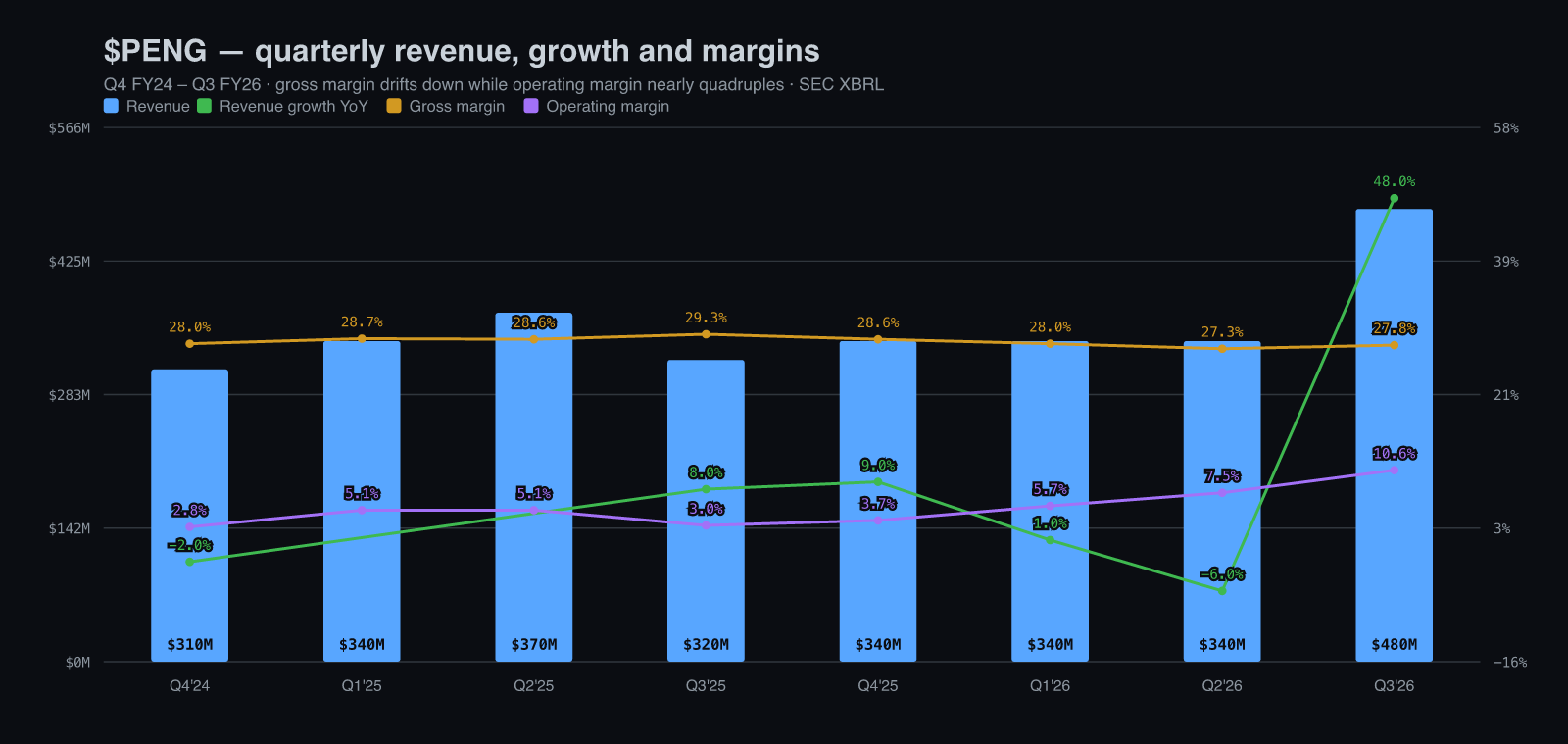
Gross margin has drifted down about two points across eight quarters. Operating margin has gone from 2.8% to 10.6% over the same stretch, and revenue growth flipped from minus 6% to plus 48% in a single quarter. That is operating leverage arriving on a mix that is optically worse, which is exactly the pattern a single-quarter or single-year look will misread. The peers say the memory leg is more durable than a normal cycle, and they say it in contract terms rather than forecasts. Micron's May quarter did $41.5bn of revenue, up 346%, at an 84.9% gross margin, with roughly 40% of revenue under take-or-pay contracts whose floor prices deliver a very robust gross margin well above Micron's peak in any past cycle, $22bn of customer deposits banked and supply tight beyond 2027. Seagate describes the identical structure in storage: a record 52.7% gross margin, the vast majority of nearline exabytes already allocated into calendar 2028, and contracts defining product configuration and pricing terms across the entirety of calendar 2027. Two unaffiliated suppliers have sold a year or more of output at contracted prices, and those floors sit under Penguin's selling prices too, since Penguin buys the dies and sells the modules.
It makes the appliance, not the silicon
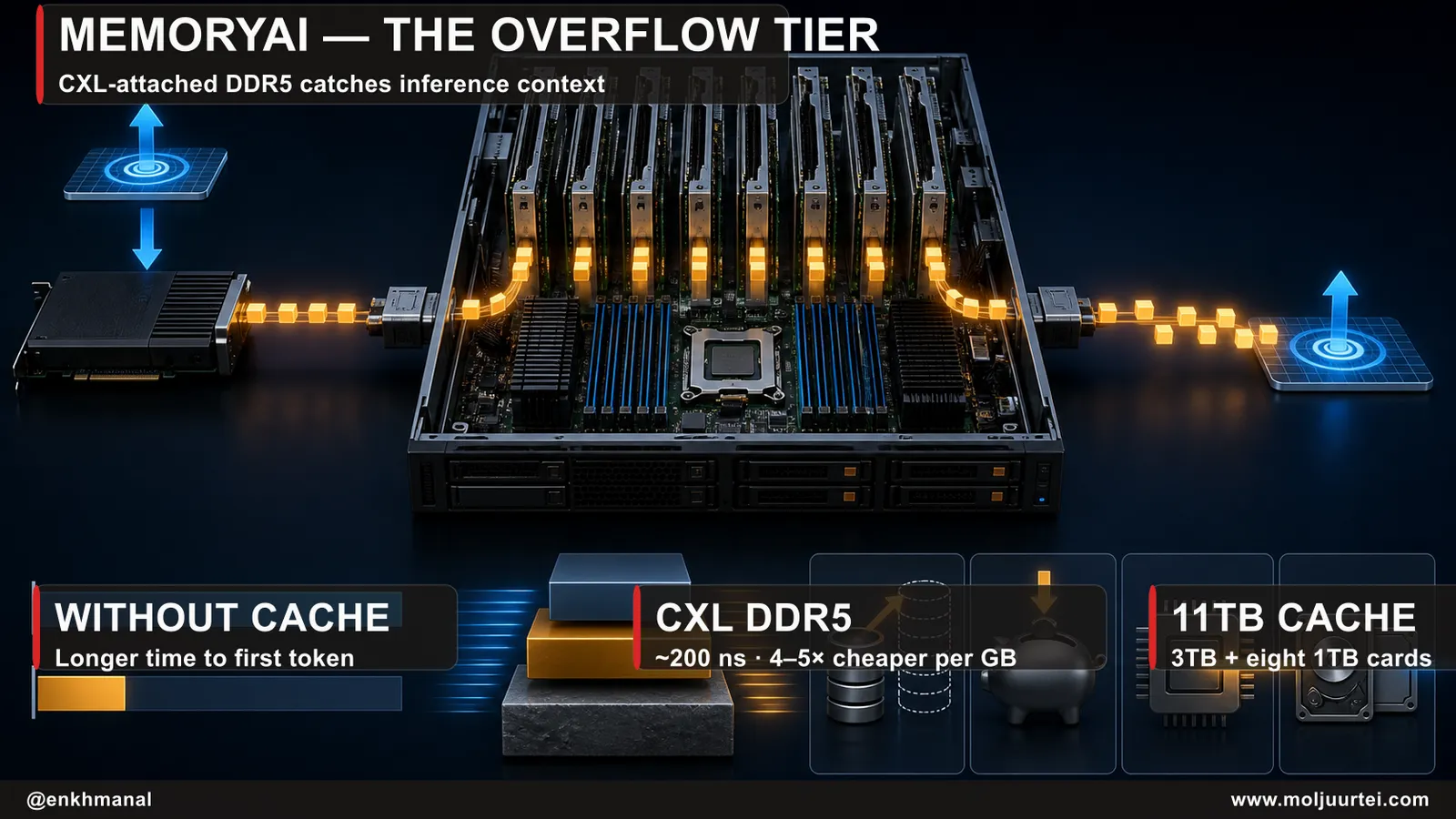
Compute Express Link is an open, cache-coherent interconnect that runs over the PCIe physical layer and lets a processor treat memory attached across a slot almost like its own local memory — readable with ordinary load and store instructions rather than through a storage driver. The practical consequence is the whole technology: software treats attached memory the same way it treats local memory, just about 200 nanoseconds further away, against roughly 100 microseconds to reach a solid-state drive. The standard is governed by a consortium founded by the hyperscalers, and it absorbed its two main rivals in 2021 and 2022, so there is no standards war to lose.
Now place Penguin in it, honestly. It does not make the controller silicon — that is Astera Labs, Marvell and Credo. It does not make the memory devices — that is Micron, Samsung and SK hynix. What it makes is the appliance and the software above them, and the specifics are more differentiated than the word integrator suggests. Around the appliance sits ClusterWareAI, a cluster operating system rebuilt several times across 25 years that turns hardware into a cluster, monitors it continuously and auto-remediates faults; OriginAI, validated reference blueprints for training and inference on both NVIDIA and $AMD silicon; and a design-build-deploy-manage services organisation with, by the company's account, over four billion hours of accelerator-cluster runtime experience. That record is why NVIDIA made it an AI Factory Specialized Partner and why Dell named it Americas AI Partner of the Year in June 2026. The honest verdict: this is an integration-and-software moat, not a silicon moat, and it is attackable from below.
It takes these Penguin-developed CXL memory expansion cards that are 1 TB each, and it takes a whole set of these and places them into a server appliance such that this box adds 11 TB of ultra-high performance memory-based storage. Within this area of KV caching, there are approaches people take using much, much slower, 100 times slower, flash-based storage.
Three lines, each with a dated proof point
MemoryAI is the flagship. The key-value cache server shipped in production form in March 2026 and is already converting: a tier-one financial-services customer added in the second quarter bought more units in the third for an on-premise inference factory running code generation on open-weight models, and a separate generative-AI customer is buying the expansion cards outright. Optical comes next — Penguin was an early investor in Celestial AI, whose photonic-fabric technology Marvell has since acquired, and management has flagged a photonic variant of the MemoryAI line as the follow-on. ClusterWareAI got a substantial update in June 2026, adding an autonomous conversational operations agent and automated remediation for Kubernetes-based inference workloads; the strategic logic is to use agentic AI to run the infrastructure that runs agentic AI, and price the result as software rather than hardware attach. The customer funnel is the least glamorous and most checkable line: across the four quarters to the second quarter of 2026 the memory business added 16 new customers, five of whom subsequently expanded, and the infrastructure business added 13, seven of whom expanded, plus four more in the third quarter.
A delta hedge and an interim finance chief
The stock peaked at $81.39 on 9 July, two days after the strongest quarter in the company's history, and closed Friday at $49.51. Nothing in the business explains a 39% drawdown. Two things in the capital structure and the org chart do. On 17 July the company issued $750m of 0.00% convertible senior notes due 2031 at a $116.70 conversion price — a 122% premium to the then-current share price — alongside $49.1m of capped-call transactions. Proceeds repurchased $135.5m of the 2029 notes and $160.0m of the 2030 notes and repaid the $100m drawn revolver. Convertible buyers delta-hedge by shorting the underlying, and in a company with roughly 50 million shares outstanding that mechanical selling is not small. The drawdown is, in substantial part, the hedging of a bond.
Read the terms the other way and they are a compliment. A company that can sell five-year money at a zero coupon, more than double its share price, is a company the credit market regards as an equity story rather than a credit risk. Pro forma, the balance sheet carries roughly $800m of debt against roughly $730m of cash — close to net-neutral, with no coupon. The second explanation is the finance seat: on 1 June the company announced that Nate Olmstead would step down on 8 July to pursue an opportunity in a different industry, with Aaron Johnson interim while a permanent search runs. That is a legitimate flag — but note the sequencing. He left immediately after raising guidance and issuing a preliminary view for the following year, which is not how someone exits ahead of a problem.
The deck's balance-sheet slide is where the contrast with the other name in this pair turns sharp. Penguin's days payable outstanding ran 53 → 63 → 62 days across the last twelve months and its cash conversion cycle sits at 33 days. Supermicro's payables went the other way, 85 days to 29, and its cycle stretched to 149.
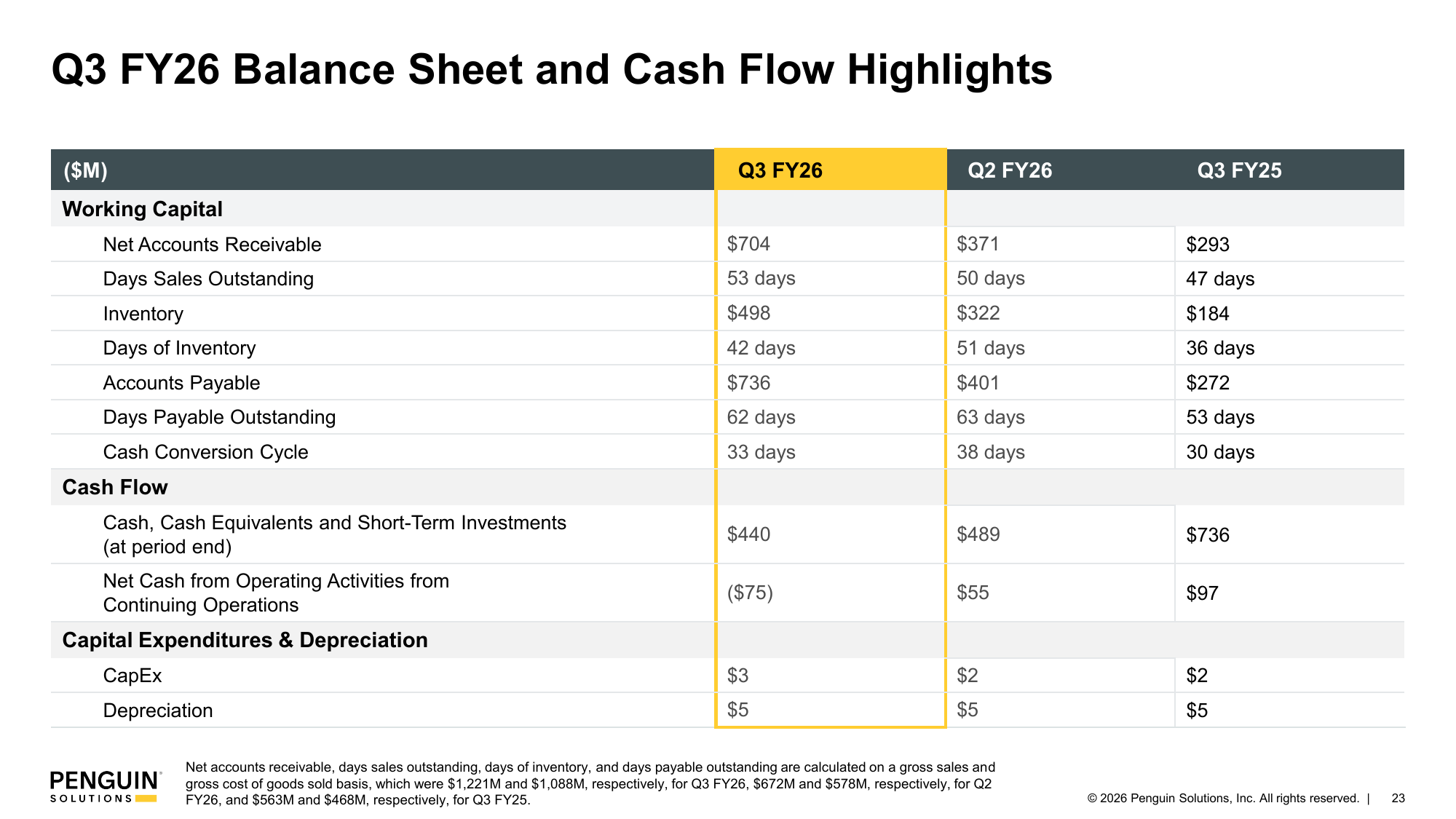
The levels are not comparable and the slide's own footnote says why: Penguin computes those day counts on gross sales of $1,221m and gross cost of goods of $1,088m rather than the $478.7m of net sales it reports, because the supply-chain services business passes through material it never takes title to. On a net basis the days would be several times larger. What survives the basis difference is direction. Suppliers extended Penguin's terms by nine days over the year while withdrawing fifty-six from Supermicro. Two buyers of the same constrained memory, treated differently by the people selling it.
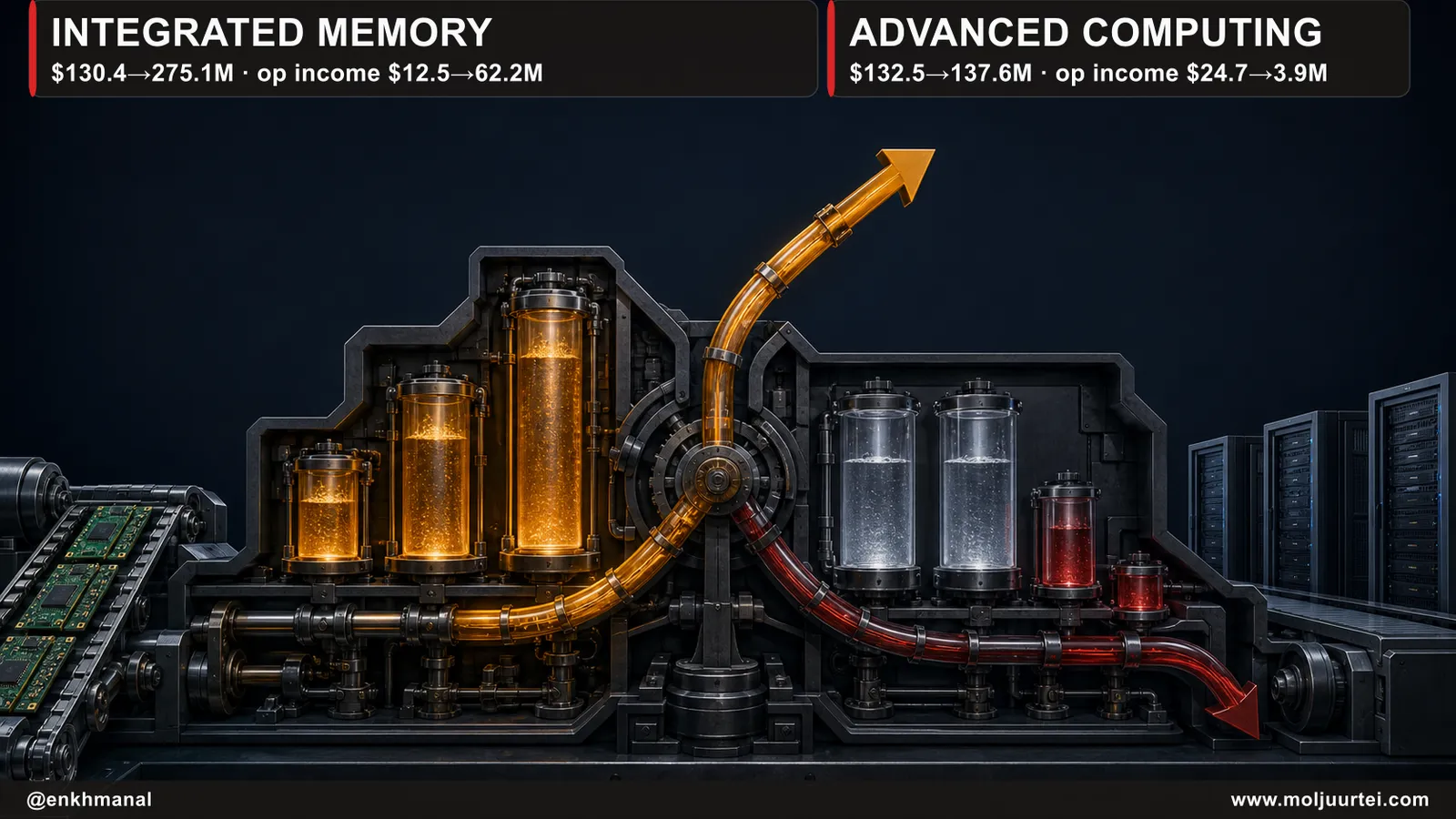
Which part of the business is actually working. Segment revenue alone hides it; share of revenue and share of growth do not.
Two things fall out of it. Integrated Memory produced 93.8% of every dollar of the company's revenue growth, went from 40.1% to 57.5% of net sales in twelve months, and earned $62.2m of the $70.2m of total segment operating income. Penguin is a memory company with two other divisions attached, and the risk section below should be read that way.
The second is a correction to the story the trailing figure tells. Advanced Computing is down 20.6% across the first nine months — but it bottomed at $115.7m in the February quarter, below the $132.5m it did a year earlier, and has since grown 18.9% sequentially to $137.6m, back above the year-ago level. The deliberate hyperscale wind-down has largely worked through. What has not recovered is the segment's profitability: operating income of $3.9m against $24.7m, a 2.8% margin against 18.6%, on slightly higher revenue. Revenue turned two quarters before margin did, and the October print is where you learn whether margin follows.
What the market is not paying for is the shape underneath. Integrated Memory's gross margin went from 21.0% to 30.0% year on year while its revenue doubled. The consolidated numbers therefore understate the health of the growing business and overstate the drag from the one being rebuilt on purpose. The last thing the market is not paying for is a genuine second-order read, and it is not about Penguin at all: engineers close to the controller vendors report that SK hynix has stopped developing its own CXL solution internally, attributed to gaps in system-on-chip design capability. A memory maker that will not build its own CXL systems needs partners who can — which is exactly the seat Penguin occupies under the January 2025 agreement.
A software team hired into a hardware holding company
Kash Shaikh became chief executive in February 2026, arriving from Securonix, an enterprise security software company built around agentic workflows, with more than 30 years of operating experience. He immediately hired Ian Colle as chief product officer from Amazon Web Services, where he was general manager of advanced computing and simulation. The pattern is legible and consistent with the strategy. The record so far is short but good: under Shaikh the company has raised full-year guidance twice, delivered a record quarter, exited a low-margin hyperscale business on schedule, shipped the first production CXL cache appliance, and been named a specialized partner by both NVIDIA and Dell inside six months.
Set the cash flow statement against the income statement and a third picture appears. Nine-month adjusted EBITDA was $163.2m against $11.2m of operating cash flow: 7% conversion, and the most important number in the release. The quarter itself ran −$75m against +$97m a year earlier. Receivables went $308m → $703m, inventory $255m → $498m, payables $319m → $803m. The growth is real, and suppliers are funding it.
The flag is the finance seat. Penguin has now lost two chief financial officers in the transformation — Ken Rizvi, who left the predecessor company and is now at Synaptics, and Nate Olmstead in July 2026. Two departures in two years is a pattern rather than an accident, and an interim finance chief during a period of heavy working-capital investment, a $750m financing and a segment mix in violent motion is exactly when you want continuity. The permanent hire is the single most informative management event ahead. Against that, SK Telecom holds board-nomination rights and has a director seat, which is a real governance anchor from a strategic holder that paid $200m at $32.81 and is sitting on a large gain.
What breaks it
A correction inside an uptrend, on thin option depth
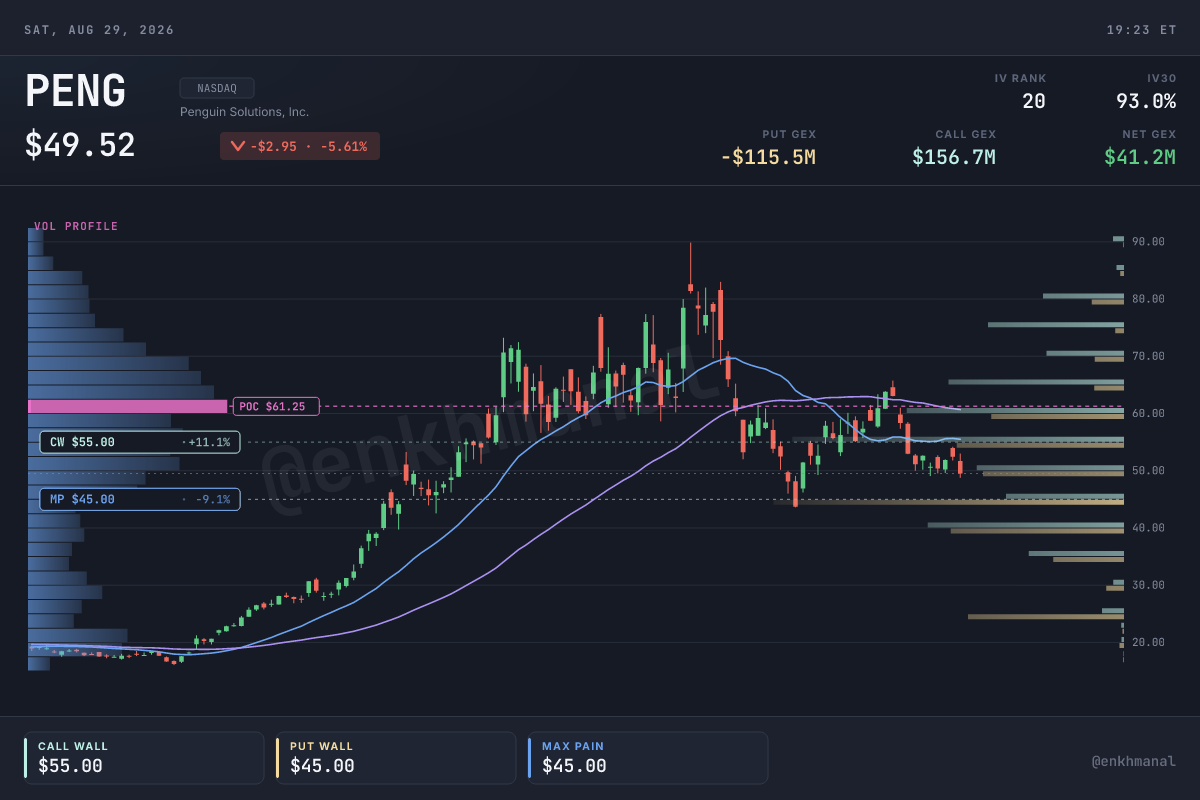
Penguin closed Friday 28 August at $49.51, down 5.6% on the day. This is a correction inside an uptrend, not a break: price sits below the 20-day ($55.49), 50-day ($60.68) and 100-day ($52.35) moving averages but 38% above the 200-day ($35.88), with a 14-day relative-strength reading near 41. The 52-week range is $16.24 on 30 March to $81.39 on 9 July — 39% below the high and 205% above the low, which tells you how much of this year's move is already banked.
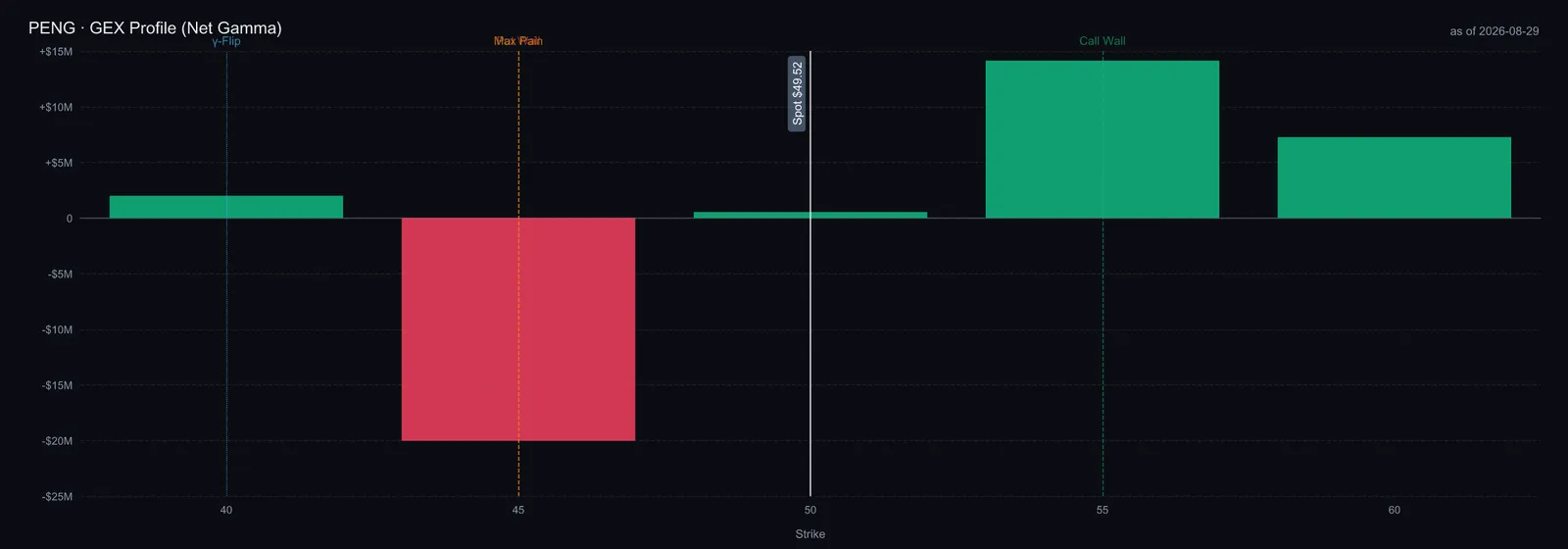
Dealer positioning on the 28 August snapshot, computed off the prior session's $52.46 spot: net gamma $65.5m, call wall $55, put wall $45, maximum pain $45, gamma flip $57, put-to-call open interest 0.75 across 10 expirations. Read that with a caveat the chart cannot show — total call open interest is about 52,000 contracts, roughly a twenty-fourth of Supermicro's. The walls are real but thin, so they frame a range rather than enforce one, and a fundamental move will go through them without much resistance. Implied volatility is high and flat: about 80% for September, 93% for October, and holding near 90% out a year, which is the market pricing an event it cannot date. Calendar: Goldman Sachs Communacopia on 10 September, then fourth-quarter results and the first full guide for the new fiscal year in early October.
Fifteen times a thirty per cent grower
On the company's own guided share count of 56m non-GAAP diluted shares, $49.51 is roughly $2.77bn of market capitalisation. Pro forma for the July financing the balance sheet is close to net-neutral, so enterprise value is about $2.85bn. Against that, fiscal 2026 revenue of roughly $1.67bn and non-GAAP earnings of $2.60 put the stock at 19 times trailing-year earnings and about 1.7 times sales. On the preliminary view for fiscal 2027 — roughly 30% growth in both lines — revenue is about $2.18bn and earnings roughly $3.38, or 14.6 times forward earnings and 1.3 times sales. Rosenblatt carries a buy rating with an $80 twelve-month target set on 17 August, when the shares were higher than they are now. Fifteen times forward earnings for a business compounding 30% is not demanding. The reason it is available is that the market cannot tell how much of the growth is cycle and how much is structure — and neither, honestly, can I. What I can do is separate them: the memory cycle is what you are paying for, the memory wall is what you are getting free.
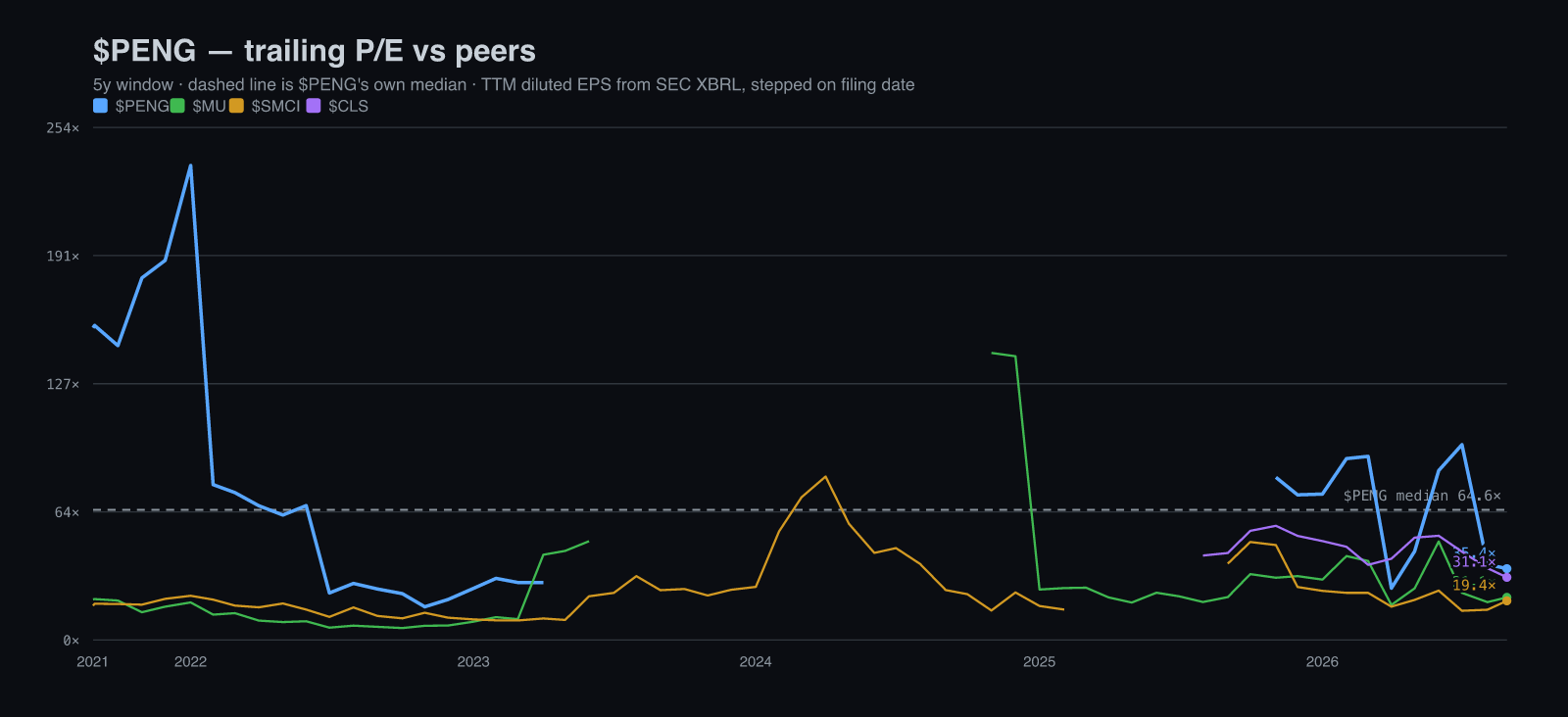
Against its own history the multiple is not stretched. On trailing GAAP earnings Penguin sits at 35.4 times versus a five-year median of 64.6, the 33rd percentile of its own range, and its trailing PEG is 0.64 on a realised 55.3% earnings growth rate. Micron trades at 21.1 times against a 20.5 median and Supermicro at 19.4 against 20.7, so the memory chain as a whole is mid-range rather than euphoric. The caveat is the one that runs through this memo: that 35 times is a GAAP trailing figure struck on a cost base the memory cycle is currently flattering, and non-GAAP forward the same shares are 14.6 times.
House view: own it, and own it as a memory-cycle position with a CXL option rather than the reverse. The pullback is mechanical — a delta-hedged zero-coupon bond and an interim finance chief — against a business that raised guidance twice in a quarter. The entry is 39% better than it was at the July high and the fundamentals are better than they were then, which is the combination worth acting on. Size it for the cycle risk, because that is what carries the earnings. What would make me wrong: memory pricing rolling over before the CXL line scales; the October guide coming in below the roughly 30% preliminary view; a permanent finance chief who is not obviously an upgrade; or Astera Labs and Marvell shipping their own cache appliances and turning a partner into a competitor. What confirms the thesis is narrower than the bull case usually is — the October guide, the named CXL customer count, and Integrated Memory holding a 30% gross margin after memory prices stop rising.