
$NVEC Deep Dive — Spintronics' 79%-Margin Annuity, With a Free-ish Call on the Humanoid Hand
Internal Deep Dive · Published: 2026-07-11 · Tickers: $NVEC, $MRAM
Thesis
$NVEC is a 37-year-old Minnesota spintronics chipmaker that does one thing extraordinarily well: it sells the smallest, most precise magnetic sensors and couplers anyone makes, into applications — implanted medical devices, factory automation, and now robotic end-effectors — where "smallest and most reliable" beats "cheapest," and where a design-in locks the customer for a decade. The result is a 79% gross margin, ~58% net margin, zero-debt annuity that has compounded almost no revenue growth in a decade but throws off nearly all of it as a ~4.4% dividend.
The setup that makes it interesting now: NVE just finished a two-year plant expansion that doubled capacity and depressed cash flow; that capex is rolling off. Defense/government revenue collapsed ~79% YoY in Q4 on shutdown-driven timing, and the CFO guided on the May 6 call that they "expect defense sales to increase significantly this fiscal year" off a near-zero base. A new growth-incentivized CEO (the physicist who built the expansion) takes over Aug 6, 2026. And on that same call, management confirmed — verbatim — that its sensors go on "the end effectors, which are the hands or fingers of the robot" — a vertical it refuses to quantify and that the market is paying ~nothing for.
My verdict: a name worth owning — start a position and add as the setup confirms. You're getting a genuinely rare business — ~79% gross margins, no debt, a two-decade medical annuity, and a U.S.-made sensor nobody else quite replicates — at ~29× earnings, with the humanoid-hand ramp thrown in as upside the market isn't yet paying for. And three tailwinds line up at the same time: a two-year capacity build just finished (so the capex that held cash flow down now rolls off), defense revenue is snapping back off a near-zero base, and a growth-incentivized new CEO takes the wheel in August. The single cleanest tell to watch is the FY2027 defense line inflecting in an actual print — and a named humanoid-robotics customer would re-rate this fast. This is the kind of high-quality, optionality-rich small-cap you build into deliberately, not a lottery ticket.
Business & Backdrop — what you actually own
$NVEC ("Non-Volatile Electronics") was founded in 1989 by Dr. James Daughton, one of the people who helped invent spintronics — the use of electron spin rather than charge to sense, store, and move information. The same physics that gave the world the GMR hard-drive read head (which is why this rhymes with the $WDC HDD deep dive — both trace to magnetic-read-head heritage) is what NVE now points at the physical world.
Management frames three product families as the eyes, nerves, and brains of an electronic system:
- Sensors (eyes) — GMR/TMR magnetic sensors that detect position, rotation, or speed. Two lanes: catalog sensors for Industrial-IoT / factory automation, and custom medical sensors that replace electromechanical switches inside implanted devices. This is the crown jewel — smallest footprint (<1 sq mm), sub-microtesla sensitivity, no moving parts.
- Couplers / isolators (nerves) — combine a GMR element with a microscopic coil to move high-speed data across an electrical isolation barrier. Sold into power conversion and factory automation.
- $MRAM (brains) — here is the first correction to the bull narrative: NVE's $MRAM strategy is deliberately low-bit-density, aimed at tamper prevention/detection and military niches. It is not a competitor to $MRAM/Everspin's high-density commercial memory. The "free $MRAM option" is real IP heritage but commercially immaterial — don't pay a cent for it.
The medical anchor and its expiry date. NVE's floor is a decades-long supplier relationship with Abbott (via its Pacesetter cardiac-rhythm business) under a formal Supplier Partnering Agreement, worth roughly ~37% of revenue. This is high-margin, deeply embedded, switching-cost-protected revenue — requalifying a component inside a life-sustaining implant with the FDA is exactly the kind of thing customers avoid, which is why it reads as a durable floor. But the floor has a date on it: the 10-K discloses that the Supplier Partnering Agreement, as amended, expires December 31, 2027. Renewal is likely — yet it is a hard expiry on a third of the revenue base, and it belongs in the model as a risk/catalyst, not a given.
The financial profile (FY2026, ended 3/31/2026, straight from the 10-K — NVE runs a March fiscal year, so "fiscal 2026" is the year just closed):
- Revenue $26.3M (up just +2% from $25.9M in FY25 — essentially flat); gross profit $20.7M → 78.7% gross margin
- Operating income $15.92M (60.5% op margin); net income $15.2M (57.7% net margin); diluted EPS $3.14 (vs. $3.11 prior year)
- Operating cash flow $16.7M (+16% YoY, and $1.5M above net income — high earnings quality); financing outflow −$19.35M = the dividend. Management confirmed the payout on the call: $1.00/share/quarter (~$4.00/yr, ~4.4% yield), funded partly by "proceeds from bond maturities."
- Balance sheet: $60.4M assets, $2.1M total liabilities, $58.2M equity, no debt. A fortress. (Note: only $1.7M is literal cash — the rest of the ~$28M liquid pile sits in a marketable-securities/bond portfolio that also throws off interest income.)
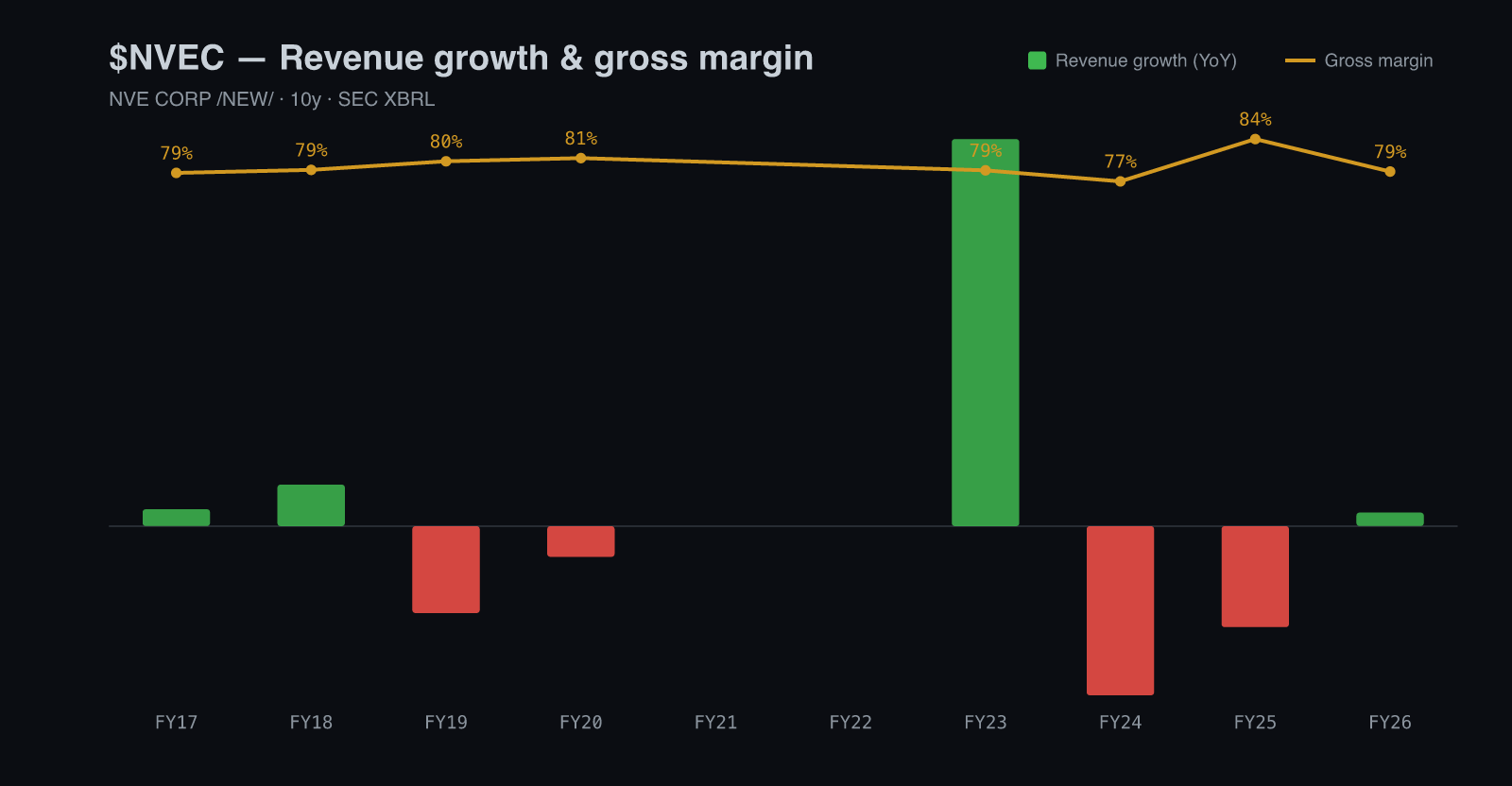
The chart is the whole business in one frame: gross margin pinned between 77% and 84% for a decade, revenue growth choppy and secularly flat — a FY23 chip-shortage spike, a FY24–25 giveback, and a modest FY26 recovery. Margins like that don't come from cost-cutting; they come from selling a part nobody else can make at that quality into applications that can't easily switch. That is the moat. The absence of growth is the reason it trades where it does.
The Setup — why the coiled spring, and where I'd temper it
Seven things are converging, and management (normally conservative) is unusually vocal about them:
-
Capex is rolling off. NVE spent two years doubling manufacturing capacity — the last major equipment went into service in the quarter ended March 2026, and management guides "fixed asset purchases to decrease significantly in fiscal 2027." Investing cash flow already turned positive (+$3.6M) in FY26. On a 79%-gross-margin base, the fixed-asset spend that suppressed cash flow now converts to free cash.
-
Defense is coiled off a near-zero base. Non-defense revenue grew ~34% YoY; defense/government fell ~79% on procurement delays and the shutdown. Management "expect[s] defense sales to increase significantly this fiscal year." At a company this small, government revenue is lumpy — a snapback off zero is arithmetically large.
-
A growth-incentivized operator takes the wheel. Dr. Daniel Baker (CEO since 2001) moves to chairman; Dr. Peter Eames — the physicist who ran advanced technology and led the expansion — becomes CEO Aug 6, 2026. The person who built the plant now gets to fill it. Per the June 2026 proxy, Eames's variable pay is tied directly to FY2027 growth (a slice of FY2027 operating income plus a cut of the increase over the FY2026 $15.92M operating-income base). The board is also expanding from five to seven, adding a medical-device commercial executive (Carolyn Valentine, of Demant/Grason-Stadler).
-
The robotics vertical is confirmed but unmodeled — read the exact words. From the actual Q4 FY2026 transcript (May 6, 2026), CEO Dan Baker on robotics pipeline: "We have a number of customers that are in robotics… some of the places where our sensors get used in robotics is on… the end effectors, which are the hands or fingers of the robot… because we offer the smallest sensors available and much more precision… Those would be delicate operations for end effectors and also things like surgical medical robots." And in the R&D section, incoming CEO Pete Eames named the target market explicitly: NVE's strategy is to make products for "high-value markets such as medical devices, electric and autonomous vehicles, advanced humanoid robotics, and highly automated fourth-wave factories." So "humanoid" is management's own stated aim — not merely an outside inference. The honest boundary: it is a named strategic target and a confirmed live application, but an unquantified one — no OEM named, no revenue disclosed, and NVE often sells to subassemblers and can't see where parts land. Sensing is 10–20% of a humanoid's BOM (McKinsey); UBS models a $30–50B humanoid TAM by 2035. That's the "free call option": a real, management-endorsed lane that is unpriced and still unsized.
Proof the expansion is already producing robotics-relevant parts: the new line controls spintronic deposition "to well within one atomic layer," and NVE just launched a 0.65mm-per-side wafer-level chip-scale sensor — ~1/3 the area of its conventional package — expressly "for smaller medical devices and especially precise robotics." The capacity isn't theoretical; it's shipping product aimed at exactly this vertical.
-
A second optionality lane beyond the humanoid headline: AI data-center power isolators. NVE just signed distributor Semitech (which services EMS / rack builders) for its isolator line, and its higher-frequency spintronic isolators pitch a power-efficiency edge into AI-infrastructure racks. Separately, NVE is picking up sockets that $TXN and $ADI are end-of-lifing — offering long-term-supported alternatives to customers whose incumbent parts got discontinued. Both are unquantified (management: "difficult to quantify… we sell to sub-assembly manufacturers"), but they're additional non-defense growth vectors beyond the humanoid headline.
-
Management ties the doubled capacity to growth ambition — without guiding. Asked directly whether doubled capacity means revenue could "more or less double," Baker replied "Our goal is to grow… we don't give specific guidance, but we're optimistic… we have exciting new products, and… quite a bit more capacity. We see a bright future." Ambition, not a forecast — but the clearest signal yet that the plant was built to be filled.
-
Biosensing optionality. NVE's GMR biosensors have been used in published work reading hemoglobin through the skin. Real, but speculative — no revenue line, no way to model it.
Where I temper the "coiled spring." The metaphor implies FCF builds cash once capex falls. It doesn't — NVE pays out essentially 100%+ of net income as dividends (that's the −$19.35M financing line). So the base case for falling capex is a bigger dividend or a maintained one, not a growing war chest. For the coiled spring to release into growth, management has to consciously redirect payout into capacity/M&A/R&D — which is plausible under a growth-comp'd CEO but is a decision, not a mechanical outcome. Underwrite the re-rating on defense snapback and margin flow-through, and treat "capex → cash pile → growth" as a management-behavior bet, not a balance-sheet certainty.
Technology & Moat — what spintronics actually is, and one correction
Start with the physics, because it's the whole story. Every chip you own works by pushing electric charge — electrons — through circuits: the flow is current, and shoving all that charge around is what makes a processor run hot and drains a battery. Spintronics exploits a second, mostly-ignored property of the electron: its spin. Alongside its charge, every electron behaves like an infinitesimally small bar magnet with a north and south pole — a microscopic compass needle that points "up" or "down." Conventional electronics doesn't care which way it points; spintronics reads and uses that orientation.
The payoff is a device that senses magnetic fields with extreme precision, using very little power, in a package small enough to disappear into a fingertip. The workhorse effect is giant magnetoresistance (GMR) — discovered in 1988 by Albert Fert and Peter Grünberg, who shared the 2007 Nobel Prize in Physics for it — and its more sensitive successor, tunneling magnetoresistance (TMR): a stack of ultrathin magnetic layers whose electrical resistance swings sharply depending on whether the layers' spins line up or oppose. GMR's first world-changing job was inside the hard-drive read head, where reading ever-fainter magnetic bits off a spinning disk is what made cheap mass storage possible. NVE's entire business is pointing that same physics outward — turning it into the smallest, most precise magnetic sensors on the market.
If you want the visual version, this five-minute explainer walks through spin-vs-charge and why it matters:
What is spintronics and how is it useful? — a 5-minute explainer (SciToons, Brown University)
That physics is the product; the manufacturing is the moat. NVE builds its spintronic GMR/TMR films — critical conductor layers under 2 nanometers thick, a few atoms — on its own U.S. line, a genuinely hard, proprietary process the company has spent >$50M of government contracts learning to do at production quality. That is real and defensible.
But the tidy "in-house U.S. fabrication = supply-chain moat" story is only half true, and the 10-K says so plainly: NVE buys most of its foundry wafers from foreign (largely Asian) manufacturers, is exposed to tariffs on them, relies on single-source suppliers for many critical wafers and chemicals with no qualified alternates, and sends wafers to Asia for dicing and packaging. So the differentiated spintronic deposition is domestic; the surrounding supply chain is not. In a "buy-American sensors" world that helps at the margin, but this is not a vertically integrated, tariff-immune fortress. Supply concentration is, in fact, one of the company's top-listed risks.
Valuation & House View
At $90.78 (2026-07-11; down ~7% from the $98.22 close on Jul 2), ~4.84M shares → ~$439M market cap, ~29× trailing EPS of $3.14, ~4.4% dividend yield.
A sum-of-the-parts framing assigns a blended ~32× FY2027E net-income multiple across six business lines (medical implantables at 35×, defense/$MRAM optionality at 36×, contract R&D at 11×), which yields three scenarios:
| Scenario | FY27E NI | Multiple | Implied /sh | vs. $90.78 |
|---|---|---|---|---|
| Bear (40% defense snapback, −5% non-defense, 24× de-rate) | $14.9M | 22.4× | $69 | −24% |
| Base (60% defense snapback, +15% non-defense, 32× SOTP) | $18.3M | 32.0× | $121 | +33% |
| Bull (80% defense snapback, +35% non-defense, humanoid multiple) | $21.6M | 50.1× | $224 | +147% |
My take on the math: the earnings bridge is credible — a defense snapback off zero plus continued non-defense growth plus capex flow-through gets you to ~$18M FY27 net income without heroics. One caveat the bull case understates: FY26 net income was flattered by $1.07M of Advanced Manufacturing Investment Tax Credits (which dropped the full-year tax rate to 15% and the Q4 rate to 5%) — and management explicitly expects those credits to "decrease significantly in fiscal 2027" as equipment purchases end. So a chunk of the FY26 earnings base has a tax tailwind that partially reverses next year; the revenue/operating ramp has to more than offset a normalizing tax rate. The multiple is where I'd be more disciplined. A 32× SOTP on a business with a decade of flat revenue and 37% concentration is a full price, and the bull-case 50× is explicitly pricing in humanoid + biosensing optionality that management itself won't underwrite. I'd anchor my own base case nearer the low-$100s and demand the defense line to actually inflect before paying up toward the SOTP.
The valuation, plainly: at ~29× you're paying a fair — not demanding — multiple for a top-decile-quality, 79%-gross-margin, no-debt, dividend-paying annuity, and getting a stack of genuinely asymmetric options (defense mean-reversion, humanoid end-effectors, GMR biosensing) largely for free on top. That's an attractive shape: a rare-quality business at a reasonable price, with the optionality as the kicker rather than the whole thesis. The scenarios frame the skew — real upside if the defense line inflects and the robotics ramp shows up, with the margins, the balance sheet, and the ~4.4% dividend cushioning the wait.
Vs. $MRAM (Everspin). The only other listed spintronics pure-play, and a useful contrast, not a comp. Everspin is a memory company — ~$55M revenue, ~51% gross margin, a small 2025 loss, fighting a scale-and-cost war, trading ~49× forward. NVE is the opposite animal: half the revenue, but ~79% margins, consistently profitable, keeping ~50 cents of every revenue dollar. Everspin is the higher-beta bet on spintronic memory at scale; NVE is the high-margin compounder on spintronic sensing. If you want spintronics-as-a-theme, they're two different risk profiles — I prefer NVE's quality-and-optionality profile to $MRAM's commoditizing-memory profile.
Positioning / house view: constructive, starter-size, accumulate on confirmation. The single cleanest catalyst to underwrite is the FY2027 defense snapback showing up in an actual print; a named humanoid-OEM disclosure or open-market insider buying would be the re-rate triggers. Mind the liquidity — bid/ask was $87.27 / $120.00 on ~240k shares/day; this is a name you build slowly with limits, not market orders.
Risks & What Breaks It
- The growth case leans on the snapback. Ex the cyclical chip-shortage spike, revenue has been roughly flat for a decade (+2% in FY26), so the re-rating rests on defense recovering and the new verticals showing up — not on a business that's already compounding. Management has guided to a defense recovery before and been early on the timing, so the FY2027 defense line landing in an actual print is the single most-watched item.
- It's a known idea — buy it with discipline. The humanoid-sensor angle on $NVEC has circulated since spring and the stock has re-rated off its lows, so this isn't a hidden name. Two practical notes: some retail framing runs ahead of the filings — the "confirmed humanoid customers in the pipeline" claim is stronger than management's actual "customers in robotics" plus humanoid robotics as a named R&D target — so underwrite the disclosures, not the enthusiasm; and because the easy first leg of the re-rating is likely behind it, scale in and add on the catalysts rather than chasing spikes.
- Abbott concentration + a 2027 expiry. ~37% of revenue in a Supplier Partnering Agreement that expires Dec 31, 2027. Non-renewal, or renewal on worse terms, is a direct hit to the floor everyone assumes is permanent.
- The dividend, not a cash pile, is the base case. ~100%+ payout means the "coiled spring" only releases into growth if management chooses to redirect it. That's a behavior bet on a first-time CEO.
- Growth is new to this management. Flat 2021–2025; no recent evidence they can scale well. New CEO = execution risk despite decades of tenure.
- Supply chain isn't the fortress it looks. Single-source foreign wafer + chemical suppliers, Asian dicing/packaging, tariff exposure. A supply interruption is a top-listed 10-K risk.
- Liquidity and float. ~$439M cap, ~4.8M shares, ~1.3% insider ownership, wide spreads. Easy to buy into, hard to exit in size; gaps both ways.
- Optionality is unquantified by design. NVE sells to subassemblers and often can't see where parts land — which cuts both ways. The humanoid story could stay a story for years with no discrete disclosure to force a re-rate.
What I'm Watching Next
- The FY2027 defense line inflecting in an actual quarterly print — the thesis's load-bearing catalyst.
- A named humanoid-robotics OEM disclosure — would instantly justify the optionality and re-rate the stock.
- Abbott agreement renewal ahead of the Dec 31, 2027 expiry.
- Open-market insider buying — with ~1.3% insider ownership, a Form 4 buy from Eames post-transition would be a real confidence signal.
- Capex actually falling in FY2027 filings, and whether management redirects the freed cash to growth vs. dividends.
The spintronics-and-the-humanoid-hand framing that surfaced this name is credit to Asymmetrical Bets (asymmetricalbets.substack.com). Every figure and quote in this piece was independently verified against primary sources — NVE's FY2026 10-K, the Q4 FY2026 earnings-call transcript, and the June 2026 proxy. Not investment advice; do your own work. (via Asymmetrical Bets)