
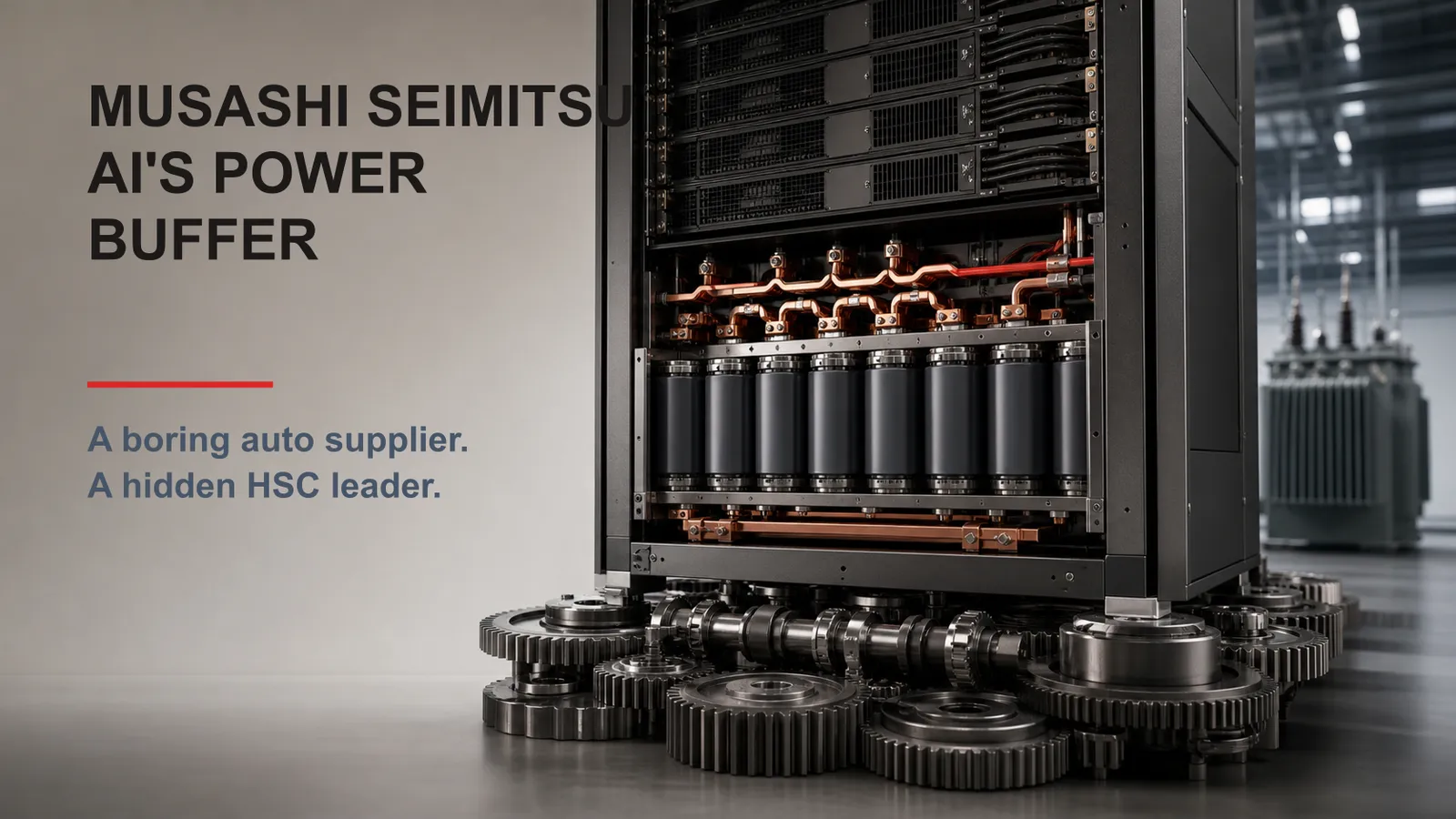
Musashi Seimitsu (7220.T) Deep Dive — HSC, the standard buffer in AI's power stack
Internal Deep Dive · Published: 2026-07-17 · Tickers: $7220.T
Thesis
$7220 is an 80-year-old Japanese Tier-1 auto-parts supplier — differentials, camshafts, gears, ~51% sold to Honda. Deeply unglamorous, cyclical, cheap-ish on cash flow. But bolted inside it is Musashi Energy Solutions, the group's lithium-ion-capacitor arm (roots in the former JM Energy "Ultimo" business), which makes a hybrid supercapacitor (HSC) that is — per multiple independent reads — the density-leading energy-buffer cell on the market for the one job the AI build-out cannot skip: absorbing the millisecond power swings of a GPU rack so the grid upstream stays stable.
This is no longer a hopeful lab story. Third-party reporting has the HSC as a standard component in NVIDIA's GB300 (Blackwell Ultra) platform, with a Flex partnership for containerized energy-storage systems. The engineer-investor at Irrational Analysis, who privately screened 10+ supercap makers, calls it "an uber monopoly of a rapidly growing, mission-critical niche that has massive technical/engineering moat" whose cell "vaporizes everyone else."
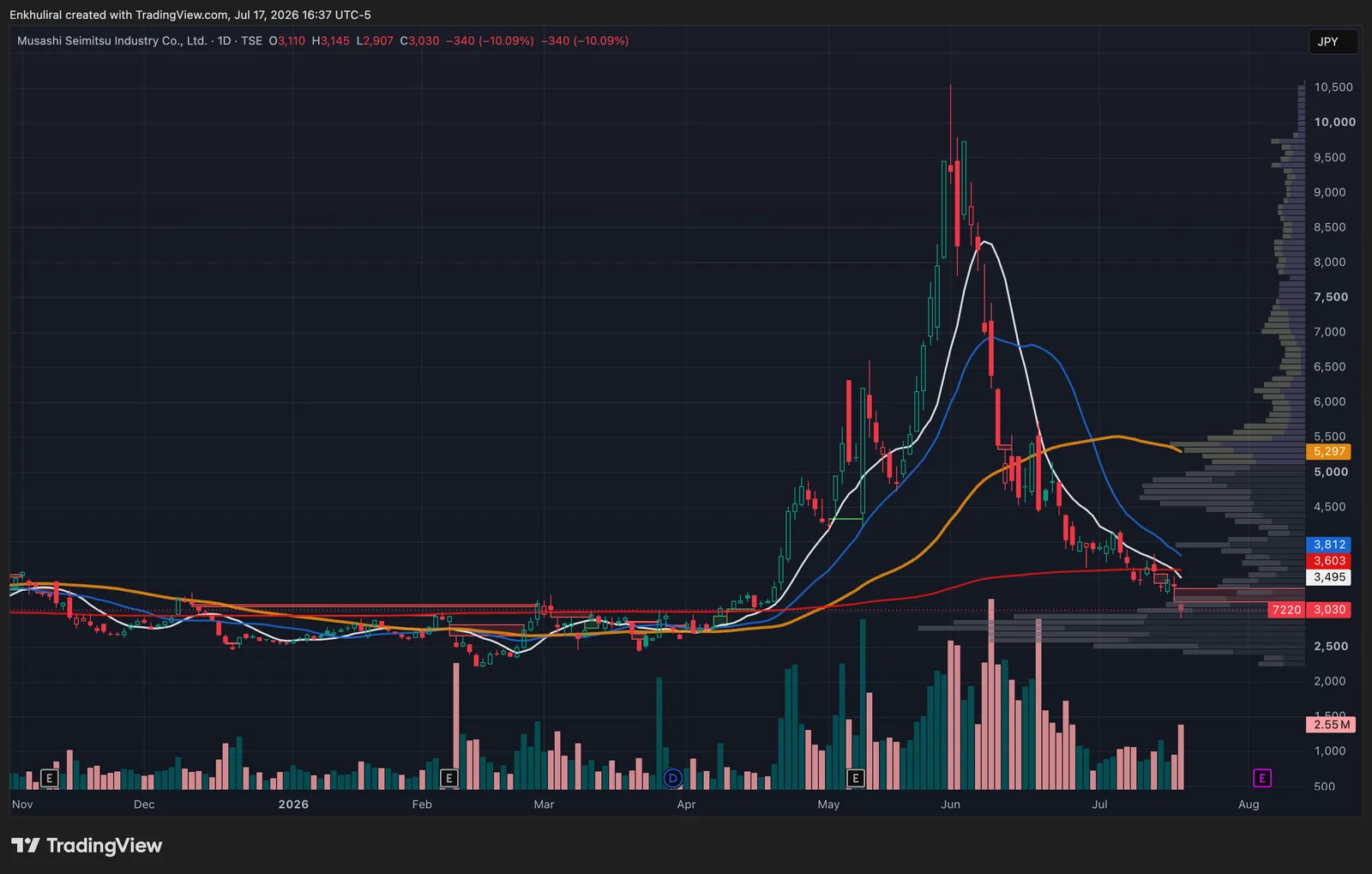
The nuance: this business is barely visible in the financials — it sits inside the Japan geographic segment as a cost (upfront investment), and it's capacity-constrained (sold out of a product it can't yet make enough of). You own a stable auto-parts industrial and get an embedded, spec-leading AI-power call option. The whole debate is how fast that option converts to earnings — and how much the market has already priced (a lot, then less: the stock ran to ¥10,550 and fell back to ¥3,460 inside a year).
Business & backdrop
The company. $7220 is a classic Honda-orbit supplier: FY-ended-March-2026 net sales ¥347.2B (flat YoY), operating profit ¥20.5B (+4.1%, 5.9% margin), EBITDA ¥38.8B, ~66M shares, 40.5% equity ratio, ¥33.9B cash. Reported net income cratered to ¥1.26B (−83.8%) — but that's a one-timer from European restructuring (closing/shrinking German plants, ~20% Europe headcount cut). Guidance for the year to March 2027 has net income rebounding ~5× to ¥6.5B (EPS ¥99.18), dividend held near ¥40. Critically, Musashi reports by geography (Japan / Americas / Asia / China / Europe), not business line — so the HSC franchise has no standalone revenue line. It's tucked inside the Japan segment, where segment profit fell −19.8% specifically because of "upfront investment expenses for the Energy Solution business." Read that correctly: they're spending now, not booking it — capex is stepping to ¥35B (+¥7.1B) to build the new Minami-Alps (Yamanashi) HSC plant, plus an Austin R&D center and a new Musashi Energy Solutions North America entity next to the US hyperscalers.
The bottleneck it plugs into. The binding AI constraint in 2026 isn't GPUs — it's power, and its stability. Musashi's own deck cites the symptoms: a Santa Clara data center idle six years waiting on a grid connection (48 MW stranded, Bloomberg Nov 2025); Nadella and Altman conceding "we have many chips in inventory but no power to connect them" (Bg2 Pod, Nov 2025). The technical wrinkle that creates Musashi's niche is transients: a GPU rack doesn't draw smoothly — when thousands of GPUs synchronize on a training step, rack draw slams from near-idle to full-tilt and back in milliseconds. Across a building this trips protection, stresses transformers, and forces operators to over-provision the scarce grid connection. Neither the grid nor batteries react on a millisecond timescale — a supercapacitor does, sitting at the rack as a fast shock-absorber so the grid sees a smooth line. Regulators noticed: FERC moved to mandate large-load power-stabilization (US-wide, from April 2026) — turning "smooth your draw" from best practice into a requirement pointed straight at this product.
Technology & moat
A capacitor stores energy as static charge on two facing electrodes — no chemical reaction — so it charges and discharges near-instantly and survives hundreds of thousands of cycles where a battery degrades after a few thousand. Its historic flaw: it holds almost nothing. The supercapacitor S-curve has been the engineering climb to fix that (tennis-court-scale activated-carbon surface area folded into a thumb-sized cell).
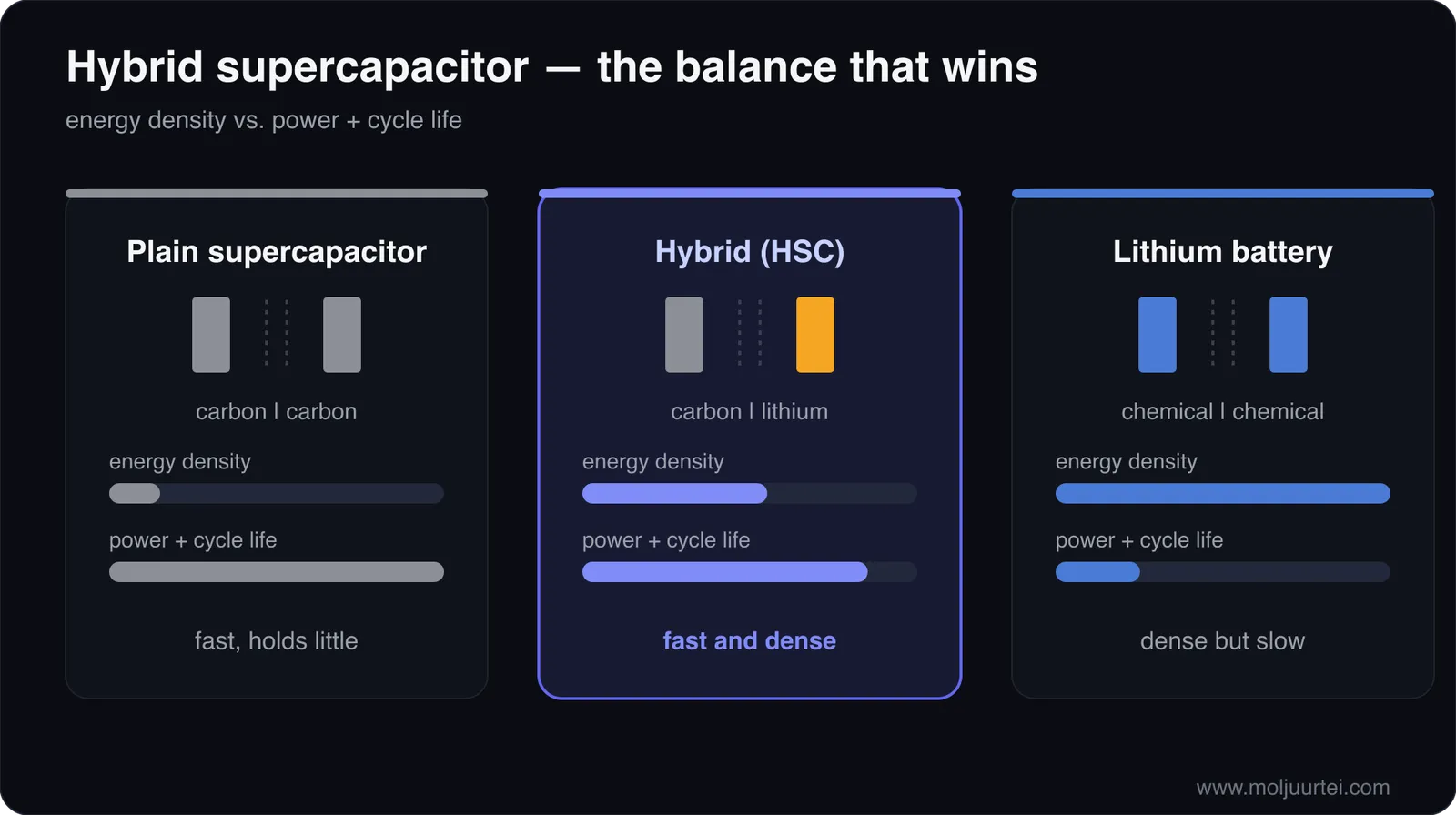
The next inflection is the "hybrid" lithium-ion capacitor, where Musashi lives: replace one of the two carbon electrodes with a lithium-doped electrode, borrowing just enough battery chemistry to roughly triple energy density while keeping the capacitor's second-scale speed, six-figure cycle life, and safety. That specific balance is what the buffering job rewards — a cell that is simultaneously dense (fits the rack), fast (millisecond response), durable (millions of micro-cycles a day for years), and safe (packed into a live, high-power rack). A plain supercap is fast but too small; a battery is dense but too slow and wears out. The hybrid is the only cell clearing all four bars at once.
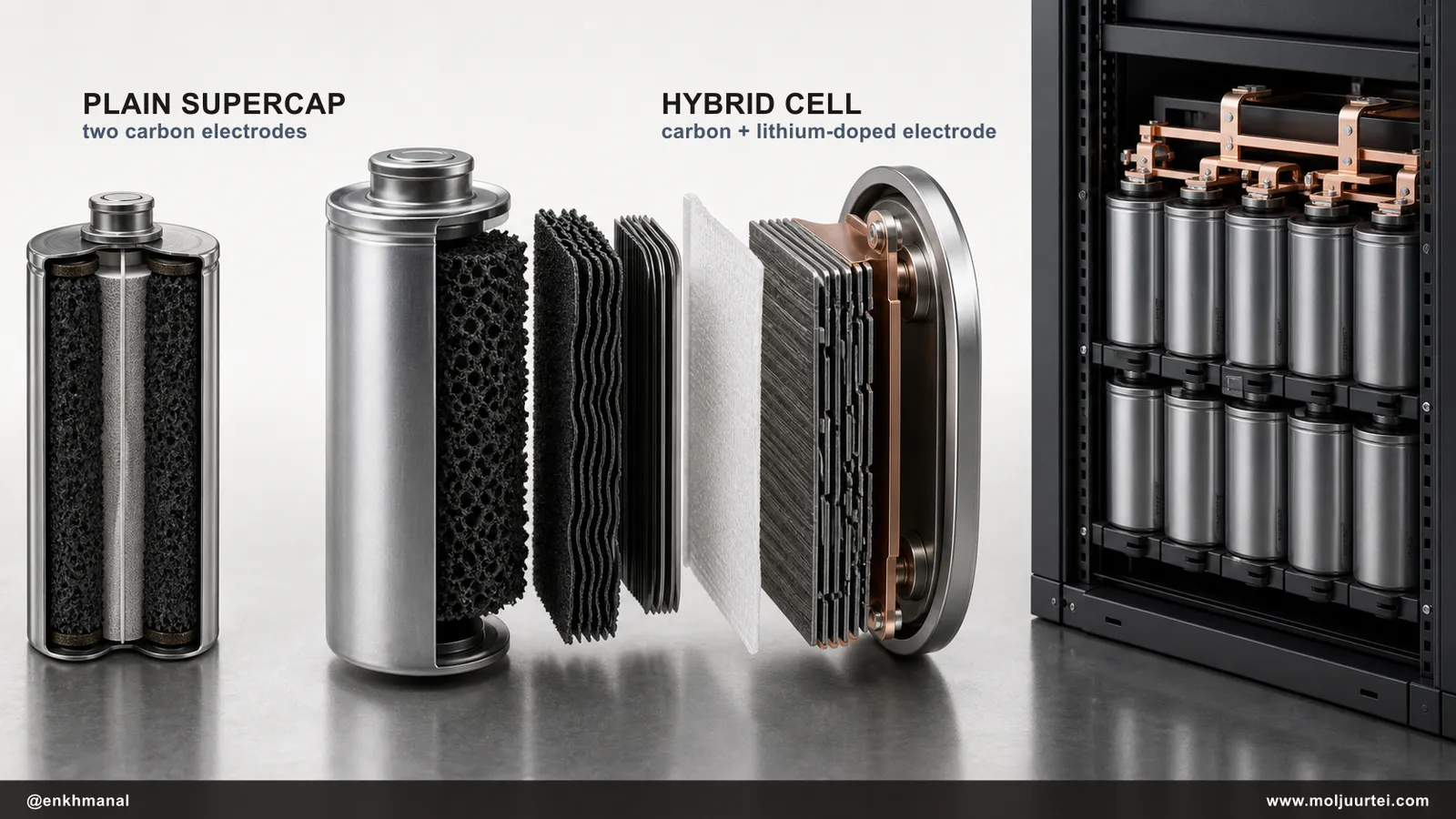
The moat isn't a patent wall — it's an unreplicated materials-and-manufacturing recipe visible on the public datasheet:
- Volumetric energy density is the metric that matters, and Musashi is "way ahead." It fits more usable energy per rack-volume than anyone else. Irrational Analysis's shorthand — density above all — is the whole spec war.
- Higher rated voltage per cell → fewer cells wired in series to reach a data-center bus voltage → simpler control electronics, fewer failure points, lower system cost. A design-in advantage the customer feels in the parts list.
- The honest weakness — high ESR (internal resistance, some energy lost as heat). It's the right trade-off here: because these buffering circuits already step voltage down then boost it back up (lossy by nature), "ESR of the supercaps themselves is not the most important spec." For a dense buffer, density wins.
The tell that it's genuinely hard: a 10+ company screen concluded Musashi beats everyone, and the datasheets are public — the thesis is falsifiable, yet nobody has matched the density. The only named peer, Nantong Jianghai (China), is the distant second place.
The setup
Why this is a growth story, not a curio (all from Musashi's decks plus third-party confirmation):
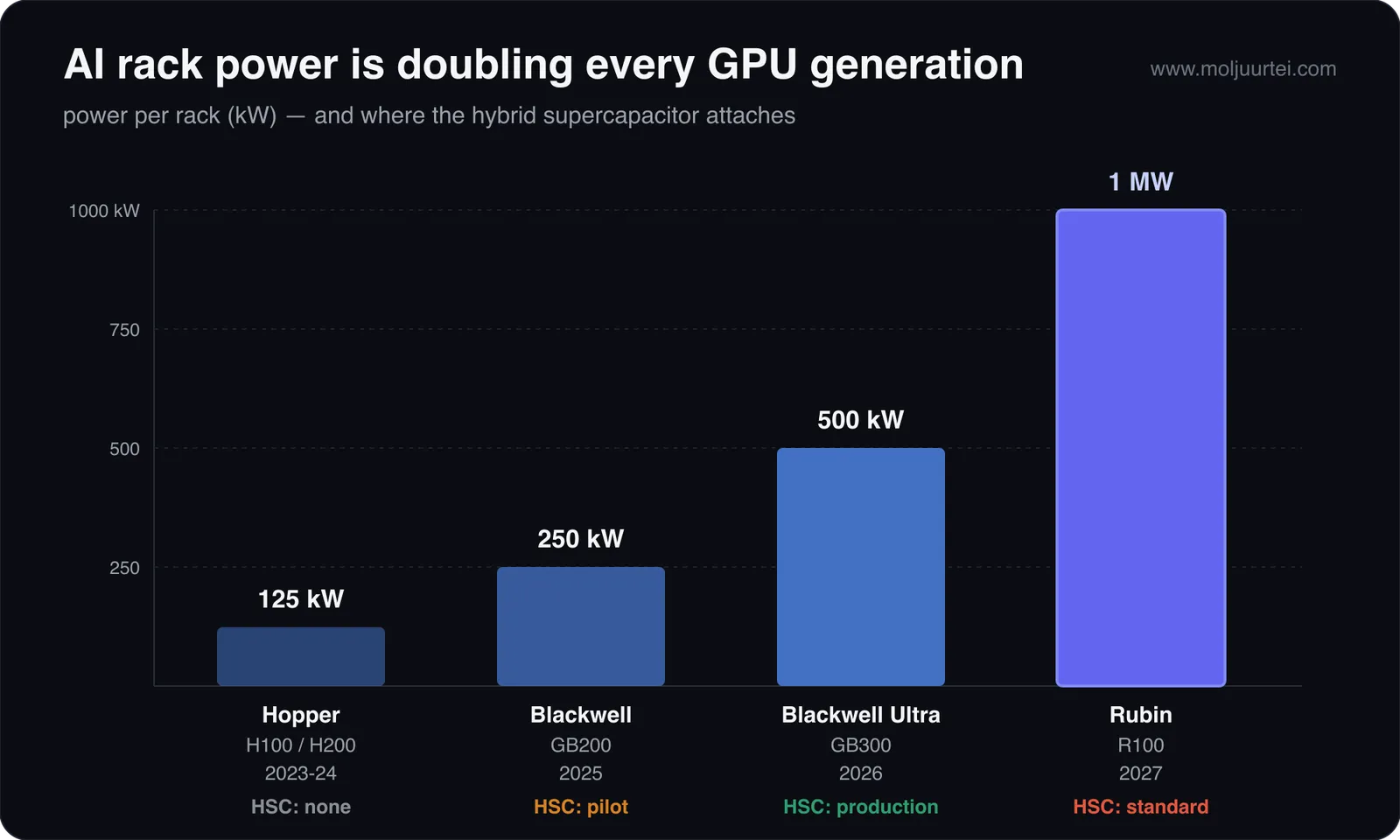
- Rack power doubles every GPU generation: Hopper ~125 kW → Blackwell ~250 kW → Blackwell Ultra ~500 kW → Rubin ~1 MW/rack by 2027 (per NVIDIA's 800-volt roadmap). Bigger, spikier loads make buffering non-optional.
- Musashi's HSC attach ramps in lockstep: none → pilot → in-production (GB300, confirmed standard) → standard (Rubin). Management: "from H2 FY2026, HSC demand rises rapidly."
- Demand spans hyperscaler custom silicon too — Google TPU v5p/v6/v7, Amazon Trainium2/3 — the whole rack market, not one vendor.
- Hyperscaler data-center capex +36% YoY into 2026 (Gartner); data-center power demand +165% by 2030.
- Market size: supercapacitors ~$2.8–3.2B in 2025 at 17–19% CAGR; lithium-ion capacitors in data centers projected ~$2.5B by 2030 (from a tiny base — the whole category is being created around this use case).
The confirmation that separates Musashi from a hopeful story: it isn't pitching NVIDIA, it's already inside GB300 as a standard part, shipping through a Flex-built system, with a plant being built specifically because it can't make enough.
Sizing the option
Today HSC has no standalone revenue line — it's inside the Japan segment as cost. So the exercise is: what does even a modest HSC revenue line do to group earnings? Base: ~66.1M shares, guided net income ¥6.5B (EPS ¥99.18). Each ¥1B of incremental net profit ≈ +¥15 EPS.
| HSC scenario (≈2029–30) | Revenue | Net margin (assumed) | Net profit add | EPS add | vs guided ¥99 EPS |
|---|---|---|---|---|---|
| Conservative | ¥20B (~$130M) | 13% | ¥2.6B | +¥39 | +40% |
| Base | ¥50B (~$330M) | 13% | ¥6.5B | +¥98 | ~doubles |
| Bull | ¥100B (~$670M) | 15% | ¥15B | +¥227 | ~3×+ |
Context: a ~$2.5B data-center-capacitor TAM by 2030 means the base case is ~13% share and the bull ~27% — plausible for the density leader already designed into GB300. Caveats: HSC margins are unproven (early-stage, capacity-constrained, capex-heavy), and these are 2029–30 outcomes, not next quarter. But the shape is the point: on a ~¥228B market cap, a base-case HSC line is a ~doubling of earnings power the market isn't underwriting.
Risks & what breaks it
- Stays a cost center longer than hoped. The Minami-Alps HSC plant slipped to early 2027; the P&L inflection is a 2027+ event. You're paid to wait via the auto business, but it is waiting.
- Cyclical, Honda-heavy core (51% Honda, European auto in structural decline, softening battery-EV demand, FX at ¥150/USD). A bad auto cycle can swamp early HSC contribution.
- The recipe gets copied. The moat is a manufacturing lead, not a patent wall — datasheets are public. If Nantong Jianghai or a large-cap closes the density gap, "monopoly" becomes "one of several."
- Architecture risk. If transients get solved another way (on-die capacitors, new bus designs, battery advances), the addressable slice shrinks.
- Disclosure opacity + a volatile stock. HSC is buried in a geographic segment, so you track capex, plant timelines, and management commentary, not a revenue line. And the price range is huge (¥2,210–¥10,550 in a year) — how much you buy, and at what price, matters more than usual.
Valuation & house view
Live data: ¥3,460; market cap ¥228.7B; ~66.1M shares; net debt ~¥64.8B → EV ≈ ¥293B.
- EV/EBITDA ≈ 7.6× (EBITDA ¥38.8B) — a reasonable industrial multiple on the core.
- Forward P/E ≈ 35× on guided ¥99 EPS — optically rich, because net income is temporarily depressed by European restructuring plus HSC operating spend. P/B ≈ 1.7×; dividend ~1.2%.
- The option is not free. At the ¥10,550 high (~¥700B cap, ~19× EV/EBITDA) the market fully priced a euphoric HSC scenario, then de-rated ~3× back to ¥3,460. So you're buying after the round-trip: an industrial multiple on the auto core, with the AI option re-compressed rather than absent.
House view: constructive, position-size aware. The cleanest way to own this is as the picks-and-shovels power-stability play on AI, wrapped in a boring, cash-generative balance sheet you're paid to hold — with the explicit acknowledgment that the stock is extremely volatile and the earnings inflection is 2027+. The signposts that mark the option going live: (1) Minami-Alps online (early 2027) and capacity language shifting from "constrained" to "ramping"; (2) management breaking out Energy Solutions as its own segment (the day they do, the market must price it); (3) named hyperscaler/OEM design wins beyond GB300; (4) the Japan-segment margin turning as HSC flips from investment to contribution. The auto turnaround (European restructuring flowing through, net income rebounding to ¥6.5B) is the free-carry underneath. Buy the boring, watch the ramp.
The setup on the chart. After spiking to ¥10,550 and then falling all the way back to ~¥3,030, the stock has given back the entire AI-driven move and is roughly back to where it traded before it started, now sitting below its rising long-term moving averages after a −10% day. That cuts both ways — the upward momentum is clearly broken, and you're not buying the exact low. But it's also what makes the risk and reward lopsided in your favor: most of the pre-AI shares changed hands in the ¥2,500–3,000 range, so that level held as a floor before the run, while the upside is a re-rating the market has already shown it will pay for (¥10,550 once — roughly 3× higher). You're buying the call option back near the company's ordinary industrial value after the excitement has drained out, not while it's still running. The sensible way to do it is to build the position gradually around that ¥2,500–3,000 level rather than trying to pick the exact bottom — the milestones that would prove the thesis (the Minami-Alps plant coming online, a possible Energy-Solution segment break-out, the GB300→Rubin ramp) are a 2027 story, and a falling stock can keep falling for a while before it turns.
Technology teardown, density thesis, and the ESR/rated-voltage framing via Irrational Analysis, "Musashi Seimitsu ($7220.T) Supercap Note," May 28, 2026 (public post) — worth reading in full. Financials, segment data, rack-power roadmap, and AI-datacenter narrative from Musashi Seimitsu Q2/Q3/Q4 FY2026 conference-call decks; rack-power figures per Musashi citing NVIDIA's 800-volt architecture paper. Market sizing via Fortune Business Insights / Mordor Intelligence; GB300 design-in and Flex partnership via industry reporting.