
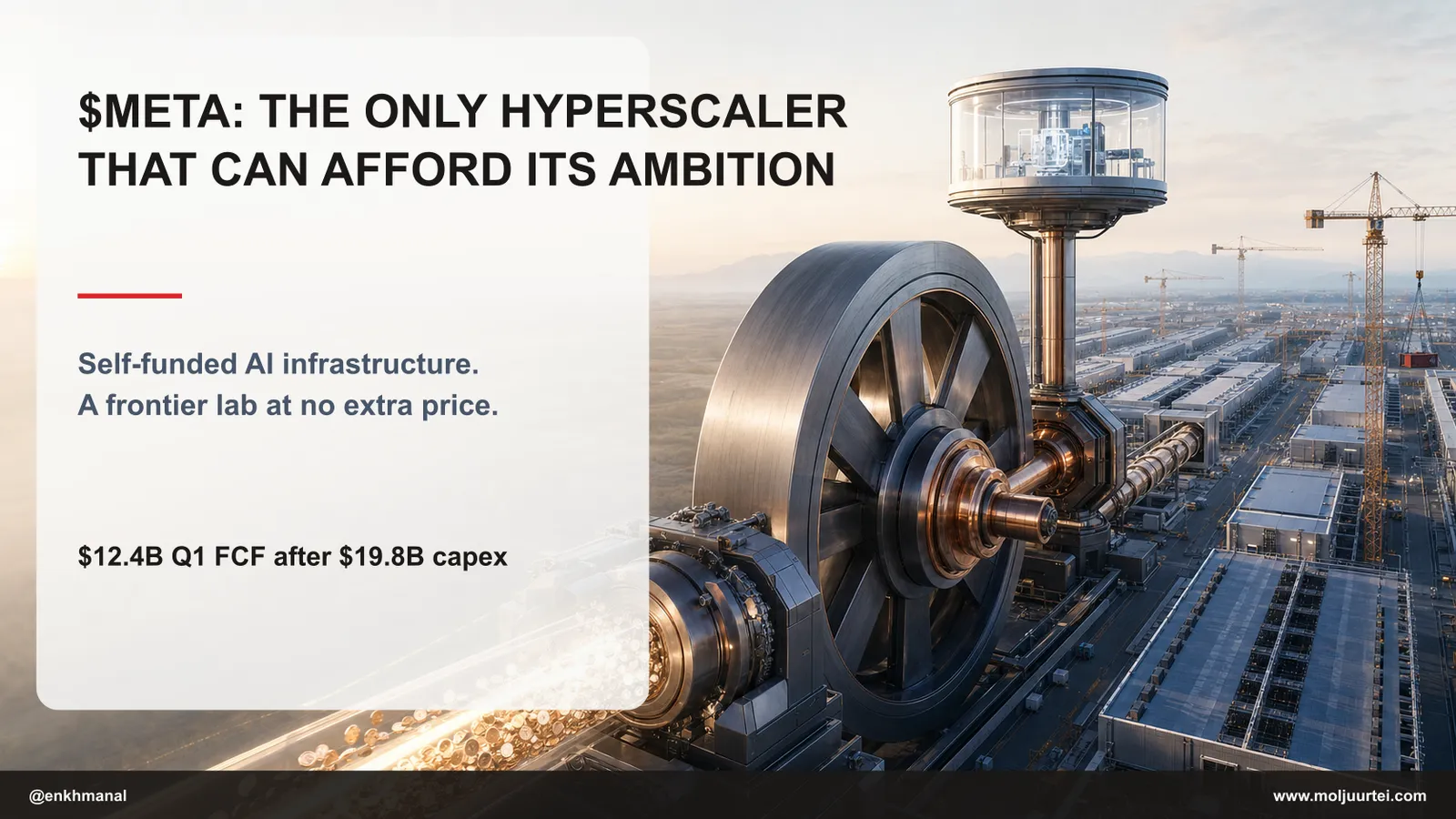
$META — The Only Hyperscaler That Can Afford Its Own Ambition
Tickers: $META
Conviction Note · rebuilt on Q1 2026 primary sources — the earnings deck, the release, and the full call transcript.
Thesis
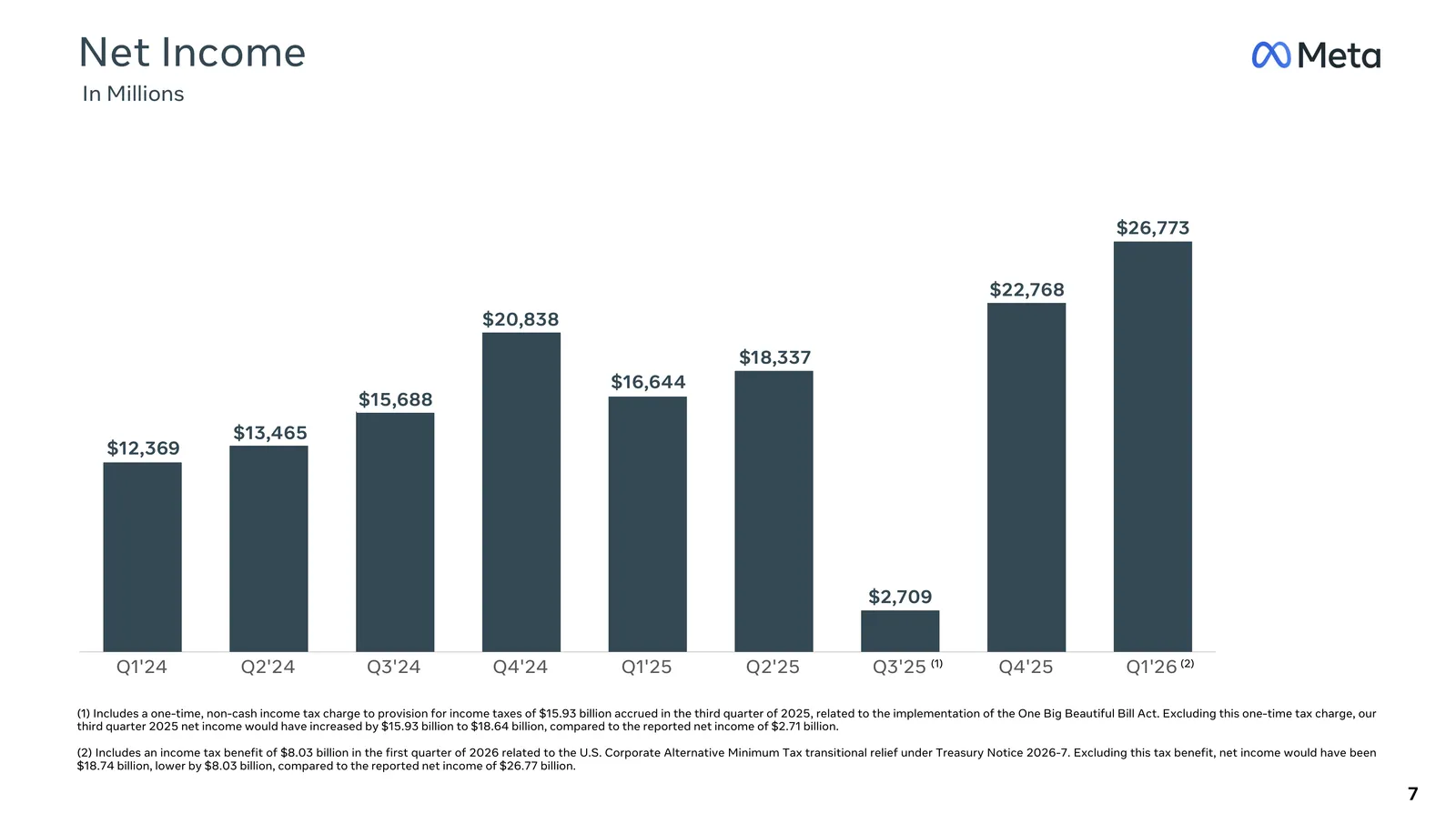
The market has spent 18 months treating AI capex as a sin, and it has handed the same sentence to two very different companies. $ORCL is borrowing money it doesn't have to build compute it hasn't sold yet. $META is funding the largest infrastructure ramp in corporate history and still generated $12.4B of free cash flow in Q1 2026 — after $19.8B of quarterly capex. The stock has gone nowhere since the start of 2025 while the earnings underneath it compounded roughly 60%. Sideways price, compounding earnings, a management-confirmed path to monetize the capex, and a frontier AI lab thrown in for free is the setup to buy. House view: bullish — $META is a good buy here. Not because the AI spend is safe, but because Meta is the one name in the group being punished as if its spending weren't.
Backdrop
We are one year into the most aggressive corporate compute ramp ever attempted, and the frontier-AI field has narrowed to what feels like a two-horse race between OpenAI and Anthropic. Per SemiAnalysis's July 2026 progress update on Meta Superintelligence Labs (MSL), the three ingredients of a frontier model are data, talent, and compute — and Meta is the only hyperscaler on track to be world-class at all three.
Management's own framing on the Q1 call backs the "slope not intercept" case. Zuckerberg called Muse Spark — MSL's first model — proof "that our work is on track to build a leading lab," noting the team went "the fastest from standing up the lab to having a very kind of widely accepted strong model." Susan Li quantified the pull-through: "double-digit percent increases in Meta AI sessions per user" after the Muse Spark rollout, now powering Meta AI across the family of apps. The honest caveat still stands — Muse Spark launched behind open-source DeepSeek/Kimi, and the lab is one release old. But a year ago this org didn't exist; today it out-resources everyone but the two leaders and is training "even more advanced models" now.
The data engine is the underappreciated leg. Zuckerberg: "for the first time in Meta's history, we're going to be able to develop a first principles understanding of what you care about" — recommendation systems rebuilt on LLMs, with same-day posts now >30% of recommended Reels (double a year ago) and >0.5B users on each of Facebook and Instagram watching AI-translated video weekly. This is the flywheel the capex feeds.
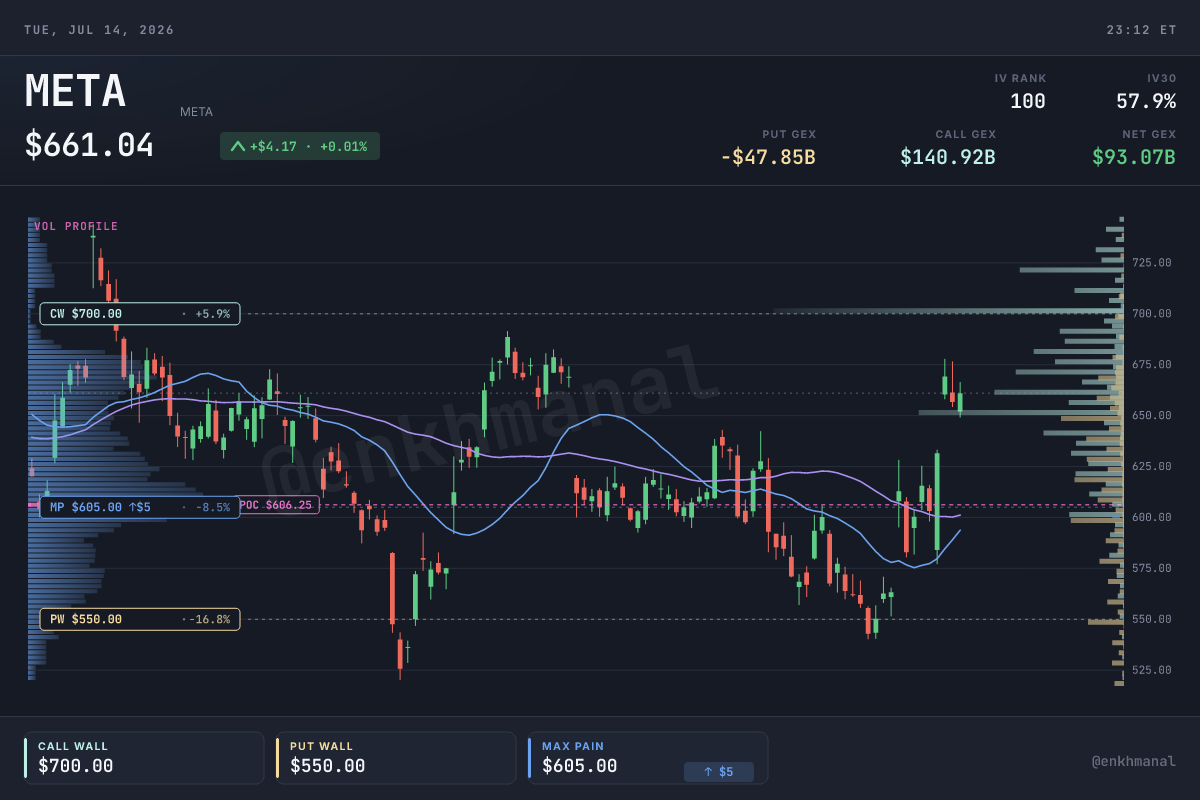
And against all of it, the tape did nothing. $META went from a $689 close in January 2025, to a $790 high in September 2025, and back to ~$657 today — a net-down round trip while the business compounded. The coil is the opportunity.
Setup
Three load-bearing nails.
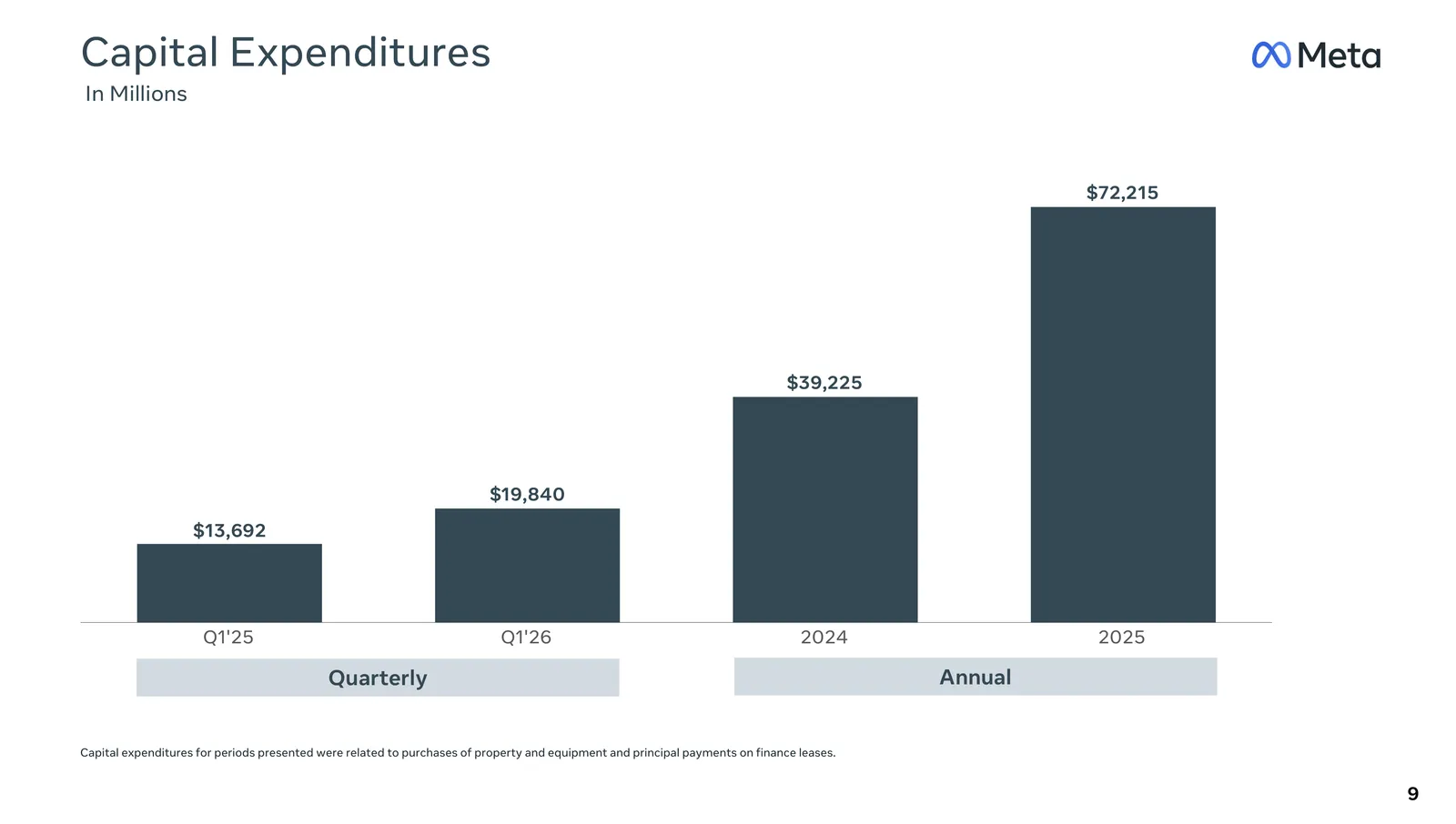
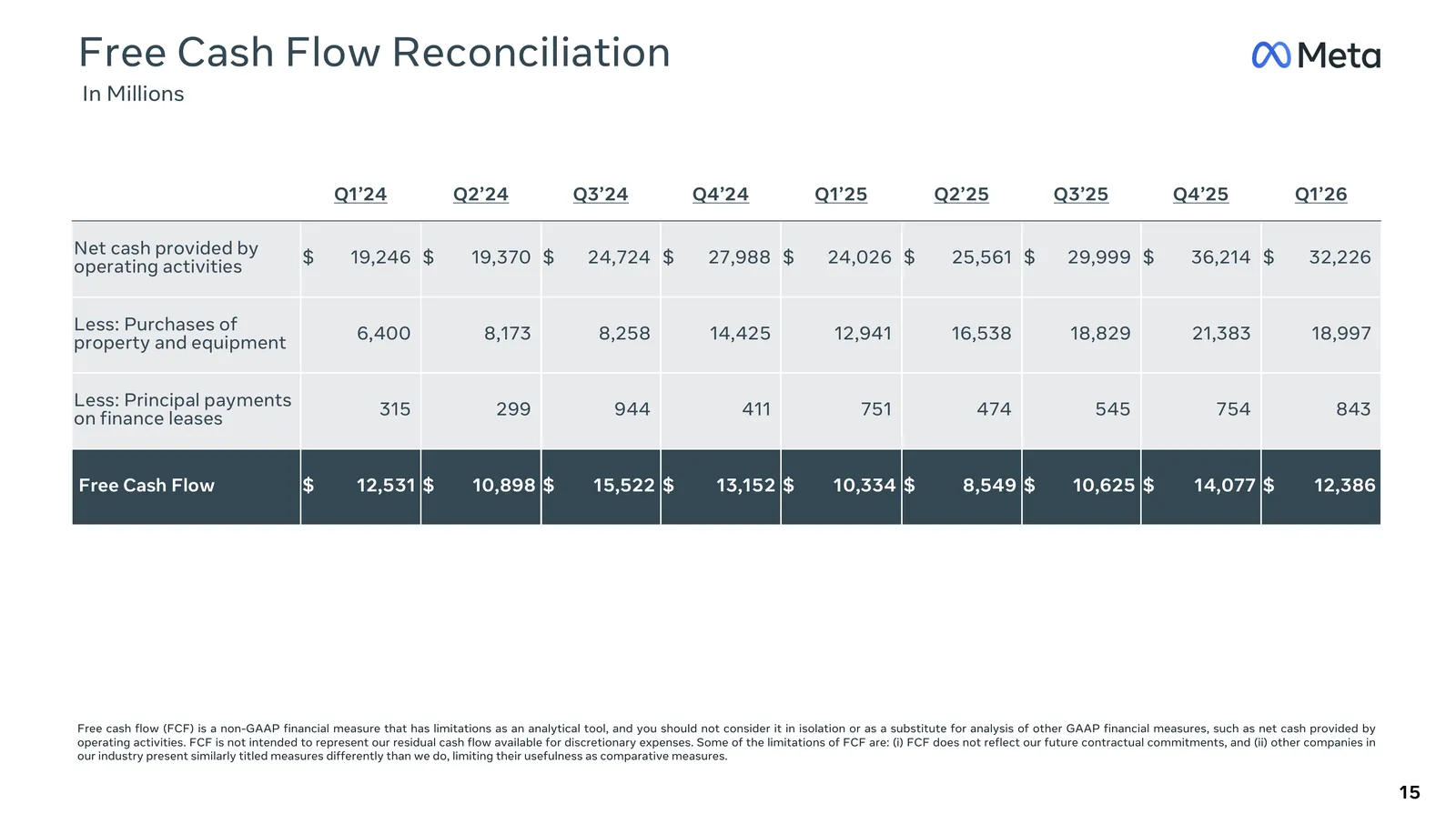
Nail 1 — the biggest build in tech is self-funding. This is the whole ballgame, and Q1's primary numbers settle it. Meta spent $19.8B on capex in a single quarter (finance leases included) and still produced $12.4B of free cash flow — $32.2B of operating cash flow, less $19.0B of PP&E and $0.8B of finance-lease payments. FY2025 capex was $72.2B, nearly double FY2024's $39.2B, and the 2026 guide was raised to $125–145B (Susan Li: mostly "higher component pricing," memory in particular). Even after all that, the balance sheet ended Q1 with $81.2B of cash & marketable securities against $58.7B of debt — net cash of ~$22B. Note the correction to lazy priors: Meta now carries real gross debt ($58.7B) to term-fund the build, but it is still net-cash and still throwing off positive FCF through the ramp.
Now hold that against $ORCL. Oracle's entire FY2026 operating cash flow ($32B) roughly equals one quarter of Meta's. Oracle burned −$23.7B of FCF after $55.7B of capex (≈83% of revenue), funded the gap with debt ($167B), and got cut to BBB− — the last rung of investment grade — on July 9. Zoom out and Oracle stops looking like a peer and starts looking like the exception:
| 2026E | OCF | Capex | Self-funded? |
|---|---|---|---|
| Meta | ~$135B | ~$125–135B | ✅ yes |
| Microsoft | ~$150B | ~$135B | ✅ yes |
| Alphabet | ~$190B | ~$180B | ✅ yes |
| Amazon | ~$165B | ~$200B | ⚠️ tight/negative |
| Oracle | ~$23B | ~$50–90B | ❌ not close |
The market is charging Meta an Oracle-sized risk premium for a net-cash balance sheet that funds the build from operations. That is the gap the trade monetizes.
Nail 2 — the cost center is becoming a business, and management said so. The July 1 Bloomberg report on "Meta Compute" (renting spare AI capacity; stock +10%, prompting The Kobeissi Letter's "Perhaps the recent CapEx now all makes sense") is not the only evidence anymore — Zuckerberg confirmed the initiative on the call: "One of the primary goals of our Meta Compute initiative is to lead the industry in efficiency of building Compute, and we expect that will be a strategic advantage over time" — rolling out >1GW of custom Broadcom silicon plus $AMD to complement NVIDIA. Susan Li added that multi-year cloud deals + infra purchase agreements drove a $107B step-up in contractual commitments in the quarter alone. Layer on SemiAnalysis's reporting of four monetization tracks (frontier training, ~10× ad/RecSys scaling, model-as-a-service — reportedly hosting private Claude instances — and on-demand rental where "a couple hundred MWs can already drive >$10B of yearly revenue," with 5GW+ contracted in H1). You don't need every track to work; you need one — and Meta gets to be landlord to the AI boom from the exact position Oracle would kill for.
Nail 3 — the lab is a free option. You are not paying a dime of Meta's ~$1.7T market cap for MSL working. If it does, that's upside the tape hasn't priced. If it doesn't, you still own the best advertising business on the planet — now with a second revenue engine bolted on.
Latest earnings callout (the primary print). Q1'26 total revenue $56.3B (+33%); Family-of-Apps revenue $55.9B; income from operations $22.9B at a 41% margin (FoA op income $26.9B against a $4.0B Reality Labs loss). Reported net income was $26.8B / $10.44 diluted — but that includes an $8.03B one-time tax benefit; normalized it's $18.7B / $7.31. Engagement + monetization both compounded: DAP 3.56B, ARPP $15.66, ad impressions +19%, price-per-ad +12%, value-optimization-suite ARR now >$20B (2×), partnership-ads run-rate $10B (2×), business-AI conversations 10M/week (from 1M). The stock fell ~10% on the raised capex guide anyway. Earnings up ~60%, stock flat: the multiple is compressing, not expanding.
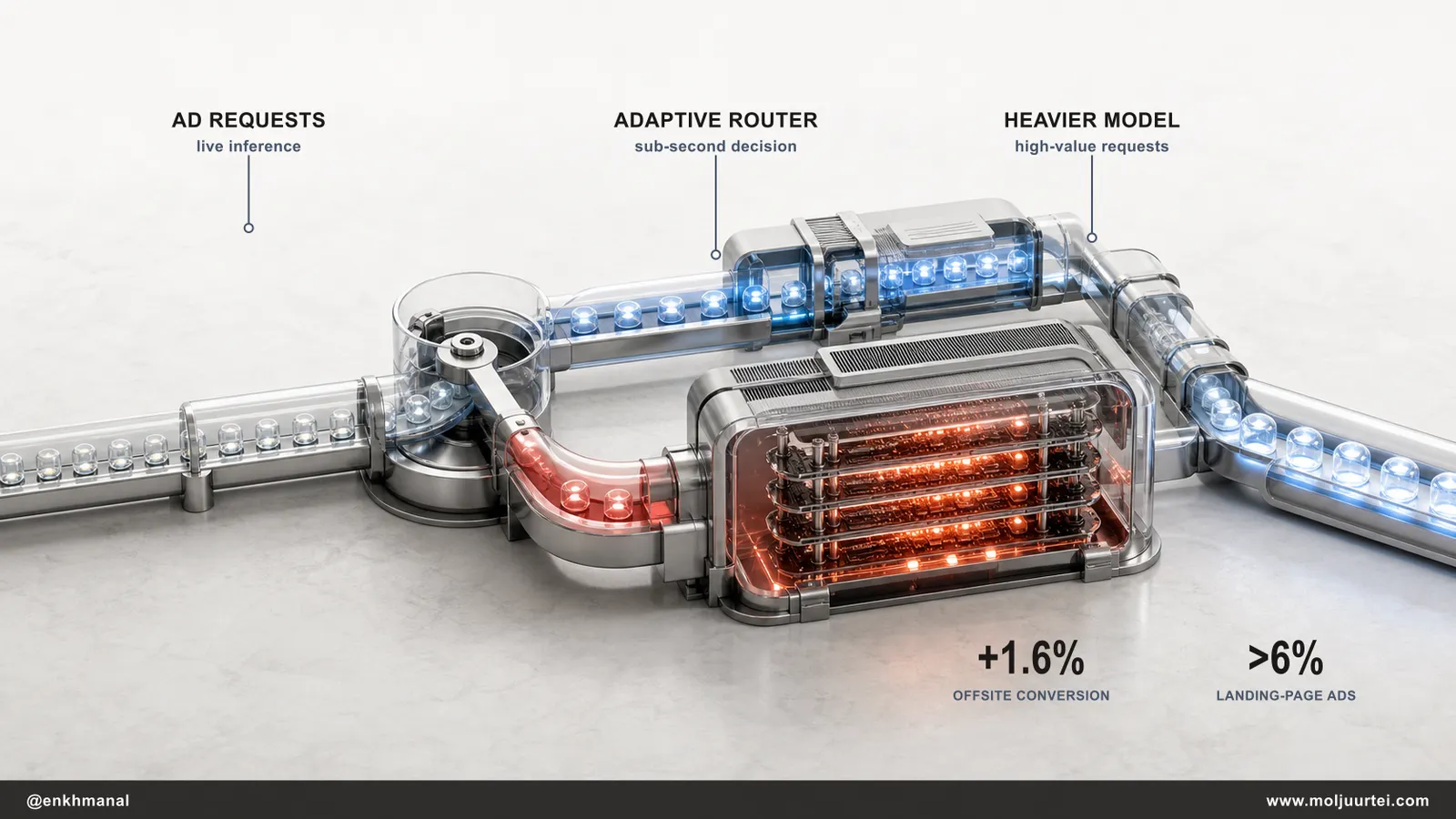
The capex is already converting — that's the part the tape is missing. The bear frame treats the spend as faith; the Q1 call shows it landing in the P&L today. Meta put a trillion-parameter, LLM-scale "adaptive ranking" model into live ad inference — co-designed with the silicon to hold sub-second latency — which routes higher-conversion requests to heavier models and drove a +1.6% conversion-rate lift on offsite conversions across Facebook and Instagram; GEM/Lattice advances added >6% on landing-page-view ads. On the organic side, Q1 ranking work lifted Instagram Reels time-spent +10% and Facebook video time >8% (its biggest quarterly gain in four years). More than 8 million advertisers now use a gen-AI creative tool, with video-generation ads seeing >3% higher conversion. This is compute being spent on infrastructure that already raises price-per-ad (+12%) and impressions (+19%) — the flywheel, not a promissory note. It is also why $META, unlike a pure neocloud, can afford to build aggressively regardless of whether any single external-compute bet hits.
The MSL Option
Worth isolating why the AI lab is a real call option, not a vanity line. Reassigning ~3,000 engineers to full-time RL work, five simultaneous 1GW+ "titan" clusters, and billion-dollar equity grants for top talent are expensive, legible signals that Meta is genuinely "AGI-pilled." Zuckerberg's ROIC formula on the call was vintage Meta: "build experiences that can get to billions of people, and focus on monetizing them once you get to scale" — quality → scale → monetization → efficiency. Compare Google, which SemiAnalysis argues shows "loser mentality," routing incremental capacity to renting IaaS out to the very competitors it's racing. Their punchline: the race for third is between Meta and SpaceX, not Google. The thing to watch is resolve, not this quarter's benchmark score.
Risks
A thesis with no kill switch is just a mood. What would make this wrong:
- ROI stays invisible. If Meta Compute is slow to book real external revenue, the capex narrative snaps right back. The cloud story has to ship, not just headline.
- The excess-compute paradox (sharpest bear take, via @amitisinvesting): if Meta has so much spare compute it can rent it out, maybe it over-bought and the industry isn't compute-constrained — bad for the whole GPU/neocloud complex, and, taken literally, an argument capex should fall. Susan Li's own hedge cuts both ways: "if we end up not needing as much as we anticipate, we can … reduce our spending in future years."
- A weakening of resolve on MSL — SemiAnalysis's tell: a long-term no-clawback compute-sale deal, disbanding the RL-task org, or top researchers walking. Any of those kills the free option.
- Earnings quality / normalization. The headline $10.44 EPS flatters the multiple; the clean number is $7.31. Don't underwrite the cheapness on the reported figure. Legal/regulatory overhangs (EU + US youth-safety trials, flagged as a possible "material loss") are live.
- Capex outruns even Meta. $135B is self-fundable on $115B+ of operating cash flow; the $107B commitment step-up shows how fast the number can move, and Zuck will run FCF-negative if he chooses. The balance-sheet argument is strong, not infinite.
Valuation
Meta produced $12.4B of FCF in Q1 alone while out-investing almost everyone, sits on ~$22B net cash, and grew revenue 33% at a 41% operating margin. On the normalized $7.31 quarterly EPS (stripping the one-time tax benefit), a simple annualization puts $META in the low-to-mid-20s× earnings on a seasonally soft Q1 — and lower on forward estimates as the year's back half (Meta's biggest) lands. That is a reasonable-to-cheap multiple for a business compounding ~30% with a brand-new cloud revenue vector and a frontier lab as free optionality.
House view: bullish, accumulate. Two companies got the same beating for the same word; only one can actually afford the sentence. Oracle is a levered, negative-FCF bet on a backlog, behind a fresh downgrade. Meta self-funds the biggest compute ramp ever built, just had management confirm the path to monetize it, and carries a genuine shot at a frontier AI lab as free optionality — all while the stock sits where it did in early 2025. On the tape itself, a book slightly beating $QQQ and slightly trailing $SPY is where you'd want to be entering this, and the selloff is the accumulation window rather than a reason to wait for a lower print a de-risking headline could erase overnight. That is the setup to own.