$MARA Deep Dive — The miner that owns the most unrented power · leases promised by Dec 31, FERC clock runs to early November, Q3 print Nov 3
$MARA closed at $12.84 on September 18, up 9% on the day after Morgan Stanley nearly doubled its target and bitcoin reclaimed $80,000, with two Underweight ratings still on the sheet. It controls about 1.9 GW of energized or interconnected power today and a path to 4.8 GW, in the two grids where an AI data center cannot get a connection for years, and it has leased none of it. The stock is priced as a leveraged bitcoin miner with an option attached; the option has a date on it, and the date is inside the next hundred days.
What Changed
An AI data center is three things stacked on top of each other: a supply of electricity, a building engineered to move that electricity into racks and the heat back out, and the chips. For twenty years the chips were the hard part and the power was a utility bill. In 2025 that inverted. Hyperscalers are expected to spend roughly $725 billion on AI infrastructure in 2026 and more than $1 trillion in 2027, and US data-center electricity demand is projected to go from about 31 GW in 2025 to 66 GW in 2027 (Goldman Sachs Commodities Research, May 2026, cited in $MARA's Q2 letter). New generation and transmission do not arrive on that schedule. A gas plant takes five to six years to permit and build; a transmission line and a grid interconnection can take seven to ten. The chips ship in months.
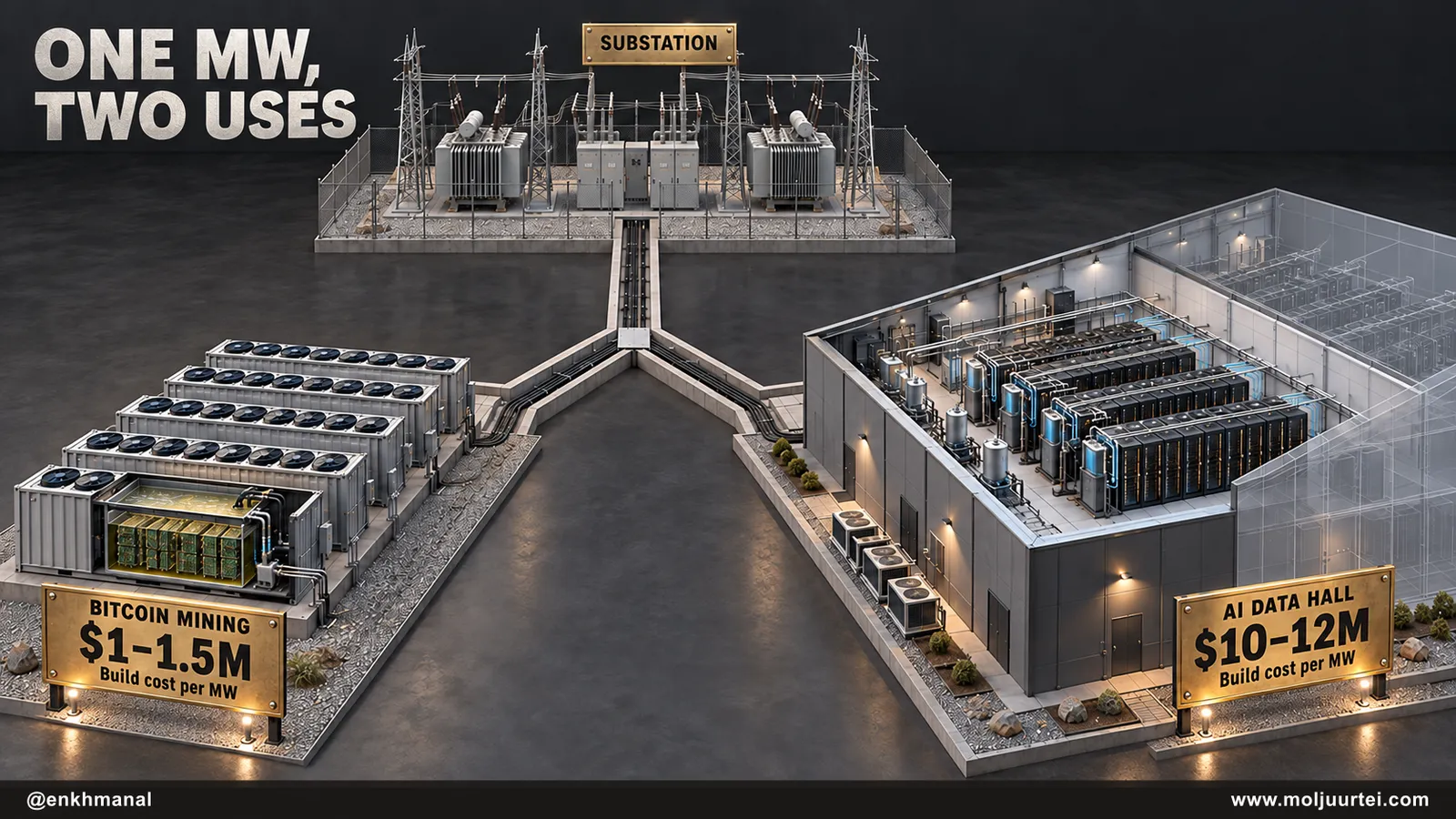
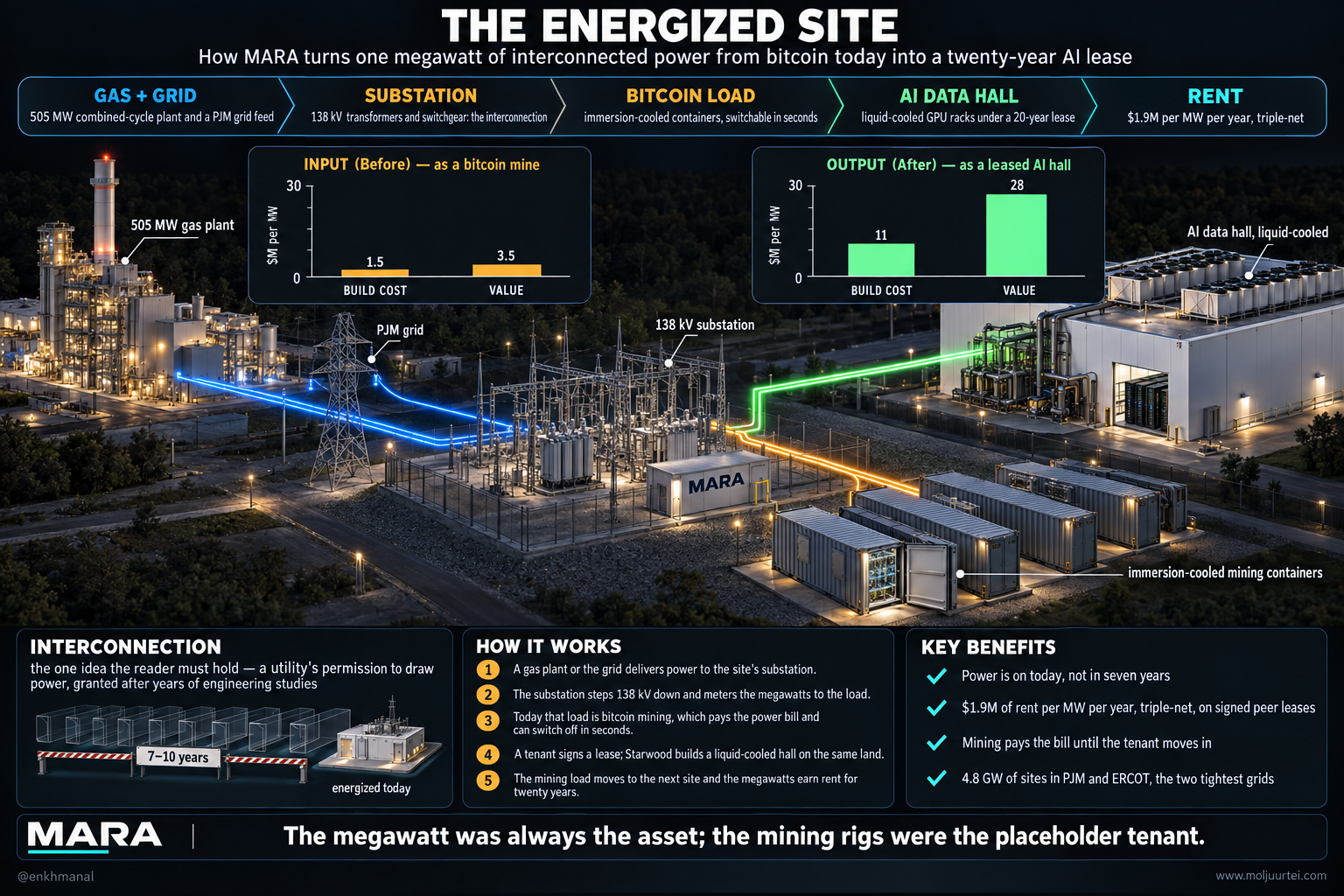
Start here. Electricity is a flow of energy delivered through wires, measured in watts; a megawatt (MW) is a million of them, roughly what 750 American homes draw at once, and a gigawatt (GW) is a thousand megawatts. A large load is any customer, a factory or a data center, that wants tens or hundreds of megawatts from the grid, and an interconnection is the utility's permission to draw it, granted only after engineering studies prove the wires can carry it. An energized site is a plot of land where that permission has already been granted, the substation and transformers are built, and power is flowing today. A bitcoin mine is an energized site running a load that can be switched off in seconds: thousands of specialized chips that earn bitcoin by solving a lottery, sitting in containers that cost about $1–1.5 million per megawatt to fill. An AI hall on the same land is the same megawatts feeding liquid-cooled GPU racks under a twenty-year lease, in a building that costs $10–12 million per megawatt to construct. Everything below is about what a megawatt is worth in the first use, what it is worth in the second, and who owns the ones that can move.
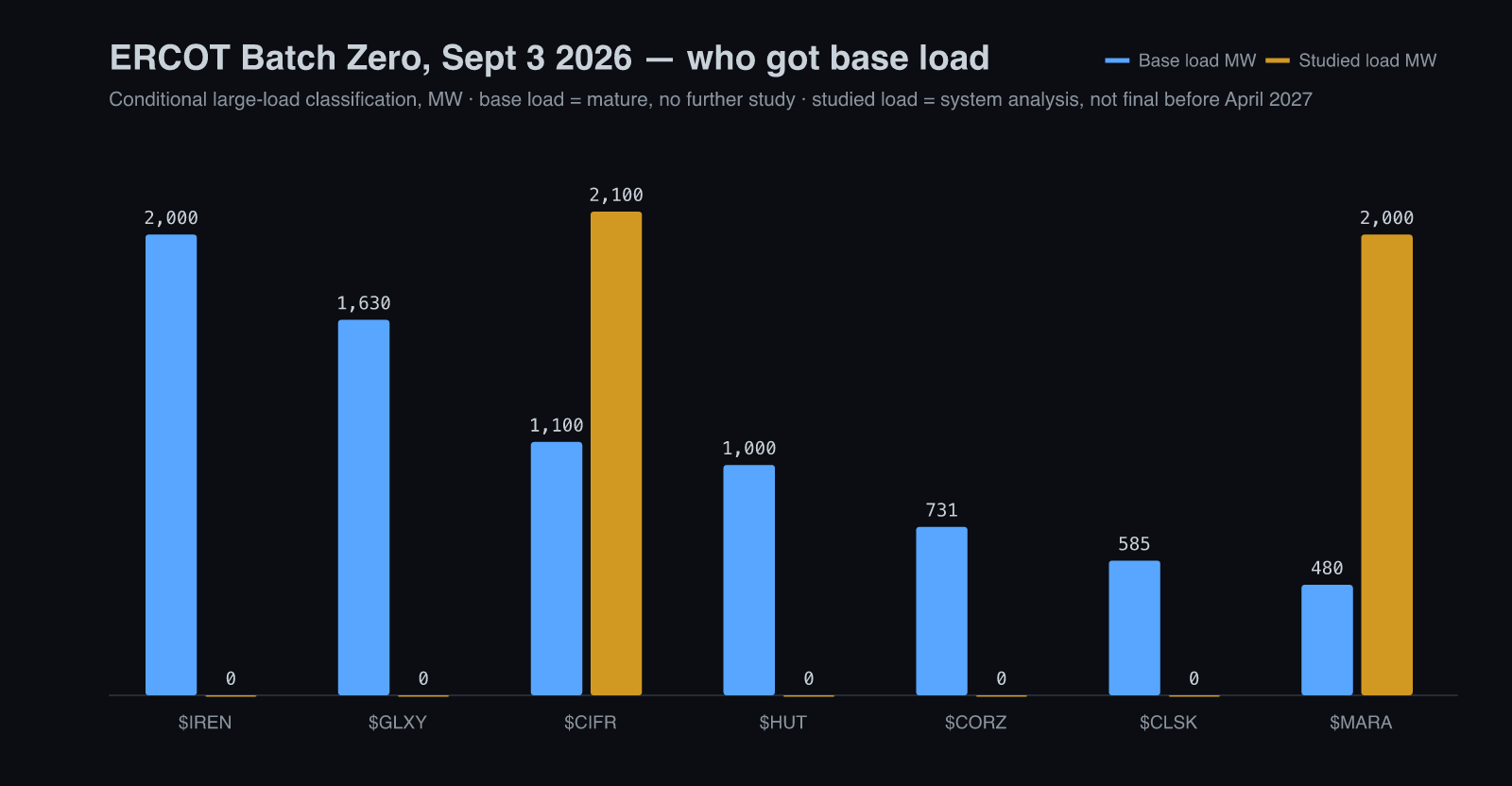
The proof that the constraint is real arrived on September 3, when Texas's grid operator, ERCOT, published the first allocation under its new "Batch Zero" process for large loads: about 8 GW of base load, meaning mature projects that get to connect without further study, and about 7 GW of studied load that must wait for system analysis, not final before April 2027. Almost every base-load megawatt went to a bitcoin miner: $IREN 2 GW, $GLXY 1.63 GW, $CIFR 1.1 GW, $HUT 1 GW, $CORZ 731 MW, $CLSK 585 MW, $MARA ~480 MW. The miners were the ones already plugged in. Morgan Stanley responded on September 18 by lifting its $MARA target from $6 to $11 while keeping the Underweight, because the megawatts that could be signed into a lease had just grown.
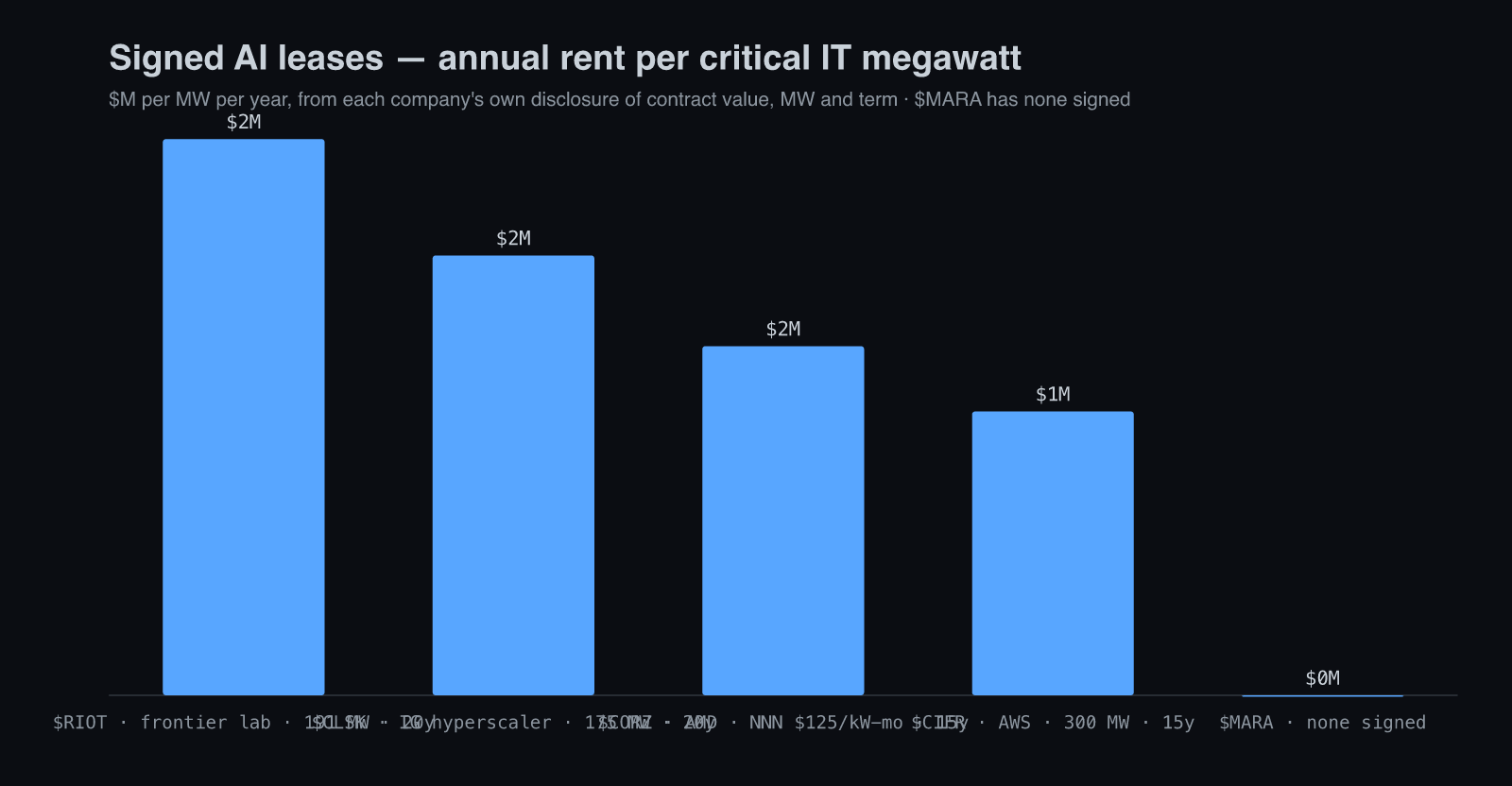
The second proof is the price. In the twelve months to September, the miners that signed leases showed what an energized megawatt fetches: $CLSK let 175 MW of critical IT at Sandersville to an investment-grade hyperscaler for twenty years at about $330 million a year of net operating income, triple-net; $RIOT let 191 MW to a frontier AI lab for $9.1 billion over twenty years; $CORZ let 500 MW to $AMD at $125 per kilowatt-month triple-net for fifteen years. Those are rents of $1.2–2.4 million per megawatt per year on land that a year earlier earned bitcoin.
The company those two facts most reward is the one that holds the most energized, interconnected land in PJM and ERCOT without a tenant on it yet. That is $MARA.
Thesis
$MARA owns 779 MW of operating power at its own sites, 1,324 MW of total capacity once pending approvals land, 480 MW of that just classified as ERCOT base load, plus contractual rights to a 2 GW site in Matagorda County and a pending 505 MW gas plant with 1,600 acres in PJM; converting even 300 MW of it to leased AI capacity at the rents its peers have signed is worth more than the company's entire enterprise value today, and management has committed to signing the first lease before December 31.
Our Q2 read is in the Q2 2026 earnings analysis; the May fact-check of the pivot is here; the two peers that have already converted are covered in the $RIOT deep dive and the $CLSK deep dive.
Business & Backdrop
$MARA is, today, one of the two largest listed bitcoin miners by energized hashrate, and it makes money in one way: it runs about 490,000 mining machines at 70.3 exahash per second, wins about 5.9% of the bitcoin network's block rewards, and books each bitcoin as revenue at the price on the day it is mined. In the second quarter that produced 2,422 bitcoin at an average $71,325, or $174.9 million of revenue, 96% of it from mining, the rest from other digital assets and a small amount of other services. It pays for that with electricity at its own sites ($48.8 million in Q2, $0.04 per kWh), maintenance ($26.9 million) and fees to third-party hosts that run about 44% of its fleet for it ($69.2 million). The rest of the income statement is depreciation on the chips ($174.7 million a quarter), overhead, and the unrealized swing in the ~35,000 bitcoin it holds, which since 2025 runs straight through operating income.
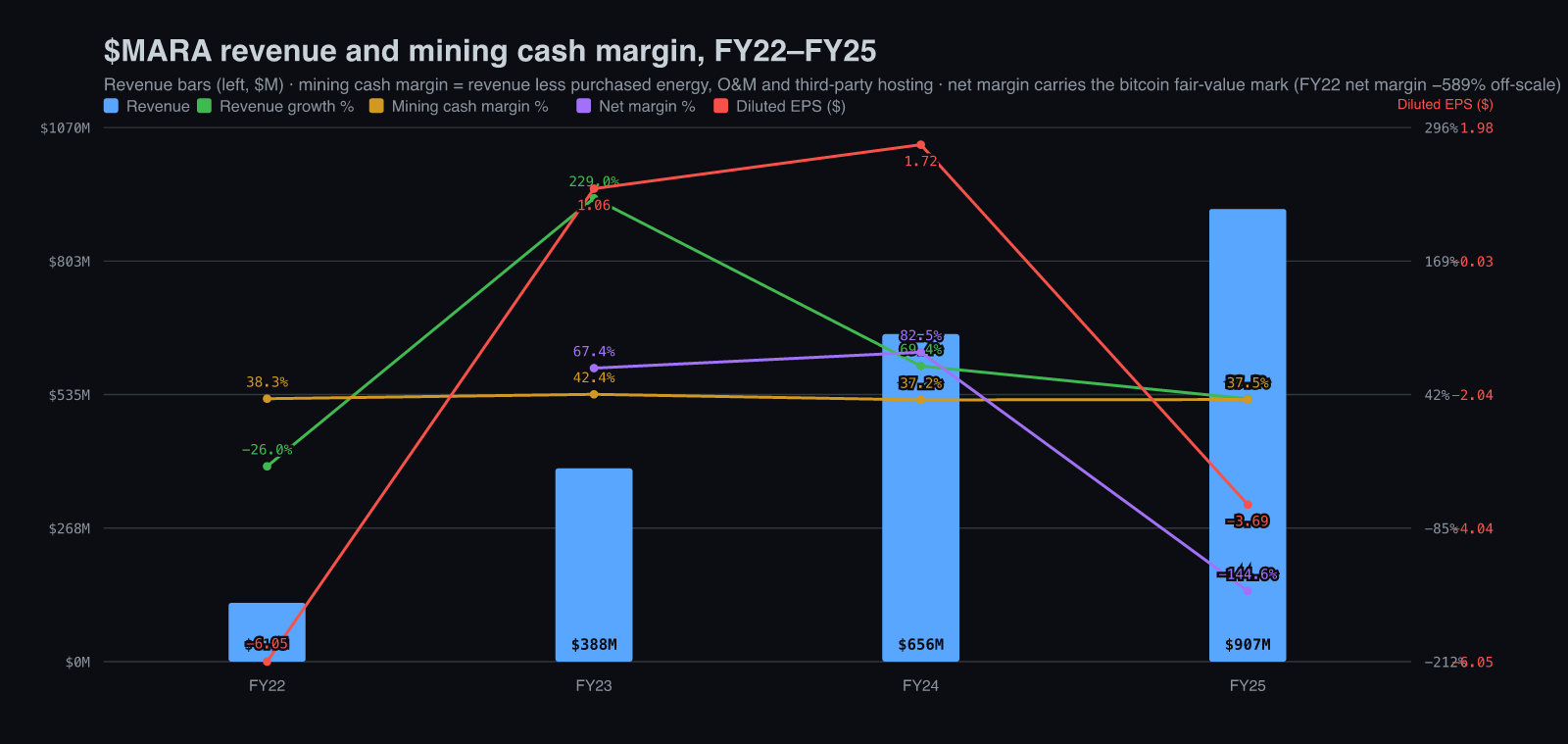
That last line is why the reported numbers look like a casino. Revenue grew from $117.8 million in FY22 to $387.5 million in FY23, $656.4 million in FY24 and $907.1 million in FY25, a 38% rise last year on a 53% higher bitcoin price against 7% fewer coins mined. The mining cash margin, revenue less energy, maintenance and hosting, has been flat for three years: 42.4% in FY23, 37.2% in FY24, 37.5% in FY25. Net margin went +67.4%, +82.5%, then −144.6%, and none of those three numbers describes the operation; they describe what bitcoin did between January and December. Diluted EPS ran −$6.05, $1.06, $1.72, −$3.69 on a share count that went from 99 million to 355 million.
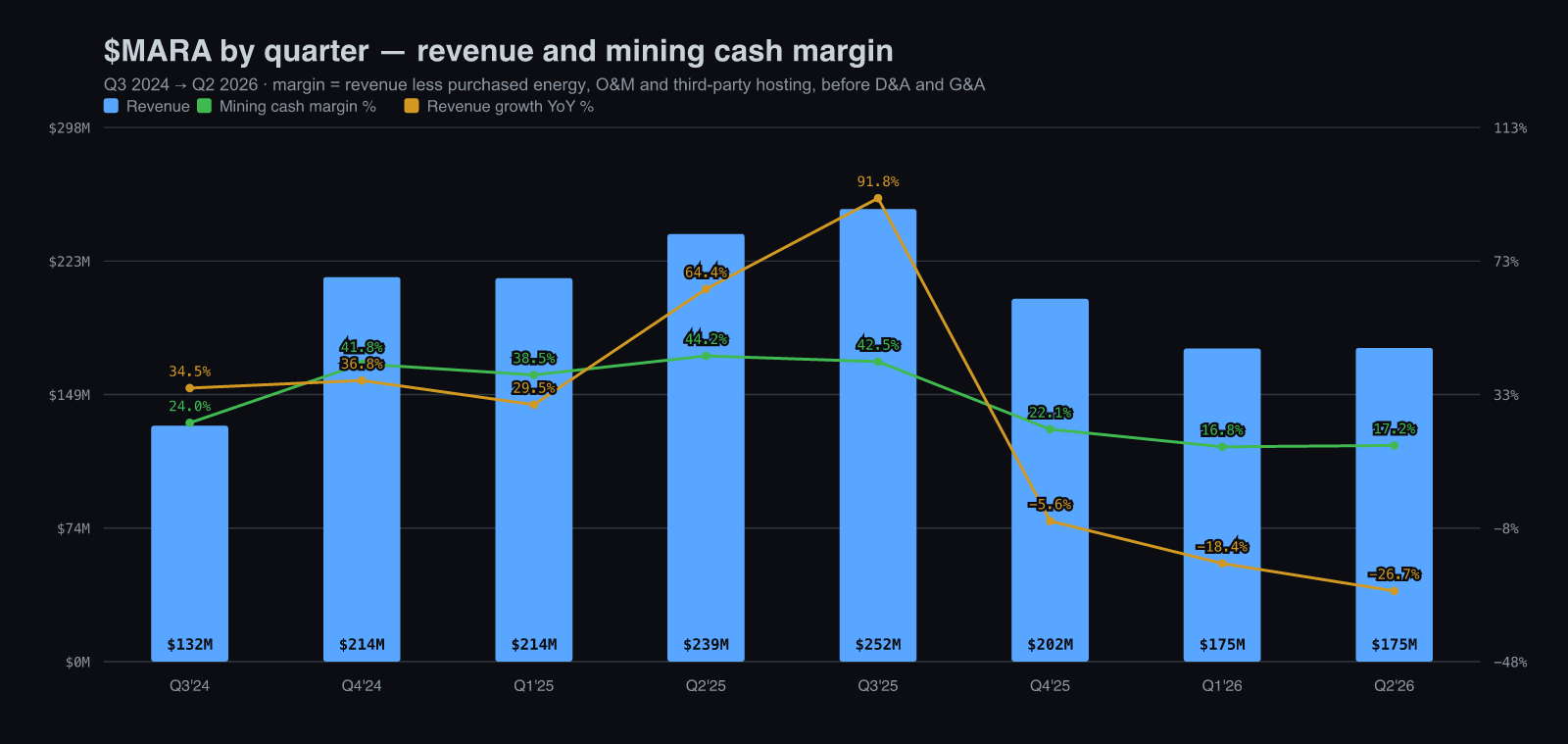
The quarterly series is where the operating story actually lives, and it is worse than the annual one. Revenue peaked at $252.4 million in Q3 2025 with bitcoin near $115,000, then fell to $202.3 million, $174.6 million and $174.9 million as the coin dropped and the April 2024 halving's smaller rewards met a rising network difficulty. The mining cash margin went from 42–44% through the first three quarters of 2025 to 22.1% in Q4, 16.8% in Q1 2026 and 17.2% in Q2: at $71,000 a coin, the fleet clears about $30 million a quarter before depreciation and before $69.5 million of cash overhead. Purchased energy cost per bitcoin at owned sites rose from $33,735 to $38,690 in a year. This is the business that funds the pivot, and at today's bitcoin price it does not.
The mix question for a single-segment miner is where the power is, and the answer moved during the year. Of $MARA's 1,315 MW of operational capacity at year-end 2025, 779 MW (59%) sat at owned sites and 536 MW (41%) at third-party hosts; the hosts carried 29.2 of 66.4 exahash, or 44% of the hashrate. Owned Central Texas alone is 411 MW operating and 550 MW total, or 31% of the footprint and 33% of the hashrate. Every one of the hosting contracts expires between Q3 2027 and Q1 2028, which removes about $277 million of annual cost and, unless Matagorda is energized by then, about 44% of the hashrate with it.
Bitcoin mining produced more than all of the growth: $273.0 million of the $250.7 million increase, while hosting, which the company exited, fell $27.0 million. There is no second revenue line yet.
The market $MARA is chasing is measured by the peers' signatures rather than a forecast: the Global Data Center Hub tracker counted 928 MW of twenty-year commitments at $WULF, $CLSK and $HUT in July alone, and H.C. Wainwright's tally on September 14 was more than $160 billion of AI colocation deals signed by bitcoin miners to date. $MARA has the biggest energized footprint in the group and the only one with a zero in the contracted column, which is the whole reason the stock is interesting.
Technology & Moat
What $MARA makes is not the chips and not the software; it is the energized site, and the moat is the interconnection queue. A site that can draw 200 MW today exists because someone filed with the utility years ago, built a substation, and has been paying a power bill ever since. Fred Thiel put the two economics side by side at the H.C. Wainwright conference on September 14:
If we look at Bitcoin mining economics, typically, you would be spending somewhere around $1 million, $1.5 million a megawatt for infrastructure and compute. Very different than the business that most of us are transitioning to… One thing that Bitcoin miners have a lot of is land and power that is turned on.
The physical estate, from the FY25 10-K and the filings since:
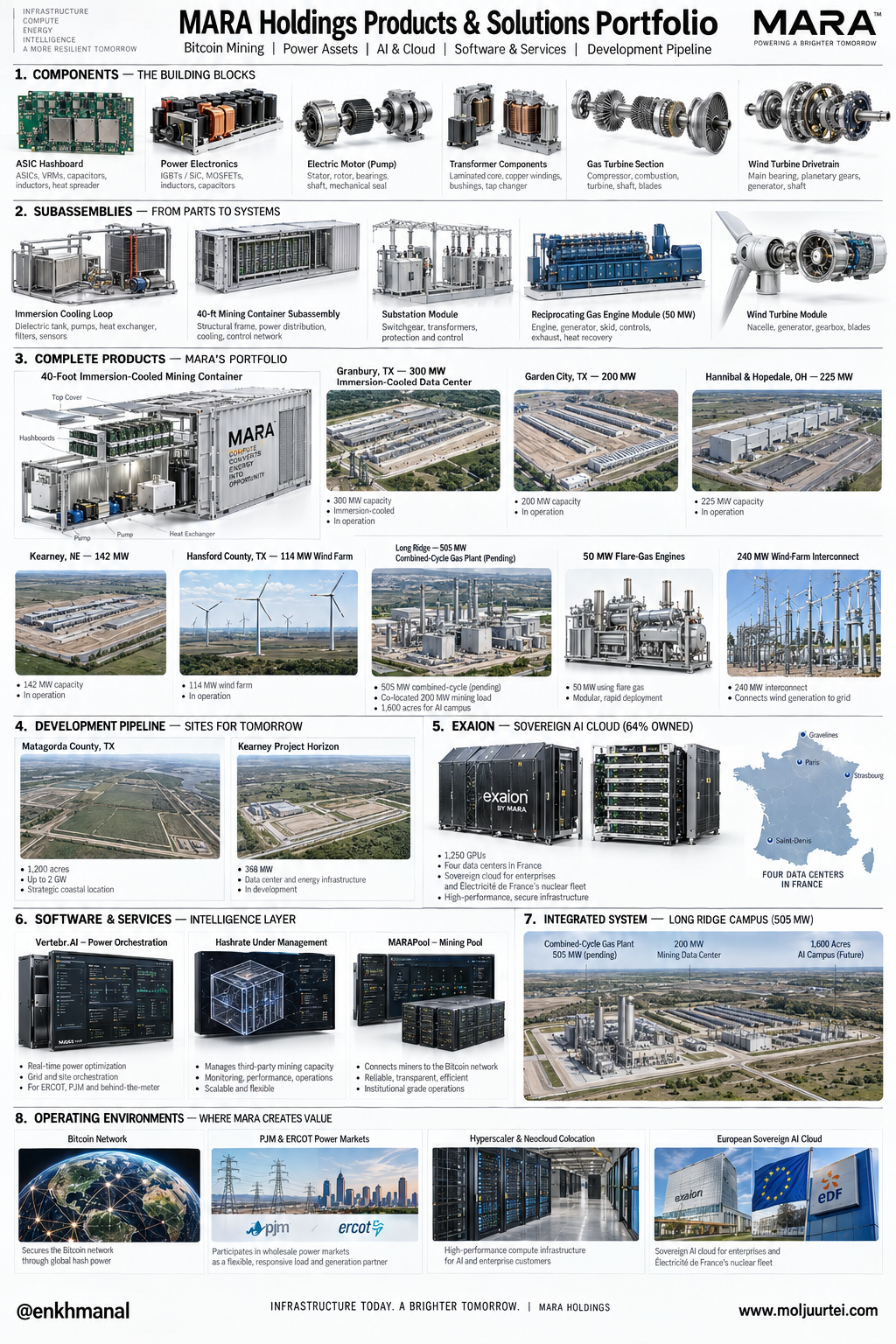
Three of these carry the thesis. Long Ridge is a 505 MW combined-cycle gas plant selling into PJM at an 89% capacity factor with more than 70% of output contracted, on a site with rail, water, fiber and its own gas supply; $MARA already mines 200 MW there, and the plan is up to 600 MW of new critical IT load paired with new on-site generation. Matagorda is 1,200 acres ninety miles from Houston with a utility letter for 1 GW by October 2027 and 2 GW by April 2028, bought from an e-fuels developer (Highly Innovative Fuels) for up to $600 million in milestone payments that are only owed as approvals, energization and a signed lease arrive. Kearney is the template: 100 MW mining today, a 368 MW AI campus approved by the city, phase one on the energized 100 MW.
Why this is hard to copy: a new large load in ERCOT now goes through Batch Zero, and the base-load allocations went to sites with substations already built; a new load in PJM enters a queue of roughly 130 GW. $CLSK's chairman described winning 110 MW in Wyoming against "a trillion-dollar hyperscaler" because a miner can start paying the power bill in ninety days. The asset is the permission, and the permission cannot be bought in a quarter.
What $MARA does not have is the building. It has never delivered a liquid-cooled hall to a hyperscaler's reference design, which is why Starwood is there: Starwood Digital Ventures brings the engineering and its captive contractor, Worldwide Digital, and $MARA contributes the site at a pre-agreed value once a tenant signs, taking equity credit before any cash is required. The trade is obvious and it is the one $JPM objects to: certainty of delivery in exchange for a share of the project rather than all of it.
Roadmap & R&D
The next twelve months are a sequence of dated gates, and every one of them is public.
The first is regulatory. Long Ridge needs FERC approval under Section 203; the application went in around May 8 and the statute deems a transaction approved 180 days after a complete filing if the Commission has not acted, which lands in the first days of November. PJM's independent market monitor asked FERC on May 29 to condition approval on the plant's output staying in PJM markets, and Thiel's public position is that any new data center at Hannibal will be paired with new generation, so the condition is one the company can live with. The noteholder consent on Long Ridge's $600 million of 8.75% notes was completed in Q2, and the $600 million of bitcoin-backed loans signed on August 4 with Coinbase and Two Prime are the cash consideration. Long Ridge contributes positive EBITDA from the day it closes: $25.4 million in the first quarter of 2026 on $62.0 million of revenue, per the June investor presentation, or about $100 million annualized against the $144 million headline that was based on the second half of 2025.
The second gate is commercial, and management wrote it down. The Q2 shareholder letter says "we remain confident in our ability to sign at least one lease before year-end"; the Q2 call and the September 14 fireside both say two:
We don't announce LOIs or exclusivities around leases, but we feel very confident about signing the two leases by year-end… if you have a hyperscaler at a triple net lease where you're talking about a yield on cost of 10%, you may have a neocloud at 15% yield on cost, then you may have enterprise clients at an even higher level.
That pricing ladder is the most useful thing he has said all year, because it tells you what the first lease will look like: a large site (Hannibal or Matagorda) let to a hyperscaler at a 10% yield on cost, or a smaller one (Granbury, Kearney) let to a neocloud at 15%.
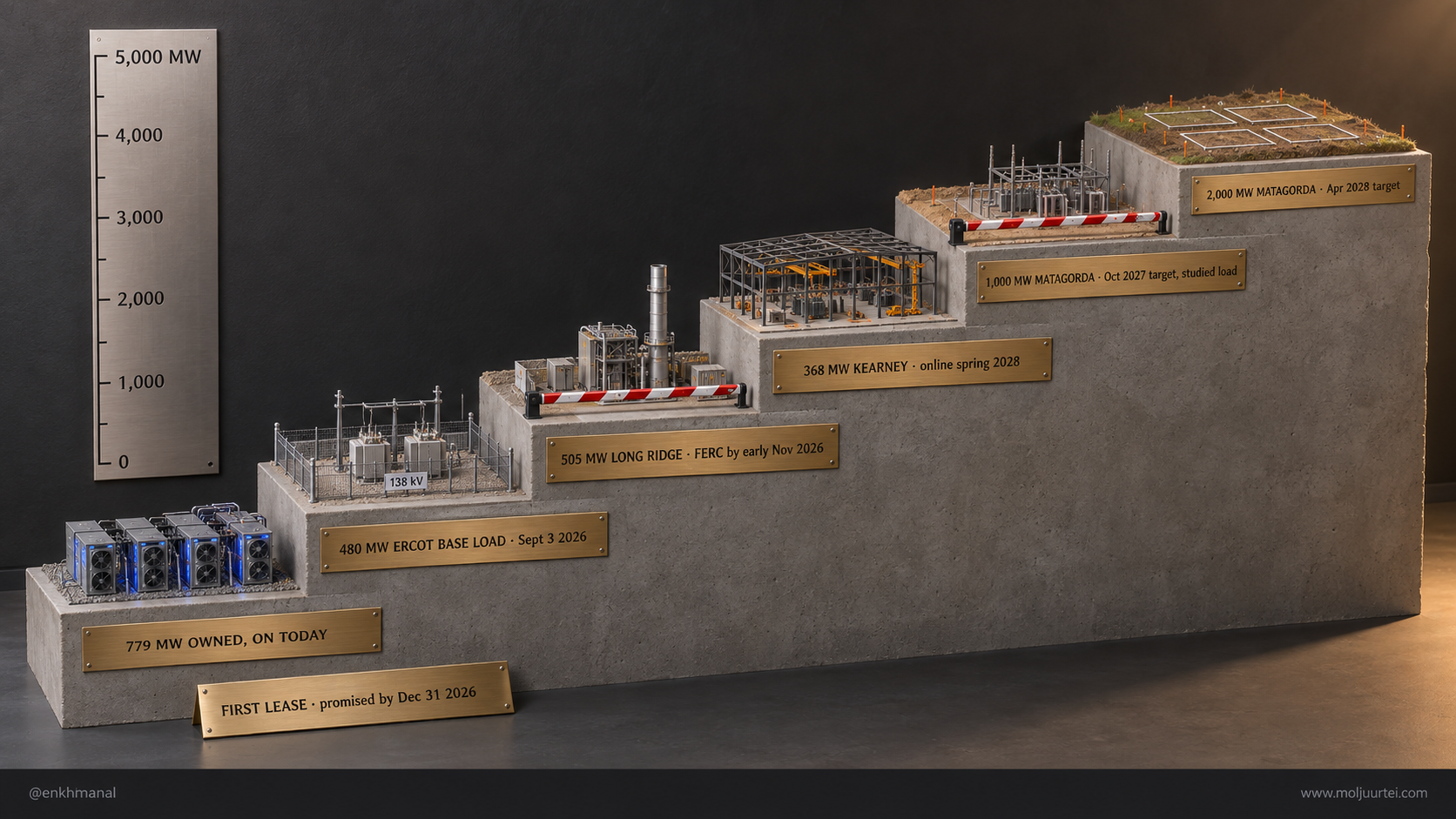
The third is construction. Kearney's phase one is targeted to break ground by the end of 2026 and come online in spring 2028 on the 100 MW already energized; Matagorda's switchyard is under a notice to proceed by the seller, with 1 GW of grid capacity targeted for October 2027 and 2 GW for April 2028, though ERCOT's decision to classify it as studied load means nothing is final there before April 2027; Long Ridge's first AI phase is targeted to start in the first half of 2027 for service in mid-2028. Hosting contracts roll off from Q3 2027, and the plan is to move the hosted fleet onto Matagorda's first gigawatt while the AI campus is designed around it. An Investor Day is promised "later this year."
The smaller lines were sized for the first time on August 6. Exaion, the French private-cloud subsidiary bought from Électricité de France for $168 million, is guided to "low eight digits" of revenue in 2026, is about 80% captive to its former parent, runs the compute behind that utility's nuclear fleet, and was selected for a European Union-backed consortium targeting about 3 GW of sovereign AI capacity; Thiel said on September 14 that it is already hosting US inference and training loads in Europe because US capacity is late. Hashrate Under Management, a financial platform for mining pools, is at "eight-digit annualized" revenue. Vertebr.AI, the power-orchestration software that runs the fleet, is being packaged for outside customers. None of the three moves the needle against $175 million of quarterly mining revenue; they are cheap options on a platform that will need to run data halls it does not yet run.
The Setup — Why It's Mispriced
The market pays roughly $4 billion for $MARA's power portfolio and nothing for leases, which is right only if none sign. At $12.84 the 381.9 million shares are worth $4.90 billion. Add the $2.42 billion of debt on the June balance sheet, subtract $421 million of cash, and the enterprise value is about $6.9 billion; subtract the 35,577 bitcoin at $80,700, worth $2.87 billion, and about $4.05 billion is left for everything that is not a coin: 779 MW of operating owned sites, the 2 GW of Matagorda rights, the equity in Long Ridge, Exaion, 70 exahash of chips and the software. That is roughly $5.2 million per operating owned megawatt, or $1.1 million per megawatt of the 3.6 GW the company could plausibly energize, against $10–12 million per megawatt of asset value where a lease exists.
What a lease is worth, in $MARA's structure, is arithmetic the company has supplied. $CLSK's Sandersville deal pays about $1.9 million per critical megawatt per year, triple-net, so the tenant carries taxes, insurance and maintenance and the rent is the net operating income. Capitalize twenty-year rent from an investment-grade tenant at 15× and a leased megawatt is worth about $28 million; building it costs $10–12 million, financed at roughly 80% loan-to-value, which leaves about $19 million of project equity per megawatt. In the Starwood structure $MARA contributes the site at a pre-agreed value and, on management's illustrative 200 MW project, ends up with about 50% of the project for "little to no incremental equity." Call it $9–10 million of value to $MARA per leased megawatt. Two hundred megawatts, the size of the company's own illustration, is $1.9 billion, or about $5 a share, on a stock at $12.84; six hundred megawatts, the Hannibal plan, is $5.7 billion.
That is exactly the number the sell side is fighting over. $JPM cut the stock to Underweight on September 14 with an $11 target for December 2027 on the argument that $MARA "sits at the bottom of the data center value chain by solely providing powered land" and keeps only 10–50% of each project, so peers that own the whole stack create more value per megawatt. The rebuttal that circulated on X the next day is the better argument: owning 100% of one site means funding 100% of it with a balance sheet that has 355 million shares and $2.4 billion of debt already, whereas 25–50% of five sites in parallel, with the dilution confined to each project, is what a company with 3.6 GW of pipeline and no data-center construction record should want. Both agree on one thing: the share $MARA keeps is undisclosed, and the first lease will disclose it.
The quarter that just printed is the bear case in numbers. Revenue of $174.9 million missed consensus by 16%; the net loss of $611 million included a $343 million bitcoin mark; adjusted EBITDA, which by $MARA's definition includes that mark, was −$361 million, and about −$18 million without it. Operating cash flow was −$803 million in FY25 against $907 million of revenue, and the accrual ratio has run between −39% and +36% over five years, which is what a company whose income statement is dominated by an unrealized asset mark looks like. The cash came from the coins: 20,880 bitcoin sold in Q1 for about $1.5 billion, most of it to retire $1.0 billion of converts at a 9% discount, 2,213 more in Q2, and 18,750 pledged in August. $JPM's line that the company needs bitcoin at about $80,000 to break even on its current cost base is roughly right on our arithmetic: at Q2's 2,422 coins a quarter, every $10,000 on the price is $24 million of quarterly margin, and the Q2 gap to breakeven was about $18 million.
So the setup is two bets on one balance sheet: that bitcoin holds above the cost of mining it, and that a lease signs before the coins run out. Morgan Stanley's move on September 18 shows which one the market has started to weigh: an analyst who thought the stock was worth $6 in July now says $11, rating unchanged, because ERCOT told him the megawatts are real.
Management & Track Record
The record on execution is genuinely strong in the business $MARA has always been in. It went from a hosted-only miner in 2023 to 779 MW of owned operating capacity by buying Granbury and Kearney (January 2024), Garden City (April 2024), Hannibal and Hopedale (November 2024), a Texas wind farm (February 2025) and a second Nebraska site (January 2026), and cut cost per petahash per day 27% in nine quarters. It has also been candid: "our shareholders should judge us not by our vision, but by our execution" is Thiel's own sentence, and the Q2 letter's written commitment is one lease, not two.
The record on strategy is less tidy. In November 2025 the plan was "smaller, modular facilities directly at lower-cost power sites instead of building hyperscaler campuses," with an inference pilot at Granbury and a letter of intent with Marathon Petroleum's $MPLX for 400 MW of on-site gas generation in West Texas expandable to 1.5 GW. By February 2026 the Starwood hyperscale partnership had replaced that plan and $MPLX was "a longer-term project" whose scope "has evolved"; it has not been mentioned on a call since. April brought Long Ridge, July brought Matagorda. That is a team that changes its mind quickly when the market does, a virtue and a warning in equal measure.
Two governance points belong in the record. The August 1 board refresh replaced a retired Siemens executive and a five-year incumbent with a data-center builder and a power financier, four months after VanEck's Matthew Sigel publicly called for "Active Power Traders or HPC Engineers" on a board he called too small and insular for the pivot. And the insiders sell: Thiel and Khan have sold on the seventeenth or eighteenth of every month since May under what look like 10b5-1 plans (27,505 and 16,000 shares at $9.21 on August 17, for example), small against Thiel's 4.3 million shares but with no open-market purchase by any insider in the pivot year.
Risks & What Breaks It
What forces a thesis change: no signed lease by December 31, 2026; a lease whose disclosed $MARA ownership is below 25% with no offsetting site-contribution credit; or Matagorda failing to reach base-load status in ERCOT's April 2027 round while hosting contracts expire.
Price Setup — Levels, Technicals & Options
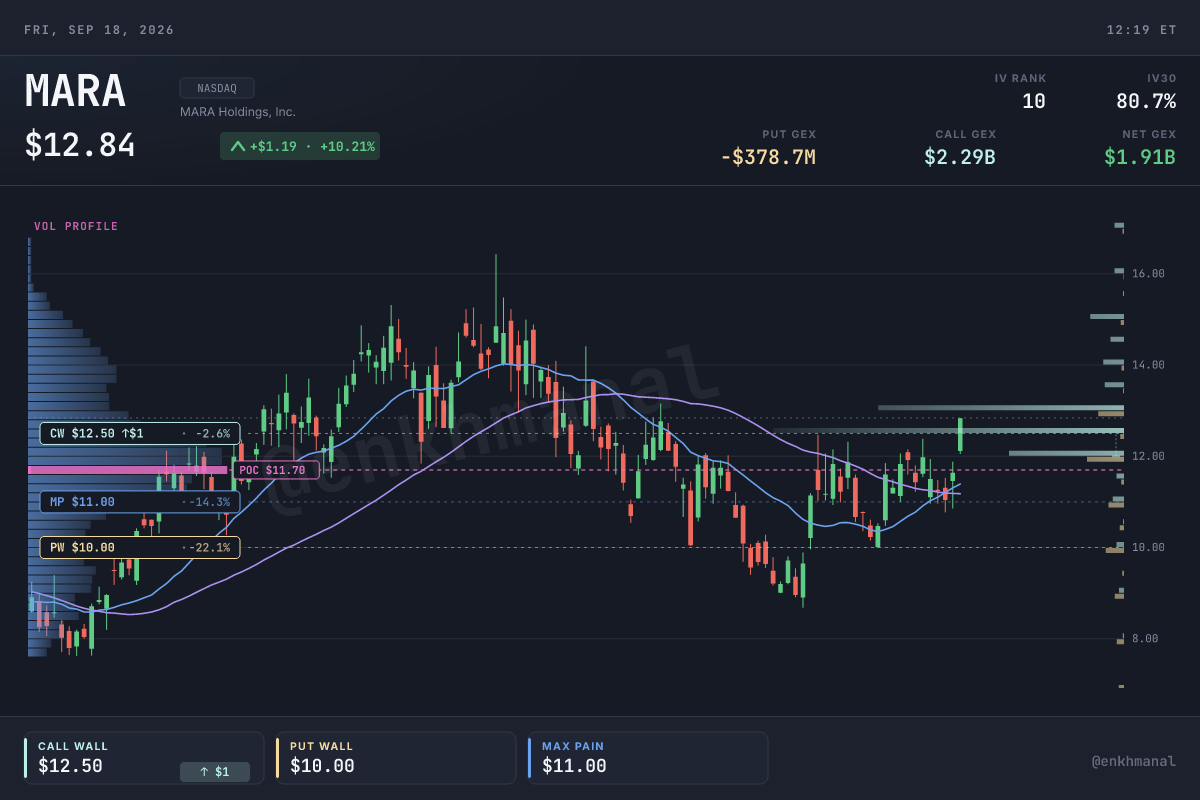
$MARA made its 52-week high of $22.84 on October 15, 2025 with bitcoin near its own peak, and its low of $6.73 on February 5, 2026 as the coin fell toward $68,000 and the company reported a $1.3 billion loss. Since then it has climbed 43% over six months on a rising floor: the post-earnings low of $9.21 on August 17, when the CEO and CFO sold, is now the level to defend. At $12.84 the stock is above its 20-day ($11.39), 50-day ($11.18), 100-day ($12.23) and 200-day ($10.95) moving averages, and the 50-day sits above the 200-day. The September 18 close through $12 cleared the level that turned the August rally back, on the highest volume in a month.
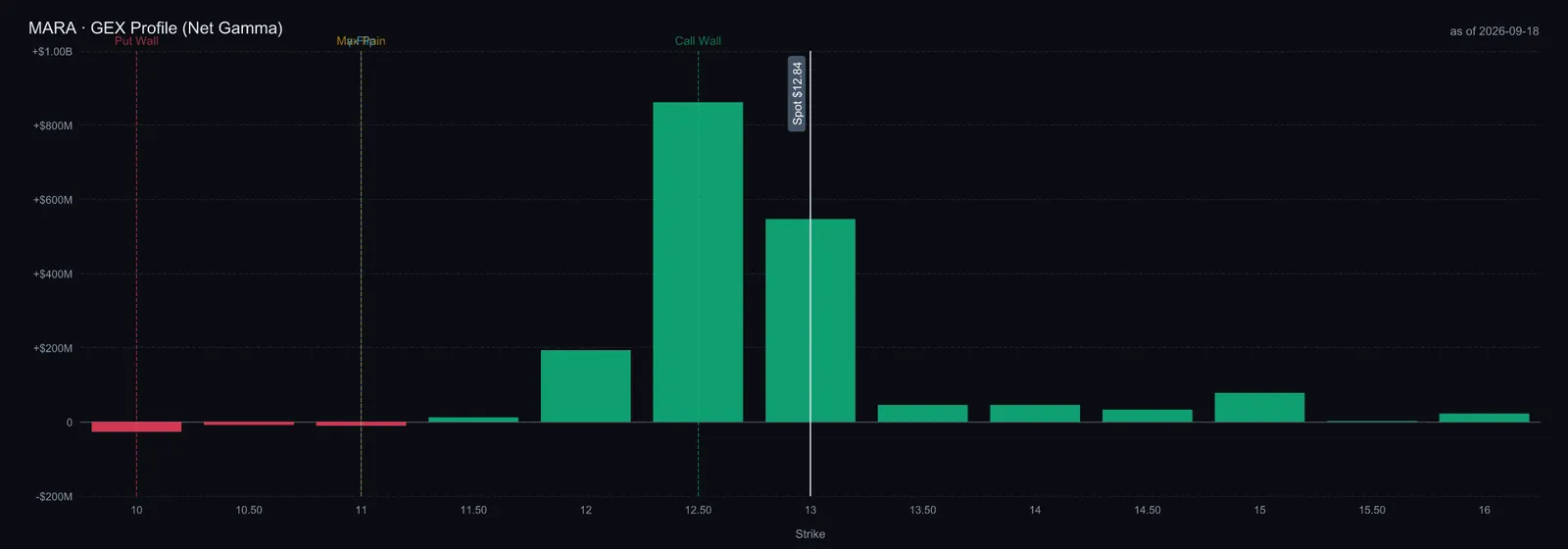
Dealer positioning turned with the price: net gamma was −$313 million on August 7, the morning after earnings, with spot pinned on a $10 put wall; on September 18 it is +$953 million, with the call wall at $12.50, the put wall at $10, max pain at $11 and the gamma flip at $11.62, on 1.13 million calls and 773,000 puts of open interest across eighteen expiries (put/call open interest 0.69). Positive gamma this size means dealers sell strength and buy dips inside the $10–12.50 band, so the near term should be quieter than the headlines; a close above $12.50 removes the ceiling. Implied volatility is 81% at the front and flat out to 86% in 2027, which prices a $12.84 stock to move about $2.30 a month; the November 20 expiry, which covers both the FERC deadline and the Q3 print on November 3, is only marginally richer than October. The options market is not paying for the catalysts.
The stock also carries one of the largest short positions in the large-cap universe, about 36% of the float in April, so a signed lease into positive dealer gamma has room to travel: the August 20–21 move, $9.40 to $12 in two sessions on a bitcoin rally alone, is the template. The level at which the market is questioning the thesis is $10: the put wall, the 200-day, and the price at which the August selling stopped.
Valuation & House View
No earnings multiple applies to a company whose income statement is an unrealized bitcoin mark, so the honest anchors are the balance sheet and the megawatts. On the balance sheet, $MARA's market value is 1.7× the bitcoin it holds, near the middle of its own three-year range: about 9× at the end of 2023 when it held 15,126 coins, 1.4× at the end of 2024 with 44,893 coins, 0.7× at the February 2026 low with 53,822 coins, when the equity traded below the treasury, and 1.7× today with 35,577. On the megawatts, the $4.05 billion of enterprise value that is not bitcoin equals $5.2 million per operating owned megawatt, between the $0.7 million per megawatt of a gas plant deal and the $10–12 million per megawatt at which $CIFR and $WULF trade on their leased capacity, and above the $3.0 million per megawatt $MARA itself paid for Long Ridge. The stock is priced as a powered-land holder that has not yet let the land.
Three cases, each a sum of the same parts: the bitcoin at a stated price, cash, the mining estate at a stated value per megawatt, Long Ridge equity, Exaion at cost, less $2.9 billion of debt including the August loans, plus the value of leases actually signed at $9.5 million per megawatt to $MARA.
The probability-weighted value is about $16.50, a shade above the sell-side median of $16 and inside a spread that runs from Morgan Stanley's $11 to H.C. Wainwright's $20; the mean of twelve targets is $18. The asymmetry is the point: the bear case is the current business marked to a lower coin, the bull case is the current business plus the thing every peer has already done once.
$MARA is a name worth owning into the fourth quarter, sized for a stock that can move 20% on a bitcoin week, with the position built in two steps: a starter here above the 50-day, and the rest on the first signed lease, when the disclosed share of the project replaces the arithmetic above with a number. The catalysts are dated, FERC in early November, the Q3 print on November 3, the lease by December 31, and the tape is set up for them, with dealers long gamma, the shorts still heavy, and the megawatts now counted by the grid operator rather than by the company. If the year ends without a signature, the position is a leveraged bitcoin holding at $10, and that is the price at which we would reconsider.