
$LITE Deep Dive — The laser chip became the scarce part of the AI network · into the November print
$LITE makes the indium phosphide laser chips that turn a data center's electrical bits into light, and since we last wrote in June the scarcity of those chips has gone from a quarterly talking point to the organising fact of the business. Lumentum printed a $1.01B June quarter (+109%) at a 50.4% non-GAAP gross margin, guided September to $1.25B, put a $40 non-GAAP EPS target on fiscal 2028, and its CEO now says it can supply only 30% of what customers want in 2027. The stock closed at a record $1,085.42 on October 2, 31% above where it stood in late June, so the question is no longer whether the cycle is real but how long a shortage this deep can last.
AI moved the data center's bottleneck onto a laser chip
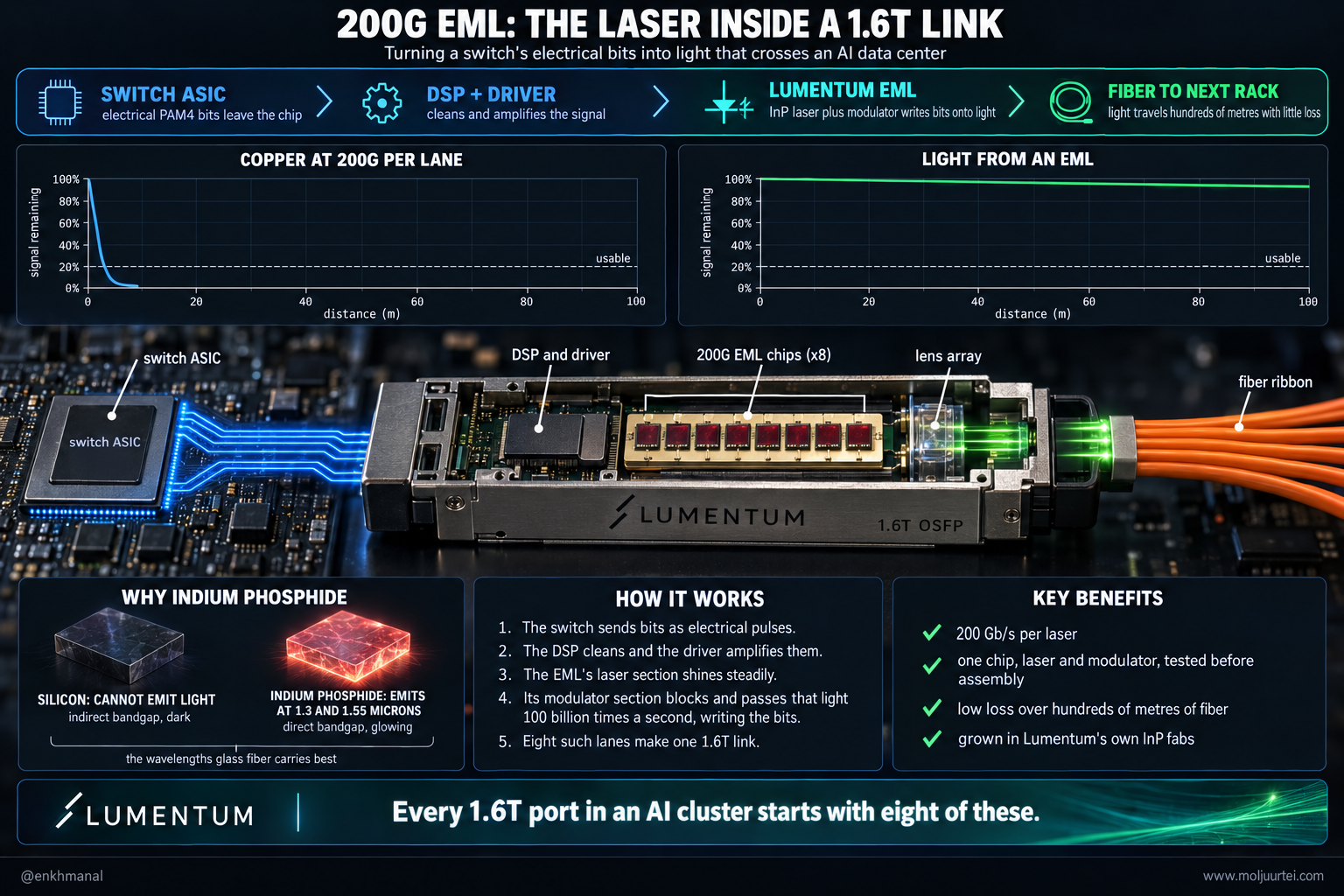
Start with the problem. An AI model is trained by thousands of GPUs exchanging partial results many times a second, and every exchange is a stream of bits that has to cross some distance: centimetres to the next chip, metres to the next rack, hundreds of metres across the hall, or tens of kilometres to the next building. Copper wire carries bits as electrical pulses and does it cheaply, but at the speed an AI cluster now runs, about 200 billion bits per second on each lane, a copper connection loses the signal within a metre or two. Past that, the bits have to become light.
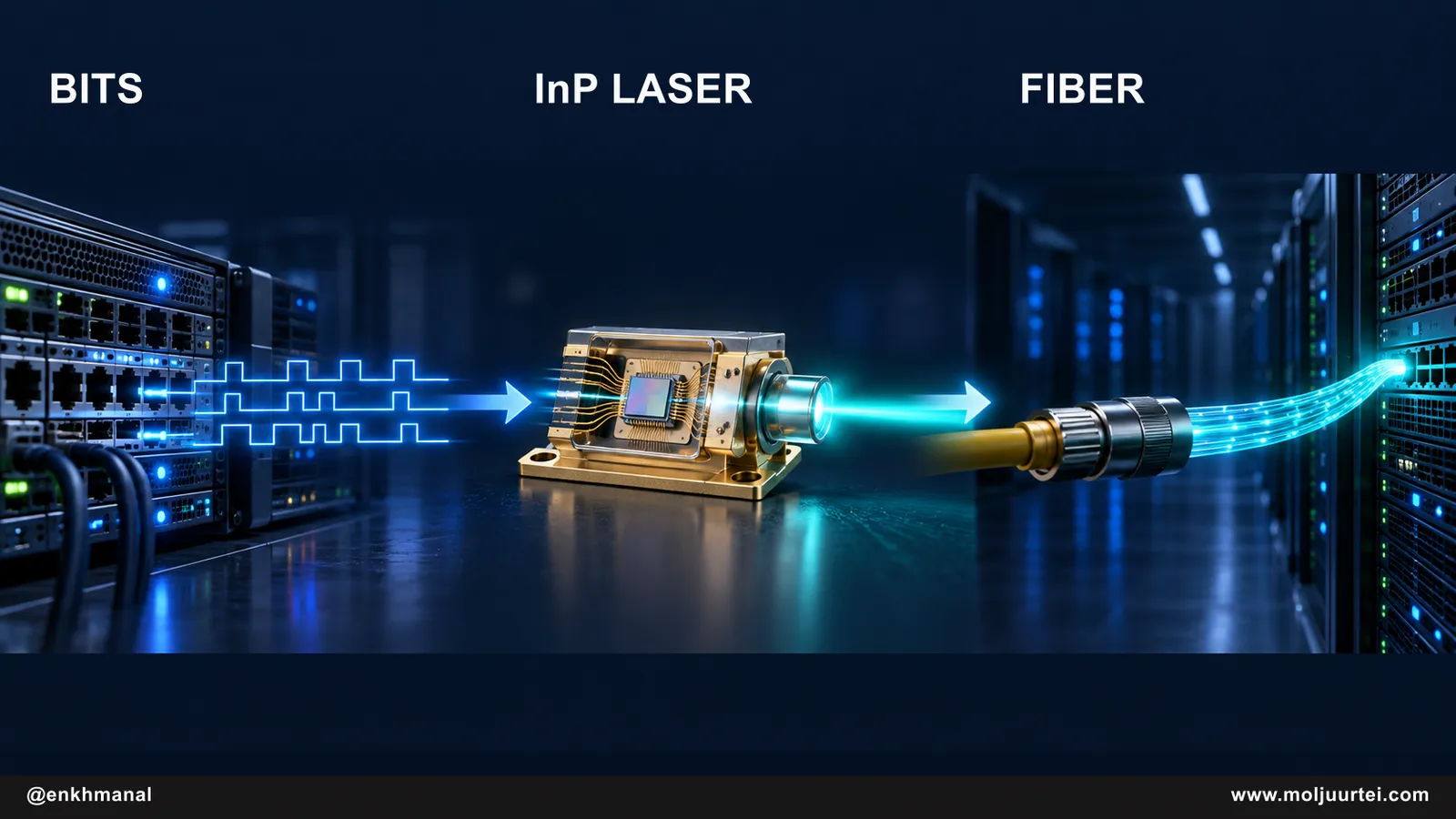
Start here. A bit is a single on-or-off piece of information. A laser is a device that turns electric current into a narrow beam of light of one colour, and a semiconductor laser is a chip a fraction of a millimetre long that does this when current flows across a junction between layered crystals. Indium phosphide is the crystal those layers are grown on when the light must sit at 1.3 or 1.55 microns, the colours glass fiber carries with the least loss; silicon, the material of almost every other chip, cannot emit light efficiently at all. An electro-absorption modulated laser (EML) is an indium phosphide chip that holds a laser and a fast light shutter side by side, so it writes bits onto the beam it makes. A transceiver is the plug at the end of every optical cable that holds those lasers and the electronics that drive them, turning electrical bits into light and back. Everything below is about who can grow enough of those chips.
The old answer to moving more bits was to make each transceiver faster: 100 gigabits, then 400, 800, and now 1.6 terabits per module, built as eight lanes of 200 gigabits. Each step needs lasers that switch faster and with less noise, and each new cluster needs more modules, because the network now has three layers that all want light. Scale-across links join data centers to each other, scale-out links join racks inside a building, and scale-up links join GPUs inside one cluster. That last layer is still copper today and is the next to turn optical. Lumentum's head of investor relations, Kathy Ta, gave the multipliers at Citi's conference on September 9: if data-center interconnect is one unit of optical bandwidth, scale-out is about ten, and the first optical scale-up in late 2027 adds three to four times that again.
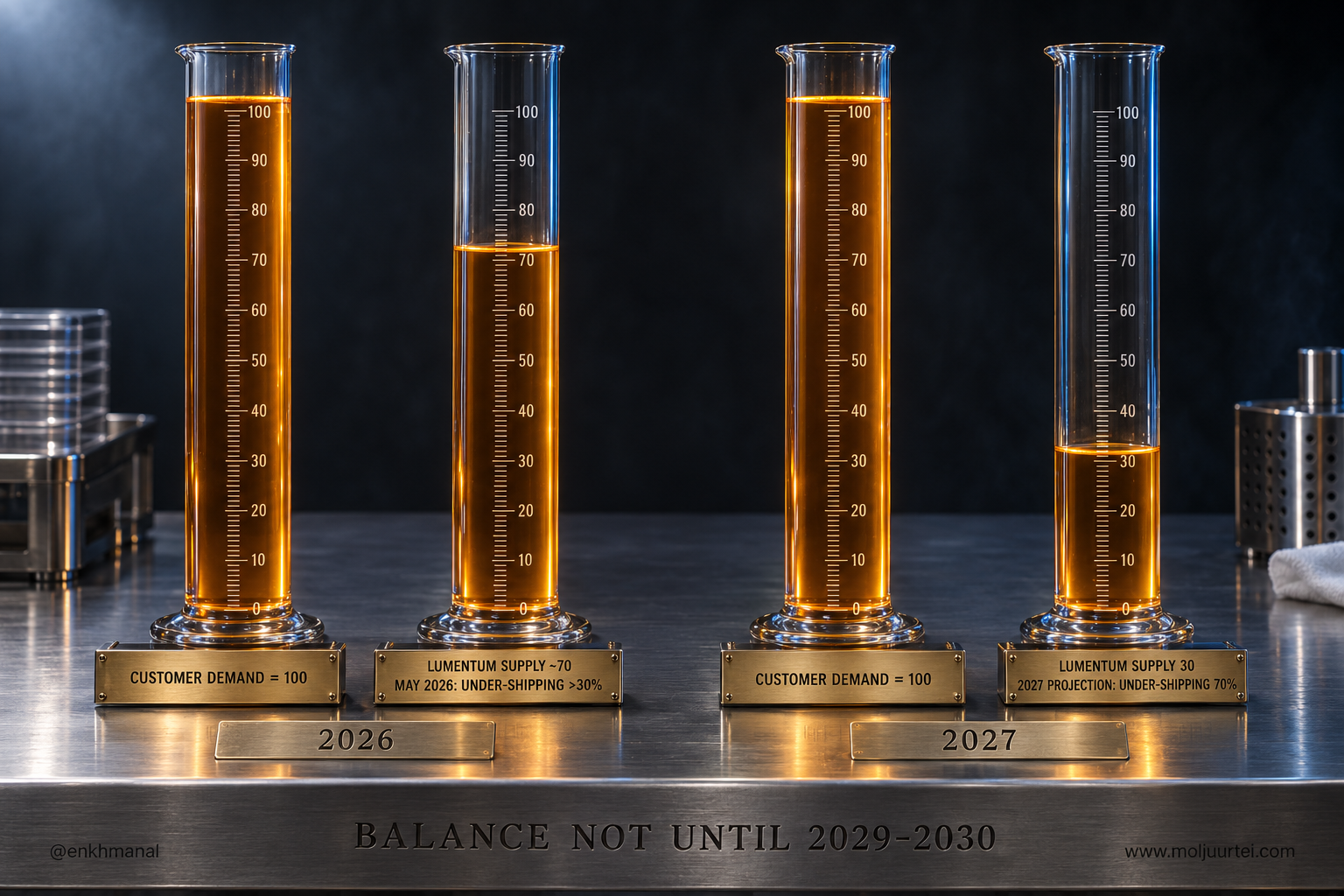
What changed since June is the width of the gap between that demand and the supply of indium phosphide lasers. On the May 5 call Lumentum said it was under-shipping demand by more than 30%. On September 24, in a keynote at Optica's Global Photonics Economic Forum in Málaga, CEO Michael Hurlston put the 2027 figure at 70%: with co-packaged and near-packaged optics arriving next year, the company expects to supply only 30% of what customers ask for, and he does not see supply and demand meeting until 2029 or 2030. A shortage that deep, in a part that takes a year to qualify and a fab that takes years to bring up, hands pricing to whoever already owns the fabs.
The company that gains most from that shift is the one with the largest merchant indium phosphide laser capacity in the West that also sells the transceivers and switches those lasers go into. That is Lumentum.
the scarce input, sold as a chip and as a box
Lumentum owns the scarcest input in AI networking, the indium phosphide laser chip, at a time when each architecture change in the data center multiplies either the number of lasers or the power each must emit; management's $40 non-GAAP EPS target for fiscal 2028 is its own measure of what that scarcity is worth.
sixty years of the semiconductor laser, and a new largest buyer
The technology is older than most of the people now buying the stock. The first semiconductor lasers were demonstrated in 1962, at General Electric's research laboratory and at several other American labs within weeks of each other, and ran only in short pulses while chilled in liquid nitrogen. In 1970 two things made optical communication practical: Zhores Alferov's group in Leningrad and, separately, Izuo Hayashi and Morton Panish at Bell Labs made lasers that ran continuously at room temperature, and Corning drew glass fiber pure enough to lose only 20 decibels per kilometre. Bell carried live telephone calls over fiber in Chicago in 1977. Indium phosphide lasers at 1.3 and 1.55 microns followed, matching the laser to the colours glass carries best, and the erbium-doped fiber amplifier of 1987 let light cross oceans. Alferov and Herbert Kroemer shared the 2000 Nobel Prize in physics for the layered structures inside every one of these chips, and Charles Kao won in 2009 for the fiber. The curve that followed was telecom: decades of steady, cyclical growth and the 2001 bust. A new curve starts when the data center, not the phone network, becomes the largest buyer of lasers.
Lumentum was spun out of JDS Uniphase on August 1, 2015 as the optical-components half of a company that had made telecom lasers for decades, and for most of the next eight years it lived on that curve. Its vertical-cavity lasers sit in the face-recognition module of Apple's phones and its telecom lasers rose and fell with carrier spending. In November 2023 it bought Cloud Light, a Hong Kong transceiver maker, for about $750M, giving it a module line in which to put its own lasers; that deal is the bridge from the old company to this one.
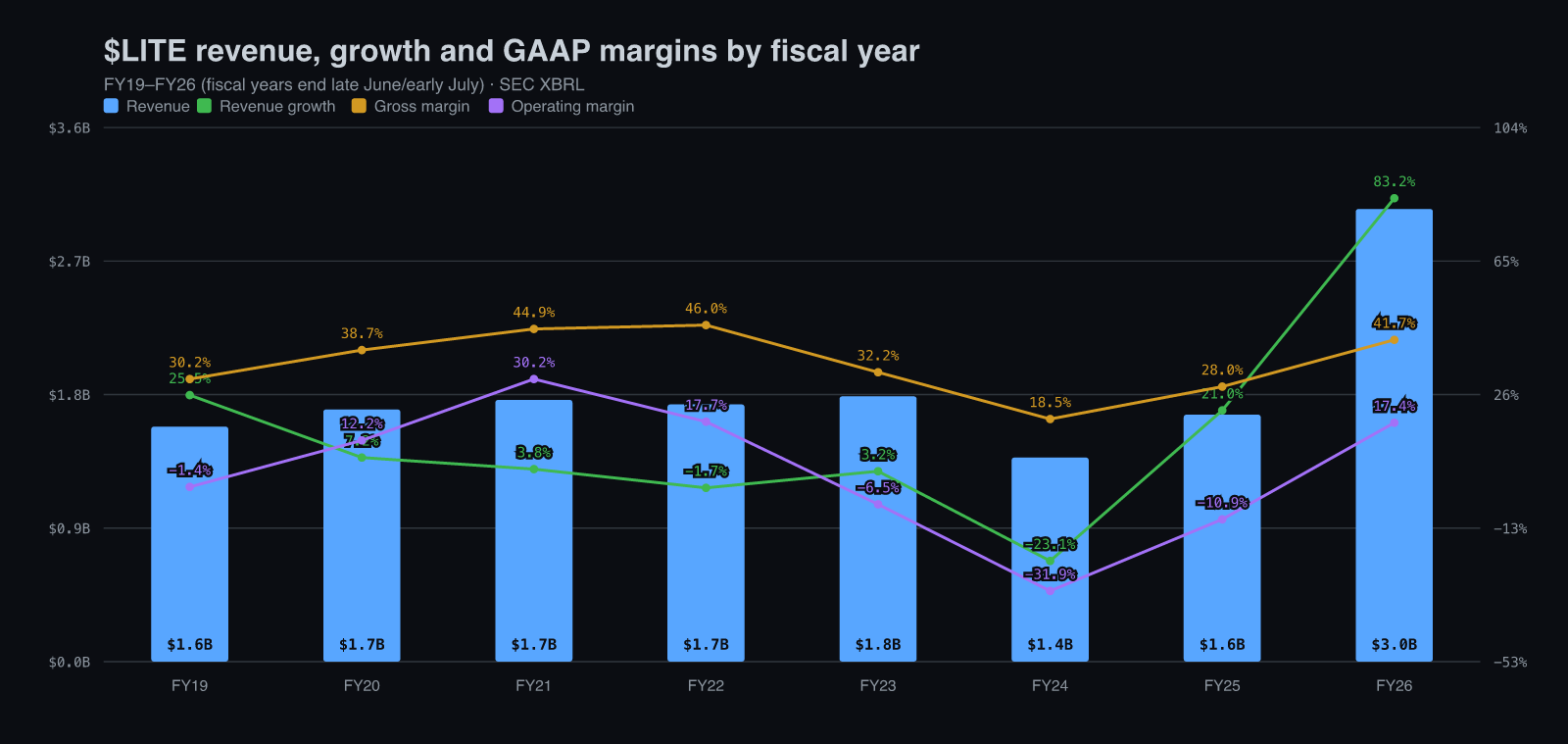
The revenue and margin record shows how cyclical the old business was and how different this upturn is. Revenue was $1.57B in FY19, $1.68B in FY20, $1.74B in FY21, $1.71B in FY22, $1.77B in FY23, $1.36B in FY24, $1.65B in FY25 and $3.01B in FY26, growth of 25.5%, 7.2%, 3.8%, −1.7%, 3.2%, −23.1%, 21.0% and 83.2%. GAAP gross margin ran 30.2%, 38.7%, 44.9%, 46.0%, 32.2%, 18.5%, 28.0% and 41.7% over those years, and GAAP operating margin went from 30.2% at the FY21 telecom peak to −31.9% in FY24 and back to 17.4% in FY26.
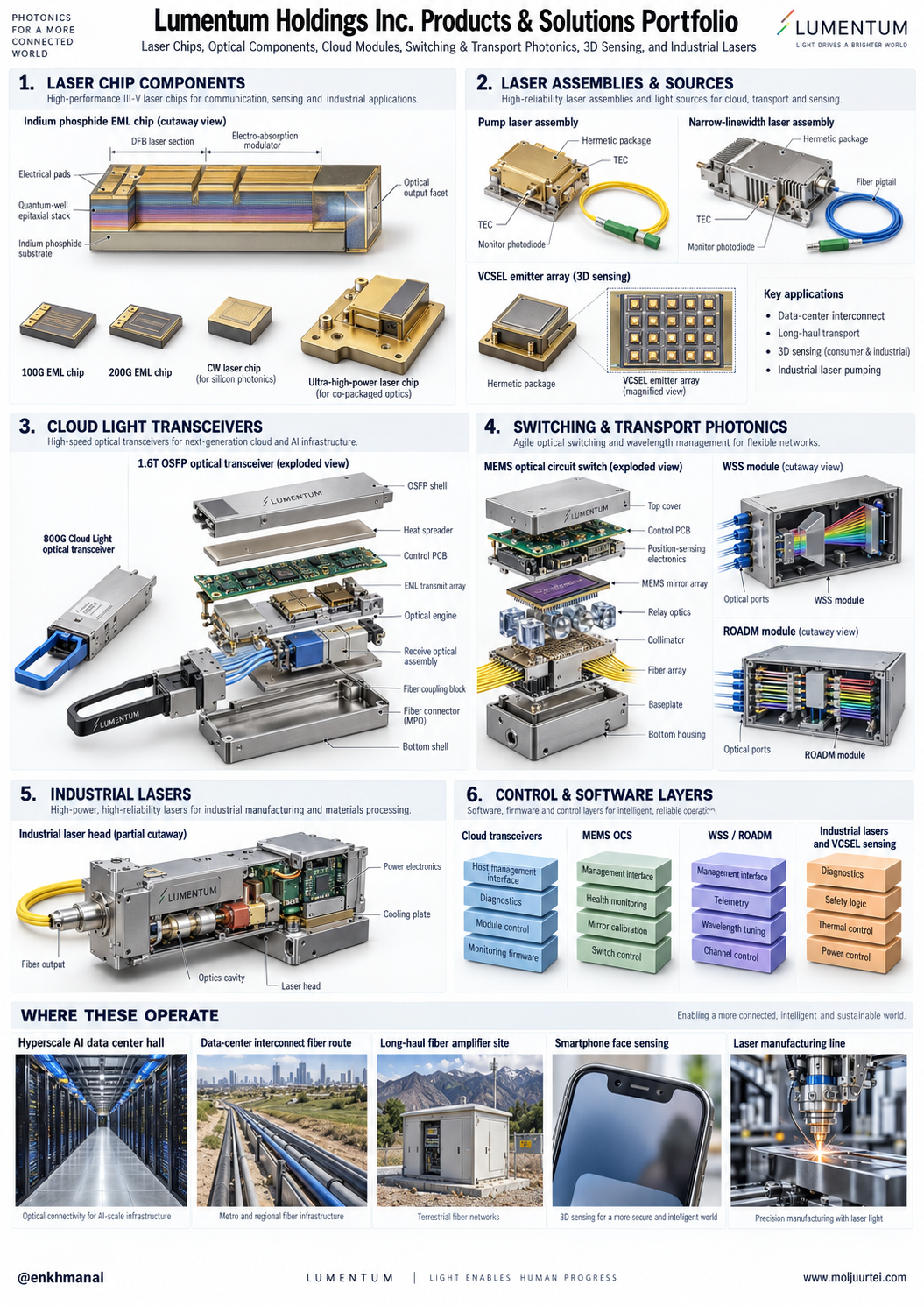
Today the company reports two product types. Components are the chips and subassemblies: EMLs and continuous-wave lasers for transceivers, ultra-high-power lasers for co-packaged optics, pump and narrow-linewidth lasers for long links, and the 3D-sensing lasers that still go to Apple. Systems are finished boxes: cloud transceivers, optical circuit switches (OCS), wavelength-selective switches and industrial lasers. Components produced 65.0% of FY26's $1.37B of growth, but Systems is growing faster and gained 2.2 points of share in the June quarter as transceivers and OCS ramped. Two end customers took 41.6% of FY26 revenue, 26.6% and 15.0%.
a laser customers can trust, grown in fabs nobody can build quickly
Reduced to one sentence, Lumentum sells a laser that customers can trust at a specification few others can hit in volume. Three things make that hard to copy. First, the chip is grown rather than simply patterned: an indium phosphide laser is a stack of crystal layers a few billionths of a metre thick, deposited atom by atom, and the recipe that yields a laser switching at 200 gigabits a second without noise is learned over years of scrapped wafers. Wupen Yuen, who runs the business units, listed four properties a co-packaged-optics laser must hit at once at Citi in September (high power, low intensity noise, narrow linewidth and no mode hops) and added that they must hold "at volume with good yield."
Second, capacity cannot be bought quickly. Lumentum is on track for more than 50% more EML units in the December 2026 quarter than a year earlier, yet wafer tools are on allocation, substrates required long-term contracts, and every new line needs customer qualification before it ships; Yuen called qualification timing "the biggest variable" in its ramp. Third, it sells both the chip and the box. Because it owns a transceiver line and builds its own OCS, it can place scarce lasers in its own modules and earn both margins, or sell them to module makers who also compete with it. Non-GAAP gross margin crossed 50% in the June quarter, a level management had planned to reach at a $2B quarterly run rate, at half that revenue.
The case against the moat is silicon photonics. In a silicon-photonics transceiver a simpler continuous-wave laser supplies steady light and modulators etched in silicon write the bits, which moves value from the laser chip to the silicon foundry; sell-side forecasts cited by Asymmetrical Bets have silicon photonics at about 64% of modules by 2028. Lumentum's answer has two parts. It sells those continuous-wave lasers too, now "in a relatively meaningful way" for 200G silicon photonics, with yields above its EMLs, pricing Yuen called similar and margins "pretty close." And at 400 gigabits per lane, management argues silicon's material limits bite: "for 3.2T, indium phosphide is a sure bet. Silicon photonics will be probably pretty challenged." That is a claim, not yet a result; 3.2T qualifications in 2027 will settle it.
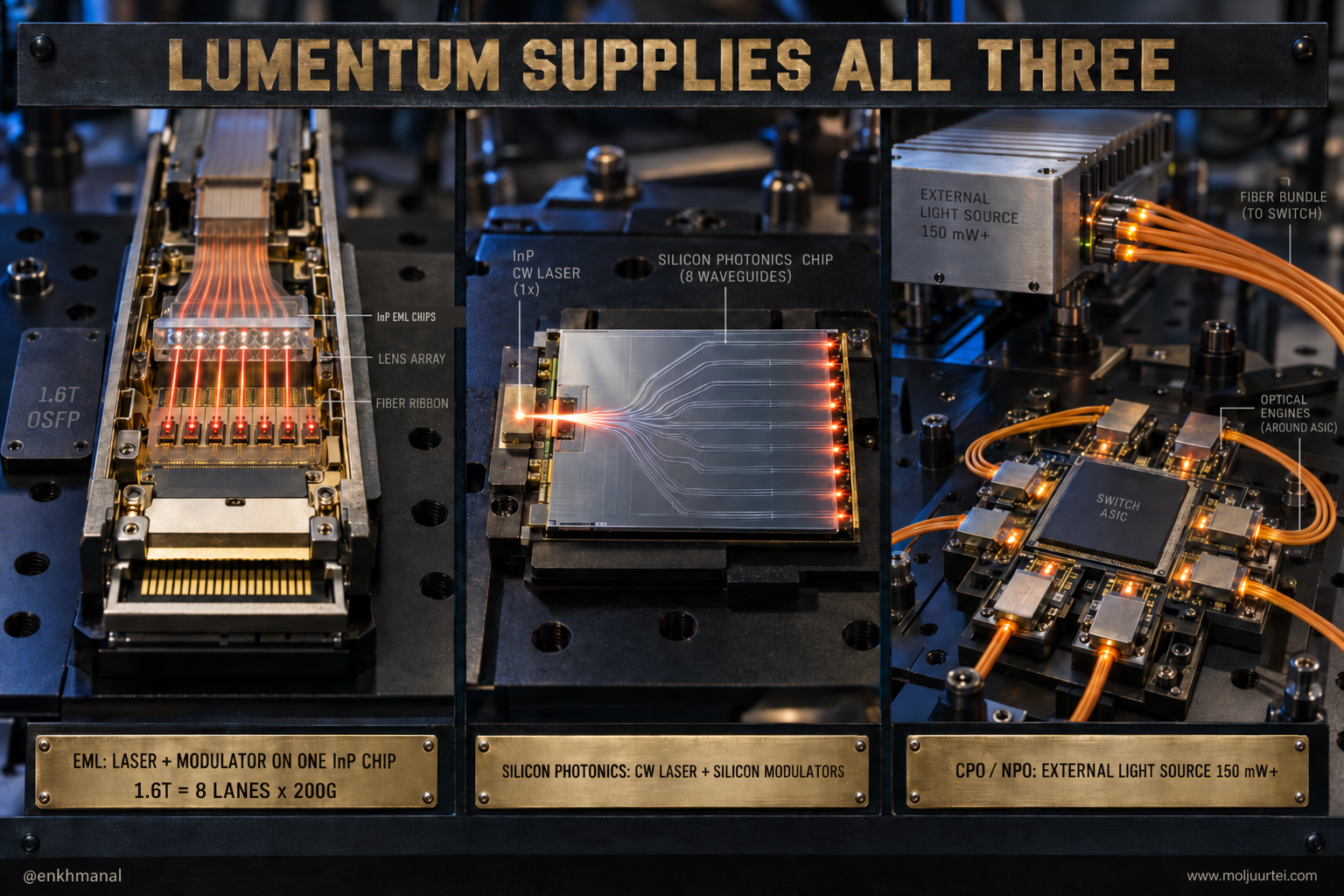
The second leg of the moat is the laser that sits outside the chip. Co-packaged optics moves the optical engine onto the switch or GPU package, and because a laser wears out faster next to a GPU or switch chip drawing hundreds of watts, the light source is moved outside into a pluggable module. Those external lasers need 120 to 150 milliwatts and up, against roughly 70 for today's pluggable continuous-wave parts. Yuen named one competitor at that power, Coherent, and said he sees nobody else.
We remain confident in a demand ramp for our ultra-high-power laser chips in the second half of calendar 2027, ahead of customer scale-up deployments in calendar 2028.
four product ramps landing on one set of fabs
Lumentum spent $356.5M on research and development in FY26, 11.8% of revenue, down from 18.5% a year earlier only because revenue nearly doubled; the June quarter alone was $104.4M. The roadmap that money funds is four ramps arriving within eighteen months. 1.6T transceivers began shipping in the June quarter, some built on Lumentum's own continuous-wave lasers, and management expects uptake "to intensify starting in fiscal Q1 and sustain through calendar 2027." 200G EMLs were already more than 25% of EML revenue.
An optical circuit switch is the newest product in that list and the easiest to misread. A normal network switch turns every incoming light signal back into electricity, reads where it is going, and turns it into light again, which costs power at every hop. An OCS skips that: an array of tiny MEMS mirrors, each a fraction of a millimetre across, tilts to steer a beam from any input fiber to any output fiber, so the light never stops being light. It cannot inspect packets, which is why it switches whole connections between groups of accelerators rather than individual messages, but for the large, slow-changing connections in an AI cluster it saves power and lets operators rewire a cluster in milliseconds. Google built its own for years; Lumentum is now one of the merchant suppliers.
Optical circuit switches doubled shipments from the March to the June quarter and are guided to their first $100M-plus quarter in September, under what the Q4 deck calls a multi-year, multi-billion-dollar purchase agreement. Ta said the $8B OCS market the company showed six months ago now has upside, from its largest customer and from new in-rack uses such as routing around failed GPUs. For co-packaged optics, the lead customer's scale-up shipments start in the second half of 2027 for 2028 deployments, and Lumentum won a first order for external light-source modules for that window, which Ta estimated at 15–20% of that customer's need. Near-packaged optics, which Yuen expects to be about half of optical scale-up, has no announced win yet; Ta said one could come "in the next handful of months." Pump lasers for scale-across links are expected to rise fourfold over about five quarters.
Capacity is the other half of the roadmap. Ultra-high-power lasers ramp in three waves: San Jose now, a new clean room in the UK from the second quarter of 2027, and the Greensboro, North Carolina fab it bought this year, from mid-2028. Capital spending was $451.3M in FY26 and $166.8M in the June quarter alone, and pump-laser customers are prepaying through higher prices under multi-year agreements to underwrite it. New long-term financial targets are due at OFC in March 2027.
Why It's Mispriced: the market prices a peak, management describes a shortage that runs to 2029
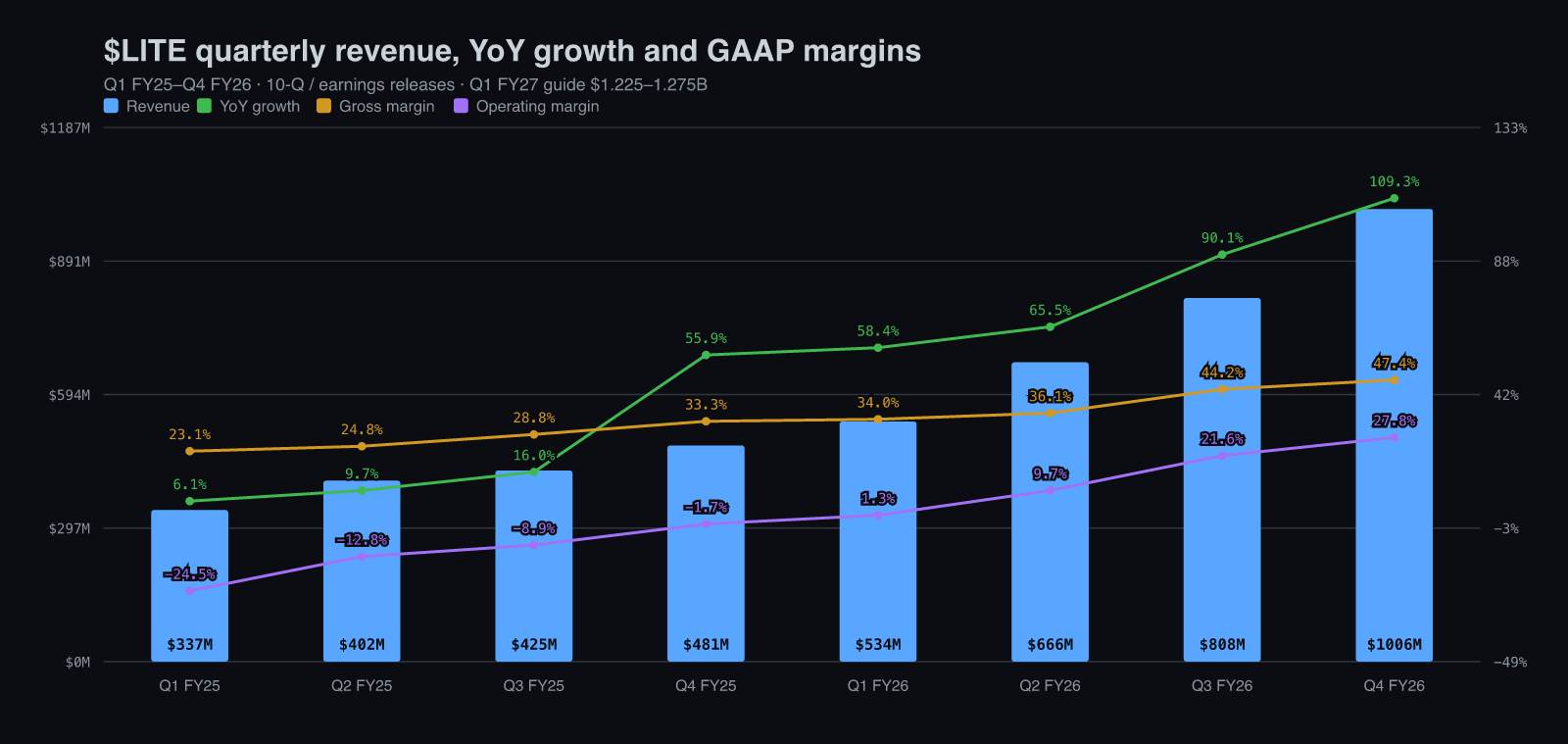
The quarterly record is what turned a recovery into a re-rating. Revenue was $336.9M in Q1 FY25, $402.2M in Q2 FY25, $425.2M in Q3 FY25, $480.7M in Q4 FY25, $533.8M in Q1 FY26, $665.5M in Q2 FY26, $808.4M in Q3 FY26 and $1,006.3M in Q4 FY26, with year-on-year growth climbing from 6.1% to 109.3%. GAAP gross margin in those quarters was 23.1%, 24.8%, 28.8%, 33.3%, 34.0%, 36.1%, 44.2% and 47.4%, and GAAP operating margin went from −24.5% in Q1 FY25 to 27.8% in Q4 FY26. On the company's non-GAAP basis the June quarter's gross margin was 50.4% against 37.8% a year earlier, and its operating margin 36.6% against 15.0%. The September quarter is guided to $1.225–1.275B with a 39.5–40.5% non-GAAP operating margin and $4.05–4.35 of EPS on about 102M shares.
Pricing is where a shortage shows up first, and it has not softened. Yuen at Citi: "All the deals we are making today are equal or higher pricing than the escalated pricing that we already had before," with some capacity allocated by price and expedite fees. The peers confirm the demand from their own books. $COHR, the other Western indium phosphide house, reported June-quarter revenue of $2.05B, up 34%, at a 40.2% gross margin, said orders now extend into calendar 2028, and is doubling its internal indium phosphide output year on year. $FN, which assembles modules for others, reported June-quarter revenue of $1.316B, up 45%.
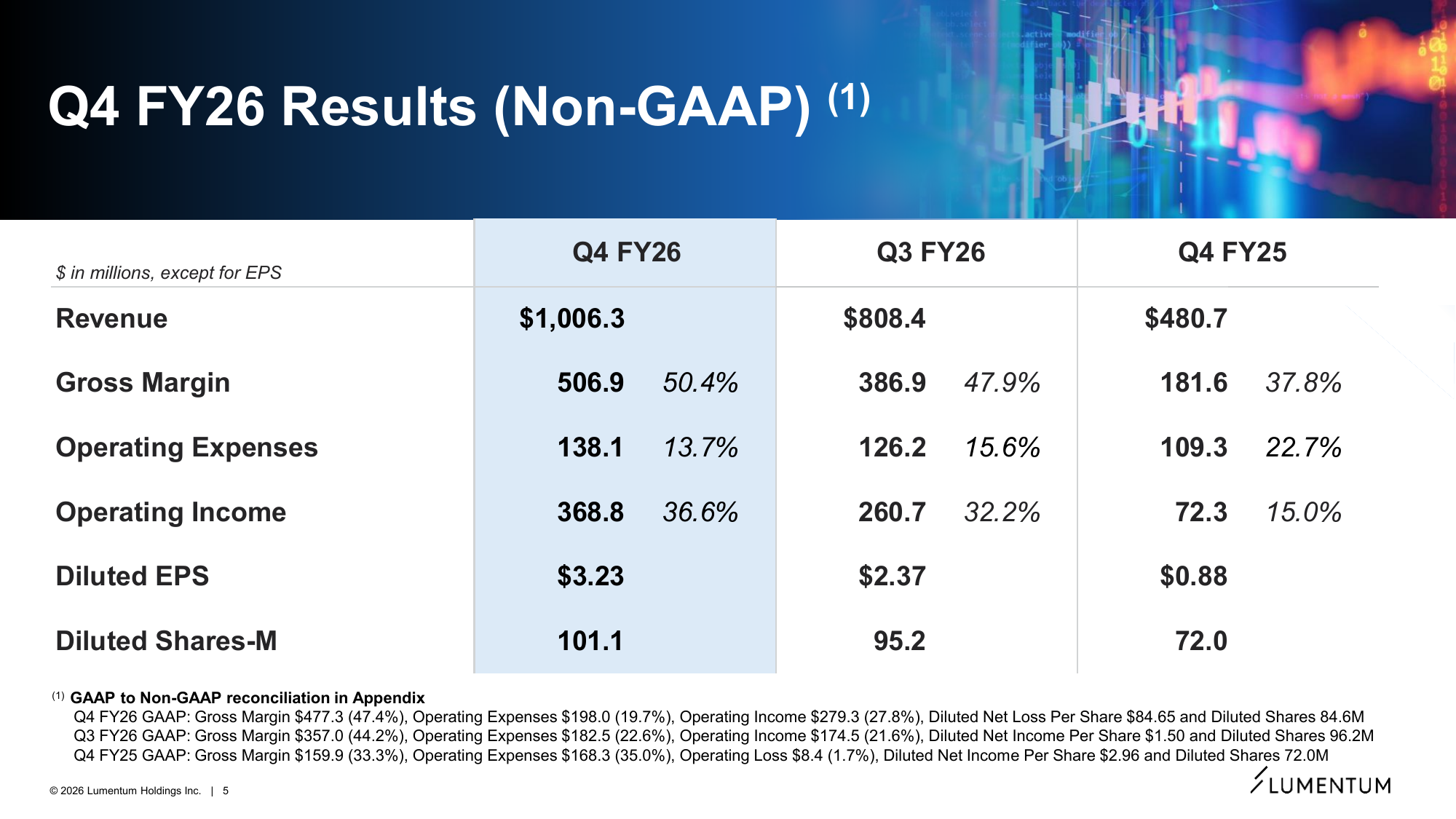
Cash is following the profit, with a lag set by inventory and capacity. FY26 operating cash flow was $751.4M against GAAP operating income of $524.8M; after $451.3M of capex, free cash flow was $300.1M, held down by a $270M rise in receivables and $228M in inventory as revenue doubled. In the June quarter alone operating cash flow was $363.0M against operating income of $279.3M. The headline GAAP net loss of $6.9B for FY26 is not an operating result: it is a one-time, non-cash $7.76B charge for converting in-the-money convertible notes to shares, which cut debt by about $1.1B. Cash and short-term investments were $2.74B at the end of June against $1.64B of debt, almost all of it the remaining convertible notes.
It is worth doing the arithmetic on management's own number. $40 of non-GAAP EPS on roughly 104M shares is about $4.2B of net income; at the 16.5% non-GAAP tax rate that is about $5.0B before tax, which at a 45–47% non-GAAP operating margin, five to seven points above the September guide, needs roughly $10.5–11B of fiscal 2028 revenue. That is three and a half times FY26, reached two years later, and it is why the target is a statement about OCS units and laser pricing as much as about demand.
So why might the price still be wrong at $1,085? Because the debate is framed as a 2027 peak. The sell-side mean target of $1,157 sits only 7% above the price, even after Citi raised its target to $1,400 from $1,200 on September 28 and Bernstein started coverage at $1,220 on September 30. A 70% shortfall that management says will not close until 2029 or 2030 implies pricing power that lasts through the year the market expects the cycle to turn, while scale-up optics, which barely exists in today's revenue, begins to ship in late 2027. The bet is on duration, not on the next quarter.
a turnaround CEO with an optics past
Michael Hurlston took over as CEO in February 2025, and the numbers since are his record rather than his pedigree: quarterly revenue rose from $402.2M in the December 2024 quarter to $1,006.3M eighteen months later, and GAAP operating margin from −12.8% to 27.8%. He came from running Synaptics and, before that, Finisar, the transceiver maker sold to II-VI (now Coherent) in 2019, so this is his second time running a company built on these lasers. CFO Wajid Ali has held the job since 2019, through the FY24 trough and this upturn, and has led the conversion of most of the convertible debt into equity.
Insiders have been sellers into the run, which is worth stating plainly: the CFO sold about $25.7M of stock on October 1 and still holds 75,074 shares, a retiring executive vice president sold about $33M in August, and there were no open-market purchases in 2026.
Risks & What Breaks It
Levels, Technicals & Options
$LITE closed at a record $1,085.42 on October 2, up 181% this year and 6.7 times its September 2025 close, after an 11.7% two-day jump on the FCC headline and the Málaga clip. It sits 23% above its 50-day average ($879) and 46% above its 200-day ($745), with the 20-day at $942; the last real test was July 29, when it closed at $602 after falling 43% from its May 11 closing high of $1,053, and it has made higher lows since. Trend is up on every average; the stretch above the 50-day is the cost of buying today.
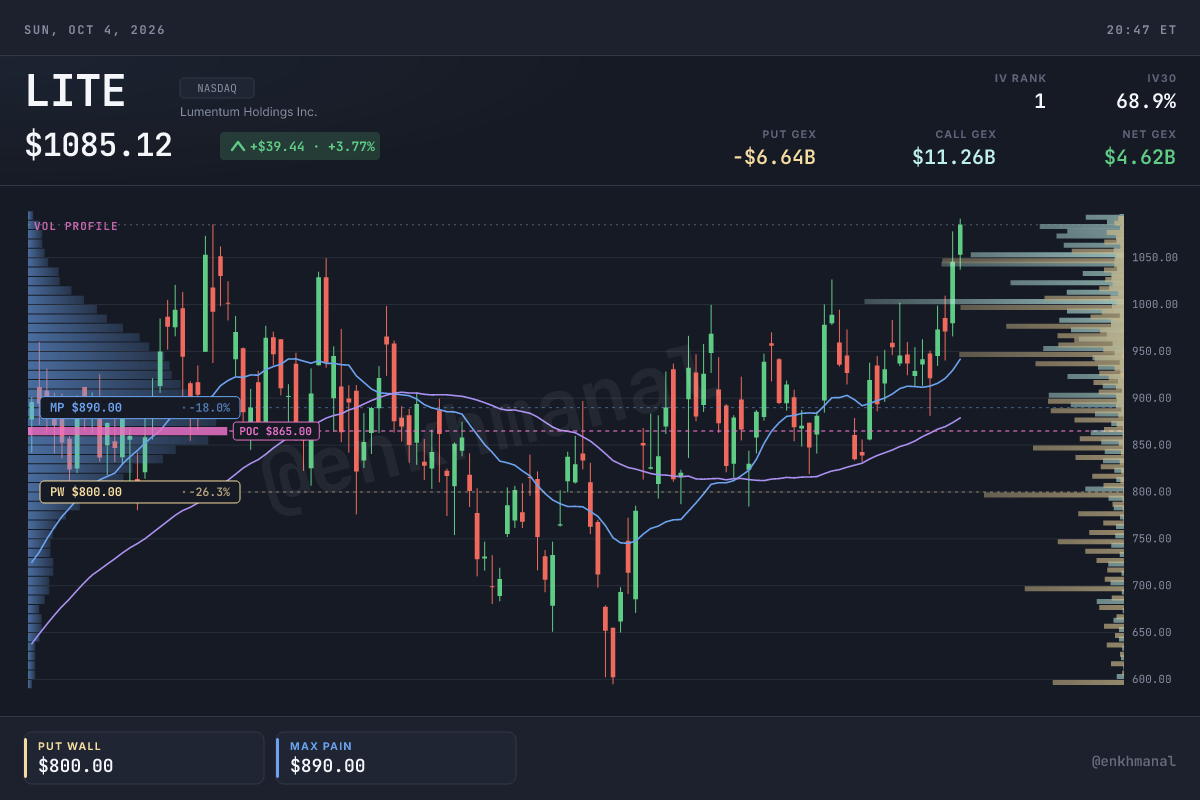
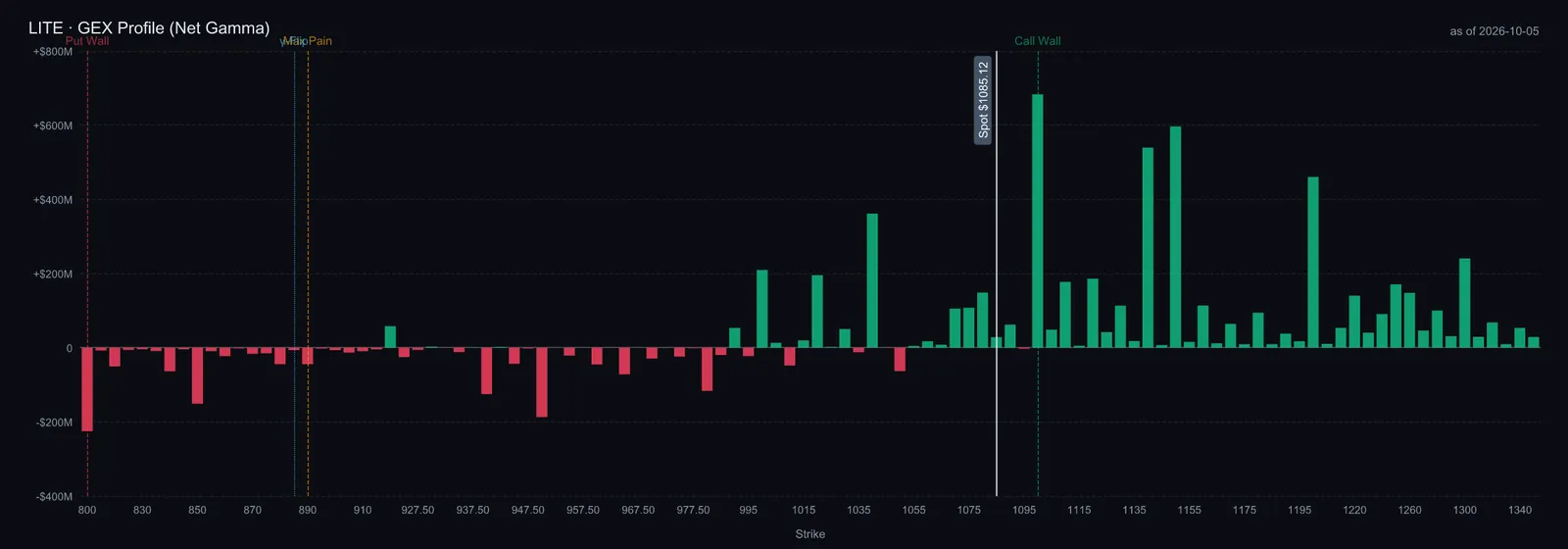
Options positioning is supportive but stretched. Dealers are net long gamma by about $9.9B, which tends to damp moves rather than feed them. The October 1 snapshot had the call wall at $1,000 and the put wall at $800, with max pain at $890; on the October 2 close, across all expiries, the call wall moved up to $1,100, right above the price. Front-month implied volatility is about 66%, rising to about 76% for the November 6 expiry that spans the early-November report, which prices an earnings move of roughly ±9%. The level where the market would be questioning the thesis is the $880–890 zone, where the 50-day average and max pain meet; below the $800 put wall the shortage story is being sold, not trimmed.
Valuation & House View
At $1,085 on about 102M diluted shares, Lumentum is worth roughly $111B, about 27 times management's fiscal 2028 EPS target and about 65 times the September quarter's guided EPS run rate. Our workbench model, built on our own estimates because the company guides one quarter at a time, takes revenue to $6.0B in FY27, $9.3B in FY28 and $17.4B by FY31 at a GAAP operating margin of 33–37%. On a perpetuity at a 10.5% cost of capital it is worth $443 a share in the base case ($97 bear, $880 bull); at a 28.3 times EV/EBITDA exit, the median of $CSCO, $FN and Nokia, it is worth $1,320 ($360 bear, $2,110 bull). The two methods are three times apart, and that gap is the finding: today's price is a bet that fiscal 2031 is still a growth year an acquirer would pay a growth multiple for. A reverse DCF on the exit method says the price assumes about 38% revenue growth a year for five years; our base case is faster than that, and its FY28 earnings, about $30 a share on the non-GAAP basis, sit below the $40 management has put on the table.
The model's audit carries no fails and four warnings we accept on purpose: there is no annual revenue guide, so every forecast year is ours; we use a five-year horizon rather than ten, because the engine's linear fade from a 55% second year compounds to a $40B-plus business we cannot defend, and landing at 8% growth in FY31 is the conservative choice; the two terminal methods disagree by more than 2 times, as stated above; and the tax driver is set to 17%, close to the 16.5% non-GAAP rate management guides, rather than the filed history of loss years.
A name worth owning for the duration of the laser shortage, bought in pieces because it is 23% above its 50-day average into a report that prices a ±9% move. We would start a position at today's $1,085, add toward $950–1,000 where the October 1 call wall and the 20-day average sit, and add again near $880; the probability-weighted value of the three cases is about $1,325, or 22% above the price. The technical invalidation is a close below the $800 put wall; the fundamental one is a September-quarter print under $1.225B or a December guide that stops growing.