
$KTOS Kratos Defense: Down 65% Into the Best News Cycle It Has Ever Had
Tickers: $KTOS
Thesis
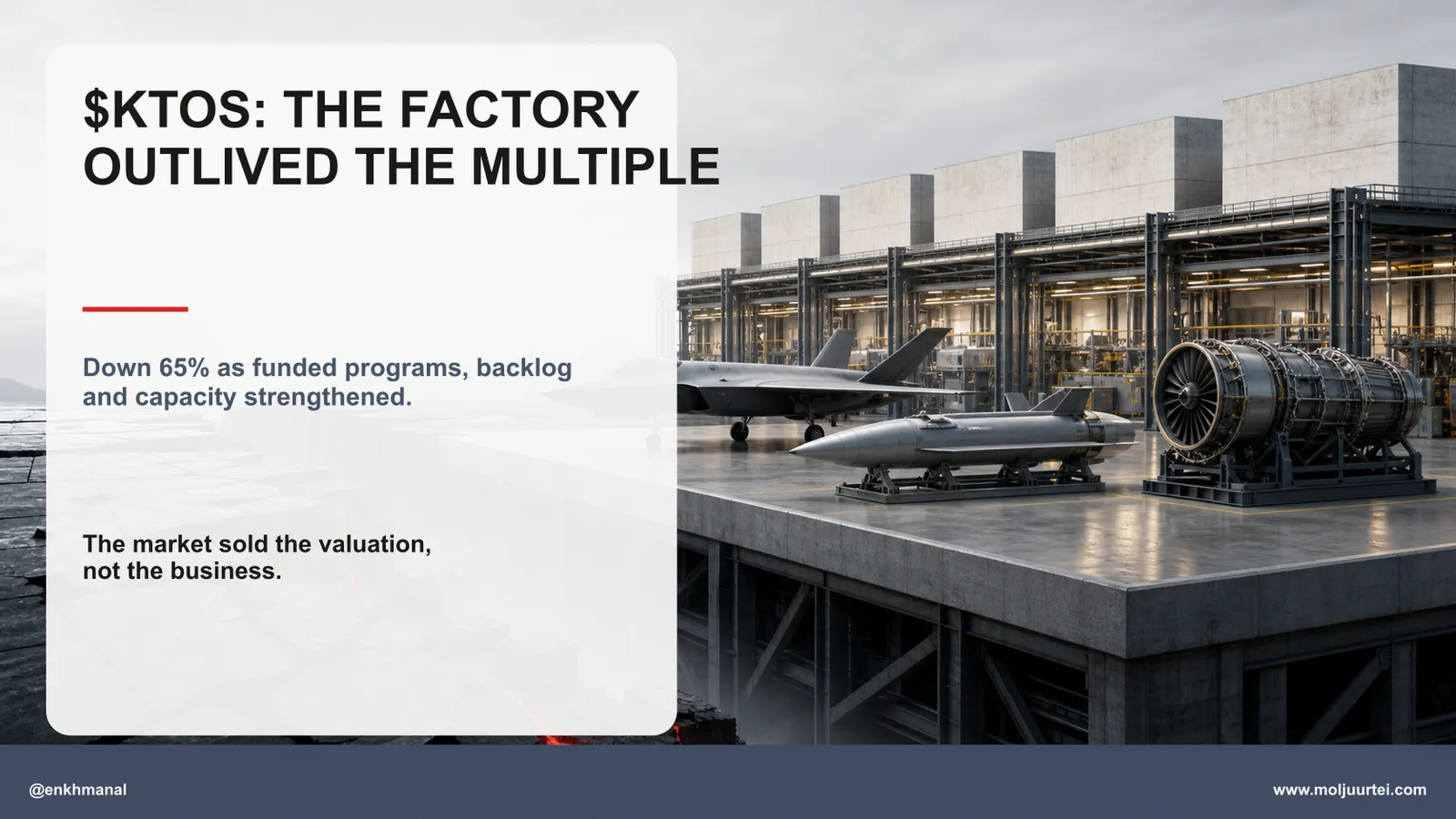
$KTOS has fallen roughly 65% from its January 2026 high of $130.72 to about $46 — while the underlying company delivered, in sequence: the largest contract in its history (MACH-TB 2.0, $1.45B), the first combat-drone "program of record" any U.S. service has ever stood up (the Marines' Valkyrie selection in January), a raised FY26 guide of $1.7–1.76B, a >$2B backlog that is ~72% funded, ~$400M of fresh hypersonic funding this month, and a factory expansion to build it all. The stock's collapse was a valuation event — the January peak priced $KTOS at over 100× forward EBITDA — not a business event. At ~$46 the market has swung from pricing perfection to pricing skepticism, and skepticism is now the cheaper side of the trade: consensus sits near $109, the business is compounding revenue at 15–19% organically with two franchises (jet drones, hypersonics) converting from development programs into funded production lines, and the balance sheet carries ~$1.46B of cash against zero long-term debt (Q1'26 10-Q, after February's $1.17B raise priced at $84 — nearly double today's price). We are bullish. The sector backdrop cooperates too: $XAR just defended its 200-day moving average for the first sustained test since the 2025 run began, which is where corrections in structural bull markets tend to end, not begin.
What Actually Happened: A De-Rating, Not a Deterioration
The chart looks like a company in trouble. The filings describe the opposite. FY25 revenue came in at $1.35B, up 18.5% — the fastest annual growth in a decade (per SEC XBRL; FY19 was 16.1%). Q1 2026 accelerated: $371M, up 22.6%, with 15.8% organic growth and the Unmanned Systems segment growing 30.9% organically. Management raised full-year guidance to $1.7–1.76B. Backlog crossed $2B, roughly 72% of it funded — meaning appropriated money, not press-release money.
What broke was the multiple. At $130 the stock traded north of 100× forward EBITDA; even after the collapse it still trades near 39× (Koyfin, NTM). The de-rating tracked the whole speculative-defense complex — drones, hypersonics, new-primes — as the market digested ceasefire headlines and rotated out of story stocks. Fair enough. But $KTOS spent that exact window becoming less of a story stock: the revenue is contracted, the customer is the Department of War, and the two flagship programs are now line items in a budget rather than slides in a deck. The market repriced the category and threw the newly-de-risked name out with it. That is the setup.
Two Franchises Went From "Promising" to "Programs" in the Same Six Months
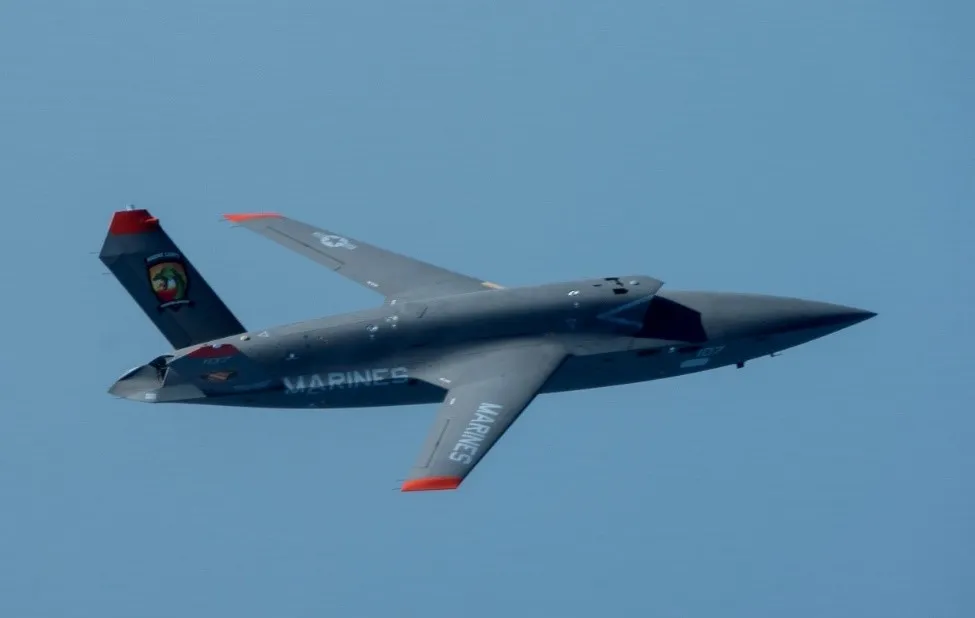
Valkyrie is now a program of record. In January the Marine Corps made the XQ-58A Valkyrie its first Collaborative Combat Aircraft program of record under MUX TACAIR — the first time any U.S. service has moved a combat drone of this class from experimentation into a formal, funded acquisition line. @Im_Specter's framing is exactly right and worth stealing: a program of record is a perennial budget line, voted on, resilient to election cycles and peace treaties. It is the one thing a ceasefire cannot take away. Northrop Grumman was brought in to develop the autonomy software and expand Valkyrie production lines — which converts the bear case ("$KTOS can't do software like Anduril") into a teaming structure where $NOC does the autonomy and Kratos builds the airframes it already knows how to build cheaply. More MQ-58 variants are reportedly in the works behind it.
Hypersonics went from testbed to revenue engine. The MACH-TB 2.0 award (January 2025, $1.45B over five years if all options exercise, team including Leidos and Rocket Lab) made Kratos the integration lead for the Pentagon's entire affordable hypersonic flight-test enterprise. Then on July 14 the company announced ~$400M in incremental funding for hypersonic and related programs — Erinyes and Dark Fury flyers, Zeus and Oriole solid rocket motors. Kratos is the only vendor delivering both the propulsion and the flyer. Hypersonic revenue is expected to roughly double in 2026 to ~$400M — against a company that did $1.35B total last year.
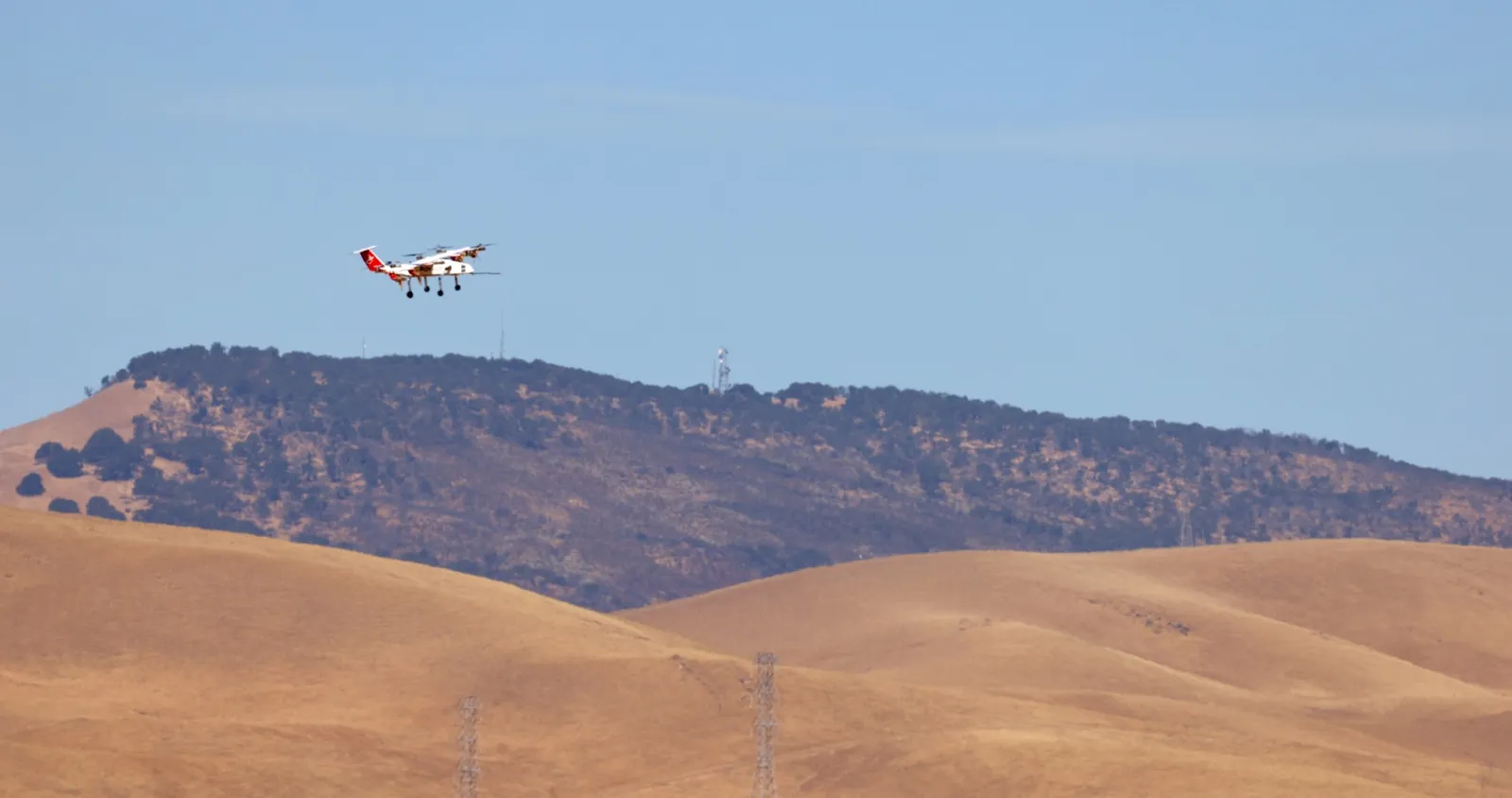
And July kept adding: a ~$36M sole-source air-defense missile award on July 2, the Oklahoma City campus expansion (+106,000 sq ft) on July 6, Ark Invest buying ~$9.1M of stock through the month — and on July 20, Kratos announced it will manufacture Elroy Air's Chaparral autonomous cargo aircraft as the exclusive U.S. manufacturer, expanding the Sacramento facility past 500 employees with the first production aircraft planned for late 2026. The Chaparral is a hybrid-electric VTOL freighter (500+ lb payload, up to 450-mile range, no airport required), and Elroy has disclosed a demand pipeline exceeding 1,400 aircraft — more than $5B in potential revenue across customers like FedEx and Bristow — ahead of its own planned public listing. For Kratos the deal is close to pure gravy: it monetizes exactly the thing this thesis leans on, the factories, and points them at a commercial-logistics market that no ceasefire or continuing resolution can touch. This is not what dying momentum names announce on the way down.
The Business Model: One Factory Base, Sold Three Ways
Step back from the individual programs and the model comes into focus. $KTOS operates on three levels of the drone/aircraft stack at once, and the Q1 call made clear this is deliberate strategy, not opportunism.
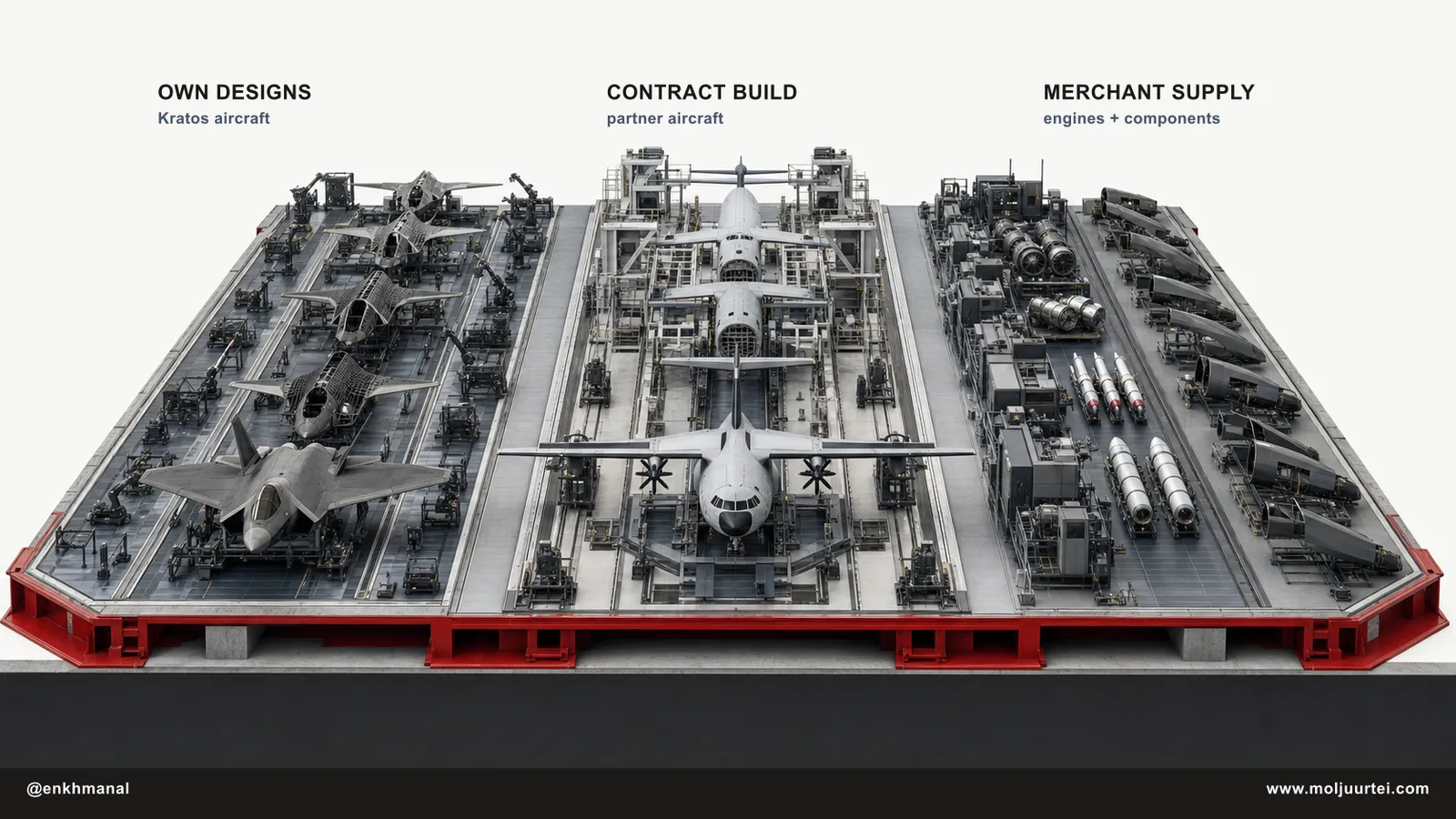
Level 1 — its own designs, built in-house. Valkyrie, Firejet/Mighty Hornet, Mako, and the ballistic-missile target drones are Kratos designs built in Kratos plants (Oklahoma City for the Valkyrie/Firejet airframes, Sacramento for Mako, Florida for avionics). On the Tactical Firejet the company is now fully vertically integrated — Kratos airframe, Kratos engine — and DeMarco's claim on the call was that Kratos is the only company in the world building both the plane and its engine under one organization.
Level 2 — contract manufacturer for other companies' aircraft. The Elroy Chaparral deal is the cleanest example: Elroy designed it, Kratos builds every U.S. unit. The Valkyrie/$NOC arrangement is the mirror image — Kratos' airframe, Northrop's autonomy software and program lead for the Marines. Either direction, Kratos gets paid for the thing it is genuinely scarce at: rapid, affordable, at-scale production of military-grade aircraft.
Level 3 — merchant supplier of components, mainly engines, to everyone else. Rather than compete head-on for every drone and missile program ("there are 10 guys bidding"), Kratos chose to be the engine inside everyone's products: $BA's GBU-75 powered bomb, the $GE-partnered engines for the next class of CCAs, the SLCM-N cruise-missile engine, the Air Force's ~30,000-missile affordable-mass family. DeMarco's phrasing: "it's better to have part of something than all or nothing."
The logic tying the three together: the Pentagon — and now commercial players — has a massive shortage of qualified manufacturers, not a shortage of designs. Kratos spent years building factories ahead of demand (which is exactly why the free cash flow looks ugly) and now sells that capacity in whatever form the customer wants — finished Kratos aircraft, someone else's aircraft built to print, or the propulsion inside a competitor's missile. That structurally de-risks the bull case: Kratos no longer has to win every design competition to grow, because it increasingly gets paid even when someone else's design wins. Picks and shovels, with wings — which is precisely the quality the current multiple compression is failing to price.
What the Q1 Call Actually Said (While the Stock Was Busy Falling)
We've now read the full May 6 call transcript (saved to the earnings library), and it strengthens the thesis on almost every axis. The quarter wasn't just a beat — revenue of $371M cleared the company's own $335–345M guide and adjusted EBITDA of $38.7M cleared the $25–30M guide by ~35% at the midpoint. Consolidated book-to-bill was 1.6:1, the satellite business booked at 3:1, and the opportunity pipeline sits at $14B after those bookings.
The hypersonic numbers the source thread attributed loosely are on the record verbatim: CFO Deanna Lund — "the expectation for 2026 is $400 million. For next year, the expectation is for $700 million." DeMarco then itemized the funding: $400M for MACH-TB inside the reconciliation bill (now being fully obligated this fiscal year) plus $300M+ covered in the FY27 budget request. On top of that, Kratos disclosed a separate $1B+ sole-source hypersonic program expansion verbally awarded and not yet announced, with two of three "very large" hypersonic initiatives verbally won. 120 solid rocket motors are under order and start arriving in Q3 with a launch manifest booked through 2028.
The call also revealed a third franchise the market barely models: small jet engines. Today it is a ~$10M-a-year business; the plan on record is ~3,000 engines in 2027, ramping toward 5,000–6,000 in 2028 at $40–60K each — call it a $120–360M revenue line materializing in under two years, tied to named programs: the SLCM-N cruise-missile engine win, a GE teaming on next-class CCA engines, the GBU-75 (a 25,000-unit program of record, expected to grow), and the Air Force's ~30,000-missile affordable-mass family. Add the $447M Space Force Resilient Missile Warning & Tracking prime ("think Golden Dome," per DeMarco), a new multi-hundred-million-dollar directed-energy prime win, and ~10% of revenue now in Israel tied to Iron Dome/Arrow/David's Sling restock, and the "one-trick drone company" framing has quietly become a five-engine compounder.
Crucially for the August print: management explained the soft Q2 guide. It is deliberate conservatism about government contracting-office throughput — roughly $120B of appropriated money is stuck in the obligation queue — not about demand, and shutdown-delayed awards were already "freeing up" into Q2 bookings on the day of the call. Underwriting a slowdown off that guide is mistaking a paperwork bottleneck for a demand signal.
The Margin Lever: Fixed Costs Meet a Production Ramp
The legitimate knock on $KTOS is profitability. FY25 operating margin was 1.9%, gross margin 22.9% — against LTM EBIT margins of roughly 9% at $LMT, 13–14% at $NOC and $LHX (Koyfin). Free cash flow ran about −$133M over the last twelve months, and the share count (187.3M) has crept up because equity has funded the factories.
Here is why we read that as the coiled spring rather than the flaw. Kratos has spent years building capacity ahead of orders — its stated moat is exactly that it builds before the contract arrives, on its own dime, while the big primes wait for customer financing. That strategy front-loads every cost: factories, tooling, working capital, dilution. It looks terrible in the FCF line right up until the orders land. The orders have now landed. Current jet-drone capacity is ~165 aircraft/year across the family; the target is ~40 Valkyries annually by the end of 2027, up from a single-digit rate. Fixed-cost absorption on that ramp is the entire margin story: the same buildings, the same engineering overhead, spread over 5× the flagship units. Management raising guidance while expanding OKC says they see the volume coming. And management has now put numbers on the slope: +100bps of EBITDA margin per year — 2026 over 2025, 2027 over 2026, and (their words) "you can probably pencil in" 2028 — with upside beyond that as catalog-priced microwave electronics and OpenSpace software grow in the mix, neither of which is subject to government cost-based pricing. And the war chest is already raised: $1.46B of cash against zero long-term debt as of the Q1'26 10-Q, after the February 2026 offering — $1.17B net, priced at $84.00 per share, nearly double today's price. The dilution the source thread complains about (168.9M → 187.4M shares, ~11%) already happened, at prices dramatically better than today's buyer is paying, and it pre-funds the Orbit/Nomad deals, the factories, and the working-capital ramp without existential financing risk. Selling stock at $84 to build factories the customer is begging for is a cost of the strategy, not a symptom of distress.
We'd also note the incentive critique from the source thread — executive compensation indexed to Adjusted EBITDA rather than FCF or dilution — as a fair governance watch-item. It is the right thing to be annoyed about and the wrong reason to skip the stock at this price.
The Setup
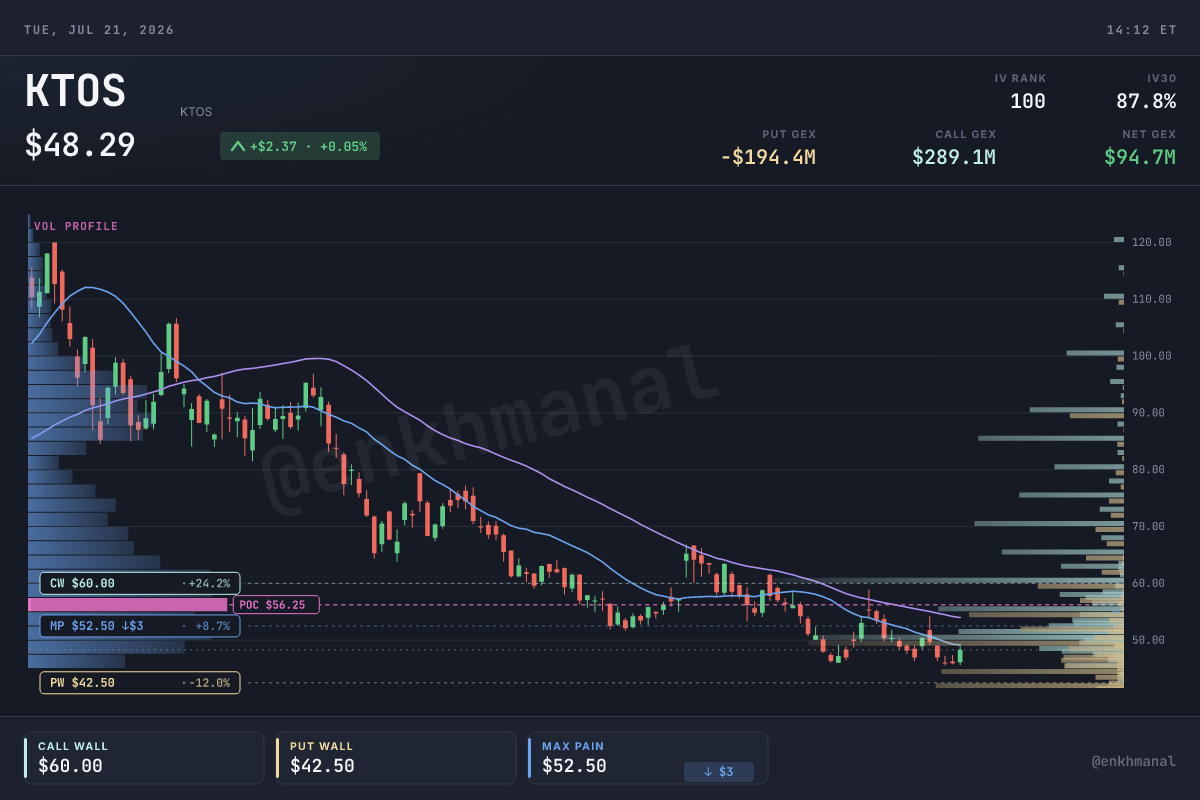
The technical picture is washed out but basing. $KTOS sits at $45.94 with RSI(14) at 38 — depressed, not yet capitulatory — below all major moving averages (50d $54.17, 100d $65.31, 200d $77.42), down 42% YTD. The dealer-positioning map is unusually clean for a name this beaten up:
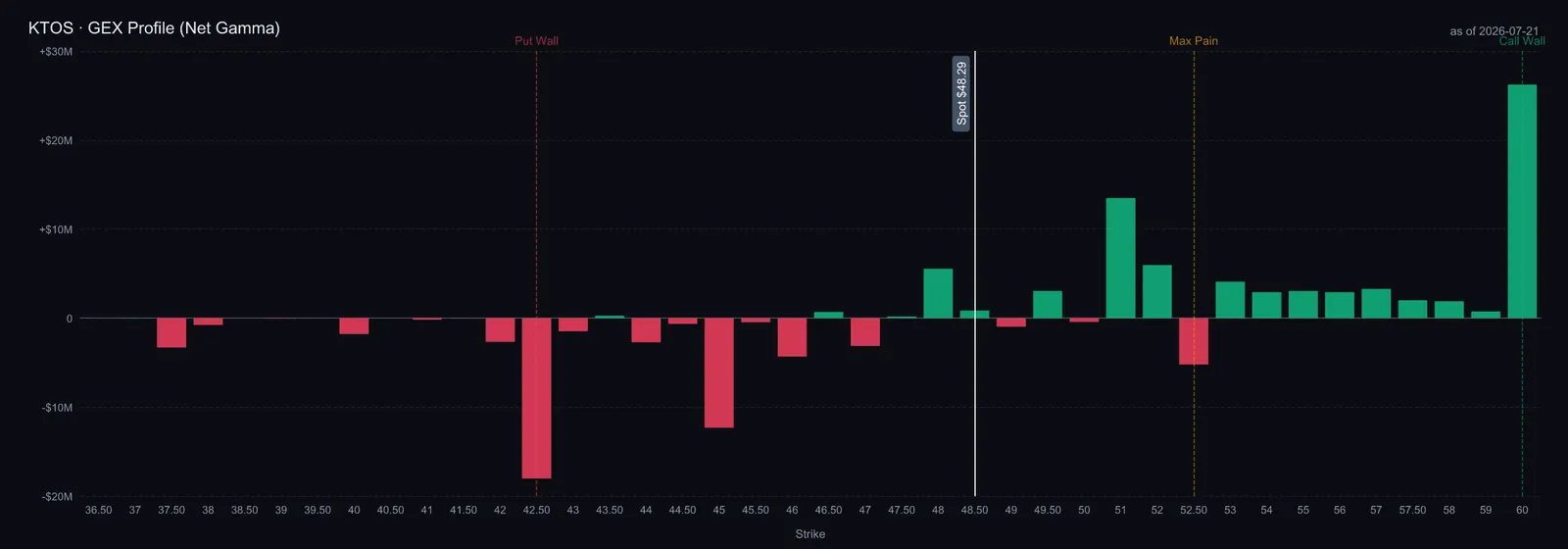
Net gamma is mildly positive (+$0.02B), the put wall sits at 42.5 — about 7% below spot, defining the level where dealer hedging turns supportive — the call wall at 60, and max pain at 55, comfortably above spot. Put/call open interest at 0.49 shows positioning is not crowded into downside. Translation: options flow sketches a $42.5–60 range with the pain trade higher.
The sector confirms the floor-building read. $XAR closed +2.3% at $265 and bounced almost exactly off its 200-day ($261) — its first real test of that average since the defense re-rating began, on a chart that remains a staircase of higher lows. Defense corrections that end at the 200-day with European rearmament, CCA funding ($4.5B for collaborative autonomy in the pipeline), and hypersonic budgets all intact tend to resolve upward. $KTOS is the highest-beta expression of that resolution.
The Drone Peer Set: Paying Less for More
Put $KTOS next to the other public U.S. drone names and the mispricing gets easier to see. Figures are approximate (market data as of mid-July 2026; EV net of cash where disclosed):
| Name | Mkt cap | EV / 2026E revenue | 2026E revenue | Growth profile | Profitability | Balance sheet |
|---|---|---|---|---|---|---|
| $KTOS | ~$8.6B | ~4.1× | $1.70–1.76B (guide) | 15–19% organic | Adj EBITDA ~9%, +100bps/yr roadmap | $1.46B cash, zero LT debt |
| $AVAV | ~$7.0B | ~3.7× | ~$2.0B (FY26 actual) | ~10% (FY27 guide) | GAAP loss (−$265M, BlueHalo impairment) | Post-merger, integrating |
| $ONDS | ~$5.3B | ~8.0× | ~$526M (raised guide) | Hypergrowth via 6 acquisitions in 2026 | Unprofitable | ~$1.0B cash (raised) |
| $RCAT | ~$1.4B | ~8× | $150–180M ("goal", not formal guide) | Hypergrowth off tiny base (Q1 +849%) | Unprofitable | Modest |
| $UMAC | ~$0.75B | ~16× | ~$32M run-rate | ~4× y/y off tiny base | ~Breakeven | ~$223M cash (raised) |
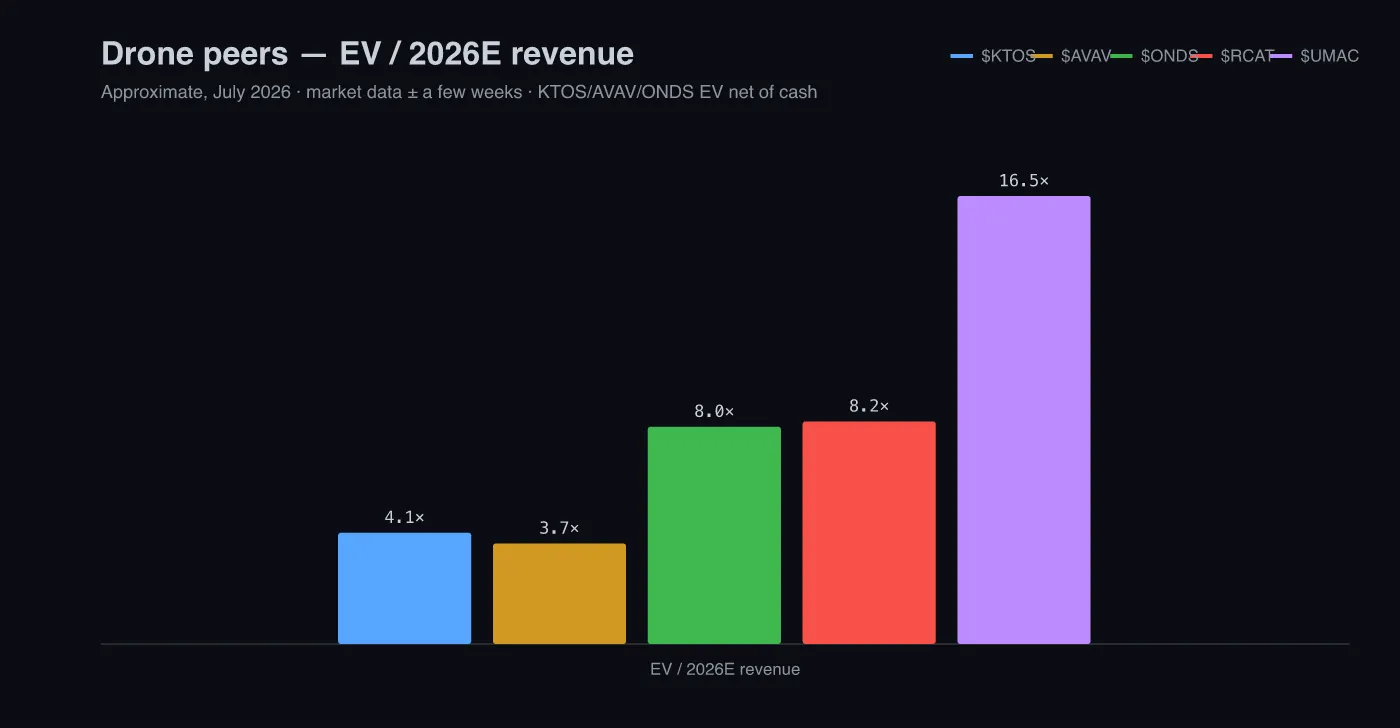
Three observations. First, $KTOS is the second-cheapest name in the group per dollar of revenue — and the cheapest per dollar of proven revenue. The only comparable multiple is $AVAV, which is digesting a $4.1B all-stock merger that just produced a $265M GAAP loss with goodwill impairment, and guides to ~10% growth versus Kratos' 15–19% organic. The small-cap pure plays ($ONDS, $RCAT, $UMAC) trade at two to four times Kratos' multiple on revenue bases that are 3–50× smaller, largely unprofitable, and in $RCAT's case not yet formal guidance. The market is paying up for drone stories while discounting the drone factory that actually ships at scale — ~165 jet drones a year, $2B backlog, positive adjusted EBITDA.
Second, the private market prices the same theme far more generously. Anduril at $61B, Shield AI at ~$5.3B, and Elroy heading to Nasdaq at ~$1B pre-revenue-scale all imply multiples that make Kratos' 4× look like a typo — and Kratos is the company two of those three (Elroy directly, and the CCA ecosystem broadly) depend on for actual production. A crude sum-of-the-parts makes the point: hypersonics alone at $700M of 2027 revenue on an $ONDS-style 8× would be worth ~$5.6B — nearly 80% of Kratos' whole enterprise value — before counting a single drone, engine, satellite ground station, or the microwave business.
Third, everyone in the sector raised money — but nobody raised it better. $UMAC pulled in ~$150M, $ONDS built a ~$1B war chest, and Kratos raised $1.17B net at $84.00 a share in February — roughly twice today's price — leaving $1.46B of cash against zero long-term debt. In a capital-intensive land-grab, the company with the most cash, raised at the least dilutive price, with the only established production base, is trading at the group's discount multiple. That is the peer table's one-line summary.
Risks & What Breaks It
- Valuation is still not cheap. ~39× NTM EBITDA means the margin ramp is partially pre-paid. If the 40-Valkyrie-per-year target slips to 2028–29, the stock can fall further even as revenue grows. This is the biggest risk.
- FCF stays negative longer than expected. Every incremental factory dollar extends the burn. Watch the FY26 FCF guide and whether capex peaks this year; another equity raise below $50 would sting.
- Anduril and the autonomy stack. A $61B-valued private competitor with effectively unlimited venture capital could compress drone pricing or out-lobby for future CCA increments. The Northrop teaming mitigates the software gap but shares the economics.
- Program concentration. MACH-TB 2.0 is a ceiling value on an OTA, not guaranteed revenue; hypersonic test cadence depends on government scheduling. A test failure or continuing-resolution budget mess delays everything.
- Margin math disappoints. If Valkyrie units price like development articles rather than production articles, absorption alone won't bridge 1.9% → high single digits.
What would flip us bearish: guidance cut on drone deliveries, a second consecutive year of widening FCF burn without a capex-peak explanation, or loss of a follow-on CCA increment to a competitor.
Valuation & House View
Consensus (21 analysts, S&P Global) averages ~$109 with a median near $112.50 — more than 2× spot — and skews Buy/Hold 15/4 with zero sells. We don't need the street's full number to like the risk/reward. A simple frame: FY26 guide midpoint ~$1.73B growing 15–19% organically puts 2028 revenue near $2.3B; if the production ramp carries EBITDA margins even to the low-teens (still half the primes), that's ~$280–300M of EBITDA, and today's ~$7.2B enterprise value (mkt cap $8.6B less ~$1.46B of net cash — raised at $84 a share in February, roughly twice today's price, with zero long-term debt against it) is paying ~24× — for a company that would still be early in the CCA and hypersonic S-curves. The bear needs the ramp to fail; the bull just needs it to happen on roughly the advertised schedule, and July's funding-and-factories news flow says it is.
House view: bullish, accumulation zone $42–47. The gamma put wall at 42.5 and the $XAR 200-day give the level; the January program-of-record decision gives the reason; the near-dated catalyst is the Q2 print, expected early-to-mid August (aggregators show Aug 6–12, after close — the company has not yet confirmed the date) with the street at ~$412M revenue / ~$0.13 EPS. The setup within the setup: the company guided Q2 to $400–410M and said on the call the guide is deliberately conservative — the binding constraint is contracting-office paperwork, not demand — with shutdown-delayed awards already freeing into Q2 bookings. That is a beat mechanism hiding in plain sight, and Q3/Q4 are guided as the profit-heavy quarters (OpenSpace software deliveries, motor shipments). After Q1’s beat-and-raise, a third consecutive raised guide — now with July’s $400M hypersonic funding and the OKC expansion feeding the numbers — against a washed-out multiple, RSI 38, and mildly positive gamma is exactly the kind of print that starts the repair; hypersonic revenue recognition through H2 does the rest. The market sold the multiple. It forgot to check what it was getting to keep at the new price: a net-cash, 20%-growth defense platform that just became un-cancellable.
Thread credit: the framing of the fundamentals-vs-price divergence is via @Im_Specter's 7/19 $KTOS thread (h/t) — a sharp, more cautious read (his verdict: interesting under $40) that we push one notch further on the strength of July's funding news and the sector's 200-day defense.