
$KRKNF Deep Dive — The Arms Dealer of the Underwater War
Update · 8 October 2026. The standalone Q2 report anticipated below was released on 27 August, one week later than the original calendar stated. Kraken reported C$27.3 million of revenue (+4% year over year) and C$5.0 million of adjusted EBITDA (+7%); a C$1.5 million contract-scope reversal weighed on revenue. Announced 2026 product orders for Kraken and Covelya together reached about C$355 million, and Kraken signed a long-term supply agreement for batteries used in extra-large underwater vehicles. Management kept 2026 guidance at C$290–320 million of revenue and C$65–75 million of adjusted EBITDA, including only a half-year of Covelya. Q2 excluded Covelya, whose acquisition closed on 2 July, so the first combined Q3 results remain the key test of integration, margins and cash conversion. The C$5.94 share price, multiples and trading plan below are the original July 2026 snapshot, not a refreshed recommendation.
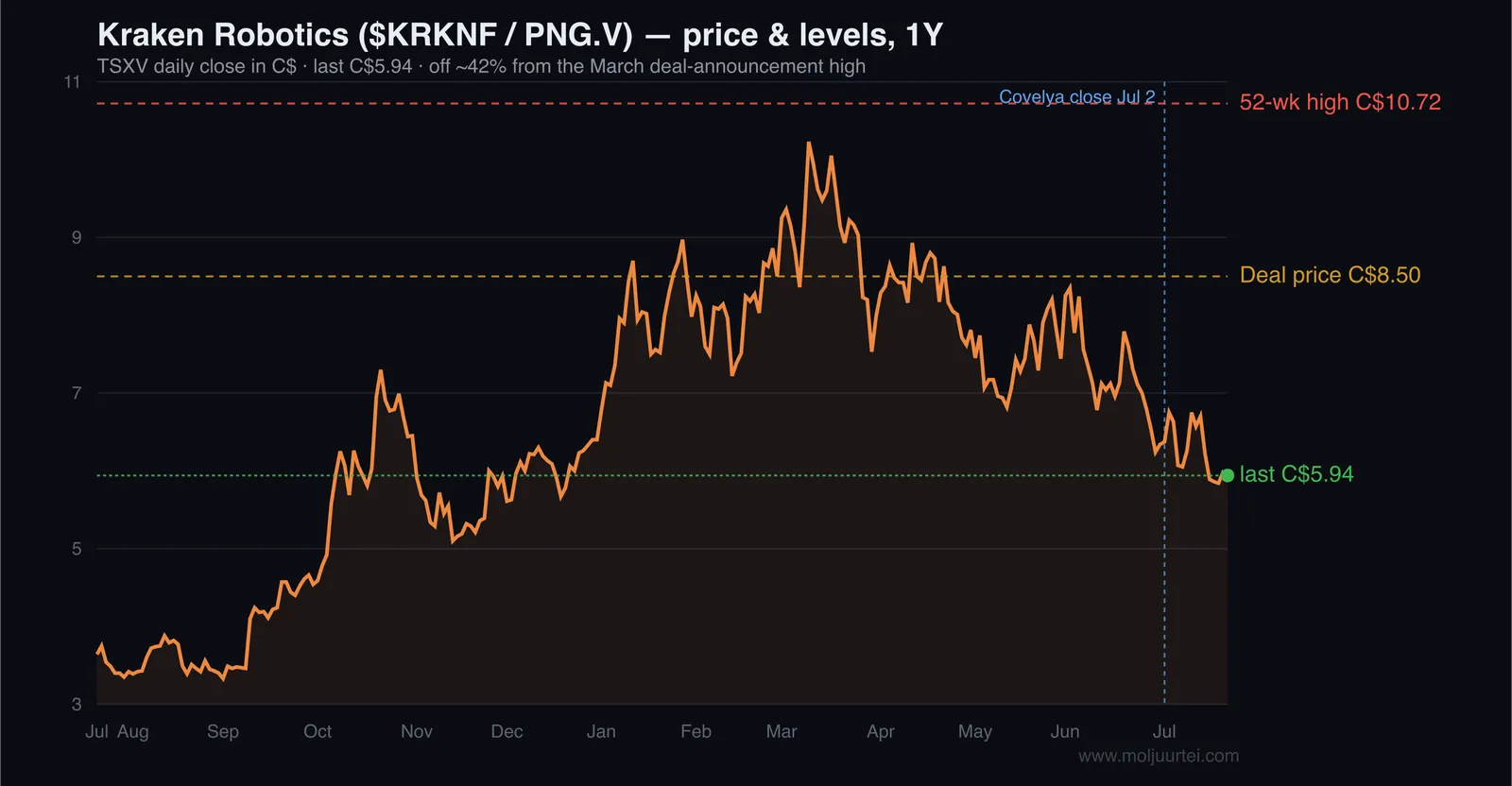
Underwater autonomy is having its aerial-drone moment, and $KRKNF (Kraken Robotics — Canada-listed as $PNG, U.S. OTC as $KRKNF) just spent C$615M to become the company that sells the sensing, positioning, comms, software and power that every underwater platform needs — regardless of which drone wins. At C$5.94 the stock has round-tripped back to December levels, ~42% below its March high, and trades at ~25× a full-year run-rate EBITDA that the market can't see yet because guidance holds only six months of the acquisition. The bet isn't that Kraken builds the best submarine; it's that it owns the arsenal everyone else has to buy from.
Thesis
$KRKNF is a picks-and-shovels supplier to a defense category that's inflecting from science project to line item — and the July acquisition of Covelya Group turned it from a two-product niche name into the closest thing to a vertically integrated subsea-intelligence platform on any public market. The mispricing: at ~C$2.2B market cap the headline optics look expensive (~32× the 2026 guided EBITDA), but that number bolts only half a year of Covelya onto Kraken — the combined business already runs at ~C$351-379M revenue and ~C$85-93M EBITDA on a full-year basis, so the run-rate multiple is ~25× and falling toward the high-teens as growth and synergies land.
- Consensus sees a rich Canadian microcap that just did a transformational deal; the reality is a ~C$365M-revenue, ~24%-margin subsea prime hiding inside a six-months-of-Covelya guide.
- The catalyst is a calendar, not a headline: Q2 prints Aug 27 (standalone), the first consolidated quarter lands late November, and 2027 is the year cross-sell and synergies get proven.
- The one risk that matters: a single customer was ~45% of 2025 sales, and the whole thesis rests on execution the market is already paying up for.
The Tailwind — Seabed Warfare's New Backdrop
For a century the ocean floor was infrastructure nobody worried about. Then unnamed hands started cutting Baltic cables and cracking Nord Stream, and every allied navy discovered at once that the pipes, fibres and power lines running under the water are both strategically vital and almost undefended. The response is a spending category that barely existed five years ago: autonomous underwater vehicles (AUVs) for mine-hunting and surveillance, uncrewed surface vessels, diver-detection sonar around ports, and distributed seabed sensor fields to watch the cables. It is the underwater analogue of the aerial-drone build-out — same logic of cheap, attritable, autonomous mass — but earlier in its adoption curve and, crucially, with far fewer qualified suppliers.
That last point is the whole game. Air-drone components have a thousand vendors; the number of firms that can make a synthetic-aperture sonar work at depth, or a battery survive 600 bar of pressure, or an acoustic positioning system a navy will actually certify, is small and shrinking. Kraken sits in that thin supplier layer. It doesn't try to build a complete drone and pick a fight with Anduril or the primes — it sells the parts they and their competitors all need, which is a structurally better place to stand when you don't yet know which platform wins.
Sizing it precisely is a fool's errand — most of the demand is inside classified defense budgets — so treat the "how big" question as directional, not modelled: naval mine-countermeasure programs, harbour security, and subsea-cable surveillance are each multi-year procurement cycles now being funded across allied navies, Australia, and Asia-Pacific simultaneously. The point for the memo isn't a TAM number; it's that the demand is structural and early, and the qualified-supplier set is tiny.
Why the Choke Point Is the Whole Stack
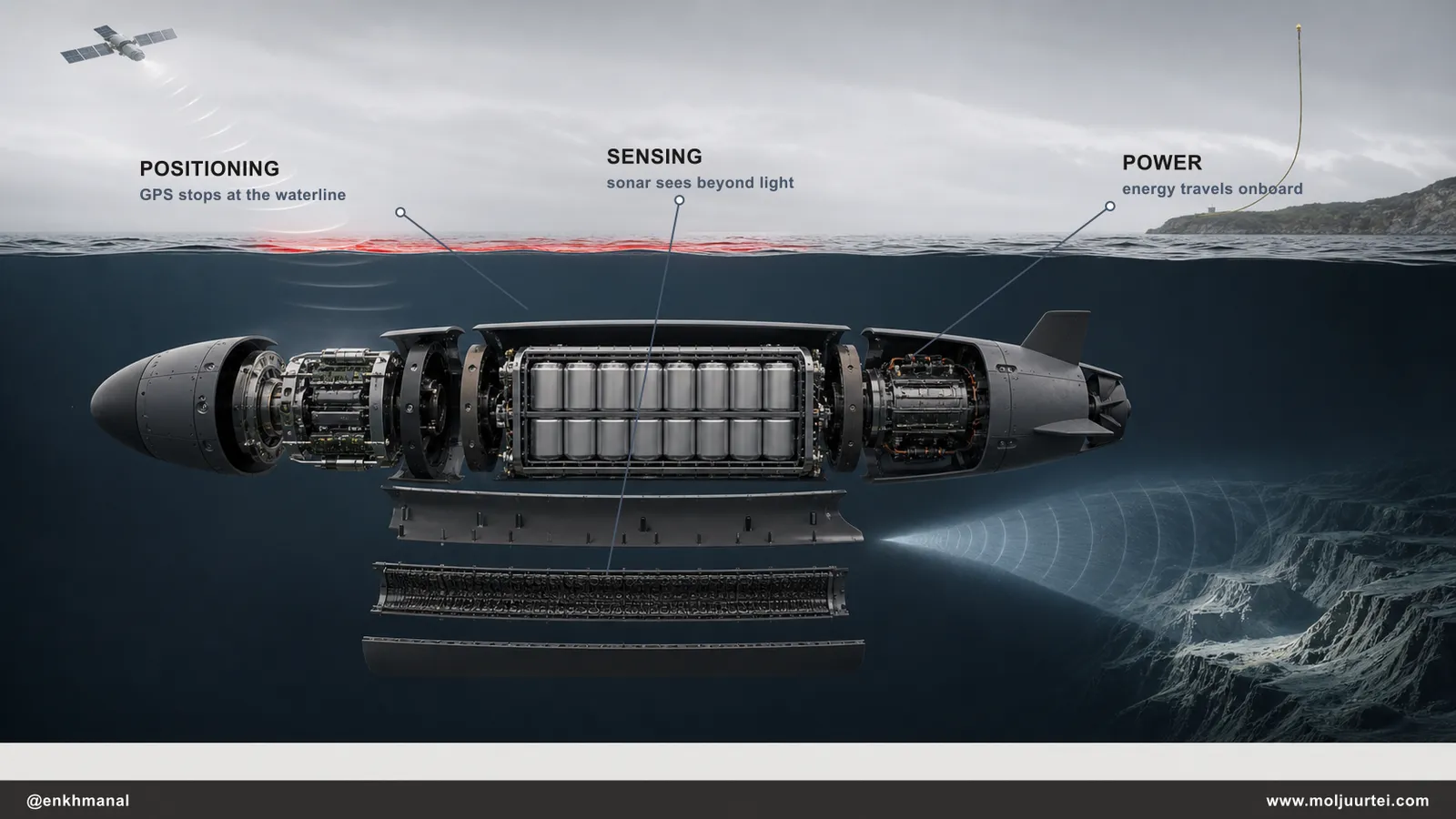
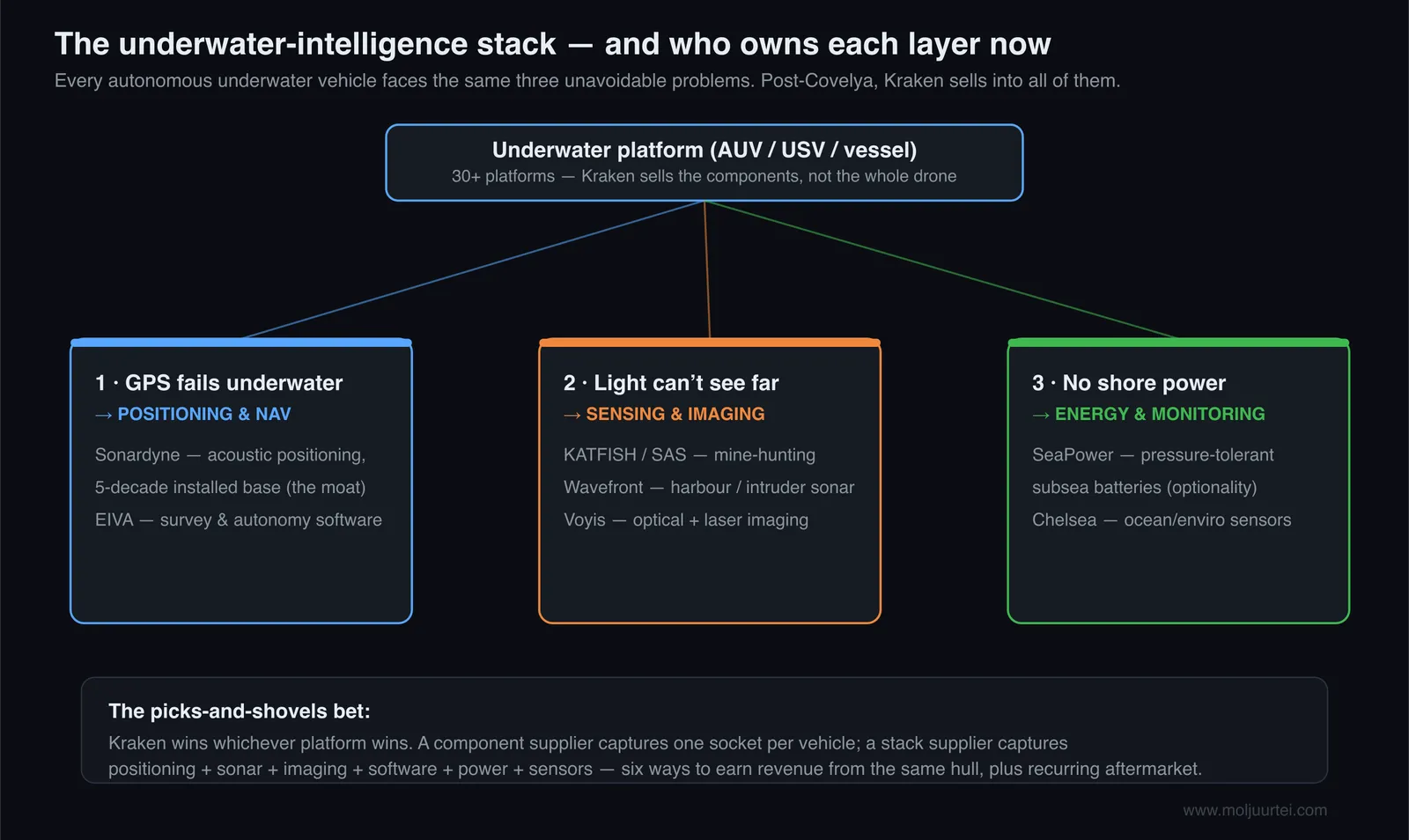
Every autonomous underwater system, from a man-portable AUV to an extra-large uncrewed submarine, runs into the same three problems that no amount of software can design away. GPS does not work underwater — so the vehicle needs acoustic and inertial positioning to know where it is. Light doesn't travel far underwater — so seeing the seabed at range means sonar, not cameras. There's no shore power at 300 metres — so the vehicle carries its own energy. Three unavoidable nodes: positioning, sensing, power. Before Covelya, Kraken owned two of them (sensing, via its KATFISH/AquaPix synthetic-aperture sonar; power, via SeaPower batteries). After Covelya, it owns all three — plus the software and monitoring layers that tie them together.
The node with the best economics is the one Kraken didn't have before — acoustic positioning, now owned via Sonardyne, a 55-year-old British institution whose systems sit under a five-decade installed base of vehicles and survey ships. Positioning is a small slice of a program's total cost, it's mission-critical (get it wrong and the drone is lost), qualification cycles run years, and the workflows and standards are built around the incumbent's kit. That combination — critical function, low cost share, high switching cost — is the textbook recipe for pricing power. One honest caveat, because it's tempting to overstate: the public numbers do not prove Sonardyne priced better than legacy Kraken. Both businesses ran ~24% EBITDA margins in 2025, and Kraken's own margin had climbed three years running. What Sonardyne adds is a wider, stickier installed base and 700+ diversified customers — the preconditions for durable pricing, which the combined gross margin will either confirm or deny once the businesses are consolidated. The moat is a hypothesis with unusually good priors, not yet a proven fact.
The Setup — Why $KRKNF Owns It
The reason to own the stock is that Kraken bought its way into the best parts of that stack at a fraction of its own multiple. Covelya — six companies (Sonardyne, EIVA's survey-and-autonomy software, Voyis optical/laser imaging, Wavefront harbour sonar, Chelsea environmental sensors, Forcys defense integration), ~750 employees, 12 facilities, 700+ customers — did an estimated C$249-275M of 2025 revenue and C$60-67M of EBITDA, growing ~24% a year. Kraken paid ~9.2× EBITDA for it. Kraken's own stock trades at ~25× run-rate. Buying an asset at a third of your multiple is only value-accretive if the asset holds up under new ownership — but the arithmetic starting point is unusually favourable, and it roughly doubles the company overnight.
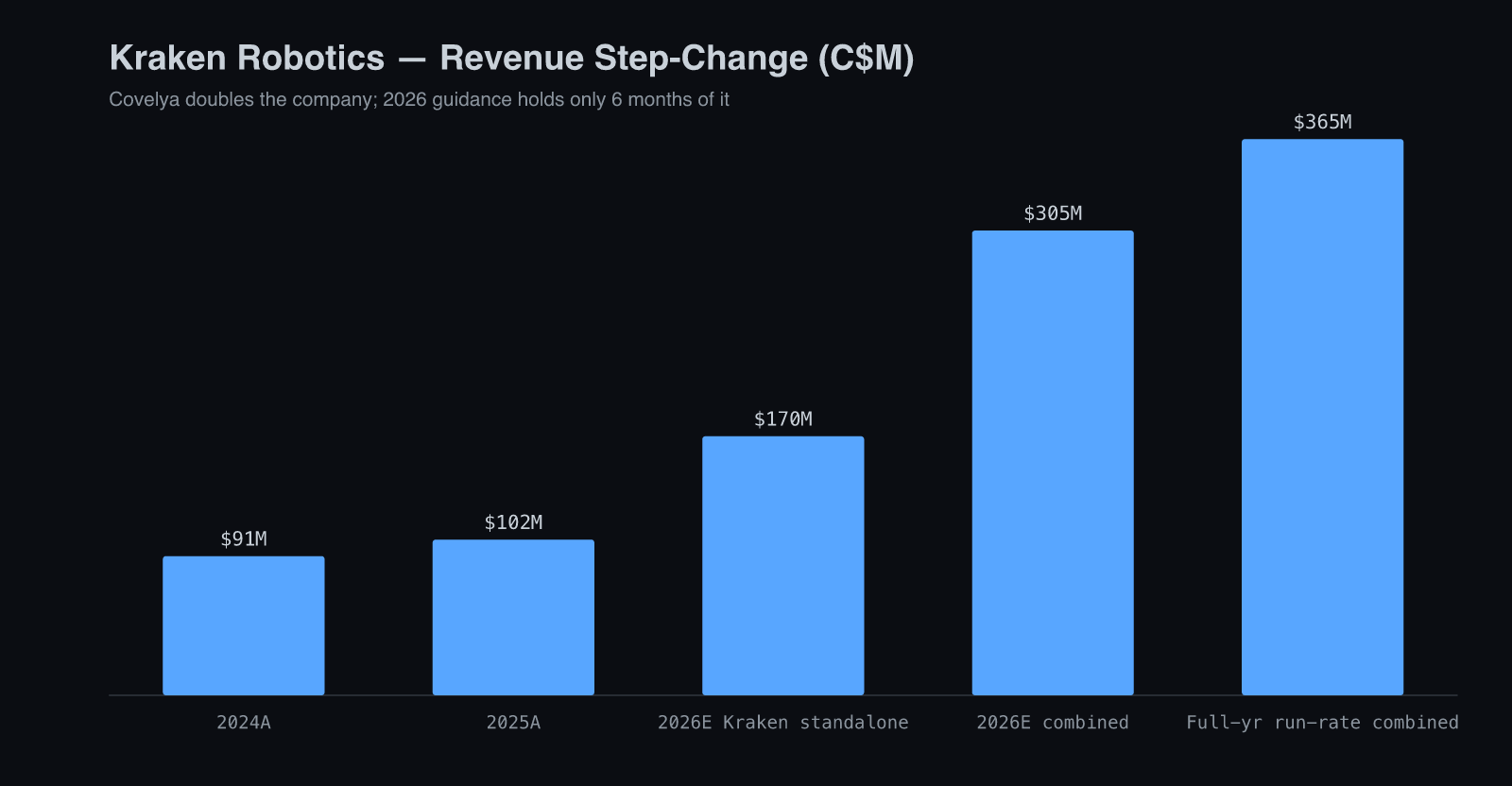
The pre-deal business wasn't a laggard being rescued, either — it was compounding. Legacy Kraken grew 2025 revenue to C$102.2M with adjusted EBITDA of C$25.0M (a 24.4% margin, up from 22.7%), and its standalone 2026 guide of C$165-175M revenue and C$40-50M EBITDA implies ~66% organic revenue growth and ~80% EBITDA growth. Management is spending ahead of that ramp: capex jumped six-fold to C$30M in 2025 to stand up a new SeaPower battery plant in Nova Scotia and expand SAS capacity, and headcount grew from 297 to 456 in a year. That's a company that believes its own order book — and it's where things can go wrong if conversion slips.
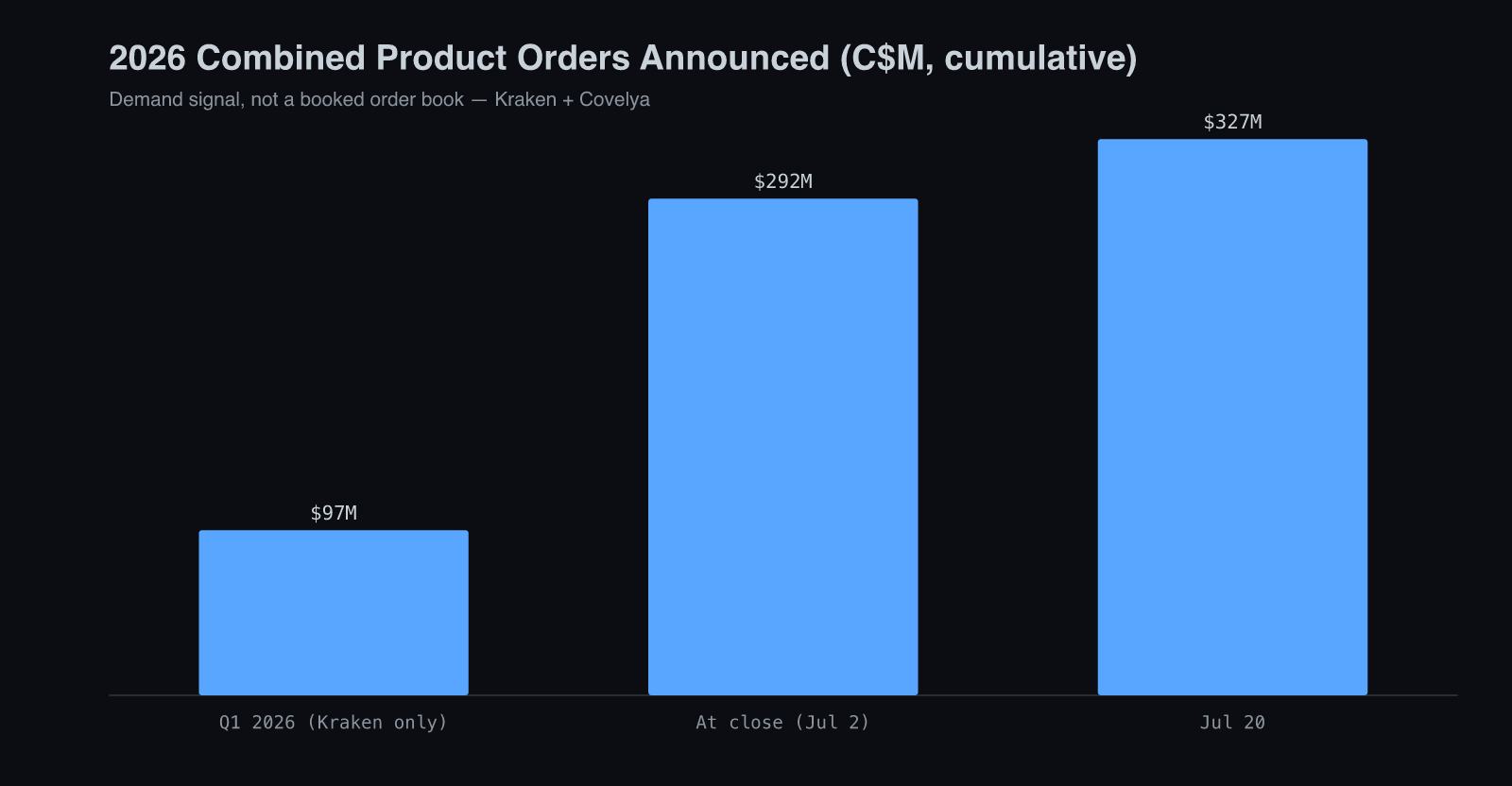
Demand, at least, is not the near-term worry. Kraken and Covelya have announced ~C$327M of combined 2026 product orders — sonar, batteries, navigation, positioning and monitoring — across maritime defence, offshore energy and ocean science, with products expected to be >75% of consolidated revenue.
"Our product portfolio forms the backbone of a wide range of platforms used across both defence and commercial applications and we expect it to represent over 75% of consolidated revenue in 2026."
Greg Reid, CEO, Kraken Robotics (order update, 7/20/26)
The honest asterisk on that C$327M: it's a demand signal, not a booked backlog. Announced orders say nothing about delivery timing or how fast an invoice becomes cash — and the most recent print is a reminder that the business is lumpy and back-half weighted. Q1 2026 revenue rose 35% to C$21.7M but missed the four-analyst consensus by ~15%, adjusted EBITDA margin compressed to 14% (from 17%) on higher admin and a larger workforce, and the quarter swung to a C$3.3M net loss on transaction costs. A soft Q1 in a business that does most of its revenue in H2 is normal; it's still the sort of quarter that keeps a "priced-for-perfection" stock honest.
The Optionality Stack
Underneath the core deal sit several upside lanes the market isn't paying much for — real, but each carrying a burden of proof:
- Harbour and cable-defence via Wavefront — arguably the most overlooked asset in Covelya. Its Sentinel intruder-detection and Solstice imaging sonar are exactly what you deploy to guard a port or watch a subsea cable, the demand category that Baltic sabotage just made a budget priority. How much of that translates into booked Wavefront revenue isn't visible yet — strategic relevance, not proven sales.
- SeaPower as a standard AUV battery — the batteries are integrated or being integrated across 30+ platforms, with disclosed customers including Teledyne Marine (on its Gavia and SeaRaptor vehicles) and Terradepth's self-recharging vehicle, plus two allied-nation navies. The bull version — that SeaPower becomes the default subsea battery — is real optionality, but the company's own claimed energy-density advantage is unverified in public sources, and large integrators can build or source their own cells at volume. Treat SeaPower as optionality on top of the core, not the core.
- Cross-sell — the reason to combine these companies rather than run them separately: sell a Sonardyne navigation customer a SeaPower battery, or hand an existing Kraken sonar account EIVA's mission software. Every successful cross-sell raises revenue per platform and makes the whole stack harder to rip out.
- A TSX main-board uplisting from the Venture exchange would widen the institutional buyer base — a plausible re-rating lever, not a fundamental one.
None of these is in the base case. They're the free-ish call options you get for owning the whole stack instead of one node.
Risks & What Breaks It
- Customer concentration is the most concrete number in the bear case. A single customer was ~45% of 2025 sales, and the top three were ~54% of nine-month revenue, with roughly half of sales from Asia-Pacific. Losing that one program would hit the P&L directly. Covelya's 700+ customers mechanically dilute this — but that fix was bought, not built, and has to prove itself in the consolidated mix. This is the assumption that most nearly breaks the thesis, and it gets the most airtime for a reason.
- Integration risk, with the timing slightly off. Kraken is going from a focused ~450-person company to a ~1,200-person, six-business international group — and its COO departs at the end of July. Several Covelya executives are stepping into senior roles (planned design, not chaos), but merging six firms while a top operator leaves is the hardest kind of quarter to execute cleanly.
- You can't see the combined numbers until late November. The deal closed two days after Q2 ended, so the Aug 27 print is a standalone Kraken quarter with the acquisition as a footnote (final price, drawn debt, purchase-price allocation). The first consolidated quarter — the first real look at Covelya margins under new ownership and at cash conversion — isn't reported until late November. The falsifiers (margins that sag in integration, orders that convert too slowly, cash that doesn't follow EBITDA) are only measurable from then.
- The multiple leaves no room for a stumble. At ~25× run-rate EBITDA, the stock already embeds smooth integration, held margins, and growth into the valuation gap. A discount to the March share price is not a discount to earnings.
- Mixed insider signals and a name-collision trap. Recent insider activity has been two-sided — reported selling alongside a ~C$250K insider buy — so it doesn't read cleanly either way. And for the avoidance of doubt: $KRKNF (Kraken Robotics) is not Kraken Technology Group, the private UK uncrewed-surface-vessel maker that raised US$175M in July from Rheinmetall and allied-government venture backers, nor the Kraken crypto exchange. At least one published write-up has already conflated them.
Valuation & House View
The valuation depends entirely on which EBITDA you put in the denominator — and the market is quoting the wrong one. On the 2026 guided C$65-75M (only six months of Covelya), enterprise value of ~C$2.23B is ~32×. On the full-year run-rate combined C$85-93M, it's ~25×. Push forward to a 2027 that captures full-year Covelya, ~80% legacy EBITDA growth, and the ~C$10M of targeted synergies, and a >C$100M EBITDA drops the multiple toward ~21×; a bull 2028 pulls it toward the mid-teens. Every rung down that ladder is an assumption, and none is yet proven — but the direction is why the "32×" headline is misleading.
Valuation console — what is the stack worth?
today 25.3×House View: a name worth owning, bought in tranches around the catalysts rather than all at once. The combined company is a genuinely differentiated asset — the only listed pure-ish play on the whole underwater-intelligence stack, at ~24% margins, into a defense category that's inflecting — and the sell-side already carries a ~C$10.17 average target (analysts rate it Buy). But the market is paying a full run-rate multiple for an integration it can't yet verify, so the honest way to own it is to start a position at today's ~42%-off-the-high price, then add on the two datapoints that actually de-risk the thesis: a clean standalone Q2 on Aug 27, and — the one that matters — the first consolidated quarter in late November. Underwrite the filings, not the order headlines.
Figures independently verified against Kraken Robotics' press releases, financial results, and live Quartr consensus; the framing of the acquisition as a multiple-arbitrage-plus-execution question was sharpened by Critical Nodes (Johan Ekroth). h/t.