
$INOD Deep Dive — Selling Experience to Machines That Have Run Out of Internet
$INOD rose 29% in two sessions on a claim nobody has confirmed: that its new "personalization of long-horizon agents" programme is the training layer under Meta's Muse assistant. The claim is probably right, and it is the third-most-important thing about this company. The first is that GAAP gross margin rose 7.8 percentage points in two quarters. The second is that the customer everyone is excited about bought less in Q2 2026 than it did in Q1 2025.
What Changed
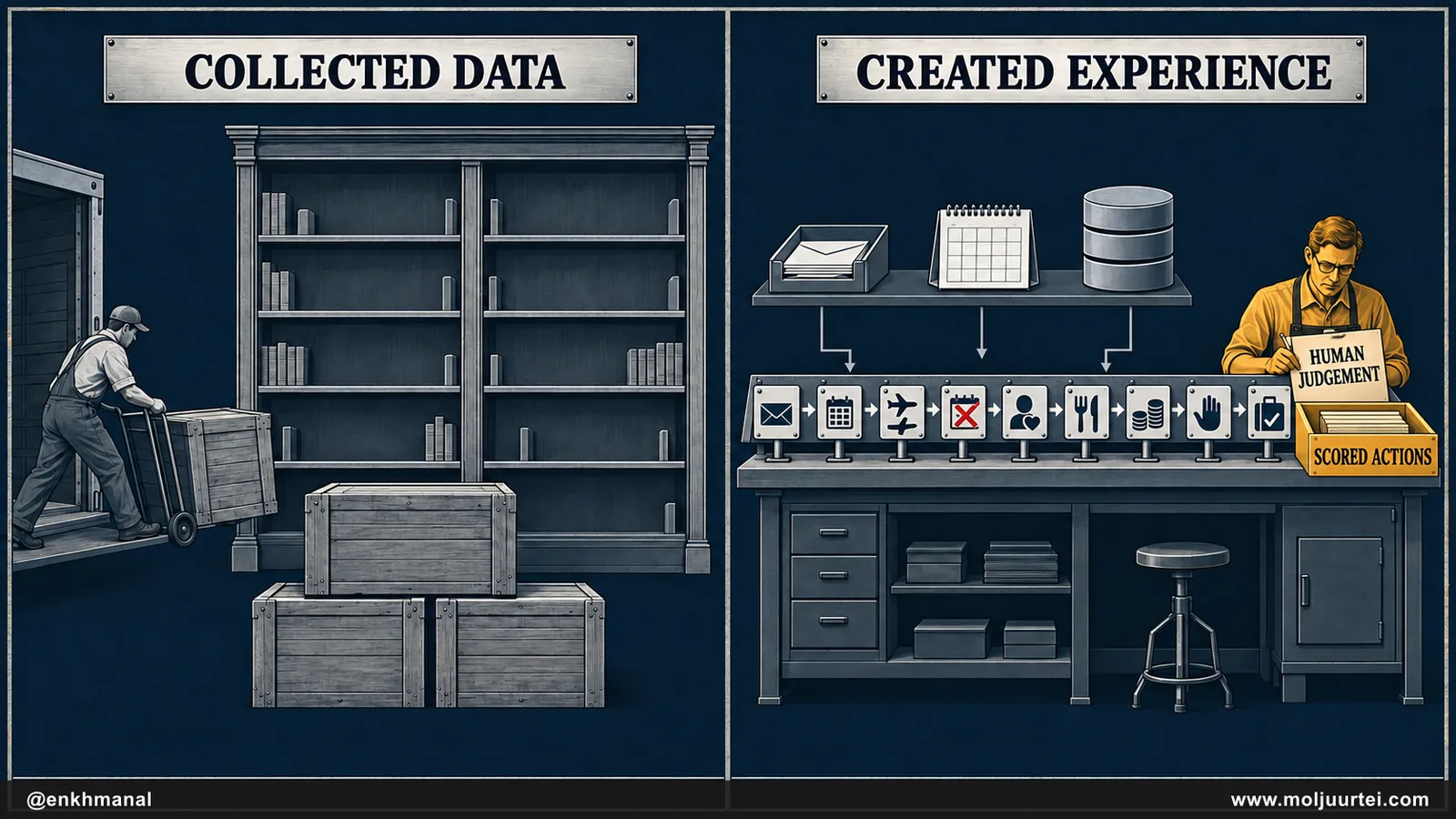
For three years the binding constraint on a frontier model was compute. That has not stopped being true, but a second constraint arrived underneath it, and it is now the one that decides which models are actually useful: there is no more internet left to read. The labs have scraped the open web, bought and scanned the books, licensed the news archives, and are now bidding on the email spools of bankrupt airlines. The cheap data is gone.
That would be a manageable problem if models only had to answer questions. It is not manageable, because over the last eighteen months the frontier moved from answering to acting. An assistant that books your travel has to read a calendar, compare flights, notice that an old email lists dates you have since changed, remember that you hate connections, distinguish the restaurant a friend recommended from the one they warned you about, and stop to ask before it spends your money. Every one of those steps is a decision, and the sequence can fail at step nine for a reason that began at step two.
Nobody writes that down. There is no corpus of "here is a messy inbox, a stale calendar, a budget and a person's actual preferences, now book the trip, and here is why this attempt was good and that one merely valid." The data required to train an agent does not exist in the wild, because it is a record of judgement under mess, and mess is precisely what people delete before publishing anything.
So it has to be manufactured. The labs now pay for simulated worlds, populated with fictional people, invented emails, plausible documents and working databases, then deliberately spoiled with missing information and contradictory instructions, in which an agent can practise a long task ten thousand times and be scored. Some of the scoring is mechanical: did it pick the right dates, stay inside budget, ask permission before paying. Most of the interesting scoring is not, because a reservation can be perfectly valid and still be a terrible choice, and only a person can say which.
The shift: training a model stopped being an exercise in acquisition and became an exercise in manufacture. Hyperscaler capital spending is guided to roughly $700bn in 2026, near double 2025, and the marginal dollar increasingly buys experience rather than tokens.
Why the old answer stopped working: scraping produces text about outcomes. Agents need traces of process, with a verdict attached to each step. You cannot scrape a verdict.
What that creates demand for: a factory whose unit of output is a scored, recoverable, multi-step task, built by domain experts, at scale, in many languages, continuously, because every model release invalidates part of the last batch.
Meta's Muse reaching No. 1 on the US free iPhone chart this month is the first mass-market evidence that a consumer agent works well enough to be adopted rather than demoed. That is the moment the category stops being a research line item. The company this memo is about has been running that factory, unglamorously, from a business park in Ridgefield Park, New Jersey, since before the internet it ran out of.
Thesis
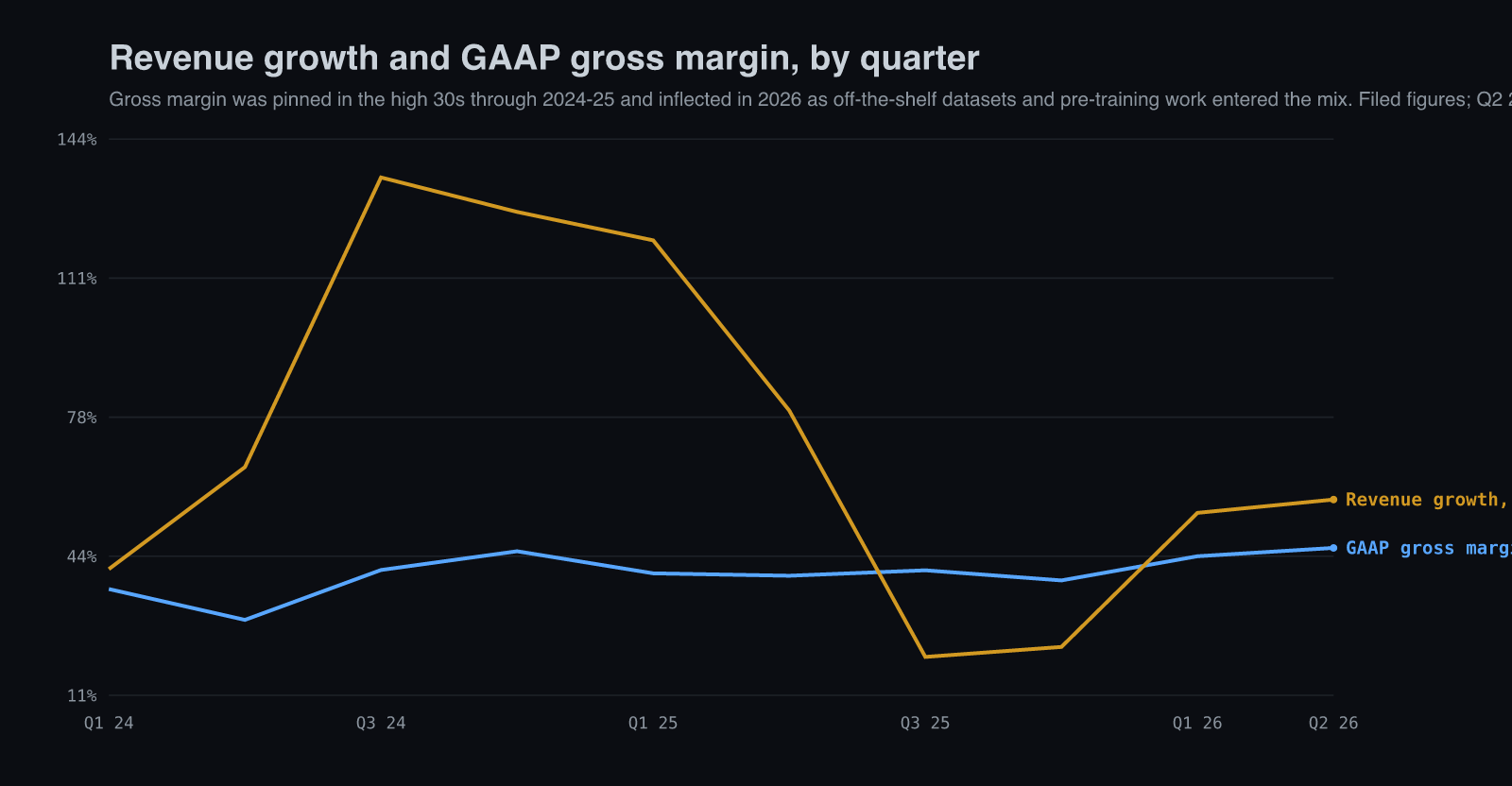
$INOD is the only listed pure-play in AI post-training and evaluation data, and in the first half of 2026 it produced the first hard evidence that the business can carry a software-shaped margin: GAAP gross margin went from 38.3% in Q4 2025 to 46.1% in Q2 2026 while revenue grew 56%.
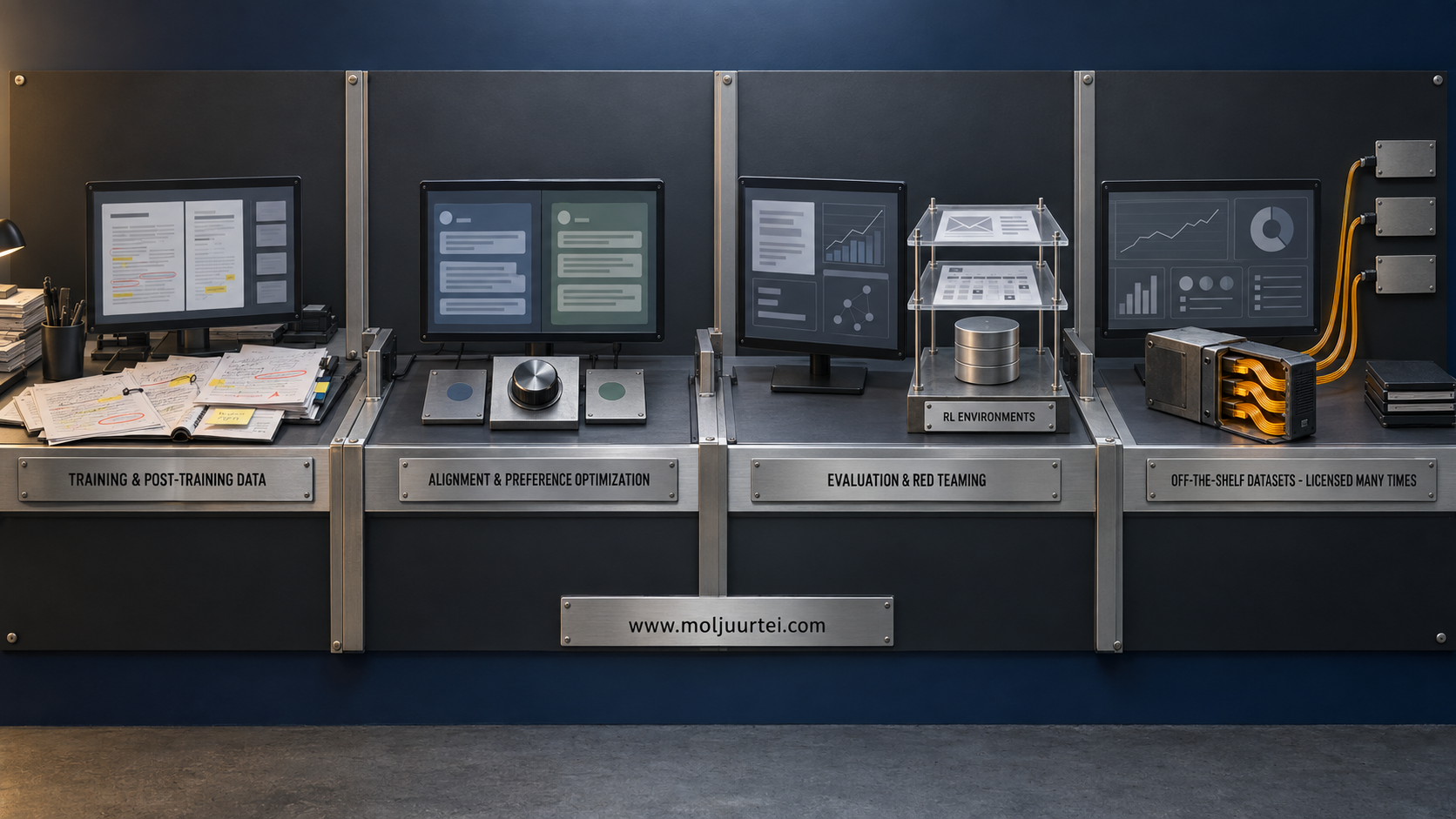
What it can do that others can't: operate across the whole model lifecycle, covering pre-training data, post-training alignment, evaluation, red-teaming and now reinforcement-learning environments, for five of the Magnificent Seven at once, with 12,200 experts in more than 70 countries. Its named competitors are mostly private. The listed alternatives are business-process outsourcers growing 2%.
What that lets it sell next: off-the-shelf datasets where $INOD keeps the rights and licenses the same asset to several labs. That is the one line in this business not paid by the hour, and it is what moved the margin.
Why now: agentic evaluation is a new budget line at every frontier lab, and $INOD disclosed two programmes inside it in August. One covers personalising long-horizon agents; the other covers reinforcement-learning environments for desktop computer use.
The one risk that matters: the revenue is project revenue, and projects end. The largest customer's quarterly spend has round-tripped from $35.6m to $50.5m and back to $34.1m inside six quarters, and the chief executive says an "air gap" after a big delivery would not trouble him.
Business & Backdrop
$INOD sells trained human judgement, organised and delivered at industrial scale, to companies building AI systems. Founded in 1988 to turn paper documents into structured databases, it spent three decades as a competent, shrinking outsourcer. Revenue fell from $86.6m in 2012 to $55.9m in 2019. Then the thing it had always been good at became the scarce input to the most expensive technology programme in history. Revenue since: $58.2m, $69.8m, $79.0m, $86.8m, $170.5m, $251.7m. The last twelve months are $317.2m.
Customers pay for four things: training and post-training data development; alignment and preference optimisation; capability, alignment and safety evaluation; and deployment support for agentic and tool-using systems. Contracts are project-based and largely at-will, which the company states in its own risk factors. There is one reportable segment, a change management made in Q1 2026 on the grounds that the chief executive now reviews results on a consolidated basis. It has the side effect of removing the last axis on which an outsider could see the mix.
The market is defined by its customers' capital budgets rather than by a consultancy's forecast, which is the honest way to size it: hyperscaler capex guided at roughly $700bn for 2026, of which the data, evaluation and assurance layer is a small but rising share. The competitor list in the FY2025 10-K is the useful map. On one side sit Appen, CloudFactory, Surge AI, Invisible Technologies, Turing, Mercor, Define.ai, $TIXT and Scale AI; on the other, Accenture, Cognizant, $EXLS, $G, Infosys, PwC, QuantumBlack and Tata Consultancy Services. The private specialists raise at twenty times revenue. The listed outsourcers trade at one.
The annual series shows a company that grew fast and converted almost none of it into per-share profit until this year:
Forty-eight per cent more revenue in FY25 bought three cents of earnings per share. That single comparison is the spine of every bear case written on this name, and it is accurate. It is also slightly unfair: FY24's $0.89 was flattered by a deferred-tax release that made net income exceed operating income in Q3 2024, so the true operating progression, from $24.3m to $39.9m of operating profit or 64%, is better than the EPS line admits.
The quarterly series is where the argument turns, because the annual rows average the inflection away:
Peer corroboration is unusually clean here, because the listed comparables are so far away. Concentrix ($CNXC) did $9.83bn of FY25 revenue at 2.2% growth, a 35.0% gross margin and a −9.3% operating margin after impairments, carrying $4.31bn of net debt. $TTEC shrank 3.2% to $2.14bn at a −5.5% operating margin. $IBEX, the healthy one, grew 15.4% to $644m at an 8.5% operating margin. None of them has ever posted a 46% gross margin. Whatever $INOD is, the filed numbers say it is not one of these, and that is the whole valuation question in one observation.
The market spent September arguing about which customer $INOD works for, and spent no time at all on the fact that its gross margin just printed the highest number of its modern history.
Technology & Moat
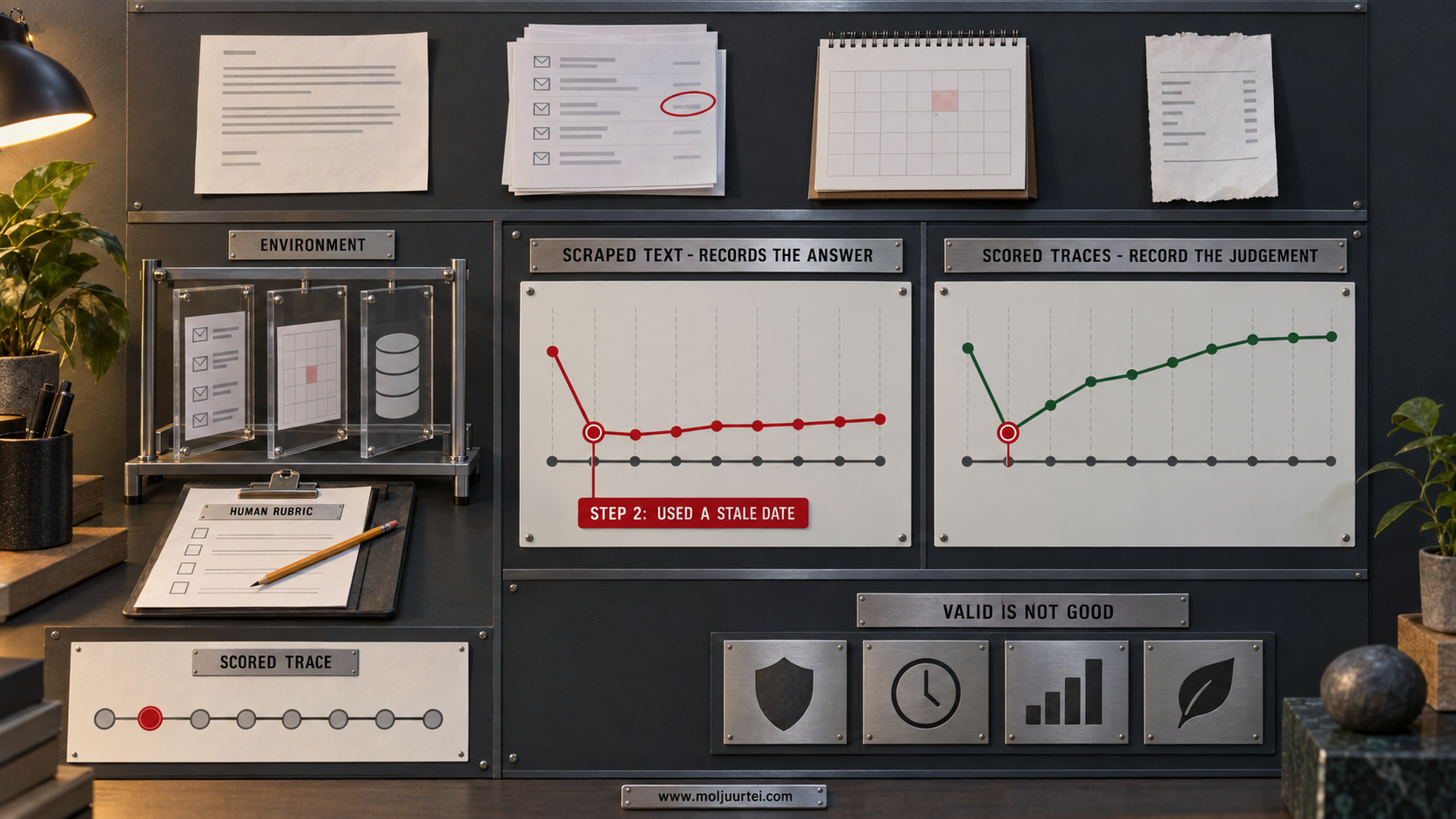
Start here. A textbook is a record of answers, which is what the open web is and what pre-training consumes. A worked example is a record of how an answer was reached, which is what the labs bought next when the textbooks ran out. A practice exam is a worked example with a grader attached, so the attempt can be marked right or wrong. A flight simulator is a practice exam inside a world that reacts, so the pilot can fail safely and try again. A reinforcement-learning environment is the flight simulator for software agents: a synthetic company, household or inbox, with working documents, databases and people in it, where an agent attempts a long task and every attempt produces a trace and a score. That last rung is the product $INOD has spent two years learning to build.
The hard part is not the simulation. It is the scoring. Some outcomes are checkable by machine: did the agent stay inside budget, did it obtain permission, did it book the stated dates. Most of the outcomes that separate a useful assistant from an annoying one are judgements, such as whether saving $100 justifies a six-hour layover, or whether "somewhere lively" means a neighbourhood full of restaurants or a room above a nightclub. The company's stated method is to have reviewers score model responses and explain the mistake, under written guidelines intended, in its own phrase, to "objectify subjectivity." That is a manufacturing process for consistency of taste, and consistency is the thing a lab cannot get by hiring ten thousand people quickly.
The moat has three parts and one glaring hole. The parts: a delivery organisation of 12,200 people across more than 70 countries, which is what allows multilingual and jurisdiction-specific safety work and follow-the-sun iteration; a position inside the customer's pipeline rather than alongside it, which is why a former employee told Hunterbrook that switching suppliers buys a lab "a 5% discount and headaches that they don't know to anticipate"; and the newest piece, datasets $INOD builds speculatively against deficiencies it finds in its own benchmarking, retains the rights to, and licenses to several customers at once.
"The off-the-shelf data sets … are data sets that we engineer, and we engineer them around model deficiencies that we detect in our benchmarking. … We maintain or we retain the [intellectual property] associated with that data set, and we enable them to use those data sets for training their models."
The hole is that the intellectual property is almost entirely contractual. The FY2025 10-K discloses that the company holds one patent, with roughly two years of remaining term, and rests everything else on trade secrets, confidentiality agreements and the clause assigning customer-specific deliverables to the customer while $INOD keeps methods "of general applicability." For a business whose bull case is now explicitly about retained rights, that is a thin legal perimeter. The defensibility is operational, meaning knowing how to run the factory, rather than legal.
Roadmap & R&D
Capital intensity is almost nil, at $5.3m of capex in the first half of 2026 against $182.2m of revenue, so the roadmap is not a capacity schedule. It is a list of capabilities being converted into programmes. The framing on the Q2 call was that research "converts to revenue within quarters, not years," and the August disclosures are the test of that claim.
Two things in that table belong apart. The top three rows are revenue today. The bottom four are options, and the company labels them as such. The egocentric programme is one "we hope to be awarded," which is the correct verb and a good sign about the disclosure culture. The Quartr archive also shows the company does not publish an earnings deck every quarter: decks exist for Q4 2024 through Q4 2025 and stop there, so the 2026 roadmap comes from the calls and releases rather than from slides.
The incoming executive chairman has told investors where he intends to spend his own time, which is the clearest roadmap statement in the file: federal and enterprise, built on technology developed for the frontier labs, aimed at "high-quality recurring revenue." That is also an admission that today's revenue is not recurring.
The Setup — Why It's Mispriced
The market is pricing a customer story. The filings contain a margin story, and they are not the same story.
Start with the customer story, because it is what moved the stock. Hunterbrook's case is that Meta is the unnamed largest customer, that the "personalization of long-horizon agents" programme disclosed on 6 August is the work behind Muse, and that a Meta product succeeding is therefore an Innodata event. The circumstantial fit is genuinely good: the phrase appears exactly once across twenty-nine stored earnings calls going back to 2020, and it appears in the same quarter Muse shipped. We think it is more likely true than not. Two things have been skipped in the excitement. Neither company confirmed it. And Citrini Research published the identical Innodata section today, crediting Hunterbrook as "our regular partners in investigation," so the two notes that moved a stock with roughly 14% to 15% of its float short are one publication rather than two confirmations.
Now the number the story is built on. Applying the filed 10-Q concentration percentages to reported revenue gives the largest customer's actual quarterly dollars, and they do not describe a compounding annuity:
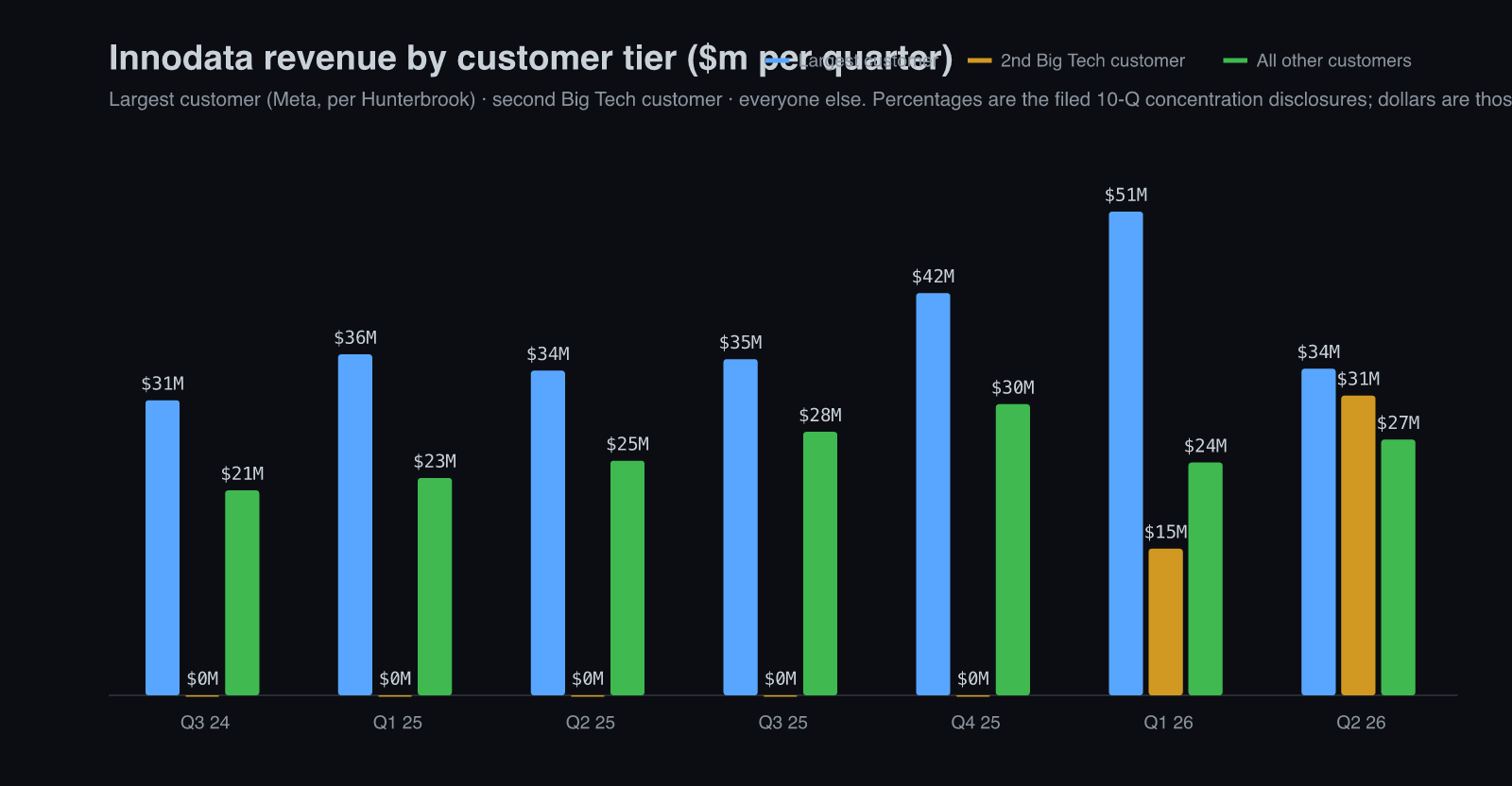
The largest customer spent $34.1m in Q2 2026 and $35.6m in Q1 2025. Six quarters, no growth. It sat flat near $35m for a year, spiked for two quarters, and gave it all back. Every dollar of the company's growth over that span came from somewhere else, overwhelmingly from the second Big Tech customer, which went from nothing to $31.3m a quarter in five quarters, and which management told investors in May would generate "approximately $51 million of revenue this year." It did $46.6m in the first half alone.
This is why the diversification claim needs reading carefully. Concentration did not fall; it moved. The top two customers were 73% of revenue in Q1 and 71% in Q2, and in dollars they contributed $65.8m and then $65.4m, essentially identical. Sixty-six per cent of accounts receivable sits with two customers. What happened in Q2 was a swap inside the top two, not a broadening beneath them.
Management's explanation for the drop is a single clause, "a change in the quarter to program structure and service mix." The mechanism behind that phrase is visible in an earlier call, and it is the most important sentence in the file:
"To illustrate, in the first quarter of this year for our largest customer, we deprecated a meaningful number of post-training workflows, which represented in the aggregate approximately $20 million of annualized revenue run rate. Replaced them with a combination of new post-training workflows and scaled pre-training…"
Workflows at this customer get deprecated and replaced. That is not a defect in the relationship, it is what research priorities do, but it means the revenue is a sawtooth by construction, and it means "now scaling" describes a programme scaling from a base that just fell by a third.
Here is what we think is mispriced in the other direction. Through 2025 the bear case was correct: this was a labour business with no operating leverage, and $317m of trailing revenue across 10,107 employees, about $31,400 a head against $300,000 to $500,000 at a real software company, says it still fundamentally is one. In the first half of 2026 that stopped being the whole truth. GAAP gross margin went 38.3%, then 44.2%, then 46.1%. Half-year operating profit rose 91% on 56% more revenue. Adjusted gross margin of 49% is nine points above the company's own public 40% target, and management attributes the gap to pre-training work and to off-the-shelf datasets licensed more than once. That is the first quantitative evidence in this company's history that a dollar of revenue can arrive without a person attached to it.
The most-read bear piece on the name, published on 2 September, rests on gross margin having "slid from 45.2% to 38.3% in a year." That is Q4 2024 against Q4 2025, and it is true. It is also four weeks stale: Q2 2026, filed on 6 August, printed 46.1%.
One caution keeps this from being a clean bull case, and it comes from management itself. Asked whether the higher margin was a trend or a quarter, the chief executive said the company still bids on lower-margin work, that some of it could be large, and that "would that mean the gross margin on a weighted basis would decline somewhat? It would." The 49% is a mix outcome, not a floor.
Forensic & Governance
Three adjustments sit between the reported quarter and the underlying one, and each is disclosed rather than hidden. The Q2 effective tax rate was about 18% against a stated long-term target of 23% to 25%, so roughly three cents of the $0.41 diluted result was tax rather than operations. Adjusted EBITDA of $25.4m is struck after adding back $7.2m of stock compensation, which is 7.8% of revenue; for the half, $13.1m of stock compensation against $29.3m of net income means the company is paying out close to 45% of its earnings in new shares. And diluted share count is roughly flat near 34.8m only because option exercises offset the shrinking overhang; actual shares outstanding rose from 32.3m to 34.4m in seven months.
The cash line needs the same treatment, because the headline is not what it looks like. Cash and short-term investments of $250.4m are up $168.2m since December, which reads like a business throwing off $168m. It is not. Set the cash flow statement against the income statement: first-half adjusted EBITDA was $50.3m and net income $29.3m, while operating cash flow was $164.4m, a conversion of 327%. A business does not convert three times its EBITDA into cash. The reconciliation says why: $135.8m of that $164.4m came from the single line "accounts payable, accrued expenses and other." On the balance sheet, advances from customers went from $1.8m to $67.0m, with a further $61.8m of related project costs incurred but unpaid sitting in payables. The chief financial officer states it plainly, to his credit:
"Excluding customer prepayments, which are a pass-through, our cash and short-term investments position was approximately $134 million, up $37 million sequentially."
$37m of real sequential cash generation on $92m of revenue is a good quarter, and against $25.4m of adjusted EBITDA it is genuine conversion. It is not $168m, and float reverses. A reader taking the balance sheet at face value is overstating the buffer by roughly a hundred million dollars.
Then the guidance, which is arithmetic rather than opinion. The company reiterated "40% or more" growth for 2026 after beating consensus by 7%. Against FY25 revenue of $251.7m that is at least $352.4m, and the first half already delivered $182.2m. At the minimum growth rate, second-half revenue would be $170.2m, below the first half, or $85.1m per quarter against Q2's $92.1m. Those are floors, not ceilings: the guidance allows a second-half decline; it does not predict one. Project timing remains a separate risk. Asked directly whether a sequential decline was likely in Q3 or Q4:
"Within the constraints of our business model, it's certainly possible, if it were to occur, I don't know that I would particularly care. … If we were to win a very large one-time project that we're delivered in two quarters, there were an air gap after a Q3, would I consider that a failure? Not at all."
"Air gap" is his word, and it is the most honest description of this revenue model anyone has offered. It is also the sentence a buyer at $73 is choosing to discount.
Finally, the history of contested disclosure, which is why this name carries a persistent discount to how it sounds. Wolfpack Research in February 2024 and J Capital in September 2024 both published short cases arguing the AI capability and the size of customer commitments were overstated. Department of Justice and SEC inquiries followed, and the company disclosed in June 2025 that both had closed without enforcement action. That is a clean outcome. It is not an erasure.
Management & Track Record
Jack Abuhoff has run $INOD since 1997 and is the reason the company survived long enough to be in the right place. He hands the chief executive role to Rahul Singhal on 30 September and becomes executive chairman, with a stated remit of federal and enterprise. The board approved the transition on 3 August and announced it with the Q2 results on 6 August, between two and eleven weeks after he sold 587,701 shares for $61.1m at prices between $94.92 and $113.16.
Two facts about this team belong together rather than apart. The first is that the succession is genuinely internal and well earned. Singhal has been the commercial architect of the transformation, and promoting him is consistent with what the company says about itself. The second is the trading record. Between 19 May and 14 September 2026, insiders sold 704,034 shares for $72.2m across four people, and bought nothing on the open market, not one share. Directors were still selling at $53.54 on 14 September, eight days before the stock reached $73. Hunterbrook's own thread flags this, and it deserves more than a clause.
A separate $300m at-the-market equity programme was signed on 6 August with Goldman Sachs as lead agent, alongside Craig-Hallum, Wells Fargo, Maxim Group and Wedbush, at commissions of up to 2.0%. We note, without drawing a conclusion from it, that the only two analysts who asked questions on the Q2 call were from Craig-Hallum and Maxim Group.
Risks & What Breaks It
What forces a thesis change: a Q3 print on 5 November showing GAAP gross margin back below 42%, or the second Big Tech customer falling sequentially the way the first one did. Either one says the 2026 inflection was mix luck rather than model change, and the labour-business valuation is the right one.
Price Setup — Levels, Technicals & Options
$INOD closed at $73.93 on 22 September, up 21.1% on 3.7m shares against a typical day nearer 0.8m, after rising 6.8% the session before. That is 29.4% in two sessions from $57.14. The stock is nonetheless 39% below its 4 June closing high of $121.50 and 115% above its 30 March low of $34.45, a year in which it roughly quadrupled and then more than halved. It fell on the Q2 beat, from $69.37 to $62.33 over two sessions, which tells you the market read the largest-customer decline and the equity programme rather than the 50% EBITDA beat.
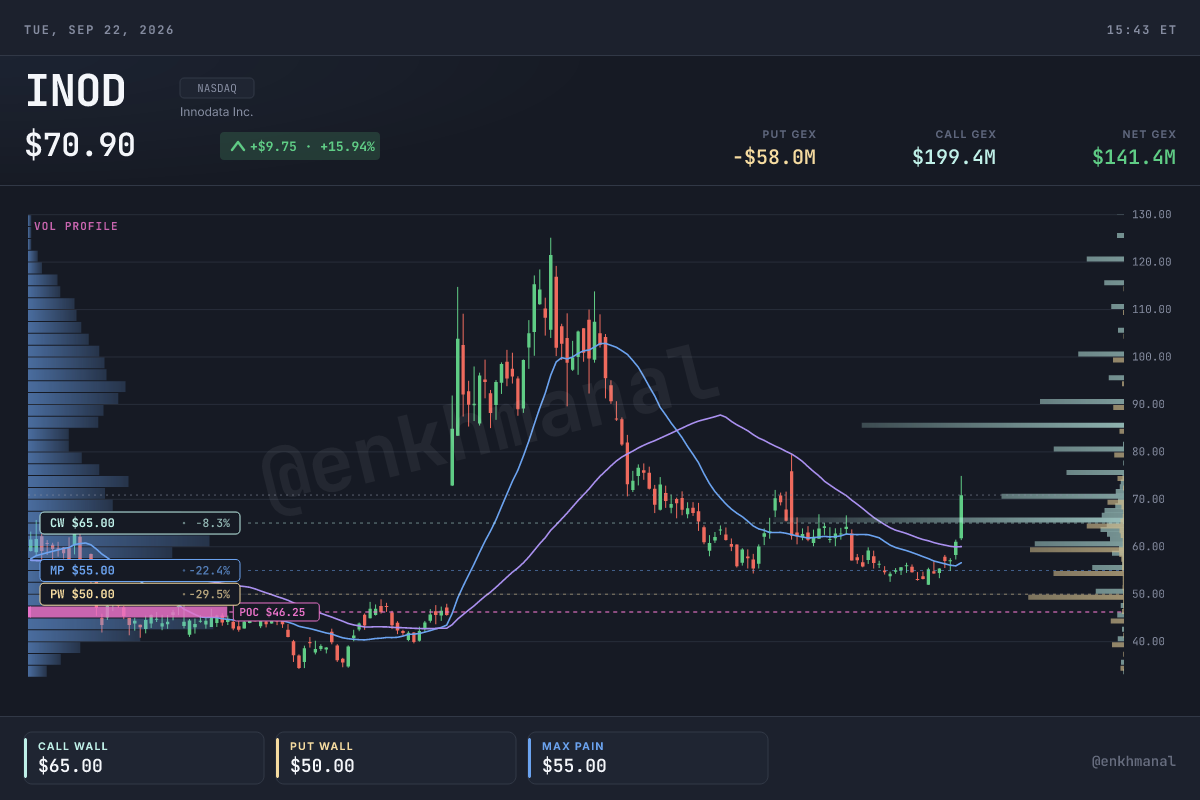
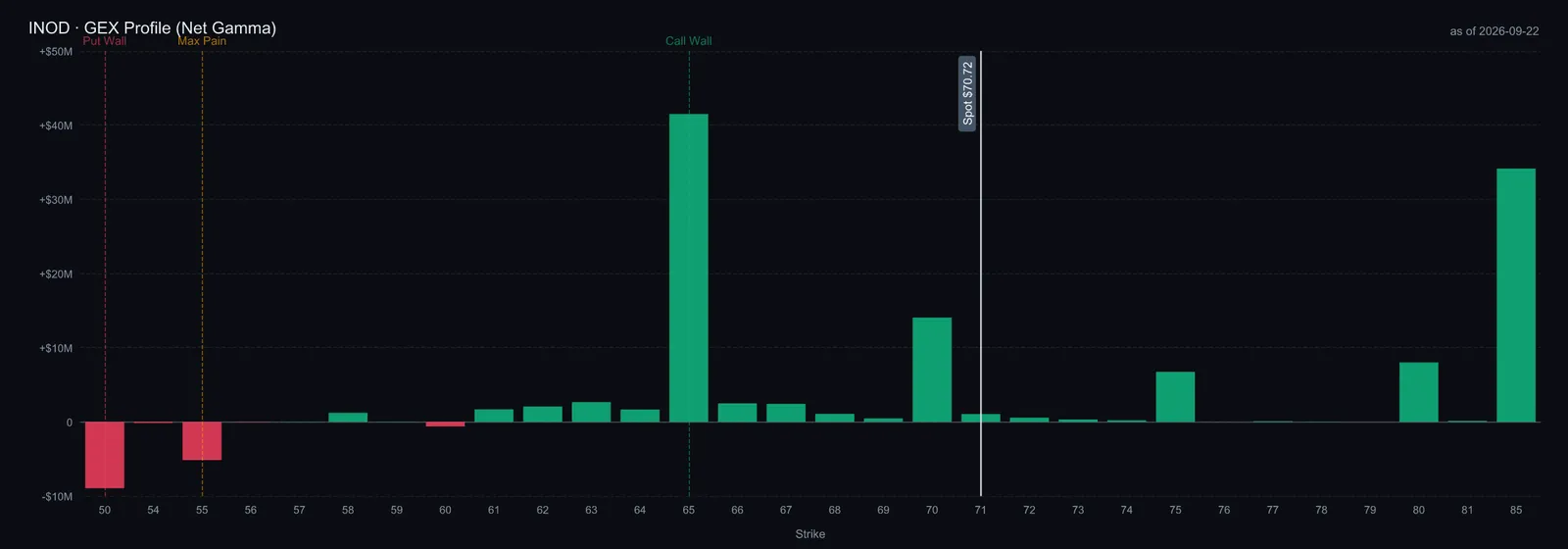
Dealer positioning: every structural level sits below spot. Call wall $65, max pain $55, put wall $50, gamma flip $38.30, net gamma exposure of +$0.14bn across twelve expiries. Spot has traded clean through the call wall, so there is no dealer-hedging resistance overhead and no gamma support until $65 on the way back down.
Option book: put/call open interest of 0.438, which is more than two calls for every put. A crowded call book into a two-day squeeze is the positioning that unwinds fastest when a story is not confirmed.
The level that matters: $65. It is the call wall, it is the top of the pre-Muse range, and it is where the argument reverts from "confirmed partnership" to "unconfirmed inference." Below $57 the entire move is retraced and the November print is the only thing holding the stock up.
Valuation & House View
At $73.29 the equity is worth about $2.52bn on 34.4m shares. Net of the roughly $134m of cash management counts as its own and $11.2m of obligations, enterprise value is about $2.40bn.
The comparison table is the argument. $INOD trades at roughly eight times the revenue multiple of the listed outsourcers and about a third of what the private specialists raise at. Neither anchor is an exit price: the outsourcers grow 2%, and private marks are not liquid. On its own five-year history the multiple is mid-range rather than extreme, which is worth remembering, because this stock's problem has never been that it looked expensive on a screen.
Probability-weighted that is about $78 against $73.29, roughly 7%, which is not compensation for this distribution. We think this is a genuinely better business than it was twelve months ago, and that the evidence for it is the margin line rather than the Muse headline. We also think a 29% two-day move on an inference neither party has confirmed, into a $300m at-the-market programme, with four insiders having sold $72.2m and bought nothing, is the wrong moment to pay for it.
Our position is to wait. The interesting entry is below $65, the call wall and the top of the pre-Muse range, and the interesting date is 5 November, when the third quarter tests whether "now scaling" outran the air gap. Buy the disappointment here, not the confirmation.