$INIO Deep Dive — The engine the AI power shortage is being solved with · $6.6B backlog, >15 GW committed, sold out through 2027 · Q3 print
$INIO closed at $21.15 on September 18, up 13% on the week after booking a 450 MW order of Jenbacher J624 engines for North American data centers, and still 51% below the $42.95 it touched eighteen days after its June IPO. INNIO makes the 4.25 MW gas engine that OpenAI's 1.4 GW Texas campus, Oracle's 3.8 GW VoltaGrid fleet and a 1.1 GW mega-campus are all being powered with, it is sold out through 2027 with more than 15 GW of committed business, and it is spending customers' deposits to triple its factory output by 2030. The market is paying about 24× this year's guided EBITDA for that — the same multiple it pays Caterpillar for a business growing at a quarter of the speed.
What Changed
For two years the thing an AI lab could not get was the chip. In 2026 it is the socket. $NVDA, $AMD and $AVGO's own revenue guidance implies roughly 30 GW of new US data-center load across 2026 and 2027, against the 15–25 GW a year that Goldman, Morgan Stanley and Bernstein expect the country to actually energize — and the low end of that range is the likelier one, because the grid that would have supplied the rest is not being built. The Federal Energy Regulatory Commission's high-probability additions for January 2026 to December 2028 add 86 GW of solar and 20 GW of wind, add just 8 GW of gas and 0.8 GW of nuclear, hydro and geothermal, and retire 41 GW of coal. Net, the country loses about 33 GW of the firm, always-on capacity a data hall needs and gains 106 GW of the intermittent kind it cannot run on.
Start here. Electricity is a flow of energy through wires, measured in watts; a megawatt (MW) is a million of them, about the draw of 750 American homes at once, and a gigawatt (GW) is a thousand megawatts, roughly one nuclear reactor. A data center is a building that turns electricity into computation and heat, and an AI data center is one whose racks draw ten to twenty times the power of an ordinary one, all day, every day, with swings of a third of the load in seconds as a training run starts or stops. A grid interconnection is the utility's permission to draw that power from the public network, granted only after years of engineering study; behind-the-meter power is generation the customer builds on its own side of the meter so it does not have to wait. A gas turbine is a jet engine bolted to a generator, big and efficient and sold out; a reciprocating gas engine is a truck engine scaled up to the size of a bus, smaller and slower to wear but available in months. INNIO builds the second kind, and what follows is why the second kind is winning the years that matter.
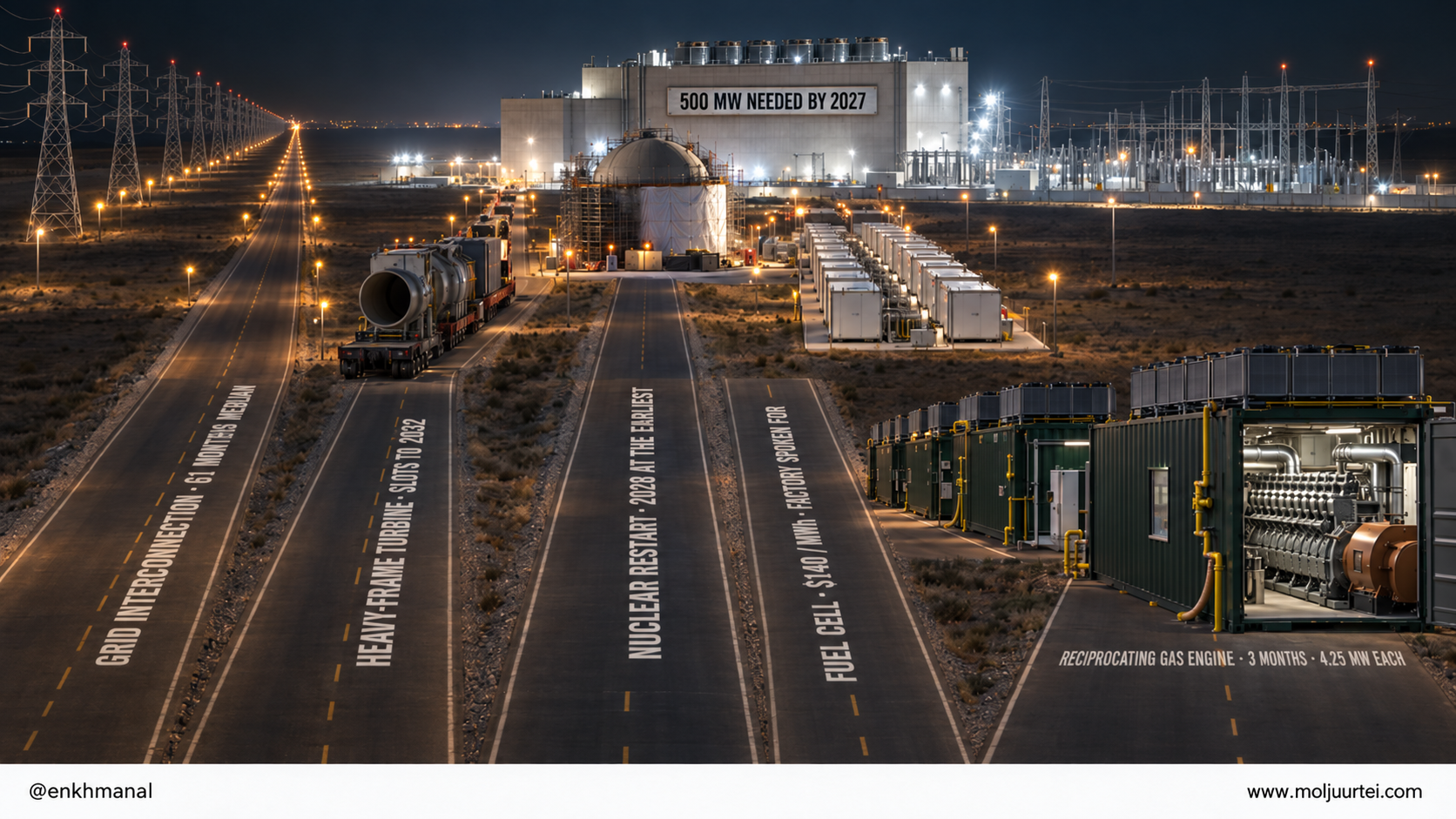
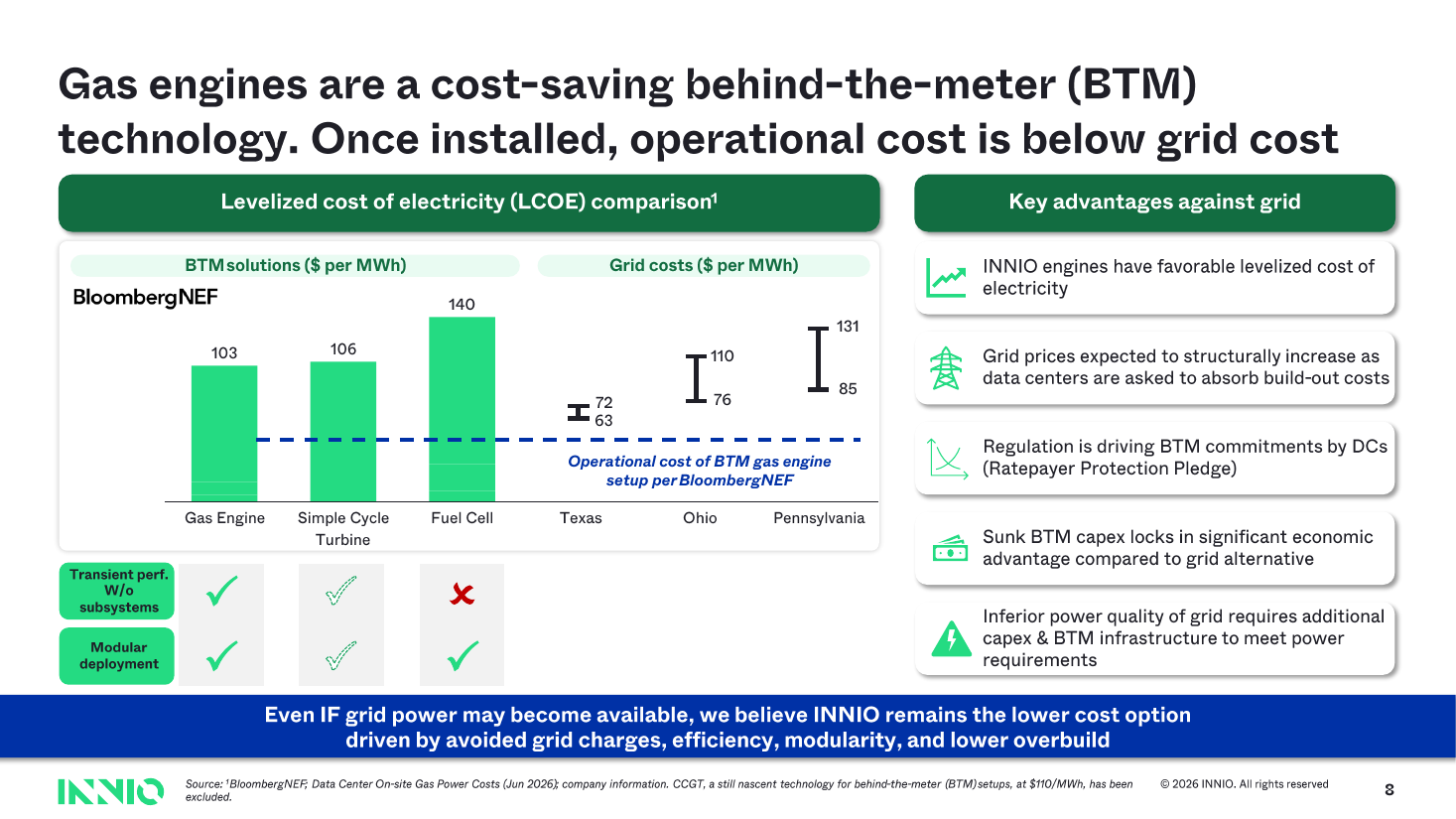
The queue is not a pipeline. Berkeley Lab's census of every US interconnection request finds that of all the capacity that applied between 2000 and 2020, 13% had reached operation by the end of 2025 and 75% had withdrawn; the median project that did connect in 2025 took 61 months from request to commercial operation. In the twelve months to the end of 2025 the queue took in 603 GW of applications and connected 53 GW, a 2% throughput, while 756 GW gave up. So a customer who needs 500 MW in 2027 has five ways to get it, and four fail the date: a grid connection (five years), a heavy-frame gas turbine ($GEV is selling slots for 2032 delivery), a nuclear restart (2028 at the earliest, and only a handful exist), a fuel cell (fast to permit, about $140 per MWh, and $BE's factory is also spoken for), or a fleet of gas engines that ships in months and is installed in weeks. That is the shift.
The company that benefits most from that calendar is the one whose engine is already the standard unit of the build. SemiAnalysis counts 75 GW of firm behind-the-meter orders for AI compute, about 20 GW of them booked in the second quarter of 2026 alone, and the flagship projects run on INNIO's engine: OpenAI's 1.4 GW-IT campus in Shackelford County, Texas, is being energized by more than five hundred 4.25 MW Jenbacher J624 units; VoltaGrid's 2.3 GW fleet for Oracle, and the 1.5 GW follow-on ordered in February, are Jenbacher-based power racks; the 1.1 GW mega-campus order INNIO booked in the second quarter is more than 200 J624s. A year ago twelve manufacturers had multi-hundred-megawatt off-grid data-center orders; today twenty-two do, and INNIO is the one that was already making the 5 MW-class engine at scale.
Thesis
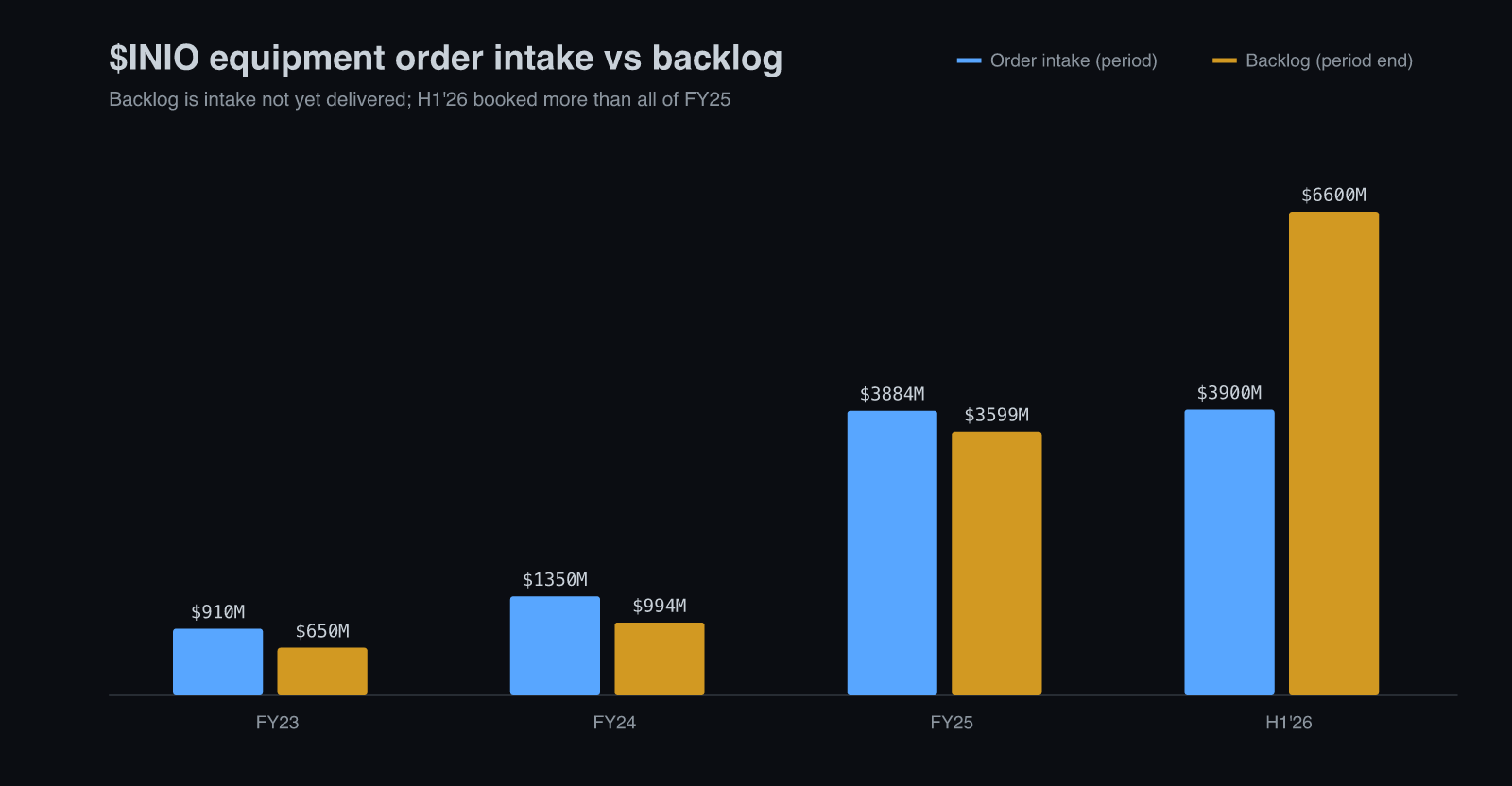
INNIO's Jenbacher Type 6 is the only high-speed gas engine in the 5 MW class, it reaches first load in about 15 seconds and holds 43–45% efficiency at part load without a battery buffer, and that combination has made it the unit hyperscalers standardize on for behind-the-meter prime power — which is why equipment order intake went from $0.9 billion in 2023 to $3.9 billion in the first half of 2026, the backlog is $6.6 billion, and every engine delivered seeds a 30%-margin service annuity that runs for thirty years.
Our read on the demand side of the same trade is in the $MARA deep dive and the $IREN Q4 FY26 earnings analysis. This is the first internal coverage of $INIO.
Business & Backdrop
INNIO is the gas-engine business General Electric sold to Advent International in 2018 for $3.25 billion, listed on Nasdaq on June 4, 2026 as a Dutch N.V. It builds two brands: Jenbacher, made in Jenbach, Austria since 1959, eight engine types from 220 kW to 10.6 MW that generate electricity from pipeline gas, biogas, landfill gas or hydrogen; and Waukesha, made in Wisconsin since 1906, the engine that drives the compressors moving gas through American pipelines and oilfields. It has about 44 GW of engines running in the field, 5,000 employees and customers in 100 countries; the Jenbach site marks 500 years of manufacturing this year, which is one way of saying the moat is the factory, not the idea.
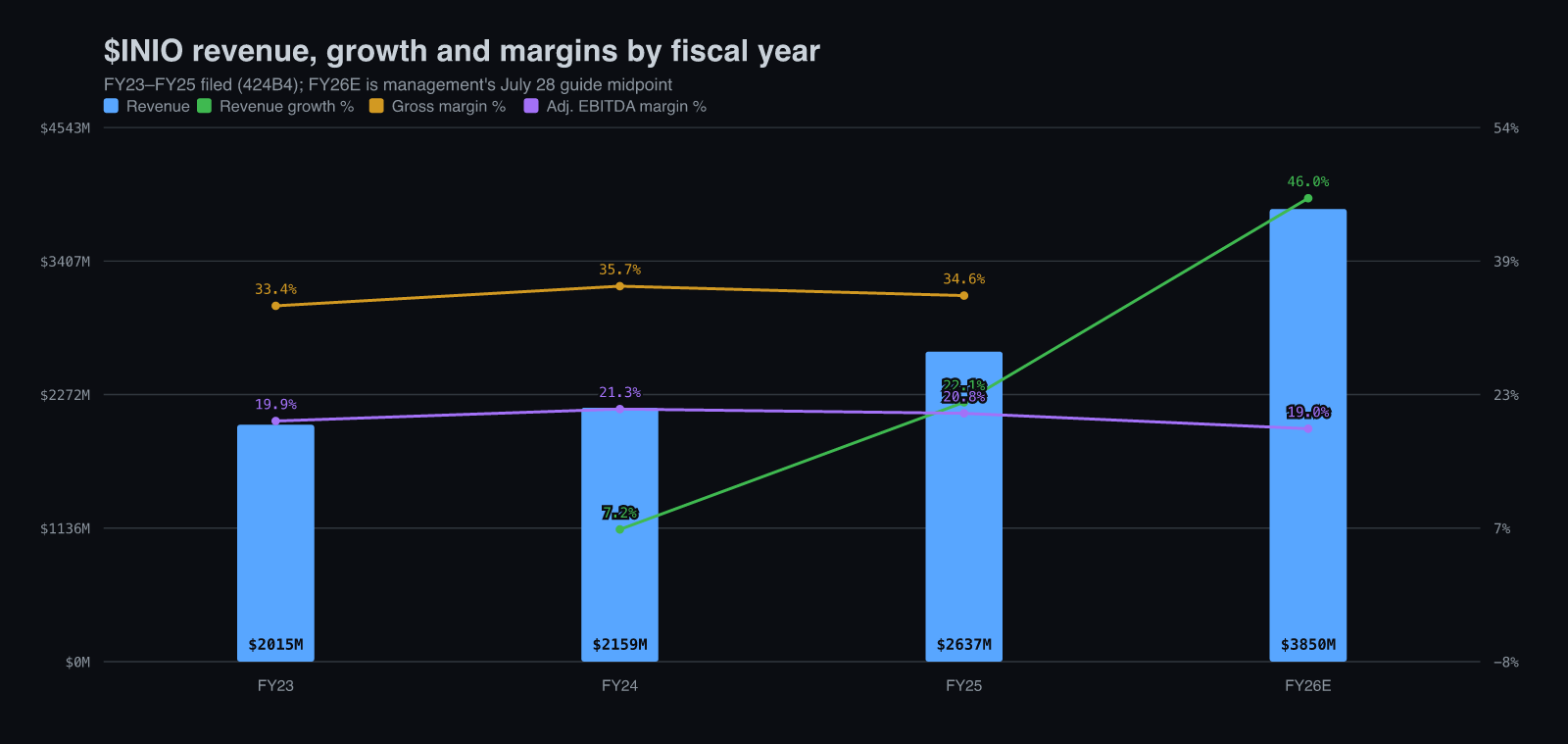
It reports two segments. Equipment (52% of 2025 revenue) sells the engines, gensets and the containerized packages that turn a J624 into a plug-in power block, across three lines — data center, power solutions (peaker plants, biogas, industrial cogeneration) and compression. Services (48%) sells parts and labor to the installed base, about 85% parts, much of it under service agreements that run ten years or more; management's rule of thumb is that a dollar of equipment EBITDA carries about 2.5 dollars of lifecycle service EBITDA behind it. Revenue went from $2,015 million in 2023 to $2,159 million in 2024 and $2,637 million in 2025, gross margin ran 33.4%, 35.7% and 34.6%, adjusted EBITDA margin 19.9%, 21.3% and 20.8%, and the 2026 guide is $3.8–3.9 billion at about 19%: the margin gives back two points because equipment, the lower-margin half, goes from 52% to 65% of the mix in one year.
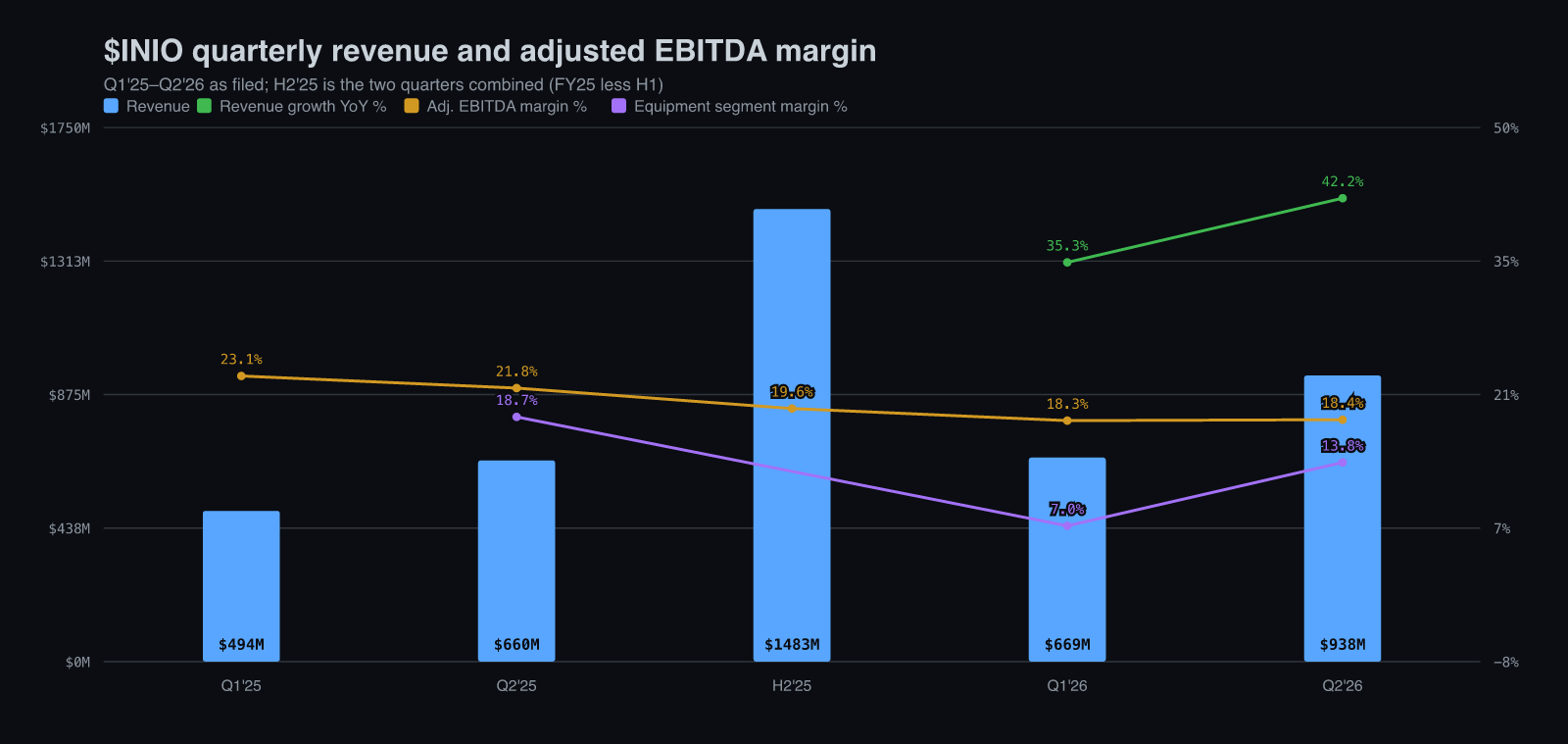
The quarterly series is where the inflection shows. Revenue was $494 million in the first quarter of 2025 and $660 million in the second, the two later quarters added $1,483 million, then $669 million in the first quarter of 2026 and $938 million in the second, up 42% on the year. The adjusted EBITDA margin went the other way: 23.1% and 21.8% in the 2025 quarters shown, about 19.6% in the second half, then 18.3% and 18.4%, and inside that the equipment segment's margin fell to 7% in the March quarter before recovering to 13.8% in June, against 18.7% a year earlier. Management's explanation is checkable: the first data-center orders were priced low to win the reference sites, containerized scope carries more pass-through cost, and the plants are being expanded ahead of volume. Equipment is guided to exit 2026 at a high-teens margin.
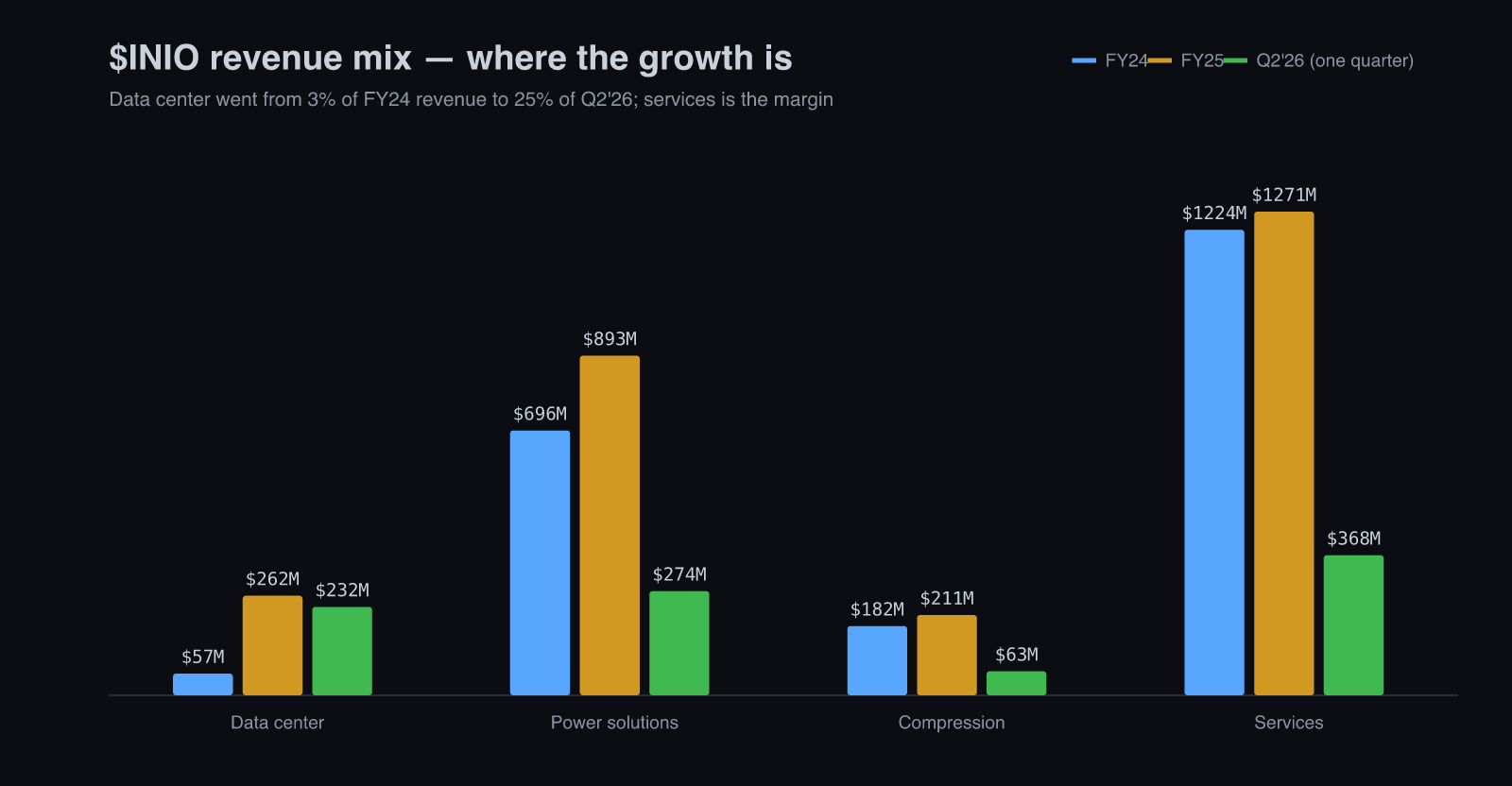
The mix is the story, and the data-center line is most of the growth. Data-center equipment revenue was $70.5 million in 2023, $57.2 million in 2024 and $261.8 million in 2025, which is 3.5%, 2.6% and 9.9% of total revenue, and then $232.4 million in the June 2026 quarter alone, 24.8% of the quarter's revenue and 40.8% of its equipment revenue. Power solutions, the decades-old core, grew 28% to $892.6 million in 2025 and 51% in the June quarter on European biogas and Type 6 peakers; compression grew 16%; services grew 4% and then 21%. Of the $478 million of revenue growth in 2025, data center produced $204.6 million, or 43%, from a line that had been 2.6% of the company; of the $278 million of growth in the June quarter it produced 41%. The order book says the share keeps rising: data center was 59% of 2025 equipment intake and about 64% of the 15 GW of committed business.
The market it is chasing is measured by its competitors' books rather than a forecast: $GEV has sold heavy-frame turbine slots for 2032 delivery, Caterpillar is lifting large reciprocating output to nearly three times 2024 levels while quoting deliveries up to 46 months out, and Wärtsilä's US data-center engine book passed 1.6 GW. INNIO delivered 3.4 GW of engines in 2025, 0.7 GW in the March quarter and 1.3 times the prior year's rate in June, and its backlog alone equals 2.9 years of trailing equipment revenue. This is not a commodity engine winning on price; it is a specific 24-cylinder machine winning on a specification the others do not have.
Technology & Moat
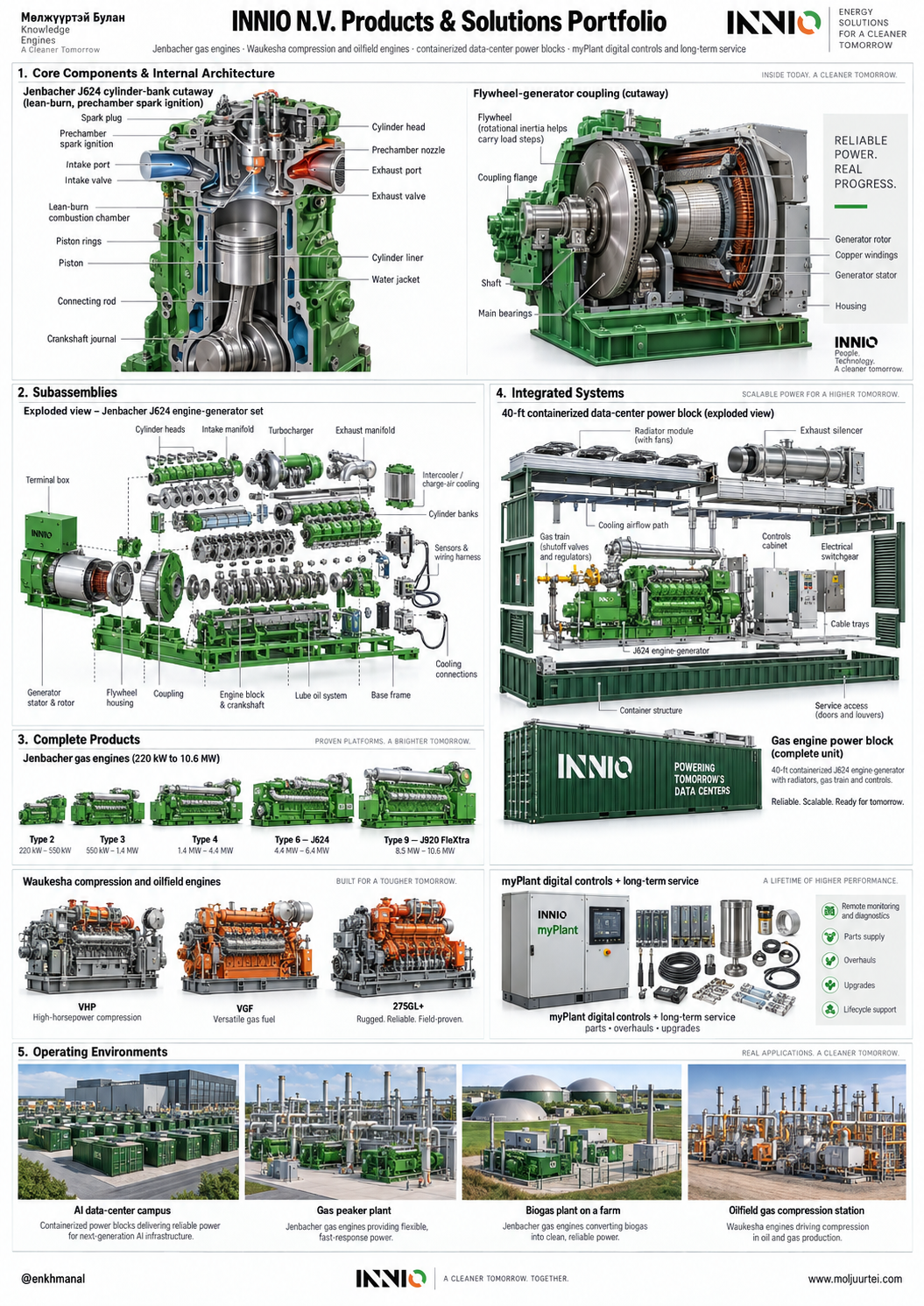
A reciprocating gas engine burns natural gas inside cylinders to push pistons, exactly as a car engine does, and turns a generator with the crankshaft. What separates INNIO's Type 6 from the rest is size and speed together: the J624 has twenty-four cylinders in a V, runs at 1,500 rpm, and produces 4.25–4.5 MW of electricity at about 45% electrical efficiency from a block that fits in a standard forty-foot container with its generator, radiators and controls. Medium-speed engines from Wärtsilä and Everllence make 10–20 MW per unit but run at 500–1,000 rpm, weigh several hundred tonnes and need a powerhouse; high-speed engines from Caterpillar and Cummins ship in containers but top out at 2.5 MW, so a gigawatt needs 400 of them and 400 sets of switchgear, catalysts and oil systems instead of 235. The J624 is, in management's words on the first call, "the only high-speed gas engine solution in the 5 MW class" — the one unit that is both containerized and big.
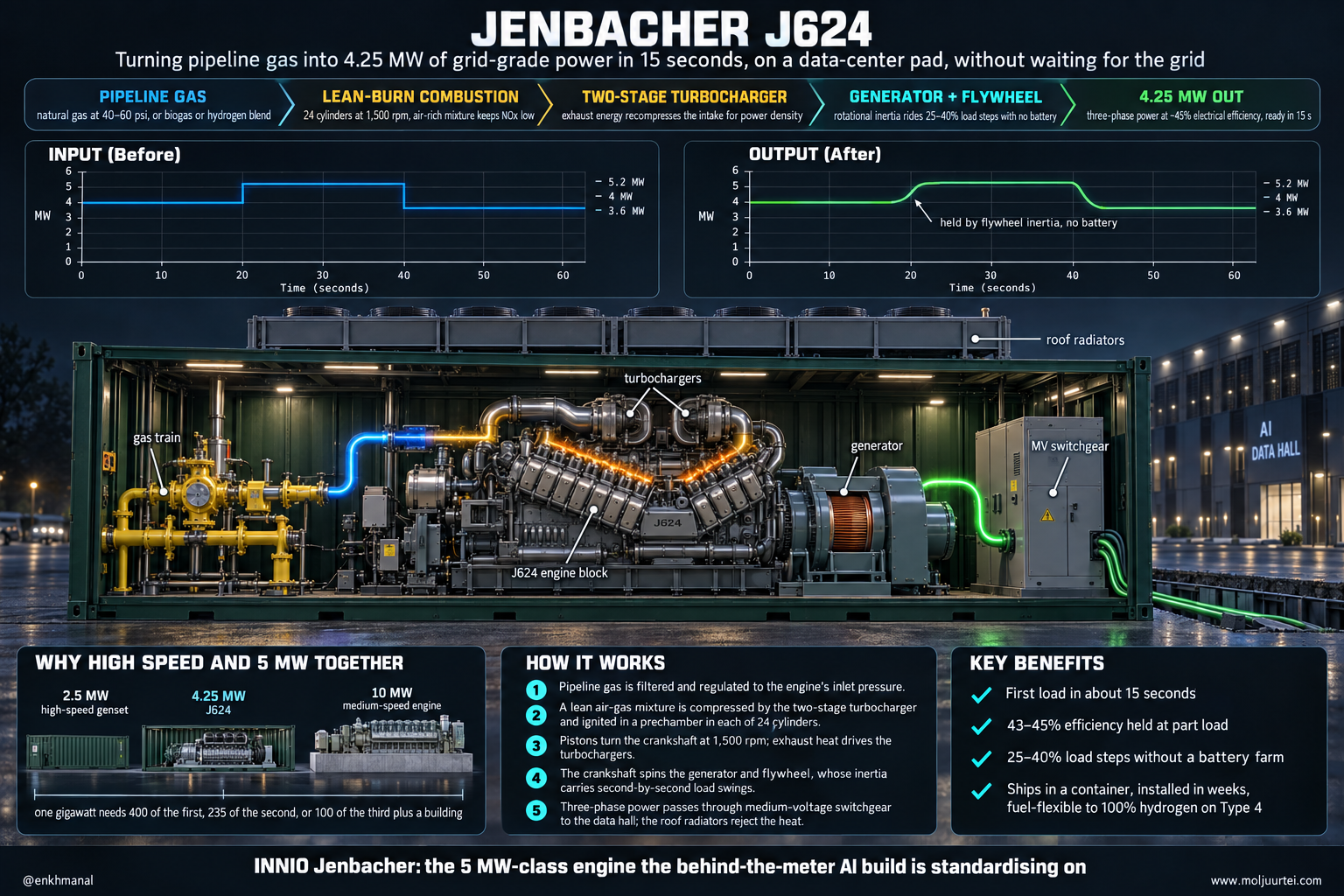
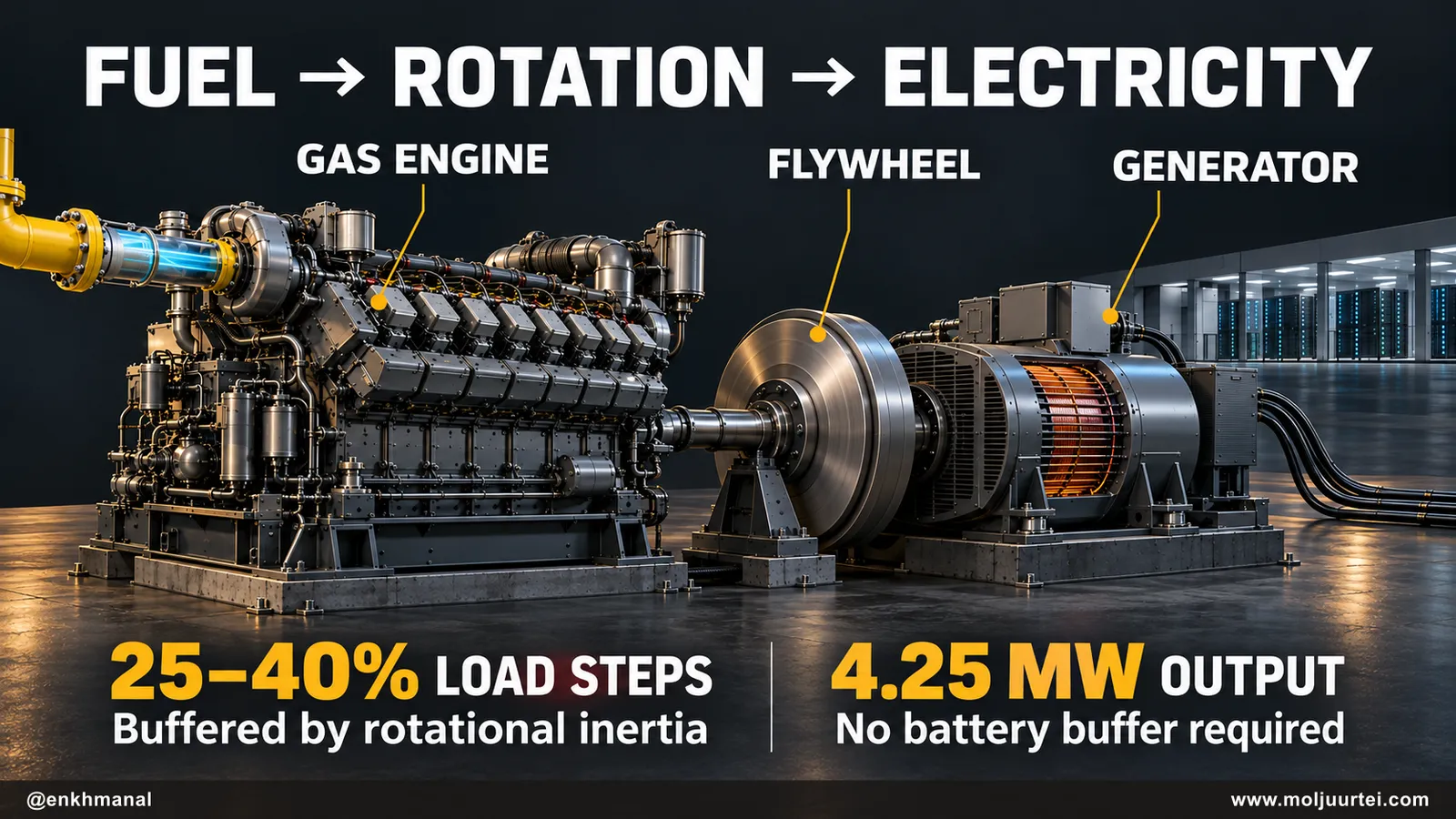
Why the specification matters is the load. A training cluster steps its draw up or down by a quarter to a third in under a second when a job starts, checkpoints or fails; a grid absorbs that with the inertia of thousands of spinning machines, an island with whatever is on site. A turbine holds its emissions performance only above roughly half its rated load and needs a battery bank to ride the steps; the J624 handles 25–40% load changes on the rotational inertia of its own flywheel and generator, reaches first load in about 15 seconds from a signal, and holds 43–45% efficiency at part load where a turbine's falls off. It is also fuel-flexible (pipeline gas, oilfield associated gas, biogas, and the Type 4 has run on 100% hydrogen since 2020), and the radiator-cooled package needs almost no process water, which turbines with water injection do. BloombergNEF's June 2026 on-site-power study puts the gas engine's levelized cost at $103 per MWh against $106 for a simple-cycle turbine and $140 for a fuel cell.
The moat has two layers, and neither is the patent. The first is the factory: the Type 6 block, the cylinder heads and the control system are proprietary, which is why service capture on the fleet is structurally high — a data-center operator running an engine 8,000 hours a year does not experiment with third-party parts on the machine that keeps the GPUs on. Management's number is that new orders carry "service intensity substantially above the average of the installed base," because a prime-power engine reaches its 30,000-hour overhaul in under four years where a peaker takes fifteen. The second is the slot itself. Reservations are non-tradable, tied to one project, and carry a non-refundable down payment; a developer who holds a 2028 slot has something a competitor cannot buy, and the company has said it is releasing slots deliberately as each capacity step proves out rather than selling the whole curve. The moat is thinner above and below the 5 MW class, where Caterpillar's G3520 and Enchanted Rock's 0.5 MW gensets win the smaller sites and Wärtsilä's 50SG the powerhouse projects, and in the balance of plant, where INNIO buys generators (India's T.D. Power Systems is a named supplier) and switchgear like everyone else.
Roadmap & R&D
The next two years are a capacity ramp with dates on it, and every date is public. Production capacity was about 3.5 GW a year in 2025. A new assembly line and the de-bottlenecking of the Jenbach campus, plus a new machining site a few minutes away in Hall, Austria, take that to roughly 7 GW; the expansion of Waukesha, Wisconsin and Welland, Ontario adds the rest from 2028 to reach about 10 GW by 2030. Two new US sites, Trenton, New Jersey and Waller, Texas, do nothing but containerization and packaging, the step that turns an engine into the product a data center buys, sited next to the customers so a power block does not cross the Atlantic twice. Management said on July 28 that June-quarter deliveries were already 1.3 times the prior year's rate, that the Jenbach line "is delivering already right now," and that the program is funded from operating cash flow because customers' down payments keep manufacturing cash-positive. Capital expenditure was $94 million in the first half against $39 million a year earlier, and a further >$300 million Waukesha expansion was announced on August 19.
The product roadmap is narrower than the capacity one, and that is a feature. Research and development was $103.5 million in 2025, 3.9% of revenue; the money goes to three things. Hydrogen: the Type 4 has run on 100% hydrogen since 2020, the rest of the range takes 25% blends, and the June 2026 3 MW demonstration of hydrogen backup for a data center was witnessed by the customer's own engineers — it matters less as a product today than as the answer every air-permit hearing wants about what these plants burn in 2035. Power density: the J624 got a rating uplift to 4.5 MW, and the 10.6 MW J920 FleXtra is being sold into utility peakers like the 104 MW Greenville, Texas plant. And controls: myPlant, the fleet-monitoring platform, is what lets a customer run 200 engines from one room, and is where the service agreements are administered. What INNIO is not building is a turbine, a fuel cell or a battery; it has chosen to own one node of the stack and package around it, with $ABB supplying the automation in the VoltaGrid racks. The dated gates: the Q3 print on October 27 (consensus revenue $1.04 billion, EBITDA $194 million), the lock-up expiry around December 1, the first full-year results and 2027 guide in February, the Jenbach ramp through 2027, Waukesha online in 2028, and the first 30,000-hour overhauls on the data-center fleet in the early 2030s.
The Setup — Why It's Mispriced
The market is pricing INNIO as a good industrial at the wrong point in its cycle. At $21.15 the 750 million shares are worth $15.9 billion, net debt on the June balance sheet is $1.58 billion ($2,619 million of term loans less $1,040 million of cash), and the enterprise value of about $17.4 billion is 23.9× the midpoint of this year's guided EBITDA. That is Caterpillar's multiple (25× trailing) for a company growing revenue at 46% against Caterpillar's single digits, and it is where $INIO itself traded at the $17.45 low on September 14, against 44× at the $42.95 high on June 22. The stock has round-tripped 59% up and 59% down on the same guidance; what changed was not the business but who owned it.
What a slot is worth is arithmetic the customers have supplied: SemiAnalysis puts a power plant for 1 GW of IT load at about $5 billion against inference revenue on the order of $100 billion a gigawatt a year at list prices, and even on Electron Economics' correction, Anthropic's whole-company run-rate of $65 billion, the plant pays back in a month. Either way, a customer paying a deposit for a 2028 slot is buying the difference between energizing in 2028 and in 2031, and the company's own comment on the call, "if the demand is high and delivery is limited, you are always in a good position to do something on prices," is that recent bookings carry margins above the historical average. That pricing has not reached the income statement yet: the equipment margin fell to 7% and then 13.8% because the first reference projects were priced to win and the plants are being expanded ahead of volume. The gap between the backlog's margin and the reported margin is the setup.
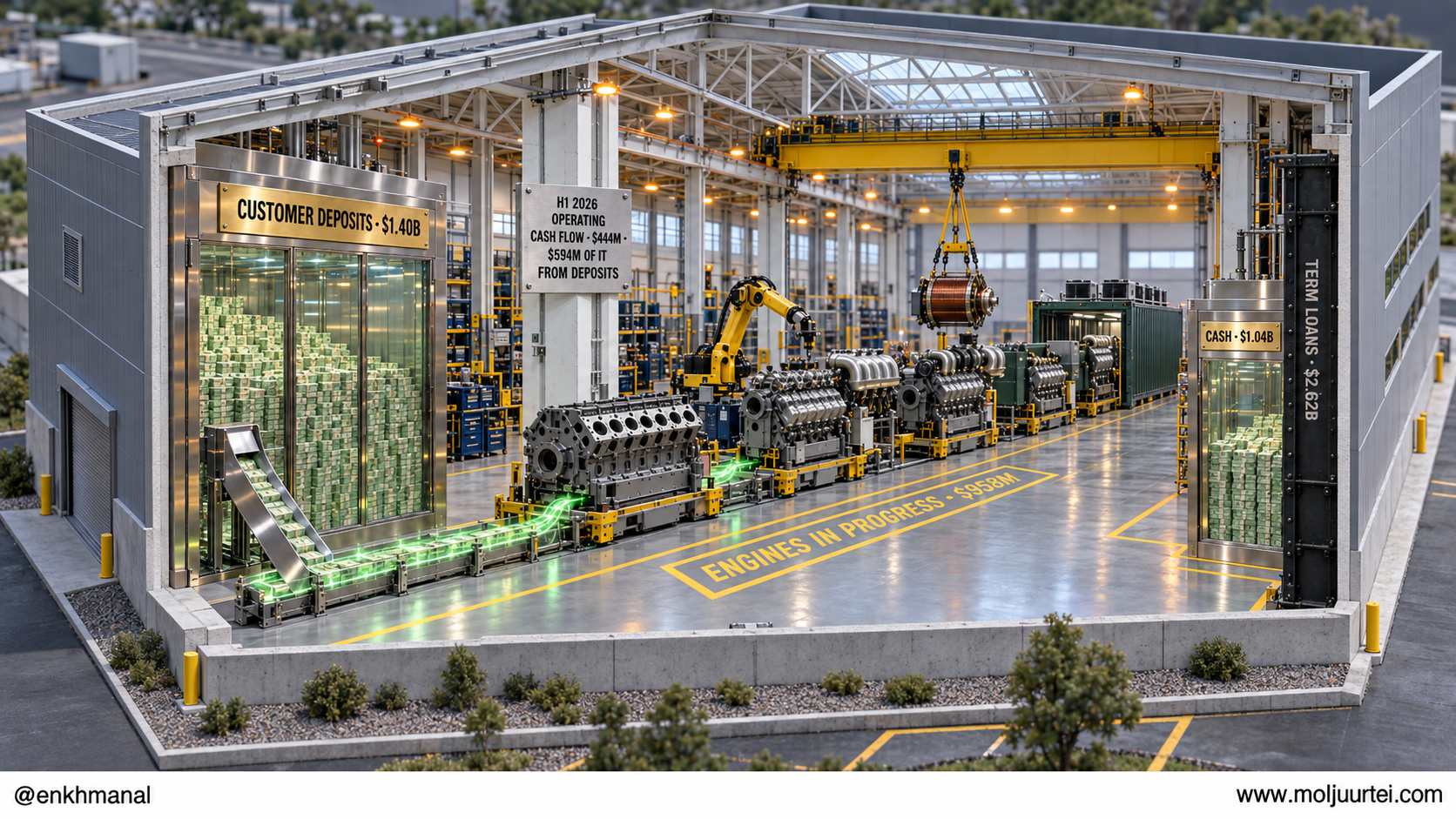
Cash tells a more complicated story than profit, and the complication is the whole business model. INNIO generated $547.9 million of operating cash flow in 2025 on $549 million of adjusted EBITDA, a conversion of 100%, and $443.6 million in the first half of 2026 on $294.8 million, a conversion of 150%. Both numbers are the customers'. Contract liabilities, the deposits customers pay when they book an engine, rose $506.1 million in 2025 and $594.5 million in the first half of 2026, to $1,397 million on the June balance sheet; take those out and 2025's operating cash flow was about $42 million and the first half's about −$151 million, because inventory rose $379.7 million as the factories filled with engines ordered and not yet shipped. Free cash flow of $397 million in 2025 and $349 million in the first half is real cash in the bank, and also cash the company owes in the form of engines. On the balance sheet, "down payments keep manufacturing cash-positive" means $1.04 billion of cash against $1.40 billion of deposits, with $2.62 billion of term loans underneath. Net debt of 2.7× EBITDA is against a covenant-free target of 2.0×, and the company chose to describe the capacity expansion as self-funded — it is, by the customers.
The quarter that just printed is the bull case in numbers with one asterisk. Revenue of $937.7 million beat consensus by 6%, adjusted EBITDA of $172.3 million beat by 18%, equipment intake of $2.3 billion was a record with the 1.1 GW order under 30% of it, the 2026 guide came in above the Street on both lines, and free cash flow was $205 million. The asterisk is GAAP: a net loss of $16.9 million against $62.4 million of profit a year earlier, on $81 million of IPO cost, a $61.5 million accrual for the pre-IPO incentive plan, and interest expense that doubled to $52.9 million on unrealized currency losses on dollar loans held in euro entities. None of it recurs at that size, which is why the trailing EV/EBITDA of 31× overstates what a buyer pays for the 2027 business.
The corroboration from either side of the invoice is unusually direct. The customers: $IREN reported three-year GPU contract pricing up about 125% since November with 2026 sold out, and $CORZ is billing 437 MW of a 1 GW book while $AMD holds an option on 2 GW more; the power INNIO's engines make is the input those contracts sell. The competitors: $GEV's chief executive said at Laguna that the market signal is "the cash that customers provide to us," that 40 GW of gas-turbine commitments were signed in the first half, and that slots now sell for 2032, which is the queue that sends a 2027 project to INNIO. The supplier side: Doncasters, which casts the hot-section blades for the turbine makers, said on August 11 that it is in "allocation mode" in industrial gas turbines until its own capacity doubles in 2029. Three companies at three points in the chain describing the same shortage from their own side of it.
Management & Track Record
The record on the operation is a good one. Berlien and Schulze took a carve-out that made $2.0 billion in 2023 to a $3.85 billion guide three years later, and the roadshow numbers (3.5 GW to 10 GW, self-funded, high-teens equipment margin by year-end) are the ones they repeated on the first call. Two things are worth naming plainly. First, this is a team that has run the business for a private-equity owner for seven years, and the financial architecture is that owner's: the $2.6 billion of term loans, the February 2026 refinancing, the 25,000-share pre-IPO structure that produced the 2023 incentive accrual, and a June IPO that was 100% secondary. Second, the only Form 4 activity is the June 2026 initial filings and the equity plan; no officer has bought a share in the open market, and none has sold one, in a stock that has traded between $17 and $43. Both facts will still be true in December, when the sponsor's lock-up ends.
Risks & What Breaks It
What forces a thesis change: two consecutive quarters with equipment intake below equipment revenue; an equipment segment margin still below 15% at the fourth-quarter print in February; a disclosed cancellation or re-sequencing of one of the gigawatt-class orders; or a sponsor secondary priced with a discount wide enough to say the buyers of the deal have a different view of 2028 than the buyers of the engines.
Price Setup — Levels, Technicals & Options
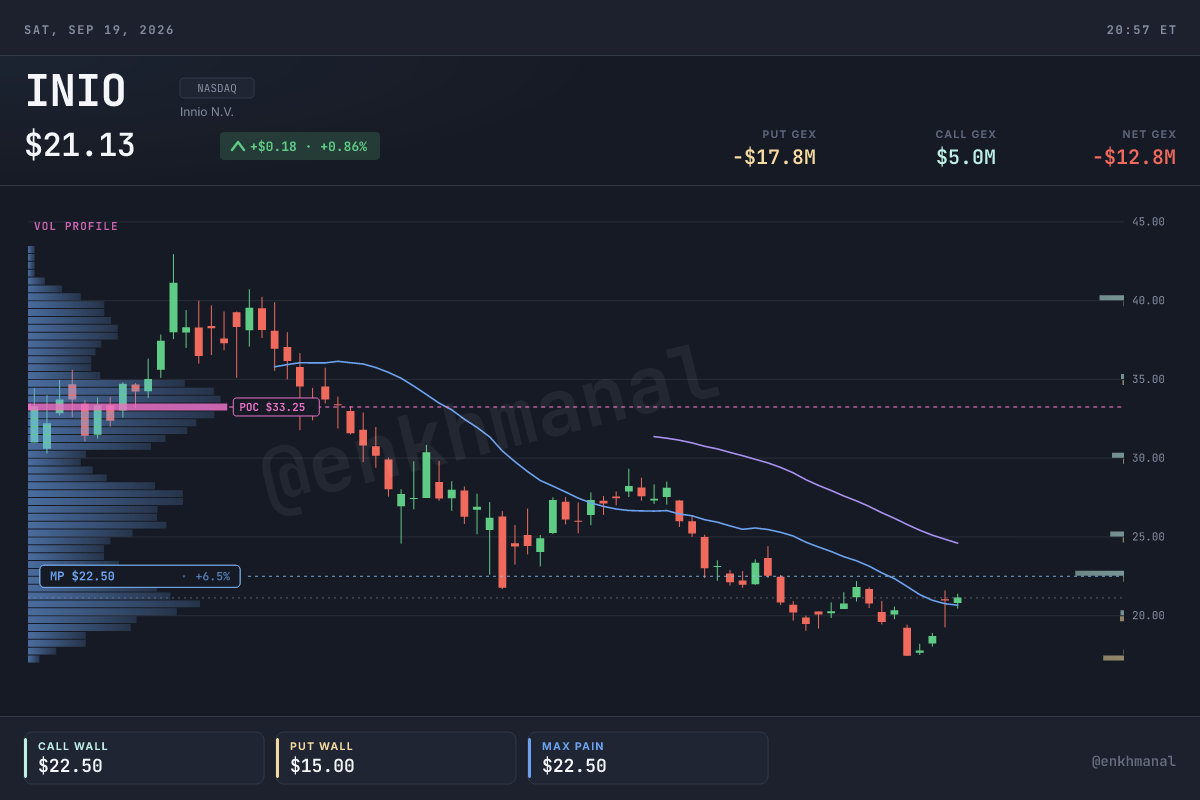
The chart is a three-month IPO chart. The deal was priced at $27, opened at $31, closed its first day at $33.30, ran to $42.95 on June 22 as index buyers and momentum funds arrived, and then fell for twelve weeks to $17.45 on September 14 as the first public quarter's margin compression met a summer sell-off in everything AI-adjacent. From that low the 450 MW order produced a 13% week and a close at $21.15, above the 20-day average ($20.67) but below the 50-day ($24.60). The levels are simple: $17.45 is the low and the level at which the market questioned the thesis; $22.50 is the September consolidation top and the first resistance; $27 is the IPO price, where the deal's original buyers get whole; $33 is the first-day close. RSI is 47, a neutral reading after a 21% bounce.
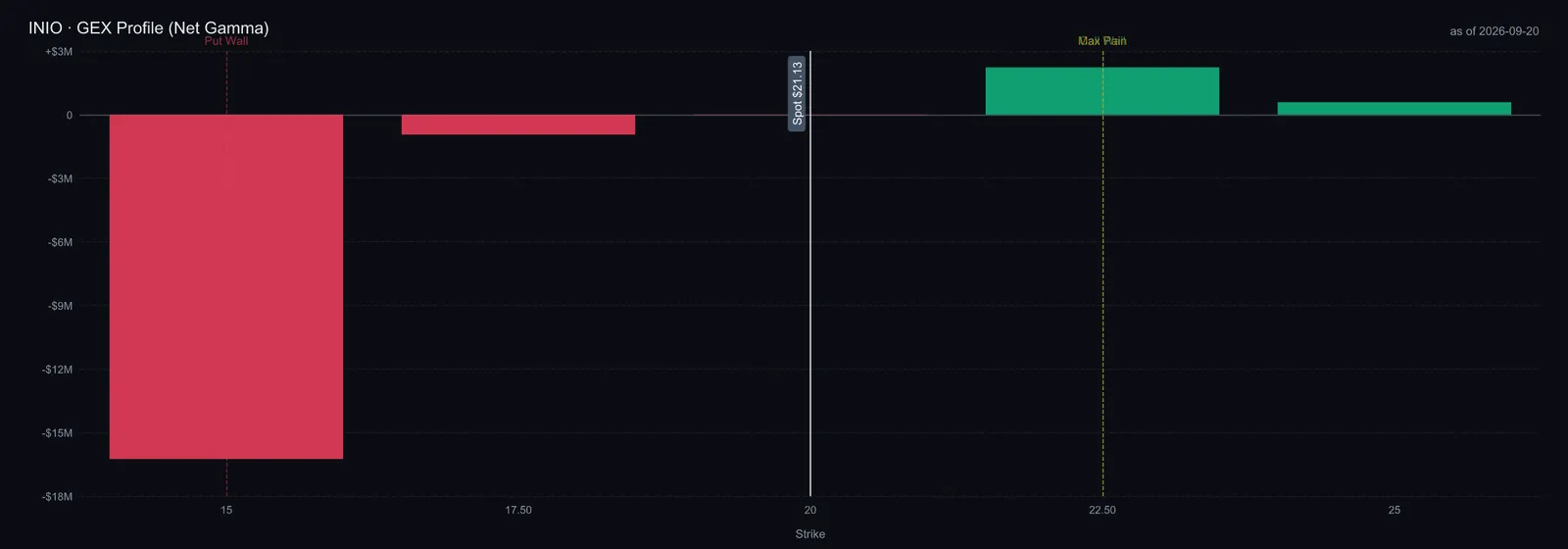
Dealer positioning is thin and lopsided. Across the five listed expiries open interest is 19,940 puts to 3,133 calls, a put-call ratio of 6.4, with net gamma of about −$13 million: small in dollars, but negative, which means the dealers who sold those puts are short the stock against them and will sell more into weakness. The call wall sits at $22.50 with max pain at the same strike, and the put wall at $15, below the September low; no gamma flip resolves on a chain this small. Short interest is 15.7% of a float of about 104 million shares. The read is that the derivatives market is positioned for a supply event, not a demand one: the puts are the lock-up hedge, and the level at which the market is questioning the thesis is not the $17.45 low but the December calendar. A close above $22.50 on the Q3 print would clear the only structural resistance below the IPO price.
Valuation & House View
The workbench cannot seed a model for this name yet (no 10-K, so no filed annual actuals to anchor on), and the valuation below is built by hand from the prospectus and the 10-Q. On this year's guide, $INIO trades at 23.9× EV/EBITDA and about 4.5× EV/sales. Its own three-month range runs from 22× at the September low to 44× at the June high, so today sits in the bottom decile of the only history it has; against that history it is cheap, and against the nearest engine peers it is not: Cummins trades at 15.7× trailing EBITDA and Caterpillar at 25×. Against the names selling the same shortage it is inexpensive, with $GEV at 62× trailing and $BE at 187×. On our 2027 estimate of about $5.0 billion of revenue at a 21% margin ($1.05 billion of EBITDA, from the capacity ramp toward 7 GW and the guided high-teens equipment margin annualised), the multiple is 16.6×, which is where Cummins sits today for a business growing a tenth as fast. No trailing P/E applies: the first public half was a loss on one-off costs.
Three cases, each the same arithmetic: 2028 adjusted EBITDA, a multiple, less net debt, over about 760 million diluted shares, two years out.
Probability-weighted, that is about $31, or 47% above the last close, with a bear case that is a real loss. $INIO is a name worth owning, and the way to own it is in two steps: a starting position now, at a multiple the stock has only seen at its own low and that Cummins commands for a business growing a tenth as fast, and the second half after the sponsor's lock-up resolves, since a December secondary priced in the low twenties would be the entry the June buyers never got. The Q3 print on October 27 has to show equipment margin on the way to the high teens and intake still above revenue; if it does, the $22.50 call wall goes first. INNIO's engine is the unit the AI power build is being assembled from, and for the next three years the question is not whether the world wants more of them but whether Jenbach and Waukesha can make them fast enough, which is the same thing the customers, with $1.4 billion of deposits, have already decided.