$HALO Deep Dive — The Enzyme That Turns an Infusion Chair Into a Five-Minute Injection
$HALO owns the only human enzyme approved to open the skin's hyaluronan barrier, and ten of the biggest biologics on earth now go under the skin because of it. Royalties grew 50% last quarter, the company has already told us how the stream decays, and the market is paying about 12× next year's earnings for a business at a 66% operating margin.
The two-millilitre limit
Modern medicine's best drugs are too big to swallow. A monoclonal antibody weighs roughly 150,000 daltons, about 400 times a molecule of aspirin, and the stomach digests it like any other protein. So for thirty years the answer has been a needle into a vein and a chair for the afternoon: three to seven hours for a first dose of daratumumab, ninety minutes for trastuzumab, an infusion suite, a nurse, and a pharmacy that compounds each bag by hand. That worked when biologics were rare. It stops working when the same clinic has to seat a multiple myeloma patient every month for years, and when the drug's dose is measured in grams.
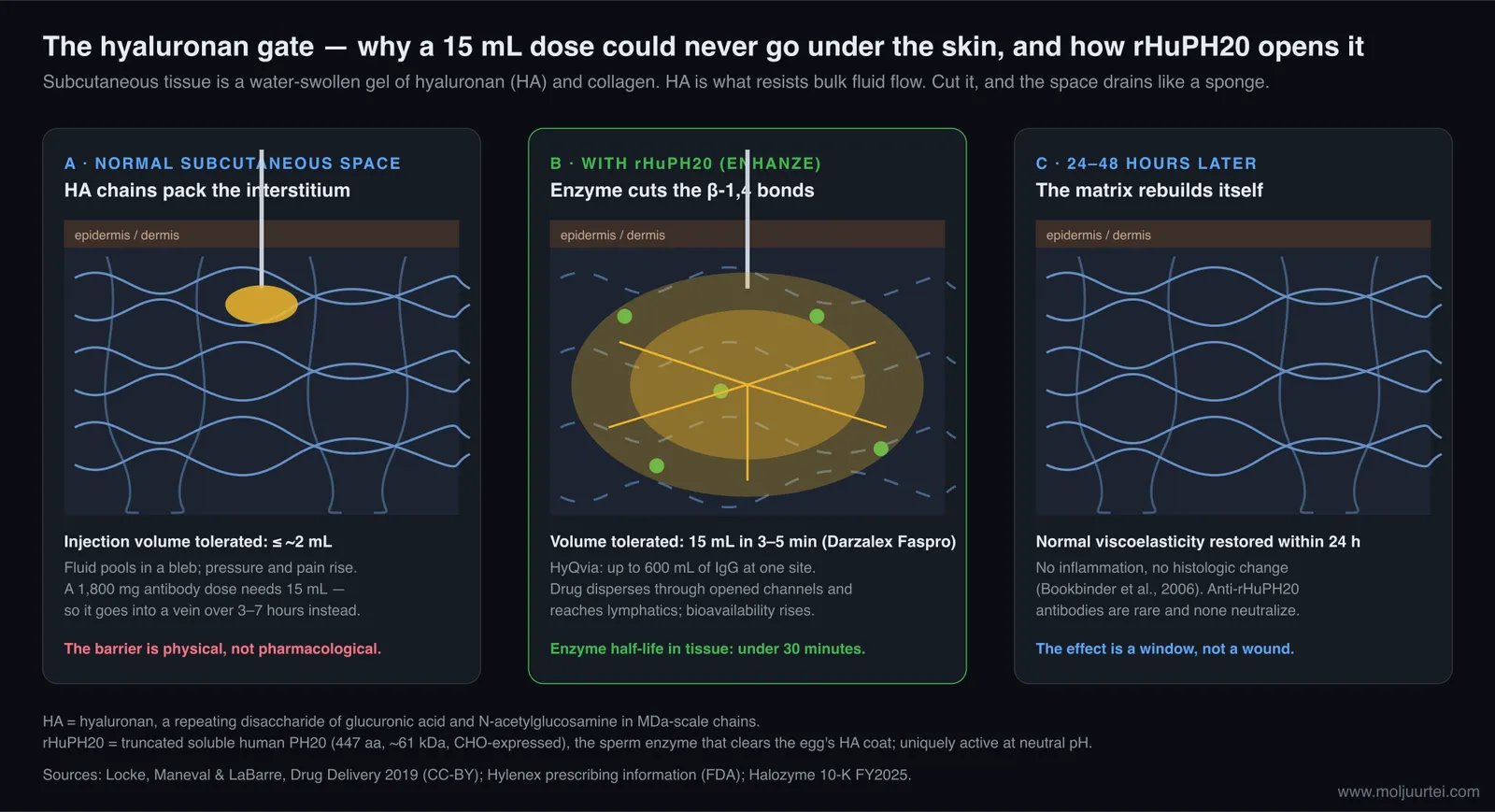
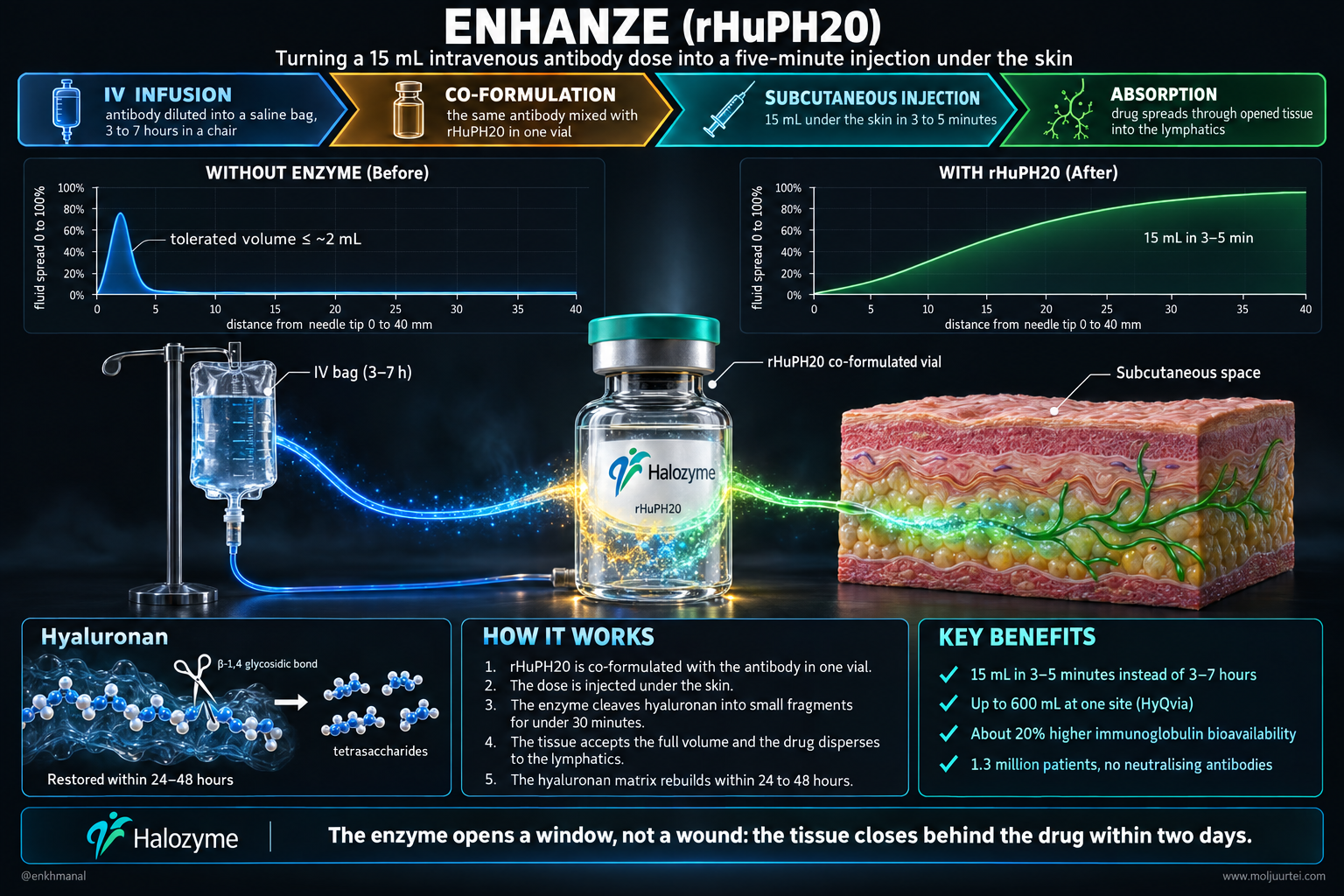
Start here. A biologic is a protein drug, usually an antibody, grown in living cells rather than synthesised in a flask. An intravenous infusion is that protein diluted into a bag of saline and dripped into a vein, because a vein will accept any volume you give it. Subcutaneous tissue is the layer of fat and connective tissue just under the skin, where a nurse gives a flu shot. Hyaluronan is the long sugar chain that fills the spaces in that tissue and holds water like a gel, which is why the skin is springy and why a subcutaneous injection larger than about two millilitres pools, hurts and refuses to spread. A hyaluronidase is an enzyme that cuts hyaluronan, and the one $HALO makes, rHuPH20, is a recombinant copy of the human version.
What changed is that the industry discovered it could remove the two-millilitre limit rather than work around it. In 2020 the FDA approved Darzalex Faspro, daratumumab co-formulated with rHuPH20, and a 15 mL dose that used to take hours became a three-to-five-minute injection with the same response rate. Within four years more than 90% of a $14 billion franchise had moved under the skin, on a drug that was already the standard of care. Roche did the same with Herceptin, then Phesgo, then Ocrevus. Bristol did it with Opdivo. Argenx launched Vyvgart Hytrulo. The pattern is the same each time: the originator keeps the patient, the clinic gets its chair back, the payer pays for less nursing, and the biosimilar that arrives later has to compete against a version of the drug that patients prefer.
This is now the dominant lifecycle strategy for a large biologic, and the reason it is investable today rather than in 2015 is scale. The ten ENHANZE products on the market address roughly $30 billion of combined IV plus SC sales by 2028 on the company's own count, thirteen more are in development, and the two next-generation formulation technologies $HALO bought last winter target the doses even rHuPH20 cannot yet help. One company sells the enzyme every one of those launches uses, and takes a royalty on the sales of each. That company is $HALO, and the science of how it does it is the subject of this memo.
A technology company paid in royalties
We think $HALO is a technology company that happens to be paid in royalties, and the market is valuing the royalties while ignoring the technology.
The technological advantage is a single molecule with a fifteen-year safety record. rHuPH20 is the only recombinant human hyaluronidase approved anywhere, it has been given to more than 1.3 million patients across ten co-formulated products, and it carries no neutralising antibody signal in that database. Every competitor in subcutaneous conversion has to either license it, engineer around it, or accept a smaller dose. $MRK chose to engineer around it with a modified enzyme for Keytruda and is now defending fifteen patent challenges and three injunction actions across two continents to keep doing so. That is the tell for how valuable the original is.
The growth is arithmetic. Royalties were $360 million in FY22 and $868 million in FY25. Management now guides $1.22 to $1.25 billion for 2026 and $1.46 to $1.51 billion for 2028, on the ten approved products only, with nothing from the thirteen in development, nothing from Hypercon, and nothing from Surf Bio. The four newest launches (Ocrevus Zunovo, Opdivo Qvantig, Rybrevant SC, Tecentriq Hybreza) grew 80% quarter on quarter in Q2 and are in the first eighteen months of curves that historically run seven to ten years.
The thematic backdrop is the biosimilar wave and the IRA together. Every originator with a $5 billion antibody facing patent expiry in 2028 to 2032 is looking for a version of the drug the biosimilar cannot copy, and a subcutaneous co-formulation protected by its own patents is the cleanest answer the industry has found. The five deals $HALO signed in the first half of 2026, including $GSK's first antibody-drug conjugate and the first nucleic acid program, are that demand showing up.
The bet is that royalties keep compounding through the 2027 rHuPH20 composition patent expiry because the money sits on product-specific co-formulation patents that run to 2032 and beyond, that Hypercon and Surf Bio open a second curve from 2030, and that a business guiding to 60%-plus operating margins and 70% free-cash-flow conversion re-rates from 12× to something closer to what a compounding royalty stream of that quality is usually worth. If we are wrong, the company has told us exactly how: 66% of the current products' lifetime royalties land in 2026 to 2032 and only 9% after, so the years beyond 2032 have to be earned by the next generation.
Three revenue lines, one enzyme
$HALO makes money three ways, and the first one is most of it. Royalties are a mid-single-digit percentage of a partner's net sales of each ENHANZE product, paid quarterly, for a term that runs at least ten years from launch and is extended by product-specific patents. They were $867.8 million in FY25, 62% of revenue, and $307.7 million in the June quarter alone, up 50% on a year earlier. Product sales are bulk rHuPH20 shipped to partners for co-formulation, plus the company's own commercial lines: XYOSTED, a weekly testosterone auto-injector, and Hylenex, the standalone enzyme sold to hospitals. Collaboration revenue is upfront and milestone payments, $35.5 million in Q2 from the five 2026 deals, which is the lumpiest line and the one management tells analysts to discount.
The partner roster reads like a large-cap pharma index: $JNJ (Darzalex Faspro, Rybrevant SC), Roche (Herceptin SC, Phesgo, Ocrevus Zunovo, Tecentriq Hybreza), $BMY (Opdivo Qvantig), $ARGX (Vyvgart Hytrulo), $TAK (HyQvia), plus $PFE, $ABBV, $GSK, $INCY, $LLY, $VRTX and $ORKA in development. Darzalex is the anchor: about $483 million of FY25 royalties, roughly 56% of the line, on $14.3 billion of $JNJ's Darzalex sales of which more than 90% is now the Faspro form. $JNJ has guided that franchise above $18 billion by 2028 and added a new second-line indication with Tecvayli in March. Phesgo, Roche's fixed-dose Herceptin plus Perjeta, paid $105.6 million on 2.4 billion Swiss francs of sales with conversion still climbing from 54% toward 60%.
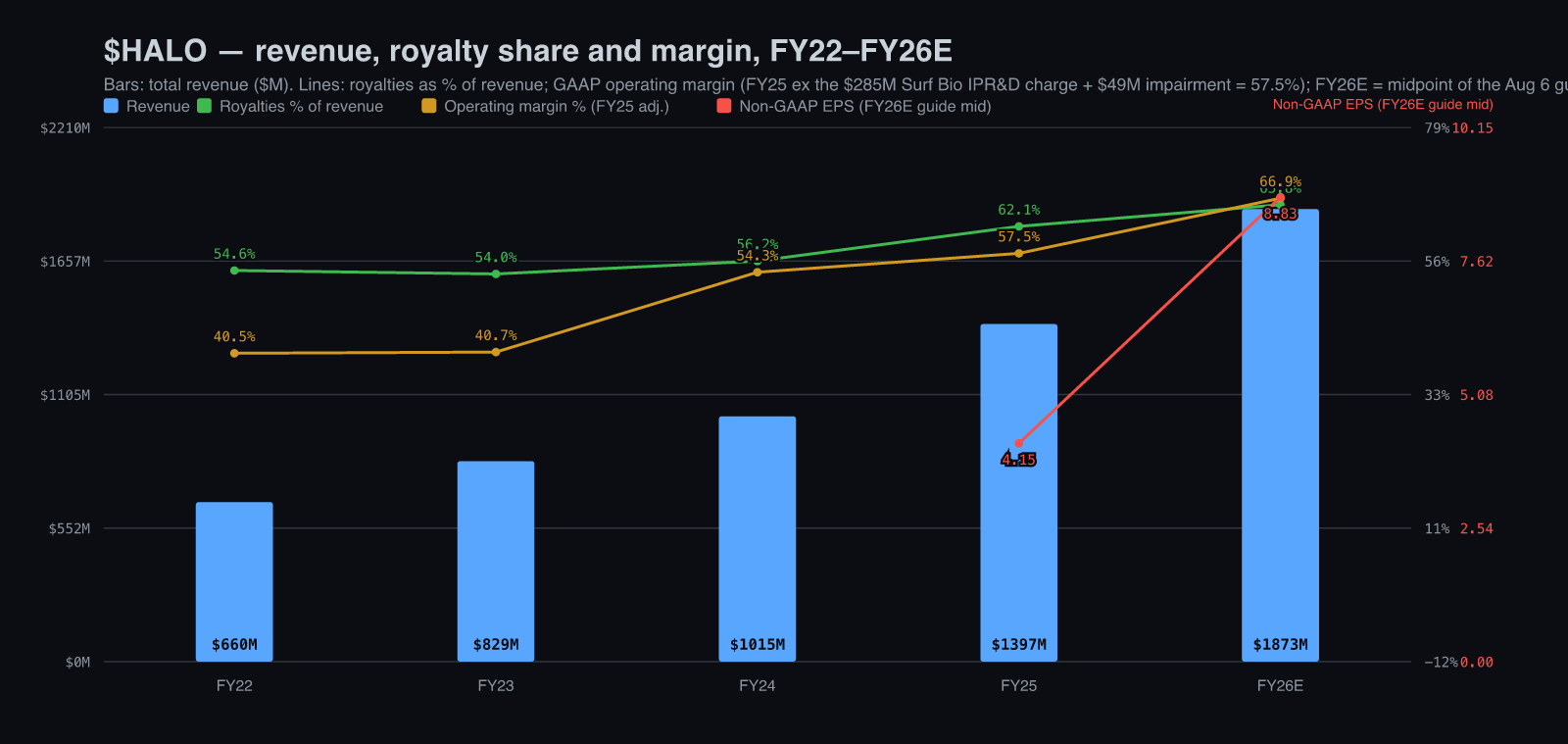
The financial shape is what a royalty mix does to a P&L. Revenue went from $660 million in FY22 to $1,397 million in FY25; royalties rose from 55% to 62% of the total; operating margin went from 40% to the high 50s on an adjusted basis, and the FY26 guide implies the high 60s. FY25 GAAP operating income of $469 million looks small only because it absorbs the $284.9 million Surf Bio in-process R&D charge and a $48.7 million write-down of a legacy Antares program; strip those and the underlying margin was already above 55%. There are 423 employees. Cost of goods is the enzyme itself, which the company makes at contract manufacturers and ships in kilograms.
The quarterly series shows where the mix turned. Royalties were $236.0M in Q3 2025 (+52% YoY), $258.0M in Q4 2025 (+51%), $240.7M in Q1 2026 (+43%) and $307.7M in Q2 2026 (+50%), against total revenue of $354.3M, $451.8M, $376.7M and $481.0M. Royalties were 67% of total revenue in Q3 2025, 57% of total revenue in Q4, then 64% of total revenue in each of Q1 and Q2 2026, the dip being the Q4 API shipment bulge rather than any royalty weakness. GAAP operating margin printed 61.5%, a loss (the quarter that absorbed the $284.9M Surf Bio charge), 49.0% and 59.8%; adjusted EBITDA margin ran 70%, 68% ex the charge, 61% and 68%. The first-quarter dip in both royalties and margin is a pattern, not a break: Q1 2025 revenue of $264.9M likewise followed Q4 2024's $298.0M before the next three quarters set records.
The industry arc is that subcutaneous delivery has moved from a nice-to-have to the default for any biologic with a long treatment duration. The partners' own prints say so. $JNJ's June quarter reported Darzalex up 20% year on year with Faspro carrying the growth. Roche's half-year showed Ocrevus Zunovo, launched in late 2024, already on more than 17,500 patients. $ARGX reported Vyvgart Hytrulo taking the majority of new Vyvgart starts and won a seronegative myasthenia label expansion in Q2 that adds about 20% to the addressable population. On the other side of the ledger, the strongest confirmation of the category is a competitor: Alteogen's ALT-B4 enzyme, licensed to $MRK for Keytruda Qlex, produced roughly $590 million of Qlex sales in the first half of 2026 in its launch year, and Alteogen signed about $4.5 billion of biobucks in new licenses this year with $NVS, $BIIB and $GSK. When the second player in a market is signing at that scale, the first player's technology is not a niche.
One molecule, four layers of moat
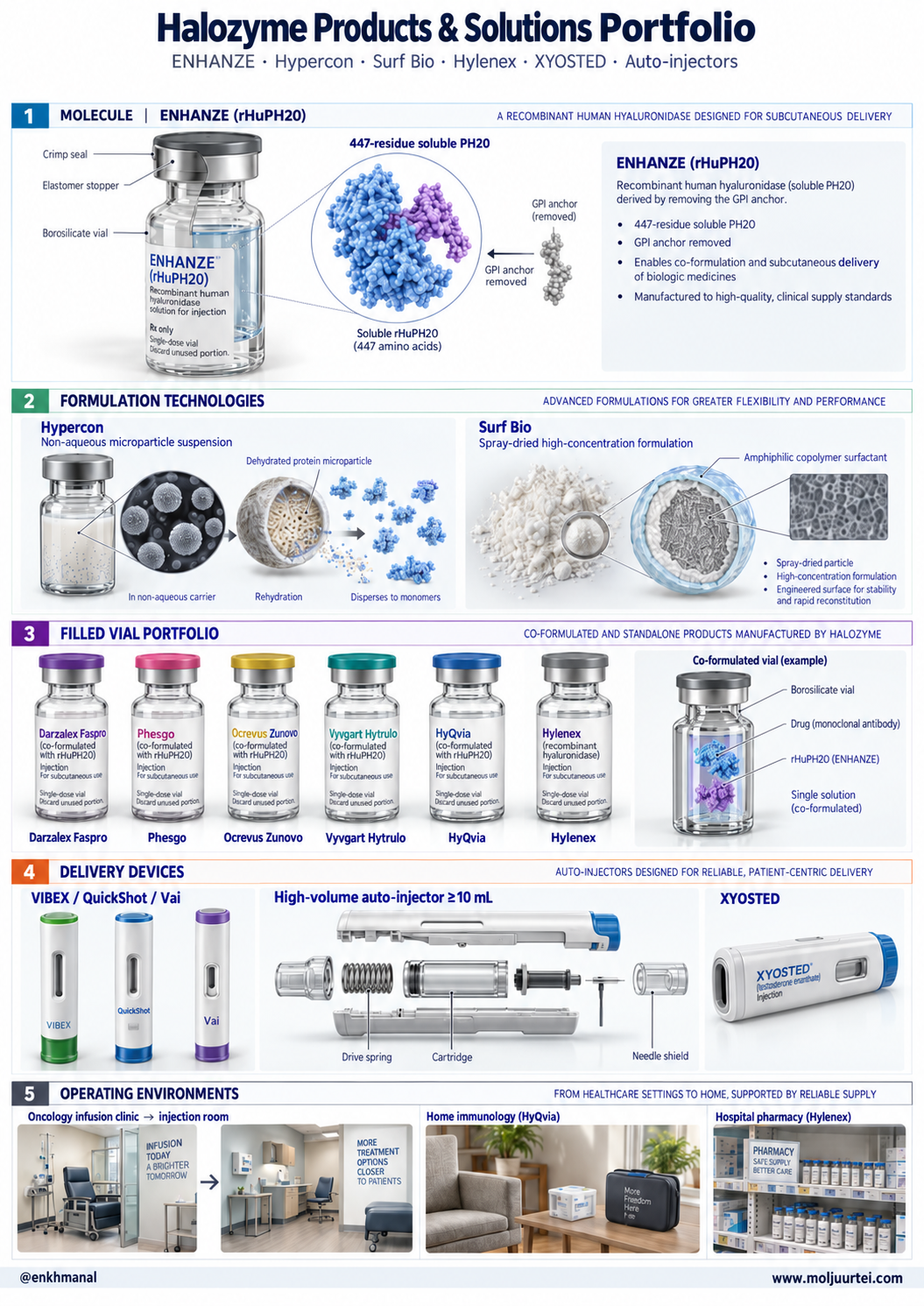
What $HALO actually makes is a 447-amino-acid protein, about 61 kilodaltons, produced in Chinese hamster ovary cells and purified into a clear liquid. It is human PH20 with its membrane anchor removed. In the body PH20 lives on the head of a sperm cell, tethered by a lipid tail, and its job is to dissolve the hyaluronan coat around an egg so the sperm can reach it. It is the only human hyaluronidase that works at the neutral pH of living tissue; the others are lysosomal enzymes tuned to acid. Cut off the anchor and the same enzyme becomes soluble, injectable and, at physiological pH, able to do to subcutaneous tissue what it does to an egg: cleave the β-1,4 glycosidic bonds of hyaluronan into small tetrasaccharide fragments that no longer hold water or resist flow.
The pharmacology is what makes this a product rather than a laboratory trick. rHuPH20 acts locally and transiently. Its half-life in tissue is under thirty minutes and the hyaluronan it removes is fully restored within 24 to 48 hours, with no inflammation and no histological change in the tissue. So the enzyme opens a window, the drug disperses through the opened channels into the lymphatics, and the window closes behind it. The measured effects in the co-formulated products are large: a 15 mL daratumumab dose delivered in three to five minutes, a 600 mL immunoglobulin dose at a single site with HyQvia, and about 20% higher bioavailability for immunoglobulin than the same dose given subcutaneously without the enzyme. Hyaluronidase itself is not new; the animal versions extracted from bovine and ovine testes have been used since the 1940s as spreading agents, but they carry an anaphylaxis risk and a foreign-protein immune response that made them unusable in a chronic biologic. Hylenex, approved in December 2005, was the first recombinant human hyaluronidase, and the immunogenicity data since have been the quiet foundation of everything after: anti-rHuPH20 antibodies are infrequent and none neutralise the enzyme.
The moat has four layers and the market usually counts only the first. Composition patents on rHuPH20 itself expire in the United States in September 2027 and in Europe in 2029; management has flagged a possible US manufacturing-patent extension to March 2029 but excludes it from guidance. Co-formulation patents are the layer that actually carries the royalty term: each partner product is protected by its own patents on the specific drug-plus-enzyme formulation, and the six issued so far have added thirteen to seventeen years of royalty duration per product. Darzalex Faspro's term now runs through 2032 in both the US and EU. Modified-hyaluronidase patents (the company's second, separate estate) cover engineered variants and run to 2032 to 2034 in the US and December 2032 in Europe; these are what $HALO is asserting against $MRK. The regulatory record is the layer nobody can buy: fifteen years and 1.3 million patients of pharmacovigilance behind a single excipient means a new co-formulation can cite the enzyme's safety rather than re-establish it, and a partner picking an alternative enzyme is choosing to run that risk on a multi-billion-dollar franchise.
MDASE, which is modified hyaluronidase, and suing Merck for using our IP is all upside for Halozyme. There is absolutely no read-through, no crossover into anything that can affect ENHANZE. It's a totally different patent estate.
We would put it plainly. The composition cliff in 2027 is real for anyone who wants to make generic rHuPH20; it is largely irrelevant to a $JNJ that is contractually bound to a royalty on Faspro until the Faspro patents lapse. The $MRK fight is on the modified-hyaluronidase estate, and Torley has repeated on every call this year that it does not touch ENHANZE.
The second curve is concentration
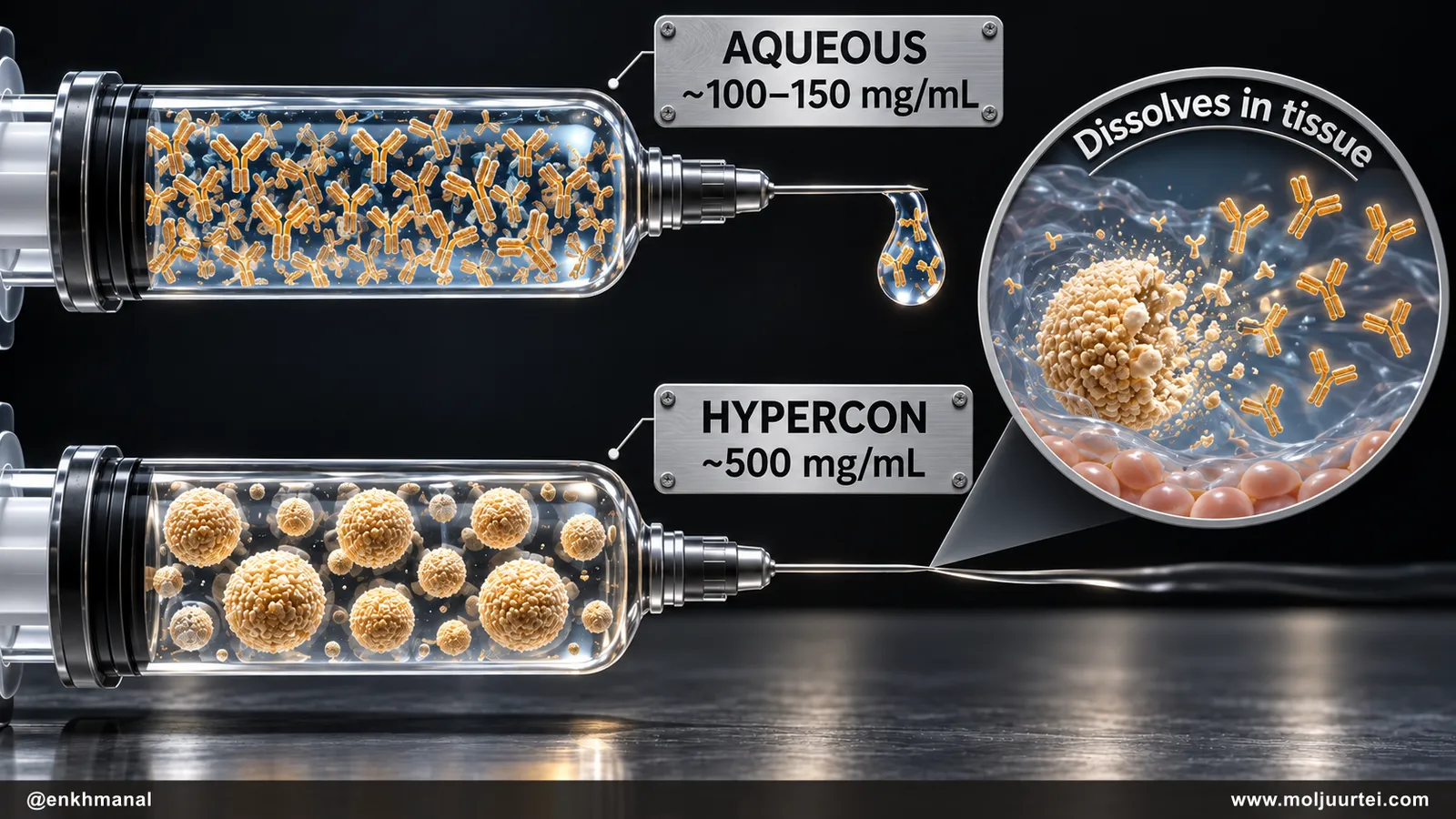
The next curve is concentration rather than volume. ENHANZE solves the problem of getting a large volume under the skin. It does nothing for the other constraint on a subcutaneous biologic, which is that proteins above roughly 100 to 150 mg/mL in water become too viscous to push through a needle, so a two-gram dose in a small volume is physically impossible today. Two acquisitions last winter attack that constraint from different directions, and both are now inside the company.
Hypercon, bought with Elektrofi for $810 million in November 2025, is a non-aqueous suspension. The protein is gently dehydrated into spherical microparticles, which are suspended in an inert carrier liquid. Because the protein is a solid particle rather than a dissolved molecule, the viscosity of the suspension is governed by the particle fraction, not by protein-protein interactions, and concentrations around 500 mg/mL, four to five times an aqueous formulation, become injectable through a standard needle. In the subcutaneous space the particles dissolve back to monomers. The first two Hypercon programs enter Phase 1 in the first half of 2027, launches are projected for 2030 to 2031, and management's stated aspiration is roughly $1 billion of Hypercon royalties by the mid-2030s. Five partners are signed ($LLY, $ARGX, $JNJ, $VRTX at $15 million upfront for three targets, and $ORKA), and the company says it has capacity for up to fifteen more targets. Deal structure matches ENHANZE: upfront, development and commercial milestones, then royalties for at least ten years with co-formulation patents able to extend the term.
Surf Bio, bought for $305 million plus $100 million contingent in December 2025 and expensed as $284.9 million of in-process R&D, is the second route to the same 500 mg/mL. It came out of the Appel lab at Stanford: the protein is spray-dried with a glassy amphiphilic copolymer surfactant excipient (the lab calls it MoNi) that sits at the protein surface and prevents the aggregation and viscosity that normally cap concentration. Surf Bio has been tested across antibodies and even small molecules. Having two orthogonal technologies matters for two reasons: a partner's molecule may suit one and not the other, and the two patent estates, both running into the mid-2040s, do not share a failure mode.
The ENHANZE pipeline is not standing still while the new technologies mature. Thirteen products are expected to be in development by year-end 2026, and 2026's five deals extend the enzyme into modalities it has not carried before: $GSK's program includes the first antibody-drug conjugate to use ENHANZE, an undisclosed partner is developing the first nucleic-acid therapeutic with it, and $INCY's INCA033989 (an antibody against mutant calreticulin, for myelofibrosis) joined in the spring. Management's own roadmap for ENHANZE launches is one possible in 2027 and multiple in 2029 through 2032. The device business, inherited from Antares, is building a high-volume auto-injector rated for 10 mL or more, which is the delivery form a 15 mL enzyme-enabled dose eventually wants to take at home. R&D spend is modest by biotech standards because the partners run the clinical trials; $HALO's own research is formulation science, enzyme engineering and device work, and the large charges in the P&L are acquisitions rather than trials.
A cliff in the market's model, a slope in the company's
The market's model of $HALO has a cliff in September 2027 and the company's model of $HALO has a slope from 2029. The difference between those two shapes is the investment. Start with what the company has actually disclosed. In January it gave the shape of the royalty stream on the ten approved products: about 25% of their lifetime royalties were earned by the end of 2025, about 66% fall in 2026 to 2032, and about 9% come after. The first step-downs are Darzalex in Europe and Vyvgart in 2029, and the Darzalex term ends in 2032 in both the US and EU. So the base case is not a cliff. It is seven fat years followed by a decline the company is already spending to fill: thirteen ENHANZE products in development for launches in 2027 to 2032, Hypercon launches from 2030 to 2031, and a deal engine that signed five licenses in six months.
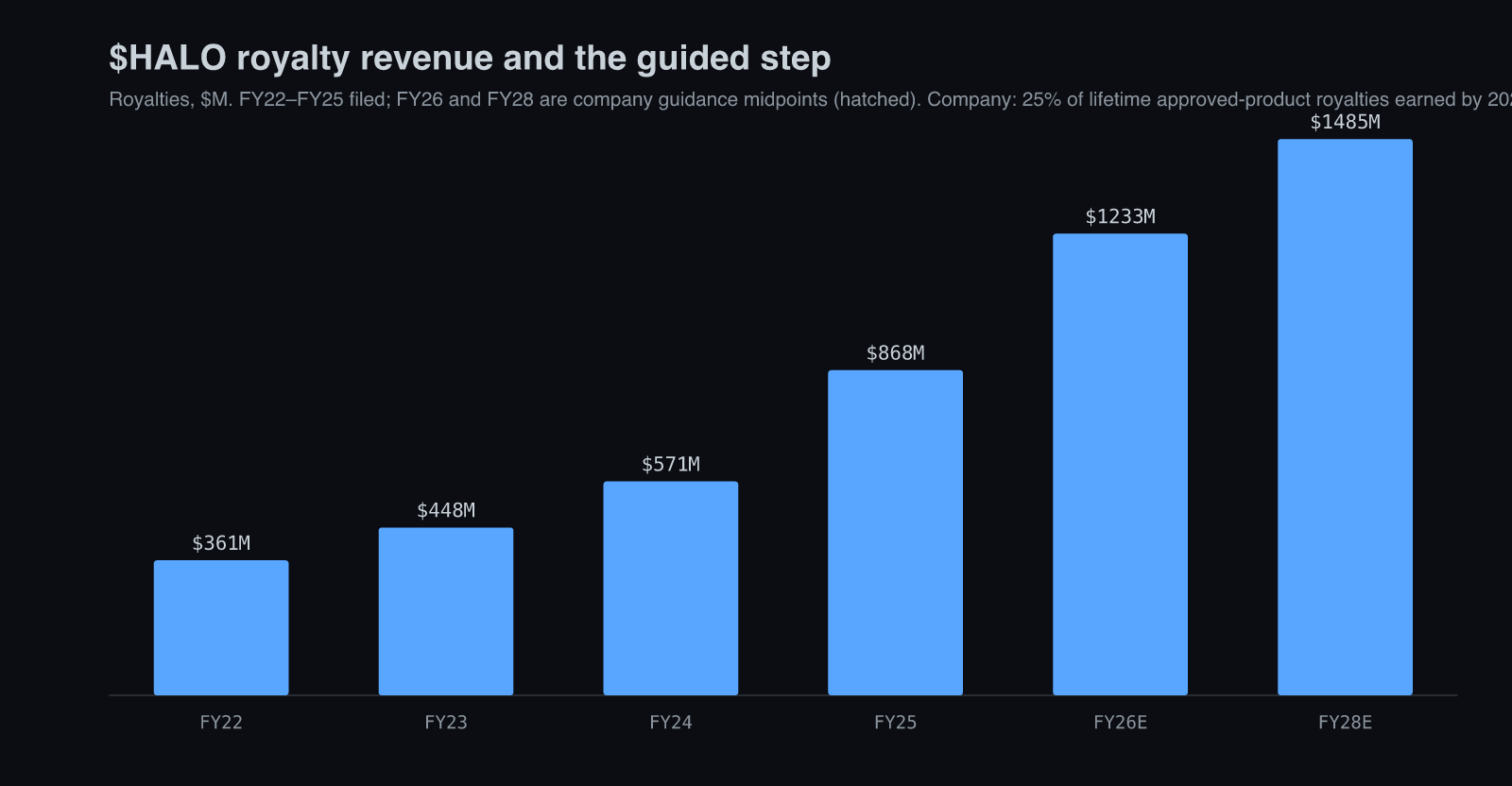
Now the numbers the guide puts on those years. For 2026: revenue $1.835 to $1.910 billion, royalties $1.220 to $1.245 billion, adjusted EBITDA $1.225 to $1.280 billion, non-GAAP EPS $8.65 to $9.00, all raised in August from the February ranges of $1.710 to $1.810 billion revenue and $7.75 to $8.25 EPS. For 2028: revenue above $2 billion, royalties $1.46 to $1.51 billion, non-GAAP EPS $10.50 to $11.10, gross margin above 80%, operating margin above 60% and free cash flow above 70% of EBITDA every year in between. Those 2028 numbers include the ten approved products and nothing else. A new launch, a Hypercon milestone or an out-of-court settlement with $MRK is upside to a guide that already implies 25% EPS growth a year.
Then the capital structure, which is where the September convert matters. The company priced $1.3 billion of 1.50% convertible notes due October 2033 at a $139.84 conversion price, 27.5% above the $109.68 reference, with capped calls to $208.39. About $652.5 million of the proceeds retire $151.7 million of the 2027 notes and $220.0 million of the 2028 notes, $162.5 million buys the capped calls, and the remainder funds the $1 billion repurchase authorisation that runs through 2028. In the June quarter alone the company bought $332.8 million of stock at an average of $69.30. The existing $750 million 2031 and $750 million 2032 converts and a $750 million revolver complete the stack; net debt was 2.1× EBITDA at year-end 2025 and falls fast against a $1.25 billion EBITDA year. We read the convert as management pre-funding a buyback with 1.5% money on a stock it thinks is cheap, and the capped call as the tell that they do not expect to be diluted below $208.
Why is it mispriced, then? Three reasons, in our reading. First, the trailing GAAP P/E screens at 32× because trailing EPS still carries the $2.30-per-share Surf Bio charge; on the 2026 non-GAAP guide the multiple is about 12×, and on the 2028 guide about 10×. Retail sees the PEG screen and institutions see the 2027 date. Second, the $MRK litigation is read as a threat to the royalty line when it is a claim against a competitor's product on a separate patent estate; a loss costs $HALO the upside of damages and an injunction, not any existing royalty. Third, biotech generalists price a royalty company on the drug it is most exposed to, and Darzalex at 56% of royalties looks like concentration until you notice that Darzalex is the drug $JNJ is guiding above $18 billion and has just extended into second-line therapy. The two Substack pieces we read closest, from the Market View newsletter and from Steve's Substack, split exactly along this seam: one values the engine, the other asks how long it runs. The company's answer is 2032 for the current engine and 2040-plus for the next two.
A record, not a pedigree
The record we would weight is Torley's. She joined a company that sold Hylenex and ran its own oncology trials, shut the drug pipeline in 2019 after PEGPH20 failed in pancreatic cancer, and rebuilt it as a licensing business whose revenue rose about 25-fold across her tenure. The board granted her a $10 million performance-only award in early 2026 that pays out solely on stock appreciation, which is the right shape for a CEO whose main job for the next five years is capital allocation and deal-making.
What we would watch is the turnover. The CFO seat changed twice in four months: Nicole LaBrosse left in March after leading the 2025 convert and the debt-facility extension, David Ramsay held it on an interim basis, and Snellgrove arrived in June. The chief operating officer, Cortney Caudill, departed at the end of June, nine months after being promoted into the role. None of these is disqualifying, and hiring $JNJ Pharma's former CFO is on its face a strong signal about the relationship that matters most, but the team executing a $1 billion buyback and a two-technology integration has less shared history than the CEO's tenure suggests. There are also a lot of Form 144 filings this year; insiders have been sellers into the run, which is normal after a stock doubles and worth noting all the same.
The cluster we cannot rule out
Pinned at the wall
$HALO closed at $109.68 on September 17 and traded around $109.84 as we wrote. The stock has risen approximately 59% from the $69 average the company paid for its own shares in the June quarter, gapped up on the August 6 print and made a new all-time high this month; the convert pricing knocked it back about 2% intraday and it recovered by the close. The 50-day average sits well below spot after a run that has not given back more than a few percent since July, so the chart is extended in the way a re-rating always looks extended halfway through.
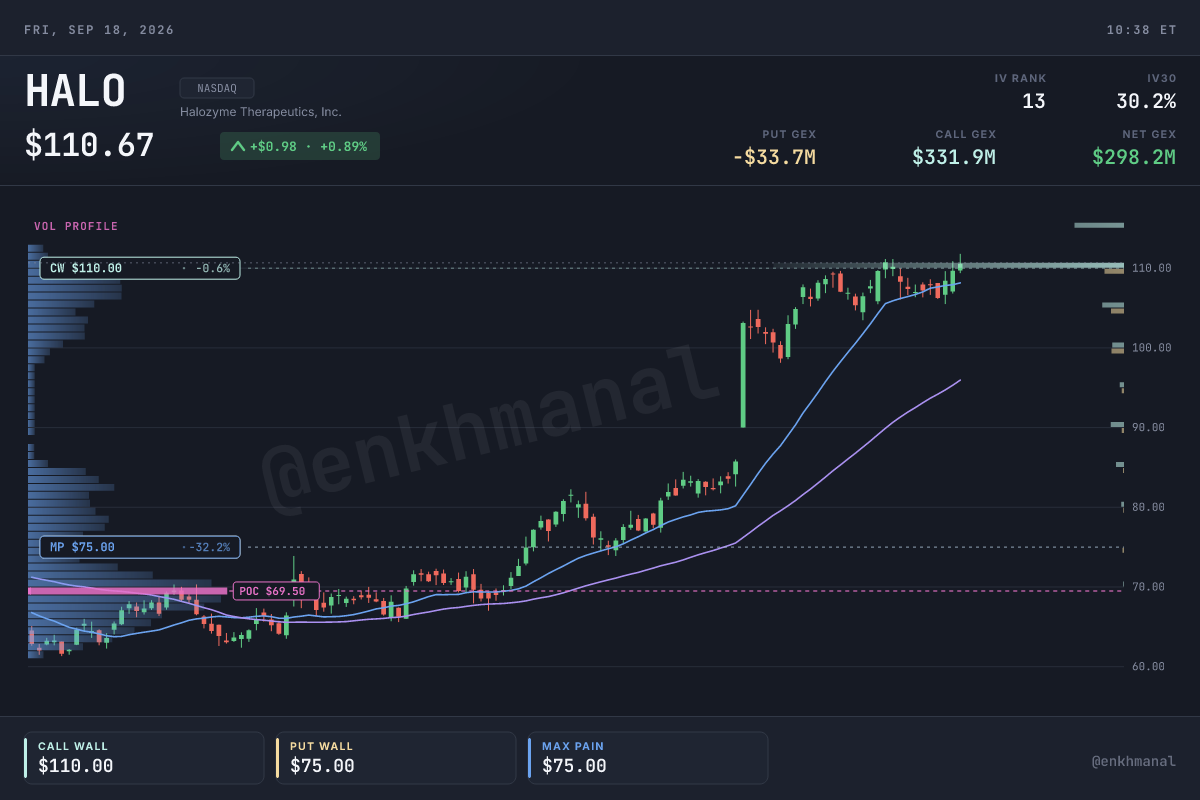
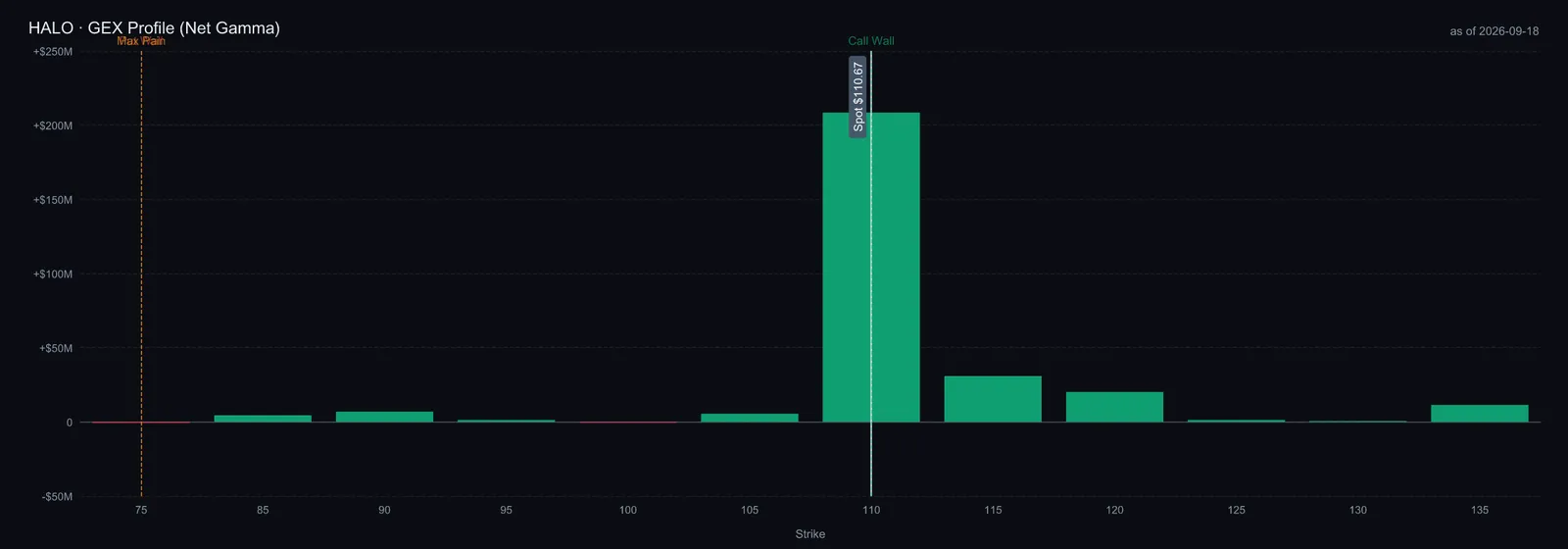
The options market is positioned for the stock to stall right here. Net gamma is positive at about $373 million, the call wall sits at $110, effectively at spot, and the put wall is far below at $75 with max pain at $75 and the gamma flip at $55. Dealers are long gamma into a strike the stock is pressing against, which tends to pin price until the position rolls or a catalyst breaks it; a close above $110 that holds through the September and October expiries would move the wall up and take the pin with it. Implied volatility of 30% on a stock that just doubled is not expensive, and the reference points are the Hague ruling in early October and the Q3 print on November 2.
Twelve times, for this
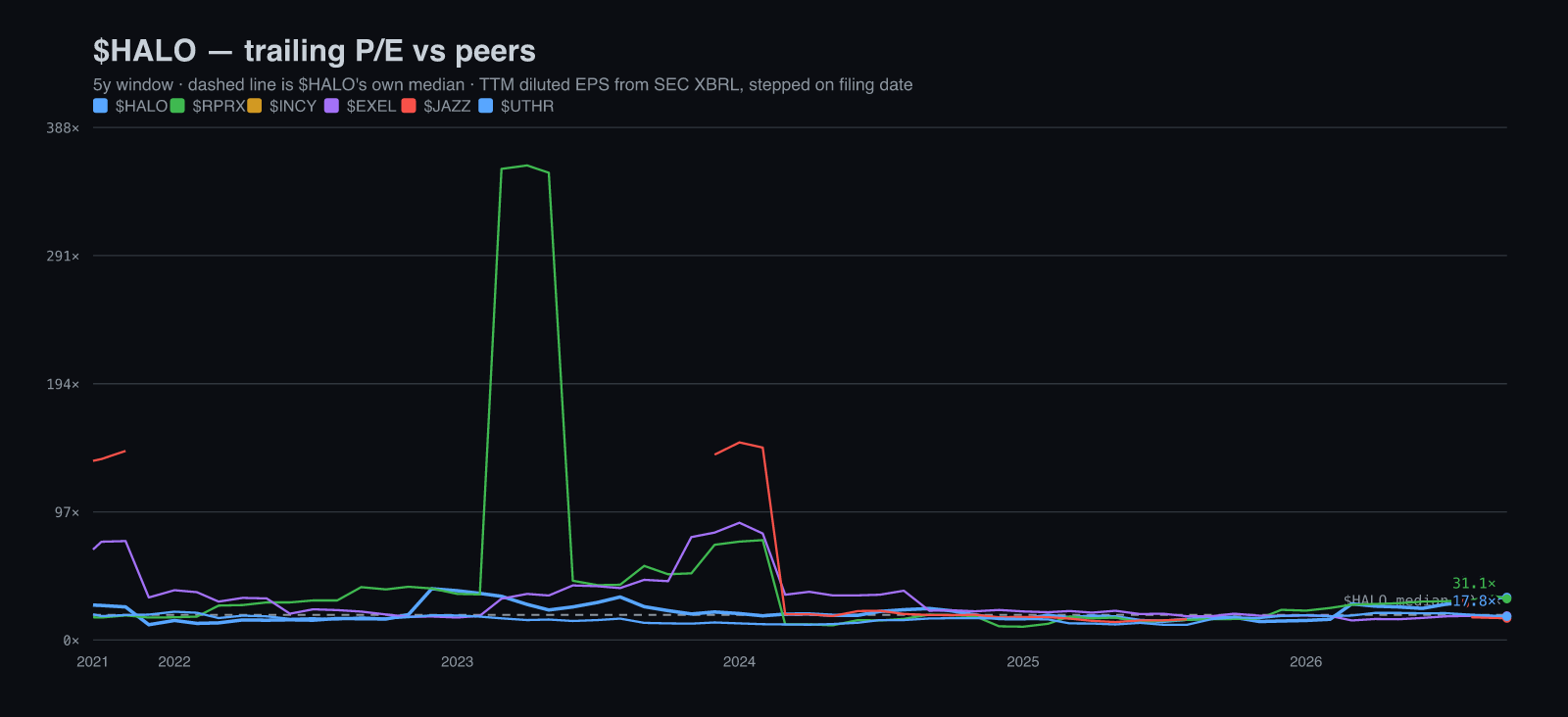
Twelve times next year's earnings for a business at a 66% operating margin growing royalties 40% is where we start, and the peer set is what makes the number interesting. On trailing GAAP earnings $HALO screens at 32×, in the 93rd percentile of its own five-year range, against a peer median of 19×; that is the Surf Bio charge in the denominator and it rolls off with the December quarter. On the 2026 non-GAAP guide midpoint of $8.83 the stock is 12.4×, and on the 2028 midpoint of $10.80 it is 10.2×. $RPRX trades at 31× trailing on a portfolio with no operating leverage; $EXEL at 18× and $JAZZ at 17× are drug developers with their own trial risk, and $UTHR at 18× sells its own drugs. A platform that carries none of that risk and compounds at this rate should not sit at the bottom of the group on forward earnings.
The scenarios below apply plain multiples to the company's own guidance; the spread between them is the 2032 question, not a view on the next two years, which every case takes as guided.
Our view is that $HALO is a buy at $110 with a base target of $150 over two years, and that the asymmetry comes from the 2028 guide being built on ten products the company already collects royalties on. The Model pane audits clean on the guided years, and the perpetuity method disagrees with the exit-multiple method by more than we like, which is exactly the 2032 question in numeric form; we quote the exit method because the company's own disclosure of the 25/66/9 shape is a better terminal assumption than a growth rate. What would change our view is a court decision that reads across from the modified-enzyme estate to the co-formulation estate, or a Hypercon Phase 1 that shows the microparticles do not behave in humans the way they do in the bench data. Short of those, the enzyme keeps opening the gate and the royalties keep walking through it.