$GFS Deep Dive — Silicon photonics at 300mm: from the copper wall to the light engine · Q3 prints 11 November
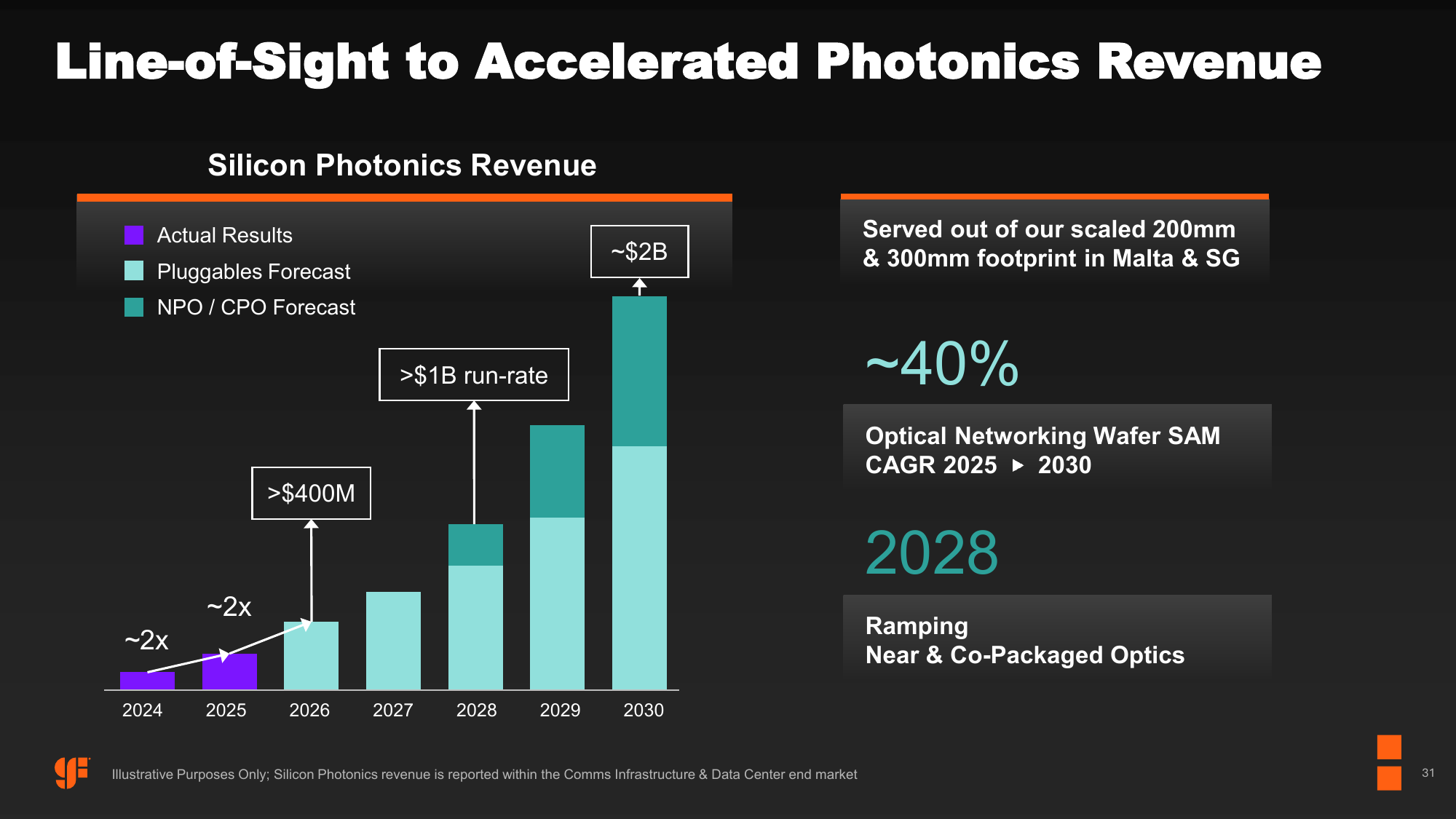
The AI data center has run into the speed limit of copper, and the industry's answer is to move data as light. $GFS is the only merchant 300mm fab that makes both halves of that link, the photonic chip and the silicon-germanium electronics that drive it, and the part of the company that sells them grew 62% last quarter while the whole company grew 6%. At $49.00 the shares sit on the 50-day average, 47% below May's high and 29% above the $37.85 the US Department of Commerce paid on 3 September; the Q3 print on 11 November is the next test of whether the optical line keeps compounding at 50–60% while the smartphone line shrinks.
From the copper wall to light
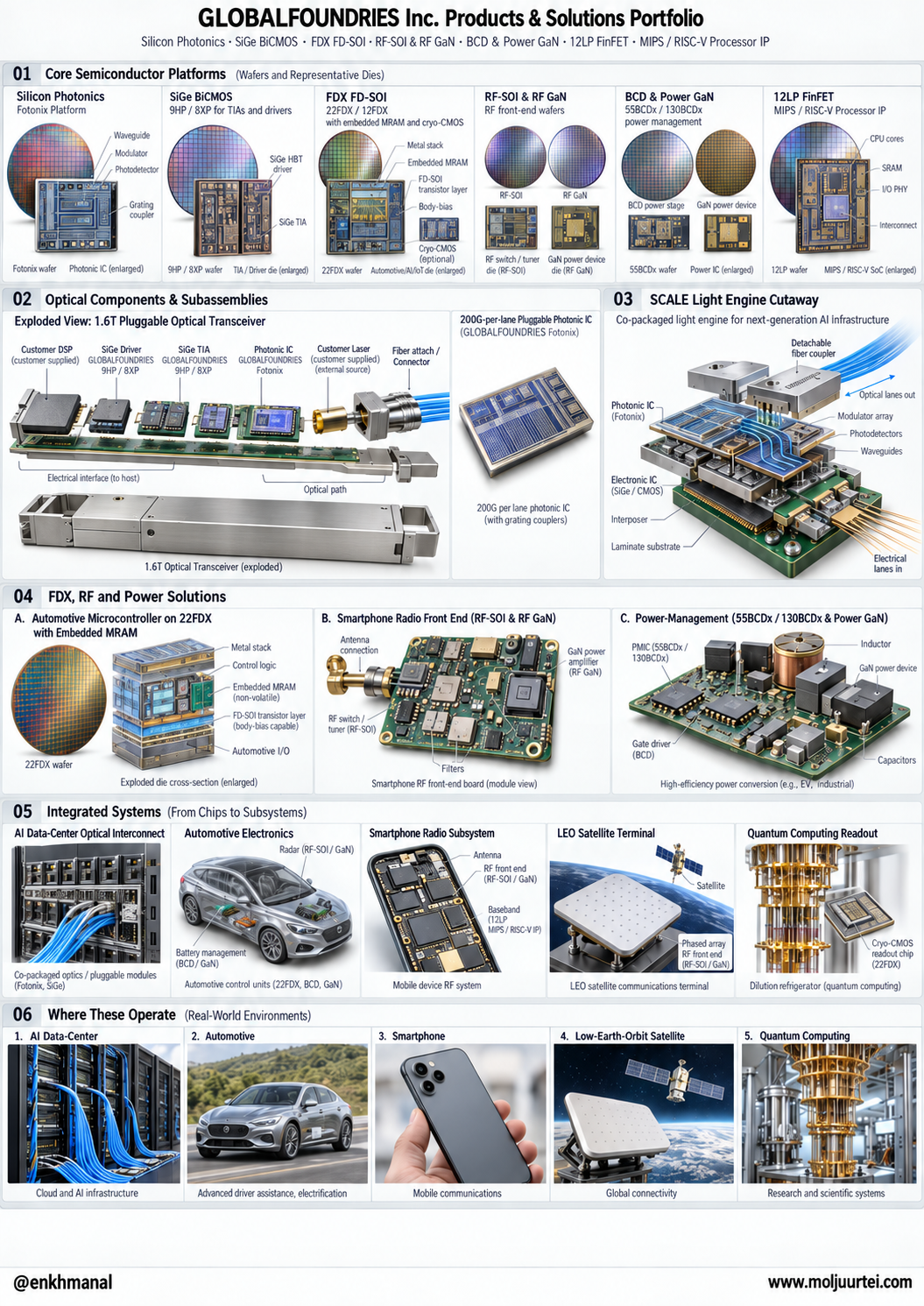
Start here. A computer chip is a slab of silicon carrying billions of switches. A data center is a warehouse of those chips wired together so they can work on one problem at once. A copper trace is the wire between two chips, and an electrical signal on copper loses strength with distance and with speed: push 200 billion bits a second down it and the signal is smeared and weak after a metre, so a power-hungry chip has to clean it up at each end. An optical fibre is a hair of glass that carries light instead of electricity, loses almost nothing over a hundred metres, and lets many colours share one strand. A photonic integrated circuit is a chip that turns electricity into light and light back into electricity: a modulator that dims a laser billions of times a second to write the bits, a waveguide (a glass channel etched into silicon) that carries them, and a photodetector that reads them back. Silicon photonics is the trick of making those optical parts in an ordinary silicon fab, on the same 300mm wafers and the same lithography tools that make transistors, so they can be built by the million rather than by the thousand.
For thirty years the wire that mattered was the one to the user. An AI cluster inverted that: the traffic that matters now runs east to west, between accelerators, because one training job or one inference request is sliced across thousands of them. Management's own figure from the March photonics webinar is the one to hold: an accelerator waiting on copper links can sit idle most of the time, and moving the links to optics is what lets its utilisation move "from as low as mid-teens to north of 80%". Copper, in the company's words, "becomes fundamentally challenged beyond 200G per lane", which is precisely the lane rate the industry is now shipping. That is the structural change. It turned optical interconnect from a nice-to-have at the edge of the rack into a requirement inside it, and in 2026 the compute and networking vendors codified it: the Optical Compute Interconnect standard for scale-up networks, founded by $AMD, $AVGO, $NVDA, $META, $MSFT and OpenAI, was published in March.
Three things happened in the seven weeks since we last wrote on the name that make it investable now rather than in 2028. On 5 August the company reported the optical end market up 62% and raised its full-year growth range for it to 50–60%. On 3 September the Department of Commerce took 9,907,399 shares at $37.85 as the equity leg of a $375M quantum award, and on 17 September $MRVL signed a multi-year expansion of silicon-germanium capacity in Vermont for optical drivers and amplifiers. The shift most rewards the fab that can make the photonic chip and its electronics at volume on American soil, and that is one company.
Both halves of the optical link
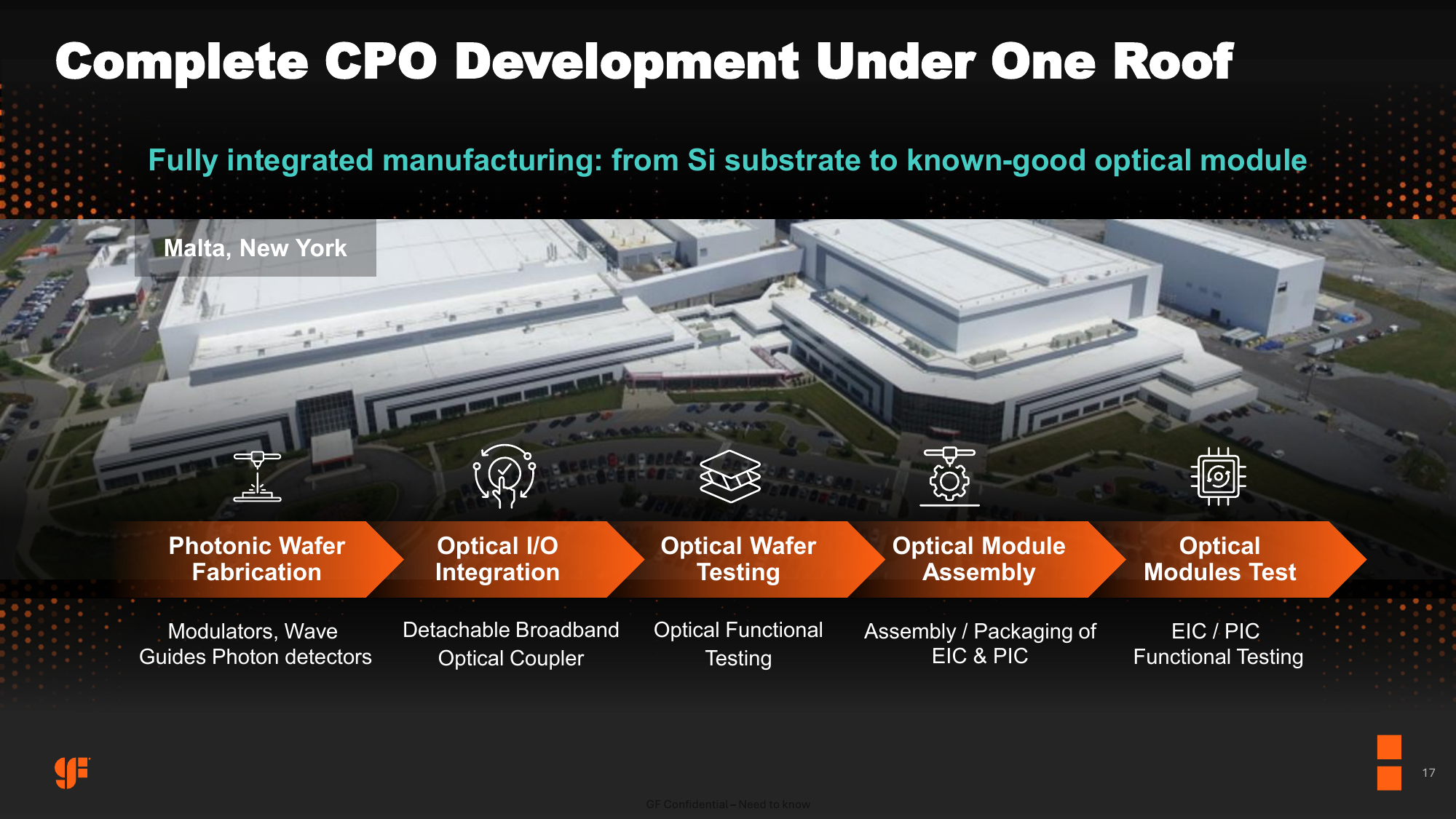
$GFS owns the two specialty platforms an optical link cannot be built without, silicon photonics for the light and silicon germanium for the electronics that drive it, at 300mm scale in Malta and Singapore, and the shift of AI networking from copper to light turns those two lines from a niche into the fastest-growing part of a $7B foundry.
What $AMD's factories became
$GFS is what $AMD's factories became. Spun out in 2009 and funded by Abu Dhabi's Mubadala, it spent a decade trying to keep pace with $TSM at the leading edge, gave up that race in 2018, and rebuilt itself around what it calls essential chip technologies: the analog, radio-frequency, power, embedded-memory and photonics platforms that go into a system alongside the processor rather than inside it. It runs four sites on three continents (Malta in New York, Burlington in Vermont, Dresden, Singapore), about 239,000 square metres of cleanroom and 2.8 million wafers a year of installed capacity, and it is Cayman-incorporated, which is why it reports under IFRS on a 20-F and 6-Ks rather than a 10-K.
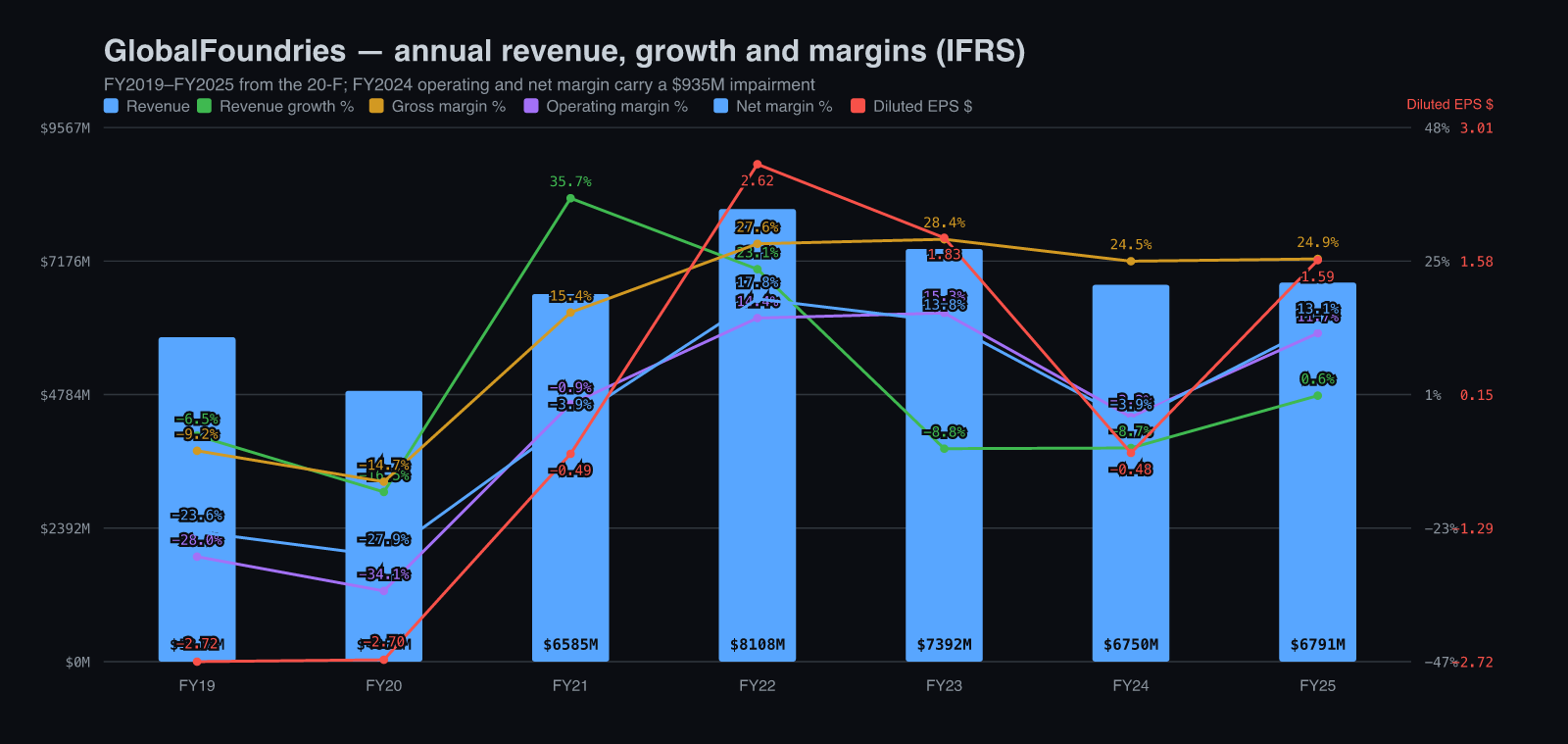
The revenue and margin history is the reason the shares carry a discount, and it is worth reading straight. Revenue ran $5,813M in FY2019, $4,851M in FY2020, $6,585M in FY2021, peaked at $8,108M in FY2022, then fell to $7,392M in FY2023 and $6,750M in FY2024 before edging to $6,791M in FY2025. Gross margin was negative in FY2019 and FY2020, 15.4% in FY2021, 27.6% in FY2022, 28.4% in FY2023, 24.5% in FY2024 and 24.9% in FY2025; operating margin went from a loss to 14.4% in FY2022, 15.3% in FY2023, a −3.2% loss in FY2024 on a $935M impairment, and 11.7% in FY2025; net margin was 17.8%, 13.8%, −3.9% and 13.1% over the last four years. A company whose revenue fell 16% from its peak while margins slid is a company the market prices as a cyclical.
The technology's own history is the other half of the backdrop, because the S-curve is older than the AI trade. Silicon waveguides were demonstrated in the 1980s; Intel shipped the first 100G silicon-photonics transceivers in volume in 2016; $GFS inherited the SiGe bipolar platform through its 2015 purchase of $IBM's microelectronics business, a technology that had been in production for 40 years, and launched its Fotonix photonics platform in 2022 with $NVDA, $AVGO, $MRVL and $CSCO as lead customers. The market did not yet need it. Then the first hundred-thousand-accelerator clusters were built, the copper links ran out of reach, and the platform that had looked premature was the one already qualified at 300mm.
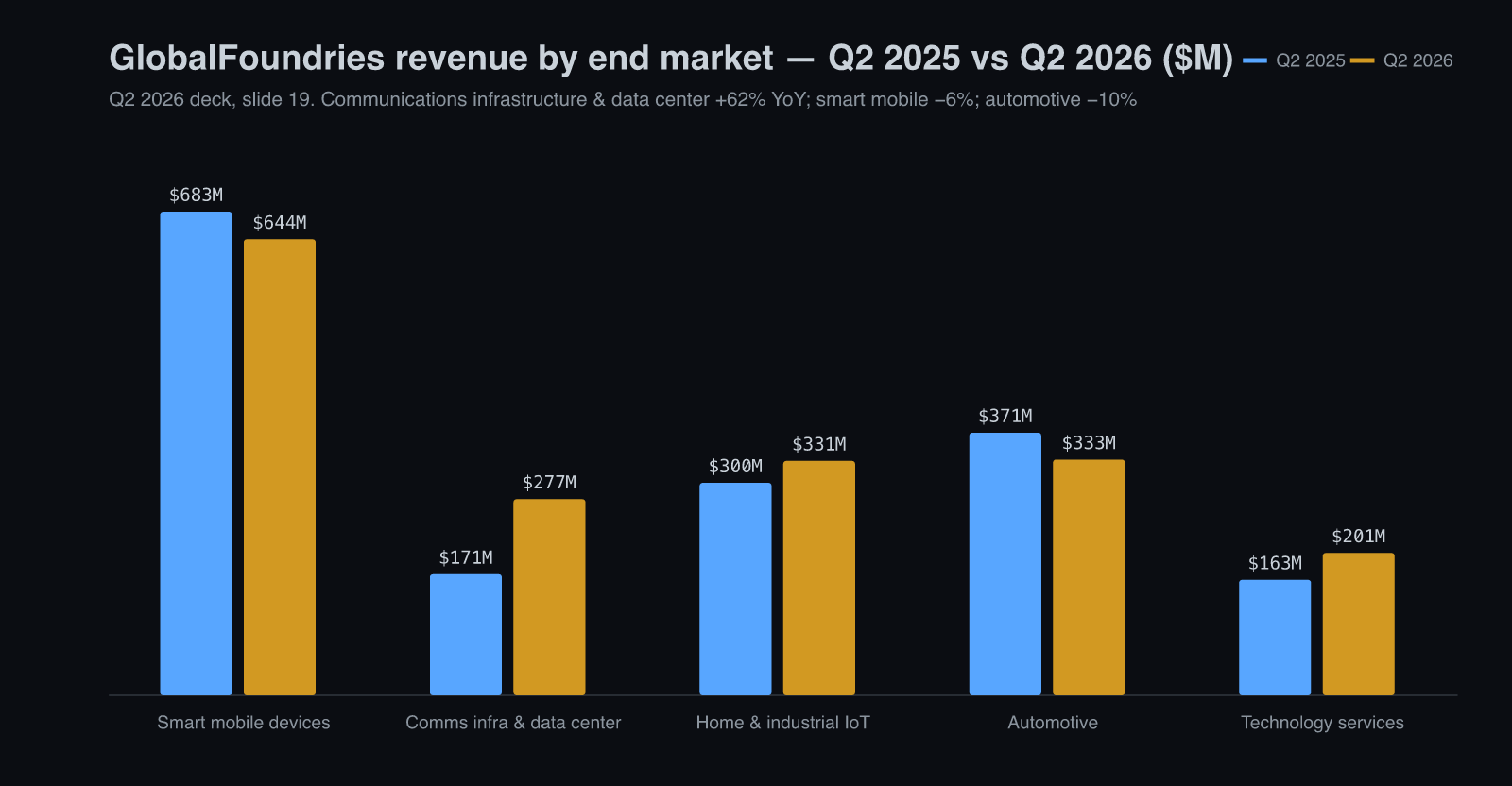
The company sells two things. Manufacturing services, running customers' wafers, was 89% of Q2 revenue; technology services (masks, reticles, non-recurring engineering, and since the 2025 Mips and 2026 $SNPS embedded-processor acquisitions, intellectual-property licensing and software) was 11%, growing 21% and carrying no fab fixed cost. The four end markets are moving in opposite directions, and the table is the whole bull and bear case in five rows.
The data center line produced all of the growth: it added $106M year over year while smart mobile and automotive together lost $77M. That is what a mix shift looks like in the quarter it starts, and it is why a 6% consolidated print can carry a 62% story inside it.
The light half and the electrical half
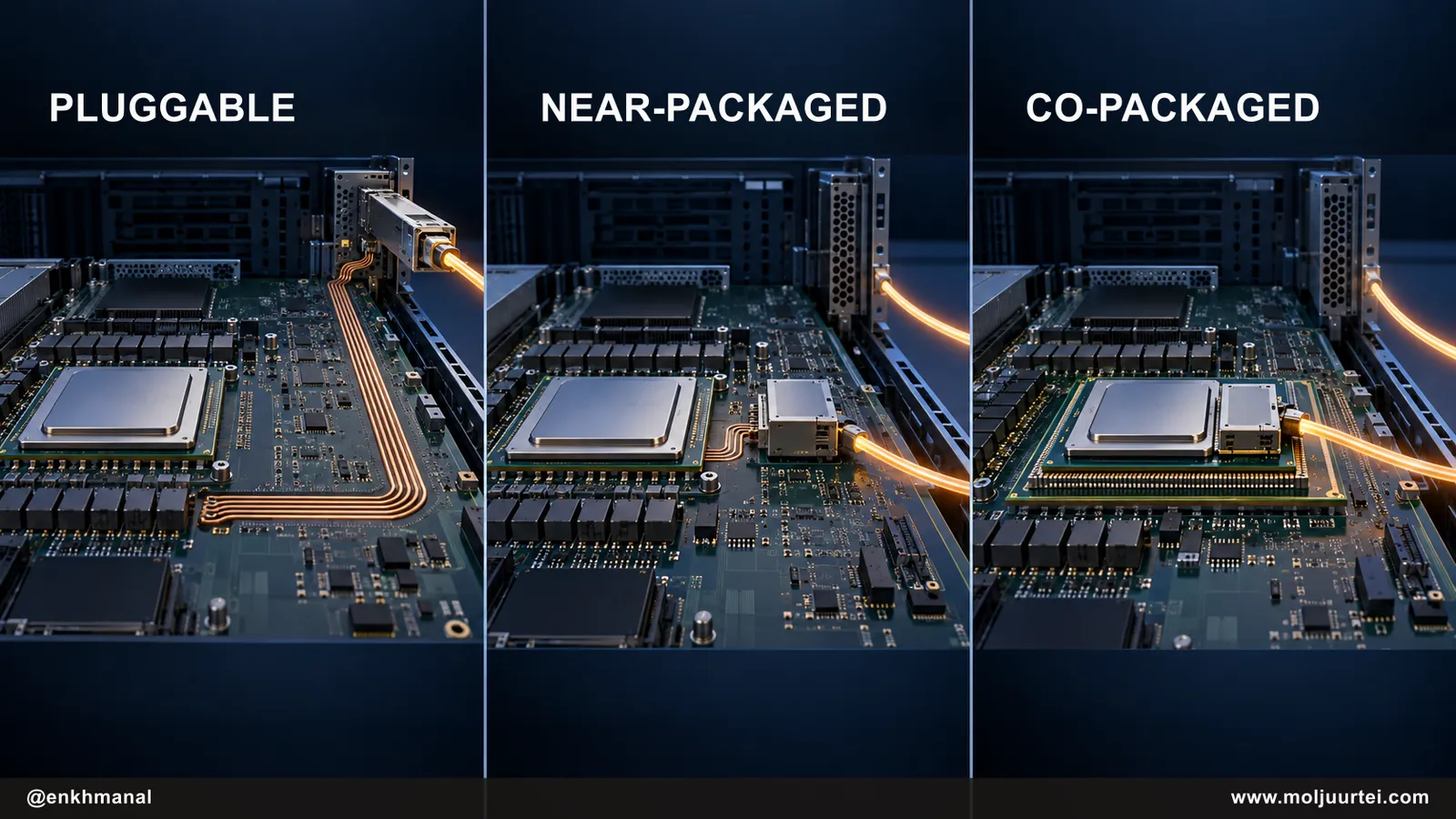
The moat is that both halves of an optical link are made on qualified $GFS platforms, and that a customer who has qualified a photonic receiver or a SiGe driver on one of them is captive for the life of the product. The light half is the photonic integrated circuit. On the Scale platform, its co-packaged optics light engine, a photonic IC and an electronic IC sit on an interposer beside the accelerator die; a fibre attach unit couples a ribbon of fibres to the chip through a detachable broadband coupler, and the photonic IC carries the modulators, waveguides and photodetectors that turn the accelerator's electrical lanes into light and back. Scale was built for the OCI standard and exceeds it: 53 Gbps signalling, bidirectional, two coarse-wavelength groups per fibre and four dense-wavelength groups inside each. The plain-English version is that one fibre carries eight colours at once, which is how a package the size of a stamp can move terabits.
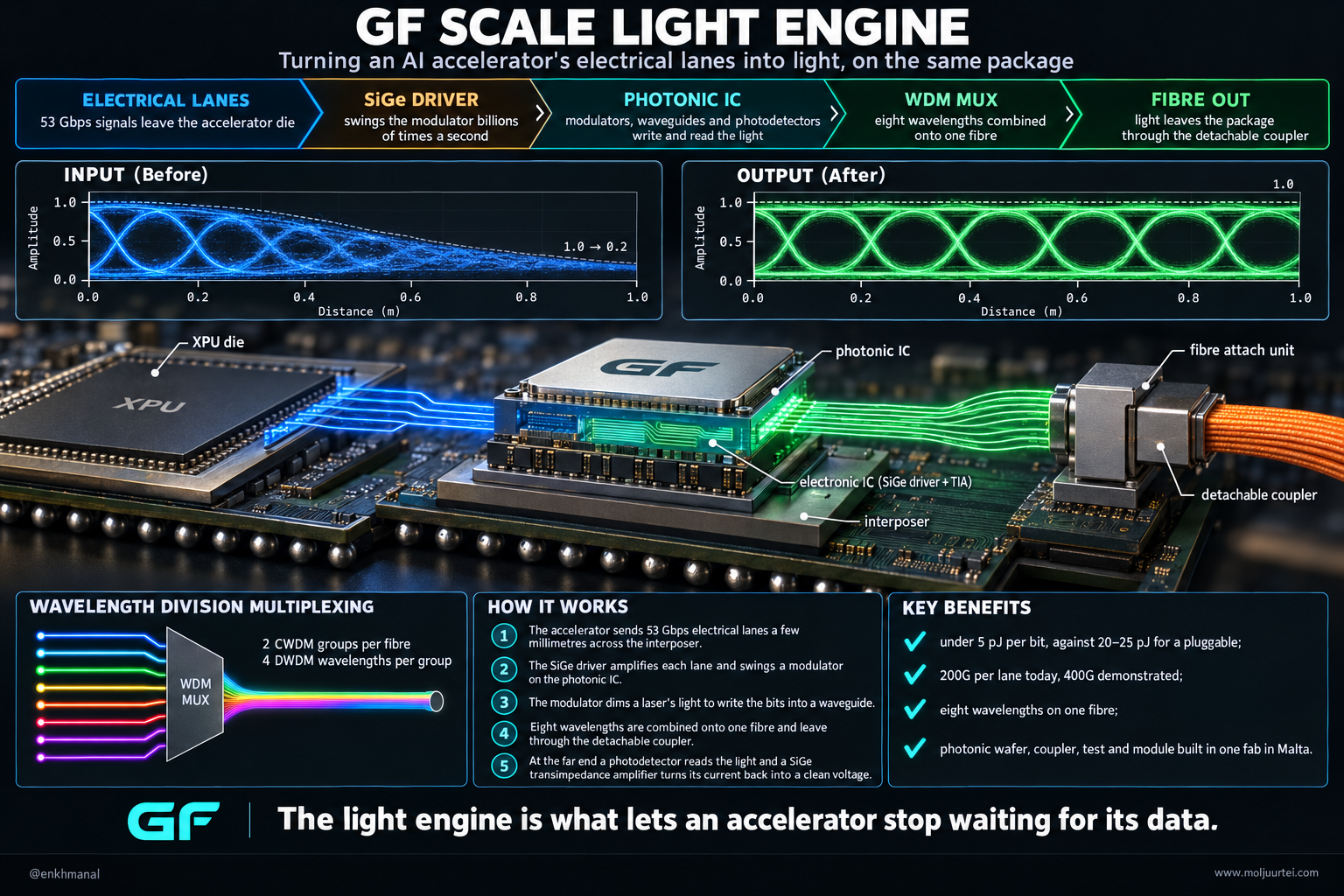
The electrical half is silicon germanium, and it is the under-covered part. Every optical link needs a driver to swing the modulator and a transimpedance amplifier to turn the photodetector's tiny current back into a voltage, and those are bipolar SiGe parts, not photonics. The chief technology officer's line at the Investor Day is the mechanism in one sentence: "the transimpedance amplifier then takes that very low current and amplifies it to a voltage. The technology that does that is our silicon germanium." Those parts are made in Burlington, the line is sold out, and $MRVL, which says its broadband analog business of exactly these amplifiers and drivers is approaching a $1B run rate, has just contracted more of it for pluggables, near-packaged and co-packaged optics.
We are seeing very strong customer demand for our SiGe solutions, with capacity at our Vermont fab oversubscribed through well into 2027. As these SiGe offerings are meaningfully margin accretive to our overall business, we are expanding SiGe capacity to meet the accelerating customer demand.
Around those two sits the rest of the essential-chip portfolio, and the same buildout pulls on it. Bipolar-CMOS-DMOS is the power process that steps a rack's supply down toward the one volt an accelerator drinks; the company landed its first smart power stage gate-driver design win on it in Q2 and signed $MPWR to bring its own power process into the Singapore 300mm fab for 2027 volume. Fully-depleted silicon-on-insulator, sold as 22FDX and 12FDX, runs at very low power and, characterised at 4 kelvin, reads out qubits; it carries the automotive radar for Bosch and the embedded magnetic memory automotive microcontrollers are moving to. Radio-frequency silicon-on-insulator and gallium nitride are the radio front end of every phone and satellite terminal; power gallium nitride, licensed from $TSM and now shipping fifth-generation devices for $NVTS, is the fast switch in chargers and server power supplies. None of those are photonics. All of them are chips a system needs beside the processor, made by the one large merchant fab in the United States that makes them, which is the analog-foundry half of the thesis and the half that pays the bills while the optical half ramps.
The switching cost underneath all of it is qualification. Moving a qualified photonic receiver or an automotive power part to another fab costs a redesign and years, which is why the 20-F reports that 95% of the 500 design wins landed in 2025 were sole-sourced and why the long-term-agreement book still carried about $11B of remaining commitments at year end.
Dates and counterparties
Spending follows the roadmap: capex is guided to 15–20% of revenue for 2026 against 7–10% in the prior two years, and the CFO named the corridors, silicon photonics, fully-depleted silicon-on-insulator and SiGe, where the company is oversubscribed. The first half ran at 21% and adjusted free cash flow was 7% of revenue, against a full-year target of about 10%.
Why it is mispriced
The market is valuing the average of the company when it should be valuing the derivative. Over five quarters revenue growth went from 2.3% to 5.8% and the Q3 guide of $1,885M implies about 12%; over the same quarters gross margin went 22.4%, 24.2%, 24.8%, 27.8%, 27.6%, 28.3% on an IFRS basis, and 23.9%, 25.2%, 26.0%, 29.0%, 29.0%, 29.9% before stock compensation, with the Q3 guide at 29.5% and 30.5%. Non-IFRS operating margin walked from 13.4% to 16.7%. The quarterly series is the finding: the margin turned two quarters before the growth did, because the mix turned first.
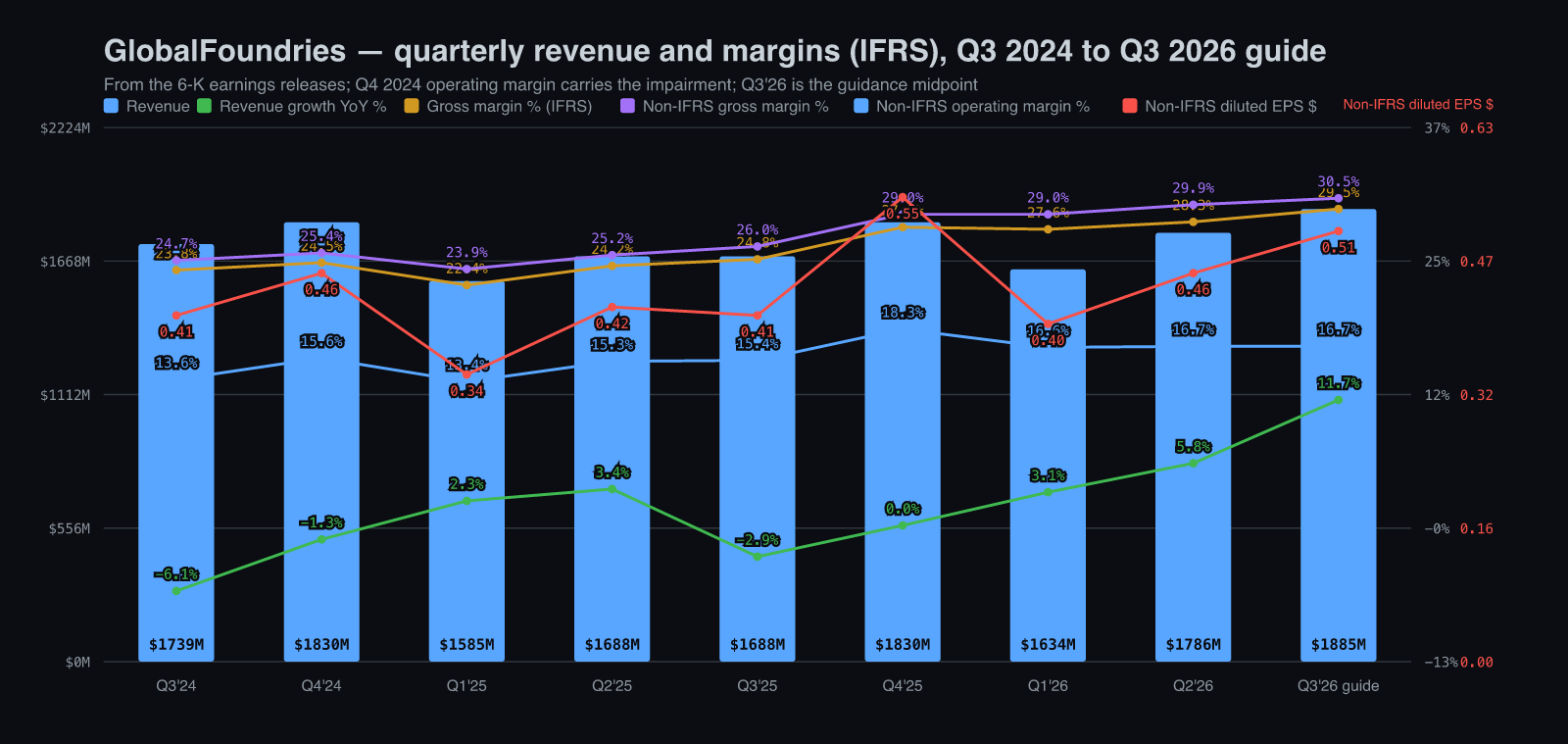
Three things drive the margin and management named all three. Mix: the two growing end markets carry higher gross margin than the shrinking one, and technology services carries no fab cost at all. Utilisation: 625,000 wafer equivalents shipped in Q2, up 8%, inside a footprint built for more, and the underutilisation payments that padded 2024 revenue are gone from the base. Price: the CEO committed on the Q1 call to raising prices on the short-term part of the portfolio "towards the back end of 2026 and obviously flowing into 2027", and the September wafer-contract surveys that show 12-inch epitaxial substrate prices rising 15–25% next year say the same thing from the supplier's side of the invoice.
If you look at things from a year-over-year basis, you know, roughly 3% of revenue growth, but 510 basis points of gross margin... We believe we're only in the early stages of this margin expansion opportunity.
Cash against profit, which is where a foundry story usually breaks, reads as an investment year rather than a problem. First-half cash from operations was $947M against $1,148M of adjusted EBITDA, an 82% conversion; capital spending was $723M, 21% of revenue, and adjusted free cash flow was $230M, or 7%, with Q2 alone at −$3M because $408M of tools landed. The balance sheet carries $3.3B of cash and securities against $1.1B of debt, a new $1.5B revolver signed in August and undrawn, a $0.12 quarterly dividend started in July, and about $100M left on the buyback. FY2025 cash from operations was $1,731M against $797M of operating profit, because $1,168M of depreciation is a cost the fabs already paid for.
What just printed, then, is a company whose optical line is doubling, whose margin has climbed five points in a year on 3–6% revenue growth, and whose consolidated growth is capped this year by a smartphone market its own customers have reallocated demand away from. Consensus is anchored on the consolidated number: the Q3 guide is $1,885M and $0.51, and the Street sits on it. The information at the 11 November print is the fourth-quarter implied step, the communications and data center dollars against the 50–60% range, and any quantification of the price increases.
Peers say the same thing from the other side. $TSEM guided its Q3 to $520M, up 31.5% year over year, on silicon photonics and 300mm expansions, and is repurposing a Japanese 200mm fab for 300mm photonics with production readiness in Q4 2027. $MRVL raised its full-year outlook by $500M and next year's by $1.5B on connectivity, naming scale-up optics, its SiGe products and near-packaged optics among the drivers. $CIEN posted record revenue up 37%. The demand is being reported by the customer and by the closest competitor in the same quarter.
A one-year record, met and raised
Two things to hold against that table. Niels Anderskouv, the President and COO who had run $TXN's analog power business, resigned effective 2 March 2026 after eleven months, with the role absorbed by Breen; the analog-foundry half of the story lost its most credentialed operator. And the CEO and CFO both came up through Mubadala, the 73% shareholder, which is a pedigree for capital discipline and a reason the register will not behave like a normal float. The record itself, one year of guides met and raised with a margin climbing every quarter, is real; it is also short.
Two registered sellers and a 16% line
On the 50-day, under the 200-day
The shares closed at $49.00 on 25 September, 47% below the May high of $92.55 and 29% above the government's $37.85. The July breakdown took the price through the 50- and 200-day averages in one move; the September base at $42–44 held above the Commerce price and above the 15 September low of $42.15, and the $MRVL agreement lifted the shares back to the 50-day, which sits at $49.25. The 200-day is $53.97 and the 100-day, still carrying the May spike, is $62.86; RSI is 49. The chart is a downtrend that has stopped going down, not an uptrend, and the level at which the market is asking whether the thesis is real is the 200-day.
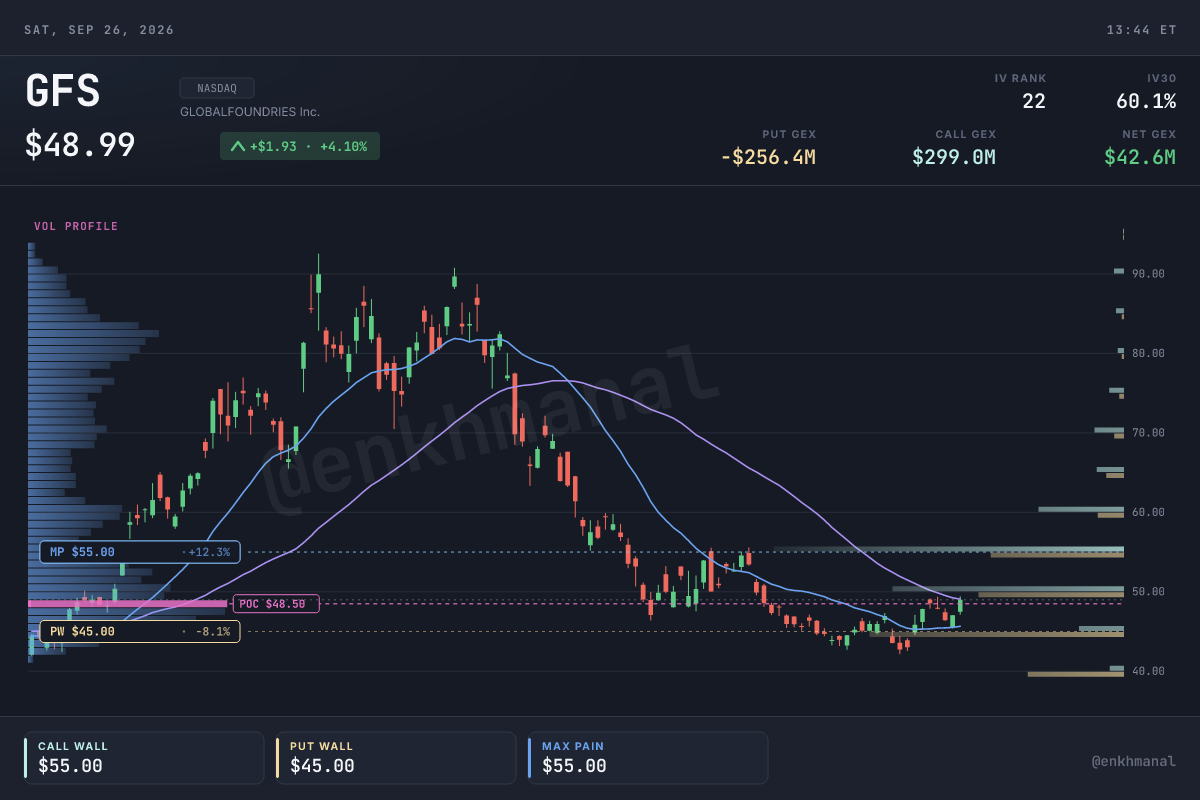
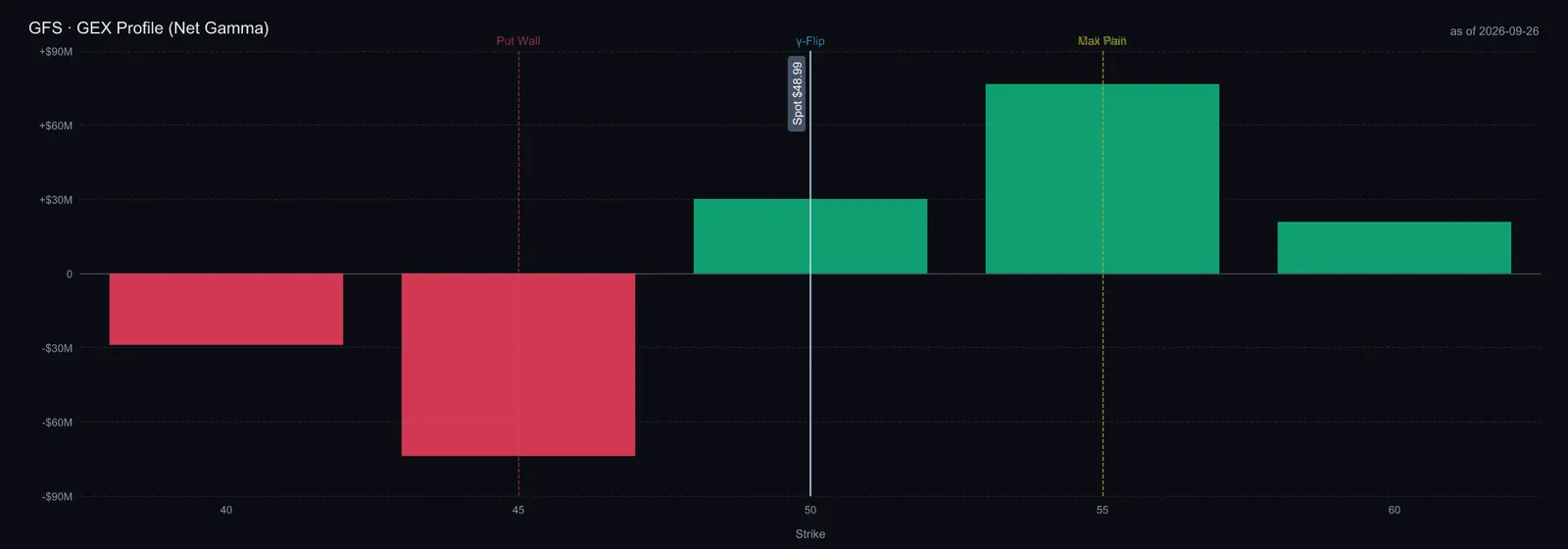
Dealer positioning is modestly short gamma: net GEX was −$27M at the 24 September snapshot, negative on eight of the last ten sessions, with the put wall at 45 and both the call wall and max pain at 55. Moves get amplified rather than damped between those two strikes, and there is no gamma flip to lean on. Implied volatility is 54% for the 16 October expiry and 60% for 20 November, the expiry that carries the 11 November print, with the rest of the curve flat near 58–61%; the options market prices roughly a ±14% move through earnings and no premium beyond it.
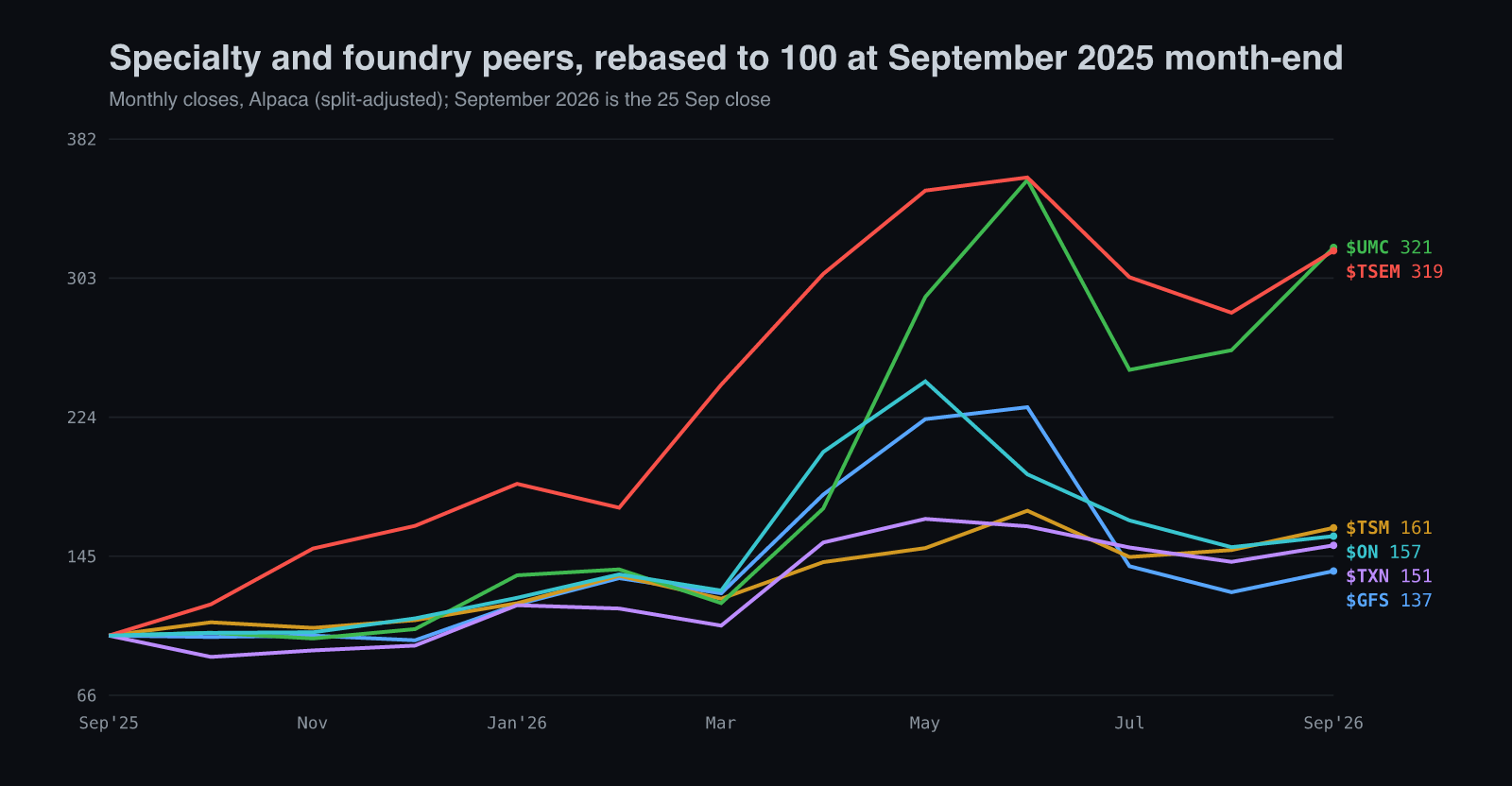
The setup for a buyer: a starter position here, on the 50-day and above the put wall; an add on a daily close above the 200-day near $54, which is also where the July gap begins; and the rest after 11 November if the comms-and-data-center line prints inside the 50–60% range with the fourth-quarter step management has implied. The stop is a close below the 45 put wall, because the next support after that is the government's price.
Two terminals, one answer
At $49.00, on about 566 million shares after the Commerce issuance, the equity is worth $27.7B and the enterprise about $25.5B net of $2.2B of cash. That is 3.5× our FY2026 revenue estimate of $7.3B, 25× the roughly $1.97 of non-IFRS earnings the four quarters of 2026 add up to on the Q3 guide, and 12× the ~$4 of earnings management targets exiting 2028. The name has no usable historical P/E series because it reports under IFRS and earned a loss in two of the last five years; trailing non-IFRS earnings of $1.82 put it at 27×, and the realised three-year EPS trend is negative, so a trailing PEG is not meaningful. Stifel initiated at Buy with a $60 target on 2 September; the 22-analyst mean is $76.
The workbench model, built on the FY2021–FY2025 IFRS actuals with FY2026 revenue estimated from the four end-market guides and the reported first half, holds no annual revenue guide because the company gives none; that is the first of three judgements the Audit asks us to state. Base case: revenue +7.5% this year, +10% next, fading to 4% by FY2035; IFRS gross margin 28.6% this year, 32.5%, 36% and 38.5% over the next three, 40% from FY2030, a year behind management's 40% exit-2028 and five points under its long-term 45%; capex 18% of revenue, working capital at the filed 31% of new revenue, cash tax at the guided 18%, a 10% discount rate and 2% terminal growth. The second judgement is the exit multiple: the resolver's peer set is optics and packaging tags, so the 14.9× used is the median of $AMKR and $AMZN, held only because it sits between $GFS's own 11.5× trailing EBITDA and the premium the market pays the closest photonics peer: on mid-September consensus $TSEM traded at 29.9× forward earnings against 16.3× for $GFS. The two terminal methods disagree, and the disagreement is the finding: the perpetuity gives $40.72 a share and the exit multiple $75.16, 1.8× apart, because a perpetuity capitalises FY2035 cash flow at 2% growth while the exit sells FY2035 EBITDA at a growth multiple. Bear $18.87 and bull $65.35 on the perpetuity; $44 and $105 on the exit.
The technology is doing the work here and the spreadsheet is a supporting test, so the reading is simple. The perpetuity says the current price already assumes the margin climb happens; the exit multiple says a foundry with a 40% gross margin and a $2B photonics line is worth half again more than today. We land between them, on a $62 base target, and we take the owner's question head on: yes, this is the right time to start, because the thing that made the shares fall, a 6% consolidated print, is arithmetic we can now see through, and the thing that makes them worth more, the optical line doubling into sold-out SiGe and a co-packaged ramp, has two contracted counterparties and a government cheque behind it as of this month. Buy a starter here at the 50-day, add above the 200-day, and put the rest to work after the 11 November print if the comms-and-data-center number holds its range; a close below the 45 put wall says wait for the government's price.