Back to Insights
Finding Opportunities in the Holdings of Big Players — Q2 2026 13F deep dive · what fourteen funds bought, what the filings proved, and the
August 17, 202638 min read

Finding Opportunities in the Holdings of Big Players — Q2 2026 13F deep dive · what fourteen funds bought, what the filings proved, and the

investment

Fourteen elite managers filed their June-quarter books on 14 August 2026. Ten of the names they were accumulating have since reported, and every single one beat — then five recovered their quarter-end price and five are still 18–33% below it. Nothing in the fundamentals separates the two groups.

LOG 01 // WHAT CHANGED

A $135 IPO absorbed $25B in eighteen trading days

SpaceX priced 638.9 million Class A shares at $135.00, over-allotment included, on Nasdaq as SPCX. Eighteen trading days later the quarter closed and the position became reportable. Across the roster, eight of fourteen managers held $25.07B of it — every one of those positions opened in the quarter. Nobody trimmed.

Roster $ in SpaceX
$25.07B
Managers holding
8 / 14
Positions trimmed
0
IPO price
$135.00
SpaceX Q2 revenue
$7.814B
Year on year
+92%

It was not only the hedge funds. Nvidia disclosed 122.8 million shares worth roughly $21B, AMD 3.31 million worth $565M, Harvard's endowment $2.2B, and Saudi Arabia's Public Investment Fund 154,146,835 shares worth $26.34B. A second new listing, Cerebras Systems, pulled in another $2.26B from four roster managers — again all opened, none trimmed.

Institutional books do not grow because a new company lists. When $27B of new supply arrives inside one quarter, it is funded by selling something else — and the something else is whatever is most liquid and most owned.

LOG 02 // THE FUNDS

Fourteen books, and how to read each one

A move means nothing until you know whose move it is. Bridgewater trimming a name is portfolio mechanics across 997 lines; Hohn trimming one of eleven is a decision. All sizes are disclosed US-listed equity at 30 June 2026.

Manager
Book
Lines
How to read it
Berkshire Hathaway
$299.25B
29
The valuation anchor. Slow, enormous, rarely wrong about price.
Children's Investment Fund
$52.77B
11
Chris Hohn. Eleven positions held for years — the highest-signal book here.
Coatue
$48.63B
66
Philippe Laffont. Tech and AI, crosses public and private, sizes aggressively.
Viking Global
$35.08B
90
Halvorsen. Deep fundamental long/short — the 13F is half the story.
D1 Capital
$34.78B
55
Dan Sundheim. The most concentrated bet on this list.
Bridgewater
$24.38B
997
Macro and systematic. Read for direction, never for names.
Tiger Global
$23.98B
46
Chase Coleman. Long-horizon growth, big positions, patient.
Pershing Square
$19.47B
14
Ackman. Eight to fourteen names, quality compounders, very long hold.
Lone Pine
$16.36B
34
Tiger cub, quality growth. The most aggressive AI-infrastructure buyer this quarter.
Whale Rock
$12.46B
35
Alex Sacerdote. Tech only, deep specialist — its adds are the best informed here.
Appaloosa
$7.47B
25
Tepper. Macro-inflected, concentrated, quick to cut.
Third Point
$4.65B
42
Loeb. Event-driven and activist; churn is the norm, not a signal.
Duquesne Family Office
$4.35B
86
Druckenmiller. Top-down, fast, gone before you read about it.
DME Capital (Greenlight)
$3.91B
46
Einhorn. Value, with a short book you cannot see.

Two filing notes changed what the roster looks like. Ackman's holdings arrived under a new EDGAR filer identity — Pershing Square Capital Management filed a notice saying its securities are now reported by Pershing Square Inc., the listed parent. And Einhorn's book files as DME Capital Management; the Greenlight Capital filer has been dormant since 2023.

LOG 03 // BACKDROP

What a 13F shows, and what it hides

A 13F is a photograph of long, US-listed equity positions on the last day of a quarter, published up to forty-five days later. It shows no shorts, no bonds, no cash, no non-US lines and no private positions, and it gives no reasons. It is also stale on arrival: between 30 June and 14 August TTM fell 47%, recovered, and finished 25% below its quarter-end mark.

What it does show is unfalsifiable and worth a great deal: share counts, at a date, from people who had to sign them. The discipline that follows is to read the diff in shares rather than in value, and to weigh agreement across unaffiliated books over any single fund's move.
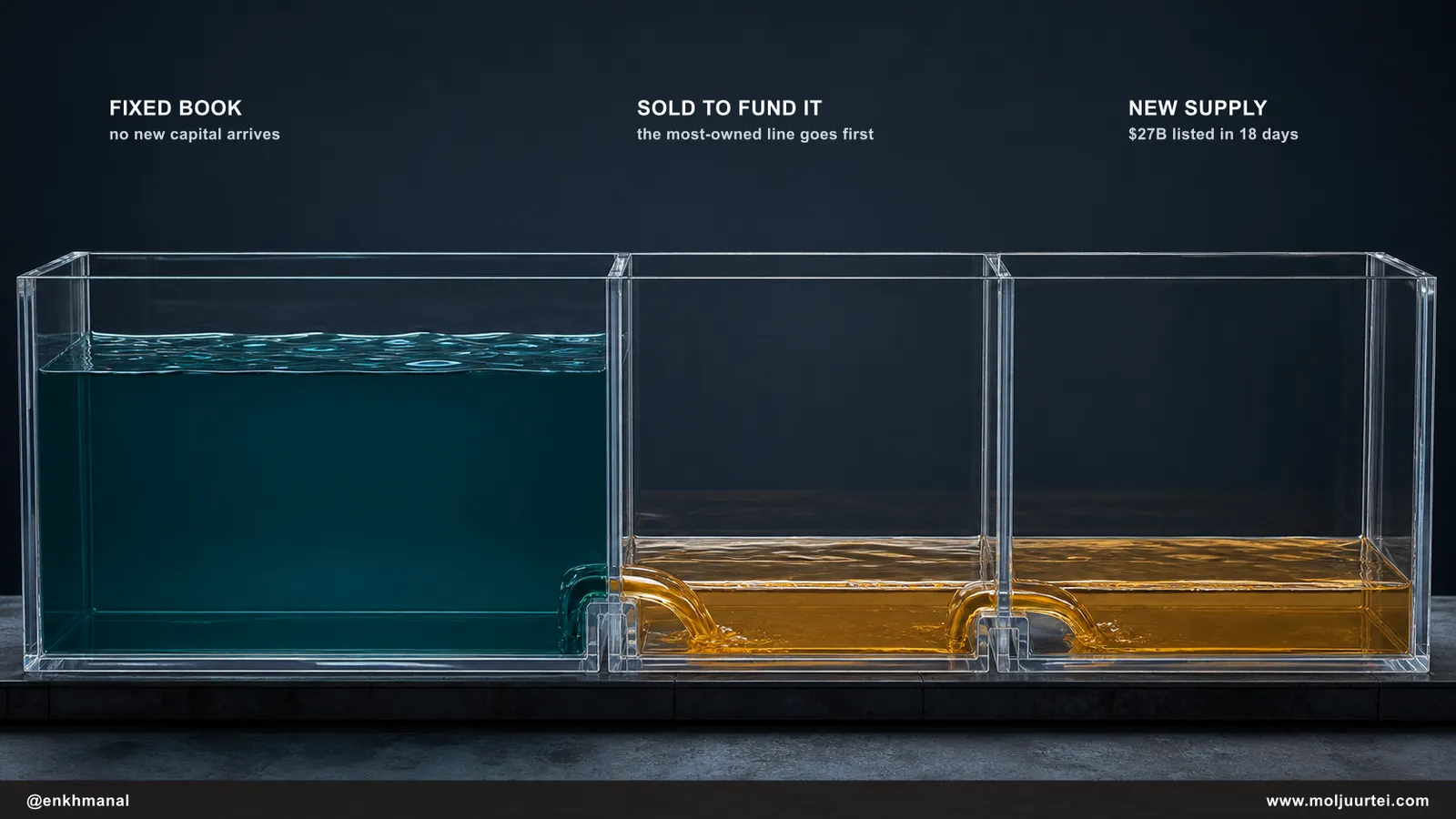
Diagram showing capital draining from crowded megacap holdings into two newly listed positions within a fixed-size book
why $27B of new listings in one quarter forces selling in the most-owned megacap names, so the rotation is plumbing rather than a change of mind
LOG 04 // MECHANISM

Funding, not conviction — then a forced unwind

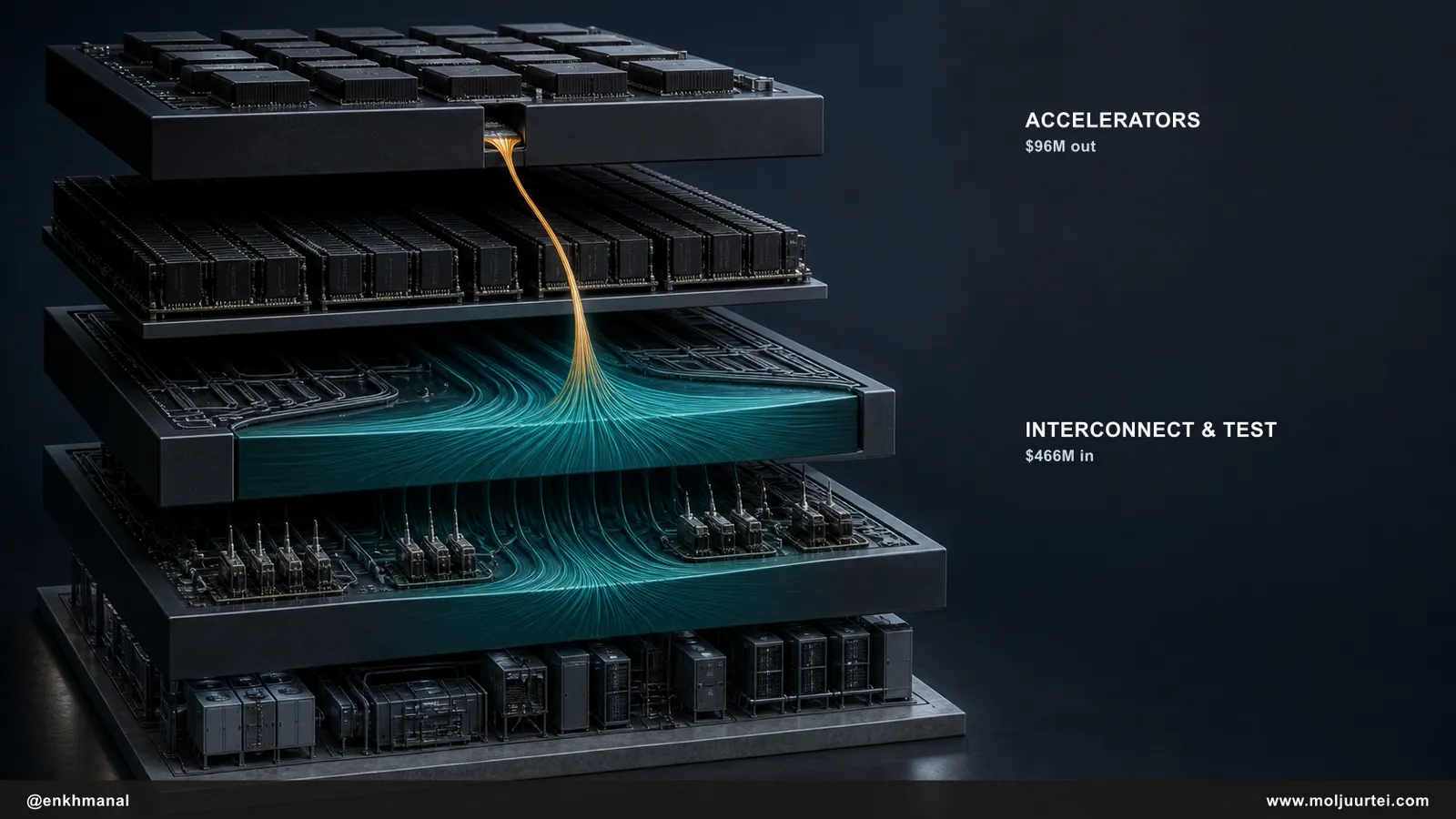
Third Point is the cleanest test, because its filing was read everywhere as a repudiation of AI. Loeb exited Nvidia, Broadcom, KLA, Lam Research and the semiconductor ETF. Those five exits totalled $96.1M out of a book that ended the quarter at $4.65B, having more than doubled from $2.08B. In the same filing he added 67.3% to TSMC and 150% to ASML, and opened Keysight at $204.8M, Flex at $166.9M and TTM at $94.4M.
Third Point Q2 2026 — what left, and what arrived
US$ millions
$96.1MAI exits$94.4MTTM$166.9MFlex$204.8MKeysight$533.2MWarner Bros
All five figures are position values as filed in the Q2 2026 13F-HR information table. 'AI exits' sums the Nvidia, Broadcom, KLA, Lam Research and semiconductor-ETF positions held at 31 March and gone at 30 June.
Layered diagram of the AI hardware stack showing capital moving from a small accelerator-layer position into a much larger interconnect and test position
that the capital never left the AI supply chain — a small exit at the accelerator layer became a much larger position in interconnect and test

The shape repeats. Tiger Global cut Alphabet 45.4% and TSMC 12.3%, and opened Cerebras at $662.8M, AMD at $392.0M, Seagate at $275.1M and Visa at $274.0M. Coatue trimmed Applied Materials 19.7% while lifting Micron 1,794% and opening Intel at $1.69B. Selling the most-owned line to fund a less-owned one is not a change of view about artificial intelligence.

Then July happened. Between 21 and 29 July the complex fell in near-lockstep and bottomed within three days of itself — Astera −49%, Nebius −47%, TTM −47%, Sterling −41%, Flex −38%. Names do not correlate that tightly on their own news. The widely reported cause was the forced unwind of a large leveraged AI fund up 439% through June that lost roughly two-thirds in days. That account is press and commentary, not a filing, so treat the cause as reported and the effect as measured.

The counter-evidence worth stating: Nvidia was genuinely net-sold. Five managers held it, one bought, six sold, roster net −4,285,427 shares. That is a real reduction in the most crowded position in the market — and entirely consistent with the funding story, since Nvidia is exactly what you sell first when you need $25B.

LOG 05 // CONSENSUS

Where unaffiliated books agreed

Name
Held by
Bought
Sold
Roster $
The tell
SpaceX
8
8
0
$25.07B
Every holder opened. New supply, not rotation.
Alphabet
10 + 6
10
8
$49.15B
Berkshire +83% to 105,979,600 shares / $37.77B.
Seagate
6
5
1
$1.72B
Four managers opened it — Tiger, Lone Pine, Whale Rock, D1.
Cerebras
4
4
0
$2.26B
Second new listing. Coatue $1.55B, Tiger $662.8M.
Intel
4
4
1
$2.32B
Whale Rock, Coatue and Bridgewater opened; Tiger +159.5%.
AMD
6
4
2
$1.79B
Opened by Tiger, Coatue and Duquesne in the same quarter.
TTM Technologies
3
3
1
$1.40B
Whale Rock's 4th-largest; Lone Pine and Third Point opened.
S&P Global
3
3
0
$6.83B
Zero sellers. Hohn's long hold plus Ackman's new $1.06B.
Nvidia
5
1
6
$4.61B
Net −4,285,427 shares. The one genuine reduction.
LOG 06 // THE NAMES

The interconnect layer — TTM and Astera

An accelerator on its own computes nothing. It has to be fed — power in, heat out, and data across to the thousands of other accelerators sharing the job. As rack designs went from air-cooled boxes to liquid-cooled systems drawing tens of kilowatts, the parts carrying those signals stopped being commodities.

TTM Q2 net sales
$1,004,054K
against $730,621K — up 37.4%, an all-time high
Non-GAAP gross margin
21.9%
from 20.9% — mix shift showing up as pricing
Non-GAAP operating margin
13.8%
from 11.1%
Net leverage
0.9×
capex guidance raised ~$45M after board approval
Astera Q2 revenue
$392.4M
up 27% sequentially, 104% year on year
Astera GAAP gross margin
73.3%
non-GAAP operating margin 39.1%; GAAP diluted EPS $0.83

M+N is not just one process. It's a family of different options, and this is only the first step. — Edwin Roks, President & CEO, TTM Technologies, 5 August 2026

The second engine at TTM has nothing to do with AI. Aerospace and defence carries the Golden Dome programme and multiple munition programmes, and the company is expanding existing sites into it — brownfield expansion inside buildings it already owns, which is why capacity arrives in quarters rather than years. Two acquisitions under $220M are expected to close in Q3.

At Astera the transition that matters is a product one. CEO Jitendra Mohan said the Scorpio fabric switch family — a 320-lane part — becomes the largest product family in Q3, a quarter earlier than previously expected. Astera began selling one retimer into one socket; a fabric switch is a larger and stickier position in the rack. Seventy-three per cent gross margins are what a company earns when the alternative to its part is a board redesign.
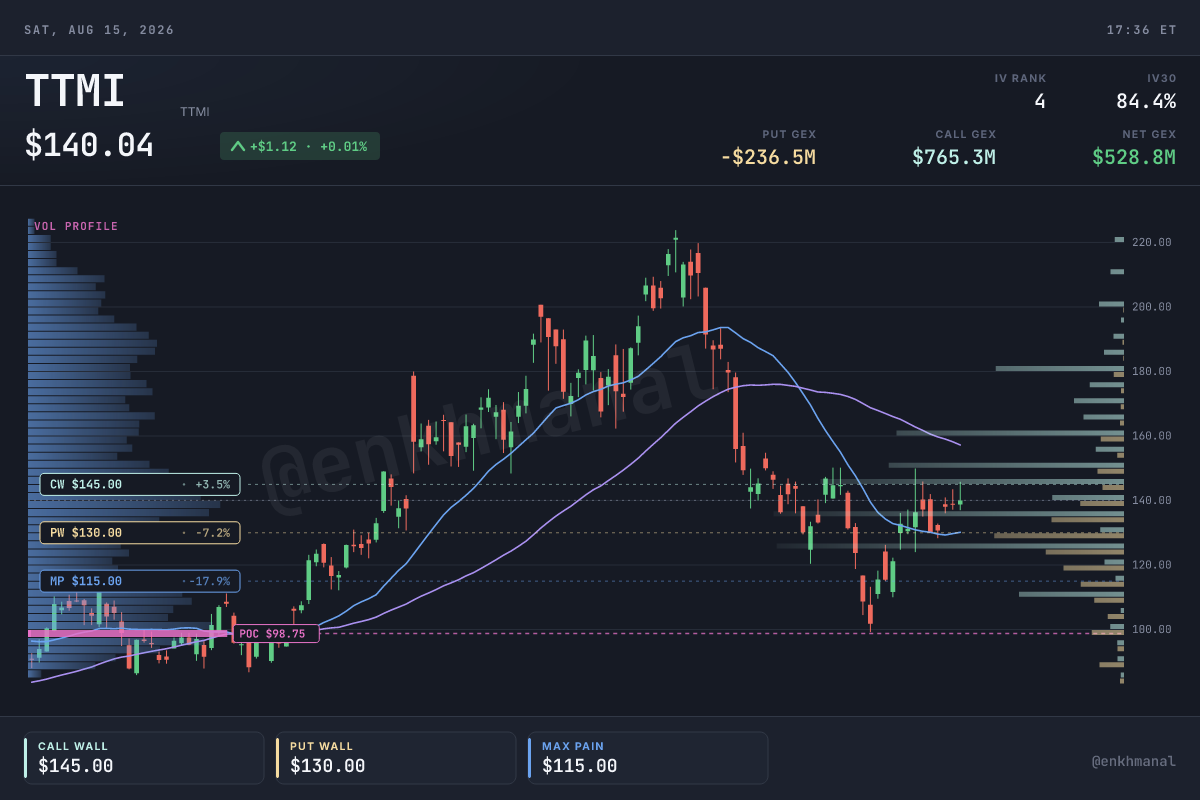
TTM Technologies price and levels, 180 days to 14 August 2026
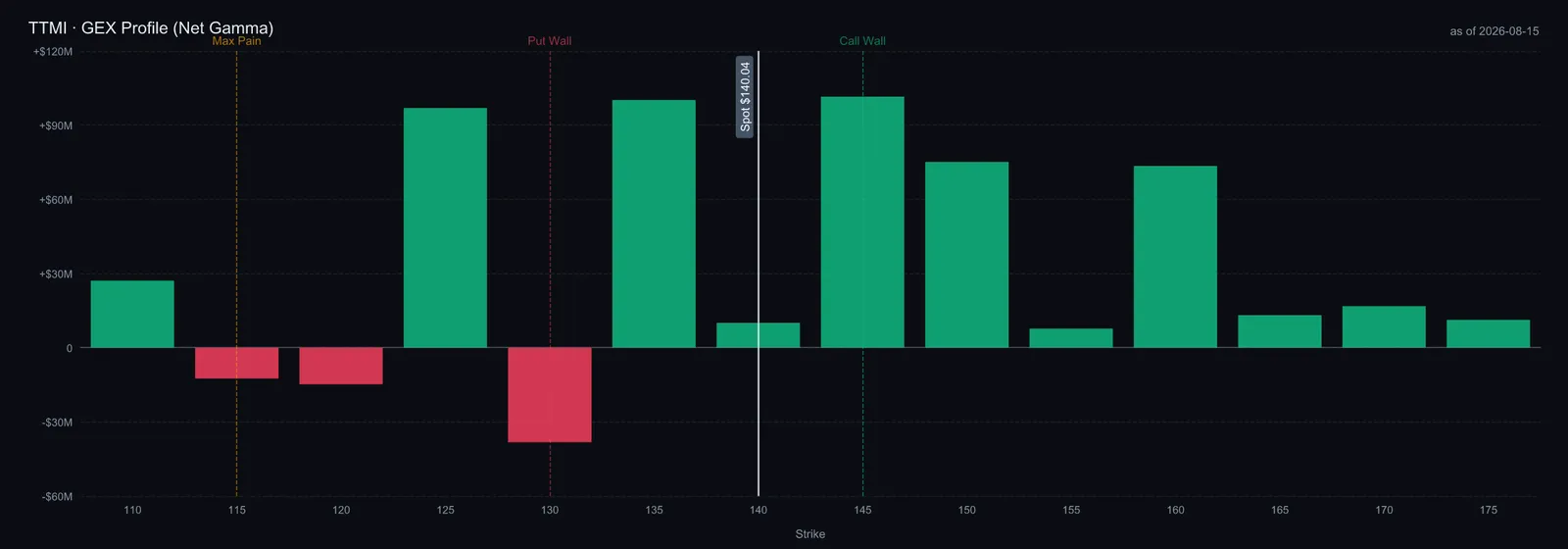
TTM at $140.04 sits in a three-percent box between a put wall at 130 and a call wall at 145, with the 50-day at $157 the level that says July is repaired.
TTM Technologies net gamma by strike, 14 August 2026
Net GEX positive at +$0.53B — dealers dampen moves rather than amplify them, so the box holds until it breaks on volume. Max pain sits far below at 115.
Astera Labs price and levels, 180 days to 14 August 2026
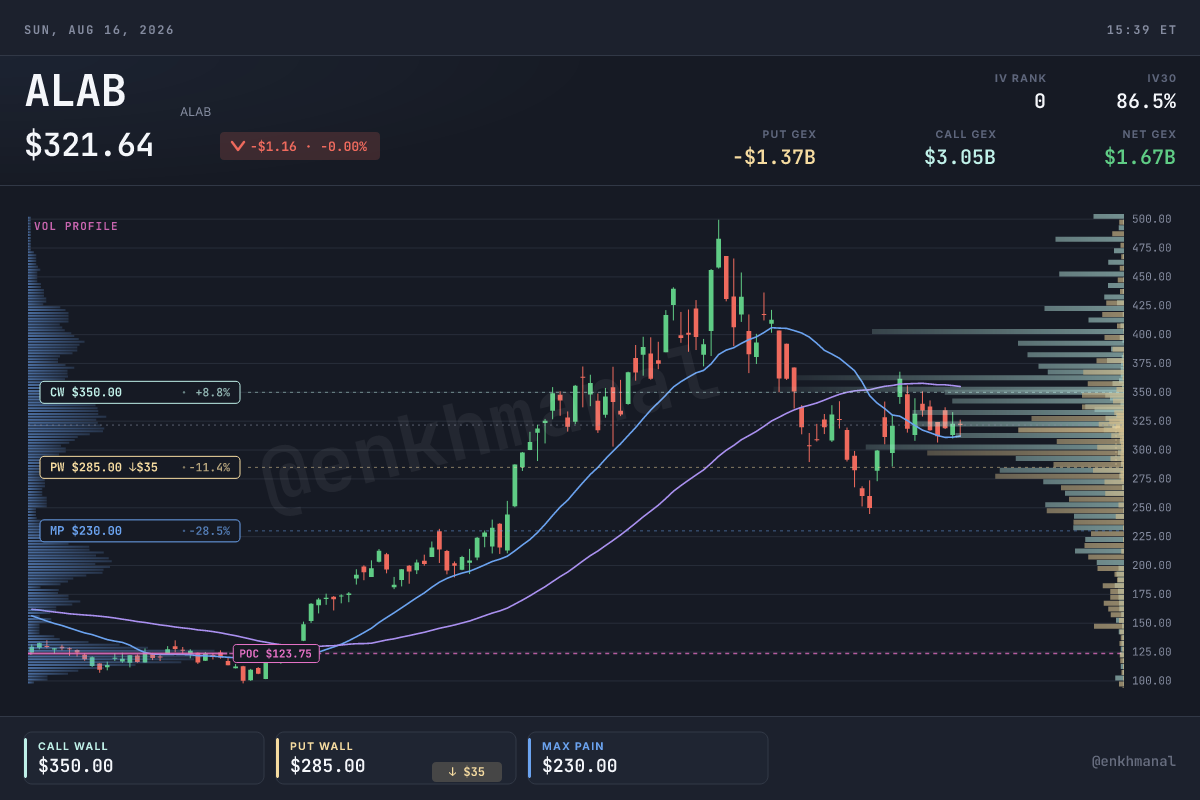
Astera at $321.64 is the deepest discount to the funds' mark in the group and the highest beta with it — 8% days are routine.
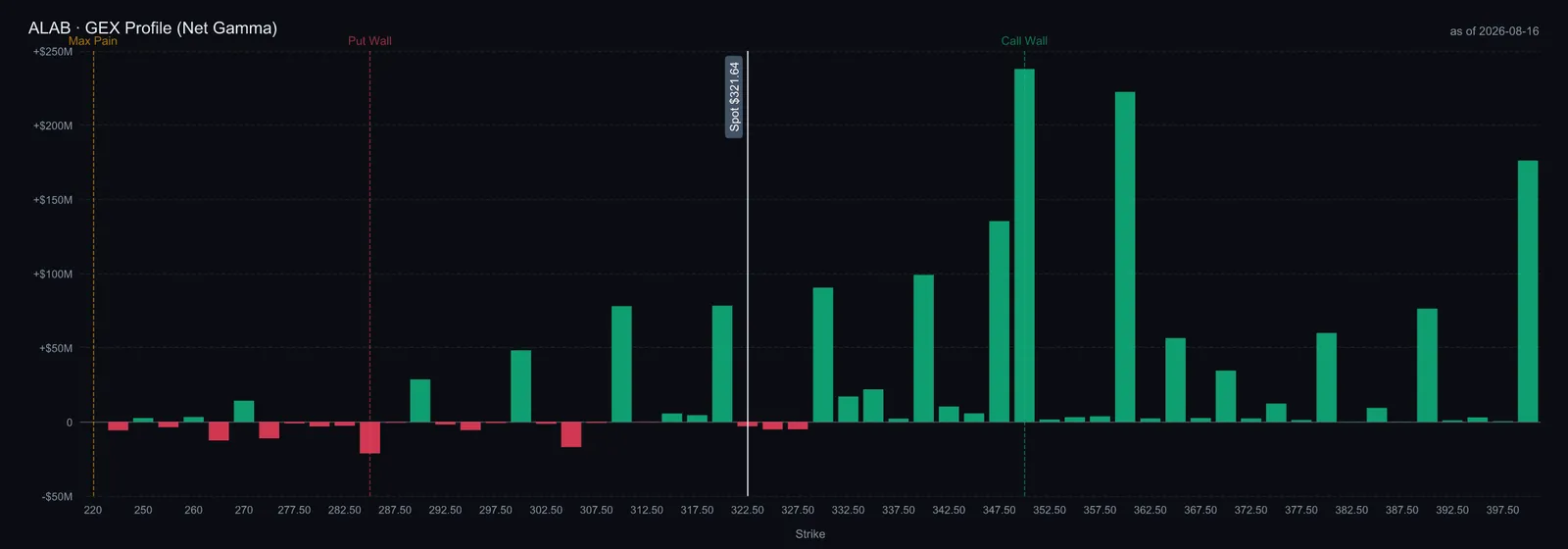
Astera Labs net gamma by strike, 14 August 2026
Spot sits on the put wall at 320 with the call wall at 350 and max pain all the way down at 230 — the widest gap between dealer support and the pain point in the basket.
LOG 07 // THE NAMES

The physical layer — Sterling and Flex

Below the silicon, an AI data centre is a construction project with an electricity problem. Sterling builds the site before anything is installed; Flex builds the power and cooling that goes into it.

Sterling Q2 revenue
$1.17B
up 90% — but acquisitions contributed $250.8M, so organic growth was ~50%
Adjusted diluted EPS
$5.80
up 116%; adjusted EBITDA $256.7M at a 22% margin
Signed backlog
$4.33B
up 116%, and up 50% organically; combined backlog $5.62B
Six-month operating cash flow
$328.0M
against $464.5M of cash — converting a boom into cash, not receivables
Flex Cloud & Power revenue
$2,202M
against $1,626M — up 35.4%, versus 20.6% for the whole company
That segment's margin
9.7%
$214M segment income, against 5.2% and 6.6% for the other two segments

The Flex gap is the entire thesis, because the market currently prices the blended average. Flex intends to separate Cloud and Power Infrastructure — data-centre power systems, thermal management, liquid cooling, rack infrastructure and power conversion — with completion targeted for the first quarter of calendar 2027. When it stands alone it gets compared to AI-infrastructure peers rather than to contract manufacturers. Third Point opened the position in the quarter that segment crossed $2.2B.
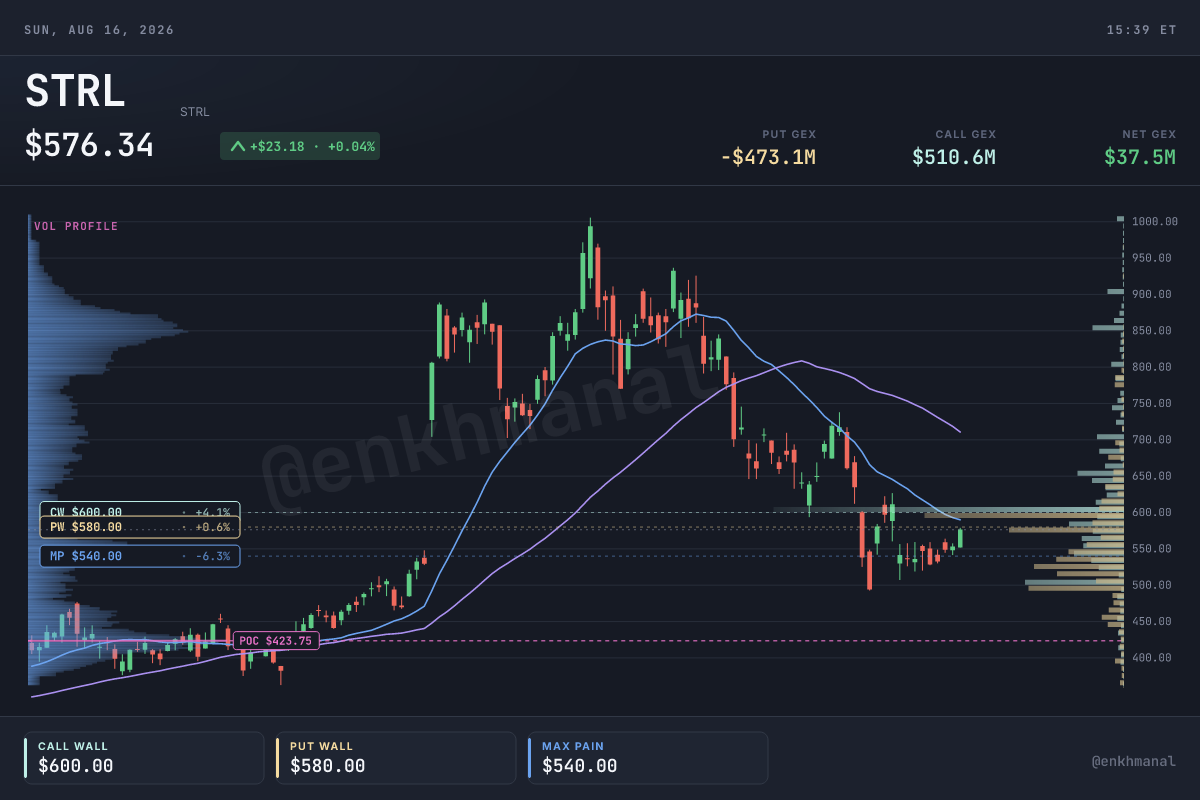
Sterling Infrastructure price and levels, 180 days to 14 August 2026
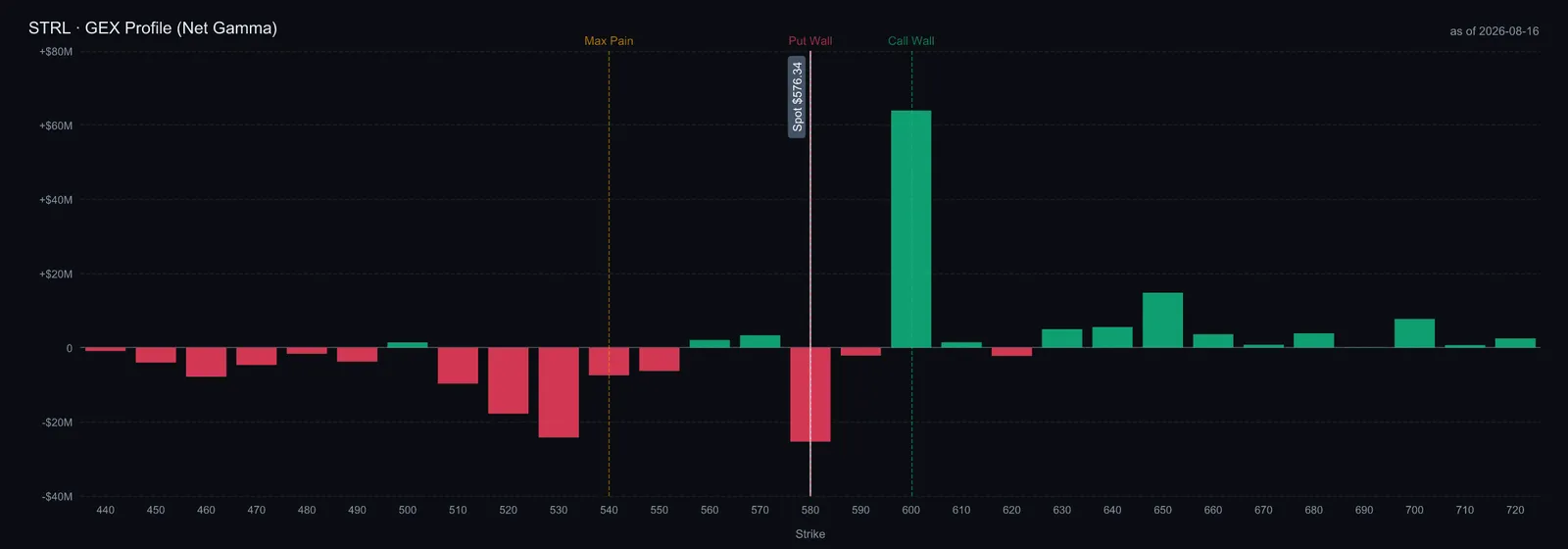
Sterling at $576.34 is the one name trading below its put wall, which removes the dealer cushion rather than providing one. The 200-day at $513 is the line that matters.
Sterling Infrastructure net gamma by strike, 14 August 2026
Call wall 600, put wall 580 against spot of 576.34 — the levels sit above price rather than bracketing it.
Flex price and levels, 180 days to 14 August 2026
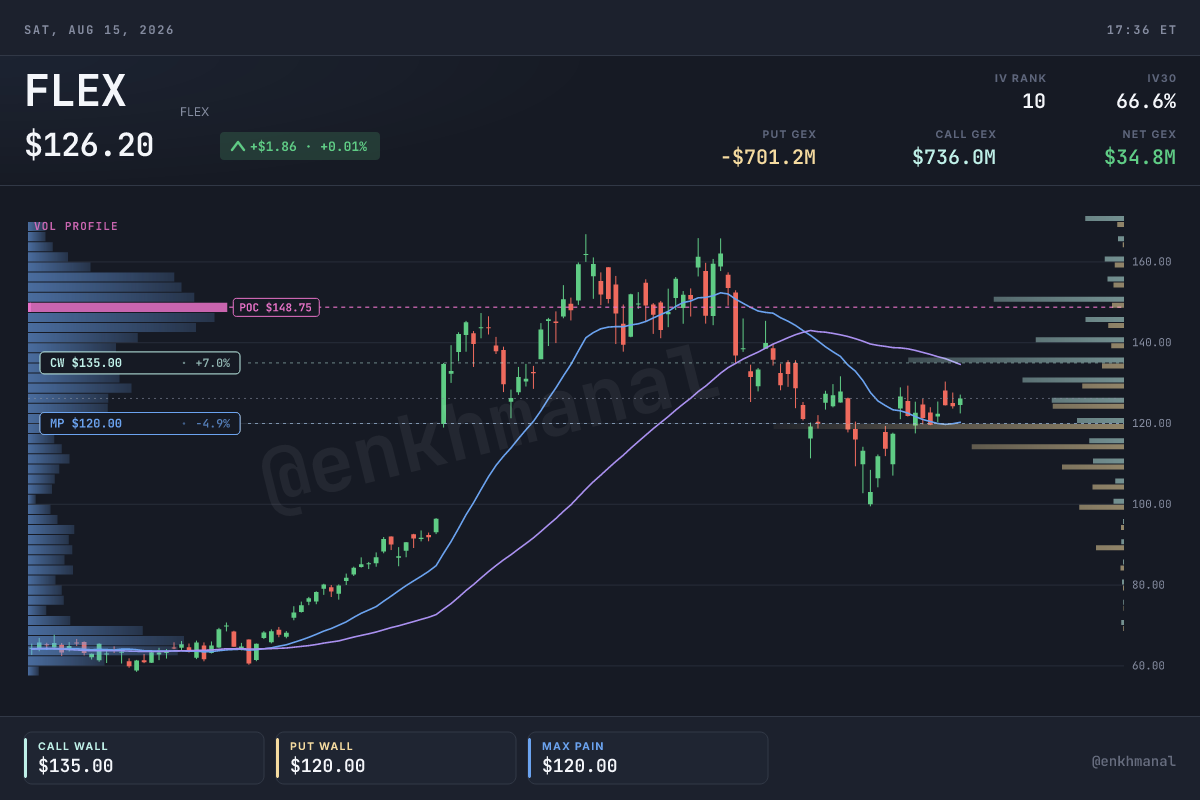
Flex at $126.20 has reclaimed its 20-day and 100-day, 22% below the price Third Point paid.
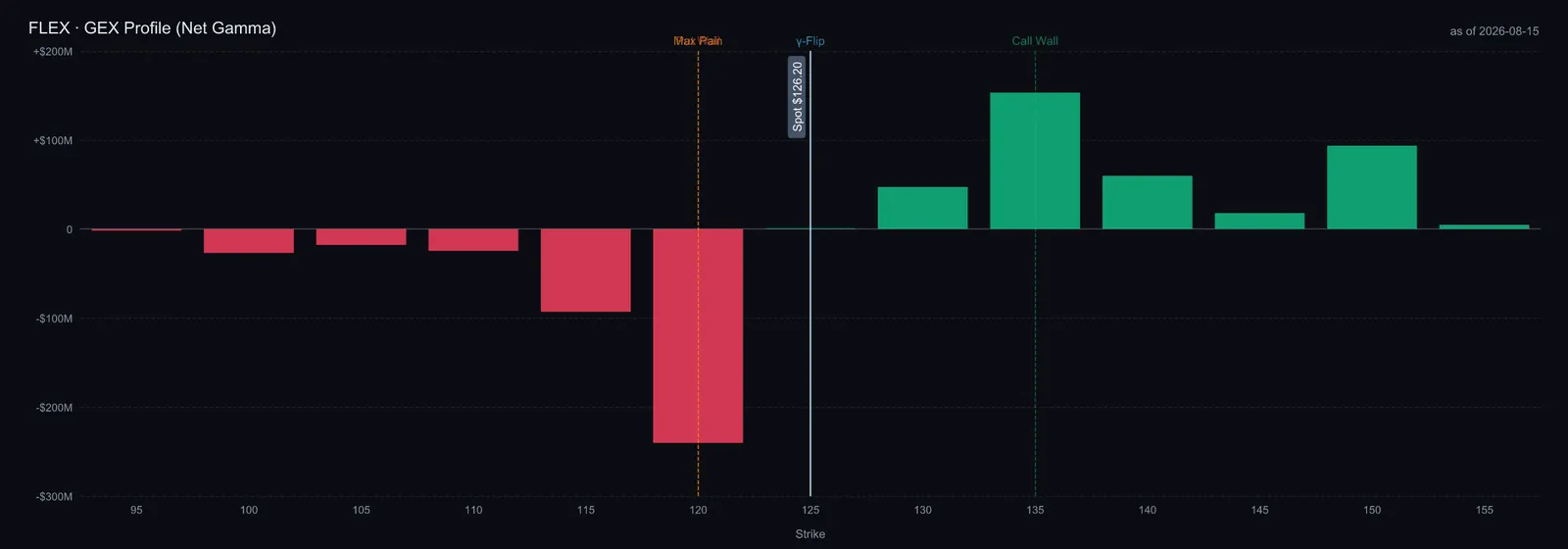
Flex net gamma by strike, 14 August 2026
Pinned between a put wall at 120 and a call wall at 135 with net GEX barely positive at +$0.03B — a far thinner cushion than TTM's, so it travels more freely both ways.
LOG 08 // THE NAMES

The new listings — SpaceX and Cerebras

SpaceX is not a story stock. In the June quarter it reported revenue of $7,814M against $4,071M, up 92%, and $12,508M across the half against $8,138M — a company earning at roughly a $31B annual run rate and roughly doubling. Revenue splits across launch services, connectivity (where all product revenue sits, meaning Starlink hardware) and an enterprise and government line that includes Starlink Mobile.

The institutional response was the most one-sided move of the quarter. Add the non-roster holders visible in the same filing round — Nvidia's 122.8 million shares, the Public Investment Fund's $26.34B, Harvard's $2.2B, AMD's $565M, Thiel and Founders Fund's 427.3 million shares — and this was less a stock-picking decision than an index-like scramble to own a company unavailable for twenty years. That is also the risk: a position everyone had to establish in eighteen days has no natural marginal buyer once established, and the lock-up expiry adds supply into that vacuum.
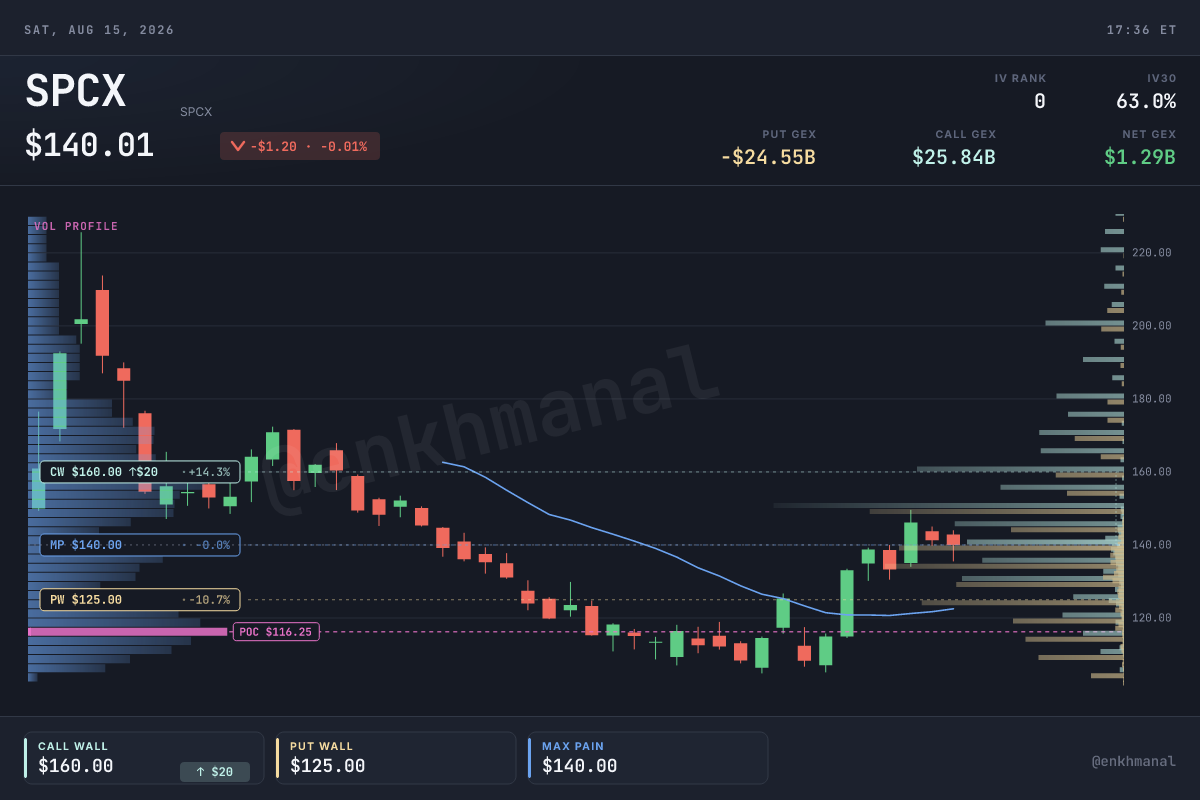
SpaceX price and levels, 180 days to 14 August 2026
SpaceX at $139.80 sits almost exactly on its $135.00 IPO price. Three months of history means no moving-average structure worth reading; the IPO price is the only real level, and it is holding.
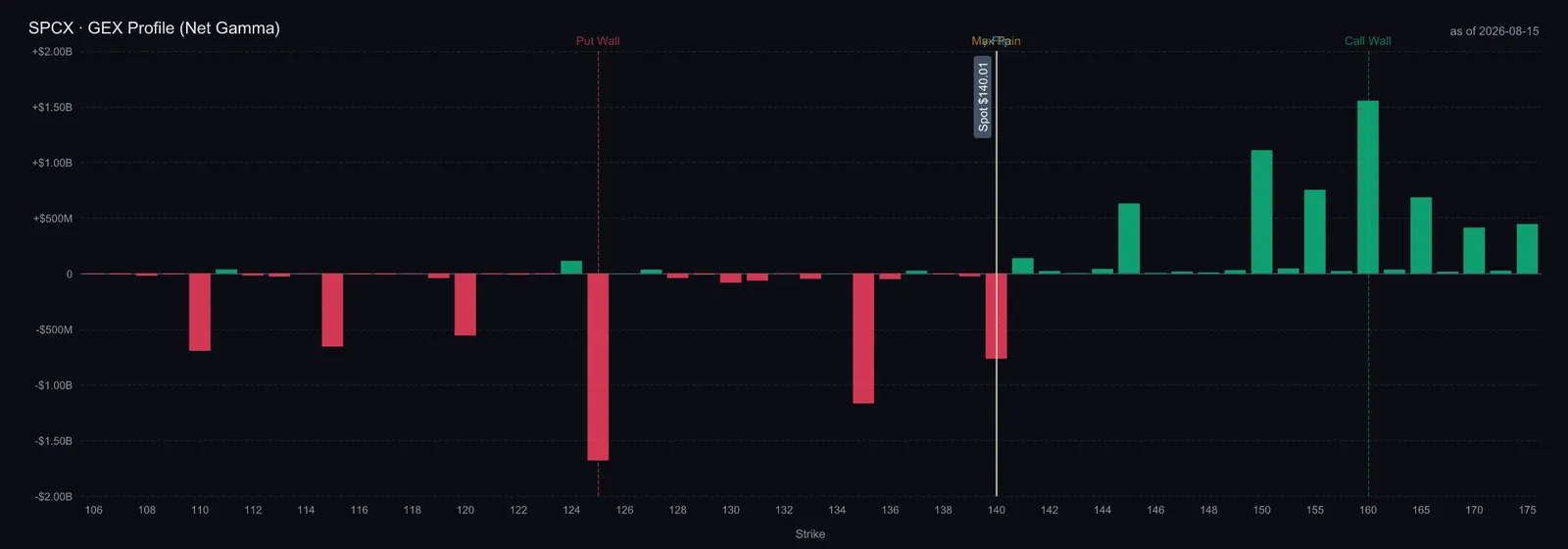
SpaceX net gamma by strike, 14 August 2026
Net GEX of +$7.12B is an enormous positive-gamma pin for a stock this young, with a gamma flip above spot at 157.6 — so the dealer cushion inverts on strength.

Cerebras is the smaller, harder version of the same trade. It drew $2.26B from four roster managers — Coatue $1.55B, Tiger $662.8M — all opened, plus a reported new $2B position from Altimeter and a new stake from Citadel. It sells wafer-scale accelerators, which is to say it competes directly with the most formidable company in the market rather than supplying it. That is a materially different risk profile from every other name here.
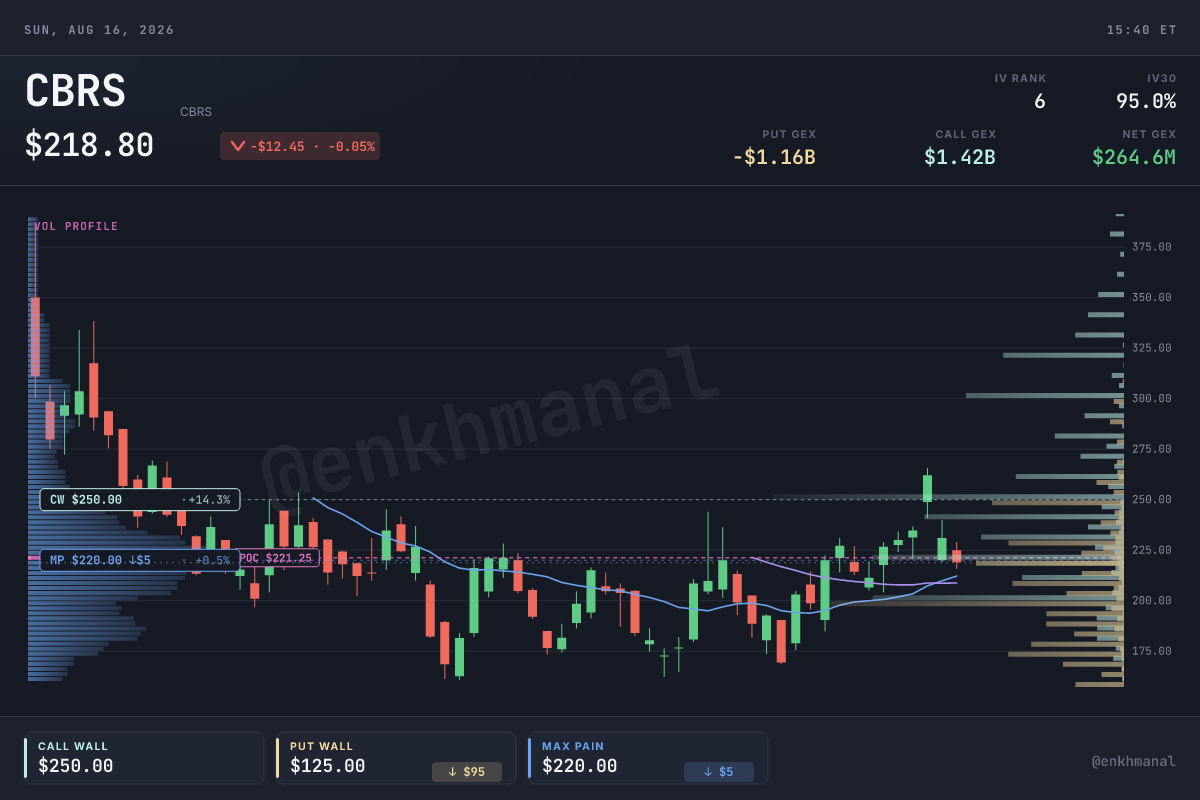
Cerebras price and levels, 180 days to 14 August 2026
Cerebras is back to its June mark but has traded a 26% range this month alone.
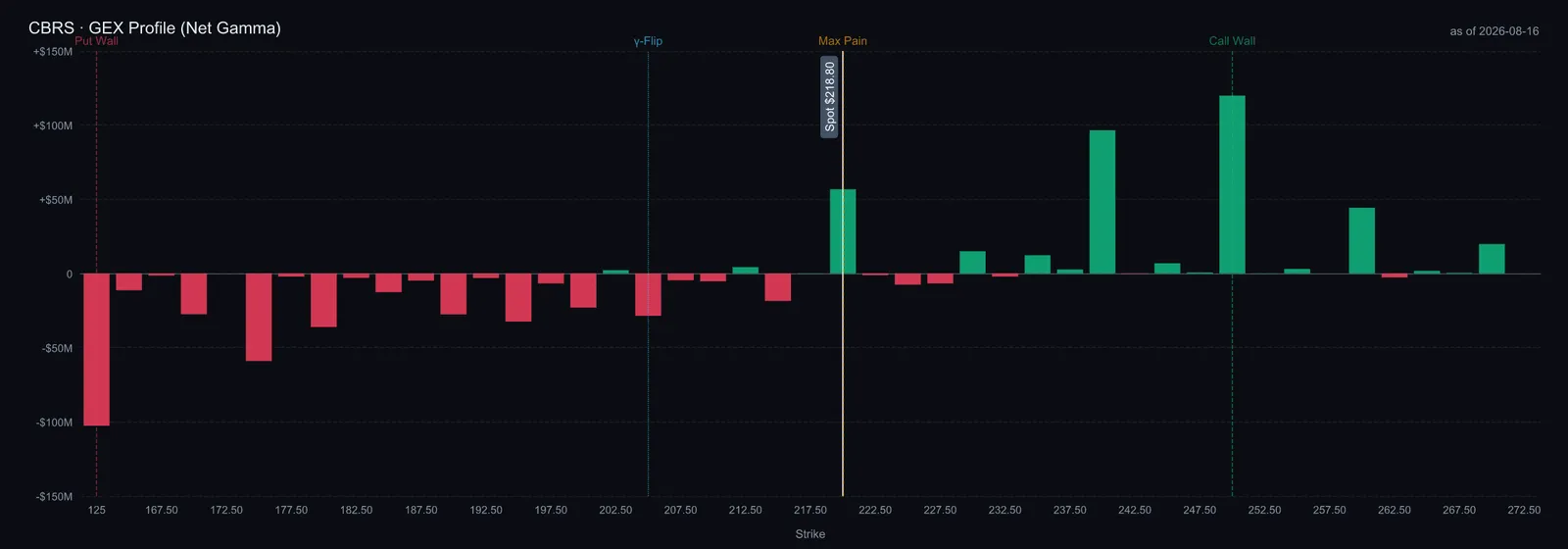
Cerebras net gamma by strike, 14 August 2026
Negative net GEX at −$3.96B with spot sitting on the put wall at 220 — dealers amplify moves here rather than damping them.
LOG 09 // THE NAMES

The counterweights — S&P Global and Alphabet

Two names on the roster were not part of the funding event at all, and that is precisely why they belong here. S&P Global's Q2 revenue was $4,146M against $3,755M, up 10.4% — but operating profit rose 16.8% to $1,812M and diluted earnings per share went from $3.50 to $4.12, helped by a share count falling from 306.1 million to 295.5 million. Ratings, indices and analytics compound at low incremental cost, which is why a 10% revenue line becomes a 17% profit line.
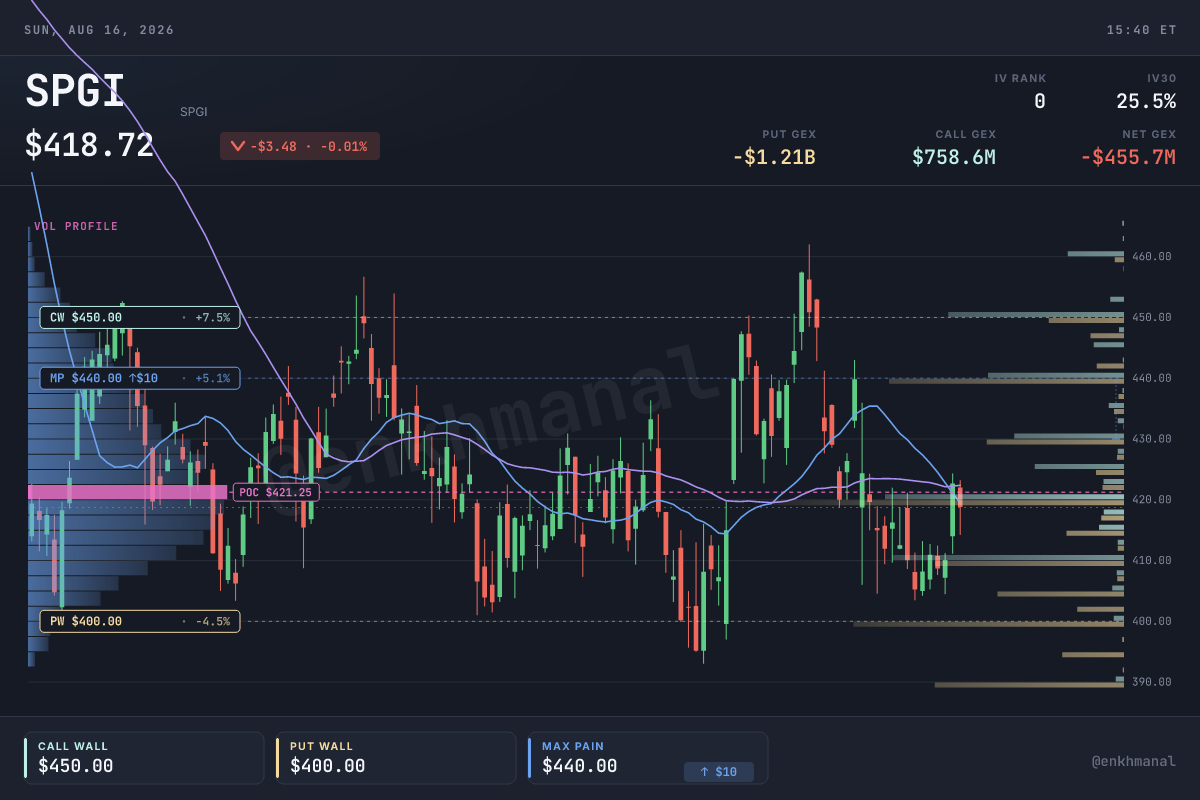
S&P Global price and levels, 180 days to 14 August 2026
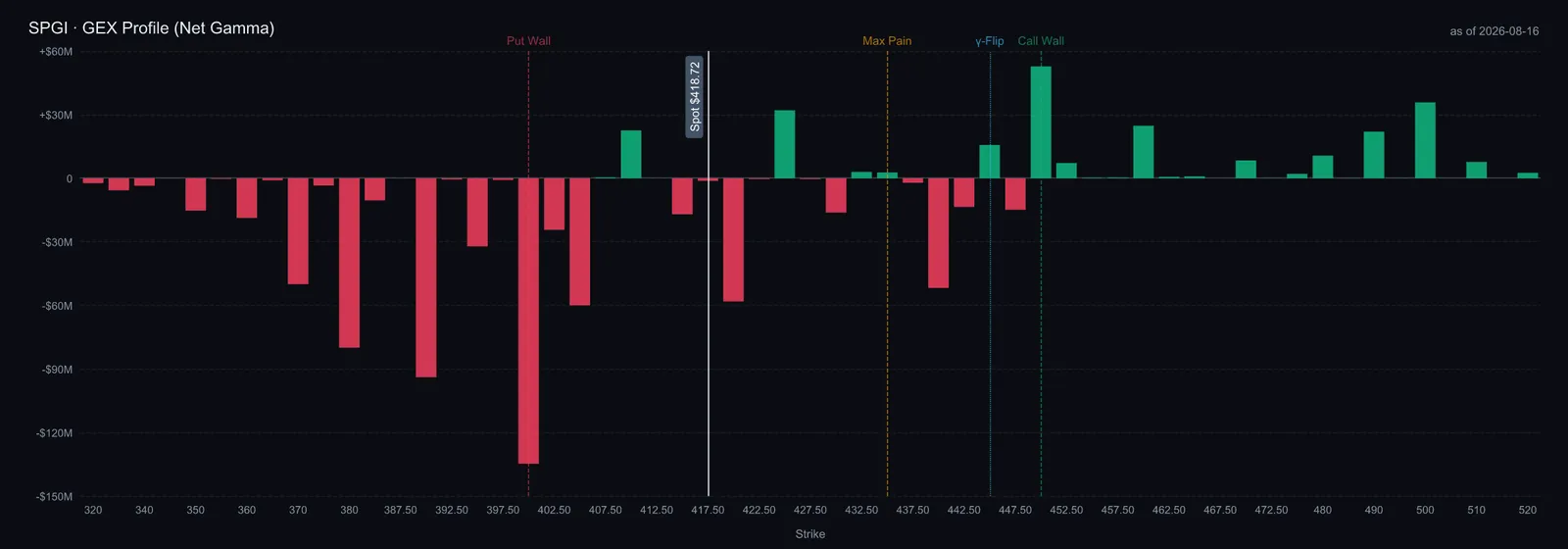
S&P Global barely noticed July — a 0.6% drawdown — yet trades below its 200-day at $432.94 and is down 13.7% year-to-date.
S&P Global net gamma by strike, 14 August 2026
Negative net GEX means dealers amplify rather than dampen here, so the name moves on its own news.

Alphabet is the roster's single largest conviction: sixteen positions across two share classes, ten buyers, and Berkshire lifting its stake 83% to 105,979,600 shares worth $37.77B, making it a top-three holding. Third Point added 485.7%, Hohn 12.3%, Coatue 12.6%. The disagreement is real and worth naming — Tiger cut 45.4%, Viking exited entirely and Ackman sold out. That split is a genuine argument about whether Alphabet's capital expenditure earns its return, had between managers reading the same disclosures.
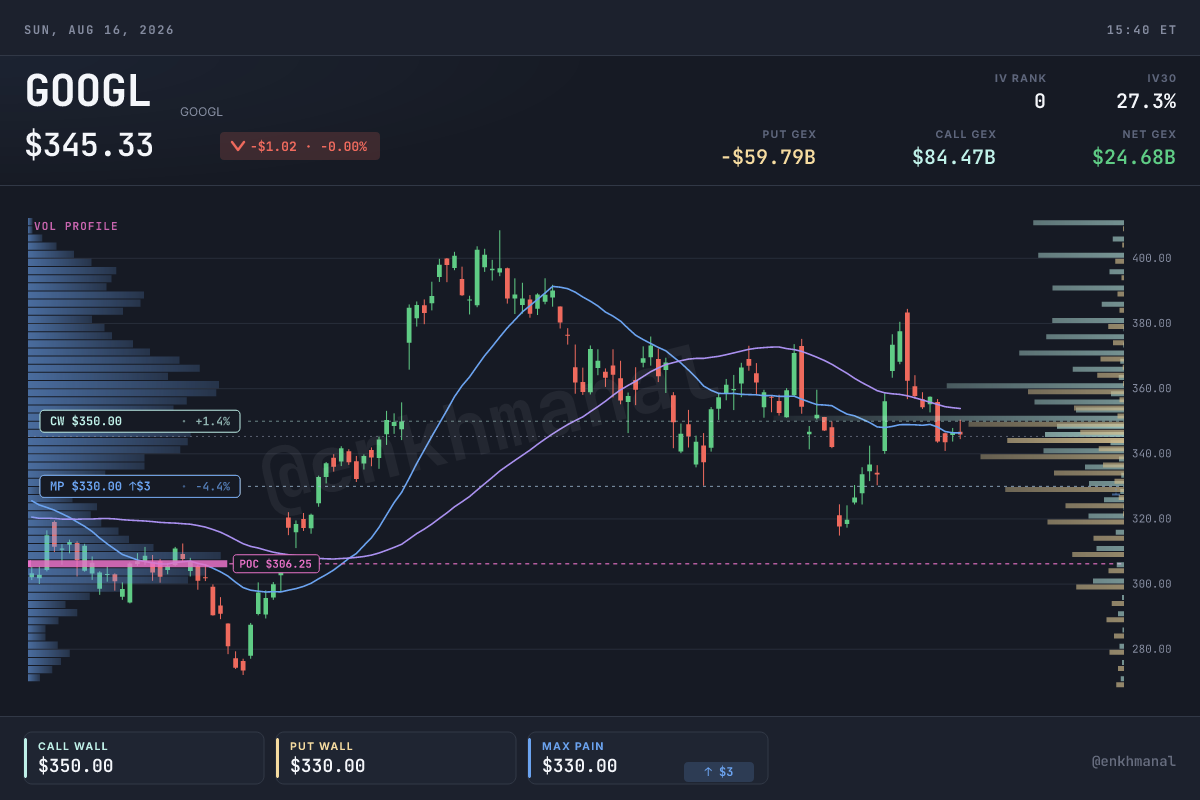
Alphabet price and levels, 180 days to 14 August 2026
Alphabet at $345.90 sits under its 20-, 50- and 100-day but above its 200-day at $331.38.
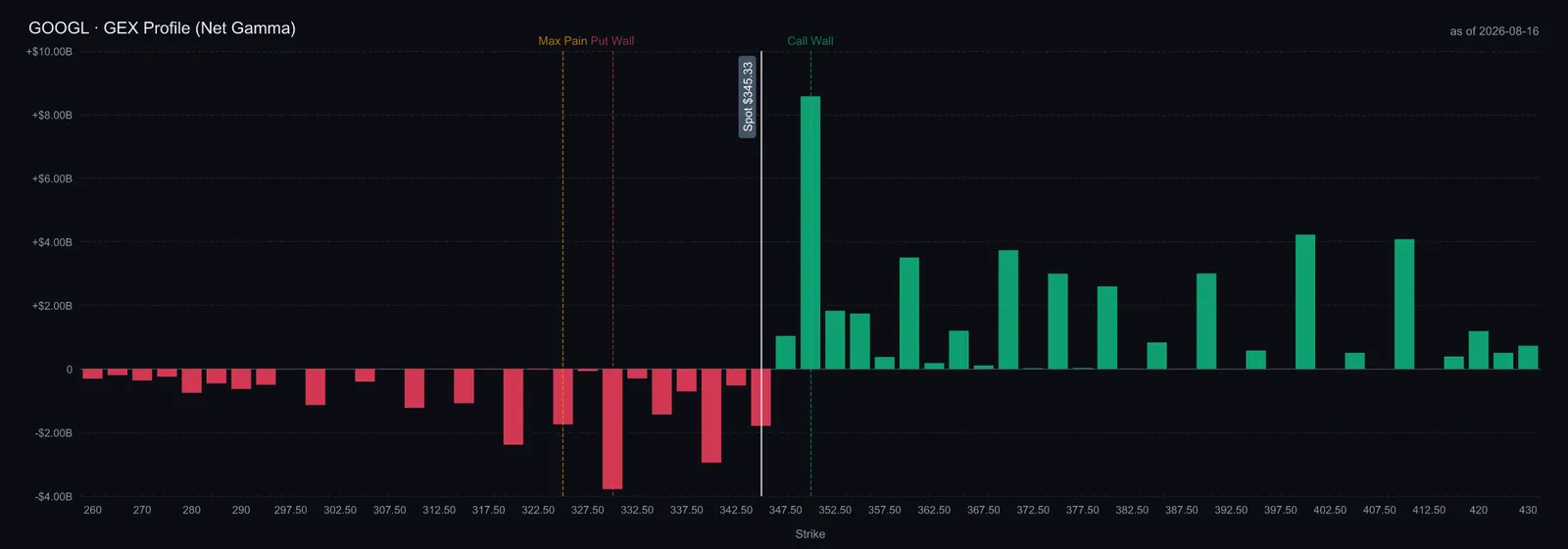
Alphabet net gamma by strike, 14 August 2026
The largest positive gamma pin in the basket at +$37.75B, with the call wall at 350 immediately overhead.
LOG 06b // BELOW CONSENSUS

What a holder-count screen structurally hides

Ranking by holder count and dollars sorts for the companies you have already read about. A position one specialist opened in a $3B business sits at the bottom of that table and disappears under any "held by 3+ funds" filter. So the same fourteen filings were re-screened on the opposite axis — conviction relative to obscurity: weight inside the manager's own book, whether it was newly opened, and fewer holders scoring better rather than worse.

TeraWulf — Lone Pine
6.8%
of the company; $596.4M and 3.6% of a 34-position book
TeraWulf Q2 revenue
$44.8M
DOWN 6% — but HPC lease revenue went 0% → 71% of the total in a year
JFrog — Whale Rock
3.4%
of the company, no other roster fund alongside; Q2 $163.8M, +28.7%
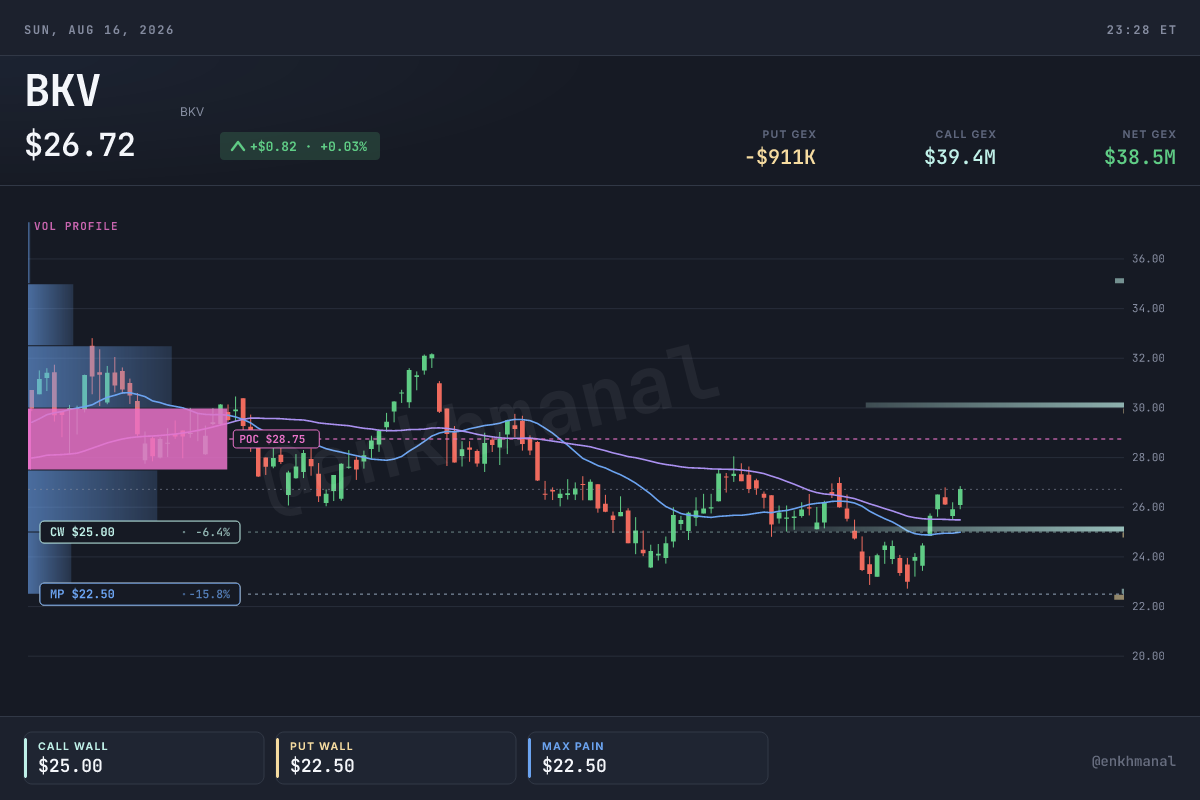
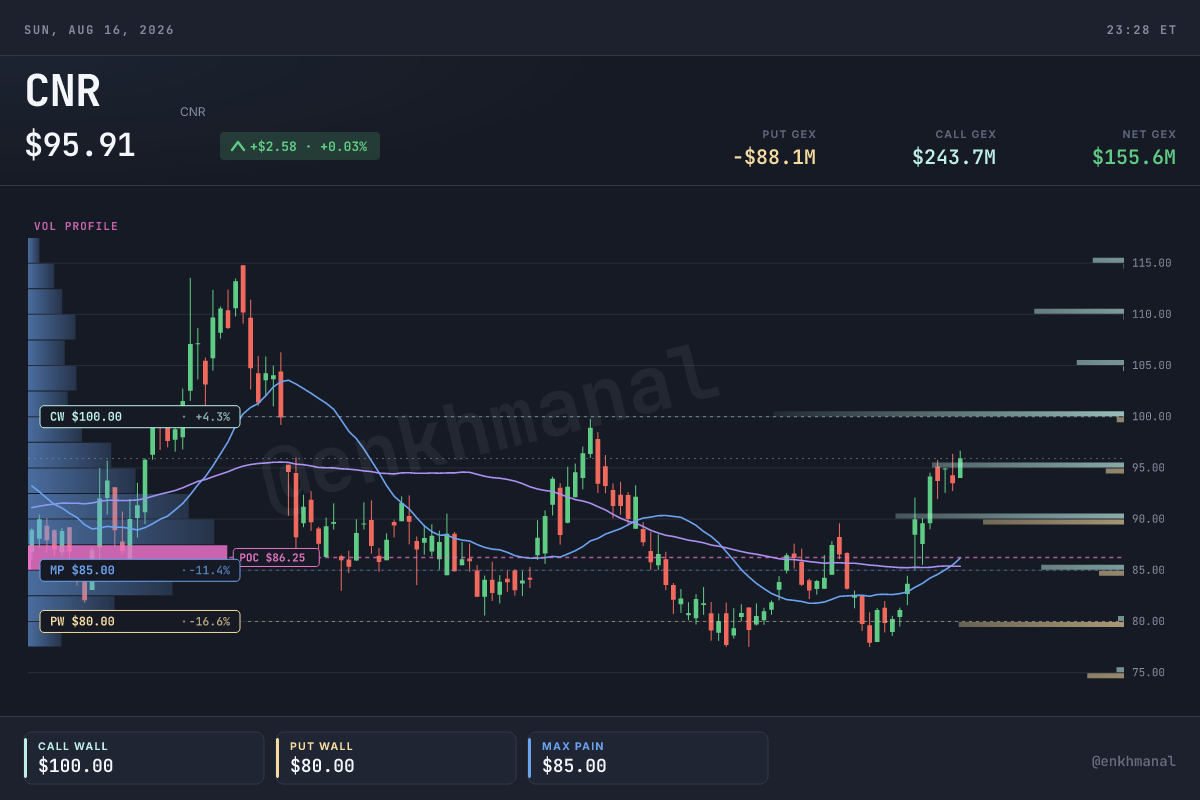
BKV — DME Capital
$322.5M
Q2 revenue, +20.0% — gas and carbon capture behind the data centres
Core Natural Resources
$1,141.0M
Q2 revenue, +3.5% — barely growing, which is the point of a value position
Sub-$5B on the roster
1 of 14
essentially only Einhorn's DME fishes there, and its book is value, not AI

TeraWulf is the one worth the work, and a growth screen would throw it away. Revenue fell 6%, which on that line alone reads as a shrinking business. The composition says otherwise: high-performance-compute lease revenue was 71% of the total against 0% a year earlier, with mining down from 100% to 29%. This is a bitcoin miner that has substantially finished converting into a data-centre landlord, and the transition shows up as flat revenue precisely because one business is replacing another rather than adding to it.
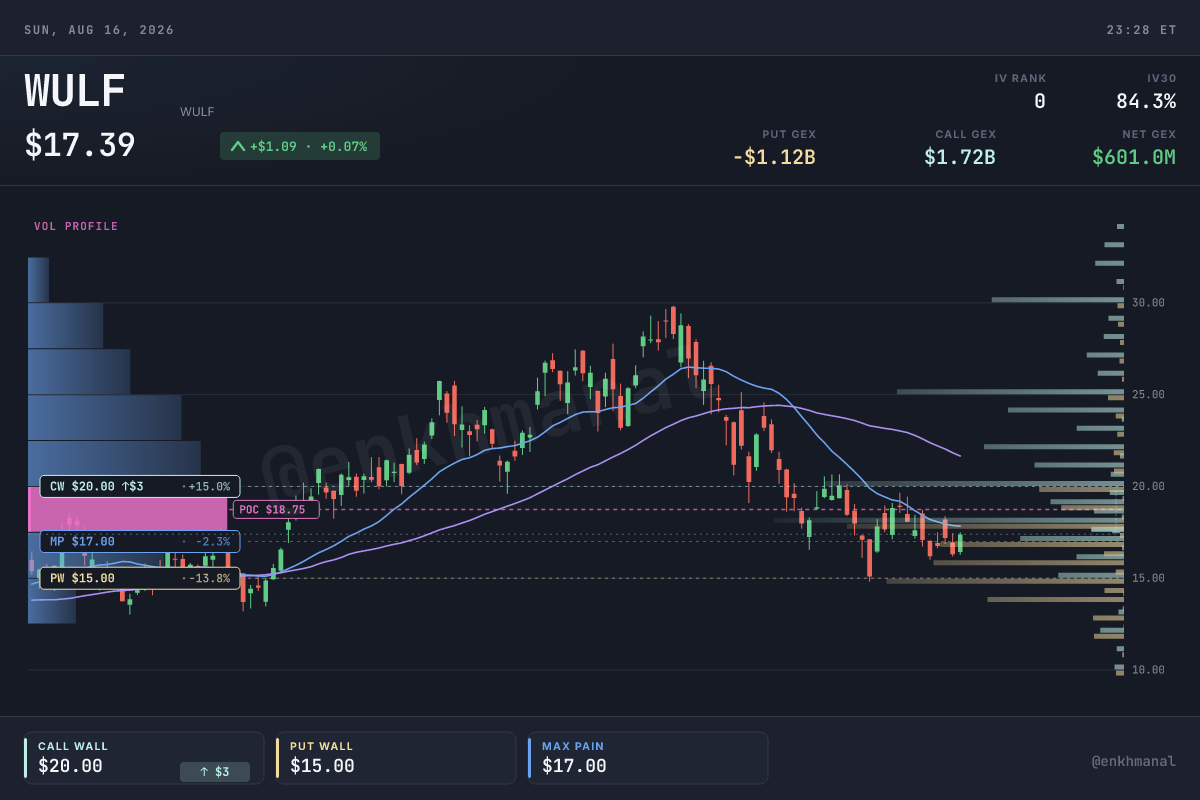
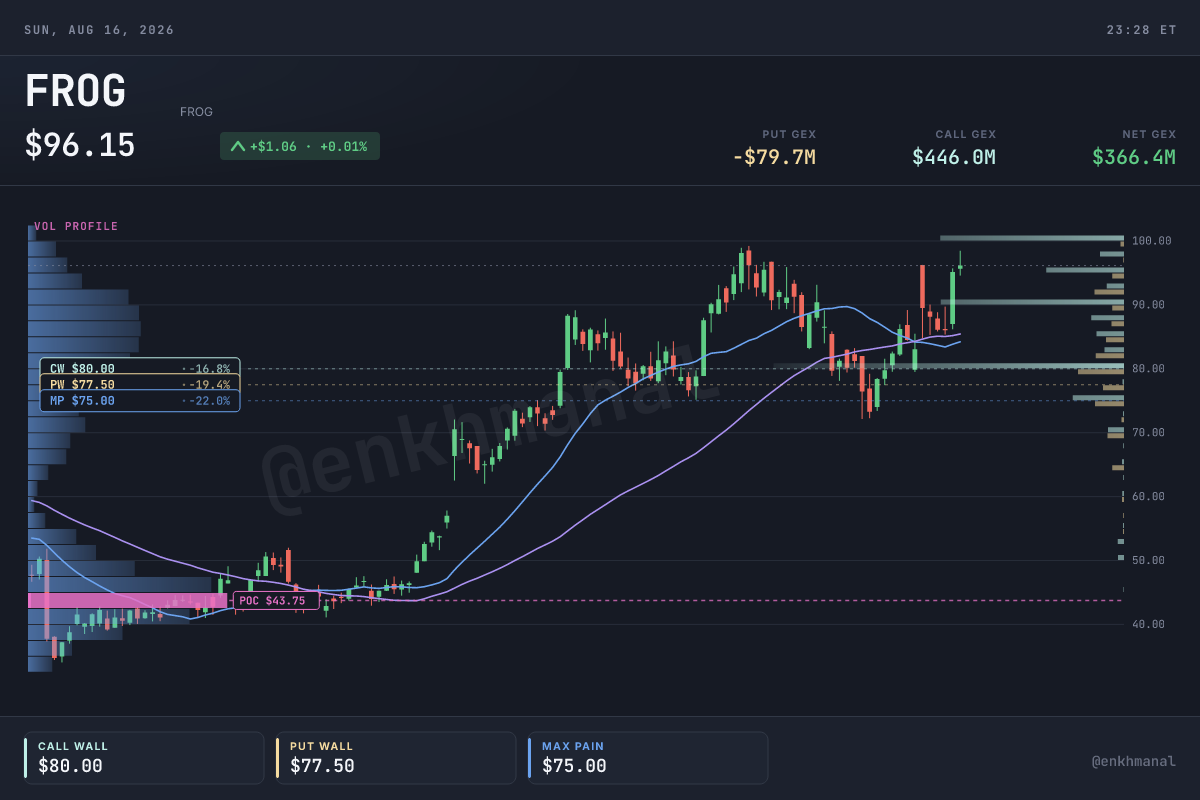
TeraWulf price and levels, 180 days to 14 August 2026
Lone Pine holds 6.8% of the company — the largest ownership share of any name in this memo, in a fund that runs 34 positions.
JFrog price and levels, 180 days to 14 August 2026
Whale Rock holds 3.4% of JFrog with no other roster fund alongside — one fund, high weight, no company. The definition of what a consensus table filters out.
BKV price and levels, 180 days to 14 August 2026
BKV produces natural gas and is building carbon-capture capacity — the same trade as Sterling, one layer further back.
Core Natural Resources price and levels, 180 days to 14 August 2026
Core Natural Resources grew 3.5% — barely, which is the point of a value position rather than a growth manager's.

The honest caveat: these are one-fund positions, carrying none of the cross-manager corroboration that makes the main basket worth anything. A single manager can be wrong in a way five unaffiliated managers usually are not. What they carry instead is the thing the main basket has already lost — nobody has written them up, and the price has not been bid by people reading the same filings. Size them accordingly.

LOG 10 // VALIDATION

The funds bought — then the companies reported

Name
What was bought
What the company then reported
TTM Technologies
3 funds, $1.40B
Q2 revenue $1.004B, +37.4%; adj. EBITDA $166.8M (16.6%); non-GAAP EPS $0.99 vs $0.58 — 10-Q + 8-K, 5 Aug
Sterling
Lone Pine, $511.7M new
Q2 revenue $1.168B, +90% (≈50% organic); adj. EPS $5.80, +116%; backlog $4.33B — 10-Q, 4 Aug
Astera Labs
Whale Rock, $757.3M new
Q2 revenue $392.4M, +104%; GAAP gross margin 73.3%; non-GAAP op margin 39.1% — 10-Q, 5 Aug
Nebius
Lone Pine's #1, $1.18B
Q2 revenue $582.3M vs $105.1M, +454%; H1 $981.3M, +529% — 6-K, 12 Aug
Flex
Third Point, $166.9M new
Revenue $7,928M, +20.6%; Cloud & Power $2,202M, +35.4% at a 9.7% margin — 10-Q, 31 Jul
Seagate
4 funds opened
FY26 revenue $12.195B, +34%; gross margin 46% vs 35%; diluted EPS $13.90 vs $6.77 — 10-K, 4 Aug
S&P Global
Hohn $5.74B, Ackman $1.06B new
Q2 operating profit $1,812M vs $1,551M, +16.8%; diluted EPS $4.12 vs $3.50 — 10-Q, 28 Jul
SpaceX
8 funds, $25.07B
Q2 revenue $7.814B vs $4.071B, +92%; H1 $12.508B — 10-Q, 4 Aug
MasTec
Held by 4, all trimmed
Q2 revenue $4.374B, +23.4% — 10-Q, 30 Jul
⚠️

We delivered strong sales growth in Q2 of 37% year-on-year, resulting in an all-time high of $1 billion for quarterly revenue, driven by increases in our Data Center and Networking, Medical, Industrial & Instrumentation, Aerospace & Defense end markets. — Edwin Roks, President & CEO, TTM Technologies, 5 August 2026

LOG 11 // THE GAP

Ten identical validations, two opposite outcomes
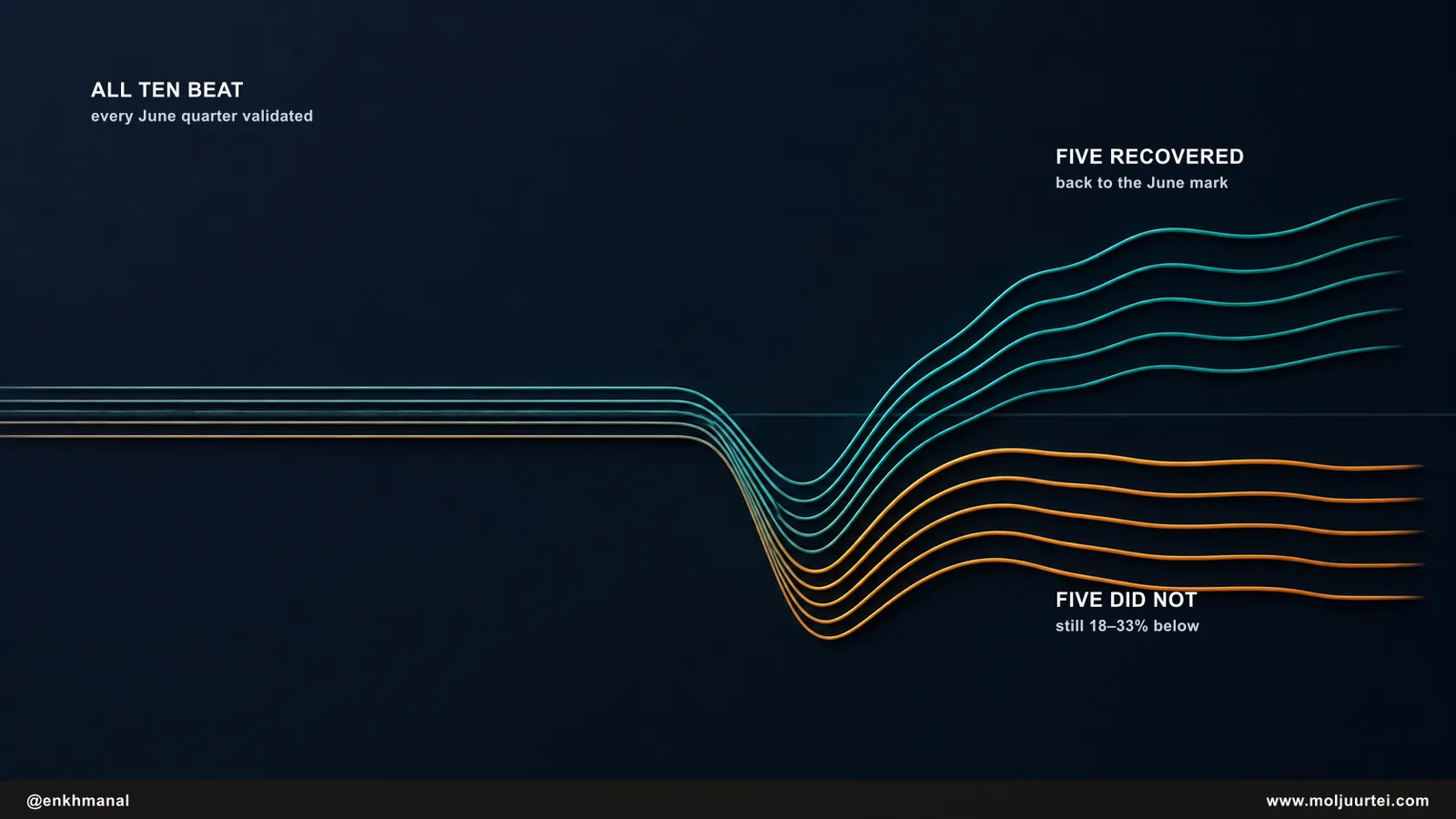
Ten price tracks from a shared June baseline, all falling together in July then splitting into five that recover and five that stall below the line
that the recovery split is arbitrary: identical drawdowns and identical beats produced opposite price outcomes, which is what makes the remaining discount positioning residue rather than information
Name
30 Jun mark
Jul low
14 Aug
vs mark
Astera Labs
$482.24
$245.01
$321.64
−33.3%
Sterling
$839.24
$492.71
$576.34
−31.3%
TTM Technologies
$187.01
$99.21
$140.04
−25.1%
Flex
$161.97
$99.85
$126.20
−22.1%
SpaceX
$170.69
$107.74
$139.80
−18.1%
Alphabet
$357.22
$314.96
$345.90
−3.2%
Cerebras
$221.27
$162.54
$218.98
−1.0%
Nebius
$276.06
$145.81
$277.68
+0.6%
Seagate
$964.36
$699.07
$973.44
+0.9%
S&P Global
$406.93
$404.54
$418.80
+2.9%

Nebius fell 47% — as deep as TTM — and is now above its 30 June mark. Same drawdown, same beat, opposite outcome. No fundamental variable separates the two groups, which is the strongest available argument that what is left in the first group is positioning residue rather than information.
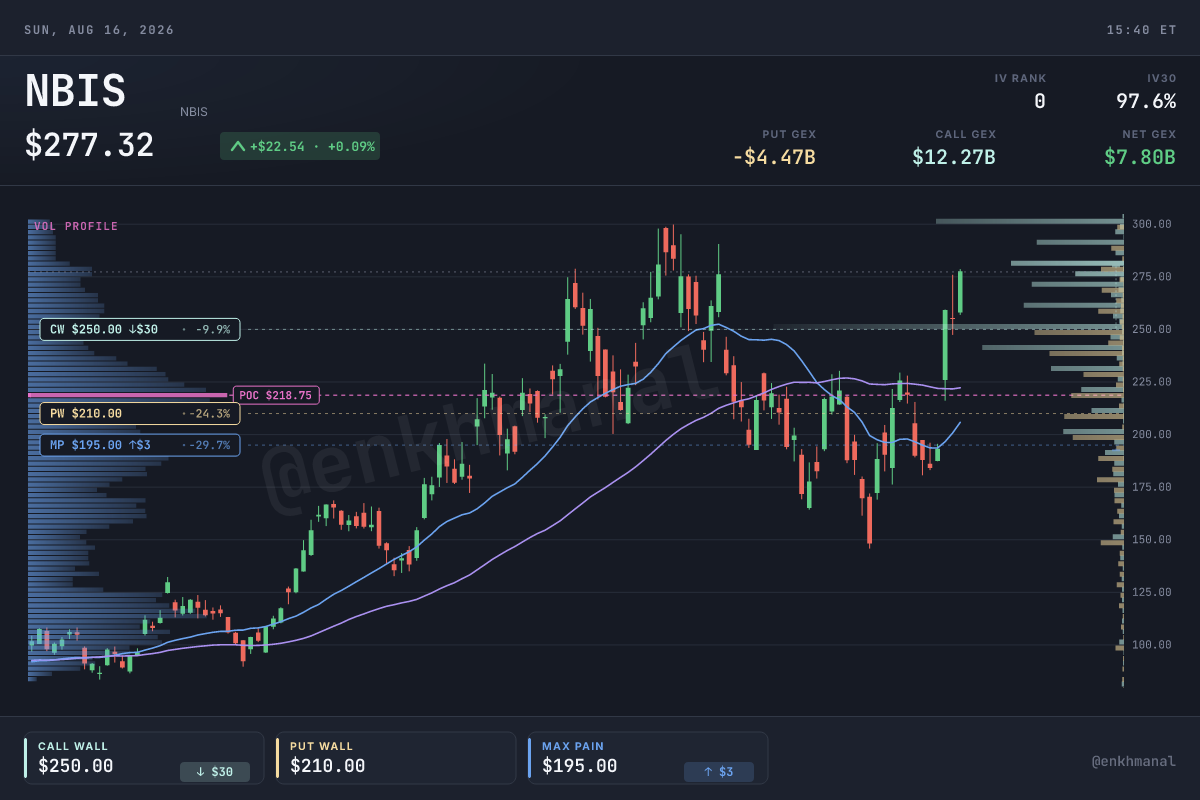
Nebius price and levels, 180 days to 14 August 2026
Nebius at $277.68 sits above every moving average with RSI 65 and a call wall directly overhead at 280 — the recovery is complete and the next move needs new information.
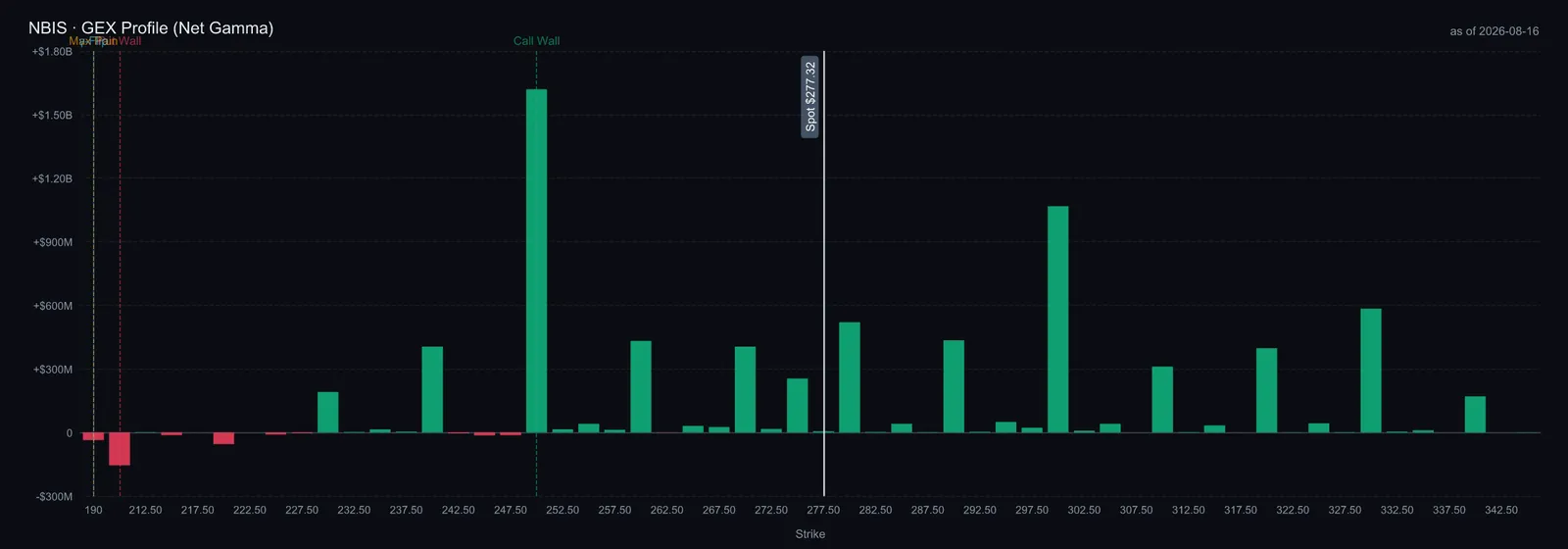
Nebius net gamma by strike, 14 August 2026
Net GEX of +$14.31B against a put wall down at 210 — a wide, well-cushioned range after the round trip.
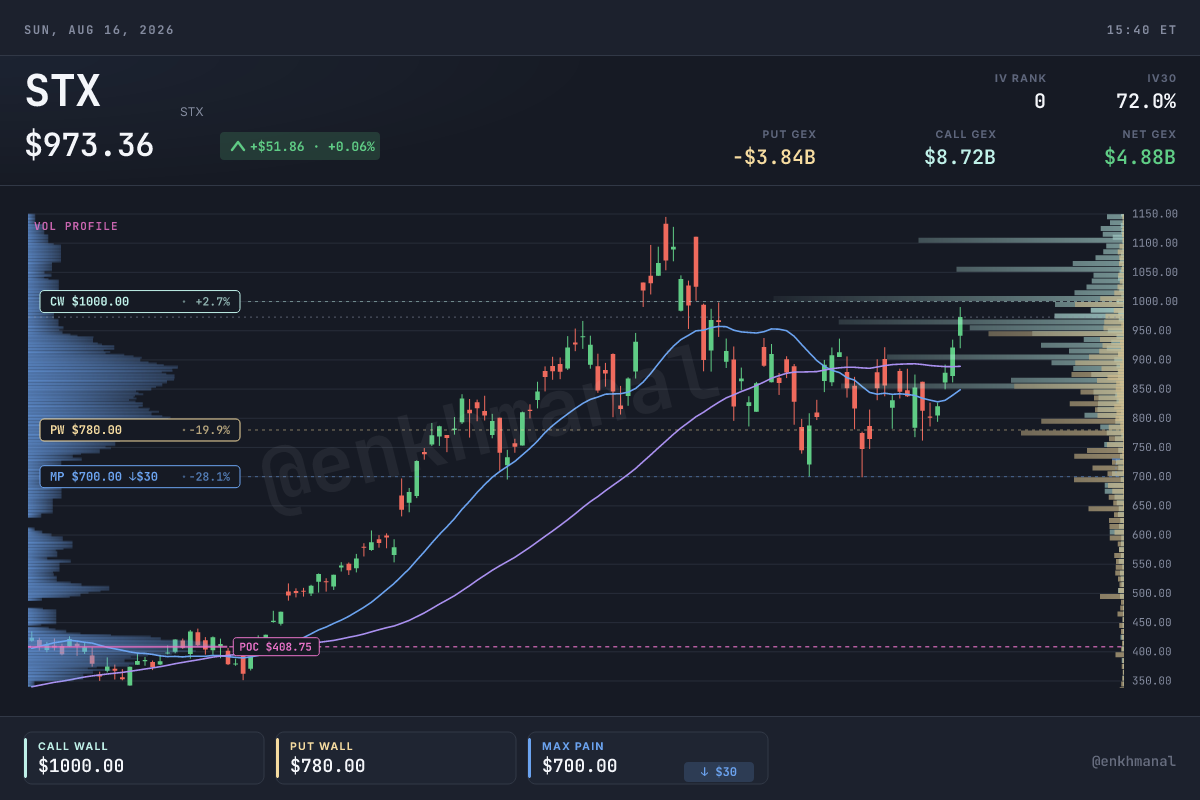
Seagate price and levels, 180 days to 14 August 2026
Seagate at $973.44 is the same story one size up: through the 50-day, with a business that just printed 46% gross margins against 35% a year ago.
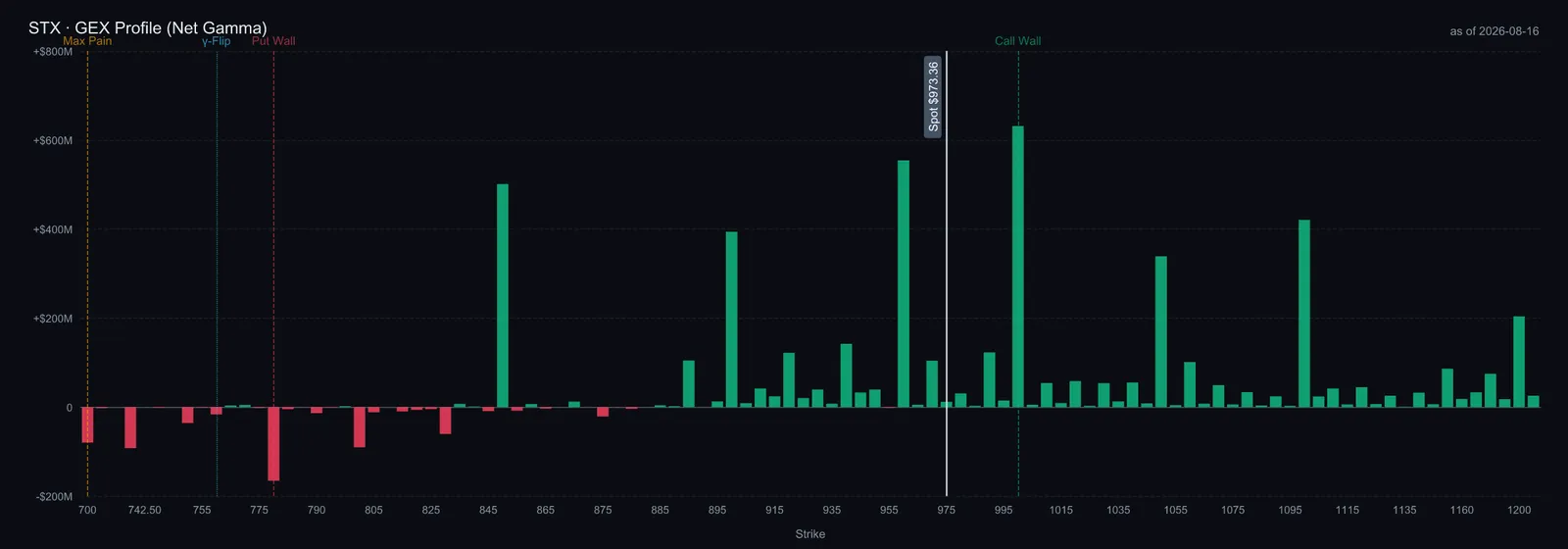
Seagate net gamma by strike, 14 August 2026
Call wall at 1,000 with the put wall far below at 780 and net GEX of +$6.62B.
LOG 12 // RISK

What breaks it

Why it works
Three unaffiliated managers accumulated TTM, which then printed a record quarter at 37% growth, a 16.6% EBITDA margin and 0.9× net leverage — and the stock is 25% below what they paid.
Not one of the ten missed on the June quarter; the validation gate is clean across every company in the basket.
Nebius fell as far as TTM and fully recovered, so nothing fundamental explains why five names are still discounted.
Flex's Cloud and Power segment grows 35% at a 9.7% margin inside a company priced on a 20% blended average, with a separation targeted for Q1 2027.
S&P Global and Alphabet offer the same economy at valuations untouched by the funding event.
What I am watching
A 13F is a photograph of 30 June. A drawdown this violent is exactly when concentrated books cut, and the next filing is 16 November.
Consensus is crowding in better clothes — nine holders means nine potential sellers through the same exit.
D1 Capital holds 61.9% of its disclosed book in one company listed for three weeks, with a lock-up expiry still ahead.
Sterling's headline 90% growth is ~50% organic; acquisitions contributed $250.8M and will lap.
One quarter of beats is a datapoint, not a trend; Astera at +104% and Nebius at +454% are lapping small bases.
LOG 13 // VIEW

What to do with it

Held and recovering
$157+
TTM
November filings show the roster held through July. TTM reclaims its 50-day and the June accumulation reads as a signal.
Range holds
$130–145
TTM
The put wall at 130 and call wall at 145 contain price while positive net gamma dampens moves. Accumulate inside the box.
Roster sold the July low
$115
TTM
November filings show the funds exited into the drawdown. Cross-fund agreement stops being evidence and max pain at 115 becomes the magnet.

TTM is the position to hold in size: three-fund accumulation across different styles, a fully validated print, defence revenue that ignores AI capex cycles, and the tightest technical box in the group. Flex is the second call and the cheaper entry, with the Cloud and Power separation ahead of it. Astera and Sterling are the higher-beta expressions of the same idea and belong in smaller size. SpaceX is a genuine starter kept small for the lock-up. S&P Global and Alphabet earn their slots precisely because they sat out the funding event. Nebius, Seagate and Cerebras have already made the round trip.

Position data read directly from the Q2 2026 13F-HR information tables on SEC EDGAR (period 2026-06-30, filed 2026-08-14) via `cowork thirteen-f`. Operating figures independently verified against the 10-Q, 10-K, 8-K and 6-K filings cited in each row. Prices are Alpaca daily bars to 14 August 2026; option levels from the app's gamma snapshot the same day. Scenario cases are illustrative outputs of the stated levels, not forecasts. The July forced-unwind account is press and commentary, not a filing — the price moves attributed to it are measured, the cause is reported.
Share: