
$EVAX — Target selection, durable responses and the partnership test
$EVAX designs personalized cancer-vaccine targets. Update · October 24, 2026: the October 23 release raised the reported target immune-response rate from 86% to 89%; six extension participants remained without progression. This updates the original October 21 thesis. The 16-patient study has no randomized control, and the approximately $24M enterprise-value reference uses the original $3.85 price and dated cash figures.
Cancer is the body's own cells growing out of control, which is why the immune system mostly leaves it alone: it is trained from birth not to attack itself. Melanoma, a cancer of the pigment cells in the skin, is where that rule bends most, because years of ultraviolet light leave so many errors in the tumour's DNA that its cells start to look foreign. Once melanoma has spread to other organs, survival depends on whether the immune system can be persuaded to finish the job.
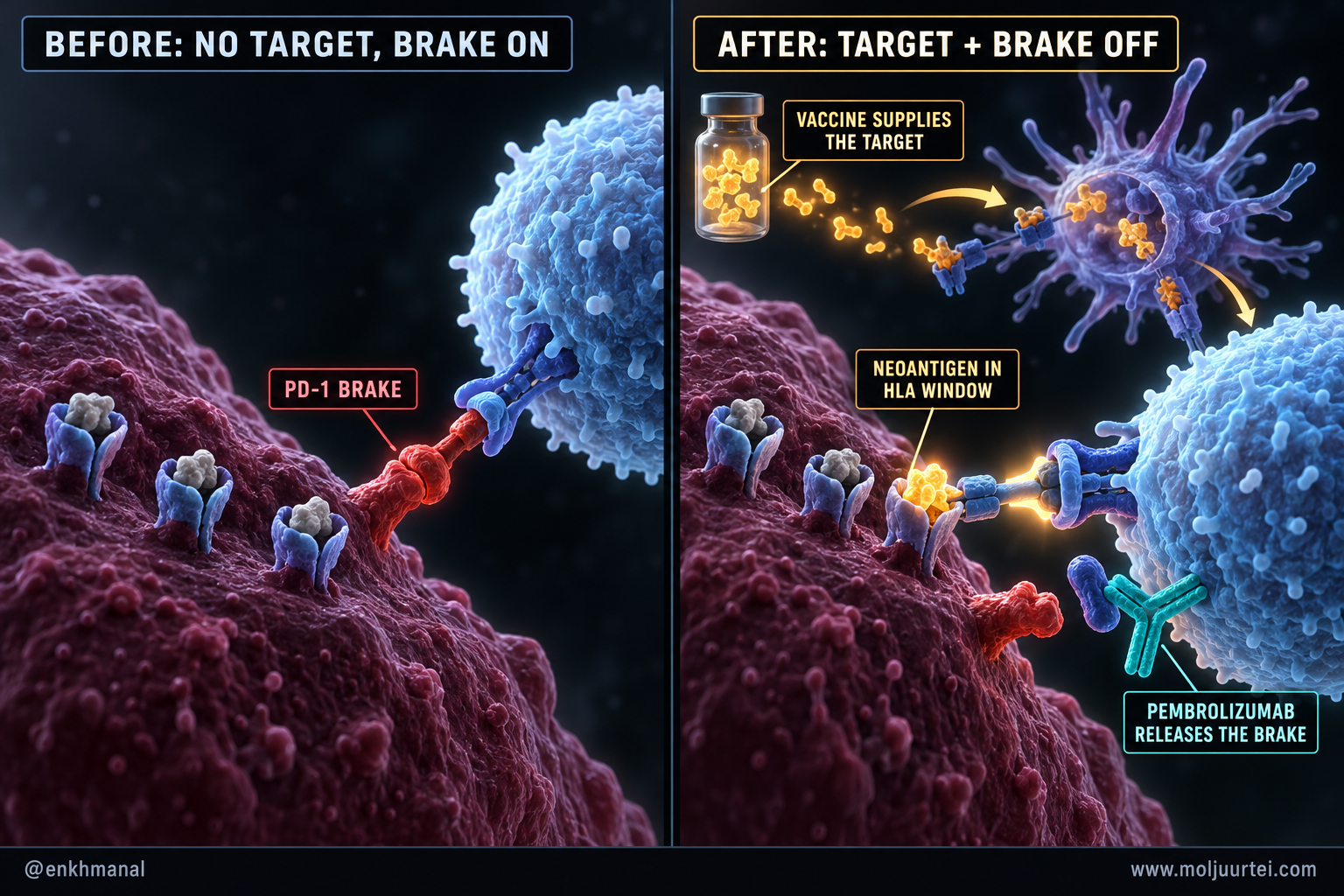
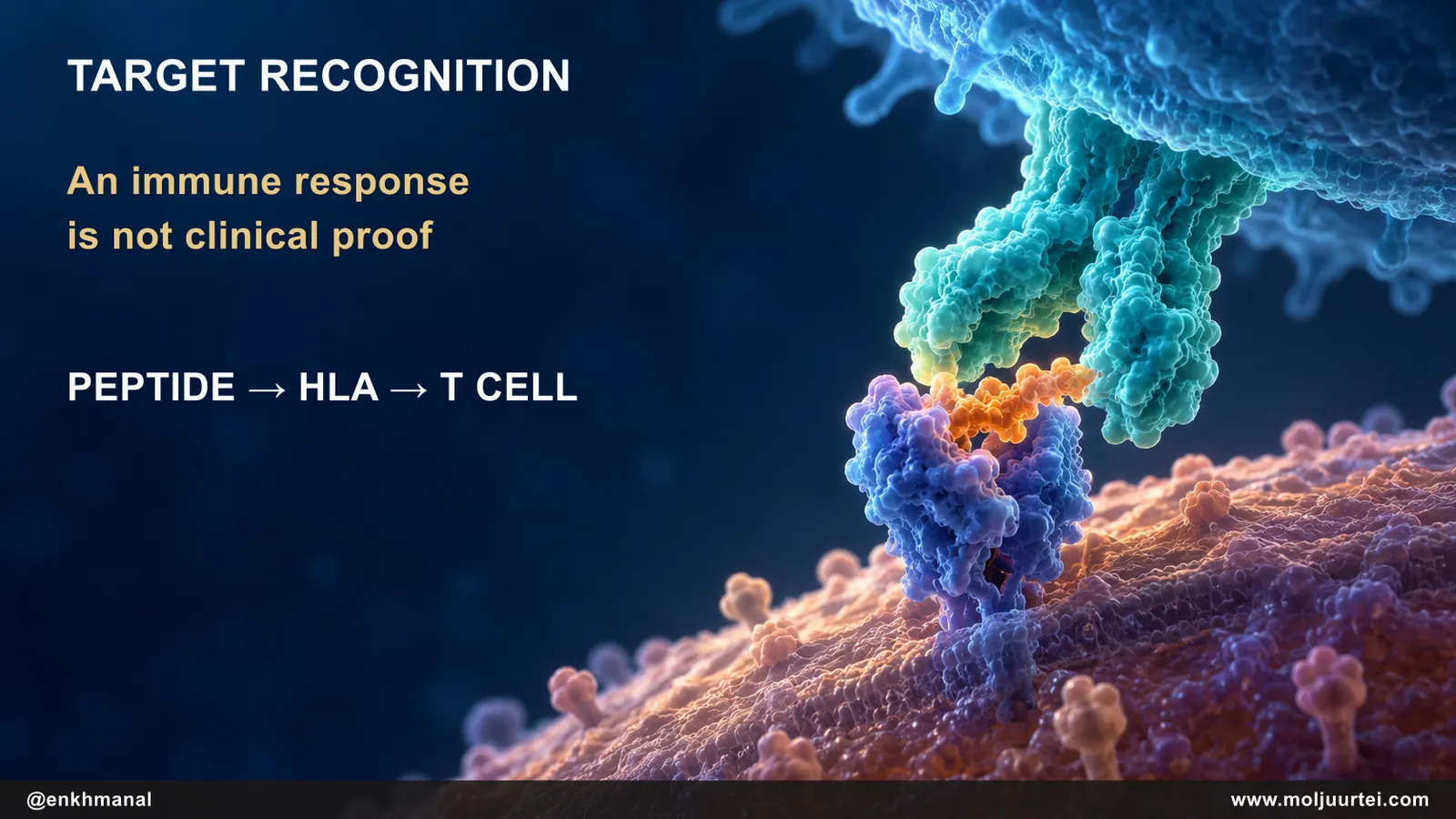
Start here. A gene is the instruction, written in DNA, for building one protein, and a mutation is a typo in that instruction. A cell constantly chops a sample of its own proteins into short fragments called peptides and displays them on its surface in a holder called HLA, the way a shop puts goods in the window. A T cell is a white blood cell that patrols the body reading those windows, and when it recognises a fragment as foreign it kills the cell showing it. A neoantigen is a fragment made from a mutated protein, so it exists in the tumour and nowhere else in the body. A personalised cancer vaccine is an injection of a few of one patient's neoantigens, mixed with an adjuvant that alarms the immune system so T cells learn to hunt them. A checkpoint inhibitor such as pembrolizumab (Keytruda) is a drug that removes a brake, called PD-1, that tumours use to switch T cells off. Everything below is about who chooses the fragments.
The standard treatment for advanced melanoma is the checkpoint inhibitor, and it changed the disease. In Merck's KEYNOTE-006 trial, median overall survival on pembrolizumab was 32.7 months against 15.9 months on the older drug ipilimumab. Its limit sits in the mechanism. Releasing a brake helps only when the car is already pointed somewhere: if a patient's T cells do not recognise the tumour, there is nothing to release, and median progression-free survival in that same trial was 8.4 months. A vaccine is the steering wheel. It hands T cells targets they did not have.
The hard part is choosing. A melanoma typically carries hundreds of mutations, but only a few produce fragments that the patient's HLA will display and that a T cell can see, and a peptide vaccine has room for five to ten. Evaxion's software, which it calls AI-Immunology, reads the DNA and RNA of a patient's tumour and blood, ranks every candidate fragment and picks the shortlist. The company makes those as synthetic peptides, mixes them with a liposomal adjuvant called CAF09b that it licenses from Denmark's Statens Serum Institut, and the patient receives a vaccine that exists for no one else. Pointed at bacteria and viruses instead, the same software chooses targets for preventive vaccines, which is how Merck came to license one.
The customer is a drug company, not a patient. Evaxion discovers, develops to Phase 2 and then licenses, collecting upfront fees, milestones and royalties; management said in December 2025 that it does not intend to run Phase 3 trials itself. That model works only when large companies want what it has, and the reason they might want it more now is that Merck and Moderna reported positive Phase 3 results in resected melanoma in August. That supports the broader approach but does not establish EVX-01 efficacy in advanced melanoma.
What Changed
Cancer vaccines spent thirty-five years being right about the biology and wrong in the clinic. In December 1991 a Belgian team published in Science the first human tumour antigen recognised by T cells, found in a melanoma, and the obvious next step was to vaccinate against it. The early vaccines targeted shared antigens: proteins that tumours overproduce but healthy tissue also makes. The immune system had been trained to tolerate exactly those, and the trials mostly failed. Professor Adnan Khattak, who runs Evaxion's melanoma trial in Perth, put the period plainly on the company's October 2025 webinar.
From 1975 all the way to 2011, melanoma was considered to be the graveyard of clinical trials where about 25-30 clinical trials were negative.
Three things then changed in order. Checkpoint inhibitors arrived (ipilimumab in 2011, pembrolizumab in 2014, a Nobel Prize for the underlying work in 2018), so a vaccine-trained T cell could no longer simply be switched off by the tumour. Cheap sequencing made each patient's own mutations readable, and in July 2017 two papers in Nature showed that vaccines built from them were safe and provoked T-cell responses in melanoma patients. Then the randomised data came. In KEYNOTE-942, 157 patients with resected melanoma received Moderna's personalised mRNA vaccine plus pembrolizumab or pembrolizumab alone; recurrence-free survival at 18 months was 79% against 62% (hazard ratio 0.561, published in The Lancet in 2024). On 19 August 2026 Merck and Moderna reported that the 1,137-patient Phase 3, INTerpath-001, met both recurrence-free and distant-metastasis-free survival.
That is the shift. The question is no longer whether a vaccine built from a patient's own mutations can help; it is who can choose the right mutations quickly and cheaply enough to make one for every patient. For Evaxion three things have moved since that August readout. On 19 October it reported that all six responders who entered a third year on its vaccine alone remain without progression, before the ESMO poster released on October 23 for the October 24 session. On 19 to 21 August it sold 681,268 ADSs into the Phase 3 volume at an average $3.20, for $2.1 million net. And the stock went from $2.83 on 16 October to $4.05 on 20 October.
Our own read has moved too. In August, writing about Evaxion inside a group of peptide-vaccine developers, we described it as cash plus programmes the market expected nobody to license, and we put dilution at 51% in a year in the earlier article; that comparison was invalid. That figure compared a six-month weighted share count with a single quarter; the like-for-like quarterly figure is 32% (315.8 million to 417.0 million ordinary shares), and no new shares were issued at all in the first half of 2026. The cash figure that the Q2 call transcript renders in kroner is a transcription slip: the filing says $14.0 million. And we left out the evidence that the platform sells, Merck's licence of EVX-B3 and its venture arm’s earlier 15% stake, subsequently about 13.5% after dilution. The shift rewards whoever chooses targets best and cheapest, and Evaxion is the smallest listed company whose product is exactly that.
Thesis
The opportunity is target selection that a pharmaceutical partner can license. Evaxion reported an 86% target immune-response rate at two years and 89% after extension samples. These are immunogenicity measures, not clinical success rates; whether EVX-01 adds benefit to pembrolizumab needs a randomized trial.
Business & Backdrop
Evaxion is a 45-person company in Hørsholm, north of Copenhagen, founded in 2008, and its income statement is a record of partner payments rather than sales. Merck paid a $3.2 million upfront fee in September 2024 for an option on two infectious-disease candidates and $7.5 million in September 2025 to exercise the option on one of them, EVX-B3. The Gates Foundation pays small grants for polio vaccine design work. Merck's payments were 100% of revenue in FY2024 ($3.3 million); in FY2025 they were 98.7% of revenue ($7.5 million in total) and the Gates Foundation grant 1.3% of revenue, the first non-Merck income the company has booked. Everything else is research and administration, funded by selling shares.
The trend is a company spending less and being paid more for what it finds. Revenue covered 0.3% of operating costs in FY2023, 18.2% in FY2024 and 44.6% in FY2025, and nothing in the first half of 2026. There is no gross margin to track, because the revenue is licence income with no cost of goods; operating loss, rather than an unstable revenue-based margin, is the useful comparison, which narrowed 34% in FY2024 and 37% in FY2025.
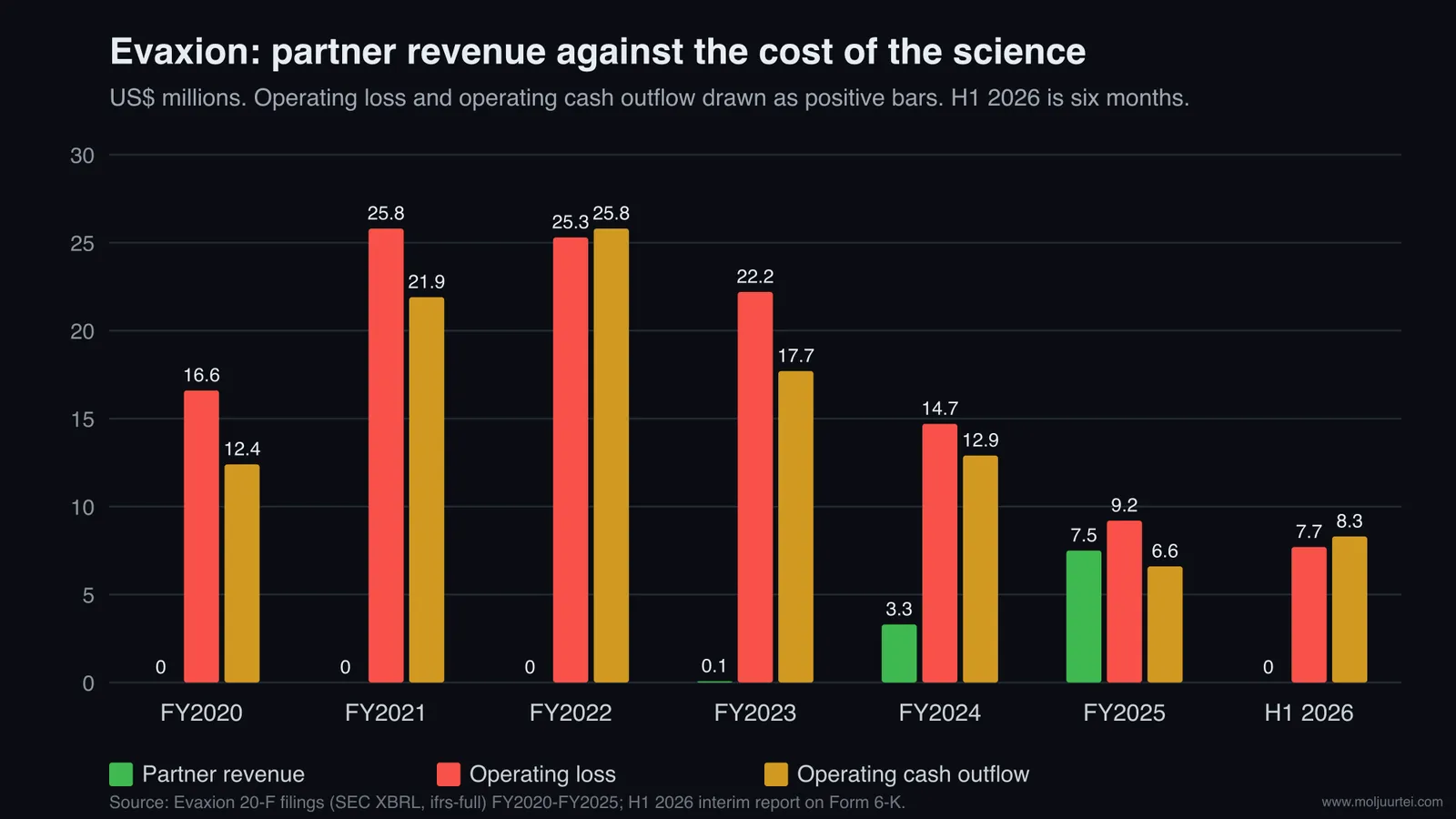
Set the cash flow against the losses and the operating loss is the honest number. In FY2024 the net loss of $10.6 million was flattered by $5.5 million of non-cash gains from revaluing warrants, and operating cash flow was −$12.9 million. In FY2025 the $7.7 million net loss sat against −$6.6 million of operating cash flow because $1.6 million of Danish research tax credits arrived in cash. In the first half of 2026 the company lost $7.4 million and used $8.3 million, the gap being $0.9 million of supplier bills paid down.
The quarters show where the money now goes. Research took 49.5% of operating costs in Q2 2025 and 60.7% in Q2 2026, because administrative spending fell from $2.2 million to $1.5 million a quarter as fundraising costs dropped away. Revenue arrives in lumps when Merck makes a decision, so a quarter's revenue margin swings from 0% to 167.6% and back; the run-rate that matters is an operating loss of about $3.8 million a quarter. The size of the prize is better read from what large companies have paid than from a market forecast: in October 2022 Merck paid Moderna $250 million to exercise its option on the personalised vaccine that became intismeran, before the randomised data were in.
Technology & Moat
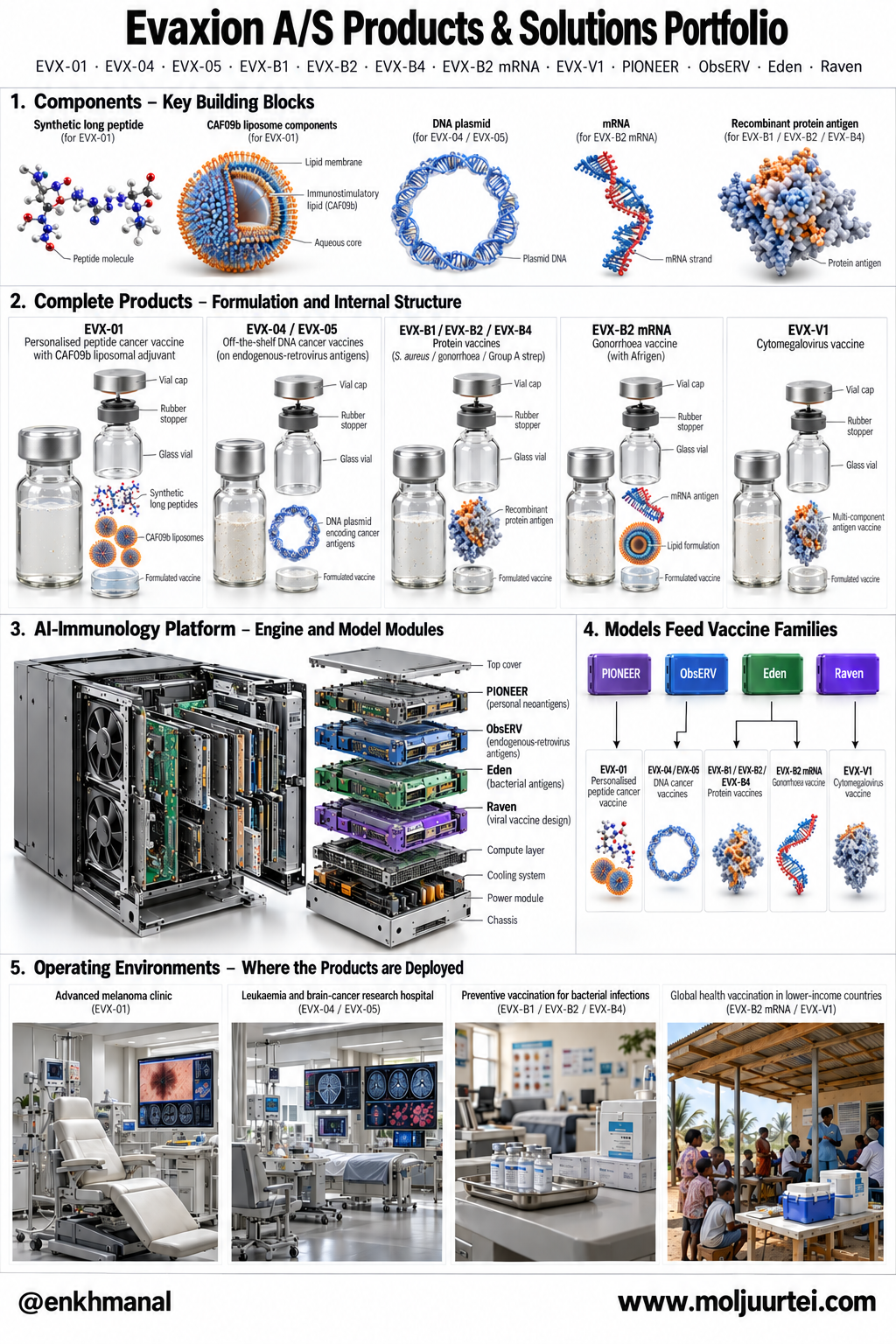
Evaxion's product is a ranking. AI-Immunology is a set of models trained on immunology data, each pointed at a different source of targets: PIONEER finds personal neoantigens in a tumour's DNA, ObsERV finds shared antigens hidden in the genome's ancient viral DNA, Eden picks bacterial antigens and Raven designs viral vaccines. The company protects the core of these models as trade secrets rather than patents, and argues in its annual report that a PIONEER vaccine cannot be copied by a generic maker because each one is unique to a patient.
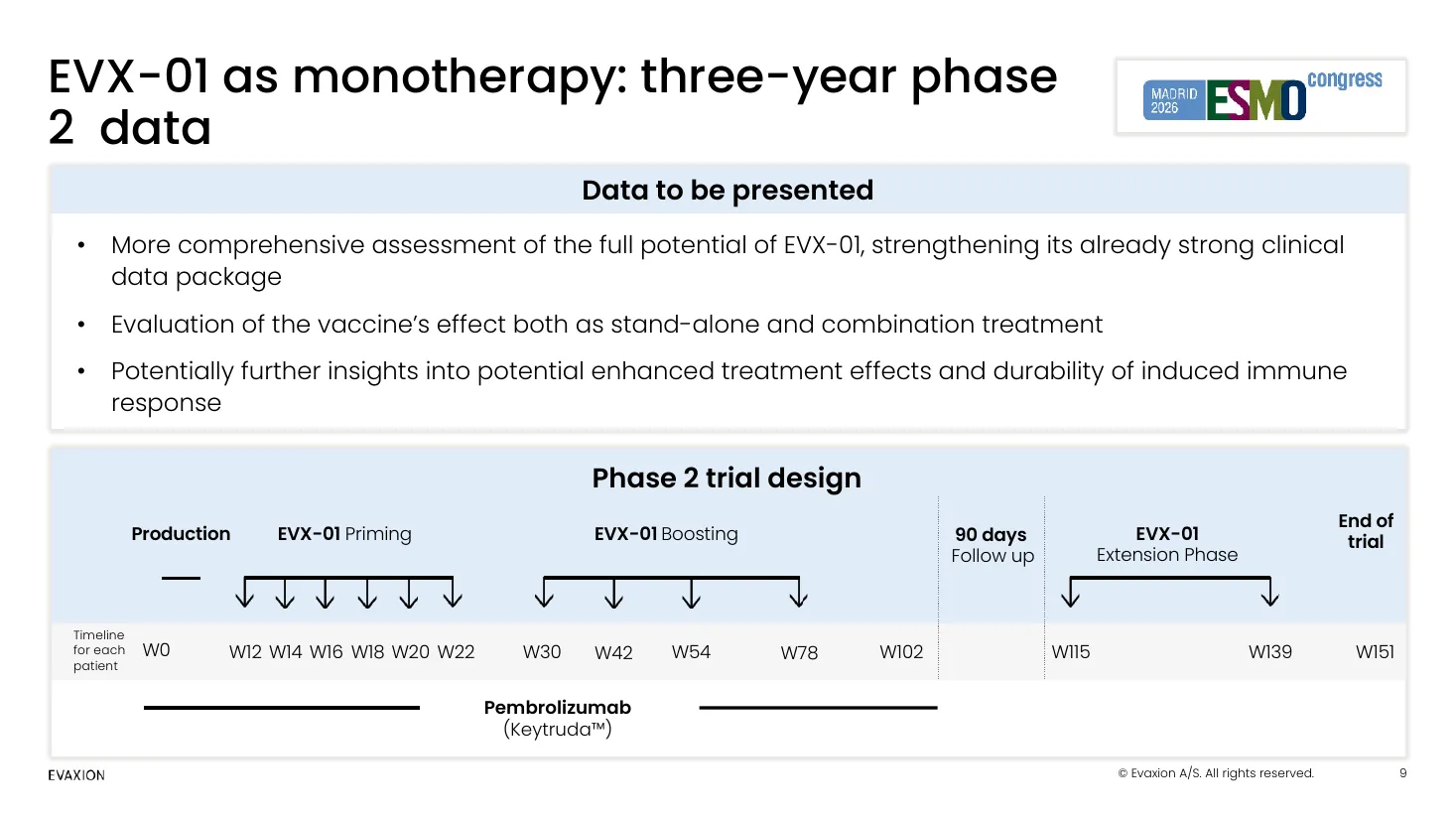
EVX-01 shows the chain from input to output. A biopsy and a blood sample are sequenced; PIONEER compares tumour with healthy DNA, predicts which mutated fragments the patient's HLA will display and which a T cell will recognise, and keeps five to ten. Those are made as synthetic long peptides and mixed with CAF09b, a fat-bubble adjuvant from Statens Serum Institut built to wake both CD4 helper and CD8 killer T cells, and the patient gets six priming doses between weeks 12 and 22 plus boosters. In the earlier Phase 1 the company reported a turnaround of six to eight weeks from biopsy to vaccine. This is a historical Phase 1 manufacturing statement, not a guaranteed commercial turnaround. This is a historical Phase 1 manufacturing statement, not a guaranteed commercial turnaround.
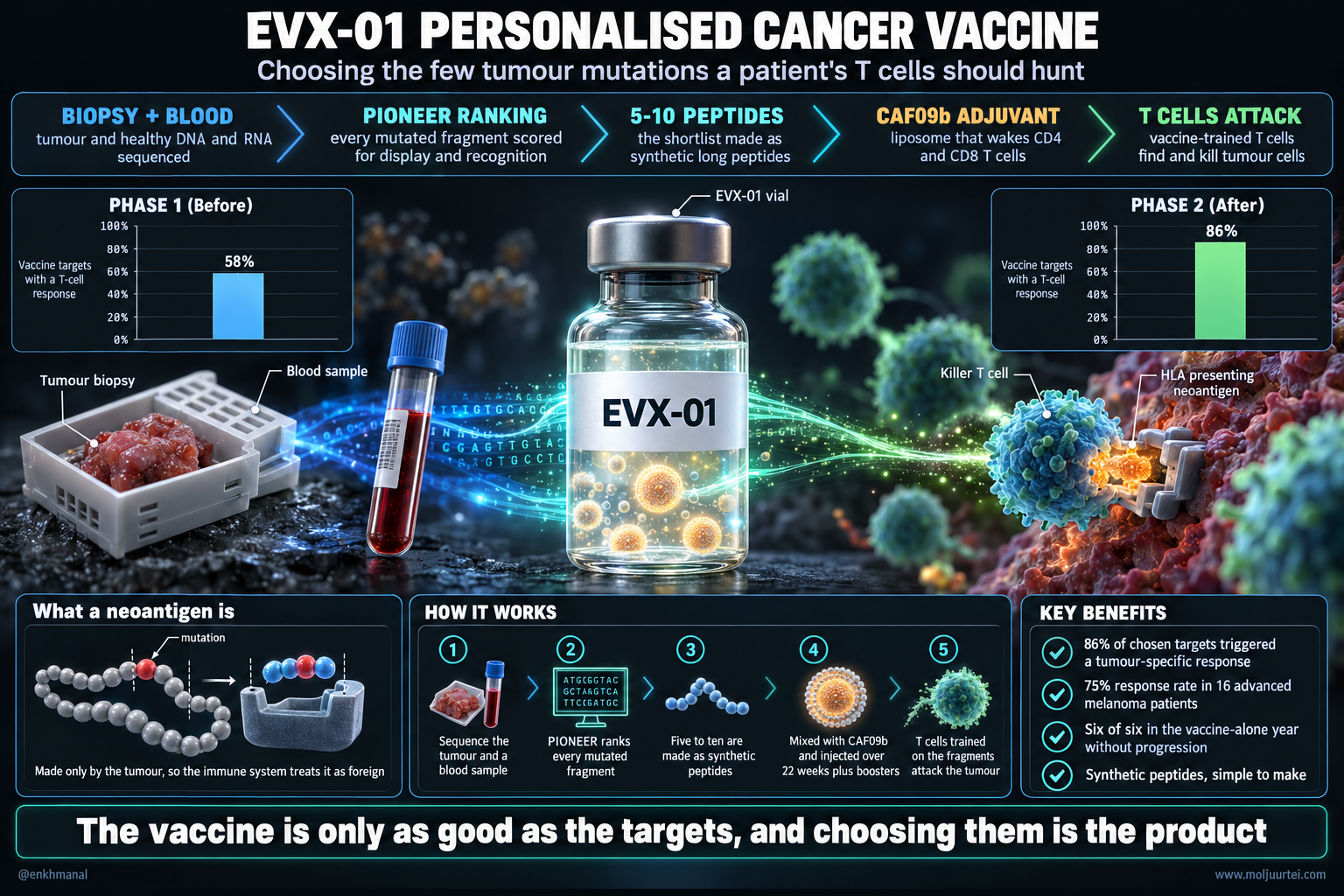
The October poster reports 105 of 118 evaluated neoantigens as immunogenic (89%), assessed in 13 patients. Immune responses were evaluated in 15 patients receiving at least six doses; the full treated cohort was 16. The separate de novo measure is 67 of 78 evaluable responses (86%). These denominators answer different questions.
We were able to show that 86% of the EVX-01 vaccine targets triggered a tumor-specific immune response, which is a substantially higher frequency than what has been reported for other similar vaccine candidates.
Here is how that property becomes money, and where it stops. Moderna's intismeran encodes up to 34 neoantigens in one strand of mRNA; EVX-01 carries five to ten peptides. A high immune-response hit rate could make fewer selected targets useful, but it does not establish that ten peptides are clinically equivalent to thirty mRNA-encoded targets. The consequence a partner would pay for is a cheaper, faster vaccine built on a target engine with clinical validation behind it, and the payment arrives as an upfront fee, milestones and royalties. The trade-off is real: fewer targets means less room for error if the predictions miss, and no head-to-head trial has compared the two approaches. The next unproven step is a randomised trial of EVX-01, which only a partner will fund.
The moat is three things together rather than one. The models and their training data are proprietary; the clinical dataset linking predictions to responses in patients is rare for a company this size; and the CAF09b licence is exclusive for vaccines built from PIONEER peptides. Neoantigen prediction is not a secret art, since academic tools exist and every large developer has its own, so the defence is the record of being right in patients, which is exactly what the three-year data add to.
Roadmap & R&D
The roadmap splits into a personalised branch that needs a partner, an off-the-shelf branch that is still preclinical, and an infectious-disease branch that partners already fund. Research spending was $10.0 million in FY2025 and $4.6 million in the first half of 2026, small for a pipeline this wide, which works only because partners and universities carry trial costs.
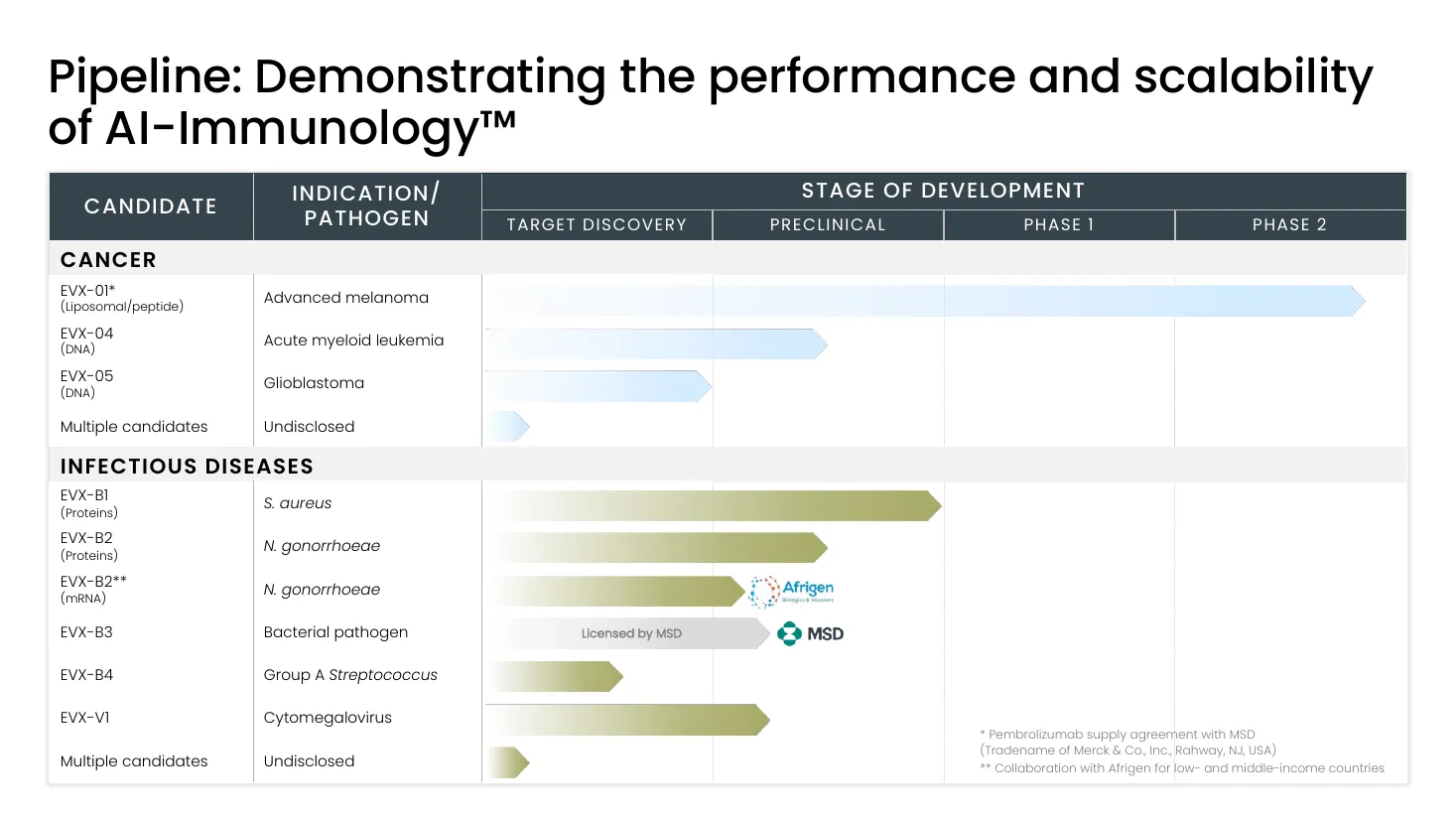
EVX-01 has its next readouts dated. The full three-year poster is now available for the October 24 ESMO session, investigator Adnan Khattak walks through it on a company webinar on 29 October, and new immune-profiling data get an oral slot at the Society for Immunotherapy of Cancer meeting on 6 November. After that the plan is a partner: the Q2 2026 deck says further trials are "planned to be conducted in partnership" and that other high-mutation cancers are being discussed. The vaccine has held FDA Fast Track designation in unresectable melanoma since January 2023.
The off-the-shelf branch rests on a different idea. About a twelfth of the human genome is the fossil DNA of viruses that infected our ancestors, normally silenced in healthy tissue; some of these endogenous retroviruses wake up in tumours and make proteins shared across many patients. A vaccine built on them can be made once, in advance, for everyone, which removes the weeks-long wait for a personal product and works in cancers with too few mutations for the personal approach.
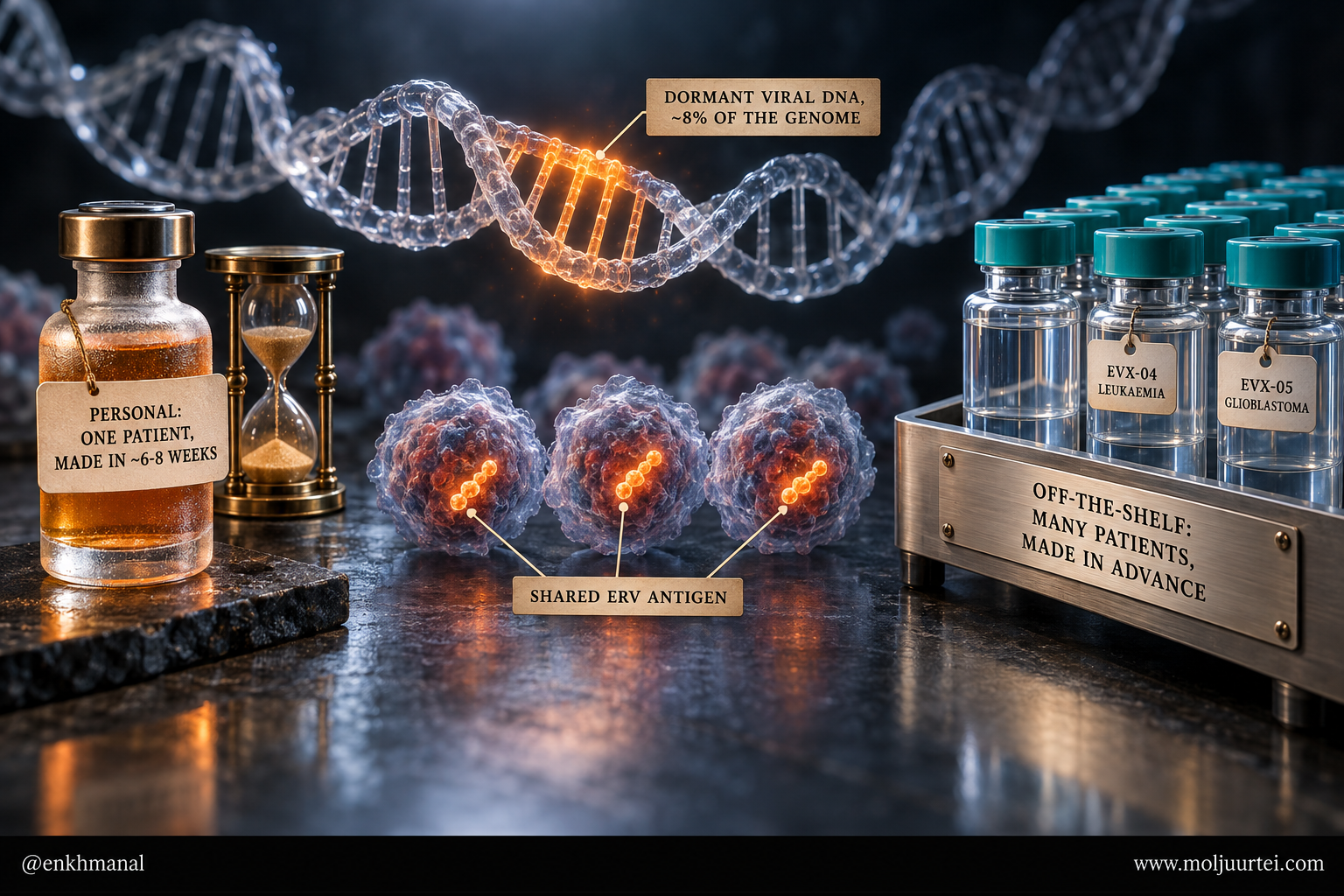
Two programmes carry that idea. EVX-04, for acute myeloid leukaemia, targets 16 such antigens and the company expects to file for its first clinical trial before the end of 2026. EVX-05, for glioblastoma, was built by mining about 1.5 million retroviral fragments from patient sequencing down to 16, with Duke University's Professor Mustafa Khasraw expected to run the first trial. It replaced EVX-03, a personalised DNA vaccine described as clinic-bound for years and dropped on 17 August 2026, and the evidence for EVX-05 is still computational and laboratory work.
The infectious-disease branch is where the platform has already been paid. Merck holds EVX-B3 against an undisclosed bacterial pathogen and carries all further costs. EVX-B2, a gonorrhoea vaccine whose antigens appear in all 1,200 published genomes of the bacterium and which kills 50 clinical strains in the laboratory, came back to Evaxion in December 2025 when Merck declined its option; an mRNA version is being developed with Afrigen for lower-income countries. Behind them sit EVX-B1 against Staphylococcus aureus, EVX-B4 against Group A strep, EVX-V1 against cytomegalovirus, polio design work for the Gates Foundation and, since September, two autoimmune concepts due to be shown in Lisbon on 18 November.
The Setup — Why It's Mispriced
The market prices Evaxion as a cash burner waiting for its next share sale, and that misses three facts that changed this year. The modality its lead asset uses has a positive Phase 3; the drug company that ran that Phase 3 already pays Evaxion for targets and owns about 13.5% of it through Merck Global Innovation Fund; and the three-year data say the responses last. Going into the 19 October release the shares were $2.83, a market value of about $25.5 million against $16.1 million of cash after the August sale, which priced EVX-01, the off-the-shelf branch and the infectious-disease portfolio together at under $15 million.
The clinical evidence has to be read with its design in view. The table sets EVX-01 beside the trials that define the field; the settings differ, so it is context rather than a contest.
The trial design matters. Pembrolizumab started at week 0 and EVX-01 at week 12. Seven of 13 patients with stable disease or partial response at that point later improved (54%); this is not 54% of all 16 treated patients. Six responders consented to the extension and maintained their responses; four had gaps longer than 33 weeks before extension enrollment. The poster does not explain every non-participant’s outcome. Without a randomized comparator, vaccine contribution remains uncertain.
The economics of a licence are already on the record. Merck paid $3.2 million for the option in 2024 and $7.5 million to exercise it in 2025, owes up to $592 million per product in development, regulatory and sales milestones plus royalties, and pays every further cost. On EVX-01, Statens Serum Institut is owed a share of any sublicensing income in the lower double digits because the adjuvant is its own, so a partner's dollar is worth roughly 85 to 90 cents to Evaxion. What just printed fits the picture: a Q2 loss of $3.7 million, cash of $14.0 million at 30 June, and a CFO who told analysts the year's cash use would be roughly $14 million or slightly lower.
I've been doing [business development] for 20-odd years, and things can go very fast when there's motivation and competition, and sometimes it can take two years. I would say that we are in active conversations.
Management & Track Record
The scientific team has a long record at Evaxion and the dealmaker at the top is new. Christian Kanstrup stepped down as CEO on 30 June 2025, Birgitte Rønø ran the company as interim CEO through the Merck exercise and the two-year data, and Helen Tayton-Martin started on 24 November 2025, eleven months ago.
Read as a record rather than a pedigree, the science team delivered: a Phase 1 with seven relapses among eight responders led to a higher dose and boosters, and the Phase 2 that followed is the best dataset the company has. The finance team kept the company alive through a near-delisting in early 2025, when Nasdaq granted a 180-day extension until equity was restored, and the equity raised since then came at prices from $2.71 to $7.18 per ADS. The CEO's partnering record is real but belongs to Adaptimmune; at Evaxion it starts with the deal she has not yet signed. The board added Jens Bitsch-Nørhave, a corporate-development executive from Johnson & Johnson, in 2026, and directors and management together own 4.1% of the shares.
Risks & What Breaks It
Price Setup — Levels, Technicals & Options
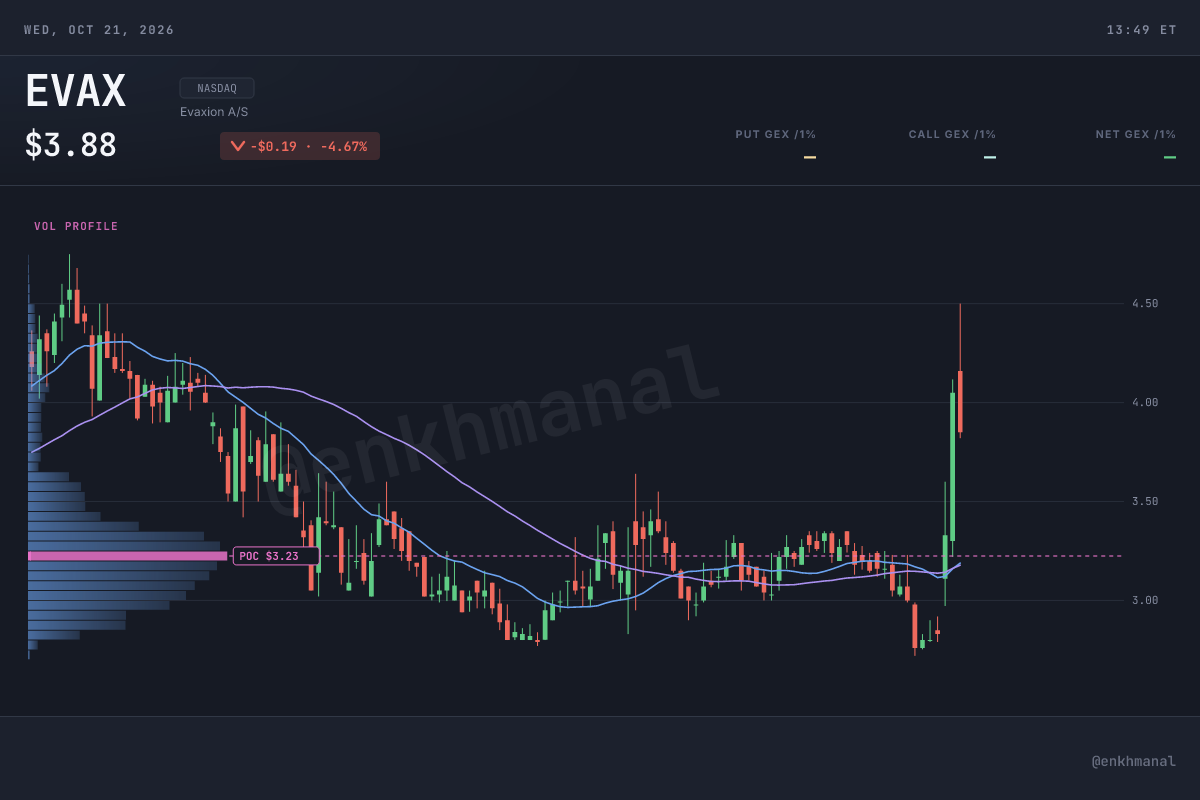
Historical market snapshot · October 21, 2026. The three-year release broke a six-month base. The stock traded between $2.72 and $3.35 from late August to 16 October, with a median of about 38,000 shares a day, then printed 470,000 shares on 19 October and 535,000 on 20 October and closed at $4.05, up 43% in two sessions. At about $3.85 on 21 October it sits above the 20-, 50- and 100-day averages, which have bunched at $3.18 to $3.20, and above the 200-day at $3.57, which is still falling (it was $3.80 twenty sessions ago). The 180-day volume profile puts its heaviest trading at $3.23, so the first support is the $3.18 to $3.23 shelf of averages and volume, and below it the $2.72 low of 13 October. Overhead sit the 21 October intraday high of $4.50 and the January high near $5.48.
Historical market snapshot · October 21, 2026. Last year's version of this setup is the one to remember. In 2025 the shares ran from $3.30 on 24 September, the day before the Merck licence, to an intraday high of $12.15 on 15 October, closed at $9.60 the day before the two-year data and fell 29% to $6.79 on the data day itself. This year's run into the poster is smaller, from a lower base, and the number that would say the market has read the three-year data the same way is a close back under the 200-day average at $3.57.
The original October 21 market check found no listed EVAX options. That dated observation does not prove why institutions do or do not own it. Share liquidity is the practical constraint: the original report’s quiet-session median volume was roughly 38,000 shares a day, and spreads or execution costs can change sharply around news.
Valuation & House View
This is a pre-approval biotechnology valuation, with no commercial earnings to capitalize. The following scenarios value hypothetical license income and royalty economics. They are analytical assumptions, not forecasts or an audited discounted cash-flow model. A positive trial elsewhere does not remove EVX-01’s development, partnering and financing risks.
Historical valuation reference · October 21, 2026. The arithmetic of the price is short. Nominal share capital of 112,768,539 Danish kroner at 0.25 kroner a share is 451.1 million ordinary shares, or 9.02 million ADSs, after the August sale; at about $3.85 that is a market value of $34.7 million. Add about 3.0 million ADSs of warrants and the fully diluted count is about 12.0 million. Against it sit $14.0 million of cash at 30 June plus $2.1 million raised in August, and $5.3 million of borrowings, for an enterprise value of about $24 million before the third quarter's spending. Four analysts on Yahoo's consensus on 21 October carry targets from $9 to $16, a mean of $11.25 and a median of $10.
An ADS represents 50 ordinary shares. Every scenario is illustrative, using a five-year discount from 2031 at 15% a year. In the bull case, $1.5B peak sales × 12% net royalty × 3 equals $540M. Discounting gives $268.5M; adding $30M license/milestone income and $11M net cash, then dividing by 13M ADSs, gives $23.81. The base case is ($20M upfront + 15% × $268.5M royalty value + $10M EVX-B3 milestones + $11M net cash) / 13.5M ADSs = $6.02. The bear is $25M / 19.5M ADSs = $1.28. With 15% / 40% / 45% judgmental weights, value is about $6.56 versus the historical $3.85 reference. The $24M enterprise-value reference is about 8.9% of the bull royalty value, not a measured probability of success. A certain royalty at the same assumptions implies roughly $134M peak sales. Future cash, dilution, dates and licensing terms can change every outcome.
Evaxion offers an early opportunity if better target selection can become a paid development partnership. The longer immune follow-up and sustained responses support investigating that possibility before commercial validation, while the Merck infectious-disease license shows one route to monetization. The central gap remains a controlled EVX-01 efficacy test and a funded next trial. A signed license, reproducible data and cash discipline would strengthen the thesis; weak controlled results, stalled partnering or repeated financing without progress would weaken it.