
The Debasement Trade Has an Equity Leg — and almost nobody is standing on it
On Wednesday the United States Treasury announced it would double the size of its long-end bond buybacks. On the same afternoon, the President stood in the White House with the heads of Coinbase, Kraken, Gemini and Robinhood and asked Congress to pass a crypto market-structure bill. Bitcoin rose 24.7% over the week to Friday. Ether rose 34.2%. Gold touched its highest level since June. The word being used for all of it is debasement — and the word is doing a lot of work, because underneath one narrative there are two completely different trades, with two different sources of return, and the market is pricing them as though only one exists.
The debt manager started managing the price of the debt
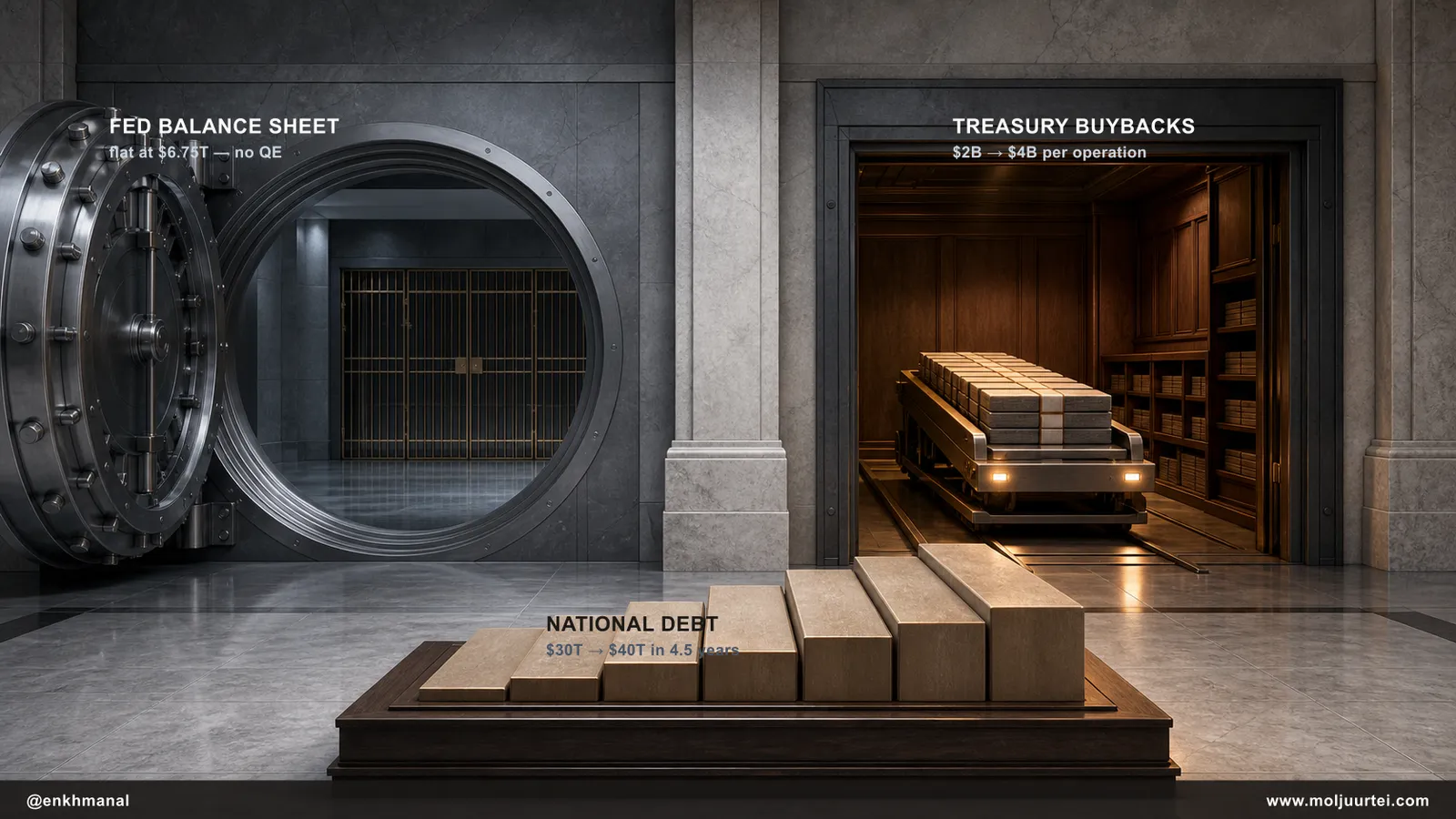
The mechanical event is small and the signal is not. Treasury raised the maximum size of its liquidity-support buyback operations for longer-dated nominal coupons from $2 billion to at least $4 billion per operation, across the 10-to-20-year and 20-to-30-year sectors, running from 9 September to 4 November. In cash terms that is rounding error against a $40 trillion debt stock — which crossed $40 trillion for the first time the same week, having been $30 trillion four and a half years ago.
The bond market did not read it as rounding error. The 30-year yield fell from 5.31% on Monday to 5.19% on Wednesday. The 10-year real yield fell from 2.44% to 2.35%. And in the same window the 10-year breakeven inflation rate rose, from 2.28% to 2.34%.
Hold those two moves next to each other, because together they are the entire thesis. Real yields down, expected inflation up. That is not a growth scare and it is not a risk rally. It is the market marking down the return it expects on money and marking up the rate at which money loses value. There is a name for the asset that absorbs that combination, and it is not a bond.
What makes this episode different from the last three years of debasement talk is who acted. This was not the Federal Reserve. The Fed's balance sheet has been flat near $6.75 trillion since May; there is no quantitative easing here. In fact the July FOMC minutes released the same afternoon were hawkish — three of twelve voting members wanted a rate hike. So monetary policy is leaning tight while the Treasury separately steps in to hold the long end down. When the debt manager starts managing the price of the debt because the central bank will not, you are looking at the early grammar of fiscal dominance.
That is the domestic half. The other half is that the United States is not where this started.
Japanese government bond yields hit a 29-year high this month — the 10-year JGB touched 2.901%, in a market that spent three decades near zero. The Bank of Japan has been withdrawing: monthly JGB purchases fell from ¥5.7 trillion in August 2024 to ¥2.9 trillion by the first quarter of 2026, and Prime Minister Takaichi has signalled she would accept a rate hike as soon as 16 September. Long yields in Korea, France, the UK and Germany are all at multi-year highs alongside it. The US 10-year rose roughly six basis points in direct response to one JGB session.
This matters for a specific, mechanical reason: Japan is the largest foreign holder of US Treasuries, at close to $1.2 trillion. For thirty years, a Japanese institution earning nothing at home had an obvious reason to own American paper. At 2.9% domestic yields, that reason weakens every week. The Treasury's buyback is not a response to a domestic wobble — it is a response to a global repricing of long-duration government debt in which the largest overseas buyer of American bonds is being paid, for the first time in a generation, to stay home.
So the sequence reads: the marginal foreign buyer steps back, long yields rise everywhere, the US debt manager starts buying its own paper to cap the damage, real yields fall while inflation expectations rise, and the currency becomes the release valve. Gold and crypto are what the valve opens into. That is the debasement trade stated properly, and it is a good deal more durable than a single $4 billion operation.
What Washington is actually doing
Crypto's macro tailwind and its policy tailwind arrived in the same week, and the second one is where the dateable catalysts live.
The CLARITY Act is stuck, and the reason is a conflict of interest. The market-structure bill that would finally define what a digital asset legally is passed the House and has not cleared the Senate floor. The blockage is not economic; it is ethics. Senate Democrats want provisions restricting elected officials from profiting from crypto businesses while setting crypto policy — in practice, requiring the President to divest. Trump backed a compromise brokered by Senator Lummis; Democrats and several Republicans including Thom Tillis judged it insufficient. The Senate left for recess without voting and returns on 15 September.
The sums explain the deadlock. The Office of Government Ethics disclosure published on 1 July runs to 927 pages and shows roughly $1.4 billion of crypto-related income to Trump in 2025 — about $635 million from $TRUMP memecoin licensing and over $500 million from World Liberty Financial token sales. World Liberty Financial is not a footnote either: it is currently earning around $11 million a month in protocol fees, which puts a sitting president's family business inside the same fee league table as our basket. Whatever one makes of that, it is the specific reason the industry's most-wanted legislation has not moved.
The GENIUS Act is the one that already passed — and it is quietly a Treasury-funding instrument. Signed in July 2025, it takes effect on the earlier of 18 January 2027 or 120 days after final rules. Its reserve schedule is the interesting part: a compliant payment stablecoin must back itself with cash, insured demand deposits, overnight Treasury repo, or Treasury bills with 93 days or less to maturity. In other words, the United States legalised dollar stablecoins on the condition that their reserves be parked in short-dated US government debt.
Hold that next to the first section. The Treasury is buying back long bonds because the long end has no bid, while federal law is simultaneously manufacturing a captive, growing, price-insensitive buyer for the front end. Circle alone holds roughly $73 billion in reserves against USDC. That is not a conspiracy, it is just what the statute does — but it means the stablecoin industry is now structurally long the same instrument the government is struggling to place, and any investor in this sector is implicitly taking a view on short-rate policy.
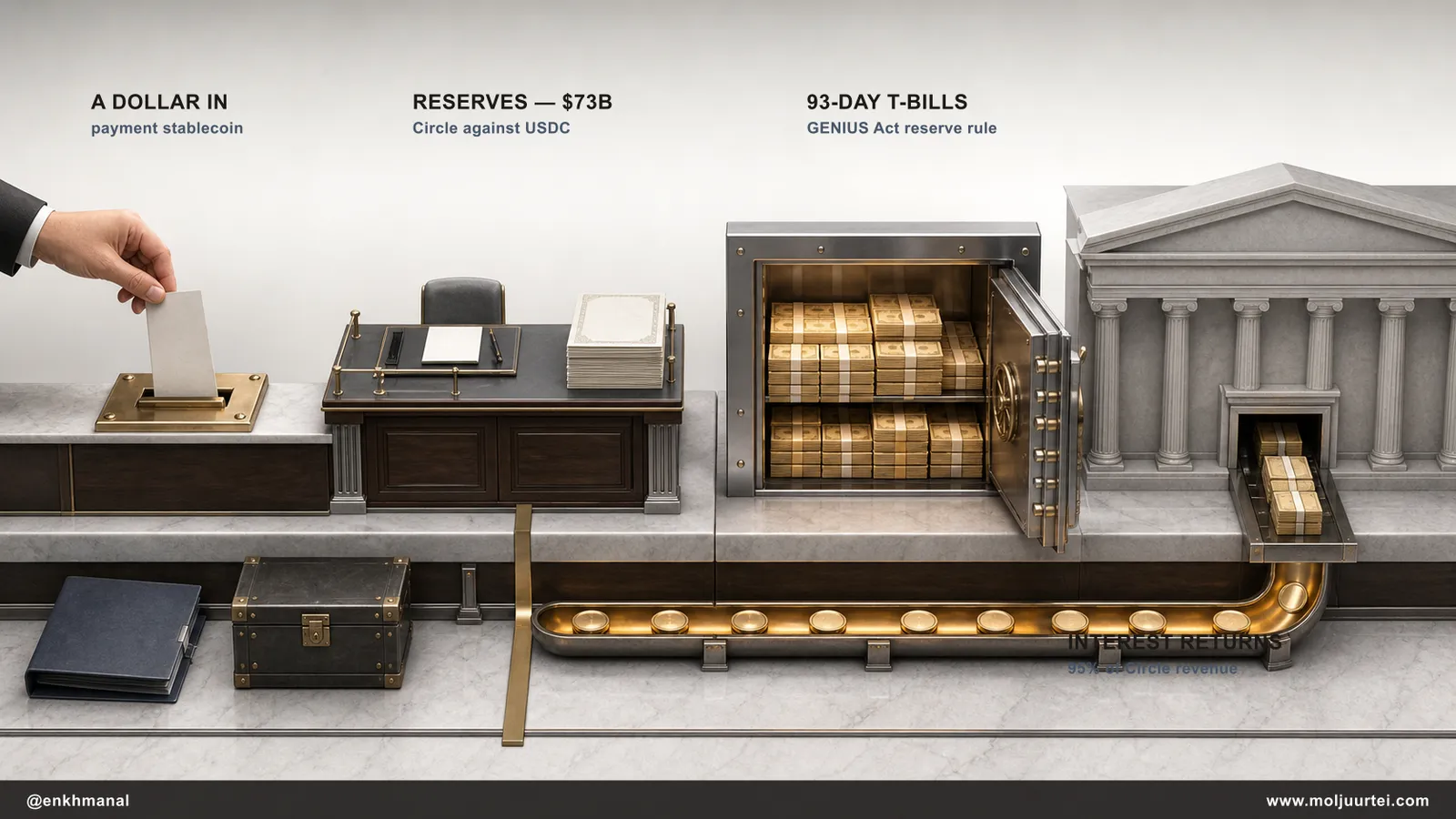
The compliance burden is falling unevenly. Circle took a national trust bank charter from the Comptroller of the Currency on 10 July 2026 and holds reserves in a BlackRock-managed, $BNY-custodied government money-market fund that already fits the 93-day ceiling. Tether — around $189 billion, issued offshore, historically holding bitcoin and secured loans that the statute flatly excludes — has received no Treasury comparability determination and faces a reserve restructuring reported at roughly $47 billion. The largest and most profitable business in crypto is the one least aligned with the law that now governs it.
Two more dates. At the White House event on 19 August, CFTC Chair Mike Selig said the agency is working to bring Hyperliquid's perpetuals exchange onshore under US federal rules — the single most concrete regulatory catalyst attached to any name we own. And Jackson Hole runs 27–29 August with Chair Warsh's first keynote on Friday the 28th at 10am New York time, nineteen days before the 16 September FOMC. The symposium's theme this year is "Financial Innovation: Implications for Payments and Policy" — the Federal Reserve's flagship gathering is convening on payments infrastructure in the same month the stablecoin rulebook is being written. Sixty-nine percent of surveyed fund managers expect Warsh to strike a neutral tone, which is precisely what makes the speech dangerous: neutral is priced. September hike odds sit near one in three.
What the CLARITY Act actually does
We have now named the CLARITY Act four times without saying what it is, which is a poor way to treat the single piece of legislation our whole thesis rests on. The problem it solves is that nobody knows what a token legally is. Under the Howey test, an asset is a security if buyers put money into a common enterprise expecting profits from the efforts of others. That test was written for orange groves in 1946 and it catches almost every token ever sold, because almost every token was sold by a team promising to build something. Being a security is not fatal but it is close to disabling: registration, disclosure, transfer restrictions, and a US exchange listing the token is running an unregistered securities exchange.
What the bill does is create a second category. It splits jurisdiction: the SEC keeps digital securities, and a new class of digital commodity goes to the CFTC, which gets exclusive authority over spot markets through registered digital-commodity exchanges, brokers and dealers. The clever part is the migration path. The bill distinguishes the primary transaction — the issuer selling new tokens to raise capital, which stays with the SEC — from the secondary transaction, where the token trades between ordinary buyers after issuance. Once it leaves the issuer's hands, the securities label can drop. The gate is a mature blockchain system: a network that operates without meaningful dependence on a central issuer. It is the first time US law has offered a token a way out of securities status rather than only a way in. The bill passed the House in July 2025 and has still not had a full Senate vote.
Now the part that matters for us specifically, and it is not a general point about regulatory clarity. The mechanism this entire thesis is built on — a protocol taking its revenue and using it to buy its own token — is the single most Howey-triggering thing a protocol can do. Routing revenue to token holders is, functionally and visually, a dividend, and a dividend is close to conclusive evidence of an investment contract. That is not hypothetical: under the SEC's earlier posture, buyback mechanisms were a principal reason tokens were treated as securities, and major projects halted their buyback plans outright rather than carry the risk.
Two things changed. The interpretive posture softened, and the design adapted — the 2025-onward model pairs the buyback with an automatic burn, which distances the mechanism from a dividend because nothing is distributed to anyone. Nobody receives a payment; the supply simply gets smaller. That reframes something we said above: the reason nearly every protocol we hold returns value by burning rather than by paying is at least partly legal, not economic. Burn is the compliant shape of a dividend. So when the Senate returns to this on 15 September it is not voting on whether crypto gets tidier rules — for the assets here it is voting on whether the thing that makes them investable is legally settled or still a matter of enforcement discretion.
Two legs, and the crowd is standing on one
The monetary leg is the familiar one: own the scarce thing. $BTC, $ETH, gold. You are not underwriting cash flow — there is none, and none is required. You are underwriting the proposition that the issuer of the reserve currency now has a visible incentive to inflate away a $40 trillion obligation, and that a fixed-supply asset is the escape hatch. This leg is real, it is working this week, and it is what essentially every piece of debasement commentary is about.
The equity leg is the one nobody is pricing. A small number of crypto protocols are genuine operating businesses: they charge fees, they earn revenue, and — this is the rare part — they route that revenue contractually back to their token holders through buybacks and burns. They are, functionally, equities with a mandatory return-of-capital policy. And they have just been through the worst drawdown since 2022, which means some of them now trade at single-digit multiples of the cash they hand back.
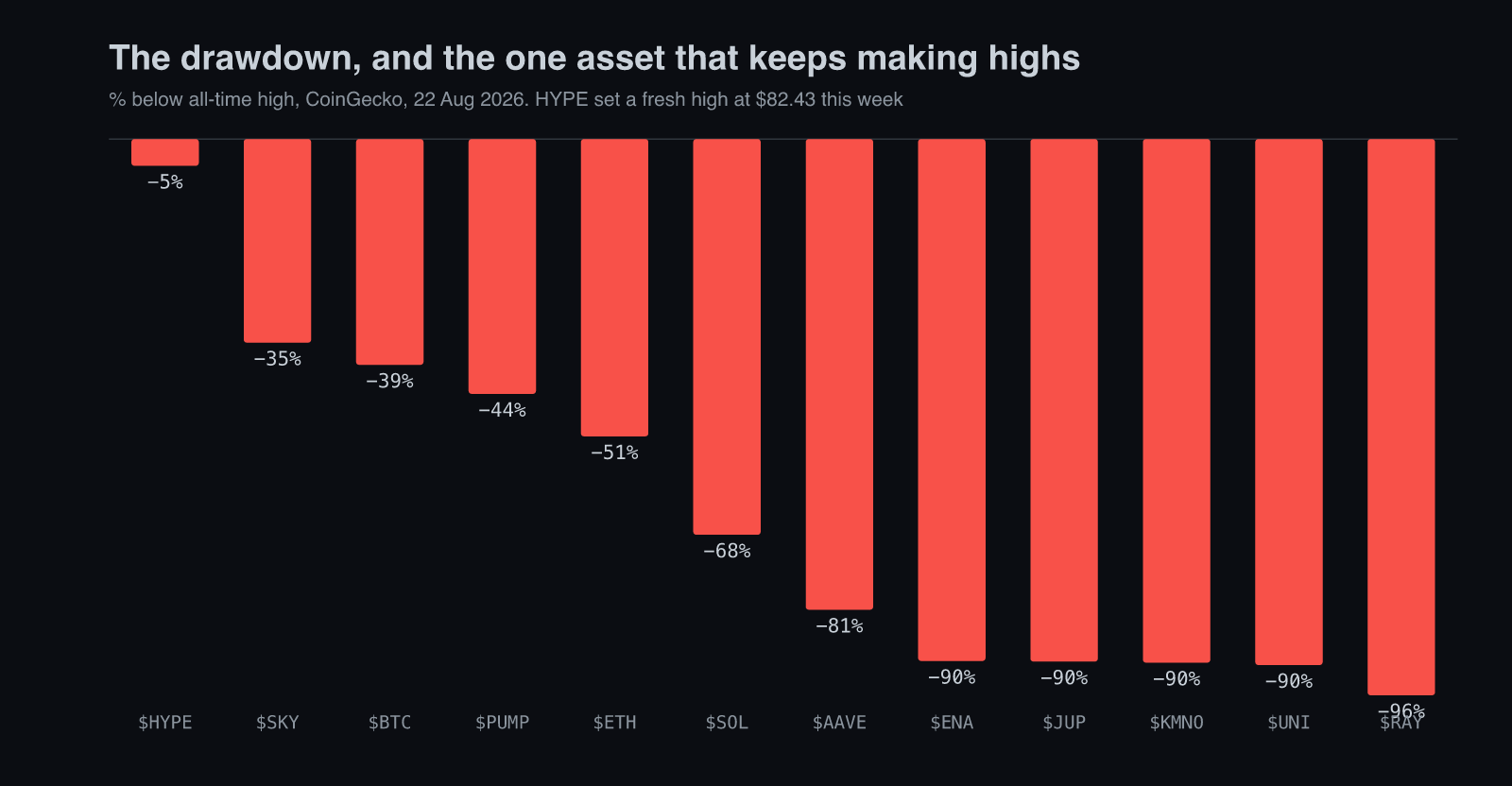
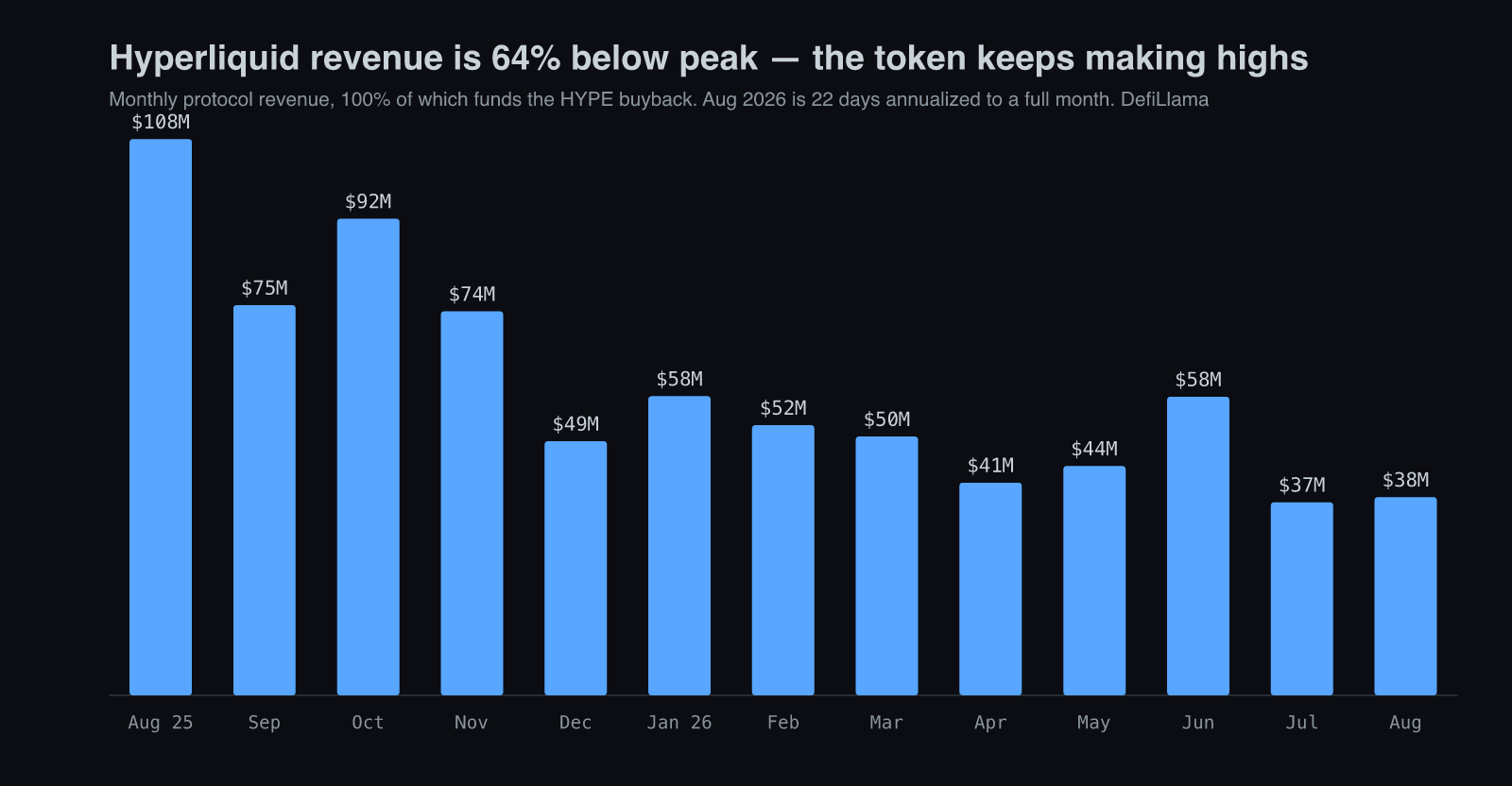
Here is the claim, and it is falsifiable: the market is paying 38× for the cash-generating protocol whose revenue has fallen 64% from peak, and 7× for the one whose revenue has been flat for a year. $HYPE set a fresh all-time high at $82.43 this week and sits 4.6% under it. $PUMP sits 43.8% below its own. On the metric that should decide between them — how much of your money the protocol retires each year at today's price — the cheap one buys back 13.8% of its market capitalisation annually and the expensive one buys back 2.6%.
Ten months of damage, then one violent week
It is worth being precise about how bad the last ten months have been, because "crypto is moving" is only true if you start the clock on Monday. $BTC peaked around $126,000 in early October 2025 and traded at $62,678 on Monday the 17th — a 50% peak-to-trough decline. $ETH is 51% below its all-time high even after last week. $SOL is 68% below. Beneath the majors the damage is worse and mostly permanent-looking: $UNI −90%, $RAY −96%, $KMNO −90%, $JUP −90%.
Then last week happened. From Monday's open to Friday's close: $BTC +24.7%, $ETH +34.2%, $SOL +25.7%. Ether outperformed Bitcoin by nearly ten points, which the market reasonably reads as $ETH being treated as a scarce financial asset rather than a high-beta technology proxy. But $2.7 billion of levered shorts were liquidated in 24 hours, and $652 million of Ether shorts went in a single hour. A move of that shape off a ten-month low is, mechanically, a short squeeze on top of a macro catalyst. Both are true at once, and the squeeze part does not repeat. Saturday's tape is the first evidence of that: $BTC $77,178, $ETH $2,420, $SOL $94 — the gains have held, but the second week is not going to look like the first. The macro shift is the reason to be interested; the bounce is the reason to be careful about the price you pay.
The week's movers, against the screen
A screen is a claim, and the week that followed is the first cheap test of it. These were the twelve biggest seven-day gainers, with the only column that matters bolted on.
The honest reading is that the tape did not discriminate on accrual at all. Three of the top four gainers — $ENA, $TRUMP, $ZEC — return essentially nothing to their holders, and $ENA led the entire market at +86% while generating $242 million a year in protocol fees of which its token sees approximately none. What the week rewarded was beta and float: the biggest gainers are mostly deeply drawn-down, low-float names bouncing off a ten-month bottom. If you went into Monday holding the cash-flow screen and nothing else, you underperformed a memecoin.
That is worth stating plainly rather than claiming the week as vindication, because our claim was never that cash flow outperforms in a squeeze. It is that cash flow is what you are paid to own once the squeeze is over. A week is not evidence either way; it is a reminder that in the first leg of a reversal, the thing that goes up most is whatever fell furthest.
Two things in that table do matter, though. Both legs of the debasement trade ran — $ZEC, a fixed-supply privacy money with no business attached, put on 70.7% and $13.7 billion of market cap, which is the monetary leg behaving exactly as the framing predicts. And the equity leg ran alongside it, not instead of it.
The second is a name we should have found on our own. $LIT — Lighter, a perpetuals exchange — earns $35 million a year in fees and routes $24 million of it to holders, roughly 69%, at an $800 million market capitalisation. That is 33× holders revenue, marginally cheaper than $HYPE at 38×, with the same low-float structure ($3.19B fully diluted, 25% circulating) and the same aggressive accrual design. It rose 46.3% on the week against $HYPE's 38.4%. It belongs in the perp-DEX competitive picture as a genuine claimant, not a footnote — and it sharpens the risk already written into the $HYPE section: the moat is share of a shrinking category, and a rival is being funded at a discount to build against it.
Fees, revenue, holders revenue — three numbers, one of them yours
Everything in the equity leg rests on a distinction that crypto commentary routinely collapses. DefiLlama publishes a ladder of three figures per protocol, and they can differ by an order of magnitude. Fees is everything users paid — much of which is not the protocol's money at all: on a lending market it is interest paid to depositors, on an exchange it is paid to liquidity providers, on a chain it is paid to validators. Revenue is the protocol's own cut. Holders revenue is the slice contractually routed to the token.
The third number is the only one that is yours. A protocol can post a perfectly respectable fee line and route none of it to the asset you own. Kamino Lend is the clean example, and it happens to be one of the names in the brief: $3.7 million of fees over the last 30 days, $0.5 million of protocol revenue, and zero to $KMNO holders. Nothing improper is happening — the fees go where lending fees are supposed to go — but a memo that quoted the fee number and called $KMNO cheap would have inverted the conclusion.
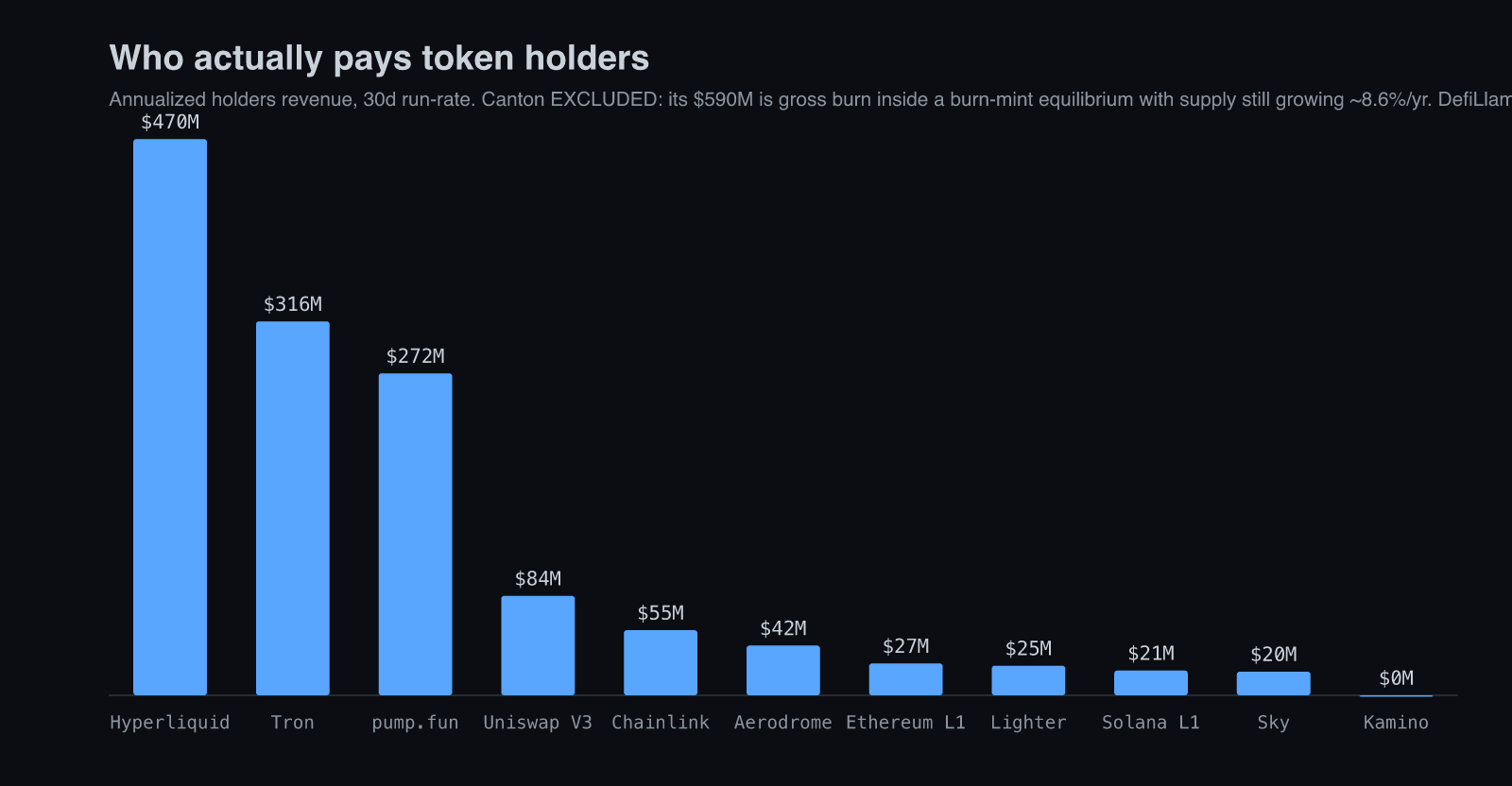
Apply the third number to the whole universe and the result is the most useful chart we have. DefiLlama tracks 2,602 protocols. In the last 30 days, 329 of them paid their holders anything at all. Six annualize above $50 million. Twenty-one clear $10 million.
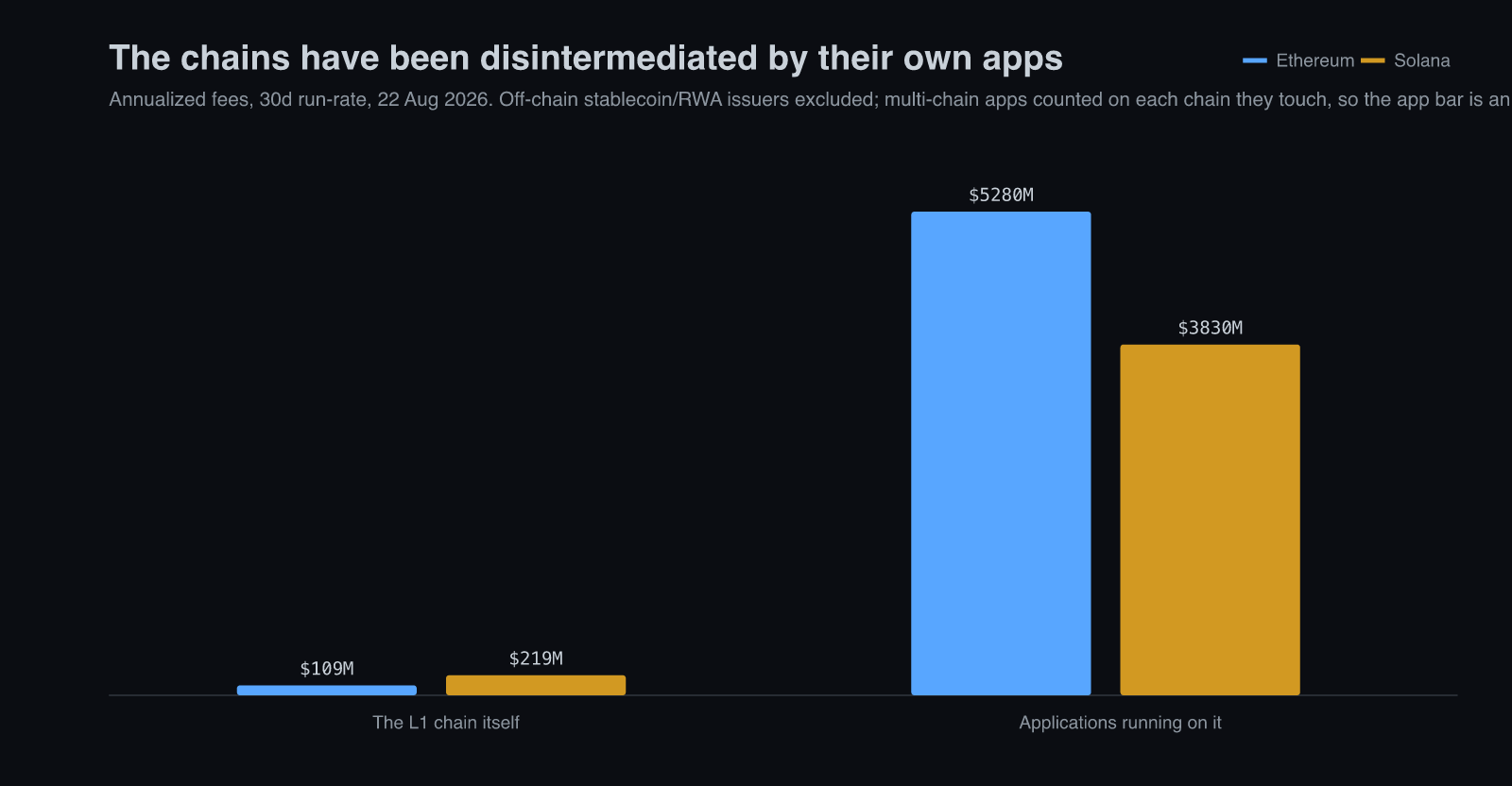
The second structural fact is where that money is not. It is not at the chains. Ethereum the network earns about $109 million a year in fees. The applications running on it earn something on the order of $5.3 billion — 49 times as much. Solana earns $219 million while its app layer earns roughly $3.8 billion, a ratio of 17. Lido alone collects more than four times what Ethereum itself does.
The contract, the supply, and the yield
If holders revenue is the numerator, the two things that decide whether it reaches you are the contract that routes it and the supply it is divided by. Crypto is unusual in that both are legible: the routing is code, and the issuance schedule is published years ahead. The four protocols here do four different things.
Hyperliquid runs the most aggressive structure in the asset class. The Assistance Fund takes 97–99% of protocol fees and buys $HYPE on the open market continuously — over the last 30 days, $37.3 million. Note that revenue and holders revenue are the same number, which is close to unique: there is effectively no wedge between what the protocol earns and what the token receives.
pump.fun used to be even purer and deliberately stopped. It ran 100% of revenue into buybacks for nine months, generated over a billion dollars, and the token still traded below its launch valuation. In April it burned the entire accumulated stack — $370 million, about 36% of circulating supply — and cut the ongoing programme to 50% of revenue, in the team's own words a "programmatic buyback and burn scheme at 50% of revenue for the next year to instill trust, predictability, and sustainability." Co-founder Alon Cohen was blunt about why the other half stays: the business needs it for product, hiring and acquisitions.
That episode is the most instructive thing we found, and it cuts against a naive version of our own thesis. A 100% buyback did not save the token. Buybacks are not alchemy; they are a transfer that only compounds if the revenue behind them persists and the supply is not simultaneously expanding. Kamino, by contrast, routes nothing — fees accrue to the treasury and buybacks are discretionary. $ETH and $SOL burn a portion of transaction fees, a real but tiny accrual at current fee levels: about $27 million and $21 million a year respectively.
Now divide by supply and quote the result as a yield — annualized holders revenue over market capitalisation. This is the number a reader who has never bought a token can price, because it is the same arithmetic as an equity buyback yield: the share of the float the issuer retires per year at today's price.
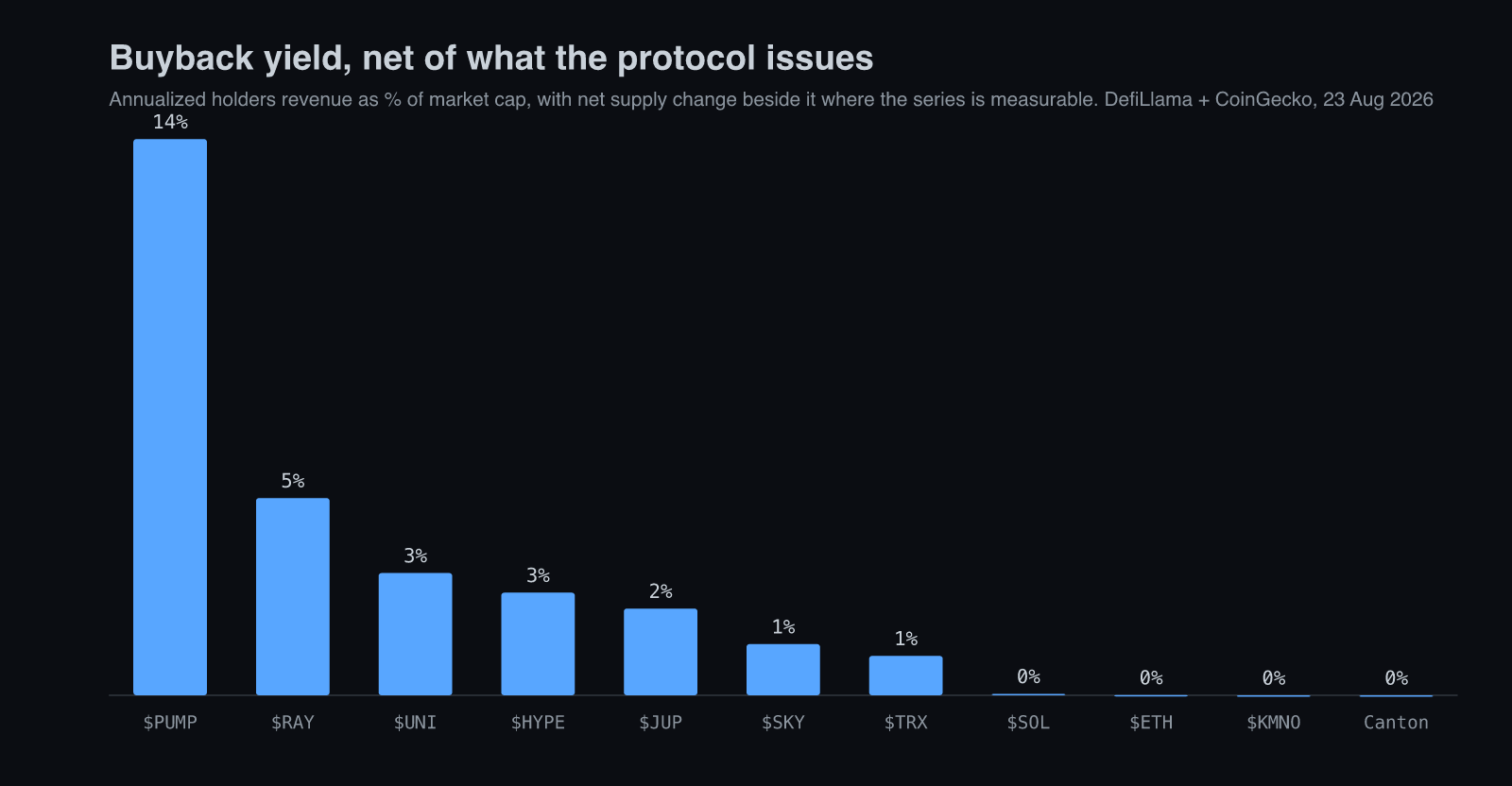
Two caveats keep this honest. First, float: $HYPE circulates only 23% of its supply, so its $17.5 billion market capitalisation sits under a $78.6 billion fully-diluted value. On a fully-diluted basis the buyback yield falls to 0.6% and the multiple rises from 38× to 173×. $PUMP circulates 47%, so its fully-diluted multiple is 16× rather than 7×. The gap narrows — it does not close, and it does not reverse. Second, these are 30-day run-rates annualized, in an asset class where volume is violently cyclical.
What counts as profitable, and who clears the bar
We framed a 100% payout as a warning sign above, on the logic that a protocol retaining nothing must fund its operations from somewhere else. That was too clever and it was wrong in an important way. If a protocol earns real revenue and that revenue reaches every token holder, it is a profitable project — full stop. Retaining cash is a capital-allocation preference, not a test of profitability, and treating distribution as suspicious gets the question backwards.
But the correction sharpens rather than removes the test, because "reaches every token holder" turns out to do a lot of work. Burn reaches everyone: when a protocol buys its token on the open market and destroys it, every holder's share of the network rises pro rata, with no claiming, locking or action required. It is the closest thing crypto has to a share buyback, and it is also the legally safest shape. Lock-gated distribution reaches a subset: Aerodrome distributes 100% of trading fees, but to veAERO voters who have locked $AERO for one to four years — a passive $AERO holder receives nothing. Chainlink's $55 million goes to stakers; Convex is the same veToken shape. Those are real cash flows, but they are payments for a service rather than a return on ownership.

Apply the corrected test — earns real revenue, returns it to every holder, and is not quietly funding itself by issuing new supply — and this is the roster. The third column is the one that separates the two kinds of payout.
Six of the nine reach every holder. The three that do not are not worse businesses — Chainlink and Aerodrome earn more than most of our basket — they simply pay a subset of their holders for a service, which is a different instrument from owning a share of the cash.

$SKY is the cleanest thing on this page and it deserves the flag. It is the former MakerDAO, now running the USDS stablecoin at a $12 billion supply. Q1 2026: $123.8 million of gross protocol revenue and a $46.0 million net surplus, with 2026 tracking toward roughly $611 million. It burns through a Smart Burn Engine that has retired 1.83 billion tokens for about $114.5 million. It is 100% circulating — no unissued supply, no unlock calendar, nothing to come. And it retains $148 million a year, so the lights are paid for out of earnings rather than out of the treasury.
The catch, stated plainly: in March it cut the daily buyback from 300,000 to 37,600 USDS, an 87.5% reduction, to rebuild reserves toward a target. So the cash is real and the distribution is currently throttled by choice. At a $1.53 billion market capitalisation against $167 million of total protocol revenue, we are paying roughly 9× revenue for the most self-sufficient business we found — versus 38× for Hyperliquid and 7× for pump.fun. It is the one name here that would survive its own token price going to zero, because its revenue comes from lending against collateral, not from people trading its ecosystem.
$TRX is the structural curiosity. Tron burns $TRX on every transaction and burns more than it mints, so the supply is net-deflationary and 100% circulating, on $316 million a year. It is genuinely profitable by the corrected test. It is also priced at about 104× that figure, which is the market charging a very full price for a very clean structure. Both are now carried in the basket table below rather than left as a footnote — the corrected screen promoted them, so we should own them. Neither is underwritten to the depth of $HYPE or $PUMP: no live coverage pass was run on either, and $SKY in particular deserves a standalone treatment we cannot give it here.
The screen put Canton first. It does not belong there.
We put Canton at the top of the holders-revenue table at $590 million a year — first in the entire universe, ahead of Hyperliquid. We were wrong, and the way we were wrong is instructive enough to keep rather than quietly delete. DefiLlama's own methodology note reads: "All the collected fees — traffic purchase, preapproval burn, preapproval renew burn, setup burn, dust expire, holding fee, sender change fees — are burned." Read that list. A holding fee is a charge for merely holding the coin. Dust expire is small balances lapsing. Setup burn and preapproval renew burn are administrative operations. These are not customers paying for a service; they are token-economic housekeeping charges denominated in the token, and the screen counted every one as revenue returned to holders.
Then the structural problem. Canton runs an explicit burn-mint equilibrium: the network is designed to issue roughly 2.5 billion coins a year as validator and application-provider rewards and to burn roughly 2.5 billion a year in fees. The burn is not profit being returned — it is the other half of the issuance loop, deliberately balanced. And it is not currently balanced in the holder's favour. Canton's circulating supply went from 37.82 billion to 39.41 billion coins over the last 180 days — up 4.2%, or about 8.6% annualised. A holder who did nothing was diluted by roughly a twelfth over a year while the screen recorded $590 million of "holders revenue" flowing their way.
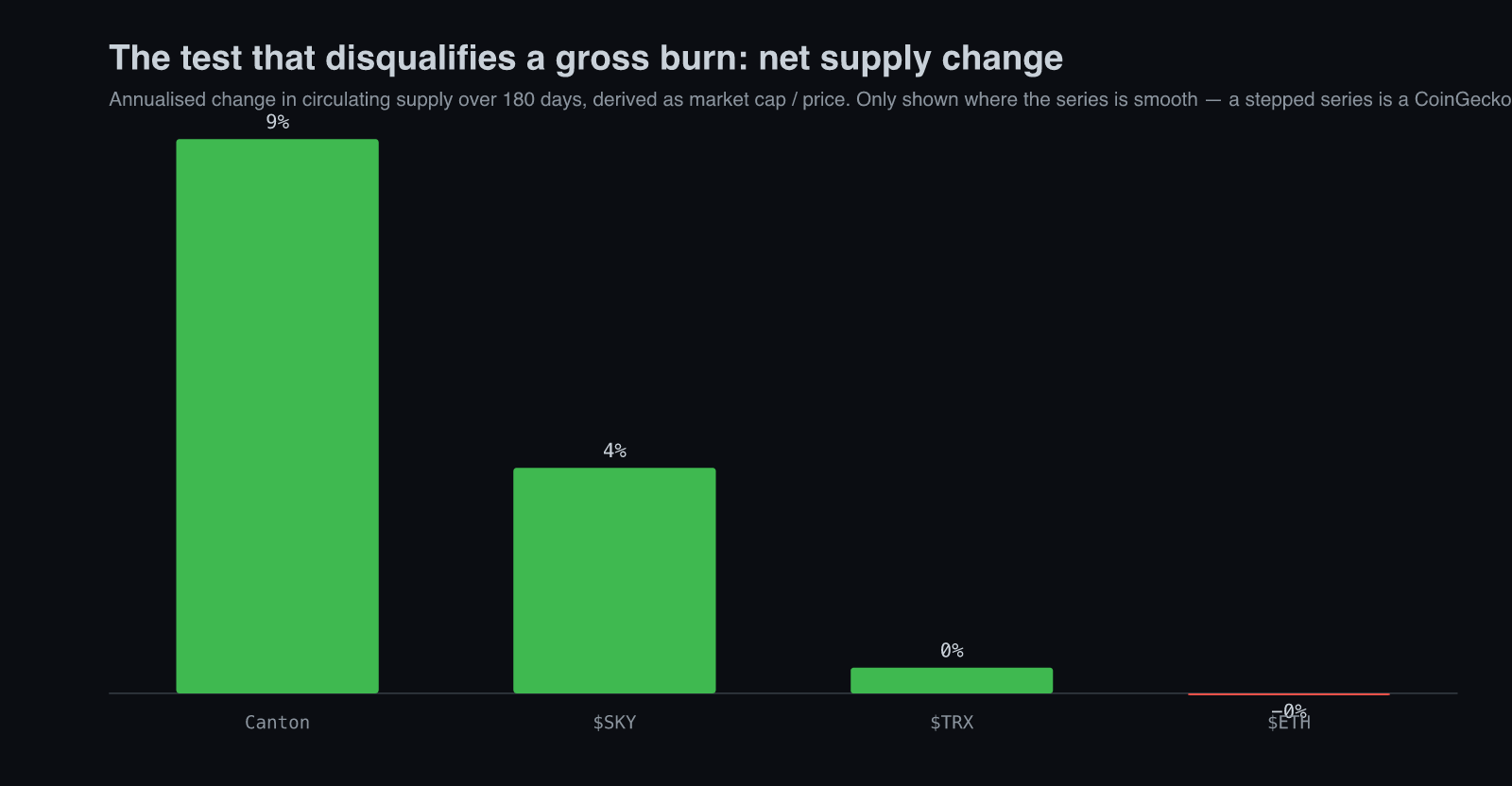
So the corrected test needs a third leg, and it is the one that actually bites: net supply change. A protocol that burns $590 million while minting more than $590 million has returned nothing; it has run a large, expensive wash. Doing that reorders the table. $TRX survives cleanly — supply up 0.4% annualised against $316 million of genuine fee burn, so the burn really is net-deflationary and the holder really is being paid. $ETH is flat. Canton fails.
And it forces an honest amendment to our own favourite. The Sky section says $SKY is "100% circulating — no unissued supply, no unlock calendar, nothing to come," and that is true of the existing supply: there is no vesting cliff. But Sky still mints new $SKY, and total supply grew about 3.5% annualised over the same window. Against a 1.3% buyback yield, a passive $SKY holder is being modestly diluted on the distribution line — the case rests on the $148 million a year retained, which builds book value rather than reducing supply. That is still the most self-sufficient business we found. It is not the free lunch we implied earlier.
Sixteen names against one test
The brief named five. The screen surfaced eleven more that clear the same bar or fail it in an instructive way, so the table below is the full set, recomputed from live data rather than patched. $HYPE now sums all three Hyperliquid modules — perps, spot orderbook and L1 — rather than perps alone, which is why its line reads $490M here and $470M in the charts above.
Ranked by yield alone the order is nonsense, which is the point of the three-leg test. Pays every holder with supply not running away: $TRX (0.97% yield, supply +0.4% a year), $CAKE (6.72%, 96% circulating), $ETH (0.01%, flat supply), and $SKY (1.30%, but total supply +3.5% a year and the case rests on the $148M retained). These are the structurally clean ones. None is cheap except $CAKE, which is 96% below its high and earns $36 million.
Pays every holder, but a lot of supply is still coming: $PUMP is the standout at 7× market cap and a 14.81% buyback yield, with 53% of supply unissued. $HYPE at 35× on mcap but 160× fully diluted and only 22% circulating. $LIT — Lighter, the perp DEX — at 31× mcap but 126× diluted on a 25% float, the same structure as $HYPE one tier down in size.
Pays only those who lock or stake: $AERO's 10.93% is the second-highest yield in the table and it goes exclusively to veAERO voters locked one to four years; a passive holder gets nothing. $CVX (5.39%) and $LINK (0.64%) are the same shape, and $JUP and $RAY are partly staking-gated. Real cash, wrong instrument if you were planning to just hold the token. Pays nothing: $KMNO and $ENA both route zero to holders despite $ENA generating around $242 million a year in protocol fees — the widest gap between business and token in the table, and $ENA was still the single biggest gainer of the week at +86%.
$UNI is the one I have not verified to the same standard. Its fee switch is on and $84 million a year reaches holders, but I have not confirmed from primary sources whether that flows by burn or by a staking gate, and the distinction decides which tier it belongs in. It is 91% below its high at 30×. Flagging the gap rather than guessing.
What the docs say that our coverage didn't
We logged an onchain coverage pass, and it was DefiLlama's API. That is a measurement source, not a mechanism source, and reading the two protocols' own documentation corrected us on both. Hyperliquid does not route 97–99% of fees to the buyback. That figure came from secondary reporting and we repeated it. The docs say fees are entirely directed to the community — HLP, the assistance fund, and deployers — and that spot and HIP-3 perp deployers may choose to keep up to 50% of trading fees generated by their deployed assets. So fees have three destinations, not one.
The claim that survives — and it is still a strong one — is that no insider takes a cut: there is no team fee, and the Assistance Fund conversion is not discretionary. It converts trading fees to $HYPE in a fully automated manner as part of the L1 execution, at the system address 0xfefefefefefefefefefefefefefefefefefefefe, and the $HYPE it buys is burned from circulating and total supply. That is a genuine, verifiable, all-holders burn. It is simply smaller than one dollar in every dollar.
The leak matters more as the platform grows, and this is the roadmap section we owed $HYPE. HIP-3 lets anyone deploy a permissionless perp market, and its economics run against the buyback in three ways: deployers keep up to 50% of fees on their markets; they can configure an additional fee share of 0–300%; and growth mode cuts all-in fees by at least 90% to bootstrap volume. Every HIP-3 market that succeeds is a market where the Assistance Fund's take is structurally lower than on Hyperliquid's own books. Against that, one thing we also missed on the bull side: deploying a HIP-3 perp dex requires staking 500,000 $HYPE, held for a minimum of 183 days — roughly $39 million locked per deployer, a real demand sink that grows with exactly the thing that dilutes the fee take.
Above roughly 420 $SOL of market cap — about $39,000 — pump.fun's take collapses from 0.930% to 0.050% and stays there. An 18.6× cliff. In the band just above it the creator earns 0.950% while the protocol earns 0.050%: nineteen to one, in the creator's favour, by design. That reframes the business. pump.fun is not levered to producing winners; it earns almost nothing on them. It is a primary-issuance and churn business, earning its real take rate on launches and on the pre-graduation trading of coins that mostly fail.
Which explains two things we had recorded but not connected: why revenue stayed flat while the market fell 50% — launch churn is far less cyclical than price — and why BOOST mode, Creator Fee Sharing and Callout Rewards are all aimed at creators and launch volume rather than at traders. They are defending the only part of the funnel where the take rate lives. It is also the sharpest bear point available on $PUMP, and it is not the one we wrote. The risk is not that memecoins stop going up; it is that launch volume falls, or that a distribution-rich competitor — Pons on Robinhood Chain — takes the launch itself.
$SOL, $ETH and $KMNO
$SOL is a claim on the wrong layer. Solana hosts the healthiest application economy in crypto — roughly $3.8 billion of annualized app-layer fees. The chain itself captures $219 million a year, of which about $21 million reaches holders. At $54.7 billion, $SOL trades at 250× chain-level fees. That is not a cash-flow asset and should not be held as one. It is a bet that blockspace demand and the base asset's monetary premium rise together — respectable, but the honest way to say "I want the Solana economy" is to notice the economy is 17× larger at the app layer, and that the app layer is purchasable directly.
$ETH is the monetary leg, cleanly. Ethereum earns about $109 million a year in fees and burns roughly $27 million against a $292 billion market capitalisation. Lido earns four times more than the chain it runs on. This is not a criticism, because nobody serious owns $ETH for fee capture. Its case is that it has become collateral — the settlement asset of a large on-chain financial system — and this week it behaved like one, outperforming $BTC and breaking a multi-year downtrend against it. Own it as the highest-quality expression of the debasement trade after $BTC, and do not build a cash-flow model, because there is no cash flow to discount.
$KMNO is an option on a decision, not a business. Kamino is a competent Solana lending and liquidity protocol with a real product line and a December 2025 push into real-world assets and institutional credit. Kamino Lend earned $3.7 million in fees over 30 days and routed none of it to the token: fee capture goes to the treasury, buybacks are at the discretion of token-holder governance, and none have been enacted. The token is 90% below its high, circulates 54% of supply, and absorbed a 229 million token unlock in April. At $130 million there is no cash-flow multiple to compute, because the numerator is zero. If Kamino flips the switch, we change our view — and that is the single cleanest thing to monitor on the name.
Beyond the brief, the screen turned up three names worth naming. Canton ranks first in the entire universe on holders revenue — $592 million annualized, every fee burned — as the settlement layer a consortium of large financial institutions has been building on; it comes with a measurement caveat, since most institutional activity reportedly runs through private synchronizers that generate no fees, and it deserves its own memo rather than a recommendation here. Uniswap now returns $80 million a year against $32 million on a trailing basis — the fee switch is finally on — with $UNI 91% below its high at 34×. Chainlink staking pays $69 million. All three belong on the follow list; none are underwritten here.
What we have not covered
The screen that produced this basket asked one question — who pays token holders — and that question has a blind spot large enough to be worth naming. Sorting the same DefiLlama universe by category rather than by token accrual produces a very different picture of where crypto's money actually is.
Stablecoin issuance is larger than every other category, and we have said nothing about it. Tether earns roughly $5.86 billion a year and Circle $2.25 billion — together about twelve times the combined annual holders revenue of the entire basket above. The reason it fell outside the screen is that neither has a token to accrue to, which is exactly the blind spot: the most profitable activity in crypto is organised as a company, not as a protocol.
That has a direct consequence for anyone reading this from a brokerage account. $CRCL is listed. Circle reported Q2 2026 revenue of $701 million, of which $668 million — 95% — is interest earned on USDC reserves, with circulation up 19% year-on-year to $73.3 billion. It is a money-market fund with a payments network attached, and it is the purest listed expression of the stablecoin theme. It is also the position most exposed to the opposite of our own thesis: Circle's revenue is the front-end rate, so a cutting Fed takes its earnings down. Morgan Stanley cut its target from $106 to $38 on competitive pressure from OpenUSD. It closed Friday at $87.98, up 5.2% on the day.
The same logic extends. We argued that chains have been disintermediated by their applications; one layer further up, applications are being disintermediated by companies. $COIN closed +8.3% and $HOOD +13.7% on Friday — and Robinhood's own chain now hosts Pons, a launchpad doing $15.1 million of fees in thirty days against a trailing-year total of $20 million, aimed squarely at pump.fun's business with tens of millions of retail accounts behind it.
The equity wrapper, meanwhile, has broken. More than two hundred digital-asset treasury companies now hold over $100 billion of crypto, and the premium-to-NAV model that funded them has inverted: $MSTR trades at 0.63× the value of its own bitcoin and is down 43% this year; $BMNR sits at 0.97× only because it carries no debt, and is down 51%. A persistent discount removes the mechanism — issue stock above NAV, buy more coin — that made the model work, and turns a cohort holding $100 billion into potential forced sellers. That is a supply risk sitting underneath $BTC and $ETH that our basket table does not show.
Four more the screen missed, briefly. Liquid staking: Lido earns $428 million a year, more than four times the Ethereum chain it runs on. Real-world assets: Grayscale $176M, BlackRock's BUIDL $106M, Ondo $78M — tokenised Treasury funds, growing, and the most likely institutional on-ramp. Prediction markets: Polymarket alone earns $378 million a year, a category that did not meaningfully exist two years ago and is about to meet a US midterm. Retail order flow: Axiom $382M and GMGN $314M — trading interfaces skimming the same Solana activity pump.fun originates, earning nearly as much as the launchpad itself, with no token between them and the cash.
And one whole leg of the market: privacy. $ZEC put on 70.7% in the week and carries a $13.7 billion market cap on zero protocol revenue. It is not a business and does not belong in an accrual screen — but a fixed-supply privacy money re-rating that hard, in a week the Treasury started monetising its own long end, is the monetary leg speaking as clearly as it can.
None of these is a recommendation. The point is the shape of the omission: a screen built on token accrual will systematically miss the parts of crypto that make the most money, because the best businesses in the asset class increasingly do not issue a token at all. The next memo in this series should start from the category table, not from the ticker list.
The tail risk under the whole stablecoin theme
We argued stablecoin issuance is the largest business in crypto at $8.40 billion a year and never mentioned the way that business fails. $ENA / USDe is not a collateralised stablecoin — it is a live basis trade. The peg holds because Ethena runs a delta-neutral book: spot collateral against short perpetuals, executed on Binance, Bybit and Deribit through off-exchange custodians. It pays a yield because funding is usually positive. Funding is positive on 79–84% of days, meaning it is negative on 16–20%, when the protocol pays rather than earns. The reserve fund that absorbs those periods stood at $61 million against $5.6 billion of supply — about 1.1%. And the protocol has roughly 26 months of operating history, which is one cycle, not several.
And it has already broken once: in October 2025 USDe printed $0.65 on Binance before recovering within hours on deeper venues. That was venue-specific rather than systemic, and it is exactly the shape the tail risk takes — a liquidation cascade or a single exchange failing while the hedge sits on it. The scenario that actually kills it is duller: a sustained multi-week stretch of negative funding in a bear market, with 1.1% of reserves to absorb it. Note where that lands relative to our own thesis — the debasement trade is a bull case, and USDe's failure mode is a bear market. They are not independent risks; the one hedges the other.
$SKY / USDS breaks the opposite way, and this is the connection we should have drawn. USDS is overcollateralised and conservative, but its peg is held by a Peg Stability Module that couples it tightly to USDC — roughly 97.5% of its stablecoin-category reserves are USDC exposure. A USDC dislocation propagates to USDS instantly, as USDC itself did in March 2023 during the Silicon Valley Bank failure. Follow that through. We called $SKY the cleanest business we found. We also called $CRCL the purest listed expression of the stablecoin theme. They share a single point of failure: Sky's peg depends on Circle's reserves, and Circle's reserves depend on the banking system that holds them. Owning both is not diversification; it is the same bet, entered twice, at two points in one chain.
And $USDT sits outside the rulebook entirely — roughly $189 billion, issued offshore, with no Treasury comparability determination and a reported $47 billion reserve restructuring required to meet the GENIUS Act schedule. The largest stablecoin is the one least aligned with the law that now governs the category. If that restructuring goes badly, it is not a Tether problem; it is a collateral problem for every venue that uses USDT as its base pair, which is most of them. None of this changes the finding that stablecoin issuance is the most profitable activity in crypto. It changes what you are underwriting when you own a piece of it: not a toll booth, but a balance sheet — and in USDe's case, a trade.
Crypto exposure you can buy in a brokerage account
If the best businesses in crypto are increasingly organised as companies rather than protocols, the practical question is which listed names actually benefit when crypto prices rise — and the answer is that they benefit through three different mechanisms that are easy to confuse.
The volume names are the cleanest expression of a crypto rally. $COIN, $HOOD, $CME and $BLSH earn on turnover, not on the level of any coin, and turnover is exactly what a violent repricing produces. $HOOD's +13.7% on Friday against $BTC's roughly flat day is the whole thesis in one session: the brokerage captured more of the move than the asset did. $HOOD is also the competitive story we told earlier wearing a stock ticker — its own chain hosts Pons, which did $15.1 million of launchpad fees in thirty days against a $20 million trailing year.
$CRCL is the one that is not what it looks like. Circle earns the front-end interest rate on roughly $73 billion of USDC reserves — 95% of its $701 million second-quarter revenue. Higher crypto prices help it only indirectly, by growing stablecoin demand and therefore the reserve base. What actually drives the earnings line is short rates, which makes it a structural hedge against the dovish end of our own thesis rather than a complement to it: if real yields fall because the Fed cuts, Circle's revenue falls with them. Morgan Stanley cut its target from $106 to $38 on competition from OpenUSD. Own it for stablecoin adoption, not for a crypto rally, and know which risk you are taking.
The miners have quietly stopped being a crypto trade. $MARA still is one. $IREN and $CIFR are converting their power and shells into AI and high-performance computing capacity, which is why both fell on Friday while everything else rose — they are increasingly priced off data-centre contracts, not off the bitcoin price. And the wrapper trade is broken: $MSTR at 0.63× the value of its own bitcoin and $BMNR at 0.97× mean the market no longer pays a premium to have someone hold coins on its behalf. If you want the coin, buy the coin; the corporate shell is currently a discount, not a leverage.
The category the screen cannot see
Prediction markets went from a crypto curiosity to roughly $44.8 billion of monthly notional in about eighteen months, and two companies capture nearly all of it. It is the fastest-growing genuinely new business in this asset class, and the on-chain screen we built this basket on is nearly blind to it.
Kalshi has taken the lead. Year-to-date notional runs $37.5 billion at Kalshi against $29.2 billion at Polymarket, and the gap is widening: Kalshi traded $31.5 billion in June alone against Polymarket's $10.8 billion, roughly three to one, and booked about $850 million of 2026 fee revenue. Polymarket — for years the undisputed leader — ceded the position amid operational stumbles in its US push. Valuations track the same story: Kalshi at $22 billion after a $1 billion Series F, Polymarket at $15 billion, with Kalshi reportedly in talks at close to $40 billion.
First, the measurement failure. DefiLlama shows Polymarket earning $378 million a year, which is real — and shows Kalshi earning nothing at all, because Kalshi is a CFTC-regulated exchange rather than a set of smart contracts. The larger, faster-growing, more profitable operator is structurally invisible to an on-chain screen. Any process that ranks crypto businesses by on-chain fees will conclude that Polymarket is the category, and will be wrong by a factor of about two. This is the same blind spot as the stablecoin section, in a different costume: the best business in a crypto category is frequently the one that chose to be a regulated company.
Second, the listed proxy exists. Both operators are private, but Intercontinental Exchange has committed $2 billion to Polymarket — $1 billion in October 2025 and a further $600 million in March 2026. $ICE is the only liquid, listed way to own a piece of this category today, and it closed Friday at $161.30. It is a diluted expression — prediction markets are a rounding error inside an exchange conglomerate — but it is the one that exists.
The near-term catalyst is obvious and dated: sports already accounts for 80% of Kalshi's volume and 39% of Polymarket's, and a US midterm election is coming. A category that did not meaningfully exist at the last midterm is about to meet its first one at $45 billion a month, with a sitting president whose own crypto disclosures are the reason the industry's market-structure bill is stalled. On-chain, the honest note is that this is not currently a token trade: Polymarket has no fee-accruing token, and the value is accruing to private equity holders and, at one remove, to $ICE shareholders. If that changes it becomes one of the more interesting accrual stories in crypto. It has not changed yet.
The on-chain side of this category is a graveyard, and it is worth showing rather than asserting. DefiLlama tracks 39 prediction-market protocols. Between them they earn about $437 million a year — and Polymarket is 86.6% of it. Below Polymarket the cliff is near-vertical: Predict Fun on BSC at $37M a year, Limitless Exchange on Base at $10M, PredictStreet at $6M, PancakeSwap Prediction at $3M, Overtime at $1M. Then nothing: 34 of the 39 earn under $100,000 a month, and 27 of them earn essentially zero.
The token-bearing ones have been destroyed. $AZUR — Azuro, the best-known prediction-market infrastructure protocol — trades 100% below its all-time high at a market capitalisation that rounds to zero, and its fee line over the last 30 days is negative $150,000: its liquidity providers lost money, which is what happens when an automated market maker takes the other side of bettors who turn out to be right. $SX is also −100%. $THALES is −93% at a $2 million cap. $OVER (Overtime) is the healthiest survivor at −35% and a $13 million cap on $1 million of annual fees. $GNO (Gnosis), the original prediction-market lineage, is −81% at $322 million and long since a different business.
So the honest read on which crypto projects are doing well in prediction markets is: essentially one, and it has no token. The economics went to Polymarket and Kalshi, both private, and $ICE is still the only listed way in. What is actually happening now is at the interface layer, and that is the thing to watch. DefiLlama's list includes MetaMask Predictions, Jupiter Prediction, Bullpen, Rainbow Predictions, Traderline — and Meridian Predict on Robinhood Chain. None earns much yet. But the pattern is the same one we identified in launchpads: the wallets and brokerages that already own the user are bolting prediction markets onto existing distribution rather than competing for liquidity from scratch. If that is how the category consolidates, the winners are $HOOD and $COIN and MetaMask's issuer, not a prediction-market token.
What owns the alt season, and where $BONK sits
Every test we have built fails on memecoins. No fees, no revenue, no accrual, no burn funded by profit. That is not a criticism, it is a category error waiting to happen: a memecoin is not a cheap business, it is a claim on attention, and attention is priced by liquidity rotation rather than cash flow. The accrual screen has nothing to say about it. What we can do is say precisely where the rotation stands and what the cleanest expression of it is.
Alt season has not started, but three of its four steps have. The canonical sequence is: Bitcoin rallies, dominance stalls, $ETH/$BTC turns higher, capital rotates outward. Bitcoin rallied. Dominance has fallen to 56.35%, down from the 58–60% that held through Q1 and April, and now under the 57% level analysts treat as the precondition for rotation. $ETH/$BTC turned — we documented it last week, $ETH +34.2% against $BTC +24.7%. The fourth step is the one that has not happened: the Altcoin Season Index has climbed from the 30s into the high 40s, and confirmation needs 75 sustained for about a month.
The tape is already leaning that way. Over the past week: $TRUMP +90%, $PEPE +56%, $BOME +45.5%, $WIF +44%, $BONK +39.3%, $POPCAT +34%, $DOGE +32.4%, $FARTCOIN +27.6%. Every one of them is still 85–97% below its all-time high, which is the entire mechanic — in the first leg of a reversal the thing that moves most is whatever fell furthest, exactly as we said when the week's movers contradicted our own screen.
$BONK is the most interesting of them because it is not purely a memecoin, and that cuts both ways. It is 100% circulating at a $0.29 billion market cap, 94% below its high. Unlike $PEPE or $WIF it has actual infrastructure attached: the LetsBonk.fun launchpad, BONKbot, Bonk Staked $SOL, Bonkswap, and by its own count 400+ Solana integrations. BONKbot burns 20% of every trading fee it collects, and a 1 trillion $BONK burn is planned at one million holders, with the count around 950,000 in early 2026. So there is a real accrual mechanism, tied to real revenue. The problem is the size of it: run the same screen and the whole $BONK ecosystem earns about $4 million a year — LetsBonk.fun $2M, BONKbot $1M, Bonk Staked $SOL $1M — against pump.fun's $480 million. On a $290 million market cap that is roughly 73× ecosystem revenue. The value case for $BONK is the attention; the infrastructure is a kicker rather than the thesis.
And there is a harder fact we would be doing you no favours by burying. In August a BonkDAO governance attack succeeded: an attacker spent roughly $4.4 million to pass a proposal that drained about 4.43 trillion $BONK — some $20 million — from the treasury. Upbit delisted the token over it and $BONK printed a three-year low on 7 August. It has since bounced 39% with everything else, but the event is not priced away by a bounce: it demonstrated that the governance surface was cheap enough to buy, on the one name in the memecoin complex whose pitch is that it is more than a memecoin. If you own it for the ecosystem, the ecosystem's control layer is the thing that just failed.
The launchpad war is the other lesson, and it argues for the position we already hold. LetsBONK is not a footnote — in late July 2025 it genuinely took the crown, its share going from 25% to about 78% while pump.fun's collapsed from 88% to 19%, on twenty thousand daily launches driven by points incentives and fee-recycled $BONK burns. It lasted weeks. Today it earns $2 million a year against pump.fun's $480 million. That is the single best available evidence that pump.fun's moat is real: it was taken, and it came back.
So the house view on memecoins. If the rotation confirms, the highest-quality way to own it is $PUMP — it earns on launch churn regardless of which coin wins, which is the same reason we like it now. Direct memecoin exposure is a separate, honest bet on attention that should be sized as a speculation and not defended with fundamentals it does not have. Within that bet $BONK is a defensible pick on ecosystem breadth and a 100% float, with the governance attack as a real and recent mark against it. Watch the Altcoin Season Index through 75 and Bitcoin dominance through 55% as the confirmation; neither has happened yet.
Who controls the fee switch, and what they did when it was inconvenient
Protocols have no boards and file no proxies, so the governance question becomes: who controls the treasury, who can change the fee routing, and what have they done when it was inconvenient.
Yan's cap table is the underrated fact about Hyperliquid. No venture round means no unlock cliff owned by funds with a cost basis near zero — the 77% of supply not yet circulating is largely future emissions and community distribution, not a queue of sellers waiting for a vesting date. That is a materially better supply structure than the raw 23% float implies. It does not make 173× on fully-diluted value cheap; it makes that number less alarming than it reads.
pump.fun's April decision is the best evidence we found of a team that reads its own data. They ran the maximal, most crowd-pleasing policy for nine months, watched it fail on the metric it was designed to move, and publicly replaced it with a smaller, more durable one while explaining that the business needed the other half. That is an unpopular, correct capital-allocation decision made in the open. It is also the reason to take the current 50% commitment seriously rather than as marketing — they have demonstrated they will change it when the evidence says to, which cuts both ways. The corresponding negative on Kamino is not a character judgement: it is that the mechanism we care about sits behind a vote nobody has scheduled.
What breaks it
The risk that matters most is liquidity, and the transmission runs through the treasury companies. If $BTC loses major support, the forced seller is not a leveraged retail book — it is the two-hundred-plus digital-asset treasuries holding over $100 billion of coin, and $MSTR above all. $MSTR holds 843,706 $BTC against $6.7 billion of convertible debt and $15.5 billion of perpetual preferred, carrying an annualised interest and dividend obligation of roughly $1.712 billion. The converts are unsecured — a falling $BTC price does not trigger a margin call, and Saylor is correct that the company can survive $BTC at $8,000 in the narrow sense of not being liquidated.
The unreassuring half is that $1.712 billion a year still has to be paid, and the two funding routes are closing simultaneously. At 0.63x mNAV the at-the-market equity programme is value-destructive — issuing stock below the value of the coin it buys shrinks holders rather than growing them. And a $1 billion maturity falls in February 2027 with another in September: if the stock sits below the conversion price, holders take cash rather than equity, and the company needs about $1.01 billion it does not currently generate. Strategy already repurchased $1.5 billion of its 2029 converts in May, explicitly funded from cash, the equity programme and potentially bitcoin sales.
So this is not a liquidation cascade. It is a grinding, scheduled supply overhang: a cohort holding $100 billion, whose cheapest remaining funding source is selling the asset, into a market where their own selling depresses the collateral. That is what deleveraging looks like when the debt is unsecured — slower than a margin call and harder to stop. Watch mNAV rather than the coin: a persistent discount is the signal the equity route has closed.
Custody risk is not a footnote this year, and we treated it as one. 2026 has already seen over $1.2 billion stolen across 276 incidents, with 207 in six months — the most ever recorded in any half-year by TRM Labs. The two that matter are both cold storage failures, which is the part that should unsettle anyone who assumed offline meant safe. Bybit lost $1.5 billion in the largest crypto heist on record, from a compromised cold wallet, attributed to the Lazarus Group. And from 30 July, attackers drained roughly 1,816 $BTC — about $116 million — from more than 5,200 Coldcard hardware wallets, exploiting a March 2021 firmware bug that weakened seed randomness from 128 bits to as little as 40 bits: brute-forceable remotely, with no physical access to the device.
Read that last one carefully, because it is a five-year-dormant defect in the single most trusted category of self-custody hardware. The second-order effect is already visible and it cuts across our own basket: it pushes holders toward ETFs and regulated custodians, which is a tailwind for $COIN and the ETF complex and a headwind for the self-custody premise underneath $BTC. It is also a reminder that every token in our table carries a hazard no cash-flow multiple prices.
Price the equity leg like any buyback-heavy small cap
What is the cash, how durable is it, and what fraction of the float does it retire per year. Three questions, asked identically of every asset here, and the answers do not line up with the prices.
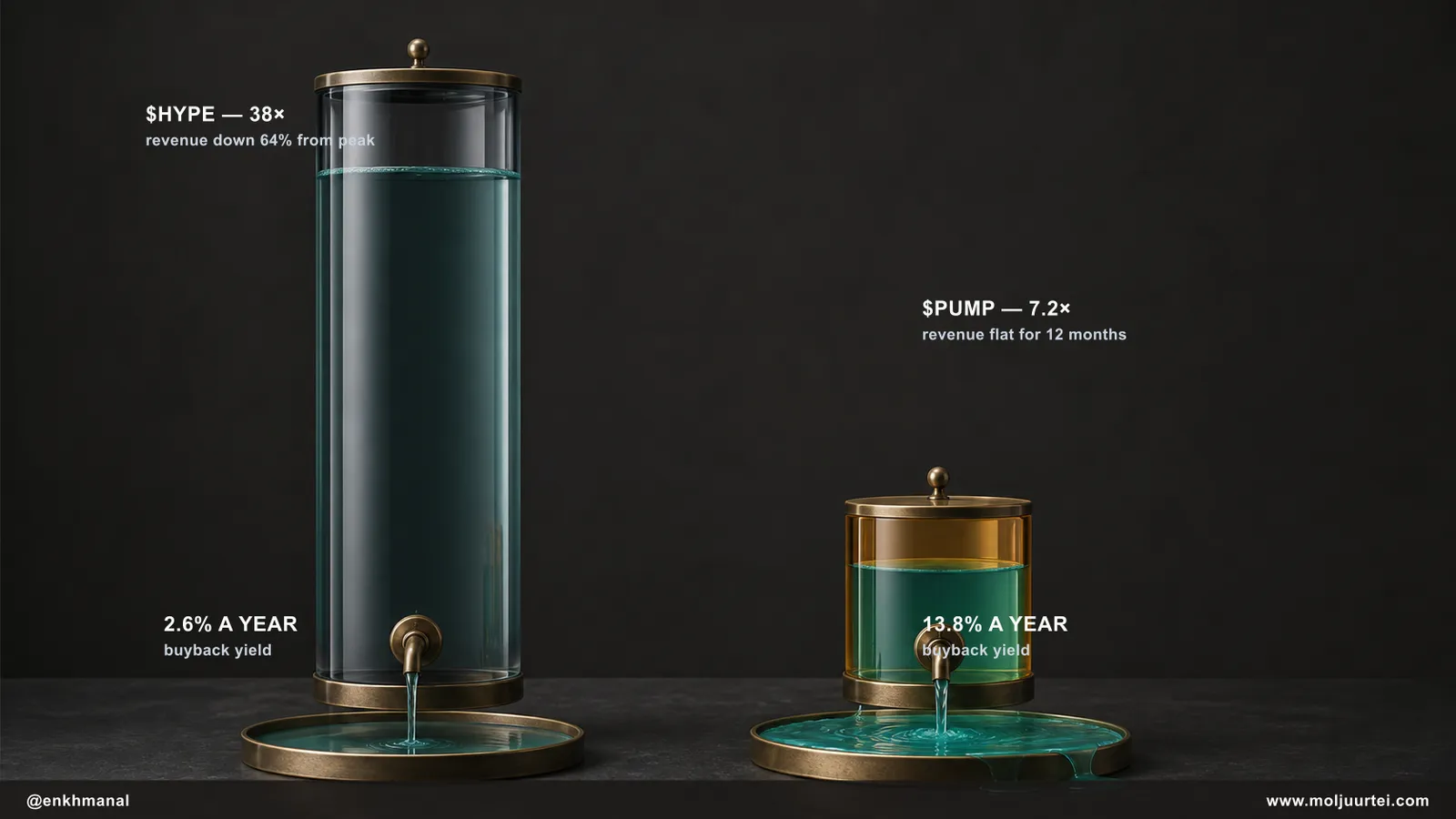
$PUMP is the position. At $0.00496 the market pays $1.93 billion for $267 million a year of contractual buyback-and-burn — 7.2× on market cap, 16× fully diluted, a 13.8% annual retirement of the float, against revenue that has been flat for twelve months through the worst crypto drawdown since 2022. The cases below are illustrative arithmetic on stated assumptions, not forecasts: they say what the token is worth if the revenue does what it has been doing, and what it is worth if it halves.
$HYPE is a hold, and a buy on weakness rather than here. The franchise is the real thing — 65% share of a category it is winning while that category contracts, a clean cap table with no venture unlock cliff, and a live US regulatory catalyst. But the entry matters when you are paying 38× market cap and 173× fully diluted for revenue 64% below peak, days after a fresh all-time high, in the same week a short squeeze added twenty points. Starter size, add on a revenue inflection or a genuine CFTC rulemaking, not on the headline.
$ETH is the monetary leg and belongs in the book as such — held against the debasement thesis alongside $BTC, sized as a macro position, with no pretence of cash flow. $SOL is the same trade with worse scarcity characteristics and a better application economy it does not capture; if the goal is exposure to Solana's activity, the app layer is 17× larger and directly purchasable. $KMNO is a watch, not a position, with one trigger: a governance vote enabling fee routing to the token. Until then the numerator is zero and there is nothing to value.
Of 2,602 protocols, six return more than $50 million a year to the people who own them. When a currency's issuer starts buying its own bonds to hold the price up, the assets worth owning are the ones that are visibly, contractually buying back their own.