
$CRWV — A Levered Call Option on the AI Compute Toll Road
Deep Dive — original analysis dated June 12, 2026 · Published: 2026-06-12 · Tickers: $CRWV, $NBIS, $CORZ, $ORCL
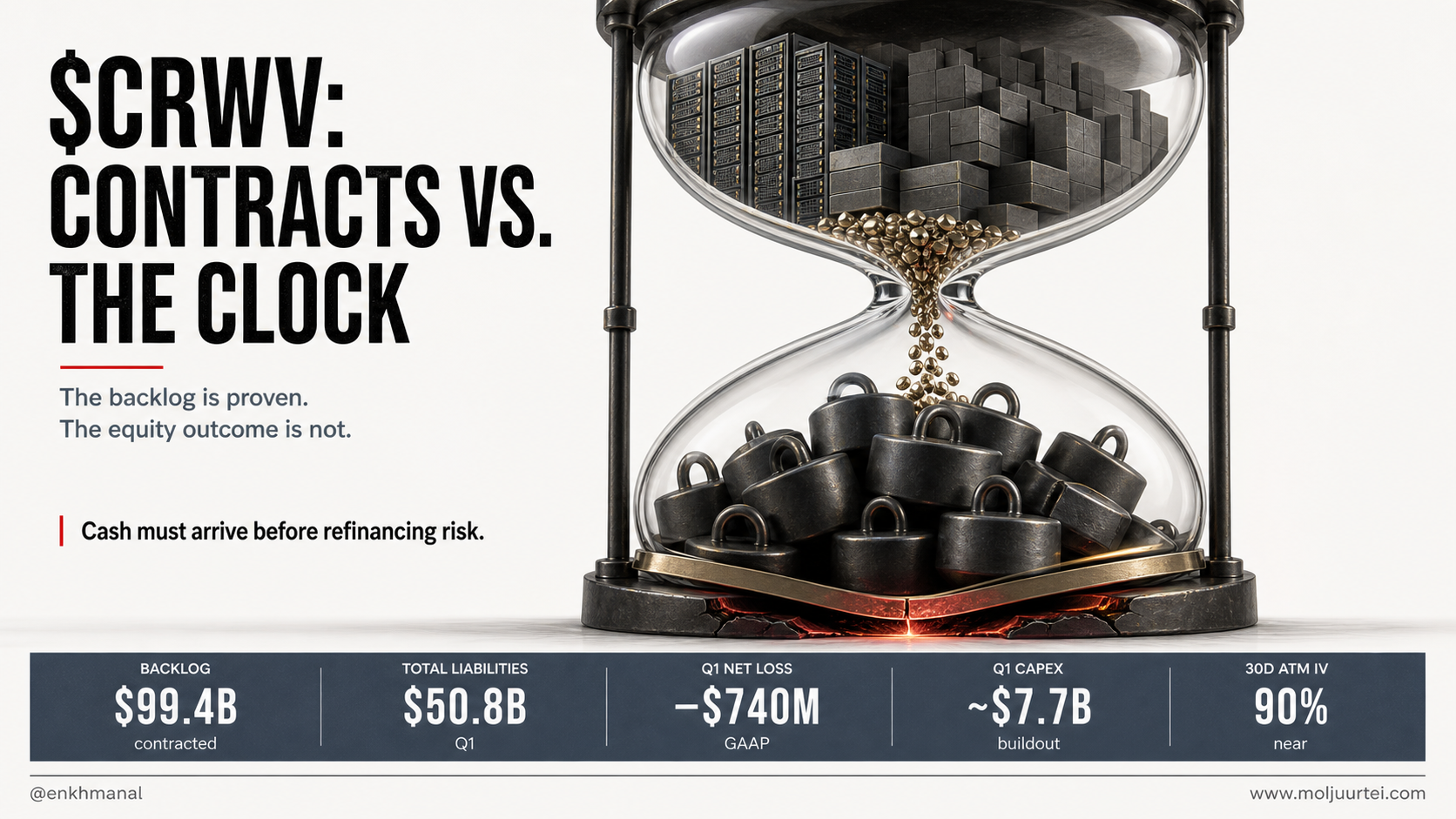
$CRWV is the purest, highest-beta expression of the AI-infrastructure buildout: a take-or-pay GPU-cloud "toll road" whose demand side is overwhelmingly proven but whose equity is a thin, volatile sliver sitting on top of one of the most aggressive balance sheets in large-cap tech. The debate is no longer whether the compute is wanted — a $99.4B backlog settles that — it is whether the contracted cash flows arrive before the $50.8B of liabilities and ~$536M-per-quarter interest bill force dilution or a distressed refinancing.
Update — October 9, 2026
This article's $95.77 share price, $100/$120 options levels, 90% implied volatility, $99.4B backlog, Q1 liabilities and June catalyst calendar are June 12 snapshots, not current readings. The Nasdaq-100 addition occurred on June 22. The next reported quarter partly validated the demand thesis: Q2 revenue reached $2.575B versus $2.078B in Q1, and backlog reached $104B at June 30. CoreWeave said more than $25B of net new commitments signed early in Q3 were excluded from that June backlog; commitments are not recognized revenue and remain subject to delivery. It announced Cognition as a production Vera Rubin NVL72 customer on September 30, after the original memo's June technology claim.
The balance-sheet test remains unresolved. Q2 interest expense increased to $640M from $536M in Q1, Q2 GAAP net loss was $626M, and June 30 total liabilities were $72.0B. The $104B backlog is evidence of contracted demand, but it is not cash on hand or an equity return. Watch delivery timing, capital spending, financing terms, customer concentration, and net debt before treating this as a durable compounder. Sources: CoreWeave Q2 2026 results, September contracting update, September Vera Rubin production release, Nasdaq index announcement.
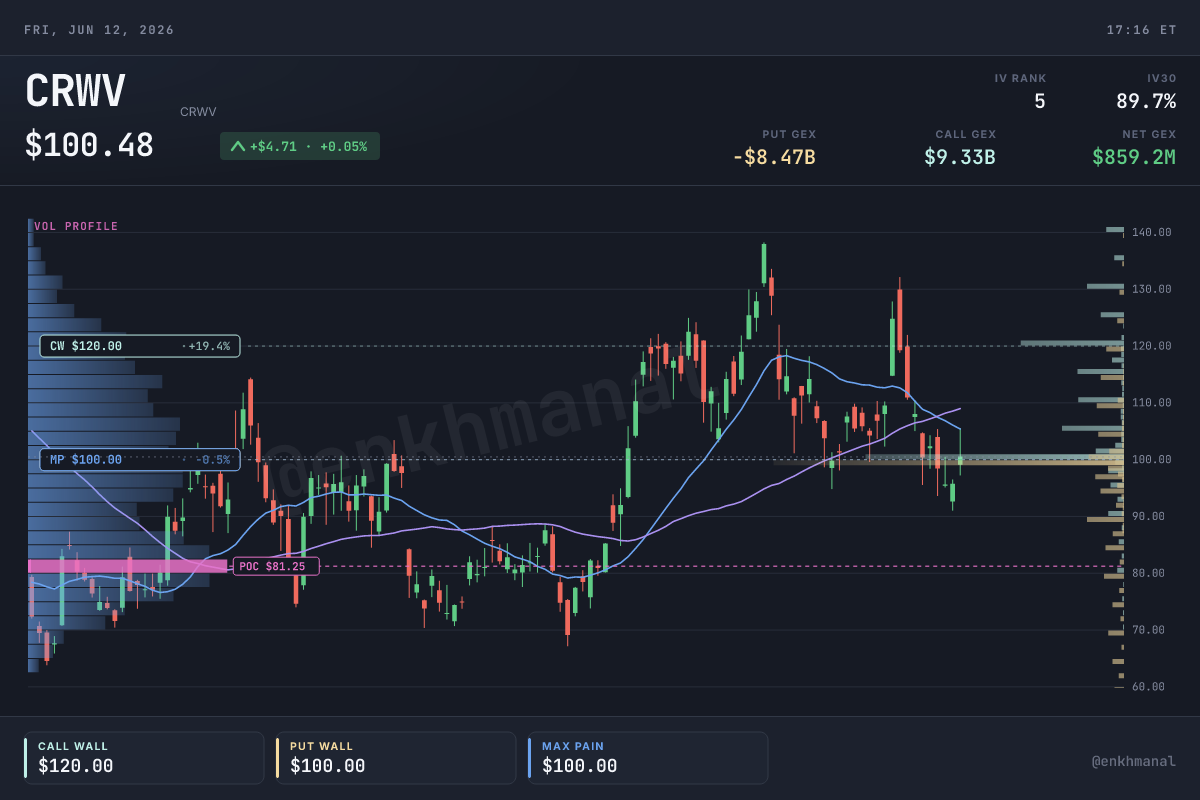 Historical price and options snapshot from June 12, 2026; the levels and volatility below are not current. Spot $95.77 sits just below a dense $100 magnet — simultaneously the max-pain strike, the put wall, a round number, and the IPO-relative reference. The $120 call wall is the next upside shelf; net GEX is mildly negative (≈−$130M, dealers slightly short gamma → moves get amplified, not dampened), and 30-day ATM IV near 90% (front-week 112%) prices roughly ±5–6% daily swings. The tape is a tug-of-war: a mechanical Nasdaq-100 passive bid (effective 22 Jun) pulling toward $100/$120 against a post-lockup supply flood pressing the other way.
Executive Summary
- $CRWV has won the demand argument — Q1 2026 revenue $2.08B (+112% YoY, +32% QoQ), adjusted EBITDA $1.2B (56% margin), and a contracted backlog of $99.4B (≈4× YoY) anchored by Microsoft, OpenAI, Meta and Anthropic — but it is losing money fast (−$740M GAAP net loss) and the equity is a leveraged option, not a compounder-yet.
- Setup: spot $95.77; near-term it is bracketed by the $100 max-pain/put-wall magnet and the $120 call wall, with Nasdaq-100 inclusion effective 22 Jun as a passive-bid catalyst against an active post-lockup seller base.
- The one risk that matters: Q1 interest expense (
$536M) nearly erased adjusted operating income ($21M); a 10–15% revenue miss against the FY26 $12–13B guide — most plausibly via a Microsoft drawdown (67% of FY25 revenue) — turns the debt stack from leverage into a trap. - Cross-reference our neocloud unit-economics work: GPU shortage & neocloud ROIC note.
- Framing: trade it as a high-IV option on contract conversion, not as a buy-and-hold; size for the bimodal ($0 ↔ multi-bagger) payoff, don't average into the supply overhang.
Industry History & Technological Evolution
Every major computing transition opens a window in which demand outruns the incumbents' ability to supply, and a fast-moving entrant either becomes the foundational layer or burns through its balance sheet trying. Content-delivery networks raced to cache the early web in the 1990s; data-center REITs built the physical backbone of cloud in the 2000s; tower companies levered the mobile build-out in the 2010s. The 2024–2027 AI training-and-inference wave is the same archetype, and the bottleneck has moved from chips to the physical plant around them — power, land, liquid cooling, and InfiniBand fabric — delivered at gigawatt scale on impossible timelines.
What is genuinely new is the contract structure financing it. Frontier labs are compute-constrained in a literal arms race; falling behind on capacity means falling behind on model quality. That fear converts into multi-year, take-or-pay reservations — customers pay whether or not they use the GPUs — which look less like cloud and more like a toll road or a triple-net data-center lease. Those contracted obligations are exactly what lets a sub-decade-old company borrow tens of billions against GPUs and signed paper. The lifecycle stage is early-and-violent: revenue growth with no precedent in cloud history, paired with a capital-intensity that no software business carries.
Company Origin & Industry Positioning
CoreWeave is an accidental infrastructure giant. Three commodities traders — Michael Intrator, Brian Venturo and Brannin McBee — founded it in 2017 as Atlantic Crypto, an Ethereum-mining operation running banks of consumer Nvidia GPUs in a New Jersey warehouse. When crypto cratered, they had a warehouse of idle Nvidia silicon and pivoted to renting it to visual-effects studios and early machine-learning teams, rebranding as CoreWeave in 2019. By the time $NVDA H100s arrived in 2022, they had years of hard-won operational knowledge in rack density, networking and thermal management that hyperscalers were only beginning to build.
That history shapes the capital structure. Intrator runs the data centers the way an energy trader treats power plants — long-duration, contracted, leverageable assets — and CFO Nitin Agrawal (a Google Cloud and AWS finance veteran) is the architect of the debt stack. The market is wrestling with where on the value chain this sits: $CRWV is the picks-and-shovels layer, not the gold miner. It owns no model, no proprietary chip, and no exclusive data. Its edge is access and speed — preferential $NVDA allocation as an Elite Cloud Partner, and the ability to stand up tens of thousands of GPUs in ~90 days when in-house and hyperscaler timelines run far longer.
Technology Deep Dive
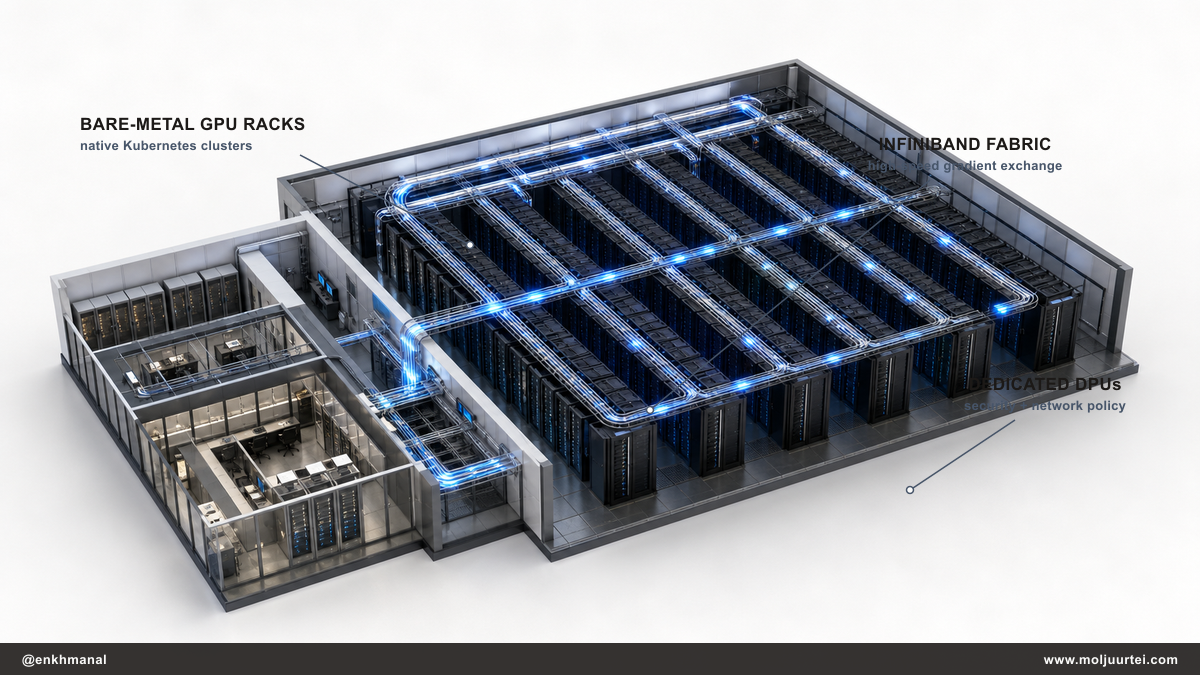
CoreWeave's differentiation is real but narrow. Where legacy clouds bury GPUs under hypervisor layers, CoreWeave deploys bare-metal GPU clusters natively on Kubernetes, wired together with Nvidia InfiniBand so thousands of GPUs exchange gradients as if they were one processor — offloading security and network policy to dedicated DPUs to get bare-metal speed without sacrificing multi-tenant isolation. For large-scale training, the virtualization overhead of a general-purpose cloud genuinely degrades performance; $CRWV sidesteps that. The fleet is ~250,000+ Nvidia GPUs (H100/H200/GB200) across ~49 data centers, and the company had completed an early Vera Rubin NVL72 bring-up and validation by Q2 2026; its first named production customer, Cognition, was announced on September 30, 2026.
The moat has three layers of decreasing durability. Supply access (preferential $NVDA allocation) is powerful today but Nvidia has every incentive to diversify cloud partners and shortages won't last forever. Operational expertise (running 250k GPUs with low-latency fabric, liquid cooling, failure modes) is real but the hyperscalers are catching up fast. The most durable layer is the contract structure itself — five-year take-or-pay agreements with immense switching costs once a lab's training pipeline is integrated. Where the moat is shallowest is plain: the business has no proprietary silicon or model, so if GPUs commoditize, if Nvidia pricing power wanes, or if custom silicon ($GOOGL and $AMZN in-house accelerators, $AMD GPUs) takes training share, the differentiation narrows quickly.
Peer Landscape — Technology & Price Action
The competitive field has three fronts. Hyperscalers ($MSFT, $AMZN, $GOOGL) own the broad enterprise cloud and are both $CRWV's largest customers and its most capable potential competitors. Specialized neoclouds — $NBIS (Nebius, a credible, well-funded European challenger), Lambda, Crusoe, RunPod — fight for the same dedicated-GPU dollar, often undercutting on per-hour pricing but lacking the scale to anchor multi-billion-dollar frontier contracts. $ORCL is the wildcard, building rival cloud capacity for the same labs. A second-order set of beneficiaries — data-center landlords $CORZ (Core Scientific) and $GLXY (Galaxy Digital) — sit downstream of $CRWV's build (per @RHouseResearch's flow-of-funds work).
| Ticker | Reference | YTD '26 (approx.) | Since IPO/2024 |
|---|---|---|---|
| $CRWV | Neocloud pure-play | ~+74% (as of early Jun) | ~+140% vs $40 Mar-25 IPO |
| $NBIS | EU neocloud peer | strong, Nasdaq-100 add | — |
| $ORCL | AI-cloud incumbent | positive | — |
Peer returns above are approximate snapshots from early June 2026, not current prices.
| Ticker | NTM P/E | Fwd EV/Rev (FY26E) | Note |
|---|---|---|---|
| $CRWV | N/M (no GAAP profit) | ~7× (EV ≈$88B / rev ≈$12.5B) | leverage discount embedded |
| $ORCL | ~mid-20s× | ~8–9× | profitable, lower growth |
| $NBIS | N/M | premium | smaller, faster |
The market has already crowned the hyperscalers and $ORCL on AI cloud; $CRWV trades at a discount forward EV/Rev to $ORCL despite ~3× the growth — the gap is the balance sheet, not the business.
Business Model, Growth & Margins
The income statement is the whole argument. The revenue ramp has no analog: ~$16M (FY22) → $5.13B (FY25, +167%) → guided $12–13B FY26, with a year-end exit run-rate of $18–19B. Gross margin headlines a software-like 71.7% (FY25) — but the bulk of GPU depreciation is parked below gross profit in "Technology & Infrastructure" opex, so FY25 GAAP operating income was roughly breakeven (−$46M) and the GAAP net loss was −$1.17B after ~$1.1B of interest (per Harsh Mhatre's FY25 build). Adjusted EBITDA was $3.09B (60.2% margin); the gap between 60% EBITDA and ~0% operating margin is the depreciation ramp.
| Quarter | Revenue | QoQ | Notes |
|---|---|---|---|
| 2025-06-30 | ~$1.2B | — | post-IPO ramp |
| 2025-09-30 | ~$1.4B | +17% | |
| 2025-12-31 | ~$1.6B | +14% | FY25 exit ~$6.3B run-rate |
| 2026-03-31 | $2.08B | +32% | +112% YoY; adj EBITDA $1.2B (56%) |
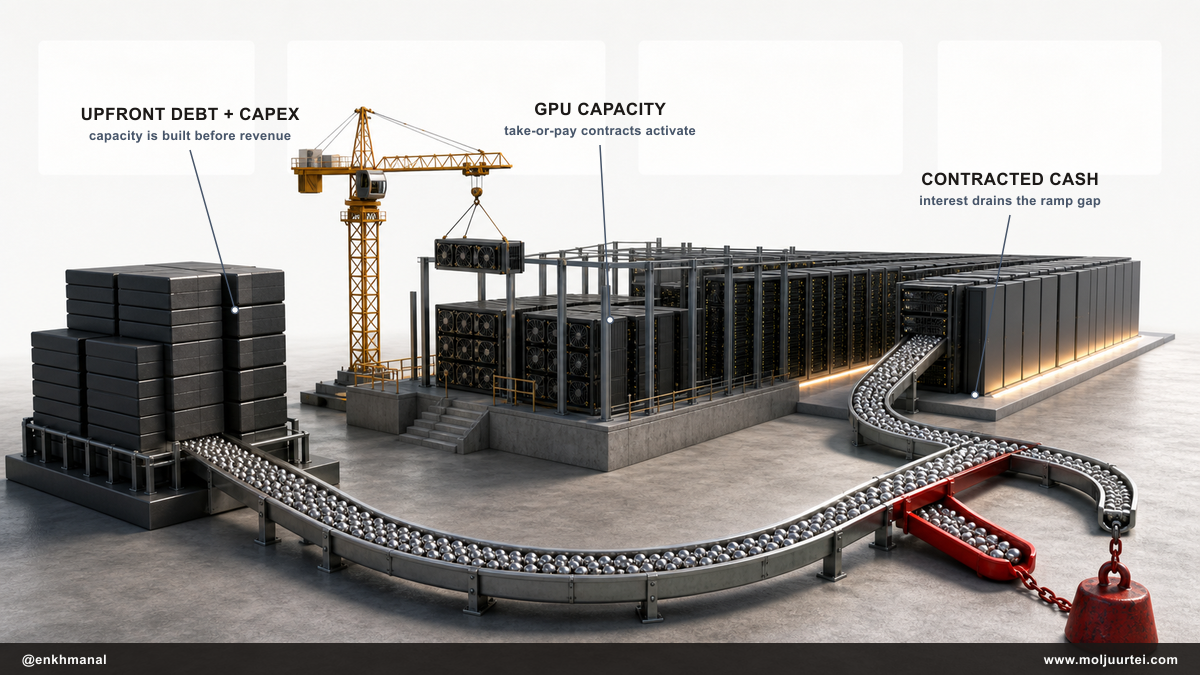
The Q1 2026 print crystallizes the tension One Upon Zero named — "priced like software, built like infrastructure." Against $2.08B revenue: interest expense ~$536M, adjusted operating income ~$21M, net loss −$740M, and Q1 capex ~$7.7B (against $31–35B guided for the full year). Capital allocation is monomaniacal — every dollar of cash, plus tens of billions of borrowed dollars, goes into new GPU capacity; no buybacks, no dividend. The unit economics work if the contracts hold: borrow against signed paper, deploy into assets that throw off 60%-type EBITDA over a five-year life, repay from contracted cash flows. The risk lives entirely in the ramp gap between spending the capex and collecting the revenue.
TAM, Strategic Narrative & Leadership
The addressable market is the global build-out of AI training and inference capacity, which management frames in power terms: >1 GW of active power today, 3.5 GW contracted, and a stated path to >8 GW by 2030. On the Q1 call Intrator emphasized scale independent of any single backer — "in the last 12 months, CoreWeave has secured 2 gigawatts worth of infrastructure… we are capable of securing infrastructure at gargantuan scale, independent of any support from Nvidia or anyone else." The enterprise (non-lab) vertical is "already approaching $10 billion in our revenue backlog," with Jane Street adding $6B of capacity in Q1 and Hudson River Trading a new logo — early evidence the customer base can broaden beyond frontier labs. The macro backdrop is supportive but not free: effective Fed funds sits ~3.63% (May, FRED DFF), so debt-funded capex still carries a real cost of capital — which is precisely why $CRWV's progress toward cheaper financing matters (below).
Leadership credibility is the swing factor on the narrative. The trader-CEO/hyperscaler-CFO pairing is either purpose-built for this model or a recipe for balance-sheet fragility, depending on one's read of the cycle. The single loudest signal cutting against management conviction is insider behavior: following the IPO lock-up expiry (~8–9 Jun), co-founders Intrator, McBee and Venturo sold >$2.3B of stock (under 10b5-1 plans; they still hold ~18%, Intrator ~10.4%), early backer Magnetar has unloaded $5.5B+, and SEC filings show ~150 Form 4s in 120 days with no insider buying. @RHouseResearch's fair-minded counter — that founders with nearly all their net worth in one stock taking some chips off the table is rational and they remain heavily exposed — is correct, but the magnitude and one-directionality is a genuine overhang.
Latest Earnings
- Headline (Q1 2026, reported 7 May): Revenue $2.08B, +112% YoY / +32% QoQ; adjusted EBITDA $1.2B (56%); net loss −$740M; adjusted operating income ~$21M against ~$536M interest expense.
- Backlog / bookings: "signing more than $40 billion of new commitments and growing contracted revenue backlog to nearly $100 billion" (Intrator) — backlog $99.4B, ~4× YoY, ~36% expected to convert within 24 months; Meta's April expansion added ~$21B.
- Forward guidance: FY26 reaffirmed at $12–13B revenue and $900M–$1.1B adjusted operating income; Q2 revenue $2.45–2.6B with adjusted operating income just $30–90M — "as margins start to expand from their Q1 lows."
- The new disclosure — cheaper money: management flagged its fourth delayed-draw term loan as "the first ever investment-grade Delayed Draw Term Loan… achieving an A− equivalent rating… priced at a level implying a cost of less than 6%," and the June ~$4B convertible notes priced at a 1.75% coupon — a blended cost-of-debt that is falling even as the absolute debt rises (older delayed-draw loans ran 11–15%).
Thematic Investment Angle
The theme is the AI compute build-out's physical layer — the toll-collectors of the buildout rather than the chip designers or model labs. Within that basket, $CRWV is the highest-octane, highest-leverage pure-play.
| Ticker | Role | Why this slot | YTD '26 |
|---|---|---|---|
| $CRWV | Neocloud pure-play (levered) | Highest growth + highest leverage; the option | ~+74% |
| $NBIS | Neocloud challenger | Cleaner balance sheet, smaller scale | strong |
| $CORZ / $GLXY | 2nd-order landlords | Capture $CRWV's build economics downstream | — |
| $ORCL | Incumbent AI-cloud | Profitable, diversified hedge to the pure-plays | + |
The theme is crowded — four of these names (including $CRWV and $NBIS) were simultaneously added to the Nasdaq-100, and @Convertbond's quip that "AI compute flows enter the index machine" captures the reflexivity: index inclusion forces passive buying into negative-FCF businesses. $CRWV screens as the most convex slot in the basket — most upside if compute scarcity persists, most downside if it doesn't. What invalidates the whole theme: a sustained hyperscaler capex deceleration, or evidence that custom silicon is structurally cheaper for training at scale.
Bull Case & Catalysts
The bull case is that $CRWV becomes the durable compute layer of the AI era — the Equinix/American Tower of GPUs — where five-year take-or-pay contracts, elite Nvidia access, and a delivery-speed advantage compound into self-funding cash generation as the FY25 backlog converts and depreciation is outrun by revenue. At Sohn, Gavin Baker argued the model is genuinely differentiated and durable (via @RHouseResearch), and the falling cost of debt (an investment-grade delayed-draw loan <6%, 1.75% converts) is the quiet tell that lenders increasingly agree.
| Date | Event | Why it matters |
|---|---|---|
| 2026-06-22 | Nasdaq-100 inclusion effective | Mechanical passive bid; near-term support toward $100/$120 |
| 2026-06 (ongoing) | Post-lockup founder + Magnetar selling | Active supply overhang capping rallies; watch 10b5-1 cadence |
| 2026-06 | ~$4B convertible notes (1.75%) + S-3ASR shelf | Cheaper financing, but added dilution/leverage capacity |
| ~2026-08 (est.) | Q2 2026 earnings | First test of the $2.45–2.6B guide + margin re-inflation claim |
| 2028–2030 | First major contract renewals | The real durability test vs. customer self-build |
What needs to go right over 2–3 years: Microsoft's revenue share falls toward 40–50% while total revenue keeps compounding; adjusted operating margin recovers toward 15–20% (depreciation outrun); and net debt flattens rather than keeps climbing — the signal the structure has turned self-funding.
Risk Register
- Microsoft concentration (67% of FY25 revenue) — the single largest swing variable. Microsoft is both best customer and most capable competitor; a drawdown (paying minimums but not expanding) while replacement revenue from OpenAI/Meta/Anthropic ramps with a 12–18 month lag is the bear's core mechanism. Backlog is diversifying (Microsoft <35% of backlog) but current revenue is still extreme.
- Debt + interest coverage — ~$50.8B total liabilities vs. $4.76B equity and $2.24B cash (Q1 10-Q); FY26 guided adjusted operating income ($900M–$1.1B) barely exceeds the interest run-rate. @ParadisLabs frames it bluntly: "ROIC (4%) − cost of debt (10%)… torching equity value." A 10–15% revenue miss + a refi window is the spiral.
- GPU commoditization / silicon shift — pure-Nvidia architecture becomes a rigid constraint if $AMD or the hyperscalers' in-house accelerators ($GOOGL, $AMZN) take training share or Nvidia pricing softens.
- Supply overhang + governance optics — founder/$Magnetar selling, a January 2026 securities class action (Raymond Masaitis v. CoreWeave), and a fresh S-3ASR shelf all cap multiple expansion regardless of operations.
- Negative FCF for years — FY25 FCF ≈ −$7.3B; @Convertbond pegs cohort FCF burn at ~−$25B (2026)/−$21B (2027). The equity depends on the eventual turn, not current cash generation.
What forces a thesis change: a quarterly disclosure showing Microsoft revenue share rising back above 65% (bearish) or falling below 40% with total revenue still compounding and net debt flattening (bullish). Either resolves the bimodality.
Valuation & House View
| Metric | $CRWV | Read |
|---|---|---|
| Fwd EV/Rev (FY26E) | ~7× | discount to $ORCL despite ~3× growth — the leverage tax |
| NTM P/E | N/M | no GAAP profit; valuation is EV/EBITDA + scenario, not P/E |
| Net debt | ~$33B | vs. ~$55B mkt cap; EV ~$88B |
| Sell-side | Buy, avg PT ~$140 | range $85 (Truist) → $192 (Paribas); spot $95.77 |
| Scenario | Prob. | 2Y target | Implied vs. $95.77 | Triggers |
|---|---|---|---|---|
| Bull | 30% | ~$280 | +192% | Compute scarcity persists; enterprise + inference broaden demand; net debt falls; re-rate to 15× EBITDA |
| Base | 45% | ~$150 | +57% | Contracts convert on schedule; Microsoft diversifies gradually; multiple stays leverage-discounted (~12× EBITDA) |
| Bear | 25% | ~$40 | −58% | Microsoft drawdown + ramp lag → FY27 revenue miss; margins compress to ~35%; refi/dilution at depressed prices |
Assessment, updated October 9, 2026. Demand and deployment have advanced since this June snapshot, but the financing test remains open. The June $95.77 price, option levels, analyst targets, and scenario probabilities above are historical estimates, not live trading levels. CoreWeave entered the Nasdaq-100 on June 22, reported $2.575B of Q2 revenue and $104B of backlog, and later announced a production Vera Rubin customer. Q2 interest expense nevertheless rose to $640M and the GAAP net loss was $626M. The equity still depends on converting contracted capacity into durable cash flow without excessive financing cost or dilution; updated customer concentration and net debt are the next tests.