
$CRL — Owning the inputs to drug-safety proof
$CRL provides preclinical safety evidence used before a new medicine enters human trials. Management says it sources about 80% of its own non-human primates internally, a supply advantage it describes as unique among large Western safety-testing providers. DSA net book-to-bill reached 1.19x in Q2 2026, its best in nearly four years. At the October 23 price snapshot, the shares had doubled since March. The opportunity is a recovery in study demand supported by owned supply; the question is how much of that recovery the price already assumes.
What Changed
Designing a drug candidate keeps getting cheaper. Proving it is safe enough to give to a person does not. Machine-learning models now propose antibody sequences and small molecules in days, and biotech funding has come back: Charles River puts the trailing twelve months at about $100 billion, just short of the pandemic peak. Candidates still need an appropriate nonclinical safety package before human dosing. For programs requiring primate studies, animal supply and validated laboratory capacity can constrain progress.
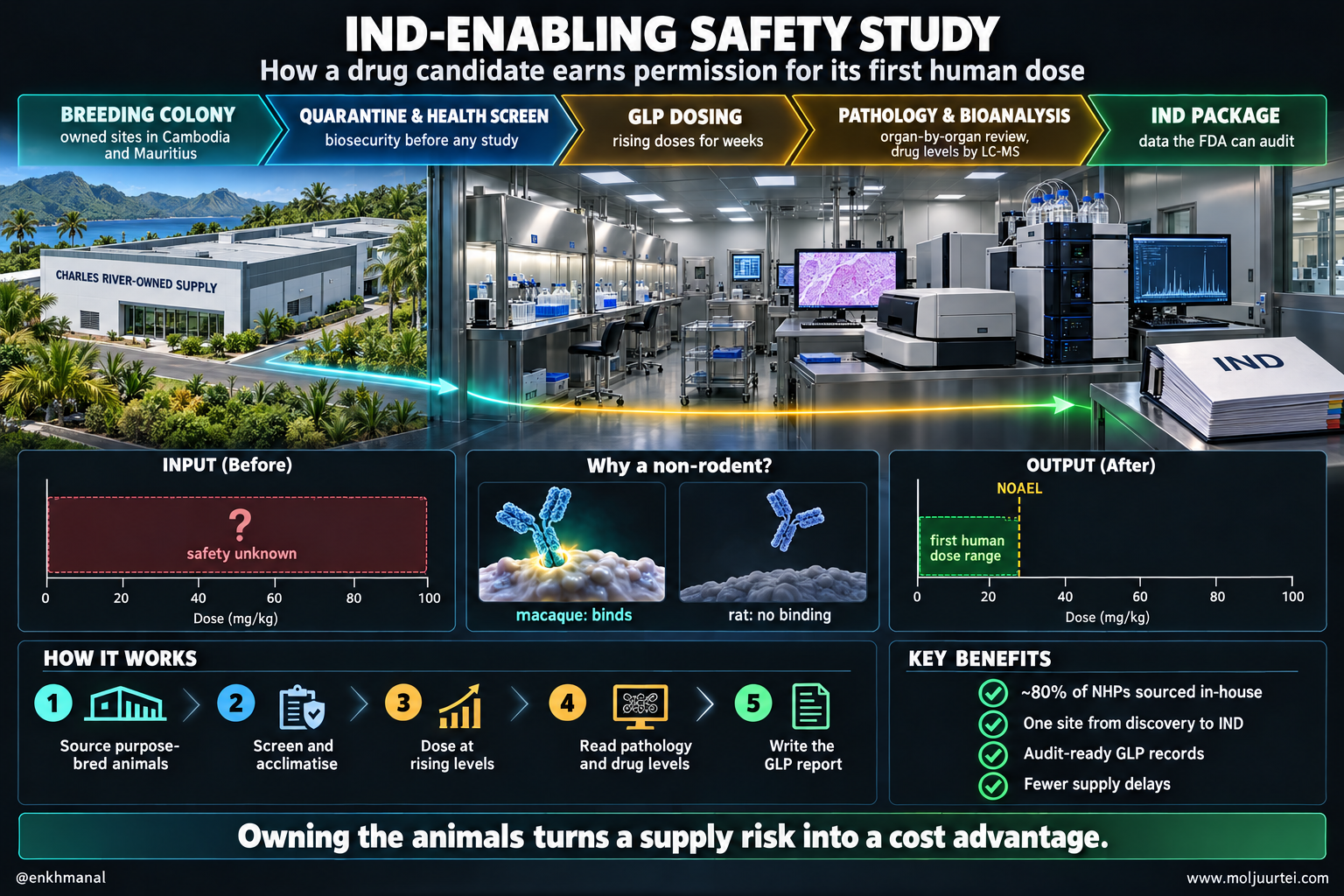
Start here. A drug candidate is a molecule a company believes may treat disease. Toxicology studies assess harmful effects and their relationship to dose. GLP, Good Laboratory Practice, governs study quality and auditable records. An IND, Investigational New Drug application, asks the FDA to allow human trials; nonclinical safety data are one important part alongside manufacturing and clinical information. Small-molecule programs commonly use a rodent and a non-rodent species; biotechnology-derived drugs use pharmacologically relevant species under product-specific guidance. For some antibodies the cynomolgus macaque is relevant because the drug binds its target there but not in common alternatives. NAMs, new approach methodologies, include organ chips, organoids and computational models that can reduce or replace particular animal tests.
The incumbent answer is the animal study, and it is used for a plain reason: it directly observes a whole living body responding over weeks, including effects beyond the intended target. Its limits are also plain. It is slow, it is expensive, and its predictions are imperfect; the FDA's own April 2026 progress report notes that more than 90% of drugs that clear animal studies are never approved. The second limit is supply. Before 2020 China exported most of the world's laboratory macaques. It stopped that year and has not resumed, a Cambodian smuggling case disrupted US supply from late 2022, and Chinese procurement awards rose from about 92,000 yuan per animal in May 2025 to 178,000 yuan in June 2026. That attrition figure does not mean every failure was caused by the animal model.
Regulators are pushing on the same gate from the other side. The FDA's April 2025 roadmap set out to make animal studies the exception over time, starting with monoclonal antibodies, and a December 2025 draft guidance says chronic studies longer than three months in a non-rodent are generally unwarranted for single-target antibodies when a weight-of-evidence case supports it. That trims the longest monkey studies on one class of drug. It does not remove the first-in-human safety package, but the evidence required and the scope for alternatives depend on the drug and the question being tested. Proof is the part that did not get cheaper, and a large share of the proof runs through one company.
Thesis
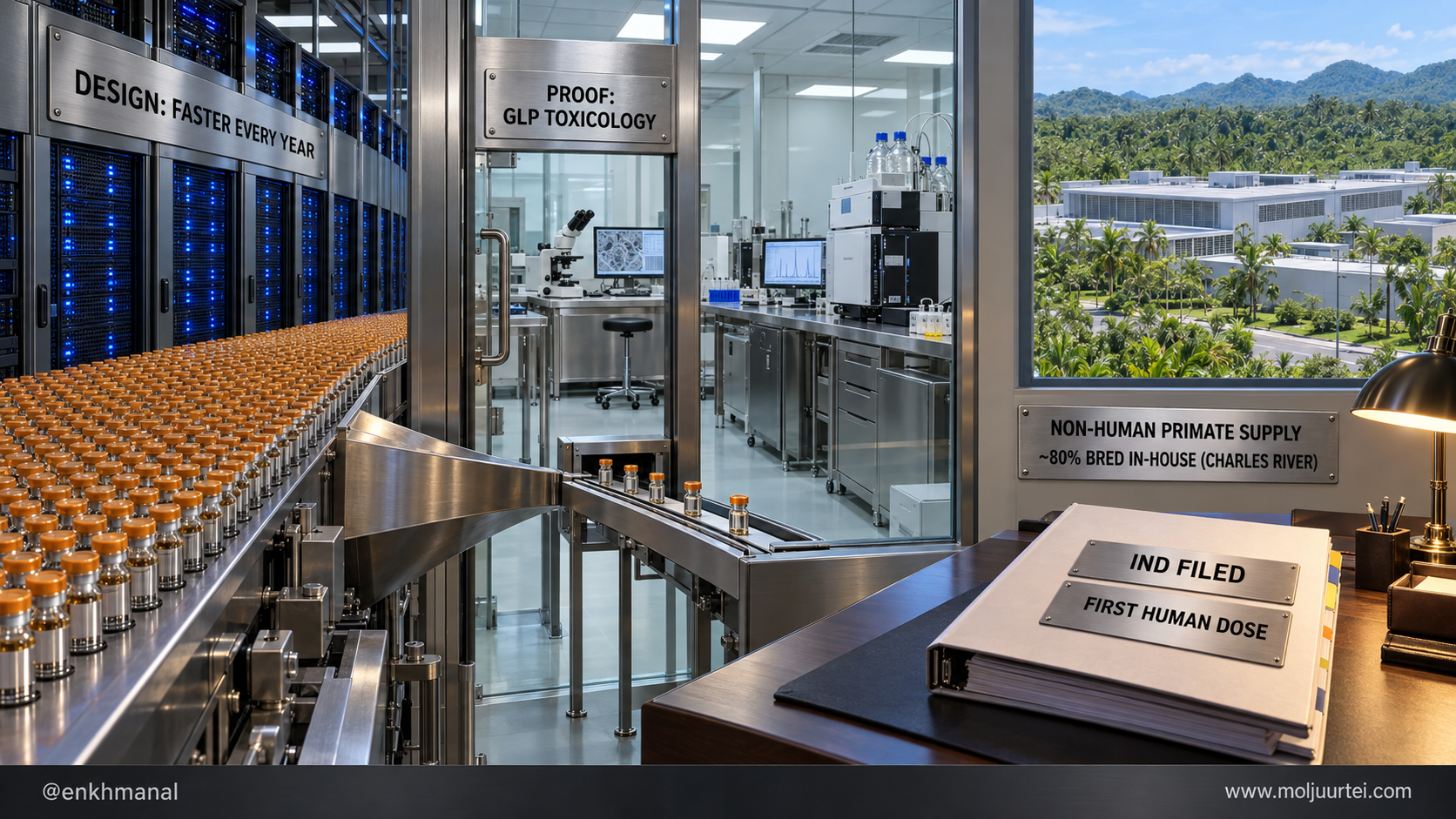
$CRL owns the scarce input of regulated drug-safety testing: after buying its Cambodian and Mauritian breeders it sources about 80% of the non-human primates it uses internally, which management says no other Western safety-testing provider can match, and that supply now sits under a demand recovery that took DSA net bookings to $701 million in Q2 2026.
Business & Backdrop — the tailwind and where the bottleneck sits
Charles River makes money three ways, and the split matters. Discovery and Safety Assessment, DSA, runs studies for a fee per study and carried 59.8% of 2025 revenue; Research Models and Services, RMS, sells purpose-bred rodents and runs vivariums for clients at 21.1%; Manufacturing Solutions sells quality-control testing for injectable drugs at 19.1%. In the second quarter of 2026, DSA was $606.5 million of $1,004.1 million, or 60.4% of revenue against 59.9% a year earlier; RMS was 20.9% of revenue, up 0.2 points, and Manufacturing 18.7% of revenue, down 0.8 points after the contract-manufacturing sale. DSA is the business the thesis is about, and the one that sets the group's direction.
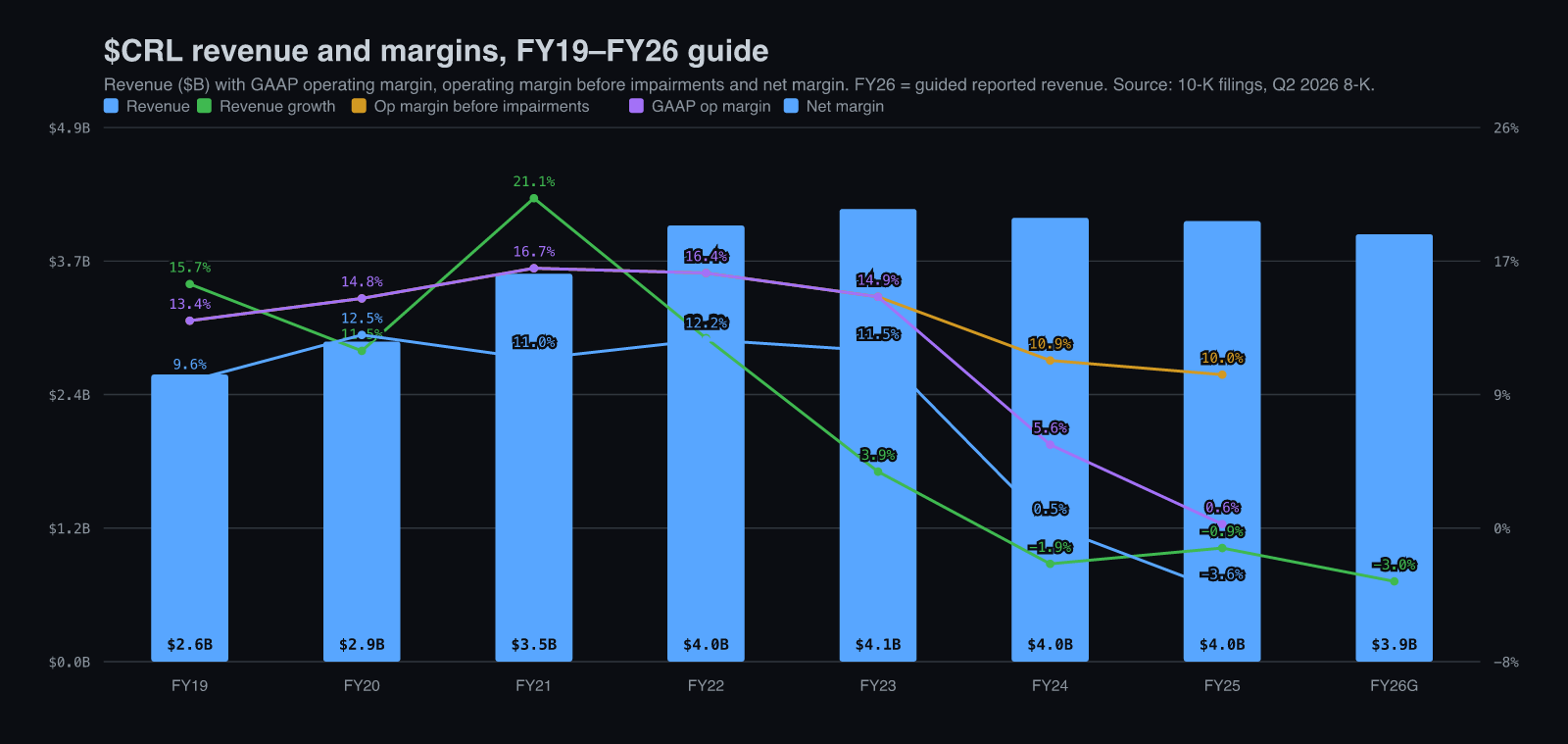
Revenue went sideways for three years and margins fell, which is the backdrop to the rally. Revenue was $2.62 billion in FY19, grew 21.1% to $3.54 billion in FY21, peaked at $4.13 billion in FY23, then slipped 1.9% in FY24 and 0.9% in FY25 to $4.02 billion; FY26 is guided to about $3.90 billion after divestitures. GAAP operating margin ran 13.4% in FY19, peaked at 16.7% in FY21, then fell to 5.6% in FY24 and 0.6% in FY25. Before goodwill and intangible impairments, which were $215 million in FY24 and $376 million in FY25, the operating margin was 10.9% and 10.0%. Net margin went from 12.2% in FY22 to minus 3.6% in FY25.
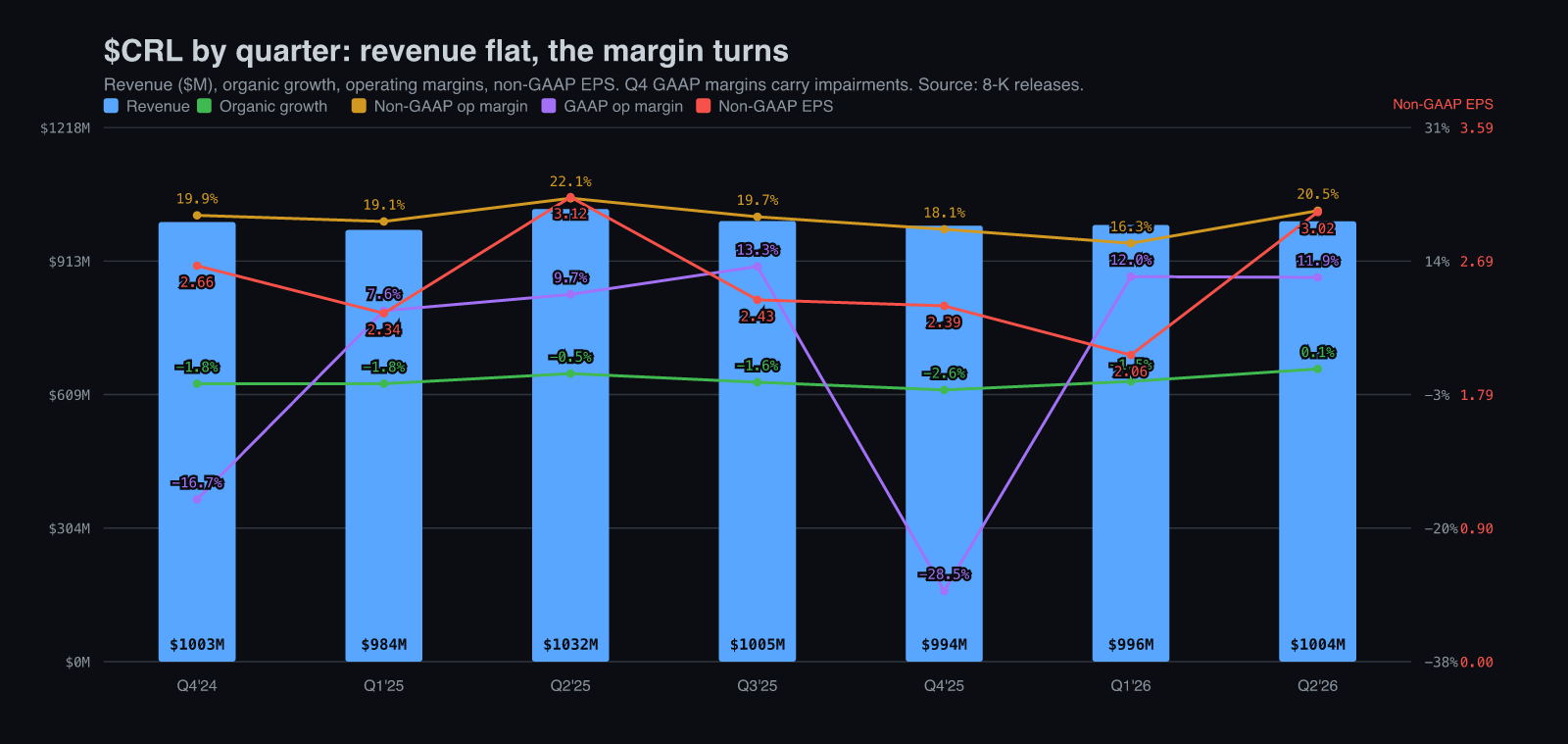
By quarter the turn is visible. Organic revenue growth went minus 1.8% in Q4 2024, minus 1.8% in Q1 2025, minus 0.5% in Q2 2025, minus 1.6% in Q3 2025, minus 2.6% in Q4 2025 and minus 1.5% in Q1 2026, then plus 0.1% in Q2 2026. Non-GAAP operating margin read 19.9%, 19.1%, 22.1%, 19.7%, 18.1%, 16.3% and 20.5% over the same quarters, so the latest print recovered 420 basis points from the first quarter. GAAP operating margin was 12.0% in Q1 2026 and 11.9% in Q2 2026, against minus 28.5% in Q4 2025 when the impairments landed. Revenue barely moved, between $984 million and $1,032 million every quarter.
Table definitions: GAAP.
Table definitions: GAAP; EPS.
Table definitions: DSA; GAAP; RMS.
The cash flow statement tells a calmer story than the income statement. In FY25 Charles River generated $737.6 million of operating cash flow and $518.5 million of free cash flow while reporting a GAAP net loss to common shareholders of $144.3 million; the gap is the non-cash impairments. Non-GAAP EPS was $10.28. Free cash flow is guided lower in 2026, to $400 million to $420 million, because the 2025 bonus pool and the retiring CEO's deferred compensation were paid in cash in the first quarter, when free cash flow was minus $15 million. Net leverage was 2.5x at the end of June.
The peers say the demand recovery is industry-wide rather than a Charles River story. Medpace's net new business awards rose 10.6% to $873.4 million in Q3 2026 against $716.0 million of revenue, a 1.22x book-to-bill. $IQV's R&D Solutions booked $3.15 billion in Q2 2026, up 19%, also at 1.22x. The closest comparison runs the other way: Labcorp's Early Development unit, the US safety-assessment rival, reported revenue down 1.4% in Q2 2026 while Charles River's DSA grew 0.2% organically, which is consistent with, but does not establish, management’s claim that owned supply helps win work.
Technology & Moat — why the monkey study is the choke point
A GLP primate study is a regulated manufacturing process whose product is a data set. The animals are bred and quarantined, health-screened, assigned to dose groups, dosed for weeks or months, sampled for blood chemistry and drug levels, and finally examined organ by organ by veterinary pathologists, with every step written to a standard an FDA inspector can audit. The bioanalysis that measures drug levels in those samples is its own business; Charles River expects it to reach about $450 million of revenue by 2030. The hard part is not any single step. It is having the animals, the GLP-validated sites and the pathologists at the same place when a client's IND clock is running.
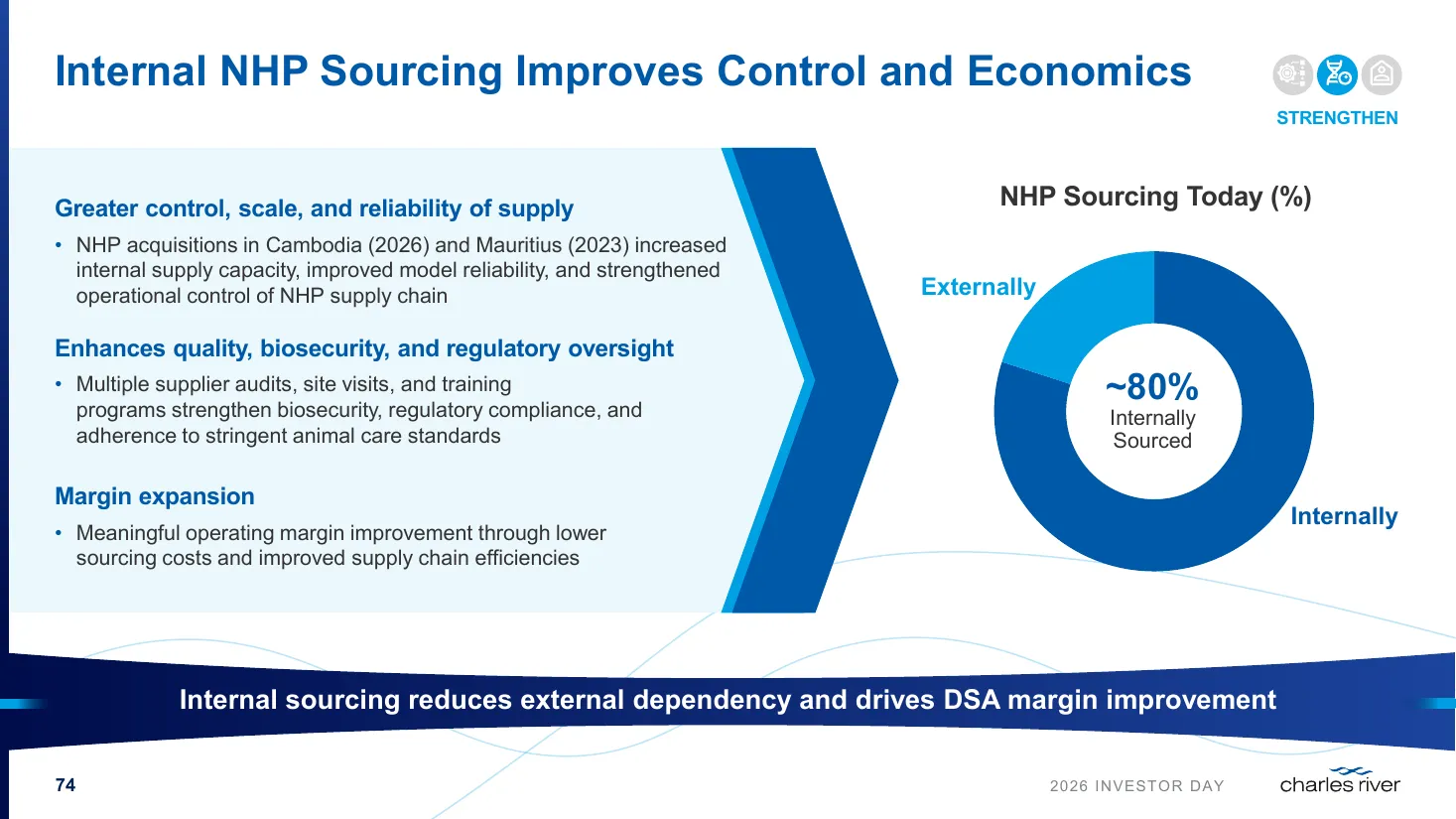
Charles River has spent about $900 million since 2022 to own the animals. It bought control of Noveprim in Mauritius in 2023 for a total of $392 million, and in January 2026 closed the purchase of K.F. (Cambodia) Ltd. at a preliminary $507.3 million, $335.0 million paid at closing and the rest deferred against post-close conditions, with $283.0 million booked as biological assets amortised over eleven years. K.F. is not expected to earn meaningful outside revenue; its value shows up as cheaper animals inside DSA, worth about $0.25 of non-GAAP EPS in 2026 and $0.60 in 2027 by the company's estimate. At the June 2026 investor conference the CEO stated the advantage plainly:
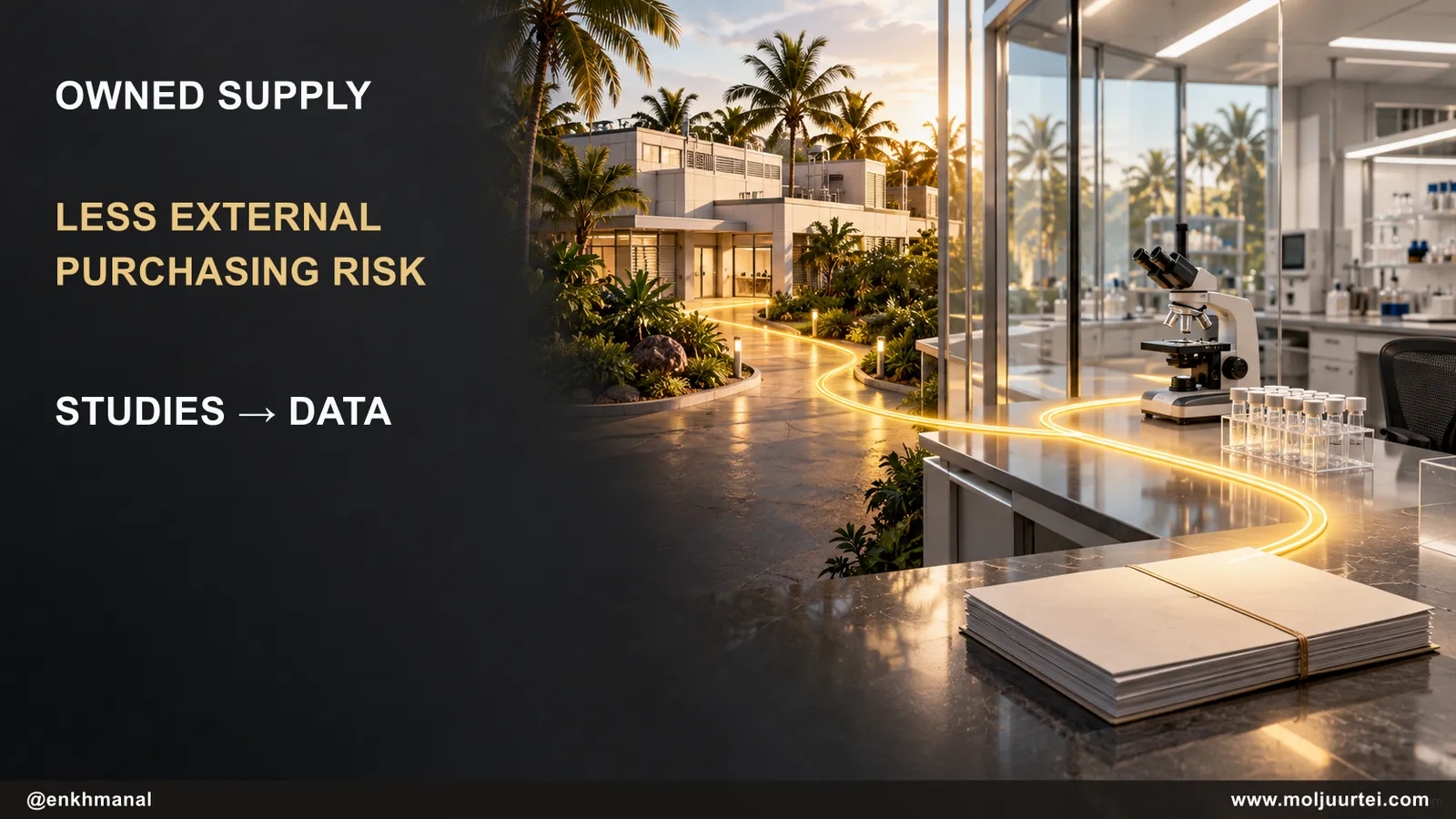
…making us the only provider of safety assessment solutions for our clients in the Western world with our own primate supply and the only one who can guarantee it.
The rivals are not who the market usually names. The FY25 10-K says safety assessment's two main competitors are a division of a large US public company, which is Labcorp's Early Development unit, and a private Canadian company; the Chinese public company it names is the main rival in discovery, not in regulated safety testing. Charles River also sold the Cambridge chemistry and biology sites that competed most directly with China to $IQV in May 2026 for about $145 million. The legal cloud over Cambodian supply has lifted: US Fish and Wildlife cleared the held shipments in July 2025, the Justice Department closed its investigations in August 2025, the SEC closed its inquiry in November 2025 with no enforcement recommendation, and imports into the US resumed under CITES clearance that month.
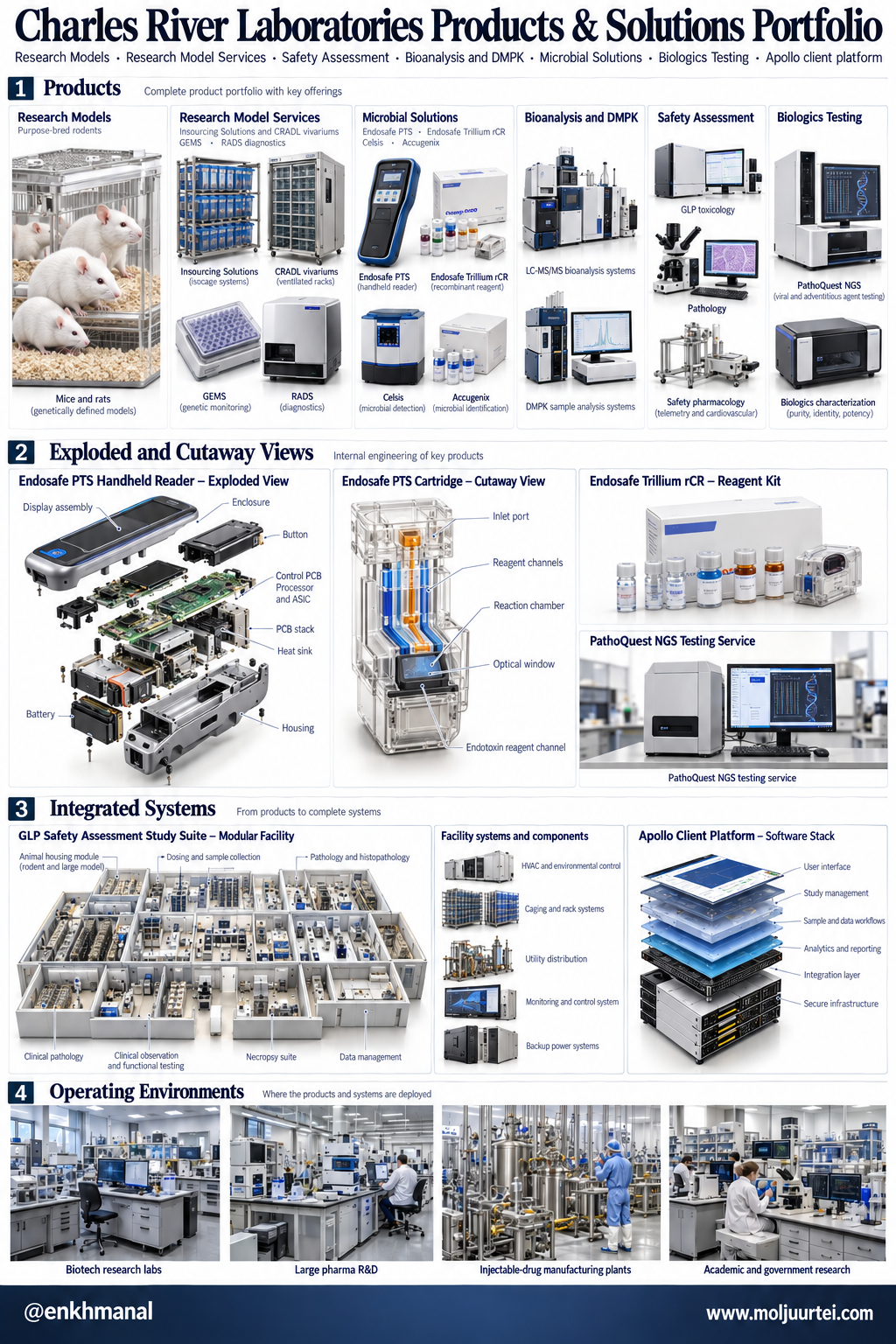
Manufacturing is the quiet second moat. Endotoxin testing, the check that an injectable drug carries no bacterial toxins, is required for every lot released, and Charles River's Endosafe cartridges and readers are a market leader in it; a recombinant, horseshoe-crab-free reagent sits in the same line. The segment's non-GAAP operating margin was 37.8% in Q2 2026, and the 2030 target is above 40%, more than half of the improvement coming from selling the contract-manufacturing business.
Roadmap & R&D — NAMs, bioanalysis and the optionality stack
The September 2026 Investor Day turned the strategic review into a plan with numbers. Organic revenue is targeted to grow 5% to 7% a year from 2027 to 2030, with DSA in the same range, Manufacturing at 7% to 9% and RMS at 2% to 4%. The non-GAAP operating margin is meant to rise from 21.0% to 21.3% in 2026 to about 24% in 2030, roughly 75 basis points a year, and non-GAAP EPS to compound at a low-double-digit rate. A cost program called Create the Future is expected to save more than $300 million cumulatively from 2027 to 2030 through automation and shared services. Capital spending is planned at 5% to 6% of sales, two-thirds of it for growth, starting with five bioanalysis lab expansions. These are targets, not guidance; the company says so on the slide.
NAMs are where Charles River is trying to own the thing that threatens it. In January 2026 it made Namandjé Bumpus, the FDA's chief scientist from 2022 and its principal deputy commissioner until December 2024, its Chief Scientific and Innovation Officer. It bought the rest of PathoQuest, a next-generation-sequencing lab that replaces some animal-based lot-release tests, for $67.6 million in April 2026, joined Eli Lilly's TuneLab AI platform as a non-clinical testing partner, and rolled out AI-assisted digital pathology. Management's position, repeated at every conference this year, is that NAMs complement in vivo work rather than replace it; at Investor Day the CEO added that NAMs could offset or add to revenue but that the effect is far from material today.
Three potential drivers merit attention. The first two are not quantified in the targets; modest pricing improvement is already included. First, AI developers buying wet-lab data to train models is a new kind of customer; it is real at Lilly's TuneLab, unsized, and unproven at scale. Second, China: management says the local preclinical market is $1.2 billion to $1.5 billion and that it is evaluating an entry built on its existing RMS business there, with nothing imminent. Third, pricing: the CFO and CEO both expect study prices to improve as capacity fills in 2027, and the 2030 margin bridge counts on modest price increases. Each of those would add to the plan; only the third is in it, and only modestly.
Growth mechanism — owned supply before pricing
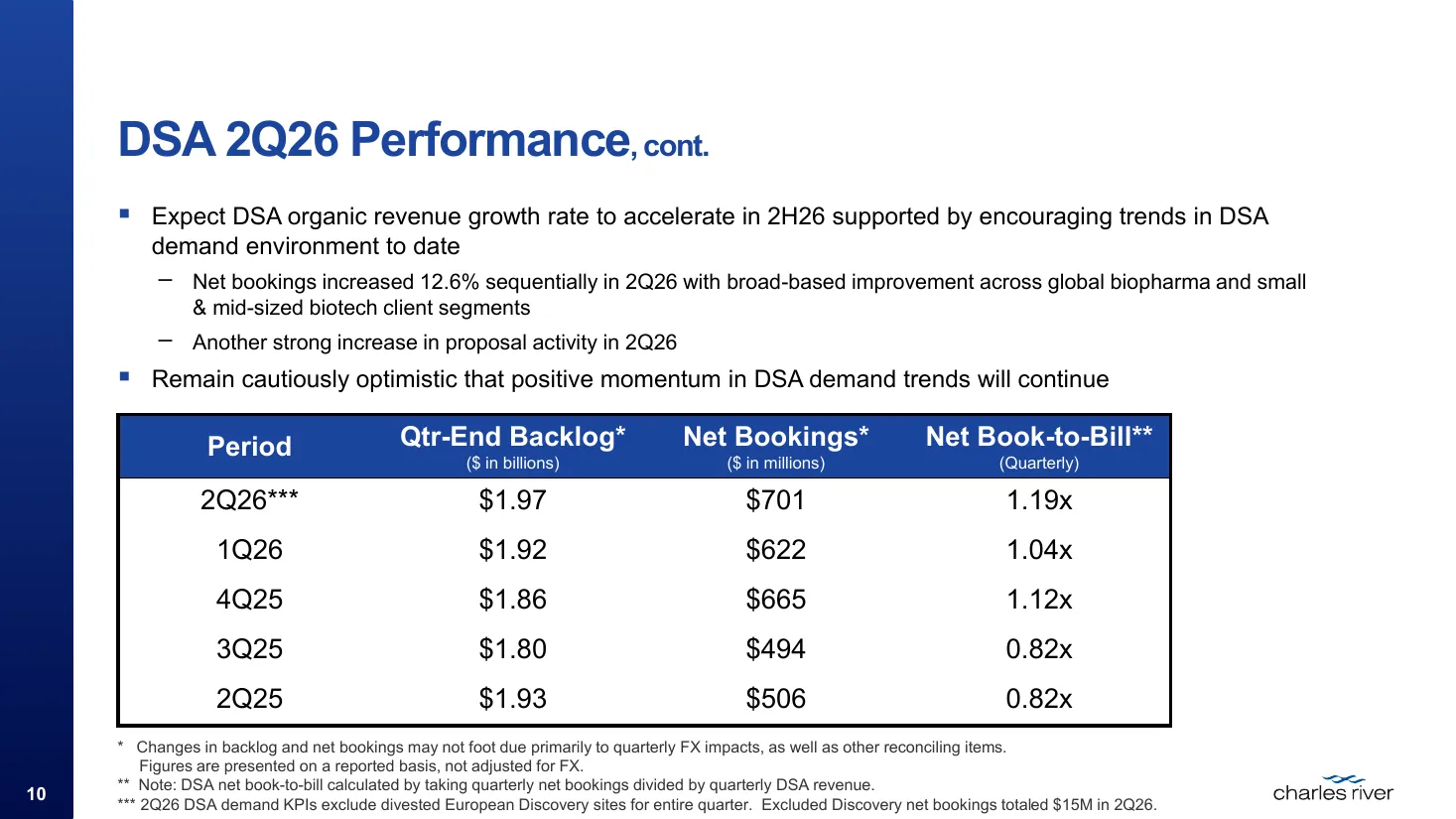
Bookings lead revenue by several quarters in this business, and the bookings have already turned. DSA net book-to-bill was 0.82x in both Q2 and Q3 2025, then 1.12x in Q4 2025, 1.04x in Q1 2026 and 1.19x in Q2 2026, on net bookings of $701 million, the highest since the third quarter of 2022. Backlog bottomed at $1.80 billion in Q3 2025 and was $1.97 billion at the end of June. Management described the improvement as broad, across big pharma and small and mid-sized biotech, with a more discernible uptick in IND-enabling studies and continued strength in primate studies.
The margin is where the new owners of the plan intend to win, and the levers are mostly in Charles River's own hands. Restructuring since 2023 is expected to deliver about $300 million of annualised savings by the end of 2026. It sold the money-losing cell and gene therapy contract-manufacturing and Cell Solutions businesses to GI Partners in May 2026 for net cash paid to the buyer of $12.4 million, with contingent payments that could come back, which removed $143 million of 2025 revenue and the businesses behind most of the impairments. Owned monkeys lower DSA's input cost, and the CFO expects the large effect in the fourth quarter of 2026, once imported animals clear quarantine and go on study. Non-GAAP operating margin rose 420 basis points from Q1 to Q2 2026, to 20.5%, and the company expects about 500 basis points more in the second half than the first.
What has not turned yet is price, and that is the most useful thing the calls say. Spare capacity left over from the downturn is why new orders can be filled without new labs, and it is also why clients have not had to pay more. The CEO was direct on the Q2 call:
Overall, what I would say is pricing has not materially improved yet. Pricing is still stable. It is at the levels that we have seen for the last few years.
That cuts both ways, and the setup is better for it. Volume is recovering on stable prices, so the operating leverage from filling idle rooms comes first and the price increase, if it arrives in 2027 as management expects, comes on top. The 2026 guide already rose twice, to 0% to 1% organic growth and $11.15 to $11.45 of non-GAAP EPS, and in September the company said both would land at the upper ends. Charles River enters the 4 November print guided to $2.90 to $3.00 of third-quarter non-GAAP EPS and to what management expects will be a second straight quarter of organic growth for both the company and DSA.
Management & Track Record
Charles River changed its chief executive, its finance chief and a third of its board in twelve months, and most of the new faces arrived with an activist. Elliott Investment Management, which described itself as the largest investor, signed a cooperation agreement in May 2025 that added four directors, including Elliott's Steven Barg, and created the committee that ran the strategic review. Elliott does not appear among the holders above 5% in the 2026 proxy, so we do not state its stake.
Table definitions: DSA; NAMs; FDA; FCF; COO; CFO; CEO.
The operator who now runs the company has 37 years inside it, which is the reassuring half. The other half is that the CEO, CFO and science chief have less than a year together as a team, and the 2030 plan is their first promise. The first test of it is the 4 November print.
Risks & What Breaks It
The assumption that almost broke the thesis is that regulators move slowly. The FDA says it met its first-year goals for the roadmap, including the December 2025 draft that makes chronic non-rodent studies longer than three months generally unwarranted for single-target antibodies. The FDA Modernization Act 3.0, which would direct the agency to rewrite rules that still assume animal testing, passed the House in July 2026 and awaits a final Senate vote; the EPA recommitted in January 2026 to ending mammal testing by 2035. Charles River does not disclose how much of DSA revenue comes from chronic primate studies on antibodies, so the exposure is real but unquantified. If clients shorten those studies faster than PathoQuest-style replacements and bioanalysis grow, the 5% to 7% DSA target fails first.
What forces a thesis change: a DSA net book-to-bill below 1.0x on the 4 November print together with management describing shorter primate studies on antibody programs, or a final FDA guidance that extends the three-month limit beyond single-target antibodies.
Price Setup — Levels, Technicals & Options
$CRL closed at $345.09 on 23 October, up from $172.50 at the end of March and about 85% above its January 2025 level. It gained 11.4% on the Q2 print on 5 August, 6.2% on Investor Day and 9.3% on 21 October, the day after Citrini Research named it a top beneficiary of AI drug discovery. The stock sits about 17% above its 50-day average, roughly $296, and about 58% above its 200-day, roughly $218. Medpace has risen about 100% since January 2025 and Labcorp and $IQV about 40%; $ICLR is still below where it started, after the February 2026 sell-off in which investors briefly treated the CROs as software companies about to be automated.
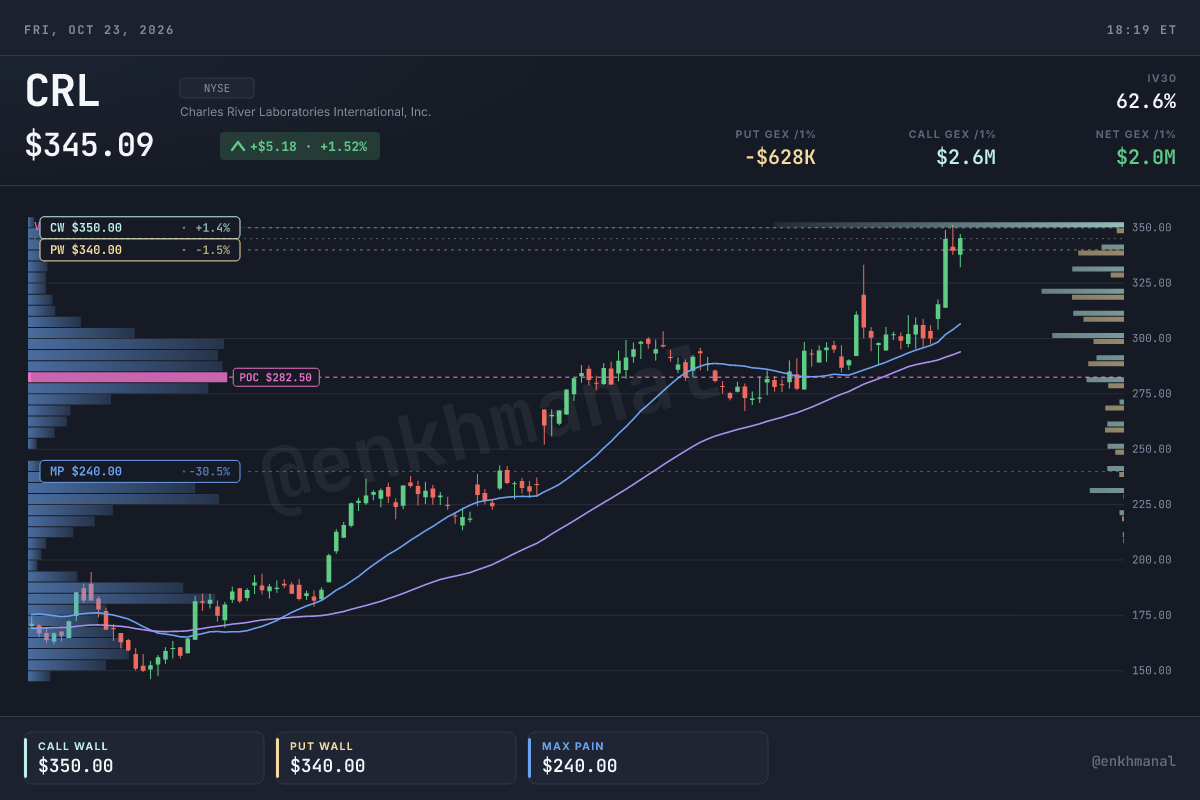
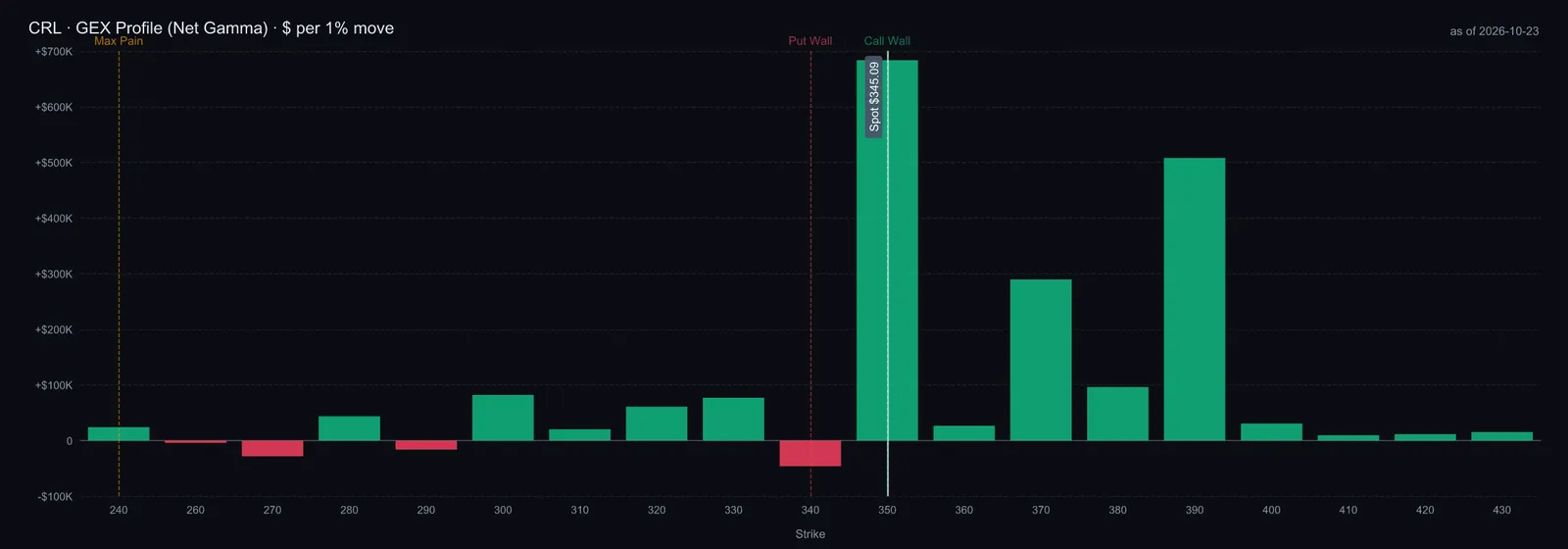
Open interest in $CRL options is light, so read the walls loosely. The call wall sits at $350, 1.4% above the close, and the put wall at $340, 1.5% below, so the listed chain brackets the price tightly; max pain is far lower at $240, which reflects old open interest more than a target. The put-to-call open-interest ratio is 0.37, a call-heavy book. November options, which span the 4 November print, carry about 63% implied volatility. The level that matters is the 21 October gap near $315: holding it keeps the move intact, and losing it puts the 50-day near $296 in play.
Valuation & House View
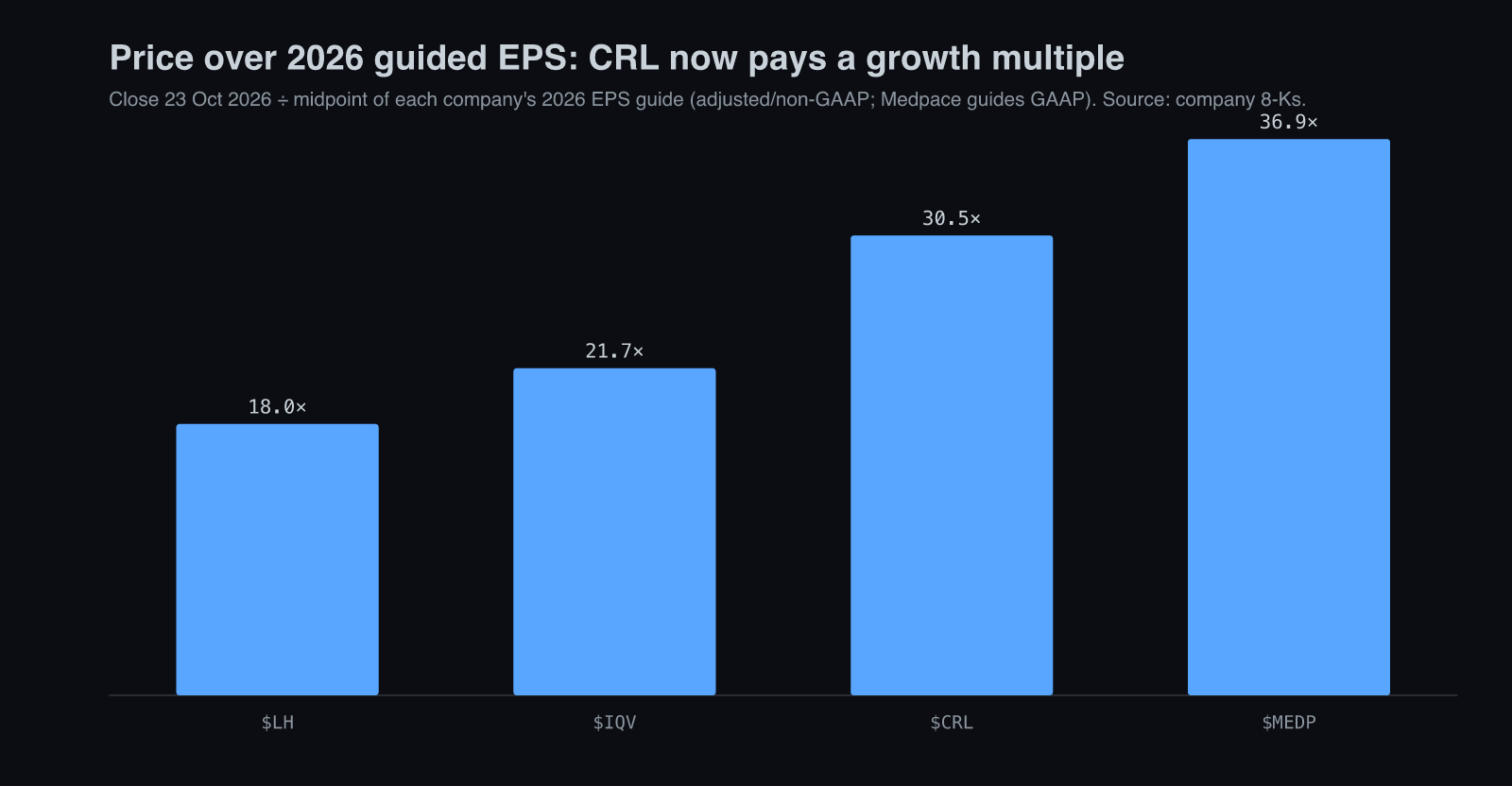
At $345.09 Charles River trades at about 30.5x the midpoint of its 2026 non-GAAP EPS guide, against 18.0x for Labcorp, 21.7x for $IQV and 36.9x for Medpace on their own guides. On 47.7 million shares the equity is worth about $16.5 billion and the enterprise about $18.9 billion, which is roughly 23x the 2026 non-GAAP operating income the guide implies and a free cash flow yield near 2.5% on the 2026 FCF guide. The stock traded at 19.3x trailing GAAP earnings in February 2025, the last time that ratio meant anything; impairments have made trailing GAAP P/E meaningless since.
Our discounted cash flow model, seeded from the 2026 guide, says the price is ahead of the cash. On GAAP cash flows, with revenue down 3.0% in 2026, up 3.0% in 2027 as the divestitures annualise, then fading to 5.0% growth, a 15.5% operating margin, a 9.5% discount rate and 2% terminal growth, the perpetuity method gives $117.63 a share and the exit method, at the 19.5x median EV/EBITDA of Labcorp, $IQV, Medpace and $ICLR, gives $284.90. The two are 2.4x apart, and that gap is the finding: the multiple peers command pays for earnings the cash flows do not yet show. Our bull case, with a 35.5% gross margin, 7% growth at the horizon and a 9% discount rate, reaches $193.99 on the perpetuity and $379.67 on the exit; the bear case gives $60.06 on the perpetuity. Run in reverse, $345 implies about 25% annual revenue growth at our base margins, and the model's IRR at today's price is 5.2%.
Table definitions: GAAP; EPS; FCF; EBITDA.
Scenario definitions: P/E; EPS. Returns use the October 23 price of $345.09.
At the October 23 close of $345.09, the business’s owned supply and improving bookings support a recovery thesis, but the valuation already assumes substantial execution. The probability-weighted 2028 scenario value is $328.50, about $329, versus a cited analyst median target of $327.50. These are scenario outcomes, not promised returns. The November 4 results will test whether DSA net book-to-bill remains above 1.0x, whether input-cost savings reach margins and whether 2027 pricing expectations are supported. Faster replacement of primate studies or renewed booking weakness would undermine the growth case.