
$CRDO Deep Dive — Reliability becomes the product: from copper cable to the optical link · Q2 FY27 print ~1 December
$CRDO built a $1.3 billion business by making a copper cable that does not fail, and it is now selling the same idea in light. Management raised the fiscal 2027 outlook to more than 85% growth on 1 September, guided more than $600 million of optical revenue, and the stock fell 20% the next day; at $194.79 it trades about 37% below its June high on a guide that implies a second-half revenue run rate near $3 billion a year.
What Changed
An AI model is now too large for one chip, so it is split across tens of thousands of them, and those chips spend much of their working life sending each other partial results. The system is only as fast as the slowest conversation. That makes the physical connection between chips a performance component in its own right, and in the last two years it has also become the most common thing that breaks.
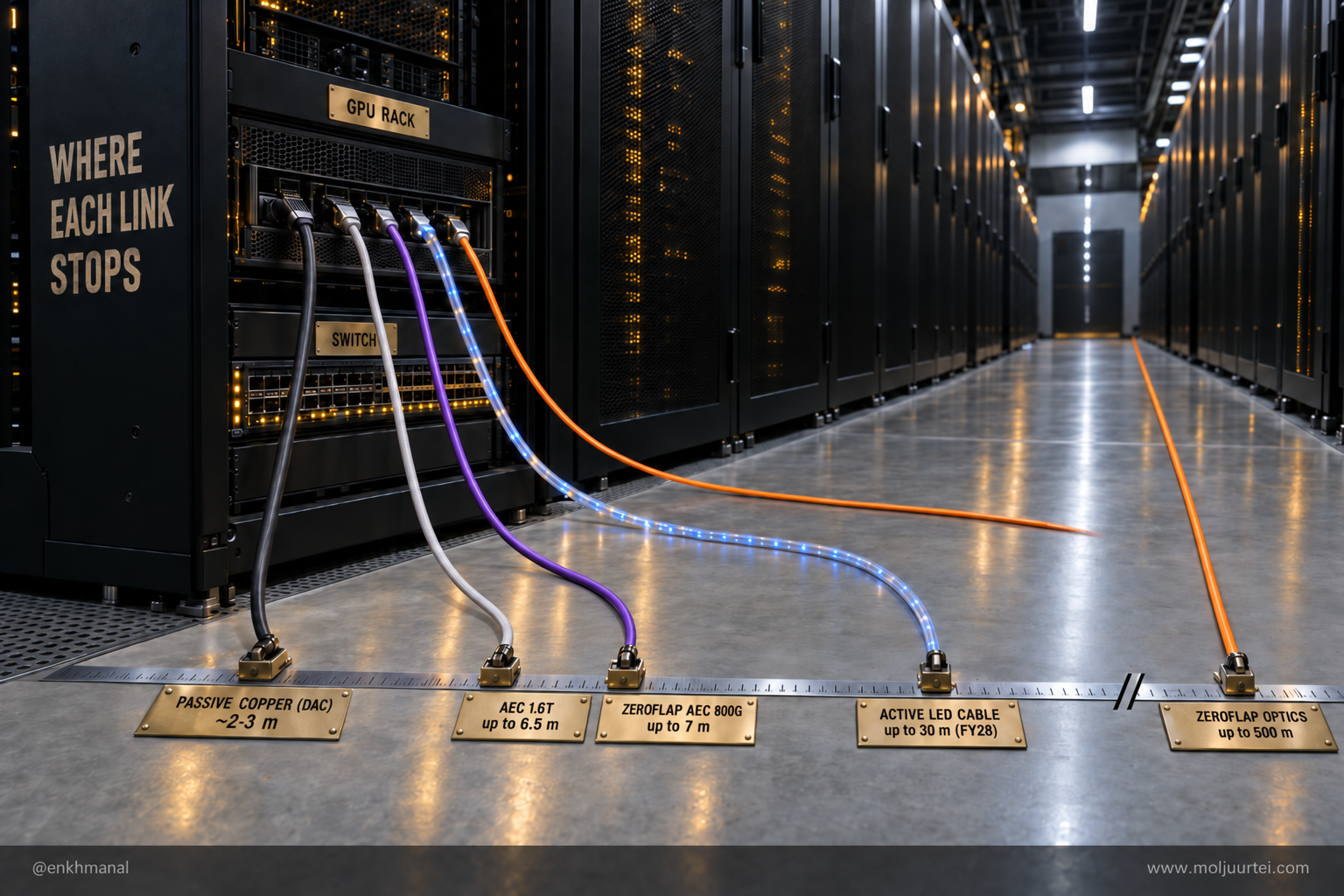
Start here. A chip is a slab of silicon that does arithmetic on bits, the ones and zeros a computer runs on. A link is the wire or fibre that carries those bits from one chip to another. A SerDes is the circuit at each end of a link that squeezes many slow parallel signals into one very fast serial stream and unpacks it on the other side. An Active Electrical Cable (AEC) is a copper cable with a small signal-processing chip in each plug that cleans up that stream, so copper can carry 800 gigabits a second for up to 7 metres. An optical transceiver is a plug that turns the electrical stream into laser light so it can travel hundreds of metres through glass fibre, using a digital signal processor (DSP) to clean the signal and a photonic integrated circuit (PIC) to put it onto the light. A link flap is what happens when one of those links drops for a moment and comes back. Everything below is about the company that sells the steadiest version of each.
Here is why the flap matters. In an ordinary data centre a dropped link is absorbed by redundancy one tier up. In an AI training cluster tens of thousands of links are interdependent, so one flapping transceiver can pause the job on every GPU waiting for its data. Credo's chief executive, Bill Brennan, told analysts on 1 September that customers have described losing "greater than 10% or even approaching 20%" of GPU utilisation to it. Every doubling of lane speed makes the problem worse in two directions at once: copper's usable reach shrinks, which pushes more links onto lasers, and lasers are the part that fails.
That combination is what changed between our June memo and today. In June the question was whether Credo's cable business could keep compounding. On 1 September the company printed $479.0 million of revenue for the quarter ended 1 August (+115% year on year, above the top of its own $465–475 million guide), raised the fiscal 2027 floor from more than 80% to more than 85% growth, and confirmed that its optical lines (DSPs, the silicon photonics PICs it bought with DustPhotonics, and its own ZeroFlap optical transceivers) will each pass $100 million, more than $600 million together. The stock closed at $206.63 that day, already down 8.6% on a weak day for AI hardware, then fell 20.0% to $165.22 on 2 September and touched $149.14 on 14 September. The shift the memo rests on is that the company that solved the flap in copper now owns the DSP, the PIC and the module needed to solve it in light.
Thesis
$CRDO owns every layer of a high-speed link (the SerDes, the DSP, the photonic chip, the cable or module, and the telemetry software) and sells the result as reliability, which is what the operator of a multi-billion-dollar cluster pays for once link flaps can cost it 10–20% of its GPU time.
Business & Backdrop
Credo was founded in 2008 by engineers who had spent a decade designing SerDes at Marvell, and for its first years it licensed that circuitry and sold chips. The business it is today began when hyperscalers asked it to put its own DSPs inside copper cables. Brennan's account is that Microsoft converted to AECs for a feature, not a price: a cable smart enough to sense a failing top-of-rack switch and move traffic to a redundant one without dropping the link. As lane speeds rose, passive copper cables (DACs) needed thicker conductors and lost signal faster, and the AEC became the default for the first connection from a GPU server to its switch.
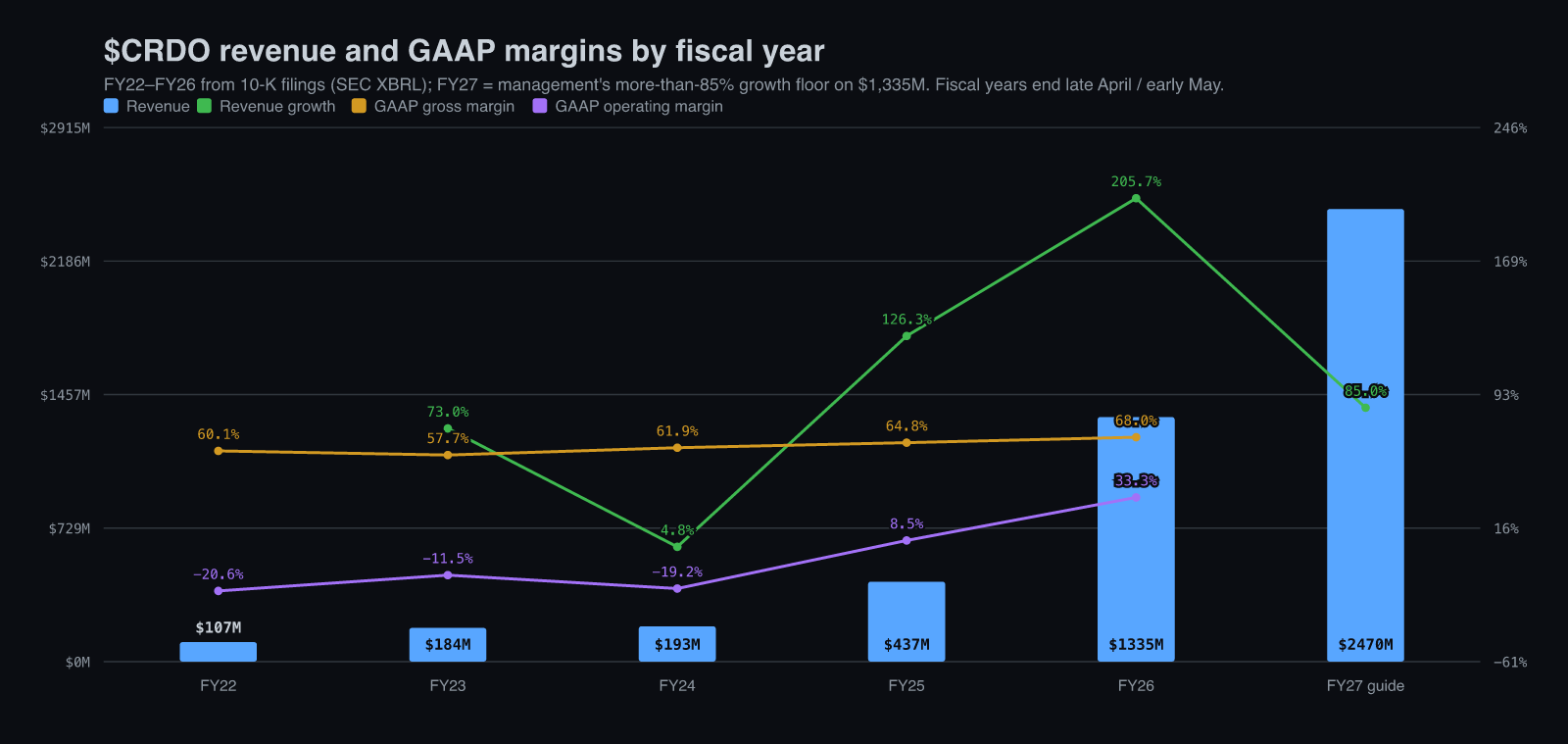
Revenue followed in steps rather than a line. Fiscal 2022 (years end in late April or early May) brought $106.5 million at a 60.1% GAAP gross margin; fiscal 2023 $184.2 million (+73.0%, 57.7%); fiscal 2024 stalled at $193.0 million (+4.8%, 61.9%); fiscal 2025 reached $436.8 million (+126.3%, 64.8%) and fiscal 2026 $1,335.1 million (+205.7%, 68.0%). GAAP operating margin went from −20.6% to −11.5%, −19.2%, 8.5% and 33.3% over the same five years, and net margin from −20.8% to 35.4%.
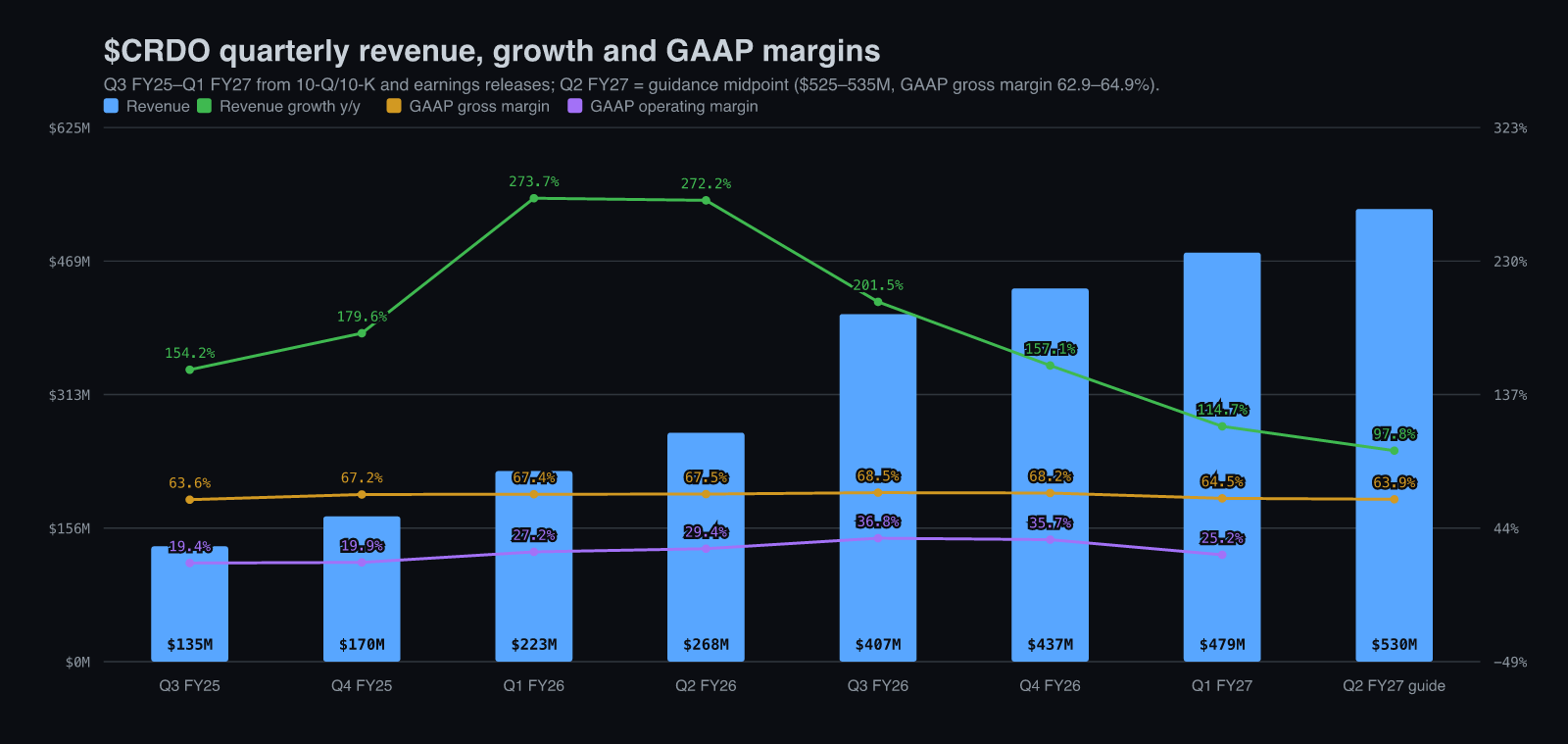
The quarters show the deceleration everyone is arguing about. Revenue was $135.0 million in Q3 FY25, then $170.0 million, $223.1 million, $268.0 million, $407.0 million, $437.0 million and $479.0 million in Q1 FY27, with $525–535 million guided for Q2. Year-on-year growth peaked at 273.7% in Q1 FY26 and has stepped down to 201.5%, 157.1% and 114.7%; the Q2 guide midpoint is +97.8%. GAAP gross margin ran 67.2–68.5% for five straight quarters and then dropped to 64.5% in Q1 FY27, and the company guides 62.9–64.9% for Q2. Almost all of that drop is purchase accounting: $11.0 million of DustPhotonics intangible amortisation and $5.7 million of stock compensation now sit in cost of sales, and non-GAAP gross margin held at 68.0%.
Credo reports one segment and does not split revenue by product, so the mix has to be read on the two axes it does disclose. By end customer, the largest took 33% of revenue in Q1 FY27, the next 28% of revenue, then 13% and 10%, so four companies took 84% of revenue together; in fiscal 2026 the largest three took 33%, 32% and 19%. By shipment destination, the United States took 53.3% of revenue in Q1 ($255.4 million) against 57.5% of revenue for fiscal 2026, Hong Kong fell to 19.0% from 28.3%, Malaysia appeared at 15.5%, and mainland China shrank to 0.2% from 6.1%. The geography moves with where contract manufacturers assemble racks, not with who owns them, so the end-customer table is the one that measures concentration.
The cash statement agrees with the income statement, which is less common in hypergrowth hardware than it should be. Fiscal 2026 operating cash flow was $464.3 million against $472.3 million of GAAP net income (98%), and free cash flow $407.0 million. Q1 FY27 was weaker by design: operating cash flow fell to $90.2 million from $182.2 million as receivables rose $54.5 million and inventory $61.5 million to $313.1 million, ahead of the second-half optical ramp. The gap between GAAP and adjusted profit is stock compensation, $88.0 million in Q1 alone and $97 million guided in Q2 operating expenses, which is why non-GAAP EPS was $1.20 and GAAP EPS $0.67. We treat it as a cost.
That is the backdrop: a company whose revenue rose twelvefold in four years on one product, now asking investors to believe the second product is as good.
Technology & Moat
Credo's advantage is that it builds the link end to end and qualifies it the way a customer will run it. Its SerDes is designed in-house and, by the company's description, delivered in cost- and power-effective form on mature nodes, and Bluebird, its first 200G-per-lane DSP, is built on 3nm. Around that circuit it has built seven generations of optical DSPs (Seagull at 50G per lane; Dove, Lark and Robin at 100G; Bluebird at 200G, introduced in September 2025), the Toucan, Screaming Eagle and Blue Heron retimers, and the ZeroFlap AEC families (Clos, Span, Shift and Switch, named for the network job each does) that run up to 7 metres with up to 50% less power than active optical cables and up to 75% less volume than passive copper. The 10-K quotes a 10-year service life for the Span cables that replace active optical cables between racks.
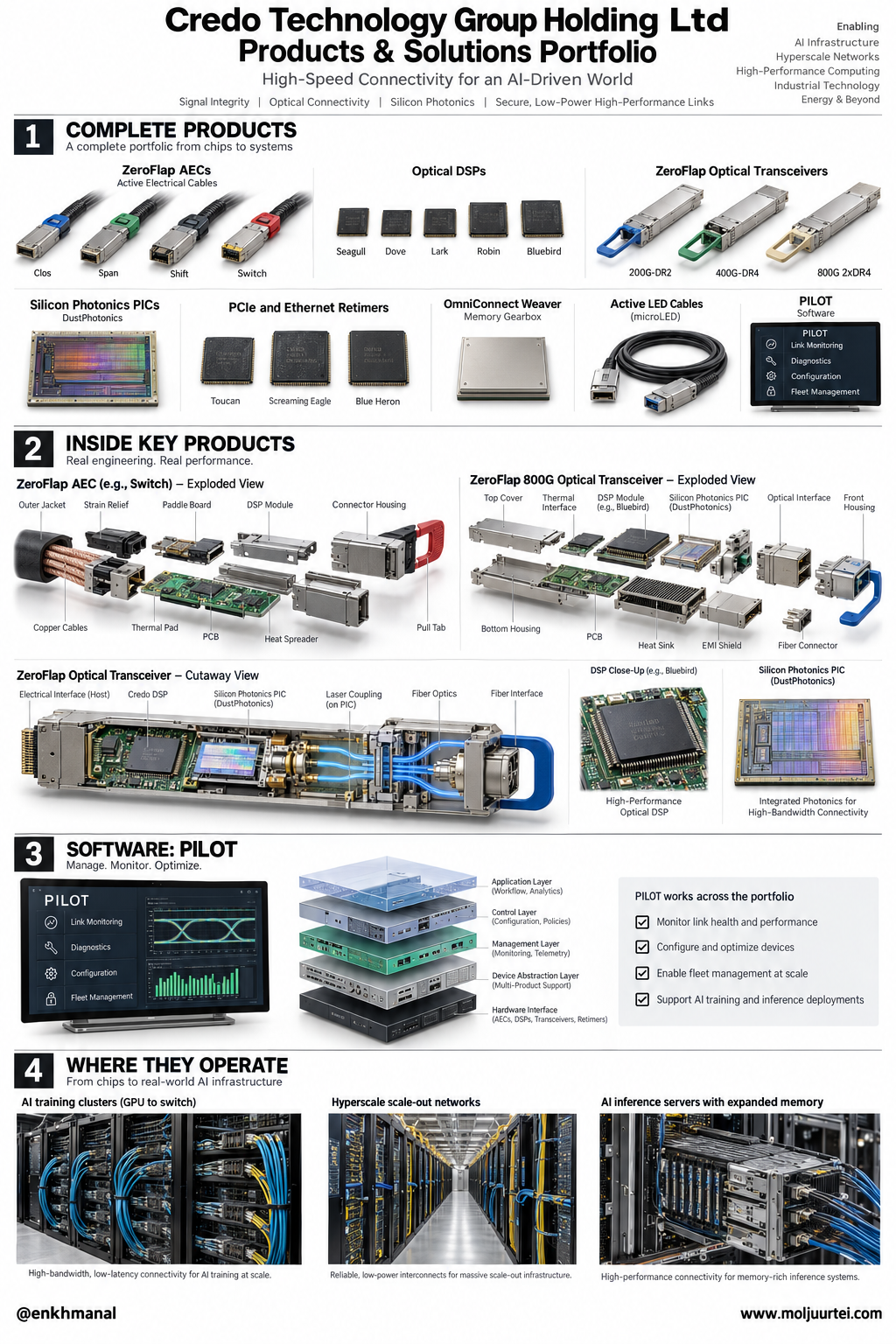
The part a competitor cannot copy quickly is the qualification habit. Brennan described it on the September call: Credo runs the customer's own switches and network cards at speed and hammers the entire link, not just its cable, then hardens weak points in firmware. That is how the AEC category was won, and the 10-K's ZeroFlap optical transceiver description lists the same tools for light: mission-mode link-quality monitoring, non-volatile event logging and in-band messaging that gives remote access to both ends of the link. PILOT, the software that reads those signals, went from evaluation on retimers in Q1 FY26 to availability across SerDes, retimers and AECs during the year.
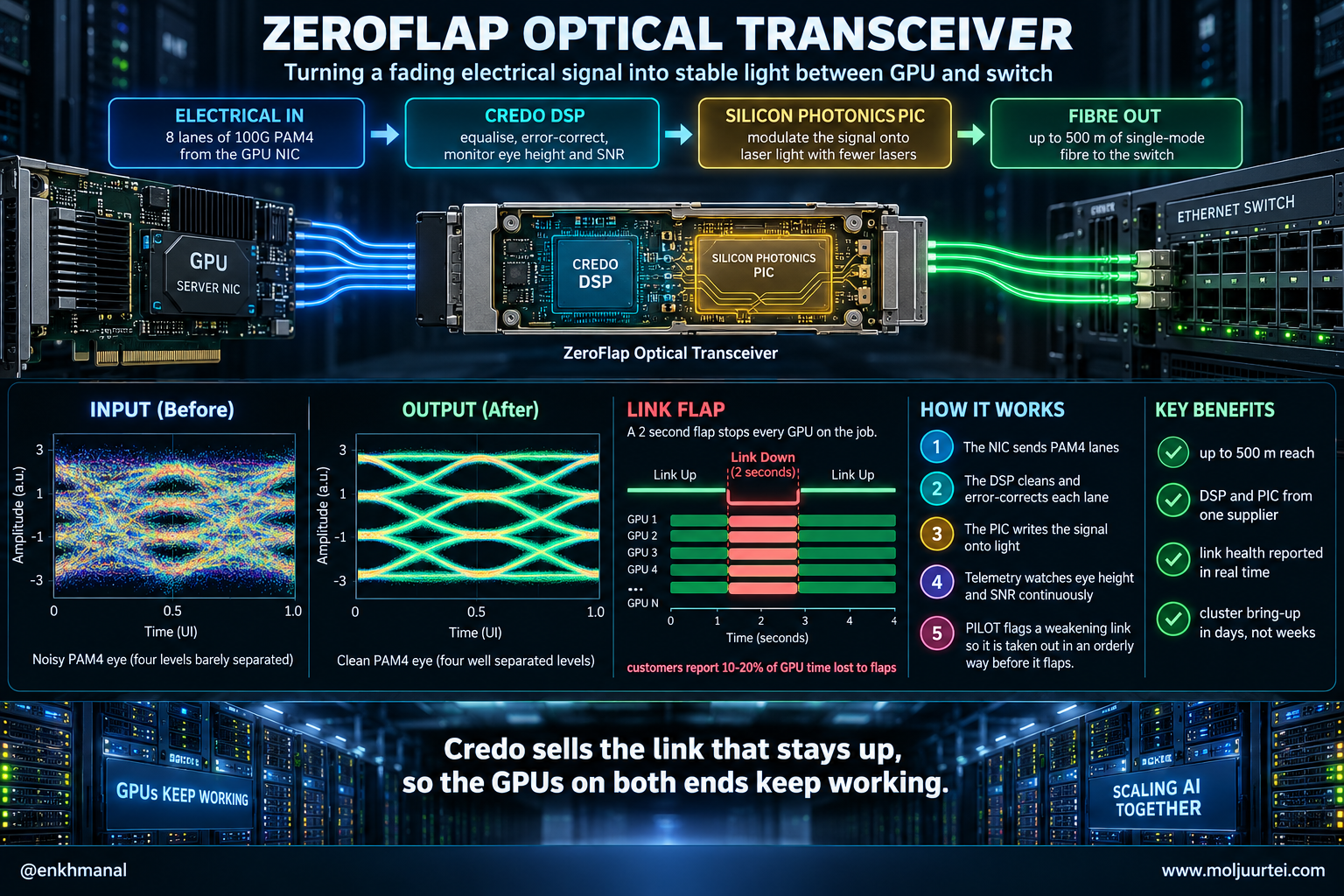
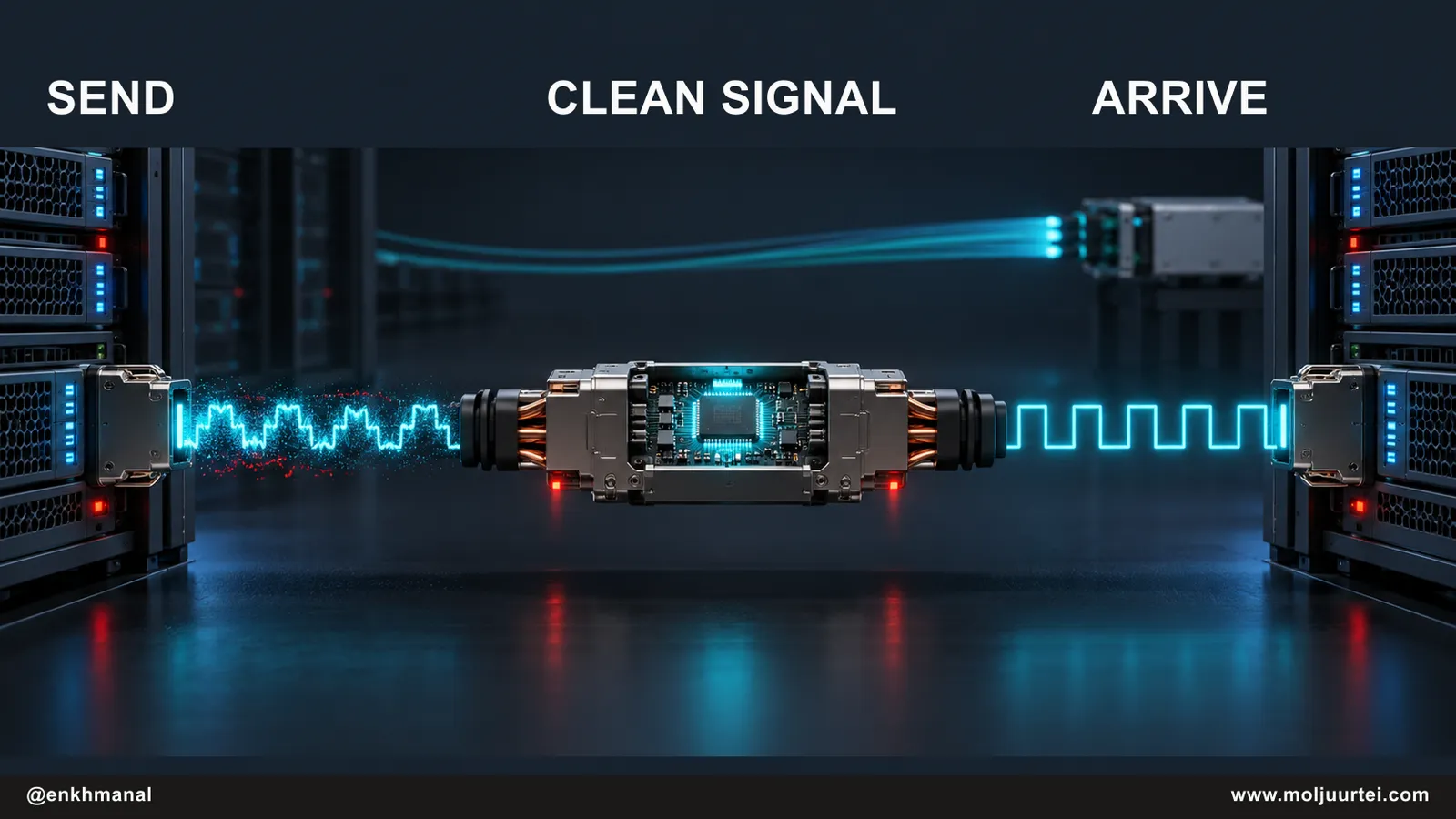
DustPhotonics is the piece that makes the optical version credible. A transceiver needs a DSP to clean the signal and a PIC to modulate light, and until May Credo bought PICs from others. It paid $1.25 billion in total consideration ($769.6 million in cash, $169.1 million in shares and $310.0 million of contingent earn-out) for a team whose silicon photonics design uses substantially fewer lasers per module, which management says improves reliability, power and cost and eases the industry's laser shortage. Brennan said the team won designs at "two major players" within months of the close, ramping in fiscal 2028 and possibly late fiscal 2027, and that those wins do not yet include Credo's DSP. That is the next lever: selling the pair.
We expect an advantage at a COGS level, but we also expect an advantage on an ASP level as we compare our solution to more standards-based solutions in the market.
The moat has limits we should state. Optical DSPs are a market where Broadcom and Marvell have deeper customer relationships, and Chinese module makers such as Innolight and Eoptolink build much of the volume. Credo's answer is to sell components where customers want components and complete modules where they want reliability, which is a narrower market than the whole of optics and a more profitable one if the feature premium holds.
Roadmap & R&D
Spending follows the roadmap. Non-GAAP operating expense is guided up about 55% this year (to roughly $420 million), raised from 50% in June, and GAAP research and development was $114.5 million in Q1 alone, 23.9% of revenue. The output arrives in three waves.
The first is fiscal 2027 optics: first 1.6T DSP revenue later this year, first SiPho PIC revenue already booked in Q1 on 800G and 1.6T transceivers, and ZeroFlap optical transceivers in production since shipments began to TensorWave, its first neocloud customer, by March, with more hyperscaler and neocloud ramps expected this year across 800G and 1.6T. 1.6T AECs reaching up to 6.5 metres contribute in the second half and "in a much bigger way" in fiscal 2028.
The second is fiscal 2028 scale-up. Credo joined the Open Compute Project multi-source agreement for co-packaged pluggable optics and says it has confirmed near-package optics design wins expected to ramp that year; it will lead with the PIC and may sell the whole optical engine later. Active LED Cables use microLED emitters, many slow lanes in parallel, to reach 30 metres with copper-like reliability. At the European Conference on Optical Communication in September, according to Funda AI's notes from the show, Credo's presentation put copper's practical limit at 72 GPUs and claimed ALCs can extend a GPU domain past 300 GPUs in one optical hop; first revenue is planned for fiscal 2028.
The third is memory. OmniConnect pairs a licensed short-reach SerDes on the accelerator with Weaver, a 5nm gearbox that moves low-power DRAM off the package. The 10-K claims 12 times the memory bandwidth and up to 40 times the density of a conventional on-substrate design. The first customer is Positron, and revenue is guided to begin in fiscal 2028. Brennan has called both ALCs and OmniConnect multi-billion-dollar annual opportunities; those are ambitions, not orders, and we treat them that way.
The board has put a number on the plan. The CEO's special performance award, granted 28 May, vests in six tranches that each need both a revenue hurdle ($2.5 billion up to $7.5 billion over any four quarters) and a stock price hurdle ($244.70 up to $489.40) by 30 June 2031, and the proxy calls $5 billion "the revenue goal under the Company's strategic plan".
The Setup — Why It's Mispriced
The market priced the September print as the end of the AEC surge, and it is reading the wrong number. The arithmetic of the guide says the business exits fiscal 2027 near a $3 billion annual run rate. More than 85% growth on $1,335.1 million is at least $2,470 million. Q1 delivered $479.0 million and Q2 is guided at $530 million at the midpoint, which requires roughly $1,461 million or more in the second half, about $730 million a quarter at the floor. If Q3 is $660 million and Q4 $800 million, the fourth quarter alone annualises to $3.2 billion, 30% above the fiscal 2027 total, before any sequential growth next year.
Three things explain the selloff, and none of them is a weaker business. The beat narrowed: revenue came in $4 million above the top of the range and gross margin landed exactly at the 68% midpoint, which the CFO noted himself. AEC growth is visibly slowing from tripling to something like doubling, and Brennan said plainly that optics will grow faster from a smaller base. And the optical number was held at more than $600 million rather than raised, which a market used to upward revisions read as a pause.
The peers say demand is not the constraint. $MRVL guided fiscal 2027 revenue up about 45% to roughly $12 billion on 27 August, with data centre growth raised to about 60% and its 1.6T DSP business "ramping rapidly". $LITE (Lumentum) reported June-quarter revenue up 109% to $1.01 billion and its non-GAAP gross margin crossed 50%. $SMTC (Semtech) said data centre revenue reached a record $100 million, up 91% year on year, on 800G and 1.6T CopperEdge. The supply side is where Credo has moved: refundable capacity deposits with assembly subcontractors reached $88.4 million at 1 August, and it committed another $102.4 million after the quarter closed.
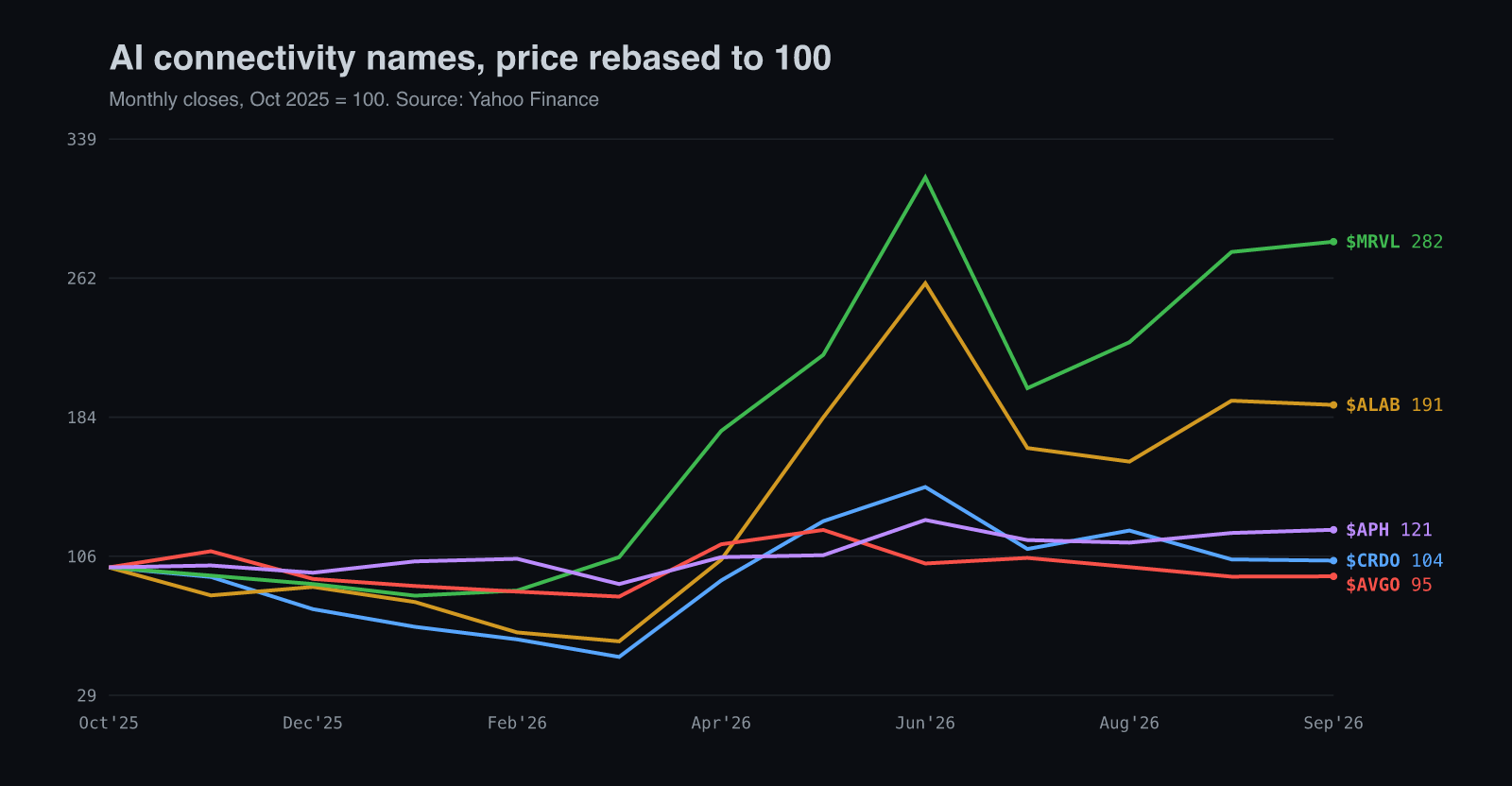
The result is a stock that is up 4% over twelve months while revenue roughly doubled, against +182% for Marvell and +91% for Astera Labs. The setup is the gap between a business that will exit the year near $3 billion of revenue and a price that, on our model, assumes only a modest climb from there.
Management & Track Record
The founders have run the company together for eighteen years, and the record is mostly one of building a category from nothing.
The record has two blemishes worth naming. Fiscal 2024 was flat at +4.8%, and in fiscal 2025 one contracting customer took 67% of revenue: that is what concentration looks like from the inside. And the co-founders have been selling: Form 4s show Job Lam sold about 311,000 shares (about $67 million) and Lawrence Cheng about 196,000 shares (about $39 million) between mid-July and late September, while Brennan sold 16,672 shares on 14 September. Lam still reports 2.5 million shares and Cheng 5.7 million, and the filings we read contain no open-market purchases. We read that as diversification by founders with very large stakes, not as a signal, but it is a fact a buyer should hold.
Brennan's own pay points the other way: his fiscal 2026 total compensation was $14.4 million, and the special award pays nothing unless revenue and the share price both rise a long way from here.
Risks & What Breaks It
What changes our mind: a Q3 guide (with the Q2 print around 1 December) below about $640 million, which would make the second-half arithmetic fail, or a quarter in which optical revenue is described as behind plan.
Price Setup — Levels, Technicals & Options
The stock is rebuilding after a 52% drop from its $308.67 high on 22 June to $149.14 on 14 September. At $194.79 it has reclaimed the 20-day average ($176.9) and sits on the 200-day ($176.5) but below the 50-day ($209.4) and 100-day ($219.3), with a 14-day RSI near 50. The trend has turned up from the low; it has not yet turned up on the averages that matter, and the 50-day is the level to watch.
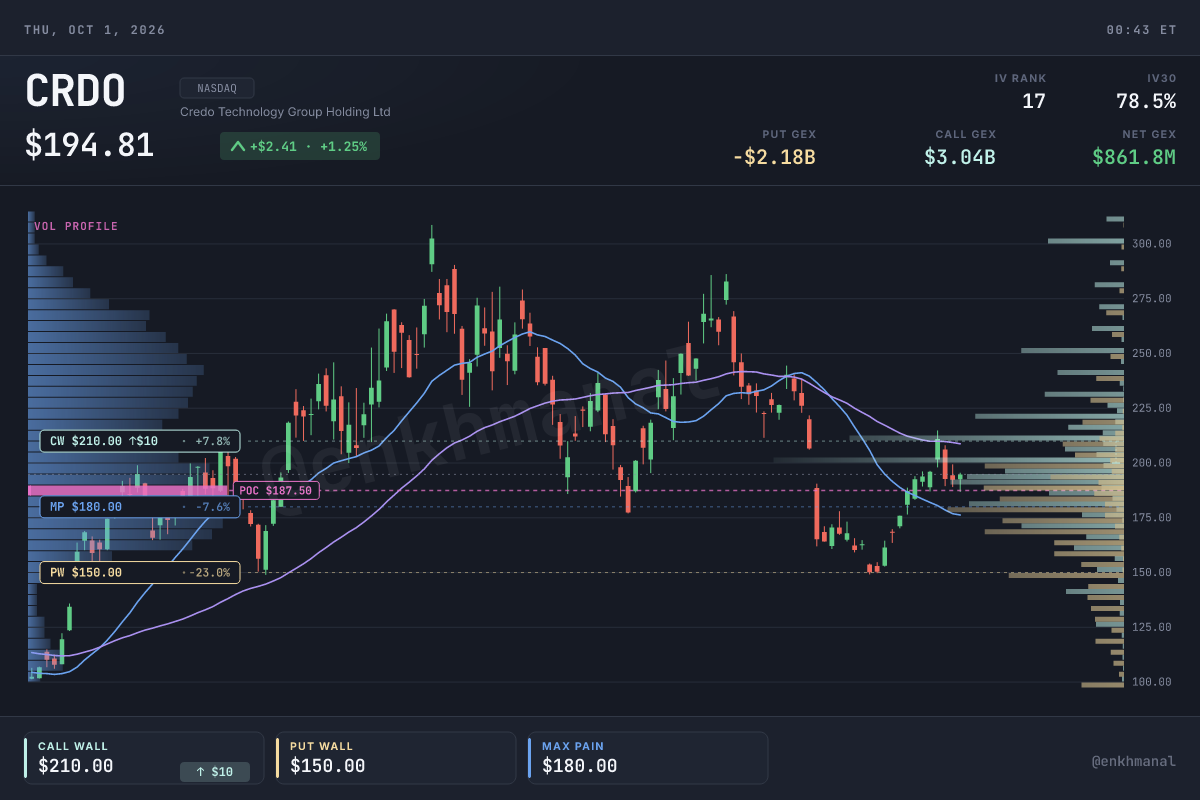
Options positioning is constructive and close to spot. Net dealer gamma is positive at about +$912 million across 17 expiries, with the gamma flip far below at about $49, so dealers dampen moves around the current price. The put wall is $150, the September low almost to the dollar; max pain is $180; the nearest call wall sits at $200–210, overlapping the 50-day average. Put/call open interest is 0.97. Implied volatility is about 78% for late October and 82% for the 18 December expiry that spans the next print, with an IV rank of 17, so options are not expensive relative to the stock’s own past year. The volume point of control from the last six months is $187.50.
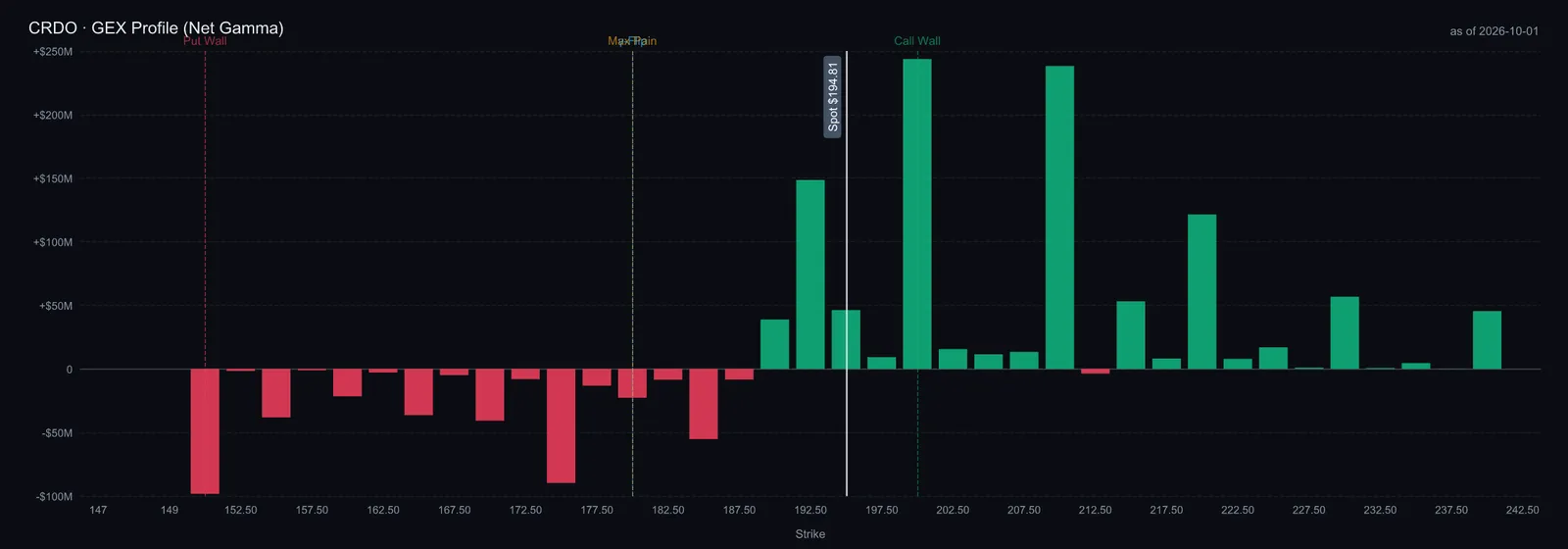
A close above the $210 call wall and the 50-day would say the market has stopped selling the September print. A break of $150 would say it has not.
Valuation & House View
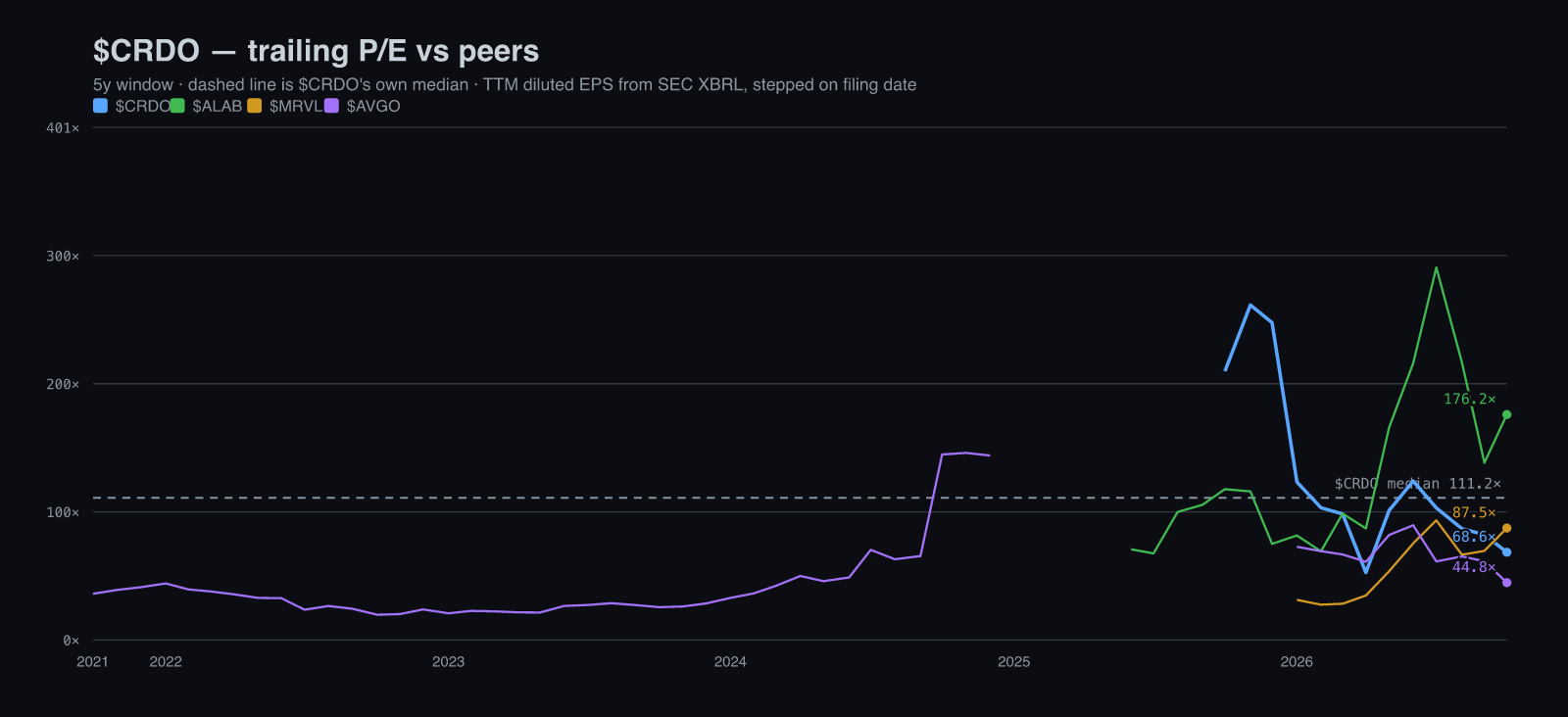
On trailing GAAP earnings $CRDO trades at 68.6 times, the 15th percentile of its own five-year range (median 111.2 times), against 176.2 times for Astera Labs, 87.5 times for Marvell and 44.8 times for Broadcom. On the fiscal 2027 guide it is about 31 times the roughly $6.20 of non-GAAP EPS that a 50% net margin on $2.47 billion and 200 million shares implies, and about 14.5 times enterprise value to sales. Those multiples tell us what is being paid; they do not rank it.
Our workbench model is a GAAP DCF: stock compensation charged as a cost, DustPhotonics amortisation in cost of sales, a ten-year horizon because guided growth is far above 10%, 85% growth in fiscal 2027 from the guide, then 35% in fiscal 2028 fading to 4% by fiscal 2036, a 64.5% GAAP gross margin, research and development falling from 20% to 15% of revenue, a 15% cash tax (Credo’s filed effective rate has been about 1–5%; we assume the 15% global minimum applies at this size), an 11.5% weighted cost of capital and 2.5% terminal growth. The base case is worth $115 on a perpetuity and $177 on a 16.3 times exit multiple. The two methods sit within 1.5 times of each other. The Audit shows no fails and one warning, which we keep on purpose: only one comparable (Amphenol, 16.3 times trailing EBITDA) passes the engine's comps screen, while the profitable connectivity chip names trade at 67 to 348 times trailing EBITDA, and capitalising a 4%-growth terminal year at those multiples would be a growth multiple on a mature year. Credo's own multiple on the guided year is 42.8 times.
The price is a statement about fiscal 2028. In our model $194.79 needs about 50% growth next year on the perpetuity method or about 38% on the exit method, against 30% from the fiscal 2027 exit rate alone with no further sequential growth. Management has promised "outsized growth again" in fiscal 2028 and has four new product lines scheduled to start shipping in it.
$CRDO is a business worth owning at this price for a buyer who believes the optical ramp: the exit-rate arithmetic covers most of what the stock already assumes, and the bull case ($281 on a perpetuity, $389 on the exit) is where 1.6T, near-package optics and ALCs land on time. We would hold a full position only after the Q2 print shows a Q3 guide of at least $650 million, and add on a close above the $210 call wall and the 50-day average; the $150 put wall is where the thesis is being questioned, not just the price.
(via Asymmetrical Bets, whose September pieces on Credo and on optical supply surfaced the idea; every figure here was independently verified against Credo's filings, releases and call transcripts.)