The CPU:GPU Ratio Deep Dive — $AMD · $INTC · $MU · $ARM · $ALAB · when agents turn tokens into work the socket count rises · $MU prints Sept
For three years the AI build was counted in GPUs, and the CPU beside them was a footnote at one socket per four to eight accelerators. Agents end that arithmetic: a token is no longer the product, it is an instruction, and the machine that carries it out is a CPU. $AMD raised its 2030 server-CPU market from $60 billion to $220 billion in nine months, Intel says it can supply half of the demand in front of it, Arm's data-center royalty has doubled for a second year running, and every one of those numbers was said by the company, not by us. Management describes the CPU:GPU unit ratio moving from 1:8 toward parity in new AI capacity. Separately, Intel describes four to six times the CPU requirement of a training data center; that demand multiple does not establish four to six CPUs per GPU. The question for the basket is not whether the shift is real but who gets paid for it at prices that have already run 150 to 220% this year.
Thesis
An agent is a user who never logs off, and every user needs a computer: the moment AI moved from answering questions to doing work, the demand for general-purpose CPU cores began growing faster than the demand for the accelerators that write the instructions, and the five listed companies that sell the socket, the memory beside it and the wires to it are guided to server-CPU growth the industry has not printed since the first cloud build. $AMD now expects the server-CPU market to compound above 50% a year to about $220 billion by 2030 and guides its own server revenue up more than 80% in the second half of 2026 and more than 70% in 2027; $INTC grew its data-center group 59% and cannot make enough Xeons; $ARM has shipped 500 million Neoverse cores in nine months after taking six years to ship the first billion; $MU is guiding a $50 billion quarter with 86% gross margin because every one of those sockets wants twelve to sixteen channels of DDR5; $ALAB sells the PCIe 6 and CXL silicon that sits between the CPU and everything else.
What changed technically: a chatbot spends its compute on the GPU and hands the CPU a paragraph to display; an agent spends its tokens on instructions, and the CPU runs the browser, the compiler, the database query and the sandbox those instructions need. Georgia Tech and Intel measured it: in a retrieval agent 81 to 89% of end-to-end latency is CPU-side tool work, and the CPU's share of dynamic energy reaches 61% (arXiv 2511.00739). Meta's Muse gives every user "your own dedicated computer in the cloud", an isolated Linux virtual machine with a browser (Meta AI Research, Sept 8).
The cleanest expression: $AMD, because its server business is guided at the growth rate of the theme itself, its 256-core Venice is the part built for the sandbox tier, and its CPU revenue is not bundled inside anyone else's rack. $MU is the cheapest way in, at eight times the earnings it has just guided. $INTC owns the fabs when supply, not architecture, decides share.
Why now: the industry has repriced the CPU three times this year. $AMD's 2030 TAM went $60 billion (November) to $120 billion (May) to $220 billion (August); Intel's CFO went from "1:8 moving to 1:4" in April to "almost in parity" in July; Arm's CEO said in May that "we probably have undercalled the CPU demand". Server-CPU prices rose 10 to 20% between March and April and lead times run six months (Tom's Hardware).
The one risk that matters: wafers. Ben Bajarin's reply to the 40:1 crowd was that "we don't have the wafers and won't for a long time" (Sept 20), and a demand curve that cannot be supplied is a price curve for the incumbents and a dilution curve for the one that builds fabs. $INTC sold $20 billion of stock at $95 in August to fund exactly that.
Backdrop — How the Theme Got Here
Start here. A computer is a machine that follows a list of instructions one after another, and the part that follows them is the CPU: a few dozen to a few hundred cores, each one good at doing the next unpredictable thing quickly. A GPU is a different machine that does one predictable thing to thousands of numbers at once, which is what multiplying the matrices inside a neural network needs, and so a modern AI model is trained and run on GPUs. A token is the unit of text a model produces, a word or part of a word, and a chatbot's whole job ends when the token reaches the screen. An agent is a model that is given a goal and tools instead of a question: it writes code, runs it, reads the result, searches the web, opens a document, calls another program, and keeps going until the job is done. A sandbox is the walled-off computer the agent does that work in, so its mistakes cannot reach anyone else's data, and it is a CPU with memory and a disk, not a GPU. The CPU:GPU ratio is just the count of one machine against the other in a data hall, and everything below is about why that count is rising and who sells the machines.
The ratio was set by the first thing generative AI was used for. A chatbot request arrives, the GPU does prefill and decode, the CPU packages the answer and sends it back, and the CPU is idle most of the time. Build a hall for that and one host CPU per four or eight GPUs is generous. Intel's CFO described the industry exactly that way as late as April: "one CPU is needed for every four to eight GPUs in an AI server" (Tom's Hardware, April 24). Microsoft's Fairwater campus in Atlanta, designed in the training era, pairs a roughly 300 MW GPU building with a separate 48 MW CPU and storage building, about one watt of CPU for every six of GPU (SemiAnalysis). That is the before picture.
Two things then happened in the space of a year. Reasoning models started spending many tokens per answer, and agents started spending those tokens on actions. OpenAI's coding agents, Anthropic's Claude Code, Meta's Muse and the fleets inside every enterprise turned the model into a worker that compiles, tests, browses and retries, and each of those steps runs on a CPU that has to be there, warm, with its own memory and disk, for as long as the task lasts. The Georgia Tech and Intel study that everyone in the industry now cites put numbers on it across five agent types: in the retrieval agent the nearest-neighbour search on the CPU consumed 81 to 89% of total latency, in the chemistry agent conformer generation took 85 to 88%, and moving to a faster GPU made the system more CPU-bound, not less (arXiv 2511.00739). The GPU had become the fast part.
The repricing followed within two quarters. $AMD had told its analyst day in November 2025 that server CPUs would grow about 18% a year to roughly $60 billion by 2030; on May 5 it raised that to more than 35% and $120 billion (Q1 call), and on August 4 to more than 50% and about $220 billion (Q2 call). Intel reported the strongest year-over-year server growth in its history in the June quarter, said unmet demand "starts with a B", and by September 20 its CEO was telling a conference audience that "CPU demand is so high that we can only supply 50% of customers" (Calcalist). Arm's CEO, asked in May whether his own 4× estimate of CPU capacity per gigawatt was too high, answered that "we probably have undercalled the CPU demand in terms of the transition here." The stocks moved with the numbers: at the September 18 close $INTC was up 176% for the year, $AMD 151%, $MU 222%, $ARM 140%, $ALAB 69%, against 11% for the S&P 500.
The size of the prize is now an argument between forecasters rather than a question. $AMD's $220 billion is the highest published figure; Arm said $100 billion in March and allowed that $120 billion was plausible; The Information Network's Robert Castellano models AI-specific CPU revenue alone rising from $38 billion in 2026 to $155 billion in 2030, a 42% compound rate against 29% for accelerators (Castellano, Sept 21); Morgan Stanley in April said agents could add $60 billion to the data-center CPU market (Tom's Hardware). Nobody's number is below the $60 billion the same industry believed in November. We will take the low end of the range as the working assumption and say so again in Valuation.
Mechanism — Why Now & How It Works
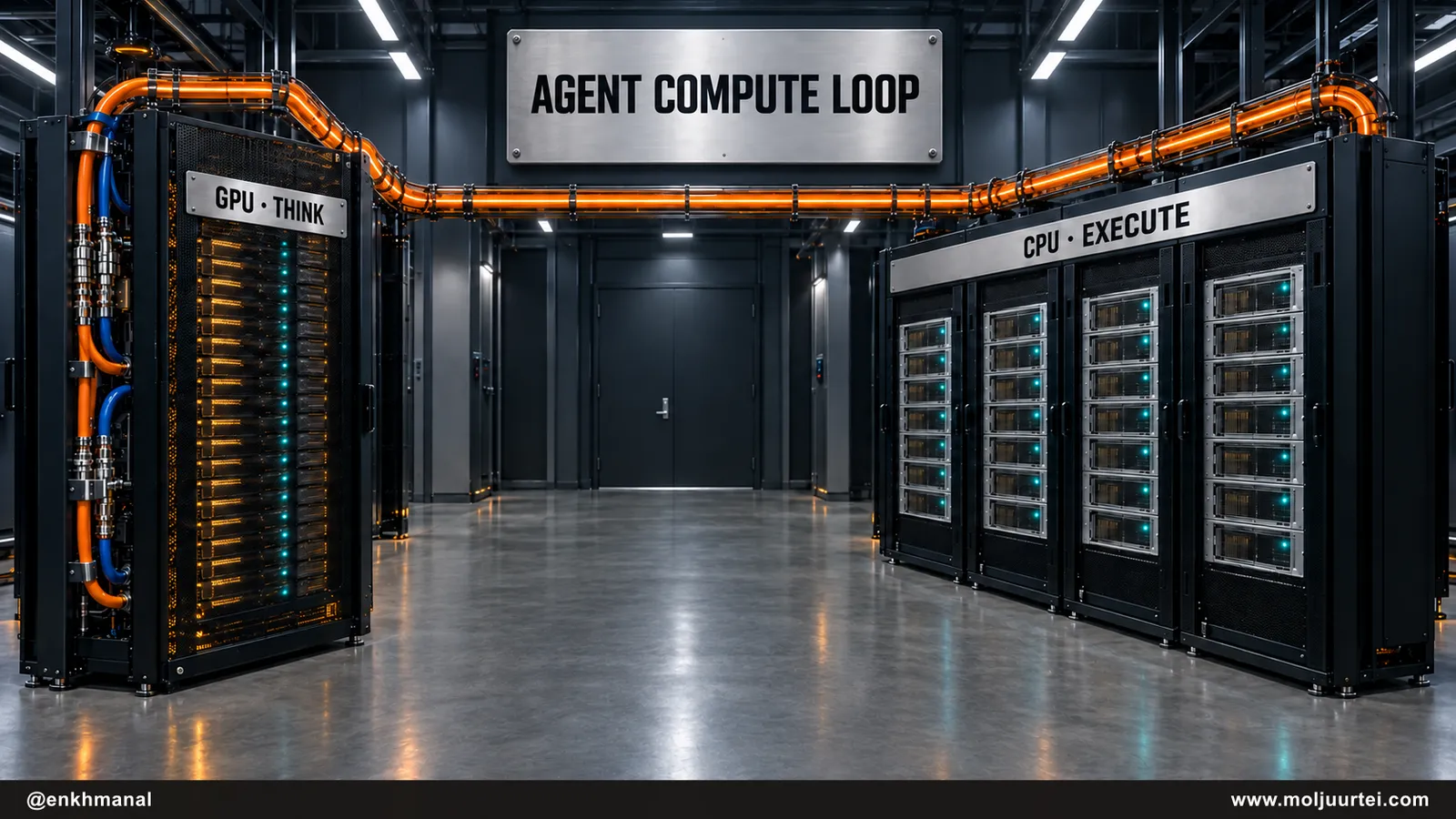
The loop is the mechanism. A GPU produces tokens; the tokens say "run this"; a CPU runs it; the result goes back to the GPU as the next prompt. $AMD's Madhu Rangarajan, who spent 26 years building servers at Dell, Intel and Ampere before running EPYC, drew it in August: gateway, orchestration, retrieval, reasoning, tool use, verification, "and then you loop around until the verification model says, yeah, that's satisfactory" (Chipstrat). Every step in that sentence except reasoning is a CPU step. The consequence he stated plainly: "CPU to GPU has reached about one to one" and every gain in GPU token output creates more tool calls and more sandbox runs that land on CPUs. Cheaper tokens do not shrink the CPU bill; they multiply the loops.
Three different machines are being bought for that loop, and the distinction matters for who gets paid. The first is the host node, the CPU inside the GPU server that keeps the accelerators fed: a few high-frequency cores, a lot of memory bandwidth, one or two per eight GPUs, and in NVIDIA's own racks it is NVIDIA's own Arm-based Grace or Vera. The second is the general-purpose fleet, the web servers, databases and caches that agents now call instead of humans; $AMD's enterprise server sales grew more than 70% last quarter, a rate Matt Ramsay said the enterprise server market had "basically" never seen, because agents are querying the same ERP and customer-relationship systems a thousand times faster than the people who used to. The third is new: the sandbox tier, standalone racks of high-core-count CPUs where each agent gets its own isolated machine. Meta's Muse launch made it concrete: "You and your Muse share your own dedicated computer in the cloud," an isolated Linux box with a Chromium browser and enough CPU, memory and storage to compile code and run sub-agents (Meta). Lisa Su called this tier "the smallest piece today" and "the largest piece of the TAM" by 2030 (Q2 call).
Management's estimates use different denominators and must be kept separate. Intel's Zinsner in July: "we now believe we're almost in parity at this point and could eventually even skew more to CPUs on a unit basis" (Q2 call); in August he put the CPU requirement of an agentic data center at "four to six" times that of a training one (Deutsche Bank). Arm's Rene Haas used cores per gigawatt: 30 million in an inference hall, "at least 120 million cores per gigawatt" for agents (Next Platform). TrendForce's April note discusses the 1:4-to-1:1 framing (TrendForce). Unit ratios, CPU demand relative to training facilities, and cores per gigawatt are three different measures. Bajarin's "4:1 maybe" is a unit-ratio conjecture, not another expression of Zinsner's demand multiple. These observations support rising CPU intensity, but do not establish a universal four-to-six-CPUs-per-GPU sandbox design.
What has to stay true is that the CPU work cannot be moved somewhere cheaper. Two substitutes exist and we take both seriously in Risks. Agents can run on the user's own device, which Rangarajan says is where most of them run today, "on laptops, on-prem boxes, or general-purpose scale-out"; and idle sandboxes can be suspended so a waiting agent stops paying for a core, which is the product Sail Research is building and which its CEO expects to push the mix "to 90/10 in favor of background" (Software Synthesis). Neither reverses the direction. A suspended sandbox still needs a core when it wakes, and a laptop is a CPU too; the substitution is between which CPU gets bought, not whether. What consensus has not priced is the second-order effect on memory: a 256-core socket wants twelve to sixteen channels of DDR5 and a Vera rack carries 400 TB of LPDDR5X, so the socket count pulls the DRAM bill with it at exactly the moment HBM has already sold out the fabs. That is why we put $MU in a CPU basket.
Basket & Positioning
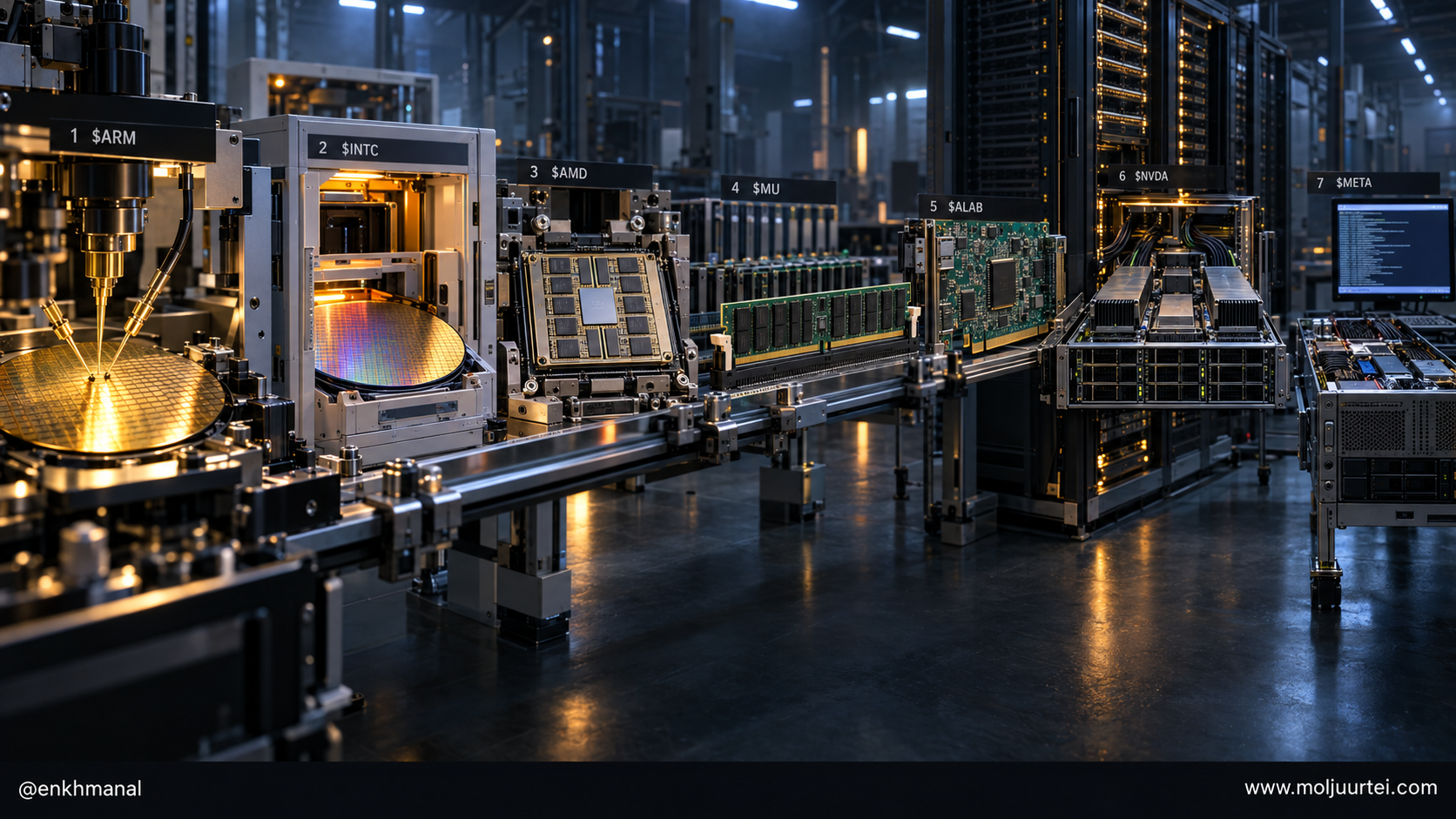
The researched universe is eight names at five stations of the chain, and the first cut is the honest one: which of them actually books a dollar when a CPU socket is added for an agent, and which is a call option on the theme inside a different business. Two of the eight are merchant x86 socket makers who bill per socket ($AMD, $INTC). One licenses the architecture inside every hyperscaler's own chip and has started selling a chip of its own ($ARM). One sells the DRAM that every socket carries ($MU). One sells the PCIe and CXL silicon between the socket and the accelerator ($ALAB). One is the bundled incumbent that ships the head-node CPU inside its own rack and now sells it standalone ($NVDA). Two are challengers with no CPU revenue yet, Qualcomm's Dragonfly C1000 and the system houses that assemble Vera and Venice racks, of which Dell is the largest; we compare them and leave them out of the return screen because the theme's dollars cannot be isolated in either.
Prices and moving averages are the September 18 close from the app's technicals snapshot; growth figures are each company's latest reported quarter. The ranking axis is the house one: a real business with a durable tailwind first, growth second, trend third, and the multiple as context rather than tiebreak. On that axis $AMD leads because its server line is guided at the theme's own growth rate and the price sits above a rising 50-day; $MU is second because it is the only name in the group whose earnings have already caught up with its price; $INTC is third because it owns the constraint everyone else is describing, at the cost of a $20 billion equity raise and a foundry that still loses money. $ARM is the widest gap between story and print: the royalty line that carries the theme is doubling, the company is growing 22%, and the stock trades at 52 times the revenue it has just guided. $ALAB is the only member trading under its 50-day and the only one whose CPU-ratio exposure we cannot yet quantify.
The same-role tests are what keep this from being a screen. Inside the x86 socket, $INTC and $AMD are selling into the same shortage, and the difference is that $AMD gained x86 server share year-over-year while Intel says share "is going to be a function of how well everyone can do in terms of getting that supply" (Deutsche Bank); one is winning on the part, the other on the fab. Inside the Arm architecture, $ARM collects a royalty on every Graviton, Axion, Cobalt and Vera but the socket itself is captive, so the merchant dollar goes to the hyperscaler or to $NVDA, which is why Arm decided to sell a chip. Between the merchant socket and the bundled one, $AMD's own benchmarks claim a 96-core Venice is 20% faster per core than Vera and the 256-core part 2.24× faster in SPECrate integer throughput, with the caveat that $AMD compiled on a newer compiler release than the one behind NVIDIA's published figures (Tom's Hardware); NVIDIA answers that Vera completes agentic tasks 1.8× faster and offers five times the bandwidth per watt (Q2 FY27 call). Both can be true of different workloads, and the buyer's decision is rarely the benchmark: AWS is deploying Vera "some integrated with Rubin, others standalone" while also ordering "tens of millions of Graviton5 cores" for agents, and a deal like that is decided by who is already in the rack.
The Buys — $AMD, the Merchant Socket
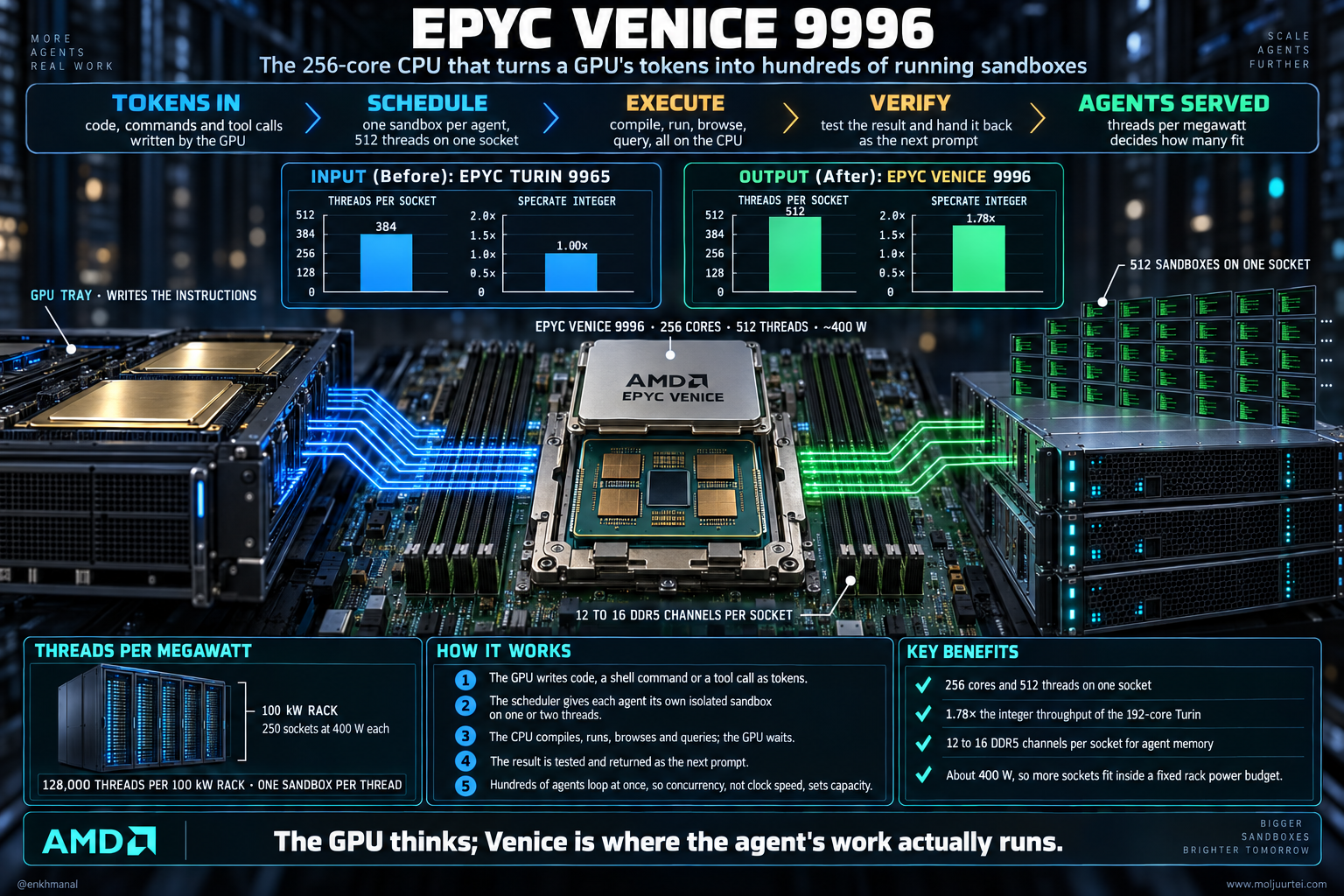
$AMD is the purest merchant expression of the theme and the one whose guidance is written in the theme's own units. The June quarter was the fifth consecutive record for server CPUs, with cloud and enterprise each up more than 70%, data-center revenue of $6.7 billion up 107%, and total revenue of $11.5 billion up 50% (Q2 call). The guide is the thesis in numbers: server revenue up more than 80% year-over-year in the second half of 2026, more than 70% in 2027 "off a much higher base", the whole data-center segment more than doubling in 2027, and a third-quarter revenue guide of $13.0 billion at a 56% gross margin. Lisa Su's answer on where the growth comes from was the sandbox tier, "the smallest piece today" and the largest by 2030, and the product for it is Venice: 256 Zen 6 cores on TSMC's 2 nm, 512 threads, roughly 400 W, which Rangarajan frames as "maximizes threads per megawatt" because when power is the constraint, threads are the number that decides how many agents fit (Chipstrat). Matt Ramsay did the arithmetic out loud at Goldman: more than half of a $220 billion market is "a $100 billion server business" (Goldman, Sept 11); $AMD's entire revenue in 2025 was $34.6 billion.
The annual series says what the quarterly one confirms: gross margin has held at 49 to 54% through a cycle that took revenue from $9.8 billion to a $46 billion run-rate, and operating margin, 10.7% for 2025 on a GAAP basis, is back at 17% as the data center becomes 58% of the company. Cash follows profit at $AMD in a way it does not at every name we cover: $2.37 billion of operating cash flow against $2.30 billion of GAAP net income in the June quarter, with $8.5 billion of inventory built deliberately ahead of the Venice and MI450 ramps and $13.1 billion of cash on hand. The mix is the finding: data center was 57% of total revenue in the March quarter and 58% of revenue in June, against 42% a year earlier, and management says the segment doubles again next year. What the print does not separate is server CPU dollars from GPU dollars, which is why we label $AMD's theme evidence a proxy, a strong one, rather than a paid line.
$MU — the Memory Every Socket Carries
$MU is in the basket because the socket count pulls the DRAM bill with it, and it is the cheapest earnings in the group by a wide margin. Micron's fiscal third quarter, reported June 24, was $41.5 billion of revenue, up 74% sequentially and 346% year-over-year, at an 84.9% gross margin and $25.11 of earnings per share; data-center revenue exceeded $25 billion in the quarter, more than $100 billion annualised (Q3 FY26 call). The guide for the quarter it reports on September 30 is $50 billion, plus or minus a billion, at about 86% gross margin and $31 of EPS on 1.15 billion shares (Micron IR). Sixteen strategic customer agreements carry roughly $100 billion of remaining performance obligations, about 40% of revenue is under take-or-pay contracts backed by $22 billion of customer deposits, and management expects "tight conditions to persist beyond calendar 2027". The CPU link is direct rather than thematic: a Venice or Diamond Rapids socket has twelve to sixteen DDR5 channels, a Vera rack carries 400 TB of LPDDR5X in SOCAMM modules, and Intel's CFO named memory as the companion constraint on its own supply. What Micron does not disclose is how much of its DRAM goes beside a CPU rather than into HBM beside a GPU, so the theme's dollars are a proxy here, and the reason to own it is that the print has already paid for the price.
The FY23 column is the risk section written in advance: this is a business whose gross margin went from 45% to minus 9% in one year the last time supply caught demand. The difference this cycle is contractual. Take-or-pay agreements with deposits did not exist in 2022; a $100 billion RPO did not exist; and the quarterly cash line is now the size of a prior full year, $25.4 billion of operating cash flow in the May quarter against $28.2 billion of GAAP net income, with $7.8 billion of capex and $24.4 billion of net cash. We rank it second rather than first only because the CPU is a fraction of the story rather than the story.
$INTC — the Owner of the Constraint
$INTC owns the thing everyone we cover is short of, and the market has already paid for that once. The June quarter was $16.1 billion of revenue, up 25% and $1.8 billion above the guide midpoint, a 41.8% non-GAAP gross margin and $0.42 of non-GAAP EPS against a $0.20 guide; the data center and AI group did $6.3 billion, up 24% sequentially and 59% year-over-year, with $2.5 billion of operating profit at a 40% margin, and Xeon 6 is "one of the fastest ramping products in Intel history" (Q2 call). The GAAP line shows a net loss of $11.0 billion for the same quarter, a non-cash valuation loss on shares held in escrow, the accounting shadow of Intel's own share price rising (earnings release); operating cash flow was $7.0 billion. The supply story is the investment case: Zinsner said Intel will under-supply this year and "probably next", that share "is going to be a function of how well everyone can do in terms of getting that supply", that ASP per core has stopped falling and in places is rising, and that Ireland's Intel 3 output, where Granite Rapids is made, will more than double next year (Deutsche Bank). To pay for it Intel raised 2026 capex above $20 billion, guided 2027 "significantly above" that, and sold 210.5 million shares at $95 in August, $20 billion upsized from $15 billion (Intel newsroom).
Six years of shrinking revenue and a gross margin that fell from 56% to 33% is the arc, and the quarters are where it turned: revenue of $13.65, $13.67 and $13.58 billion in the September, December and March quarters and then $16.13 billion in June, GAAP gross margin 38.2%, 36.1%, 39.4% and 40.4% across the same four, and the data-center group going from 38% of the company to 39% while growing 59%; operating cash flow was $7.0 billion in June against $1.1 billion in March. Zinsner's own framing is that gross margin is now "comfortably in the 40s" and the goal is "something that starts with a five" (Deutsche Bank). The client business is the counterweight: client unit volumes are guided down low double digits for 2026 as memory prices destroy demand, and Intel is deliberately starving client of wafers to feed servers, "the best thing we could have, given the data center demand". We put it third because the equity raise and the foundry losses mean a dollar of CPU demand earns Intel less per share than it earns $AMD, and because the stock has already done the round trip once this year, from $142 on June 30 to $85 in August and back to $109.
The Watches — $ARM and $ALAB
$ARM collects on every Arm-based CPU in the hall, which is now most of them, and the market has priced that twice over. IDC's first-quarter count put Arm-based accelerated servers at $53 billion of spending against $34.6 billion for x86, the first quarter Arm has led (IDC); Rene Haas' own tally is that Arm holds about 50% of CPU share at the top hyperscalers, with the joke that "$AMD has 50, Intel has 50, and we have 50, so you add up to some crazy number." The royalty line carrying the theme is real and doubling: data-center royalty revenue more than doubled year-over-year for a second consecutive year, Neoverse shipments passed 1.5 billion cores with the last 500 million in nine months, and the customer list is Graviton5, Axion as the host for Google's TPU 8t and 8i, Cobalt 200, Grace and Vera (Q1 FY27 call). But the whole company grew 22% to $1.29 billion in the June quarter and guides 22% for September, because a royalty is a few dollars per socket and the rest of Arm is phones; revenue went $3.23 billion, $4.01 billion and $4.92 billion across fiscal 2024 to 2026 at a gross margin of 95 to 97.5%, with GAAP operating margin swinging from 3% to 21% to 18% as the company spends on the chip. The new leg is the Arm AGI CPU, 136 Neoverse V3 cores on TSMC N3 at 300 W, sold as finished silicon for the first time in the company's history: Meta is the lead customer, OpenAI and Cloudflare follow, demand is "more than $2 billion" across fiscal 2027 and 2028 against $1 billion of secured supply, and the stated ambition is $15 billion of revenue by fiscal 2031 (Next Platform). The catch is in the margin: the CFO guides the first-generation chip to a high-30s to low-40s gross margin against a 97.5% corporate figure, so every dollar of AGI CPU revenue arrives with half the profit of a royalty dollar. We rank it a watch: the theme's tailwind is undeniable, the growth is the slowest in the group, and the price is 52 times the revenue it has guided.
$ALAB is the wire between the CPU and everything else, and we cannot yet show that the ratio pays it. The business itself is the fastest grower in the group: $392.4 million of revenue in the June quarter, up 104% year-over-year and 27% sequentially, PCIe 6 products more than half of revenue, Scorpio fabric switches becoming the largest line in the third quarter, and a guide of $540 to $560 million for September, up 40% sequentially at a 72% gross margin and a 43% operating margin on 185 million diluted shares (Q2 call). The connection to this theme runs two ways. Every additional host CPU per accelerator is another PCIe 6 link that needs an Aries retimer, and management says Aries is "the gold standard across major XPU and CPU platforms". And the memory pressure the socket count creates is what revived CXL: Sanjay Gajendra said the industry is "recognizing its potential to unlock performance and utilization benefits in agentic AI applications", Astera closed a Leo memory-controller design win at a US hyperscaler in the quarter, and volume ships in 2027. Neither is a disclosed dollar. Astera's revenue is overwhelmingly a function of GPU cluster size, the stock is the only one of the five under its 50-day, and Grok's read of the last ten days on X found no post connecting the name to the CPU ratio at all. It stays a watch until a CPU-attached line shows up in the numbers.
Peers — $NVDA and the Custom-Silicon Challengers
Inside an NVIDIA rack the CPU is NVIDIA's, and that is the fact that keeps the x86 names out of the largest single buyer of head nodes. A GB200 or Vera Rubin NVL72 carries 36 Grace or Vera CPUs against 72 GPUs, one per two, and none of them is a merchant socket; IDC's finding that Arm-based accelerated servers overtook x86 in the first quarter is mostly a count of those racks (IDC). Grace has become a business in its own right, with more than $5 billion of trailing-twelve-month revenue and, in Ian Buck's words, "hundreds of thousands of Grace standalone servers" shipped (Tom's Hardware); Vera, 88 custom Olympus cores on a single monolithic die with 3.4 TB/s of on-chip fabric and 1.2 TB/s of LPDDR5X bandwidth, is in full production, sold standalone, and NVIDIA sizes its CPU opportunity at $200 billion (Q2 FY27 call). Colette Kress' framing is the one that matters for the basket: the revenue per gigawatt NVIDIA addresses has gone from $18 billion with Hopper to $25 billion with Blackwell to $40 billion with Vera Rubin because the platform "now spans Vera CPU, Rubin GPU, NVLink" and the rest. The CPU dollar inside that $40 billion goes to $NVDA and, as a royalty, to $ARM. We exclude NVIDIA from the basket not because it is losing this theme but because it is 5% of the reason to own the stock, and the other 95% is a different piece of work.
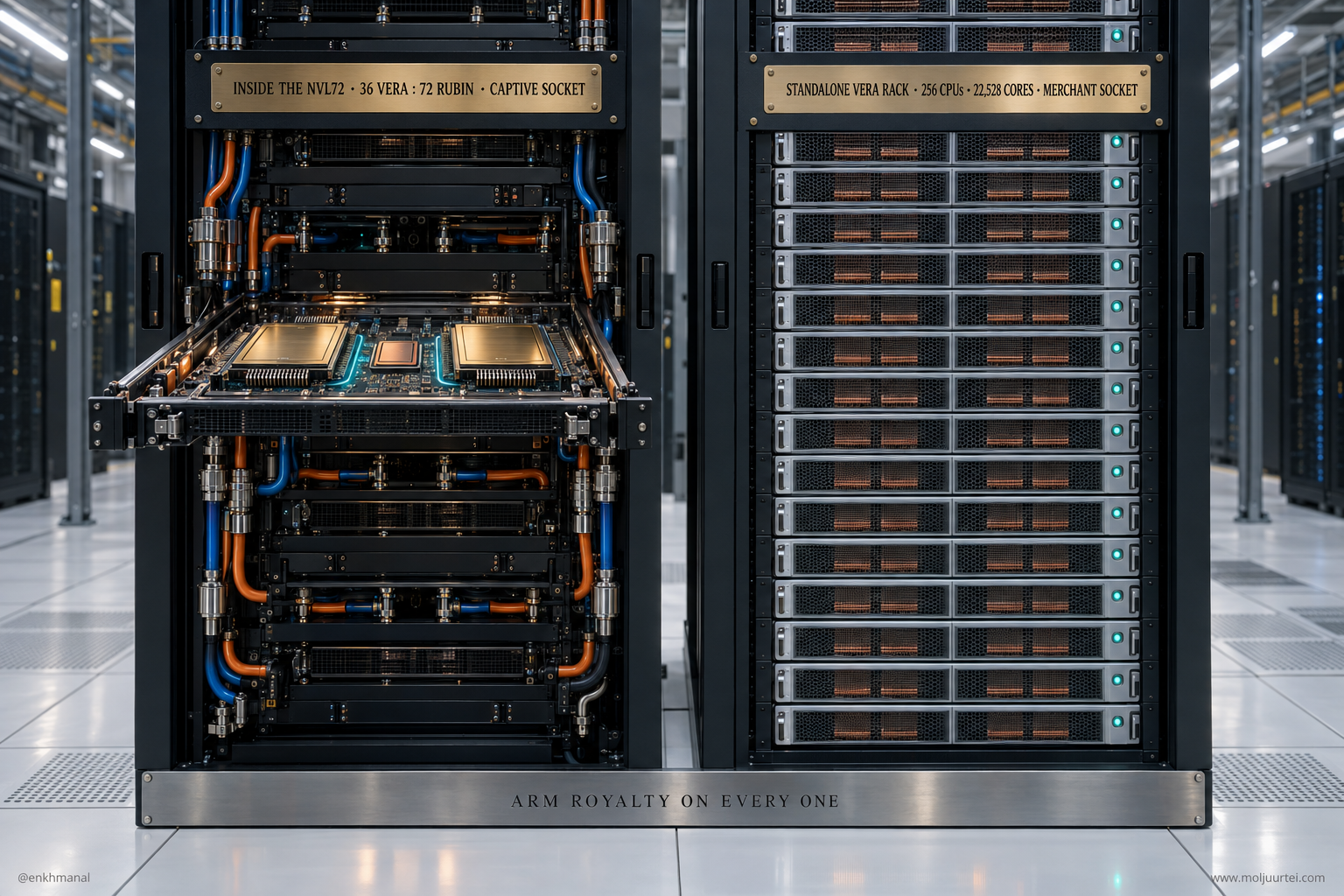
The challengers are the hyperscalers' own chips and two newcomers. AWS is ordering "tens of millions of Graviton5 cores to power agentic AI workloads", Google has made Axion the host CPU for its latest TPU systems in place of x86, and Microsoft has expanded Cobalt 200; each of those is a socket that Intel and $AMD do not sell and Arm gets a royalty on (Q1 FY27 call). Qualcomm announced the Arm-based Dragonfly C1000 for the data center with no shipping date and no revenue, and we leave $QCOM out of the screen until either exists. The system houses are the other route into the theme: Dell, $HPE, Lenovo and Supermicro are all building standalone Vera CPU systems (Castellano), $DELL has risen 344% this year on AI servers, and none of them separates a CPU rack from a GPU rack in its disclosure, so we cannot underwrite the theme through them. The budget test is the one that matters: when a hyperscaler builds its own CPU, the merchant dollar disappears and the royalty dollar remains, which is the structural argument for $ARM's watch rather than an exclusion, and the structural cap on how much of the $220 billion $AMD and $INTC can share.
Management & Track Record
Three of the five chief executives are engineers who took the job in a downturn and are now being judged on a supply cycle. Lisa Su has run $AMD since October 2014, when the company was worth $2 billion and the server share was low single digits; the record is Zen, five generations of EPYC, five consecutive record quarters for server CPUs and a data-center segment that was 58% of revenue in June. Lip-Bu Tan took Intel in March 2025 from a company that lost $11.7 billion at the operating line in 2024; the record eighteen months in is seven consecutive quarters above guidance, 18A in volume with yields ahead of plan, a gross margin back in the 40s and a capital raise that dilutes shareholders to fund the demand he says he cannot meet. Rene Haas has run Arm since 2022 and made the decision the previous 35 years of management refused, to compete with his own licensees by selling silicon; Meta as lead partner is the evidence the licensees accept it. Sanjay Mehrotra at Micron since 2017 is the operator who turned a commodity into contracts, sixteen strategic customer agreements and $100 billion of RPO in a market that had never signed a take-or-pay contract. Jitendra Mohan founded Astera in 2017 and has doubled it three years running.
The pedigree-versus-record distinction cuts one way here. Su's and Mehrotra's records were built at the companies they run; Tan's is eighteen months old and consists of beating guides he set himself and a fab roadmap that has not yet shipped an external customer at volume; Haas' silicon business is a product that has been delivered to customers but not yet reported as revenue. The team we would most want to hear from and cannot is at the hyperscalers, since Graviton, Axion and Cobalt decide how much of this market is merchant at all.
Risks & What Breaks It
What forces a change of view is one print, not a narrative: $AMD's November 3 report guiding server CPU growth below 70% for 2027, or $INTC's October 21 report in which supply has caught demand and Xeon pricing is flat. Either would mean the socket count is still rising and the pricing power that the whole basket's multiple rests on has already peaked.
Price Setup
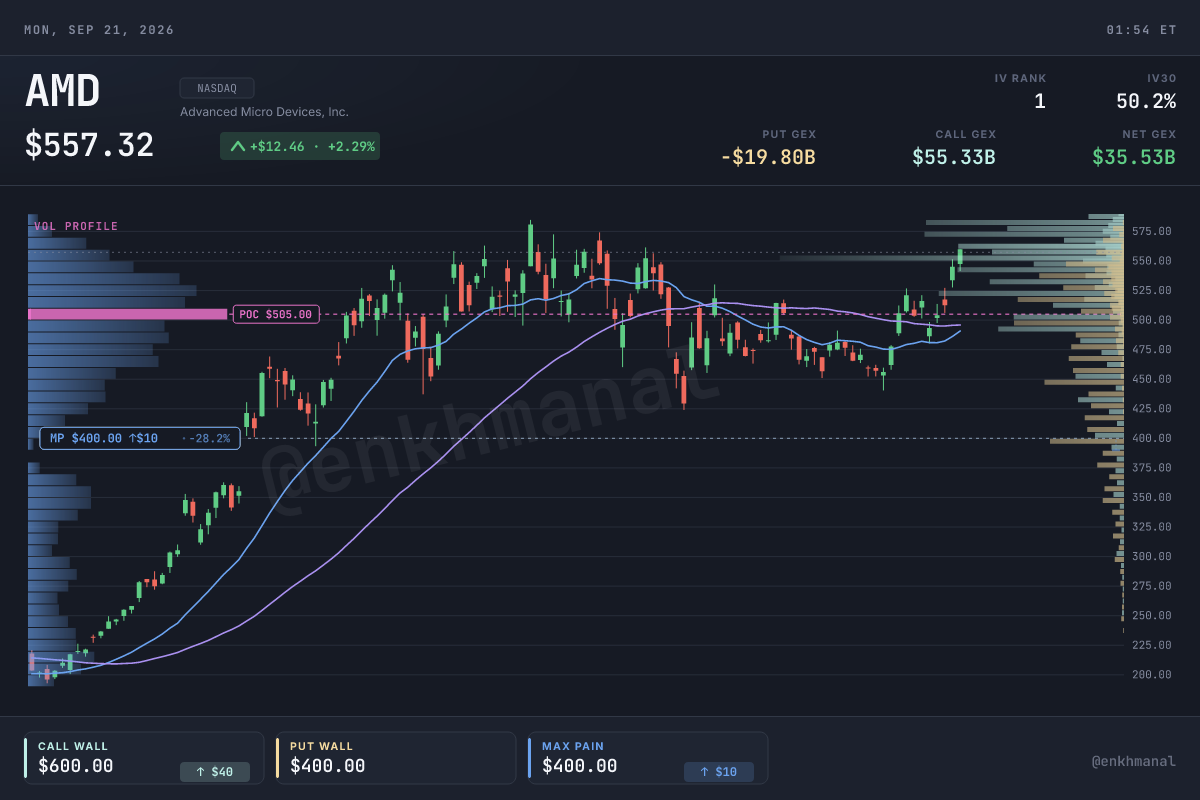
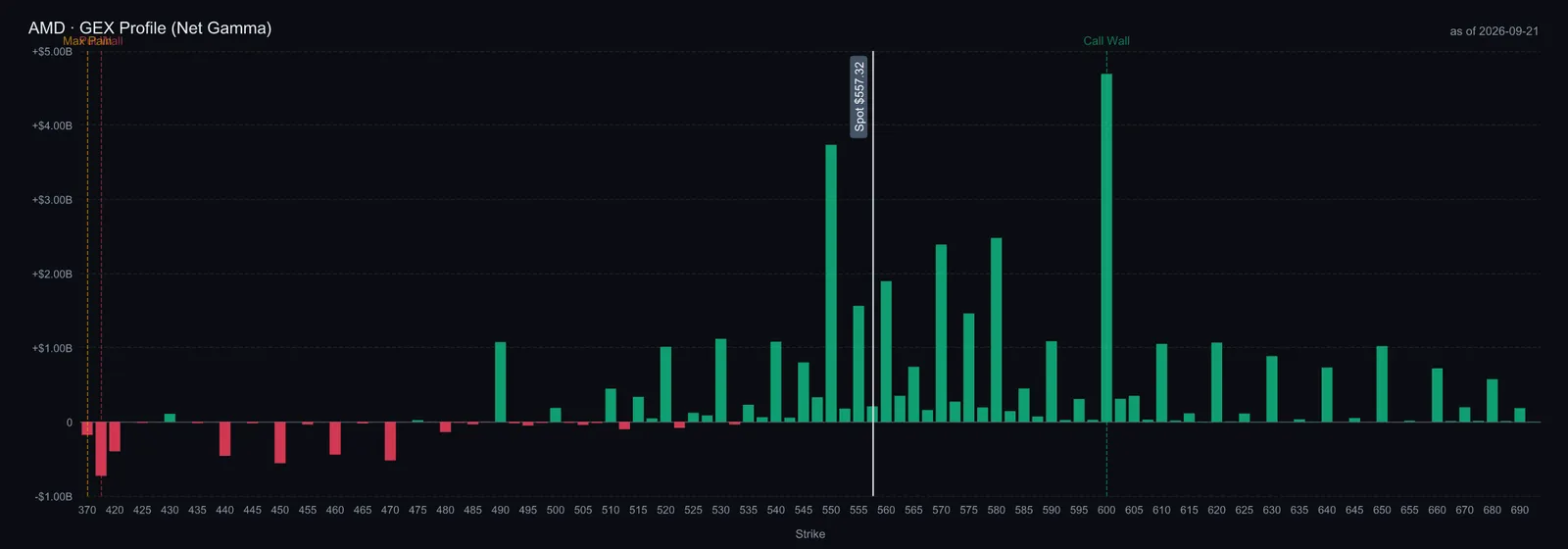
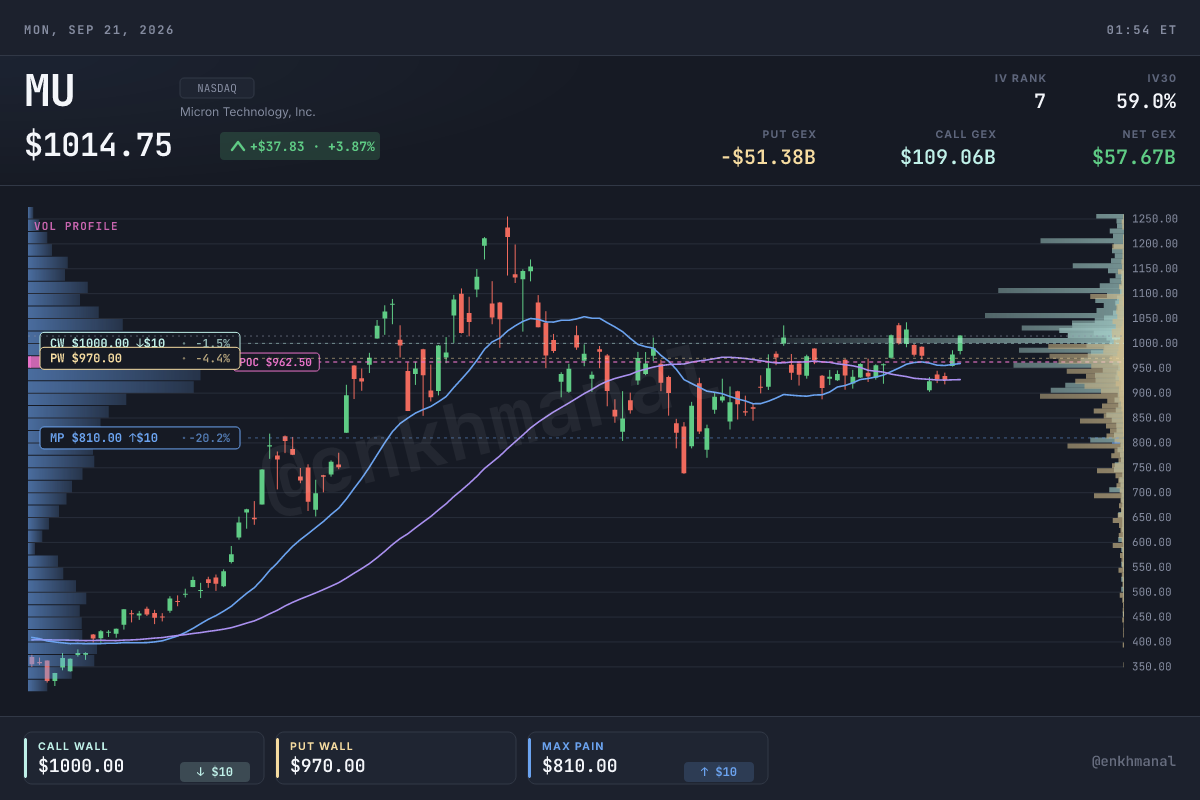
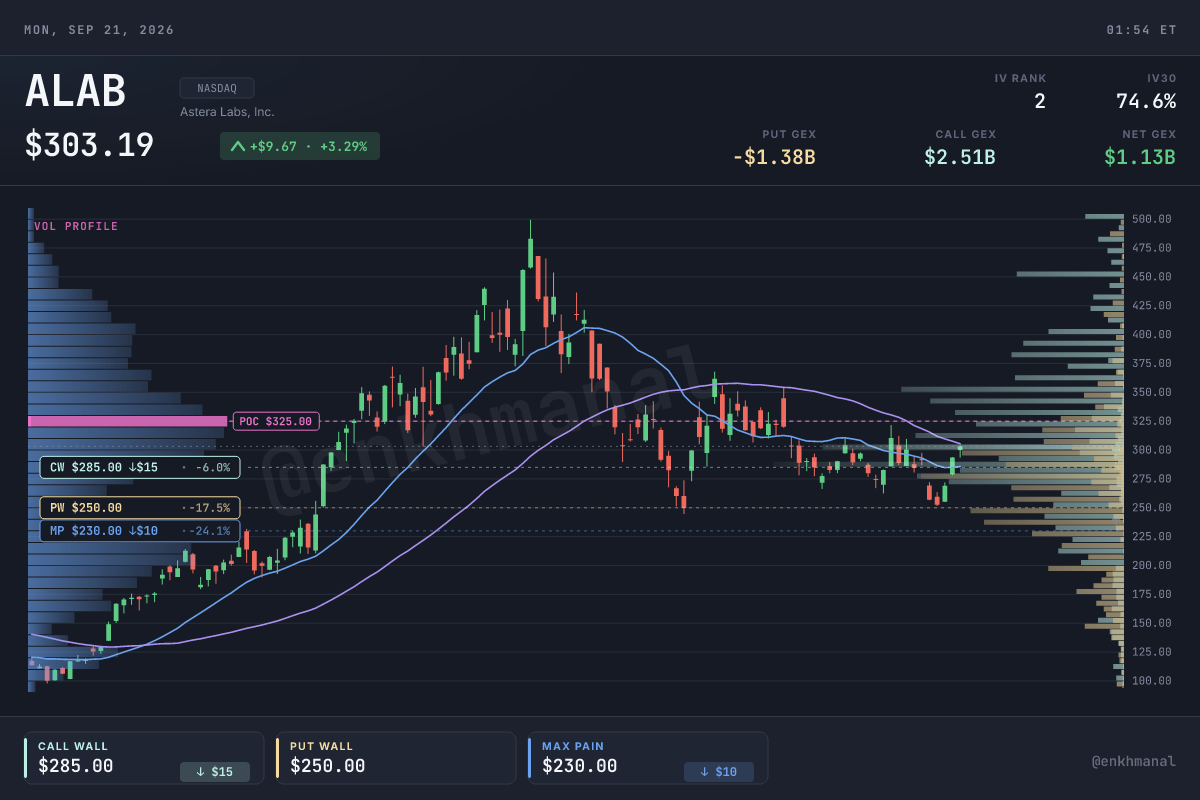
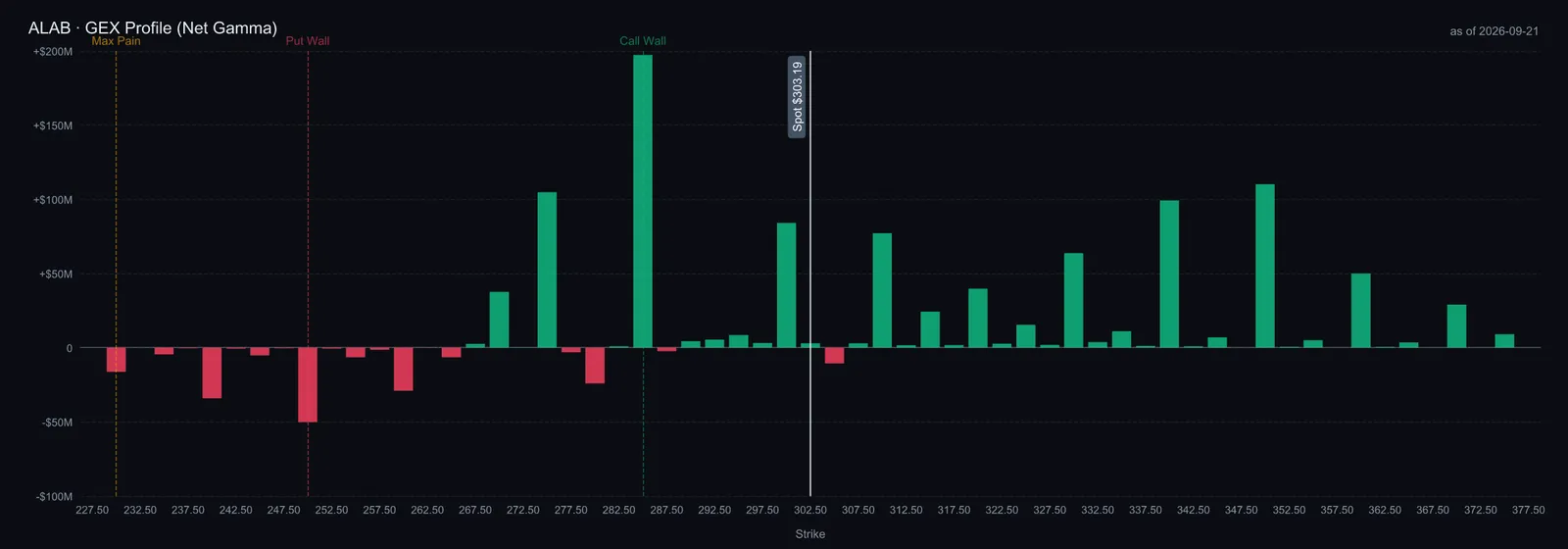
Every chart here is the September 18 close, the monthly options expiry, and all six names in the universe sit above their 200-day averages; five of six sit above their 50-day, with $ALAB the exception at $303 against $305. Dealer positioning is unusually uniform: net gamma is positive in all five names with GEX figures in the table, so dealers sell strength into the call walls and buy dips toward the gamma flips, and every call wall is within two percent of spot. October's expiry on the 16th resets positioning. Micron reports before that expiry; the other listed reports follow: $MU September 30, $INTC October 21, $AMD November 3, $ARM and $ALAB in the first week of November, $NVDA November 17.
$AMD. The chart is a stair: $355 to $560 in six months with the 50-day never lost, and the September 18 expiry pinned the close on the $560 call wall. With the gamma flip at $548 and $76 billion of dealer gamma, a dip to the $548 to $530 area is where the position gets added, and a close above $560 after the October 16 expiry is the tell that the wall has moved up with the stock.
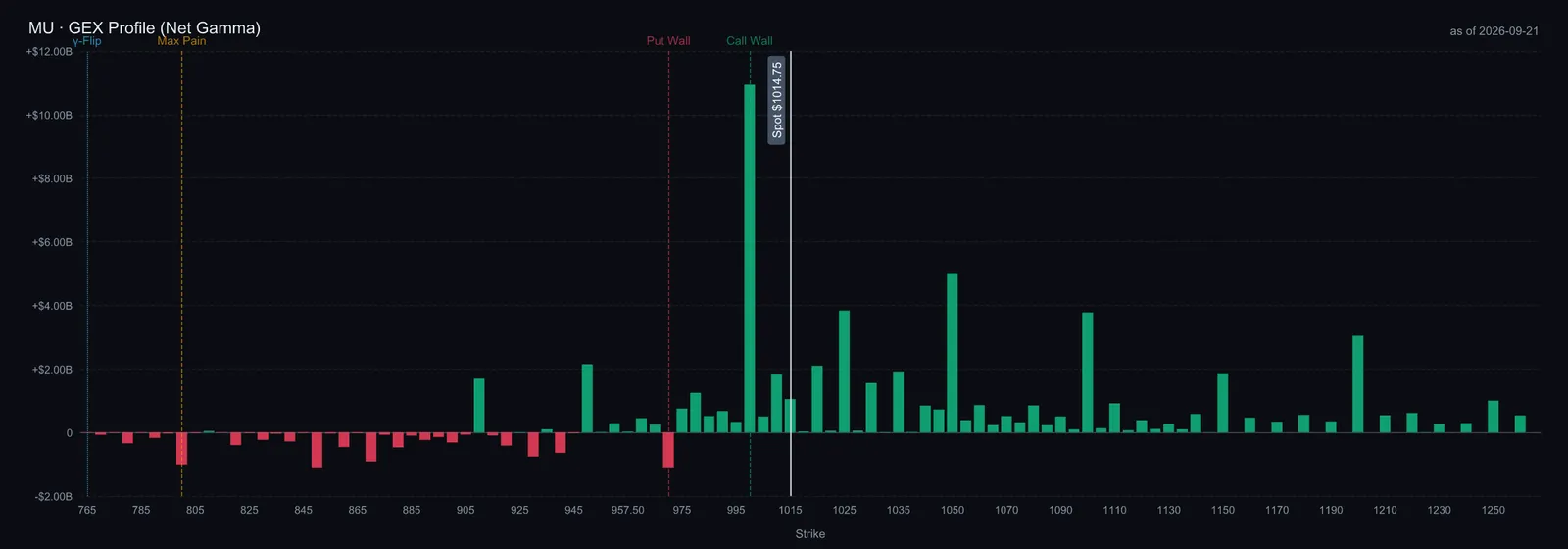
$MU. The largest dealer positioning in the basket has a $30 gap between the $970 put wall and $1,000 call wall; the $1,015.80 close sits above both, twelve days before a print that is guided to $50 billion. The chart has not closed below its 50-day since the spring; the risk into September 30 is a beat that is already in the price, and the level that would say so is a close back under $970.
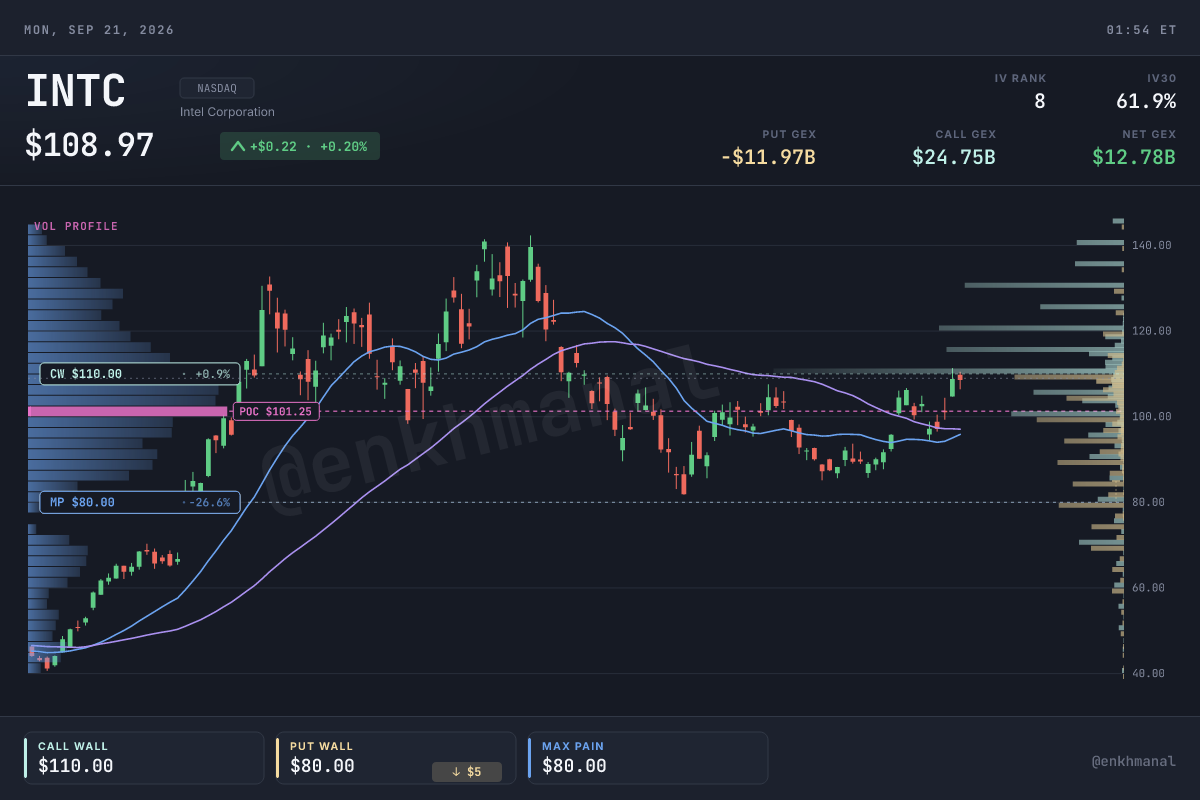
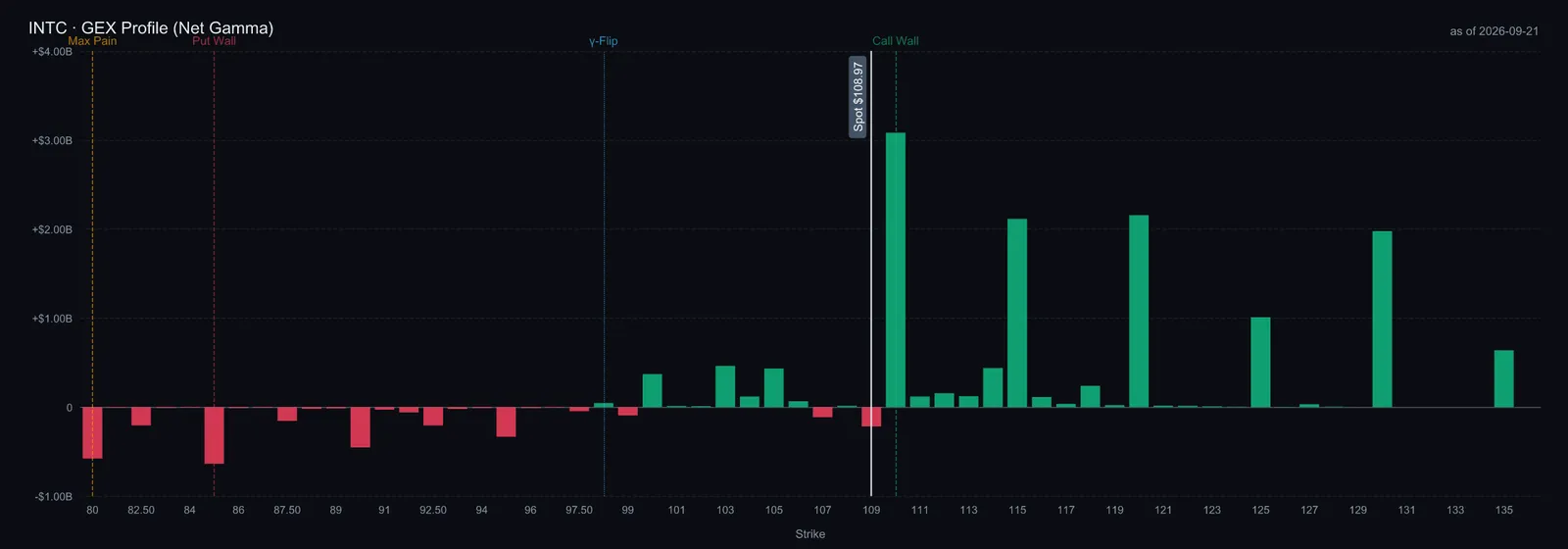
$INTC. The only chart in the basket that has already broken and repaired: $45 in March, $142 on June 30, $85 in August, $109 now, back above a 50-day at $97 that is flattening rather than rising. The put wall sits at the August low of $85, while max pain is $80. The $85 put wall is the nearer options level, and the $110 call wall a dollar overhead is the level it is capping until October's expiry. Add above $97, not into $110.
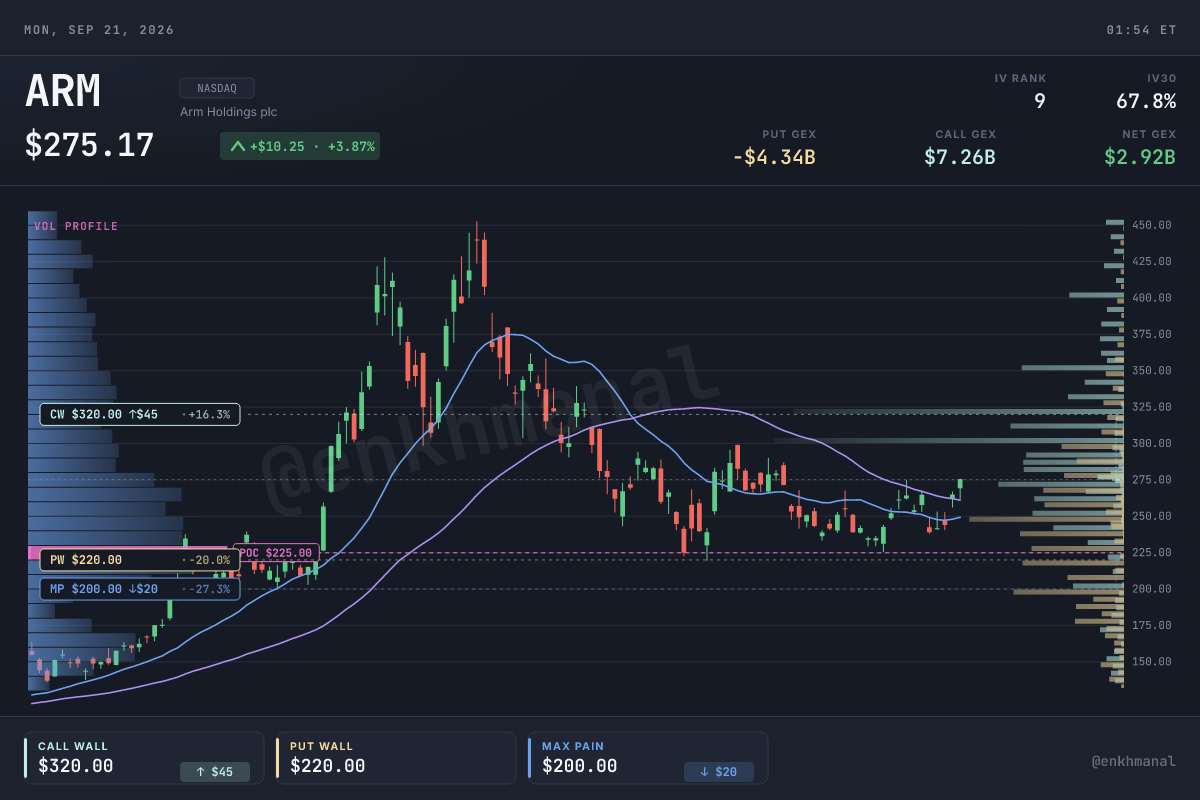
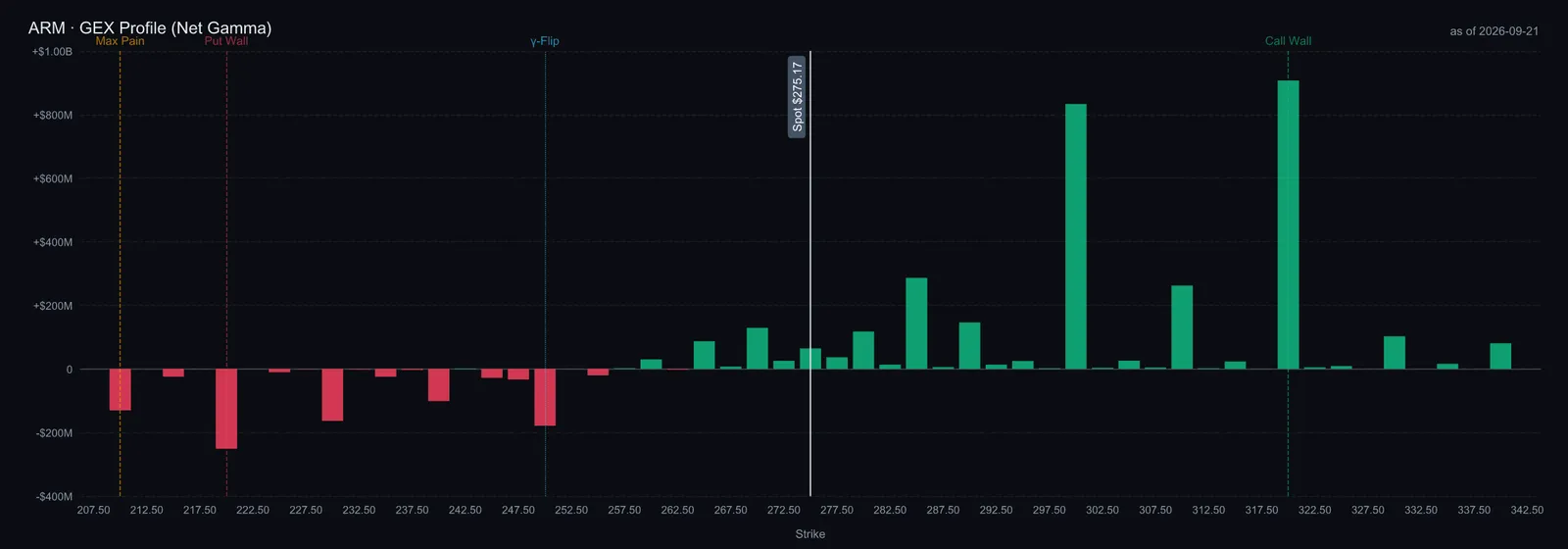
$ARM and $ALAB. Both closed on their call walls, $275 and $300, with dealers holding the two smallest net-gamma positions in the group, $10 billion and $3 billion respectively, which means neither has much of a cushion when the walls move. Arm's put wall and max pain at $220 is where the AGI CPU margin story would be fully priced; Astera's $250 put wall is the level below which its 200-day at $231 becomes the next test. Both are watches, so these are the levels at which the watch turns into a buy, not levels to defend.
Astera's chart reads against its own history: a run from $231 to $305 into the Q2 print, then a stall under the 50-day while every other name kept climbing.
Valuation & House View
Multiples are context, and the context is that the theme has been bought. Against their own five-year ranges, $INTC's 90 times trailing earnings sits at the 85th percentile of a history whose median is 10, $AMD's 144 times at the 76th percentile against a median of 101, $ARM's 281 times at the 75th against 217, $ALAB's 150 times at the 76th against 104; only $MU, at 23 times trailing and 8 times the earnings it has just guided, sits near its median at the 59th percentile with a PEG of 0.35. Trailing earnings understate the x86 and Arm names because the guide is the story, so we screen each on what it has guided: September 18 prices, two years, a 15% hurdle, two exit multiples per name, asking what compound growth in the guided per-share metric the price already requires. It is a screen, not a fair value.
Read against the guides, the screen sorts the basket. $MU has the lowest current multiple in the basket, but flat annualised guided EPS does not clear the 15% annual return hurdle at both exits. At $124 EPS, an 8× exit gives $992, below the $1,015.80 entry; meeting the hurdle requires EPS to compound 16.4% annually for two years. At 12×, EPS could fall about 5.0% annually and still meet it. The buy case therefore depends on earnings durability and the exit multiple, alongside memory-cycle risk. $AMD needs 40% compound growth in revenue per share for two years if the market still pays 12 times sales in 2028, and its own guide is server up 70% and the data-center segment doubling in 2027, so the growth is there and the multiple is the bet; at 8 times sales the price needs 72%, which the guide does not deliver. $INTC needs 34% at 6 times sales against a company guided to grow revenue in the mid-20s with the data-center half growing 59%, so the price requires either client to stop shrinking or the multiple to hold above its own history, which is why it is the smallest buy. $ARM needs 32% growth at 40 times sales from a company growing 22%; $ALAB needs 16% at 25 times from a company growing 100%, the easiest hurdle in the table on the fastest grower. Share counts are the diluted figures each company guided, Intel's after the August offering; none of the screens adjusts for stock compensation or net cash, which flatters every name except $INTC with its $9 billion of net debt.
Own the socket count, in the order the guides support it: $AMD first as the merchant part built for the tier that grows fastest, sized as the largest position and added on any dip toward the $548 gamma flip; $MU second as the memory that every socket carries, bought before the September 30 print because the guided quarter is already in the price at eight times earnings; $INTC third and smallest, as the owner of the constraint, added only above the $97 50-day and cut if the October 21 report says supply has caught demand. $ARM and $ALAB stay on the watch list: Arm until the AGI CPU shows up as revenue at a margin the market has accepted, Astera until a CPU-attached line appears in its numbers or the price reclaims its 50-day. The whole basket is reviewed on November 6, after four of the five have reported, against one measurable line: $AMD's 2027 server growth guide held at 70% or better, and $INTC still supply-constrained with Xeon pricing firm. The screen says the expected return is carried by $MU's earnings and $AMD's growth, and that the multiples elsewhere already assume the theme; that is a place to start a position, not a reason to avoid one.