
$CLSK Deep Dive — A Bitcoin Miner Just Signed a Landlord's Lease
$CLSK spent five years building itself into one of America's largest Bitcoin miners. On July 14 it quietly stopped being one. In the worst week the AI-infrastructure trade has ever had — with $NBIS, $CRWV, $IREN and $APLD down 25–40% in a month — $CLSK signed a 20-year lease worth twice its own market cap, and the stock barely moved.
Thesis
$CLSK is priced as a struggling Bitcoin miner, but it just became a triple-net data-center landlord with a $6.6B contracted backlog and a free option on five times more — and the market, mid-panic, hasn't re-rated it.
- Consensus says: $CLSK is a leveraged, loss-making miner burning cash at $64K Bitcoin — but: the July 14 lease bolts ~$330M of near-100%-margin, investment-grade rent onto the same land and power, a business the market pays roughly double for.
- The catalyst: the Texas exclusivity window (885 MW under LOI, ~5× the signed deal) converting between now and Q4 2026 — plus the tenant getting named.
- The one risk that matters: the lease pays nothing until Q4 2027, so a weak Bitcoin tape and a ~$1.8B debt load have to carry the company across a two-year bridge — and the tenant is still confidential.
- First internal coverage of the name; the ingested source memo is [[a1553b80|Asymmetrical Bets' $CLSK write-up]].
Business & Backdrop
Strip away the AI headline and $CLSK is still, today, a Bitcoin miner — and a good one. It owns its power outright at ~5.2¢/kWh across Georgia, Mississippi, Tennessee and Wyoming, runs ~225,000 machines for roughly 50 exahash/second (about 5% of the global network), and mined 1,799 $BTC last quarter. Owned cheap power is the whole game in mining: it makes $CLSK one of the lowest-cost producers in the industry, with a cash cost to mine near $54K per coin. Against $BTC at ~$64K, the machines still print cash.
The problem is everything below the cash line. Once depreciation, interest and stock comp are loaded in, $CLSK's all-in cost is ~$119K per coin (CoinShares' sector table) — well above the coin price. That gap is why the reported numbers look grim even as the sites hum: revenue has stair-stepped down for three straight quarters as $BTC fell from a January high above $93K to the low-$60Ks and the April 2024 halving kept biting. The realized swing is stark — $CLSK's average mined-Bitcoin price fell from ~$100K in fiscal Q1 to ~$76K in Q2, which alone explains the −25% sequential revenue drop even as production held (1,799 coins, down just 22 QoQ). Management is explicit that this is the design, not distress: mining is "a power acquisition tool" that funds the platform, and "mining funds the platform; AI monetizes it."
| Quarter (FY end Sep) | Revenue | $BTC backdrop |
|---|---|---|
| Q3 FY25 (Jun '25) | $198.6M | — |
| Q4 FY25 (Sep '25) | $223.7M | peak |
| Q1 FY26 (Dec '25) | $181.2M | rolling over |
| Q2 FY26 (Mar '26) | $136.4M | −24.9% YoY |
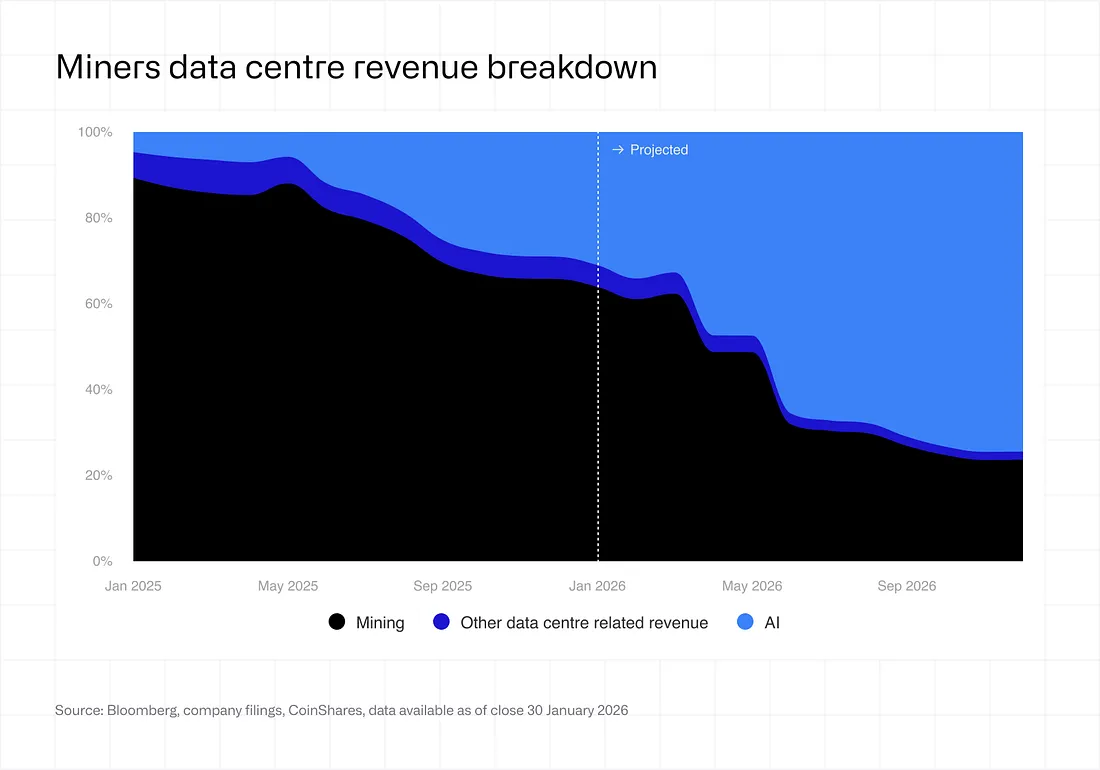
Full-year FY25 revenue was still $766M, up 102% — but that growth is in the rear-view, and the market knows it. The strategic question $CLSK's management answered on July 14 is the one every miner is facing: you're sitting on hundreds of megawatts of energized, permitted power at a moment when AI can't find any — so why keep pointing all of it at a commodity you mine at a loss? The market it's chasing is real: Bitcoin miners have signed over $70B in AI compute contracts this year (CoinShares), and the same land-and-substation asset re-rates from ~5.9× to ~12.3× EV/sales the moment it carries an HPC lease instead of a mining rig. The whole sector is mid-pivot — mining was ~90% of miner data-centre revenue in early 2025 and is projected to fall toward a quarter of it by 2027.
The Setup — Why It's Mispriced
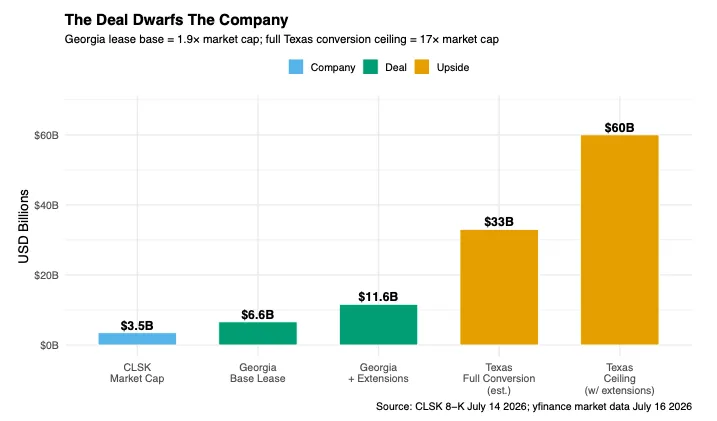
The lease is the whole thesis, and its structure is what retail skims past. It's a 20-year triple-net lease at the Sandersville, Georgia campus with a "high investment-grade, leading global technology company." Triple-net means the tenant pays power, maintenance and cost inflation — $CLSK builds the shell, collects the check, and the check carries annual escalators. That's why management guides to $330M of average annual net operating income at near-100% margin on 175 MW of critical IT load, against a build cost of just $10–12M/MW ($1.75–2.1B of capex). The numbers: $6.6B of contracted revenue, rising to $11.6B if two five-year extensions are exercised. For a company whose entire market cap is ~$3.5B, the Georgia base lease alone is ~1.9× the company — and a full Texas conversion carries a ceiling near 17× market cap. The deal doesn't move the needle; it dwarfs the company.
The capital-discipline pivot is the part the "serial diluter" bears keep missing. On the July 14 investor-update call, CFO Gary Vecchiarelli was pointed about it:
"We have not raised capital via issuance of stock in over 20 months... We have repurchased more than $600 million of our own shares... Our capital strategy will be to continue minimizing the issuance of equity as we believe our stock is our highest cost of capital currently." — Gary Vecchiarelli, President & CFO, $CLSK, July 14 2026 investor-update call
He was equally clear the build gets funded with debt, not equity: recent project-debt deals in the space have run 5–6× oversubscribed and priced "slightly over 6%," and an investment-grade, direct lease lets $CLSK skip the credit wrappers (and the equity-scrape / warrants) a neocloud deal would demand. Morgan Stanley advised the transaction; Davis Polk was legal counsel — the kind of bench a real institutional financing needs.
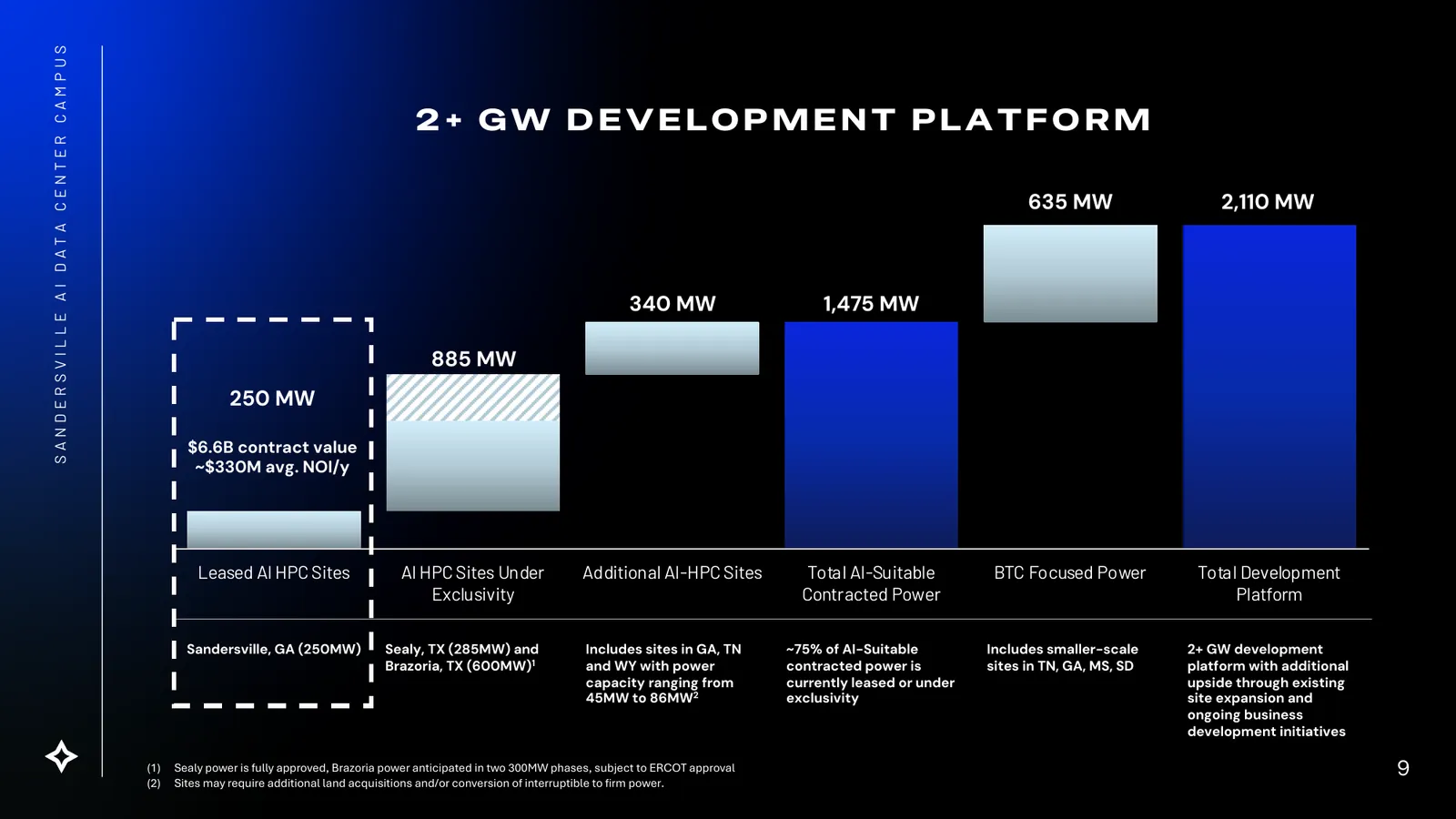
Then there's the part buried in paragraph two: the same tenant signed a letter of intent and exclusivity over $CLSK's entire Texas portfolio — 718 acres and up to 885 MW across the Sealy (~300 MW) and Brazoria (300→600 MW) campuses near Houston. That's roughly five Sandersvilles, with one counterparty holding first rights on all of it. Priced at the Georgia rate, a full conversion would lift the combined contracted book toward ~$40B (a ceiling above $60B if every extension is struck). Schultz is careful to keep it honest — on the call he stressed it's an "exclusivity window, not... a finish line." But hyperscalers do not lock up 885 MW of a landlord's portfolio for sport. Management's own framing makes the option concrete: the portfolio has grown ~600% — from 300 MW to a 2.1 GW platform in about two and a half years, and roughly 75% of its AI-suitable contracted power is already leased or under exclusivity.
Two details make the bridge more survivable than the bears allow. First, mining doesn't stop: $CLSK structured the deal to keep mining Bitcoin at Sandersville until power transfers to the new facility, so the site earns during construction instead of going dark. Second, the liquidity to wait is real — ~$1.2B at the March quarter ($260M cash + $925M of Bitcoin) plus an undrawn $400M Bitcoin-backed revolver — and management guides the "overwhelming majority" of the ~$2B build to project-level debt. An investment-grade triple-net lease is exactly the kind of collateral project lenders underwrite, so for once the balance sheet, not the share count, does the work.
Peers — Landlord, Not Neocloud
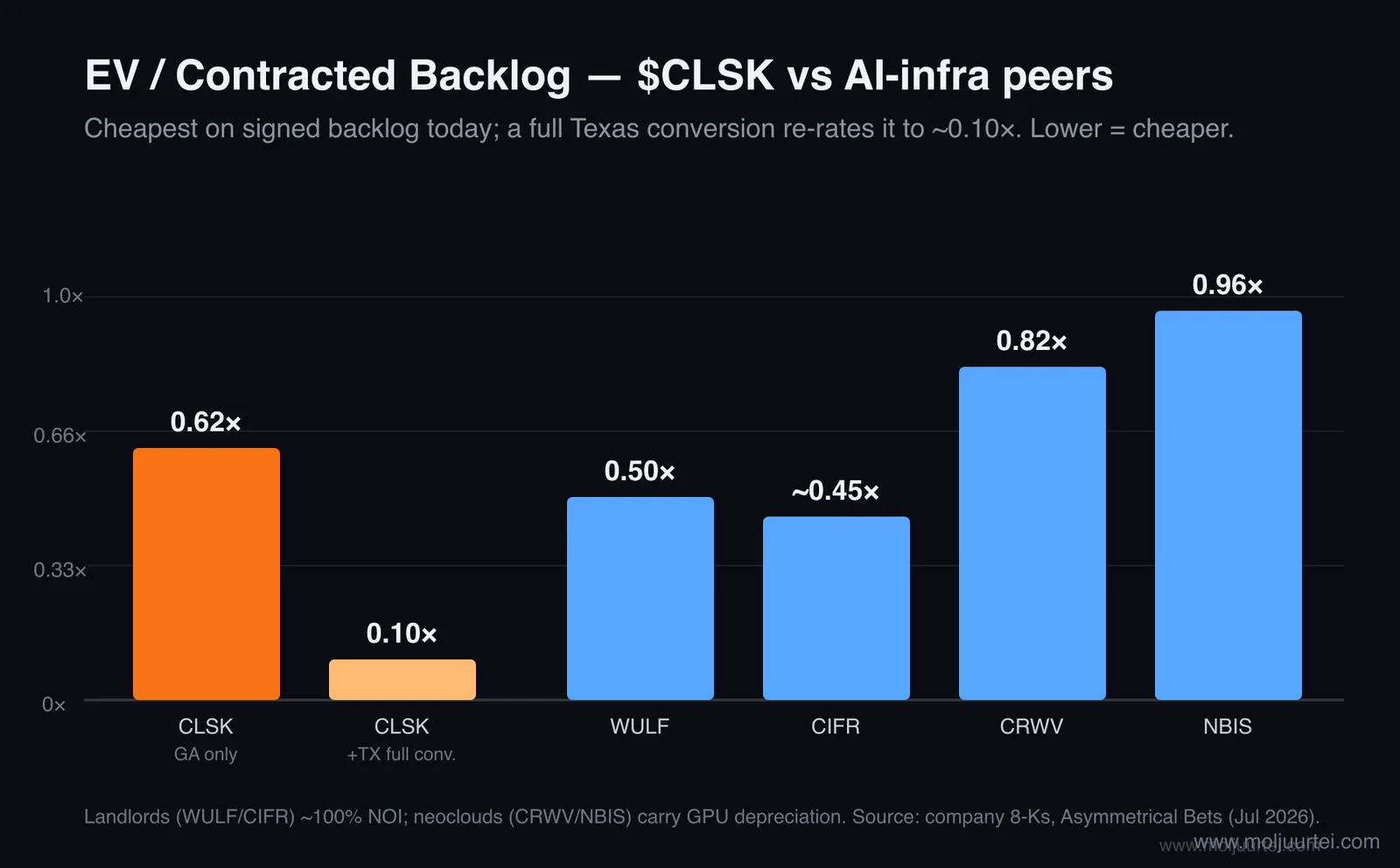
The single most important classification in this thesis: $CLSK is a landlord, not a neocloud. $CRWV, $NBIS and $IREN buy the GPUs and sell AI compute — their backlog dollars carry GPU depreciation and operating cost. $CLSK sells the building and the power, the tenant brings the chips, and the rent lands at ~100% margin. The right comps are therefore the other miner-turned-landlords, $WULF and $CIFR — and on the metric that matters, contracted backlog, $CLSK is the cheapest name in the group.
| Company | Deal | Contracted backlog | MW | Tenant | Revenue start |
|---|---|---|---|---|---|
| $WULF | 20-yr infrastructure lease | ~$12.8B (Anthropic anchor ~$19B) | 522 | Named (Anthropic) | H2 2027 |
| $CIFR | 15-yr AWS + 10-yr Google/Fluidstack | ~$9.3B | 700 | Named (AWS, Google) | Oct 2026 |
| $CLSK | 20-yr triple-net + Texas option | $6.6B→$11.6B (+ up to ~$40B TX) | 175 (+885 option) | Confidential ("high-IG") | Q4 2027 |
The honest read of that table is that $CLSK is cheapest because it's least-proven: $WULF and $CIFR have named tenants (Anthropic, AWS, Google), financing further along, and deliveries starting sooner. $CLSK signed its first definitive lease two weeks ago, its tenant is confidential, and its ~$2B build isn't funded yet. But the counter is that a landlord dollar at ~100% operating margin is worth more than a neocloud dollar carrying depreciation — so comparing them at face value, if anything, understates $CLSK. The market is discounting what it can't yet verify; the re-rating is what happens when it can.
Catalysts
| Date | Catalyst | Why it matters |
|---|---|---|
| ~Aug 11, 2026 | Fiscal Q3 earnings | First look at financing specifics + Sandersville construction milestones |
| Now → Q4 2026 | Texas exclusivity window | The single most important undated event — a conversion re-rates the stock hard |
| Any day | The tenant gets named | Removes the "we can't verify it" discount; a Meta/Anthropic name would be a step-change |
| Any day | Project-debt financing package | An investment-grade triple-net lease is bankable; favorable terms de-risk the build |
| First week, monthly | Bitcoin production updates | Keeps the mining bridge visible while HPC revenue is still 5+ quarters out |
| Q4 2027 | First Sandersville delivery | Revenue actually starts; the market pays for realized, not promised, cash flow |
The tenant-identity chatter is already live: $META is rumored to be the counterparty, at the same time it's reportedly in talks to rent compute to Anthropic — which would make $CLSK's "confidential" tenant one of the most creditworthy names on earth. Treat that as rumor until an 8-K says otherwise, but it's why the tape is watching every filing.
Forensic & Governance
This is a name with a messy past that has been cleaning up, and both halves of that sentence matter. On the encouraging side, the flows are turning: a 13G filed July 17 shows D. E. Shaw crossing 5% (12,859,115 shares) — a top quantitative fund going long within days of the lease, not at a stale quarter-end — one of three >5% stakes filed in the July 14–17 window. Institutional ownership has been rising straight through the selloff. The source memo also flags Leopold Aschenbrenner's Situational Awareness reportedly multiplying its stake ~7.5× (per its 13F); I couldn't re-verify the 13F this run, so treat that as reported, not confirmed.
On the cautious side, EDGAR's forensic history is not spotless: 28 SEC comment-letter correspondences, four auditor changes, and 17 late-filing (NT 10-K/Q) notices over the company's life. The reassuring nuance is that these cluster in $CLSK's scrappier micro-cap years — the most recent late filing was December 2024, and the accounting has held up as the company scaled to $766M of revenue and clean quarterly 10-Qs. The other governance fact to hold onto is dilution: $CLSK went from ~43M shares (FY22) to ~318M (FY25) funding its mining growth with equity. The entire bull case rests on that stopping — the pivot to project-level debt is the change — but it hasn't been proven at scale yet, and the company already carries ~$1.8B of debt into a ~$2B build.
Risks & What Breaks It
- The lease pays nothing until Q4 2027. Between now and then, the money-losing mining business carries the income statement, and the 8-K risk language is explicit: missed financing, construction, or delivery milestones can trigger rent abatement or termination. This is a two-year bridge, not a finish line.
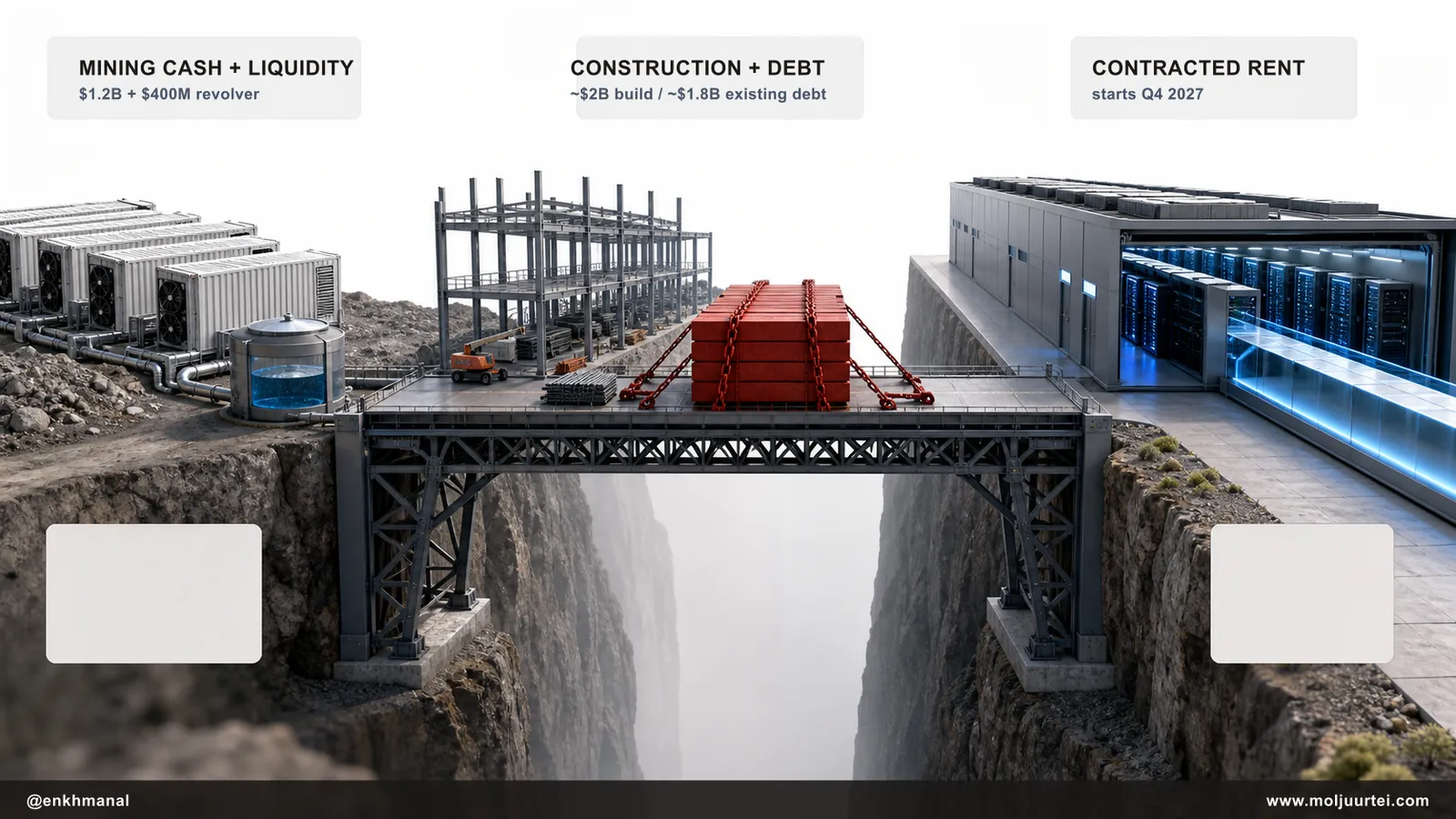
- The balance sheet is already levered. ~$1.8B of debt against $260M cash and $925M of (volatile) Bitcoin. Layering ~$2B of project debt on top is the plan — but it assumes lenders show up on good terms, which isn't signed.
- It's still a Bitcoin proxy in the interim. The treasury and interim cash flow swing with $BTC. A retest of late-June's ~$58K narrows the bridge; a deeper fall widens it. (The mirror image is a tailwind — a $BTC recovery from multi-year-low levels would fund the wait handsomely.)
- The single assumption that almost breaks the thesis: an unnamed tenant you're taking on faith. $WULF can say "Anthropic," $CIFR can say "AWS." $CLSK can only say "a high investment-grade global technology company." If the counterparty is genuinely top-tier, ~$4B of EV against a $6.6B base lease (before Texas) is a mispricing. If the market's discount is right — if the credit or the terms are softer than billed — the whole re-rate is built on a name nobody can check. Everything hinges on which it is.
What forces a thesis change: the tenant is disclosed and it's not investment-grade; or the Texas exclusivity lapses without a definitive lease; or the project-debt package prices punitively (or forces an equity raise after all). Any one of those turns the coiled spring into a value trap.
Valuation & House View
The cleanest frame is EV to contracted backlog, because that's the asset the market is actually buying. At ~$4B enterprise value against a $6.6B signed lease, $CLSK trades near 0.62× — cheaper than $WULF (~0.50× on far more backlog with a named tenant), and a fraction of the neoclouds ($CRWV ~0.82×, $NBIS ~0.96×). If the Texas 885 MW converts on Georgia-like terms, the combined book approaches ~$40B and the multiple collapses to ~0.10× — a structural mispricing if it converts. Against that, the sell side is unusually one-sided: a Strong-Buy consensus with post-lease targets clustered $22–27 (Needham, BTIG, Citizens) versus a ~$13 quote, into a float that's been 33–46% short across 2026 — one of the most crowded shorts among large miners.
| Scenario | Prob. | ~2Y target | Implied return | Triggers |
|---|---|---|---|---|
| Bull | 30% | $28 | ~+115% | Texas converts, tenant named IG, $BTC recovers, short squeeze |
| Base | 45% | $19 | ~+45% | Sandersville funds + builds on schedule, no TX yet, sell-side targets met |
| Bear | 25% | $7 | ~−45% | Milestone slips / equity raise / weak-credit tenant / $BTC to $50Ks |
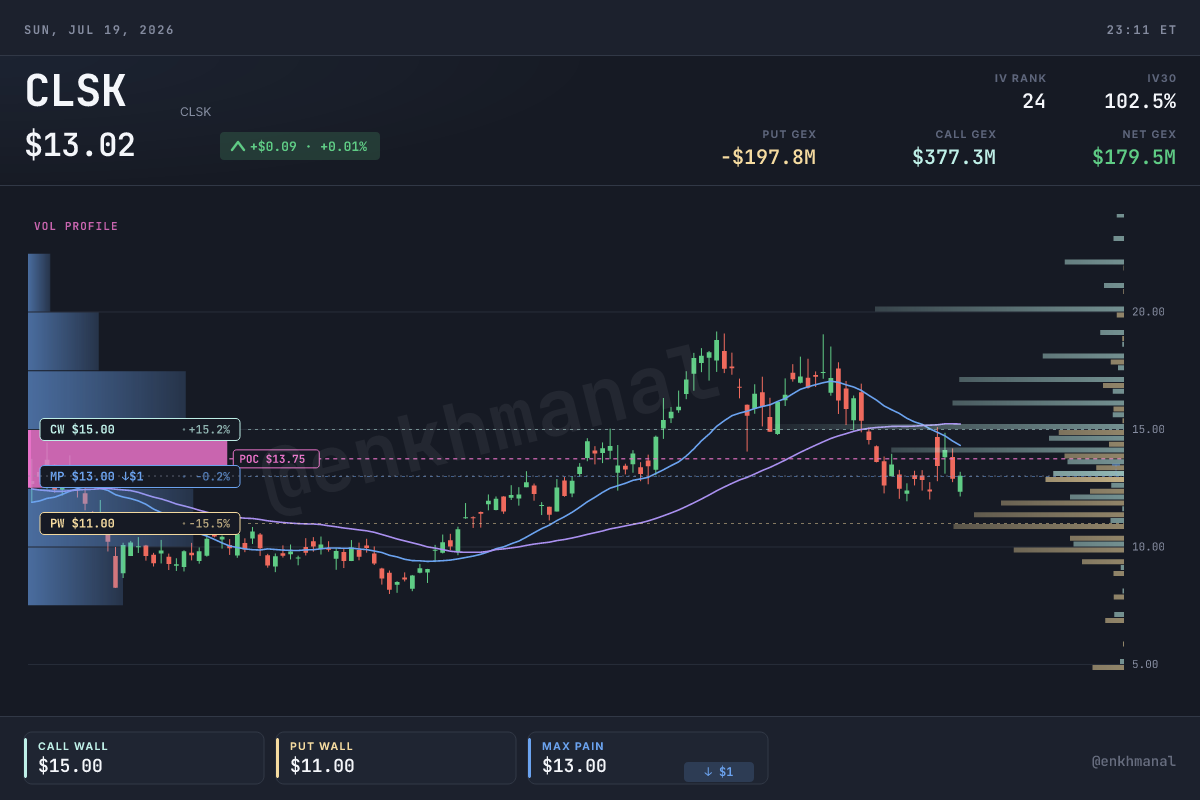
House View. This is a genuinely asymmetric setup, not a sure thing — the kind of name to start rather than size to the hilt. The upside is real and multi-legged (a re-rate to landlord multiples, a Texas conversion, a Bitcoin recovery, and a violent squeeze on a third-of-the-float short base, any of which can fire independently), while the downside is bounded by a signed, escalating, investment-grade cash-flow stream that exists whether or not $BTC cooperates. The levels frame the entry: spot ~$13 sits between a gamma put-wall near $11 (support) and a call-wall at $15, with options priced at a ~100% implied vol that makes patience cheaper than leverage. Watch the August print and the Texas window; a named tenant is the single event that turns "can't verify" into "re-rate." (Numbers and structure via [[a1553b80|Asymmetrical Bets]]; every load-bearing figure re-checked against $CLSK's SEC filings.)