

$CIEN Deep Dive — AI outgrew the building, and Ciena sells the road between buildings · $10B backlog into the December print
A training run that no longer fits inside one data center has to be stitched across several, and the only thing that can stitch two buildings 100 kilometres apart into one machine is a strand of glass carrying laser light. $CIEN makes the equipment that turns that strand into a usable network: the modem that encodes data onto light and the line system that keeps the light alive over distance. Ciena is now booking orders faster than the optical supply chain can build them: backlog went from about $5B to a projected $10B+ in one fiscal year, management has laid out a plan to reach roughly $14B of revenue at 32–35% adjusted operating margin by FY2029, and the stock sits 45% below its June high at $351.82.
Start with the problem the customer is solving. A modern AI model is trained by tens of thousands of GPUs passing partial results to each other many times a second. Inside one building that traffic rides copper and short optical cables. But a single site runs out of electricity long before a frontier model runs out of appetite: the largest campuses are now measured in gigawatts, and the power grid will not deliver another gigawatt to the same plot of land on the training schedule. So the cluster spreads to a second and third building, sometimes tens or hundreds of kilometres away, and the link between them becomes part of the computer. If that link is slow or narrow, thousands of GPUs sit idle waiting for it.
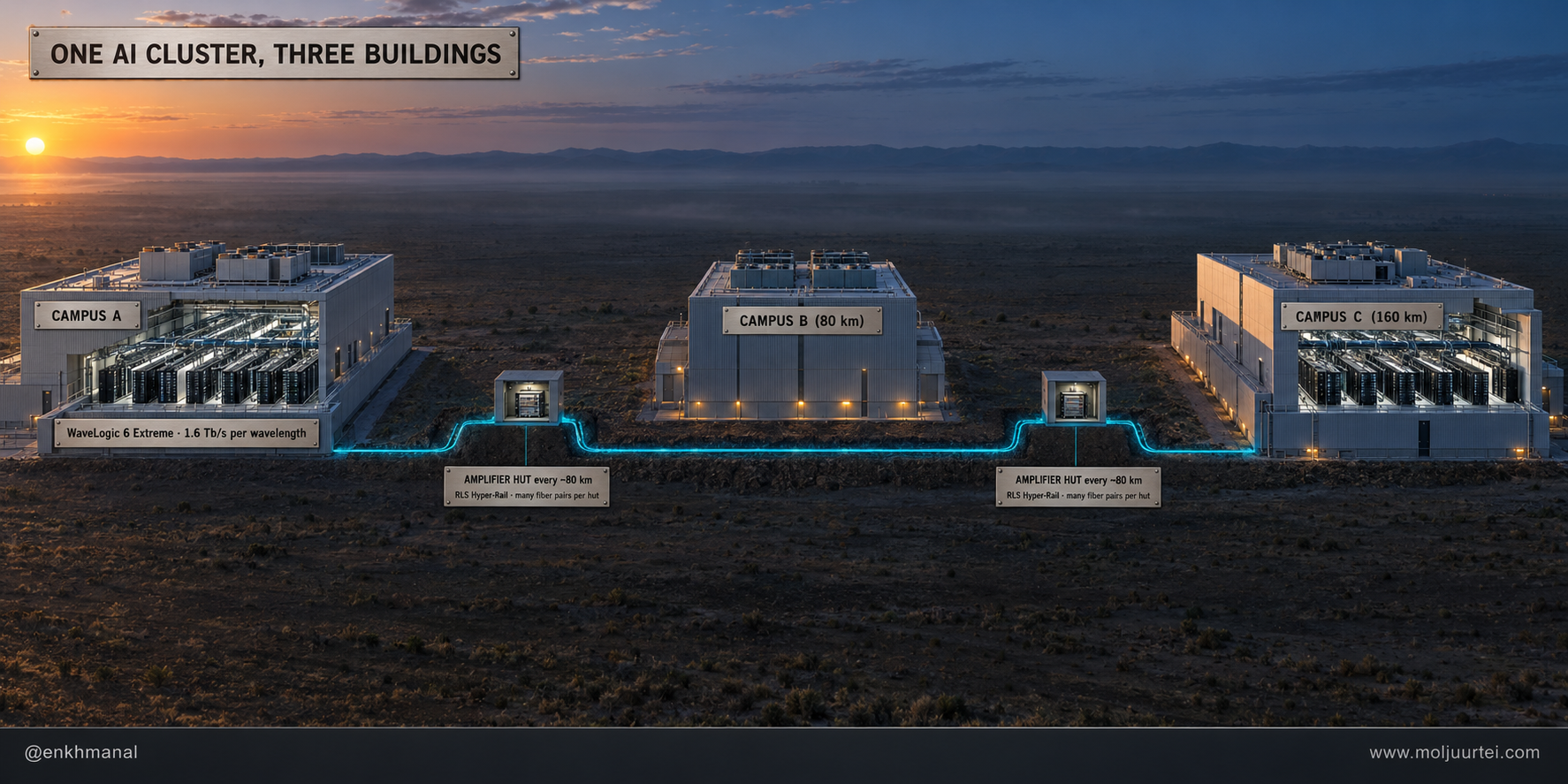
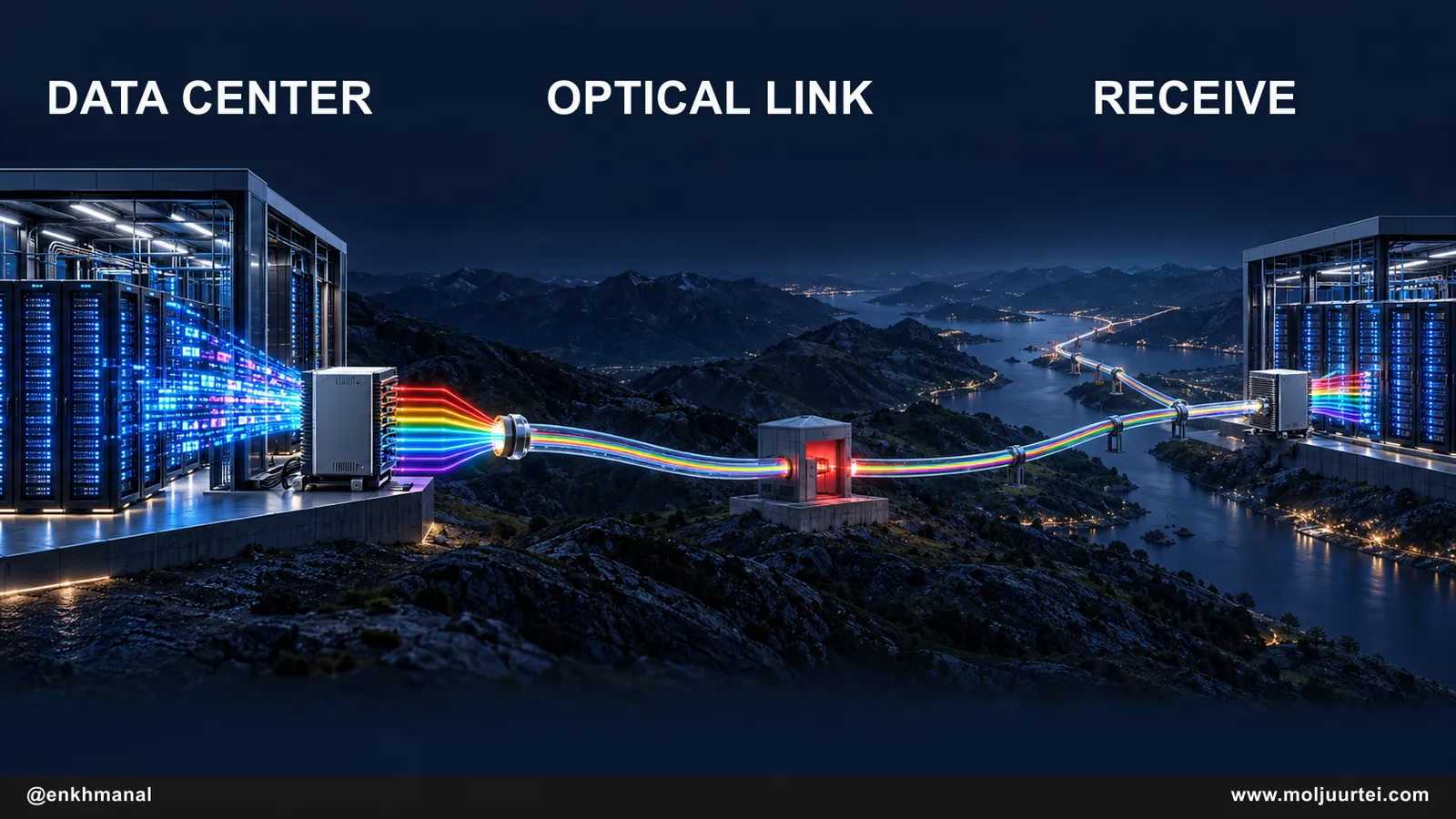
Start here. A bit is a single on-or-off piece of information, and a network is any system that moves bits from one place to another. An optical fiber is a hair-thin strand of very pure glass that guides laser light, losing only about 0.2 decibels of power per kilometre, so light can travel tens of kilometres before it needs help. A wavelength is one colour of laser light, and one fiber can carry dozens of colours side by side without them interfering. A coherent modem is the chip that writes data onto a wavelength by changing the light's phase and brightness rather than simply switching it on and off, which lets one colour carry 1.6 trillion bits per second today. A line system is the chain of amplifiers and switches strung along the fiber, roughly every 80 kilometres, that restores the fading light and steers each colour to the right destination. Everything below is about who builds the modem and the line system that sit at either end of, and along, the glass between AI data centers.
The incumbent answer to "move more data between two places" has always been to light more colours on existing fiber, then lay more fiber. It works, but it has two limits that AI has made binding. The amplifier sites along the route are small, power-limited huts that were designed for a handful of fiber pairs, and the coherent modem has to keep doubling its speed to stop the number of boxes, and their power bill, from growing with the traffic. Ciena's contribution sits exactly at both limits: it designs the coherent modem (WaveLogic, now in its sixth generation) and it sells the line system (RLS, with about 70% share of the disaggregated market by management's count), and its new Hyper-Rail version was co-designed with hyperscalers to run many fiber pairs through the same amplifier site. A customer that has to connect buildings buys both, and because the buildings already exist, it buys them on the schedule of the data centers, not of the economy.
AI outgrew the building, and the network became the bottleneck
For twenty years optical transport grew with internet traffic, about as fast as the economy plus streaming. Carriers bought it in cycles, and Ciena's own record shows the pattern: revenue of $3.57B in FY19 and $3.63B in FY22, three years of going nowhere. What changed is that the buyer changed. Direct cloud providers were 40% of Ciena's revenue in Q3 FY25 and 53% in Q3 FY26, growing 82% in a year, and they are not buying to serve more Netflix subscribers. They are buying because the unit of AI compute grew from a server to a rack to a whole data center, and then to several data centers acting as one. Ciena's investor deck draws it as three steps on each side: a processor becomes a rack becomes a data center on the compute side, and a wavelength becomes a fiber becomes a conduit of about a thousand fibers on the capacity side.
The second change is that demand outran supply, and management put dates on it. Orders doubled from FY24 to FY25 and are expected to rise at least another 50% in FY26; backlog rose from about $5B at the end of FY25 to $7.7B in Q2 and $8.5B in Q3, and management expects more than $10B by the end of October. Revenue, which is what the factories can ship, grew 37% in the quarter. CFO Marc Graff on the call: "we do not see that happening before 2028 at all", referring to supply and demand coming back into balance.
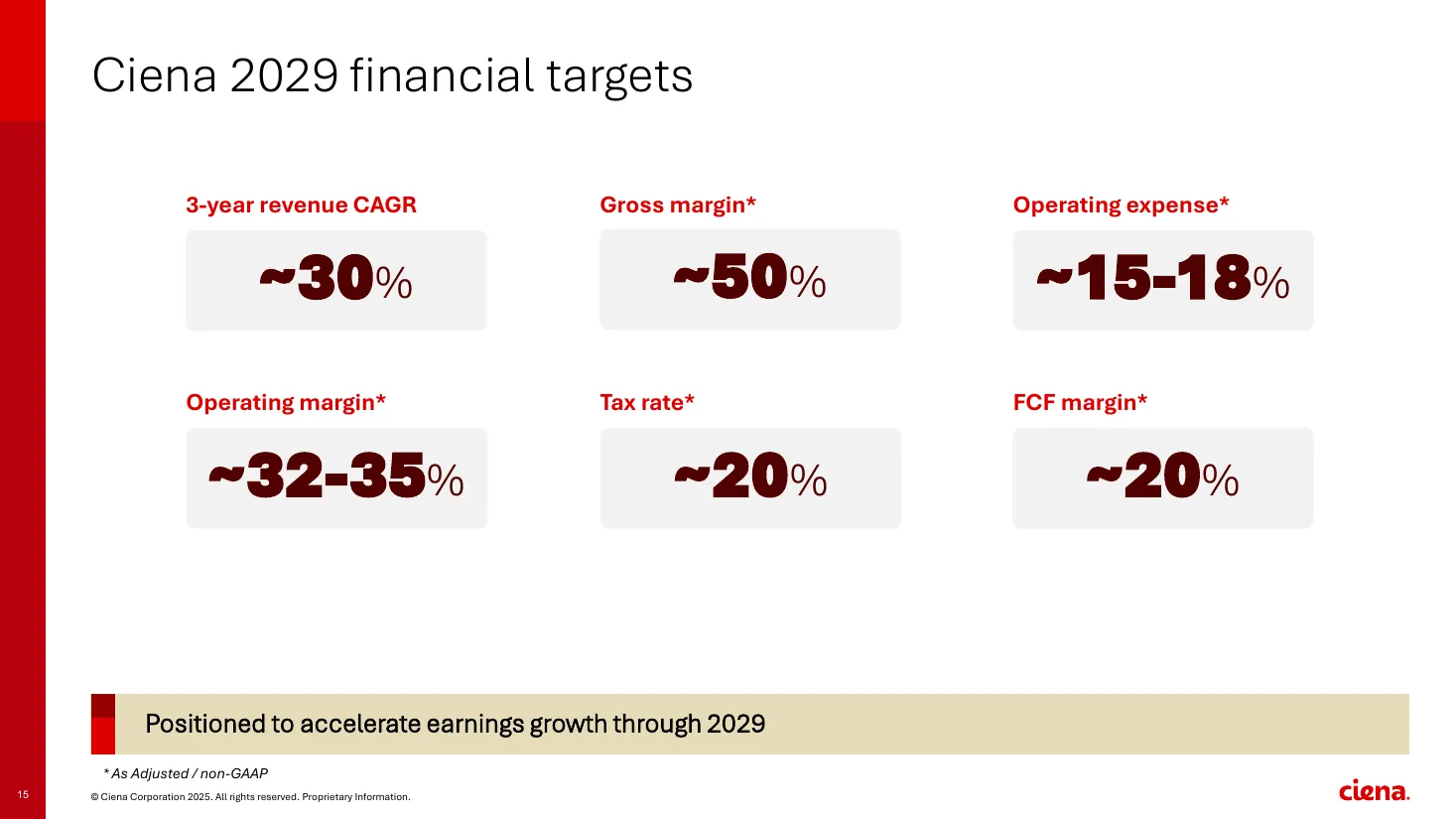
The third change happened in the last month. On September 3 Ciena printed a record quarter, gave a first look at FY27 of at least 30% growth, and the stock fell 10.4% to $317.46. Thirteen days later, at an investor forum in Ottawa, management published three-year targets that nobody had modelled: a roughly 30% revenue CAGR to about $14B in FY2029, about 50% adjusted gross margin and 32–35% adjusted operating margin. The stock has recovered to $351.82, still 45% below the June high of $637.51. In June the market was paying about 75 times this year's earnings for the story. Today it pays about 29 times our estimate of next year's earnings for a company that has since raised its FY26 outlook again and published a three-year plan. That gap is what we are writing about.
The company that owns the road between AI data centers
Ciena owns the two pieces of hardware every scale-across link needs, the coherent modem and the line system that carries it, and it leads in selling both to the hyperscalers that are now 53% of its revenue (it is first in data center interconnect by Dell'Oro's count); with backlog heading past $10B and supply secured for 30% annual growth through 2029, the next three years are set by how fast it can build, not by whether anyone will buy.
A cyclical telecom vendor becomes a capacity-constrained AI supplier
Ciena sells finished networks. A customer buys line systems and modems (Networking Platforms, 81.1% of Q3 revenue), software to run them, and installation and maintenance (Global Services). The money is made on hardware, and almost all of the growth is coming from one place: in Q3 FY26 Optical Networking was $1,191.3M, 71.3% of revenue against 66.9% a year earlier, and it produced $375.8M of the $451.7M increase in total revenue, 83.2% of all growth. Routing and Switching was 9.8% of revenue (+$38.5M), Global Services 11.6% (+$33.4M), Platform Software 5.9% (+$8.6M), and Blue Planet automation software 1.4% and shrinking (−$4.6M). This is a single-engine company in a multi-segment income statement, and the engine is optical.
By customer, the mix moved even faster: cloud providers went from 40% to 53% of revenue in four quarters, service providers to 37%. By region the Americas were 79%.
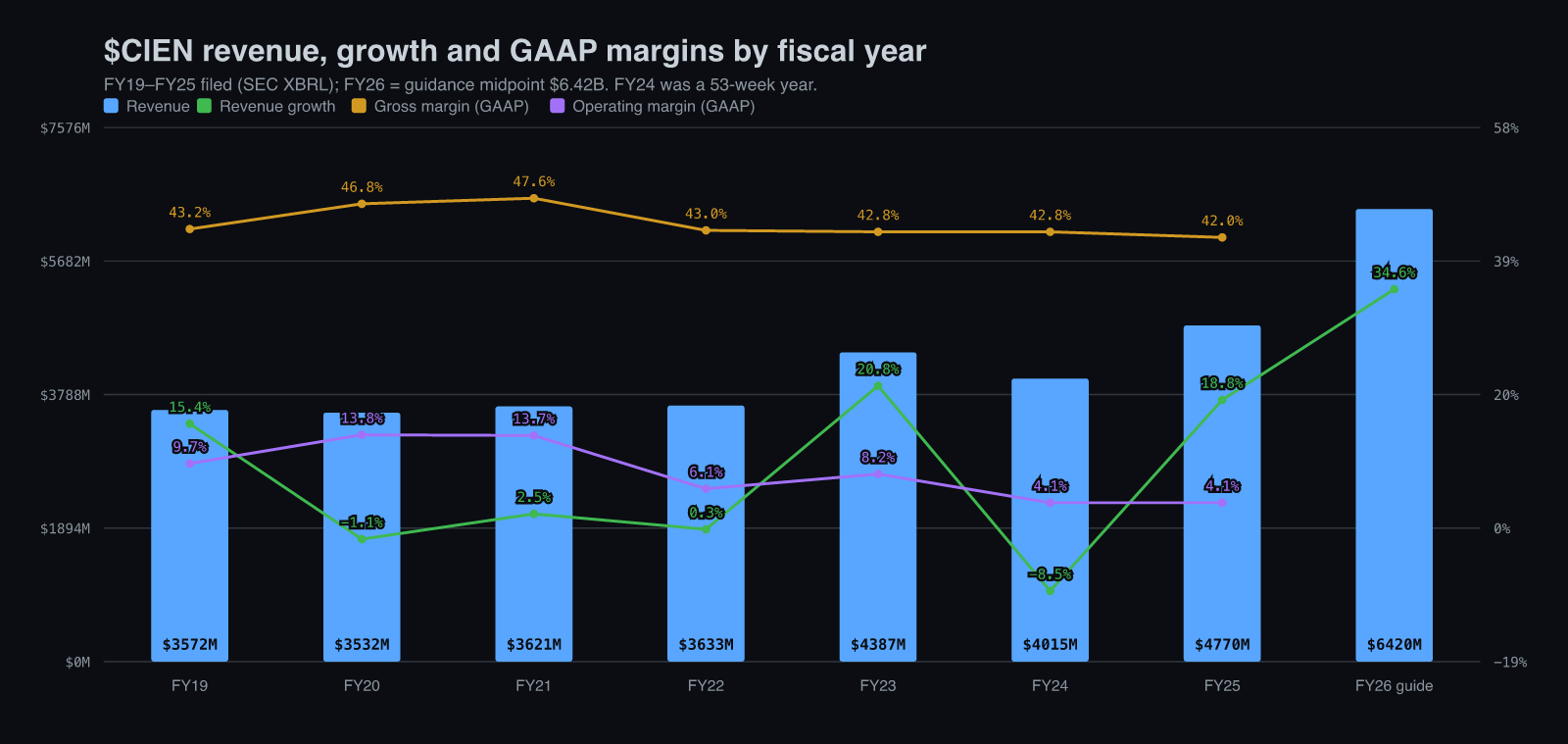
The long record explains why the market spent years pricing this as a telecom cyclical. Revenue was $3.57B in FY19, $3.53B in FY20, $3.62B in FY21, $3.63B in FY22, $4.39B in FY23, $4.01B in FY24 and $4.77B in FY25, with growth of 15.4%, −1.1%, 2.5%, 0.3%, 20.8%, −8.5% and 18.8%. Over the same years GAAP gross margin ran 43.2%, 46.8%, 47.6%, 43.0%, 42.8%, 42.8% and 42.0%, and GAAP operating margin 9.7%, 13.8%, 13.7%, 6.1%, 8.2%, 4.1% and 4.1%. FY26 is guided at $6.42B, +35%. (FY24 was a 53-week year, which flatters FY24 and understates FY25 growth by roughly two points.)
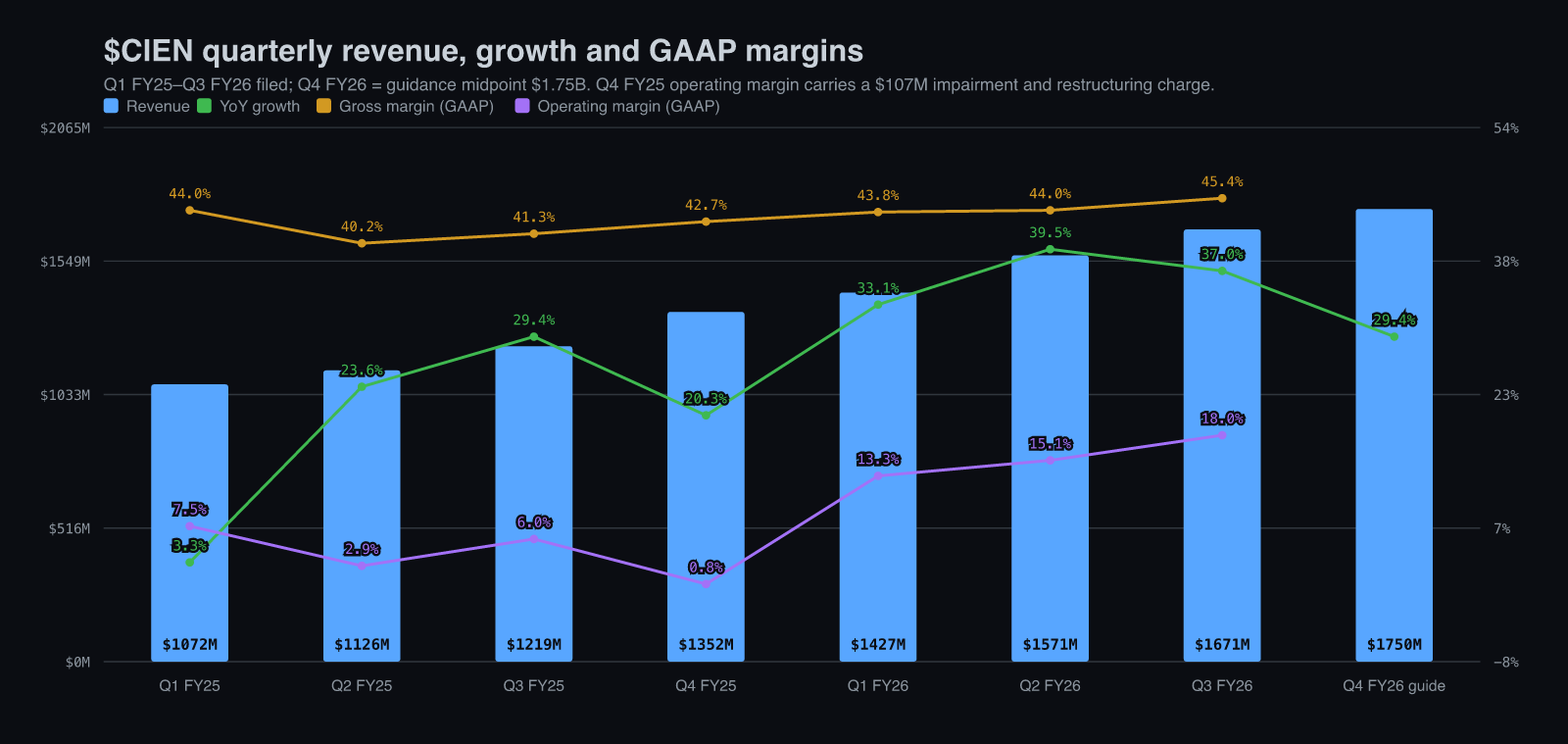
The quarterly series is where the turn shows. Revenue went $1,072M, $1,126M, $1,219M, $1,352M, $1,427M, $1,571M and $1,671M from Q1 FY25 to Q3 FY26, growth of 3.3%, 23.6%, 29.4%, 20.3%, 33.1%, 39.5% and 37.0%, with Q4 guided at $1.75B (+29.4%). GAAP gross margin climbed from a 40.2% low in Q2 FY25 to 41.3%, 42.7%, 43.8%, 44.0% and 45.4%, and GAAP operating margin from 2.9% to 18.0% (Q4 FY25's 0.8% carries a $107M impairment and restructuring charge). On the adjusted basis management guides to, gross margin went 41.9%, 43.4%, 44.7%, 44.9%, 46.4% over the last five quarters and operating margin 10.7%, 13.2%, 17.9%, 19.5%, 22.5%. Margins rising with volume, not against it, is the opposite of what a vendor fighting for share looks like.
Cash is the part that lags, and it lags for a reason we can see. In the first nine months of FY26 operating cash flow was $683.6M against net income of $634.9M, and after $194.9M of capital spending free cash flow was $488.7M. Q3 alone produced only $196M of operating cash and $116M of free cash flow against $266.4M of net income, because receivables rose $251.5M and inventory $118.3M over nine months to feed a backlog the factories cannot clear. Management has warned that Q4 operating cash will fall as payments go out under new supply agreements running through 2029. A company paying up front for components it will turn into revenue in FY27 and FY28 is a different situation from one whose customers are slow to pay; days sales outstanding actually fell from 88 to 76 over the year.
The market Ciena is chasing, by its own count built on Cignal AI, Dell'Oro, LightCounting, Omdia and 650 Group forecasts, grows from $27B in 2026 to about $52B in 2029: traditional network markets $21B to $26B, AI-WAN (data center interconnect and scale-across) $7B to $14B, and markets inside the data center to $12B. The first is the base, the second is where Ciena already leads, and the third is the option. Gage gave an illustrative size for one scale-across project: a 500,000-GPU cluster needs about $500M of optical connectivity, roughly $1,000 per GPU, before any inline amplifiers, and stretching the same link to 1,000 km doubles it.
The modem, the line and the 70%
Ciena's moat is two technologies that are each hard, and much harder together.
The first is the coherent modem. Encoding data in the phase and amplitude of light, then recovering it after hundreds of kilometres of glass have smeared it, takes a custom signal-processing chip built on the most advanced silicon nodes and years of algorithms. WaveLogic 6 Extreme runs at 1.6 terabits per second per wavelength, and Gary Smith said on the Q3 call that after 18 months it "is still the only 1.6 Tb high performance modem on the market today", with a ramp already larger than its predecessor's. Doubling the bits per wavelength halves the number of modems, the rack space and much of the power per bit, which is exactly what a power-limited data center operator is buying. The same design team produces WaveLogic 6 Nano, an 800G pluggable module that drops into a router or switch: Ciena shipped more than twice as many 800ZR plugs in Q3 as in Q2, and in Q2 it won a hyperscaler that is integrating WaveLogic 6 Extreme into its own platform, which management called a takeaway from a component competitor.
The second is the line system. RLS is the set of amplifiers, wavelength switches and monitoring that sits along the fiber and keeps every colour usable over distance. Management puts its share of disaggregated line systems at roughly 70% and calls it the first system deployed for scale-across. Hyper-Rail, its successor, attacks the physical limit that AI made binding: the amplifier huts along a route were built for a few fiber pairs, and a scale-across link wants dozens. A multi-rail system runs many fiber pairs in parallel through shared amplification and monitoring, so the operator adds capacity without building new huts. Ciena has two multi-rail wins, the first in Q2 FY26 and a second in Q3, and expects customer standardization by the end of 2026. At the September investor forum Brodie Gage, Ciena's chief product and technology officer, said the first Hyper-Rail release targets a 32-fold improvement in amplifier density, and gave one hyperscaler's 80 km scale-across route as the reason: more than 20 petabits per second, needing over 400 fiber pairs. By Dell'Oro's count through Q2 2026, Ciena has recognized 4.5 times the photonics revenue of its nearest systems competitor and gained 25 points of share in four years.
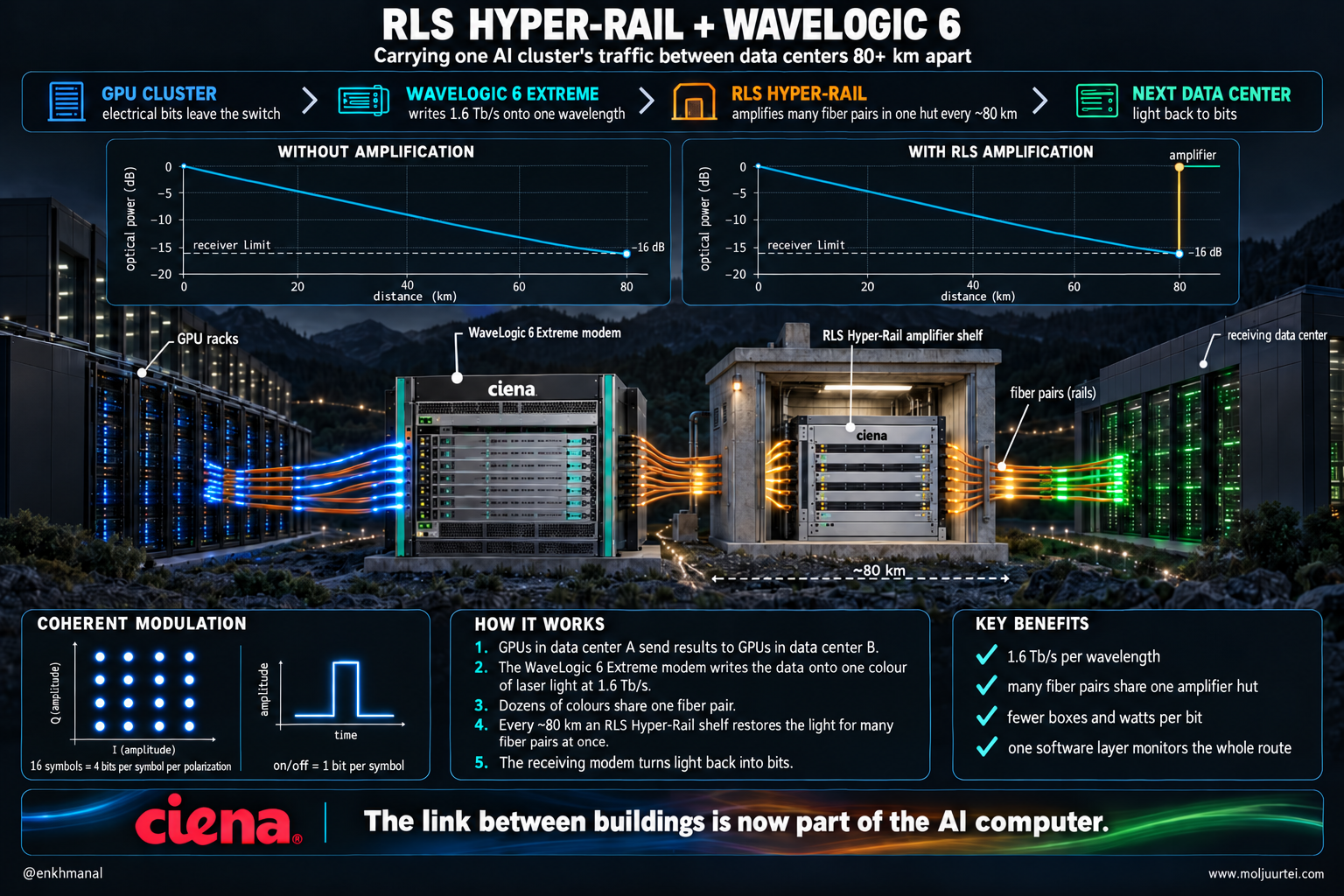
What makes the combination hard to copy is the part that does not show up in a parts list. Scott McFeely, a Ciena executive advisor, put it on the Q2 call when asked whether component makers could move up into systems: the hard part is "the software that goes around the control of that... the integration in the back office systems... the services to be able to service these networks 24/7, 365 days a year around the world." Coherent's own Q4 FY26 call introduced a Multi-Rail product line and sized it at more than $2B by calendar 2030, so the component makers are coming. What they bring is a line card. What Ciena sells is a route that works on day one and is monitored for ten years.
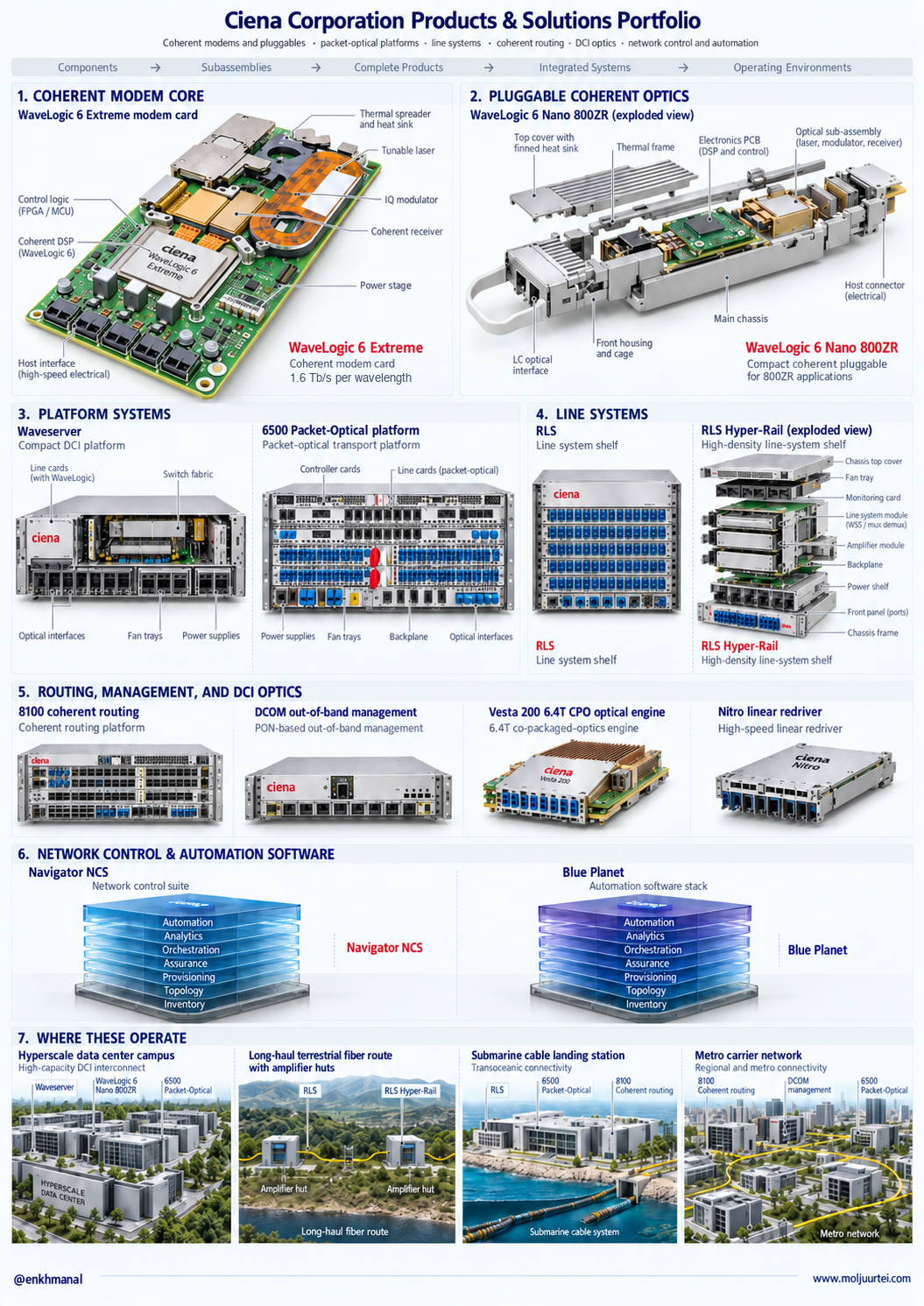
Ciena does not own a semiconductor or laser fab, and that is a real difference from Nokia, which bought Infinera's indium-phosphide fabs in 2025. It means Ciena buys lasers, pump lasers and modulators from suppliers, and today those suppliers are the binding constraint. It also means Ciena has spent its money where the switching cost lives: in the DSP, the system and the software.
Hyper-Rail in 2027, optics inside the data center in 2028
The next two years have three dated product ramps, each sourced to management's own words.
Hyper-Rail is the near one. Graff on the Q3 call: "That ramp in 2027 will be to several hundred million dollars... it probably could be faster if we could get more components," and its margins will be "a step function" above RLS. It is accretive to the company and it is already in backlog: Smith said there are "a number of new wins for Hyper-Rail that we will begin to ramp up during 2027."
Inside the data center comes next. Ciena bought Nubis Communications in October 2025 for its optical engines. Two products came out of it: Nitro, a linear redriver chip for active copper cables, slated for general availability this summer, and Vesta 200, a 6.4-terabit optical engine for co-packaged optics that management describes as the industry's first open, pluggable CPO solution. Vesta received sample orders from "several anchor customers" in Q3, and the investor deck puts first samples shipping in Q4 2026 into an $8B 2029 market. Short-reach "coherent-lite" modules, which bring the WaveLogic approach inside the building at shorter distances, are slated for adoption in late 2027 to early 2028 into a $3B-plus market. Management said its FY2029 plan takes a "relatively modest approach" to these products, so they are upside to the target rather than load-bearing for it.
Funding is not the constraint. Ciena plans $2.5–3B of R&D through 2029, roughly half of its 9,000 employees are in R&D, and the June convertible raised $2.875B at a zero coupon and an initial conversion price of $746.66, retiring a 5.5% term loan. In September it also launched a $200M Ciena Ventures fund. From Q1 FY27 Ciena will report four new segments, Optical Systems, Interconnects, Global Services and Routing and other, which will let investors see the data-center business grow on its own line for the first time.
Why the market sold the best quarter in Ciena's history
The selloff on September 3 was a reaction to a number that looked like deceleration: FY26 is growing 35%, and the first FY27 outlook said "at least 30%". The setup is that the FY27 number is a supply floor rather than a demand forecast, and this management team's floors have a record of moving up.
It would be greater than that if supply was greater... We have, we think at least a $10 billion backlog as we leave this year. In the midpoint of what Marc was talking about, you are looking at revenues of $8.3 billion, $8.4 billion as a sort of baseline for us for next year. It would be greater than that if we had more supply. The demand is absolutely there.
The record is worth laying out. In December 2024 Ciena guided FY25 growth of 8–11% and delivered 18.8%. For FY26 it discussed about 17% in September 2025, guided $5.7–6.1B in December, $5.9–6.3B in March, $6.3B in June and $6.42B in September: four raises in four quarters. The pattern says these are numbers set by what the supply chain has committed to deliver, and that supply has repeatedly come in better than planned.
Three things make the earnings growth faster than the revenue growth. Price: Graff said customers are accepting increases from "high single digits" to "high teens, low 20s", some of it applied to existing backlog. Mix: Hyper-Rail and the data-center modules carry higher margins than the systems they extend. Leverage: operating expense was $400M in Q3 against $380M a year earlier while revenue rose $452M. The investor-forum plan turns those three into numbers: adjusted gross margin from the 45–46% FY27 floor to about 50% by 2029, operating expense at 15–18% of revenue, and operating margin of 32–35%.
The peers on either side of the invoice confirm the demand. $COHR (Coherent), which sells pump lasers and DCI transceivers into this chain, grew communications revenue 56% year on year in its June quarter and said orders extend into calendar 2028. $LITE (Lumentum) reported fiscal Q4 revenue of $1.01B, up 109%. $FN (Fabrinet), which assembles optical modules, put its data center interconnect business at an annualized run-rate above $1B. When the suppliers are this full, a company with a $10B order book and supply agreements through 2029 is not short of demand; it is short of parts, and it has paid to fix that.
A 25-year CEO, a new CFO from Intel's data-center group
The record that matters is the guidance record, and it is good: two consecutive years in which the first number was the lowest one. The caveat is that the CFO who set the 2029 plan has been in the seat for thirteen months, and the plan assumes operating expense falls from about 24% of revenue today to 15–18%. Executives also sell steadily: Form 4 and Form 144 filings clustered in mid-September, consistent with vesting and pre-planned programs rather than a change in view, but a constant supply of insider stock all the same.
Two buyers, a soft order book and a supply chain Ciena does not own
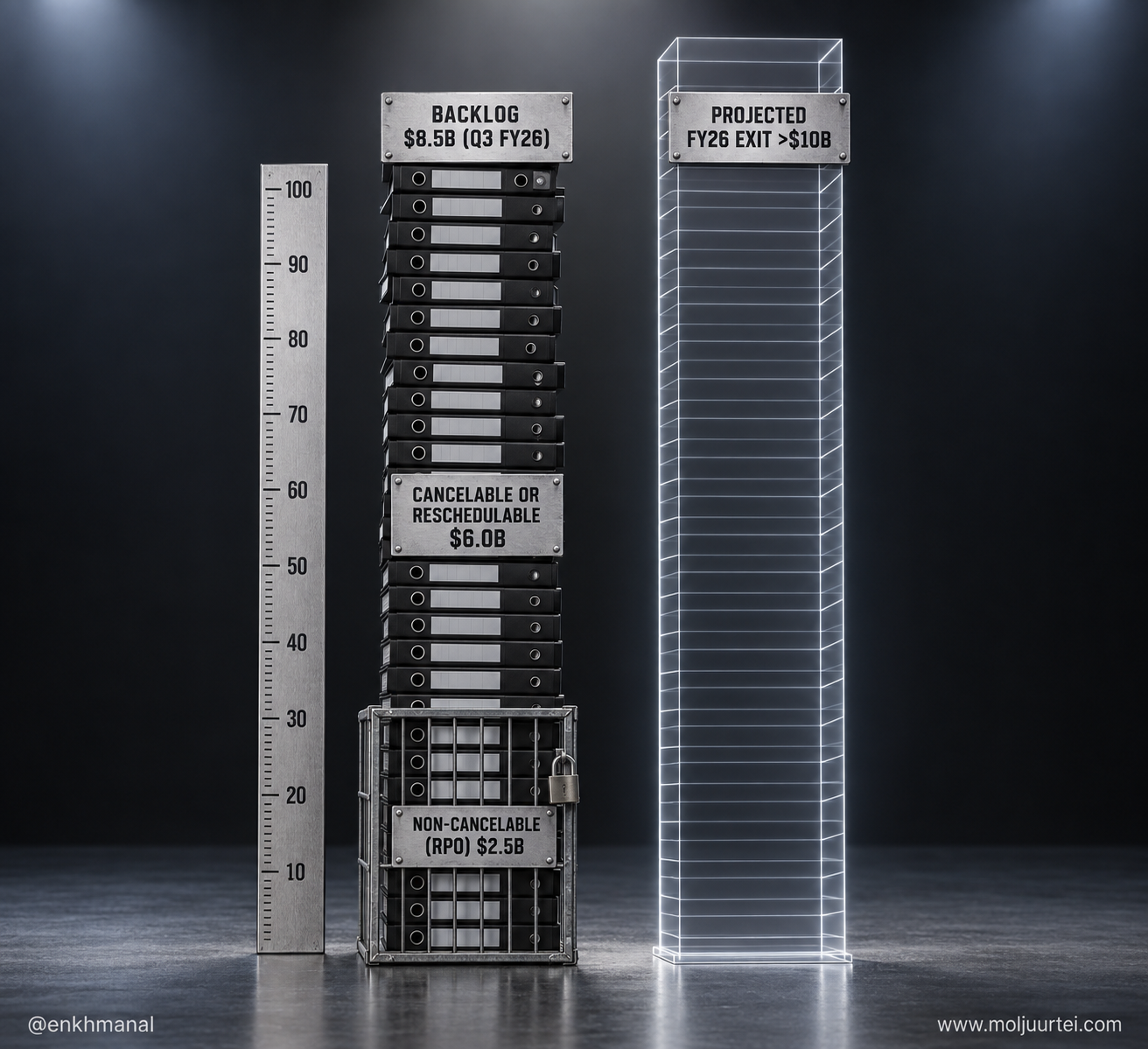
What forces a thesis change: a December print in which backlog comes in below $10B, or the FY27 outlook is not lifted from its $8.3–8.4B floor despite the supply agreements. Either would mean demand, not supply, is setting the pace, and the 2029 plan would need to be re-underwritten from scratch.
A higher low at $320, a ceiling at the 50-day
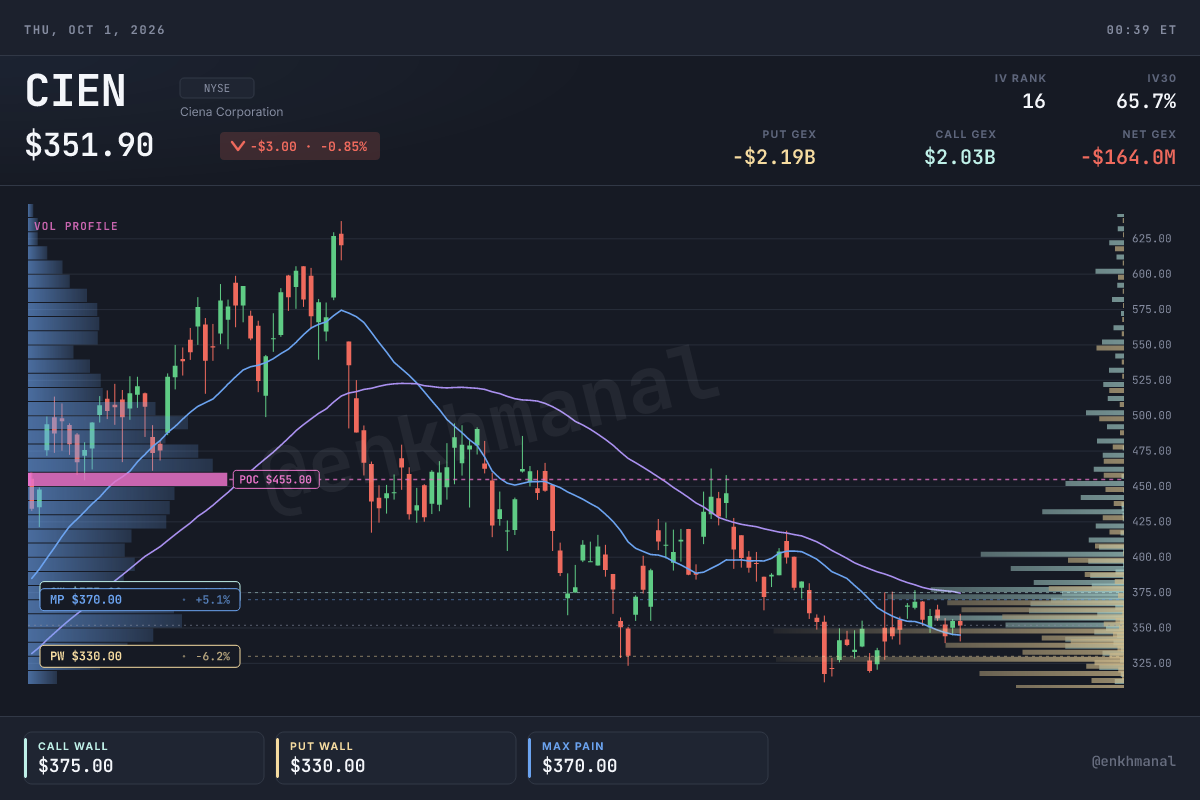
$CIEN closed September at $351.82, above its 20-day average of $345.0 but below the 50-day ($374.6), the 200-day ($389.6) and the 100-day ($434.0). The September 3 low closed at $317.46 and the September 14 retest held at $319.64, a higher low; the bounce after the investor forum carried to $368.56 on September 22 before fading. Daily RSI is 56. The trend is still down on every average that matters, and the stock has to reclaim the 50-day near $375 before the chart agrees with the fundamentals.
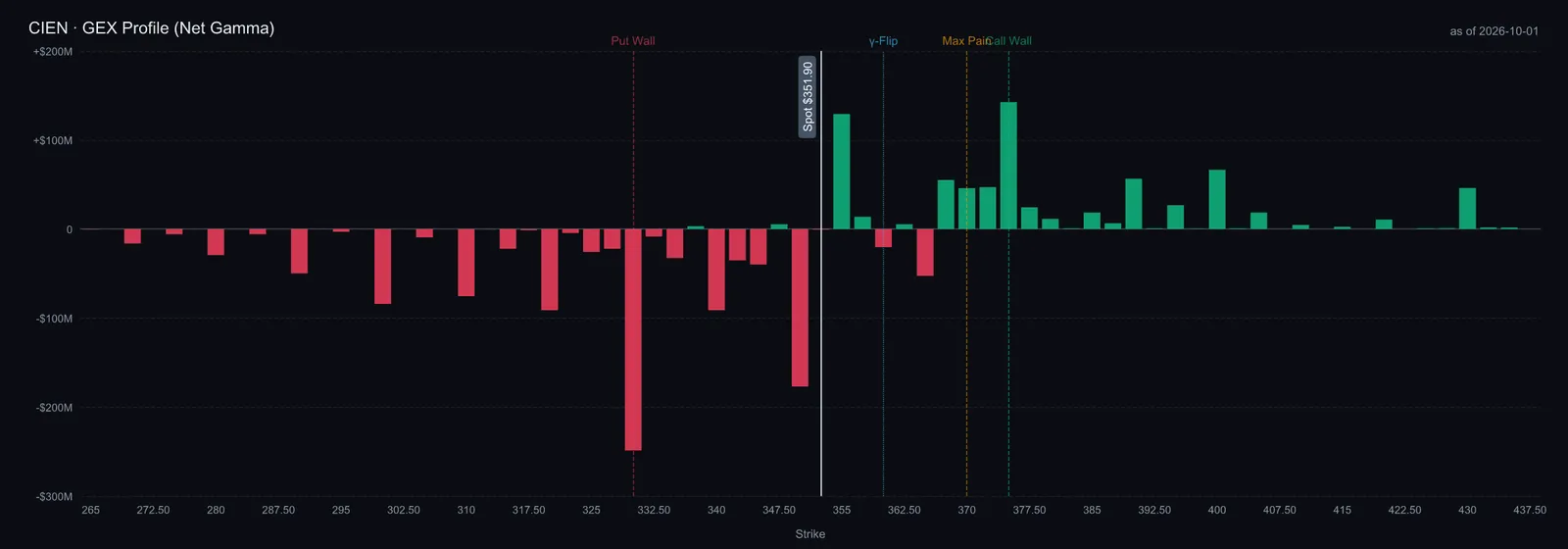
Options positioning frames the same range. The largest put concentration sits at $330, the call wall at $375 coincides with the 50-day average, and max pain is $370. Net dealer gamma is slightly negative at −$164M, so moves are amplified rather than dampened, and implied volatility is about 66% for late-October expiries, high enough that the market expects roughly a 19% move in either direction over a month. The level at which the market is questioning the thesis is the $317–320 double bottom; a close below it would undo the higher low.
Against its peers, $CIEN is up 141% over twelve months but has given back 39% from its May month-end close, the worst drawdown in the group: Nokia is 32% off its high, Coherent 27%, Cisco 11%, while Arista and Lumentum sit at highs.
Paying for the margin plan, not ten years of hypergrowth
The multiple has done most of the falling. On trailing GAAP earnings of $4.48 a share, $CIEN trades at 78.5 times, the 65th percentile of its own five-year range and above its 44.8 times median, but trailing earnings include a year when operating margin was 4%. On our estimate of FY27 adjusted earnings, about $12.00 a share (the $8.35B guide midpoint at a 26% adjusted operating margin, a 20% tax rate and 146M diluted shares), the price is about 29 times. Management's own FY29 plan, $14B at a 33.5% operating margin, works out to roughly $26 a share by our arithmetic. The trailing PEG of 14.5 is meaningless here because the five-year EPS history starts in a trough.
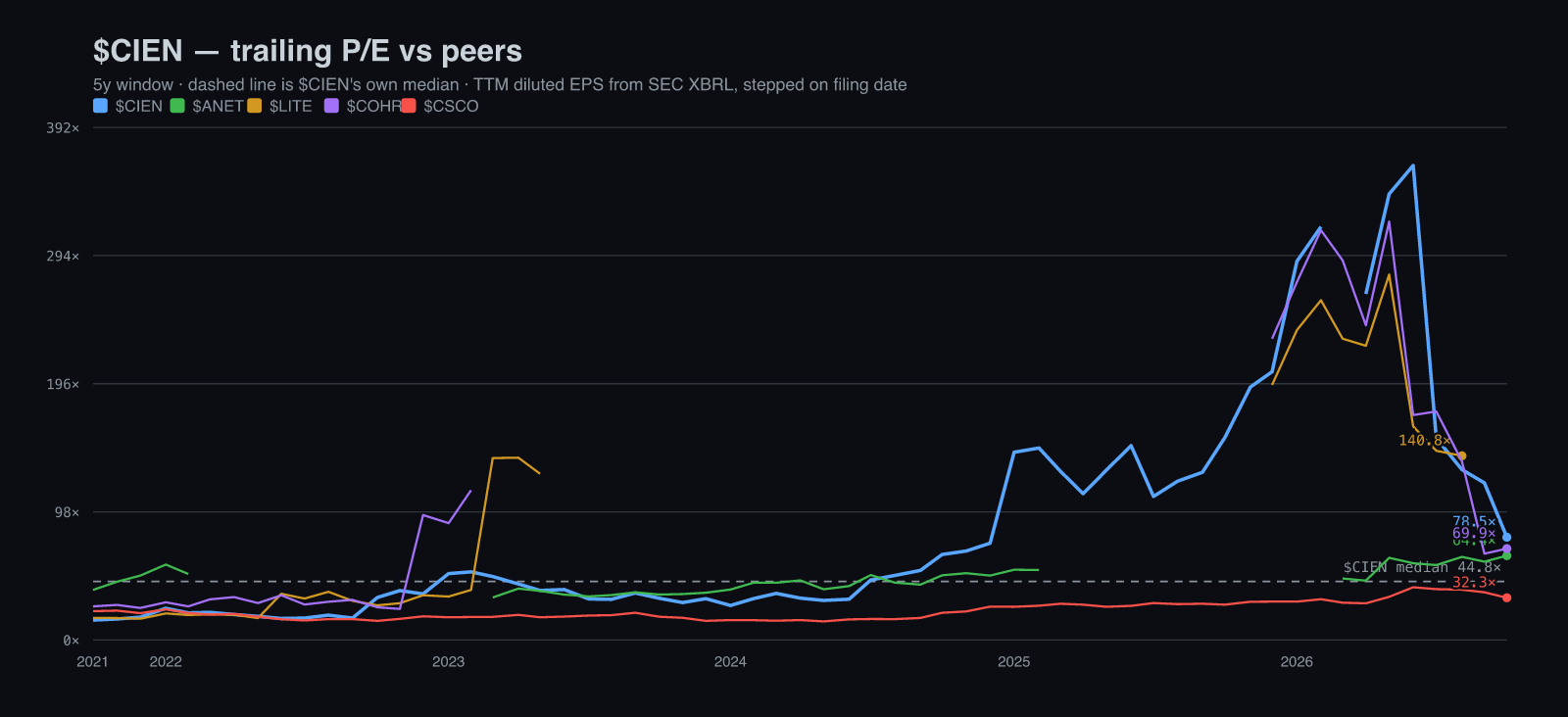
Against peers, the trailing multiples are $ANET 64.4 times, $COHR 69.9 times and $CSCO 32.3 times. On filed EV/EBITDA, $CIEN is 170 times FY25 and 35.8 times our FY26 estimate, while the systems peers cluster near 27 times ($CSCO 27.1, $FN 28.3, $NOK 26.7) and $ANET sits at 63.4. Twenty analysts cover the stock with targets from $347 to $660, a median of $536.50 and sixteen buy ratings.
Our valuation model is built from management's guidance for FY26 and FY27 ($6.42B, then +30.1%), fades growth to 4% by FY35, and holds the cost ratios Ciena actually files: GAAP gross margin 44.5% (the nine-month FY26 figure), R&D at 18% of revenue, cash tax 21%, working capital at 26.4% of each new dollar of revenue, a 10% discount rate. On that build the perpetuity method gives $219.41 a share and the exit method, at the 27.1 times median EV/EBITDA of Cisco, Fabrinet and Nokia, gives $553.07. The two are 2.5 times apart, and that disagreement is the finding rather than something to average. The perpetuity holds Ciena's GAAP operating margin at about 19.6% forever and its free-cash-flow margin between 8% and 14%; management's plan is a 20% free-cash-flow margin by 2029. A reverse DCF on the same cost structure says the current price needs about 33% growth for ten straight years. In other words, the price is not paying for ten years of hypergrowth at today's margins; it is paying for the margin plan. The model's audit passes every rule except that method gap, which we have stated here.
The probability-weighted value is about $419, 19% above the price. We think Ciena is a business worth owning for the next three years: the network is the part of the AI buildout that has to catch up, Ciena is the company it is catching up with, and the stock has given back 45% while every forward number went up. Start a position around $330–350, where the put wall and the September lows sit, and add on the December print if backlog clears $10B and the FY27 floor moves up. Our two-year base target is $425.
(via Asymmetrical Bets, Gaetano Research and Aurelion Research; all figures independently verified against Ciena's filings, earnings calls and investor-forum materials.)