
$BFLY Deep Dive — Butterfly Put Ultrasound on a Chip; Now Other Companies Are Building on It
Butterfly Network sells a handheld ultrasound probe that plugs into a phone. That much has been true since 2018, and for most of the time since, the stock treated it as a medical-device company that grew slowly and lost money. What changed in the last eleven months is who else wants the chip inside the probe. Midjourney, the AI image company, licensed it in November 2025 and in June showed a whole-body scanner built from 40 of them. Sam Altman's brain-computer interface company, Merge Labs, signed in September. Mendaera's robotic needle-guidance system went on sale with it on 1 October. Butterfly is the only company that has put an entire ultrasound machine on one semiconductor chip and sold it at scale, and that chip is turning into a platform other companies license, pay for, and build products on.
The stock has noticed: $8.95 on 2 October, up from $1.90 the day after the Midjourney deal, a $2.4B market cap at about 20 times this year's guided revenue. The part the market is paying for is still small. In the second quarter the core probe-and-software business grew 2% and Embedded licensing grew 439%, almost all of it from one partner. We would own it, sized as an option on the platform, and we explain below what has to happen for the price to work and where we would add.
What Changed — From a Crystal to a Chip
Start here. A sound wave is a pressure wave, and when it crosses from one material into another, part of it bounces back. An ultrasound wave is sound pitched far above human hearing, between about 1 and 15 million cycles a second, where the waves are short enough to resolve millimetre-scale structures inside the body. A transducer is the part that turns an electrical pulse into that sound and the returning echo back into electricity. An ultrasound machine is an array of transducers plus the electronics that fire thousands of pulses a second, time every echo, and turn the delays into a picture: soft tissue grey, fluid black, bone bright white.
For 70 years the transducer has been a crystal. In 1880 Pierre and Jacques Curie found that certain crystals produce a voltage when squeezed and change shape when charged, the piezoelectric effect. Karl Dussik pointed ultrasound at the human brain in 1942, Ian Donald published the first images of abdominal masses in The Lancet in 1958, and from there the crystal probe became one of medicine's most used instruments. Its limits are physical. Each crystal is cut for one frequency band, so a hospital needs a linear probe for veins, a curved one for the abdomen and a phased one for the heart. The crystals are hand-assembled and wired to a cart that carries the electronics, which is why a cart system costs tens of thousands of dollars and stays in the radiology department.
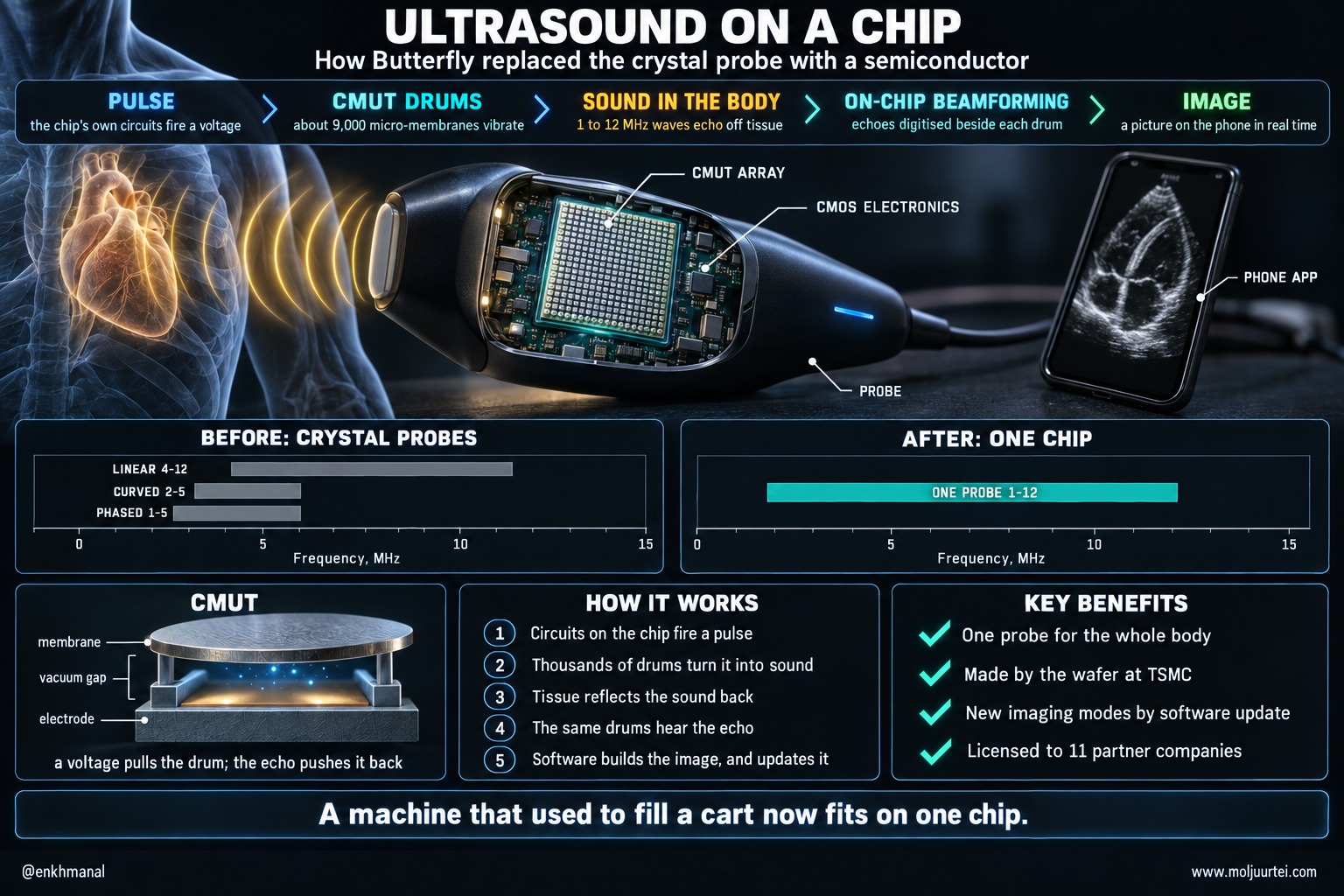
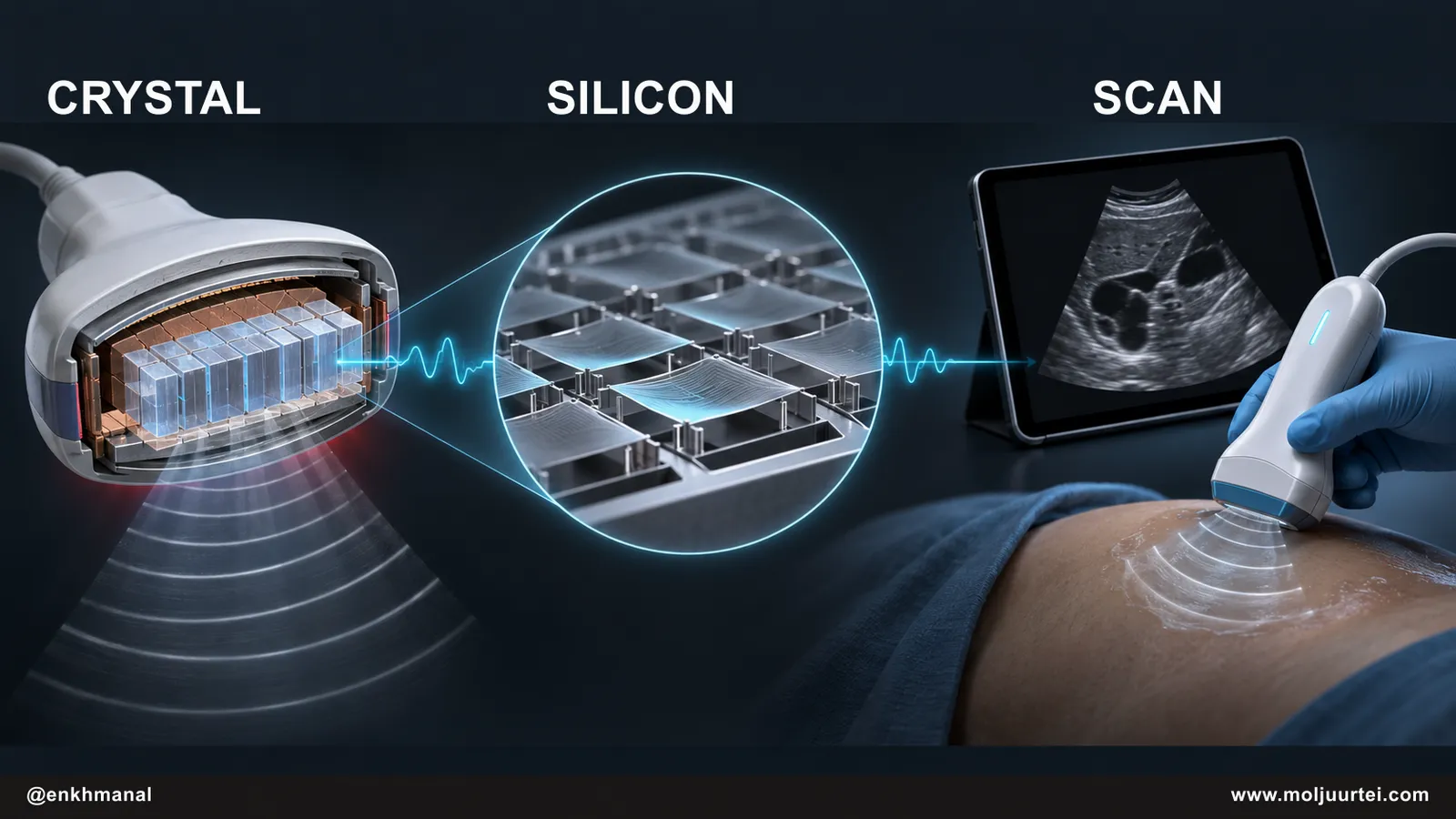
A capacitive micromachined ultrasonic transducer, or CMUT, does the same job with a drum instead of a crystal: a membrane a few microns across is suspended over a vacuum gap and pulled by a voltage, so it vibrates and listens. Butrus Khuri-Yakub's group at Stanford demonstrated the idea in 1994. Because a CMUT is etched rather than cut, thousands of them can be printed straight onto a computer chip that also carries the electronics. Jonathan Rothberg, who had already built two DNA-sequencing companies on the same move from bench chemistry to semiconductors, founded Butterfly in 2011 to do exactly that. The result, cleared by the FDA in 2017, put roughly 9,000 elements and the beam-forming electronics on one stamp-sized chip, and replaced the three-probe set with one probe that a software update can re-tune across about 1 to 12 MHz (PNAS, 2021).
Three things changed between November 2025 and October 2026. A well-funded technology company paid $74M over five years for exclusive use of the chip in one field, and showed the world what 40 of them can do together. Two more classes of buyer arrived: brain-computer interface companies, of which Merge is the fourth or fifth, and medical-device makers such as Mendaera that want imaging inside their own product. And Butterfly began reporting Embedded as its own line, so for the first time we can see how much of the company is the probe and how much is the chip.
Thesis
Butterfly has spent $300M and 15 years turning ultrasound into a semiconductor, and the payoff is arriving from a direction the market did not price: other companies now license that chip to build products Butterfly would never build itself, from a whole-body scanner to a brain interface, while the next-generation probe due in early 2027 aims the same chip at the hospital cart market.
We are not buying a handheld probe company that might grow faster. We are buying the company that owns the technology everyone building semiconductor ultrasound has to license or design around, at the moment the first products built on it go on sale.
Business & Backdrop — Two Businesses Under One Ticker
Butterfly reports two lines. Core is everything it sells itself: the iQ3 and older iQ+ probes, the membership software that runs on the phone, Compass AI (the enterprise system that lets a hospital manage, document and bill point-of-care scans), training, and from the fourth quarter a home-care service for nursing facilities. Embedded is everything it sells to other companies: one-time development fees, annual licence fees, paid engineering work and chips. Revenue was $97.6M in 2025 and is guided to $119M–$123M in 2026, up 22%–26% (Q2 2026 release).
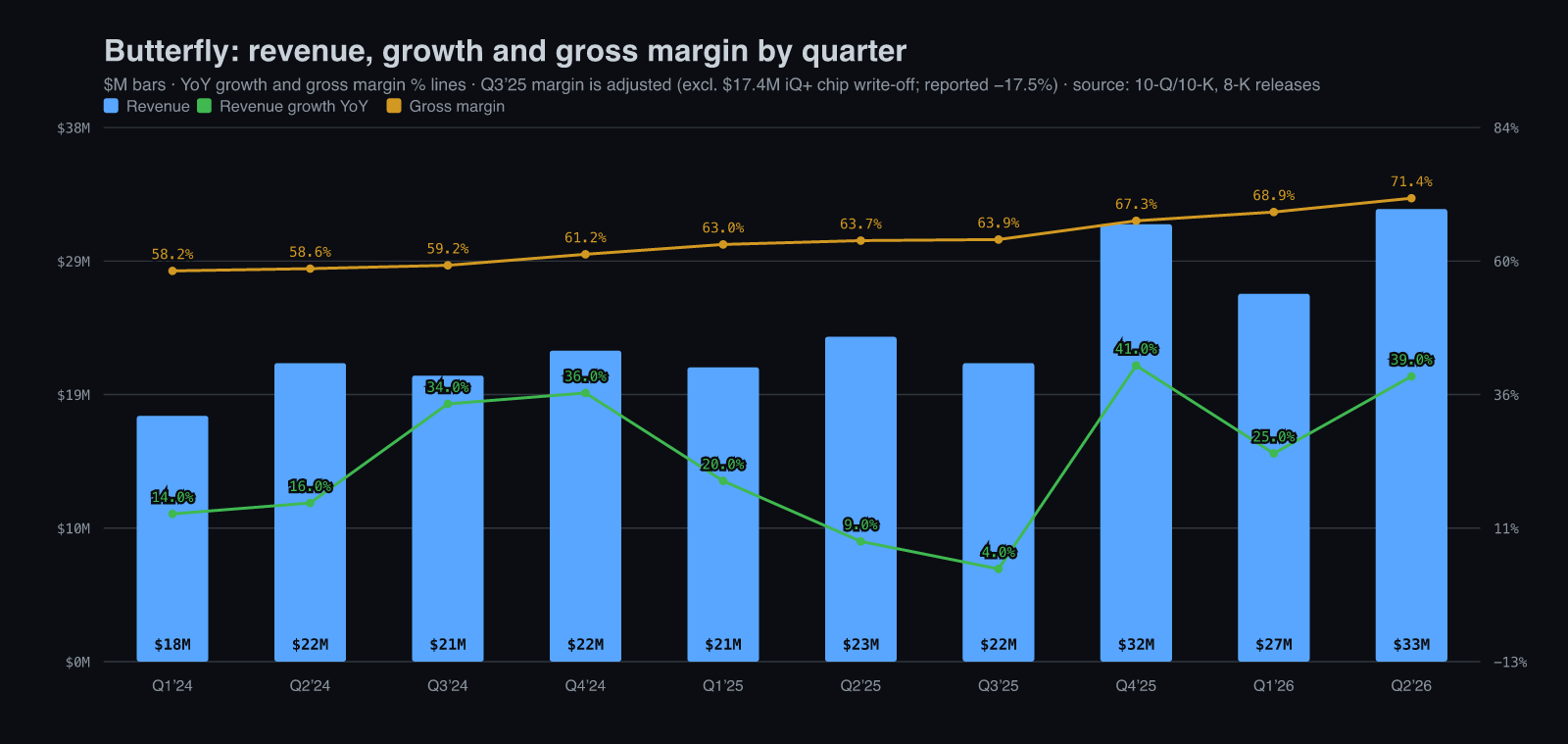
The split is the most important number in the company, and the headline hides it. Second-quarter revenue rose 39% to a record $32.6M. Core was $21.9M, up 2%; Embedded was $10.8M, up 439%, mostly Midjourney (10-Q, Q2 2026). Core did better earlier in the year, up about 10% in the first quarter and 15% in the fourth quarter of 2025, and the second quarter carried a deliberate subsidy: Butterfly sold discounted iQ+ probes to the Edward Via College of Osteopathic Medicine to win a four-year, $10M-plus contract and clear old inventory, which cut the average selling price by 12% while units rose 23%. Even so, the core business is a single-digit grower today. Embedded rose from 9% of revenue in the second quarter of 2025 to 33% of revenue a year later, and core fell from 91% of revenue to 67% of revenue; Embedded supplied $8.8M of the $9.2M of growth.
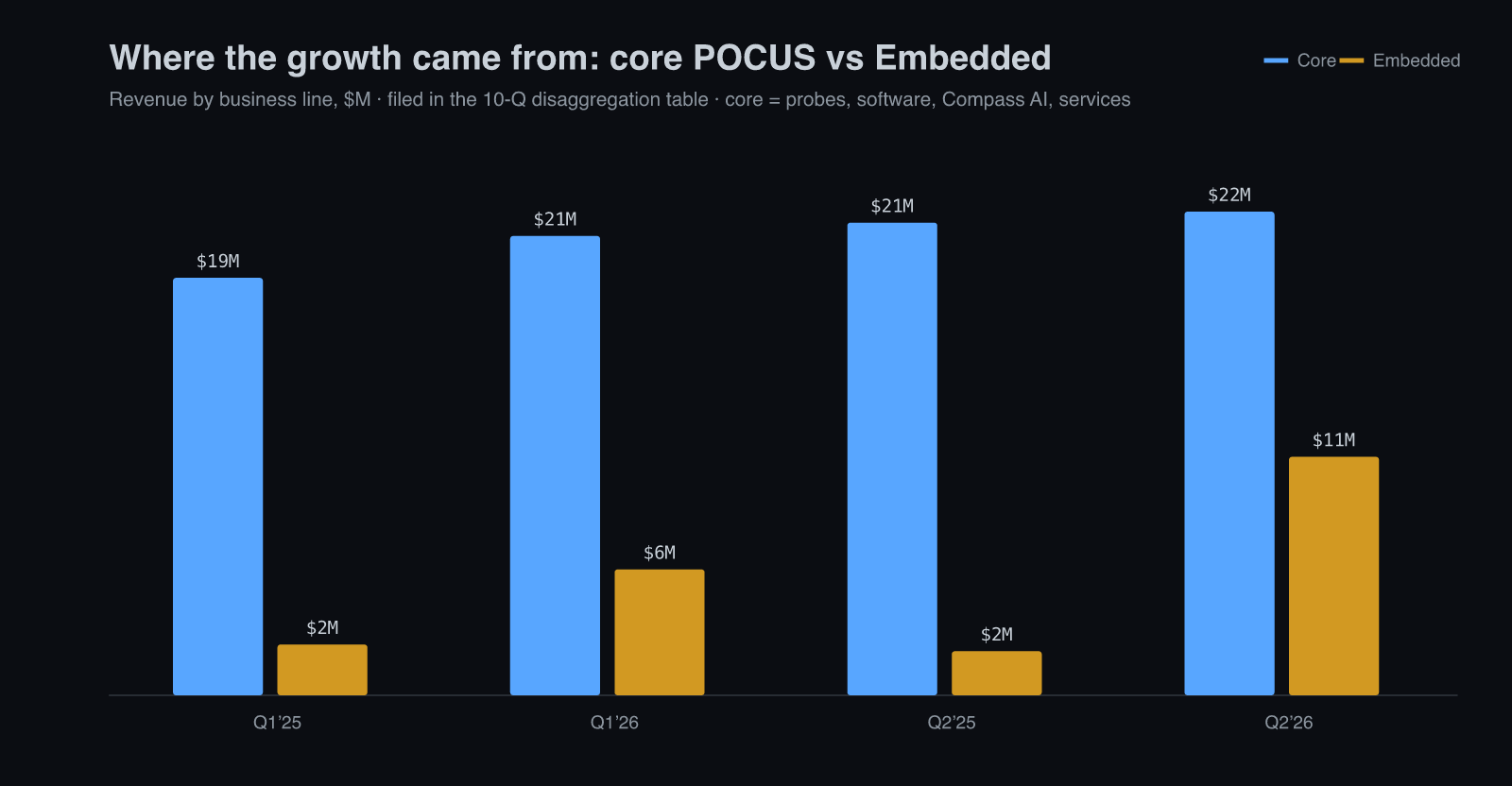
The annual record explains the stock's history. Revenue grew only 56% in four years after the 2021 listing, gross margin swung with two inventory write-offs, in 2023 and in 2025, and the operating cash burn of $189M in 2021 forced the cuts that took it to $13M in 2025. Quarterly, the turn is clearer: revenue growth ran 20%, 9% and 4% in Q1, Q2 and Q3 of 2025, then 41%, 25% and 39% in Q4 2025, Q1 2026 and Q2 2026 once Midjourney paid, while gross margin climbed from 63.0% in Q1 2025 to 67.3%, 68.9% and 71.4%. Cash and profit do not line up, and the gap runs both ways. In 2025 the net loss was $77.1M but operating cash flow was only −$12.8M, because the $17.4M write-off cost no cash and Midjourney paid $17.5M while only $6.8M was booked as revenue. In the first half of 2026 that reversed: the net loss was $25.6M and operating cash flow −$30.2M, as $10.6M of prepaid deferred revenue was recognised without new cash. Backlog of remaining performance obligations was $85.8M at the end of June, 60% of it due within twelve months.
The market the core sells into is point-of-care ultrasound: a scan done by the doctor at the bedside, in the emergency room or in the field, rather than ordered from radiology. It is a share-taking market. Vscan from $GEHC, Lumify from Philips ($PHG), Clarius and Exo all sell handhelds built on crystals, and the big two own the hospital purchasing relationships and the installed carts. Butterfly's edge is price and breadth, one probe for the whole body at a few thousand dollars plus a subscription, and its installed base: about 150,000 devices shipped, roughly 80,000 active, more than 25 million stored scan clips and a presence in more than 80% of US medical schools, according to the company. Those students are next decade's buyers.
Technology & Moat — Why a Chip Can Replace a Crystal
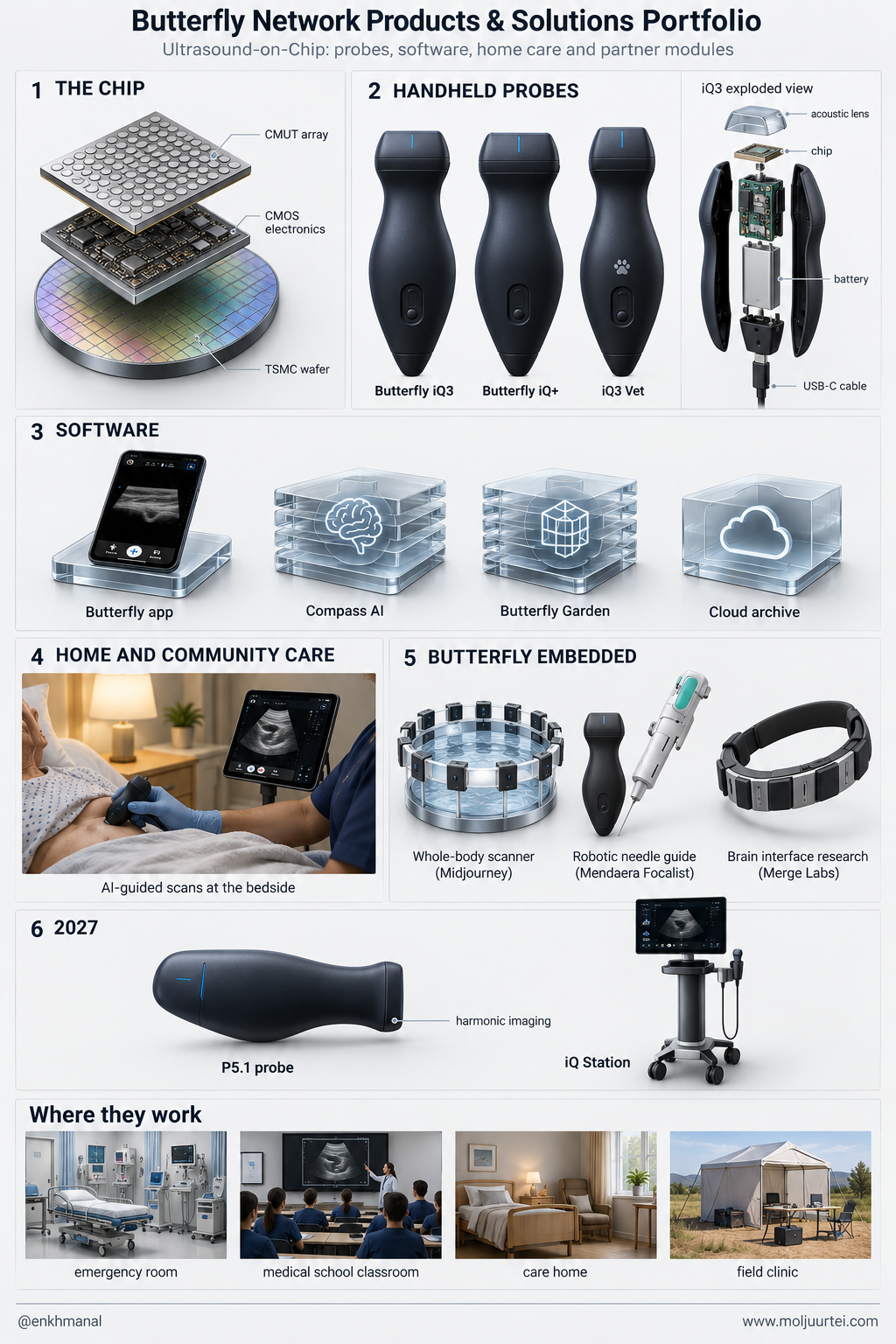
A crystal probe and a Butterfly probe answer the same question differently. The crystal probe is analogue: each element is a separate piece of ceramic wired back to a cart, the cart does the beam-forming, and the frequency is fixed by how the crystal was cut. The Butterfly chip is digital from the first millimetre. Its CMUT drums sit directly on top of a CMOS chip, the same kind of chip that runs a phone, so the pulsers, amplifiers, analogue-to-digital converters and beam-forming logic sit microns from the elements that need them. Three practical advantages follow. One probe covers what used to take three, because the drums can be driven at any frequency in their range. The probe is cheap, because a semiconductor fab, TSMC in Butterfly's case, makes it by the wafer rather than by hand. And it improves by software: the iQ Slice and Fan beam-steering modes released this year shipped to existing probes as an update.
The weakness has always been image quality on hard exams. A drum pushes less acoustic pressure than a crystal, and the cardiology and deep-abdomen presets where that matters are exactly where cart systems still win. The third-generation iQ3 closed most of the gap in 2024. The fifth-generation P5.1 chip, now in production, is built to close the rest: it is the first CMUT chip with harmonic imaging, the technique that listens for echoes at twice the transmitted frequency to cut clutter, and which critics said a CMUT could not do because it needs higher pressure. Management says early P5.1 cardiac images beat crystal handhelds. That is a claim we cannot verify until the probe launches in the first quarter of 2027, and it is the single most important technical claim in the core business.
The moat is not the idea of a CMUT, which is public, but the 15 years of turning it into a product. Butterfly says its first chip cost $300M to make and that it holds about 600 patents. Its partners show what that is worth in practice. Midjourney, which could afford to build its own transducer, licensed Butterfly's instead and put 40 chips around a water tank, roughly half a million acoustic elements in one scanner (haverin). Merge Labs made Butterfly its exclusive chip-based ultrasound partner for brain interfaces, paying upfront and milestone fees, hardware commitments and access fees, with royalties on future sales (Merge Labs release). These are not the customers of a commodity component.
Our fourth-generation chip that will be out next year will be harmonic. We will have proved their hypothesis wrong.
The product line the moat supports is wider than one probe, and the portfolio below lays it out: the iQ3 and iQ+ probes and their veterinary versions, the Compass AI and Butterfly Garden software layers, the Home and Community Care service, the Embedded chip modules partners build into their own systems, and the 2027 additions, the P5.1 probe and the iQ Station cart.
Roadmap & R&D — Harmonics, Apollo and the Cart
The roadmap runs on two chip families. P5.1, the fifth generation, finished development in late 2025 and moved to production; the probe built on it launches in the first quarter of 2027, and the iQ Station, Butterfly's first cart, follows later in 2027. A cart puts the chip on a wheeled stand with a large screen, which is how hospitals buy most ultrasound, and management sizes that market at about $3B of existing revenue. Apollo, the sixth generation, has finished primary design and moved into development. It is built to process 20 times the data of P5.1 and to stream raw data straight into GPUs, which is what a partner reconstructing a whole body from 40 chips needs. Butterfly has committed to deliver Apollo chips to Midjourney by the end of 2027 or early 2028. The nearer dates are smaller: FedRAMP certification for federal sales is guided for the third quarter, and the first home-care revenue and three partner AI apps in Butterfly Garden for the fourth.
The date to watch is Midjourney's, not Butterfly's. Its own announcement says its third-generation scanner in 2028 will use completely custom silicon. Read one way, that is Apollo, the chip Butterfly is building to Midjourney's requirements, and the point at which chip sales and revenue share begin. Read the other way, Butterfly is the bridge for generations one and two and Midjourney moves on, which is the case the haverin newsletter makes (haverin). Butterfly's CFO describes the $74M as the floor and expects the agreement to be extended. We do not know which reading is right, and neither does the market; it is the largest single variable in the Embedded line.
R&D spending fell from $89.1M in 2022 to $36.3M in 2025 as the company cut to survive, and the chip roadmap kept moving anyway. Since the end of 2025 Butterfly has split off a separate team for partner work, paid for by partners, so that Embedded engineering does not pull people off the core roadmap. Management says every partner so far uses the same chips: no custom silicon has been built for any one of them, so each partner's requests improve the platform for all.
The Setup — Why It's Mispriced
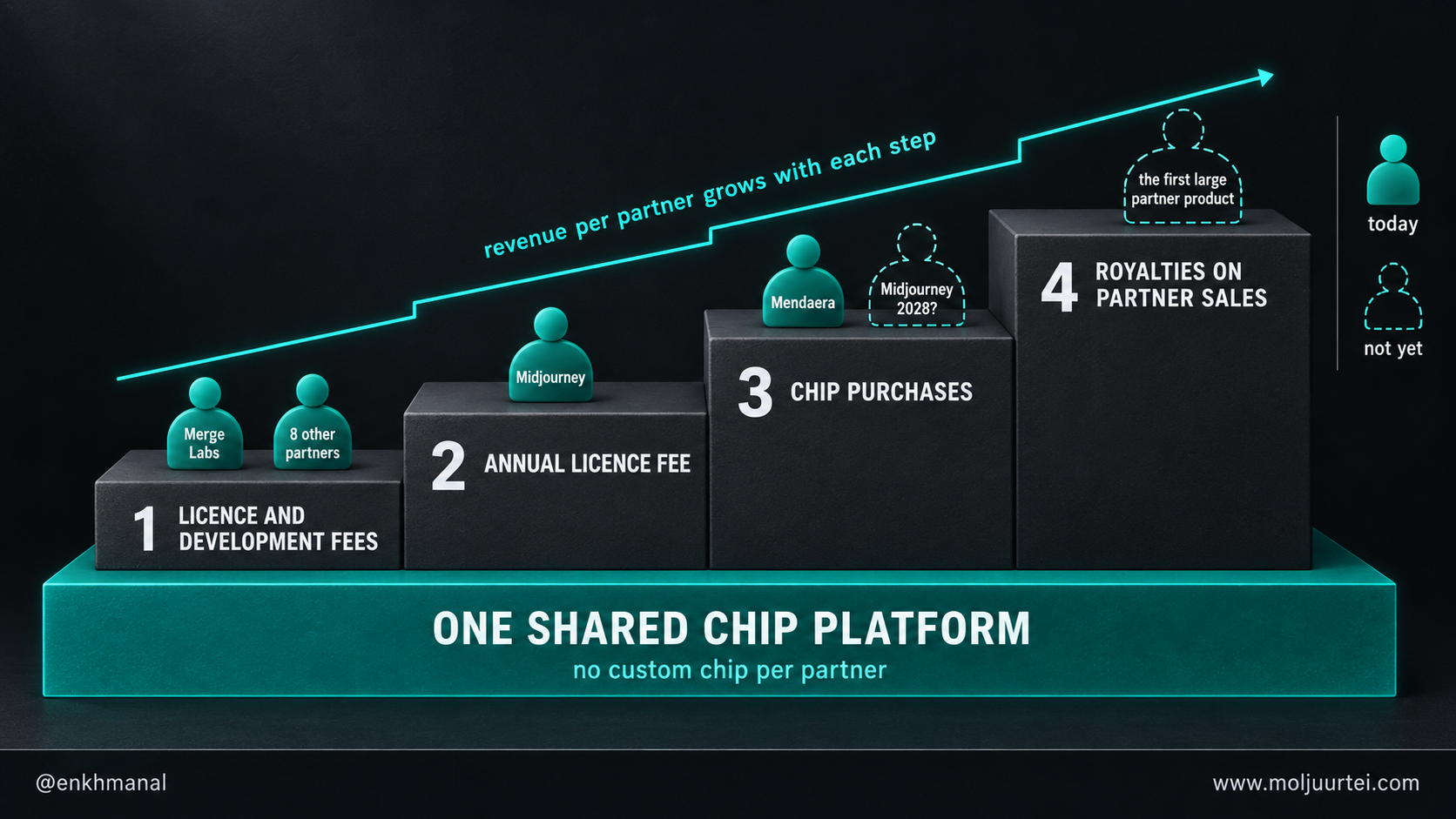
The market sees a $2.4B company with a core business growing in single digits and one big licence fee, and has re-rated it nearly fivefold on that licence. What it is pricing loosely is the shape of what comes next. Embedded is not a single contract; it is a standard licensing business forming in real time. DeVivo described it on the second-quarter call: partners license the technology, buy hardware, later buy chips and software licences, and pay more for exclusivity in a field. Eleven partners were signed by June, two of them in the second quarter, including a second brain-interface company and a women's-health wearable. Management says it is talking to its first partner outside healthcare, a company that measures stress in materials such as aircraft wings before they crack. Its investor deck puts the healthcare markets the chip could reach above $350B; we do not lean on that number, but it shows how management now thinks about the company.

Partners come in three speeds, and the near ones are already arriving. Mendaera and Sonic Incytes, which diagnoses fatty liver, use Butterfly's existing modules in products that already have or need only modest regulatory clearance; Mendaera went on sale on 1 October with a customised iQ3 inside. The brain-interface companies are doing primary research and face a long regulatory path. Midjourney sits between: a wellness spa in San Francisco targeted for the end of 2027, starting with body-composition scans that need no diagnostic claim. Third-party estimates on X put Mendaera's value to Butterfly at about $25M over time, small on its own; what it proves is that a partner product can be built, cleared and sold on the chip.
The cheapest way to see what the price assumes is to run it backwards. The enterprise value is about $2.26B, market cap less $124.7M of cash and no debt. If a mature Butterfly is worth 8 times sales in 2030, about what profitable, fast-growing device makers get today, and an investor wants 10% a year until then, today's price needs about $420M of revenue in 2030. Management's goal is $500M; Evercore ISI, which started coverage on 29 September with a $15 target, models more than $550M. So the price already assumes Butterfly gets about four-fifths of the way to its own goal. The upside is in the rest, and in a partner product becoming large enough that chip sales and royalties, rather than licence fees, drive the line.

Management & Track Record
Joseph DeVivo has run Butterfly and chaired its board since April 2023. He previously ran AngioDynamics and InTouch Health, which Teladoc bought in 2020, and chaired Caption Health, an AI ultrasound-guidance company bought by $GEHC in 2023 (proxy, April 2026). John Doherty joined as CFO in December 2025 from Kaltura, after running finance and operations at Magic Leap. Jonathan Rothberg founded the company and controls it: he holds all 21.4M Class B shares, each with 20 votes, about 71% of the voting power (10-K 2025). Rothberg's record is building companies on the move from bench science to chips (Ion Torrent, sold to Life Technologies; Hyperfine; Quantum-Si), and his recent posts on X describe Butterfly as the template for the others.
On what management said it would do, the record across the last four calls is good on the numbers and late on the products. Revenue beat the top of guidance in the fourth quarter of 2025 and the second quarter of 2026, and the full-year guide has been raised. Mendaera was promised commercial within six months on 30 July and went on sale nine weeks later. The slips are on launches. In October 2025 the P5.1 probe was due to debut in the second half of 2026; it is now the first quarter of 2027. In February the first home-care commercial agreement could be finalised in the first half; the first state starts on 1 October with revenue in the fourth quarter. FedRAMP was anticipated in the coming months in February and is now guided for the third quarter. None of these is a broken promise, and together they say the same thing: the dates move by a quarter or two.
Insiders sold into the re-rating. Rothberg sold 3.79M shares for about $25M between 17 and 22 July, before the second-quarter report, under a trading plan adopted on 13 March for estate planning, and kept his 21.4M Class B shares. Director Larry Robbins' Glenview Capital sold 4.17M shares for about $34.6M between 31 July and 17 August, cutting Glenview's own stake to 4.8%. DeVivo sold about 74,000 shares and gave away 250,000. Against that, director Louise Phanstiel bought 115,200 shares for about $1.0M on 14 August. A founder trimming 15% of his stake under a plan set in March is not a verdict; a long-time 13D holder selling $35M in three weeks is a fact to weigh, and it is in the Risks.
Risks & What Breaks It
What would make us sell: a second consecutive quarter of core growth below 5% after P5.1 launches, Midjourney confirming Gen3 silicon from another supplier, or an equity raise below $7.
Price Setup
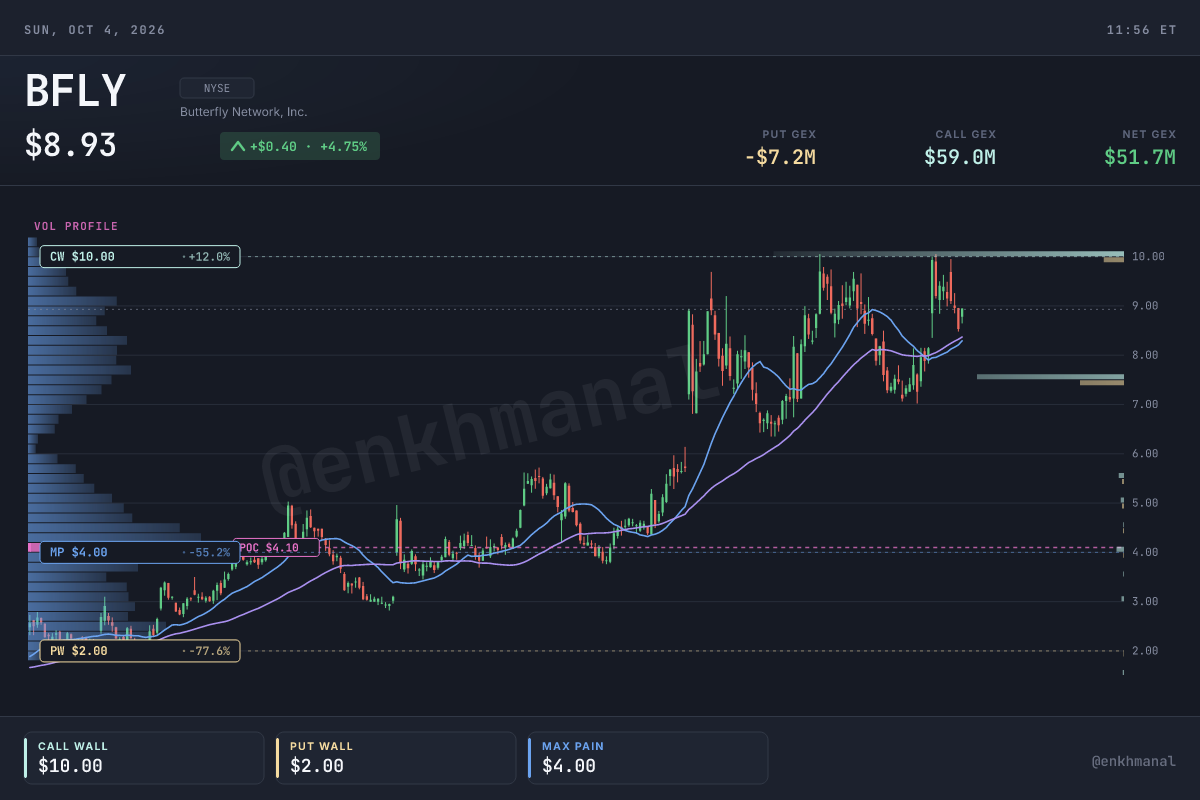
$BFLY has traded between $7 and $10 since the second-quarter report. It hit $10.05 intraday on 10 August and again on 23 September, the day after Needham started coverage, and both times sold off; the floor is $7.02–$7.06 from the 10 and 16 September lows. The close of $8.95 on 2 October sits above the 50-day average of $8.37, and the 200-day average of $5.67 is far below, a reminder of how quickly the re-rating happened. A daily close above $10.05 opens the range; a close below $7 says the market wants to see the third-quarter print before paying more.
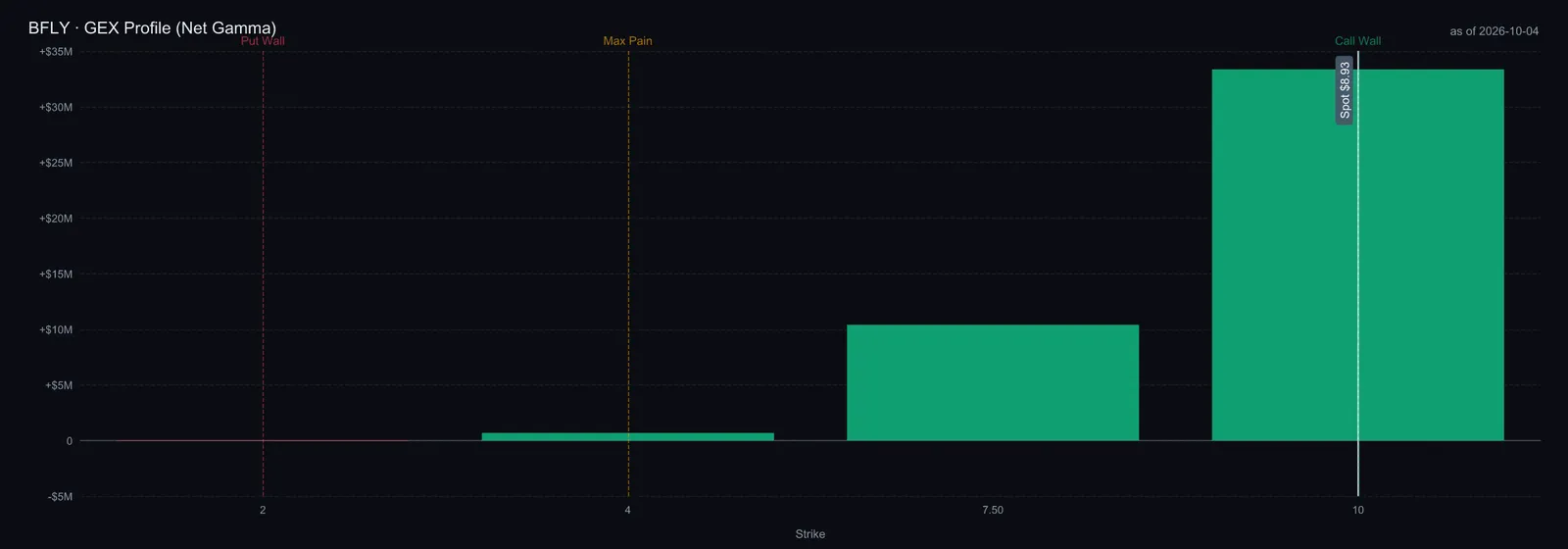
Options agree with the chart. Dealer gamma is positive across the strikes, largest at $10, so hedging flows should lean against moves inside the range until something breaks it. The next catalyst is third-quarter results on 30 October. We would start a position in the $7.50–$8.50 zone, add on a close above $10.05 after the print, and treat a close below $7 as the signal to wait.
Valuation
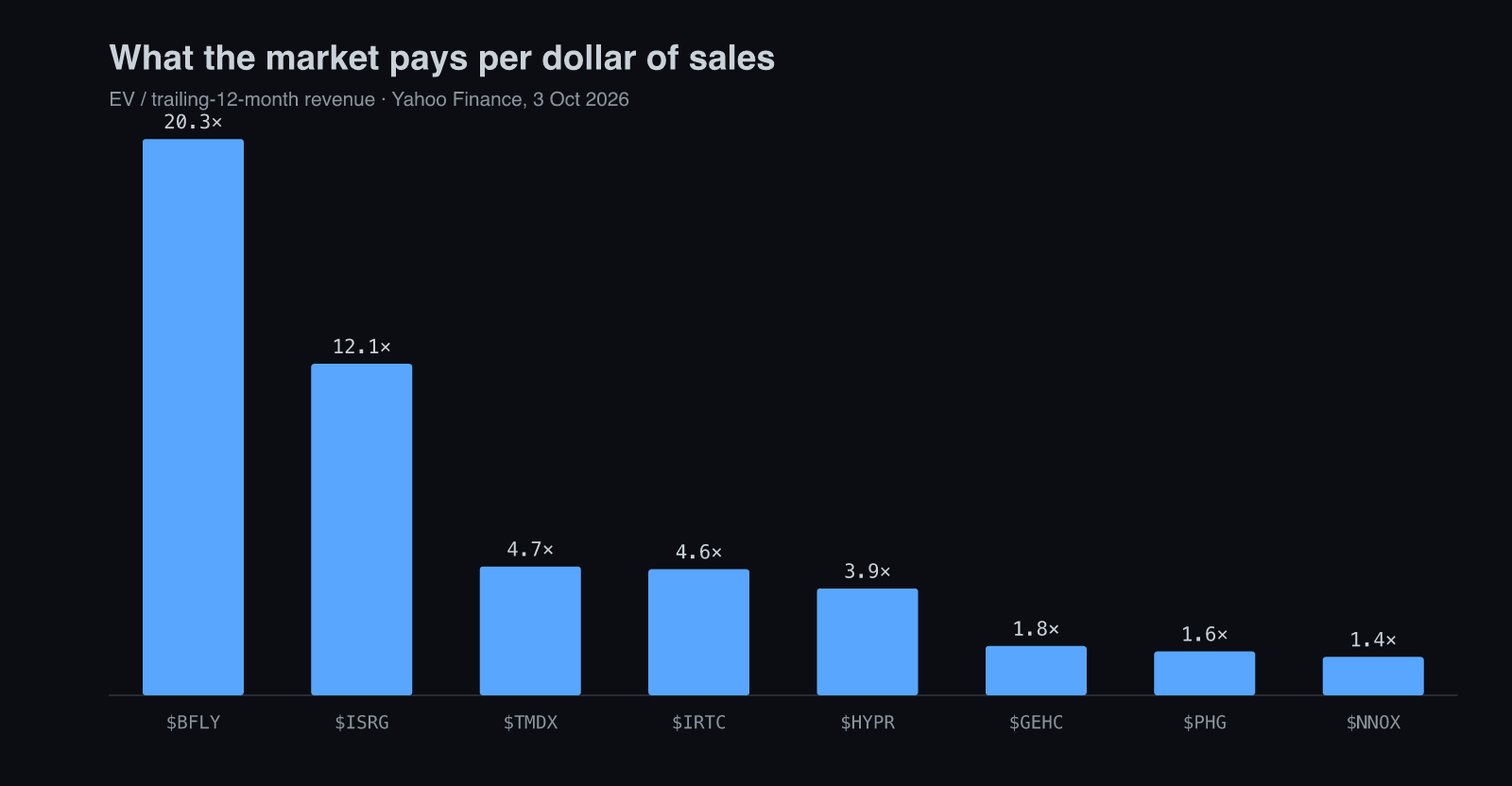
On today's numbers $BFLY is expensive by any device yardstick: about 20 times trailing revenue against 1.8 times for $GEHC and 1.6 times for $PHG, 4.6 times for $IRTC and 4.7 times for $TMDX, which grow about 20%, and 12.1 times for $ISRG. It is also near the top of its own range. The multiple was above 100 times sales at the 2021 listing peak of $29, fell below one times at the April 2024 low of $0.67, when the market valued the business at little more than its cash, and was about 4 times at the November 2025 low. That gap to peers is the price of the platform. The useful question is not whether the multiple is high, but what has to be true in 2030 for it to have been fair.
We value it on 2030 revenue, the year management has anchored to, at a multiple that fits what the business would be by then, with about 290M shares after modest dilution and net cash near zero after four years of spending. The cases differ on two things: whether Embedded moves from licence fees to chip sales and royalties, and whether P5.1 and the cart lift the core above 10% growth.
The cases are lopsided in the way an option should be. The base case, which assumes several partners and a better core but no breakout, roughly returns today's price in 2030. The bull case, management's own goal plus a little, doubles it. The bear case, in which nothing beyond Midjourney's licence works, loses about two-thirds. That is not a stock to own at full size on a guess, and it is the kind of asymmetry the platform argument earns: the evidence that decides between the cases arrives over the next five quarters, from the P5.1 launch, Midjourney's spa, and the number of partners that reach market.
Butterfly is the rare medical-device company whose most valuable customers are other technology companies, and that is the part of the story the market has only begun to price. We would own a starter position in the $7.50–$8.50 range, sized for the bear case, and add when P5.1's images or a second partner's product prove the platform is wider than one licence.