$BSX Deep Dive — The floor management built out of pessimism · Q3 print 28 October
$BSX has fallen 60% from its September 2025 high, and the last leg came from an eight-day cyber shutdown that has nothing to do with whether its devices sell. Management's own 2027 framework assumes its two damaged franchises stay damaged; the launches that fix them are dated for the second half of 2027 and 2028, and the people who wrote that plan bought $9.5M of stock into the drawdown. At $43.92 the stock trades at 13.3× a pre-cyber earnings guide, against a house model that lands between $40 and $51.
What Changed
Start here. The heart is a four-chamber pump, and the two upper chambers, the atria, fill the two lower ones that do the pushing. Atrial fibrillation is the upper chambers losing their rhythm and quivering instead of beating, which lets blood pool. The left atrial appendage is a small pouch on the left atrium where that pooled blood clots; a clot that escapes it travels to the brain, which is why atrial fibrillation carries a roughly five-fold stroke risk and why the standard treatment for decades has been a lifelong blood thinner. A left atrial appendage closure device is a plug, about the size of a coin, that seals the pouch so the patient can stop the drug. Catheter ablation is the other answer: a thin tube threaded into the heart destroys the small patches of tissue that trigger the misfiring, and for twenty years that meant burning them with radiofrequency heat or freezing them with a cryoballoon. Pulsed field ablation replaces heat and cold with trains of microsecond electrical pulses that open permanent pores in heart-muscle cell membranes; the effect is called irreversible electroporation, and because heart-muscle cells give way at a lower field strength than the oesophagus, the nerves and the blood vessels behind them, the lesion is selective in a way a burn can never be. Everything below is about the company that sells the plug and, for two years, owned the pulse.
Thermal ablation's constraint was collateral damage. Heat delivered against the back wall of the left atrium can injure the oesophagus that sits a few millimetres behind it, and scarring at the pulmonary veins can narrow them. Those risks capped how aggressively an electrophysiologist could treat and how many centres wanted to. When a non-thermal method arrived with the same efficacy and a materially different safety profile, the switch was clinical rather than commercial, and it happened at a speed the device industry had never seen. Mike Mahoney put the US conversion at about 90% of ablations by September 2026, which is where a category goes when the argument for it is safety.
$BSX launched FARAPULSE into that vacuum in 2024 and for a while was the category. It had invested in Farapulse, Inc. since 2014, held about 27% of it, and bought the rest in August 2021 for $450M upfront plus up to $125M in milestones, the FY2021 10-K says. Electrophysiology revenue grew 172% in the fourth quarter of 2024. Then Medtronic arrived with PulseSelect and the Affera mapping-and-ablation platform, Johnson & Johnson with Varipulse, Abbott with Volt, and share went the only direction it could from 100%. By the Wells Fargo conference on 10 September the sell-side estimate was about 50%, and management did not argue with it.
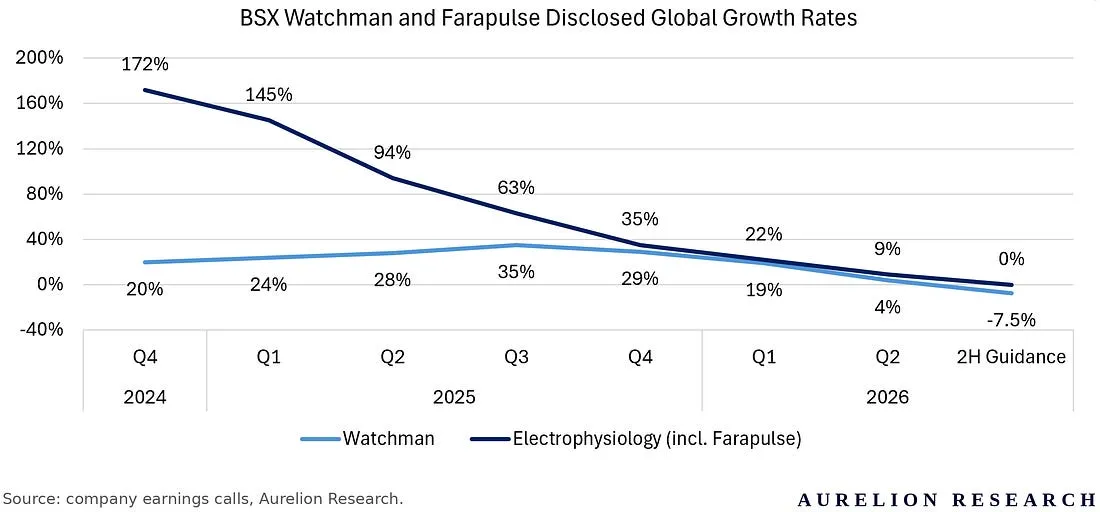
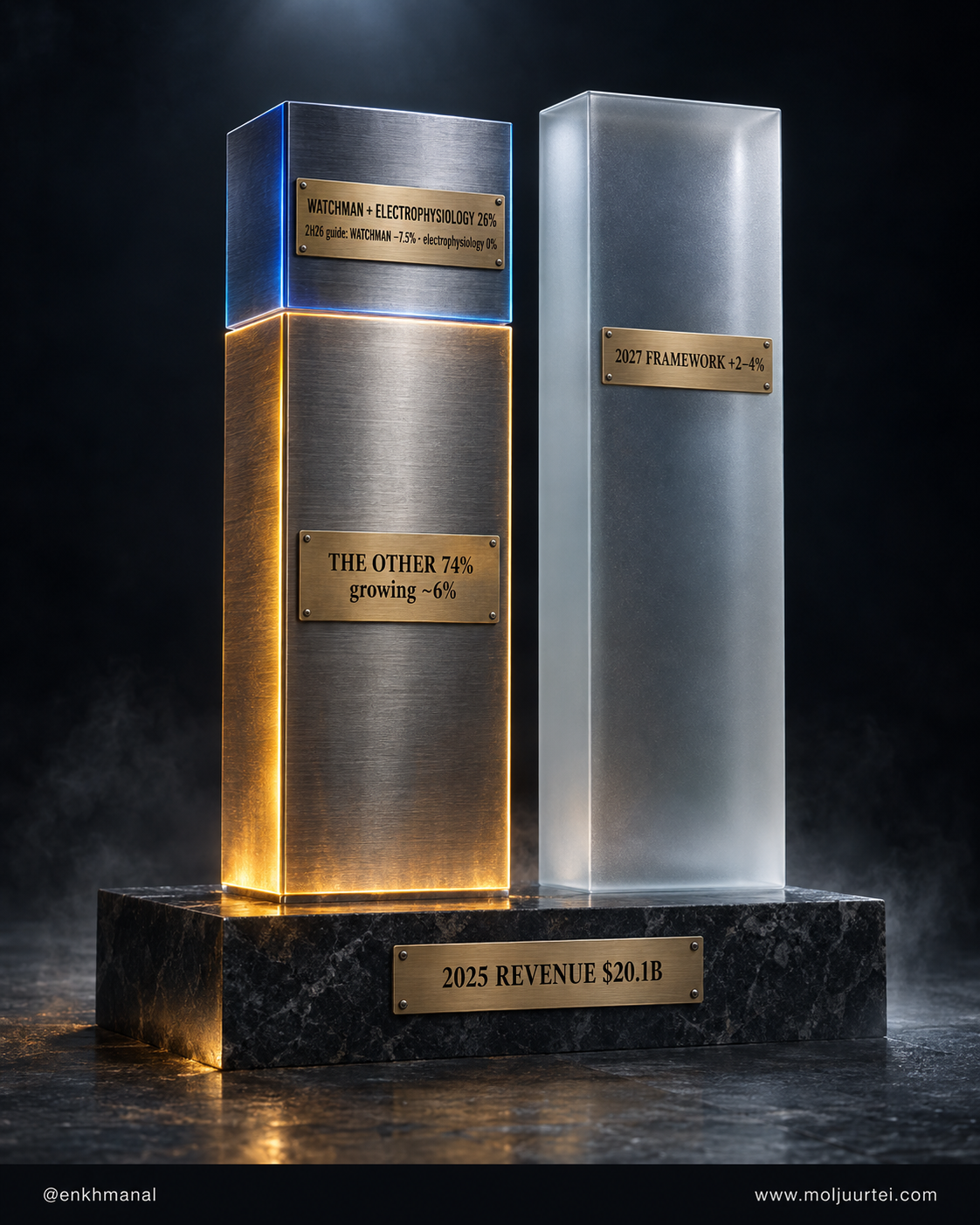
The two engines were about 26% of 2025 revenue and carried margins above the corporate average. Both stalled in the same year, for different reasons: FARAPULSE because the market it created finished converting and the competition arrived, WATCHMAN because a nine-month run of overlapping clinical trials left referring physicians unsure whom to send. The organic growth guide for 2026 went from 10–11% in February to 6.5–8% in April to 5–6% in July, and the stock went from $93 to $46 on the way.
Since our last look on 20 August, three things are new. On 25 August the company identified a cyber incident and shut every plant and distribution centre in the world for eight days; on 8 September it told the SEC it is unlikely to meet the third-quarter or full-year guide it had given five weeks earlier, and moved the reckoning to the 28 October call. On 10 September, at Wells Fargo, Mahoney said 2027 will bring "minimal EPS growth" and that the return to normal is a 2028 event. And on 23 September Art Butcher, who runs the MedSurg segment, said he will retire on 1 January. The stock, $52 when we last wrote, closed Friday at $43.92. The company that captured the whole first wave of pulsed-field ablation is now priced as if the wave, the plug and the other 75% of the business were all in doubt at once. That is our subject here.
Thesis
$BSX runs eight single-use device franchises off one hospital call point, and the six that were never in question still grew about 6% in the second quarter; the 2027 plan assumes the two that stalled stay stalled, so the 2027–2028 launch cadence is upside to a floor rather than a rescue we need in order to be right.
• What it can do that others can't: arrive in the electrophysiology lab, the cath lab, the endoscopy suite and the urology theatre with a full tray. Interventional cardiology grew 15% in Q2, neuromodulation 12%, endoscopy 7%, international electrophysiology 23%.
• What that lets it sell next, with dates: FARAWAVE Ultra, a catheter that maps and ablates in one pass, and an intracardiac ultrasound catheter in the second half of 2027; SEISMIQ coronary lithotripsy in the first half of 2027 into a $1B+ market; a new defibrillator platform and the EMPOWER leadless pacemaker in 2027; FARAFLEX in 2028; a possible WATCHMAN label update in 2027.
• Why now: the 28 October call is where the cyber recapture gets a number and the 2027 framework gets a shape. Management has already set 2027 expectations at the floor; a print that merely confirms the other 75% of the business is intact removes the last open question.
• The one risk that matters: pulsed-field share keeps falling through 2027, so that flat electrophysiology turns into declining electrophysiology and the 2–4% framework becomes the ceiling.
Business & Backdrop
$BSX sells devices that are used once and thrown away, into two reportable segments. Cardiovascular was $3,624M of the $5,442M second quarter, 66.6% of revenue, and grew 7.8% organically; it holds interventional cardiology and vascular therapies, WATCHMAN, electrophysiology, cardiac rhythm management and interventional oncology. MedSurg was $1,818M, 33.4%, and grew 5.4%; it holds endoscopy ($793M, +7.0%), urology ($684M, +0.8%) and neuromodulation ($341M, +12.2%). Cardiovascular produced $279M of the quarter's $381M year-on-year increase, 73% of the growth on two-thirds of the revenue, and it did so with its two most famous products barely contributing: WATCHMAN grew 4% and electrophysiology 9%, both carried by international sales (+18% and +23%) while the US lines grew 3% each. The United States is 63% of net sales and grew 6.2%; Asia-Pacific grew 11% operationally, Europe 4%.
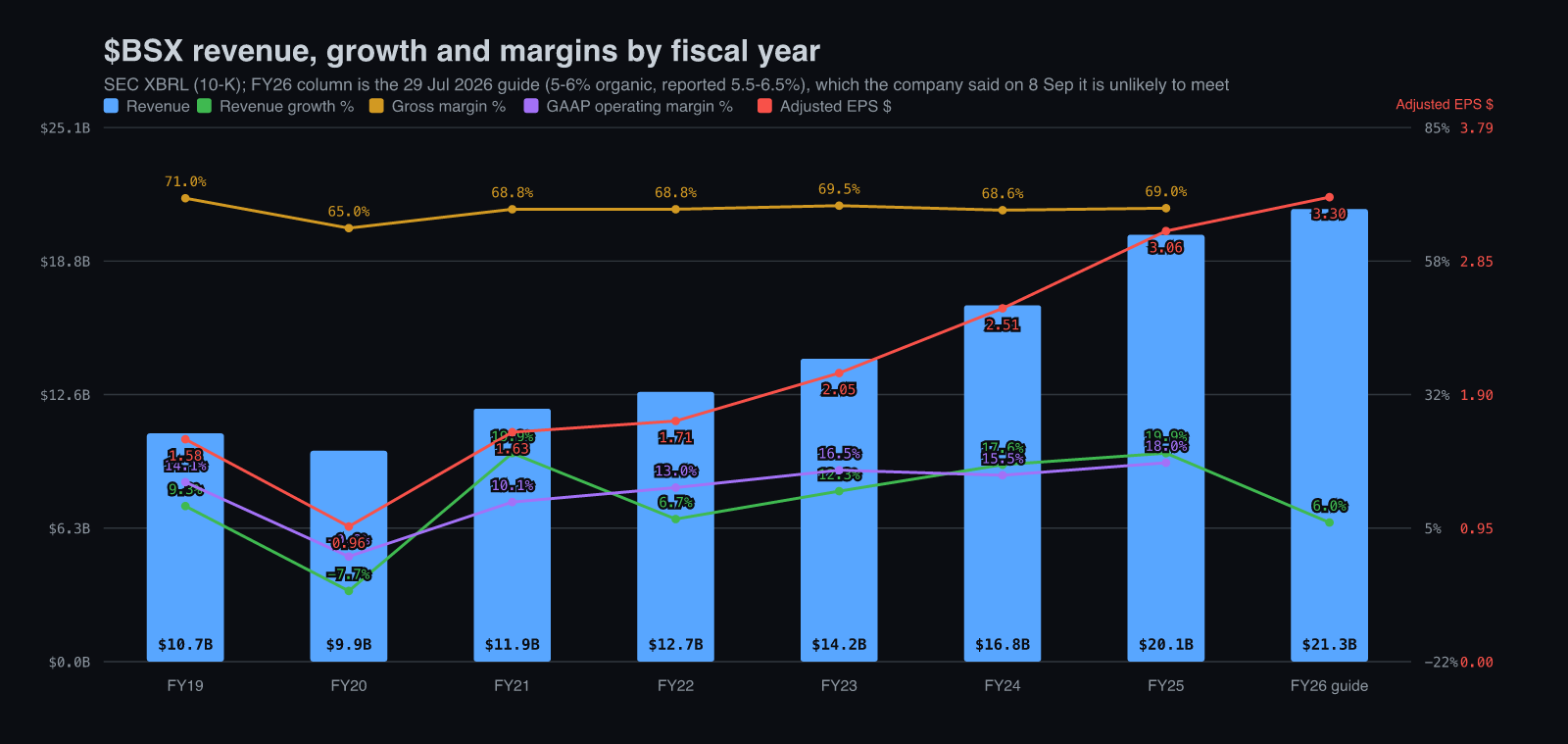
The economics are those of a physician-preference consumable: gross margin has sat between 68.6% and 71.0% every year since 2019 except the COVID year, and the operating leverage has been the story. Revenue ran $10.73B in FY19, $9.91B in FY20, $11.89B in FY21, $12.68B in FY22, $14.24B in FY23, $16.75B in FY24 and $20.07B in FY25, with growth of 9.3%, −7.7%, 19.9%, 6.7%, 12.3%, 17.6% and 19.9%. Gross margin ran 71.0%, 65.0%, 68.8%, 68.8%, 69.5%, 68.6% and 69.0% over the same years, and GAAP operating margin climbed from 14.1% in FY19 through −0.8% in FY20 to 10.1%, 13.0%, 16.5%, 15.5% and 18.0%. Adjusted EPS, the number the company guides on, went $1.58, $0.96, $1.63, $1.71, $2.05, $2.51 and $3.06. The FY26 guide, as it stood on 29 July, was 5–6% organic growth and $3.28–3.32 of adjusted EPS; the company has since said it will likely miss both.
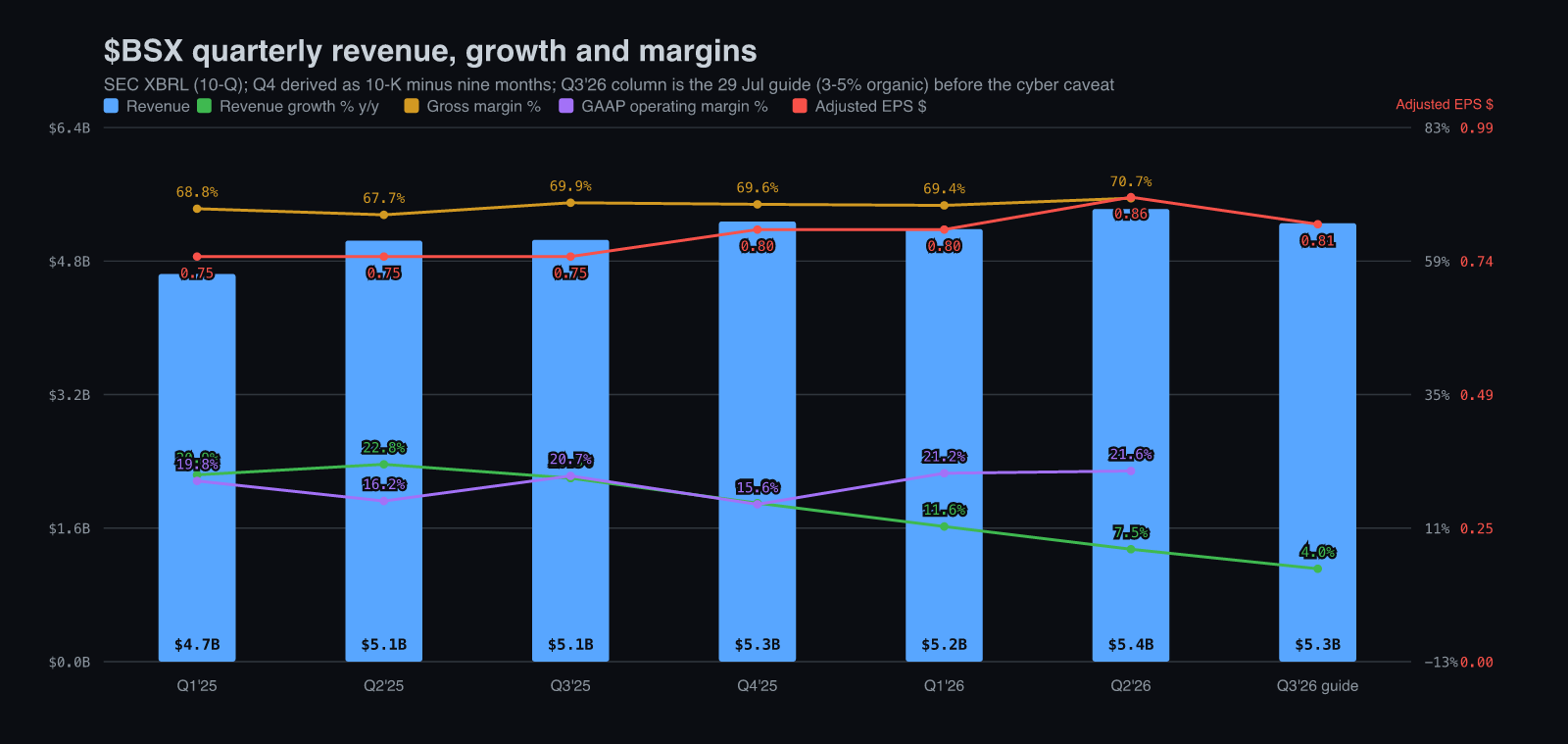
The quarterly series shows the deceleration the annual one hides. Revenue was $4.66B in Q1'25, $5.06B in Q2'25, $5.07B in Q3'25, $5.29B in Q4'25, $5.20B in Q1'26 and $5.44B in Q2'26, growing 20.9%, 22.8%, 20.3%, 15.8%, 11.6% and 7.5% year on year, with the third quarter of 2026 guided to 3–5% before the shutdown. Gross margin over those six quarters was 68.8%, 67.7%, 69.9%, 69.6%, 69.4% and 70.7%, and GAAP operating margin 19.8%, 16.2%, 20.7%, 15.6%, 21.2% and 21.6%; adjusted operating margin in Q2 was 28.4%, up 70 basis points. Growth halved in eighteen months while margins went up. That combination is what a franchise losing its growth engines but not its pricing looks like, and it is the reason the de-rating was a multiple event rather than an earnings event.
Cash follows profit here. FY25 operating cash flow was $4.5B against $5.0B of GAAP EBITDA, a 91% conversion, and free cash flow was $3.7B; the first half of 2026 produced $1,290M of free cash flow ($1,475M from operations less $184M of net capital spending), and the full-year figure is now guided to about $3.8B, down from roughly $4B coming into the year. Inventory is the one heavy line, at 159 days in the second quarter and 173 at year-end, which is normal for a company that stocks consignment trays in thousands of hospitals. The industry arc the company is chasing is the one it helped create: procedures moving from open surgery to a catheter, then to a better catheter, in a cardiology market where Mahoney counts "about eight platforms that enter well over $25 billion of new market spaces." That is where the technology section has to start.
Technology & Moat
The moat is the tray. A cardiologist implanting a WATCHMAN is already using $BSX access sheaths and the same representative sells the FARAPULSE console; displacing one product means unpicking a purchasing relationship, which is why device share usually moves in years. It was genuinely alarming when pulsed-field share moved in quarters, and it is worth being precise about why: FARAPULSE launched with a single basket-shaped catheter, FARAWAVE, and a mapping system, Opal HDx, that many labs did not adopt, so a competitor with a catheter that maps and ablates in one pass had a workflow argument, not a clinical one. Mahoney said as much at Wells Fargo: "When you are really relying on, for the most part, one platform with our Opal mapping system... there is kind of one way to go with that share position. Despite that, more often than not, doctors are still choosing FARAPULSE."
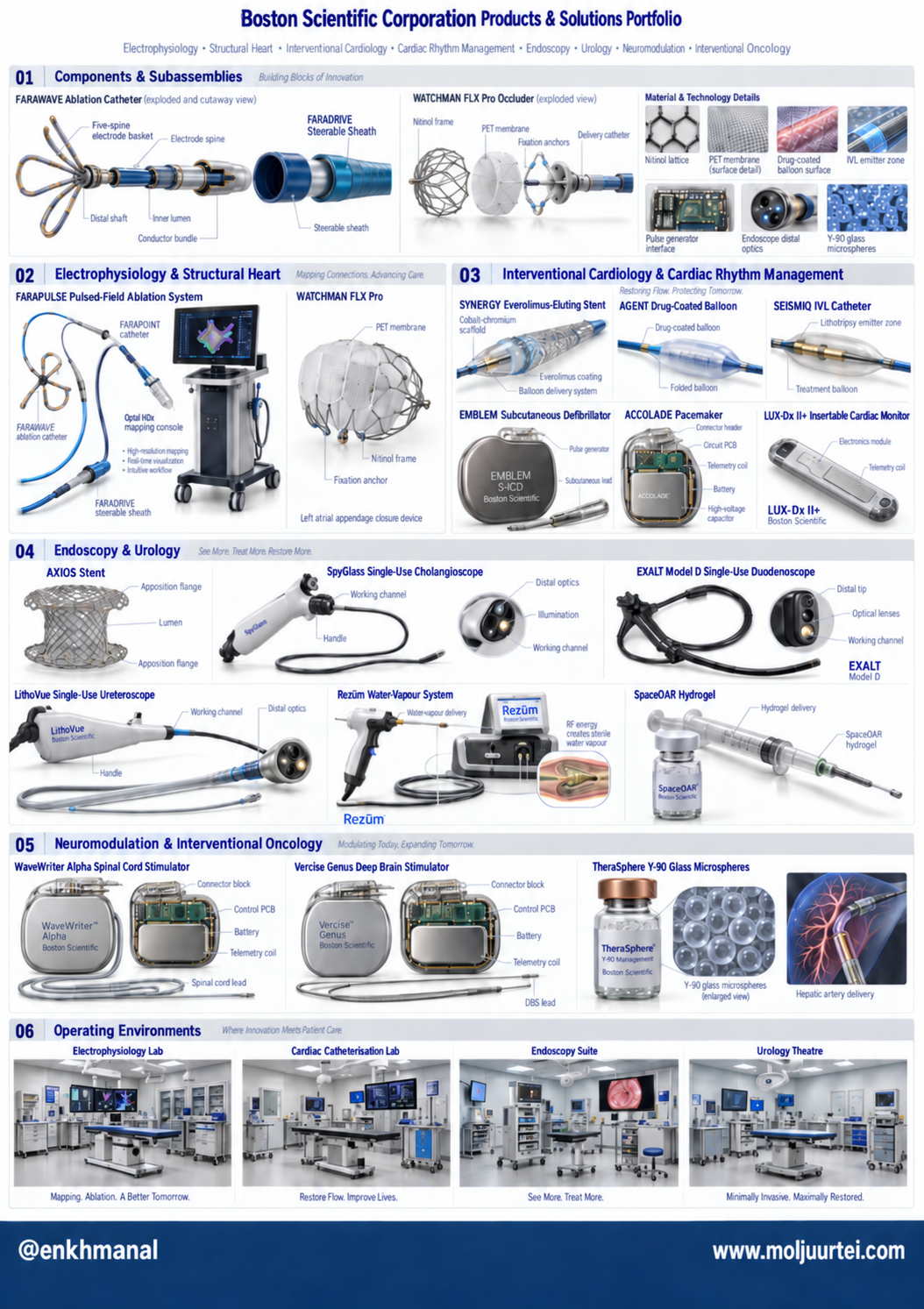
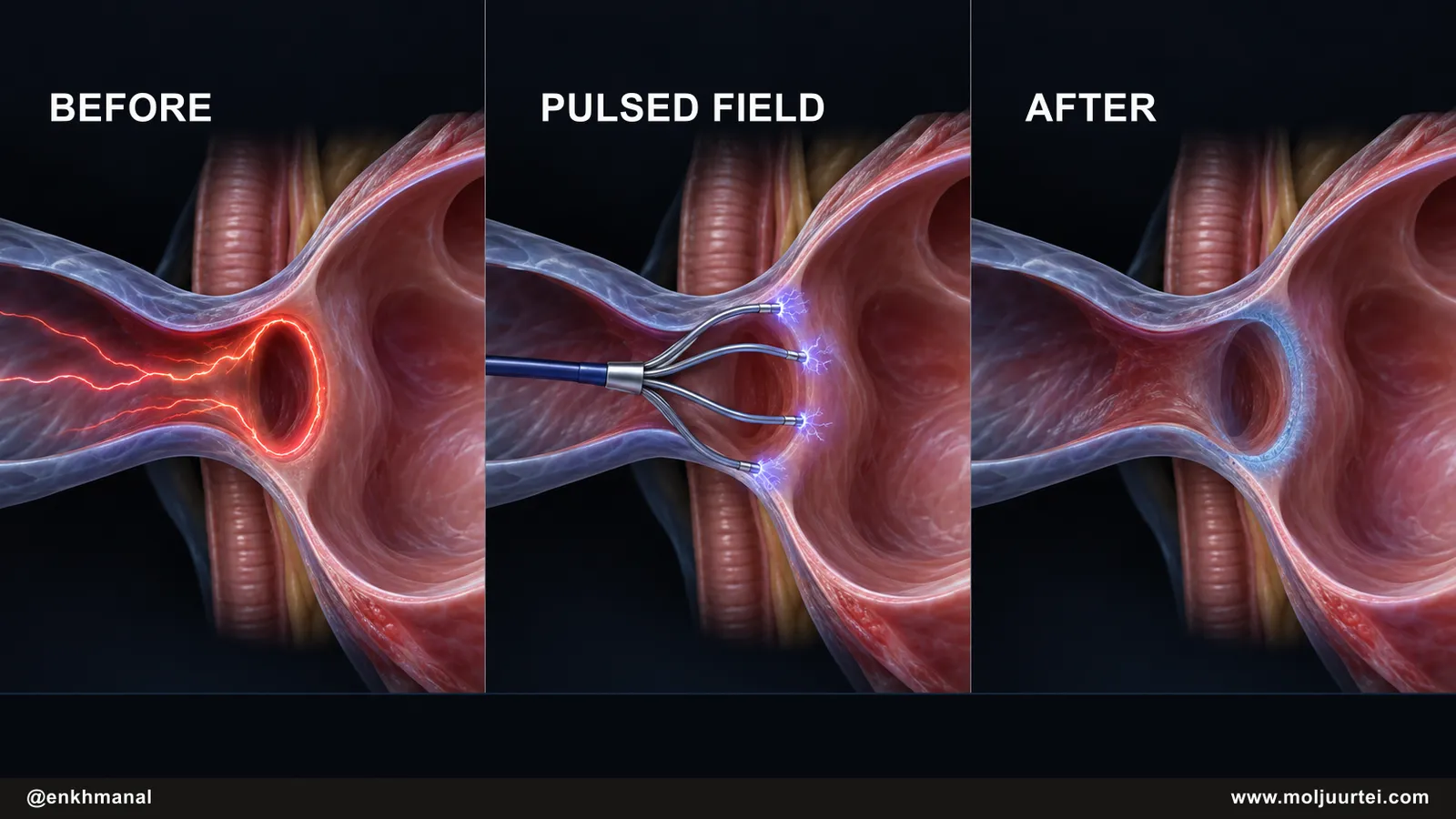
Pulsed field ablation, drawn input to output, is the product our argument rests on. A steerable sheath delivers a catheter whose tip opens into a basket of five splines, each carrying electrodes, and the basket is pressed against the ring of tissue where a pulmonary vein enters the left atrium. The generator then fires a train of bipolar, biphasic pulses, each lasting microseconds and reaching field strengths of a few kilovolts per centimetre. Above a tissue-specific threshold those fields open nanoscale pores in the cell membrane that never close; the cell dies over hours without ever being heated. Heart muscle has the lowest threshold of the tissues in reach, so the lesion set is a clean ring of electrically silent muscle that isolates the vein, while the oesophagus behind it, the phrenic nerve beside it and the vein's own smooth-muscle wall sit below their thresholds and survive. Thermal ablation cannot make that distinction, because heat obeys distance and not cell type. The output is a durable pulmonary-vein isolation in a fraction of the time, and the reason electrophysiologists switched in two years.
WATCHMAN is the simpler object and the larger franchise. It is a nitinol frame covered in a permeable fabric, delivered through a catheter from the femoral vein across the septum into the left atrium and opened in the mouth of the appendage, where the frame's anchors hold it until the heart's own lining grows over the fabric in a few weeks. After that the pouch is sealed and the patient can stop anticoagulation. The device has been on the US market since 2015 and holds about 90% of the transcatheter market, Mahoney said; the constraint was never the implant but the referral, and the clinical picture changed in 2025 and 2026 in a way that helped and hurt at once. CHAMPION, the company's 3,000-patient trial of the current WATCHMAN generation against direct oral anticoagulants as a first-line therapy in atrial fibrillation, met all of its primary and secondary endpoints in March. It landed alongside other trials that read in different directions, and referring physicians did the human thing and waited.
Intravascular lithotripsy is the next launch, and it is worth teaching because the coronary version arrives in the first half of 2027. Arterial plaque that has calcified is concrete in a pipe: a balloon cannot crack it, a stent cannot expand against it, and drilling it out is slow and risky. Lithotripsy, the sonic-wave technique that has been fracturing kidney stones for forty years, was miniaturised into a balloon catheter by Shockwave Medical, now part of Johnson & Johnson, which sits an array of spark-gap electrodes inside the balloon; each discharge vaporises a bubble of fluid and the collapsing bubble sends a pressure wave through the vessel wall that cracks the calcium while leaving the soft tissue alone. $BSX's SEISMIQ generates the acoustic wave with laser energy delivered through optical fibres inside the balloon instead of a spark, and the FRACTURE trial of the coronary catheter in 420 patients met both endpoints in May: 93.3% freedom from major adverse cardiac events at 30 days and 93.7% procedural success. The peripheral version launched in January 2026. $JNJ's Shockwave sold $335M in the second quarter, growing 14.6%, which tells you what the market is worth to whoever holds a credible second device.
Roadmap & R&D
$BSX answered a growth scare by spending more, not less: R&D rose 27% to $2,052M in FY25, 10.2% of sales. The second-quarter deck's timeline is the cleanest statement of what that buys, and the Wells Fargo transcript added the dates.
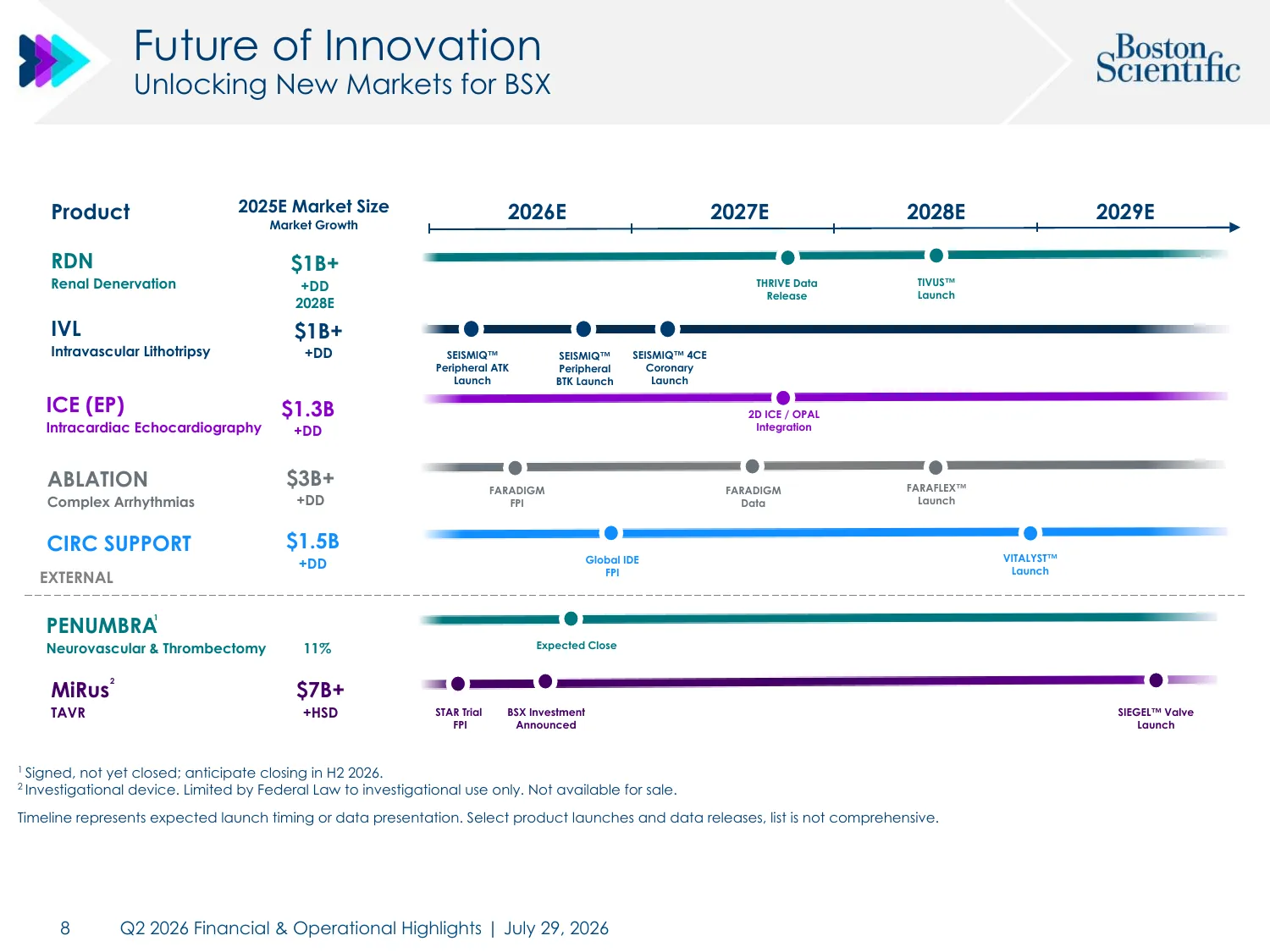
Three of these decide the thesis. FARAWAVE Ultra is the one that answers the share question, because it removes the workflow argument competitors have been winning on: Ken Stein noted at Wells Fargo that the second mapping catheter in a FARAPULSE case "more often than not is a competitive product," and a catheter that maps and ablates keeps the premium on the ablation catheter while letting the hospital control the procedure's total cost. Management's own words on timing: "We are aiming with the Ultra launch and the [intracardiac echo] launch in the second half of 2027 to improve our position." SEISMIQ is the one that adds a market rather than defending one, and it fits a call point where $BSX already sells the imaging, the stents and the Agent drug-coated balloon. And Penumbra, if it closes by year-end as Mahoney still expects, is the one that changes the shape of the company, adding a thrombectomy franchise growing 11% and about $11B of cash consideration to the balance sheet.
The Setup — Why It's Mispriced
The de-rating was a multiple event, and the cyber quarter is an exogenous one. In early February $BSX traded near $93 against a $3.46 adjusted-EPS guide, about 27×. On 25 September it closed at $43.92 against a $3.30 guide the company will likely miss by some amount it has not yet sized, about 13.3×. The earnings guide fell 4.6% between February and July; the multiple fell by half. Then a threat actor reached an external-facing network device on 25 August and the company chose to shut everything down while it found out how far the intrusion went: CrowdStrike's 22 September summary found a limited portion of the on-premises environment touched, no evidence that data was taken and no compromise of manufacturing systems. Eight days without shipping is 2.2% of a year, about $470M of revenue at the FY26 run rate, and roughly 9% of a third quarter guided to 3–5% growth. Consumables used in procedures that happened anyway with a competitor's product are gone; implant and capital backlog ships later. Mahoney: "some hospitals likely ordered from others during that time, which would be understandable... it is hard to pinpoint that exact dollar amount at this point." $SYK's March attack cost it one quarter and its June-quarter revenue came in 9.4% higher; West Pharmaceutical's May intrusion cost it sixteen days and no guidance at all. A quarter is the right unit for this.
What the July guide contains matters more than what the cyber quarter subtracts from it. The second-half build was stated on the call: the roughly 75% of revenue outside WATCHMAN and electrophysiology growing about 6%, global WATCHMAN declining mid-to-high single digits, global electrophysiology flat. Mahoney's framing of 2027 on the same call was that the company "aims to improve 2027 versus our second half 2026 guidance," which the sell-side turned into the 2–4% organic framework he was asked about at Wells Fargo, and his answer there was that "the business dynamics are similar." Read literally, that plan gives no credit to the medical-education push on WATCHMAN, none to urology recovering from 1%, none to the defibrillator launch, and it holds electrophysiology flat while the share slide continues into the second half of 2027. Every one of those is a thing the company is spending money to change. A framework built that way is a floor with a plausible upside, which is exactly how Aurelion read its August conversation with investor relations, and the print on 28 October is the first chance to test it.
Our guidance reduction is concentrated in two areas. First, WATCHMAN, where the U.S. market has slowed sharply and unexpectedly, primarily driven by compounding clinical evidence, which has impacted referral patterns. Second, [electrophysiology], where we did not anticipate the degree of competitive share movement we're now seeing in the U.S. market.
The insiders bought before the shutdown, and one director bought on the day of it. Every open-market purchase since the July cut is below, in the Form 4s:
Mahoney's purchase lifted his direct holding from 1,403,784 to 1,590,024 shares, 13.3%, and it is 9% under water at Friday's close. The skeptics on X are right that a Form 4 dated 3 August cannot tell you what he believed on 26 August. It can tell you what the person who set the 2027 plan believed about the 2027 plan, three weeks before an event that has no bearing on it. Joseph Fitzgerald runs the Cardiology group that contains both WATCHMAN and electrophysiology; he is the executive who would know first if either were structurally impaired, and he moved $3.0M of his retirement account into the stock two days after the guidance cut. The company itself retired about 40 million shares at about $50 through a $2B accelerated repurchase, its first meaningful buyback since 2020, with $3B of authorisation remaining.
Management & Track Record
The record is an execution record, not a pedigree. This is a management team that took a company with a shrinking defibrillator business and a litigation overhang in 2012 and built it into the fastest-growing large-cap in medtech, largely by buying early stakes in venture-stage device companies and exercising the option once the clinic proved them: FARAPULSE, Axonics, Silk Road, now MiRus. The same record includes the misses. Axonics' sales force turned over after the 2024 acquisition and urology has grown 1% for two quarters while the funnel refills; Silk Road's integration "went poorly initially," Mahoney said, and manufacturing is being moved to Minnesota. He was direct that both are the reason Penumbra's commercial team is being retained on its own incentives. Two disclosures since August bear on the team's judgement: the cyber response, which restored global distribution in about eleven days and reported it in the separate, useful terms of distribution, sterilisation, manufacturing and monitoring, and the 27 July restructuring, a $700–800M program approved by the board before the guidance cut it was announced with.
The largest holder on file is Fidelity at 46.4M shares, 3.2% of the 1,449M outstanding, per a 13G/A for 30 June. Sell-side coverage runs to 29 analysts with a mean target of $61, 25 buys and no sells; the September cuts we could find on X took Oppenheimer to $65 from $85 and clustered Citi and Cowen in the mid-$50s.
Risks & What Breaks It
Price Setup — Levels, Technicals & Options
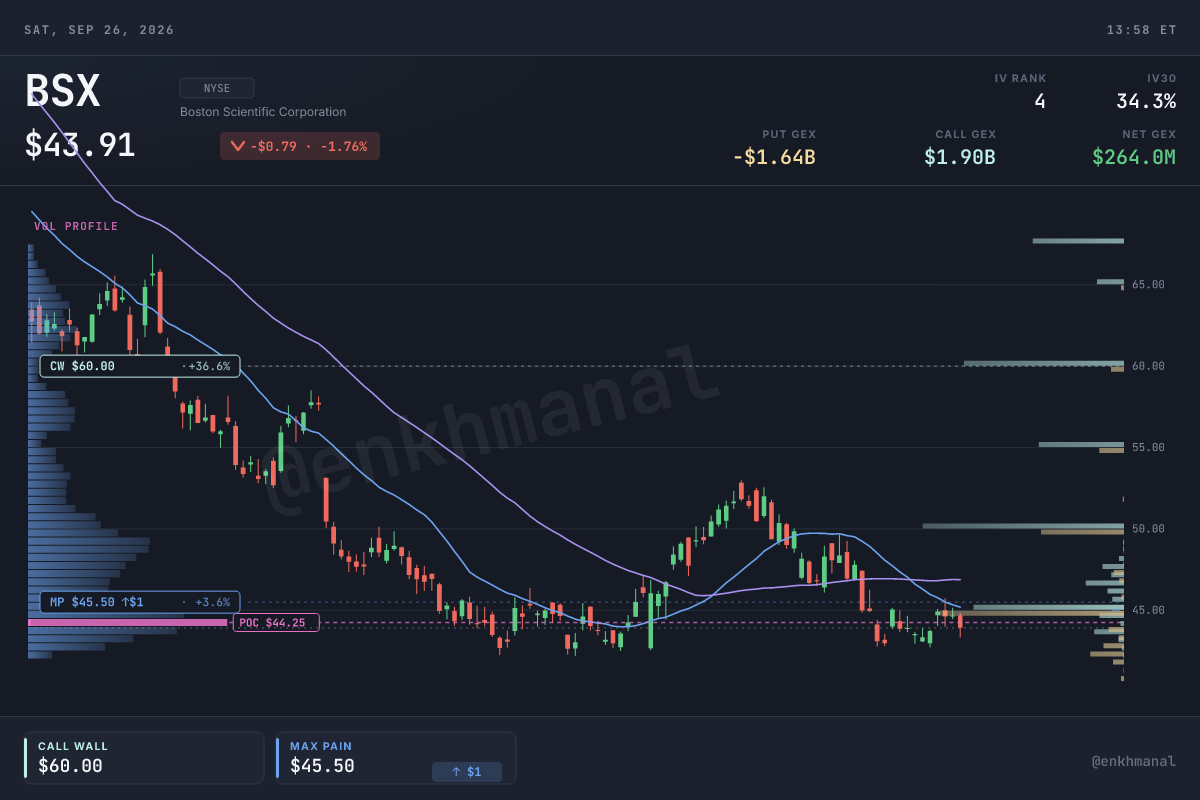
The decline was orderly and it is now a year old. From a $109.38 high in September 2025 the monthly closes stepped down through $93.53 in January, $76.85 in February on the initial guide, $62.75 in March, $57.61 in April on the second cut, $48.31 in May and $42.68 in June, then bounced to $48.30 in August on the insider buying and the buyback before the cyber news took it back to $43.92. The intraday low of the whole move is $42.20, printed in July, and Friday's close is 4% above it. The stock is below its 50-day and 200-day averages and has been below the 200-day since February; the February gap from $93 is still open overhead, and the nearer level is the $48–50 band where the CEO and the buyback paid. Against its peers the picture is stark: rebased to August 2025, $BSX sits at 42 while $MDT is at 96, $EW at 106 and $JNJ at 153. $SYK, the other cyber victim of 2026, is at 70 after its own September drop.
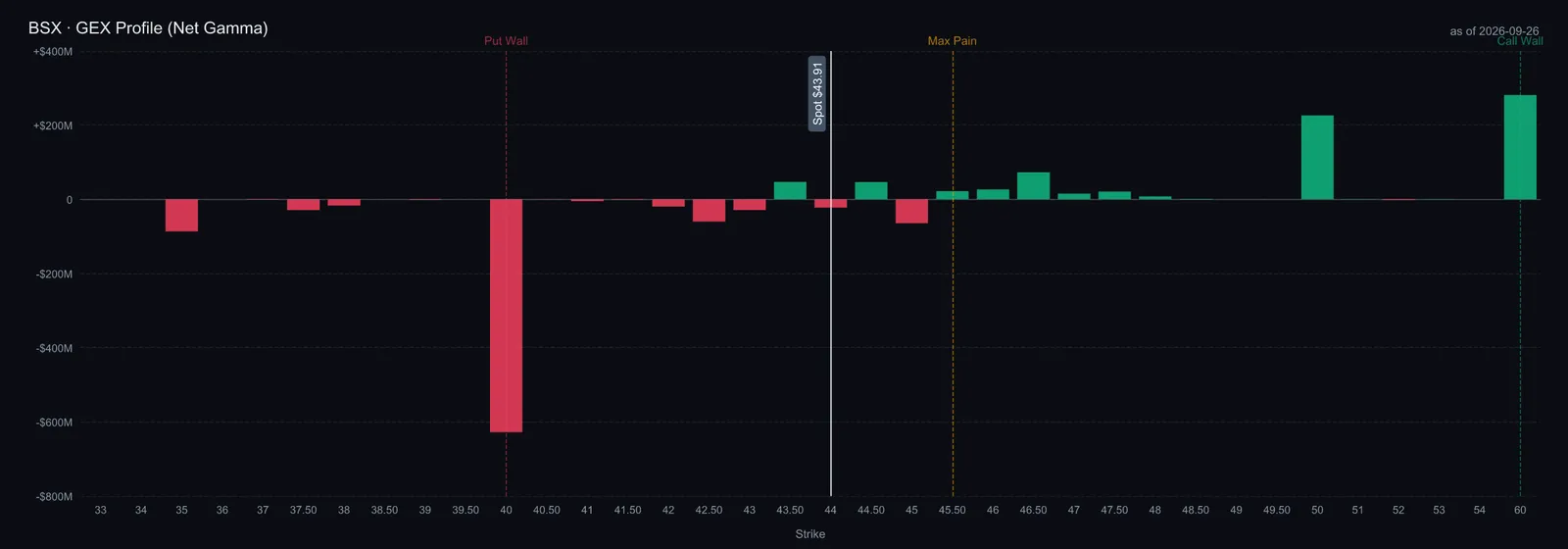
• Dealer positioning: net gamma is positive at about +$556M with the call wall at 60, the put wall at 40, max pain at 45 and the gamma flip up at 59.66; spot sits just above max pain and 10% above the put wall, so dealers are hedged for a range rather than a break, and a move through 40 is where that changes.
• Implied volatility: 30-day implied is 34%, and the term structure kinks at the 30 October expiry, 40.9% against 30–34% on the weeklies before it, which is the options market pricing the 28 October print as the event. Put-call open interest is 0.40, which is not a market paying up for downside protection.
• The level that matters: $42.20, the July low. Below it the market is saying the cyber quarter revealed something structural; above $48.33 it is saying the CEO was right.
Valuation & House View
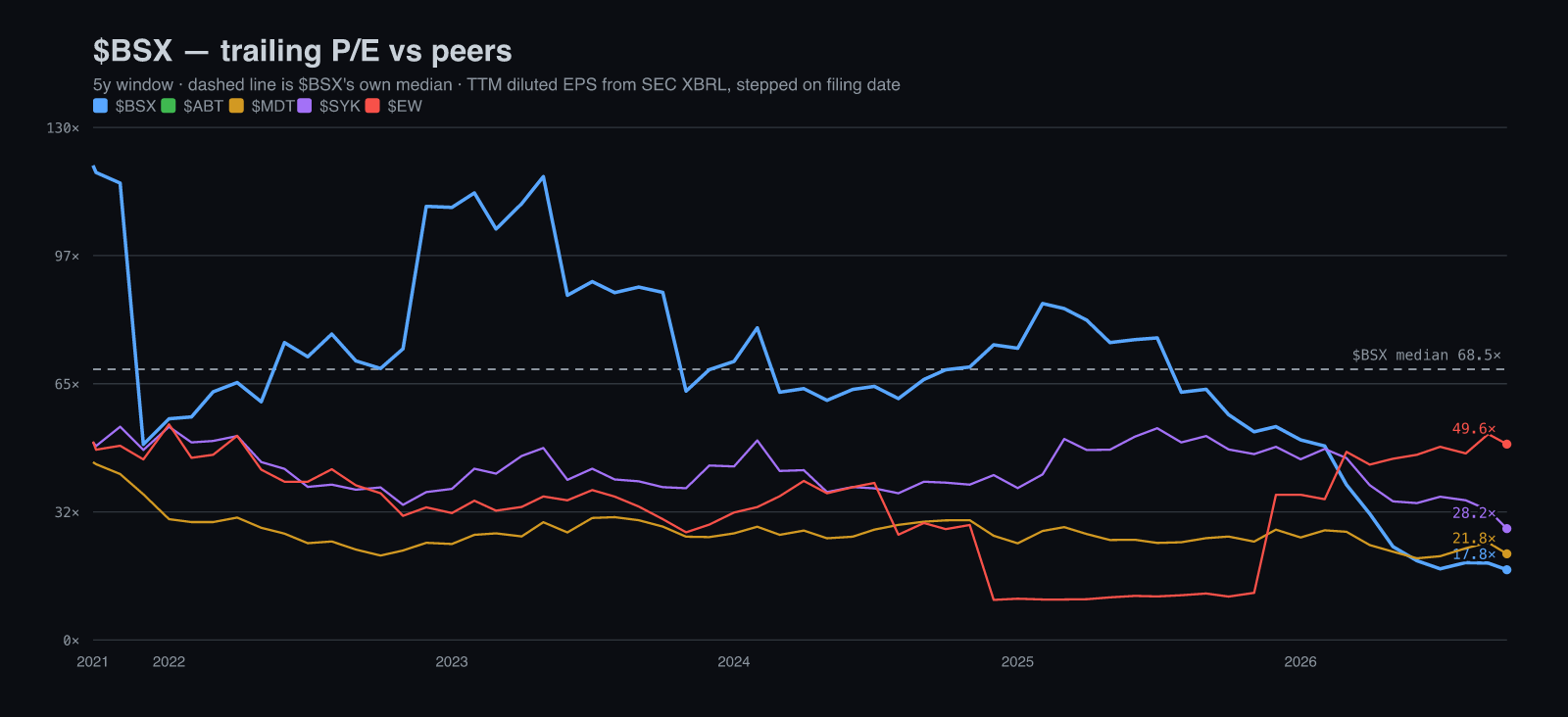
Two multiples circulate and they need a basis. At $43.92 against the July guide midpoint of $3.30, $BSX trades at 13.3× adjusted earnings, and that guide is now stale-high by the cyber quarter; against trailing GAAP diluted EPS of $2.47 it trades at 17.8×. Its own five-year trailing median of 68.5× is inflated by the low-earnings years of 2021–2023 and means little, but the peer read does: $MDT is at 21.8× trailing, $SYK at 28.2×, $EW at 49.6×. On enterprise value, $63.6B of market capitalisation plus $12.1B of net debt is $75.7B, about 11.6× the roughly $6.5B of adjusted EBITDA the July guide implied for 2026 (adjusted operating income plus depreciation; adding back amortisation a second time, as some models do, overstates it by close to $1B) and 15.1× the $5.0B of GAAP EBITDA filed for FY25. The pre-2024 range for this stock was 16–22× forward EBITDA.
The house model is an unlevered GAAP cash-flow build over ten explicit years, seeded from management's guidance for 2026 and the 2027 framework and fading to 5% growth at the horizon, with gross margin held at the filed 69.0%, working capital charged at the filed 25% of each year's revenue increase, cash tax at 15%, an 8% discount rate and 2% terminal growth. It is a standalone model: no Penumbra revenue, no Penumbra debt and no Penumbra shares, which roughly offset. Two judgements stand against the house standard. The audit warns that a 5% horizon growth rate sits above the 3% guided for 2027; we hold it because management has said in two forums that 2028 returns to its weighted market growth rate, which is 7–8%, and 5% is a haircut to that, not an acceleration past it. And we override the model's diluted share count, which would otherwise drift up 1.3% a year to 1,693M by FY35, to a flat 1,494.5M, because the company has just retired 2.7% of itself and the roughly 41M shares Penumbra issues are matched by the accelerated repurchase; on the drifting count the base perpetuity is $35.28. The base case is $39.96 by perpetuity, 9% below spot, and $50.95 at the exit, 16% above it; the bear case is $16 and $25, the bull $63 and $82.
The exit multiple is the median of six real medtech comps on filed trailing EBITDA, $ABT 19.1×, $MDT 14.1×, $SYK 18.1×, $EW 33.0×, $COO 12.7× and $ZBH 11.4×, and it sits above $BSX's own 14.0× on the guided year without assuming a return to the old range. The two terminals are 1.3× apart, which the standard accepts; the perpetuity implies 11.5× on terminal EBITDA and the exit implies 3.7% growth forever, and a company that compounded revenue at 15% for five years sits somewhere between them. The sensitivity grid runs $30 to $54 across 7–9% discount rates and 1–2.5% terminal growth. The reverse DCF is the cleanest statement of the setup: at $43.92 the price implies 5.3% revenue growth a year, forever, against a sixteen-year filed record of 5.8% and a plan that says 2028 is back to 7–8%.
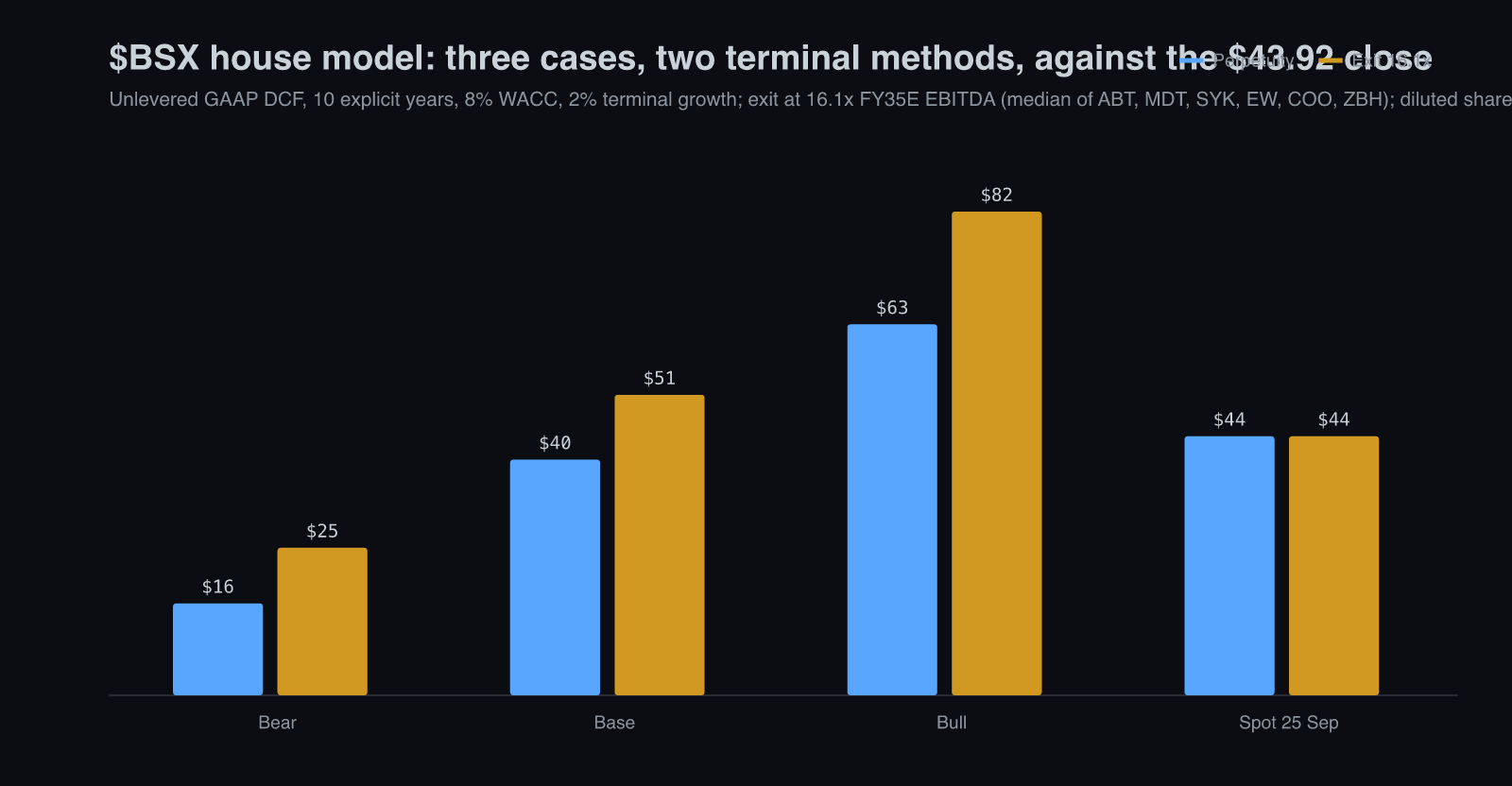
The asymmetry comes from a structural fact rather than optimism: the 2027 plan already assumes the two damaged franchises stay damaged, so the base case needs only the other 75% of the business to keep doing what it did in the second quarter, and the launches are upside. Our own model lands the stock between $40 and $51 on standalone GAAP cash flows, so the market is paying roughly the perpetuity value of a company that never re-accelerates for one whose management has dated the re-acceleration. Own it at $43.92, with the position sized for a print on 28 October that could take it to either the July low or the CEO's fill; add above $48.33, and treat a 2027 framework below 2% or a share disclosure below 40% as the reason to stop. Aurelion's $67 needs 16× on next-twelve-months adjusted EBITDA and all excess cash into buybacks; our base case gets to $56 in two years on less.