
$AVAV Deep Dive — The Laser Goes On the Books · Into the E-HEL Award and the 8 Sept Print
Update · 8 October 2026. Two catalysts that were still ahead when this analysis was written have since occurred. On 2 September, the U.S. Army awarded AeroVironment a $464.8 million E-HEL production agreement for LOCUST, resolving the competitive award risk discussed below. On 9 September, FY2027 Q1 results showed $480.5 million of revenue (+6% year over year), $0.7 billion of bookings, $1.5 billion of funded backlog (+37%), and $53.4 million of adjusted EBITDA versus $56.6 million a year earlier. Management reiterated its $2.125–2.225 billion FY2027 revenue range. The laser win validates a key product thesis; conversion of orders into revenue, the capacity buildout and remediation of the disclosed control weakness remain the tests. Prices, valuation and trading levels below are the original 5–6 August 2026 snapshot, not a refreshed recommendation.
Precision used to be the expensive part of warfare. It isn't any more — and once precision got cheap, the binding constraint moved from targeting to production rate. That single inversion created two demands at once: affordable mass on offence, and cost-symmetric defence against everyone else's affordable mass. $AVAV is one of very few companies industrialising both. It spent the last eight weeks proving it — a record $641.6M quarter, adjusted gross margin back to 34%, the first FY2030 framework in company history — and the stock is worth what it was worth before any of it happened.
What Changed
For eighty years Western military power rested on an assumption that was so reliable it stopped being examined: precision is expensive, therefore precision is scarce. A guided munition cost six figures. The aircraft that delivered it cost eight or nine. Force structure followed that cost curve down to its logical end — few platforms, exquisitely capable, protected at enormous expense, because each one was irreplaceable and each shot it took was precious.
Three things broke the assumption, roughly at once.
The components got cheap. Guidance no longer requires a purpose-built defence supply chain. A modern strike drone is assembled from the same technologies that went into consumer electronics at scale: MEMS inertial sensors, lithium cells, brushless motors, cheap high-resolution imagers, and a system-on-chip with enough compute to run machine vision. What cost hundreds of thousands now costs hundreds.
Autonomy got good enough. The decisive threshold was not full autonomy but terminal guidance — the weapon finishing the engagement on its own when the radio link drops or is jammed. Once that worked, the operator no longer had to fly the thing into the target, and one soldier stopped being a hard ceiling on one effect.
Ukraine proved it at scale, in public. The exchange ratio inverted in front of everyone: sub-$1,000 airframes destroying armoured vehicles worth millions, at a rate no procurement system had budgeted for.
The lesson is usually mis-stated as "drones matter now." What actually happened is that mass came back. When precision was scarce, the hard problem was finding and hitting the target. When precision is cheap, the hard problem is making enough of it — the attrition arithmetic is won by whoever can sustain the higher production rate of guided effects per month. That is a manufacturing question wearing a military uniform.
And the inversion runs in both directions, which is the part that took defence establishments longer to internalise. If a $1,000 drone can kill a $3M vehicle, then a $3M interceptor cannot be the answer to a $1,000 drone. You go bankrupt winning. Counter-drone therefore stopped being a capability problem and became a cost-per-engagement problem — which is precisely why directed energy stopped being a laboratory curiosity. A laser's marginal cost per shot is electricity.

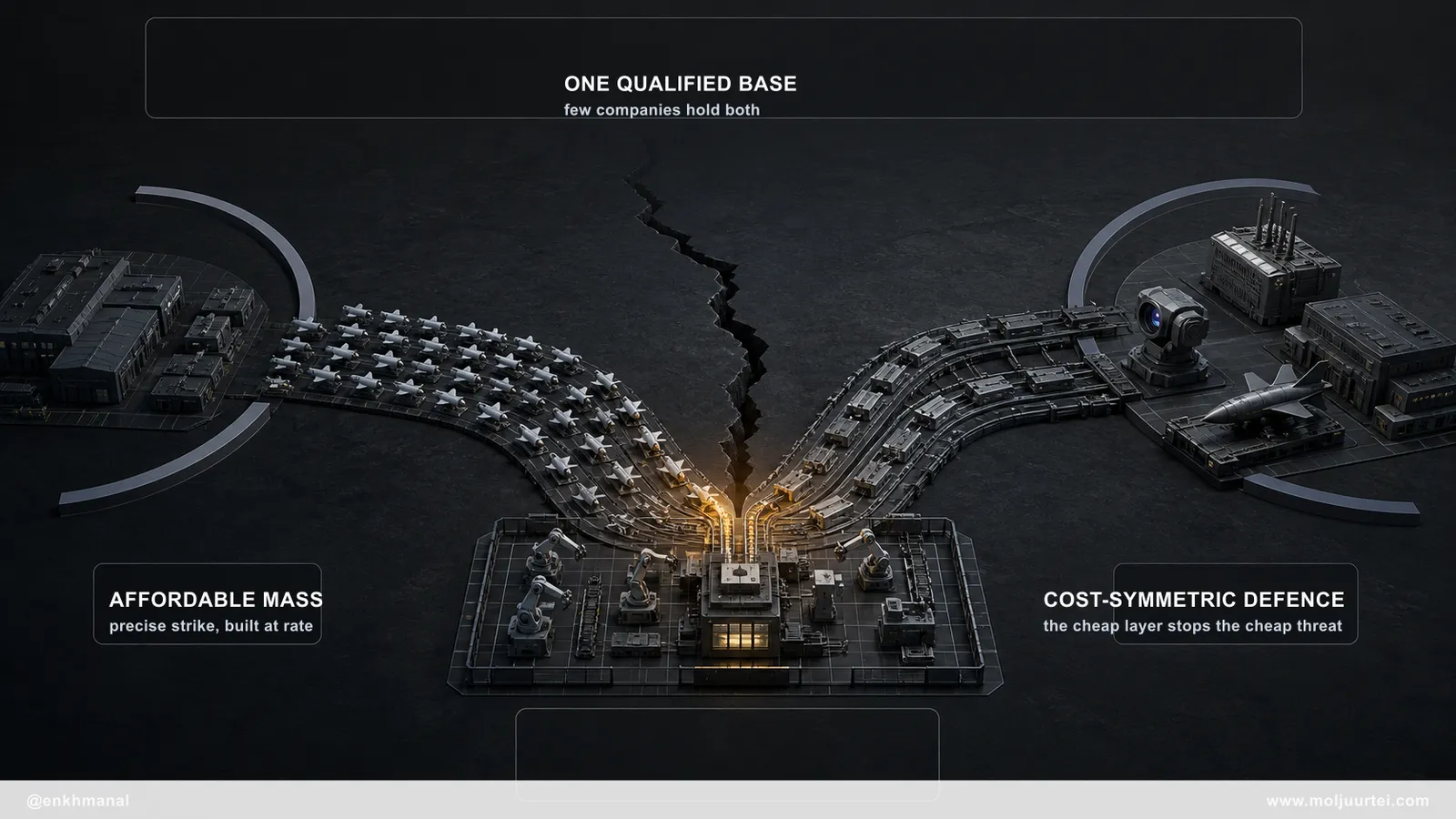
So the shift produces two demands, not one. Affordable mass — precise, attritable strike manufactured at rate. And cost-symmetric defence — layered counter-drone in which the cheap layer handles the cheap threat. Almost nobody builds both at industrial scale. The traditional primes are structurally organised around the old cost curve; the venture-funded newcomers have the right instincts and no qualified production base. $AVAV sits in the narrow overlap, and that is why it is the subject of this memo.
Thesis
$AVAV is the only company that has industrialised all three physical layers of drone defence — radio-frequency, laser, and kinetic — and fused them under one software stack, at the exact moment the U.S. Army is about to make lasers a permanent budget line rather than a science project. It arrives there holding the West's highest-volume loitering-munition franchise, which means it serves both halves of the inversion described above from one manufacturing base.
- What it can do that others can't: ship Titan radio-frequency jammers, the LOCUST laser, and the Freedom Eagle-1 interceptor as one layered system tied together by AV_Halo autonomy — with 65,000+ deployments across 55+ countries behind it, and the only directed-energy weapon ever fired from a U.S. supercarrier.
- What that lets it sell next: E-HEL, the Army's first high-energy-laser program of record, initial requirement 24 systems, in contract negotiation with $AVAV now and due by 30 September. Behind it sits a >$35B slate of programs the company says it will compete for through FY2030.
- Why now: the FY2027 Pentagon request carries roughly $74B for unmanned and counter-drone, including a 424% increase in counter-UAS funding — the category $AVAV built its last five years around.
- The one risk that matters: this is a company that just told the market its internal controls failed. Demand is not the question; whether you can trust the numbers describing it is.
Business & Backdrop
$AVAV was founded in 1971 by Paul MacCready and spent three decades as an aeronautics curiosity shop before the Switchblade turned it into a precision-strike company. The May 2025 all-stock acquisition of BlueHalo for ~$4.1B turned it into something else again: a two-segment defence-technology company with 4,000+ employees across 26 locations, headquartered now in Arlington rather than Monrovia.
FY2026 closed at $1.98B of revenue, +17% pro forma and +26% organic, split $1.36B Autonomous Systems (AxS) and $619M Space, Cyber & Directed Energy (SCDE). Underneath those two reporting segments sit five operating groups, and that distinction matters more than the segment labels do — which is the point COO Rob Smith went out of his way to make at the Investor Day:
"I've heard, as I've talked to investors… that they equate Space, Cyber and Directed Energy to Heritage BlueHalo, and they equate Autonomous Systems to Heritage AV. I just wanted to make sure you all recognize that that's not right."
Dr. Rob Smith, COO, AV Investor Day (8 July 2026)
He is correcting a real and expensive misconception. Both of the counter-UAS products now sitting inside the AxS segment — the Titan radio-frequency family and the Freedom Eagle-1 interceptor — came from BlueHalo. LOCUST, the laser, sits in SCDE. So the mental model that says "AxS is the good drone business and SCDE is the broken acquisition" mis-sorts the assets: the fastest-growing thing the company owns is in the segment everyone has written off, and a meaningful chunk of the segment everyone likes was bought in the deal they hated.
Management sizes its serviceable market at roughly $32B growing 22% — against $1.4B of AxS revenue.
Technology & Moat
What $AVAV makes is unusually easy to describe and unusually hard to copy: more than 20 products in production or entering production, organised into four hardware categories sitting on one software layer.
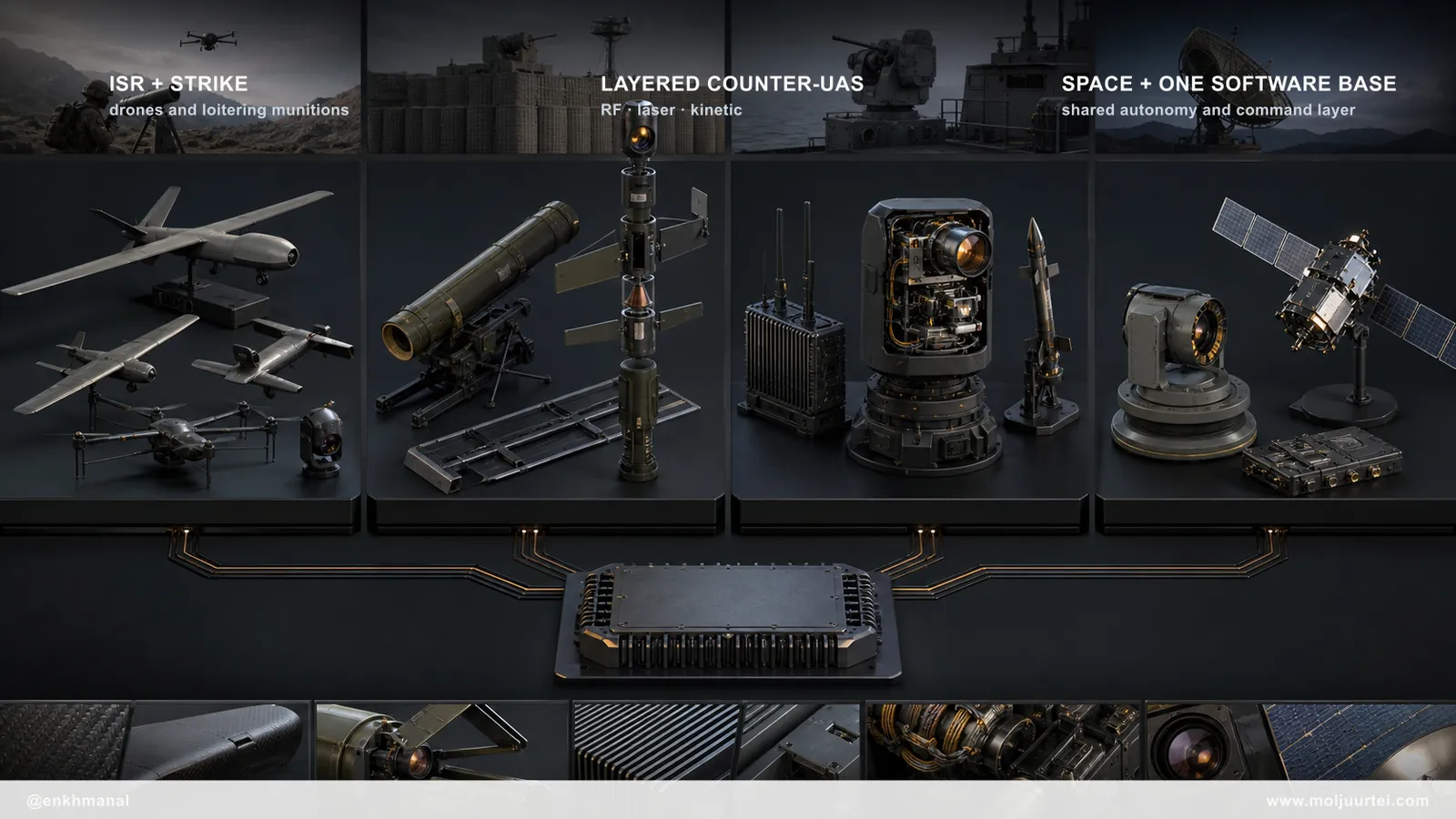
The Strike family is the franchise. Switchblade 300 is backpackable and man-portable; Switchblade 600 is the anti-armour variant with automated target recognition and encrypted M-code GPS; Switchblade 400, selected for the Army's LASSO program, sits between them. Mayhem 10 and Red Dragon round out the one-way-attack and launched-effects lines.
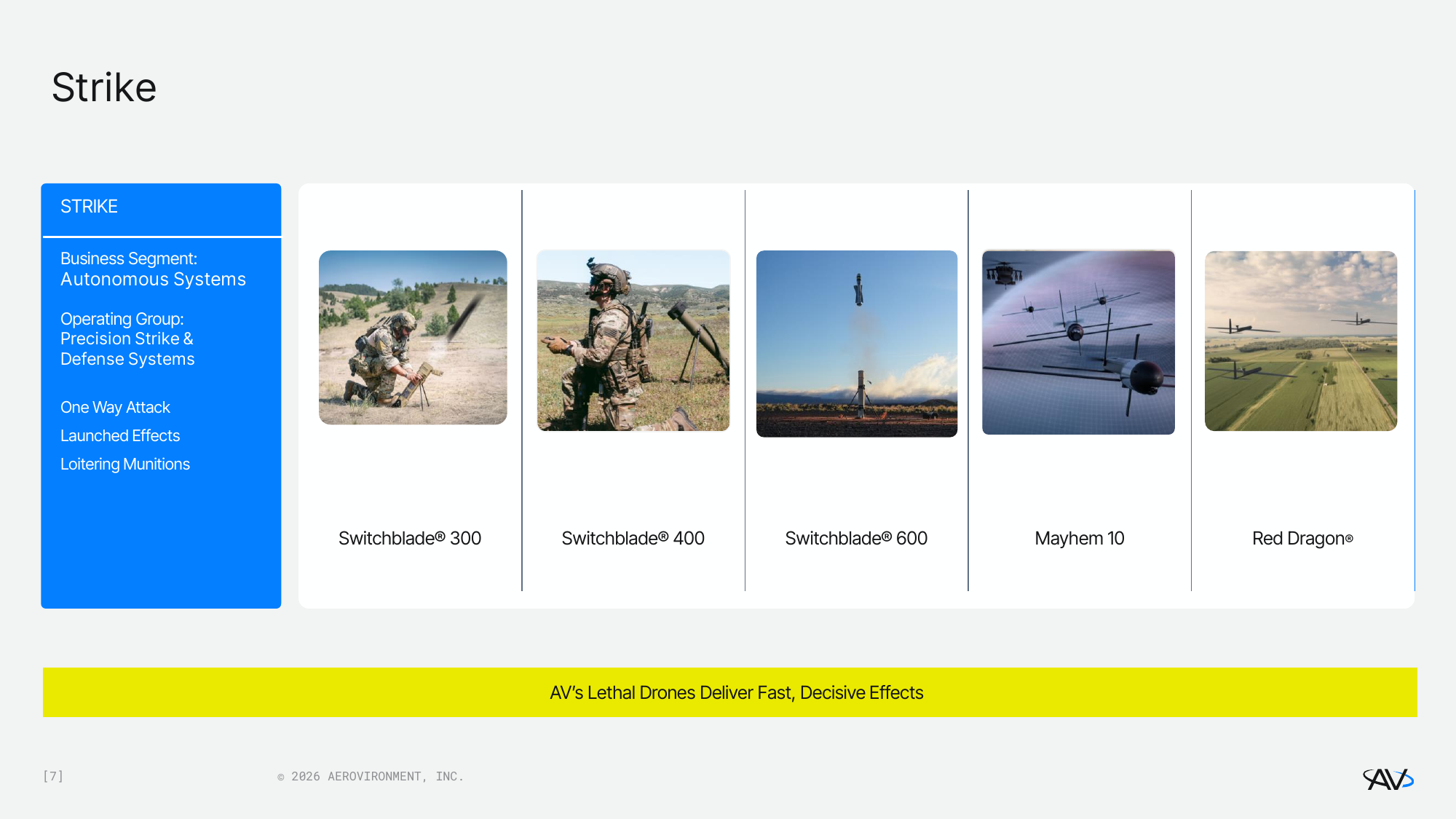 $AVAV Investor Day 2026 presentation, slide 7.
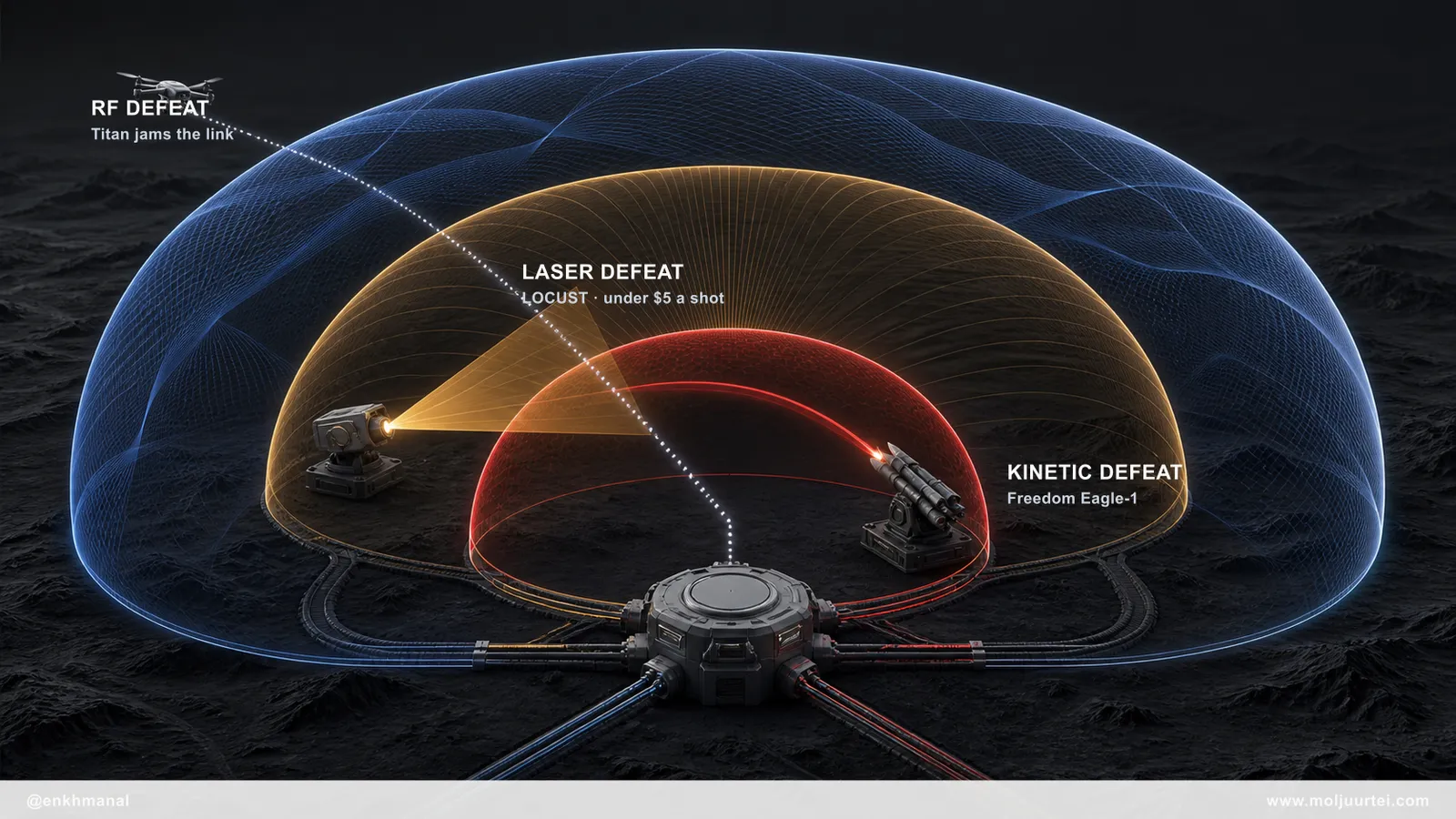
But the part of the portfolio about to be repriced is Counter-UAS, because $AVAV is the only vendor that fields all three physical ways of killing a drone. Titan defeats it by radio — jamming the link it navigates on. LOCUST defeats it with a fibre laser at a marginal cost management puts under $5 a shot. Freedom Eagle-1 defeats it kinetically when the first two can't, at a unit cost of roughly $100–150k against interceptors that historically cost $2–3M. AV_Halo is the command-and-control and automatic-target-recognition layer that decides which of the three to use. Owning one of those layers makes you a vendor; owning the decision about which layer to use makes you the architecture.
LOCUST is also the most-tested directed-energy weapon in the world, and that is a qualification argument rather than a marketing one. It has been fired at White Sands with the Army and operated from the deck of the USS George H.W. Bush — a moving ship, in salt air, against a live threat set — with what the COO describes as a 100% success rate. Four LOCUST prototypes have already been delivered under the Army's AMP-HEL effort, two on Infantry Squad Vehicles and two on Joint Light Tactical Vehicles.
That delivered-and-shot-at history is the moat. A laser is not a product you win on a proposal; it is a product you win by having already put one on a vehicle the Army drove into the desert and fired.
Roadmap & R&D
FY2027 is a construction year, and management is unusually explicit that it will look like one. Capital expenditure guides to 12–14% of revenue against 5% in FY2026 — roughly $300M, which CFO Sean Woodward framed plainly: "We have not spent nearly $300 million in CapEx before. Our company, in general, is not a capital-intensive type of company."
The money is going to four places, each attached to a named product line. Salt Lake City — the AV_Frontier site — is the Switchblade plant, operational around the turn of the calendar year. Albuquerque takes roughly $25M to ramp LOCUST. Huntsville expands for the Freedom Eagle-1 interceptor. Northern and Southern California expand for uncrewed-aircraft and counter-drone radio-frequency work. Alongside it, internal R&D steps up to 7–9% of revenue, about a $50M increase in dollars.
Here is the number that matters, and it is the one the market has not obviously priced:
"These capital expansions, we expect to be in fiscal year 2027 to add $4 billion of incremental additional revenue capacity. We anticipate the capital levels to return to more historical levels post fiscal year 2027."
Sean Woodward, CFO, AV Investor Day (8 July 2026)
One year of capital spending, on a company that will do ~$2.2B of revenue, builds the physical ability to do $4B more. Salt Lake City alone is sized to add about $2B of Switchblade capacity. Whether that capacity gets filled is a real question — but the cost of having built it is fully in the FY2027 numbers, and the revenue from filling it cannot be. This is the production-rate constraint from the opening section, being addressed with concrete.
That is what turns the FY2030 framework from slideware into arithmetic. Management guides to $3.5–4.0B of revenue by FY2030 — a 15–20% CAGR that roughly doubles FY2026 — and $630–800M of adjusted EBITDA, an 18–20% margin against 14% today. The growth is not spread evenly, and the shape of it is the tell:
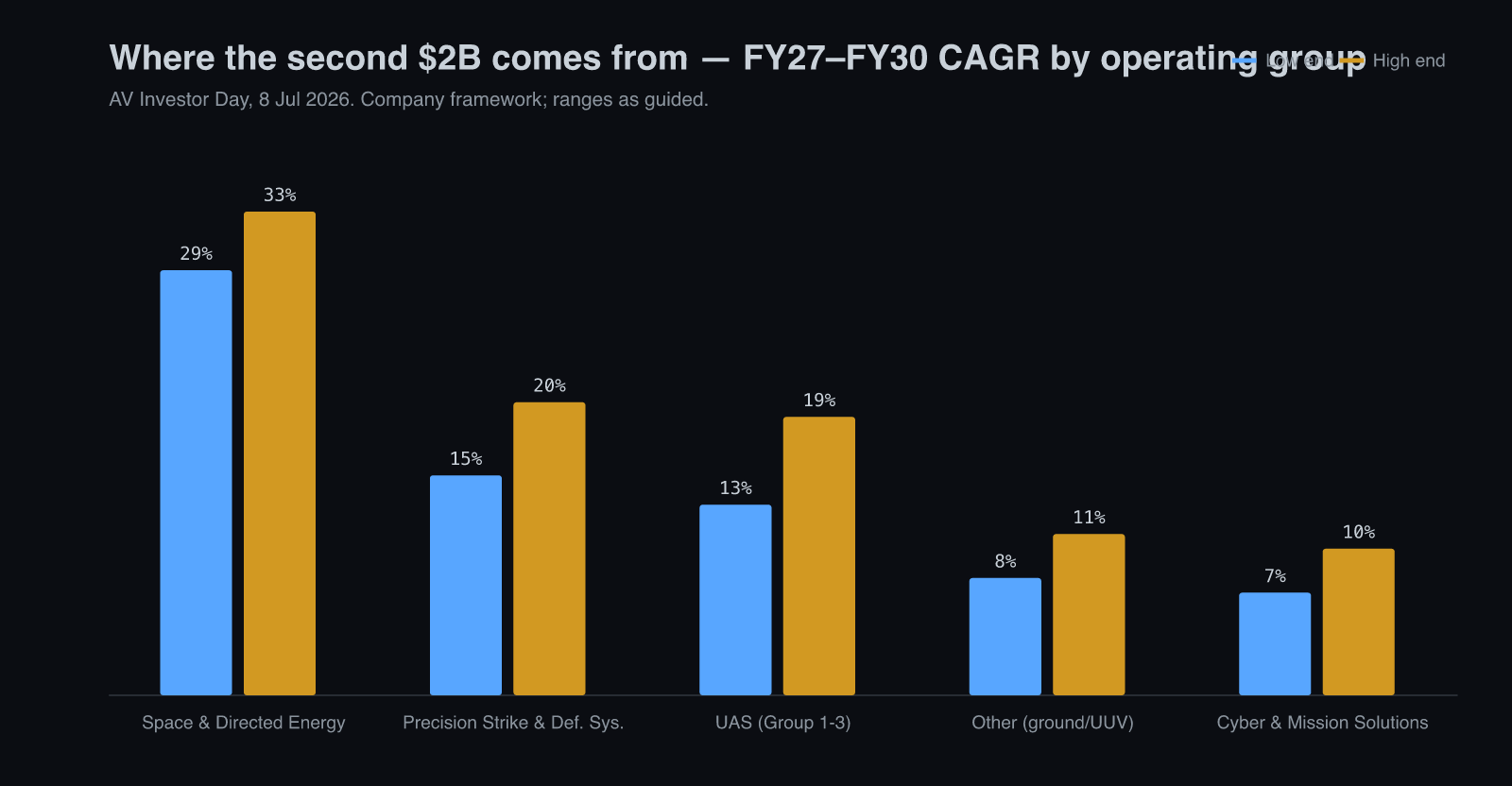
Space & Directed Energy — the LOCUST group, inside the segment the market treats as the damaged one — is guided to grow fastest at 29–33%. Precision Strike, already the largest business and coming off an 80% year-over-year quarter, is guided to a comparatively sober 15–20%.
The Setup — Why It's Mispriced
The Q4 FY26 print was not a modest beat. Revenue of $641.6M came in +30% year-over-year against a $556M consensus; non-GAAP EPS of $1.84 beat the $1.48 estimate by roughly 24%; adjusted EBITDA of $140.1M was a 22% margin and more than double the prior year. Adjusted gross margin recovered to 34%, the best quarter of the fiscal year and 730 basis points off the Q2 trough. GAAP earnings turned positive at $1.25 a share. Funded backlog reached $1.2B, up 65% year-over-year.
The market marked the stock up 18.8% the following day — and then handed all of it back. By the 8 July Investor Day, where the FY2030 framework was unveiled, $AVAV closed at $157.78. It changed hands at $168.06 on 5 August. On 12 June, before any of this was known — and while the prior memo on this name, The Loitering-Munition Bottleneck, was still arguing to wait for exactly this print — it was $170.58.
So a record quarter, a margin recovery, the first long-range framework in company history, a $500M Army counter-drone IDIQ awarded 1 July running through 2029, and an imminent laser program of record have collectively moved the share price by less than nothing.
Three things explain it, and only two are good news for a buyer.
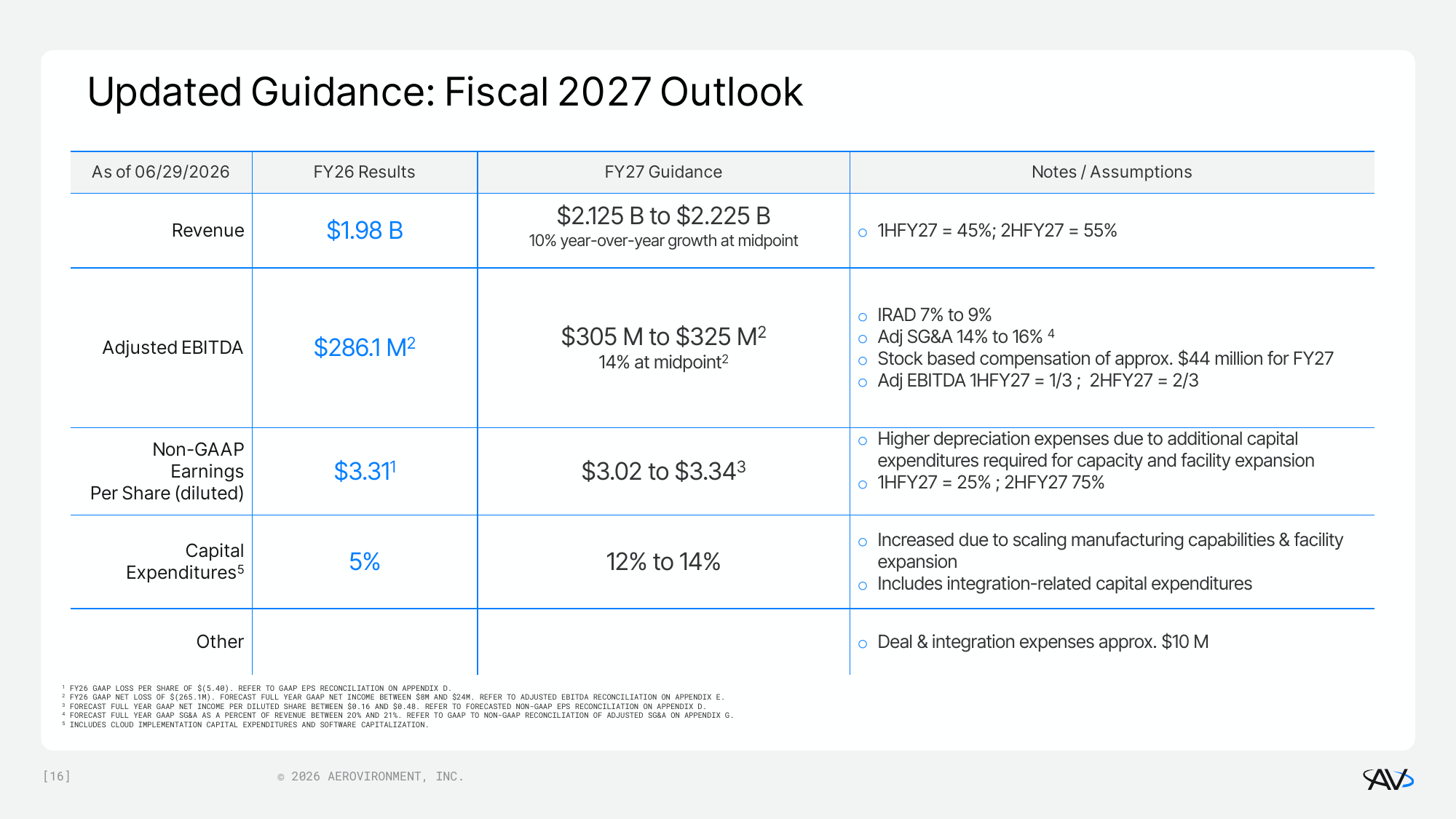
First, the guide reads flat where people look. FY2027 non-GAAP EPS guides to $3.02–3.34 against $3.31 delivered. A headline reader sees no growth. The reconciliation says otherwise: depreciation goes from $41.9M to $70M and cloud amortisation from $5.7M to $14M — the accounting shadow of the $4B capacity build. Strip the buildout and the operating business is guided to grow adjusted EBITDA from $286M to $305–325M on 10% revenue growth. Meanwhile GAAP net income swings from a $(265.1)M loss to a guided $8–24M profit. The company is guided to earn more and report the same.
 $AVAV Investor Day 2026 presentation, slide 16.
Second, the same print carried a governance disclosure. Alongside the record quarter, $AVAV took an $89M goodwill impairment, restated its Q3 FY2026 results, and disclosed a material weakness in internal control over the preparation and review of the impairment analysis. That is a genuine reason for a lower multiple, and it is discussed below rather than waved away.
Third, the E-HEL decision has not happened yet. The Army is in contract negotiation with $AVAV for the Enduring High Energy Laser — its first program of record for high-energy lasers, initial requirement 24 systems, decision expected by 30 September.
Risks & What Breaks It
The material weakness is the single assumption that almost broke this memo. A company that restates a quarter and tells you its controls over impairment review failed has forfeited the benefit of the doubt on every other number in this document — including the ones the thesis leans on. Two things keep it from being disqualifying: the failure is scoped to the goodwill-impairment process rather than to revenue recognition, and the restatement moved a non-cash charge without changing previously reported revenue or cash. It is still the reason to size this as a position rather than a conviction, and the FY2027 10-K remediation disclosure is a genuine gate.
The SCAR file is not closed. SCAR — the Space Force's Satellite Communications Augmentation Resource program, under which $AVAV was building BADGER phased-array antennas — was stop-worked and then terminated for convenience, removing $1.5B from unfunded backlog and triggering the impairment. A securities class action covering 25 June 2025 to 10 March 2026 alleges the company overstated the program's stability. The Space Force is recompeting SCAR, so the technology can come back; the litigation cannot be un-filed.
Concentration in a decision made by one customer. E-HEL is a single award by a single service. If it goes to a competitor — General Dynamics unveiled a competing microwave counter-drone platform the same day LOCUST X3 was shown — the Space & Directed Energy 29–33% growth line loses its anchor.
Lumpy revenue and a second-half-weighted year. Management guides FY2027 to a 45/55 first-half/second-half revenue split, one-third/two-thirds on EBITDA and 25%/75% on EPS. A soft Q1 on 8 September proves nothing and will still be traded as if it does.
Free cash flow is negative in FY2027 by construction, and the buildout assumes the demand arrives. Rare-earth supply constraints for drone motors and electronics — largely China-controlled — remain a live input risk, and they bear directly on the affordable-mass thesis: cheap effects depend on cheap magnets.
What forces a thesis change: E-HEL awarded to a competitor, or a second control failure in the FY2027 filings.
Price Setup — Levels, Technicals & Options
The tape has spent 2026 unwinding a 2025 that got ahead of itself. $AVAV peaked at $417.86 in October 2025, printed $281.67 as recently as 19 February, and bottomed at $136.68 on 25 June — four days before the print that resolved the margin question. It has since built a higher low and traded back to the $168–171 area.
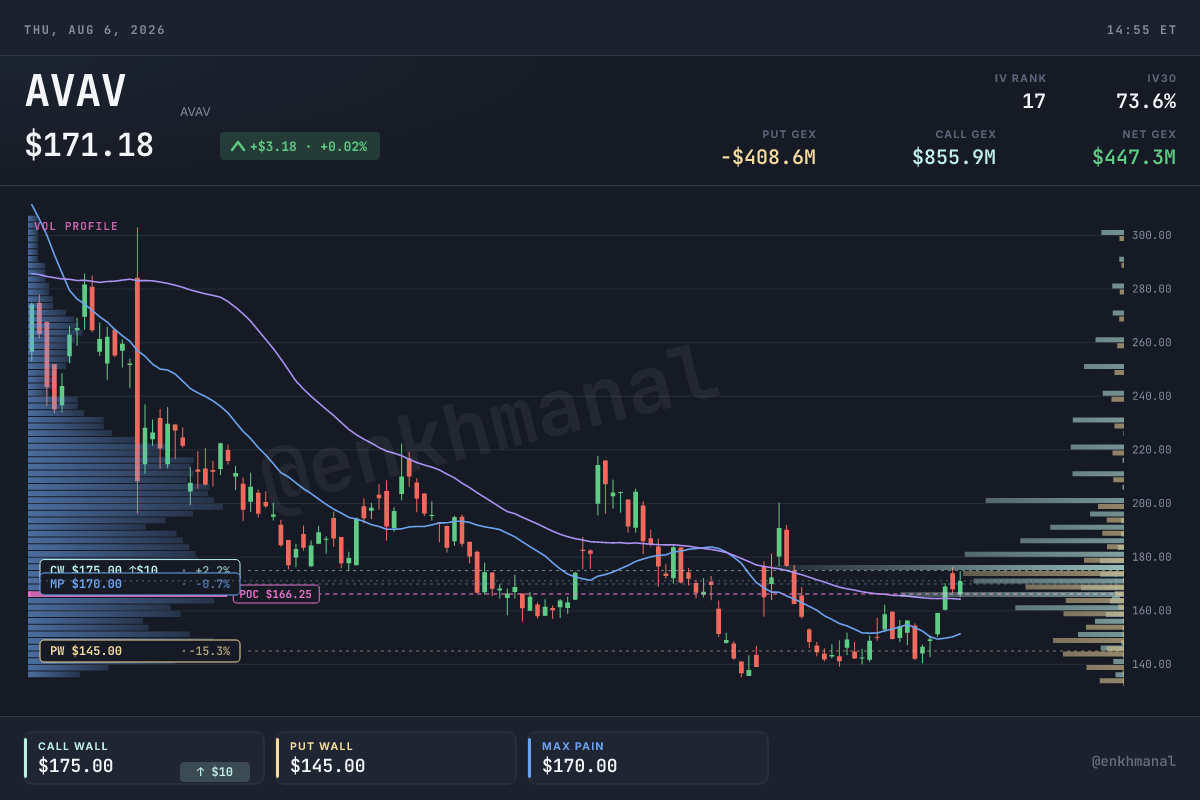
Two features matter. The 30 June gap from $139.00 to $165.07 has held for six weeks — the market has repeatedly declined to fill it, which is the clearest evidence that the print reset the floor rather than the ceiling. And the 8 July fade into the Investor Day says the FY2030 framework was received as a spending announcement rather than a capacity announcement. Both facts are consistent with a stock whose operational news is being read through an accounting lens.
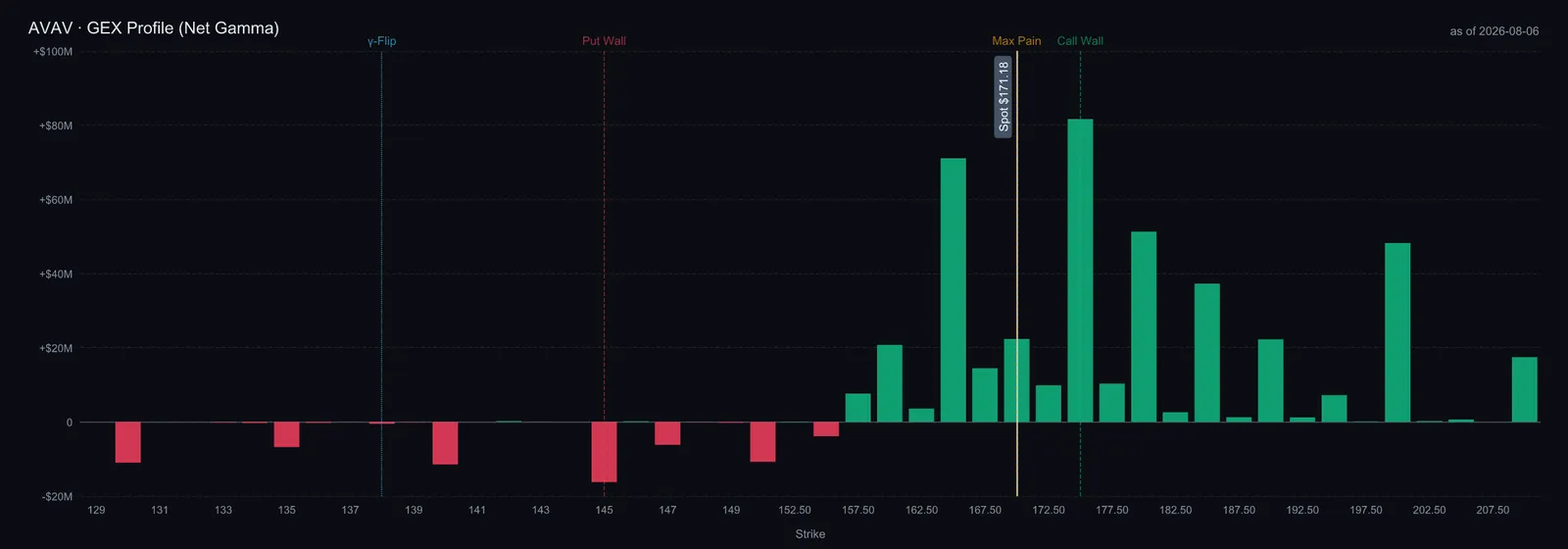
Dealer positioning frames the next move. Net gamma is positive, with a call wall near 175 and a put wall down at 145 — a pinned range that tends to dampen drift until a catalyst forces repricing, and there are two of those inside eight weeks. Thirty-day implied volatility around 74% is rich in absolute terms but not obviously rich against an event calendar carrying both a program-of-record decision and a print. One participant put the asymmetry plainly on 9 July: "If $LASR gets a 26% rerate on moving forward with its laser system, what does $AVAV get on E-HEL?"
The level that matters is 145. That is where the put wall sits, and roughly where the pre-print base was built. Losing it would mean the market has stopped treating the 25 June low as the bottom of the de-rating.
Catalysts
| Date | Catalyst | Why it matters |
|---|---|---|
| 2026-09-08 | Q1 FY27 print | Consensus $460M revenue, $0.30 EPS (15 analysts). First read on the 45/55 cadence |
| by 2026-09-30 | E-HEL award decision | Army's first directed-energy program of record; 24 systems initial |
| CY26 year-end | AV_Frontier (Salt Lake City) operational | ~$2B of Switchblade capacity comes online |
| FY27 10-K | Material-weakness remediation | The governance gate |
| Ongoing | SCAR recompete | The terminated program returns as a competed award |
Valuation & House View
At $168.06 and roughly 53M shares, $AVAV carries an ~$8.9B market capitalisation and, against ~$362M of net debt, an enterprise value near $9.3B. On FY2027 guidance that is ~4.3× EV/revenue and ~29× EV/adjusted EBITDA, with non-GAAP earnings at ~53×. Those are not cheap multiples, and nothing here argues they are.
The argument is about which year you are buying. Hold the FY2030 framework at its midpoint — $3.75B of revenue and $715M of adjusted EBITDA — and today's enterprise value is ~2.5× revenue and ~13× EBITDA on a business the company says will be growing 15–20% with an 18–20% margin. The gap between 29× and 13× is entirely a question of whether the capacity being built this year gets filled, and the funded backlog of $1.2B plus 69% visibility against the FY2027 guidance range is the early evidence that it is being filled rather than hoped for.
Sell-side consensus sits near a $245 target with no Sell ratings, which is a useful marker of where the crowd is rather than a reason to agree with it.
The Q4 print did the one thing the bear case required it to fail at: it recovered the margin. The Investor Day then did something the bull case had not asked for — it put a number on the capacity being built and a date on when the capital stops. What is left is a company whose reported earnings are being suppressed by the construction of its own next doubling, trading at the price it held before any of that was disclosed, into a laser award being negotiated right now. Buy it for the counter-drone architecture and the E-HEL optionality, size it for the material weakness, and treat a soft Q1 on 8 September as noise unless it arrives with a second controls disclosure. Below 145 the thesis is not wrong, but the market will have started asking a different question — and above $245 you are paying for FY2030 in full.
The Q4 and Investor Day facts here were sourced from the primary transcripts and decks; the market-reaction framing was sharpened by reads from Colby Hill (23 Jul) and FloorTrade (29 Jul), and the E-HEL timing by @laserwarsHQ's 4 Aug flag of Noah Shachtman's Wired report.