
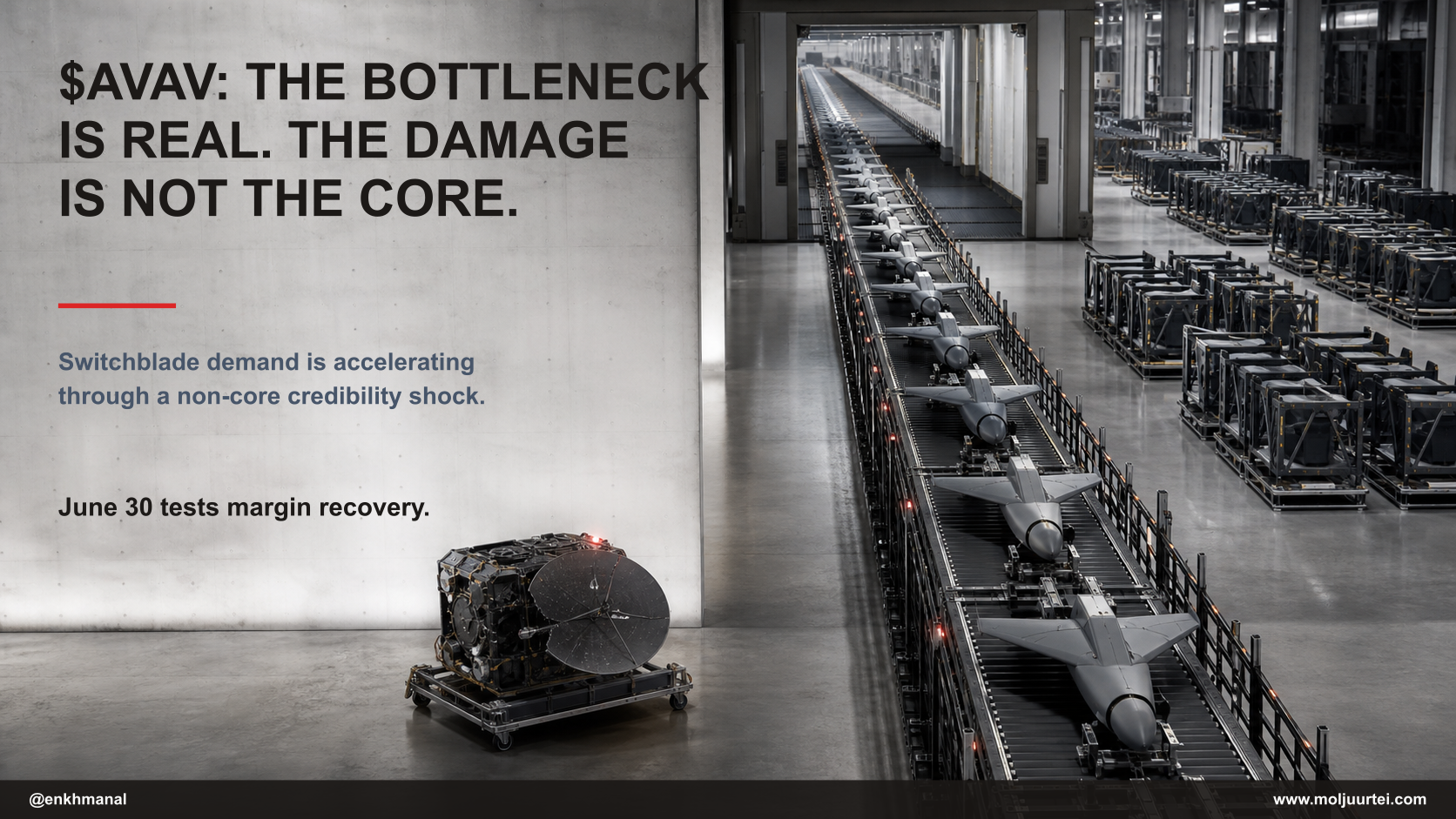
$AVAV Deep Dive — The Loitering-Munition Bottleneck · Into the June 30 FY26 Print
Update · 8 October 2026. This is the original 14 June thesis; the $170.67 share price, valuation, scenarios and June catalyst calendar below are historical, not current trading guidance. The June margin test has now happened. AeroVironment reported fiscal Q4 revenue of $641.6 million and a 32% GAAP gross margin, above the 28% recovery threshold in the original memo; it guided fiscal 2027 revenue to $2.125–2.225 billion and adjusted EBITDA to $305–325 million. Fiscal Q1 2027 then brought $480.5 million of revenue (+6% year over year), a 26% GAAP gross margin and $1.5 billion of funded backlog (+37% year over year). The lower sequential margin shows one good quarter did not finish the integration test. The other dated catalyst also resolved: on 2 September, LOCUST won a $464.8 million U.S. Army E-HEL production award. The structural demand and product breadth now have stronger evidence, while BlueHalo integration, spending to expand capacity and conversion of backlog into cash remain the decisive risks. No price target or scenario below has been refreshed.
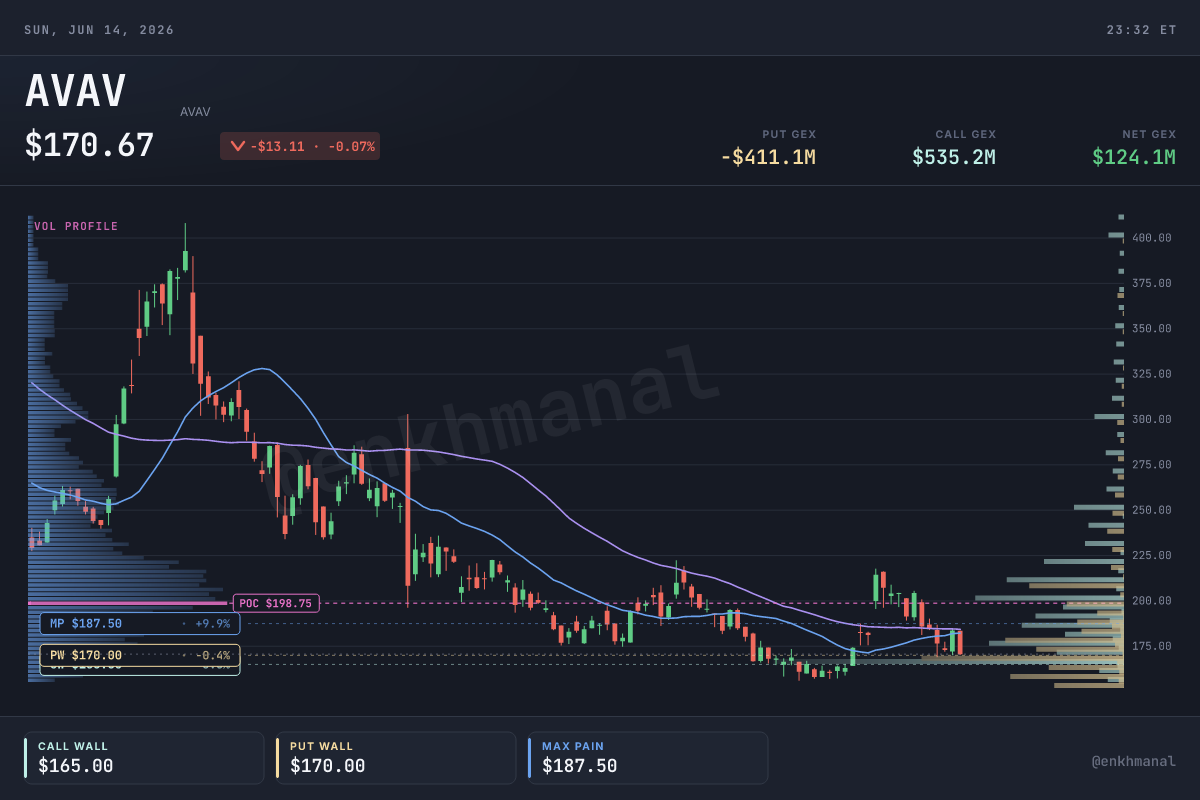
A ~59% drawdown from $417.86 to $170.67 has priced $AVAV as a broken BlueHalo-integration story — yet the legacy franchise that actually builds Switchblades grew 38% organically last quarter, the company is sitting on a record $1.1B funded backlog and $4.6B of year-to-date awards at a 1.6× book-to-bill, and it is the only Western manufacturer producing loitering munitions at industrial scale just as 31 allied nations discover they cannot source a domestic equivalent. The bull thread that prompted this work is directionally right on the demand picture and largely right on the facts — but it omits the three things that make this a high-risk turnaround rather than a layup: a securities class action over the BADGER contract, a multi-tranche Arlington Capital lock-up that runs into 2027, and a simultaneous CFO-and-COO change mid-integration.
Executive Summary
- $AVAV is the picks-and-shovels bottleneck of the "Affordable Mass" doctrine (see the Affordable Mass theme): the dominant at-scale Western maker of Switchblade-class loitering munitions, with combat heritage and ITAR-compliant domestic lines no competitor can replicate on a short clock.
- The setup is a washed-out laggard into a hard catalyst: $AVAV closed $170.67 (−59% from the $417.86 high, ~+9% off the $156 52-week low), down −33% YTD vs. $LMT +12% / $RTX flat — and reports Q4/FY26 on ~June 30, where the whole debate (margin recovery, FY27 guide) resolves.
- The drawdown over-discounts a non-core event. The $151.3M goodwill impairment and BADGER cancellation hit the Space/Space segment (BlueHalo) segment; the core Autonomous Systems franchise grew +38% organically and is untouched. On the numbers, "BlueHalo is free" at this price.
- The one risk that matters is credibility, not demand: a filed securities class action (class period 6/25/25–3/10/26) alleging $AVAV misrepresented BADGER, landing the same quarter it swapped CFO and COO — the worst possible moment to ask the market to trust an execution turnaround.
- House framing: constructive on the franchise, sized as optionality — the structural demand is real and the price is depressed, but the litigation + Arlington overhang + muted consolidated FY27 (~$2B) argue for waiting on the June 30 margin print before pressing.
Industry History & Technological Evolution
For most of the post-Cold-War era, precision strike was an exquisite, top-down capability: a small number of expensive platforms — cruise missiles, guided-bomb-equipped fast jets, Hellfire-armed drones flown by rated pilots — delivered effects that the infantry on the ground had to call in and wait for. The man on the ground had a rifle, a radio, and at best a shoulder-fired anti-tank missile with a kilometer or two of range and a single shot. The defining shift of the last decade is that precision strike has been pushed down to the individual soldier, and made attritable — cheap enough to expend by the thousand.
Three things drove the inflection. Commercial drone technology collapsed the cost of flight, optics, and autonomy. The proliferation of cheap microelectronics made a guided munition a backpack item rather than an aircraft payload. And Ukraine ran the live experiment at scale: three years of footage showing a single soldier with a tube destroying a tank that costs a hundred times more. Every allied defense ministry watched the same lesson and reached the same conclusion — their infantry lacks organic, jam-resistant precision strike at range, and the answer is the loitering munition: a one-way attack drone that orbits, finds, and dives.
This is a genuinely new product category, not a cyclical up-leg in an old one. $AVAV is the company that industrialized it. Its Switchblade family — born out of work for U.S. special operations in the 2010s — is the only Western loitering-munition line with real combat heritage and at-scale domestic production. The competition is real but young: $ANDURIL's Bolt-M is in Marine Corps production, and $TXT's Damocles won a loitering-munition prototype slot alongside the Switchblade 400. What none of them has yet is the combination of qualification, flight heritage, and ITAR-compliant capacity that takes years — not capital — to build.
Company Origin & Industry Positioning
$AVAV was founded in 1971 by Paul MacCready, the aeronautical engineer behind the human-powered Gossamer Condor. For decades it was a quirky innovation shop — solar aircraft, small hand-launched drones (Raven, Puma) for the Army, the occasional moonshot. The Switchblade, introduced around 2011, turned it into a precision-strike company. The pivot that defines the present, though, is the May 1, 2025 all-stock acquisition of BlueHalo for ~$4.1B from private-equity sponsor Arlington Capital Partners — a deal that roughly doubled the share count and bolted on an entirely new segment: space communications, directed energy, electronic warfare, and counter-drone.
That deal is the source of both the opportunity and the pain. $AVAV now reports two segments. Autonomous Systems (AxS) is the legacy core — Switchblade, Puma, Jump 20, counter-drone — and the franchise the thesis rests on. Space, Cyber and Directed Energy — the BlueHalo segment — is higher-revenue, lower-margin, services-heavy, and home to the contract (BADGER) that blew up. In Q3 FY26 AxS did $278.7M and Space segment $129.3M of the $408.0M total.
What the market is mispricing is the attribution. The headline disasters of the last two quarters — gross margin collapsing from ~38% to 24%, a $151.3M impairment, a guidance cut, back-to-back GAAP losses — are overwhelmingly BlueHalo/Space segment phenomena. The AxS franchise that builds the Switchblades the Army cannot get enough of grew 38% organically through the noise. The market has concluded the execution failures are permanent and structural; the evidence says they are concentrated and, on the demand side, transitory.
Technology Deep Dive
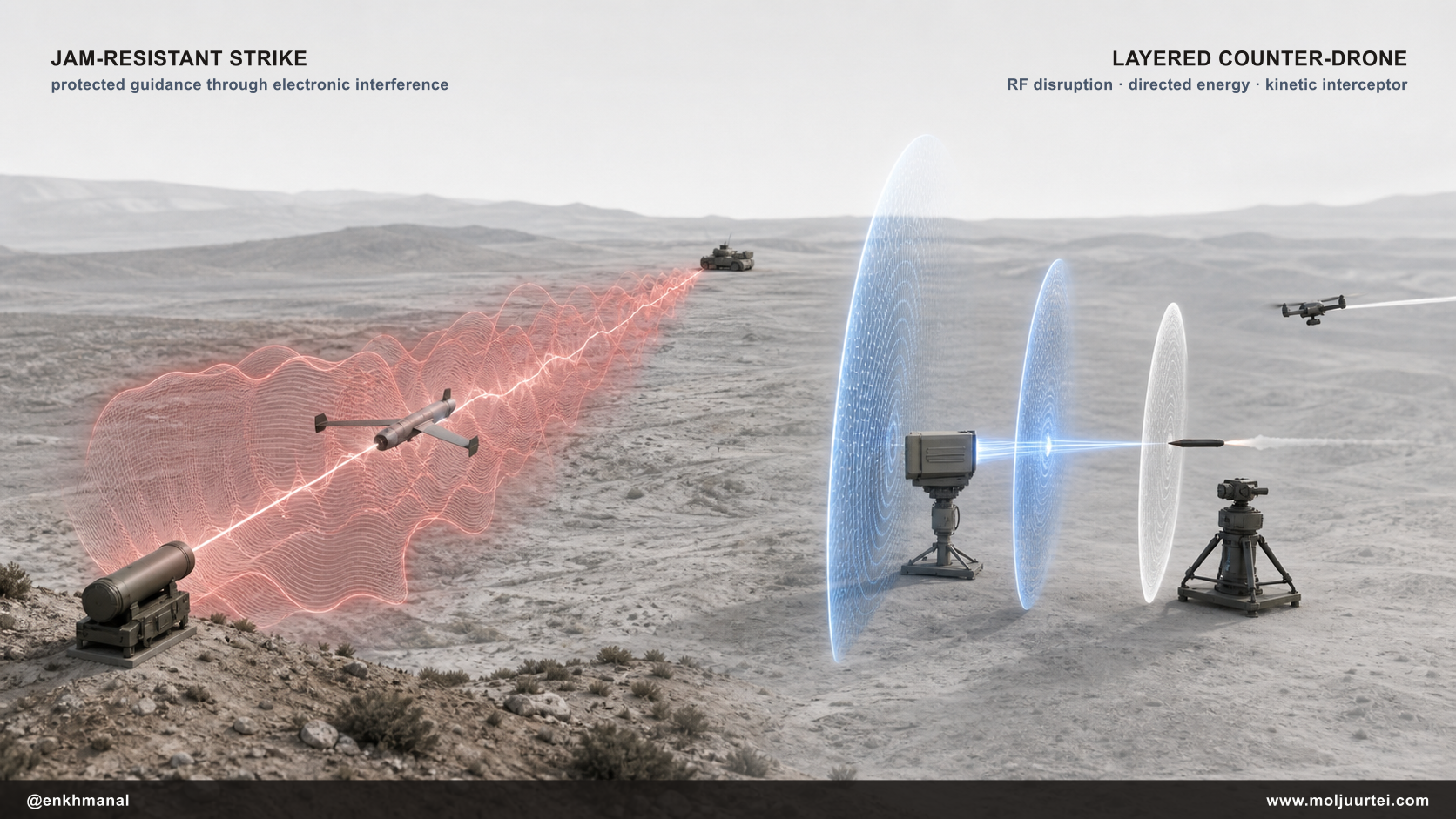
The Switchblade family is the moat. Switchblade 300 is backpackable, deployable by a single soldier in under two minutes, anti-personnel; the Block 20 (announced Oct 2025) adds an explosively-formed-penetrator payload for hardened targets. Switchblade 600 is the longer-range anti-armor variant with automated target recognition and encrypted M-code GPS. Switchblade 400, selected for the Army's loitering-munition program on May 4, 2026, slots between them and gives platoon-level infantry an armor-killing weapon out to ~65 km. The differentiation is not any single airframe — it is jam resistance (encrypted M-code GPS and hardened datalinks where commercial drones get electronically defeated), combat-proven flight heritage, and ~15 years of accumulated, selector-level manufacturing process knowledge that a competitor cannot recreate by writing a check.
BlueHalo layered a second technology stack on top that retail coverage almost entirely misses. Freedom Eagle-1 is a low-cost kinetic counter-drone interceptor that beat $RTX head-to-head for the Army's Next-Generation Counter-Drone Missile program in October 2025 — an initial $95.9M contract (plus $20.2M in May 2026 to expand the Huntsville line) for ~80 systems at a $100–150k unit cost, versus the $2–3M interceptors the Army burns on $40k drones today. LOCUST is the directed-energy weapon — its X3 generation delivers 20–35+ kW and defeats a drone for roughly the price of a coffee per shot; it engaged 17 drones in a live-fire demonstration aboard the carrier George H.W. Bush, the first directed-energy weapon ever fired from a U.S. supercarrier. Titan is the radio-frequency counter-drone jammer, 1,000+ units fielded — a line management says is "doubling every year" — with a ~$500M annual-capacity target. $AVAV also holds a 10-year, $499M Air Force Research Laboratory indefinite-delivery contract (HELMSSMAN) for electromagnetic-spectrum survivable materials, and just launched the Tom-50 backpackable explosive-ordnance-disposal/recon ground robot through its Telerob subsidiary (June 14, 2026).
The point is that $AVAV is now two growth stories — attritable munitions and a counter-drone/directed-energy portfolio — fused under one roof. The BADGER loss obscured the second one precisely when it should have been re-rating.
Peer Landscape — Technology & Price Action
The honest comp set is a barbell: small-cap attritable/drone names that trade on story multiples, and the legacy primes for whom the theme is a growth vector. $AVAV straddles it — small enough to move on a single program win, large enough ($8.5B cap) to be a prime in its category.
Peer price action (as of 2026-06-12):
| Ticker | 1M | 3M | 12M | YTD |
|---|---|---|---|---|
$AVAV | +1% | −20% | −10% | −33% |
$KTOS | −10% | −18% | +24% | −24% |
$RCAT | −23% | −14% | +53% | +41% |
$TXT | +1% | +6% | +16% | +6% |
$LMT | +2% | −11% | +17% | +12% |
$RTX | +2% | −5% | +26% | +0% |
$PLTR | −18% | −13% | −6% | −28% |
Forward multiple comparison (estimates):
| Ticker | NTM EV/Rev | NTM P/E | Note |
|---|---|---|---|
$AVAV | ~4.5× | ~58× (non-GAAP) | GAAP loss FY26; story multiple on depressed earnings |
$KTOS | ~10×+ | very high | purest small-cap "story multiple" in the group |
$RCAT | high | n/m | speculative drone pure-play |
$LMT | ~1.5× | low-teens | magazine prime, value multiple |
$RTX | ~2.5× | high-teens | missiles/effectors prime |
| Group median (small-cap) | ~7–10× | n/m | — |
$AVAV is the clear 12-month laggard of the defense complex (−10% vs. $LMT +17%, $RTX +26%, $KTOS +24%) and the worst YTD performer of the group except the higher-beta names. On forward EV/Revenue it screens cheaper than $KTOS despite a larger, more diversified, combat-proven franchise. The peer the market has already crowned is $KTOS — celebrated as the attritable-mass pure-play — yet $AVAV is the larger Switchblade-scale producer trading at a fraction of $KTOS's revenue multiple. That gap is the setup.
Business Model, Growth & Margins
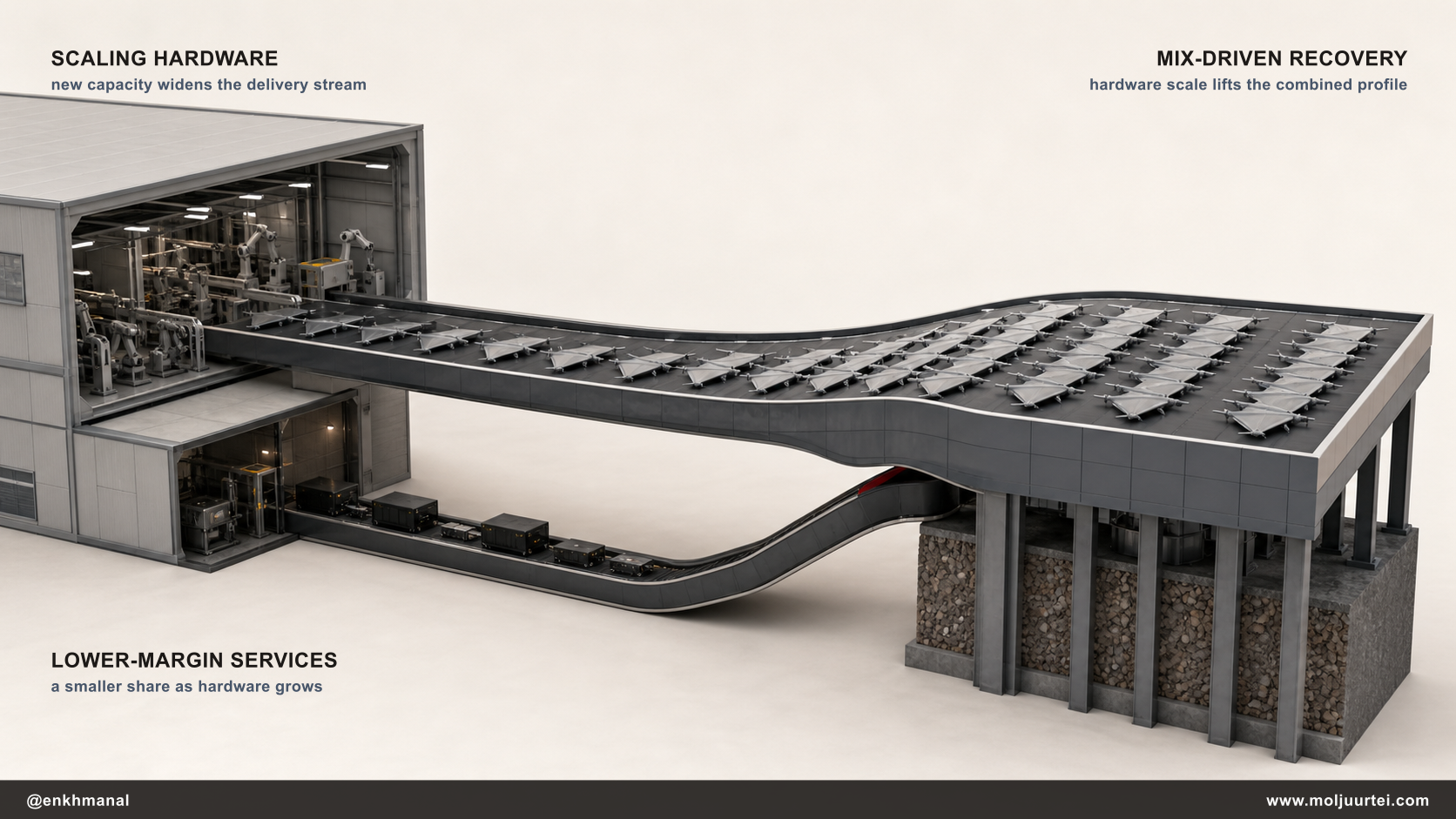
$AVAV sells hardware (higher margin) and services (lower margin) under multi-year indefinite-delivery contracts. BlueHalo shifted the mix toward services, which is the proximate cause of the margin compression. The revenue base nearly doubled on the acquisition, and the forward visibility is unusually concrete for a defense small-cap: a U.S. Army five-year ~$990M Switchblade indefinite-delivery contract (with ~$1.2B allocated to the loitering-munition program through FY2031), a separate $874M five-year foreign-military-sales indefinite-delivery contract (Dec 2025) covering Jump 20, Puma, Raven, P550 and Titan for allied forces, and named allied orders — Canada (C$67M), plus Lithuania, Romania, Greece, Australia and Taiwan totaling well over $200M in 18 months.
Segment revenue (Q3 FY26, quarter ended 1/31/26):
| Segment | Revenue | YoY | Read |
|---|---|---|---|
| Autonomous Systems (AxS) | $278.7M | +38% organic | the franchise; Switchblade/Puma — accelerating |
| Space, Cyber & Directed Energy — the BlueHalo segment | $129.3M | −19% | BlueHalo; hit by BADGER stop-work; the margin/credibility drag |
| Total | $408.0M | +143% | total flattered by BlueHalo; organic core is the +38% |
Recent quarters & guidance:
| Period | Revenue | Gross margin | Note |
|---|---|---|---|
| Q2 FY26 (10/31/25) | — | ~22% | margin trough; service-mix dilution |
| Q3 FY26 (1/31/26) | $408.0M | 24% | $151.3M impairment; net loss $(156.6)M / $(3.15); non-GAAP EPS $0.64 |
| Q4 FY26 (4/30/26) | guided record | watch ≥28% | reports ~June 30 — the margin-recovery test |
| FY26 (full) | $1.85–1.95B | — | adj. EBITDA $265–285M; non-GAAP EPS $2.75–3.10; GAAP EPS $(4.44)–(4.10) |
| FY27 (early frame) | ~$1.9–2.0B | — | formal guide comes with the print; muted vs. the AxS growth story |
Gross margin at 24% (from ~38% pre-deal) is the bear's whole case, and it is real. The recovery thesis is mechanical: as Switchblade hardware deliveries scale, the BlueHalo service mix shrinks as a percentage of revenue and margins normalize. Management guided Q4 to record revenue; if the mix is favorable, margin should inflect. The production math underwrites the scale — Switchblade 600 went from 40 to 240 units/month, and the new FreedomWerx facility in Salt Lake City (online late 2026/early 2027) is designed to push total Switchblade output past 1,200 units/month — roughly a 30× increase in two years. Capacity like that gets built only against contracted demand. The tension to respect: consolidated FY27 framed around ~$2B implies modest total growth, because a shrinking post-BADGER Space line offsets a fast-growing AxS line — the 38% organic figure is real but it is not the company's growth rate yet.
TAM, Strategic Narrative & Leadership
The addressable market sits across three pools that the Affordable Mass memo sized: a ~$20.7B military-drone market and ~$4.8B counter-drone market in 2026 (the fast-growing, attritable layer where $AVAV plays), feeding into the broader FY26 defense bill's $162B procurement envelope and the Golden Dome architecture. $AVAV's framing — "a defense technology leader delivering integrated capabilities across air, land, sea, space, and cyber" — is the post-BlueHalo pitch to become a multi-domain prime rather than a drone vendor. The credibility check cuts both ways: the AxS demand is unambiguously real and contracted; the Space segment "multi-domain prime" story just took a $151.3M, $1.7B-contract credibility hit.
On the call, CEO Wahid Nawabi struck the expected tone — "unprecedented demand," "numerous requests for proposals," and a defense of BADGER as "best-in-class and essential for national defense," with the BADGER termination cast as an inability "to reach a mutually acceptable solution with the customer." He framed the quarter as "impacted by revenue timing and adjustments in our Space business" while pointing to "record fourth quarter revenue" ahead. Nawabi has run $AVAV since 2016 and has genuine credibility on the AxS franchise; the question the litigation raises is whether management oversold BADGER's durability.
The freshest read came at Bank of America's industrials conference on May 13, 2026. Nawabi argued two conflicts had reset the paradigm from "more F-35s and carriers" to mass drones and counter-drone — "this is like our moment" — with AV "the #1 or #2 player in the world" across small drones, loitering munitions, and the layered counter-drone stack. He pointed to the Pentagon consolidating drone and autonomy funding into a single ~$75B bucket and called the $1.5T FY27 frame "real, not unreal." Crucially, he also volunteered the bear's ammunition: a continuing-resolution likelihood he put at "high," and a candid admission that European demand "could be a little bit overinflated." New CFO Sean Woodward used the same stage to make the valuation case directly — AV's "ability to deliver and grow profitably has been undervalued from a multiple perspective compared to our peers… they're losing money, or they're just starting up… we think our multiple is really kind of undervalued."
The leadership table is the part the bull case ignores. $AVAV is changing both its CFO and COO mid-integration: Sean Woodward (a 15-year $AVAV veteran, ex-General Dynamics/Honeywell) became CFO effective May 1, 2026, with prior CFO Kevin McDonnell staying as an advisor through July; Dr. Robert Smith (ex-Raytheon ($RTX) radar/electronic-warfare and Lockheed ($LMT)) became COO effective April 13, 2026, with outgoing COO Brad Truesdell transitioning to a consultancy. These are credentialed, largely internal/industry hires — not a panic exodus — but a simultaneous CFO-and-COO swap during a margin turnaround, a contract cancellation, and active litigation is a real key-man and execution risk.
Latest Earnings
The Q3 FY26 print (reported March 10, 2026) is the pivot the whole stock is reacting to:
- Headline: Revenue $408.0M, +143% YoY (+38% organic ex-BlueHalo); gross margin 24% vs. 38%; GAAP net loss $(156.6)M / $(3.15) per share; non-GAAP EPS $0.64 (vs. $0.30 — a beat on the adjusted line); adjusted EBITDA $44.5M.
- The impairment: a $151.3M non-cash goodwill impairment in the Space reporting unit, triggered by the January 2026 stop-work order on the BADGER Other Transaction Agreement; the Space Force subsequently terminated the ~$1.7B contract for convenience and moved to a multi-vendor commercial-product recompete.
- Backlog: record funded backlog $1.1B (vs. $726.6M at FY25-end), unfunded backlog ~$3B, nine-month bookings $2.1B at a 1.6× book-to-bill, and $4.6B of year-to-date awards — the demand signal is building, not shrinking.
- Guidance: FY26 cut to $1.85–1.95B revenue (from ~$1.975B), adj. EBITDA $265–285M, non-GAAP EPS $2.75–3.10 — the reduction driven by the Space segment, not AxS.
- The tough question: analysts pressed on whether BADGER's loss signals broader BlueHalo integration failure. Management's answer — that BADGER was a customer-specific acquisition-strategy change, not a technology or demand problem, and that BADGER will be re-offered commercially — is the crux of the bull/bear divide and the subject of the litigation.
The next print (~June 30, Q4/FY26) is the single most important near-term event: it tests the margin-recovery mechanism and delivers the first formal FY27 guide.
Thematic Investment Angle
$AVAV is one leg of the "Affordable Mass" basket — the doctrine that you win the cost-per-engagement war with attritable autonomy, cheap effectors, and a software kill chain rather than $4M interceptors against $40k drones. Within that basket it is the pure-ish attritable-munitions producer with real scale, distinct from the magazine primes and the software layer.
| Ticker | Role | Why this slot | Crowdedness |
|---|---|---|---|
$AVAV | Attritable-munitions producer at scale | The Switchblade bottleneck + a counter-drone/directed-energy optionality stack | Under-covered on X; washed-out, laggard |
$KTOS | Attritable drones/engines | Valkyrie + tactical engines; the market's anointed pure-play | Crowded, story multiple |
$RCAT | Small-drone pure-play | Higher-beta speculative drone exposure | Hot (+53% 12M) |
$TXT | Damocles / diversified | loitering-munition prototype competitor; theme is a sliver | Under the radar |
$LMT $RTX $NOC | Magazine / solid-rocket-motor chokepoint | Interceptor replenishment; theme is a growth vector | Cheap, out of favor |
$PLTR | Software kill chain | Maven; the connective tissue | Expensive, consensus |
$ANDURIL (private) | Cleanest attritable pure-play | Bolt-M, Barracuda; the benchmark | IPO is the basket's catalyst |
Within the basket $AVAV screens as the cheapest scaled expression of attritable mass — larger and more diversified than $KTOS at a far lower revenue multiple, and uniquely carrying a free counter-drone/directed-energy option. The whole theme is invalidated if the Ukraine-driven loitering-munition procurement wave proves to be a one-time restocking rather than a permanent shift in infantry force design — but the Army replacing traditional anti-tank missiles with loitering munitions under that program of record argues for structural, not cyclical.
Bull Case & Catalysts
The bull case is that the market is pricing a non-core, one-time event (BADGER + BlueHalo service-mix) as a permanent impairment of a franchise that is structurally accelerating. Strip out the noise and $AVAV is the sole at-scale Western Switchblade producer, tripling capacity into a multi-nation procurement wave, with a counter-drone/directed-energy portfolio (Freedom Eagle-1, LOCUST, Titan) thrown in essentially for free at today's enterprise value. If Q4 confirms margin recovery and FreedomWerx ramps on schedule, the AxS business alone — $1.2–1.4B at 38% organic growth — supports a valuation well above the current EV; BlueHalo becomes upside, not a tax.
| Date | Event | Why it matters |
|---|---|---|
| ~2026-06-30 | Q4/FY26 earnings (AMC) | The margin-recovery test (watch gross margin ≥28%) + first FY27 guide |
| ~Jun–Aug 2026 (30–90d from 5/13) | Army Enduring High-Energy Laser decision (24 systems) | Mgmt (5/13): decision "within 30–90 days" — the "first-ever" US laser program of record; $AVAV has 4 LOCUST prototypes on the preferred Joint Light Tactical Vehicle / Stryker. "Should open the floodgates." |
| 2026-07-27 | Securities class-action lead-plaintiff deadline | Litigation-headline risk crystallizes |
| 2025-12 → 2026 | BADGER recompete (draft → final final solicitation) | Re-entry into a ~$1.7B program now opened to $NOC/$LHX/$LMT |
| Late 2026 / early 2027 | FreedomWerx production start | Confirms the 30× Switchblade scaling thesis |
| 2026-11-01 | Arlington lock-up tranche (≈5.5M sh) | Technical supply overhang |
What needs to go right: Q4 gross margin recovers above ~28%, FreedomWerx comes online on time, the BADGER recompete is won or replaced by other Space segment wins, and a named allied ally signs direct Switchblade 400 procurement under the loitering-munition program. If those land, this re-rates toward the $305 analyst consensus over 12–18 months.
Risk Register
- Securities class action over BADGER. A complaint is filed (E.D. Va., Pomerantz and others), class period 6/25/25–3/10/26, alleging $AVAV called BADGER a "tremendous growth opportunity" and "very much on track" while understating imminent-competition risk. This is exactly the "filed complaint with a defined class period spanning the run-up" that turns a routine overhang into a repricing event — and it directly attacks management credibility on the eve of an execution turnaround.
- The Arlington lock-up is an overhang, not a bullish "tell." The popular bull framing — "insiders aren't selling" — is misleading. Arlington Capital received ~18.5M shares; only 7.4M unlocked on May 1, 2026, with 11.1M more releasing in two tranches (Nov 1, 2026 and May 1, 2027). A PE sponsor does not hold a defense small-cap forever; the bulk of the supply has not even unlocked yet. A sustained break below ~$140 around the November tranche would be a tape-confirming negative.
- Margin recovery may be structural, not transitory. If BlueHalo's service mix proves sticky and hardware cross-sell fails, $AVAV has permanently lowered its margin profile for a $4.1B deal generating ~$600–700M of low-margin revenue. Gross margin failing to clear ~25% in Q4 would falsify the core recovery mechanism.
- Management is choosing reinvestment over margin expansion. Nawabi (5/13): "we intentionally are not increasing EBITDA margins as we grow because we're going to continue to invest." Internal R&D runs ~8–9% of revenue and is heading back toward 10% — so the bull's margin-snapback case partly collides with management's own stated preference to plow scale into the next program win. A rapid EBITDA-margin re-rate is not the plan.
- Leadership transition risk. A new CFO and new COO simultaneously, mid-integration, mid-litigation — credentialed hires, but the execution bar is high and there is no margin for a fumbled quarter.
- BADGER recompete is no longer sole-source. The Space Force opened the program to $NOC, $LHX and $LMT; $AVAV may not recover the work, and ~$1.5B of unfunded backlog already evaporated (Space segment −19% YoY).
- Competition in the core is real and intensifying. $ANDURIL's Bolt-M is in Marine Corps production and $TXT's Damocles shares a loitering-munition prototype slot; the moat is time-and-qualification, not legal exclusivity, and it erodes as rivals field.
What would force a thesis change: funded backlog falling below ~$900M, book-to-bill under 1.0× for two consecutive quarters, or Q4 gross margin failing to recover above 25% — any of which would convert "transitory integration noise" into "permanently impaired franchise." Conversely, a clean Q4 margin inflection plus an Enduring High-Energy Laser win would flip the memo decisively bullish.
Valuation & House View
At $170.67, $AVAV carries ~$8.5B of market cap and ~$9.0B of enterprise value (cash ~$290M against ~$0.7–0.8B of debt). That puts it at roughly 4.5–4.7× forward revenue and ~58× non-GAAP FY26 EPS on a loss-making GAAP year — a story multiple, but a far cry from the ~13.5× trailing EV/sales screen that reflects a stale, pre-BlueHalo revenue base. The disconnect is between a depressed price and a backlog that says demand is compounding.
Valuation snapshot:
| Metric | Current | Context |
|---|---|---|
| EV / NTM Rev | ~4.5× | well below $KTOS (~10×+); below the small-cap drone median |
| Non-GAAP P/E (FY26) | ~58× | on $2.75–3.10 EPS; GAAP is a loss |
| Analyst fair value | reset $382 → ~$311 | trimmed for BADGER, still ~+80% from spot |
| Consensus PT | ~$305 (16 Buy / 21 cover) | implies +79% — sentiment has gapped below fundamentals |
Scenarios (≈2-year):
| Scenario | Prob. | Target | Implied | Triggers |
|---|---|---|---|---|
| Bull | 40% | $320 | +88% | Q4 gross margin >28%, FreedomWerx ramps, Enduring High-Energy Laser win, BADGER recompete recovered/replaced |
| Base | 40% | $215 | +26% | AxS compounds, BlueHalo margins normalize slowly, litigation settles modestly |
| Bear | 20% | $115 | −33% | margin recovery stalls, litigation/headline shock, Arlington supply, BADGER lost |
House View. The structural read is genuinely constructive: $AVAV is the cheapest scaled expression of attritable mass, the AxS franchise is accelerating, and "BlueHalo is free" is a fair characterization of the enterprise value at this price. But the bull thread that prompted this work understated the risk side — the filed securities class action, the Arlington lock-up that runs to mid-2027, the dual CFO/COO change, and a consolidated FY27 (~$2B) far more muted than the 38%-organic headline. The clean way to express this is sized optionality, not a core position: the asymmetry favors patience through the ~June 30 print, where a gross-margin recovery above ~28% would be the green light to add. Until then, the franchise is real, the price is washed out, and the catalyst is dated — but the credibility overhang is exactly why it is cheap.