$AKAM Deep Dive — Renting the CPUs that agents run on · $11.6B from Anthropic, service from mid-2027
$AKAM spent a quarter of a century building a computer spread across thousands of small rooms, and on 24 September Anthropic agreed to rent $11.6 billion of it for seven years to run the part of artificial intelligence that happens on ordinary processors. The contract turns a slow-growing security and delivery company into one of the larger independent suppliers of CPU capacity for AI agents, at the price of $5.5 billion of up-front spending and a customer that now accounts for most of its cloud backlog.
What Changed
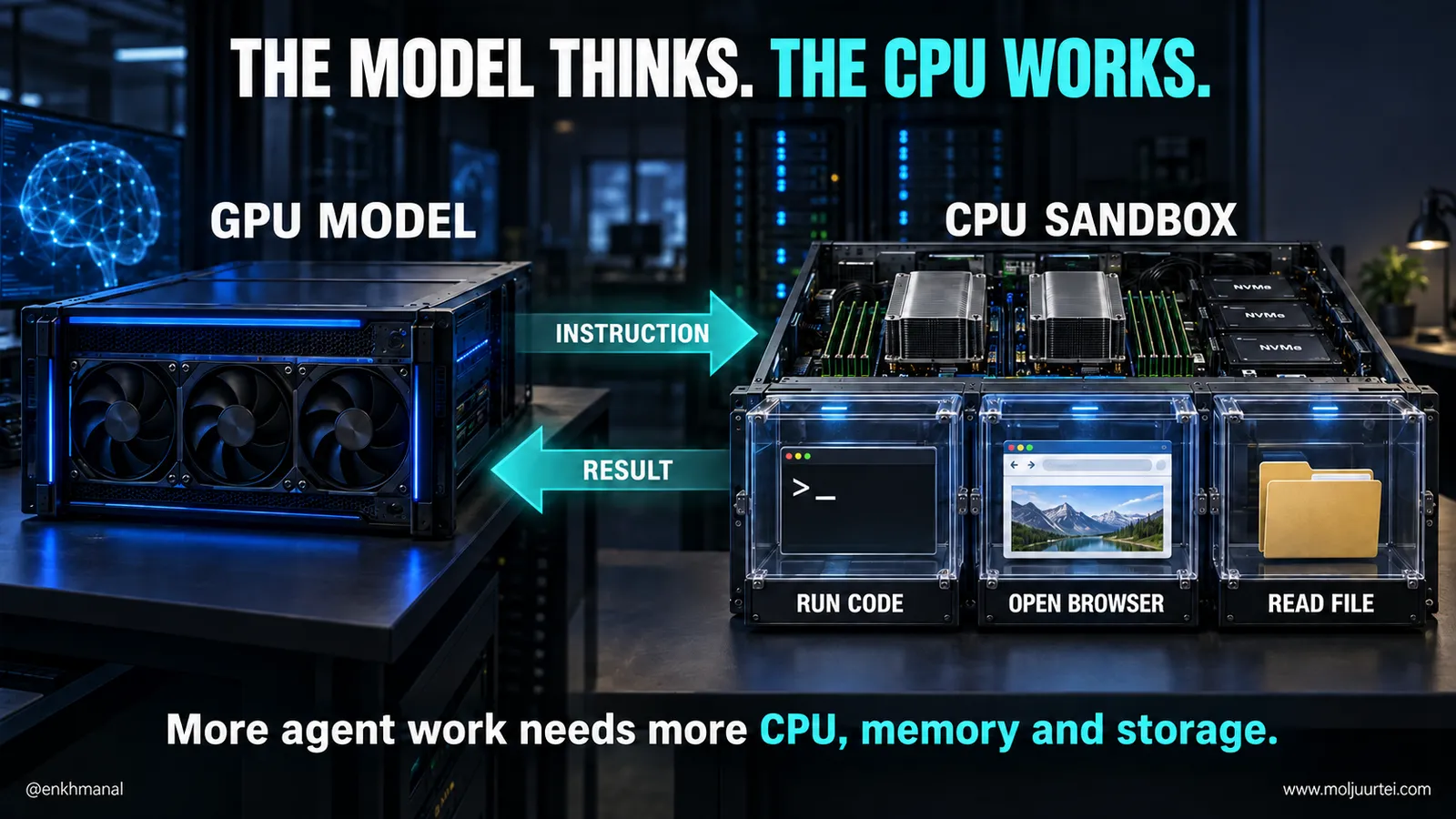
A chatbot and an agent run on the same model, and they spend money in different places. When you ask a chatbot a question, the expensive work happens on a GPU, which turns the question into a paragraph of text, and the job ends when the paragraph reaches your screen. An agent is given a goal instead of a question. It writes code and runs it, opens a browser, reads a file, calls another program, checks the result and goes round again until the goal is met. Much of that tool execution runs on CPUs, although individual tools can also call GPUs or external services.
Start here. A computer is a machine that follows a list of instructions, and the part that follows them is the CPU, a chip with a few dozen to a few hundred cores that are each good at doing the next unpredictable thing quickly. A GPU is a different chip that does one predictable piece of arithmetic to thousands of numbers at once, which is what a neural network needs, so models are trained and answered on GPUs. An agent is a model with tools and a goal, and a sandbox is the walled-off computer it uses those tools in, designed to limit its access to other users' data. A sandbox is a CPU with memory and a disk. A cloud is simply those computers owned by someone else and rented by the hour or by the year. Everything below is about who rents out the sandboxes.
That loop is why the chip count inside AI buildings is shifting. A training cluster needed one or two host CPUs to keep eight GPUs fed. An agent fleet needs CPU capacity for its open sandboxes; this does not imply one physical chip per sandbox, and a single user can have several open at once. The chip vendors have been saying so for two quarters: Intel's finance chief put the CPU requirement of an agentic data centre at four to six times that of a training one, and $AMD's cloud and enterprise server CPU sales each grew more than 70% in its June quarter. We laid out that ratio, and who sells the sockets, in our CPU:GPU basket. What was missing from that piece was the renter: someone who buys the CPUs, the memory, the power and the floor space, runs them for years, and signs the customer to a contract long enough to pay for it.
Twenty years ago that job would have gone to whoever owned the most buildings. Today the scarce inputs are different: power already connected to a building, memory chips bought before the price moves again, and a network that can join many medium-sized sites into one system. The shift that makes this investable now is that the largest agent builders have started signing seven-year contracts for CPU capacity, the way they signed for GPU capacity two years ago. The first large one went to $AKAM.
Thesis
$AKAM owns the one asset an agent builder cannot buy quickly, a working distributed computer with its own backbone, security stack and the colocation relationships to add 100 megawatts without building a campus, and the Anthropic contract prices that asset at roughly $1.7 billion of revenue a year from 2029.
What it can do that others can't: stand up 95 to 105 MW of dedicated CPU and GPU capacity across many existing colocation sites joined by one of the largest private backbones, with its own security products on top, and carry the contract on an investment-grade balance sheet.
What that lets it sell next: the signed Cloud Infrastructure Services book went from about $2.8 billion to about $14.4 billion in one day, which management says is roughly $2.2 billion of annual revenue once ramped, against $99 million in the June quarter. Anthropic has a further $9 billion option, and the warrant pays it to use it.
Why now: agents turn every model call into CPU work, and the model companies are now contracting for that CPU work in seven-year blocks.
The one risk that matters: $AKAM spends $5.5 billion before this contract earns its first full year, most of it in the next five quarters, on a balance sheet that already carries $7.64 billion of convertible notes.
Business & Backdrop
$AKAM sells three things, and only one of them is the delivery network most people still picture. In the June quarter it booked $1.100 billion of revenue, up 5% on a year earlier. Security was 55% of it and grew 10%. Delivery, the original business of caching websites and video close to viewers, was 36% and shrank 6%. Cloud Infrastructure Services, the rentable compute that came with the Linode acquisition in 2022 and has been rebuilt since, was 9% and grew 39%.
Security is the engine today: it produced 93% of the quarter's revenue growth and is guided to grow in the high single digits for the year, led by the web application firewall, API security and Guardicore segmentation. A security line of $2.4 billion a year makes $AKAM one of the larger security vendors by revenue, which is rarely how the stock is described. Delivery took away 43% of the growth and is guided to keep declining in the mid single digits. That arithmetic is why total growth has sat between 4.5% and 6.6% for five years.
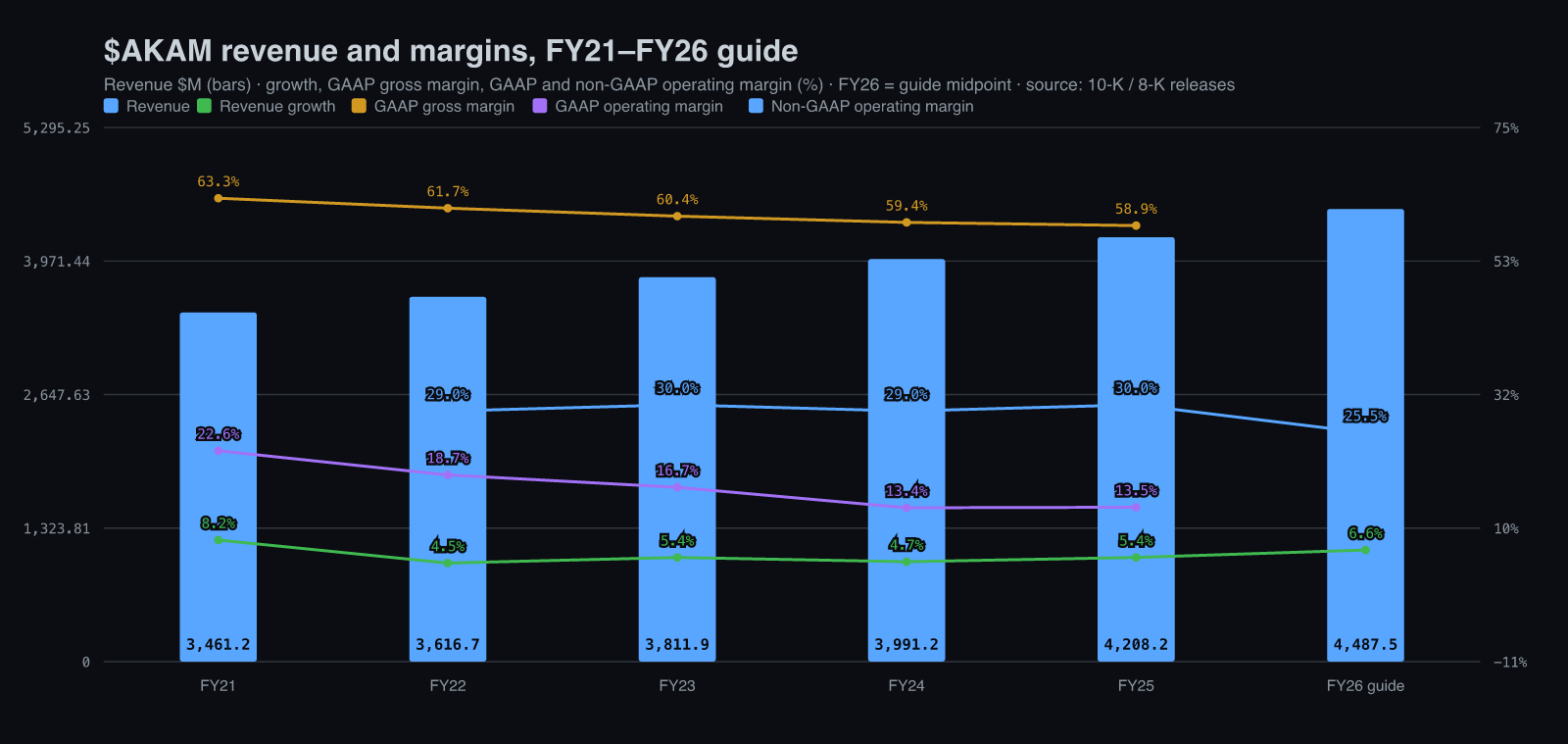
The annual series shows the cost of moving from software to machines. Revenue went from $3,461 million in FY21 to $3,617 million in FY22, $3,812 million in FY23, $3,991 million in FY24 and $4,208 million in FY25, with growth of 8.2%, 4.5%, 5.4%, 4.7% and 5.4%, and FY26 is guided to $4,488 million at the midpoint, or 6.6%. Over the same years GAAP gross margin (revenue less cost of revenue, which includes network depreciation) slid from 63.3% to 61.7%, 60.4%, 59.4% and 58.9%, and GAAP operating margin fell from 22.6% to 18.7%, 16.7%, 13.4% and 13.5%. The non-GAAP operating margin management steers by held at 29% to 30% from FY22 to FY25 and is guided to 25% to 26% this year.
By quarter the pressure is sharper and more recent. Revenue ran $1,015 million in Q1'25, $1,043 million in Q2'25, $1,055 million in Q3'25, $1,095 million in Q4'25, $1,074 million in Q1'26 and $1,100 million in Q2'26, growth of 2.8%, 6.5%, 5.0%, 7.4%, 5.8% and 5.4%, with Q3'26 guided to $1,105 to $1,130 million. GAAP gross margin held near 59% through 2025 at 58.7%, 59.1%, 59.3% and 58.7%, then dropped to 56.1% and 55.8% in 2026 as colocation for the cloud contracts arrived ahead of their revenue. Non-GAAP operating margin went 30%, 30%, 31%, 29%, then 26% and 25%.
The cash statement is healthier than the income statement, and the gap is the whole company in one line. In the first half of 2026 operating cash flow was $639 million against net income of $186 million and adjusted EBITDA of $416 million in Q2 alone, because depreciation ($369 million in the half) and stock compensation ($275 million) are real costs that do not leave the building as cash in the period. Free cash flow was $221 million after $418 million of cash capital spending, down from $291 million a year earlier. Those are the pre-Anthropic numbers.
Technology & Moat
What Anthropic is renting is dedicated capacity: racks of servers that belong to $AKAM, sit in colocation halls that $AKAM leases, run $AKAM's cloud software, and are reserved for one customer under a take-or-pay contract, which means the customer pays for the capacity once it is delivered whether it uses it or not. The press release describes the work as Anthropic's CPU workload. The company has not said what that workload is. Futurum's Brendan Burke read it as the sandboxes that reinforcement-learning training and agents run in, which fits the loop above, but it is an outside read.
Three things about the asset are hard to copy. The first is the network fabric. $AKAM runs more than 4,000 points of presence in 700 cities and a backbone carrying hundreds of terabits a second, built for its own traffic rather than sold as connectivity, so a new compute site can be joined to every other site without buying transit. The second is placement. The company builds in 5 to 30 MW blocks inside other people's buildings: CFO Ed McGowan described 41 bigger sites that typically start at 5 MW with options to expand, and on the Anthropic call said the 100 MW portfolio is spread across numerous colocation providers, some of it already secured. The third is the security stack, which the hyperscalers sell too but the neoclouds mostly do not.
We are very unique, I would say, in terms of how we go about building out 100 MW of power... We have many, many providers we work with, and we are able to get agreements for multi-years for say, 10 MW-30 MW in certain locations.
The disclosure lets us put a number on the placement advantage. Across the whole signed portfolio, $AKAM says 95 to 105 MW of power will support about $2.2 billion of annual revenue, roughly $22 million per megawatt a year. In July TeraWulf leased Anthropic 401 MW of building and power in Kentucky for about $19 billion over 20 years, which is about $2.4 million per megawatt a year. The difference is what $AKAM adds on top of the powered room: the servers, the memory, the network, the software and the people who keep it running, which is also why it has to spend the capital.
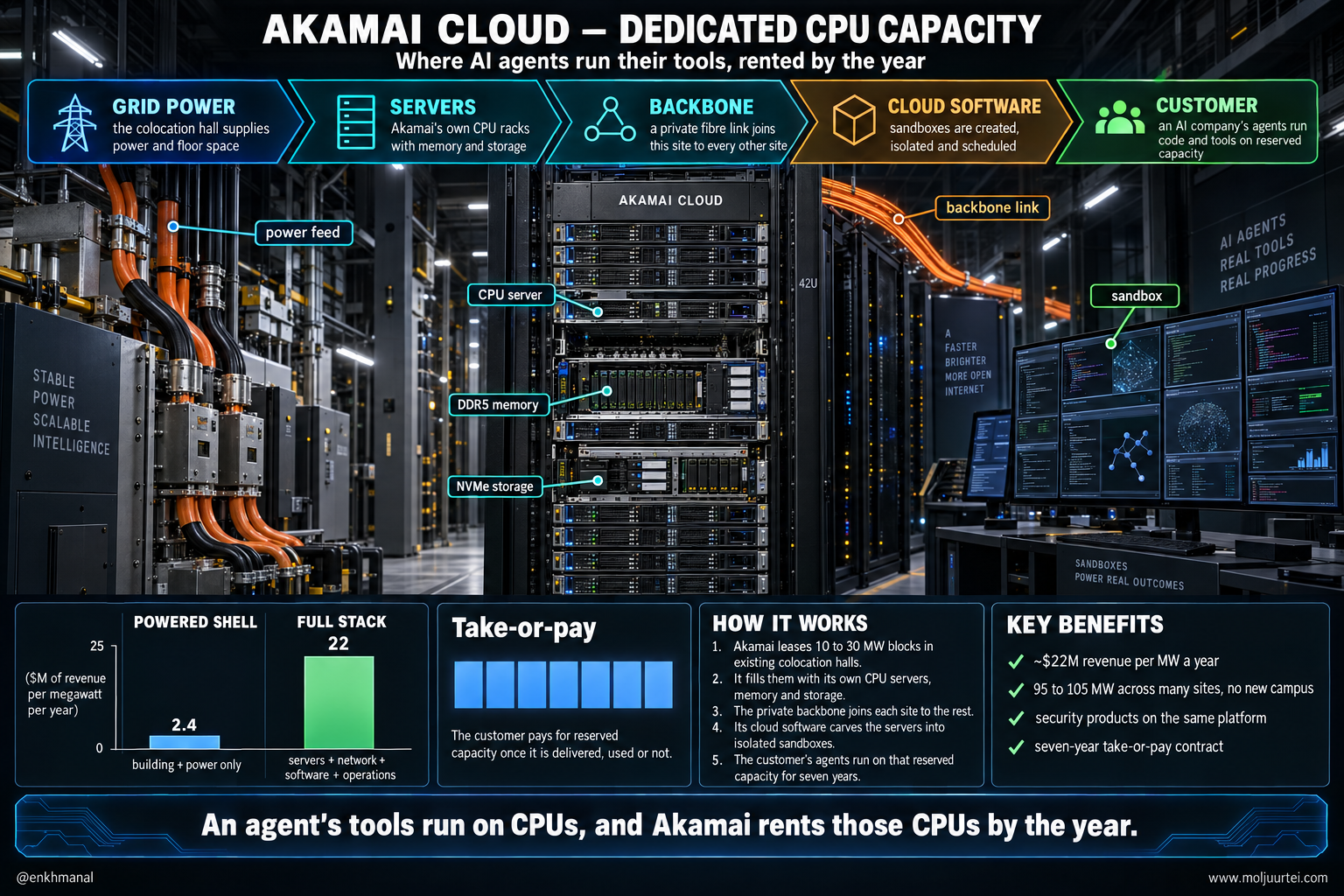
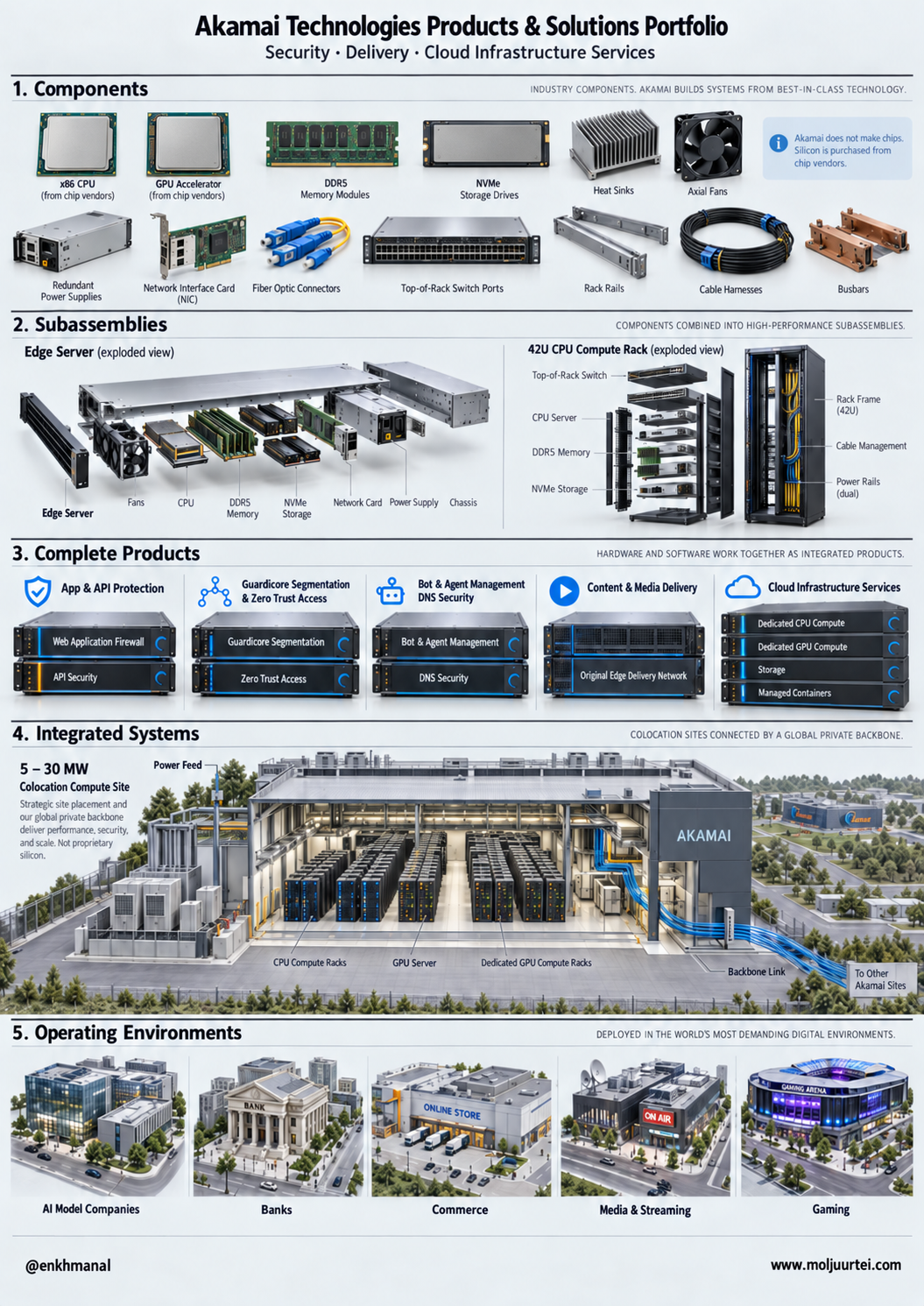
Everything $AKAM sells runs on the same platform, and that is the point of the portfolio board below: the security products and the delivery network already occupy thousands of the company's own servers, and the cloud business rents the same kind of machine to customers who want it dedicated.
Roadmap & R&D
For an infrastructure company the roadmap is a schedule of where the money goes and when the machines switch on, and $AKAM published it for this contract on one slide. Capital spending is about $1.7 billion in the fourth quarter of 2026, spent to secure memory and other parts before the price moves again, about $3.1 billion in 2027 and about $0.7 billion in 2028. Service starts late in the second quarter of 2027. Revenue is $150 to $300 million in 2027, ramps through 2028, and runs at about $1.7 billion a year once fully delivered at the end of 2028, flat thereafter because the contract is take-or-pay.
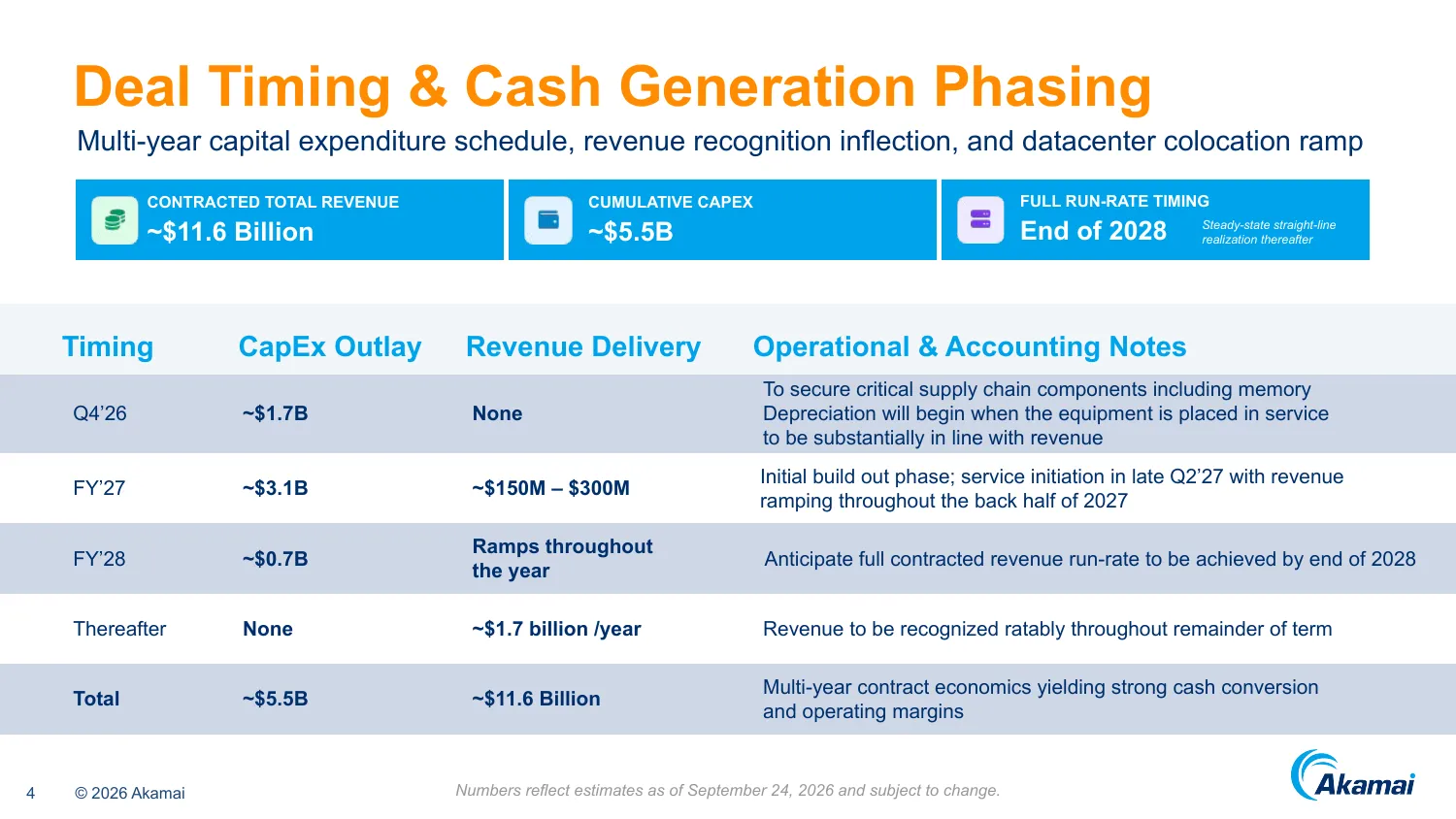
The supply chain behind the schedule is partly disclosed. The 8-K names two suppliers. Jabil, which has built $AKAM's customised servers under a master agreement since 2019, was authorised on 24 September to buy about $1.7 billion of memory components, held on consignment and sold back to $AKAM at cost as they are used. Lenovo signed a master agreement on 23 September to supply hardware, software and services under a seven-year statement of work. Neither filing names the CPU or the memory maker. $AKAM's current dedicated CPU instances run on 5th-generation $AMD EPYC chips, and Micron signed its own supply agreement with Anthropic in June, so $AMD and $MU are the natural readings, but they are readings.
On the product side, Tom Leighton listed what gets built next on the same platform: agent sandboxing and security, an AI gateway and firewall, model-as-a-service, and orchestration that places each workload on the cheapest suitable hardware. That list matters more than it looks, because it is how a rented rack becomes a higher-margin service over the life of a contract. Research and development ran $149 million in Q2, 13.5% of revenue.
The Setup — Why It's Mispriced
The contract economics below are an illustrative calculation, not company guidance. At $1.7B annual revenue, an assumed 77 MW allocation and $3.5M per MW of annual colocation expense imply $269.5M of colocation cost, correcting the original $245M arithmetic. Another 5% of revenue, or $85M, for warranty, network and operations leaves about $1.346B EBITDA, a 79.1% margin. Straight-line depreciation of $5.5B over seven years is $785.7M annually, leaving about $560M operating income, or 32.9%. The 77 MW is an allocation assumption, not a disclosed Anthropic power requirement; actual power and service costs can differ.
That 32.9% sits at the top of the range McGowan gave in August for large cloud contracts, which he described as mid-60s to mid-70s cash gross margin and low-20s to low-30s operating margin. The weaker number is the return on capital. On the original 24 September schedule, which recognises about $10.6 billion of the $11.6 billion inside 2034 and gives the servers no value after seven years, the original contract pre-tax internal-rate-of-return estimate was about 12%; that dated output has not been rerun for the corrected colocation arithmetic and should not be used as a refreshed return estimate. That is a utility-like return, and it is the honest reason the deal looks low-margin on a spreadsheet. Samik Chatterjee of JPMorgan asked the right question on the call: revenue is about 31 cents per dollar of capex here, against the 50 cents to a dollar management has talked about for smaller deals. McGowan's answer was that CPU uses power more efficiently, seven years is long, and a customer this size gets a scale price.
There's an awful lot of CPU that's needed to run all this. It's not all just GPU.
The return that matters for shareholders could exceed the standalone contract return, for three reasons the spreadsheet leaves out. The servers keep working after year seven, and McGowan said $AKAM already runs servers longer than that, so renewal or re-use could improve returns, although power, maintenance, refresh and operating costs remain. The customer is paid to buy more: the warrant vests another 1% of $AKAM for each additional $3 billion Anthropic commits, up to $9 billion, and each tranche would carry its own capex. And the signing changes what $AKAM is in the eyes of every other buyer. McGowan said larger deals have widened the pipeline, and Leighton said there are no exclusivity limits on working with other model companies.
Who else gets paid is where the X crowd went first, and the filings support part of it. Serenity (@aleabitoreddit), whose post drew about 90,000 views, argued that to execute $AKAM has to buy "a ton of CPUs and memory", so the upstream suppliers may keep more of the economics than the name in the headline. That is directionally right for $JBL, which is named, and plausible for $AMD and $MU, which are not. It also frames the edge comparison correctly. $NET runs the sandboxes for Claude Managed Agents on its Workers and Containers products, which is the control layer an agent calls many times a second. $FSLY says AI requests on its network grew about 30% from January to May, roughly 6.5 times faster than human traffic, and on 21 September launched an AI Firewall and AI Runtime Control. Both are selling governance and execution by the request. $AKAM sold capacity by the year, the larger and slower dollar.
Management & Track Record
This is an unusually long-tenured team, and the record is one of steady reinvention rather than fast growth. Tom Leighton co-founded the company in 1998 as its chief scientist and has run it since January 2013; revenue was about $1.58 billion that year and $4.21 billion in 2025. Every senior operator came up inside the company. The record is mixed in the useful way: under this team security grew from a side line into $2.24 billion of revenue in 2025 and the diluted share count fell from 165.8 million in 2021 to 147.0 million in 2025, but total growth never cleared 8.2% in the last five years and GAAP operating margin fell by 9 points while they built the cloud.
The part of the record that matters most for this contract is execution speed on a physical build, and there the team has one live data point: the robotics GPU order announced in August was sold out and replenished within a quarter, and GPU shipments that slipped from June into July were caught up in Q3. A build four times larger on a fixed service date is a different test.
Risks & What Breaks It
The funding gap is the risk we give the most weight, because it is arithmetic rather than opinion. At 30 June $AKAM held $4.62 billion of cash and marketable securities against $7.64 billion of convertible notes at par, including $1.15 billion due on 1 September 2027. Its plan before this contract already put 2026 capex near 40% of revenue, about $1.8 billion; adding $1.7 billion takes 2026 to roughly $3.5 billion, and 2027 carries $3.1 billion for Anthropic on top of the other cloud builds. Operating cash flow ran about $320 million a quarter in the first half. On those figures we estimate $AKAM needs $2 to $3 billion of new capital during 2027. McGowan pointed to $4.6 billion of cash and a $1 billion revolver and said that if more is needed the board will decide what is best for shareholders. The May converts show the company can borrow cheaply; another equity-linked raise would still be dilution.
What forces a thesis change: a slip in the late-Q2 2027 service start, a funding announcement that uses common equity rather than debt or converts, or security growth below 7% for two quarters.
Price Setup — Levels, Technicals & Options
The completed 25 September session closed at $113.94, up 3.2% from $110.41. That is well below the roughly $132 after-hours level used in the original memo; the gap did not hold through the next close. Price is just above the 50-day simple average of $113.27 and the 200-day of $111.13, versus a 20-day average of $108.76 and 100-day of $123.74. It is 29.3% below the $161.14 spring closing high. The chart now uses the completed regular session, not the earlier after-hours mark.
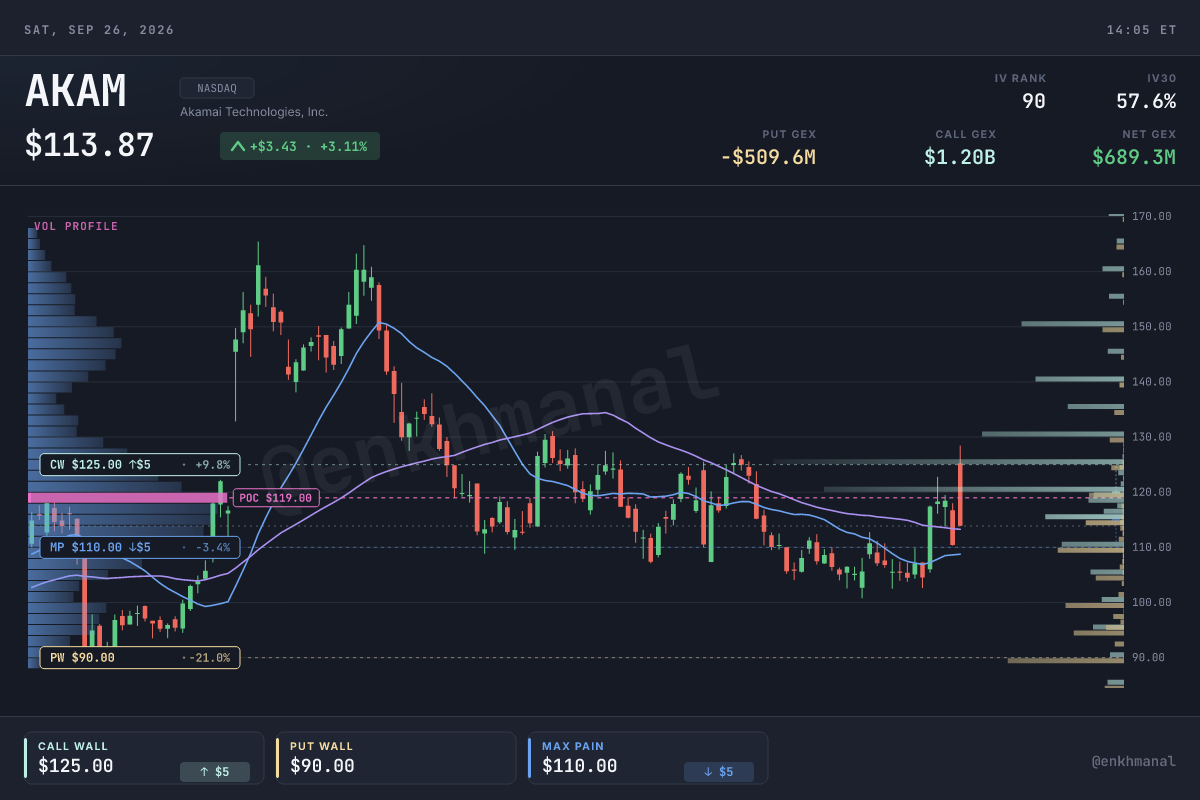
The refreshed options proxy aggregates 18 expirations at a $113.87 quote. Net GEX is about +$901M, the call wall $125, put wall $90 and max pain $115, with put/call open interest 0.58. The spot-dependent gamma-flip calculation returned no crossing; the strike-profile zero crossing is $114. Do not substitute one for the other. IV is 57.58% in the 26 September snapshot, approximately ±16.5% or $18.81 over 30 days using a square-root-of-time estimate. These figures describe options prices and a positioning convention, not guaranteed price bounds or actual dealer holdings.
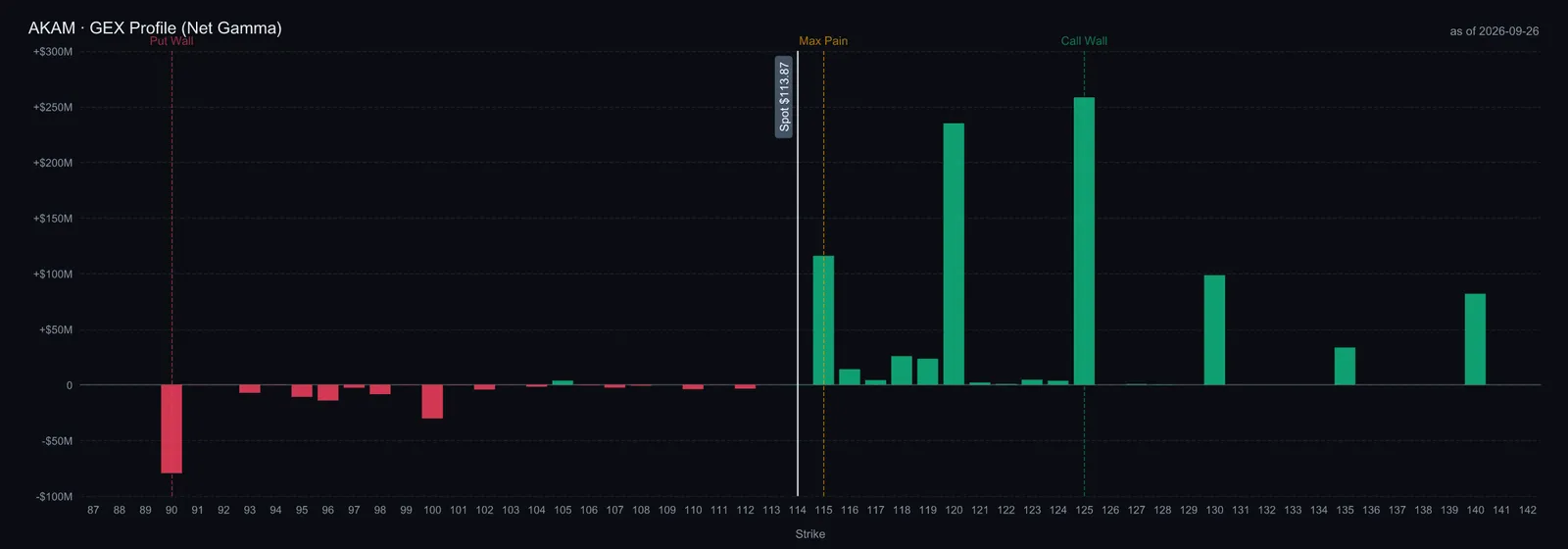
The original $120–$125 pullback plan is now above the latest close, so it is no longer an actionable description of a dip from current price. Watch the $111–$114 area around the moving averages, then $120–$125 as a recovery area. Neither the chart nor the options book establishes a floor; funding and service-delivery evidence remain the drivers.
Valuation & House View
At $113.94 and 143.72M reported shares, market capitalization is about $16.38B. Using the memo's $7.64B convertible-note principal less $4.62B cash and securities gives about $19.40B enterprise value before leases and other adjustments. That is 16.9x FY26 non-GAAP EPS guidance midpoint of $6.73, 11.7x annualized adjusted EBITDA of $1.66B, and 4.3x FY26 revenue guidance midpoint of $4.488B. Yahoo's broader EV is $22.36B, so its peer-table multiple uses a different debt/cash convention. The refreshed SEC-EPS GAAP P/E is 41.1x, the 96th percentile of its five-year range, versus a 28.0x median. The median is not a forecast of where the multiple must return.
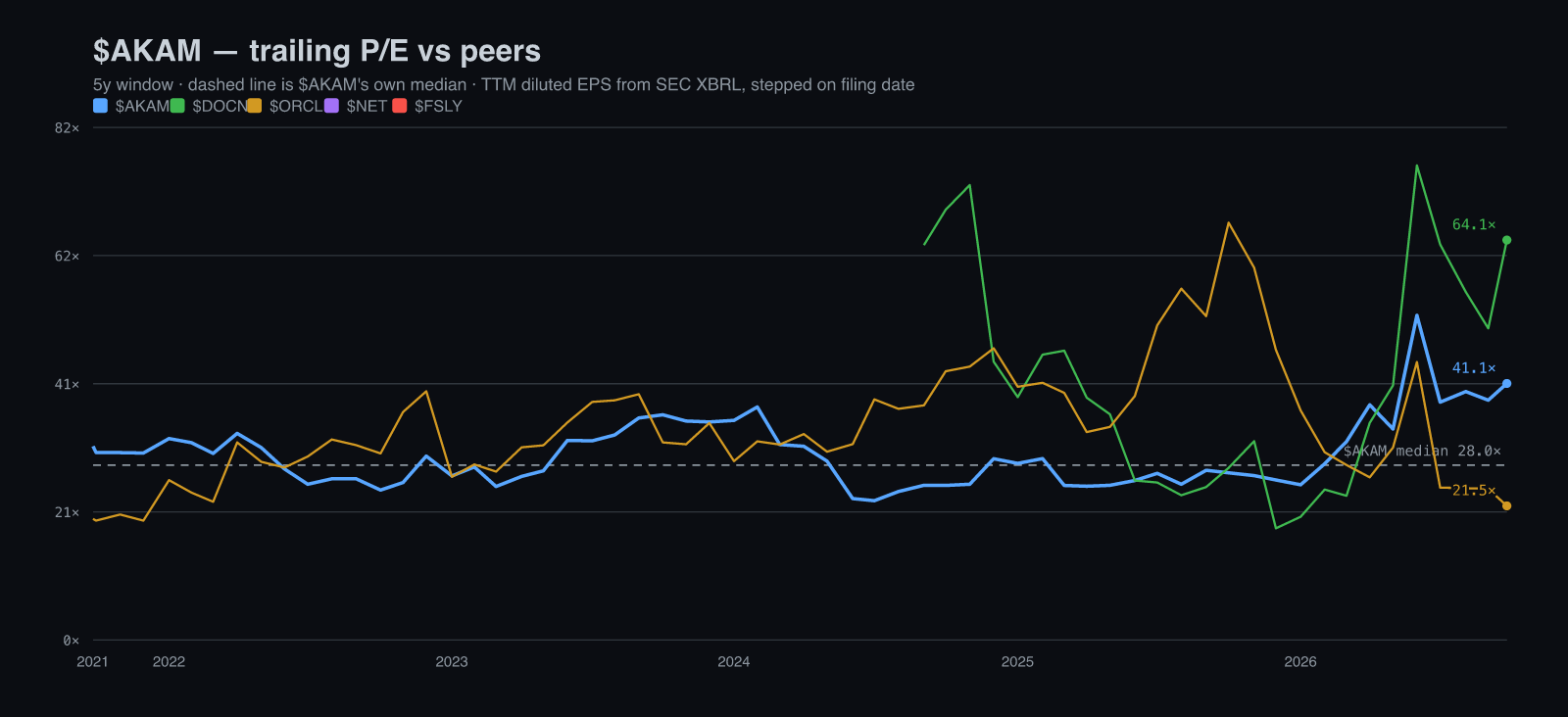
Table terminology: EV; P/E; sandbox; GPU.
Multiples are context here rather than the verdict. What changed is the growth line: management said on 9 September that growth goes from 6 to 7% now to the teens next year with what was already signed, and the new contract adds $150 to $300 million on top in 2027 and about $1.7 billion a year from 2029. We build 2029 non-GAAP EPS in three pieces. The existing business grows EPS about 4% a year from the $6.73 midpoint, to about $7.60. The Anthropic contract adds about $560 million of operating income, less about $235 million of interest income lost on $5.5 billion of spent cash at the 4.25% McGowan suggested, taxed at 19% over about 152 million shares: about $1.73. The rest of the signed cloud book adds perhaps $0.65. That is about $9.98, which we haircut to $9.30 for execution and financing. The workbench model holds 12 guidance items and its audit shows no fails and three warnings: a five-year horizon on a name guided into the teens, working-capital lines untagged in the filings, and no comps curated. Its capex seed of 12% of revenue cannot see the $5.5 billion build, so we do not quote its DCF.
The unchanged 25%/50%/25% scenario weights and $95/$160/$195 targets give a September 2028 value of $152.50. Against $113.94, that is +33.8% total, approximately +15.7% annualized over two years. This is a future scenario value, not a present-value target. The refreshed analyst mean is $158.79, a separate estimate. The investment case is still the growth acceleration from delivered CPU capacity, with the 2027 ramp conditional on execution and funding. The original instruction to buy a dip toward $120–$125 is superseded by the latest close below that zone. Reassess position decisions against financing terms and proof of the late-Q2 2027 service start; the next earnings date should be confirmed with the company rather than assumed.