
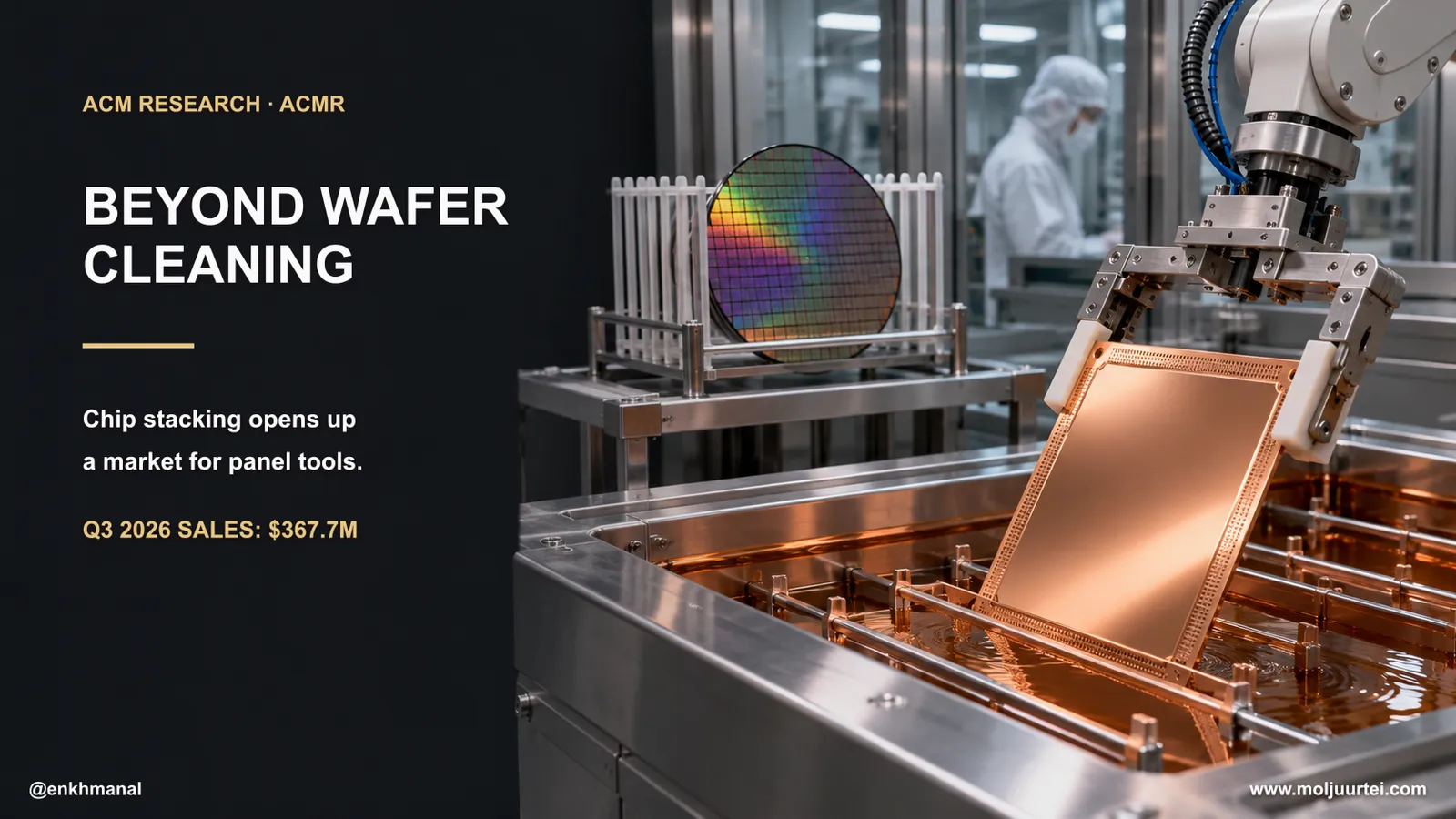
ACM Research — Beyond wafer cleaning
A silicon wafer passes through many rounds of processing before its chips are cut out. A stray particle can ruin a circuit; cleaning removes contaminants without damaging the tiny features underneath. Stacking finished chips adds surfaces to clean and connections that need copper plating. ACM Research ($ACMR) built its business on wafer cleaning and now sells equipment for both jobs. In Q2 2026, cleaning revenue fell 14.2% year over year while total revenue rose 36%.
November 11, 2026 update. The November 5 report put Q3 sales at $367.687 million versus $269.160 million, up 36.6%. Cleaning recovered to $210.721 million from $181.570 million, up 16.1%. Plating, furnace and other rose to $109.469 million from $59.853 million, up 82.9% on the unrounded filing figures. Advanced packaging excluding plating, services and spares reached $47.497 million from $27.737 million, up 71.2%. ACM shipped a 310 × 310 mm production panel plater in October and raised 2026 revenue guidance to $1.24–$1.28 billion from $1.125–$1.175 billion. Q3 GAAP gross margin slipped to 41.5% from 42.0%; diluted GAAP EPS fell to $0.02 from $0.52 while adjusted EPS rose to $0.55 from $0.41. The quarterly filing also shows the parent’s Shanghai ownership fell from 73.2% to 72.8%.
Stacking changes equipment demand
Smaller transistors remain important, but one way to improve performance without shrinking every feature is to stack chips. High-bandwidth memory (HBM), for example, stacks memory dies and uses short vertical connections to move more data to the processor.
That changes what a fab spends on, in a specific direction. Every extra die in a stack is another surface to clean, another copper layer to plate, another interconnect to fill. The beneficiaries are not the lithography scanners but the wet-process and plating tools between the glamorous steps. Management said it plainly on the Q2 call: in memory, HBM packaging demands more DRAM stacking and therefore more copper process steps.
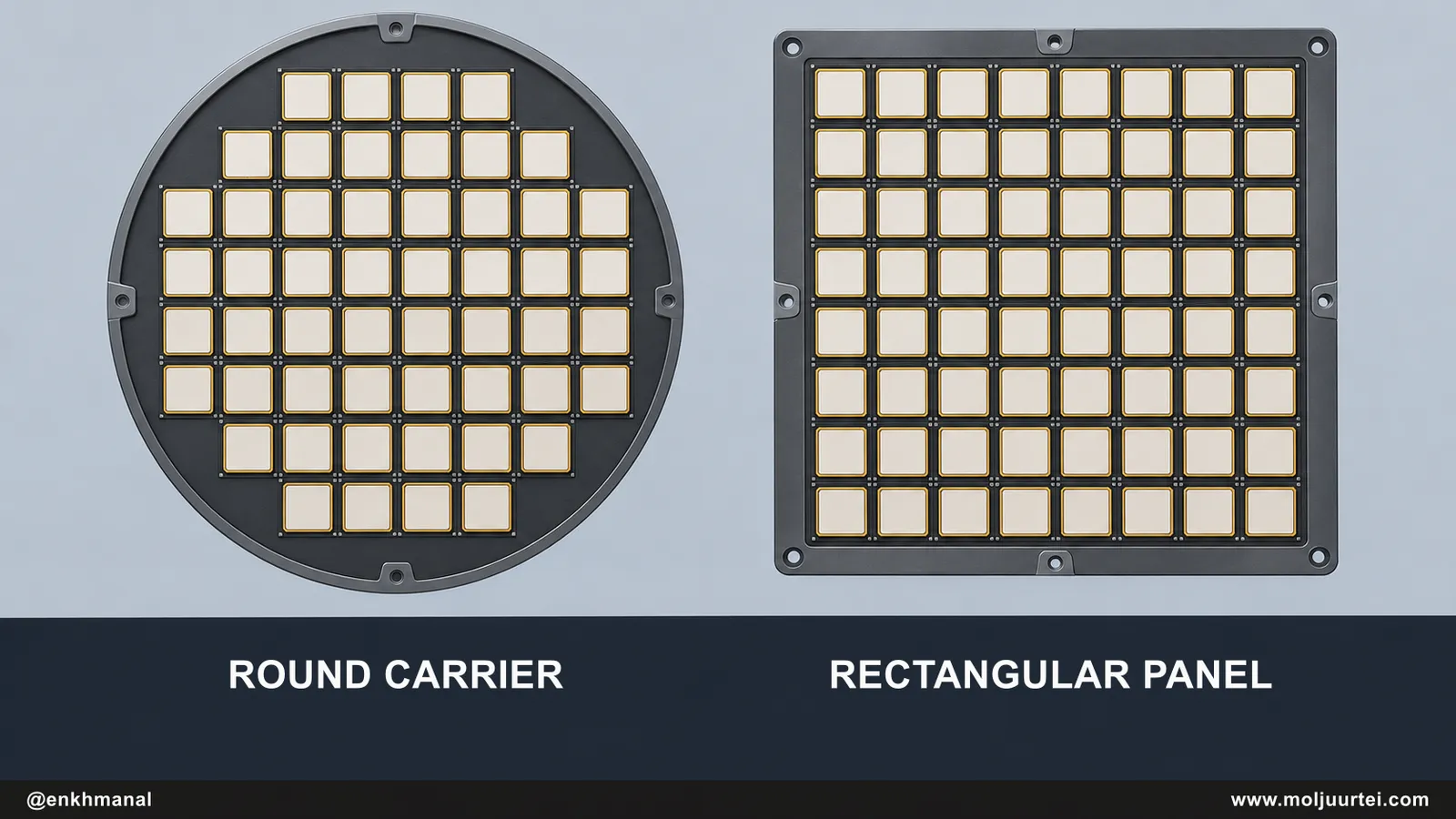
Rectangular panels are one option for packaging large chips. A regular grid of packages can use more of a rectangular carrier than a circular one, depending on package size and edge clearances. The chips themselves can still be made on round silicon wafers. The panel changes packaging tools: equipment must handle a different carrier shape and plate evenly across a larger surface.
ACM had panel plating equipment in development before the initial production orders. Repeat orders and customer acceptance will show whether that head start translates into sustained sales.
A wider business than wafer cleaning
The August thesis was that demand for chip stacking and a broader set of process tools could keep ACM growing even when cleaning slows. The November results give that argument a stronger revenue base, while lower gross margin shows the cost of turning new orders into earnings.
How the equipment business earns revenue
ACM Research ($ACMR) sells process tools that remove particles and photoresist, deposit copper in openings and form thin films. Equipment revenue typically depends on customer acceptance; services and parts add another source of sales. Qualification can shift revenue between quarters. Management’s gross-margin target is 42–48%.
David Wang founded ACM Research in Fremont, California, in 1998 after working at Lam Research. ACM established its Shanghai subsidiary in 2005. That company accounts for most production and sales and is separately listed on Shanghai’s STAR Market.
The parent consolidates subsidiary revenue. Nasdaq shareholders own the parent, whose economic interest in Shanghai is smaller than the consolidated revenue figures imply. Cash transfer restrictions also matter to what investors can ultimately receive.
Two Ways to Clean a Wafer Without Breaking It
Removing tiny particles from a patterned wafer can damage the structures the tool is supposed to preserve. ACM’s SAPS uses high-frequency sound and varies the phase to distribute energy more evenly. Its TEBO controls how bubbles oscillate so the process can clean delicate features.
ACM says its Ultra C Tahoe tool cuts sulfuric acid use by about 75% compared with conventional single-wafer cleaning by combining batch and single-wafer steps. The October update concerns a different tool: ACM said its enhanced hot SPM system can recycle 70% of its sulfuric acid. Those percentages measure different things.
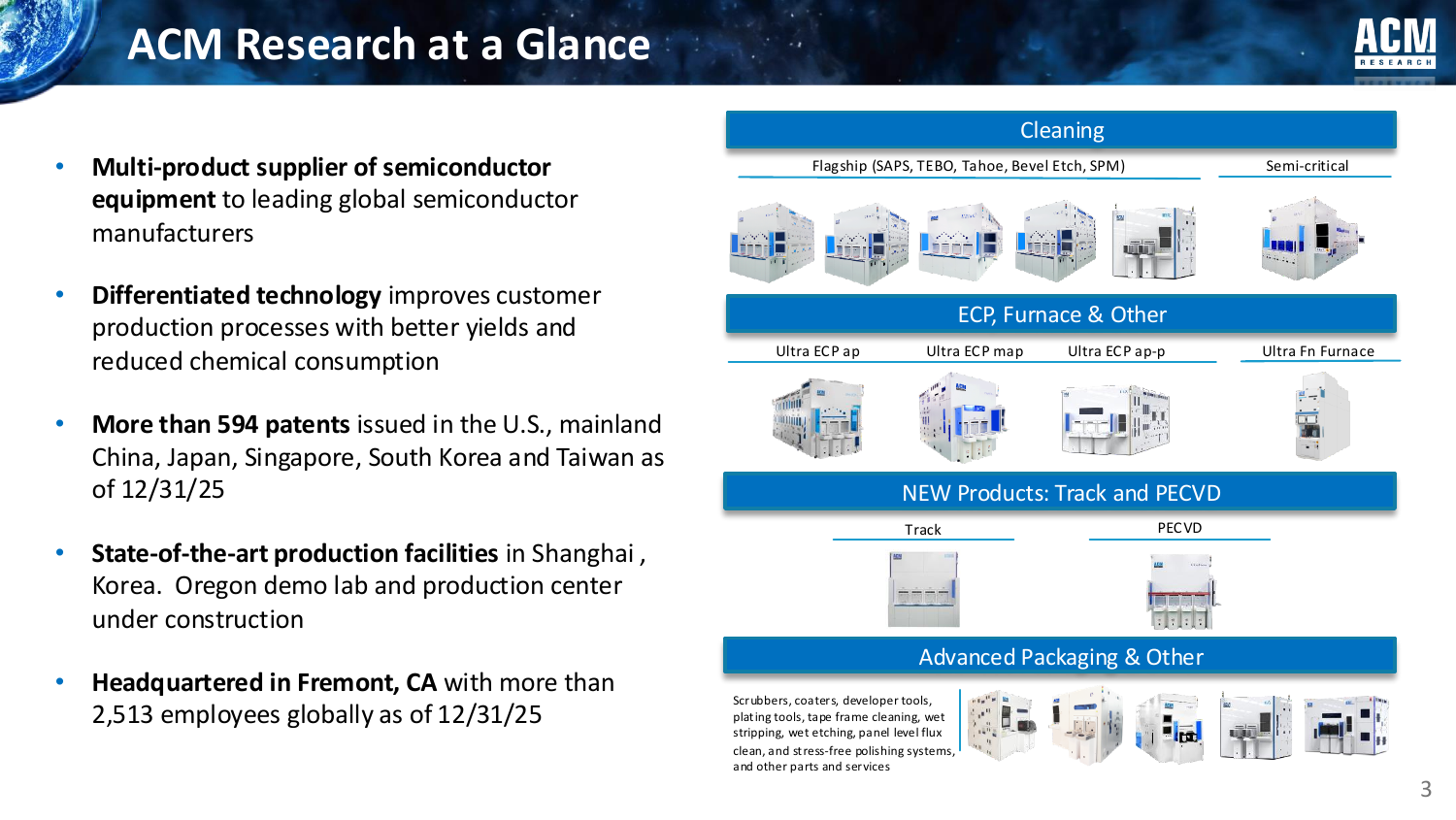
Copper plating is the second pillar. The Ultra ECP family serves connections within a chip and in packages, including vertical connections through silicon. Management reported that cumulative plating chamber shipments went from 500 to 2,000 in four years: four times as many, a 300% increase. Shipments do not measure how many chambers are qualified and in production.
New tools and manufacturing capacity
In August, management planned R&D spending at 16–18% of 2026 revenue, compared with 13.9% adjusted in Q2. Its annual capital spending plan was about $175 million, with $65.4 million spent in Q2. These are August plans. In November, the company said its second Lingang building would come online in Q4 and double manufacturing floor space at the site.
[$ACMR] predicted a shift from wafer level to panel level packaging more than five years ago and began investing early in horizontal panel level plating. We believe the market is now coming to us and has begun to validate those investments.
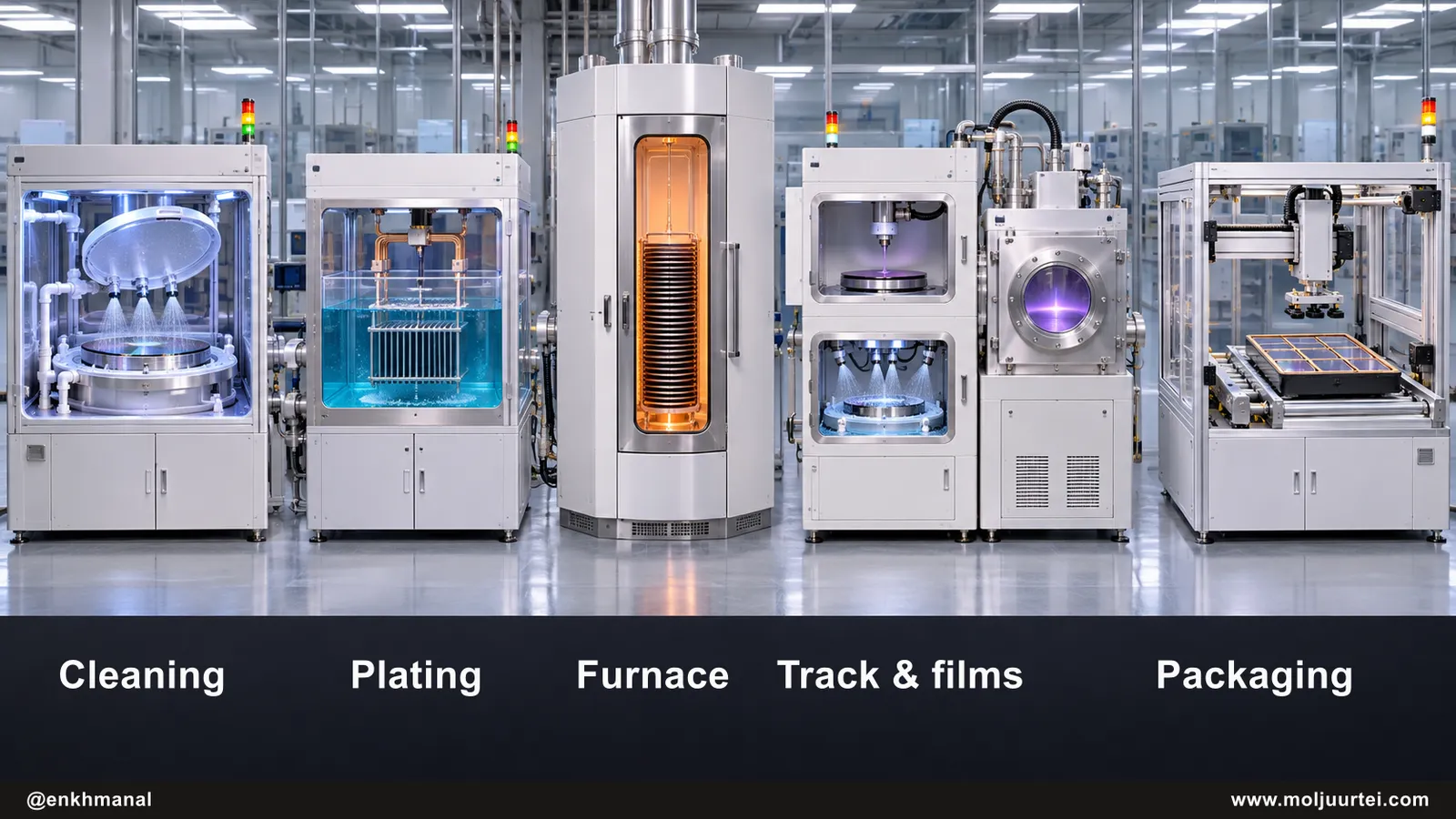
The August year-end qualification dates for track and PECVD were targets. Customer acceptance and follow-on production orders are the milestones to watch. An evaluation shipment alone is insufficient.
The revenue mix changed in the first half
Compare the same periods: in the first half of 2026 cleaning accounted for just under half of sales, down from nearly three-quarters in the first half of 2025. The Q2 detail shows where the difference came from.
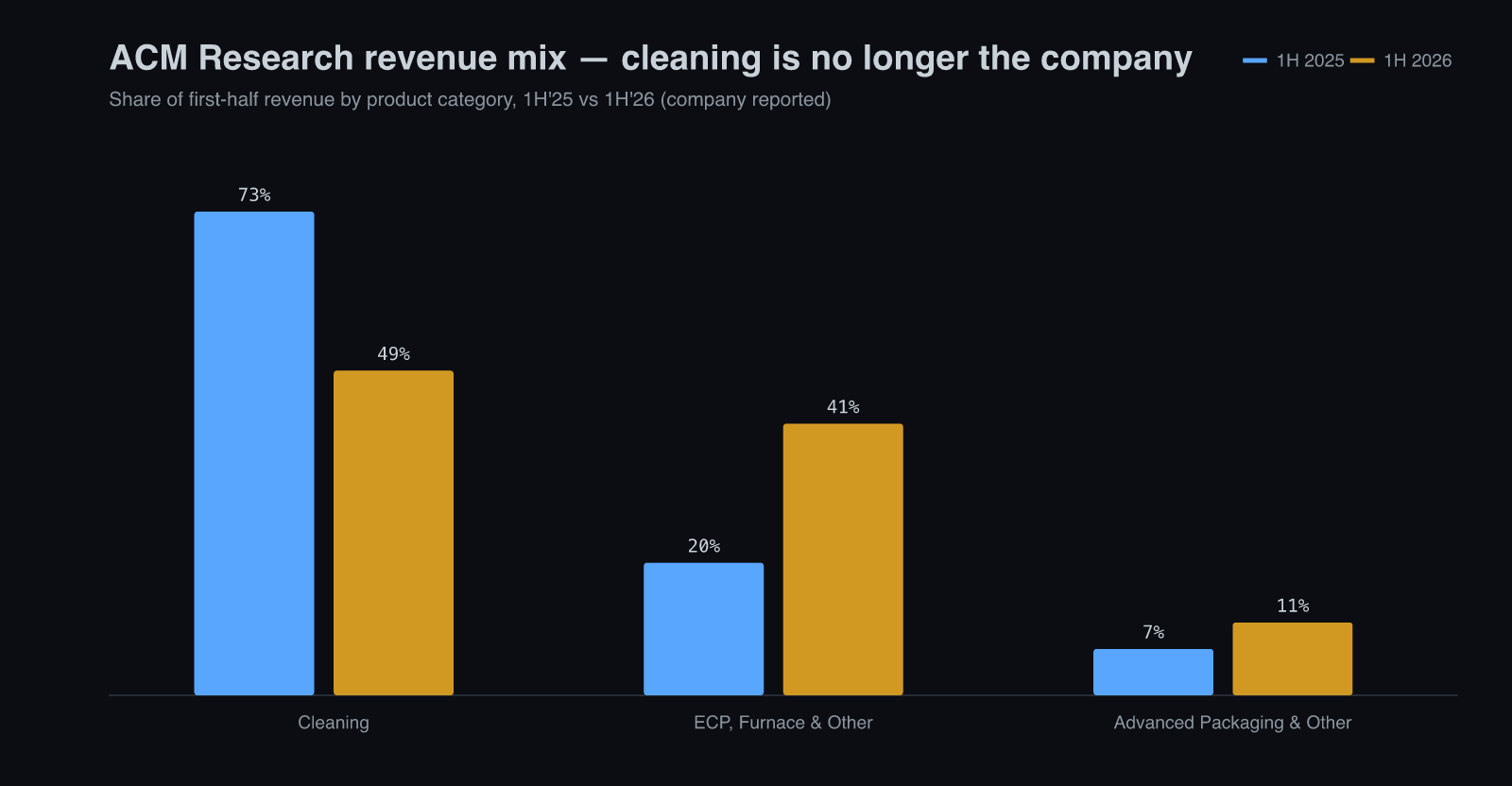
In Q2, cleaning was $132.978 million versus $154.961 million, down 14.2%, and 45.4% of sales. Plating, furnace and other was $128.546 million versus $48.016 million, up 167.7%, and 43.9% of sales. Advanced packaging excluding plating, services and spares was $31.395 million versus $12.395 million, up 153.3%, and 10.7% of sales. Total sales were $292.919 million versus $215.372 million, up 36.0%.
Management attributed the Q2 cleaning decline to the timing of shipments and revenue recognition, particularly for hot SPM tools. That explanation was testable: the category needed to return to growth once customers accepted more systems.
Q2 revenue reached $292.9 million and adjusted operating income was $56.3 million. Adjusted EPS was $0.61. In August, management lifted the bottom of the annual sales range to $1.125 billion, with a ceiling of $1.175 billion. The November report raised both ends.
FY2025 revenue grew 15.2%. Gross margin fell from 50.1% to 44.4%, a 5.7 percentage point drop. Operating margin fell from 19.3% to 12.1%, a 7.2 point drop, or 37.3% relative to the prior margin. Higher sales alone do not guarantee improved profitability.
From a panel thesis to production orders
Founder David Wang has led the company since 1998. At the August call he recalled predicting the shift toward panels five years earlier. The first production shipments are stronger evidence than the prediction itself; it will take repeat business to confirm adoption. Investors also need to follow decisions at the separately listed Shanghai subsidiary, which accounts for most operations.
What Breaks It
The November report answered the first cleaning test. The next tests are whether growth persists into Q4, whether new tools draw repeat orders and whether margins recover as volumes rise. A single quarterly rebound does not settle market share.
The August share-price snapshot
In the original analysis, ACMR closed at $79.41 on August 21, 2026. The stock had risen from $23.94 in early August 2025 to an intraday high of $127.19 in late June 2026, or 5.31 times the starting price. The August close was 37.6% below that peak. These are historical figures.
What the August valuation did and did not capture
The historical parent equity value was $5.53 billion: $79.41 multiplied by 69,649,196 shares disclosed in August. Subtracting $1.0 billion of consolidated net cash yields $4.53 billion, or 4.4 times $1.04 billion of trailing consolidated revenue. That screen leaves out the value of the Shanghai minority stake and treats consolidated cash as available to the parent. It cannot support a like-for-like enterprise value comparison with peers.
In August, the Shanghai subsidiary’s market value of roughly 145 billion yuan translated to $21.6 billion at 6.72 yuan per dollar. The parent’s June stake of 73.2% was worth about $15.8 billion at that quote, versus its own $5.53 billion capitalization. The difference is $10.3 billion, or roughly 65% of the quoted stake value. That is a price gap across two markets. It does not establish what the stake could realize after taxes, restrictions and a sale of that size.
The downside case is that cleaning growth fades again, qualification takes longer and demand slows in China. The central case is a steadier cleaning business and gradual contributions from the new lines. The upside requires repeat panel orders and production acceptance for track and PECVD, with better margins as volume rises.
The November results strengthen the case that ACM can grow beyond its original cleaning franchise. The evidence to watch now is repeat equipment orders and sustained gross margin alongside revenue growth. Exposure to China and the structure of the Shanghai stake remain separate risks from the equipment cycle.
Sources: August earnings release, November earnings release, and September quarterly filing.