
Water — The Overlooked Bottleneck: $ERII, $XYL and $ECL, and Three Ways to Own It
Thesis
Everyone is modeling the AI buildout as chips, power and lasers. The input that quietly gates all of it — and that half the Persian Gulf now depends on a machine to manufacture — is water. In the last four months water stopped being a utility footnote and became two things at once: a strategic military target (Iranian and US strikes have hit desalination plants across the Gulf and inside Iran, most recently in mid-July 2026) and a hard constraint on where you can build compute (US data centers are on track to drink hundreds of billions of gallons a year by 2030). Two very different clocks, one scarce resource.
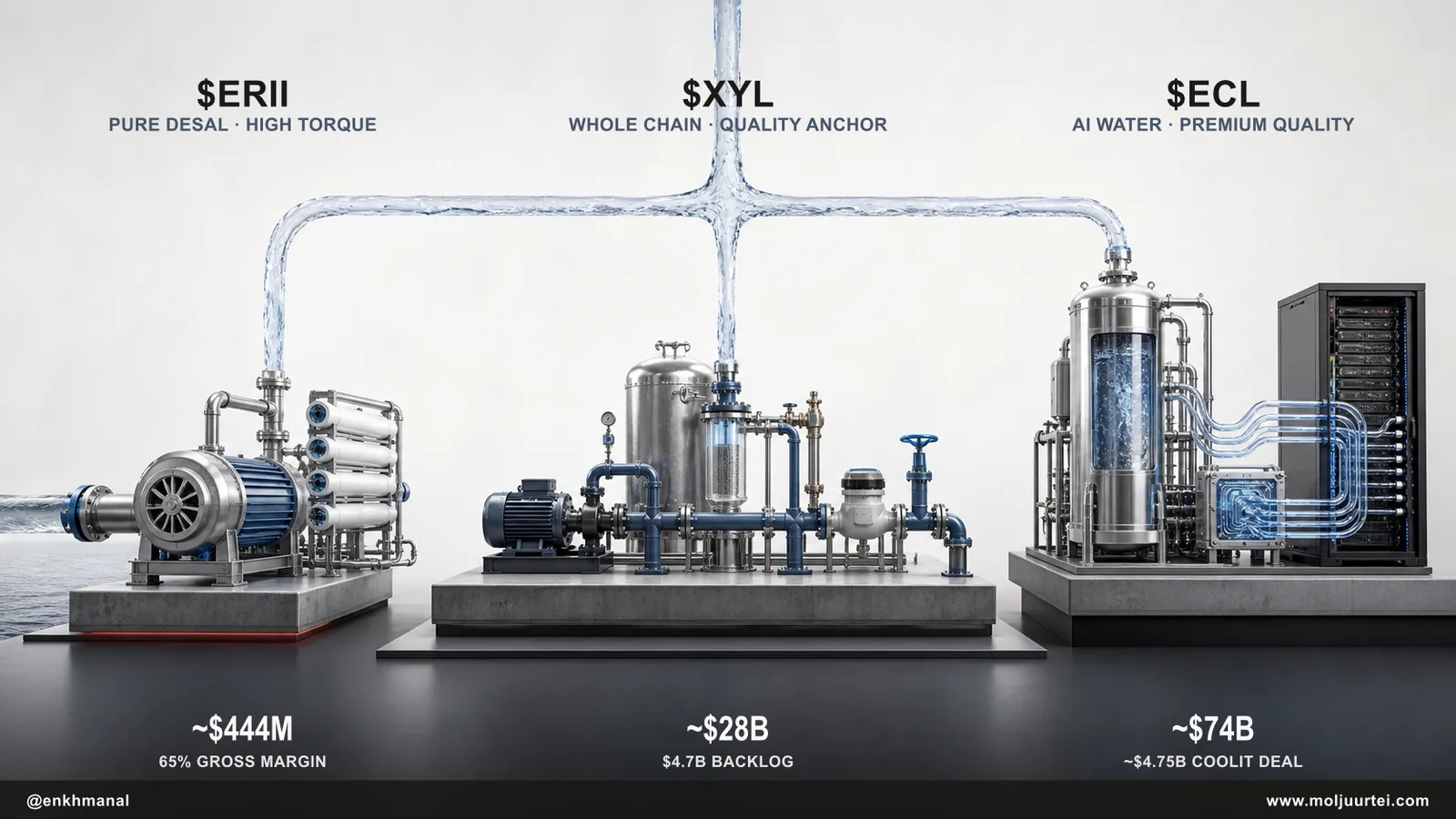
There is no single "water stock," and pretending otherwise is how people lose money on a good theme. Instead there's a value chain with distinct nodes, and three public names occupy three of them cleanly enough that the comparison itself is the insight:
- $ERII (Energy Recovery) — the pure-play desal-economics node. A ~$444M micro-cap that makes the one device that renders seawater desalination affordable, at 65% gross margins, priced like a broken industrial after a self-inflicted rough year. The highest-torque, highest-risk expression.
- $XYL (Xylem) — the diversified water-infrastructure node. The ~$28B pick-and-shovel utility of the entire water economy — moving it, treating it, measuring it, digitizing it — with a $4.7B backlog and a fair-ish multiple.
- $ECL (Ecolab) — the AI-water-cooling node. A ~$74B premium compounder that, via the ~$4.75B CoolIT deal, is now the most directly verifiable "water is the AI bottleneck" business in public markets — and is priced for exactly that.
The one-line ranking: you buy $ERII for the asymmetry, $XYL to own the whole chain at a fair price, and $ECL for the cleanest AI-water exposure if you'll pay up for quality. This memo maps the chain, profiles each node honestly (including how much of each business the theme actually is), and ends on which expressions to own and in what order.
Backdrop — How Water Became a Strategic (and AI) Chokepoint
The Gulf's machine-made water. The Arabian Peninsula runs on desalination the way the rest of the world runs on rivers and aquifers. Kuwait draws roughly 90% of its drinking water from desal; Qatar and Bahrain are close to fully dependent; Oman is around 86%; even Saudi Arabia, with more groundwater, gets about half its distributed supply from the sea. That dependency was always a quiet vulnerability. In 2026 it became a loud one: Iranian strikes damaged Kuwaiti and Bahraini desalination plants across March, April and again in mid-July, and a US strike in turn hit Iranian desalination and power facilities near Jask on July 18. Bloomberg's July 21 framing — "How the Iran War Is Exposing Risks to Gulf Water Supply" — is now the mainstream read, not a contrarian one.
The strategic conclusion the Gulf's water ministries are drawing is not "build less." It's "harden, decentralize, and build more redundancy" — because a centralized, aging desal fleet is a single point of failure for national survival. That is structurally bullish for desalination capacity over a multi-year horizon, whatever the near-term project timing.
The AI clock. Meanwhile, the compute buildout has quietly become a water story of its own. US data centers were consuming on the order of a trillion litres a year by 2025; independent projections put US AI-server water use at 200–300 billion gallons annually between now and 2030, with Texas alone potentially near 400 billion gallons by 2030. Researchers at the University of California and Caltech estimate US water systems may need $10–58 billion of new infrastructure by decade's end to absorb the load. Xylem commissioned a Global Water Intelligence study that pegs AI + semiconductor water demand rising ~130% by 2050. And the geographies where compute is landing hardest — Texas, Arizona, the Gulf, Saudi Arabia — are precisely the water-stressed ones. Water isn't the cost of the AI buildout; increasingly it's the permit for it.
Why one theme, three nodes. These two clocks pull on the same chain but at different points. Gulf desalination is about making fresh water from the sea cheaply and reliably — the $ERII node. The AI buildout is about treating, cooling and reusing water inside industrial and compute facilities — the $ECL node. And underneath both sits the unglamorous business of transporting, filtering, metering and managing water everywhere it moves — the $XYL node. No single company spans all three well, so the honest way to play the theme is a small, deliberately differentiated basket.
Mechanism — Why Now & How the Value Chain Works
Decompose "water" into the parts an investor can actually own, and three nodes matter here:
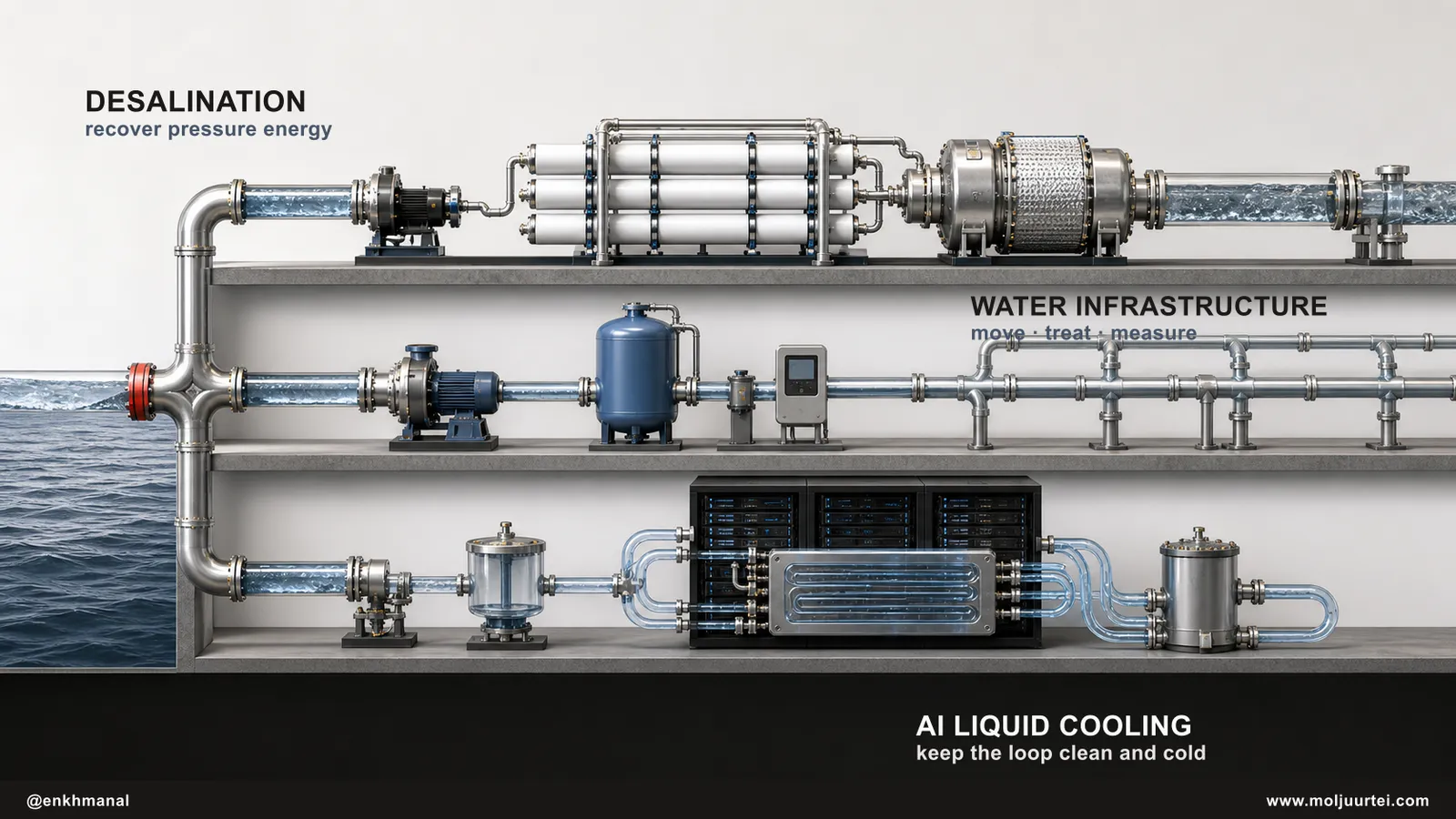
Node 1 — Desalination energy recovery (make seawater affordable). Seawater reverse-osmosis desalination forces seawater through membranes at very high pressure; the single biggest operating cost is the energy to generate that pressure. An energy recovery device captures the pressure energy in the outgoing brine and hands it back to the incoming feed, cutting a plant's energy use by up to ~60%. $ERII's Pressure Exchanger is the industry-standard device for large seawater-desalination plants — a ceramic rotor with essentially no consumable parts, sold into virtually every major new plant. This is a razor that behaves like an annuity: ~90% of revenue, 65%+ gross margins, and an installed base that scales with global desal capacity. It is the closest thing in the basket to a monopoly product, and the reason the "harden and build more" Gulf conclusion flows fairly directly to $ERII's order book — with a lag measured in project-planning cycles, not quarters.
Node 2 — Water infrastructure (move, treat, measure, digitize). Once you have fresh water, you have to pump it, filter it, test it, meter it and manage the network. $XYL is the diversified leader across that whole layer — pumps and transport, treatment and filtration, and a fast-growing digital layer (Xylem View, up ~30% in 2026 after doubling in 2025) that turns dumb pipes into instrumented networks. Its exposure to the theme is broad rather than pure: data-center and semiconductor water reuse and leak mitigation is a named growth vector (the reason it commissioned the Global Water Intelligence study), but it's one lane inside a $4.7B-backlog business, not the whole story. That breadth is the point — $XYL is how you own the water economy's plumbing without betting on any single application.
Node 3 — Industrial + AI-cooling water treatment (keep the loop clean and cold). A data center's cooling loop is a chemistry problem: prevent corrosion, scale and microbial growth, and maximize how efficiently each litre and watt is used. That's $ECL's Nalco Water franchise. In 2026 $ECL pushed decisively into the hardware of that loop by closing the ~$4.75B acquisition of CoolIT Systems, a leader in direct liquid cooling for high-density AI racks (CoolIT's sales grew more than 100% year-over-year). Combined with its Ovivo ultra-pure-water business, $ECL now spans the full AI water chain: ultra-pure water to make the chips, treated water to cool the racks and the power that feeds them. Management's Global High-Tech unit has gone from ~$150M of sales in 2021 to ~$1.5B annualized in 2026, with a stated $4B-by-2030 target, and its own line — that data-center cooling demand "will outlast the AI bubble" — is the cleanest articulation of the thesis in the basket. The catch, covered below, is that all of this still sits inside a ~$16B-revenue diversified company priced for premium quality.
Basket & Positioning
The three names occupy genuinely different points on the risk/quality/purity spectrum. The comparison table is the memo's backbone; the per-name charts and levels follow.
| $ERII Energy Recovery | $XYL Xylem | $ECL Ecolab | |
|---|---|---|---|
| Node | Desal energy recovery (pure-play) | Water infra: move/treat/measure | Industrial + AI-cooling water treatment |
| Mkt cap | ~$444M (micro) | ~$28B (large) | ~$74B (mega) |
| Last / recent print | $8.61 | $116.34 | $263.58 |
| Gross margin | 65.1% (FY25) | ~37.8% (Q1'26) | ~42% (co. reported range) |
| Rev trajectory | Lumpy: FY25 −6.9%, 5y CAGR ~2.6% | Record FY25, modest '26 growth | Steady mid-single-digit + High-Tech ramp |
| Theme purity | Highest — ~all revenue is desal | Medium — one lane of many | Medium-high on AI, small % of total |
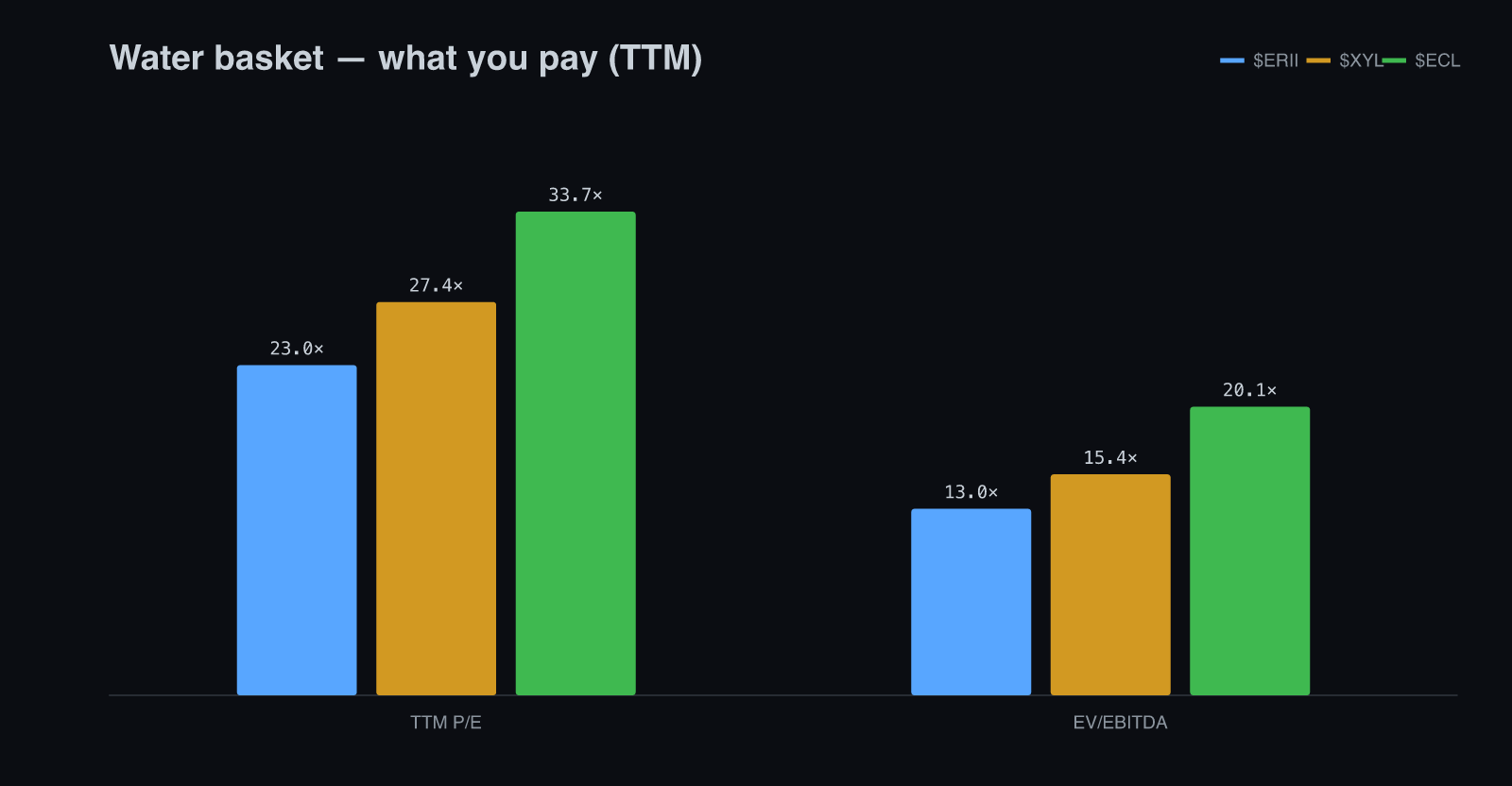
| TTM P/E (approx) | ~22–24× | ~27× | ~34× (fwd ~29×) |
| EV/EBITDA (approx) | ~13× | ~15× | ~20× |
| Balance sheet | Net cash, 9.3× current ratio, ~no debt | Investment-grade, $0.8B cash | Investment-grade, levered for M&A |
| The bet | Asymmetry / re-rate | Quality at a fair price | Pay up for the cleanest AI-water link |
$ERII — the purest, most mispriced node. At ~$8.61 the stock sits roughly 46% below its February high near $16, priced like a broken industrial rather than the 65%-gross-margin intellectual-property business it is. The break was self-inflicted: FY25 revenue fell ~7%, Q1'26 printed a ~$12.25M net loss (a one-time charge from exiting the CO2-refrigeration side project plus a $1.66M goodwill impairment — though revenue beat the Street's low bar), management withdrew 2026 guidance on Middle East concentration, and the CEO and CFO both departed. Ugly. But the balance sheet is a fortress (see table), and a new $25M buyback was authorized. The bull case isn't "fast grower" — it's a high-margin, net-cash near-monopoly on a de-risked number, with a new product (the Q650, launched March, first order booked) and re-rating catalysts, for a mid-single-digit-times-EBITDA price. You're paid to wait for the desal cycle and the Gulf "build more" impulse to show up in orders.
Management framed the withdrawal as delay, not destruction — the crux of the bull case:
"...our original financial guidance for 2026 is no longer reliable, and we're temporarily withdrawing guidance until we have better visibility on the evolving conflict… while timing is a key factor, we know the demand is there, and we are building inventory to serve customers when they are ready." — David Moon, President & CEO, $ERII Q1 2026 earnings call (5/6/26)
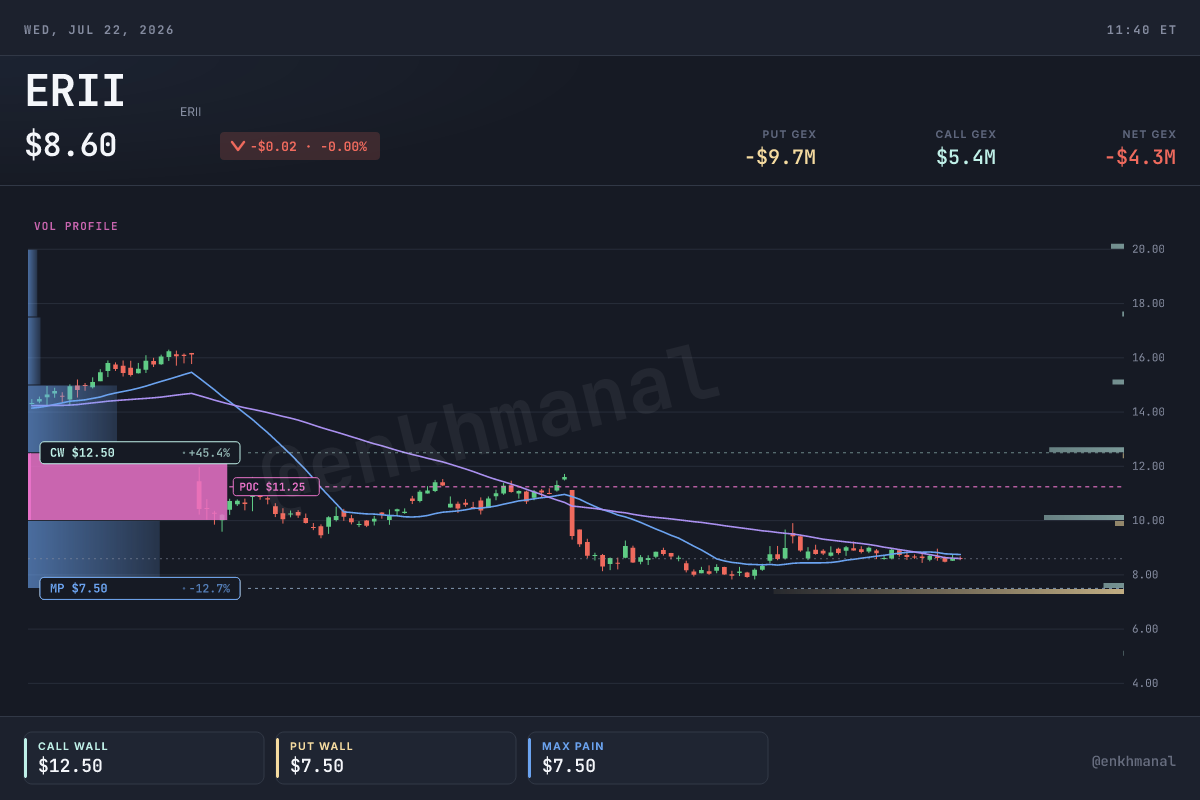
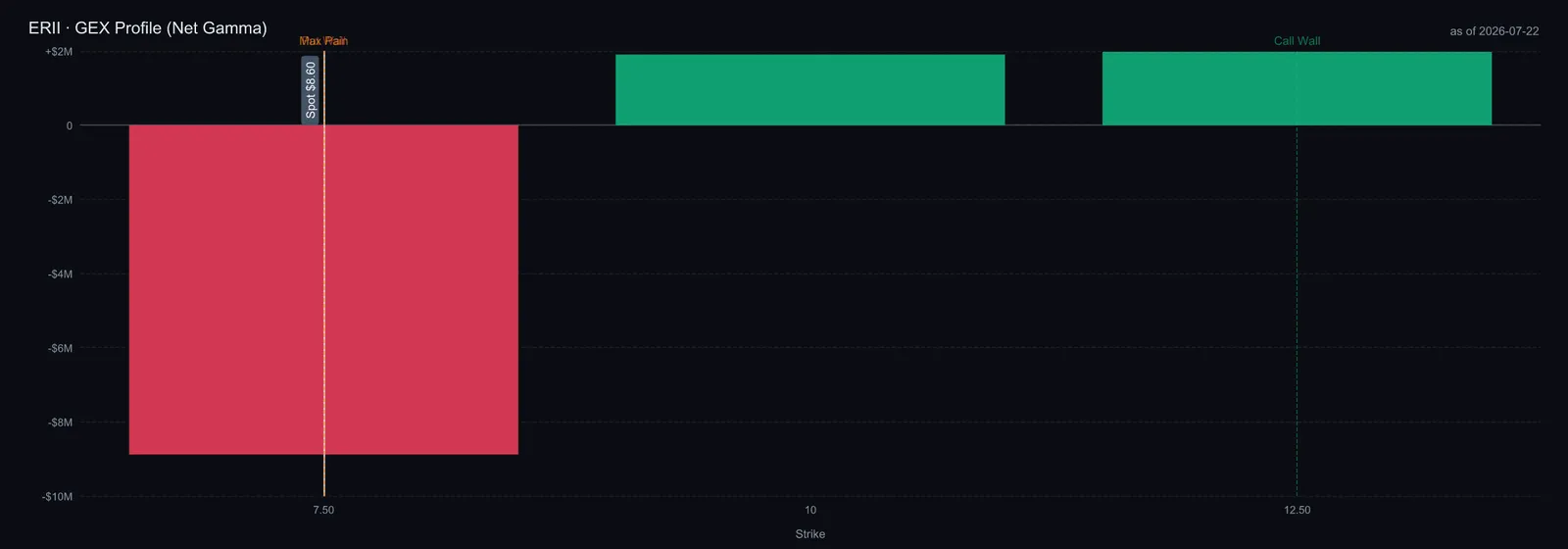
Dealer positioning is thin, but the GEX profile frames the range — a put wall near 7.5 at recent-low support, a call wall near 12.5 around a guidance-reinstatement re-rate. The next dated catalyst is concrete: Q2 2026 results on August 5, where the market is watching for any move to reinstate guidance. The bar into it is low — Quartr consensus models a soft ~$18.8M revenue quarter (roughly −33% YoY) with a small EBITDA/EPS loss — so a reinstatement or a Q650 order update is the swing factor, not the headline print.
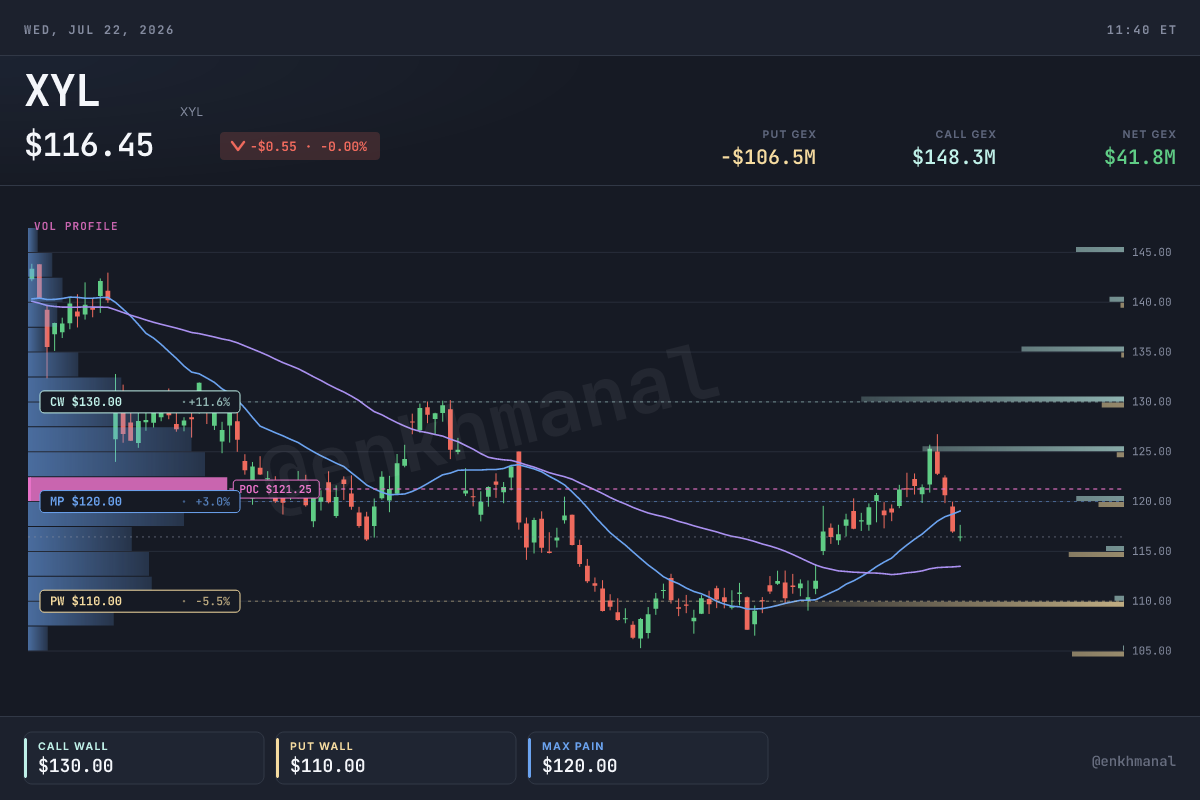
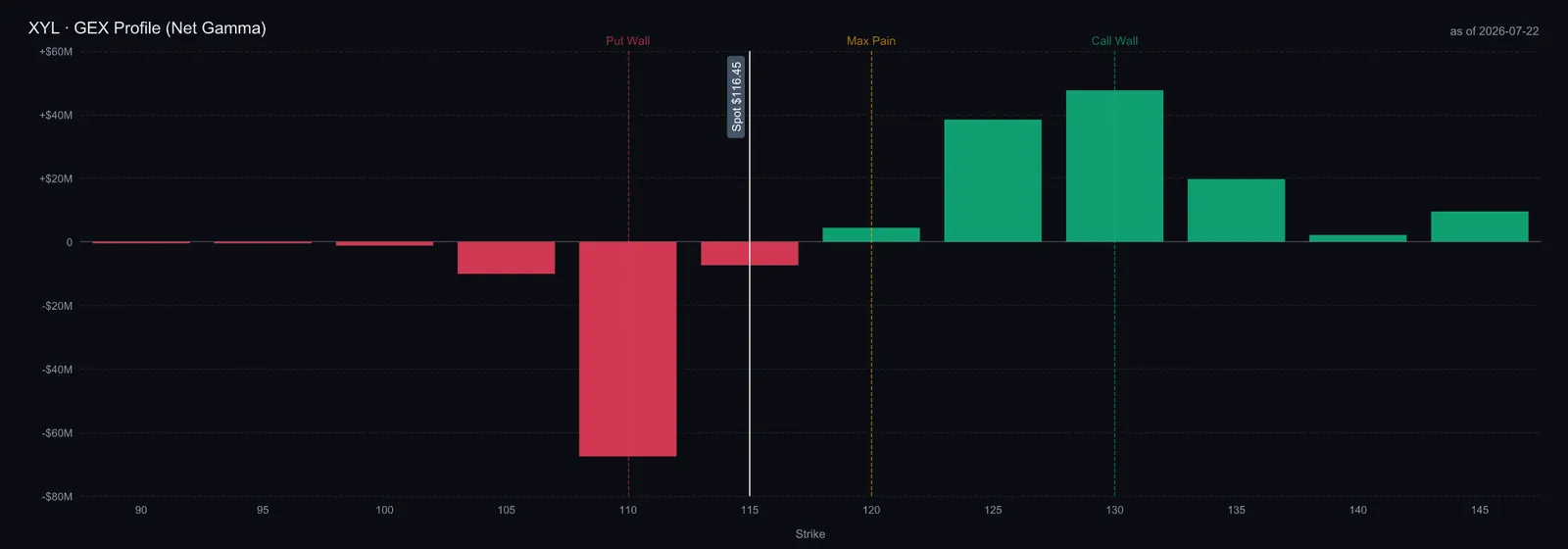
$XYL — own the whole chain at a fair price. $XYL is the quality anchor: a $2.1B-a-quarter, $4.7B-backlog water major that closed FY25 at record revenue, EBITDA and EPS, and guides 2026 to modest growth with margin expansion (its "8020" simplification builds in a deliberate ~2% revenue headwind for higher-quality earnings). Its theme exposure is real but diversified — data-center and semiconductor water reuse is a growth lane, not the franchise — and management compounds it with ~$1B a year of bolt-on M&A. At ~15× EV/EBITDA and ~27× earnings it's neither cheap nor expensive; the name you own for the water theme without single-application risk.
In Q1 the water-services arm booked its largest order ever — an $850M, 20-year outsourced-water contract:
"Demand remained solid with our ending backlog up sequentially to $4.7 billion, and our book-to-bill for the quarter was above one." — Bill Grogan, CFO, $XYL Q1 2026 earnings call (4/28/26)
$ECL — the cleanest AI-water link, priced for it. $ECL is the premium compounder with the most directly verifiable AI-water business. The CoolIT deal turned a chemistry-and-service franchise into the end-to-end AI water platform mapped in §Mechanism. Global High-Tech's path from ~$150M (2021) to ~$1.5B (2026) to a $4B-by-2030 target is the crispest growth story in the basket. The honest caveat: even at $1.5B, High-Tech is under 10% of a ~$16B-revenue company, so $ECL is a call option on AI-water inside a diversified compounder, not a pure play — and the premium multiple (see table) says the market already knows.
The CEO put the AI-water link in his own words — and noted the growth engines have "close to no exposure to energy costs," a hedge against the Gulf-conflict energy spike that pressures the desal names:
"Global High-Tech and digital both grew more than 20%, driven by strong demand tied to digital adoption and the ongoing AI build-up." — Christophe Beck, Chairman & CEO, $ECL Q1 2026 earnings call (4/28/26)
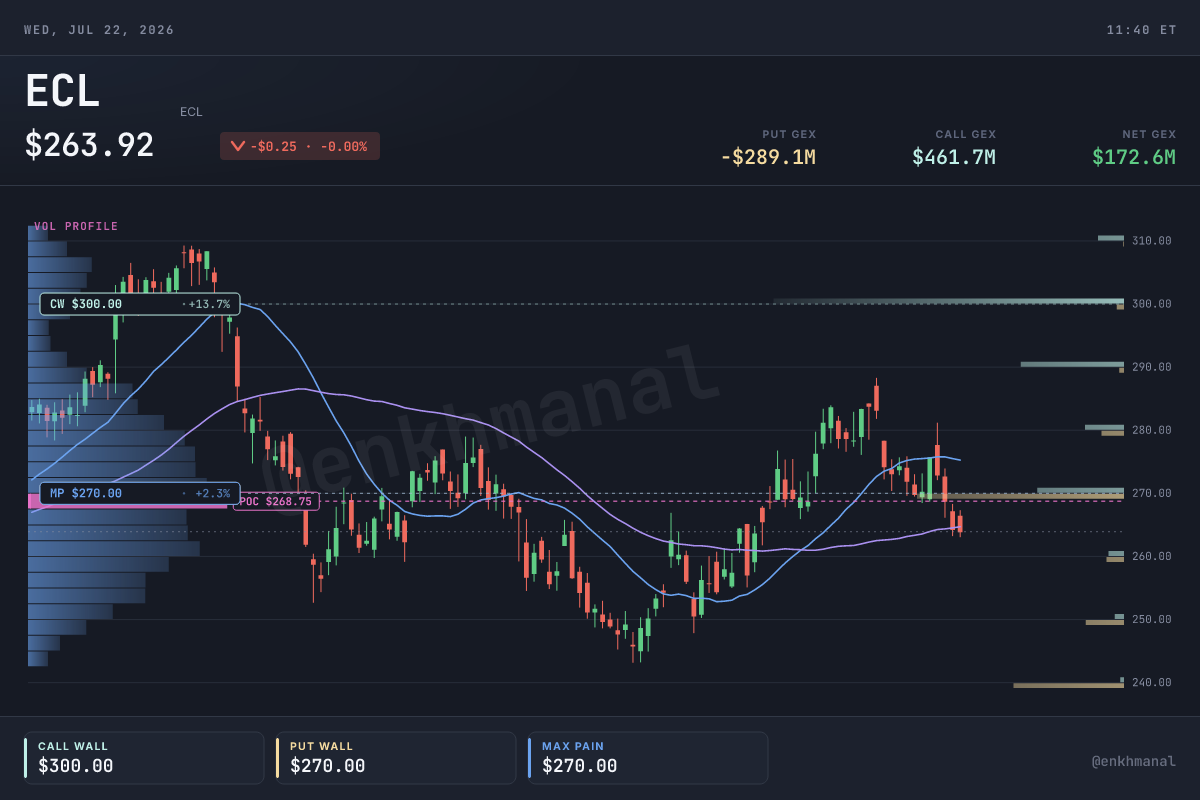
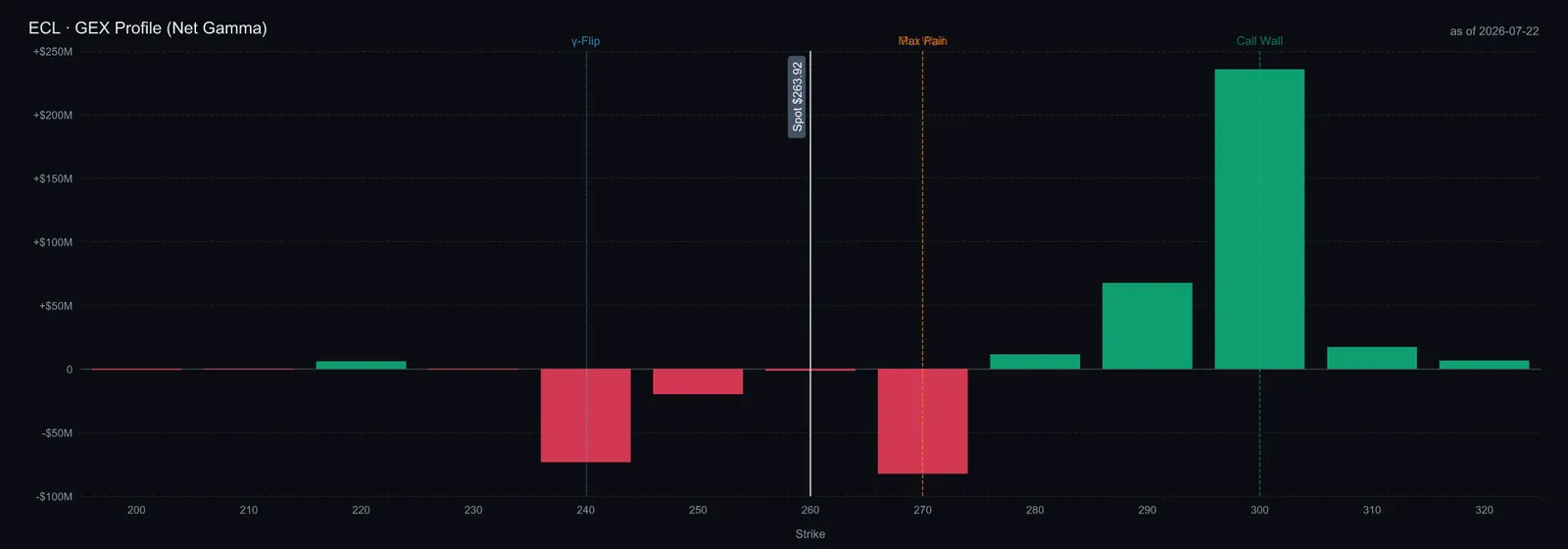
The ranking. $ERII for purity and asymmetry (the only one where the whole business is the theme, and cheapest on every multiple); $XYL for quality and durability; $ECL for the cleanest AI-water exposure if you'll pay the premium. Complements, not substitutes.
Risks & What Breaks It
Theme-level.
- The Gulf catalyst cuts both ways, and it is not resolving. The seductive version of this thesis — circulating on X — is that "the Iran war looks resolved," making peace the catalyst. The tape says otherwise: strikes on water infrastructure continued through mid-July 2026 and now run in both directions (Iran into the Gulf, the US into Iran near Jask). Sustained escalation delays the very Gulf megaprojects the bull case needs, and re-escalation after any lull would hit sentiment hardest on the most ME-exposed name ($ERII, ~50% Middle East revenue). Treat ME concentration as a live risk, not a resolving one.
- AI-water is a real backdrop but a second-order driver for two of three names. The data-center water story is strongest and most verifiable for $ECL; for $ERII it's a genuine but indirect optionality lane (more desal in water-stressed compute hubs), and management, by its own admission, isn't yet telling that story. Don't underwrite $ERII on an AI narrative the company hasn't monetized.
Per-name.
- $ERII: lumpy, back-half-weighted, project-driven revenue where large orders slip without warning (February proved it); leadership is unsettled with a permanent-CEO search still open; the bear case (echoed in a Seeking Alpha piece literally titled around desalination "evaporating into 2027") is that megaproject delays push the recovery out a full year. The floor is the balance sheet — net cash near a fifth of the market cap, no debt, a buyback — which is why it's a when, not an if, but the when is the whole risk.
- $XYL: the risk is mostly valuation and pace — a great business at a full-ish multiple with only modest organic growth and a self-imposed revenue headwind; M&A-driven compounding can stumble on integration or price.
- $ECL: you are paying ~29–34× earnings, so any wobble in the High-Tech ramp, CoolIT integration, or the broader AI-capex cycle gets punished from a premium starting point; the AI-water business is still a minority of the whole.
The single line that most threatens the cheap leg of the basket: if the Gulf conflict grinds on and megaprojects keep slipping, $ERII's re-rating simply doesn't arrive in 2026 — and a value trap with a great balance sheet is still dead money until the catalyst lands.
Valuation & House View
On the numbers, the basket sorts exactly as the nodes suggest. $ERII is the cheapest by a wide margin (~22–24× trailing earnings, ~13× EBITDA) and carries the highest gross margin and the cleanest balance sheet — the classic setup for a name the market has left for dead on a temporary, self-inflicted air pocket. $XYL sits mid-pack (~27× / ~15×) for a diversified quality compounder — a fair price, not a bargain. $ECL is the most expensive (~34× trailing / ~29× forward, ~20× EBITDA) because it owns the crispest AI-water growth story, and the market has noticed.
House view — constructive on the basket, with a clear ordering:
- $ERII — starter position, accumulate on catalysts (highest asymmetry). The risk/reward skew is the widest here: a net-cash, 65%-margin near-monopoly on a withdrawn/de-risked number, cheapest on every multiple, with dated catalysts (August 5 earnings; a guidance reinstatement in Q2/Q3; any durable Gulf de-escalation; the Q650 ramp). Size it as a starter precisely because the timing is unknowable and the revenue is lumpy — then add on the guidance reinstatement or a genuine ME peace signal rather than trying to catch the exact bottom. This is the name that most rewards patience and most punishes impatience.
- $XYL — core, own-the-chain quality. The way to hold the water theme through cycles without single-application risk. Accumulate on market-wide pullbacks toward its lower support; you're buying a compounder at a fair multiple, so entry discipline (not narrative) is the edge.
- $ECL — quality tilt for the AI-water link, on weakness. The cleanest expression of "water is the AI bottleneck," but the premium multiple means you want a wobble — an AI-capex scare or a High-Tech-integration stumble — to establish it, rather than paying ~29× forward into strength.
Net: this is a balanced basket by construction. $ERII supplies the torque and the asymmetry; $XYL supplies the ballast; $ECL supplies the sharpest thematic exposure at a price that already respects it. Own the mispricing where it exists ($ERII), the quality where it's fair ($XYL), and the theme where it's cleanest but pay for it on weakness ($ECL).
Water is the one input both the Gulf's survival and the AI buildout now depend on, and the market still prices it as three separate industrial stories rather than one scarce molecule. The seed for this basket — and the "$ERII as the pure-play, dots-not-yet-connected" framing — came from KawzInvests on X; every load-bearing figure here (financials, margins, guidance, the CoolIT deal, the Gulf-strike timeline) was independently verified against SEC 10-Q filings, all three Q1 2026 Quartr earnings transcripts, company IR, and wire reporting, and a few of the source's characterizations (a "record" quarter that was flat, a "resolved" war that isn't, a "9% buyback yield" that is a ~$25M authorization) were corrected in the writing. h/t KawzInvests for the thread that started the dig.