
Personalized Cancer Vaccines Deep Dive — What Cancer Is, How You Teach a Body to Kill It, and Who Sells the Picks
Update — October 10, 2026. This is an August 20 research snapshot; the prices, chart levels, multiples and scenarios below are historical, not current trading levels. Merck and Moderna's August 19 release reported that INTerpath-001 met recurrence-free and distant-metastasis-free survival endpoints in resected stage IIB through stage four melanoma. Detailed Phase 3 effect sizes, overall-survival results and treatment economics were not in that topline release; the study continues to assess other endpoints. A positive readout reduces clinical risk in this setting but does not prove that every mRNA cancer-vaccine programme will work or that a particular supplier will win its spending. The commercial evidence remains more limited than the August share-price reaction. Maravai's Q2 results reported $51.4 million of revenue, $8.7 million of adjusted EBITDA, and 2026 guidance of $205–215 million of revenue and $33–35 million of adjusted EBITDA. TriLink's September China CleanCap patent adds protection, not a confirmed vaccine order. Castle's Q2 results reported $103.5 million of revenue and raised its 2026 revenue guide to $365–375 million; a September 30 study update supported DecisionDx-Melanoma for sentinel-node decisions and recurrence-risk stratification. DecisionDx-Melanoma is a tumour-tissue gene-expression prognosis test, not a blood-based ctDNA residual-disease test. INTerpath-001 used stage-defined enrollment; the cited trial release did not name DecisionDx or a ctDNA-positive requirement. ctDNA-based selection appears in a separate BioNTech colorectal study. The earlier claim that Castle is a required diagnostic gate for this melanoma therapy was too strong. Its investment case must stand on its existing tests and any future demonstrated use, rather than assumed vaccine eligibility.
On Wednesday, 19 August 2026, a surgeon somewhere finished removing a melanoma. That part is routine — roughly 112,000 Americans will be diagnosed with melanoma this year, and for most of them a scalpel is the whole treatment. What is no longer routine is what can now happen to the tumour after it leaves the body. Instead of going into a jar of formalin and a basement archive, it can be couriered to a sequencer, read letter by letter, compared against the patient's own healthy DNA, and mined for the specific typographical errors that made it cancer. Those errors get written into a strand of messenger RNA, wrapped in fat, and injected back into the arm they came from — a set of instructions telling the immune system exactly what to hunt.
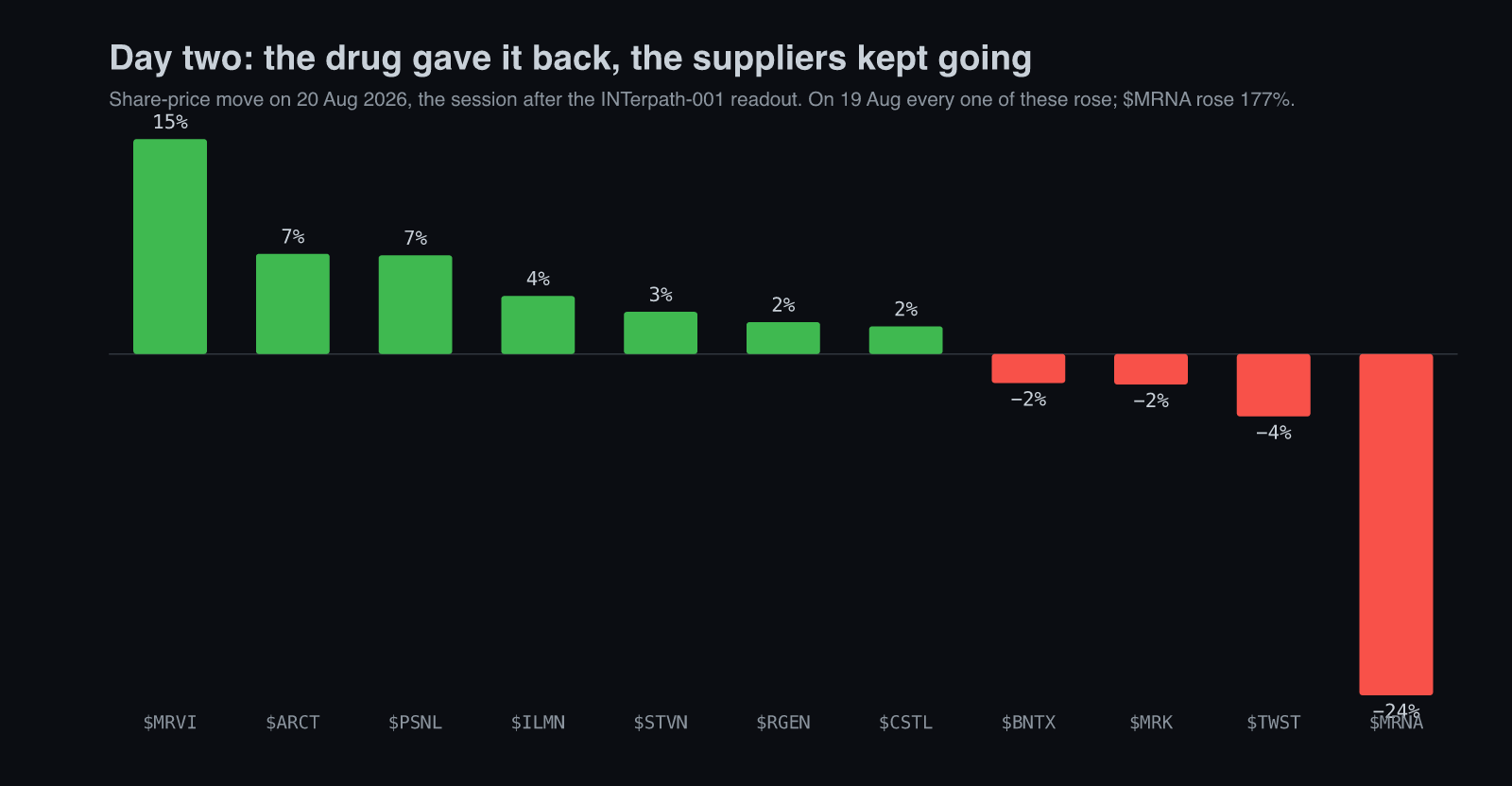
That same Wednesday, Merck and Moderna said the approach works. Their Phase 3 trial, INTerpath-001, met both of its endpoints. It is the first time a personalized mRNA cancer vaccine has cleared a Phase 3 bar, and $MRNA rose 177% in a session — the largest one-day move in the company's history, on the heaviest volume it has ever traded.
By Thursday afternoon $MRNA had given back 23.5%. Meanwhile $MRVI, a $2.1 billion company most investors have never heard of that sells the chemical reagent used to finish an mRNA strand, was up another 14.8%. That divergence — the drug reversing while the supply chain kept bidding — is the whole subject of this memo.
What follows is built from the ground up, because the trade is downstream of the biology and you cannot rank the companies without understanding the steps. We will define what cancer is, why the immune system does not deal with it unaided, what a neoantigen is and why it is the most important word in this field, exactly how a vaccine gets built for one person in six weeks, and then which of the eight companies standing between a biopsy and a syringe are worth owning.
The Factory Is the Asset, Not the Drug
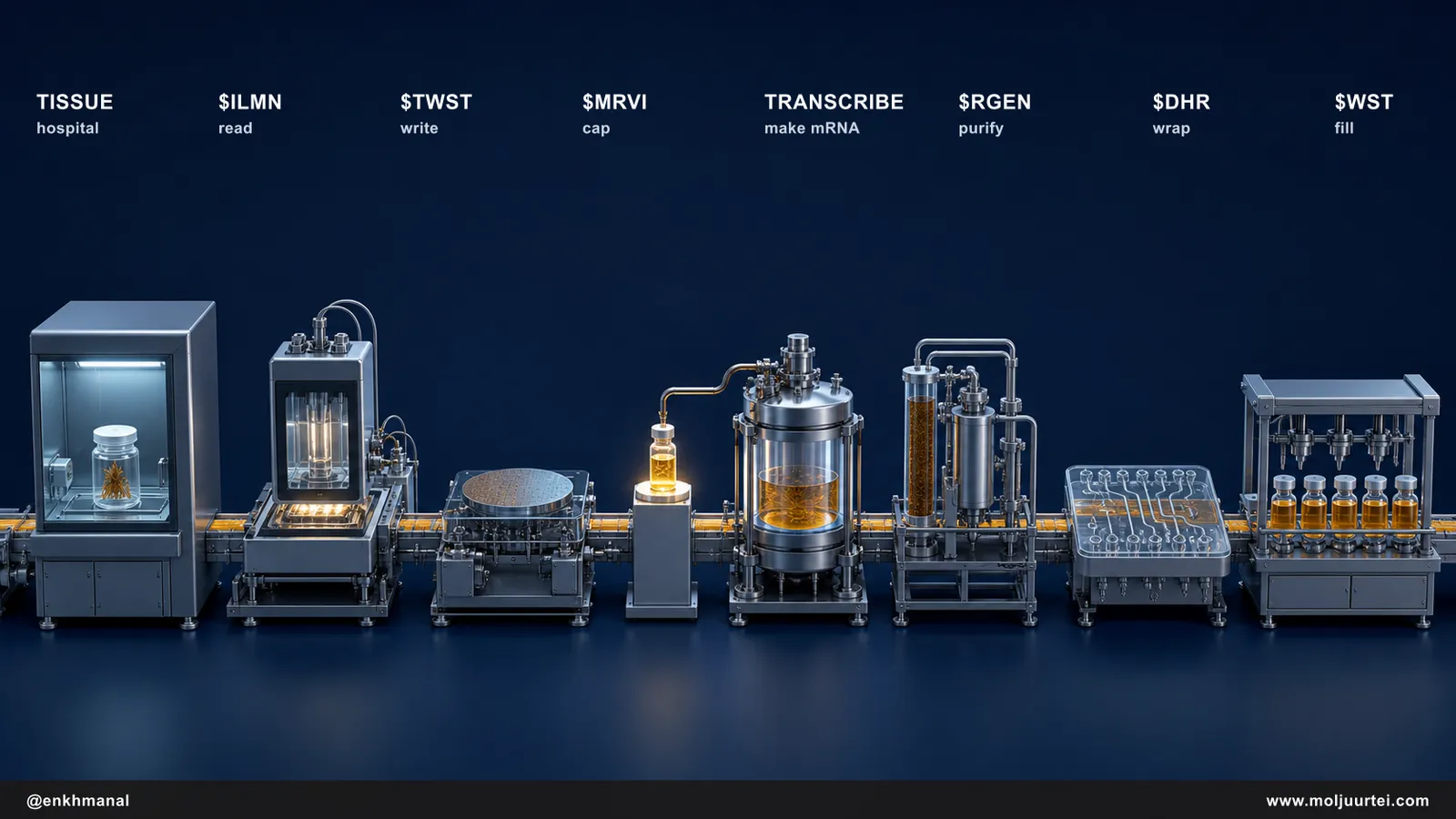
A personalized cancer vaccine is not one product. It is an assembly line that runs the same way every time and produces a different output every time — read a tumour, choose targets, write a genetic sequence, manufacture it, ship it. The drug is bespoke; the factory is not. That distinction is where the money is, because a factory that must run once per patient rather than once per product is a factory whose consumable bill scales with the number of people treated rather than the number of drugs approved.
INTerpath-001 does not make Moderna rich. It does something more useful for everyone else: it removes the question mark over whether the modality works at all. Nine trials from Moderna and Merck are already running across melanoma, lung, bladder and kidney cancer; BioNTech and Genentech have a rival programme in pancreatic and colorectal disease; and behind them sits a long tail of small companies who were waiting to see whether a Phase 3 was survivable before committing to clinical-grade manufacturing. Those companies do not own sequencers or capping chemistry or lipid-mixing skids. They buy them.
So the basket here is deliberately not built around the two names that moved most. It is built around the eight steps between a biopsy and a syringe, and the public companies that own each one. Four observations shape the ranking, and the first is the one that reverses most people's instinct.
The house view, stated plainly and defended below: underwrite capping supply and diagnostics separately. $MRVI is the purest expression of the manufacturing thesis and a supplier positioned to sell capping reagents to outside manufacturers, although no programme must buy its product. $CSTL was the cheapest asset in this August basket, but its melanoma test is a prognostic tool rather than a required intismeran eligibility test. $ILMN and $TWST are the quality reads on the front of the line but have already run. $WST is the laggard nobody has bid. $ARCT is a lottery ticket, sized accordingly. And $MRNA, at $52 billion after doubling in two days on a press release containing no numbers, is a trade rather than an investment.
What Cancer Actually Is
Every cell in your body carries the same instruction manual: roughly three billion letters of DNA, copied each time a cell divides. The copying is extraordinarily accurate and still not perfect. A cell picks up errors from ordinary metabolism, from ultraviolet light, from tobacco smoke, from sheer statistical bad luck over billions of divisions. Most errors land in stretches of DNA that do nothing, or break the cell so thoroughly that it dies, or get caught by repair machinery and corrected. That is the normal state of affairs and it goes on inside you constantly, right now, without consequence.
Cancer is what happens when the errors land in exactly the wrong places, in the right order, in the same cell. There is a set of genes whose job is to say stop dividing — the tumour suppressors, of which p53 is the famous one — and another set whose job is to say divide now, the oncogenes. Break enough of the first kind and jam enough of the second kind on, and you get a cell that divides when it should not, ignores the instruction to die, and passes both properties to every descendant. That is the entire disease in one sentence: a cell that stopped taking orders, and made copies of itself.
Everything else about cancer follows from that. The lump is descendants. The spread is descendants that learned to travel. The drug resistance is descendants that happened to carry a mutation making them survive the drug, which then became the whole population because everything else died. Cancer is evolution running inside a body on a timescale of months, with your tissue as the environment and your treatments as the selection pressure.
That framing explains the numbers. The American Cancer Society projects 2,114,850 new cancer diagnoses in the United States in 2026 and 626,140 deaths — about 5,800 new diagnoses every day. Globally the World Health Organization's cancer agency counted close to 20 million new cases and 9.7 million deaths in its most recent full survey, and projects 35 million cases a year by 2050. Roughly one person in five develops cancer in a lifetime; about one man in nine and one woman in twelve dies of it. Cancer is not a rare event that happens to unlucky people. It is the statistically expected outcome of running a body made of dividing cells for eighty years.
The encouraging half of the arithmetic is that this is a war being slowly won. Five-year survival across all cancers in the US is now 70%, up from 50% in the mid-1970s, and the cancer death rate has fallen 34% since its 1991 peak — roughly 4.8 million deaths that did not happen. Some of that is screening finding disease earlier. Some is surgery and radiation getting better. But the steepest individual improvements of the last thirty years came from a single idea, and it is the idea this memo is about.
Why Your Immune System Doesn't Just Handle It
Here is the obvious question, and it is the right one: you have an immune system that destroys bacteria, viruses, fungi and parasites with ruthless efficiency. Cancer cells are damaged, misbehaving, obviously abnormal. Why does the immune system not simply remove them? It does, constantly. The failure mode is specific and worth understanding, because everything commercial in this memo hangs off it.
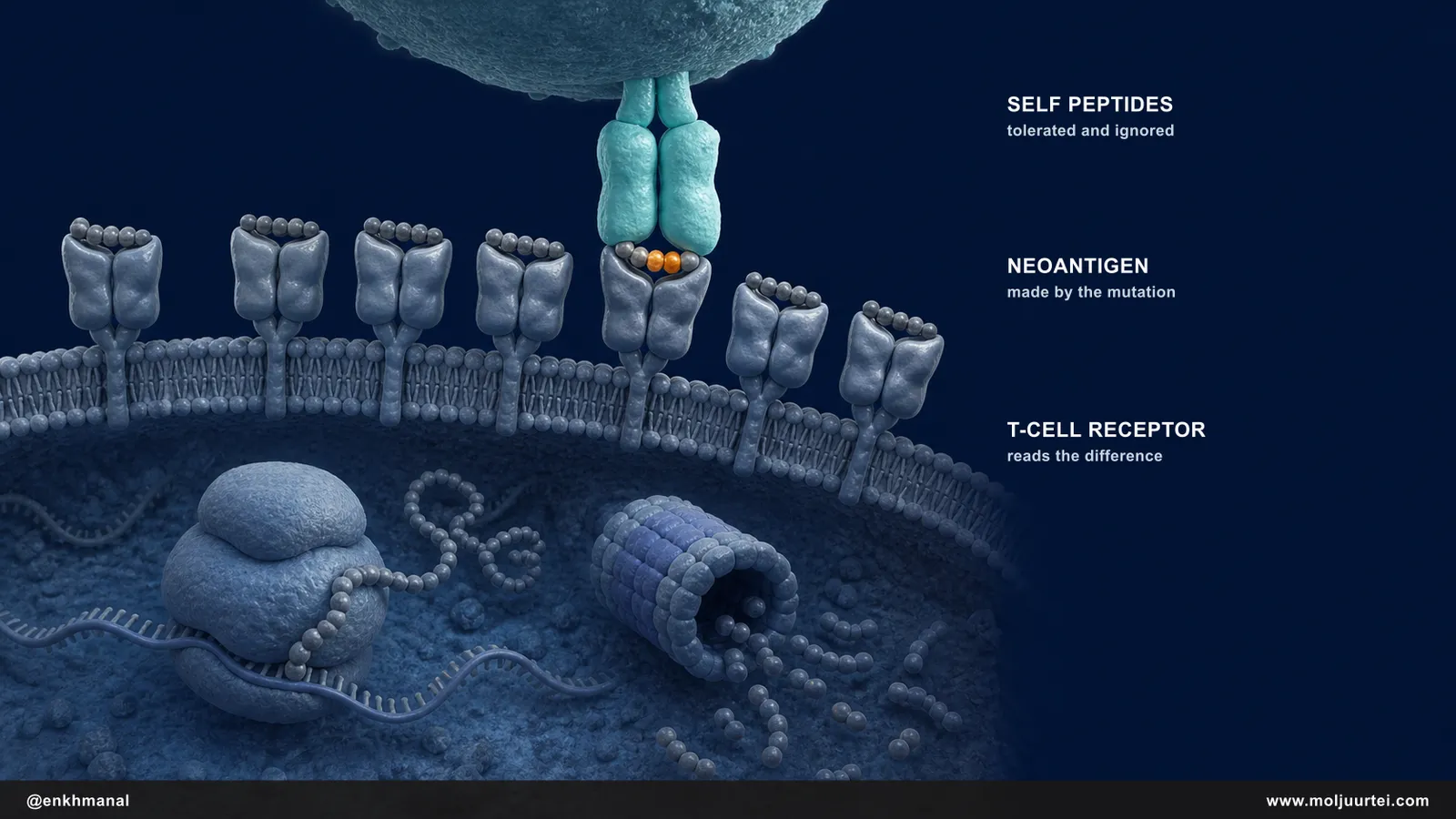
Your immune system's job is to distinguish self from not-self. To do that, essentially every cell in your body performs a continuous public confession. It takes samples of the proteins it is currently making, chops them into fragments about nine amino acids long, and displays those fragments on its surface in a molecular clamp called MHC class I — in humans, the HLA system. Think of it as every cell in your body holding up a small sign, all day, that reads: here is what I am building right now.
Patrolling this display are cytotoxic T cells, and each one is built to recognise exactly one fragment shape. When a T cell finds a cell whose sign shows something it recognises as foreign, it kills it. That is how a virus-infected cell dies: the virus forces the cell to make viral protein, fragments of viral protein appear on the sign, and a T cell reads the sign and executes the cell.
The problem for cancer is that a cancer cell is you. Its sign shows your proteins, because it is built from your genome. And during development, in the thymus, T cells that react strongly to your own proteins are systematically deleted — a process called central tolerance, which exists so you do not spend your life attacking your own tissue. The result is a beautiful defensive system with a designed blind spot, and cancer sits precisely inside it.
Tumours then make the blind spot bigger. As a cancer evolves under immune pressure, the clones that survive are the ones that hide best. Some stop displaying MHC altogether — no sign, nothing to read. Some recruit suppressive cells that switch off attackers in the neighbourhood. And many learn to press a specific off-switch that T cells carry for their own safety.
The Brake, and Why Removing It Was Not Enough
T cells are dangerous, so they come with brakes. The most important one is a receptor called PD-1. When PD-1 on a T cell touches a partner molecule called PD-L1 on another cell, the T cell stands down. This exists to stop immune responses running forever and destroying healthy tissue after an infection has cleared. Tumours discovered this. Many cancers coat themselves in PD-L1. A T cell arrives, correctly identifies the cell as abnormal, reaches out — and gets a handshake that says stand down. The tumour is not hiding from the immune system at that point. It is telling it to go home, using the immune system's own vocabulary.
Checkpoint inhibitors are antibodies that block that handshake. Merck's Keytruda (pembrolizumab) is an anti-PD-1 antibody: it binds PD-1 and physically prevents PD-L1 from reaching it, so the stand-down signal never arrives. It does not attack cancer. It removes the tumour's ability to call off an attack that was already underway.
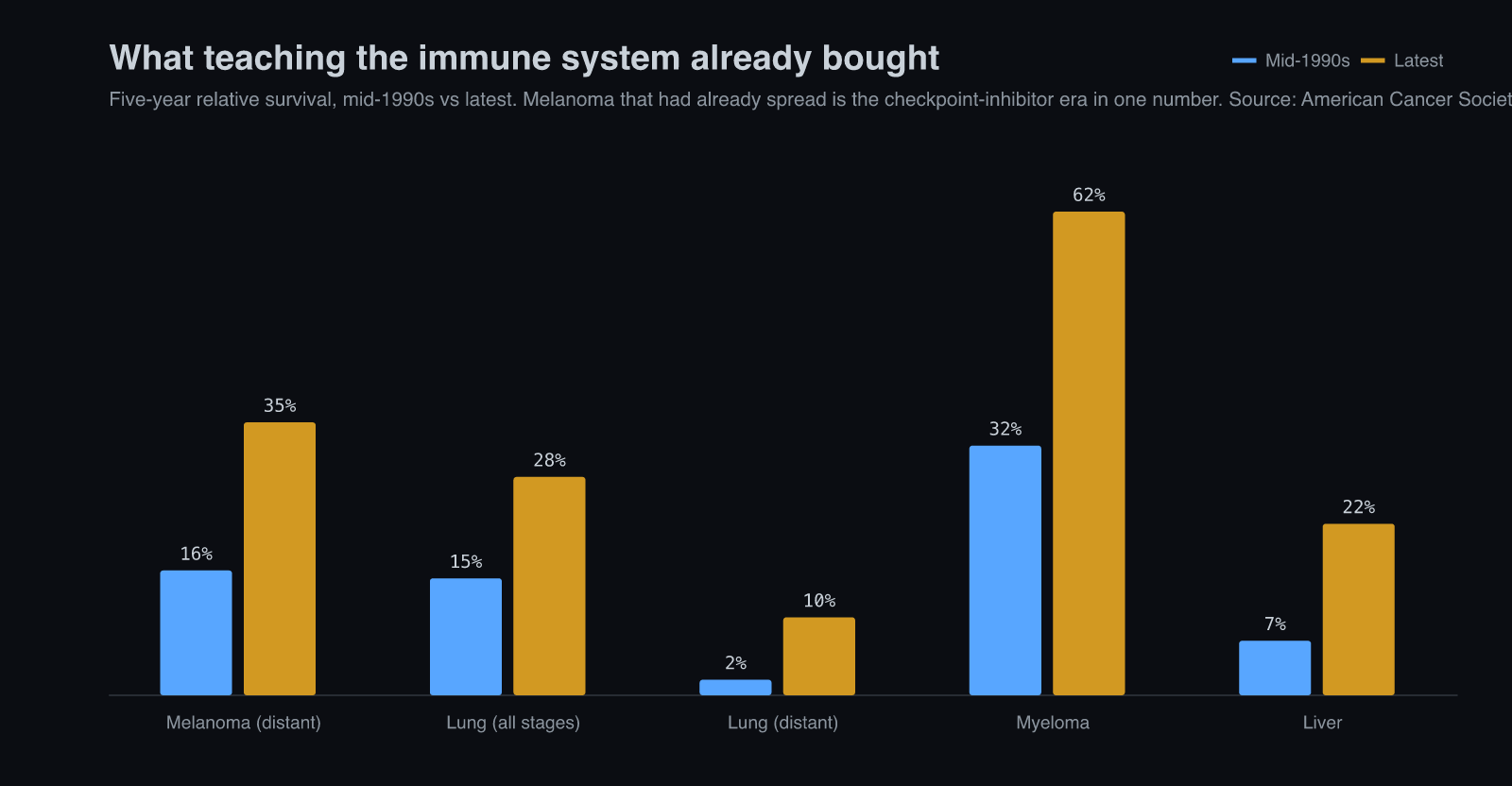
The results were the largest step-change in oncology in a generation. Melanoma that had already spread to distant organs — a diagnosis that used to be a death sentence measured in months — went from 16% five-year survival in the mid-1990s to 35% today. Distant-stage lung cancer went from 2% to 10%. Keytruda alone did $31.7 billion of revenue in 2025, making it the best-selling drug in the world.
And then the curve flattened, for a reason that is easy to state. Checkpoint inhibitors amplify whatever immune response already exists. If your immune system has already found your tumour and is being suppressed, releasing the brake works spectacularly. If your immune system never found the tumour in the first place — never generated T cells against it, has nothing to amplify — then removing a brake from a stationary vehicle achieves nothing. Across most tumour types, checkpoint inhibitors alone produce durable responses in a minority of patients.
Keytruda removes the brake. The vaccine provides the address.
Neoantigens — The Word the Entire Industry Turns On
The address exists. It has been sitting in plain sight the whole time, and it is made of the tumour's own mistakes. Go back to the mutations. A cancer cell carries genetic errors that a healthy cell does not. Many of those errors sit in genes that get read and translated into protein. When a mutation changes one amino acid in a protein — a missense mutation — the cell dutifully builds the altered protein, chops it up like everything else, and displays fragments of it on its MHC sign.
That fragment is not in your genome. It was never present in the thymus when your T cells were screened for self-reactivity. No tolerance was ever established against it. It is, immunologically speaking, as foreign as a virus. This is a neoantigen — literally new antigen. It is a piece of protein that exists nowhere in your body except in your cancer, produced by the very mutations that made the cell cancerous in the first place. And it means every tumour is carrying, on its surface, a molecular barcode unique to itself and legitimately attackable.
The elegance of this is worth pausing on, because it inverts the disease's central advantage. Cancer's weapon is mutation: it mutates to escape drugs, to escape the immune system, to grow faster. But each mutation it acquires is another neoantigen — another thing that marks it as not-you. The more aggressively a tumour evolves, the more distinguishable it becomes. The strategy that makes it dangerous is the same strategy that makes it targetable.
This also explains a fact that puzzled oncologists for a decade: why do checkpoint inhibitors work far better in melanoma and lung cancer than in, say, pancreatic or prostate cancer? The answer is tumour mutational burden — how many mutations a tumour carries. Melanoma is caused by ultraviolet light smashing DNA, and lung cancer by tobacco smoke doing the same; both accumulate enormous numbers of mutations, which means enormous numbers of neoantigens, which means a rich supply of legitimate targets for a released immune system to find. Low-mutation tumours present the immune system with almost nothing to see. That is why melanoma was the first indication for checkpoint inhibitors, and it is why melanoma was the first indication for this vaccine too.
So the therapeutic idea writes itself, and researchers have been chasing it since the 1990s: don't wait for the immune system to notice the neoantigens on its own. Find them by sequencing, and tell it where to look. The reason it took thirty years is that telling it where to look turned out to be a manufacturing problem, not a biology problem. Every patient's tumour has different mutations. A vaccine against them has to be built one patient at a time, from scratch, fast enough to matter, at a cost and a reliability that a health system will accept. Until mRNA, there was no technology that could do that.
The Vocabulary, in One Place
Before the assembly line, the terminology — because this field buries a fairly simple idea under a great deal of jargon, and every term below appears in the press releases you will read over the next two years.
How You Build a Vaccine for One Person in Six Weeks
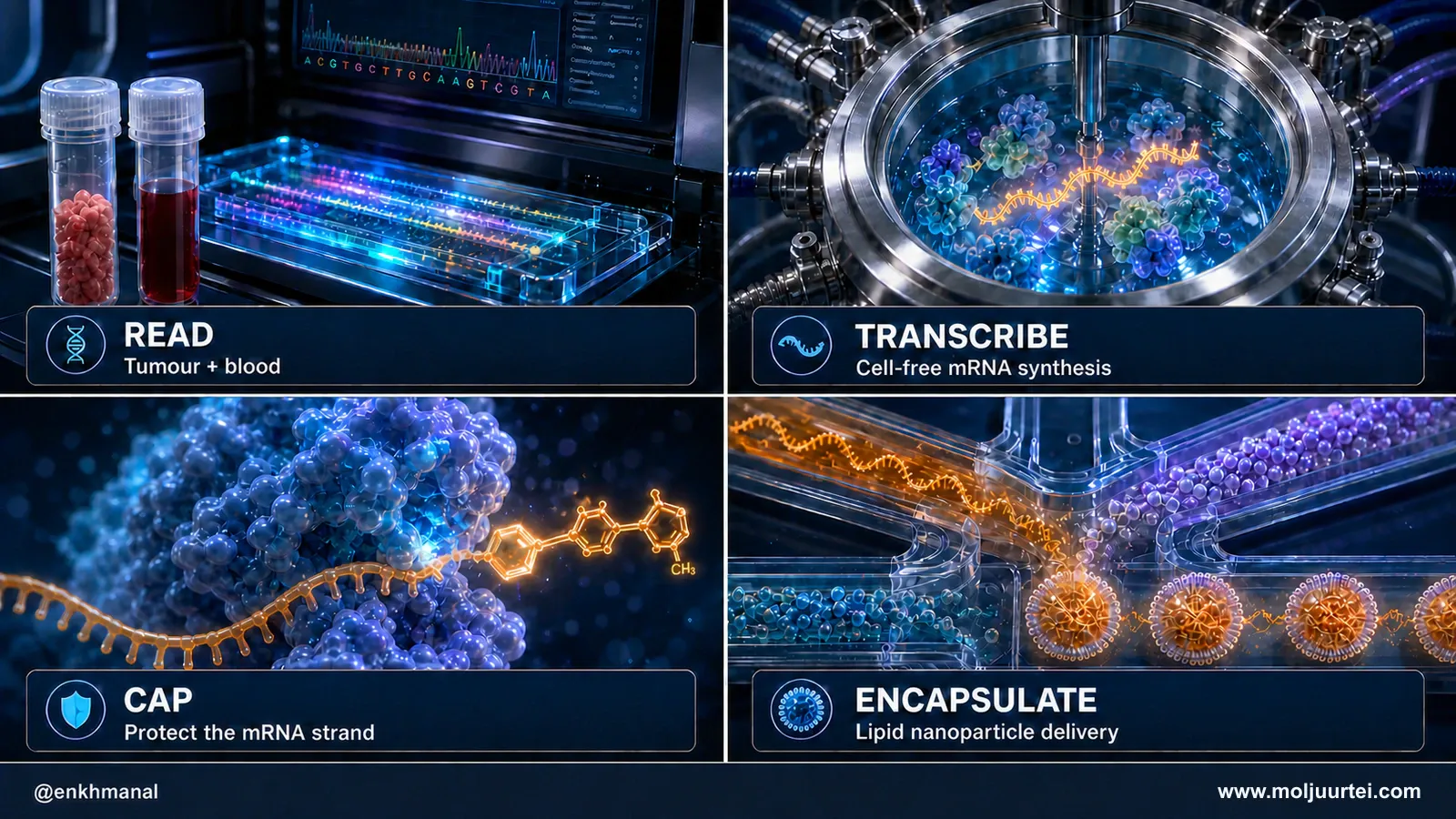
Here is the actual process, step by step, as it runs for an individual patient. This is the part that matters commercially, because each step is a purchase order. Step one: cut it out, and keep it. The patient has surgery. Standard practice for decades has been to preserve the tumour in formalin and embed it in paraffin, a chemistry that cross-links and fragments nucleic acids — so for high-quality sequencing a fresh-frozen sample is better. Every hospital that wants to offer this therapy needs a tissue-handling pathway it probably does not have today.
Step two: read two genomes, not one. The tumour is sequenced — typically whole-exome sequencing, covering the roughly 2% of the genome that codes for protein. Crucially, a normal sample from the same patient is sequenced alongside it, usually from blood. You cannot identify a tumour-specific mutation by looking at the tumour alone; you can only find it by subtracting the patient's own inherited variation. Every patient therefore requires two exomes, not one. That is the sequencing consumable bill, and it is why $ILMN is upstream of everything here.
Step three: sort the errors from the noise. Bioinformatics compares the two files and calls the differences — the somatic mutations. A typical melanoma might throw up hundreds; a low-burden tumour, a handful. RNA sequencing is usually run in parallel to check which mutated genes are actually being expressed, because a mutation in a gene the tumour has switched off produces no protein and therefore no target.
Step four: work out which locks the patient's keys fit. This is the hard part. A neoantigen only works if it is presented, and presentation depends on the patient's HLA type — the most variable region in the human genome. A mutated peptide that binds tightly to one person's HLA may not be displayed at all by another's. So the pipeline types the patient's HLA and runs machine-learning models that predict, for each candidate mutation, how well the resulting peptide will bind that individual's molecules, how stably it will sit there, and how likely a T cell is to react to it. The candidates get ranked, and the top 34 are selected. Thirty-four is not arbitrary. It is a hedge — predicting immunogenicity is imperfect, and a tumour can delete any single target under pressure, so you fire a spread rather than a single shot.
Writing the Strand — Template, Transcription and the Cap
Step five: write it as one sentence. The 34 chosen neoantigens are not made as 34 separate drugs. They are strung end to end into a single synthetic gene — a concatemer — encoding one long artificial protein that exists nowhere in nature and consists of nothing but the patient's tumour mutations, each with a short stretch of flanking sequence so the cell's chopping machinery can cut them apart correctly. That sequence is then written as DNA. This is the node $TWST occupies: synthetic DNA, written to order, at scale.
Step six: transcribe it into mRNA. The DNA template goes into a tube with a bacteriophage enzyme called T7 RNA polymerase and a pool of the four nucleotide building blocks. The polymerase reads the DNA and builds an RNA copy. This is in vitro transcription, and it is a cell-free chemical reaction in a tank, which is exactly why the process scales — there are no cells to grow, feed, keep alive or contaminate. One of the four building blocks is swapped for a modified version, N1-methylpseudouridine, which is chemically almost identical to uridine but is not recognised by the cell's viral-RNA alarm system. Without that substitution the body treats injected mRNA as an infection, inflames, and destroys it before it can be read.
Step seven: cap it, or it dies in minutes. Natural mRNA in your cells carries a specific chemical structure on its 5' end — a cap — which does two jobs: it is the docking signal that lets the ribosome start translating, and it is the badge that marks the strand as native rather than viral. An uncapped mRNA is not translated and is rapidly degraded. There are two ways to attach one. The older way is enzymatic: make the RNA, then run a second reaction with capping enzymes afterwards. It works, it adds a step, it adds a day, it adds cost, and it never caps everything. The newer way is co-transcriptional capping — put a synthetic cap analog into the transcription reaction itself, so the polymerase incorporates the cap as it initiates. One reaction instead of two, capping efficiency above 95%, roughly a week faster and materially cheaper.
The dominant co-transcriptional cap analog is CleanCap, and it is owned by $MRVI's TriLink unit. TriLink licenses it non-exclusively to Lonza and to Danaher's Aldevron; it holds patents on the analog family in the United States, in Europe, and — as of last quarter — in China; and it supplied Pfizer and BioNTech under a supply agreement signed in October 2020 for the manufacture of Comirnaty. TriLink states its capping technology is used in a majority of approved mRNA and self-amplifying RNA vaccines.
This is the single most defensible node in the chain, and it is worth being precise about why. Sequencers are excellent businesses but they are capital equipment with competitors. Bioreactors and filters are consumables with several suppliers. The cap is a patented molecule that goes into the reaction, gets consumed, and must be re-bought for every batch — and swapping it out means re-validating a regulated manufacturing process with a regulator who does not enjoy surprises. Nobody changes their capping chemistry casually once a programme is in the clinic.
Purify, Package, Ship
Step eight: purify. The reaction tank now contains the mRNA you want plus DNA template, enzymes, unincorporated nucleotides, and — most importantly — double-stranded RNA byproducts, which are potent triggers of exactly the inflammatory response the modified nucleoside was chosen to avoid. Purification runs through chromatography and tangential-flow filtration. This is $RGEN's business.
Step nine: wrap it in fat. Naked RNA injected into a person is destroyed almost immediately and cannot cross a cell membrane anyway. It has to be packaged into a lipid nanoparticle — a bubble roughly a hundred nanometres across, built from four components: an ionizable lipid that is neutral in the bloodstream but becomes positively charged inside the acidic compartment of a cell, which is the trick that lets the RNA escape into the cytoplasm; a helper phospholipid; cholesterol for structural rigidity; and a PEG-lipid that controls particle size. The RNA and the lipids are pushed together through a microfluidic mixer at controlled speed, and the particle self-assembles. Danaher owns this step through Cytiva and Precision NanoSystems; $ARCT owns competing delivery patents.
Step ten: fill, test, and ship. The formulated product is filled into glass vials with elastomeric stoppers — $WST's business, and $STVN's — then tested for identity, purity, capping efficiency, particle size, encapsulation and sterility, and released. Analytical instruments from $TMO, $A and $BRKR do that work. Then it is couriered, frozen, to the patient's oncologist. Total elapsed time: about six weeks, with published estimates running six to eight. That number is the entire commercial argument. It is short enough to matter clinically — the window after surgery, before microscopic residual disease establishes itself, is exactly when the immune system has the best chance — and it is short enough to run as a business rather than a research project.
What INTerpath-001 Showed, and What It Didn't
Precision matters here, because the market traded a press release, not a dataset. INTerpath-001 enrolled 1,137 patients with completely resected Stage IIB through Stage IV cutaneous melanoma and no prior systemic therapy. They were randomised 2:1: two-thirds received intismeran autogene at 1 mg every three weeks for up to nine doses plus Keytruda at 400 mg every six weeks for up to nine cycles; one-third received Keytruda alone. Both arms ran about a year.
Read those two endpoints carefully, because they are doing different jobs. Recurrence-free survival asks whether the cancer came back anywhere. Distant metastasis-free survival asks whether it came back somewhere that kills you — the lungs, the liver, the brain — as opposed to a local nodule that can be cut out again. The second is the one that tends to track overall survival, and it is the one the sceptics were waiting on. Hitting both is a materially stronger result than hitting the first alone.
The predecessor Phase 2b, KEYNOTE-942, had reported a 49% reduction in the risk of recurrence or death and a 59% reduction in the risk of distant metastasis or death versus Keytruda alone, which is what earned the programme an FDA Breakthrough Therapy designation. Wednesday's release did not say whether the Phase 3 reproduced anything like those magnitudes. That is the honest hole in the middle of this.
This is a topline announcement, not a finished investment case. We need the hazard ratios, absolute event rates, Kaplan–Meier curves, adverse-event profile, treatment discontinuation rates, subgroup consistency, manufacturing turnaround time, and ultimately overall-survival follow-up.
There is a second criticism, and it is a good one. Adam May, a physician posting the day after, noted that the trial enrolled patients whose tumours had already been surgically removed — nobody in it had measurable disease. He is right, and the point is not trivial: an adjuvant trial cannot show a tumour shrinking, because there is no tumour to shrink. It can only show that fewer cancers came back, later. That is a real and valuable thing to demonstrate. It is also a much easier headline to over-read than the drug melted a mass, and a good part of Wednesday's 177% was generalist money reading it that way. Thursday's 23.5% give-back was the market re-reading it. Both things can be true at once: the result is a genuine first, and the release contained no number a modeller could use.
One melanoma indication is not a large business. Roughly 112,000 Americans are diagnosed with melanoma annually and only a fraction are Stage IIB or worse. If intismeran were only ever a melanoma drug, the addressable population would be tens of thousands of patients a year in the US, and Wednesday's move would be indefensible. The reason it is not indefensible is that the same manufacturing line makes every other version — nine Phase 2 and Phase 3 trials across melanoma, non-small cell lung cancer, bladder and renal cell carcinoma, plus Phase 1 programmes in pancreatic and gastric cancer. Each one is a different set of neoantigens, encoded in the same way, wrapped in the same lipid, made on the same equipment. The company changes the sequence; it does not change the factory.
Lung cancer is the prize. It is the most commonly diagnosed cancer in the world at roughly 2.5 million cases a year — about one cancer in eight — and it is high-mutation-burden disease for the same reason melanoma is, which is precisely the profile where neoantigen approaches should work. If the melanoma result translates to non-small cell lung cancer, the addressable population moves by an order of magnitude. And Moderna is not alone: $BNTX, with Genentech, is running autogene cevumeran in randomised Phase 2 trials in adjuvant pancreatic and adjuvant colorectal cancer. The colorectal readout has slipped from 2026 to 2027 because events accrued more slowly than projected, which is a mixed signal — slow recurrence in a trial is bad for statistics and good for patients — and a bladder study was discontinued. The second programme is progressing more slowly than the first. It is still progressing, and it validates the same supply chain.
Who Owns Which Step
Now map the ten steps onto public companies. The discipline here is to give each name a node and be honest about how much of its business the theme actually is, because a diversified instrument maker where neoantigen vaccines are 1% of revenue is a call option inside a different business, not a pure play.
Two names that moved hard are deliberately not in the ranked basket, for reasons worth stating. $MRNA is the wrong instrument for this thesis: it owns the drug, which sounds like the point, but it is vertically integrated — it makes its own mRNA, its own lipids and its own nanoparticles at Norwood, and it invested years ago in in-house production of key raw materials including plasmid DNA. Its success therefore adds nothing to any supplier's revenue line. It is also now a $52 billion company that fell from over $400 to under $30 and has just doubled in two days on a release with no numbers in it, with a 27.6% revenue decline behind it. That is a trade. It may well be a good one. It is not what this memo is for.
$PSNL is the one I wanted to include and could not. Personalis sells NeXT Personal, a tumour-informed ultra-sensitive residual-disease test — exactly the right product for this theme, and the stock is up 267% in a year. But reported revenue went $85M in FY24 to $70M in FY25, down 17.7%, with a three-year growth rate of 2.3% and an operating margin of −126%. The mix is shifting from a legacy population-sequencing contract toward clinical testing, which may well be the right shift. It is still a business whose revenue is shrinking while its stock triples. On a framework that ranks growth and trend, the trend qualifies and the growth does not, and I am not going to pretend otherwise to make the basket tidier.
The Cap — $MRVI in Detail
Maravai LifeSciences, $2.1 billion, sells the reagent that finishes an mRNA strand. Its TriLink unit owns CleanCap; its Cygnus unit sells host-cell-protein and ELISA assays used in biologics quality control. It is the only public pure-play on mRNA manufacturing consumables, and it is the name whose product every un-integrated programme in this field must buy.
The last quarter is the argument. Revenue $51.4 million, up 9% year-over-year, ahead of the $48.7 million consensus. Adjusted gross margin expanded more than 1,600 basis points to 58.9%. Adjusted EBITDA improved by $19.1 million to $8.7 million, against a $3.05 million estimate — about a 185% beat. Management raised full-year adjusted EBITDA guidance to $33–35 million, an improvement of $64–66 million year-over-year, while leaving the revenue range alone. Underneath the total, the mix is what matters, and CEO Bernd Brust now breaks TriLink into three stages of customer maturity.
Because TriLink supports customers throughout the drug development life cycle, we believe today's discovery success will create tomorrow's GMP opportunity. As customer programs advance through clinical development, we expect their demand for GMP materials to increase significantly while our infrastructure remains largely unchanged.
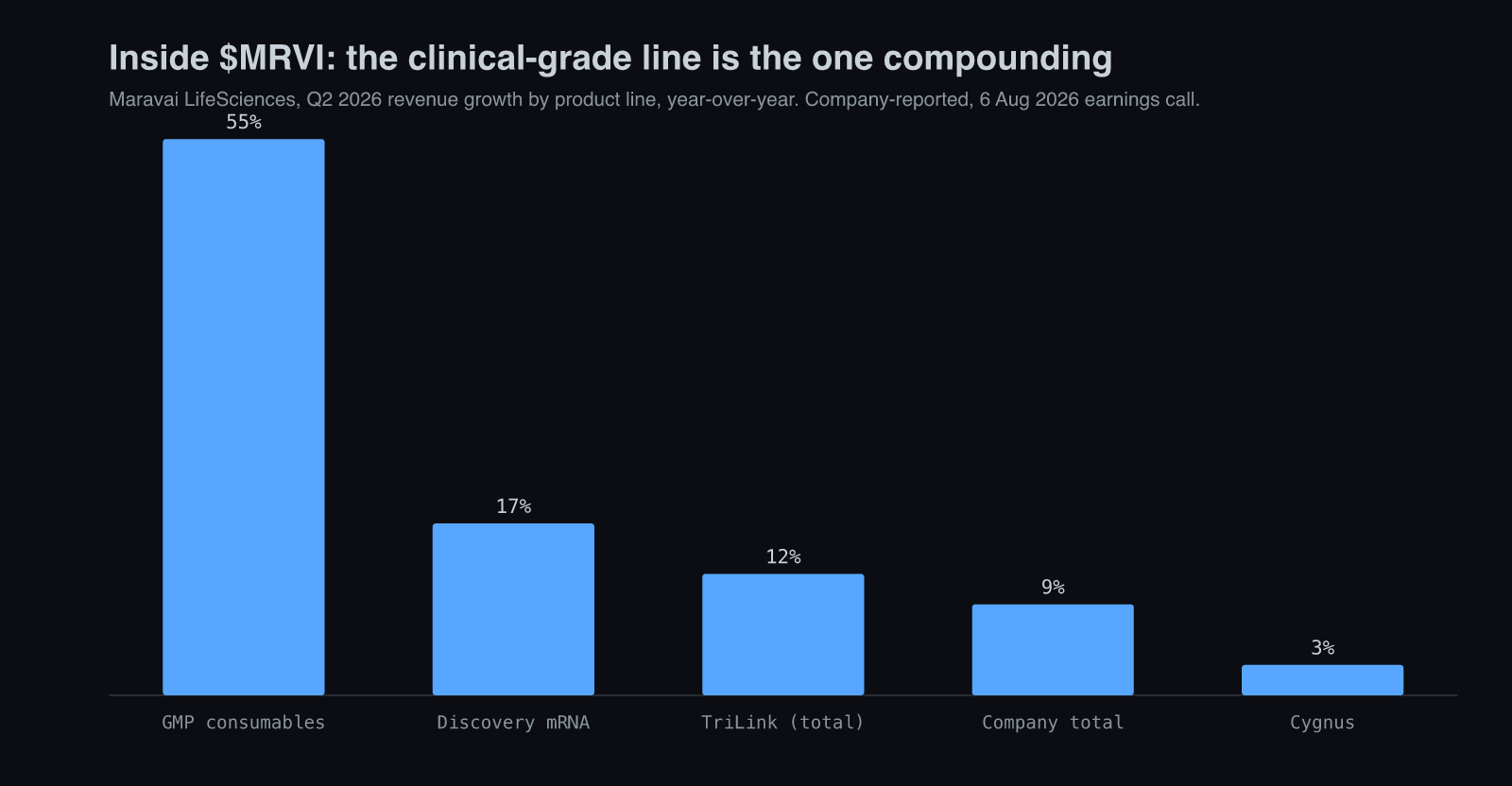
Three details deserve emphasis. First, GMP consumables grew 55% with no COVID revenue in the quarter at all — the base is clean, which is the thing that has held this stock back since 2022. Second, the company added a record 67 new discovery customers and four new GMP customers in the quarter, and ModTail passed 125 customers a year after launch. Third, the balance sheet was fixed in June: debt halved to roughly $150 million with maturities pushed to 2032.
And the one fact that frames the opportunity honestly: oncology is not mentioned once in the entire Q2 call. Not cancer, not neoantigen, not personalized medicine. Thirteen days before the readout, the company that sells the capping chemistry for this modality was talking about balance-sheet flexibility and enzyme launches. Nobody was modelling this. That is why the stock was $5.74 on 18 August.
The Read, the Gate and the Vessel
Every personalized vaccine begins with two sequencing runs and ends with a synthetic gene. $ILMN, at $32.1 billion, makes the sequencers and — more importantly — the flow cells and reagents they consume. If this modality reaches even a hundred thousand patients a year, that is two hundred thousand exomes annually that do not exist today. The business grows modestly at 4.9% trailing, but it converts, at 66% gross margins and a 19.5% operating margin, and trades at 6.4× sales. The problem is the entry: the stock sits at its 52-week high, 47% above its 200-day moving average, having doubled in a year.
$TWST, at $9.2 billion, writes DNA on silicon, which lets it produce synthetic genes at a fraction of the cost of column-based synthesis. A 34-neoantigen concatemer is exactly the product: a novel gene, needed once, needed fast, needed correct. Revenue grows 19% on 52% gross margins, and it also sells the exome capture panels used in step two, so it touches the chain twice. The catch is the same as Illumina's, worse: Twist is 136% above its 200-day moving average and up 373% in a year, at 19× sales, still burning money at a −34% operating margin. It is the highest-quality growth story in the basket and the most fully priced. Both names pass the growth-and-trend test emphatically. Neither passes the entry test today.
Here is the node most people miss, and the one I think is genuinely underpriced. Adjuvant therapy is treatment given to somebody who appears cured. The tumour is out, the scans are clean, and the question is whether microscopic disease is still hiding somewhere. Historically medicine answered that question with statistics — this stage of disease recurs 30% of the time, so treat everybody and accept that most of the treatment is unnecessary. That is tolerable when the therapy is cheap. It is much less tolerable when the therapy costs six figures, takes six weeks to build, and requires a year of clinic visits.
The modality may increase the value of patient-selection tools, but the positive stage-defined melanoma trial does not establish a universal requirement for an MRD test. Minimal residual disease testing looks for circulating tumour DNA — fragments shed by dying cancer cells into the bloodstream. A tumour-informed assay sequences the patient's tumour first, builds a bespoke panel against their specific mutations, then hunts for those exact sequences in blood at vanishing concentrations. $NTRA's Signatera is the established leader, growing 38% on a trailing basis at 65% gross margins; $NEO's RaDaR and $GH's Reveal compete. A separate BioNTech colorectal research pathway identifies ctDNA-positive patients for trial enrollment; that does not establish a universal rule for melanoma.
$CSTL — the Cheapest Asset in the Basket
Castle Biosciences is a $1.0 billion company with $289 million of net cash — 29% of its market capitalisation — 77% gross margins, and roughly 2.1× enterprise value to sales. Nothing else in this basket is priced like that. It is cheap because 2025 went wrong. Revenue compounded from $63 million in 2020 to $332 million in 2024 — four straight years above 45% growth — and then grew 3.7% in 2025 to $344 million, while operating income swung from +$8.7 million to −$42.8 million on a $29 million increase in operating expense. Growth stalling and losses widening simultaneously is how a 45%-grower gets repriced to 2× sales.
What the market has been slower to mark is that the stall appears to be over. Second-quarter 2026 revenue was $103.5 million, up 20% year-over-year, and management raised full-year guidance to $365–375 million from $345–355 million. Test volumes across the core franchises rose 32%, led by TissueCypher at +63%. The full-year guide still only implies high-single-digit growth, so this is a recovery rather than a re-acceleration to the old rate — but it is a genuine inflection off a trough, which is exactly the shape worth owning.
The thematic link is a hypothesis, not a proved treatment gate. DecisionDx-Melanoma stratifies recurrence risk using tumour tissue; it does not detect ctDNA or determine intismeran eligibility. Castle’s September study supports sentinel-node decisions and risk-aligned surveillance, while no cited trial or payer rule requires this test for the Merck/Moderna regimen. The August price setup was: 23.5% below its 52-week high, 29.9% above its 50-day moving average and 12.1% above its 200-day — a stock that fell a long way, bottomed, and has recently reclaimed both averages. That is a different proposition from buying $TWST at 136% above its 200-day.
Three names occupy the back half of the line. $RGEN, at $10.1 billion, sells the filtration and chromatography hardware and consumables that take a crude transcription reaction and turn it into injectable-grade material — the highest-quality bioprocessing operator in the basket at 16.5% trailing growth, 53.8% gross margins and, rare in this group, a positive 6.5% operating margin. Citrini flagged it in June for stringing together three consecutive quarters of double-digit growth, which is the observable evidence that the bioprocessing destocking cycle has actually turned. The problem is again the entry: at its 52-week high, 28% above the 200-day, 12× sales.
$WST, at $23.9 billion, makes the elastomeric stoppers and seals that close the vial. It is a dull, excellent, high-barrier business — 20.4% operating margins, 12.4% growth — and it is the only name in this basket that did not participate. It rose 1.8% on the readout and 0.3% the next day, and it sits 2.4% above its 50-day moving average. Every dose of every personalized vaccine ends up behind a West closure, and the market has not connected that to the news at all. It will not multiply your money; it is the position you take when you want the theme without the volatility.
$ARCT, at $312 million, owns LUNAR, a lipid-nanoparticle delivery platform, and self-amplifying mRNA patents — technology that lets a much smaller dose replicate itself inside the cell, which if it works in oncology would change the cost structure of the entire modality. That is the bull case and it is real. The bear case is that this is not an oncology company: its pipeline is respiratory and rare disease, its trailing revenue fell 76%, and its operating margin is −348%. It is 52.5% below its 52-week high and has violently reclaimed both moving averages, up 58% against its 50-day. Treat it as what it is — a small, volatile call option on delivery technology, sized so that being wrong does not matter.
The Principals — $MRK Is the Quiet One
Merck rose 12.6% on the readout, which on a $368 billion company is roughly $41 billion of market value — nearly as much as Moderna's entire capitalisation. The market was not repricing a vaccine. It was repricing Keytruda's back half. Keytruda did $31.7 billion in 2025, up 7%, and is the best-selling drug in the world. Its first composition-of-matter patent expires in December 2028, and roughly half of Merck's revenue base is exposed to that cliff. The company has been buying time in two ways: a subcutaneous formulation, Keytruda Qlex, approved in September 2025 with protection running to 2041, and combination regimens that make the franchise harder to substitute.
Intismeran is a combination regimen of the strongest possible kind. Every patient on the vaccine is on Keytruda for a year alongside it. If the combination becomes standard of care in resected melanoma — and then in lung, bladder and kidney — Merck has attached its expiring blockbuster to a partner drug that a biosimilar cannot replicate, because a biosimilar pembrolizumab does not come with a personalized mRNA vaccine, a sequencing pipeline and a six-week manufacturing line behind it. That is a defensive move worth a great deal more than the vaccine's standalone revenue, and Merck trades at 5× sales with a 9.6% operating margin and a dividend, which is a very different risk profile from anything else here.
$BNTX, at $28.4 billion, is the second neoantigen platform, partnered with Genentech and sitting on a large cash pile from the Comirnaty years. Its programme is behind Moderna's and slipping — the colorectal final analysis moved to 2027 and a bladder study was discontinued — but a second independent shot on goal in pancreatic and colorectal cancer is worth something, and unlike Moderna, BioNTech has been a TriLink customer.
Who Is Actually Running These Companies
A theme does not operate a business. For the two names this memo actually recommends, the people matter more than usual, because in both cases the investment case is an execution case. $MRVI's entire leadership is fourteen months old, and the turnaround is theirs. Bernd Brust became CEO in June 2025, succeeding William Martin III. He brings roughly thirty years in life-science tools: Executive Chairman and CEO of Antylia Scientific; before that CEO of Qualicaps, the pharmaceutical capsule manufacturer acquired by Mitsubishi Chemical; and before that senior roles at Life Technologies, where he ran the global commercial organisation, plus Invitrogen and General Electric's medical-systems division. That is a commercial operator's résumé from precisely this industry, not a scientist promoted into a corner office.
Raj Asarpota arrived as CFO at the end of the same month. He spent a decade-plus as a life-science and medical-device CFO: most recently at Augmedics, before that EVP and CFO of NuVasive — where the stated track record is $1.2 billion of market-cap creation and material margin expansion — and before that CFO and COO of Cole-Parmer, where he ran the carve-out from Thermo Fisher. Earlier stops at Questcor, Life Technologies and General Electric's healthcare arm. He and Brust overlapped at Life Technologies and at General Electric; this is a team that has worked together.
Judge them on what has happened since. In their first four quarters the pair completed a restructuring, expanded adjusted gross margin by more than 1,600 basis points, took adjusted EBITDA from roughly −$10 million to +$8.7 million in a single year-over-year quarter, halved debt to about $150 million and pushed maturities to 2032, and introduced a three-stage customer framework that tells investors where the growth is coming from rather than hiding it inside a segment total. A carve-out specialist and a commercial operator were hired to fix a post-COVID hangover, and four quarters later the hangover is largely fixed. That is the single strongest reason to believe the operating leverage they describe is real.
One structural caveat to check before sizing: Maravai is an Up-C. A sponsor-controlled holding vehicle associated with GTCR, the private-equity firm that built the company, holds Class B shares carrying votes but no economic rights, so the sponsor's voting weight exceeds its economic ownership. Public Class A holders do not control the vote. Read the current split in the latest proxy rather than assuming it — the ratio has moved over time — but understand going in that this is not a widely-held company.
$CSTL has been run by its founder for nineteen years. Derek Maetzold founded Castle Biosciences in September 2007 and has been President and CEO since inception. Before that he spent twenty-four years in pharmaceutical development and commercialisation at Encysive, Schering-Plough, Amylin and Sandoz. He took the company through several private rounds, a July 2019 IPO and two acquisitions in 2021, is a co-inventor on a number of the company's technologies, and was named CEO of the Year by The CEO Magazine in 2025. Founder-operators in diagnostics are worth paying attention to, because the hard part of the business is not the assay — it is a decade-long grind of clinical evidence generation and payer negotiation to get a test reimbursed. That is a job that rewards someone who intends to still be there in ten years. The honest counterweight: nineteen years of tenure did not prevent 2025, when growth fell from 51% to 3.7% while operating expense rose $29 million. The 2026 recovery is the test of whether that was a stumble or a ceiling.
What Breaks It
The Political Risk, Sized Honestly
That last category deserves its own treatment, because it is the risk most likely to be either overstated or ignored entirely. The facts: on 5 August 2025, the Department of Health and Human Services under Secretary Robert F. Kennedy Jr. terminated 22 federal mRNA vaccine development contracts worth roughly $500 million, cancelled or rejected pre-award solicitations from Pfizer, Sanofi Pasteur, Seqirus and Gritstone, and de-scoped mRNA work in several existing contracts. The stated rationale was that mRNA vaccines fail to protect effectively against upper respiratory infections. Scientists objected loudly. The money is gone regardless.
Now the nuance that most commentary misses: every one of those cancellations was in infectious disease. The argument the department made — that mRNA underperforms against mutating respiratory viruses — has no bearing on a therapy that treats an existing cancer in a patient who already has it. And the politics run the other way. Cancer therapy is the one application of this technology with no organised opposition; Citrini put it well in June, noting that AI ranks among the most negative opinions voters hold across the political spectrum but nobody is opposed to curing cancer. The same sentence applies here with more force.
So the correct framing is not that mRNA is politically doomed, and not that oncology is immune. It is that the modality carries a discount that is largely mispriced against oncology, and that the discount is unlikely to close quickly, because the loudest voices in the public conversation are not distinguishing between a flu booster and a personalized neoantigen therapy — and in a reimbursement fight, that failure to distinguish is itself the risk. Notably, Arcturus's federal contract for a bird-flu mRNA vaccine was among the few allowed to run to completion, which tells you the policy is a wind-down rather than a prohibition.
Where $MRVI Actually Trades
Before the valuation, the tape, because the entry matters as much as the thesis. Maravai closed Thursday at $8.29, up 44.4% in two sessions from $5.74 on 18 August. It sits 36.5% above its 50-day moving average and 98.4% above its 200-day, and it is at a fresh 52-week high after a 219% year. That is momentum, not value, and it is the honest counterweight to everything positive written above: the stock has already re-rated. The rally began well before Wednesday — it had already doubled from its 2026 low as the bioprocessing cycle turned, which is precisely the inflection Citrini flagged in June.
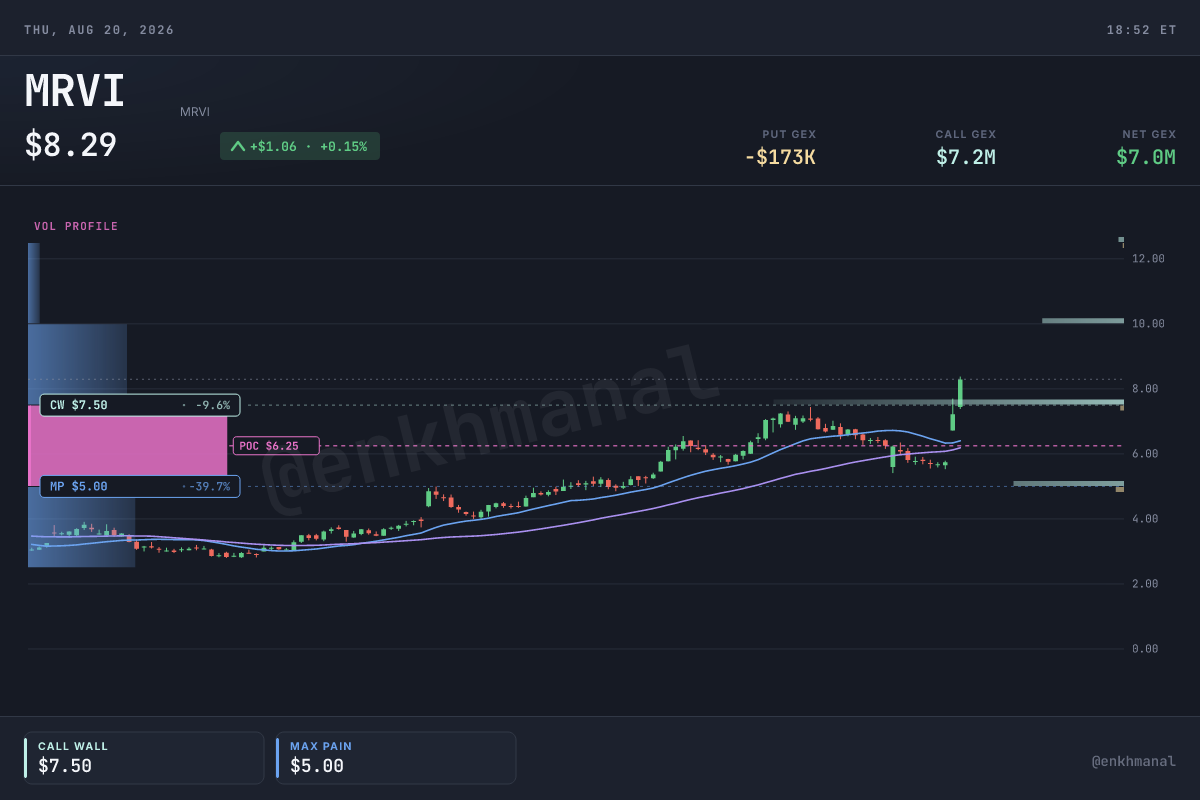
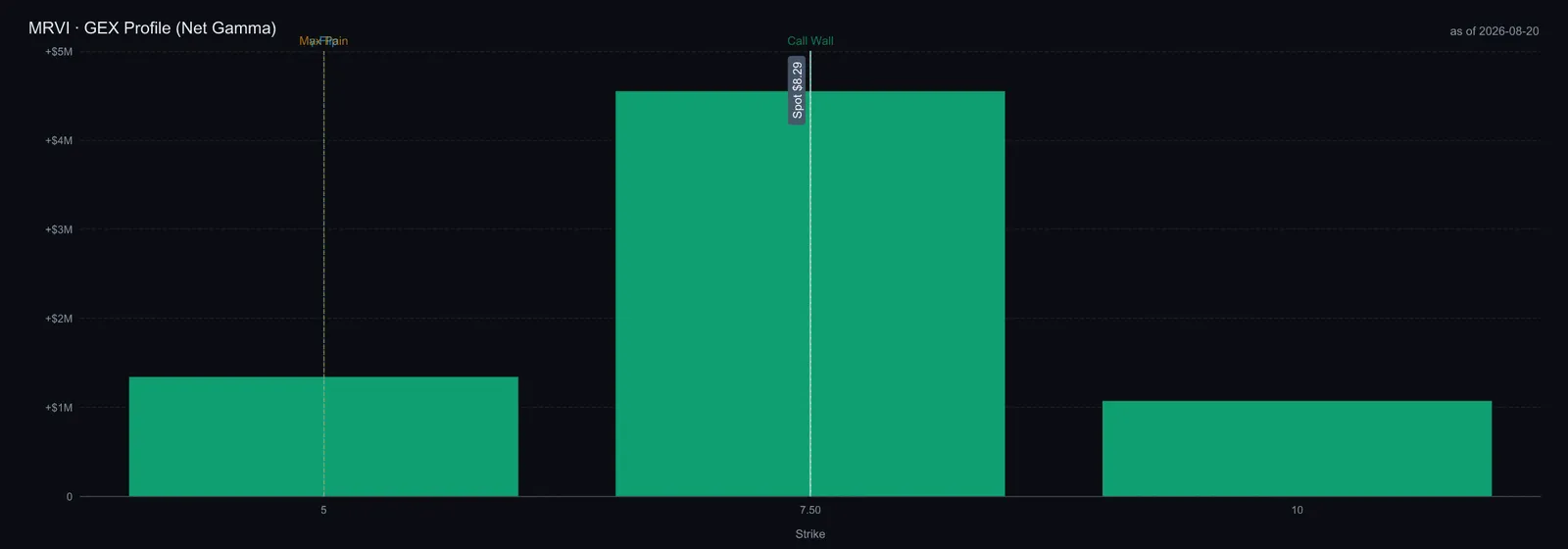
Options positioning reinforces the picture. Net gamma is a modest +$7.0 million, overwhelmingly call-side at $7.2 million against −$173 thousand of put gamma. The call wall sits at $7.50 — now beneath spot, which converts it from resistance into a shelf dealers defend on the way down — and max pain is far below at $5.00. Positive net gamma means dealers are long gamma and sell rallies and buy dips, which dampens the moves; a small absolute figure means that dampening is weak and this stock can still travel. The practical read: $7.50 is the level that matters. Holding above it keeps the structure intact. Losing it puts the volume shelf around $6.25 in play, and the 50-day at roughly $6.07 below that.
Valuation & House View
Standard multiples do not work on most of this basket, because most of it has no earnings. $MRVI is the position. At $8.29 the equity is roughly $2.1 billion, plus about $150 million of net debt, against FY26 revenue of roughly $200 million and adjusted EBITDA guided to $33–35 million. That is approximately 11× revenue and something like 65× EBITDA, which on its face is expensive for a business guided to mid-single-digit revenue growth.
The reason it is defensible is that the reported total is the wrong denominator. Roughly 7% of 2026 revenue is COVID CleanCap that is going to zero. Around 35% is non-COVID mRNA, growing high-single to low-double digits today with a clinical-grade line inside it compounding at 55%. Specialty chemistry is another 20%-plus of stable research-tools revenue, and contract manufacturing under 5%. The company is a declining COVID annuity wrapped around a growing clinical franchise, and the total obscures both. As the annuity finishes rolling off — largely through 2026 — the reported growth rate should converge upward on the underlying rate. Adjusted EBITDA improving $64–66 million year-over-year on flat revenue tells you the margin structure has already reset; the operating leverage on the next dollar of GMP revenue is very high, because management has said the infrastructure is already built.
Valuation console — what is $MRVI worth?
today 66.6×The bear case is straightforward and should be stated: you are paying 11× sales today for a business whose revenue inflection is a 2028–2029 event, in a stock that has doubled in two days, in a company where public shareholders do not control the vote. If the second wave of neoantigen programmes never materialises, or materialises inside vertically integrated pharma, this is an expensive research-reagent company.
$CSTL is the value expression and the better risk-reward on a strict reading of the framework. Roughly $719 million of enterprise value against $365–375 million of guided 2026 revenue is about 2× EV/sales for a 77%-gross-margin diagnostics business that just re-accelerated to 20% growth in its most recent quarter, carries $289 million of net cash, and is 23.5% below its high having just reclaimed both moving averages. The reason it is cheap is 2025, and the reason it may not stay cheap is that 2025 looks like the trough. It is the only name here where you are not paying a full price for the theme.
The rest, ranked. $ILMN and $TWST are the highest-quality operators at the front of the line and both are extended — buy weakness, not strength. $RGEN is the best-run bioprocessing asset and is likewise at its high. $NTRA is established in ctDNA testing and was priced at 16.5× sales in August; selection in some colorectal research does not make it a gate for this melanoma regimen. $WST is the boring laggard that has not moved at all and is the lowest-volatility way to hold the theme. $ARCT is a call option, sized as one. $MRK is the way to own the outcome with a dividend and half the risk, because a Keytruda franchise extension is worth more to Merck than the vaccine is to anyone.
What would change my mind. Publication of INTerpath-001 showing a small absolute benefit or meaningful discontinuation. A disclosed cost of goods high enough to force narrow reimbursement. Evidence that the second-wave programmes are building rather than buying. Or, on the other side, a positive BioNTech pancreatic readout — which would confirm the modality generalises beyond high-mutation tumours, and would be the single most bullish event available to this basket.