
JD.com — What the delivery investment has to prove
A store can deliver faster if it knows what is in stock, keeps popular items near customers and has drivers available when orders come in. JD.com ($JD) built a network to do all three. In 2025 it used that network and funded new couriers and promotions to enter food delivery. The August 2026 analysis asked whether the extra orders could ultimately pay for the investment. The second quarter showed an improvement in group profit as new-business losses narrowed, even as core retail operating profit fell.
November 12, 2026 update. The October 2 deadline cited in August was an earlier timetable. The European Commission gave conditional approval on November 3. JD completed the acquisition on November 12, paying €1.335 billion for 59.8% of CECONOMY and consolidating it from that date. This answers the question of whether the deal could close. The November 17 earnings release is the next test of the domestic operating thesis.
What Changed
Chinese e-commerce spent a decade competing on assortment and price, and both are now commoditised. What changed is the clock. The competitive frontier moved from what can you sell me to how fast can it be at my door, and once delivery time became the product, the deciding asset stopped being marketplace software and became the physical network underneath it.
That shift is why 2025 looked like a war. Meituan and Alibaba pushed instant commerce into groceries and daily replenishment — the habit-forming purchases that used to walk past $JD. $JD answered by building a food-delivery business from nothing. The cost is not hidden: group marketing expense rose 75.1% to RMB84.0B in 2025 from RMB48.0B, and group operating income collapsed 93% to RMB2.8B from RMB38.7B.
$JD is the only large Chinese platform that already owned that network before the fight started. It buys and holds its own inventory and delivers through its own couriers — which is why it could add a completely new order type on top of existing routes. The question is whether the money spent doing so was an investment that ends, or a permanent cost of staying in business.
Why the group returned to operating profit
The New Businesses segment recorded an operating loss of RMB46.6 billion in 2025. In Q2 2026 that segment’s operating loss narrowed to RMB9.9 billion from RMB14.8 billion a year earlier. Group operating income swung to RMB4.5 billion from a loss of RMB0.9 billion.
Using the exact figures, group operating income improved by RMB5.406 billion, from a loss of RMB0.859 billion to a profit of RMB4.547 billion. New Businesses narrowed its loss by RMB4.923 billion, from RMB14.777 billion to RMB9.854 billion. That accounts for 91.1% of the improvement. JD Retail operating profit declined from RMB13.939 billion to RMB13.478 billion.
Marketing expense fell 24.8% to RMB20.3 billion while research and development rose 37.7% to RMB7.3 billion. The mix of spending moved away from promotion and toward engineering. The filings do not establish that every yuan cut from marketing went to engineering or that the remaining loss can all be eliminated.
Business & Backdrop
$JD runs four things that matter. JD Retail is the core first-party and marketplace business. JD Logistics is the supply-chain and delivery arm, serving both $JD and outside customers. New Businesses holds JD Food Delivery, Jingxi, JD Property and Joybuy. Separately listed in Hong Kong are JD Logistics, JD Health, and JD Industrials, which floated in December 2025.
Management pointed to a difficult comparison with the prior year’s trade-in incentives and to higher component costs in electronics. The category’s recovery remains a test for the thesis. The New Businesses comparison is also affected by JD’s transfer of on-demand delivery revenue to JD Logistics.
Two newer businesses are worth watching because they are where the remaining spend goes. Jingxi, aimed at the discount market $PDD built, grew quarterly active customers over 40% and supplied 40% of all new active customers in the quarter. Joybuy, the European platform launched in March 2026 with JoyExpress as its delivery arm, doubled revenue in two quarters.
A word on peers, because the margin comparison that circulates is not a comparison at all. $JD is China's largest retailer by revenue and, on Shareholdersunite's framing, the third-largest e-commerce platform by gross merchandise value behind $BABA and $PDD. Those two facts sit together because $JD buys inventory and books the entire ticket as revenue, while an asset-light marketplace books only its commission on the same transaction. Put $JD's 18.5% retail gross margin next to a marketplace's and you are comparing a retailer's spread against a commission rate — different denominators, different businesses. The comparison that does mean something is who carries inventory risk and who controls the delivery promise, and on that axis $JD is alone among the three. It is also why $JD's earnings are more operationally geared than its peers': on a fixed network, a few points of revenue swing a lot of operating profit in either direction. That gearing cut against it through 2025 and is now working the other way.
Technology & Moat
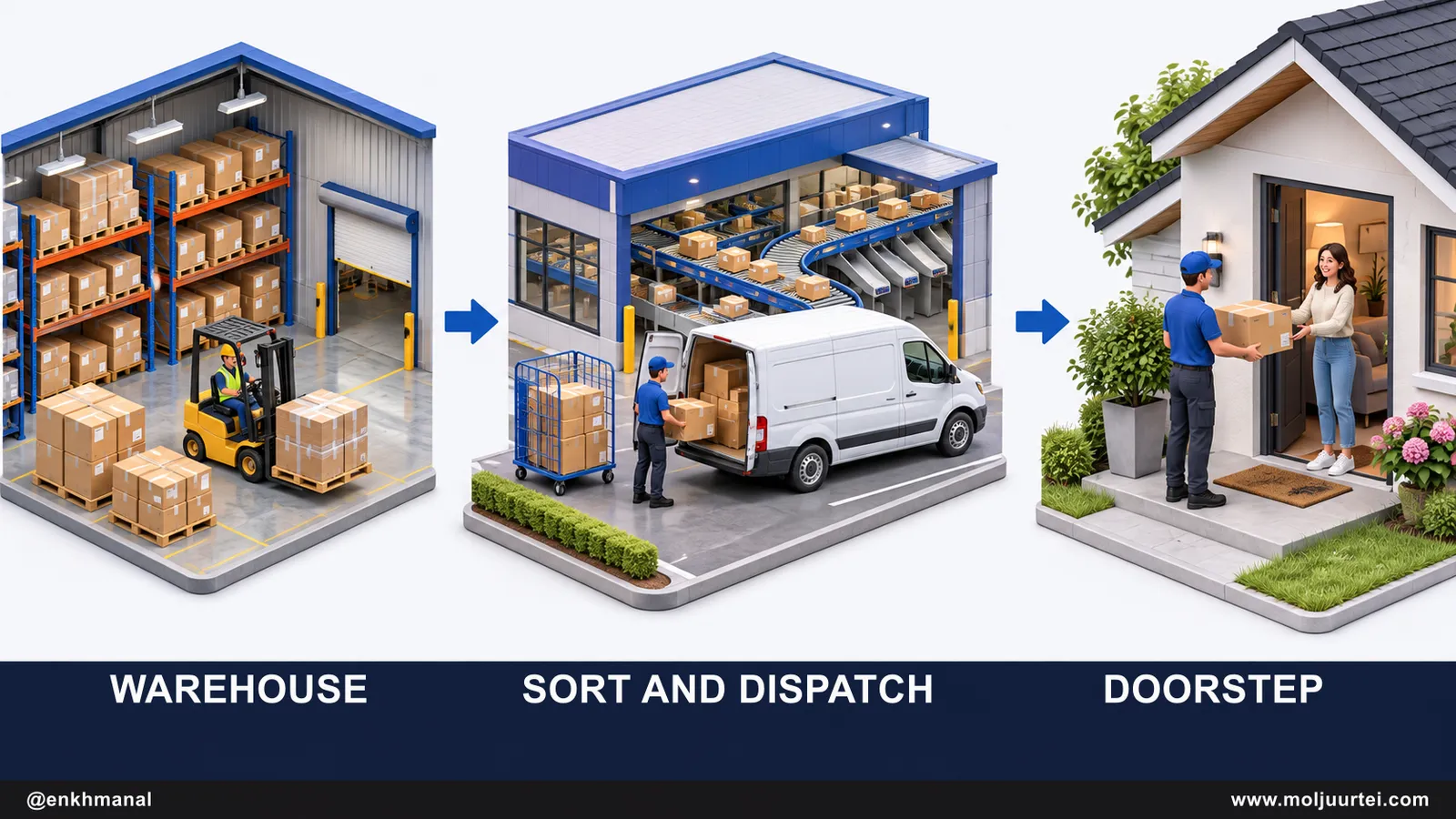
JD controls much of the route from stock to doorstep. When it can put more compatible orders through the same warehouses and routes, it can spread the fixed cost over more deliveries. Food delivery also needs riders and local dispatch capacity, so the overlap does not make the new business costless.
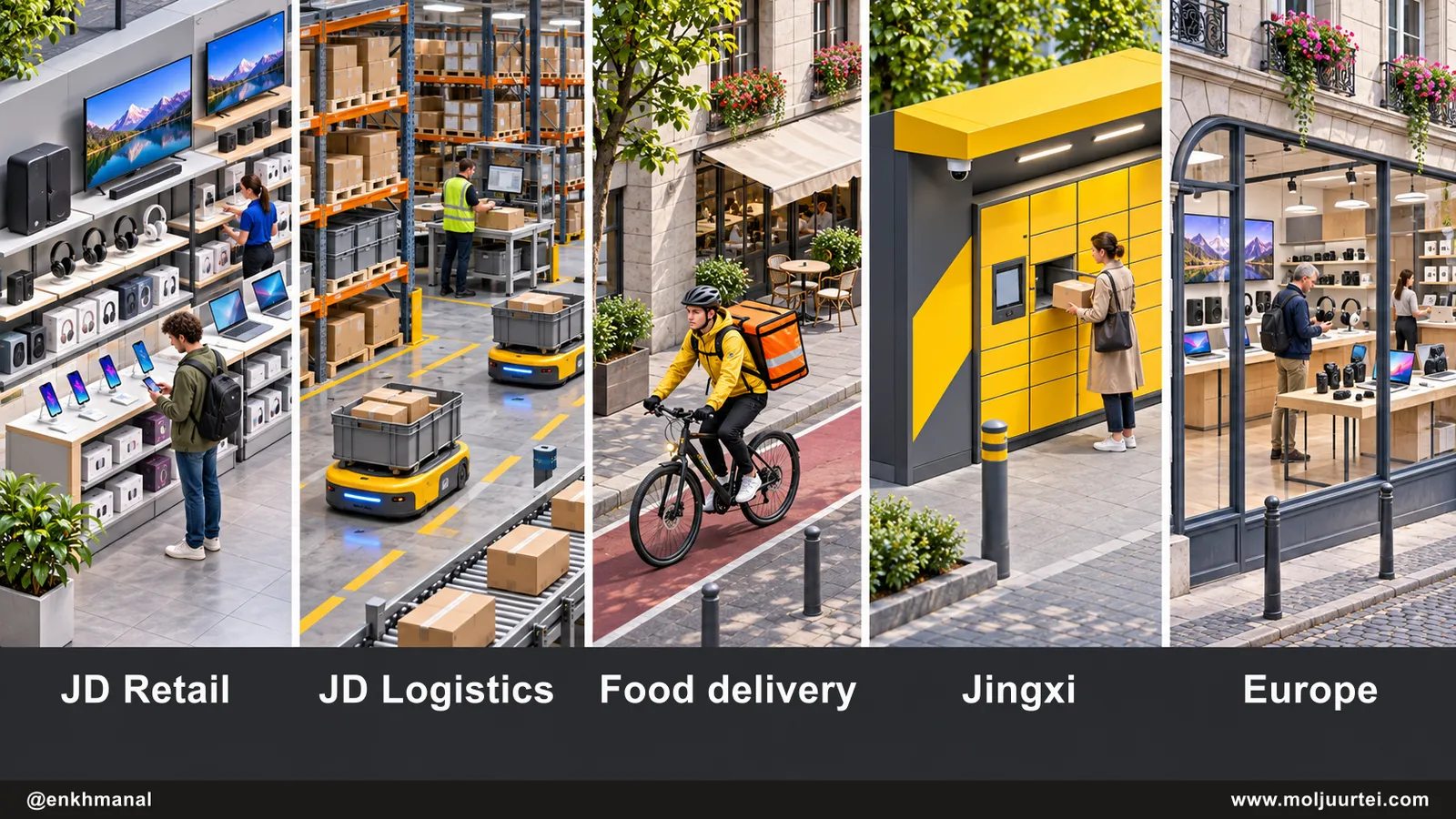
Three pieces of that network were upgraded materially in the quarter, all proprietary rather than bought in. In warehousing, JD Logistics expanded deployment of LangzuTech, its own goods-to-persons system — the robotics layer that brings shelves to a picker instead of walking the picker to the shelves. In delivery, it scaled thousands of air and ground autonomous vehicles across more than 20 provinces and launched its first 24/7 overnight autonomous routes in Shenzhen. Coordinating both is the JINGDONG Logistics Metabrain LLM.
Robots can bring shelves to workers, and an automated route can cover repetitive trips. The question for investors is how much the changes reduce costs after equipment and operating expenses. More orders make that easier only where the routes, facilities or systems can be shared.
Roadmap & R&D
R&D rose 37.7% to RMB7.3B, or 2.1% of revenue, while marketing fell by nearly a quarter. That trade is the roadmap in one line: $JD is converting a variable, competitor-matched customer-acquisition cost into a fixed engineering asset that compounds.
Management named three destinations. First, demand and conversion — search, recommendation and ad targeting rebuilt around user-intent matching, plus proprietary shopping agents; this matters because advertising is the highest-margin revenue $JD has, and marketplace and marketing revenue grew 8.3% against a 2.9% group decline. Second, internal productivity — generative AI inside customer service and cross-departmental workflow. Third, physical automation. The stated destination is a high-single-digit retail operating margin against 4.6% today; treat that as direction, not guidance.
Europe after the CECONOMY acquisition
CECONOMY operates MediaMarkt, Saturn and MediaWorld, with more than 1,000 stores in 11 markets according to JD. Those stores and local supplier relationships give JD a route into European consumer electronics. The company says CECONOMY will continue operating independently in Europe with local technology systems. How much integration saves remains an open question.
Management & Track Record
Founder Richard Liu built the original logistics network when it required substantial investment. A concentrated voting structure limits the influence of outside shareholders on similarly large commitments. The food-delivery investment should be judged by operating results and cash over time.
Management attributed most of the Q2 loss reduction in New Businesses to food delivery. JD still reports the broader segment’s loss, which includes other ventures. The segment result cannot establish stand-alone food-delivery profitability.
Risks & What Breaks It
The Commission’s November 3 decision requires market terms for intra-group transactions, including financing, and equivalent access for third parties to JD’s logistics and technology services. The commitments run for ten years under independent monitoring. They reduce the scope for exclusive or subsidized support to CECONOMY.
The next domestic test is Q3 results on November 17. Watch the New Businesses operating loss against RMB9.9 billion in Q2, JD Retail revenue and operating profit, and whether a lower marketing bill can coexist with growth. A higher margin on lower retail sales is weaker evidence than higher profit alongside growth.
What the valuation depends on
JD reported adjusted diluted earnings of RMB6.29 per ADS for Q2. Annualizing that quarter would yield RMB25.16 per ADS, an illustration that ignores seasonality and changes in subsidy spending. The earnings assumptions in the August scenarios were not current targets. A sustained reduction in new-business losses and a recovery in retail profit would matter more to valuation than a single promotional quarter.
The August thesis has partial support: Q2 group operating profit turned positive and JD completed the European acquisition. The evidence still needed is sustained improvement in domestic retail profit, less loss from new businesses, and results from Europe under the Commission’s terms.
Sources: JD’s Q2 earnings release, European Commission decision, and JD’s acquisition announcement.