

$YOU Deep Dive — Proven humans in an age of agents · Q3 print 5 November
$YOU sells a five-second walk past the airport ID check to 8.33 million paying members, and turned that into $374.5M of free cash flow in the first half of 2026. The AI-agent story attached to the stock this month rests on a real asset, 43.5 million people whose identity CLEAR has proofed, but the company's own 10-Q still calls its partner revenue immaterial, so at $39.60 we are buying a cash-rich airport subscription with an identity option attached.
Start here. An identity is the bundle of facts that make you one particular person: a name, a date of birth, a face, and the government documents that vouch for them. Verification is the act of checking that the person presenting those facts is the person they belong to, which at an airport means an officer holding your licence up against your face. A biometric is a body measurement a machine can read, such as the pattern in an iris or the geometry of a face, so that the comparison can be done by a camera in seconds. Identity proofing is the careful version of that check, done once against authoritative records and then bound to your biometric so it never has to be repeated. An AI agent is software that acts on your behalf, booking a flight or pulling your medical records, and the one thing it cannot supply on its own is proof that a real, verified person stands behind the request. Everything below is about who holds proofed people, and whether that can be charged for.
The problem underneath is old. A gatekeeper has to decide whether the person in front of it is who they claim to be, quickly and without being fooled. For fifty years the answer was a document check: a licence carries a photo and security features, and a trained person compares photo to face. It works because documents are hard to forge at scale and people are decent at faces. Its limits are speed, since an officer handles one traveller at a time, and, since generative AI, the falling cost of a convincing fake: a doctored licence image or a deepfake selfie now costs almost nothing, so a document-only check done online proves less every year.
CLEAR's contribution is to do the careful check once, in an airport pod or in its app. It authenticates the government ID, captures face, iris and fingerprints, runs the vetting that lets the Department of Homeland Security accept it as a Registered Traveler provider, and stores the binding. After that a member proves who they are by looking into a camera; at one of the new eGates it takes about five seconds, according to the FY25 10-K. A traveller pays for it because the time saved sits at the most unpredictable queue in American life. A partner, whether an airline, a hospital or Medicare.gov, pays because a person proofed once can be recognized anywhere without being proofed again, and every new place that accepts the credential makes the $219 membership worth more.
What Changed
Three things changed in eighteen months, and they pull CLEAR in different directions. The first is that faking a person became cheap. When the Centers for Medicare & Medicaid Services announced its Medicare.gov contract with CLEAR on 9 December 2025, the stated reason was that attackers increasingly use publicly available personal data, AI-generated synthetic identities and deepfake impersonation against beneficiaries. In February 2026 NIST's cybersecurity centre published a concept paper on software and AI agent identity, asking how an agent proves the authority to act for a person and how that delegation is audited. A standards body writing the question down is usually the point where budgets start to follow.
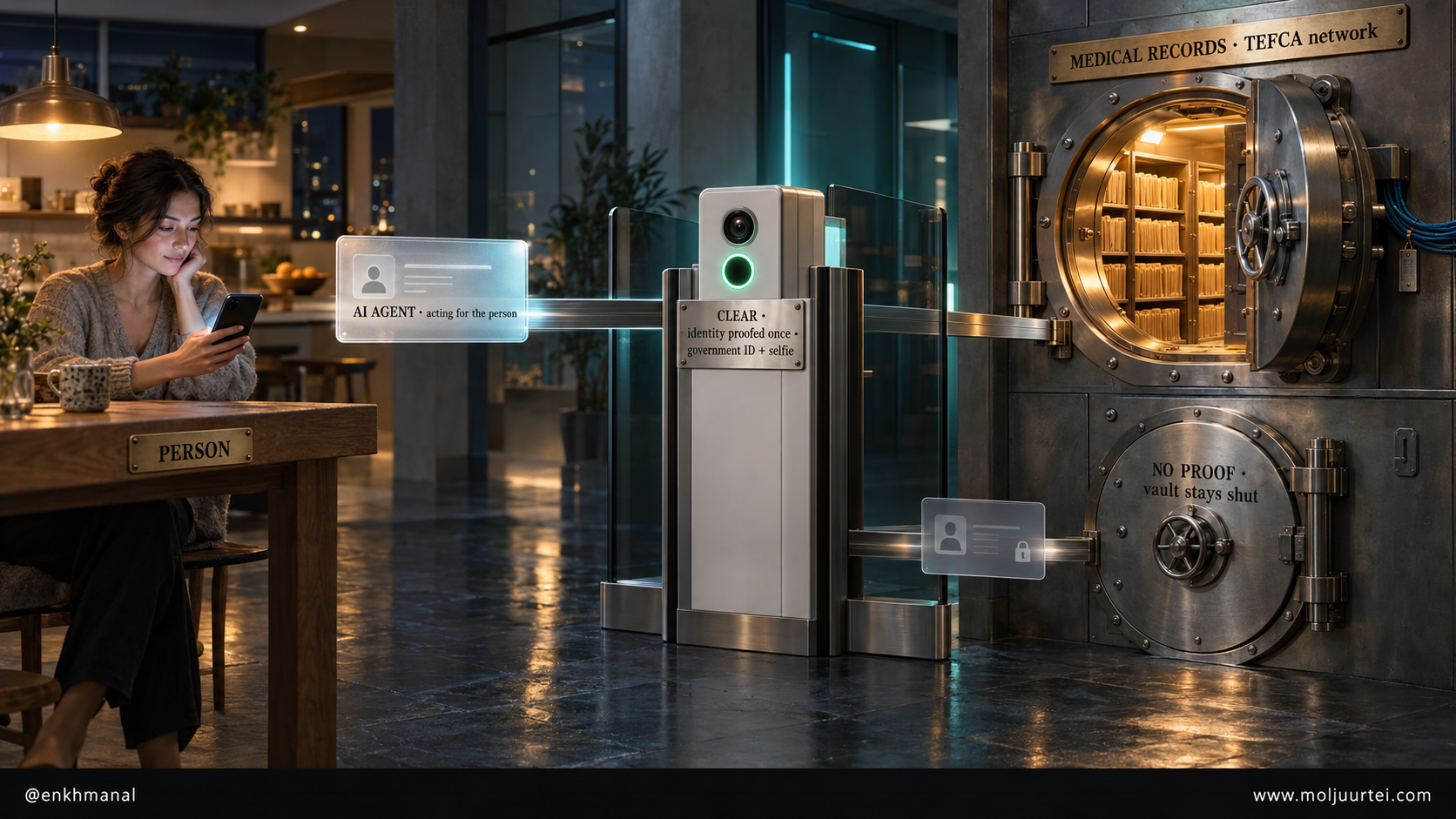
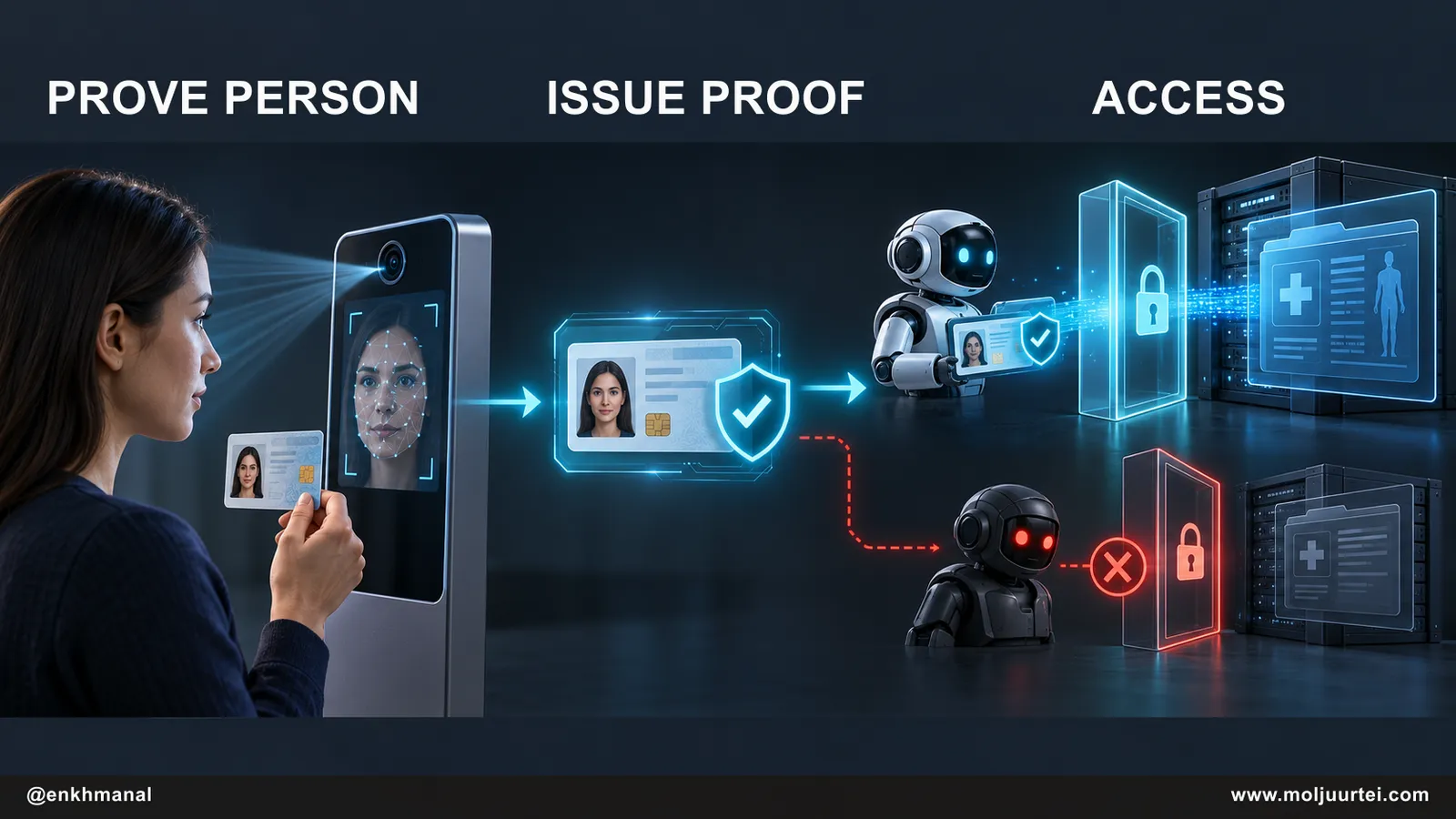
The second is that agents started touching sensitive records. On 8 September 2026 HealthEx launched a connector that lets users of Muse, Meta's consumer AI agent, bring their medical history into the agent over the national TEFCA exchange. Before HealthEx searches providers for a user's records, the user verifies with CLEAR, using a government ID and a selfie, free of charge; users can also connect providers one by one instead. That is the first consumer agent we have seen where a proofed human is the key that opens the records, and CLEAR is the key.
The third change runs the other way: the government built its own camera. TSA PreCheck Touchless ID, which matches a traveller's live face to their stored passport photo at no extra cost to PreCheck members who opt in, was at 65 airports by September 2026 and gained a Google Wallet sign-up path on 24 June 2026. CLEAR's own FY25 10-K names it as a competing solution. So the careful check a person does once is becoming more valuable away from the airport and less scarce at the checkpoint where CLEAR earns nearly all its money. CLEAR is the one public company holding tens of millions of in-person-proofed identities, and it is also the company whose paid product sits at the checkpoint the government is automating. That tension is our subject.
Thesis
$YOU holds the largest in-person-proofed identity network in the US, 43.5 million enrolled and 8.33 million paying, and is extending the airport lane that built it into the verification step that high-stakes digital requests, including an agent's, will need.
Business & Backdrop
CLEAR earns almost everything from one product. CLEAR+ costs $219 a year at standard price since 1 July 2026, $125 for each family member, less through airline tiers, and is subsidized for American Express card members through statement credits. Members pay upfront, so cash arrives before revenue is recognized: deferred revenue stood at $573.0M on 30 June 2026, about seven months of revenue. The two big costs follow the lane. Airports take a revenue share, 14.1% of revenue in Q2 2026, because CLEAR operates as a concessionaire; the Ambassadors who staff the lanes are the other, 17.3% of revenue in Q2 2026 against 21.7% a year earlier. TSA PreCheck enrollment adds fee revenue net of what goes to TSA and the FBI. The 10-Q is blunt about the rest: revenues from partners, meaning CLEAR1, have historically been immaterial.
The business took a long time to build and it is hard to rebuild. CLEAR runs under the federal Registered Traveler program in 62 airports; the 10-K notes it took seven years to assemble enough airports to attract its first million members, and the in-airport channel still produced 66% of new CLEAR+ members in FY25. The market it lives in is the TSA checkpoint, which screened 76.8 million people in August 2026, 4.4% fewer than a year earlier by TSA's own daily count. CLEAR grew active paying members 15.2% over the same stretch, so it is taking share of a flat-to-falling flow, through price and conversion rather than through more travellers.
The long trend is growth slowing into profit, then re-accelerating. Revenue ran $254.0M in FY21, $437.4M in FY22, $613.6M in FY23, $770.5M in FY24 and $900.8M in FY25, growth of 72.2%, 40.3%, 25.6% and 16.9%. Contribution margin, which we define as revenue less the airport revenue share and lane staff because CLEAR reports no cost-of-goods line, went 58.7%, 63.1%, 62.3%, 63.5% and 64.4% across those five years, while GAAP operating margin climbed from −45.3% and −29.5% (FY22 carried $138.5M of IPO-related stock compensation) to 3.3%, 16.0% and 20.7%. Free cash flow margin rose from 16.4% in FY21 to 38.1% in FY25.
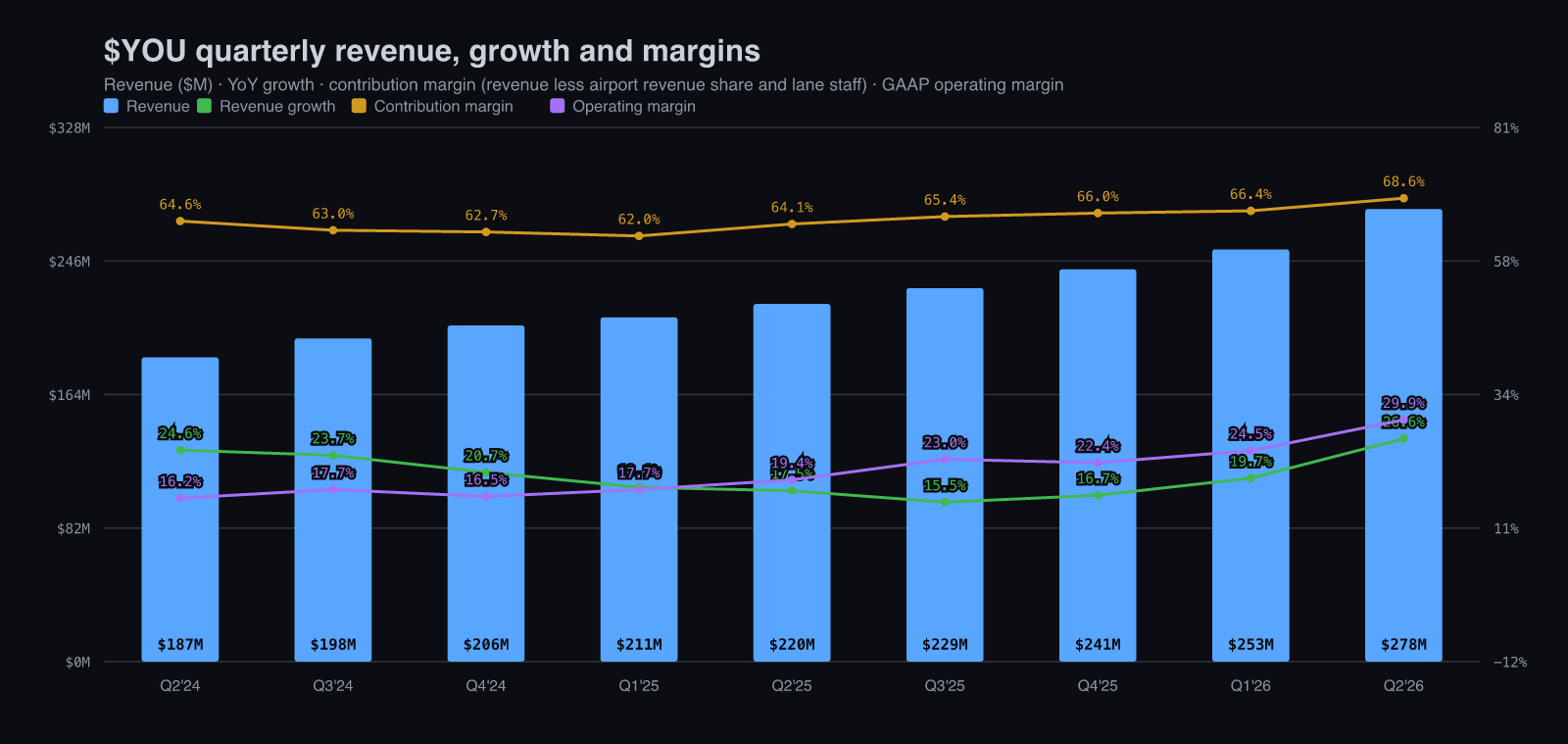
The quarterly series shows where it turned. Year-on-year growth bottomed at 15.5% in Q3 2025, then ran 16.7%, 19.7% and 26.6% in the next three quarters. Contribution margin fell to 62.0% in Q1 2025 and has risen every quarter since, to 68.6% in Q2 2026, because lane staff cost was $48.0M against $47.7M a year earlier while revenue grew 26.6%. That is the eGate paying for itself. For corroboration from outside, identity is a growing budget line elsewhere too: $OKTA's revenue grew 11.8% in its last fiscal year at a 5.1% operating margin and $GEN's grew 27.1% at a 42.4% operating margin, helped by an acquisition, according to their own filings. CLEAR is now growing faster than the enterprise identity vendor, but from its consumer subscription, not yet from the enterprise market Okta sells into.
Technology & Moat
Physically, CLEAR makes three things. The first is enrolment and verification hardware at the checkpoint: EnVe pods, launched in 2024 and about five times faster than the legacy pods according to the 10-K, and eGates, rolled out from 2025, which verify a member in roughly five seconds and open straight into physical screening. eGates were live at 50 airports on 5 August 2026 and covered more than 70% of the network. The second is the app, which carries CLEAR ID, a free mobile ID accepted at more than 250 TSA checkpoints, a stored e-passport, and the calendar-synced Home to Gate itinerary. The third is CLEAR1, a set of software development kits and APIs that let a partner call the same identity check inside its own product, under its own brand, choosing how many layers to run: document, biometric, device signals and verified data sources.
The bridge from hardware to money runs like this. An eGate verifies in about five seconds, so a lane needs fewer Ambassadors checking faces; management says it has redeployed them toward hospitality and selling Concierge. Lane staff cost held flat at $48.0M while revenue rose 26.6%, contribution margin moved from 64.1% to 68.6% year on year, and adjusted EBITDA margin reached 36.4% in Q2 2026, passing the 35% target set at the 2021 IPO for the first time. The next unproven step is whether the faster lane keeps members paying after the price rose from $209 to $219 on 1 July; management reports early retention as healthy, but it stopped publishing gross dollar retention this year, so that claim cannot be checked from outside until the member count moves.
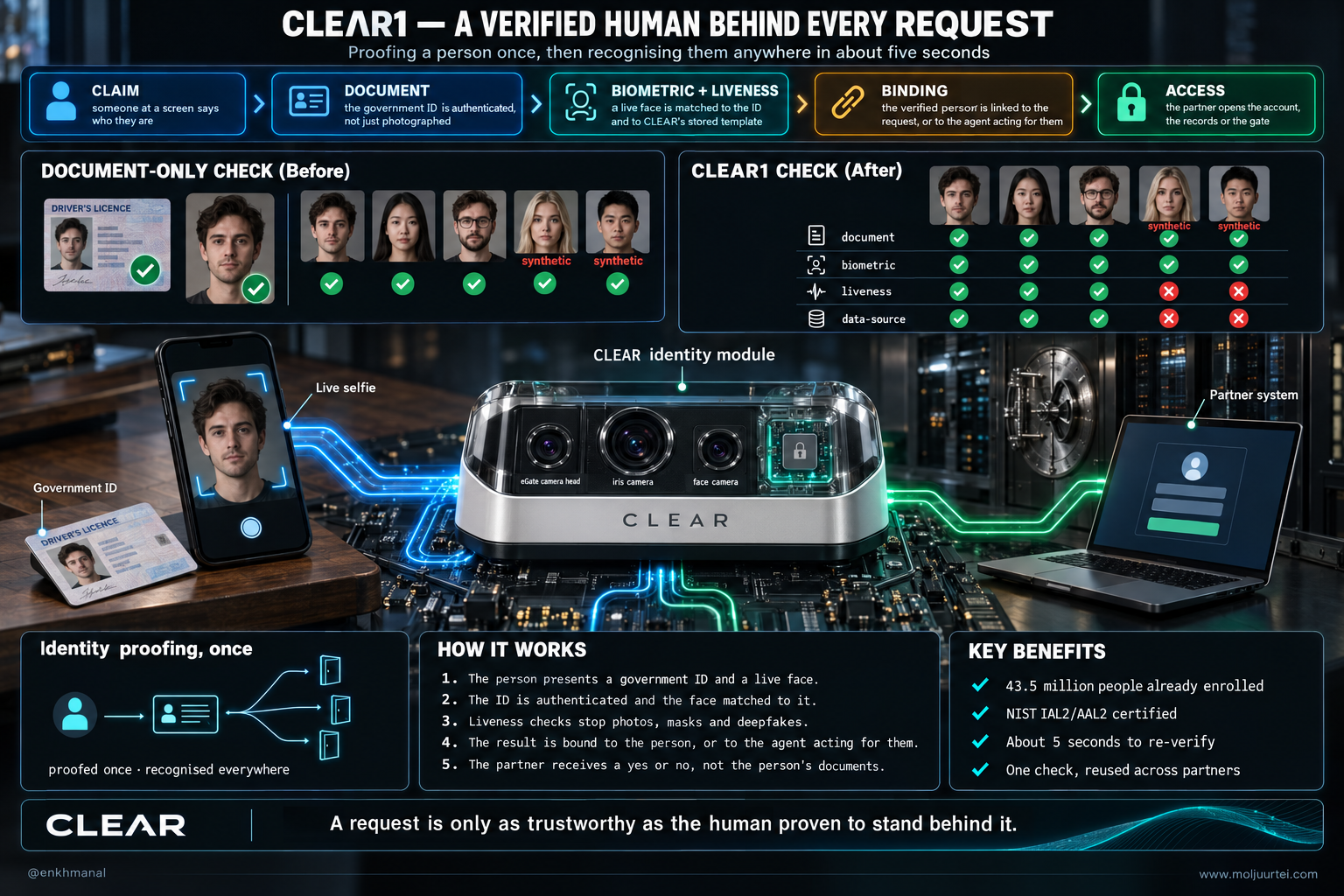
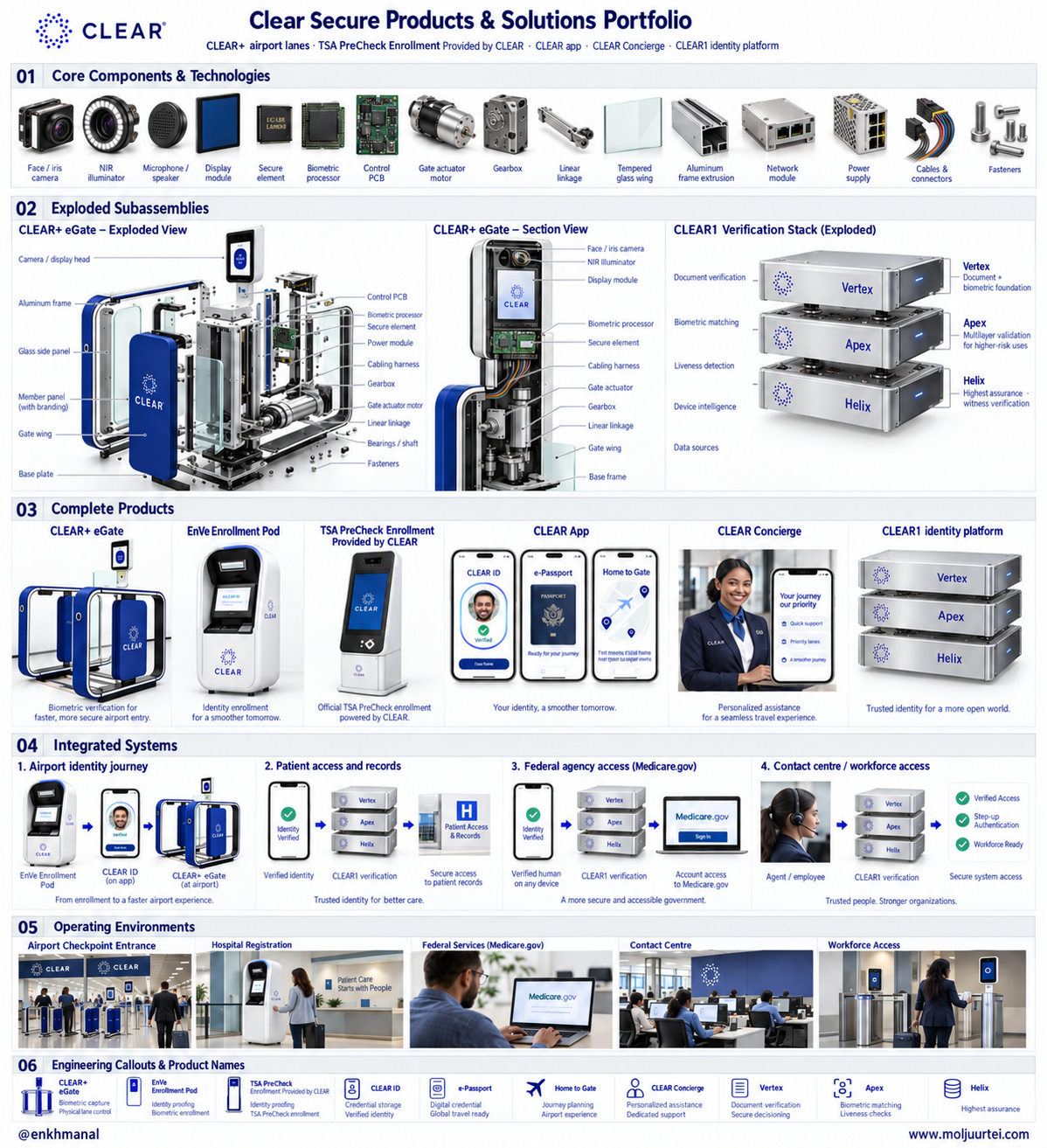
The advantage is not the camera; TSA owns the same kind of camera now. It is three things a camera cannot copy. First, the enrolled base: 43.5 million people have registered with CLEAR, 8.33 million of them paying, and a partner that integrates CLEAR1 can recognize any of them with no new enrolment. Second, the certifications, which took years: Homeland Security's FISMA High rating for the information security programme, SAFETY Act designation for the Registered Traveler system, Kantara certification of CLEAR1 at NIST's IAL2/AAL2 assurance level, and FedRAMP In Process since April 2026. Third, the concession footprint in 62 airports, which is scarce real estate that took over a decade to assemble. On the Q2 call Caryn Seidman Becker put the agent version of this argument in one line.
CLEAR is in a unique position to provide human insurance to facilitate agentic authorization.
Roadmap & R&D
The spending is modest and pointed at the lane first. Research and development was $72.4M in FY25, 8.0% of revenue and slightly below FY24's $73.4M, and capital spending was $29.3M; in the first half of 2026 capex was $17.1M as eGates went in. CLEAR publishes no earnings deck, so the roadmap below is assembled from the 10-K, the 10-Qs, the releases and the calls.
The agent roadmap is described rather than scheduled. We lined up every stored earnings call from Q2 2021 to Q2 2026: the words agent and agentic appear for the first time on the Q4 2025 call in February 2026, then in the Q1 and Q2 2026 calls, five uses in all, every one of them in framing language such as agentic identity or agentic authorization and none attached to a product name, a customer, a price or a number. The closest thing to a figure is the CFO's: net new CLEAR1 signings grew over 50% from Q1 to Q2 and the pipeline grew over 50% quarter on quarter. Asked on the Q2 call to size CLEAR1, management declined. So the agent opportunity is a direction the company has chosen to talk about, built on assets it genuinely has, and not yet a line we can model.
The Setup — Why It's Mispriced
The market sold a beat. On 5 August CLEAR reported Q2 revenue of $277.8M, up 26.6%, bookings of $295.9M, up 32.8%, a 29.9% operating margin and $189.0M of free cash flow, and raised the full-year free cash flow floor for the second time this year, from $440M in February to $465M in May to $480M. The shares opened at $64.77, touched $69.07 and closed at $56.46, then drifted to $39.60 by 25 September with no new number from the company. What the market is selling is a list: a Q3 bookings guide of +20.5% after +32.8%, TSA volumes down 4.4% in August, Touchless ID at 65 airports, and the President and the head of Aviation announcing their departures on 16 September.
Two pieces of arithmetic sit under that table. Bookings, revenue plus the change in deferred revenue, lead revenue by about a year because members prepay annually, and price is a large part of the acceleration: standard price went from $199 to $209 in Q2 2025 and to $219 in July 2026, and airline tiers rose from $119 to $189 since 2023. Active paying members, the volume half, grew 15.2%, on a base recast lower this year after a billing-system clean-up removed lapsed accounts (Q2 2025 was first reported as 7.6M and is now 7.23M). The CFO's answer to the bookings step-down was that the Q3 guide is still well above last year's rate.
The Q3 rate of growth that's implied by our guidance is significantly higher than the approximately 14% growth that we delivered in Q3 of 2025.
Here is why we think the price is wrong. At $39.60 the equity is worth about $5.4B on 136.8 million economic units: CLEAR is an Up-C, so Class A shares plus the exchangeable Class C and D units plus dilutive awards, not the 102 million Class A shares alone. Against that it held $700.1M of cash and securities at the end of 2025, less $163.4M owed to the card partner and $244.7M under the tax receivable agreement, so the enterprise value is roughly $5.1B, about 10.7 times the $480M free cash flow floor for 2026. Our reverse DCF says the price needs revenue growth of about 11.7% a year for a decade, while the company is printing 26.6%. The market is pricing CLEAR as an airport subscription that is about to stall, and it is paying nothing for CLEAR1.
One trap to avoid before anyone annualises the cash. First-half 2026 operating cash flow of $391.5M includes $152.0M from accrued liabilities, most of it the $315.4M owed to American Express for card-member credits, which CLEAR pays once a year in the third quarter (Q3 2025 free cash flow was −$53.5M on a payment of about $229M). The $480M full-year floor already nets it, which means the second half will show only about $106M. The cash engine is real, but it is lumpy, and Q3 2026 will print negative free cash flow by design.
Management & Track Record
CLEAR is a founder-run company whose operating bench is being rebuilt in real time. The chief executive has run it since 2010, the year the operating company, Alclear, was formed; the CFO has been in the seat eighteen months; and the two executives closest to the airport business, the President and the head of Aviation, leave in October.
The record is a genuine operating record, not a pedigree: the founder took the business from about 2.4 million paying members at the 2021 IPO to 8.33 million and a 36.4% adjusted EBITDA margin, and said plainly on the Q2 call that the member experience degraded in 2023 and 2024 and many members left. Two governance facts matter for a new holder. The dual-class structure sunset on 2 July 2026, the fifth anniversary of the IPO, so the 20-vote Class B and D shares converted to one vote each. And the chief executive sold 573,904 shares for about $33.2M in July and August 2026, 323,904 of them on 5 August at $60.52 to $68.45, the day the stock spiked on the print; the President sold 11,444 shares at $45 on 3 September.
Risks & What Breaks It
The assumption that almost broke our thesis is that a faster, dearer lane stays worth paying for once the government's free one is at the same checkpoint. Touchless ID matches a face to a passport photo inside the PreCheck line; CLEAR+ matches a face to a proofed identity and then walks the member to the front of physical screening. The product difference is the queue skip, not the camera. If TSA staffing keeps PreCheck lines short, as D.A. Davidson's wait-time work suggested over the summer, the queue skip is worth less, and there is no public number that tells us which hubs are closest to that line.
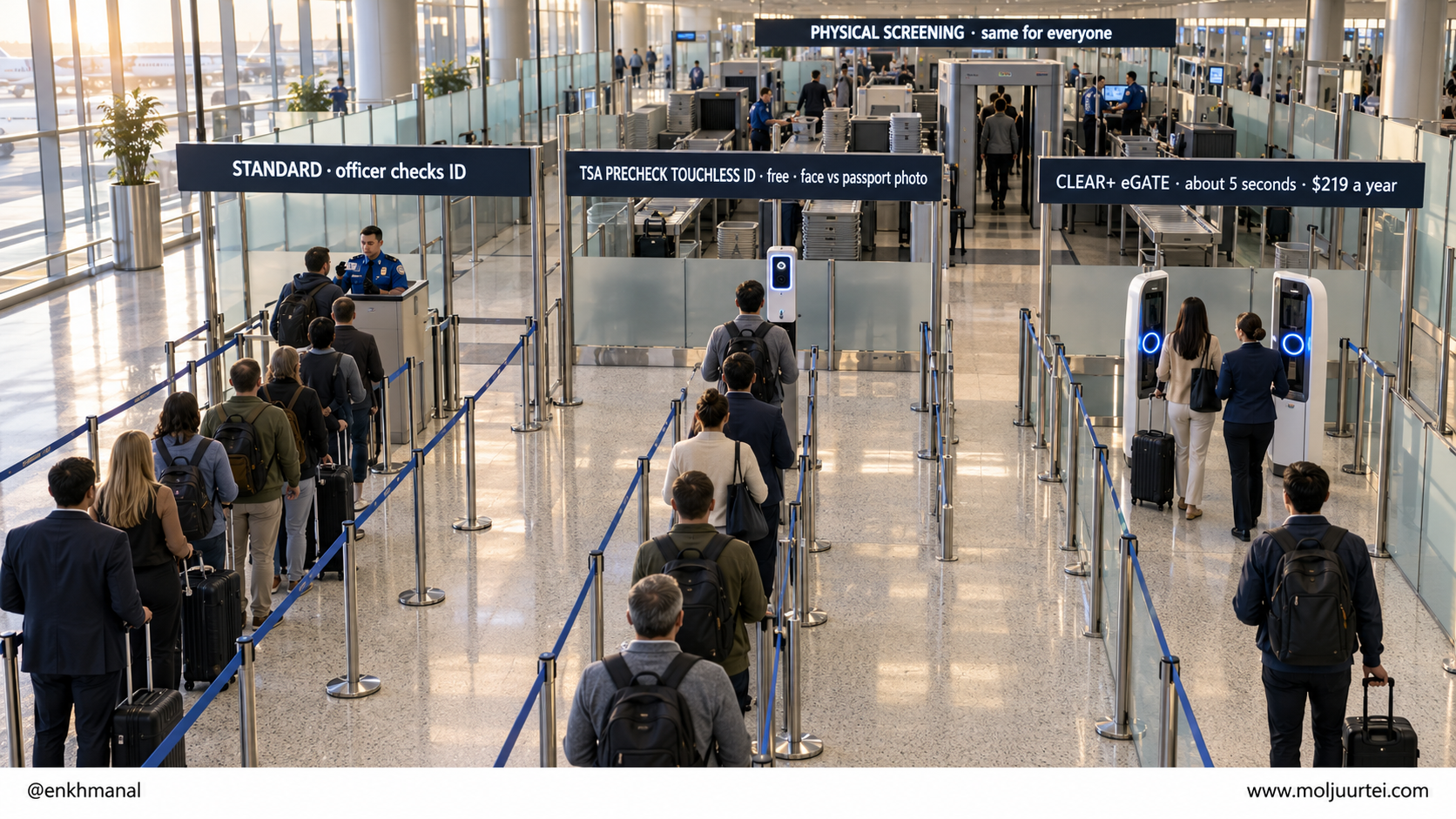
What forces a thesis change: active CLEAR+ members growing below 10% year on year, or Q3 bookings below the $311M bottom of the guide, would tell us the queue skip is losing to the free camera, and we would move to neutral. The other direction is a disclosure: CLEAR1 reported as a revenue line of at least 5% of the total, or a named agent-platform partner paying per verification, would turn the option into a business we can value.
Price Setup — Levels, Technicals & Options
The chart has done the market's arguing for it. $YOU closed at $39.60 on 25 September, 36.5% below its $62.36 closing high of 26 May and 12.9% above where it started 2026. It sits below every moving average we track, the 20-day at $41.66, the 50-day at $46.83, the 100-day at $51.25 and the 200-day at $46.78, with a 14-day RSI of 35. The low of the last year was $29.61 on 10 October 2025, just before the Q3 2025 print that began the re-acceleration.
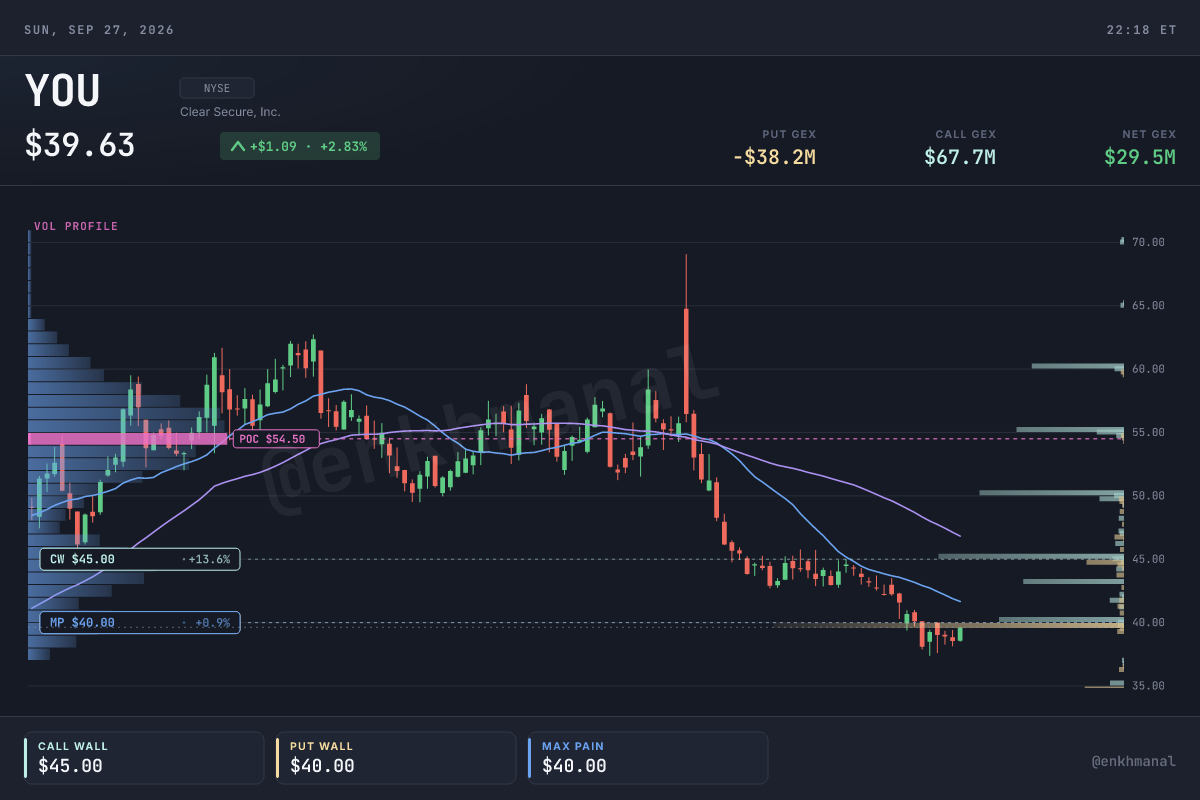
Options positioning is small and leans long. Across all listed expiries dealer gamma nets to about +$29.5M, with the put wall and max pain both at $40 (2,187 put contracts), the call wall at $45 (1,961 calls) and the largest call open interest at $50 (2,481). Call open interest of 19,248 is more than three times the 5,991 in puts. At-the-money implied volatility is about 56%, and the 20 November expiry spans the 5 November Q3 print.
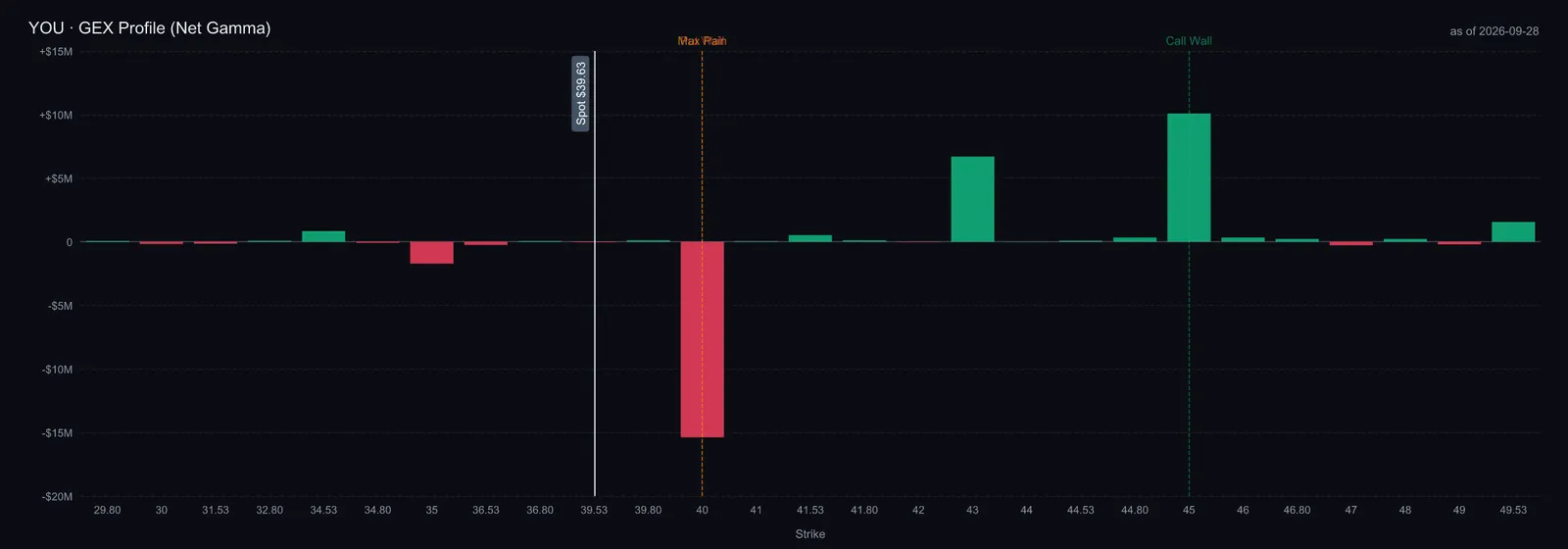
The level that matters is $40, where put interest, max pain and the gamma profile's flip near $39.80 all sit; a close back above the 50-day near $47 would say the market has stopped selling the TSA story. Below $40 the next support is the $35 strike and then the October 2025 low near $30.
Valuation & House View
On multiples CLEAR looks dear against identity-data companies and cheap against identity software. Its enterprise value is 23.2 times FY25 GAAP EBITDA, which includes stock compensation, and 17.1 times our FY26 estimate, against 12.8 times for $EFX, 12.6 times for $TRU and 8.1 times for $GEN; $OKTA trades at 210.7 times on a thin margin. The trailing P/E is 26.9 on diluted EPS of $1.47 for the last four quarters, against 26.0 for $EFX and 12.6 for $GEN. CLEAR's own P/E history is distorted by a $158.6M tax benefit in FY24, so a trailing PEG is not meaningful. The better anchor is cash: about 10.7 times the 2026 free cash flow floor for a business growing revenue 26.6% this quarter.
Our valuation model values the earnings, not the cash timing. It charges stock compensation as a cost, taxes operating profit at 25%, treats 40% of each year's revenue growth as prepaid cash from members, and runs ten explicit years because growth is above 10%. The base case takes 2026 revenue to about $1.11B (+23%, first-half actuals plus the Q3 guide and our Q4 estimate), 17% in 2027, then fades to 4% by 2035 with contribution margin at 67.5%. That gives $39.09 a share on a perpetuity at a 10% cost of capital and $46.20 on an exit at 12.6 times EBITDA, the median of $EFX, $TRU and $GEN; the two methods sit within 1.2 times of each other. The bear case, 8% growth in 2027 as Touchless ID bites, is worth $20 to $26; the bull case, 22% growth and a 69% margin, $62 to $67.
The model's audit shows no fails and three warnings, each deliberate. CLEAR gives no annual revenue guidance, only a quarter of revenue and a free cash flow floor, so every forecast year is our estimate and the audit says so. Working capital is set from deferred revenue rather than from receivables and payables, which CLEAR barely has. And the share count is held at 136.8 million units rather than drifting, because buybacks have slowed to about $22M this quarter.
$YOU is a name worth owning at a starter size at $39.60: the probability-weighted value of our three cases is about $43, the cash floor limits how wrong the base case can be, and the identity option, which the market values at zero, is the free part of the trade. We would add after the 5 November print if active members grow at least 12% and bookings land inside the $311–316M guide, and we would step back if members grow below 10%. Our fair value range is $39 to $46.