
$AUR Deep Dive — Driverless Freight's Leader, Priced as a Venture-Stage Call Option
Update · 9 October 2026. This deep dive was written on 12 June. The roughly $6 share price, valuation, trading levels, runway estimate and event calendar below are historical, not a refreshed recommendation. Its main hardware catalyst has resolved: Aurora launched its second-generation International LT driverless trucks without an in-cab person on 22 July. The 29 July Q2 shareholder letter reported $2 million of quarterly revenue, approximately $225 million of operating cash use and $31 million of capital spending. The company sold 30 million Class A shares through its at-the-market program for $215 million of net proceeds and ended June with nearly $1.2 billion of cash and short-term investments. It still targeted more than 200 driverless trucks at year-end and $14–16 million of 2026 revenue; these are targets, not completed deployments or contracted recurring revenue. The launch strengthens the technology and rollout evidence, but the equity issuance confirms that dilution is part of the cash bridge. Scaling the fleet, earning durable Driver-as-a-Service fees and containing cash use remain the business test. Q3 results are scheduled for 28 October. The original price scenarios below have not been recalculated.
$AUR is the clearest winner in autonomous long-haul trucking — fully driverless commercial runs on public highways, blue-chip customers, a 500-truck demand pipeline — yet at ~$11.7B and ~$1M of quarterly revenue it trades as a levered call option on flawless 2026–27 execution, not as a business. The technology question is largely answered; the cash, dilution and competition questions are not.
Executive Summary
- $AUR is the leader in driverless long-haul trucking — 5.3M+ cumulative commercial miles, 370k+ driverless miles in April alone with zero Aurora-attributed collisions, and seven driverless customers including a Berkshire subsidiary ($McLane). The Q2 2026 launch of second-generation hardware removes the in-cab observer and cuts hardware cost 50%+.
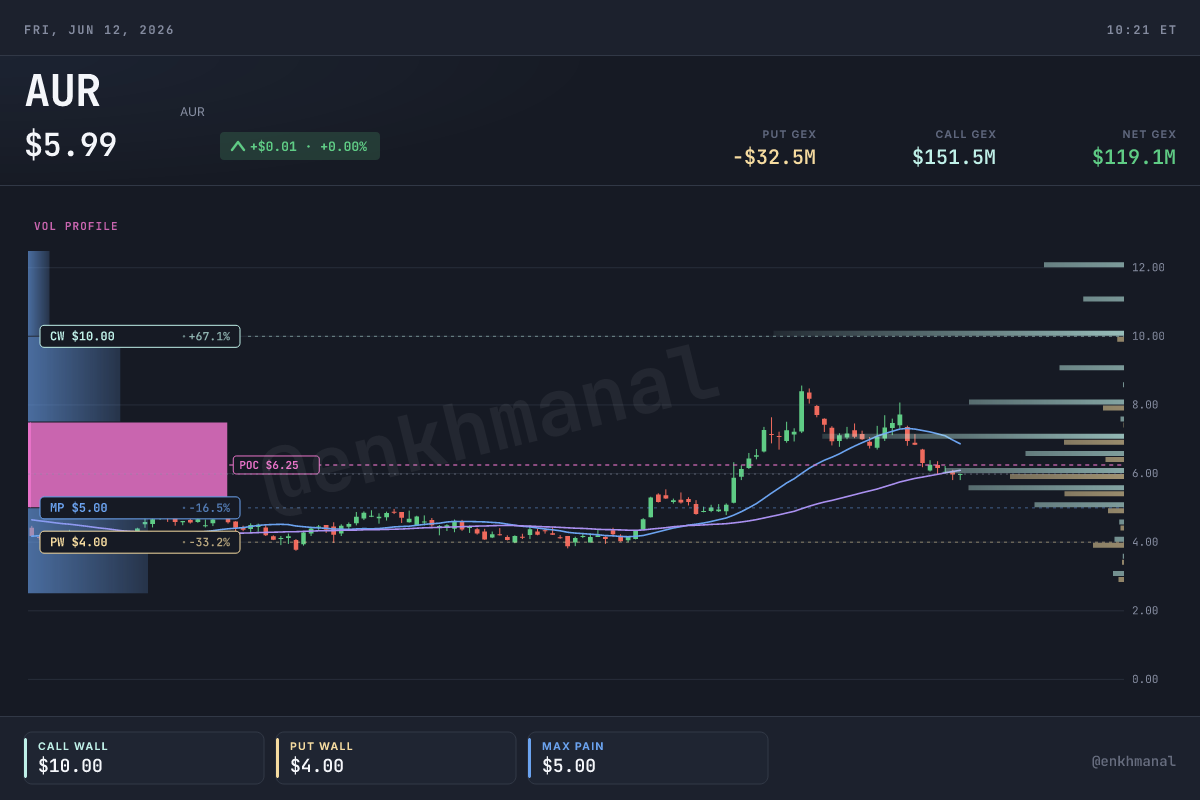
- The setup is a sharp pullback into a binary window. $AUR doubled off ~$4.16 (April) to an $8.57 May high on the Q1 print + the $Hirschbach 500-truck MOU, then fell ~30% into ~$6 after $UBER dumped $479M of stock on 6/2. The next catalyst — gen-2 launch + observer removal — lands this quarter.
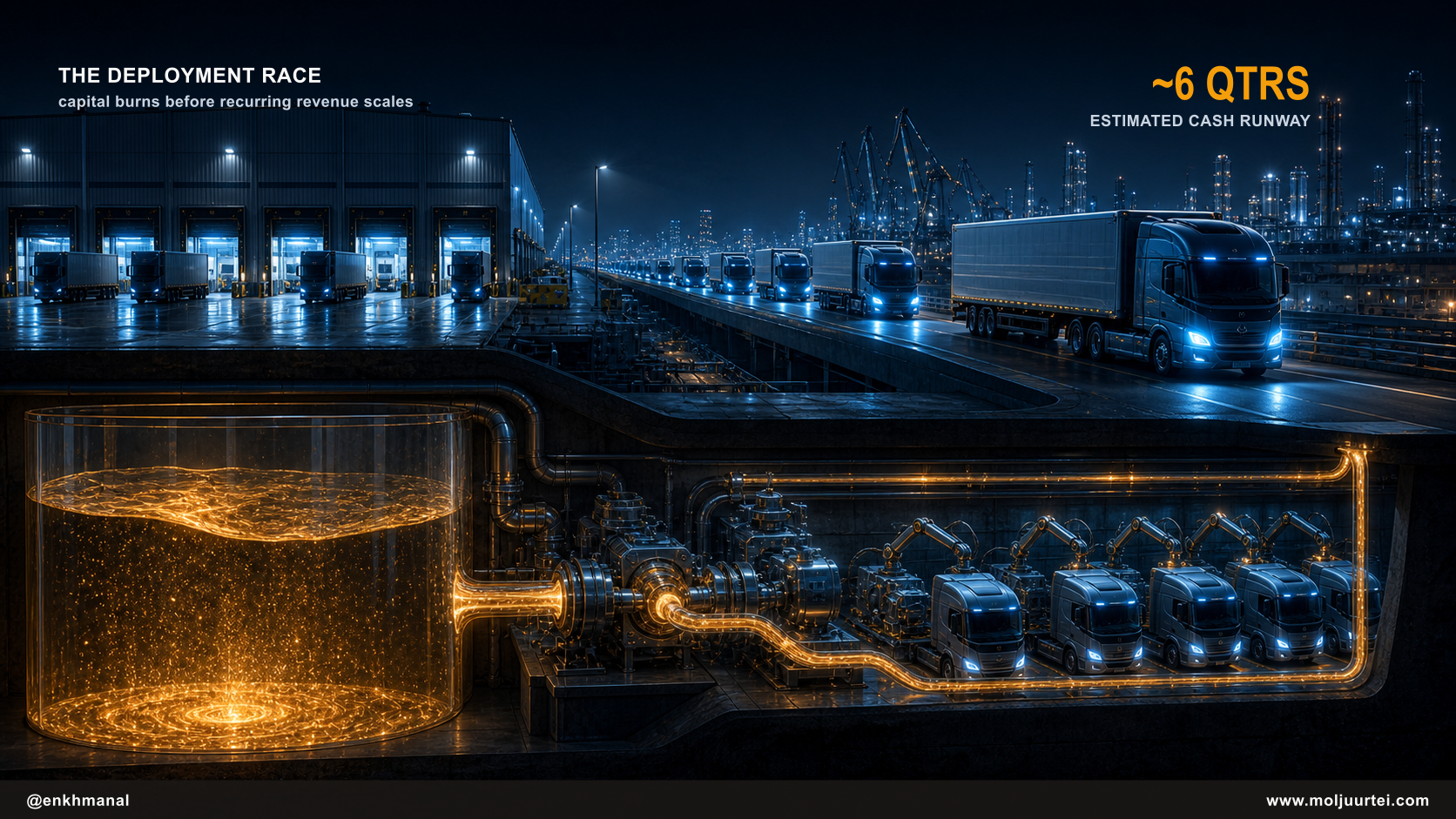
- The one risk that matters: this is a pre-revenue cash-burn story. ~$190–220M quarterly cash use against ~$1.28B liquidity is ~5–6 quarters of runway; the entire $10.5B enterprise value rests on a DaaS model that has not yet earned a dollar. Two peers worth a combined ~$13.5B in 2021 (Embark, TuSimple) died of exactly this.
- Framing: own the leader, but size it as the venture-stage option it is — a small, conviction-on-technology / no-conviction-on-valuation position, not a core holding.
Industry History & Technological Evolution
Autonomous trucking has been "five years away" for a decade. The first wave — Embark, TuSimple, Starsky, Otto — raised billions on the promise and largely died: Embark went bankrupt in 2023 at a 2021 peak valuation near $5B, and TuSimple, valued ~$8.5B in 2021, exited the US business the same year. The lesson of that wave was not that the technology was impossible but that the capital required to bridge from demo to deployment exceeded what the market would patiently fund through a rate-hiking cycle.
What changed by 2026 is that the problem got narrower and the proof got real. Developers stopped chasing SAE Level 5 (drive-anywhere) and settled on Level 4 within a tightly-bounded operational design domain — highways only, fair-weather Sun Belt corridors, a "transfer-hub" model where the autonomous truck runs hub-to-hub and humans handle the messy first/last mile. Long-haul highway driving is genuinely simpler than urban robotaxi: straighter roads, fewer edge cases, a repeatable route set. By mid-2026 the inflection is visible — $AUR is running cabful driverless freight with no in-seat operator, Sweden's Einride is running cabless electric trucks in Ohio (and listed on Nasdaq on 6/10), and $TSLA began mass-producing a Semi it now explicitly markets as "designed for autonomy." As one Substack put it, "The 'five years away' era is over. The question now is which players survive to operate at scale" — Robert Wollenberg, PhD, 6/9.
Company Origin & Industry Positioning
Aurora was founded in 2017 by a who's-who of the field: Chris Urmson (who led Google's self-driving program, the ancestor of $Waymo), Sterling Anderson (ex-$TSLA Autopilot) and Drew Bagnell (ex-Uber ATG). It initially aimed to license a universal "Aurora Driver" across passenger and commercial platforms, then made the defining 2019 pivot to focus on long-haul trucking — the application with the simplest ODD and the clearest unit economics. In December 2020 it acquired $UBER's self-driving unit (ATG), which is how Uber became a major holder, and it went public via SPAC in November 2021 near $10.
Today $AUR sits at the software-and-integration layer of the value chain, not the truck-building layer. It does not want to own trucks; it wants to sell the Driver — hardware kit, software, remote assistance, on-site support and insurance — to carriers who own the iron, under a Driver-as-a-Service (DaaS) per-mile fee. The market is mispricing two things in opposite directions: it under-appreciates how far ahead $AUR's commercial deployment is versus every listed peer, and it over-appreciates how much current revenue ($1M/quarter) justifies an $11.7B valuation. The stock is the tension between those two facts.
Technology Deep Dive
The Aurora Driver is a full-stack autonomy system, and the moat is concentrated in two places. First, FirstLight, a proprietary FMCW (frequency-modulated continuous-wave) lidar that the company says reaches a 1-kilometer range — roughly double the nearest FMCW competitor — giving the truck 34+ seconds to react at highway speed. FMCW also measures instantaneous velocity per point, which matters at 70 mph closing speeds. Second, a validated safety case built on millions of supervised then driverless miles, which is the regulatory and liability currency of the whole industry.
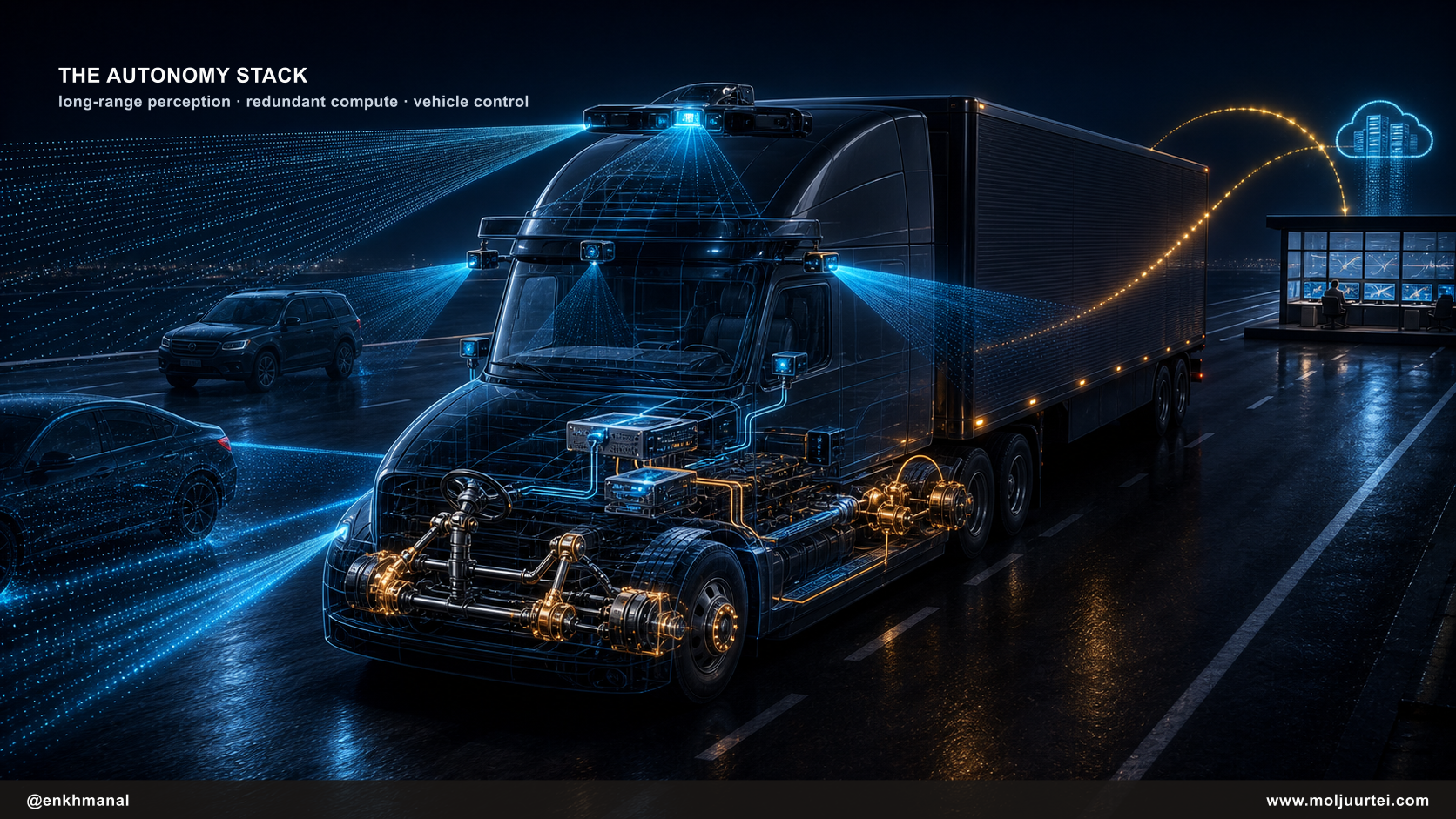
The load-bearing near-term event is the second-generation commercial hardware kit launching in Q2 2026. It does three things at once: it enables driverless operation without a partner-requested in-cab observer (the gate to true labor elimination), it is engineered for one million miles of life, and — critically — it is expected to cut Aurora Driver hardware cost by more than 50%, the single biggest lever toward management's breakeven-gross-margin target. The third-generation kit, due 2027, is where the industrialization story lives: built by AUMOVIO (the Continental spin-off) at a New Braunfels, TX plant with start-of-production in H2 2027, using a "Super Thor" compute platform that fuses two $NVDA DRIVE Thor SoCs. Upfitter Roush is standing up capacity for 1,000 trucks/year on the International LT platform, $Volvo is building VNL Autonomous trucks at its Virginia plant, and $PCAR (PACCAR) is jointly defining a future integrated platform. The risk embedded here: the cost curve and the reliability data both still have to compound over hundreds of millions of miles before the unit economics are proven, and the skeptics are right that today's "driverless" still leans on a remote-assistance specialist who can intervene for what the safety report clinically calls a "minimal risk condition."
Peer Landscape — Technology & Price Action
The pure-play listed comparable is $KDK (Kodiak); $TSLA is the wildcard platform; the OEM route is $DTRUY (Daimler/Torc). The price action tells the re-rating story — $AUR has been the relative winner on the scaling narrative while the cheaper laggard $KDK bled out post-SPAC.
| Ticker | 1M | 3M | 12M | YTD |
|---|---|---|---|---|
| $AUR | −22% | +44% | +10% | +55% |
| $KDK | −20% | −16% | −45% | −43% |
| $TSLA | −6% | +8% | +22% | −9% |
$KDK's 12M/YTD reflect a SPAC trust→deal de-rating (traded a flat ~$11.40 pre-merger), not a fundamental comparison; $TSLA is a mega-cap where the Semi is a rounding error on the thesis.
| Player | Status | Listed? | Position vs $AUR |
|---|---|---|---|
| $AUR | Driverless commercial, 7 customers, ~$11.7B | Yes | Leader; furthest-deployed |
| $KDK (Kodiak) | Largest driverless Class 8 fleet (Permian), long-haul H2'26 | Yes (~$1.5B) | Cheaper #2; also defense/industrial |
| Einride | Cabless electric L4, 5 NHTSA approvals | IPO'd Nasdaq 6/10 | Architecturally different (electric, FCaaS) |
| Gatik | 60k driverless retail orders, $600M contracted | No | Short-haul/B2B, not long-haul |
| Bot Auto | 230-mi Houston→Dallas L4, no human | No | Early; same Texas corridor |
| $TSLA | Semi mass production 2026, FSD stack | Yes | Captive charging + data; not yet in freight |
| PlusAI / Torc ($DTRUY) | OEM-software; 2027 entry | Private / OEM | Sell-to-OEM model, harder to value |
The market has already crowned $TSLA as the autonomy platform; $AUR is quietly the only one actually running driverless freight at commercial scale today — but the gap is the kind that a well-capitalized platform can close, which is exactly the bear's point.
Business Model, Growth & Margins
$AUR is pre-commercial-scale, so the income statement is a development budget, not a business. Revenue is a rounding error that exists mostly to validate the model; the real numbers are the cash-burn and the deployment count.
| Quarter | Revenue | YoY growth | Notes |
|---|---|---|---|
| Q1 2026 | $1M | n/m | +10% q/q; supervised + driverless loads |
| FY2025 | $3M | n/m | First commercial year |
| FY2026 (guide) | $14–16M | +400% | Back-end loaded; Q4 > half of FY |
The economic logic is genuinely compelling if it scales. Autonomous trucks are not bound by hours-of-service rules: a Fort Worth–Phoenix run that takes a human 2+ days takes the Aurora Driver ~15 hours, and $AUR's own driverless trucks for $WERN are already averaging 4,000+ miles/week (a 225,000-mile annual run-rate per truck). A third-party 2030 scenario in the original June memo assumed $2.06/mi autonomous vs $3.21/mi human (about 36% lower), mostly from eliminating driver labor at an implied $0.85/mi DaaS fee. That arbitrage widens over time because labor inflates while technology deflates — FRED's transport-and-warehousing wage series rose +34% from 2019 to 2025, even as gen-2 hardware costs fall 50%+. The catch: at the current burn, margins are deeply negative (Q1 cost of revenue $6M on $1M revenue), and the path to breakeven gross margin runs entirely through hardware-cost reduction and utilization that haven't been demonstrated at fleet scale.
TAM, Strategic Narrative & Leadership
The addressable market is large and credible: ~200B long-haul truck-miles annually × $0.85/mi ≈ a **$170B TAM**, with a near-term serviceable market ~$85B through 2030 (Sun Belt corridors, the Texas Triangle, hub-to-hub). California's recent move to enable autonomous trucking expands the serviceable footprint to a projected 60B vehicle-miles by 2028 and, just as importantly, opens a coast-to-coast operating environment. Management's framing is that 2026 is "the year Aurora begins to scale" after "a deliberate build-up before the inflection" — CEO and co-founder Chris Urmson's letter leans hard on the >200-truck exit target and the Hirschbach DaaS MOU.
Leadership credibility is a real asset (Urmson is arguably the most accomplished operator in the field), but the §11 caution is the shareholder register, not the C-suite. Insider activity has been heavy — 22 Form 3/4 filings in 120 days plus a cluster of Form 144 sale notices — though most of this is RSU vesting and tax-driven sales typical of a SPAC-era company expensing $46M of stock comp per quarter; there were no visible open-market insider buys. The louder signal is the institutional exit (below). On balance: a leadership team that has earned the benefit of the doubt on technology, attached to a cap table that is a source of supply, not demand.
Latest Earnings
- Q1 2026 (reported 5/6) — Revenue $1M (+10% q/q); GAAP operating loss $244M (including $46M stock-based comp), net loss $223M (−$0.11/share); adjusted EBITDA −$192M. There is no "beat/miss" in the consensus sense — the number that matters is cash.
- Forward guidance — FY2026 revenue $14–16M (+400% YoY at midpoint), heavily back-end loaded (Q4 > half of the year) as driverless-without-observer operations scale. Exit-2026 target: >200 driverless trucks → ~$80M TaaS revenue run-rate.
- The new disclosure — The $Hirschbach 500-truck DaaS MOU ("a potential multi-year revenue stream in the hundreds of millions of dollars," deliveries from 2027) and the gen-3 "Super Thor" dual-$NVDA-Thor architecture with AUMOVIO — the first concrete shape of the 2027 industrialization plan.
- The tough question — Liquidity. Management asserts a "strong balance sheet with sufficient liquidity to achieve positive free cash flow," but the math is ~$1.28B against ~$190–220M/quarter of guided burn — roughly six quarters. The CFO (David Maday) flagged 2026 as peak capital spend (~$150M capex), declining sharply in 2027 as the model shifts to DaaS and Hardware-as-a-Service with AUMOVIO. Whether the company reaches free-cash-flow breakeven before it has to raise again is the entire debate.
Thematic Investment Angle
The theme is "physical AI" reaching commercial deployment — autonomy that earns revenue on public roads, not in a demo. Long-haul trucking is the cleanest expression: a bounded ODD, a quantifiable labor-cost arbitrage, and a fragmented $800B+ freight industry desperate for capacity.
| Ticker | Role | Why this slot | Valuation | YTD |
|---|---|---|---|---|
| $AUR | Pure-play leader | Furthest-deployed driverless freight | ~$11.7B / ~700× FY26 rev | +55% |
| $KDK | Cheaper #2 | Same tech, smaller scale, defense optionality | ~$1.5B | −43% |
| $TSLA | Platform wildcard | Captive charging + FSD data; Semi optional | ~$1.3T | −9% |
The theme is crowded and getting more so — Einride's 6/10 IPO, $TSLA's Semi ramp, Gatik and Bot Auto in the same Texas corridor. $AUR screens as the highest-quality way to express it (real driverless revenue, blue-chip customers, the OEM relationships) but also the most fully-valued. What invalidates the theme: a high-profile autonomous-truck safety incident, or a labor/regulatory clampdown (the Teamsters and the "Labor United Against Waymo" coalition are already litigating California's approval).
Bull Case & Catalysts
The 1–3 year bull case is simple to state and hard to underwrite: $AUR removes the observer this quarter, exits 2026 with 200+ revenue-generating driverless trucks, converts the Hirschbach MOU and adds OEM-built trucks through 2027, and re-rates as a ~$300–500M run-rate business with a visible path to positive unit economics — at which point a $20B+ valuation is defensible. The cost curve (−50% gen-2 hardware) and the OEM industrialization (Roush, $Volvo, $PCAR, AUMOVIO) are the levers.
| Date | Event | Why it matters |
|---|---|---|
| 2026-06 (in progress) | Gen-2 hardware launch on International LT | Removes in-cab observer → true labor elimination; the quarter's binary |
| 2026-07/08 (est.) | Q2 2026 earnings | First read on driverless-without-observer scaling + burn vs guide |
| 2026-09-30 | BUILD America 250 Act / surface-transport reauthorization deadline | A single federal AV framework would unlock multi-state scaling |
| 2026-12 | Exit-year target: >200 driverless trucks (~$80M run-rate) | The number the entire FY26 thesis is judged on |
| 2027-H2 | AUMOVIO gen-3 start-of-production; core DaaS model begins | The transition from capex-heavy fleet to asset-light DaaS |
What needs to go right: the gen-2 launch lands on time and reliably, the burn stays inside guidance, and a capital raise (if needed) comes from strength rather than a discounted desperation print.
Risk Register
- The Uber overhang is now explicit supply. On 6/2, $UBER's Neben Holdings sold 67.5M shares at $7.10 — a $479M block — into the rally, the proximate cause of the ~30% pullback (volume hit ~132% of average). Uber still holds ~258M shares (15.6%), an orderly-exit signal that nonetheless leaves ~$1.5B of potential supply hanging over the stock. It is a financial-investor exit, not a partnership breakup (Uber Freight remains a customer), but the tape did not read it that way.
- Cash runway is the killer, exactly as it was for the last wave. ~$1.28B liquidity ÷
$190–220M/quarter ≈$8.5B, 2021) both had the technology and still ran out of money. Any raise dilutes a name already carrying ~1.96B shares.6 quarters. Embark ($5B, 2021) and TuSimple ( - "Driverless" is ODD-bound and not yet fully autonomous. Per the skeptic read (Seth, 5/19), operations are confined to specific fair-weather Sun Belt highway routes with remote-assistance intervention available — "is it accurate to say the vehicle is autonomous in any meaningful sense?" Weather, construction and new-corridor generalization are unproven at scale.
- Competition is compounding faster than revenue. $TSLA's purpose-built Semi + FSD + captive charging is the largest-surface-area threat; Einride just IPO'd; $KDK, Gatik and Bot Auto crowd the same corridors. Even partner $Volvo says it won't remove safety drivers until 2027 — a hedge on the timeline from inside the tent.
- Labor and regulatory backlash. Teamsters California and the anti-Waymo coalition are litigating state approvals route-by-route; an adverse ruling or a single high-profile incident resets sentiment on the whole complex.
What forces a thesis change: a gen-2 launch slip past Q3 2026, a driverless safety incident, OR a capital raise priced at a meaningful discount — any one converts "leader scaling into its inflection" into "cash-strapped option with diluting supply."
Valuation & House View
There is no meaningful P/E or EV/EBITDA here — this is a pre-revenue optionality name, so the honest valuation lens is enterprise value against the forward revenue trajectory and the deployment count.
| Metric | Current | Note |
|---|---|---|
| Market cap | ~$11.7B | ~1.96B shares × $5.98 |
| Net cash | ~$1.2B | ~$1.28B liquidity, negligible debt |
| Enterprise value | ~$10.5B | — |
| EV / FY26 revenue ($15M mid) | ~700× | Meaningless on current revenue |
| EV / exit-2026 run-rate ($80M) | ~131× | The "if-it-works" multiple |
| Scenario | Probability | 2Y target | Implied return | Triggers |
|---|---|---|---|---|
| Bull | 35% | $10.50 | +76% | Gen-2 on time; 200+ trucks; DaaS scales; re-rate to ~$20B+ |
| Base | 40% | $7.00 | +17% | Launch slips a quarter; ~150–200 trucks; one dilutive raise |
| Bear | 25% | $3.50 | −41% | Reliability/observer delay; discounted raise; Uber supply + competition compress the multiple |
House View. $AUR is the highest-quality, furthest-deployed way to own autonomous long-haul trucking — the technology question is largely answered and the leader's lead is real. But at ~$10.5B EV on $1M of quarterly revenue, the stock is a venture-stage call option: the payoff is genuinely asymmetric to the upside, and genuinely binary on cash and the gen-2 launch. The probability-weighted 2-year return is modestly positive (+15%) with a wide distribution, which is exactly what an option looks like. Lean neutral; own it small, as the conviction-on-technology / no-conviction-on-valuation position it is — and treat the ~$6 post-Uber-sale level, not the $8.57 high, as the honest cost basis. The view flips bullish on a clean gen-2 launch + a raise from strength, and bearish on any launch slip or discounted dilution.