$CCXI Deep Dive — The first humanoid you can buy on an exchange · Digit 5 unveiled Sept 15, Investor Day Oct 6, close targeted Q4
$CCXI closed on 25 September at $12.43, up 1.6% on the day and 34.9% below its July $19.10 high. It is Churchill Capital Corp XI, the SPAC proposing to merge with Agility Robotics, not an already completed Agility listing. The structural opportunity is practical humanoid labor in buildings designed for people. Agility brings operating experience and a redesigned Digit 5 safety architecture; the open questions are safe deployment, repeat orders and manufacturing economics. The June-30 trust reference of about $10.16 implies today’s price is 22.3% above trust; a return from $12.43 to $10.16 would instead be an 18.3% loss. It is a conditional pre-merger redemption reference, not a permanent price floor.
What Changed
Start with the job. Warehouses move plastic totes, parts and cartons between shelves, conveyors and workstations. People handle changing layouts, mixed objects and narrow aisles with little reconstruction. Conveyors, mobile robots and fixed robotic arms already automate many of these tasks; humanoids compete where a human-shaped reach and footprint can integrate into existing workflows economically. A safety cell separates a robot’s work area from people. Reducing the need for such barriers could broaden useful tasks, but requires site-specific risk assessment and validated safety functions. The investment question is whether a humanoid can perform enough reliable work to justify its full cost, not whether all other automation requires a new building. $GXO, a logistics operator with $13.64B trailing revenue, is a useful customer lens: turnover and repetitive handling create demand for automation, but suppliers must prove productivity.
The humanoid is the bet that the cheaper path is a machine shaped for the building rather than a building shaped for the machine. The difficulty is not walking. Agility's Digit has walked in customer sites since 2023. The difficulty, as Agility's chief business officer Daniel Diez put it on a podcast filed with the regulator in July, is that "what holds back large-scale deployments of humanoid robots is their inability to work outside of safety parameters or safety cages." Agility’s existing commercial deployments used controlled work areas. A 129 kg machine carrying a heavy load needs validated detection, protective motion and a stable safe state; that does not mean every competitor uses an identical enclosure.
Two things changed this summer. On June 24, Agility agreed to go public through Michael Klein's eleventh Churchill blank-check company, at a $2.5 billion pre-money value, with about $576 million of net deal cash in the later S-4 sources-and-uses estimate, versus $574 million in the original presentation if no one redeems. On September 15, it unveiled Digit 5, a redesigned robot whose headline feature is not the payload but an independent safety controller that sits outside the autonomy software and can slow, stop, or sit the robot down when a person approaches. Early customers get it in the first half of 2027. The filing that carries the audited numbers landed on September 4, and supplies the dated audited financial baseline used here.
Thesis
CCXI offers a proposed US-listed, relatively focused exposure to humanoid robotics if the transaction closes, expected in Q4. It is not the only way to invest in robotics: Tesla, warehouse-automation companies and foreign-listed manufacturers offer different exposures. Scarcity can attract capital before revenue scales, but the operating thesis depends on delivering a useful, safe machine.
The acceleration mechanism is wider usable workspace. Digit 5 combines an independent safety controller with perception and planned integration of NVIDIA IGX Thor and Halos; the company contributes to ANSI/A3 TR R15.108 and ISO 25785-1 work. Those developing documents and partnerships are not a completed product certification. If validation allows more shared-space applications, customers can deploy across more workflows and Agility can reuse operating lessons across sites. Its 65,000 reported operating hours are useful experience, not proof of an exclusive data monopoly or guaranteed safety.
The financial claim is narrower than the headline. FY25 revenue was $1.782M, 63.5% from related parties, against $4.47M cost of goods and approximately $137M operating expenses. The $300M-plus order disclosure describes 1,000 Digit 5 robots under a three-year rental contract with one related-party customer, contractual milestones and 453 warrants per robot sourced subject to the minimum sourcing condition. Accounting remained under evaluation in the draft. At $12.43, the no-redemption 277.697M basic share count implies $3.45B equity value; the memo’s approximate 336.3M expanded share count implies $4.18B before treating exercise proceeds. Neither equals the quote provider’s current SPAC-shell market capitalization. Deal funding depends on redemptions and is not a guaranteed three-year runway.
The research stance remains watch-and-verify, not an assertion about the owner’s holdings. The 6 October Investor Day, updated financial disclosures, shareholder vote and transaction close can clarify deployments, order quality and funding. The opportunity is a new category of flexible industrial labor before its scale is visible; the risk is paying for that category before a repeatable economic model exists. Goldman’s cited 2035 market estimate of 6.5M annual units is a dated external scenario, not Agility guidance or a forecast adopted here.
Business & Backdrop
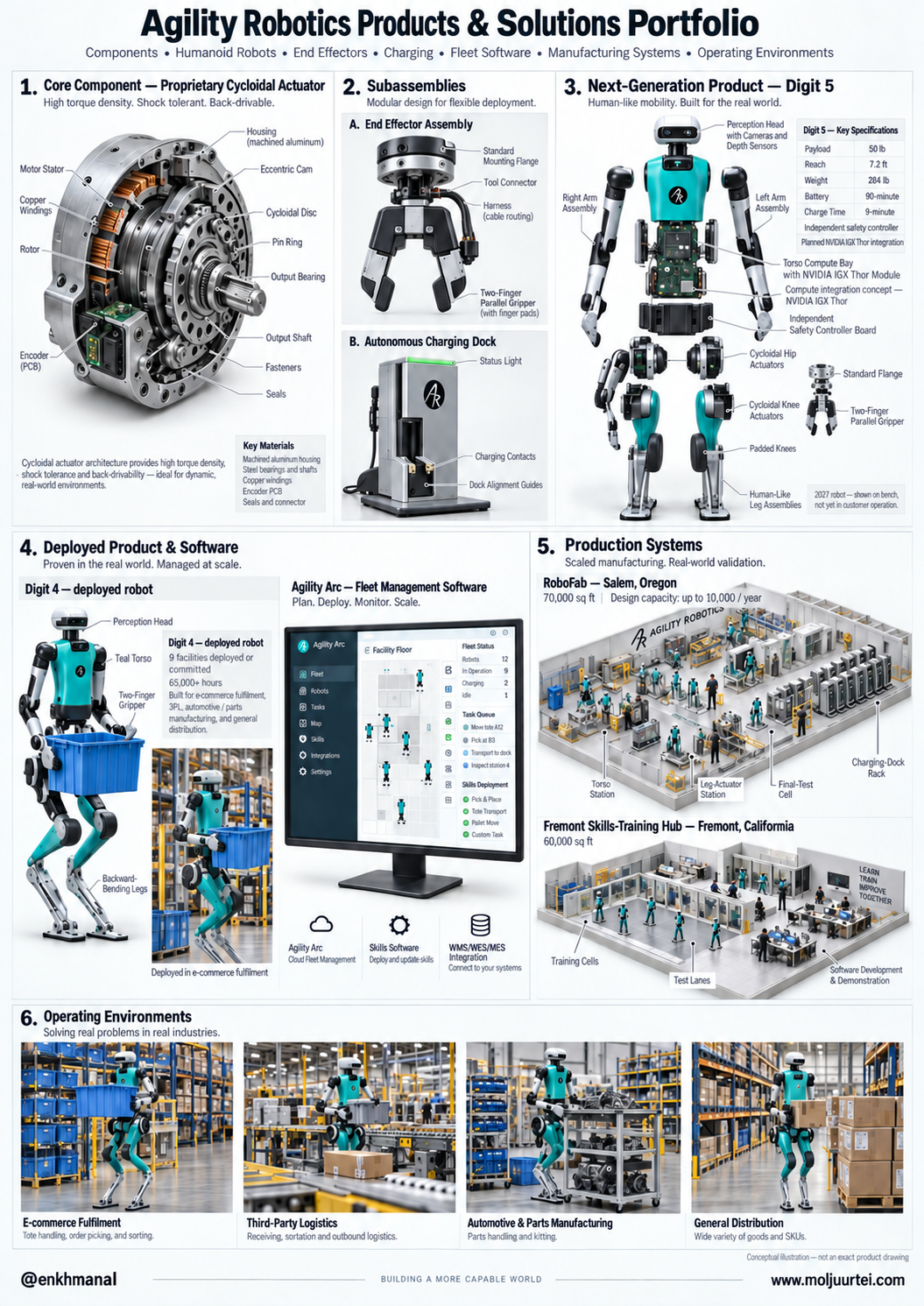
Start here. Agility Robotics builds one product, Digit, a bipedal robot about the height of a person that carries totes and parts around warehouses and factories, and it earns money two ways: it rents the robot by the month, or it sells it outright with a service contract. It was spun out of Oregon State University in 2015 by Jonathan Hurst and Damion Shelton on the back of Cassie, a two-legged research platform; the legs are the lineage. Peggy Johnson, who ran business development at Microsoft and was chief executive of Magic Leap, took over in March 2024. The company has 393 employees, 32 United States patents, a 70,000-square-foot factory in Salem, Oregon that it rates at 10,000 robots a year, and a 60,000-square-foot training hub in Fremont, California opened in July. Factory capacity is a design target, not current annual output.
The customers are the argument for the technology. Digit 4 is deployed or committed across nine customer facilities: Amazon, which has used it for tote recycling since 2023 and invested in the Series B and C; $GXO, which signed the industry's first multi-year humanoid rental in June 2024 and has since pushed about 100,000 totes through one facility at roughly 98% on-task; Schaeffler, the German bearings and actuator group, an investor since November 2024, where Digit feeds greasy parts into an industrial washer in South Carolina faster than the washer can take them; Toyota Motor Manufacturing Canada; and Mercado Libre. Johnson says another thirty or so customers are in the pipeline and unannounced. A Customer Acceleration Program at a $500,000 fee has four signatures and thirty-plus in discussion.
The April-20 pricing assumptions are $8,500 a month plus $25,000 deployment for rental, or $200,000 hardware plus $20,000 deployment and $36,000 annual software/maintenance for ownership. Five-year customer payments are therefore $535,000 and $400,000. At the stated launch BOM of $150,000, $15,000 deployment cost and $15,000 annual service cost, simple five-year contribution is about 55.1% for rental and 40.0% for ownership, before corporate costs and other omitted items. The filing’s margin above 70% is a potential outcome as costs improve, not the launch arithmetic. Its 1.1-year customer-payback claim concerns labor savings under utilization assumptions; it is not Agility’s manufacturing-cost payback. Actual customer savings require productive hours, labor substitution and support costs to be measured.
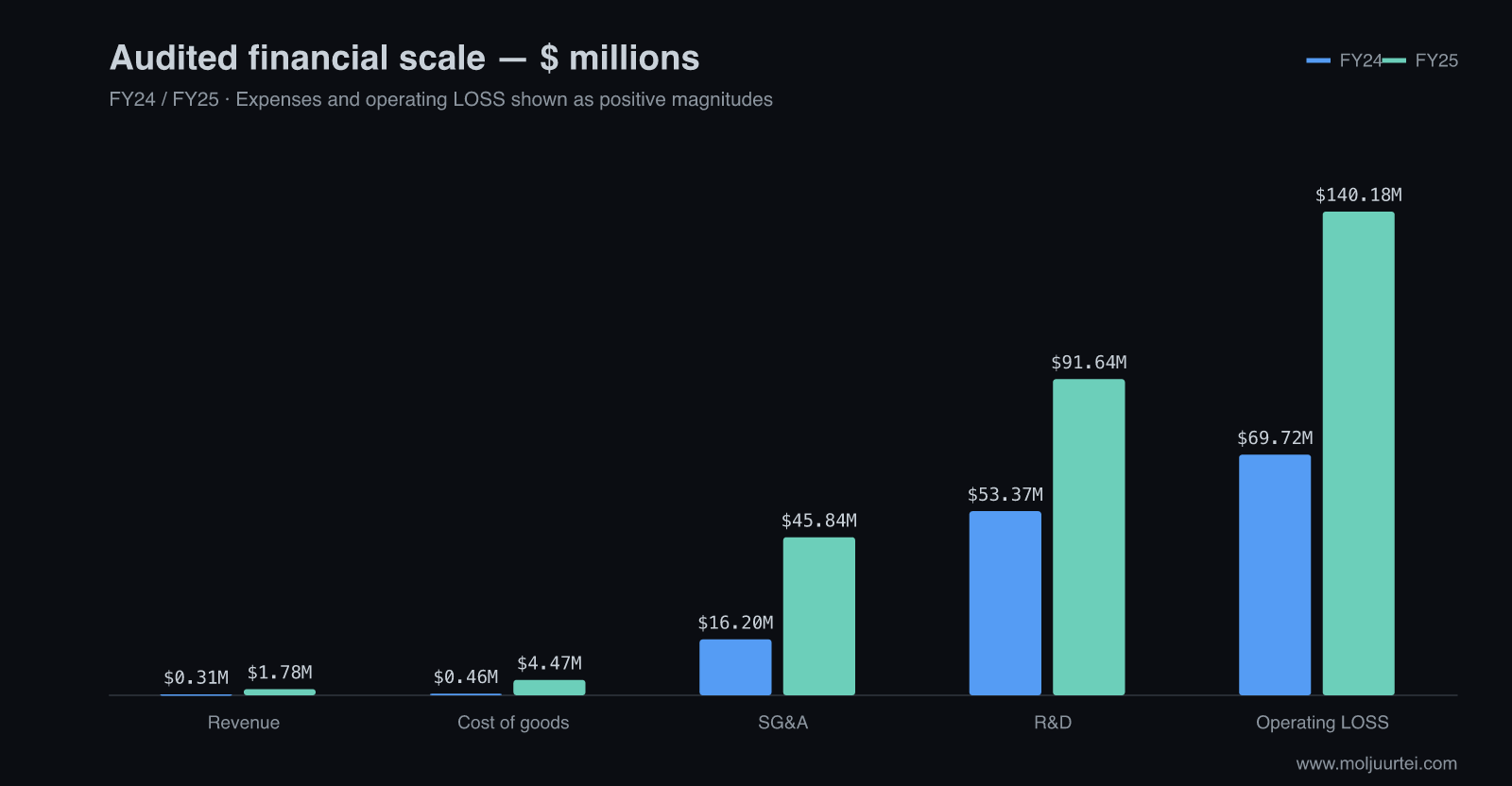
The audited numbers answer the wider question. Net sales were $310,000 in 2024 and $1.78 million in 2025, of which $650,000 came from trade customers and $1.13 million from related parties. Cost of goods was $4.47 million, so the gross margin was about minus 151%. Selling, general and administrative expense was $45.8 million and research and development $91.6 million, for an operating loss of $140.2 million. Net income was −$138.1 million and operating cash flow was −$99.8 million in the same year, so about $38 million of the loss was stock compensation and other non-cash charges rather than cash out the door; cash at year-end was $103 million and the accumulated deficit $313 million. Note 1 describes Digit sales and deployments as "largely considered to be research and development" and the company as a development-stage business; the S-4 retains a going-concern warning. July’s $100M SAFE financing did not resolve it: management concluded that its plans did not alleviate substantial doubt under the accounting standard.
The original competitive context used dated financing marks: Figure’s September-2025 round at $39B, Apptronik’s February-2026 round above $5.5B, and Johnson’s comparison of Agility’s $2.5B transaction price with other humanoid developers. These are different capital structures and business ambitions, not interchangeable public-market comparables. Tesla’s Optimus remains an exposure inside a much larger listed company; UBTech offers foreign-listed exposure. The cited 16 September Citrini note treated the large Figure/Agility gap as a difference in software ambition, not automatic evidence that Agility was cheap. Its 2% basket weight was that author’s construction, not a sizing recommendation here.
Technology & Moat
Start here. A humanoid is four problems stacked: legs that do not fall, arms that lift, hands that grip, and a brain that decides. Agility's history is legs first. Cassie, and then Digit 1 through 4, walked on backward-bending "ostrich" legs, a configuration borrowed from birds because it keeps the knee joint out of the way and is efficient to balance. Digit 5 abandons it for human-like legs with padded knees, and Hurst explains why in one sentence: "the new configuration is optimized for lifting heavy things and getting up and down off the ground a lot." A warehouse robot spends its day squatting to floor-level totes and reaching to 7.2 feet; the bird leg was a research answer to a walking question, and the work question has a different answer.
Agility develops proprietary cycloidal actuators for its joints. An actuator turns electrical power into controlled motion; its motor, transmission and sensing must manage load, heat, impacts and precision. Gear architecture can influence durability and back-drivability, but does not alone prove that one robot outperforms all alternatives. Dynamic balance and a controlled transition to a stable seated state are part of the safety design. Schaeffler’s actuator and bearing expertise makes its investment relevant; it does not establish that Schaeffler supplies half of Digit’s bill of materials.
Agility describes itself as model-agnostic, using vision-language-action methods and language models such as Claude and Gemini for suitable tasks. Johnson presents real-world operating data as a competitive advantage. The company reports 65,000 hours of operation, equivalent to about 8.9 robot-years if divided by an illustrative 7,300 hours a year. That conversion is an analytical scale comparison, not measured fleet utilization or a proven service life. The useful advantage is learning from failures, interventions and workflow integration in actual facilities; neither the largest-data claim nor the exclusion of rival data is independently established here.
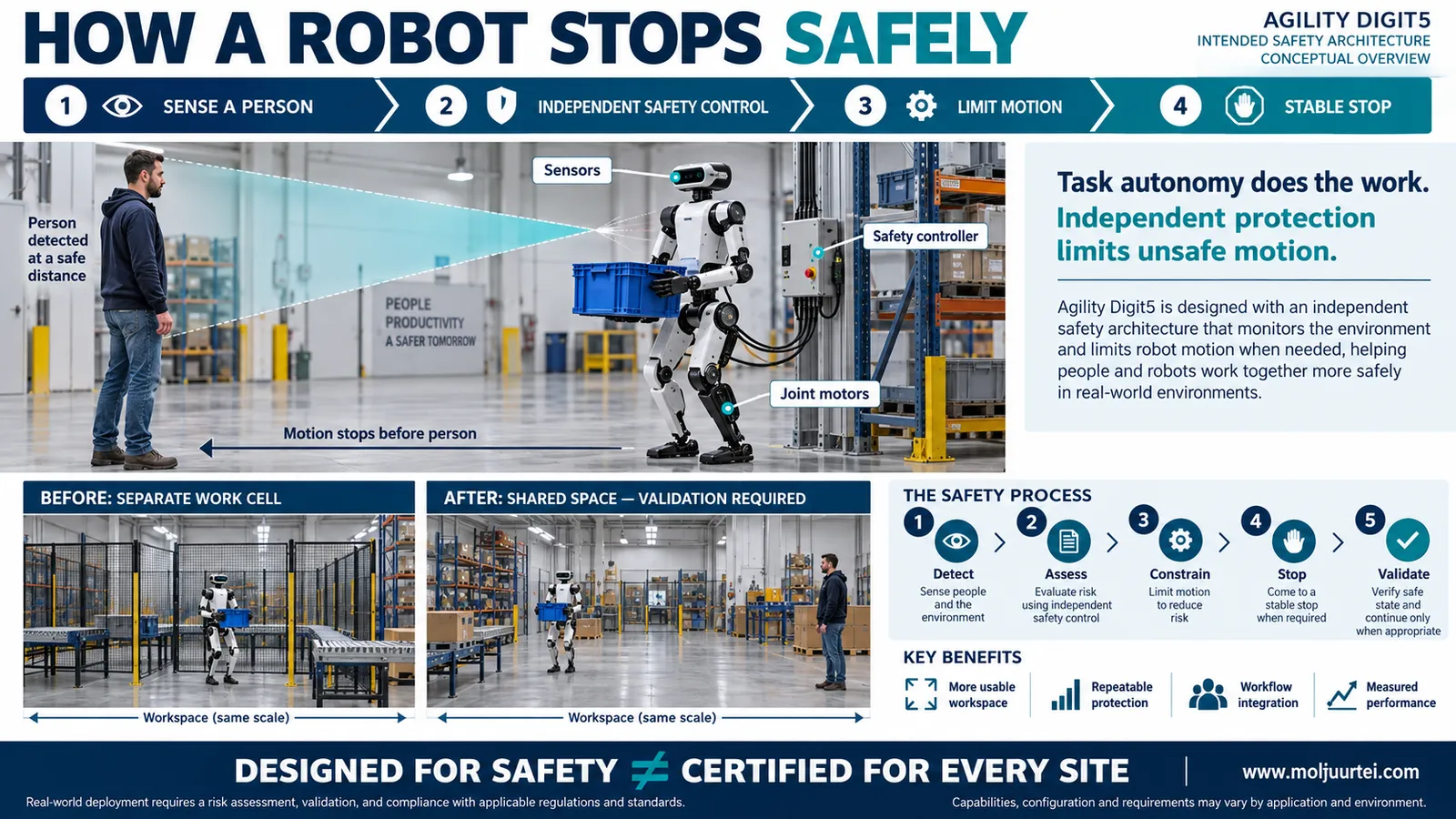
Digit 5’s new architecture monitors for people and uses an independent safety controller to oversee protective responses such as avoiding, stopping or sitting. Agility identifies NVIDIA IGX Thor and Halos Core as the integration platform; the earlier reference to Jetson Thor was incorrect. A separate safety function is designed to constrain learned autonomy, but the press release does not establish that every safety decision runs on the same AI computer or that contact can never occur. The engineering argument is clear: reliable protective limits must remain effective when task software behaves unexpectedly. Field validation and the applicable conformity process must still demonstrate that performance.
Agility specifies about 90 minutes of operation and nine minutes of charging, a 10:1 ratio versus Digit 4’s 2:1. That alone implies a theoretical 90.9% duty cycle, or 21.8 hours per day before travel to the charger, maintenance and other downtime. The company’s more-than-20-hour objective therefore depends on the task and operating conditions. A swappable gripper on an ISO-standard flange lets the robot use task-specific tools rather than requiring a five-finger hand. Autonomous tool changes and more dexterous work remain development priorities. GXO’s emphasis on better manipulation illustrates why useful throughput matters more than an athletic demonstration.
Roadmap & R&D
The latest formal schedule is early access in H1 2027 and general availability by end-2027. The earlier December-2026 initial-unit remark is not treated as the current customer-delivery promise. Expansion to the EU and UK is planned, subject to the required market-access and safety work. Investor Day is confirmed for 6 October at 12:30 p.m. ET, with technology, manufacturing, commercial progress and long-term financial discussion. The merger is expected in Q4, subject to approvals and closing conditions. The cited PIPE outside date is 31 January 2027 and the SPAC deadline 18 March 2028; neither substitutes for a confirmed closing date.
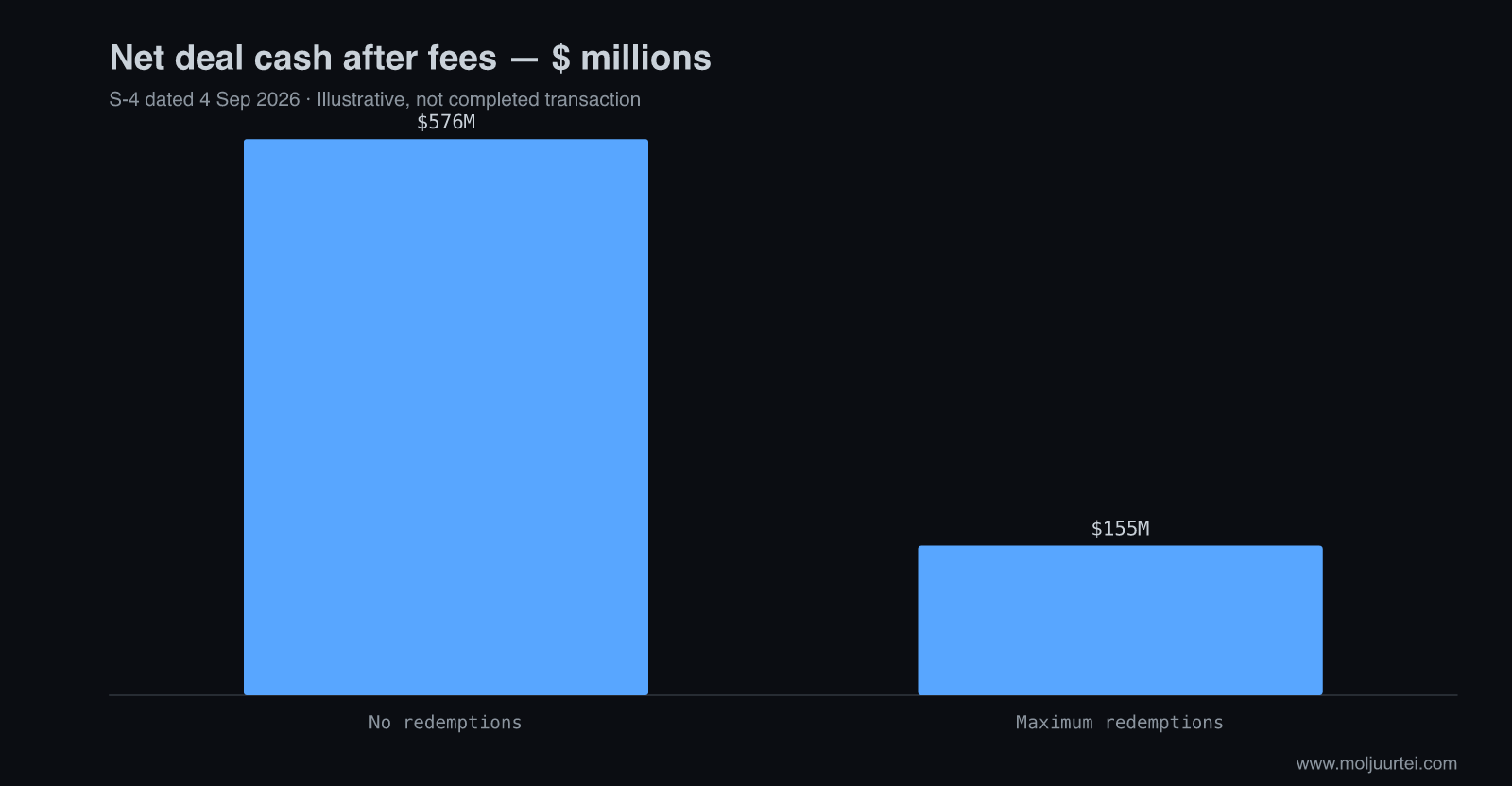
The filing’s planning assumptions are about $115M R&D in 2026, growing 15% annually through 2028, and $60M SG&A growing 20%, plus roughly $8M annual capex. The implied 2028 operating expense is $238.5M before gross profit, incremental public-company costs and other cash needs. The S-4 sources-and-uses table shows about $576M net deal cash without redemptions but only $155M with maximum redemptions. Current share-price premium does not remove redemption risk. A reliable runway requires an updated cash balance, burn, customer receipts and working-capital plan; simply dividing the headline cash by one year’s costs is insufficient.
The deployment schedule is illustrative, and the company says so: about 800 robots deployed in 2027, about 7,000 by 2030, about 25,000 by 2035, from an unadjusted pipeline it puts at 28,000 robots by 2030 across signed and prospective customers. The bill-of-materials curve is tied to that volume, and it is the single line that decides whether the illustrative margins are real: $150,000 a robot at launch, $75,000 at 1,000 robots a year, $30,000 at 10,000 a year. Agility saw the curve work once, on Digit 4, and the filing emphasizes engineering improvements, supplier engagement and manufacturing experience as well as scale; neither volume nor the passage of time alone guarantees the curve. On its own schedule, 1,000 a year arrives around 2028 and 10,000 a year not before 2031.
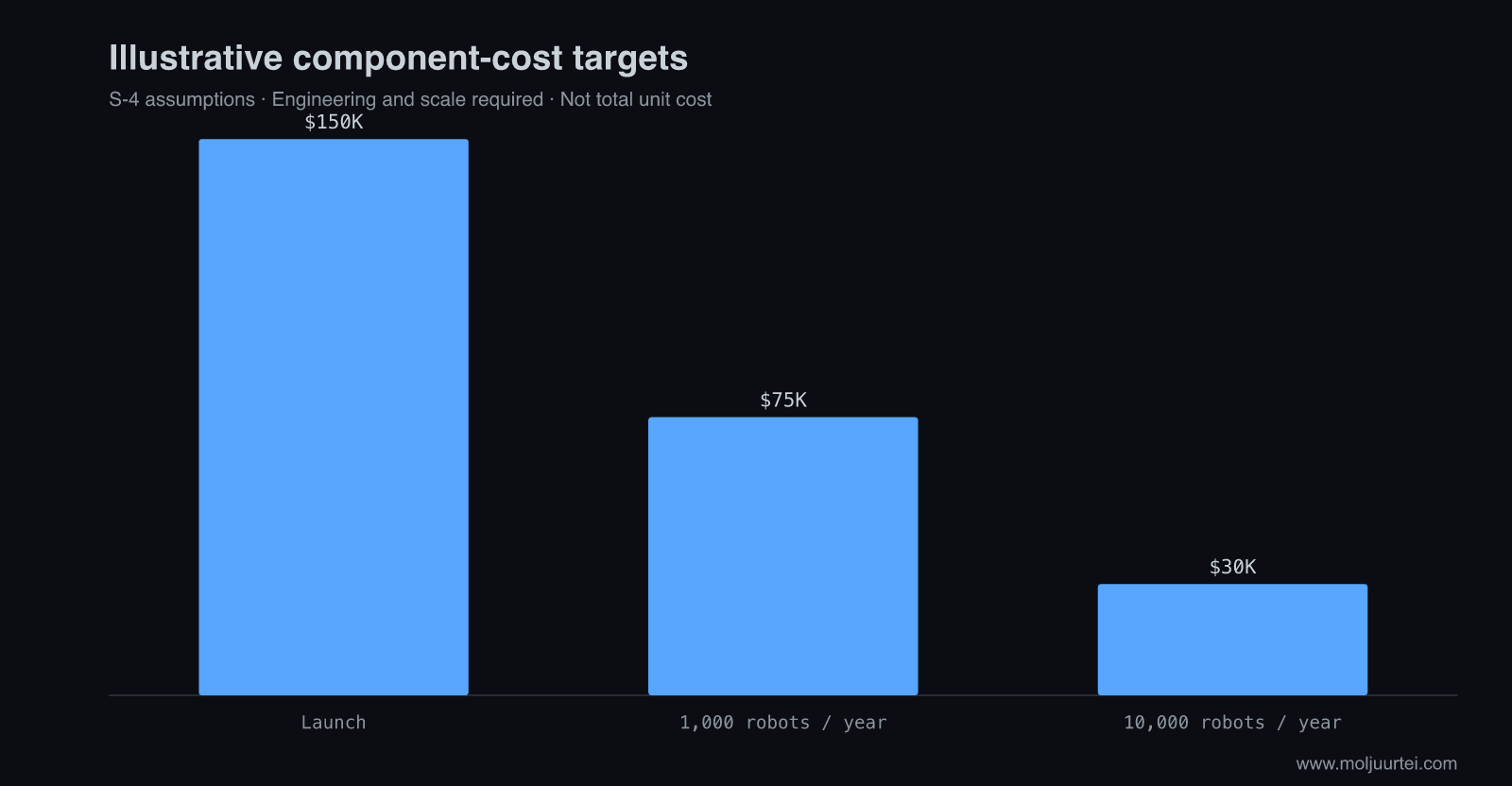
BOM omits assembly labor, freight, overhead, depreciation and reserves. The Robotics CFO’s estimate divides roughly $4.5M FY25 cost of goods by an assumed eight to ten robots, implying about $450,000–$562,500 per robot. It is a rough inference from development-stage accounts, not a disclosed mature unit cost; the denominator and cost allocation are uncertain. Launch economics can remain weak even as component costs fall. A $102,000 annual rental against a $150,000 BOM creates an upfront financing need, but does not by itself prove a short useful life or an insolvent fleet. Foxconn’s investment and possible manufacturing collaboration are relevant; exploratory engagement is not a signed outsourcing solution.
The research agenda after safety is manipulation. Diez is explicit that Digit 5 is meant to move from bulk material handling to "more dexterous manipulation and manipulation of smaller objects," kitting and sorting, because that is what the early customers are asking for next. The flange, the tool-changing demonstrations in the lab, and the Fremont hub, which exists to teach skills faster, are that roadmap. Agility will never put Digit on a stage to dance, Diez says, and the product decisions bear him out; the trade is that it will also never lead a demo reel.
The Setup — Why It's Mispriced
The argument that the stock is cheap rests on scarcity, and the argument that it is dear rests on the filing. Both are right about different things.
Focused exposure is scarce, not unique access to the entire category. Several large humanoid developers are private; UBTech is listed in Hong Kong and Tesla’s Optimus sits within a diversified company valued at about $1.47T at the latest close. CCXI could become a comparatively direct US-listed expression after closing. The July surge is consistent with thematic demand, but a volume chart cannot establish the identity or reasoning of its buyers. Theme-driven flows can reverse before commercial evidence catches up.
The filing adds three qualifications. First, the $300M-plus order is one three-year customer arrangement, and Note 14 identifies a related-party warrant agreement for 453 warrants per robot if the customer sources at least 1,000 robots. The accounting was still being evaluated; any revenue reduction must follow the final accounting, not be assumed as settled. Second, the March LOI contemplated $2.5B–$3.0B and the signed transaction used $2.5B. An old Agility employee-option strike of $26.31 is on a different share basis and cannot be compared directly with CCXI. Third, the reviewed initial draft does not provide a completed H1 2026 operating comparison. Updated interim financials are needed; this is a limitation of that draft, not a claim that nobody outside the company knows the results.

The S-4 uses about $421M in trust, $201M PIPE financing at $10 and $46M fees, leaving approximately $576M with no redemptions or $155M at maximum redemptions. Its minimum-cash test is before transaction expenses; passing the $200M condition does not mean $200M of spendable cash remains. The July $100M SAFEs have a 75% conversion-price factor and an estimated 1.348M pre-merger Agility shares; apply the merger exchange ratio before comparing with combined shares. PIPE registration is expected within 90 days, but registration does not prove immediate selling. Holder lockups and early-release price tests have timing and other conditions; today’s quote does not unlock pre-close shares. The sponsor’s 13.8M founder shares cost $25,000; the total sponsor line in the basic closing table is 14.3M including private-placement shares.
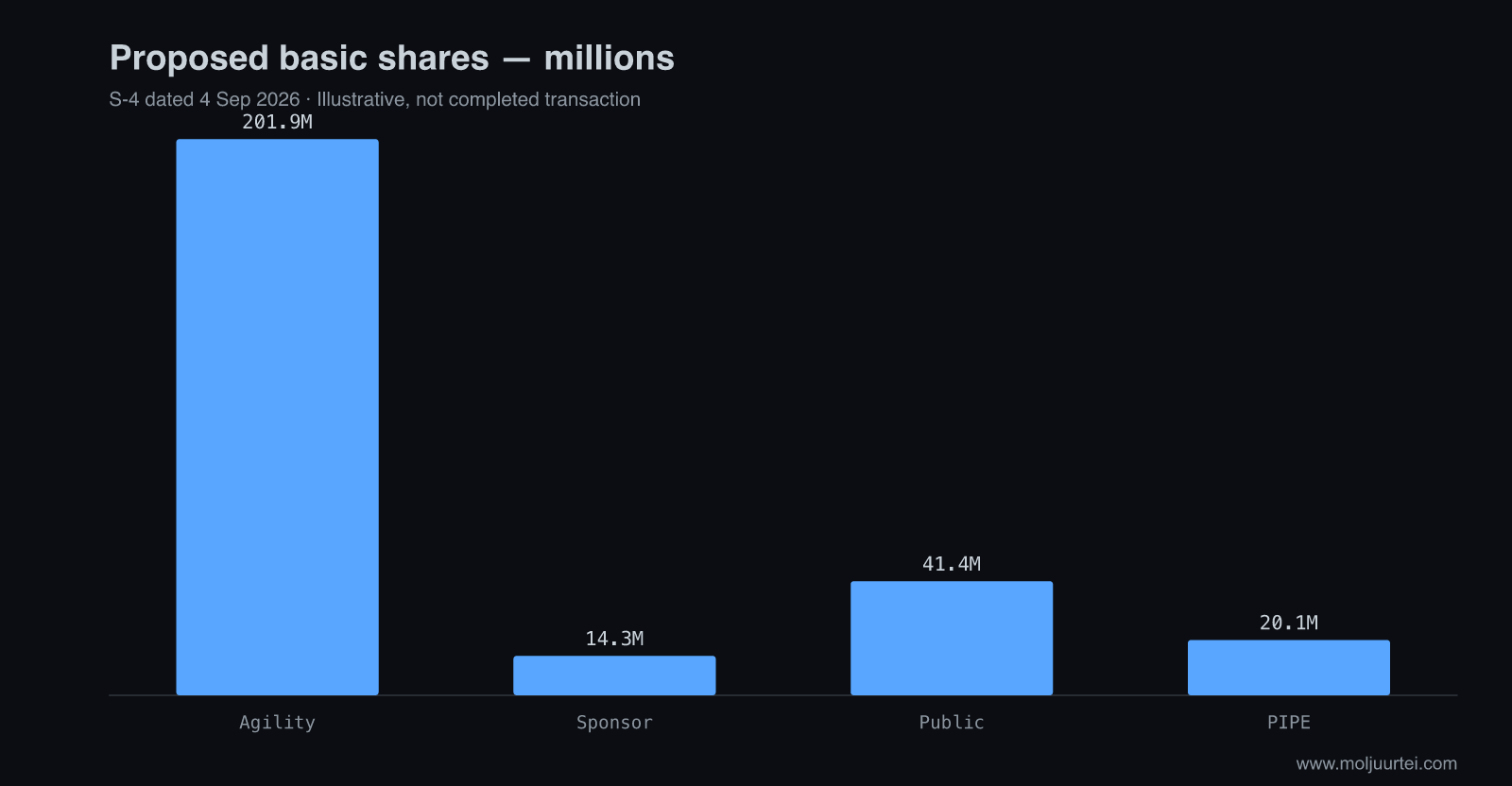
At $12.43, the market is paying for potential safety-enabled growth through a liquid transaction vehicle. Updated financials, repeat customers and unit costs can turn that possibility into a stronger thesis. A move to the dated $10.16 trust reference would be −18.3%, not the 22.3% premium calculated with trust as denominator. Redemption rights have deadlines and conditions and generally disappear after the merger, when the stock can trade below the old trust value.
Management & Track Record
Peggy Johnson spent twenty-four years at Qualcomm, ending as president of global market development, six at Microsoft as executive vice president of business development, where she led the LinkedIn acquisition, and four as chief executive of Magic Leap, a company that raised more than $3 billion for a consumer headset and survived by retreating to enterprise. She joined Agility in March 2024 and has run it as a commercial company: rental over sale, warehouses over homes, "10-plus years" before a humanoid is in a house, and, to TechCrunch, "our biggest competitor right now is just us." Jonathan Hurst, the co-founder and Chief Robot Officer, is the Oregon State professor whose lab produced Cassie; the legs are his, and so is the decision to abandon them. Daniel Diez runs the commercial side and is the source of the clearest thinking in the public record on what actually stops deployments. Michael Beer arrived as chief financial officer on July 23, about six weeks before the filing; Jennifer Hunter moved from finance to chief operating officer.
The capital table is a second management team. Amazon's industrial fund came in at the Series B in April 2022 and again in the Series C; Playground Global co-led every round from seed to B and holds a board seat; Data Collective, SoftBank, $NVDA's venture arm, Schaeffler and Foxconn are on the register; the Series C-3 in June 2025 was struck at $1.985 billion post-money. Foxconn's presence is the one with a plan attached: it deploys UBTech humanoids in its Asian plants and, per its chairman, wants humanoids operating at its Houston server factory. That interest does not establish a blanket legal prohibition on Chinese-built robots. Schaeffler's presence is the one with a warning attached: since investing in 2024 it has signed Neura for 4,000 to 6,000 units and Humanoid Inc for 1,000 to 2,000, in firmer language than it has ever used about Digit, and its own annual report lists four humanoid partners.
Klein’s sponsorship record is mixed and is a governance comparison, not a current-price chart. The original memo contrasted thematic rallies in $OKLO and $INFQ with poor outcomes in MultiPlan, $LCID, $CLVT and $SKIL, three liquidations and the cancelled PlusAI transaction. Those historical share-price marks are removed from the refreshed valuation comparison because dates, reverse splits and corporate actions make raw comparisons with $10 misleading. The enduring issue is incentive asymmetry: low-cost founder shares can retain substantial value when public buyers lose money. Prior winners do not validate Agility’s technology; prior losers do not establish that this transaction must fail.
Risks & What Breaks It
Safety validation and delivery may slip. Early access in H1 2027 and general availability by end-2027 require engineering, manufacturing and application-specific safety work. ANSI/A3 TR R15.108 and ISO 25785-1 are developing standards work, not certification bodies awarding approval to Digit. The 800-deployment figure is an illustrative planning assumption, not a guaranteed shipment schedule. A twelve-month delay can reduce revenue, postpone cost improvements and increase funding needs together.
The order is thinner than the headline. One customer, related party, milestone-gated, paid partly in warrants, accounting undecided, customer unnamed. Agility says it has thirty-plus other customers in the pipeline, and the four paid acceleration-program signatures are real, but the $300 million is a single dependency until the amended filing says otherwise.
The unit cost does not fall on schedule. The bill of materials falls with volume and the volume depends on the certification; the all-in cost in 2025 was several times the bill of materials; the rental price recovers two-thirds of the materials cost a year on a fleet Agility must finance itself. If deployments run behind the illustrative schedule, the cruel loop Kirstein describes, no margin without volume and no cash for volume without margin, is the 2028 story.
The anchor customers are not exclusive. $GXO is piloting five humanoid vendors and its chief executive wants hands; Schaeffler has signed two others with unit counts; Amazon backs Fauna and Neura as well and runs more than a million wheeled robots of its own. Digit's edge is hours in the building, not a contract that keeps others out.
Capital structure can dilute returns. About 20.1M PIPE shares were subscribed at $10, without the same lockup as existing holders; registration can create selling capacity but not certain sales. Founder economics and assumed options/warrants add dilution. Redemption remains an uncertainty even above trust, because prices and holders’ decisions can change before the deadline. Maximum redemptions can satisfy the gross cash condition while leaving only roughly $155M after fees in the filing’s illustration.
Supply-chain risk includes tariffs, magnets, component availability and execution at new volumes. The filing says about 75% of components are sourced from US suppliers; that does not guarantee every upstream material is domestic or immune to trade disruption. Policy support for US manufacturing can help demand while higher input costs hurt margins. A blanket claim that Chinese-built robots cannot legally operate in a US factory is not supported by the evidence reviewed and is not used in the thesis.
Price Setup — Levels, Technicals & Options
The 25 September close is $12.43 versus $12.23 previously. The simple 20-, 50- and 100-day averages are $12.90, $14.19 and $13.08, all above price. There is not yet a full 200-session history, so no 200-day average is shown. July’s $19.10 high and the original memo’s $11.83 post-announcement low remain dated reference levels; the refreshed chart supersedes the old volume-profile mark. Neither a chart low nor the June-30 $10.16 redemption estimate guarantees an executable exit or post-merger floor.
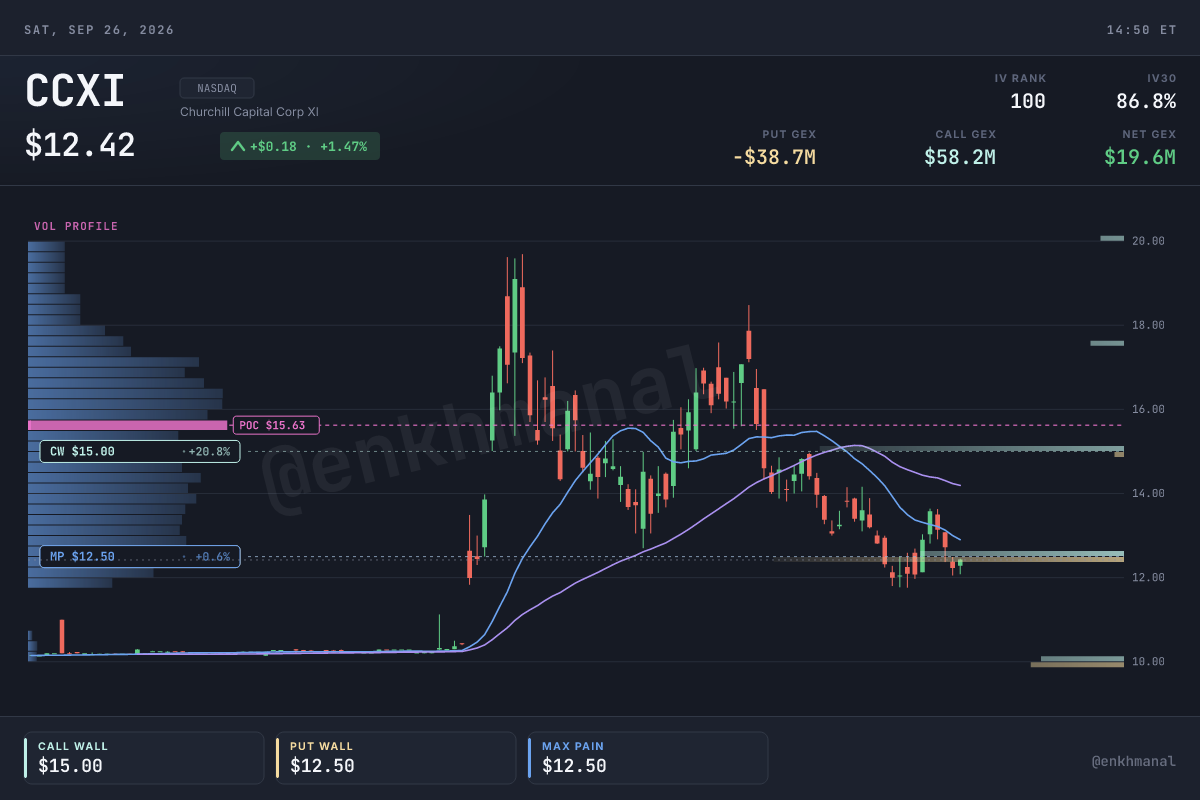
The 26 September options snapshot uses $12.42 and eight expirations: net GEX about +$19.6M, call wall $15, put wall and max pain $12.50, put/call open interest 0.42. The spot-dependent gamma-flip calculation found no crossing; a strike-profile crossing at $15 is a different statistic. IV is 86.84%, implying a rough 30-day move of ±24.9%, or $3.10, under square-root-of-time scaling. Only seven days of IV history exist, so the reported 100 rank is not a meaningful long-run percentile. The chain is young and concentrated; the proxy does not reveal actual dealer positions or guarantee a $12.50–$15 trading range.
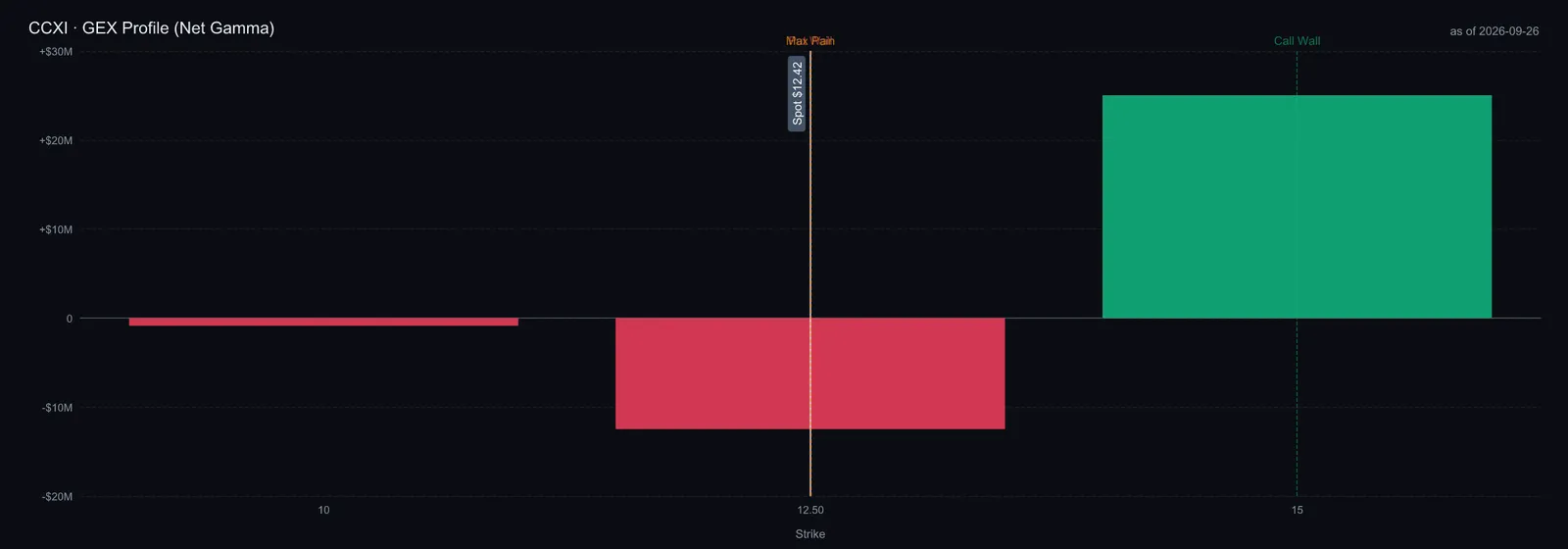
The next confirmed public milestone is Investor Day on 6 October at 12:30 p.m. ET; the announced 29 September Evercore appearance is another opportunity for commentary. Updated interim statements, the vote date and closing terms still need monitoring. Q4 closing and the proposed AGLT ticker remain conditional. Digit 5 early access is formally targeted for H1 2027, with general availability by end-2027. Lockup expiries should be calculated from actual closing and the final terms, not a presumed mid-2027 date.
Valuation & House View
At $12.43 and 277.697M basic no-redemption shares, proposed combined equity value is $3.452B. Subtracting the sources-and-uses estimate of $576M net cash gives a simplified $2.876B EV, before any other debt/cash adjustments. The approximate 336.3M expanded share count gives $4.180B equity value before exercise proceeds. The former $574M estimate came from the earlier deal presentation. These are different share/cash conventions, not the SPAC quote service’s market cap. FY25 revenue is too early-stage to make a current sales multiple a useful central lens. The June-23 Ocean Tomo fairness analysis used an 18% discount rate and projections to 2040, with an approximate $1.7B–$7.3B EV range and $3.8B average; cited per-share cases were $15.85, $13.73 and $12.91. Those are dated transaction opinions with their own assumptions, not refreshed price targets or a guarantee that CCXI is undervalued.
Table terminology: EBITDA.
Illustrative twelve-month scenarios retain the original $22/$13/$9 targets and 25%/45%/30% weights; returns are recalculated from $12.43. They are judgmental scenarios, not a newly built discounted-cash-flow model.
The exact weighted scenario value is $14.05, or +13.0% from $12.43 over twelve months. It is a future scenario average, not present intrinsic value or an expected return guaranteed by probabilities. The technology and commercial milestones create an opportunity before revenue is mature, but the dispersion is wide and dilution can change per-share outcomes. The corrected funding and unit-economics reading is more important than the modest change in the weighted upside.
Keep CCXI on the research watchlist for safety-enabled industrial labor. Evidence that would justify greater conviction is validated shared-space work, arm’s-length repeat customers, transparent interim cash use and an achievable manufacturing cost path. Waiting for every metric to mature could miss early category adoption; acting before these milestones risks funding a demonstration rather than a scalable business. The next decision should follow the Investor Day and updated filings, with price and dilution assessed together. The old trust value is not the post-merger downside case.